transformations within global value chain
typology
著者
Inomata Satoshi
権利
Copyrights 日本貿易振興機構(ジェトロ)アジア
経済研究所 / Institute of Developing
Economies, Japan External Trade Organization
(IDE-JETRO) http://www.ide.go.jp
journal or
publication title
IDE Discussion Paper
volume
682
year
2017-12
INSTITUTE OF DEVELOPING ECONOMIES
IDE Discussion Papers are preliminary materials circulated
to stimulate discussions and critical comments
Keywords: global value chain (GVC), technology, platform
JEL classification: F23, L14, L23, L62, L63, O14, O33
*
Chief Senior Researcher, Inter-disciplinary Studies CenterIDE DISCUSSION PAPER No. 682
Impact of new technologies on the
organization of global value chains (1):
dynamic transformations within global
value chain typology
Satoshi Inomata* December 2017
Abstract
This paper is one of two articles that consider the impact of new technologies on the organization of global value chains (GVCs). The current paper considers value chains in two representative industries, namely, the automotive industry and electronic equipment industry, and the other forthcoming paper will examine the apparel industry and material processing industry. The study draws on the analytical framework developed by Gereffi et al. (2005), who presented a GVC typology and mechanism of value chain transformation.
The Institute of Developing Economies (IDE) is a semigovernmental, nonpartisan,
nonprofit research institute, founded in 1958. The Institute merged with the Japan
External Trade Organization (JETRO) on July 1, 1998.
The Institute conducts basic and
comprehensive studies on economic and related affairs in all developing countries and
regions, including Asia, the Middle East, Africa, Latin America, Oceania, and Eastern
Europe.
The views expressed in this publication are those of the author(s). Publication does not imply endorsement by the Institute of Developing Economies of any of the views expressed within.
INSTITUTE OF DEVELOPING ECONOMIES (IDE), JETRO 3-2-2, WAKABA,MIHAMA-KU,CHIBA-SHI
CHIBA 261-8545, JAPAN
©2017 by Institute of Developing Economies, JETRO
No part of this publication may be reproduced without the prior permission of the
IDE-JETRO.
Impact of new technologies on the organization of global value chains (1):
dynamic transformations within global value chain typology
Satoshi Inomata1
1. Introduction
This paper is one of two articles that consider the impact of new technologies on the organization of global value chains (GVCs). The current paper considers value chains in two representative industries, namely, the automotive industry and electronic equipment industry, and the other forthcoming paper will examine the apparel industry and material processing industry. The study draws on the analytical framework developed by Gereffi et al. (2005), who presented a GVC typology and mechanism of value chain transformation.
The paper is organized as follows. The next section illustrates the main features of Gereffi et al. (2005)’s analytical framework. Then, some generic references to industries are presented in terms of the GVC typology introduced in the preceding section. This is followed by two case studies: one on the automotive industry and the other on the electronic equipment industry, both of which consider the impact of technological progress on these industries’ value chains along with the implications for economic development by emerging economies. The final section concludes.
2. Typology of GVCs2
The main objective of GVC studies is to explore the interplay between value distribution mechanisms and the organization of the cross-border production– consumption nexus. The GVC concept was first collectively framed in discussions by the Global Value Chains Initiative (2000–2005), sponsored by the Rockefeller Foundation,3
and further crystallized by Gereffi et al. (2005), whose analytical focus centered on the governance structures for organizing international production networks. Who are the players in the game? What are the rules? Is it a competitive or a cooperative play? What
1 Chief Senior Researcher, Institute of Developing Economies, JETRO. 2 This section is entirely reconstructed using the text from Inomata (2017). 3 See Gereffi and Kaplinsky (2001).
generates the winning opportunities? In answering these questions, GVC studies pay attention to the forms of transactions, codified or otherwise, among stakeholders. This is because the way transactions are made reflects the structure of power relations between the parties, which ultimately determines the scope and magnitude of value distributions within the game.
Traditionally, the issue of GVC governance has been considered in relation to the choice between two extreme forms of value chain arrangements: vertical integration (i.e., foreign direct investment) and arm’s-length offshoring. Vertical integration assumes a hierarchical structure with absolute and unidirectional control by the parent company over its subsidiaries. The activities and performance of subsidiaries are strictly monitored and assessed in line with their headquarters’ management strategies. In contrast, arm’s-length transaction options tend to generate leveled relationships between clients (buyers) and subcontractors (service suppliers), and power is exercised more or less mutually, unlike in the vertical integration arrangement.
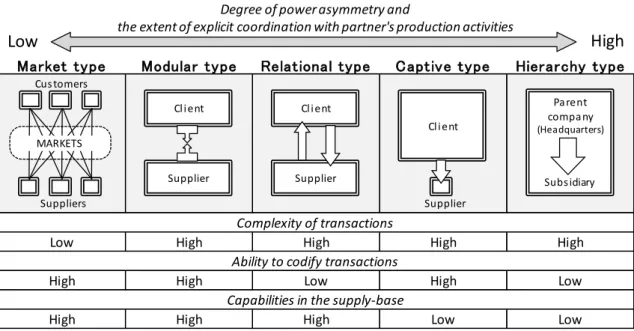
Within this dichotomy, Gereffi et al. (2005) set out a GVC typology in a higher-resolution spectrum in accordance with power relations between the contracting parties. Figure 1 illustrates five variants of GVC governance. Rectangles represent a firm’s boundary, and their size indicates the strength of that firm’s bargaining power in relation to the other party. Arrows indicate the direction and extent of business intervention in partners’ activities. These can range from supportive, such as creating “win–win” scenarios from a long-term perspective, or predatory, by focusing on quick profit in the short run. Toward the right of the diagram, clients (headquarters, in the case of the “hierarchy” type) possess greater bargaining power and so are considered to exert a strong influence over the distribution of value added.
Market-type global value chain
Producing a commodity of a generic nature does not require any specific investment in production facilities for a particular transaction, giving both customers and suppliers countless choices for alternative partners. Customers and suppliers are connected mainly through open spot-market transactions in a shoulder-to-shoulder relationship. In addition, the procurement of a generic commodity will not necessitate an exchange of detailed product specification between contractors because the key information is mostly reduced to a preset product price available in a book of catalogs. The transaction cost for changing business partners is almost negligible, leaving value chains in a constant state of flux because of their high price elasticity.
Modular-type global value chain
In business management or industrial engineering, the word “module” generally refers to a composite of subcomponents grouped by types of functions they assume in the final product.4 The possibility of different combinations of differentiated modules
enables producers to design multiple variants of one product. Similarly, if a complex transaction can be accommodated in the supply base by adjusting the combination of multipurpose equipment, the supplier will not incur transaction-specific investment (no hold-up problem) and is thus able to spread the equipment’s use across a wide range of potential clients. Even though the information to be exchanged between contractors may be considerable (say, for producing a complex product), the relative codifiability of transactions, as presumed in this type of GVC governance, compresses the volume of interventions, allowing the supplier to take overall control of its own production process. This implies that the transaction cost for changing business partners remains relatively low.
Relational-type global value chain
When a manufacturing process involves specialized equipment (for example, the mold for a particular shape of product), transactions become asset-specific, and contracting parties can become mutually dependent. Specific purpose equipment has limited scope for alternative uses, so its productivity will drop considerably when it is applied in other contexts. Accordingly, service suppliers (holders of the specialized equipment) are not motivated to look for other potential clients. However, it is also difficult, or at least costly, for the client to expect the same level of performance from alternate suppliers who lack these specialized facilities. As a result, both parties have little incentive to search for alternative business relations. Further, reinvestment in the specialized equipment to raise productivity increases the asset-specificity of the transaction, thus trapping the parties in even deeper mutually dependent relationships. Captive-type global value chain
This type of transaction assumes an overwhelming disparity in power among parties, as seen in the business relations between a lead firm of global brands and its subcontracting local small companies. Service suppliers are expected to follow the client’s instructions impeccably and are subject to strict surveillance regarding product quality
4 For example, a modular car may consist of a power-management module (a composite of compressors
and charge controls), a drive-assisting module (a composite of sensors, cameras, and light emitting diodes), and so on.
and delivery times. Unlike suppliers in the market-type GVC, captive service suppliers have neither sufficient productive capacity to enjoy the scale of mass production nor the specialized production facilities needed to claim its uniqueness, as attributed to the suppliers in the relational-type GVC. Access to only mediocre production capability greatly narrows their opportunities to look for alternative business relations, imposing a captive position vis à vis their clients.
Hierarchy-type global value chain
As stated earlier, this type of GVC generally refers to the relations within a vertically integrated firm, such as those found in multinational corporations.
Gereffi et al. (2005) also considered the dynamics of GVC configuration by factoring out three parameters: complexity of transactions, ability to codify transactions, and capabilities in the supply base (known as the 3Cs model—Complexity, Codifiability, and Capabilities). For example, a shift in value chain type from market to relational is associated with an increase in transaction complexity. A shift from relational to modular assumes an increased ability to codify transactions. Improving capabilities in the supply base, other things equal, drives value chains from the captive type toward the market type.
Figure 1 Typology of global value chains
Source: Author’s drawings based on Gereffi et al. (2005).
Capabilities in the supply-base
High High High Low Low
Ability to codify transactions
High High Low High Low
Complexity of transactions
Low High High High High
Hierarchy type Captive type Relational type Modular type Market type Cl i ent Supplier Cl i ent Supplier Cl i ent Supplier Pa rent compa ny (Headquarters) Subs idiary Suppliers Cus tomers MARKETS
Degree of power asymmetry and
the extent of explicit coordination with partner's production activities
3. Reference to industries for respective GVC types
The GVC typology introduced here is to some extent associated with specific industries according to that industry’s product attributes, such as technological characteristics or market trends.5
The hierarchy type can be typically represented by the automotive industry. A car is a product of an extremely complex system containing over 15,000 different types of parts, among which the key components are often design-specific and difficult to substitute. In the assembly stage, the parts must be carefully aligned with one another in harmony. For example, the “computerization” of modern cars has increased the risk that the air conditioning system will adversely interfere with electronic-intensive modules, which need to be located nearby within a narrow space between the engine and instrument panel. Facing such risks, car production requires holistic and systematic coordination of every aspect of the production processes from start to finish, which makes governance of this value chains highly prone toward vertical integration.
An example of the captive-type value chain is the apparel industry. Both the input materials (fabrics) and final products (clothes) weigh little and can be stored compactly, which makes them quite suitable for packaging and shipping. Accordingly, offshoring production arrangements progressed in the industry from a relatively early age, under tight and unidirectional control of the production processes by global lead firms.
The offshored tasks are generally labor-intensive and low-skilled, such as cutting and sewing, and hence are moved from country to country in search of the least costly labor force: Japan in the 1950s–1960s, East Asian newly industrialized economies in the 1970s–1980s, and China in the 1990s. With wage levels rising in China in recent years, these tasks are now offshored further to less-developed economies such as Myanmar and Bangladesh.6
In the preceding section, molds were cited as an example of asset-specific equipment, which is a key attribute of relational-type value chains. It should then seem natural to consider that value chains in the material processing industry, such as metal stamping or plastic molding, are categorized as this type.
5 Note that this GVC typology is neither exhaustive nor exclusive; some types of value chains do not fit
into any of these five categories, and furthermore, these categories may overlap for certain aspects of value chains. Also, we may observe differing GVC types for the same industry across different countries and different periods. The reference to industries presented here is for the sake of illustrating the principal ideas.
6 However, a recent trend is toward an increase in “full-package” outsourcing, in which the designing
Furthermore, transaction specificity can be considered from a spatial perspective. When the product in concern is not suitable for physical delivery, the product supplier is likely to locate production facilities near the client’s venue, which ties the supplier to this specific transactional relation with the client. For example, as television display increase in size it became increasingly difficult to deliver glass panel substrates between factories. Sharp’s production of liquid-crystal panel displays may represent such a case because the company’s parts suppliers have clustered in the district of Kameyama. Although the district’s proximity to Sharp’s research and development center (in the city of Tenri) and the local government’s industrial promotion scheme have undoubtedly served as incentives for industrial agglomeration, the aforementioned difficulty and risk of product delivery might also have influenced the suppliers’ choice of location.
The electronic equipment industry is typically considered as having a modular-type value chain. From its emergence, the industry has had close links with the development of military technology; hence, the standardization of its major product lines was advanced under the strong military influence. Product standardization was further facilitated by the introduction of computer-aided design systems, which allowed information on product designs and specifications to be digitized and stored for repeated use in the industry.
In addition, the Information Technology Agreement, a high-level plurilateral free-trade agreement, was adopted by many countries including emerging economies, and thus became another important driver of standardization and modularization of the industry’s value chains.
4. Technological innovation and value chain dynamics
Developing countries are increasingly recognizing that participation in GVCs is an important kick-start to economic development. At the same time, however, they are also worried that the prospect for upgrading value chains is limited because their production activities are considered to be “locked-in” to the lower value-added segment of global production networks.
In the discussion that follows, we present two cases where technological progress triggered a dynamic transformation of value chains from one type to another, with a particular focus on growth opportunities for emerging companies in developing countries.
4.1 Automotive industry: Modularization of cars
Section 3 introduced the automotive industry as a typical example of hierarchy-type value chains because its industrial organization is highly prone to vertical integration given the complexity of its production arrangements. Car manufacturers find it quite difficult to outsource the production of key components because of potential interactions with other parts during integration processes.
However, recent developments in architectural design schemes have spurred changes. In 2013, Nissan introduced a design scheme called the “common module family” into the production lines of 14 models. The scheme’s objective is to reconfigure the production system so as to reduce costs yet also maintain the variety of product lines. This is pursued through the modularization of products, which increases the proportion of standardized common components that can be shared among different models while leveraging scale merits through bulk purchases of common inputs.
Even before the introduction of Nissan’s scheme, Volkswagen devised the “modular transverse matrix platform” to develop a wide range of different products and implemented it for the production of standard models such as Golf as well as luxury cars such as Audi. Toyota later adopted the “Toyota new global architecture” for Prius in 2015, while Hyundai Motors, aided by its fully-automated assembly system, engaged in the large-scale outsourcing of its main car components, including the cockpit and chassis (Nikkei Business, 2013).
Further, the implementation of modularization schemes can also be found in developing countries. As described earlier, a “module” generally refers to a composite of subcomponents grouped by type of function assumed in the final product. Each module has a high degree of functional autonomy (namely, the mutual interference between modules is small), while the standardized architecture of its interface makes it easy to combine multiple modules. Accordingly, the modularization of a complex product simplifies its manufacturing processes by compressing knowledge-intensive segments of production (such as harmonization of car components).
This has had a strong side-effect of lowering technological barriers to market entry. According to Oshika et al. (2009), Shenyang Aerospace Mitsubishi Motors China, for example, ran a joint business with a U.S. auto-parts supplier Delphi of selling core system components (such as engines and transmissions) mainly to local auto manufacturers in China such that the components were pre-adjusted to the specifications of client’s individual products (i.e., cars). Engines and transmission systems are generally considered far too important to outsource because the requirement for relevant parts harmonization is substantial. However, digital
technology makes it now possible to codify the harmonization expertise and encapsulate it in a chip as a set of digital information, whereby potential conflicts among parts arising from variations in car bodies can be mediated through a mere parameter adjustment of electronic control units (ECUs).7
This suggest that even those without top technology can enter the automotive market simply by obtaining the said “knowledge capsule” of ECUs. The advancement of modularization has accelerated structural change in the automotive industry, from a vertically integrated production system to that of value chains in a more open environment, which has provided wide opportunities for emerging companies in developing countries to join the arena.8
In reference to the 3Cs model of Gereffi et al. (2005), the gradual transformation of the automotive industry’s value chains from the hierarchical-type to modular-type was driven by an increased ability to codify transactions for individual tasks along production processes as a consequence of product modularization. The well-known theories of Vernon’s “product life-cycle” and Akamatsu’s “flying geese” depict a process in which technologies originating in advanced economies become obsolete and are passed on to less-developed countries, thereby promoting their economic development. The progress of modularization accelerates such technological spillovers, yet in a different form, namely, the technological catch-up and restructuring occur at the “task level” such as design, fabrication, assembly, and marketing, rather than the industry level as traditionally envisaged in classical theories.
4.2 Electronic equipment industry: Impact of “platform leaders”
The electronic equipment industry covers a wide range of products, from personal computers (PCs) to mobile communication devices. Traditionally, the industry’s supply chains have been governed by final consumer goods manufacturers such as Apple, Hewlett-Packard, Toshiba, NEC, and Samsung, who organized and presided over their own GVC networks, which could take the form of several types. The most dominant GVC configuration is the modular type, yet other types of value chains are also observed
7 Shenyang Aerospace Mitsubishi Motors designed engines and transmissions, and then Delphi took
charge of ECU adjustment in order to customize these system components according to the individual designs of clients’ vehicles (Oshika et al. 2009).
8 The modularization of car architecture has also invited new entrants from other industries.
Panasonic’s subsidiary Automotive & Industrial Systems develops system component packages in three areas: cockpit systems (displays, gauges, and car navigation devices); drive-assist systems (sensors, cameras, and LEDs); and power management systems (compressors and charge controls). Panasonic’s technological know-how from manufacturing electrical equipment is fully applied to and embodied in the car production schemes. (Nikkei Business, 2013.)
depending on the nature of outsourcing activities; for example, the market type for generic parts procurement, relational type for the supply of product-specific components, and, at the end of the manufacturing processes, the captive type for the final assembling stage. Given the variety of GVC types throughout the entire supply-chain spectrum, the industry is often associated with a smooth U-shaped graph to represent the relationship between production process and value added, i.e., a so-called the “smiley curve.”
Recently, such an industrial profile was increasingly destabilized by the emergence of a new player called “platform leaders.” Here, “platform” is defined as “a set of common components, modules, or parts from which a stream of derivative products can be efficiently created and launched” by “constraining the linkages among the other components” (Baldwin and Woodard, 2009). A large-scale integrated circuit, which often determines the performance level of the product in which it is embedded, provides a good example. Platform leaders develop platforms and facilitate an industry’s technological progress. In this process, a platform imposes structural constraints on the design and specification of other auxiliary components because the platform ultimately governs the final product’s functions and performance. Given such a relationship, platform leaders maneuver other parts suppliers into producing complementary products whose designs are highly subordinate to the platform’s interface specification while completely black-boxing the interior of the platform module itself. As a result, platform leaders acquired an overwhelming power to influence the way that supply chains are organized in the industry.
Platforms can be found in various industries, from consumer electronics such as LCD TVs to special industrial machinery such as numerically controlled machine tools. In the PC industry, the most prominent example is “Win-tel,” which comes from Microsoft’s operating system Windows and chip designer/vender Intel.
In recent years, platform leaders have also emerged in developing countries. Particularly notable is the increasing presence of MediaTek and Spreadtrum in China’s mobile phone components market. Shiu and Imai (2009) argue that these companies have boosted their influence in the industry by devising a unique marketing strategy. Alongside the production and sales of chips, they also offered an assembly blueprint for mobile phone terminals as a set package. The blueprint provided a thorough how-to guideline for producing mobile phones that embody their chips, such as the layout of parts configuration and electrical wiring, and even included a list of recommended parts suppliers.
According to Shiu and Imai (2009), sales promotion through blueprint packaging is known to have originated in the business model of US/European chip vendors who sought
marketing opportunities in China. However, the production guidelines in their blueprints covered only basic aspects of terminal assembly. Lacking detailed explanations, these blueprints were not sufficiently user-friendly for Chinese manufacturers with limited experience in the production of high-tech equipment like mobile phones.
In contrast, Taiwanese MediaTek provided full guidelines for every aspect of assembly tasks, even covering multimedia functions for music/video playback, and offered a package with a considerably cheaper license fee than those of US/European rivals. As a result, Chinese manufacturers gained opportunities to produce low-cost yet highly appealing products for local consumers.9
Effective functioning of platforms assumes the modularization of final products’ architecture because a platform is a complete module on its own that does not require surrounding components to have any product-specific attributes except those regarding connection. Accordingly, any parts suppliers who have adopted the platform’s interface can enter the market.
Correspondingly, this tends to invite a massive entry of producers into the industry, leading to an excessive supply of homogeneous products and price competition. In the case of China’s mobile phone industry, product homogenization became increasingly evident after the introduction of MediaTek’s chipsets into the parts market. Although the “turn-key” solution of MediaTek’s chipsets was highly attractive for local manufacturers, it also became difficult for them to differentiate their final products through own in-house elaboration of the chipset because MediaTek did not disclose its software source code.
Around 2004, China experienced an observable excess supply of mobile phone terminals. In order to capture consumers’ attention, local manufacturers rushed to introduce multiple models with very similar functionalities. The market was flooded with undifferentiated products, and the industry’s profitability significantly declined. The emergence of two platform leaders in China’s chip market, first MediaTek and then Spreadtrum, provided local manufacturers with the opportunities to produce high-tech mobile phone terminals, but also induced the side-effect of rapid commoditization of the industry. Commoditization of mobile phones into undifferentiated products significantly lowered the complexity of transactions between parties, and thereby transformed the industry’s value chains from the modular type to the market type.
9 In the period between the advances of US/European chip vendors and emergence of MediaTek in the
Chinese mobile phone industry, the “Design House” group sold design blueprints to local manufacturers. They provided various supporting services for using chipsets of US/European venders in mobile phone terminals, such as software development and model design. See Shiu and Imai (2010).
Do emerging firms in developing countries have any chance to avoid such excessive competition and maintain or even upgrade their value chains? Based on detailed literature reviews and collections of interviews with stakeholders, Kawakami (2012) demonstrated how emerging companies from Taiwan succeeded in promoting their position in the notebook PC industry through continuous interactions with the prominent platform leader, Intel.
Up until the first half of the 1990s, the notebook PC industry was dominated by several top Japanese companies, such as Toshiba and NEC. In the mid-1990s, Intel, who supplied central processing units used in these notebook PCs, launched the aforementioned platform strategy. Introduction of a strong platform with a highly standardized interface lowered technological barriers which prevented emerging manufacturers from entering the PC market. The movement was accelerated when Intel released the “Centrino” series in 2003, and, along with the anticipated emergence of product homogenization and price competition, the aforementioned Japanese companies significantly lost their positions in the notebook PC industry.
In contrast, PC manufacturers from Taiwan chased growth opportunities during this period of structural change in the industry. They tactically utilized multiple supply networks with various branded firms from advanced economies to learn about market trends and product development. Alongside the relocation of production bases to mainland China, they successfully promoted their production capacities and upgraded their company profiles from mere subcontracting manufacturers to actual providers of various value-adding services such as product design and logistics.
5. Conclusion
A core subject of the GVC literature is the relationship between globalization and economic development. As often suggested by the aforementioned “smiley curve,” less-developed countries are increasingly worried that their economies will be “locked-in” to the lower value-added segment of the global production system.
However, it is also recognized that entering GVC can offer less-developed countries a rich opportunity for industrial upgrading through dynamic interactions with advanced economies. The key to such growth is the nature of technology involved in production processes, which ultimately determines the speed and direction of value chain transformation.
This paper investigated the impact of new technologies on the organization of GVCs, with a particular attention paid to the automotive and electronic equipment industries. The study revealed that new features of production technology, such as modularization and platforms, may disrupt the present configuration of value chains and hence raise the possibility of new players entering the arena. The study also demonstrated that such a development scenario requires careful implementation of learning strategies through active interactions with the lead firms from advanced economies, which has important implications for less-developed countries who seek sustainable economic growth through continuous industrial upgrading.
References
Baldwin, C. and J. Woodard (2009), “The Architecture of Platforms: A Unified View,” Working Paper 09-034, Cambridge, MA: Harvard Business School.
Gereffi, G., J. Humphrey, and T. Sturgeon (2005), “The Governance of Global Value Chains,” Review of International Political Economy 12 (1): 78–104.
Gereffi, G., and R. Kaplinsky, eds. (2001), The Value of Value Chains: Spreading the Gains from Globalisation. Special issue of IDS Bulletin, the Institute of Development Studies, Brighton, U.K.
Inomata, S. (2017), “Analytical Frameworks for Global Value Chains: An Overview”, in Global Value Chain Development Report 2017, Chap.1, 15-35, the World Bank Group, Washington D.C. Kawakami, M. (2012), 川上桃子 『圧縮された産業発展 台湾ノートパソコン企業の成長 メカニズム』、2012 年、名古屋大学出版会。 Nikkei Business (2013), 日経ビジネス『特集 部品創世記』、2013 年 7 月 22 日、日本経済 新聞社。 Oshika, T., et al. (2009), 大鹿隆・井上隆一郎・呉在烜・折橋伸哉 「自動車産業:アーキテ クチャ分析によるアジア産業比較」、新宅純二郎・天野倫文編『ものづくりの国際経営戦 略―アジアの産業地理学』, 2009 年、有斐閣。
Shiu, J. and K. Imai (2009), 許經明・今井健一 「携帯電話産業:中国市場にみるアーキテ
クチャと競争構造の変容」、新宅純二郎・天野倫文編『ものづくりの国際経営戦略―アジ
アの産業地理学』, 2009 年、有斐閣。
Shiu, J. and K. Imai (2010), 許經明・今井健一 「携帯電話産業における垂直分業の推進 者:IC メーカーとデザイン・ハウス」丸川知雄, 安本雅典編著 『携帯電話産業の進化