Digital economy and development: an empirical
study on motorcycle driver jobs in Uganda
著者
Inoue Naomi
権利
Copyrights 日本貿易振興機構(ジェトロ)アジア
経済研究所 / Institute of Developing
Economies, Japan External Trade Organization
(IDE-JETRO) http://www.ide.go.jp
journal or
publication title
IDE Discussion Paper
volume
753
year
2019-03
INSTITUTE OF DEVELOPING ECONOMIES
IDE Discussion Papers are preliminary materials circulated to stimulate discussions and critical comments
Keywords: digital economy, gig worker, employability, Uganda, motorcycle taxi driver JEL classification: O3, O35, O55, P31, Q01
* Research Fellow, Economic integration studies group, Development studies center, IDE ([email protected])
IDE DISCUSSION PAPER No. 753
Digital economy and development:
An empirical study on motorcycle
driver jobs in Uganda
Naomi INOUE*
March 2019
Abstract
This study investigates how the digital economy benefits motorcycle taxi drivers in Uganda. It focuses on three motorcycle related businesses connected the digital economy and studies the impact of the digital economy on drivers’ gross profit. The results show that the digital economy directly enhances the financial capability of motorcycle drivers and their work efficiency. Likewise, it indirectly creates greater demand for motorcycle drivers in the market, including for motorcycle taxi drivers connected to motorcycle taxi app platforms and e-commerce motorcycle delivery drivers. Another crucial point for the motorcycle taxi drivers to benefit from the digital economy is the enhancement of their employability skills.
The Institute of Developing Economies (IDE) is a semigovernmental, nonpartisan, nonprofit research institute, founded in 1958. The Institute merged with the Japan External Trade Organization (JETRO) on July 1, 1998. The Institute conducts basic and comprehensive studies on economic and related affairs in all developing countries and regions, including Asia, the Middle East, Africa, Latin America, Oceania, and Eastern Europe.
The views expressed in this publication are those of the author(s). Publication does not imply endorsement by the Institute of Developing Economies of any of the views expressed within.
INSTITUTE OF DEVELOPING ECONOMIES (IDE), JETRO 3-2-2, WAKABA,MIHAMA-KU,CHIBA-SHI
CHIBA 261-8545, JAPAN
©2019 by Institute of Developing Economies, JETRO
No part of this publication may be reproduced without the prior permission of the IDE-JETRO.
1
Digital economy and development:
An empirical study on motorcycle driver jobs in Uganda
Naomi INOUE
#Institute of Developing Economies, Japan
Abstract: This study investigates how the digital economy benefits motorcycle taxi drivers in Uganda. We focus on three motorcycle related businesses connected the digital economy and study the impact of the digital economy on drivers’ gross profit. The results show that the digital economy directly enhances the financial capability of motorcycle drivers and their work efficiency. Likewise, it indirectly creates greater demand for motorcycle drivers in the market, including for motorcycle taxi drivers connected to motorcycle taxi app platforms and e-commerce motorcycle delivery drivers. Another crucial point for the motorcycle taxi drivers to benefit from the digital economy is the enhancement of their employability skills.
Keywords: digital economy, gig worker, employability, Uganda, motorcycle taxi driver JEL classification: O3, O35, O55, P31, Q01
1. Introduction
The development of information and communications technology (ICT) led to the development of the
“the digital economy,” which created jobs in the ICT sector and across the supply chains of ICT-related
services. The ICT boom, along with the fast growth of digital technology provides workers with easier
#
2
access to jobs online. The World Development Report 2016: Digital Dividends (WDR 2016) states that
the number of direct jobs created by digital technologies is fairly modest, but the number enabled by
it can be large (World Bank, 2016).
The “digital economy” is defined broadly as all activities that use digitized data or digital
technologies. Services and goods within the digital economy use online platforms and app-based
platforms. The digital economy also includes the sharing economy, which provides peer-to-peer short
term rental or labor services, such as Airbnb and Uber. The online gig economy enables people to
participate through single projects or tasks called the “gig,” such as delivery services and cleaning
services. The collaborative economy includes services such as lending finance in a broad sense. The
flexible working conditions of the digital economy make it easier for previously underserved
populations to find jobs compared to traditional methods, such as face-to-face interviews.
The digital economy, as an outcome of the development of digital technologies, provides poor
people with opportunities to earn more income; however, it is conditional. The WDR (2016) states that
digital technologies promote the inclusion of poor people in the digital economy if the self-employed
adopt digital technologies that allow them to work through ICT-enabled outsourcing or
entrepreneurship. Thus, the poor can contribute to development, and create opportunities for inclusion,
efficiency, and innovation. However, the report concludes that those who benefit more from digital
technologies are better educated or have stronger IT skills. Additionally, for digital technologies to
3
demands of the digital economy, and accountable institutions should be developed. Others also point
out that the distribution of working opportunities in the digital economy do not benefit underserved
populations mainly due to the lower employment protection for gig workers and skill premiums. The
uneven power relations between workers and global platforms, uneven geographies of digital labor,
and the frictions digital workers face remain to be solved (Graham, Hjorth, & Lehdonvirta, 2017).
How do the digital economy’s benefits spread to poor workers in developing countries? The
contribution of the digital economy to the poor is not substantial, though it has been contributing to
the poor, particularly to workers, in developing countries. China for instance, sees new opportunities
for entrepreneurship and self-employment growing rapidly in the digital economy (World Bank, 2016:
14). We use qualitative data collected from field interviews with about 20 respondents during a field
visit in May 2018 in Uganda to examine the empirical connection between digital gig economy
participation and the rise in earnings of the poor working as motorcycle drivers in Uganda.
Our results support other researchers’ claim that although the digital economy benefits the poor,
the impact is minimal due to workers’ limited digital skills, poor regulations, and weak institutions.
On the other hand, in terms of working opportunities, although there is an unfair distribution of
working opportunities in the global digital economy (Graham et al., 2017), we find that workers are
gaining more working opportunities locally thanks to the expansion of digital technologies and the
digital economy.
4
country? We focus on one notable example of digital workers who utilize digital technology in their
business operations: motorcycle drivers, including motorcycle taxi drivers and motorcycle delivery
drivers in Uganda. Our results suggest that the digital economy brought direct benefits to motorcycle
drivers, and increased the demand for motorcycle drivers, providing motorcycle taxi driver jobs
connected to application-based platform taxi services and e-commerce motorcycle delivery driver jobs.
Another crucial point for the poor to benefit from the digital economy is enhanced employability. Put
simply, both the direct benefit from the innovation brought about by the digital economy together with
enhancing motorcycle drivers’ employability skills are important for them to better their lives through
direct or indirect engagement with the digital economy.
2. Definitions and examples of the digital economy and digital gig economy 2.1 Digital economy
The digital economy is founded in various types of digital technologies, although the digital
economy has no concrete agreed definition as the digital sector, products, and services do not have one
concrete definition. The IMF (2016), in, “Measuring the digital economy” describes the “digital
economy” as sometimes defined narrowly as online platforms, platform-enabled services1 and
1 The IMF report presents Google, Facebook, and Alibaba as examples of online platforms and states, “their
product is incomplete.” It also introduces some definitions: “platform products covered by the CPC include searches, content and media, and e-commerce. But matching services and cloud computing are not covered.” Additionally, the report states that, “we speak of ICT services as a separate category from online platforms. However, they overlap, as the web portals classification within ICT services contains several types of online platforms.” Likewise, the report presents Airbnb as an example of platform-enabled services, but notes that they are not explicitly covered (IMF, 2016: 7).
5
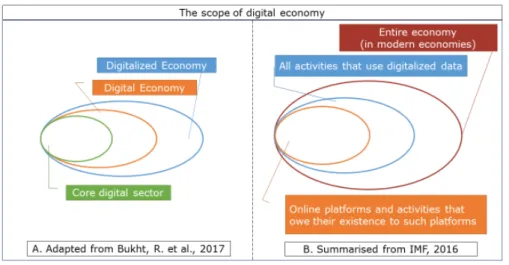
activities that owe their existence to such platforms. Yet, in a broad sense, all activities that use digitized
data are part of the digital economy: in modern economies, the entire economy.
Bukht & Heeks (2017) describe the digital economy as, “that part of economic output derived
solely or primarily from digital technologies with a business model based on digital goods or services”
and identifies three scopes of the digital economy: the digital sector, digital economy, and digitalized
economy. The digital sector deals with core IT or ICT products and services, and specific ICT-related
manufacturing and services. The digital economy includes ICT-enabled businesses such as new digital
business models such as platform-based firms, which have blurred the boundary. Within the extended
digital economic activities by ICT-enabled businesses, many services and goods in the digital economy
use online and app-based platforms. The digitalized economy has a much broader scope that covers all
economic activities associated with digital technologies.
Although the digital economy can cover the broader sense, as Bukht et al., (2017) show in their
three scopes, this study focuses on IMF’s “narrower scope of the digital economy,” which includes the
digital gig economy, platform economy, and sharing economy associated with online platforms,
platform-enabled services, and suppliers of ICT goods and services with which digital gig workers
associate. Figure 1 below shows the scopes of the digital economy according to Bukht et al., (2017)
and the IMF (2016). The narrower scope of the digital economy we refer to as the digital economy is
“online platforms, and activities that owe their existence to such platform” according to the IMF (2016).
6
Online platforms and platform-enabled services include the platform-based economy, such as the
sharing economy, which provides peer-to-peer short term rental or labor services (e.g., Airbnb and
Uber). The collaborative economy, including lending finance, is also a part of the sharing economy
and digital economy in a broad sense.
Figure 1: The scope of the digital economy
A: Source: Adapted from Bukht et al., (2017) and simplified by the author.
B: Source: Author summary of IMF (2016).
Traditional businesses associated with technology platforms are also considered a part of the
digital economy. On the other hand, although many of platforms are based around technology
platforms, not all are so. That is to say, a company changing the staffing system for delivery operations
to a digitized system that hires a piece-by piece basis delivery staff via an online platform is also
7
2.2 Digital gig economy
The digital gig economy belongs within the narrower scope of the digital economy in which workers
find single projects or tasks called “gig work” via online platforms and do work on a task-by-task
contract basis. Gig works include freelancing work, delivery services, ride share services, and cleaning
services. The digital gig economy enables the workforce to participate in the platform-based market
through single projects using online platforms.
Some notable examples of workers in the digital gig economy are delivery passengers of
Deliveroo, Uber drivers, or the taskers of TaskRabbits. The gig economy, in which gig workers find
jobs and work via online platforms, spread widely because technology-based platforms allow users to
find per-job contract work. The tech platform creates dependent contractors that provide a workforce
on a contract basis. This type of work is called “digital gig work” or simply “gig work.” We use the
term digital gig work in this paper. The workers of bike taxi service platforms, such as SafeBoda in
Uganda, also count as digital gig workers.
3. Background
3.1 The danger and benefits for digital gig workers
Digital gig workers face problems such as the lack of job security and fair pay, discrimination in global
transactions, and hard competition in a global market. Gig work is even called “the digital sweatshop”
8
due to the lack of job security and fair pay, gig workers receive fewer benefits,2 lower pay,3 and less
flexibility.4 Additionally, gig workers are socially isolated.5 Another problem is the discrimination in
global transactions. Workers at the global margins face discrimination due to their countries of origin.6
In addition, the oversupply of gig workers in global market lowers workers’ pay and worsens their
condition. The competition in the global market is growing tougher.
The employment status of gig workers is also problematic; gig works and zero-hour contracts
have similarities (Kobie, 2018).7 Both have no grantees. Gig work is not provided under an
employment contract, but on a contract per task. “The Taylor Review of Modern Working Practices,
July 2017” describes that the gig workers are “not an employee, but neither are they genuinely
self-employed.” The report claims that “Ultimately, if it looks and feels like employment, it should have
the status and protection of employment.” Gig workers work as contractors without any guaranteed
payment. They are paid per task, such as for per-piece delivery and do not count as company employees.
In addition, sharing and supplying gig work such as short-term property rental services and providing
a workforce for pay-per-task jobs may be informal, with an unregistered and untaxed status.
The impact of the gig economy on each country is becoming substantial, though the technique
to measure the trade flows is not well developed. The difficulty of measuring transactions associated
2 Gig workers have no employment benefits such as holidays, sick leave, or maternity pay rights. 3 Gig workers receive no decent wage, no guarantees, and no minimum wage.
4 Gig workers must work when the company needs them, and have no choice. 5 Gig workers do not have a labor union or worker association.
6
Gig workers in the global south tend to receive low scores in reputational feedback systems.
7
Nicole Kobie, What is the gig economy and why is it so controversial? (September 14, 2018), WIRED, (https://www.wired.co.uk/article/what-is-the-gig-economy-meaning-definition-why-is-it-called-gig-economy, September 18, 2018).
9
with gig work accurately is another concern among policy makers. Since transactions between service
platforms and customers (users) in the digital economy occur online, they may also be cross-border
transactions. Some experts point out that these transactions are in the digital trade. Moreover, the
significant economic benefits of international flows of data and money should be measured (Fortanier
& Gonzalez, 2017), and such transactions should be taxed.
On the other hand, with the given flexible working conditions, it is easier for previously
underserved populations in the digital economy to find jobs compared to traditional methods such as
through face-to-face interviews. For instance, during a visit in May 2019 to Uganda, we met new
engineering graduates who could not find contract work in the country previously can now find
single-task type contracts; that is, gig work, with an EU based companies using an online platform.
3.2 Examples of digital gig work
A well-known example of digital gig work that uses an online platform as a marketplace where clients
and customers meet is Uber. Uber dramatically changed how people find transportation. A decade ago,
people found taxis at a taxi stand or by calling a taxi company to hire a taxi when they needed
immediate transportation in the middle of a city or town. Now, with Uber on smartphones, people use
an online application to find the most convenient car services. Uber provides digital services to enable
customers to find a car to reach their destinations and enables customers to find the best driver that
10
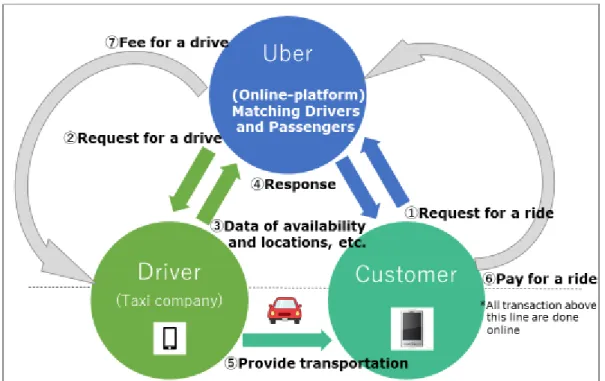
but use drivers’ property to provide transportation services in many countries worldwide. Figure 2
demonstrates a simplified illustration of the concept of matching services that Uber provides to drivers
and customers. First, a customer using the Uber app requests a car ride from place A to place B. Then,
the Uber platform automatically matches a driver and a customer. The driver picks the customer up at
their location, and after arriving at the destination, the customer pays for the ride and provides a score
for the driver. Then, the driver receives the fee from Uber rather than directly from the customer.
Figure 2: Example platform associated with digital gig workers: Uber, simplified model
Source: Developed by author with insight from the UberEATS web site8
We refer to Uber as one of example platform associated with digital gig workers. Many other
platforms enable a workforce and customers to meet online. The transactions of the online matching
11
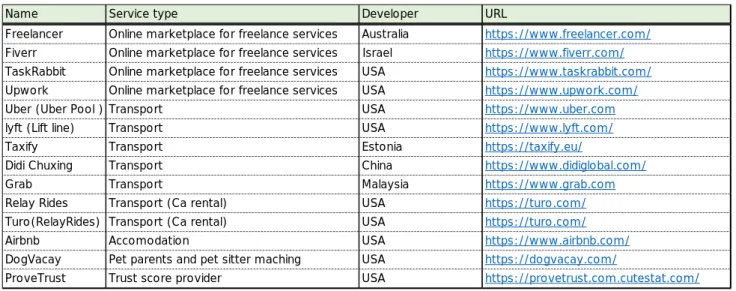
services differ, but all occur through online platforms. The table below lists other examples of these
platforms.
Table 1: Examples of the platforms associated with digital gig workers
Source: By author
3.3 Research question
Our study aims to determine if the digital economy benefits poor workers in developing countries,
though its contribution to the poor is minimal rather than substantial, by looking into how the digital
economy’s benefits spread in Africa. To answer this question, we focus on motorcycle taxi driver
related services in Uganda and empirically compare four related services, including: 1) Boda Boda, a
motorcycle taxi service provider that is popular among citizens in Uganda; 2) Tugende, a financing
service company that allows motorcycle taxi drivers who do not have access to bank loans to own a
motorcycle through lease-type installments; 3) SafeBoda, a web application-based motorcycle taxi
service provider that uses digital technology in its operations; and 4) Pink Tie, a third-party logistics
Name Service type Developer URL
Freelancer Online marketplace for freelance services Australia https://www.freelancer.com/ Fiverr Online marketplace for freelance services Israel https://www.fiverr.com/ TaskRabbit Online marketplace for freelance services USA https://www.taskrabbit.com/ Upwork Online marketplace for freelance services USA https://www.upwork.com/
Uber (Uber Pool ) Transport USA https://www.uber.com
lyft (Lift line) Transport USA https://www.lyft.com/
Taxify Transport Estonia https://taxify.eu/
Didi Chuxing Transport China https://www.didiglobal.com/
Grab Transport Malaysia https://www.grab.com
Relay Rides Transport (Ca rental) USA https://turo.com/ Turo(RelayRides) Transport (Ca rental) USA https://turo.com/
Airbnb Accomodation USA https://www.airbnb.com/
DogVacay Pet parents and pet sitter maching USA https://dogvacay.com/
12 and order fulfillment service provider for e-commerce.
4. Empirical case study on the motorcycle drivers sector
In this part, we first identify the problems that Boda Boda drivers face, and then analyze how the other
three services overcome these problems, the innovations that changed motorcycle drivers’ lives, and
the remaining challenges. Below, we discuss what differentiates each services.
4.1 Overview of Boda Boda
Boda Boda is a motorcycle taxi service in Uganda. The origin of the word is not clearly defined, though
people call motorcycle taxis “Boda Boda” since they can easily transfer people “from border to border”
without any official paperwork. Thus, Boda Boda, a shortened form of “from border to border” became
a common term for motorcycle taxis in Uganda. Boda Boda is popular because it is the easiest and
fastest transportation mode in Uganda, especially in congested cities like Kampala. Therefore, the
demand for Boda Boda is very high. The road conditions in Kampala are particularly bad and create
heavy traffic jams. Boda Boda is the most convenient way to avoid traffic. Motorcycle taxis like Boda
Boda are a common means of transportation for many among the low-income population, not only in
Uganda, but also elsewhere in Africa. While it is called “Boda Boda” in East Africa, it is called “Okada”
in West Africa.
13
than 120,000 registered Boda Boda drivers according to the Kampala Boda Boda Riders Association
as of 2015.9 Another source estimates that there are between 200,000 and 300,000 Boda Bodas as of
2017.10 In Kampala alone, there are an estimated 30,000 to 100,000 Boda Boda drivers, though the
number varies depending on source and if the number includes unregistered Boda Boda drivers. The
working age population in Kampala City in 2015 was 1,082,000, and among them 614,700 is currently
working according to the Uganda Bureau of Statistics.11 Assuming 100,000 Boda Boda drivers in
Kampala, about 16% of the working population engages in the Boda Boda business. Although the
economic impact of the Boda Boda business is small, since the business is the major contributor to
employment for the poor in the country (Howe, J. & Davis, A., 2002), the impact on the population in
the lower part of the economic pyramid is huge.
Boda Boda safety and security are a concern. For example, they are well-known for their high
rate of road accidents, abuse of passengers, and for cheating money out of passengers. In addition,
many unregistered Boda Bodas lack proper driving licenses or insurance. For customers, identifying a
safe Boda Boda is a challenge. Motorcycles contribute 41% of all road traffic injuries (Tumwesigye,
Atuyambe, & Kobusingye, 2016). From 2014 to 2016, at least 7,000 people lost their lives in Boda
Boda accidents. In particular, “The biggest cause of boda boda accidents is their impatience,” as well
9 “The boda boda economy defining the streets of Kampala” The Daily Monitor, September 15, 2015,
(https://www.monitor.co.ug/Business/Prosper/boda-boda-economy-defining-streets-Kampala/-/688616/2869756/-/82s1jd/-/index.html, accessed on November 18, 2018).
10 “Kampala: Moving on boda boda power” The East African, August 16, 2017
(https://www.theeastafrican.co.ke/magazine/Kampala-moving-on-boda-boda-power/434746-4059576-94g5v3/index.html, accessed on November 18, 2018).
11
Working population is from 14 to 64 years old. Urban labor force survey 2015. (https://www.ubos.org/wp-content/uploads/publications/03_2018ULFS_2015_Fact_Sheet.pdf, accessed on February 5, 2019).
14 as untrained and reckless riders.12
Although the number of the Boda Bodas is huge, its impact on local economies is limited.
However, if Boda Bodas can address the safety and security concerns above, they will help reduce road
accidents and causalities among riders, passengers, and pedestrians, though this will require solving
the various challenges that Boda Boda drivers face. We identified 9 problems and categorize them into
three. The first challenge is financial capability. Boda Boda drivers lack financial discipline. Many
Boda Boda drivers do not have education above secondary school. Due to their limited financial
literacy, it is difficult for drivers to properly manage their earnings and expenses. Additionally, most
drivers are poor at record keeping, do not have saving capacity, and tend to mix business capital and
personal money. Likewise, without financial management skills and knowledge, Boda Boda drivers
easily misuse business profits for themselves. Thus, drivers cannot save out of their very limited
earnings.
The second challenge area is the model of the Boda Boda business. Drivers earn low gross profits
because they do not own their motorcycle. Based on data collected in field interviews, we estimate that
the typical driver’s daily revenues are UGX 30,000. Since most of the drivers do not own their
motorcycle, out of their earnings, a drive can pay back UGX 10,000 to the lender of the motorcycle,
and spend UGX 8,000 on daily fuel expenses13. The gross profit after expenses is UGX 12,000, without
12 “Boda bodas kill 7,000 in three years” The Daily Monitor, February 13, 2018,
(https://www.monitor.co.ug/News/National/Boda-bodas-kill-7000-three-years/688334-4302092-v1jwb4/index.html, accessed on December 15, 2018).
13
We simplified a calculation formula of daily gross profit; revenues minus the motorcycle leasing fee minus fuel expense.
15
counting the maintenance fees that the motorcycle borrowers often cover. The driver needs to feed his
family with UGX 12,000 (USD 3.214). It is hard for Boda Boda drivers to support their family on such
low earnings. The other problems that drivers face are low job security, lack of access to financial
services, and low work efficiency. Boda Boda drivers have low job security since informal motorcycle
lenders can always withdraw the motorcycle without notice, and most drivers do not have motorcycle
insurance or health insurance. For these reasons, the job lacks stability and Boda Boda drivers are in
an insecure position. Drivers also lack access to financial services and have low credit and low daily
earnings, making it almost impossible for them to borrow to buy a motorcycle and leaving them with
only the option to rent a motorcycle. Moreover, Boda Boda drivers suffer from low work efficiency.
They usually spend a long time waiting until they carry a passenger and have fuel waste for a long trip
to where they cannot find a passenger on the way back to their base.
The third challenge area is the human resource development of drivers. Boda Boda drivers do
not have the opportunity to gain education and grow as professional drivers. Without proper training
and education opportunities, they often have problems with safety, low reliability from customers, lack
of IT skills and knowledge, and lack of basic employability skills. Regarding safety issues, Boda Bodas
are well-known for their high rate of road accidents due to drivers’ poor attitude toward road safety
and not well maintained motorcycle. They do not wear helmets properly; moreover, only 30.8% of
drivers and 1% of passengers wear helmets (Roehler et al., 2013). Many drivers do not carry a helmet
14
The exchange rate used in this paper is 1 Ugandan Shilling (UGX) = 0.00027 United States Dollar (USD), as of 28 November 2018.
16
for their passengers nor themselves. Another problem is low reliability from their customers.
Customers always face the risk of being ripped off, cannot judge if the driver is safe or not, and face
the risk of being robbed. Drivers also lack IT skills and knowledge. Many of drivers are aware of
SafeBoda and other motorcycle taxi services connected with web applications, though they cannot
easily join the service platforms due to limited IT skills and knowledge. Finally, drivers lack basic
employability skills; they have limited soft skills such as problem solving, communication skills,
teamwork, self-management, time management, interpersonal skills, ability to learn proactively,
emotional intelligence, leadership, and planning and organizing, among others, to work as professional
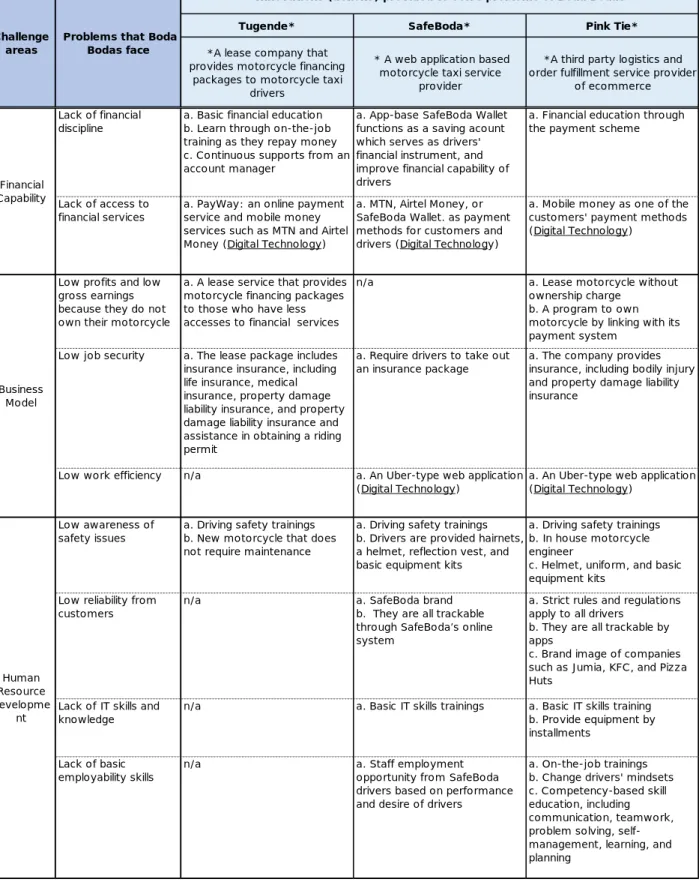
motorcycle taxi drivers. The two columns on the left of Table 2 demonstrate the points mentioned
above.
4.2 How each service tackles motorcycle drivers’ problems
This section discusses how motorcycle taxi driver type jobs linked to the digital economy can help to
solve drivers’ problems and improve drivers’ earnings. Motorcycle drivers connect to these companies
as clients in Tugende’s case or as the work force in the case of SafeBoda and Pink Tie. Moreover, all
three companies are social enterprises that aim to solve social problems through their business
17
4.2.1 Tugende
Tugende is a social enterprise that provides motorcycle financing packages to motorcycle taxi drivers15.
It helps motorcycle taxi drivers own motorcycles by providing a lease-to-own type of financing scheme
and increase earnings. In a typical case, after 19 months of repayment16 , a borrower can own the
motorcycle. The model allows motorcycle taxi drivers to use the motorcycle while they borrow funds.
The most prominent difference from the general Boda Boda system is the fact that motorcycle taxi
drivers do not need to be stuck renting a motorcycle forever. The money that motorcycle taxi drivers
pay to Tugende becomes a source of funds to invest in their own motorcycle taxi business. At the end
of the payback period, the borrowers become motorcycle owners and motorcycle taxi business owners.
We next discuss Tugende’s innovations to solve the problems that Boda Bodas face.
Tugende’s innovations deal with above mentioned three challenge areas that Boda Boda drivers
face. First, to address the issue of financial capability, Tugende provides a solution to the access to
finance. Tugende does not require formal collateral like land titles which are required by most banks
and microfinance institutions. Tugende’s down payment is approximately 10% of the cost of the asset,
whereas many other lenders require 25-40% upfront. Therefore the barriers to entry for drivers to get
a path to ownership are lowest with Tugende. Likewise, to address financial discipline in the area of
financial capability, Tugende provides opportunities for basic financial education. This is a part of the
prerequisite training classes. Motorcycle taxi drivers also acquire financial discipline through
15
As of March 2019, Tugende provides other income generating assets, including refrigerators, sewing machines, commercial vehicles, and others.
18
job training (OJT) as they pay installments. They also receive continuous support from an account
manager. By joining the system, after 19 months of the payback period, motorcycle taxi drivers
improve their financial capacity and become financially independent. Thanks to the digital technology,
PayWay17 and mobile money such as MTN and Airtel money, motorcycle taxi drivers can easily
access financial services and make payments via digital payment channels. Additionally, it enables
motorcycle taxi drivers to make savings since they can save money in their mobile money account.
This is where the digital economy benefits drivers directly.
Regarding aforementioned Boda Boda drivers’ second challenge area, the business model of
Boda Boda, Tugende’s unique leasing service model helps drivers not only become owners, but also
enhance their job stability and economic security. Consequently, drivers can have bike ownership18
and increase their earnings after the installment payment period. The lease package includes life
insurance, medical insurance, property damage liability insurance, and assistance in obtaining a riding
permit, all of which improves drivers’ job security and protects them and their family in case of
accidents or other issues. Moreover, motorcycle drivers become more safety conscious with using own
assets by driving his own motorcycle since drivers pay extra care on their own assets.
In terms of the Boda Boda’s third challenge area, human resource development, motorcycle taxi
drivers with Tugende learn driving safely after receiving driving safety trainings and a new motorcycle
that does not require maintenance. Tugende also provides high quality safety equipment including
17
Pay Way is an internet-based payment service.
19
helmets, reflector vests and upgrades to the motorcycle which reduce safety risks of motorcycle taxi
drivers.
During the 19-month payback period, a motorcycle taxi driver needs to carry more passengers
to reach the same daily gross profit of a typical Boda Boda; however, after payback period, the driver
will earn more gross profit previously. Tugende requires a leaser to pay 15% more than what is paid to
rent a motorcycle (UGX 10,000 per day). In an ordinary case, we estimate that the typical driver’s
daily revenues are UGX 30,000. A leaser pays back UGX 11,500 in the daily installment and spends
UGX 8,000 on fuel. A driver’s daily gross profit becomes UGX 10,500 (USD 2.8), which is slightly
less than the earnings of a typical Boda Bodas19. However, after the 19-month payback period, the
driver pays only the UGX 8,000 fuel expense out of the daily revenues and earns a daily gross profit
of UGX 22,000 (USD 5.9), which is almost twice that of a typical Boda Boda. The biggest challenge
for Boda Boda drivers to join Tugende’s model is having the down payment of about USD 130 up
front. Tables 2, 3, and 4 summarize the points mentioned above.
4.2.2 SafeBoda
SafeBoda is a web application-based motorcycle taxi service provider founded in 2014. It aims to
reduce Boda Boda accidents. Boda Bodas in Uganda are well-known for their high rate of traffic
accidents. Kampala’s Mulago hospital reported that 41% of its trauma cases involved a motorcycle
19
Many Tugende clients increase their number of trips and drivers earn more than typical Boda Bodas do because they have new motorcycles that they own. As the asset owner, they increase safety and efficiency of their rides, and more motivated to carry more customers.
20
taxi (Kigera, Nguku, & Naddumba, 2010). SafeBoda aims to modernize informal transportation and
ensure safe access to mobility through its safe ride, fair price, and convenient services. According
SafeBoda co-founder Rapa Thomson Ricky, it has more than 1,500 registered motorcycle taxi drivers
as of May 2018. All Safeboda motorcycle taxi drivers wear identifiable orange color reflecting vests
and helmets and are equipped with smartphones and spare helmets. Passengers use the SafeBoda app
on their smart phones to find the most convenient Boda Bodas.
SafeBoda’s innovations deal with three challenge areas. In the area of financial capability,
SafeBoda uses digital technology and mobile money, including MTN, Airtel Money, or SafeBoda
Wallet, which enables customers to make easy and accurate payments online. Additionally, on-line
bank technology lets drivers receive payments from customers and commissions from SafeBoda easiy.
SafeBoda Wallet is a service that enables customers to deposit funds in advance and use them when
they use SafeBoda’s service. Customers can get a 50% discount if they pay by SafeBoda Wallet, though
the difference in revenues are covered by the company, and SafeBoda drivers do not lose
revenues20.While the said discount promotion reduces revenues for SafeBoda, this led customers to
use SafeBoda more and to be royal to SafeBoda’s service with their own SafeBoda Wallet account
actively used. Additionally, SafeBoda solved problems of price discrimination21 and improved price
fairness and visibility of motorcycle taxies by providing an app-based fee.
20
As of March 2019, the company promotes a 25% discount to customers who choose SafeBoda Wallet as a payment method.
21
When a customer uses a Boda Boda on the road, the customer does not have the power to decide price of the trip; the Boda Boda driver decides the price, even if it is too high for the actual trip.
21
In terms of the second challenge area business model, SafeBoda deals with problems associated
with low job security, lack of access to financial services, and low work efficiency. SafeBoda requires
member drivers to take out an insurance package that includes bodily injury and property damage
liability insurance. It improves drivers’ job security with their own additional payments. Likewise, an
Uber-type web application makes it easy for drivers to find potential passengers, reduce wasted fuel,
and increase the number of passengers that they can carry.
Another challenge area SafeBoda deals with is human resource development. Motorcycle taxi
drivers receive training on road safety, first aid, basic motorcycle maintenance, and customer care. All
SafeBoda drivers are required to carry hairnets and a spare helmet for a customer, which improves
safety. In addition, the reflective jacket a SafeBoda driver wears has the driver’s name on it and the
trip history record in the customer’s mobile app improves the reliability of SafeBoda drivers. SafeBoda
also requires drivers to wear identifiable orange uniforms, which provides strong presence of the
SafeBoda brand and improves customer trust in its drivers. This in turn helps drivers get more
passengers. Moreover, they are all trackable through SafeBoda’s online system. Average drivers after
joining SafeBoda increase their passengers by at least 30 to 40% and the average is about 230%,
according to SafeBoda. It is worth noting that some research results show that SafeBoda increased the
safe riding behaviors of motorcycle taxi drivers (Muni et al., 2018). Regarding IT skills and knowledge,
SafeBoda provides registered motorcycle taxi drivers basic IT skills training. It also provides drivers
22
SafeBoda is a typical digital gig working service in which the workers are self-employed and
receive fees upon per ride. To join SafeBoda, a Boda Boda driver needs to pay UGX 200,000 (USD
54.0) as a part of a total principal fee of UGX 45,000 (USD 121.5). In addition, drivers need to pay
15% of the per-ride fee for app-based trips and UGX 7,000 (USD 7.9) of the installment of initial fee
for the first 8 months. These are the three biggest hurdles for motorcycle taxi drivers to join SafeBoda.
Based on the interviews with SafeBoda drivers, we estimate that the typical SafeBoda motorcycle taxi
driver’s daily revenues are UGX 70,000.22 Assuming that customers pay the fares by cash, the driver
pays a 15% commission of UGX 10,500 and a UGX 7,000 installment of the initial fee to the company,
pay UGX 10,000 to the owner of the motorcycle, and spend UGX 20,000 on fuel. The gross profit
becomes UGX 22,500 (USD 6.1) for the first 8 month. After 8 months, the gross profit becomes UGX
29,500 (USD 8). If the motorcycle taxi driver owns the motorcycle, then the gross profit becomes UGX
32,500 (USD 8.8) for the first 8 months. Under the same assumption, after 8 months, the gross profit
becomes UGX 39,500 (USD 9.7). Tables 2, 3, and 4 summarize the points mentioned above.
4.2.3 Pink Tie
This company was born of the necessity for efficient and reliable fulfillment services led by the growth
of the digital economy; namely, on-demand e-commerce platforms. While e-commerce businesses
have been expanding in Uganda, there is insufficient fulfillment capacity, nor could these companies,
22
The SafeBoda drivers we interviewed in Kampala indicated that the average daily revenues are between UGX 70,000 to UGX 100,000, depending on how many customers they carry.
23
such as Jumia23, establish sufficient fulfillment operations themselves when they began operations.
When Jumia established fulfillment capacity for on-demand delivery, it was difficult to operate due to
bad road conditions, high traffic accident rates, and badly maintained motorcycles that often break
down. Moreover, Jumia had difficulties in managing drivers; it faced high turnover, low commitment,
absenteeism without due notice, and sometimes missing articles and misuse of collected money.
Pink Tie enhanced drivers’ employability skills and successfully improved their lives. The
company is a third party logistics and order fulfillment service provider to e-commerce companies
founded in May 2016. The company aims to better the life of people at the bottom of the social scale
by employing them and leading them to self-growth through engaging in its business. The company
provides fulfillment to e-commerce platforms such as Jumia Fresh, Jumia Food, Jumia Party, and more.
Pink Tie inventories product shipments and delivers products to the customer on behalf of an
e-commerce store. The company hires about 100 motorcycle drivers. There are two types of drivers:
partner drivers who receive only commissions based on the number of deliveries and use their own
motorcycles, and company drivers who receive commissions and a monthly salary on the last Friday
of the month and do not have their own motorcycles. Both types of drivers deliver goods upon a request
sent to their smart phones, though partner drivers are equivalent to digital gig workers. Most drivers
working at Pink Tie were Boda Boda drivers who earned about UXG 360,000 (USD 100.0) per month.
Thanks to Pink Tie, drivers currently earn about UXG 500,000 (USD 135.0) on average and UXG
24
1,000,000 (USD 270.0) at most.24 On average, drivers earn about 1.35 times their previous earnings.
The company offers on-demand order fulfillment services to Jumia Party, for example. Jumia
Party is an on-demand e-commerce platform specialized in drinks and goods for a party use. Pink Tie
operates one of Jumia Party’s warehouses. When it receives an order, a staff member responsible for
Jumia Party picks and packs the order in a box or a paper bag, and prepares a slip to dispatch the goods.
While the office staff is preparing the shipment, the system assigns a motorcycle driver who delivers
the order to the designated address. Once the motorcycle driver arrives at the warehouse, he picks up
a package and makes the delivery immediately. At the same time, the system notifies the customer via
email that the order is on its way. After the package arrives to the customer, the driver collects the fees
in cash or a coupon, or the customer pays via mobile money. If the delivery staff receives the fee by
cash, then the office staff member processes the payment and transfers the funds to Jumia Party. Jumia
party limits delivery time to only one hour. The delivery fee is UXD 5,000 (USD 1.4) per order,
regardless of the size of the order.
Pink Tie’s innovations deal with all three challenge areas identified in the overview of Boda
Boda drivers. The first challenge area is financial capability, specifically the lack of financial discipline.
Pink Tie provides financial education and improves financial literacy through its payment scheme.
Drivers receive commissions weekly and salary monthly on time, which enables them to gradually
become capable of managing their funds. Pink Tie also uses mobile money as a payment method for
25
both customers and drivers. This makes it easier for drivers who have less access to financial services
to receive fees and manage their own funds online. Regarding the business model, the company helps
drivers earn more without additional expenses for a motorcycle lease. It also introduced a program for
drivers to own a motorcycle by linking drivers with its no interest payment system. The bodily injury
and property damage liability insurance that the company buys for all drivers improves drivers’ job
security. Likewise, the Uber-type web application makes it easy for drivers to receive delivery orders,
and thus to increase the number of deliveries and reduce fuel waste, which also enhances work
efficiency.
In terms of the third challenge area, human resource development, the company works to assure
driver safety. It offers driving training, in-house motorcycle engineers, and equipment including
helmets, uniforms, and basic aid kits. To earn customer trust and increase the number of orders, the
company makes a special effort to produce the best customer experiences by having strict rules and
regulations that apply to all drivers. They can identify and track all drivers using apps and uses the
brand image of companies such as Jumia, KFC, and Pizza Hut. Likewise, to provide basic IT
capabilities, it provides drivers with free basic IT skills training and smartphones by installments.
Finally, and most importantly, Pink Tie has been positively working on issues of employability, which
is one of the biggest challenges that workers in most of Sub-Sahara African countries face. The
company copes with this challenge through people development in a patient manner. It provides
26
skills trainings, including communication, teamwork, problem solving, self-management, learning and
planning, and more. Through employment relationships as a team, the company builds relationships
on trust, proper pride among drivers, and stable life and work. Although the company must be patient
and provide continuous supports to drivers, the drivers gain employability and drive the team to a
success. All of these skills are also applicable to other settings. For instance, a former Boda Boda driver
who started as a delivery driver for Pink Tie became a field operations manager after improving his
skills by working with the company.
To join Pink Tie, drivers require guarantees from good acquaintances who already work at the
company. Essentially, the number of deliveries determines drivers’ earnings. The company has a clear
commission list depending on whether the driver is a partner driver or a company driver, and if the
driver has a delivery box and the client for which the driver is working. The average driver delivers
goods eight times a day. Based on this assumption, a company driver who works for Jumia food, for
example, earns UGX 20,000 per day. After fuel expenses of UGX 8,000 and UGX 15,000 of monthly
salary per day, the driver’s gross profit per day is UGX 27,000 (USD 7.3). A partner driver under same
assumption earns UGX 31,000 per day (USD 8.4). Tables 2, 3, and 4 summarize the points mentioned
27
Table 2: Summary of Boda Bodas’ problems and the innovations of each service
Source: By author
Tugende* SafeBoda* Pink Tie*
*A lease company that provides motorcycle financing
packages to motorcycle taxi drivers
* A web application based motorcycle taxi service
provider
*A third party logistics and order fulfillment service provider
of ecommerce Lack of financial
discipline a. Basic financial educationb. Learn through on-the-job training as they repay money c. Continuous supports from an account manager
a. App-base SafeBoda Wallet functions as a saving acount which serves as drivers' financial instrument, and improve financial capability of drivers
a. Financial education through the payment scheme
Lack of access to
financial services a. PayWay: an online paymentservice and mobile money services such as MTN and Airtel Money (Digital Technology)
a. MTN, Airtel Money, or SafeBoda Wallet. as payment methods for customers and drivers (Digital Technology)
a. Mobile money as one of the customers' payment methods (Digital Technology)
Low profits and low gross earnings because they do not own their motorcycle
a. A lease service that provides motorcycle financing packages to those who have less accesses to financial services
n/a a. Lease motorcycle without ownership charge
b. A program to own motorcycle by linking with its payment system
Low job security a. The lease package includes insurance insurance, including life insurance, medical insurance, property damage liability insurance, and property damage liability insurance and assistance in obtaining a riding permit
a. Require drivers to take out
an insurance package a. The company providesinsurance, including bodily injury and property damage liability insurance
Low work efficiency n/a a. An Uber-type web application
(Digital Technology) a. An Uber-type web application(Digital Technology)
Low awareness of
safety issues a. Driving safety trainingsb. New motorcycle that does not require maintenance
a. Driving safety trainings b. Drivers are provided hairnets, a helmet, reflection vest, and basic equipment kits
a. Driving safety trainings b. In house motorcycle engineer
c. Helmet, uniform, and basic equipment kits
Low reliability from
customers n/a a. SafeBoda brandb. They are all trackable through SafeBoda’s online system
a. Strict rules and regulations apply to all drivers
b. They are all trackable by apps
c. Brand image of companies such as Jumia, KFC, and Pizza Huts
Lack of IT skills and
knowledge n/a a. Basic IT skills trainings a. Basic IT skills trainingb. Provide equipment by installments
Lack of basic
employability skills n/a a. Staff employmentopportunity from SafeBoda drivers based on performance and desire of drivers
a. On-the-job trainings b. Change drivers' mindsets c. Competency-based skill education, including communication, teamwork, problem solving, self-management, learning, and planning
Financial Capability Challenge
areas Problems that BodaBodas face
Innovations (actions) provided to solve problems of Boda Bodas
Business Model Human Resource Developme nt
28
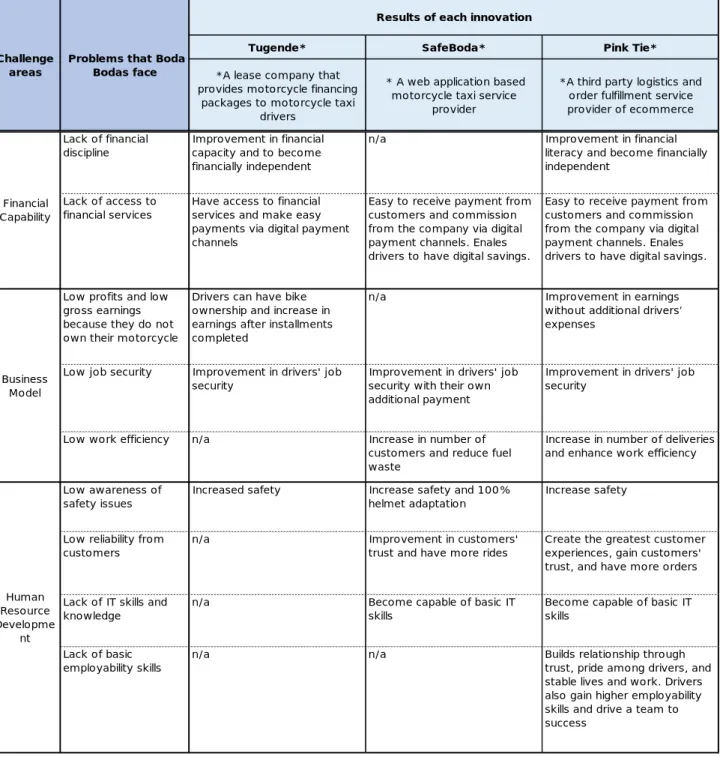
Table 3: Summary of Boda Bodas’ problems and results of each innovation
Source: By author
Tugende* SafeBoda* Pink Tie*
*A lease company that provides motorcycle financing
packages to motorcycle taxi drivers
* A web application based motorcycle taxi service
provider
*A third party logistics and order fulfillment service provider of ecommerce Lack of financial
discipline Improvement in financialcapacity and to become financially independent
n/a Improvement in financial literacy and become financially independent
Lack of access to
financial services Have access to financialservices and make easy payments via digital payment channels
Easy to receive payment from customers and commission from the company via digital payment channels. Enales drivers to have digital savings.
Easy to receive payment from customers and commission from the company via digital payment channels. Enales drivers to have digital savings.
Low profits and low gross earnings because they do not own their motorcycle
Drivers can have bike ownership and increase in earnings after installments completed
n/a Improvement in earnings without additional drivers’ expenses
Low job security Improvement in drivers' job
security Improvement in drivers' jobsecurity with their own additional payment
Improvement in drivers' job security
Low work efficiency n/a Increase in number of customers and reduce fuel waste
Increase in number of deliveries and enhance work efficiency
Low awareness of
safety issues Increased safety Increase safety and 100%helmet adaptation Increase safety
Low reliability from
customers n/a Improvement in customers'trust and have more rides Create the greatest customerexperiences, gain customers' trust, and have more orders
Lack of IT skills and
knowledge n/a Become capable of basic ITskills Become capable of basic ITskills
Lack of basic
employability skills n/a n/a Builds relationship throughtrust, pride among drivers, and stable lives and work. Drivers also gain higher employability skills and drive a team to success
Financial Capability Challenge
areas Problems that BodaBodas face
Results of each innovation
Business Model Human Resource Developme nt
29
Table 4: Summary of Boda Bodas’ problems and material challenges for Boda Bodas
Source: Author.
4.3 Discussion
Our research results suggest that the digital economy directly benefits motorcycle taxi drivers by
Tugende* SafeBoda* Pink Tie*
*A lease company that provides motorcycle financing packages to motorcycle taxi drivers
* A web application based motorcycle taxi service
provider
*A third party logistics and order fulfillment service provider of ecommerce Lack of financial
discipline n/a n/a n/a
Lack of access to
financial services n/a The sales is discounted by50% with SafeBoda Wallet credit and reduce the earnings of drivers
n/a
Low profits and low gross earnings because they do not own their motorcycle
USD130 of down payment
up front to join the system USD54 up front (out ofUSD121.5 initial fee) to join SafeBoda, 15% of the per-ride; fee for app-based trips and UGX7000 of repayment of the rest of initial fee for the first 8 months
Guarantee from good acquaintances who already work at the company
Low job security n/a n/a n/a
Low work efficiency n/a n/a n/a
Low awareness of
safety issues n/a n/a n/a
Low reliability from
customers n/a n/a n/a
Lack of IT skills and
knowledge n/a n/a n/a
Lack of basic
employability skills n/a n/a Must be patient and providecontinuous support
Challenge
areas Problems that BodaBodas face
Material challenges for Boda Bodas
Financial Capability Business Model Human Resource Developme nt
30
enhancing their financial capability and improving the efficiency of the business model. Indirectly, the
growth of the digital economy expanded business opportunities for motorcycle drivers, as the
SafeBoda and Pink Tie cases demonstrate. Both SafeBoda and Pink Tie would not exist without the
emergence of the digital technology. Besides, mobile technology enabled Tugende clients to save fuel
and time by using mobile payments rather than driving to the Tugende office to make installment
payment in person. Tugende clients’ Boda Boda businesses also benefited indirectly from the digital
technology by increasing the efficiency of each ride since motorcycle taxi drivers are motivated to
drive safely because they use their own motorcycles and carry more passengers. As such, the mobile
payment methods Tugende and SafeBoda use increased the efficiency of the payment process.
Additionally, Tugende creates motorcycle owners who associate with SafeBoda, which motivates
motorcycle taxi drivers using their own assets provide more rides, thus increasing their earnings. All
three businesses take great pains to improve the nine challenges that Boda Boda drivers face, including
lack of financial discipline, lack of access to financial services, low gross profits due to the lack of
motorcycle ownership, low job security, low work efficiency, lack of safety, low customer reliability,
lack of IT skills and knowledge, and lack of basic employability skills. We categorized these challenges
into three categories: drivers’ financial capability, the Boda Boda business model, and human resource
development. We then looked at how each service is leading innovations to overcome these issues in
each category.
31
solve Boda Bodas’ problems. Tugende mainly provides innovations to solve problems related to
financial capability and the business model. SafeBoda typically focuses on the business model and
human resource development. Pink tie provides innovations to all three areas, though they typically
see great impacts on human resource development. In particular, Pink Tie exerts more effort to address
the lack of basic employability skills, which is an indispensable condition for workers to compete in
the job market because Pink Tie directly employs most of their drivers unlike Tugende and SafeBoda
which contract with individual drivers. Before working with Pink Tie, Boda Boda taxi drivers were
treated as an incompetent labor force and were not seen as candidates for human capital development.
However, the company believed in drivers’ personal potential and through employment, enhanced the
lives of people at the bottom of the social scale. This did not happen without the development of the
e-commerce, nor the digital economy. In this sense, the digital economy offered an enormous
contribution, though alone, it would not better the employability skills of motorcycle taxi drivers. It
consequently increased the drivers’ sense of belonging to the company. Combined with the company’s
innovations, the digital economy helped to improve drivers’ employability and stabilized the business
operations.
Figures 3, 4, and 5 below illustrate how each company’s service contributed to enhancing drivers’
earnings compared to those of ordinary Boda Boda drivers.25 This study finds that each service
enhanced drivers’ gross profit compared to those of a typical Boda Boda driver. In this comparison,
32
we estimated ordinary Boda Bodas’ earnings from the results of on-site interviews conducted in
Uganda in May 2018, and use it as the earnings baseline. First, Figure 3 compares the case of Tugende
to an ordinary Boda Boda’s earnings. Although in the first 19 months, Boda Boda drivers using
Tudende’s leasing model earn slightly less on average, they earn UGX 22,000 after 19 months (Figure
3).26
Figure 3: Daily Gross Profit, Tugende
Source: Author (Note: Numbers are estimated based on interviews).
Figure 4 and Figure 5 show SafeBoda’s case compared to a typical Boda Boda driver. During
the first 8 months, a SafeBoda-associated driver has to pay UXG 7,000 per day to pay back the balance
of the initial fee of 450,000. The gross profit become more than double that of the ordinary earnings.
However, due to harsh market competition, SafeBoda has been promoting a 50% discount to customers
who choose SafeBoda Wallet as a payment method and the company covers the cost of discounted
33
revenues to drivers. This promotion may reduce SafeBoda’s profits (Figure 4 and Figure 5).
Figure 4: Daily Gross Profit, SafeBoda (Up to 8 Months)
Source: Author (Note: Numbers are estimated based on interviews).
Figure 5: Daily Gross Profit, SafeBoda (After 8 Months)
Source: Author (Note: Numbers are estimated based on interviews).
Next, Figure 6 shows Pink Tie’s case compared to that of an ordinary Boda Boda driver. The
34 resource development (Figure 6).
Figure 6: Daily Gross Profit, Pink Tie
Source: Author (Note: Numbers are estimated based on interviews).
5. Conclusion
Our research aimed to discover whether the digital economy benefits poor workers in Uganda by
looking into how it benefits motorcycle taxi drivers. Our results suggest that both the direct and indirect
benefits of the digital economy helped motorcycle drivers improve their lives by engaging with the
digital economy. In particular, employability skills enhancement increased job stability.
The results show that motorcycle drivers benefit directly from the digital economy in three
aspects. First, they gain easy access to financial instruments brought about by digital payment services,
such as Payway and mobile money in the case of Tugende. Such online-payment methods enable
35
an Uber-type web application and mobile money, such as MTN and Airtel money in the cases of both
SafeBoda and Pink Tie. Third, drivers gain more job opportunities with higher earnings by using
mobile application-associated services like SafeBoda. The results also demonstrate an indirect benefit
of digital technology through the enhancement of employability skills. Both SafeBoda and Pink Tie,
enhanced the employability skills of motorcycle drivers with their efforts.
All three businesses take great efforts to improve the challenges that Boda Boda drivers face.
Tugende has the most impact on issues of financial capacity, SafeBoda has a significant impact on
issues of the business model, and Pink Tie has the greatest impact on issues of human resource
development.
To conclude, we identified that while the digital economy brought direct benefits such as access
to financial services and higher work efficiency, the relationship between the digital economy and the
rise in motorcycle drivers’ earnings is conditional on more fundamental issues, such as employability
skills and the mindset of drivers which brings about responsible behavior and safe rides as a result.
Therefore, both the direct and indirect benefits of the digital economy are substantial for Boda Boda
36
References
Bukht, R. & Heeks. R. (2017). Defining, conceptualising and measuring the digital economy. Working
Paper no. 68, Global Development Institute, University of Manchester, UK. Retrieved
September 20, 2018. http://www.gdi.manchester.ac.uk/research/publications/di/
Fortanier, F. & Gonzalez, J. L. (2017). Measuring digital trade: Towards a conceptual framework.
Presented at the March 2017 Meeting of the OECD Working Party on International Trade in
Goods and Trade in Services Statistics. Retrieved 3 October, 2018.
https://unctad.org/meetings/en/Contribution/dtl_eWeek2017c04-oecd_en.pdf
Graham, M., Hjorth, I., & Lehdonvirta, V. (2017). Digital labour and development: impacts of global
digital labour platforms and the gig economy on worker livelihoods. Transfer: European
Review of Labour and Research, 23(2), 135-162. https://doi.org/10.1177/1024258916687250
Howe, J. & Davis, A. (2002). Boda Boda – Uganda’s rural and urban low- capacity transport services.
Urban Mobility for All, Lisse: A. A. Balkema Publishers, pp. 235-240.
IMF. (2016). Measuring the digital economy, IMF Policy Papers. Retrieved September 20, 2018.
https://www.imf.org/~/media/Files/Publications/PP/2018/022818MeasuringDigitalEconomy.a
shx
Kigera, J. Nguku, L., & Naddumba, E. K. (2010). The impact of Bodaboda motor crashes on the budget
for clinical services at Mulago Hospital, Kampala. East and Central African Journal of Surgery,
15(1). http://www.bioline.org.br/pdf?js10009
37
taxi programme increases safe riding behaviours among its drivers in Kampala, Uganda. Injury
Prevention. http://dx.doi.org/10.1136/injuryprev-2018-043008
Roehler, D. R., Naumann, R. B., Mutatina, B., Nakitto, M., Mwanje, B., Brondum, L., Blanchard, C.,
Baldwin, G. T., & Dellinger, A. M. (2013). Using baseline and formative evaluation data to
inform the Uganda Helmet Vaccine Initiative. Global Health Promotion, 20(4 Suppl), 37-44.
https://doi.org/10.1177/1757975913509657
Taylor, M., Marsh, G., Nicol, Diane., & Broadbent, P. (July 2017). Good work: The Taylor Review of
modern working practices. London, UK.: Department for Business, Energy & Industrial
Strategy, UK. Retrieved October 2, 2018.
https://www.gov.uk/government/uploads/system/uploads/attachment_data/file/626772/good-work-taylor-review-modern-working-practices.pdf
Tumwesigye, N., Atuyambe, M., & Kobusingye, O. (2016). Factors associated with injuries among
commercial motorcyclists: Evidence from a matched case control study in Kampala City,
Uganda. US National Library Medicine, National Institute of Health. Retrieved December 15,
2018. https://doi.org/10.1371/journal.pone.0148511
World Bank. (2016). The World Development Report 2016: Digital dividends. Retrieved October 3,