Abstract
This paper examines the use of authentic materials that affects students motivation, L2 WTC, International Posture and anxiety, and explores the possibility of using authentic materials in the classrooms to find whether these materials could develop a better classroom environment where L2 learners are willing to engage in activities such as interview games or role plays, and can increase students motivation, L2 WTC, and Internatinal Posture, and decrease anxiety. For this purpose, the author conducted a quantitative research using the data from the students. This paper mainly discusses the result of the quantitative analysis and attempts to show the possibility to use authentic materials in the classroom.
Keywords: WTC, motivation, language anxiety, authentic materials, role-play 1. Introduction
It has been widely claimed that foreign language learners need to communicate during the language learning process in order to acquire the language they are learning (MacIntyre & Legatto, 2011; Savingnon, 2005). Communicative Language Teaching, for example, stresses that students learn a language by using it in meaningful communication while engaged in authentic tasks and using authentic material (Richards & Rodgers, 2014). Therefore, student engagement in communicative activities in the classroom is of vital significance in L2 learning. However, when students feel anxiety in classroom communication, it may be assumed that it is hard for them to engage in communicative tasks and activities, as affective variables such as motivation and language anxiety significantly influence learners second-language (L2) Willingness to Communicate (hereafter abbreviated as WTC). The concept of WTC, therefore, is an important factor in the ability of L2 learners to participate in classroom communicative activities. The present research aims to incorporate the idea that personal-trait variables
Kazuhiro Kitaoka
in WTC are crucial for L2 learners to be able to use the L2 in authentic communication, and explore the possibility of using authentic materials in the classrooms to find whether these materials could develop a better classroom environment where L2 learners are willing to engage in activities such as interview games or role plays, and can increase students L2 WTC.
2. Literature Review 2.1. Studies of Authentic Materials
Visual materials, such as films, dramas and TV series, or music, have been used as authentic materials in EFL classrooms to enhance learners motivation or increase students interest in learning in the studies (Weyers, 1999; Kadoyama, 2005, 2008, 2014; King, 2002; Tanaka, 2009; Yamaoka, 2014; Kerekes, 2015, Kitaoka, 2019). Tanaka s quantitative study, for example, found that motivation of lower-motivated students toward learning English in the classroom were increased by using authentic materials such as movies and drama (Tanaka, 2009). As a result, there are many English text books based on movies or music that have been published by Japanese publishers, which have gained popularity among students as well as teachers.
While there are many definitions of authentic materials or authenticity (Al-Surmi, 2012; Gilmore, 2007), this study follows Nunan s definition that authentic materials are any material, spoken or written, that has been produced in the course of genuine communication, and not specifically for purposes of language teaching (Nunan, 1999). Some examples of authentic materials suggested by Nunan (1999) includes both spoken and written data, such as casual conversations, public announcements, stories and anecdotes, or invitations, airline tickets, postcards, and so forth (Nunan, 1999, p. 80). From these authentic materials, western music and the movie were used; music was played from the beginning to an end of the class to make the classroom more enjoyable and relaxing for students as well as to avoid learners becoming silent, except for the times when students needed to concentrate on vocabulary tests and similar situations. As for the movie, (2009) was chosen as the primary authentic material for the class because the movie has been popular and enjoyed by the students. The English spoken in the movie is standard American English and the diction of the voice actresses and actors is clear and identifiable, so that students who participated in role plays were able to join in the activity and practice their pronunciations by imitating characters in
the movie.
2.2. Studies of L2 WTC
The concept of WTC was first developed in L1 communication research. Since WTC has been researched in relation to the personalities or personal traits of L2 learners, various individual variables such as motivation, communicative competence, and communication anxiety have been the focuses of attention in this field. There has since emerged a new perspective proposed by MacIntyre, Clément, Dörnyei, and Noels (1998), claiming that L2 learners situational WTC must also be examined as situated antecedents. They suggest a hierarchical WTC model to show the range of potential influences on L2 WTC, and define situational WTC as a readiness to enter into discourse, at a particular time with a specific person or persons, using a L2 (MacIntyre et al., 1998, p. 547).
After the emergence of situational WTC, many researchers have examined variables of WTC, and conducted new variables such as perceived communicative competence, age and sex variables (Kang, 2005; MacIntyre et al., 2002), attitudes towards International Posture (Yashima, 2002), and so forth in EFL classrooms. As L2 communication involves many affective variables that influence the development of language acquisition, psychological, social and cultural aspects of L2 speakers with a person or persons with whom she or he talks, it is recently claimed that L2 WTC should be observed in the moment-to-moment dynamic changes in language interaction between the speakers (Kang, 2005; MacIntyre & Legatto, 2011). This study incorporates a relatively new definition of WTC suggested by MacIntyre and Legatto, and demonstrates a new approach of using authentic materials in a Japanese EFL context: MacIntyre and Legatto propose that WTC represents the intention to speak or to remain silent that can be considered the most immediate determinant of L2 use (MacIntyre & Legatto, 2011, p. 150). In this definition, MacIntyre and Legatto mention a significant variable to influence L2 WTC in a Japanese educational context, namely the possibility of remaining silent. In classroom reality in the Japanese EFL context where this study was conducted, as Yashima observes, when students need to join in the conversation and tell others their own opinions, they tend to shrink back and remain silent in apprehension of others opinions (Yashima, 2002). Being unwilling to communicate means that students remain silent, therefore the state of being silent has
to be discussed and considered as a significant tendency that influences student L2 communicative competence and language anxiety (MacIntyre & Legatto, 2011). This study in a Japanese EFL context in particular, focuses on personality-trait of L2 WTC in a classroom environment, and emphasizes students willingness to engage in activities such as role plays with the use of auntentic materials.
2.3. Studies of Silence
Although the study of silence has been paid little attention, when considering an EFL context in Japan, King (2013) argues that it is necessary to research the origin of silence in Japan in terms of L2 WTC and language learning anxiety. By examining historical and cultural influence of silence on communication practice in Japan, King and other researchers assert that Japanese people in general have grown up in a culture influenced by Confucianism, where silence is valued more than being talkative, and silence is therefore encouraged (King, 2013, p. 33; Shao & Gao, 2016). In a recent study, Shao and Gao (2016) state that L2 learners in Japan are regarded as those who are from the so-called Confucian Heritage cultural contexts, according to their definition of East Asian learners (p. 116). In this cultural context, the priority tends to be put on social harmony or community interests rather than on individuals interests, which seems to make L2 learners in Japan reluctant or fear to speak in front of others (Shao & Gao, 2016, p. 116). The present study, therefore, considers learners cultural influence or background as an important factor that affects L2 WTC, and attempts to make the classroom enjoyable and relaxing for L2 learners.
2.4. The Atmosphere of Classroom Environment in regard to L2 WTC
Classroom environment is also taken as an important factor that influences students situational WTC (Peng, 2012). Peng s finding, for instance, shows that the perceptions of the classroom atmosphere ‒ which refers to the mood or climate in the class ‒ are important since learners can sense the atmosphere when they can raise their hand (Peng, 2012, p. 208). Baker and MacIntyre (2000) also suggest that teachers in classrooms need to consider the classroom atmosphere carefully, otherwise teachers might make L2 learners nervous and feel inadequate, and as a result, lower students L2 WTC, or possibly let them stay silent. Therefore, it should be noted that classrooms need to be kept enjoyable and relaxing places for L2 learners.
In order to make classrooms enjoyable and relaxing for L2 learners, it is suggested by many researchers that the classroom should be less teacher-centered (Noels, 2001; Peng 2012, Cao, 2011). This might involve a significant change in approach in the Japanese EFL context, where teachers are expected to teach learners, and impart knowledge (Peng, 2012), while students submissively listen to the teacher, writing what he or she says in their notes. Teachers roles, attitudes, involvement, and teaching style are essential factors contributing to L2 WTC and engagement in activities in the classroom (Wen & Clément, 2003; Cao 2011). Cao s qualitative research of students WTC in the classroom from an ecological perspective also shows that teachers involvement in activities such as group discussions produced interpersonal closeness, thereby promoting students WTC in the classroom (Cao, 2011, p. 472). In this way, students’reticence or lack of participation in classroom activities need to be resolved, which will be a significant challenge for teachers.
In this regard, the correlative relations among affective variables including classroom environment that affect students WTC are explained in the study by Peng and Woodrow (2010) as shown in Figure 1:
. L2 WTC model in Chinese EFL classroom adapted from Peng and Woodrow(Peng & Woodrow, 2010, p. 844)
The diagram of L2 WTC model in Chinese EFL classroom suggested by Peng and Woodrow (2010) indicates the correlative relations among five affective variables that influence students WTC in English in the classroom. Each path that is shown in the diagram was originally analyzed by the researchers. For example, the relation between motivation to learn English and communication confidence in English was investigated by Yashima (2002; Yashima, Zenuk-Nishide, & Shimizu, 2004),
and the relation between classroom environment including teacher support and L2 WTC was theoretically analyzed by Wen and Clément (2003; see more details in Peng & Woodrow, 2010, p. 844). The present study employed this model and made a hypothesized model of L2 WTC using authentic materials, shown in Figure 2 below:
2. A Hypothesized Model of L2 WTC model using Authentic Materials By employing the model suggested by Peng and Woodrow, this study uses a hypothesized dotted path that may affect classroom environment and motivation to learn English in L2 WTC model. The relation between and has been investigated by Kadoyama and others (2008; Tanaka, 2009). Accordingly, this study investigates in particular how effective it is to use authentic materials in the classroom in order to better include students in activities and reduce language anxiety.
2.5. Language Anxiety
As for the foreign language learning process, personal attitude, motivation, beliefs and anxiety are considered as affective variables that contribute to L2 WTC. Of these variables, anxiety, defined as Language Anxiety, foreign Language Anxiety (MacIntyre & Gardner, 1991), and communicative anxiety (Baker &MacIntyre, 2000; MacIntyre et al., 2002), has been paid much attention. This study follows the definition of foreign language anxiety defined by MacIntyre (1999) as worry and negative emotional reaction aroused when learning or using a second language (p. 27). Many studies have been conducted to research the relationship between L2 WTC and Anxiety, and it is
stated that the potential to experience language anxiety in the communication process can affect learners L2 WTC and communication (MacIntyre et al, 2002). L2 learners who have language anxiety may not answer questions willingly nor participate in oral classroom activities, and remain silent (MacIntyre & Gardner, 1991).
However, having language anxiety does not necessarily produce failures or demotivation. The research in the relation between anxiety and performance shows that a certain amount of anxiety can improve students performance as Figure 3 below shows (MacIntyre, 1995):
3. Inverted “U” relation between anxiety and performance (MacIntyre, 1995, p. 92)
The figure above suggests that when L2 learner s anxiety is the lowest, then it is very unlikely that the learner can perform their tasks well. When L2 learner s anxiety is moderate, the performance can reach to the highest as the graph shows. This result reminds us that being anxious about speaking in front of others does not necessarily cause negative effects on learners motivation, and rather that a certain amount of anxiety may enhance learners performances effectively given that L2 learners make effort to the extent to improve the quality of performance. In the present study, although role plays in the classroom can be considered as the most
anxiety-provoking of second language activities for L2 learners (MacIntyre & Gardner, 1991; Young, 1991; Peng, 2014), it is significant that teachers need to provide L2 learners low-anxiety classroom environment in order for students to engage in role play and get a good performance.
2.6. Role play
The use of role play based on dramas and movies that the students have been exposed to has been considered beneficial and useful in EFL classrooms (Haruyama, 2010; Kadoyama, 2014). It is suggested that role play may increase learners motivation and interest, reduce students anxiety and reticence in the classroom, and successfully develop their language skills by acting the role. Although the definition of role play
varies depending on materials (Sato, 2001), in this study the term indicates that L2 learners play a part in a specific situation in a classroom supported by the instructor and classmates.
2.7. International Posture
The term international Posture was first suggested by Yashima (2002) in the replacement of the term integrativeness (Gardner, 1985). International Posture (IP) can be defined as learners attitude toward the international community (p. 56), which influences students L2 motivation and WTC (Yashima, 2002; Yashima, Zenuk-Nishide & Shimizu, 2004). Since interview handouts of traveling abroad or vacation were used as supplementary for increasing students WTC and IP in the present study, and movies and western music also may influence students IP in some way, the scale of IP was used in the quantitative analysis in the study.
3. Research Questions
This research, therefore, was conducted to find the answers to the following research questions.
1. How does the use of authentic materials influence students motivation, L2 WTC, International Posture (IP)?
2. How do authentic materials affect students language anxiety, and make it possible for students to participate actively in the classroom?
4. Method 4.1. Participants
A total of 48 students in two classes of the university in Japan participated in the study, with each class consisting of approximately 24 students ( = 25 in Class A, = 23 in Class B). Majoring human life science and physics, 48 participants were second-year students, ranging in age from 19-21. According to their self reports, the level of English proficiency varied from the Pre-Second Grade to the Second Grade of English Proficiency Test (STEP) and from 500-600 on the TOEIC test. Classes were divided into six sections in accordance with the results of the tests the students took in the previous year. Since this study did not compare the two classes, these two classes are
treated as equal.
Fifteen classes were held within the spring semester in 2017 in the CALL classroom where students were able to access plenty of resources from websites using the Internet. Each class took about 90 minutes respectively. From the first day to the ninth day, students practiced basic English pronunciation and did many tasks on traveling abroad that were made according to the theory of International Posture (IP) in order for them to be accustomed to talking with friends and teachers in English, as well as to be interested in foreign cultures.
4.2. Teaching Procedure
4.2.1. The teaching procedure of using the movie
The movie was viewed in the classroom for three days, followed by role plays for three days.
Here is the procedure of using authentic materials in the classroom:
1. After students watched the whole movie, the author gave them handouts of dictation exercises using a scene from the movie . The merits of using dictation exercises from films have been argued (Kadoyama, 2008), though this study mainly focused on pronunciation practice and speaking, rather than listening comprehension. 2. Students carefully watched and listened to the scene twice, and were asked to talk
with friends around them in Japanese and check answers. Making pairs or small groups in the classroom is considered beneficial and is one of the keys to making the classroom more enjoyable and active, which will lead to decreasing students anxieties in the classroom.
3. The author told students to answer the questions by raising their hands in pairs or with friends around them. Since they had already talked with friends and made sure of their answers together, it was easier for them to raise their hands to answer the questions.
4. After students answered the questions, students then listened to some part of the scene again, so that they could make sure of the pronunciation and grammar that they had not heard.
5. After checking the answers and the sounds they had missed, students wrote comments on the dictation sheets and the author collected them, next giving them a full script of the scene to assist their comprehension of the story. The students were
then told to practice the conversation in the script in the classroom.
6. Students then practiced the pronunciations using Movie-Teleco, by which they could practice as they wished by changing the speed of the conversation.
7. After the practice, the author distributed the movie file of the scene to the students and told them to practice the scene at home for role play in the next class.
4.2.2. The procedure of role play
After students watched the full movie in the classroom, the researcher conducted tasks that related to role plays for three days. Here is the procedure of role play as below:
1. The author gave some time for practicing pronunciation for the role play by using Movie-Teleco.
2. After about five minutes of practice, the author asked students to raise a hand if they were willing to participate in a role play.
3. Students who raised a hand came to the front, talked with the participants, and decided which part they wished to act.
4. While students were acting, speaking English, other students needed to evaluate their performances, on pronunciation and acting, and write a short comment on each speaker by using a handout or an excel sheet on computers, which the author previously had sent to the students on the CALL system.
5. The author gave some students advice on students pronunciations when it was necessary.
6. After collecting evaluation sheets or excel files from the students, then students watched the next scene, using a new dictation sheet, and prepared for the next day of role play.
4.3. Instrument
To investigate students motivation, L2 WTC, IP and language anxiety, and how influential the authentic materials are, this research is based on quantitative research.
4.4. A Questionnaire for Students
For the purpose of this study to answer research questions No. 1 and No. 2, a questionnaire was developed to examine students motivation, IP, L2 WTC, language anxiety, and authentic materials (Appendix 1). The scale of authentic material was also administered to know how influential the use of authentic materials was in the classroom. The questionnaire was conducted before and after students watched the movie (day 10 and day 14). The questionnaire was consisted of 35 items with a five-point Likert scale (from no. 1: I really think so, to no. 5: I really don t think so, respectively), and 29 items out of 35 were employed in the present study. Most of the items employed in this study were adapted from the previous studies: some scales in previous research were used or partly adapted: the scale of motivation consisting of 8 items (1, 2, 3, 4, 5, 6, 7, 8) was adapted from the studies of Makino and Hirano (2015), which measured the motivation of remedial college students in Japan, and of Nishida (2013). Five items of authentic materials (9, 10, 11, 12, 13) were made in accordance with items used in the motivation scales in the previous research (Makino & Hirano, 2015). For example, the item I feel I want to study English more when I feel the scene where I can speak English was altered and adapted to I feel I want to study English more when I watch the movie and hear what a native speaker said. The scale of IP consisting of six items (14, 15, 16, 17, 18, 19) was adapted from Yashima (2002) and Nishida (2013). The scale of language anxiety consisted of five items (20, 21, 22, 23, 24) adapted from Yashima (2002) and Makita and Hirano (2015). The scale of L2 WTC consisted of five items (25, 26, 27, 28, 29) adapted from Nishida (2013) and Yashima (2002), with little modifications made to match the purpose of the research. Each questionnaire took about five to eight minutes to complete using Google forms on smartphones students had in the classroom.
For analysis of these variables, SPSS Ver. 23 was used, and Cronbach s alpha for each variable is shown in Table 1. As it is stated in Table 1, the reliability estimates (Cronbach alphas) for the variables were moderate to high, and are considered reliability thresholds. The questionnaire, therefore, was regarded as a reliable measure of Motivation, Authentic Materials, International Posture, Language Anxiety, and WTC.
Table 1
Variables Cronbach s Alpha
Motivation α = .89 AM α = .93 IP α = .77 LA α = .81 WTC α = .87 . A M = a u t h e n t i c m a t e r i a l s ; I P = international posture; LA=language anxiety; WTC= willingness to communicate.
5. Results of Quantitative analysis
Survey data from 48 students from two classes were collected by Google forms from which the file of the survey was able to be downloaded (though the conversion of resource was necessary at the time the author downloaded). The data were then cleaned and reversed (except for the scale of Language Anxiety) since the five-point Likert scale was started from no. 1 I really think so to no. 5 I really don t think so at all . It is generally considered that the paired-patch dependent comparison is desirable in order to find the clear differences and changes between pre- and post-data of participants. However, since the data missed the individual information of participants who answered in a questionnaire, the data were analyzed by independent -test comparison and correlation analysis.
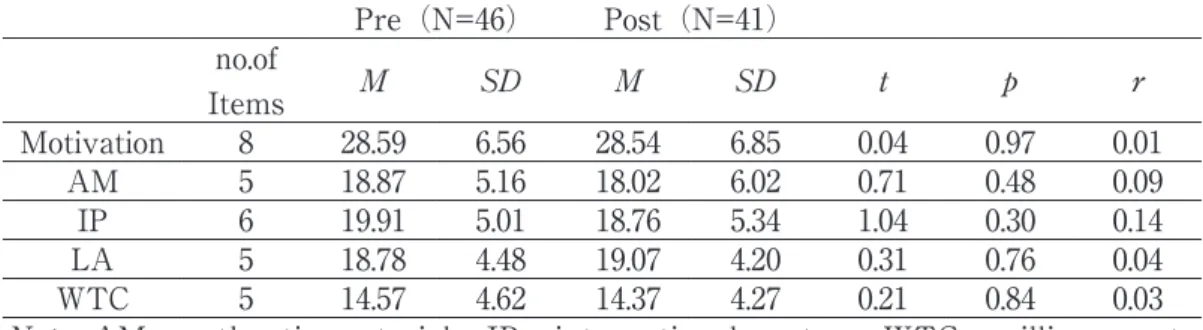
Table 2 ( ) Pre(N=46) Post(N=41) no.of Items Motivation 8 28.59 6.56 28.54 6.85 0.04 0.97 0.01 AM 5 18.87 5.16 18.02 6.02 0.71 0.48 0.09 IP 6 19.91 5.01 18.76 5.34 1.04 0.30 0.14 LA 5 18.78 4.48 19.07 4.20 0.31 0.76 0.04 WTC 5 14.57 4.62 14.37 4.27 0.21 0.84 0.03
. AM= authentic materials; IP= international posture; WTC= willingness to communicate; LA=language anxiety.
To investigate research questions No. 1 How does the use of authentic materials influence students motivation, L2 WTC, IP and language anxiety? and No. 2 How
do authentic materials affect students anxiety, and make it possible for students to participate actively in the classroom? , independent -test and Pearson s product-moment correlations analysis were conducted. Since the variances in the independent t-test were not equal (N = 46, N = 41), the assumption of homogeneity of variance was tested using Levene s Test of Equality of Variances in SPSS, and it did not show any significant difference, which suggested -value was greater than .05 ( >.05). Therefore, it is assumed that the two group variances can be treated as equal.
As can be seen in Table 2, no significant effects were found from five variables (i.e. Motivation: (85) = 0.04, = .972, = .01; Authentic Materials: (85) = 0.71, = .482, = .09; IP : (85) = 1.04, = .300, = .14; LA : (85) = 0.31, = .756, = .04; WTC : (85) = 0.21, = .836, = .03). These results may indicate that the use of authentic materials in the classroom did not directly affect students WTC, IP, and Language Anxiety, and thus there is a need for more systematic research on authentic materials in EFL classrooms.
Next, to find the correlation of authentic materials with other variables, the Pearson s correlation analysis was conducted using the combined data of pre-and post variables. The result is shown in table 3 below.
Table 3. motivation AM IP WTC LA Motivation -AM .743** -IP .698** .601** -WTC .476** .244* .541** -LA -.198 .115 -.406** -.598**
-. * <-.05, ** <-.01, =85; AM= authentic materials; IP= international posture; WTC= willingness to communicate; LA=language anxiety.
After examining the scatterplots of each correlation of AM with other variables, Pearson s product-moment correlation analysis was conducted. There was a significant positive correlation between motivation and AM ( = .743, < .01), the result being the same as the previous studies using authentic materials (Kadoyama, 2008; Tanaka, 2009).
There was also a slight positive correlation between IP and AM ( = .601, < .01). The result of correlation analysis between WTC and AM, however, does not suggest a significant result, though, showing a small positive correlation between the
two ( = .244, < .05). It can be suggested that the use of authentic materials in the classroom may not influence students L2 WTC as much as the present study had expected. Lastly, the result of correlation analysis between AM and LA did not indicate a significant correlation between the two ( = -.115).
6. Discussion
This research attempted to show how authentic materials can be used to increase students motivation, L2 WTC, IP, and reduce students language anxiety in the classroom, and has yielded some findings on the use of authentic materials in classrooms.
To answer research questions No. 1 How does the use of authentic materials influence students motivation, L2 WTC, IP and anxiety? and No. 2 How do authentic materials affect students anxiety, and make it possible for students to participate actively in the classroom? , this study first carried out an independent-samples -test to compare five affective variables between pre- and post-questionnaires. After the -test, Pearson s product-moment correlation analysis was conducted to see the relationships with AM and with other variables. From the result of the -test, there was not a significant increase in the scores of students motivation, Language Anxiety, and L2 WTC. This may be because the use of authentic materials in the classroom was not effective enough to influence students motivation and WTC. Therefore, it can be suggested that it would have been necessary to conduct a more well-conducted pedagogical approach to enhance students motivation, and L2 WTC, and reduce Language Anxiety.
Another limitation in the present research is that the paired-patch dependent comparison should have been conducted to find more accurate changes in individuals. Since students interests in authentic materials can vary from person to person, the influences on students and the process of learning also might have been different from others.
However, from the correlation analysis, there was a significant positive correlation between AM and motivation, and a relatively positive correlation between AM and IP. Although this study does not find a significant correlation between AM and WTC, the correlation between L2 WTC and IP has been analyzed from structural equation modeling by Yashima (Yashima, 2002), which suggests a slight positive correlation
between IP and WTC2 ( = .22, = .01) (Yashima, 2002, p. 61). The present study showed the significant correlation between AM and IP. Therefore, the result may indicate that the use of authentic materials tend to be correlated with increases in rating of IP and students WTC.
The result of a correlation analysis between AM and LA, on the other hand, did not show a significant correlation between the two. Therefore, it can be concluded that the use of authentic materials may not help decrease students LA in the classroom from both -test and Pearson s correlation analyses.
The present study, therefore, concludes with the suggestion that further research towards encouraging L2 WTC in the classroom environment is necessary and this research should focus more on both situational and personal-trait WTC while considering the cultural and historical context of the targeted country, especially in a Japanese EFL context.
7. Conclusion
This study investigated the possibility of using authentic materials in the classrooms, incorporating the idea that personal-trait variables strongly influence L2 learners desire and ability to use the L2 in authentic communication. Although the result of the study did not show that the movie used in the research directly affected students WTC, IP, and Language Anxiety, there is a possibility that the use of other materials will produce different results. In this regard, this study may foster future research on the use of authentic materials and on learners personal-traits that affect language learning and motivation in EFL classrooms, and offer hope that learners motivation and will to communicate with people from other countries will be enhanced by the use of authentic materials in classrooms.
Note
1) This paper is a revised version of a Master s thesis submitted to Kansai University in 2018.
References
Al-Surmi, M. (2012). Authenticity and TV shows: A multidimensional analysis perspective. , 671-694.
Baker, S.C., & MacIntyre, P.D. (2000). The role of gender and immersion in communication and second language orientations. , 311-341.
Cao, Y. (2011). Investigating situational willingness to communicate within second language classrooms from an ecological perspective. , 468-479.
Deci, E.L., & Ryan, R.M. (1985). . New York. Plenum. Dörnyei, Z. (2005).
. Mahwah, NJ: Erlbaum associates. Gardner, R.C. (1985).
. London: Edward Arnold.
Gilmore, A. (2007). Authentic materials and authenticity in foreign language learning. , 97-118.
Haruyama, J. (2010). Effective practice of role play and dramatization in Foreign
Language Education. 31-58.
Kang, S.J. (2005). Dynamic emergence of situational willingness to communicate in a second language. . 33, 277-292.
Kadoyama, T. (2005). Film-based materials in Senior High School English textbooks. 211-220.
Kadoyama, T. (2008). Teaching communication through the Use of films. , 243-252.
Kadoyama, T. (2014). Development of film-based WBT courses responding to various proficiency levels: with a focus on modularization and sharing. , 17-30.
Kerekes, E. (2015). Using songs and lyrics in out-of-class learning. In D. Nunan & J.C.
Richards (Eds.), . New York: Routledge,
33-42.
King, J. (2002). Using DVD feature films in the EFL classroom. , 509-523.
King, J. (2013). . Palgrave Macmillan.
Kitaoka, K. (2019). A Qualitative Analysis of Films focusing on Students L2 WTC, Language Anxiety, and Learner Autonomy. , 31-44.
MacIntyre, P.D., & Gardner, R. (1991). Language anxiety: It s relationship to other anxieties and to processing in native and second languages. ,
513-534.
MacIntyre, P.D. (1995). How does anxiety affect second language learning? A
Reply to Sparks and Ganschow. , 90-99.
doi:10.2307/329395
MacIntyre, P. D., Dörnyei, Z., Clément, R., & Noels, A.K. (1998). Conceptualizing willingness to communicate in a L2: A situational model of L2 confidence and
affiliation. , 545-562.
MacIntyre, P. D., Clément, R., & Donovan. L. A. (2002). Sex and age effects on willingness to communicate, anxiety, perceived competence, and L2 motivation Among Junior High School French immersion students. , 537-564. doi:10.1111/1467-9922.00194
MacIntyre, P.D. & Legatto, J. J. (2011). A dynamic system approach to willingness to communicate: Developing an idiodynamic Method to Capture Rapidly Changing
Affect. , 149-171.
Makino, M., & Hirano, J. (2015). Eigo rimedhiaru kyoikuwo hitsuyoutosuru daigakuseiwo taishoutosita eigogakushuu chosa. . Kinki University. Nishida, R. (2013). The L2 Self, motivation, international posture, willingness to
communicate and can-do among Japanese University learners of English. , 43-67.
Noel, K.A, Clément, R., & Pelletier, Luc G. (1999). Perceptions of teachers communicative style and students Intrinsic and extrinsic motivation.
, 23-34.
Noels, Kimberly A. (2001). Learning Spanish as a second language: Learners orientations and perceptions of their teachers communication style.
, 107-144.
Nunan, D. (1999). . Heinle Cengage Learning.
Peng, J. E. (2012). Towards an ecological understanding of willingness to communicate in EFL classrooms in China. , 203-213.
Peng, J. E., & Woodrow, L. (2010). Willingness to communicate in English: A model in the Chinese EFL classroom context. , 834-876.
Peng, J. E. (2014).
. Multilingual Matters.
Cambridge: Cambridge University Press.
Sato, R. (2001). Role play: Effective role play for Japanese high school students. Retrieved from https://eric.ed.gov/?id=ED454709
Savignon, S.J. (2005). Communicative language teaching: Strategies and goals. In E.
Hinkel (Ed.), ,
Mahwah: Lawrence Erlbaum Associate, 635-670.
Shao, Q., & Gao, X. (2016). Reticence and willingness to communicate (WTC) of East Asian language learners. , 115-120.
Tanaka, H. (2009). Mittsuno reberunonaihatuteki doukidukewo takameru: doukidukewo takameruhouryakuno koukakennsho (Enhancing intrinsic motivation at three levels: The Effects of motivational strategies). , 227-250.
Yamaoka, K. (2014). Qualitative analysis of effects of the use of authentic materials in remedial English classes at a Japanese university. , 123-133.
Yashima, T. (2002). Willingness to communicate in a second language: The Japanese
EFL context. , 54-66.
Yashima, T., Zenuk-Nishide, L., & Shimizu, K. (2004). The influence of attitudes and affect on willingness to communicate and second language communication.
, 119-152.
Young, D. J. (1991). Creating a low-anxiety classroom Environment: What does language anxiety research suggest? , 75, 426-439. Wen, W., & Clément, R. (2003). A Chinese conceputualisation of willingness to
communicate in ESL. , 18-38.
Weyers, J. R. (1999). The effect of authentic video on communicative competence. , 339-349.
Appendix 1. A Questionnaire used in the study with 29 items translated from Japanese to English that were used in both pre-and post-questionnaires.
1. I like English.
2. I like English classes.
3. I can enhance my ability of English in the English class. 4. My motivation for studying English is strong.
5. I study English occasionally.
6. I can enhance my ability of English by using English.
7. I was motivated when I met a person who is able to speak English well, hoping that I wish to be like him or her.
8. I want to have an ability to use English in the future.
9. I feel I want to study English more when I watch movies and hear what a native speaker said.
10. I wished I could speak English better when I see movies and wanted to know what an actor or actress said in the movie.
11. I want to watch the movies without subtitles someday.
12. I want to speak English just like actors or actresses speak in the movies. 13. I want to study English by using foreign movies or music.
14. I want to live in a foreign country. 15. I want to travel abroad.
16. I want to work in an international organization such as the United Nations. 17. I m interested in volunteer activities in developing countries such as
participating in Youth International Development Assistance. 18. I want to communicate with foreigners in English.
19. I want to have foreign friends.
20. I feel anxious about my English when I talk with foreigners 21. I try to avoid talking with foreigners if I can.
22. I wouldn t want to have a speech in English in front of the others. 23. I wouldn t want to speak in front of others.
25. I can raise a hand and talk in a discussion in the English class. 26. I want to raise a hand and speak in the English class.
27. I feel it better to have an opportunity to speak freely in English class. 28. I want to speak English in front of the others in English class.