Distribution System of China's Industrial
Clusters: Case Study of Yiwu China Commodity
City
著者
Ding Ke
権利
Copyrights 日本貿易振興機構(ジェトロ)アジア
経済研究所 / Institute of Developing
Economies, Japan External Trade Organization
(IDE-JETRO) http://www.ide.go.jp
journal or
publication title
IDE Discussion Paper
volume
75
year
2006-10-01
1
INSTITUTE OF DEVELOPING ECONOMIES
Discussion Papers are preliminary materials circulated
to stimulate discussions and critical comments
Abstract
This paper discusses the issue of upgrading industrial clusters from the
perspective of external linkages. It is taken for granted that in most developing
countries, due to the limited domestic market and poor traditional commercial
networks, industrial clusters are able to upgrade only when they are involved in
global value chains. However, the rise of China’s industrial clusters challenges this
view. Historically, China has had a lot of industrial clusters with their own
traditional commercial networks. This fact combined with its huge population
resulted in the formation of a unique external linage to China’s industrial clusters
after the socialist planning period ended.
In concrete terms, since the 1980s, a traditional commercial institution – the
transaction market – began to appear in most clusters. These markets within the
clusters get connected to those in the cities due to interaction between traditional
merchants and local governments. This has resulted in the formation of a powerful
DISCUSSION PAPER No. 75
Distribution System of China’s
Industrial Clusters: Case Study of
Yiwu China Commodity City
DING Ke*
market network-based distribution system which has played a crucial role for China’s
industrial clusters in responding to exploding domestic demand. This paper explains
these features in detail, using Yiwu China Commodity City as a case study.
Keywords: industrial cluster, transaction market, merchants, network, Yiwu
JEL classification: L67, L81, O14, O53
* Research Fellow, East Asia Study Group, Area Studies Center, IDE
([email protected])
The views expressed in this publication are those of the author(s). Publication does not imply endorsement by the Institute of Developing Economies of any of the views expressed within.
INSTITUTE OF DEVELOPING ECONOMIES (IDE), JETRO 3-2-2, WAKABA,MIHAMA-KU,CHIBA-SHI
CHIBA 261-8545, JAPAN
I. Introduction
1As for the issue of upgrading developing countries’ industrial clusters, the role of global value chains (GVCs) has been extolled for some time. Compared to traditional approaches, which paid much attention to the local relationships between enterprises and institutions, the GVCs approach emphasizes the clusters’ linkages with the external world even more2. Along with the constant advance of economic globalization,
it is almost taken for granted that industrial clusters in developing countries are able to develop only when they are involved in the global production and distribution network controlled by trans-national companies3.
However, the rise of some of China’s industrial clusters suggests the possibility of building a different theoretical framework. After China gave up its economic policies based on socialistic planning, the domestic market which had been restrained for so long began to balloon. The total retail amount of China’s social consumer commodities increased nearly 20 times during the period 1978 to 1998 (National Statistics Trading and Foreign Economic Relations Statistic Secretary, ed. 2000). In order to respond to such huge demand, numerous small merchants and small producers began to appear in the clusters and the cities, thus reviving the local tradition of either crafts production or long-distance peddling4. In this process, the existing production and distribution
networks became increasingly inefficient.
The above-mentioned facts caused an interesting phenomenon. As a stage that gathers numerous small producers and small merchants, the traditional commercial institutions – the transaction market – made its appearance in most of China’s clusters and cities. During the period 1978 to 1998, at the country level, the total number of transaction markets increased from 33,302 to 89,177 (National Statistics Trading and Foreign Economic Relations Statistic Secretary, ed. 2000). In Zhejiang province where markets first appeared and are the most developed, the number increased from 1,322 to
1 This paper is a highly revised version of the 2nd chapter of the author’s doctoral thesis (Ding 2006). 2 Hubert Schmitz (2006) has done a lucid survey of the literature on these approaches.
3 See Global Value Chain Initiative website: http://www.globalvaluechains.org (accessed October 2, 2006).
4 For details relating to Zhejiang province where industrial clusters are most highly-developed in China, see Ding (2006, Chapter 1).
4,278 (Jin 2004, p.14). At the same time, the number of clusters in Zhejiang expanded to more than 1000, of which the domestic share of 52 clusters amounts to over 30% (Jin 2004, p.13). Almost every industrial cluster has not less than one market5. The
relationship between the development of industrial clusters and the expansion of the transaction market must be studied.
This paper discusses this issue by focusing primarily on the distribution function of these markets. In most developing countries, the difficulty of constructing a distribution system specific to small and medium enterprises (SMEs) and the limitation of the size of the domestic market have usually been the most important factors in constraining the development of industrial clusters. Thus, the reasons why traditional markets are useful to SMEs in marketing in modern China must be clarified first. This work will be the key to understanding the other functions of modern China’s markets.
This paper explains these aspects of the markets’ distribution function in detail, using Yiwu China Commodity City as a case study, because it is the largest market in China’s clusters. In the rest of this paper: Section II gives a brief introduction of our survey area; Sections III, IV, V explore the features of the distribution system that has Yiwu Market as its hub, and; Section VI concludes this paper.
II Brief Introduction to Yiwu China Commodity City
1. Yiwu China Commodity City
As a county-level city, Yiwu is located in Jinhua city, the center of Zhejiang province, with a total population of over 1.6 million people6. By the end of the 1970s,
Yiwu was an impoverished rural area. In 1978, the GDP of Yiwu was a mere 128 million Yuan, of which agricultural industry accounted for nearly 60%. In the 1980s, Yiwu started growing very rapidly. The GDP of Yiwu exploded to 28200 million Yuan by 2004,
5 Modern China’s transaction markets which are located in industrial clusters originally appeared in Whenzhou at the end of the 1970s. Due to the fact that the transaction commodities of Wenzhou’s markets used to specialize in some specific categories, these markets have been called “Zhuanye shichang” (specialized markets). As a result, whether it is specialized market or not, transaction markets are informally called specialized markets at present.
6 Of which one million are non-native residents. This fact illustrates that Yiwu had become a typical trading city.
of which the secondary sector accounted for nearly 50% (Yiwu Statistics, ed. 1978-2002). The integrated development level of Yiwu is listed 15th in the top 100 counties and cities
of China (Zhejiang China Commodity City Group Co., Ltd., ed. 2006).
This transformation resulted from the rapid development of a huge commodity wholesale market ― Yiwu China Commodity City (the Yiwu Market)7. The local
government formally established the Yiwu Market in 1982. Since 1991, this market has been holding the top position as China’s largest industrial products market. Currently, the Yiwu Market gathers over 400,000 commodities in 1901 categories from 43 industries. It is even said that this market has become the production and distribution center of daily necessities in the world.
With regard to the theme of this paper, the commodities of Yiwu Market are currently distributed in not only China’s domestic market, but also in 212 countries and regions in the world market (Zhejiang China Commodity City Group Co., Ltd., ed. 2006). At the same time, this market tends to be a main distribution channel for various industrial clusters. In terms of production areas, we can roughly divide the industrial clusters related to Yiwu into three groups. The first group consists of the clusters formed within Yiwu. The second group consists of the clusters located in other areas of the Zhejiang province. The third group includes those clusters in other parts of China. It was estimated by the Yiwu government that the shares of these three groups in the Yiwu Market are one third each8. How has the Yiwu Market connected these clusters to
such broad domestic and overseas demand? The answer must be a key factor in understanding the external linkages of China’s industrial clusters.
This paper attempts to answer this question by primarily using the publication known as the “Specialized Markets and Regional Development — Focusing on Yiwu Markets’ Radiation Zone” (SMRD). Commodities World News is a newspaper that reports on the Yiwu Market. During 2004 and 2005, this newspaper sent a large number of reporters to China’s 25 provinces to investigate the business relationship
7 This market had been called the Yiwu Commodity Market until 1992. In this paper, we call both markets the Yiwu Market for brevity.
between Yiwu and these areas. The main result of this investigation was published as the SMRD. Other reports have been published on the website of Yiwu Xinwen Wang (Yiwu News Network)9. Since the small producers and small merchants related with
Yiwu are scattered over an extremely wide area, the SMRD and the website information are the most appropriate material for our work10.
Due to the following two reasons, this paper is confined to discussing how the clusters in Zhejiang province became connected to the Yiwu Market and How the Yiwu Market became connected to the domestic market.
The first reason is due to the importance of the domestic market. As stated above, the domestic market is usually the most important bottleneck in the development of industrial clusters in developing countries. Thus, a study of the Yiwu Market’s domestic linkages must be given priority over any others.
The second reason is the lack of reference material. There are two parts in the SMRD. The first part is entitled “Yiwu Market and Zhejiang’s industrial clusters” and contains many reports on the clusters in Zhejiang’s other areas. The second part of the SMRD is entitled “Yiwu Market and the whole country.” Though it consists of three reports on the clusters in China’s other areas, the main content of this part is about the sales outlets of Yiwu commodities in China. Thus, we have to narrow the focus of this study. But, since the difference in the second and third group of Yiwu related industrial clusters is mainly based on distance, this does not affect our final conclusion.
2. Two important actors
To understand how the Yiwu Market has created domestic linkages, two key actors deserve attention. The first actor is the local Yiwu merchant who has a long tradition of peddling. At the beginning of the Ching dynasty, in order to acquire rooster feathers for compost, a few peasants in Yiwu began to move around the neighboring rural area, selling brown sugar in exchange for feathers. Their trading area gradually
9 http://www.ywnews.cn/gzywscjj/index.htm (accessed October 2, 2006).
10 The author has done field work in Yiwu since 2002. However, in order to keep the material consistent, this paper uses field results as complementary material only.
expanded to seven provinces and their range of merchandise was also extended to cover many different kinds of daily necessities. Gradually, a peddler’s organization, which is called Qiaotang Bang, was formed. At its peak in the second decade of the twentieth century, Qiaotang Bang had 7000-8000 members (Zhejiang Province Zhengxie Historical Data Committee, ed. 1997, pp. 301-303). After the PRC was established, Qiaotang Bang was dissolved and their peddling activity was discontinued for a while. However, they started peddling again in 1963, at the latest11. In the 1970s, these
vendors spontaneously formed two periodic markets in Yiwu (Zhang, ed. 1993, p.35)12.
Along with the establishment of the regular market in 1982, the Yiwu peddlers split into two groups with specific features. The first group continued to peddle in various places around China. This paper will mainly pursue their business activity in detail.
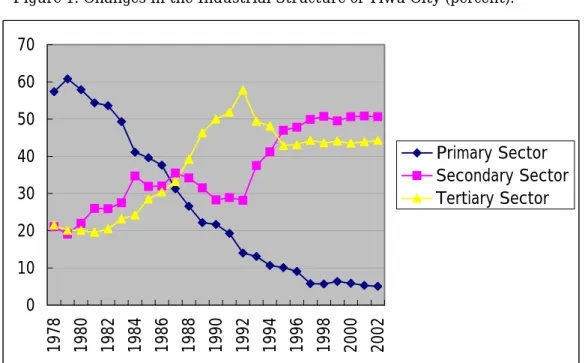
Figure 1. Changes in the Industrial Structure of Yiwu City (percent).
0
10
20
30
40
50
60
70
1978
1980
1982
1984
1986
1988
1990
1992
1994
1996
1998
2000
2002
Primary Sector
Secondary Sector
Tertiary Sector
Source: Lu, Bai, Wang (2003). The original source is Yiwu Statistics. ed. (1978-2002).
11.Wu zhixiong, ”Shichang luodi qian de timing” - the cry before the establishment of the Yiwu Market. Yiwu Xinwen Wang, http://www.ywnews.cn/20040309/ca777.htm (accessed October 2, 2006). 12 However, their formal organization never revived.
The second group became booth-keepers at the Yiwu Market. In order to purchase commodities, they went to various clusters located in Zhejiang, Guangdong and other areas of China in the early days. Some of them gradually took part in the manufacturing process. In the beginning, they primarily organized small-scale family craft production or ran workshops themselves. Since the mid-1990s, as a result of capital accumulation, these merchants began to invest substantially in building modern mass-production factories. Up until 2004, no less than eight large clusters were formed by these merchants in Yiwu, namely socks, shirts, wool, accessories, zippers, toys, key sticks and printing (Ding 2006, Chapter 4). The changes in the industrial structure of Yiwu City bear out such surprising formation of industrial clusters. As Figure 1 indicates, after the rapid expansion of the tertiary sector, Yiwu’s secondary sector sustained remarkable growth from the 1990s onwards. This changing pattern in the industrial structure is quite contrary to the well-known Petty-Clark Law.
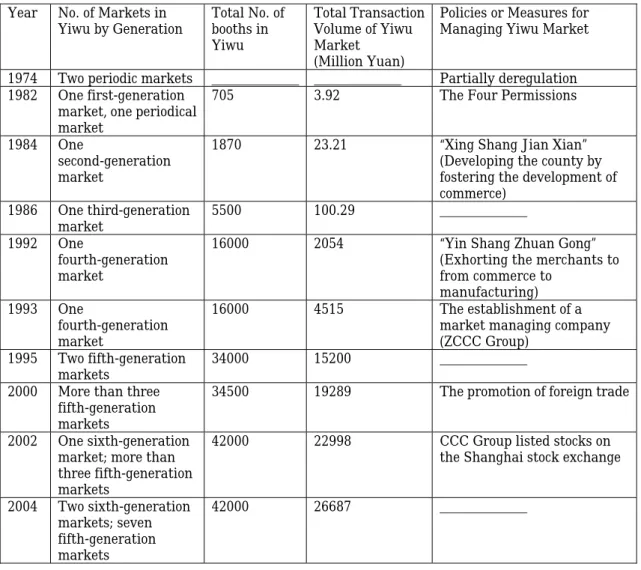
The second actor that deserves attention is local government. We can derive three features of the Yiwu government’s behavior from Table 113.
Firstly, the local government of Yiwu has formulated a few policies for deregulating the private sector. By 1983, Chinese peasants were strictly prohibited from engaging in any commerce. In spite of this, the Yiwu government has partially permitted peddling since 1963. Under the pretext that rooster feathers were still important for compost, they issued many licenses to peddlers. It was confirmed that the number of licenses had been 7000 only in 1980. In 1982, the local government created the well-known policy of “Sige Xuke” (Four Permissions). This permitted Yiwu’s peasants to engage in four kinds of business, namely: (1) engage in commerce in the city; (2) engage in long-distance logistics; (3) competing with public-owned enterprises, and; (4) opening commodity market. Shortly thereafter, the informal periodic market in Yiwu was altered to become the regular Yiwu Commodity Market.
13 According to interviews with staff of the Yiwu local government (August, 2002; March and August, 2005; September, 2006). As Ding (2006, see chapter 4) discusses, the Yiwu government has
formulated some policies for fostering the manufacturing sector as well, which are seen in the slogan of the government Yin Shang Zhuan Gong (Exhorting the merchants to from commerce to
manufacturing). However, due to paper space is confined, we don’t investigate this issue in further detail here.
Secondly, the local government took measures to manage transactions in the Yiwu Market. Early on, the Yiwu government established a specific managing committee, which consisted of a few local staff in government departments. In 1994, they established a market-managing company called Zhejiang China Commodity City Group (ZCCC Group), which listed its stock on the Shanghai Stock Exchange in 2002. In the meanwhile, the local government departments continued to maintain links with the market in the areas of quality control, forgery exposition and so on.
Table 1 The Profile of Yiwu China Commodity City.
Year No. of Markets in
Yiwu by Generation Total No. of booths in Yiwu
Total Transaction Volume of Yiwu Market
(Million Yuan)
Policies or Measures for Managing Yiwu Market 1974 Two periodic markets Partially deregulation
1982 One first-generation
market, one periodical market
705 3.92 The Four Permissions
1984 One
second-generation market
1870 23.21 “Xing Shang Jian Xian”
(Developing the county by fostering the development of commerce) 1986 One third-generation market 5500 100.29 1992 One fourth-generation market
16000 2054 “Yin Shang Zhuan Gong”
(Exhorting the merchants to from commerce to manufacturing) 1993 One fourth-generation market 16000 4515 The establishment of a
market managing company (ZCCC Group)
1995 Two fifth-generation
markets
34000 15200
2000 More than three fifth-generation markets
34500 19289 The promotion of foreign trade
2002 One sixth-generation
market; more than three fifth-generation markets
42000 22998 CCC Group listed stocks on
the Shanghai stock exchange
2004 Two sixth-generation
markets; seven fifth-generation markets
42000 26687
Sources: Lu, Bai, Wang (2003, pp.38-45); Zhejiang China Commodity City Group Co. Ltd., ed. (2005); Zhejiang Province Zhengxie Historical Data Committee, ed. (1997); Zhang Wenxue and others, ed. (1993, pp.34-40); the author’s fieldwork conducted in August 2002, February 2004, March 2005, August 2005 and August 2006.
Market. The regular market was originally built in 1982. As business expanded and infrastructure and other constraints became felt, a new, second generation market came up in the place of the original. Thus future generations replaced the earlier ones periodically. Now it is the sixth generation market. The number of the booths at all markets reached 58,000 by 2006. In this process, the service sectors which support the market such as logistics and financial systems have been improved accordingly.
III. Linkages between Zhejiang Industrial Clusters and the Yiwu Market
As a starting point for exploring the Yiwu Market’s domestic linkages, section III explores the linkages between the Yiwu Market and the industrial clusters in Zhejiang province, which sell commodities to Yiwu Market.
Ding (2006, Chapter 4) has already analyzed how several clusters were formed within Yiwu. This work illustrates that the owners of Yiwu’s factories came mainly from the merchants at the Yiwu Market. Along with their growth, the marketing measures of these factories are becoming diverse. However, even at present, most of the factories still attempt to keep booths in this market14. Based on this work, Section III focuses
primarily on the relationships between the Yiwu Market and the clusters outside of Yiwu but within Zhejiang province. We find four things worth noting in Table 2.
Firstly, the clusters that have linkages with Yiwu are widely distributed in Zhejiang province. Among nine cities of this province, except the cities of Hangzhou and Zhoushan, the rest of the seven cities’ clusters are connected with Yiwu. Though data is limited, the share of sales of some industrial clusters in Yiwu as a percentage of the cluster’s total sales is considerable. In addition to the features of the clusters in Yiwu, we can infer that Yiwu is becoming a main distribution channel for Zhejiang’s clusters15.
14 This fact can be easily confirmed by various shopping guides of the Yiwu Market. See Zhejiang
China Commodity City Group (2005; 2006).
15 Indeed, the firms in Zhejiang clusters have various marketing measures. Most of them have made use of local specialized markets or local merchants’ networks for a long time. Some have even constructed their own sales network. Even after they got connected to Yiwu, they would never abandon these existing channels. Thus, it is difficult to assert that Yiwu Market has become the only distribution channel for these clusters.
Table 2. Aspects of Some Zhejiang Industrial Clusters’ Linkages with the Yiwu Market.
City of Zhejiang Province
County Town Main Industry Ultimate Destination * Ways to Get Business Relations with Yiwu Market** Share of Sales of Cluster*** The Presence of Leading Firms’ Commoditie s Various Places Apparel 1 1,2 ________ Yes Ningbo
Cixi Various
Places Small home appliances 1,2 1,2,3,4 One of the largest domestic sales outlets
Yes
Zhuji 19 Towns Socks 1,2 1,2 ________ ________ Zhuji Shaxiahu Pearls 1,2 2 ________ Yes Shaoxing Shengzhou Various Places Neckties 1 2,3 ________ Yes Xianju Xiage, other Towns Gifts 1,2 2,4 ________ ________
Wenling Daxi Water Pumps 1 3 ________ Yes Wenling Various Places Hats 1,2 ________ 80%(Nanjian Village) ________ Wenling Various
Places Footwear 1,2 ________ Majority ________ Linhai Duqiao Glasses ________ 2 ________ ________ Taizhou
Luqiao Various Places
Plastic Products 1,2 (80%) 2 50% Yes
Footwear 1,2 1,2 ________ Yes Glasses 1,2 2 ________ ________ Lighters 1,2 2 ________ ________ Shavers 1,2 2 40-50% Various Places Zippers 1,2 1,2,3,4 ________ ________ Various places in the city Stationery 1,2 2,4 ________ Yes
Pingyang Zhenglou Gifts, Calendars 1,2 2 50% Yes Plastic Parts of
Accessories 1 2 80% ________
Wenzhou
Yongjia Qiaotou
Buttons 1,2 2,3 ________ Yes
Wucun Bamboo Wares
(Bird Cages, etc.) 2 3 95% or more ________ Quzhou Longyou
Muchen Mats 1,2 2,3 ________ ________ Various Places Stationery 1,2 2,3 Nearly 50% ________
Longyuan Toy Snakes ________ 3 80% in Zhangcun Village ________ Longquan Various Places Swords 2 2,3 33.3% ________ Qingyuan Various
Places Bamboo Chopsticks 1,2 2 Nearly 50% Yes Yunhe Various
Places
Wooden Toys 2 3 Majority ________ Lishui
Suichang Various
Places Black Pottery ________ 1or3 ________ ________ Wucheng Shafan Chinese Knots ________ 3 Majority ________
Crystal Crafts 1,2 2,3 10% ________ Pujiang Various Places Handmade Sewing Commodities 1,2 2,1or3 ________ ________ Jinhua
Qianxiang Leather
Commodities 2(1 in early period) 2 Majority ________ Various
Places
Apparel 1 2,3 Majority Yes (in the 1990s) Lanxi Various
Places Towels 1,2 1,2,3 50% Yes
Panan Various Places Hair Accessories, Ribbons, etc. ________ 2or3 Majority ________ Source: SMRD Notes: * Ultimate Destination.
1: Domestic Market; 2: Overseas Market.
** Ways to establish business relations with the Yiwu Market.
1: Yiwu merchants physically go to clusters to place orders. Some expressions in the SMRD reports are: “Yiwu Market merchants.” However, as the number of merchants who come from other area is small and they mainly sell their local products in Yiwu, most of the “Yiwu Market merchants” can be considered to be Yiwu merchants. 2: Local firms directly open booths in the Yiwu Market.
3: Local firms, on their own initiatives, engage Yiwu Market merchants in sales. 4: Other relationships.
*** Share of Sales of Cluster: Share of the sale of industrial clusters in Yiwu as a percentage of the cluster’s total sales.
****“――”: No description.
Secondly, the Yiwu Market is an important channel for selling commodities to both the domestic market and the overseas market. As Table 2 shows, among a total of 36 clusters in Zhejiang, 22 clusters are using the Yiwu Market for accessing both markets. But, it is difficult to distinguish which kind of market is more attractive. By checking the reports carefully, we can find a rough trend that the domestic market is definitely crucial in the early stages and in recent years, the overseas market is becoming increasingly important. However, even at present, there are still five clusters which have linkages with the Yiwu Market only for access to the domestic market. Whatever the case may be, what is relevant to our theme is that the development of Zhejiang’s industrial clusters is dependent on not just the developed countries’ markets. Thirdly, there are various ways to establish business relations with the Yiwu Market. It has been mentioned in Section II that since the 1980s, a large number of Yiwu merchants went to clusters outside of Yiwu for purchasing. In Table 2, we can observe at least six such cases. However, many linkages with the Yiwu Market are created on these clusters’ own initiative. As Table 2 indicates, in at least 27 clusters, the local firms themselves opened booths in Yiwu. In 15 clusters, local firms engaged Yiwu
Market merchants in sales on their own initiatives.
There are three reasons that explain the initiatives of local firms. Firstly, some clusters have a similar tradition of long-distance peddling. Just like Yiwu merchants, the merchants of these areas attempted to revive and spread their business network as well. For example, the people from Wenzhou are called China’s Jews.16 As the most
typical case, there are nine Wenzhou clusters which have opened booths in the Yiwu Market. Secondly, the local governments of some clusters have played a crucial role in establishing linkages with Yiwu. In some neighboring areas such as Wucheng, Pujiang, Dongyang, Lanxi and Panan, the local governments not only trained local firms on how to get orders from Yiwu merchants, paying a bonus as an incentive to stimulate them to strengthen the linkages with Yiwu, but also set up offices in the Yiwu Market themselves17. To emphasize their strong desire, local governments use the ringing
slogan of “Duijie Yiwu” (Form links with Yiwu). Thirdly, the local government of Yiwu has increased the number of booths at the Yiwu Market several times. The sub-leasing of booths also took place at the Yiwu Market. As a result, even as newcomers, SMEs were able to access this market easily.
Fourthly, the leading firm’s commodities suggest a considerable presence in the Yiwu Market18. A lot of scholars in China asserted that along with growth, most of the
leading firms will expand their business scale (and work out brand strategy), then a sales network specific to an individual leading firm will be constructed. As a result, the commodities of these firms must disappear in the market (Zheng, 2003). However, as Table 2 suggests, there are 12 clusters’ leading firms that do not match this view.
16 It is said that whether they are in Whenzhou city, outside of Wenzhou but inside China or outside of China, the number of the people originally from Wenzhou accounted for 1,500,000, most of them engaging in business.
17 Interviews with persons in charge of the Yiwu office of Wucheng (September, 2006) and some reports in SMRD. But, it is difficult to confirm the role of local government in the cases in Table 2. Thus, we didn’t list it as one of the ways to establish business relations with the Yiwu Market. 18 This paper defines a leading firm as one that is clearly described in the reference material as being in the top level of an industrial cluster or as one that has its own brand. Indeed, most of these firms’ brands are not yet well known. But, compared with innumerable non-brand firms, the behavior of creating a brand itself illustrates their capacity for management and a strong ambition to succeed.
IV. Linkages between the Yiwu Market and
the markets of China’s main cities
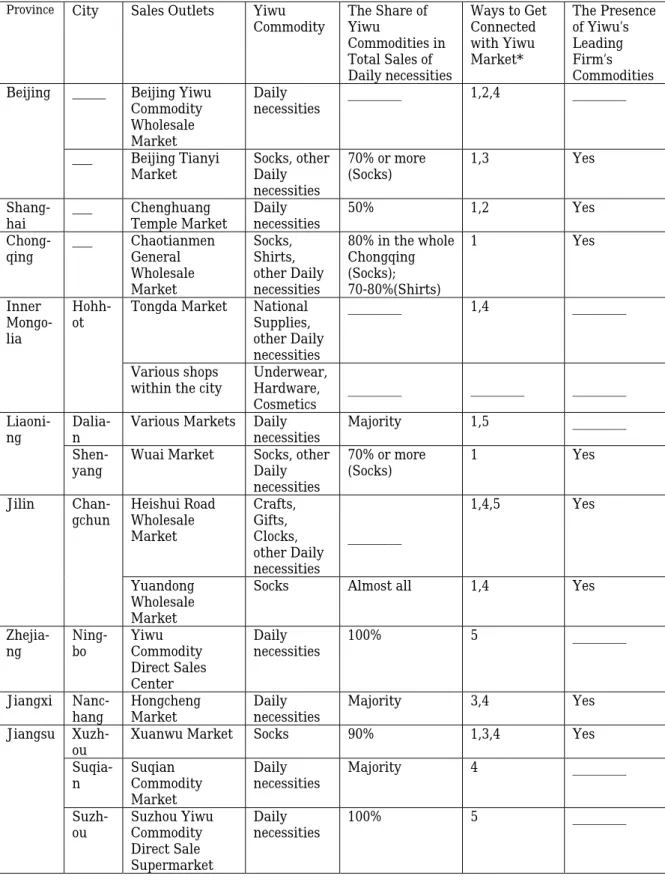
Table 3. Yiwu Commodities’ Main Sales Outlets in China
Province City Sales Outlets Yiwu
Commodity The Share of Yiwu Commodities in Total Sales of Daily necessities Ways to Get Connected with Yiwu Market* The Presence of Yiwu’s Leading Firm’s Commodities Beijing Yiwu Commodity Wholesale Market Daily necessities ________ 1,2,4 ________ Beijing Beijing Tianyi
Market Socks, other Daily necessities
70% or more
(Socks) 1,3 Yes
Shang-hai Chenghuang Temple Market Daily necessities 50% 1,2 Yes
Chong-qing Chaotianmen General Wholesale Market Socks, Shirts, other Daily necessities 80% in the whole Chongqing (Socks); 70-80%(Shirts) 1 Yes
Tongda Market National
Supplies, other Daily necessities ________ 1,4 ________ Inner Mongo-lia Hohh-ot Various shops
within the city Underwear, Hardware,
Cosmetics ________ ________ ________
Dalia-n Various Markets Daily necessities Majority 1,5 ________
Liaoni-ng
Shen-yang
Wuai Market Socks, other
Daily necessities 70% or more (Socks) 1 Yes Heishui Road Wholesale Market Crafts, Gifts, Clocks, other Daily necessities ________ 1,4,5 Yes Jilin Chan-gchun Yuandong Wholesale Market
Socks Almost all 1,4 Yes
Zhejia-ng Ning-bo Yiwu Commodity Direct Sales Center
Daily
necessities 100% 5 ________
Jiangxi
Nanc-hang Hongcheng Market Daily necessities Majority 3,4 Yes
Xuzh-ou Xuanwu Market Socks 90% 1,3,4 Yes
Suqia-n Suqian Commodity Market Daily necessities Majority 4 ________ Jiangsu
Suzh-ou Suzhou Yiwu Commodity Direct Sale Supermarket
Daily
Qianwanli Bridge Commodity Market Daily necessities ________ 4 Yes Hefei 70-80 Wholesale Markets in Hefei Daily necessities 60% or more 1,4 ________
Huang Street Apparel,
Textiles, other Daily necessities ________ 1 ________ Anhui Liuan Dabie Mountain Yiwu Commodity Market Daily necessities 90% or more 1,2 ________
Jimo Jimo Commodity
City Daily necessities 80% 1,2,4 Yes
Weifa-ng Weifang Commodity Market Apparel, Knitwear, Watches, Crafts, other Daily necessities. ________ 4 ________ Weih-ai Weihai International Trade City Daily necessities ________ 2,4,5 ________ Shand-ong
Heze Huadu Market Daily
necessities 80% 5 ________
Zhen-gzhou The Clustering of a few Markets in Zhengzhou City Daily necessities Majority 5 ________ Luoy-ang Guanlin Markets Daily necessities 80% or more 1,3,4 Yes
Kaife-ng Daxiangguo Temple Market Socks, Hardware, Toys, Suitcases, other Daily necessities 50% or more (Of which, Socks:80%) 3 Yes Henan
Xinxi-ang Yiwu Commodity General Wholesale Market Textiles, Toys, Crafts, Apparel, other Daily necessities ________ 4,5 ________ Jiancaoping
Market Daily necessities ________ 1 ________
Shanxi Taiyu-an Yiwu Commodity Wholesale Market Daily necessities ________ 2,4 Yes Hubei
Wuha-n Hanzheng Street Market Cards, Accessories, Crafts, Socks
Yicha-ng Changjiang General Wholesale Market Stationary, Shirts, Socks, Crafts, Clocks 90% or more 1,3 Yes Knitwear 70% Stationery, Toys 80%
Chan-gsha Gaoqiao Market
Other Daily necessities 60% 1,4,5 ________ Hunan Zhuz-hou The Clustering of more than 40 apparel markets Shirts, Underwear, Other Daily necessities Majority 1,3 Yes Yide Fine Commodities Street Christmas Gifts 50% ________ Yes Guan-gzhou Dejin Commodity Market Daily necessities Majority 5 ________ Laodongmen
Commodity City Daily necessities 60% ________ ________
Daily
necessities 60% Sungang
Stationery, Toys Wholesale
Market Of which: Lanterns, Stationery, Artificial Flowers 80% ________ ________ Guang-dong Shen-zhen Art Exhibition
Center Daily necessities 70% (Early period) Nearly 50% (Now)
1 ________
Guang-xi Liuzh-ou Feie Market Leather, Apparel, Footwear ________ 1,4 ________ Sichua-n Chen-gdu Hehuachi Market Socks, Shirts, Accessories, Cosmetics Majority 1 Yes Yunxi-an Yunxing Commercial Street ________ ________ 1, 2 (Under construction) ________
Dali Ziyun Market Socks,
other Daily necessities 60% of Dali (Socks) 1,2 Yes Yunna-n
Kun-ming Luoshiwan Daily Necessities Wholesale Market Shirts, Socks, Rainwear, Accessories, Crafts, other Daily necessities 60%(Shirts) 1,3 Yes
Tibet Lhasa Bakuo Street Crafts,
Buddhism Commoditie s, other commodities
Chongsaikang General Wholesale Market Shirts, Socks, other Daily necessities 90% or more 1,5 ________ Lingz-hi Qingxiang Market Daily necessities 80% 1 ________
Shanxi Xi’an Kangfu Road
Market Shirts, Socks, Zippers, Buttons, Children’s Wear ________ 1 Yes Gansu
Lanz-hou Yiwu Commodity City Daily necessities ________ 1,2,4 ________
Ningxi-a Yinch-uan More than 10 Markets Daily necessities Almost all 1,2,5
Qingh-ai Xining Yiwu Commodity City Daily necessities Less than 70% 1,2,3,4 Yes
Daily necessities 90% ________ Changzheng Wholesale Market Of which: Shirts, Socks 100% 1,2,3 Yes Xinjia-ng Urum-qi The Clustering of a few markets around South Station
Socks Nearly 100% 1,3 Yes
Source: SMRD and Yiwu Xinwen Wang (2005) Notes:
* Ways to get connected with Yiwu Market.
1: Yiwu merchants sell Yiwu commodities in the market.
2: Yiwu merchants open the branch markets of the Yiwu Market.
3: Local merchants or merchants from other region sell Yiwu commodities as agents of Yiwu producers.
4: The managing committee or managing company took the initiative for establishing linkages with Yiwu.
5: Other ways.
Strictly speaking, some of the ways to get connected with Yiwu are not shown clearly in SMRD or Yiwu Xinwen Wang (2005). However, most of these could be judged from the context.
** Some information is derived by studying a few individual cases. ***“――”: No description.
By analyzing the second part of the SMRD, we can roughly divide the flow of Yiwu Market commodities into two stages. The first stage is from Yiwu Market to China’s main cities. The second stage is from those main cities to smaller cities or consumers and so on. Section IV focus on the first stage. From a close examination of Table 3, three interesting facts emerge.
markets of China’s main cities. As Table 3 indicates, among a total of 52 sales outlets, there are 41 sales outlets directly named as “market” or “the clustering of a few markets.” Seven sales outlets are called “street” or “city.” In a Chinese context, these can also be considered as a market19. This large dependence on the term “market”
illustrates that the leading actors who deal with Yiwu commodities in the main cities are small merchants. “Market” provided a good stage for them to seek customers and collect information.
Secondly, Yiwu commodities command an absolute majority in most of the sales outlets. By checking Table 3, we find among 52 sales outlets, except 16 sale outlets without description, 28 sales outlets (of which 26 are markets) where no less than half of the Daily necessities or some specific commodities are purchased from Yiwu. At ten sales outlets (all of them are markets), though the concrete data are not shown, the share of Yiwu commodities in the total sales of Daily necessities or some specific commodities clearly accounted for the majority. Section V will suggest that the sweep of these sales outlets is very wide as well. Thus, we can conclude that a powerful market network has been formed between the Yiwu Market and the markets in China’s main cities. It can be imagined without any difficulty that the SMEs in Zhejiang’s clusters are able to access a huge market by using this network.
Thirdly, in these main city markets, the ways to get connected with Yiwu Market are as various as those found in the industrial clusters of Zhejiang.
In most cases, Yiwu merchants can be considered as the biggest contributors to the formation of this market network. In the early stages, they usually gathered together in great numbers at a market for purposes of selling Yiwu commodities. This activity not only caused keen competition, but also spread information on the Yiwu
19 The case of “center” is a little bit complicated. In the case of “Art Exhibition Center” in Shenzhen, it means a market; in the case of “Yiwu Commodity Direct Sales Center” in Ningbo, however, it means a retail shop. There are two exceptions, namely “various shops in Hohhot, Inner Mongolia” and a “supermarket in Suzhou, Jiangsu”. As a retail shop, the latter is similar to the case of Ningbo. The former is a common wholesale shop.
There are a few markets called wholesale markets. This means its main function is wholesale. However, in reality, usually both retailing and wholesaling take place in the same market in China. The transaction scale is smaller and the share of retail is higher. Their boundaries are not as clear as in most developed countries.
Market. Consequently, local merchants began to go to Yiwu. Table 3 indicates that there are 34 markets (no other forms of sales outlets exist) where Yiwu merchants sell Yiwu commodities. By checking the details of the SMRD, we find at least 11 markets (no other forms of sales outlets exist) where the number of Yiwu merchants has at some point of time exceeded 100 and at least at 13 markets (no other forms of sales outlets exist) where Yiwu merchants have been the first movers.
However, the mobility of Yiwu merchants was also high. The SMRD and the Yiwu Xinwen Wang website show that in at least at five markets (no other forms of sales outlets exist), the number of Yiwu merchants decreased significantly. For example, in the early stages, among 550 booths at the Beijing Yiwu Commodity Wholesale Market, 80-90% of traders came from Yiwu or a neighboring area in Zhejiang. But currently, the number of Zhejiang merchants has declined to one-fifth of the total. Inside this, the number of Yiwu merchants fell to below 30. On the other hand, their number increased surprisingly in other markets. As an extreme example, from 1990 to 2005, the number of Yiwu merchants in Chengdu Hehuachi Market increased from 200 to 2800. Such high mobility might be due to their long history of peddling. Based on this tradition, Yiwu merchants have been very sensitive to changes in market conditions, so they constantly move around China and even overseas, in search of better marketing opportunities20.
After its incipient stage, some of the Yiwu merchants constructed a steady channel between Yiwu and these markets. With Yiwu local government’s strong support21, a few
Yiwu merchants attempted to establish branch markets in China’s main cities. They applied the management style of the Yiwu Market to these branch markets. They not only invited Yiwu merchants to open booths at the branch, but also told local merchants about Yiwu, helping them to access and purchase from the Yiwu Market. We can
20 Because of the Yiwu Market’s remarkable development, it is said that 60-80% of outside Yiwu merchants are going to return to Yiwu (interview with a booth-keeper at Yiwu Market, September, 2006). But as mentioned below, the actors who supported this markets network are not only Yiwu merchants. Their disappearance would not affect this network’s strong distribution function. 21 In most of the cases, Yiwu government helped Yiwu merchants to negotiate with local government in main cities.
At the same time, they have taken the initiative to build up a market information exchange network since 1991, which consists of China’s 39 important industrial products wholesale markets. Needless to say, through this information network, Yiwu Market and its merchants have become more and more famous.
observe 12 such cases in Table 3.
Likewise, Yiwu’s leading hometown factories have also played an important role in strengthening this market network. As these factories grew, some of them intended to build their own sales network. However, the cost of marketing was too high that they had no choice but to make use of the existing market network. As a result, they
organized the Yiwu merchants, local merchants or the merchants from other region as their agents22. Table 3 suggests there are at least 13 markets (no other forms of sales
outlets exist) where local merchants or the merchants from other region sell
commodities as agents of Yiwu factories. In addition to the commodities dealt with by the agents from Yiwu, we observed Yiwu’s leading firm’s commodities at 25 markets (no other forms of sales outlets exist).
Lastly, the role of managing committees or managing companies of these main cities’ markets is as important as the Yiwu merchants in the formation of a market network. Usually, they (including some Yiwu managers) not only invite Yiwu merchants to open booths, but also send a group of inspectors to Yiwu to learn from its market management experience. Like the local government of the clusters in Zhejiang province, they similarly use the slogan “Form links with Yiwu” to emphasize their strong determination to get connected to Yiwu. Table 3 presents 19 such kinds of managing committees or managing companies.
V. Distribution Network beyond China’s Main City
As section IV suggests, a network which primarily deals with Yiwu Market commodities has been formed between the Yiwu Market and the markets located in China’s main cities. After being sold to such a powerful network, where are Yiwu commodities being dispersed to? In other words, how are Yiwu commodities circulating in the downstream of this distribution system? In the SMRD, the data related to this stage is not as complete as in the first stage from Yiwu to the main cities. Thus, we have
22 It should be noticed that Yiwu’s leading firms usually send off their products to main cities’ markets directly without using Yiwu Market. However, due to paper space is confined, we don’t investigate this issue in further detail here.
Table 4. The Distribution Network beyond Main City.
Province City Sales Outlets The Sweep of
the Markets in the Main Cities* The links with smaller cities or counties
Buyers Ways to Get
Linkages with the Markets in the Main City** _____ Beijing Yiwu Commodity Wholesale Market _____ _____ Wholesale Merchants, Companies, Schools, Citizens 3 Beijing _____ Beijing Tianyi
Market 3 △ The merchants from other
markets, Departments, Supermarkets
3
Shang-
Hai Chenghuang Temple
Market 3 _____ The merchants from other markets in Shanghai _____ Chongqi-ng _____ Chaotianmen general wholesale market 2 Yes Wholesale Merchants in Local county 2
Tongda market 2 Yes Wholesale
Merchants in Local city 3 Inner Mongoli-a Hohhot Various places
in the city 2 Yes Wholesale Merchants in
Local city
2 Liaoning
Shenya-ng
Wuai Market 3,4 △ Wholesale
Merchants in Local city, Supermarkets
3
Jilin
Changc-hun Heishui Road Market 3 Yes Wholesale Merchants in
big city and local city,
Departments
2 or 3
Zhejiang Ningbo Yiwu Commodity Direct Sales Center _____ _____ Consumers, Local Governments, Schools 3 Xuzhou Xuanwu Market 3 △ _____ 2 or 3 Jiangsu
Suzhou Suzhou Yiwu
Commodity Direct Sale Supermarket 1 _____ Consumers 3 Anhui Hefei 70-80 Wholesale Markets in Hefei 2 _____ Departments, Supermarkets _____ Jimo Jimo Commodity City 3,4 △ _____ _____ Shando-ng
Zhengz-hou The Clustering of Several Markets
3 Yes _____ _____
Henan
Luoyan-g Guanlin Markets 2 Yes The from other merchants
markets, Departments, Supermarkets
1
Wuhan Hanzheng
Street Market 3,4 △ Wholesale merchants,
Schools, Restaurants 3 Hubei Yichang Changjiang General Wholesale Market 3 Yes Supermarkets, Departments 1 Changs-ha Gaoqiao Market 3 Yes _____ _____ Hunan
Zhuzho-u The Cluster formed by more than 40 apparel markets 3 Yes _____ _____ Sichuan Cheng- du Hehuachi Market 3 △ Merchants, Departments, Supermarkets 1,3
Dali Ziyun Market 1 △ Departments,
Supermarkets 3 Yunnan Kunmi-ng Luoshiwan Daily Necessities Wholesale Market 3 △ Companies, Departments, Supermarkets 3
Bakuo Street _____ _____ Tourists 3
Tibet Lhasa
Chongsaikang General Wholesale Market
2, 4 Yes The merchants
from other markets, Departments
3
Shanxi Xi’an Kangfu Road
Market 3
△ Departments,
Supermarkets (Shirts)
4 Qinghai Xining Yiwu
Commodity City 1 Yes Consumers, 4 Changzheng Wholesale Market
2, 4 Yes The merchants
from other markets 3 Xinjiang Urumqi The Markets Cluster around South Station 2 Yes Departments, Supermarkets 1,2
Source: SMRD and Yiwu Xinwen Wang (2005) Notes:
* The Sweep of the Markets in the City
1: Inside the city; 2: Beyond the city but inside the province; 3: Beyond the Province but inside China; 4: Foreign countries.
** The sales within smaller cities or rural areas.
△: No description about whether or not the commodities are sold to smaller cities and rural areas, but the possibility is large, from the context.
*** Ways to get linkage with the markets in the main city. 1: Yiwu merchants open shops directly.
2: Yiwu merchants or makers organize local merchants to sell Yiwu commodities. 3: Buyers come to the Market for purchasing.
4: Other ways.
**** “――”: No description
*****Some information is derived from a few individual cases. to narrow our focus to some basic features.
Firstly, beyond the market network, Yiwu commodities are still circulating with a comparatively wide scope. Five markets and one more sales outlet of different form are circulating the commodities beyond the city but inside the province, 12 markets beyond the province but inside China, and four markets to foreign countries and somewhere of China. More important to us is that there are at least 13 markets and one more sales outlet which cover some small cities or counties and eight markets with the possibility of covering small cities or counties. These markets and other sales outlets have occupied the big gap between the large demand of consumers in these areas and the poor distribution network, which lasted for a long time. In this sense, China’s large domestic market was really exploited23.
Secondly, by checking the buyers who purchase from these markets, a few modern distribution organizations such as department stores and supermarkets can be observed. In China, prior studies always state that the traditional distribution system such as wholesale markets must give way to the new system (Zheng 2003). However, as Table 4 suggests, the relationship between the markets and the supermarkets or department stores is not rivalry but complementary.
Lastly, we try to analyze the way to forge linkages with the markets in the main cities. At this level, Yiwu merchants’ efforts are seen again. The Yiwu merchants of three markets tried to open shops directly for the selling of Yiwu commodities. The Yiwu merchants in two markets and one more sales outlet of different form organized local merchants to sell Yiwu commodities. However, all these are just minor cases.
23 Marukawa (2004) provides an interesting case about how the Yiwu commodities are circulating in the downstream of this distribution system.
Mostly, local merchants go to the market and purchase commodities themselves.
VI. Conclusion
How to upgrade clusters is a central issue for economic growth in developing countries. There are two lines of work that discuss this issue so far. The first discusses how to forge local linkages between those small firms and institutions within the industrial clusters; the second discusses how to create linkages between small producers and global trans-national companies. It is clear that the role of domestic linkages has been ignored for a long time24. The development of Zhejiang’s industrial
clusters and the Yiwu Market are, in this sense, examples to industrial clusters in developing countries.
Firstly, the case of Yiwu indicates that under some socio-economic conditions, a traditional commercial institution such as a market has a large potential to play a key role in the domestic market.
In modern China, while domestic demand expanded quickly, the old distribution system soon collapsed. Consequently, transaction markets appeared. As the most typical case, the Yiwu Market and its related markets in the cities have created a strong domestic distribution system.
By checking the flow of commodities, we can generally divide this system into three stages. The first stage is from the clusters to the Yiwu Market. As Sections II and III suggest, not only Yiwu, but also other parts of Zhejiang and even China’s other regional industrial clusters’ SMEs are making use of this market as one of the most important distribution channels. The second stage is from Yiwu Market to the markets in China’s main cities. Section IV indicates that as the core of this distribution system,
24 Under this academic circumstance, the argument of Professor Hubert Schmitz deserves attention. According to the case of Brazil and India, he emphasized the role of “National Chain” many times (Hubert Schmitz 2005, 2006; his presentation in the fifth international conference on industrial clustering and regional development 2006, Beijing). We can derive two points from this concept. The first is that using a national chain is a good way to weaken the control of a single powerful global buyer. The second is that the national chains are usually useful to local producers in realizing functional upgrading in brand, marketing and so on. However, noteworthy in the cases of Brazil and India, is that national chains are still controlled by some successful leading firms. It seems that no effective distribution system for SMEs has been created as yet.
most of the Yiwu Market commodities command an absolute majority in these markets. In the third stage, we observed that Yiwu commodities are not only spreading across a wide area, but are also trickling down to some smaller cities or counties. Thus, China’s huge low-end market is fully exploited.
It is clear that China’s numerous SMEs, not only in the industrial clusters, but also in the cities, realized their dynamic growth by just using this powerful distribution system25. A noteworthy fact is that this market network-based system is getting
upgraded. We found the products of Zhejiang clusters’ leading firms in the first stage and the products of Yiwu clusters’ leading firms in the second stage. Correspondingly, in the third stage, supermarkets and department stores have appeared that are the nodal points in a modern distribution systems. Needless to say, this trend illustrates a new pattern of industrial clusters’ upgrading.
The second implication in the case of the Yiwu Market is that according to domestic circumstances, the expansion of a typical Gemeinschaft system, such as the network of Yiwu merchants, might result in the development of a typical Gesellschaft system, such as the market network-based Yiwu commodity distribution system.
As indicated throughout this paper, Yiwu peddlers have formed a wide business network in traditional society. This network survived China’s socialist planning period. Since the 1980s, a group of Yiwu merchants have gone to various clusters in Zhejiang and other province for purchasing commodities. The other group moved to various markets in the cities for purposes of selling Yiwu commodities, usually playing the role of the first movers in a market. Needless to say, the revival of Yiwu merchants’ network is the most important factor in constructing such a powerful distribution system.
However, as suggests in Section IV, Yiwu merchants are sensitive to market conditions, so their mobility is high as well. Under this circumstance, the following two factors are indispensable to sustaining and strengthening this distribution system.
On the one hand, along with its growth, some of the Yiwu firms intended to
25 It must be pointed out that not all the markets in developing countries are as accessible as the markets in China. In order to learn more from Yiwu’s experience, a comparative study on the accessibility of markets in developing countries is required.
construct a business network which transcends the network of people from the same place of origin. As section IV and sectionⅤ suggest, some of them established branch markets or retail shop in the main cities. The others within Yiwu attempted to organize both the Yiwu merchants and the merchants from other region to deal in Yiwu commodities. On the other hand, the efforts of local government, the markets managing committees and managing companies in various places deserve attention. As sections III and IV suggest, they have taken several measures to establish and strengthen their linkages with Yiwu, giving rise to the slogan: “Form links with Yiwu.” As a result, the network of Yiwu merchants has been transformed into a proper modern business network.
References
Ding Ke. 2006. Gendai chuugoku niokeru sanchikeisei bunseki no tame no ichishiron [A study on the formation of industrial clusters in modern China] Nagoya: Nagoya University, doctor thesis.
National Statistics Trading and Foreign Economic Relations Statistic Secretary ed. 2000. Zhongguo shichang tongji nianjian2000 [Market statistical yearbook of China2000].Beijing: China statistics press
Hubert Schmitz. 2005. “Understanding and Enhancing the Opportunities of Local Producers in the Global Garment and Footwear Industry: What does the value chain approach offer?”Deutsche Gesellschaft für Technische Zusammenarbeit (GTZ) GmbH ――2006. “Regional systems and global chains”. In Keynote papers and session-papers’ abstracts.Beijing: The fifth international conference on industrial clustering and regional development 2006.pp.1-18.
Jin Xiangrong. 2004. “Sekkoushou niokeru sengyouka sangyouku.”[The industrial districts in Zhejiang province].In Chuugoku kougyouka no nosonteki kiso: choukoukaryuuiki wo chuxin ni[Rural basis of Chinese industrialization: with particular reference to downstream Yangtze river areas],ed. Takeuchi Johzen. Nagoya: Nagoya University East Asian study seriesⅠ.
Lu Lijun, Bai Xiaohu, Wang Zuqiang. 2003. Shichang Yiwu----Cong jimaohuantang dao guoji shangmao[Market Yiwu---- from Jimaohuantang (exchange of the feathers of roosters with sugar) to international business].Hangzhou: Zhejiang people press. Marukawa Tomoo.2004. “Marketing and social network in inland China.” Paper Presented at the Kobe University - Sichuan Academy of Social Science Conference on the Development of Inland China.
Yiwu Forum Secretariat ed. 2005.Zhuanye shichang yu quyu fazhan----guanzhu yiwu shichang fushequan[Specialized Markets and Regional Development — Focusing on Yiwu Markets’ Radiation Zone].Yiwu: published at Yiwu Forum 2005.
Yiwu Statistics ed.1978-2002.Yiwu tongji nianjian[Yiwu statistical yearbook] Yiwu Xinwen Wang(www.yiwunews.cn).2005. Guanzhu Yiwu Jingji
http://www.ywnews.cn/gzywscjj/index.htm (accessed October 2,2006).
Zhang Wenxue and others ed.1993.Yiwu xiaoshangpin shichang yanjiu ― ― shehuizhuyi shichangjingji zai yiwu de shijian[A study on Yiwu commodity market----the practice of the socialist market economy in Yiwu]Beijing: Qunyan Press.
Zhejiang Province Zhengxie Historical Data Committee ed.1997. Xiaoshangpin,
Dashichang ― Yiwu Zhongguo XiaoshangpinCheng Chuangyezhe Huiyi[Small
commodities, big market---- the memoirs of the founders of Yiwu China commodity city]Hangzhou: Zhejiang people press.
Zhejiang China Commodity City Group Co.,Ltd(ZCCC Group)ed.2005.Zhongguo Xiaoshangpin cheng daogou zhinan[China Commodity City shopping guidance manual].
― ―ed.2006.2006nian zhongguo xiaoshangpin cheng shangpin mulu[Commodities catalogue of China Commodity City in 2006].
Zheng Yongjun.2003.Jiedu “shichang dasheng”----Zhejiang Zhuanyeshichang xianxiang yanjiu[An interpretation on “the province of market”―― a study on the specialized market in Zhejiang].Hangzhou: Zhejiang university press.