Family Business in Peru: Survival and
Expansion under the Liberalization
著者
Shimizu Tatsuya
権利
Copyrights 日本貿易振興機構(ジェトロ)アジア
経済研究所 / Institute of Developing
Economies, Japan External Trade Organization
(IDE-JETRO) http://www.ide.go.jp
journal or
publication title
IDE Discussion Paper
volume
7
year
2004-08-01
INSTITUTE OF DEVELOPING ECONOMIES
Discussion Papers are preliminary materials circulated to stimulate discussions and critical comments
DISCUSSION PAPER No. 7
Family Business in Peru: Survival
and Expansion under the
Liberalization
Tatsuya SHIMIZU*
Abstract
It is argued that joint stock companies would be transformed from family firms to managerial firms with their development in size and scope. Such managerial firms would have many small shareholders; hence the ownership and management of the firm would be separated. However, in many developing countries including Peru, family businesses, in which families control both ownership and management, still play an important role in the national economy. After the liberalization of economy, which started in Peru in the 1990s, the national market has become more competitive due to the increase in participation of foreign capitals. To secure competitiveness, it is indispensable for family businesses to obtain management resources such as financial, human and technological resources from outside of the families. In order to do so without losing the control over ownership and management, Peruvian family businesses have incorporated companies with distinct characteristics to the extent that they can secure the control over ownership and management inside of their group. While keeping exclusive control of companies in traditional sectors, they actively seek alliance with other families and foreign capitals in competitive sectors. The management of
companies with different degrees of control allows them to survive in today’s rapidly changing business environment.
Keywords: family business, joint stock companies, ownership, management, Peru JEL classification: M19, O54
* Staff Researcher, Latin American Studies Group, Area Studies Center, IDE ([email protected])
The Institute of Developing Economies (IDE) is a semi-governmental, nonpartisan, nonprofit research institute, founded in 1958. The Institute merged with the Japan External Trade Organization (JETRO) on July 1, 1998.
The Institute conducts basic and comprehensive studies on economic and related affairs in all developing countries and regions, including Asia, Middle East, Africa, Latin America, Oceania, and East Europe.
The views expressed in this publication are those of the author(s). Publication does not imply endorsement by the Institute of Developing Economies of any of the views expressed.
INSTITUTE OF DEVELOPING ECONOMIES (IDE), JETRO 3-2-2, WAKABA,MIHAMA-KU,CHIBA-SHI
CHIBA 261-8545, JAPAN
Introduction
Peru has been depending in primary exports such as mining and agricultural products in its history. Although foreign companies had been dominant in their exports until the first half of the 20th century, some Peruvian companies that exist today started their business at the turn of the century and became to compete with foreign companies. Most of these companies can be called family businesses, in which founding families exclusively control ownership and management of their companies.
The participation of foreign capitals in the Peruvian economy was greatly changed by the military government established by General Velasco at the end of 1960s. The government attempted to control economic activities by establishing state-owned enterprises, and aimed at industrialization by substituting imports. At the same time, the government limited the participation of foreign capitals in economic activities and favored national capitals, or local family businesses. For example, foreign capitals were forced to decrease their participation in banking activities, and some decided to withdraw from the country selling stocks to local family businesses. The family businesses took advantage of this situation and expanded their activities from their traditional business such as agriculture and commerce to new areas like manufacturing. Despite of adverse economic environment in the 1980s, these family businesses expanded their scale and scope within the protected national economy.
The economic liberalization reform in the 1990s changed this panorama. The government started to privatize major public enterprises in banking, petroleum, electricity, telecommunication sectors, etc. It also eliminated foreign exchange control, reduced and simplified tariffs. Not only transnational companies in Europe and North America participated in the privatized sectors, but also major corporations in Latin American region made inroads into Peruvian markets in food and consumer goods sectors.
Since the economic liberalization, Peruvian family businesses have been loosing their territories by the expansion of foreign capitals. In 1999, Banco Wiese, one of the major banks established by national capital, was sold to an Italian financial group. In 2002, beer company Backus, which absorbed all national breweries and enjoyed monopoly in the national market, was acquired by Colombian company that
aims to integrate the regional market.
However, there are some Peruvian family businesses that took advantage of the liberalization and strengthened their businesses. One of the best examples is Romero Group, the largest family business group in today’s Peru. Banco de Crédito, largest bank in the country and the flagship company of the group, has been expanding its territory to Bolivia, Colombia and Ecuador. In 2003, it purchased a retail section of a Spanish bank in Peru. Also, the group absorbed a foreign and a national company for its food business, and founded the largest food and consumer goods manufacturer Alicorp in 1996.
This paper intends to analyze the evolution of Peruvian family businesses after the liberalization by focusing on the control of ownership and management by families. The first section briefly presents arguments on the evolution of family businesses. It also mentions existing studies on Peruvian family business. The second section explains the change of business environment in the economic liberalization process after 1990. The company sales ranking is used to verify the change in the presence of public, foreign and family business companies. The third section presents three cases of Peruvian family businesses explaining their control of ownership and management. The fourth section concludes how Peruvian family businesses experience their evolution in order to maintain and expand in a liberalized economy.
1. Evolution of Family Business
According to A.D. Chandler1, with the growth of a joint stock company in its size, original share holders, such as family members and small number of investors, cannot secure the entire share. Through sales of shares in a stock exchange, a large number of small share holders emerge. These small share holders are only interested in stock price and dividend, while the management of company is transferred from a founding family to professional salaried managers. This often occurs in a family business because a family has limits in its financial and human resources. With a family business expanding its scopes to industries which require larger capital, such as manufacturing, the family needs to obtain the capital from outside. Also, in order to
invest in an industry in which family members do not have knowledge and experience, it is necessary to hire professional managers who are educated and experienced in the area. This process of separating ownership and management, along with the development of managerial hierarchy, or the transformation from family firms to managerial firms, is a common phenomenon among large companies in the United States.
However, the separation of ownership and management is not a common phenomenon around the world according to the study by La Porta and others2. They made a research on the ownership structure of large corporations in 27 developed countries, and found out that except in economies with very good shareholder protection, such as in the United States, U.K. and other a few countries, the ownership of corporation is not widely spread, and these firms are controlled by families or the state. In fact, in many developing countries, besides enterprises established by states or foreign capitals, most of large corporations founded by national capitalists are family owned. And the owner families control management of these corporation.
The liberalization and globalization of economy forced family businesses to change in order to adapt to a new economic environment. While some family businesses have survived, many others have disappeared. Hoshino presents two perspectives about the changes of family businesses3. The one perspective is a decline of family business. She argues that family businesses are declining because of the changes of business environment. Some of the important factors that supported the development of family business are stable economic growth and protection of national economy by the state. These two factors have been reduced or disappeared in the process of the structural adjustment and liberalization, which many Latin American countries implemented after the debt crisis in the early 1980s. In case of Asia, the economic crisis in the second half of the 1990s interrupted a stable economic growth, and the protection of national economy was removed. In addition, with the expansion of a family business in its size and scope, it faces its limit of management resources within a family, namely financial, human and technical resources. The family needs to depend more on resources from outside. Because of the changes of business
2 La Poarta, et. al. (1999). 3 Hosino ed. (2004).
environment and the limit of management resources inside a family, a family business is declining.
The other perspective is the evolution of family business. Some family businesses are not only surviving, but also expanding. Also, new family businesses are emerging after the liberalization of economy. Furthermore, some family businesses in developing countries have made themselves into multinational enterprises and have started to make investment in other countries in the region. These family businesses have overcome their limits in management resources inside the family, and adapted themselves to new business environment. The question is if these family firms are going to become managerial firms in which ownership and management are separated with developed managerial hierarchy as Chandler discusses.
With respect to the existing studies on Peruvian family business, it is worth to mention the works by Carlos Malpica. He published a series of books called Los
Dueños del Perú (The Owners of Peru) during 1960s and 70s which listed principle
properties of major families in Peru. The list included general information of farms, mines, industrial companies that belonged to each family. In 1989, he also published
El Poder Económico en el Perú (Economic Power in Peru). This two-volume title
contains information about families that formed banking and other business groups in Peru. Malpica mentions a brief history of major families and their control over ownership and management of the companies. Eduardo Anaya published a book called Grupos de Poder Económico (Group of Economic Power), in which he described control by families over five major banking groups in Peru.
A series of studies by Enrique Vásquez focus on development process of family business groups in Peru. In his book, Grupos Económicos en el Perú (Economic Group in Peru), he selected four major family business groups, namely Romero, Brescia, Wiese and Bentín, and examined their evolution from their foundation in the late 19th century until 1990s. Francisco Durand is also involved in the similar studies with focus on today’s family business groups. In his article “Backus y la desaparición de
los apóstoles” (Backus and disappearance of the Apostles), he chose 12 family business
groups that pledged their cooperation to Garcia’s government in the late 1980s, plus some other new family business groups. Having examined the current situation of each group, he concluded that among 18 groups, 9 groups are stable while 6 groups are
weakening and 3 groups have disappeared. He argued that those disappeared or weakened could not adapt new business environments.
Based on these existing studies, this study analyzes today’s family business in Peru, utilizing information on companies that are available through public and private institutions.
2. Economic Reforms and Changes in the 1990s
2-1. Economic Reforms
The Fujimori government, which took power in July 1990, implemented economic reforms based on market liberalization. Liberalization consists of policies such as privatization of public enterprises, simplification and reduction of tariff, deregulation of foreign exchange regime, etc. Revisions of laws and regulations for banking, capital market, corporations are especially relevant for changes in business environment in Peru. In banking law, Superintendent of Banks and Insurances (Superintendencia de Banca y Seguros: SBS) is established to monitor the financial sector. It obliged financial institutions to disclose information. State banks for agriculture, industry, mining and housing were closed down, and state-owned commercial banks were privatized.
In the capital market, the reforms were aimed at to reactivate capital market to help corporations to raise capital and to provide investors with variety of financial products. The National Council of Enterprises and Stocks (Consejo Nacional de Empresas y Valores: CONASEV) played a major role as a supervisor of the capital market. A private pension fund system was introduced, and the administrators of the fund called AFP (Administradores de Fopdos de Pensiones) became important institutional investors in the capital market. As a result, transaction in Lima Stock Exchange (Bolsa de Valores de Lima: BVL) increased from US$ 764 million in 1990 to US$ 12,131 million in 19974. In 2004, around 200 corporations are listed in BVL.
Corporate laws (Ley de Sociedades Generales) were revised in 1997. The new corporate laws divide joint-stock companies into two forms: private or closed (Sociedad Anónima Cerrada: S.A.C.) and public or open (Sociedad Anónima Abierta:
S.A.A.). Through the reform, foundation of private corporations became easier than before because the number of minimum directors was reduced from three to two, and the installation of board of directors and external auditing became optional. In case of public corporations, the law obliges to have directors that represent minority shareholders, to receive external auditing and to register corporate and financial information to CONASEV.
2-2. Privatization and Foreign Investment
In order to examine how these changes of business environment in the 1990s affected family business in Peru, the top 100 sales ranking of corporations in Peru prepared by Peru Top Publications is used5. The author classified top 100 companies into four categories: state owned, foreign capital, family-owned and other. Numbers of companies in each categories and their sales share among 100 companies are summarized in Table 1. The table also includes figures for top 50 companies in order to increase accuracy in classification.
Table 1 shows three tendencies. The first is the replacement of state enterprises by foreign capitals. From 1987 to 2001, the number of state enterprises decreased from 28 to 12, while that of foreign capitals increased from 25 to 41. This is because foreign capitals actively participated in privatization of large state enterprises in petroleum, communication and mining sectors. In terms of sales shares, state enterprises represented 50% while foreign capitals represented 20% in 1987. The foreign capitals caught up with the state enterprises in 1994, and reversed in 2001. The second is the slight decline of family businesses. Although the number of family owned firms increased from 43 in 1987 to 46 in 1994, it decreased to 30 in 2001. The same tendency can be confirmed with the changes in the top 50 companies. After the initial declined of economy because of the shock brought by the abrupt liberalization at the beginning of 1990s, the economy recovered in a few years. Family businesses started to grow through this recuperation. Some of them participated in the privatization and listed in the top 100. However, the recession that started in 1998 eliminated them from the list. The third is the concentration of foreign capitals into
5 The ranking include both public and private companies, but excludes financial
higher ranks. Comparing the top 100 and the top 50 companies, the presence of foreign capitals are stronger in the top 50 companies.
Considering the result of this analysis, it is confirmed that foreign capitals have increased their presence through privatization of state enterprises, and Peruvian family business is facing very competitive market environment.
2-3. Major Economic Groups
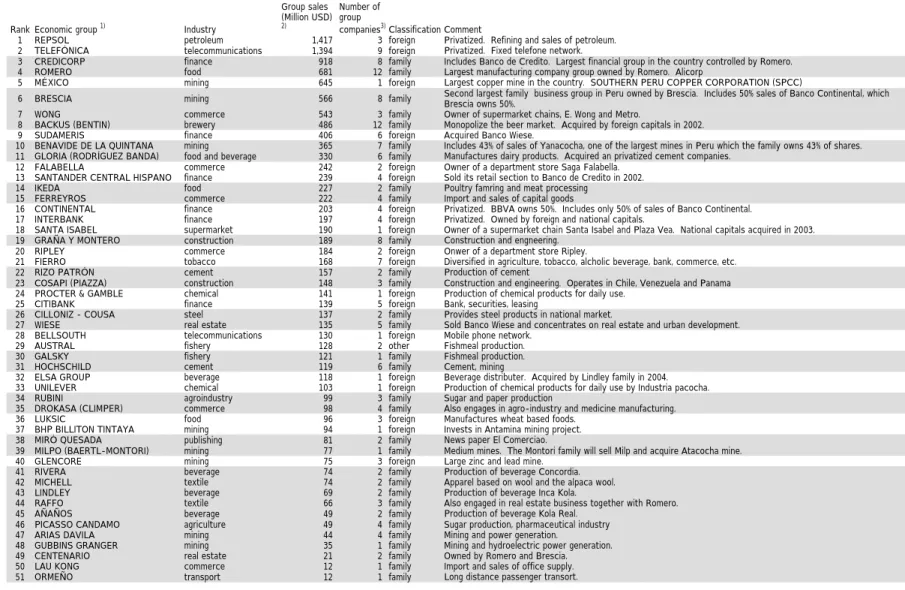
In order to closely examine the competition between foreign capitals and Peruvian family businesses, Table 2 listed 51 economic groups identified by Peru Top Publications in 2001. Among these, the author classified 19 groups as that of foreign capitals, 31 as family business and 1 as other.
This table shows that the presence of foreign capitals is very strong in petroleum, telecommunications and banking industries. These are the industries that demand huge capital and latest technologies. Spanish companies such as Repsol in petroleum, Telefónica in telecommunications and Banco Bilibao Vizcaya in banking, which had participated in privatization process in Latin American region, made inroads upon Peruvian market. Meanwhile, Peruvian family business companies maintain their presence in construction, cement, agriculture, real estates and textile industries. These are the ones from which families started their business. Compared with petroleum, telecommunication and banking industries, the sizes of capital required in these industries are very small. In the industries such as mining, commerce and beverage, food and toiletry, foreign capitals and family business are competing. In mining industry, large corporations such as Southern Peru Copper Corporation and Minera Yanacocha6 are foreign capitals while small and medium sized mines are controlled by family business. In commerce, modern retail store chains such as Saga Falabella and Reipley are dominated by foreign capitals while in supermarket, which needs numerous local suppliers, family business such as Wong is competitive. In beverage, food and toiletry industry, Peruvian family businesses such as Alicorp, Backus, Lindley (Inca Kola) are competing fiercely with international brands such as Coca Cola, P&G, Uniliver.
6 U.S. company Newmont holds 51.35% of shares while Peruvian company
3. Cases from Three Family Businesses in Peru
This section attempts to analyze how family businesses in Peru have been trying to survive in the competitive business environment since the 1990s by closely examining their control of ownership and management of three representative family businesses in Peru, namely Romero, Brescia and Backus (Bentín family). Romero group consists of Banco de Crédito, the largest commercial bank in the country, and Alicorp, the largest industrial company in private sector by national capital. Brescia group owns a half of Banco Continental, one of the four major commercial banks in the country, and Minsur, one of the largest tin producers in the world. It used to own Tejido La Unión, the biggest textile industrial group in the country at the end of the 1980s. Bentín family had been a major shareholder of Cervecería Backus & Johnston (Backus), the leading brewery in the country. Since the second half of the 1990s, Backus absorbed its competitors and established a monopoly. However, a Colombian brewery Bavaria acquired majority of its share in 2002. In this paper, Backus is treated as Bentín’s family business prior to its acquisition by Bavaria. In the following sections, brief history of each family is overviewed followed by analysis of control over ownership and management.
3-1. Romero Group: The Biggest Family Business in Peru
3-1-1. Brief History
The origin of Romero’s family business came from the foundation of C. Romero & Co. by Calixto Santo Romero, a Spanish immigrant, in the 1880s. The company was based in Piura, northern coastal department of Peru. It was involved in export of panama hats, which were typical handicrafts of the area. There was strong demand for panama hats in the international market, and Calixto accumulated capital through this business and invested into cotton ginning factories. In order to compete with other ginning factories for raw material, Calixto began helping farmers finance their cultivation, then bought cotton farms and launched to cultivate cotton in order to supply his ginning factories. He also invested in Banco Italiano in 1918. In 1920s,
he expanded his business to cotton oil production, and the company became familiar in the region. According to Vásquez (2000 p.114), the company started to appoint professional mangers and agronomists who played important roles for introduction of new Pima variety of cotton in the region. At the same time, Calixto helped his relative, Feliciano del Campo Romero, to study economics and finance in England. Feliciano succeeded Calixto’s business after his death in 19357.
It was Feliciano who pushed Romero’s family business to a nationwide business group through diversifying its business into the financial sector. In 1951, Feliciano participated in a foundation of Banco Continental, and invested in an insurance company El Pacífico Compañía de Seguros y Reaseguros. Furthermore, he established a trading company, Calixto Mostert, a joint venture with a foreign capital. C. Romero & Co. is divided into a few specialized companies such as: Almacenes Romero S.A. (import of agricultural input and sales of oil based products), Romero S.A. (finance cotton cultivation and ginning), Romero & Co. Agents (trade agent). It also invested in brewery Backus through the Lima stock exchange.
During the military government of Velasco in the late 1960s and the early 1970s, industrialization through import substitution policy gave preference to national capitalists over foreign capitalists. This policy helped Dionisio Romero Seminario, the third generation of the family, expand his family business. Dionisio, who was appointed as a director of the state Industrial Bank, took advantage of his position and received loans to establish a textile company in Piura. Furthermore, Romero group bought ginning and vegetable oil plants from Anderson Clayton, which decided to withdraw from Peru because of unfavorable business environment for foreign capitals. Through this acquisition, Romero obtained not only large scale production base but also a new management system of Anderson Clayton. In a financial sector, the military government imposed a restriction on participation of foreign capitals. They are allowed to own only up to 20% of stocks of banks in the country. Romero family, together with other minority shareholding families of Banco de Crédito (ex Banco Italiano) such as Brescia, Raffo, Nicolini, increased their participation in the bank by purchasing stocks released by Banque Sudameris. In 1979, these Peruvian families
7 According to Malpica (1989 p.83), Calixto’s children, Dionisio and Francisca Romero
took over the control of the bank, and Dionisio became the president of the board. By the 1980s, Romero group became one of the biggest family businesses in the country. Although it faced a crisis of nationalization of Banco de Crédito in the late 1980s, Romero managed to get away with the nationalization by selling its stocks to the employees, and transfer some of its assets to its subsidiaries established outside of the country. After the liberalization of economy at the beginning of the 1990s, Romero recovered the control of Banco de Crédito. The bank expanded not only in the country, but also in the Andean region through acquiring banks in Bolivia, Colombia and Ecuador. In textile sector, a group’s spinning company expanded its export by introducing foreign technology and building a new factory together with a foreign capital. In consumer goods (food and toiletry products) sector, Romero purchased La Fabril, one of the biggest companies in the sector by foreign capital of Bunge y Born, then absorbed Nicolini Hermanos, the biggest flour milling company, and established Alicorp.
3-1-2. Control over Ownership and Management
Based on the ownership and management structure, companies of Romero group can be classified into three sub-groups (Chart 2-1, 2-2). The first one is a financial sub-group (Credicorp group). Although Romero famlily does not own majority shares of Credicorp, holding company of Banco de Crédito, companies in this sub-group are considered to belong to Romero group. The second sub-group includes Alicorp and its related companies (Alicorp group). Romero family seems to own majority of these companies, but there are also other important share holders. The third sub-group is companies in commerce and agriculture sector (Ransa group). The companies in this sub-group are exclusively owned and controlled by the family8.
With respect to Credicorp group, although Romero family can have a strong influence over the companies as the largest shareholder, the family alone does not have total control over its ownership and management. The family owns 15% of shares issued by Credicorp while the rest are owned by pension funds and other families. In insurance sector, Credicorp owns 76% of Pacífico Peruano Suiza while an U.S.
8 CONASEV and Peru Top Publications divide Romero’s family business into two
insurance company A.I.U. owns 20% and other Peruvian families also have some shares. This ownership structure is reflected to the composition of board members (Table 3). Dionisio Romero Seminario, the leader of the third generation of Romero family, is the president of board in many group companies in Credicorp group accompanied by some of the family members as board members. Besides Romero family, representatives from minor shareholding families such as Nicolini, Verme, Llosa, Raffo are included in the board member. The insurance companies have different board members from different minority shareholding families and representatives from A.I.U. As to management teams9, family representatives do not serve as managers and leave day-to-day management to professional managers headed by Raymundo Morares. He and other mangers such as Carlos Muños (assistant general manager), José Luis Gagliardi (manager in administration) have been in an important position in foreign banks, and the first two acquired MBA degree from Wharton School.
With respect to Alicorp group, it is difficult to determine how much stocks the family holds. However, judging from the fact that the important part of Alicorp is composed of Romero’s family companies, such as Consorcio Distribuidora and Cía Industrial Perú Pacífico, Romero family is likely to still own majority. At present, U.S. grain giant, Cargil, and pension funds own some part of its shares (Table 2-2). The president of the board is Dionisio Romero Paoletti, the son of Dionisio Romero Seminario and the leader of the fourth generation of the family. His cousin, Ernesto Romero Belismelis stays in the position of vice president. According to the Peru Top Publications, the fact that Dionisio Romero Seminario transferred the presidency of Alicorp and Ransa groups to his son is to disperse the risk of the family and to increase transparency of group companies10. Also, the management team of Alicorp includes some family members. This can be interpreted as a training for young family members. In case of textile companies in Alicorp group, representatives from other participating families serve as board members. In addition, some family members serve as managers in these companies. In this sub-group, both ownership and management are mostly controlled by the family.
9 Management teams consist of managers listed in CONASEV’s corporate information
as “Plana Gerencial,” which includes general manager (gerente general) and other managers.
Finally, Ransa group consists of companies such as Ransa Comercial (logistics), Romero Trading (export of agricultural products), Palma de Espino and Industria de Espino (cultivation of palm trees and production of palm oil), etc. As Table 2-2 shows, Romero family owns 100% of these companies, and dominates the board lead by Dionisio Romero Paoletti.
3-2. Brescia Group: Recover from a Failure in Textile
3-2-1. Brief History
Brescia is the second largest family business group in the country at the moment. After working for a retail store owned by an Italian, an Italian immigrant Fortunato Brescia (Chart 3) purchased small farms and started to produce wheat and dairy products in order to supply retail stores in Lima. With capital accumulated through this business, he bought larger farms close to Lima to increase agricultural production for urban consumers. When the city started to expand in the 1930s, his farm land became an objective of urbanization and its value rapidly increased. In the 1940s, Prado government expropriated a part of Brescia’s farm in Limatambo, a suburb of Lima, in order to construct an airport. Although it was a loss in a short term, the increase of land value around the airport that was owned by Brescia benefited the family in a long term. Fortunato established a real estate developer company, Urbanizadora Jardín, and real estate became a core business of the family.
After the decease of Fortunato, his sons, Pedro and Mario Bresica Cafferata took over the family business developed by their father. Brescia brothers invested profit earned by the real estate sector into fishery and mining sector, which went through a boom at that time. At the end of the 1950s, when fish meal boomed because of the increase of demand as livestock feed, they established a fish meal factory outside of Lima, which became one of the five largest producers in the country. When the mining boom occurred in the 1970s because of high metal price in the international market, the family invested in the redevelopment of mines owned by the family. However, both booms did not last so long.
Although the family experienced a great loss because of expropriation of its farmland and fish meal factory by the Velasco government, Brescia brothers diversified
their business activities taking advantage of withdrawal of foreign capitals. While increasing participation in Banco de Crédito along with Romero and other Peruvian families, Brescia increased its participation in insurance companies, Compañía de Seguros Rímac and Compañía Internacional de Seguros del Perú. At the same time, the family bought mines owned by an U.S. company W.R. Grace (Cía Minera Atacocha and Minsur) and a textile company formally owned by a British Duncan Fox (Fábrica de Tejidos la Unión). By the end of the 1970s, Brescia’s family business had grown to include real estate, banking, insurance, textile, chemical, mining, etc. Especially, Fábrica de Tejidos la Unión, with the acquisition of supermarket chains, became a largest conglomerate in Peru’s industrial sector in the 1980s. Although Brescia brothers stayed in positions of the president and the vice-president of the textile company, they left its management to professional managers who had been involved in managing it since before. When the company went into trouble by guaranteeing debts by other Brescia group companies, the brothers were forces to leave from the board. In the 1990s, when the liberalization of market allowed cheap import of textile, the company faced with competition against the imported. Brescia brothers decided to sell the company to its former executives, and lost the conglomerate.
In the 1990s, Brescia sought a new expansion. It participated in a privatization of Banco Continental together with Spanish bank Banco Bilbao Viscaya (it is now Banco Bilbao Vizcaya Argentaria: BBVA). While Brescia holds 50% of its stocks and the position of president of the board, the management of the bank is controlled by BBVA. Furthermore, Brescia made a large investment in Minsur and built a foundry, which generated big profit for the family and made Minsur one of the largest tin producers in the world. Furthermore, the family invested in tourism industry, owning and running a chain of five-star hotels in major cities in the country.
3-2-2. Control over Ownership and Management
Based on the ownership and management structure, companies of Brescia group can be divided into three sub-groups (Chart 4). The first sub-group includes Banco Continental and other financial companies (financial group). The second sub-group is holding companies of Brescia family such as Inversiones Breca (family holdings group). The third sub-group includes other companies for mining, tourism,
insurance, etc (industrial group).
In the financial group, Brescia and BBVA each has 50% of Holding Continental, which owns most of Banco Continental and little more than half of a pension fund AFP Horizonte. BBVA directly invests in AFP Horizonte together with other Spanish and Chilean capitals. The list of board members in Table 4 shows that Brescia brothers are the president and the vice-president of the board along with other younger family members as directors. Some representatives from BBVA are also on the board. With respect to the management, the team consists of highly educated and experienced professional managers. José Antonio Colomer, board member and general manager, acquired MBA from a Spanish university and had served in BBVA’s affiliates in Latin America before joining Banco Continental. The assistant general manager, Jose Luis Casabonne Rickets, is ex-general manager of a pension fund, and the financial manager, Enrique Pellejero Collado, was ex-substitute director of a pension fund. The managers of AFP Horizonte consist of those who acquired business degrees, and board members of financial subsidiaries include ex-managers of the bank. Taking these facts in consideration, it can be argued that the financial companies are run by non-family professional managers.
The second sub-group, family holding group, includes investment (holding) and real estate development companies. Four brothers and sisters of Brescia Caferrata personally own shares of these companies, and family members are directors and managers. These are typical family business companies in which family controls exclusively its ownership and management.
Finally, the rest of Brescia group companies can be classified as the business group, in which Brescia family controls majority shares, but other families participate in the board as minority share holders. In this sub-group, directors and managers are distinctly different. For example, the managing team of a chemical company EXSA is composed of specialists in economics, chemistry and metal engineering. It is likely that Brescia family leaves most part of operation to these professional managers.
3-3. Backus Group: Integration of Beer Industry and Acquisition by Foreign Capital
3-3-1. Brief History11
Today, Peru’s brewing industry is monopolized by Unión de Cervecerías Peruanas Backus y Johnston (Peruvian Brewery Union Backus and Johnston: UCPBJ). The brewery, Cervecería Backus & Johnston (Backus), was founded by two Americans, Jacob Backus and Howard Johnston, at the end of 19th century just outside of Lima city. The relationship between Backus and Bentín family started when Ricardo Bentín Sanchez purchased some shares of B&J at the end of 1910s. Bentín was already an eminent family in Peru at that time. Antonio Bentín y La Fuente, father of Ricardo Bentín, was the prime minister, and Ricardo Bentín himself was the vice-chairperson of the congress. His wife, Rosa Mujica Carassa was also from an eminent family of Mujica. Her father Elías Mujica y Trasmonete was a director of Companía Nacional de Cerveza (CNC), a competitor of Backus, and his brother Carlos Mujica Carassa was the president of CNC (Chart 5).
When B&J was transferred from English management to Peruvian in the 1950s, Ricardo Bentín Mujica, son of Ricardo Bentín Sanchez, became the vice president of the company. Later he became the president and controlled its management in cooperation with other share holding families such as Olaechea and Berckemeyer. Meanwhile, Piaggio family, which owned CNC but has left the management to Mujica family since the turn of the century, regained the control of the company in the 1950s. Although Backus and CNC were competitors, they held shares each other, and jointly established Maltería Lima, which supplied malt for both breweries. Under the Velasco government, both companies expanded taking advantage of government policy to promote national industries. They established oligopoly in beer market: Lima market for Backus and regional market for CNC.
After the decease of Ricardo Bentín Sanchez in 1979, some of the family members sold Backus shares to other families such as Romero, Raffo and Brescia. All of them were directors of Banco de Crédito. Consequently the control of ownership of
11 Malpica (1974), Vásquez (2000), Durand (2000), and CONASEV, information of this
Bentín family were weakened. As of 1984, Bentín had 14% of Backus shares while Brescia, Romero and Raffo families had 19% in total, Backus and its subsidiaries had 11%, and Olaechea and Berckmeyer had 5%. Bentín prevented a take over by Brescia, Romero and Raffo families by seeking help from other families.
In 1990s, Backus started to consolidate its position in the market by acquiring its competitors. First, Backus acquired CNC and obtained 65% of the national market in 199412. In 1996, Backus established UCPBJ merging Backus, CNC and its two subsidiaries. In 2000, UCPBJ finally acquired most shares of Cervesur, another rival brewery that had strong presence in the southern part of the country. Today, there are three brewing companies in Peru, UCPBJ, Cervesur and Cervecería San Juan, all of which belong to Backus group.
3-3-2. Control over Ownership and Management
The control of ownership (Chart 6) and management (Table 5) as of year 2000 is studied in this paper. From the observation on these data, some differences with Romero and Brescia groups can be pointed out. First, important shares of the core company of the group, UCPBJ, are held by Minsur, Brescia’s mining company, and Pacífico Peruano Suiza, Romero’s insurance company. Although Bentín family does not appear as a major share holder in the CONASEV’s record, some news reports revealed that Bentín family owned 30% while Bresica and Romero had 22% and 12% respectively13. Second, UCPBJ owns most part of shares of the group companies. There is no sub-groups within the family business groups that were discussed in Romero and Brescia. Third, there is more participation of other families in the board. These facts show that the control of Bentín family over ownership and management of the group companies is not as strong as that of Romero and Brescia over their groups.
Two factors might be affecting the control of Bentín family over Backus group. The first is that the shares of Backus were widely held among a large number of family members. Although the history of Backus as a family business is not very long, for about a half century after Ricardo Bentín Sanchez assumed the presidency of the
12 Lanatta Piaggio, who controlled CNC, needed cash to rebuild the group’s food
company, Molitalia. However, the family later sold Molitalia to a Chilean company, and its family business disappeared.
company, Bentín family itself is a very eminent family with large family members. After the sales of shares to other families by some Bentín family members in the 1980s, there were still 15 shareholders with Bentín family name in 1987. Furthermore, unlike Brescia’s investment and real estate development companies, which serve as family’s holding company, Bentín did not have any means to concentrate and coordinate family’s shares.
The second reason of Bentín’s weak control over the group is that the family itself did not start brewing business. In case of Romero and Bresica, they started their own business and invested their profit in order to expand in size and scope. However, in case of Bentín, they gained the control of Backus by acquiring relatively large shares of the brewery. There was no exclusive control over ownership or management by Bentín family from the beginning.
3-3-3. Sales to Foreign Capitals
Brewing companies in other Latin American countries have found potential in Peruvian market due to relatively low consumption of beer per capita. Since the end of the 1990s, they became interested in acquiring B&J. Upon being offered high prices by foreign capitals, minor shareholding families like Brescia, Romero and Raffo sold their shares. Finally in 2002, Bavaria, a Colombian brewing company, obtained majority of UCPBJ’s shares. Although Bentín family still holds 12% of stocks and their family members serve as the vice-president of the board and the general manager, it can no longer be called as Bentín’s family business.
4. Family Control over Group Companies
4-1. Three Sub-groups in Family Business
The above analysis shows that companies in a same family business group can be classified into three sub-groups according to characteristics of family’s control over ownership and management: (1) companies with exclusive control over both ownership and management by a family (EXCLUSIVE); (2) companies with a strong control by a family, but not exclusive (MAJOR); (3) companies in which control is shared with other families or foreign capitals (JOINT).
Companies such as Ransa Comerical, Romero Trading in Romero family and Inversiones Breca in Brescia family can be classified as the EXCLUSIVE sub-group. In this sub-group, family members, including females, directly own shares of group companies. At the same time, family members are board members, and often serve as managers. These companies belong to industries like agriculture and commerce as in Romero, and real estate development as in Brescia, with which the families built the base of their business. In these industries, family businesses have an advantage of owning large farm lands and distribution networks all over the country. The amount of capitals necessary for the development of these industries is not very large, and families can finance by themselves. Besides, family members themselves have knowledge and know how of the business.
Companies that belong to MAJOR sub-group are Alicorp of Romero, Minsur, Rimac and Exsa of Brescia. Judging from composition of shareholders and board members, one family seems to have majority shares of these companies with the participation of other families. The leading families secure the posts of the president and some directors, but other families also participate in the board, sometimes exercising influence with their expertise and experience in the industry. While directors make important decisions of the companies, day-to-day management is left for professional salaried managers who do not belong to the families. Sometimes, younger family members participate in the management of the companies as managers. This can be considered as trainings for younger members of the family. Through the expansion into the manufacturing sector for the national market such as production of wheat flour based food industry, beverage, toiletry products, chemical products, etc., the family business becomes known to the national level. In these sectors, foreign capitals have been competing with family businesses since before the liberalization of economy in the 1990s. It is important to seek human, financial and technical resources from outside of the family for the success in these sectors.
Finally, companies that belong to JOINT sub-group are Banco de Crédito, El Pacífico Peruano Suiza (insurance) for Romero and Banco Continental and AFP Horizonte for Brescia, and brewery Backus for Bentín family. The leading family often does not own majority shares, though, with help from other collaborating families, the leading family stays in posts of the president and some directors. The family
control over ownership and management of companies in this sub-group is not as strong as that in other sub-groups. Professional paid managers with higher education and rich experience are involved not only in day-to-day decision making but also in strategic decision of the companies. Companies belong to JOINT sub-group are seen in financial sector such as banking, insurance, pension funds, and large scale mining projects, in which speed of technological innovation and management is very fast, and companies are competing across boarders due to the liberalization of economy. Beer industry, which is now facing regional integration, is also included in this sub-group. It is indispensable for a family in order to obtain huge capital and highly educated and experienced human resources.
4-2. Controlling Three Sub-groups
As mentioned above, companies that belong to family businesses in Peru can be classified into three sub-groups according to their control over ownership and management: EXCLUSIVE, MAJOR and JOINT. The families first started their businesses with EXCLUSIVE companies. Then, with MAJOR companies, they expand their scale and scope of the family businesses. In the process of the economic liberalization after the 1990s in which higher competitiveness is required for survival, family businesses sought their business partners abroad and incorporated JOINT companies in order to obtain resources. In other words, the evolution of a joint stock company and separation of ownership and management argued by Chandler did not happen in many family business companies in Peru. The families, while keeping exclusive control of ownership and management over their traditional businesses of EXCLUSIVE companies in order to protect family assets, they combine different kinds of companies such as MAJOR and JOINT depending on business environment in order to expand socio economic influence of the family. In the case they face with adverse business environment, they can sell MAJOR and JOINT companies while surviving with EXCLUSIVE companies, such as in the case of Brescia, which sold Tejidos La Unión at the beginning of the 1990s, and wait for another opportunity.
Among three sub-groups, JOINT companies, in which control is shared with other families or foreign capitals, have played important roles in the history of family business in Peru. Families that have some kind of connection, for example, securing
posts in the board of the same bank, often collaborates each other in their businesses, making possible to raise capitals and share risks. For example, when two breweries, Backus and CNC owned their shares each other, Bentín and Piaggio families together established a company that provides materials for both companies in order to reduce the production cost. Also, Romero and Raffo, both of which have been in the board of Banco de Crédito, are partners in insurance, textile and urban development businesses. JOINT companies have helped families to build and expand the network among them.
In addition, JOINT companies have a mechanism to prevent failure through mutual monitoring among participating families. In the case that a family that takes the lead in managing the company cannot satisfy other participating families, they try to take over the control of management by acquiring shares from other minority shareholders. Romero, together with other Peruvian families, gained the control of Banco de Crédito at the end of the 1970s from the hands of the Italian bank. Also, at the beginning of the 1980s when Brescia tried but failed to gain the control of Banco de Lima, which was controlled by Olaechea family, this attempt put pressure on the leading family to improve management of the business. Furthermore, JOINT companies, which have been based on collaborations among Peruvian families, are established during the 1990s with foreign capitals in order to obtain financial, human and technical resources that cannot be obtained inside the country.
Concluding remarks
By focusing on the control over ownership and management, this paper attempts to analyze how family businesses in Peru have expanded their scale and scope, and are trying to survive after the liberalization of the economy. The word “Family Business” often makes us think of a typical family business in which family exclusively controls both ownership and management of their group companies, also in which family members are shareholders, directors and managers. However, as can be observed through the case studies, there are different kind of companies in Peru’s family businesses. First, the families started their business in commerce, real estate, agricultural export, etc. These enterprises became the bases of their family business, and the families keep exclusive control on both ownership and management. Second,
during the period of industrialization by import substitution, the families expanded scale and scope of their businesses through purchasing enterprises from foreign capitals that withdrew from the country. In these businesses, the families control majority of ownership and management, but they accept capitals and directors from other families in order to share risks and supplement resources. Third, during the market economy reform in the 1990s, the families actively made alliances with other families and foreign capitals in order to obtain financial, human and technical resources that could not be obtained within the families. Although the leading families do not have absolute control over the ownership of the companies, they keep control over management through collaboration with other participating families. This is how family businesses in Peru maintain themselves today.
The business environment surrounding Peru’s family businesses is getting more competitive due to the liberalization of the economy during the 1990s. In the privatization process, only foreign capitals participated in industries that requires great amount of capital, such as petroleum and telecommunications. No Peruvian family business was able to participate in it. Even though in the industries in which family businesses are considered to have advantages over foreign capitals, such as beer industry in which loyalty to brands and distribution channels play important roles, Peruvian families cannot compete with foreign capitals that have enough financial resources to acquire a whole company, as in the case of acquisition of Backus.
The sales of Backus also raised an important issue on survival of family business. One of the reasons of the acquisition by a foreign capital is that shares of the company were widely held among Bentín family, and some family members sold their shares for their individual interest, rather than the family interest. Bentín is a distinguished family with a large number of family members, and the spread of ownership within the family was wider than others. There was no mechanism to coordinate the interest of the Bentín family as a whole, such as family holding company or family trust, which can be seen in other Latin American family businesses. This was the reason why the family finally lost its control. Toward the future expansion of family business in Peru, this case suggests that the families need to introduce some mechanism to coordinate family interest such as family council, family holding company, etc.
References
“Accionista minoritarios pierden: Venden fuera de Bolsa 21.9% de Backus,” agenciaperu, 16 de julio del 2002. (www.agenciaperu.com/economia/ 2002/jul/backus.htm) February 2004.
Anaya, Eduardo (1990) Los grupos de poder económicos: Un análisis de la oligarquía financiera, Lima: Editorial Horizonte.
Chandler, Alfred D. (1995) “Managers, Families and Financiers,” in M. Rose ed. Family
Business, Aldershot, UK: Edward Elgar Publishing Ltd.
Consejo Nacional de Empresas y Valores: CONASEV(http://www.conasev.gob.pe/) December 2003 – February 2004.
Durand, Francisco (1996) Incertidumbre y soledad: Reflexiones sobre los grandes
empresarios de Amrérica Latina, Lima: Fundación Friedrich Ebert.
Durand, Francisco (2002) “Backus y la desaparición de los apóstoles,” Quehacer, No. 138.
Hoshino, Taeko ed. (2003) Hattentojokoku no family business (Family business in developing countries), Chiba: IDE-JETRO.
Hoshino, Taeko ed (2004) Family business no keiei to kakushin (Evolution and management of family business), Chiba: IDE-JETRO, forthcoming.
“La guerra de las cervezas,” Caretas, No. 1733, 8 de agosto de 2002. (www.caretas.com.pe-2002-1733-articulos-cerveza.phtml) February 2004. La Porta, Rafael, Florencio Lopez-de-Silanes, and Andrei Shleifer (1999). “Corporate
Ownership Around the World,” The Journal of Finance, Vol.LIV, No. 2. Malpica, Carlos (1974) Los dueños del Perú, Lima: Ediciones PEISA.
Malpica, Carlos (1989) El poder económico en el Perú (Tomo I: Los bancos nacionales y sus filiales. Tomo II: Accionistas de financieras, seguros, bancos regionales y otros empresarios nacionales.), 2a edición, Lima: Mosca Azul Editores.
Miller, Rory (1999) “Business History in Peru,” in C. Dávila and Rory Miller eds.,
Business History in Latin America: The Experience of Seven Countries,
Liverpool: Liverpool University Press.
Morikawa, Hidemasa (1996) Toppu maneijimento no keieishi: Keieisha kigyo to kazoku
kigyo (History of top management: managerial enterprise and family
enterprise). Tokyo: Yuhikaku.
Morris, Felipe e Italo Muñoz (2000) “La reforma del mercado de capitales,” en Abusada, et. al., La reforma incompleta, Lima: Universidad del Pacífico.
Nakagawa and M. Yatani eds.Raten America shokoku no keizaihousei (Law on economy in Latin America), Tokyo: Institute of Developing Economies.
Parodi, Carlos (2000) Perú 1960 – 2000: Políticas económicas y sociales en entornos
cambientes, Lima: Universidad del Pacífico.
Peru Reporting (1988) Peru The Top 1,500 Companies, Lima Peru Reporting. Peru Reporting (1996) Peru The Top 5,000 Companies, Lima Peru Reporting.
Peru Top Publications (2003) Peru: The Top 10,000 Companies, Lima: Peru Top Publications.
Sanchez, Luis Alberto (1978) Historia de una industria peruana: Cervecería Backus y
Johnston S.A., Lima: Cervecería Backus y Johnston S.A.
Thorp, Rosemary and Geoffrey Bertram (1985) Peru: 1890 – 1977 Crecimiento y
políticas en una economía abierta, Lima: Mosca Azul Editores.
Vásquez Huamán, Enrique (2000) Estrategias del poder: Grupos económicos en el
Table 1 Number and their share in sales according to types of companies
Top 100 companies Top 50 companies
1987 1994 2001 1987 1994 2001 Number Share in sales Number Share in sales Number Share in sales Number Share in sales Number Share in sales Number Share in sales State owned 28 48.5% 14 33.4% 12 20.6% 20 58.6% 10 39.7% 7 23.2% Foreign capital 25 20.6% 30 33.2% 41 48.5% 12 18.6% 18 35.1% 25 52.0% Family owned 43 28.9% 46 28.8% 30 23.1% 17 21.8% 19 22.5% 15 20.9% Others 4 2.1% 10 4.6% 17 7.7% 1 1.1% 3 2.8% 3 4.0% (Source) Elaborated by author from the company ranking in Peru Reporting (1988, 1996) and Peru Top Publications (2003).
Table 2 Major economic groups in Peru (2001)
Rank Economic group 1) Industry
Group sales (Million USD) 2)
Number of group
companies3)Classification Comment
1 REPSOL petroleum 1,417 3 foreign Privatized. Refining and sales of petroleum. 2 TELEFÓNICA telecommunications 1,394 9 foreign Privatized. Fixed telefone network.
3 CREDICORP finance 918 8 family Includes Banco de Credito. Largest financial group in the country controlled by Romero. 4 ROMERO food 681 12 family Largest manufacturing company group owned by Romero. Alicorp
5 MÉXICO mining 645 1 foreign Largest copper mine in the country. SOUTHERN PERU COPPER CORPORATION (SPCC)
6 BRESCIA mining 566 8 family Second largest family business group in Peru owned by Brescia. Includes 50% sales of Banco Continental, whichBrescia owns 50%. 7 WONG commerce 543 3 family Owner of supermarket chains, E. Wong and Metro.
8 BACKUS (BENTIN) brewery 486 12 family Monopolize the beer market. Acquired by foreign capitals in 2002.
9 SUDAMERIS finance 406 6 foreign Acquired Banco Wiese.
10 BENAVIDE DE LA QUINTANA mining 365 7 family Includes 43% of sales of Yanacocha, one of the largest mines in Peru which the family owns 43% of shares. 11 GLORIA (RODRÍGUEZ BANDA) food and beverage 330 6 family Manufactures dairy products. Acquired an privatized cement companies.
12 FALABELLA commerce 242 2 foreign Owner of a department store Saga Falabella. 13 SANTANDER CENTRAL HISPANO finance 239 4 foreign Sold its retail section to Banco de Credito in 2002. 14 IKEDA food 227 2 family Poultry famring and meat processing
15 FERREYROS commerce 222 4 family Import and sales of capital goods
16 CONTINENTAL finance 203 4 foreign Privatized. BBVA owns 50%. Includes only 50% of sales of Banco Continental. 17 INTERBANK finance 197 4 foreign Privatized. Owned by foreign and national capitals.
18 SANTA ISABEL supermarket 190 1 foreign Owner of a supermarket chain Santa Isabel and Plaza Vea. National capitals acquired in 2003. 19 GRAÑA Y MONTERO construction 189 8 family Construction and engneering.
20 RIPLEY commerce 184 2 foreign Onwer of a department store Ripley.
21 FIERRO tobacco 168 7 foreign Diversified in agriculture, tobacco, alcholic beverage, bank, commerce, etc.
22 RIZO PATRÓN cement 157 2 family Production of cement
23 COSAPI (PIAZZA) construction 148 3 family Construction and engineering. Operates in Chile, Venezuela and Panama 24 PROCTER & GAMBLE chemical 141 1 foreign Production of chemical products for daily use.
25 CITIBANK finance 139 5 foreign Bank, securities, leasing
26 CILLONIZ - COUSA steel 137 2 family Provides steel products in national market.
27 WIESE real estate 135 5 family Sold Banco Wiese and concentrates on real estate and urban development. 28 BELLSOUTH telecommunications 130 1 foreign Mobile phone network.
29 AUSTRAL fishery 128 2 other Fishmeal production.
30 GALSKY fishery 121 1 family Fishmeal production.
31 HOCHSCHILD cement 119 6 family Cement, mining
32 ELSA GROUP beverage 118 1 foreign Beverage distributer. Acquired by Lindley family in 2004. 33 UNILEVER chemical 103 1 foreign Production of chemical products for daily use by Industria pacocha. 34 RUBINI agroindustry 99 3 family Sugar and paper production
35 DROKASA (CLIMPER) commerce 98 4 family Also engages in agro-industry and medicine manufacturing.
36 LUKSIC food 96 3 foreign Manufactures wheat based foods.
37 BHP BILLITON TINTAYA mining 94 1 foreign Invests in Antamina mining project. 38 MIRÓ QUESADA publishing 81 2 family News paper El Comerciao.
39 MILPO (BAERTL-MONTORI) mining 77 1 family Medium mines. The Montori family will sell Milp and acquire Atacocha mine.
40 GLENCORE mining 75 3 foreign Large zinc and lead mine.
41 RIVERA beverage 74 2 family Production of beverage Concordia. 42 MICHELL textile 74 2 family Apparel based on wool and the alpaca wool. 43 LINDLEY beverage 69 2 family Production of beverage Inca Kola.
44 RAFFO textile 66 3 family Also engaged in real estate business together with Romero. 45 AÑAÑOS beverage 49 2 family Production of beverage Kola Real.
46 PICASSO CANDAMO agriculture 49 4 family Sugar production, pharmaceutical industry 47 ARIAS DAVILA mining 44 4 family Mining and power generation.
48 GUBBINS GRANGER mining 35 1 family Mining and hydroelectric power generation. 49 CENTENARIO real estate 21 2 family Owned by Romero and Brescia. 50 LAU KONG commerce 12 1 family Import and sales of office supply. 51 ORMEÑO transport 12 1 family Long distance passenger transort.
(note) 1) Gray shades show family business. When a group name is different from the family name, the family name is shown in parenthesis.
2) Sum of sales by group companies recognized by Peru Top Publications. In cases of No. 6, 10, 16, sums of sales are calcutaed according to ownership share. The average exchange rate for 2001 is US$1.00=S/. 3.507. 3) Only includes companies with sales figures.
Table 3 Directors and managers of major companies in Romero group
Name1) Family Credicorp Banco de Credito PacificoPeruano Suiza Alicorp Cía UniversalTextil Ransa ComercialRomeroTrading
ROMERO SEMINARIO DIONISIO ROMERO President President
ROMERO SEMINARIO CALIXTO ROMERO President FORT MARIE FERNANDO ROMERO Director Director
ROMERO PAOLETTI DIONISIO ROMERO Director Director President President President President ROMERO BELISMELIS LUIS ROMERO Alternative Director and
Manager of Finance
Vice President Vice President Substitute Manager3)
ROMERO BELISMELIS ERNESTO ROMERO Vice President Vice President ROMERO BELISMELIS MANUEL ROMERO Alternative Director3) Director
ROMERO BELISMELIS FERNANDO ROMERO General
Manager ROMERO GUZMAN CALIXTO ROMERO Director Director Director
BEECK ONRUBIA JAVIER ROMERO Director Director
ONRUBIA HOLDER JOSE ANTONIO ROMERO Alternative Director and Manager of Sales
Director Director Substitute Manager3)
NICOLINI BERNUCCI LUIS NICOLINI Vice President Vice President Director NICOLINI BERNUCCI ERNESTO NICOLINI Director Director CAMET DICKMANN JORGE Director
ISOLA CAMBANA JUAN BAUTISTA Director LLOSA BARBER REYNALDO LLOSA Director Director
LLOSA ISENRICH JUAN LLOSA Assistant General Manager NIERI GALINDO LUIS Director
VERME GIANNONI JUAN CARLOS VERME Director Director WOODMAN POLLIT ARTURO Director YARUR REY LUIS ENRIQUE Director Director
MONTERO FERNANDO Director
MORALES DASSO RAIMUNDO MORALES General Manager General Manager MUÑOZ SEMSCH CARLOS Assistant General Manager Assistant General Manager GAGLIARDI WAKEHAM JOSE LUIS Manager
RODRIGO SANTISTEVAN ARTURO Manager General MORALES DASSO JOSE MORALES Director
RAFFO NOVELLI JUAN FRANCISCO RAFFO Director Director LEMAITRED D. MAXIMILIANO AIU2) Director
PALACIOS REY CARLOS PALACIOS Director RIZO PATRON DE LA PIEDRA RICARDO RIZO PATRON Director RIZO PATRON LEGUIA JUAN CARLOS RIZO PATRON Manager
BIAGIONI ETTORE BANKERS TRUST2) Director
PURCELL LA BRECQUE TIMOTHY JP MORGAN2) Director
PIER DIEZ CANSECO LESLIE General Manager
PALACIOS REY ENRIQUE PALACIOS Director
SEMINARIO DE LA FUENTE JAVIER General Manager
IRAZOLA ARRIBAS ANGEL Director
FANTOZZI TEMPLE EMILIO ANTONIO General Manager
CAMPBELL GARCIA RONALD Director
(note) Romero family members are shown with gray shades.
1) Names include Paternal family name, maternal family name, first name and middle name) . 2) Representative of investing companies and investment banks.
3) Both alternative and substitute directors act as directors in case of their absence.
(Source) Elaborated by author based on annumal reports obtaiend from CONASEV homepage (www.conasev.gob.pe).
Table 4 Directors and managers in major companies of Brescia family
Name1) Family Banco Cintinental Seguro Rimac EXSA Minsur Inversiones Breca
BRESCIA CAFFERATA PEDRO BRESCIA President President President President Director
BRESCIA CAFFERATA MARIO AUGUSTO BRESCIA Vice President Vice President Vice President Vice President President, General Manager
BRESCIA CAFFERATA DE FORT ROSA AUGUSTA BRESCIA Director
BRESCIA MOREYRA PEDRO BRESCIA Manager Director Director Director Representative3)
BRESCIA MOREYRA MARIO BRESCIA Alternative Director Director Director Director Representative3)
BRESCIA MOREYRA FORTUNATO BRESCIA Alternative Director Director Director andManager Representative3)
FORT MAGOT PAUL BRESCIA Director Director Director Director
FORT BRESCIA ALEX PAUL BRESCIA Director Director andGeneral Manager Director Representative3)
FORT DEL SOLAR LUIS FELIPE BRESCIA Substitute Director Substitute Director Representative3)
COLOMER GUIU JOSE ANTONIO BBVA2) Director and GeneralManager
NAFRIA AZNAR VITALINO MANUEL BBVA2) Director
TERREROS CEBALLOS GONZALO BBVA2) Director
EZEQUIEL ZARICH MARTIN Director
MARIN ESTEVEZ JAVIER Director
ARBOCCO VALDERRAMA EDGARDO Substitute Director Substitute Director Representative3)
TORRES ALARCON JUAN MANUEL Substitute Director
PEREZ CALOT JUAN Substitute Director
CASABONNE RICKETS JOSE LUIS Assistant General Manager
PELLEJERO COLLADO ENRIQUE Manager of Finance
BRAZZINI DIAZ - UFANO ALFONSO Director
CILLONIZ CHAMPIN RICARDO Director
MUNN CARDEW PHILIP Director
WINDER CALMET CARLOS Substitute Director
MIRANDA COSTA JUAN MIRANDA Director
MIRANDA ALZAMORA LIZARDO MIRANDA Director
MASLO TOBIEN KARL MASLO Director
MASLO LUNA KARL MASLO General Manager}
ZAVALETA CRUZADO FAUSTO General Manager
(note) Brescia family members are shown with gray shades.
1) Names include Paternal family name, maternal family name, first name, middle name 2) Representative of investing companies
3) Legal representative of directors (apoderado)
(Source) Elaborated by author based on annumal reports obtaiend from CONASEV homepage (www.conasev.gob.pe).
Table 5 Structure of family board members of Backus group companies 1)
Company UCPBJ CERVESUR CERVESARI SAN JUAN MALTERIA LIMA Industry Brewery Brewery Brewery malt production President Bentín Bentín Bentín Olaechea
Vice President Bentín Bentín Other Bentín
Directors Bentín 4 Bentín 2 Bentín 3 Bentín 3 Brescia 3 Brescia 1 Berkemeyer 1 Olaechea 1 Romero 2 Llosa 1 Brescia 1 Berkemeyer 1 Berkemeyer 1 Romero 1 Romero 1 Brescia 1
Olaechea 1 Other 2 Romero 1
Raffo 1
Luksic (Chile) 1 Polar (Venezuela) 1
Company INDUSTRIA ENVASE NOVASALUD PARIACHI CREDITEX Industry bottle manufacturing medical service real estate textile President Olaechea Bentín Bentín Von Wwdemeyer Vice President Bentín Wiese Berkemeyer Bustamante
Directors Olaechea 1 Bentín 2 Bentín 2 Von Wwdemeyer 2 Bentín 1 Wiese 1 Berkemeyer 1 Bustamante 2
Brescia 1 Olaechea 1 Other 1
Raffo 1
Other 1
(note) As of 2000. Numbers show the number of board members from a family including president and vice president Bentín family members are shown with gray shades.
(Source) Elaborated by author based on annumal reports obtaiend from CONASEV homepage (www.conasev.gob.pe).
Table 6 Characteristics of three types of companies controlled by families.
Exclusive control by family (EXCLUSIVE)
Strong but not exclusively controlled by a family (MAJOR)
Control shared with other family / foreign capitals (JOINT)
Ownership Exclusive ownership by a family. Shares are owned by individual family members.
A family owns majority of shares, but other families also have important shares.
A family shares ownership with its partners.
Directors Family members dominate board. A family are majority on the board, but other families also serve as board members.
A family secures a position of president, but its members are not majority of the board. Other families and representatives of investors also serve as directors.
Managers1) Family members themselves serve as managers.
Professional salaried managers are in charge of day-to-day operation.
Highly educated and experienced professional salaried managers run the company. They are in charge of not only day-to-day operation, but also corporate strategy.
Financial, human and technical resources
All resources can be obtained within family.
Requirement for financial and technical resorces is high,. It is necesary to obtain them from outside of the family.
Large amount of capital, highly qualified personnel and cutting edge technology are required. It is
indispensable to seek resources from outside of the family.
Industry Holding companies, real estate, domestic logistics, agriculture, fishery, textile
Food for national market (wheat based products, beverages), light
manufacturing and medium size mines
Finance, insurance, large scale mines
Participation of foreign capitals
Scarce National companies compete with
foreign capitals
Foreign capitals are predominant
Example of family business companies
Ransa Comercial (logistics), Romero Trading (agricultural export), Inversiones Breca (real estate, holding)
Alicorp (foods), Minsur (mine), Exsa (chemical)
Banco de Crédito (bank), Pacífico Peruano Suiza (insurance), Banco Continental (bank), AFP Horizonte (pension fund), Backus (brewery, until its acquisition by foreign capitals)
(note 1) Managers refer to those whose names appear on the list of administrators (plana gerencial) in CONASEV information. (Source) Elaborated by author.
Chart 1 Romero family Dionisio Calixto Santo Romero Hernandez Founder Dionisio Romero Iturrospe Romero Seminario Third generation, chairperson of Credicorp
MBA Stanford Univ.
Calixto Romero Seminario Chairperson of PPS Manuel Romero Seminario Rufina Romero Seminario Dionisio Romero Paoletti Fourth generation, chairperson of Alicorp
MBA Stanford Univ.
Francisca Romero Iturrospe
Jose Antonio
Onrubia Romero Jose Antonio
Onrubia Holder Substitute director of Alicorp
MBA Babson College María del Carmen
Onrubia Romero
Beeck
Manuel Romero Belismelis Substitute director of Alicorp
Luis Enrique Romero Belismelis Substitute director of Alicorp
Boston Univ.
Feliciano Del Campo Romero
Second generation Onrubia
Javier Beeck Onrubia Director of Alicorp MBA Northwestern Univ.
Calixto Romero Guzman Director of Alicorp
Ernest Romero Belismelis Vice chairperson of Alicorp
Babson College
Rosalina Helguero Romero
Fernando Romero Belismelis
General manager of Romero Trading
Rosa Fejioo first and middle names
legend
family names (paternal & maternal) position in a group company
education
Char 2-1 Investment in Credicorp group companies (as of 2001 and investment in Credicorp as of 2002. Figures show percentage of company's shares owned by each investor.) CREDICOPR holdings (Bermudas) ATLANTIC SECURITY HOLDING CORP holding company (U.S.A.) ATLANTIC SECURITY BANK (U.S.A.) BANCO DE CREDITO DEL PERU bank SOLUCION FINANCIERA personal loan
Romero Family AFP
Integra (institutional investor) AFP Horizonte (institutional investor) PACIFICO PERUANO SUIZA insurance PACIFICO VIDA life insurance AMERICAN INTERNATIONAL UNDERWRITERS OVERSEAS LTD. (U.S.A.) AFP Union Vida (institutional investor) AMERICAN LIFE INSURANCE COMPANY (U.S.A.) 100 100 96.22 10.76 100 15.57 11.60 10.47 9.46 75.72 20.01 38 62 Capital Group International, Inc. AFP Profuturo (institutional investor) 5.43 7.19 33