Growth strategies in a greener world
著者
Nabeshima Kaoru
権利
Copyrights 日本貿易振興機構(ジェトロ)アジア
経済研究所 / Institute of Developing
Economies, Japan External Trade Organization
(IDE-JETRO) http://www.ide.go.jp
journal or
publication title
IDE Discussion Paper
volume
314
year
2011-11-01
INSTITUTE OF DEVELOPING ECONOMIES
IDE Discussion Papers are preliminary materials circulated to stimulate discussions and critical comments
Keywords: green growth, environment and trade, industrialization JEL classification: F18, O14, Q01
* Director, Technological Innovation and Economic Growth Studies Group, Inter-disciplinary Studies Center ([email protected])
IDE DISCUSSION PAPER No. 314
Growth Strategies in a Greener
World
Kaoru NABESHIMA*
November 2011
Abstract
Two new developments in the global landscape - growing concerns towards global warming and the rising prices of commodities – require countries to craft new growth strategies. These recent developments in the global market offer fresh industrial opportunities as well as difficulties for developing countries embarking on industrialization. In this paper, we examine current developments in global market that would affect industrialization prospects in East Asia and explores development strategies that are suitable for development based on export oriented manufacturing industries in a green world.
The Institute of Developing Economies (IDE) is a semigovernmental, nonpartisan, nonprofit research institute, founded in 1958. The Institute merged with the Japan External Trade Organization (JETRO) on July 1, 1998. The Institute conducts basic and comprehensive studies on economic and related affairs in all developing countries and regions, including Asia, the Middle East, Africa, Latin America, Oceania, and Eastern Europe.
The views expressed in this publication are those of the author(s). Publication does not imply endorsement by the Institute of Developing Economies of any of the views expressed within.
INSTITUTE OF DEVELOPING ECONOMIES (IDE), JETRO 3-2-2, WAKABA,MIHAMA-KU,CHIBA-SHI
CHIBA 261-8545, JAPAN
©2011 by Institute of Developing Economies, JETRO
No part of this publication may be reproduced without the prior permission of the IDE-JETRO.
Growth Strategies in a Greener World*
Kaoru Nabeshima#
Director, Technological Innovation and Economic Growth Studies Group Inter-disciplinary Studies Center
Institute of Developing Economies, Japan External Trade Organization (IDE-JETRO)
Abstract:
Two new developments in the global landscape - growing concerns and awareness towards global warming and the rising prices of commodities stemming from increase in demand for resources coming from emerging large economies – require countries to craft new growth strategies. These recent developments in the global market offer fresh industrial opportunities as well as difficulties for developing countries embarking on industrialization. On the one hand, higher resource costs and ever-increasing awareness towards sustainability issue are creating demands in renewable energy and energy and resource efficient products and processes, although rising commodity prices themselves pose another challenge. The enlargement of such market is a great window of opportunity for firms in developing countries to enter into new industrial activities less entrenched by existing firms from developed countries. On the other hand, to curb greenhouse gas emissions and to ensure environmental sustainability, environmental regulations are becoming stricter. The effect of these will be felt in two fronts. One is domestic efforts to curb GHG emissions which would have negative impacts on manufacturing activities. The other stems from the changing nature of the regulations from production-based (domestic environmental regulations affecting domestic producers) to product-based domestic regulations affecting foreign producers). For East Asian countries relying on exports through participation in extensive production networks, this new type of environmental regulation is a great concern. In this paper, we examine current developments in global market that would affect industrialization prospects in East Asia and explores development strategies that are suitable for development based on export oriented manufacturing industries in a green world.
Keyword: green growth; environment and trade; industrialization JEL classification: F18;O14:Q01
* The original version of this paper was written as a part of “Pathways to Green Growth in Asian
Countries”, an international research project in collaboration with United Nations Industrial Development Organization (UNIDO) and Economic Research Institute for ASEAN and East Asia (ERIA). This paper was presented at the APEC Study Centers Consortium Conference held in San Francisco on September 22, 2011.
#
Director, Technological Innovation and Economic Growth Studies Group, Inter-disciplinary Studies Center, Institute of Developing Economies - Japan External Trade Organization (IDE-JETRO), 3-2-2 Wakaba, Mihama-ku, Chiba-shi, Chiba 261-8545, Japan. Tel: +81 43 299 9680; Fax: +81 43 299 9763. E-mail: [email protected]
1
I. Introduction
Many economies in East Asia, especially middle income economies, are now aiming to become high income ones by the next decade or two. In order to realize this aspiration, they need to maintain high rates of growth. This desire of achieving rapid growth is of course shared by those countries that are still at the initial stage of development such as Cambodia, Laos, and Myanmar. This rapid growth is needed to narrow the development gap within the region. Looking at the experience of the success in East Asia, and the fact that there is no other alternative credible growth strategy for small economies, the main growth strategy is still export-led industrialization for much of East Asia. This means that East Asian economies are particularly vulnerable to changes in global economic landscape. And currently there is a big shift that is occurring, which is the greater emphasis on sustainability issue.
With growing concern on global warming mounting, every country is now considering sustainability issue more seriously. In addition, some countries are taking pro-active approach to turn this “crisis” into an opportunity to develop new industries that contribute to the sustainability goals as well as stimulate innovation activities, the so-called “green economy”. This attempt to stimulate green economy is most noticeable in advanced countries, but a handful of developing countries are also eyeing green economy as a means to quickly catch-up and in some instances leapfrog advanced countries. They see this as a great opportunity to develop their industrial sectors and domestic innovation capabilities while minimizing environmental damages.
This shift towards green economy will affect all economies regardless of income levels. There are three reasons for this. First, the initial impetus for green economy came from the concern on global warming and the efforts to reduce greenhouse gases emission. This stimulated the development of alternative energy sources other than fossil fuels. To be truly effective, the supply side policies of developing new energy sources need to be complemented by the demand side policies that encourage energy efficiencies. The supply-side polices offer great opportunities for new industrial development and a scope for new entries by firms in developing countries in energy sector. The demand side policies can create markets for energy and resource efficient products, thus creating fresh new opportunities for innovation.
2
Second, in future, the costs of fossil fuels are expected to be high because of because of rising demands from rapidly developing large economies and because of the rising concerns on global warming. For instance, the expected oil price is $113 per barrel in 2035, up from $60 in 2009 (IEA 2010). Similarly, prices of other resources will likely to rise with rapid growth in large developing countries,1 unless significant new
supplies are found. Therefore, an economy that is more energy and resource frugal will have a competitive edge in future.
Finally, in globalized world, many countries are interlinked and changing attitudes towards sustainability by trading partners, especially of large countries, could affect a country’s export performance. Changes in regulations in major importing countries could affect the export opportunities of other countries. For instance, tougher energy efficiency requirements in advanced countries could make exports from developing countries uncompetitive. Similarly, product-related environmental regulations (PRERs) can also greatly influence the export and industrial prospects in developing countries. East Asia has collectively flourished as export platforms through attracting FDI. These FDI inflows allowed firms in East Asia to participate in global production networks. If final products need to meet more stringent PRERs, then most likely most of the inputs going into these products will also need to meet these regulations. Therefore, it is likely that these firms participating in global production networks will be affected by PRERs by major importing countries.
These three factors will affect every country regardless of whether they can take advantage of new opportunities offered by green economy. Much like the development of electronics and IT and emergence of global production networks (and globalization in general), the momentum to shift into green economy is large enough that swimming against this tide may be futile. This will necessitate rethinking on development strategy for developing countries. A part of the strategy would aim to pro-actively consider green economy as an opportunity for industrial development. Another part of the
1 China is now the largest users of energy, followed by the United States and India. More than one third
of projected growth in energy demand from 2008 to 2035 comes from China, and India accounting for 18%. The share of China in global energy demand will increase from 17% to 22% by 2035. Electricity demand in China is expected to triple between 2008 and 2035. To meet this increase in demand, China needs to install additional capacity which is equivalent to current installed capacity in the United States (IEA 2010).
3
strategy would be more reactive and focuses on adaptations to actions done by other countries to incorporate sustainability issues. A right mix of above strategies for a country will depend on the existing industrial structure and technological and institutional capabilities.
The past development path depended on the availability of cheap energy and resources. In future, this may not be the case as mentioned above. This calls for rethinking of growth strategies in East Asia. This paper attempts to chart out the course of green growth strategy for Asian region. In so doing, we focus on two major pillars of policies: new industrial activities; and adaptations to changes in regulations and standards of importing countries.
II. Increasing attention to sustainability issue
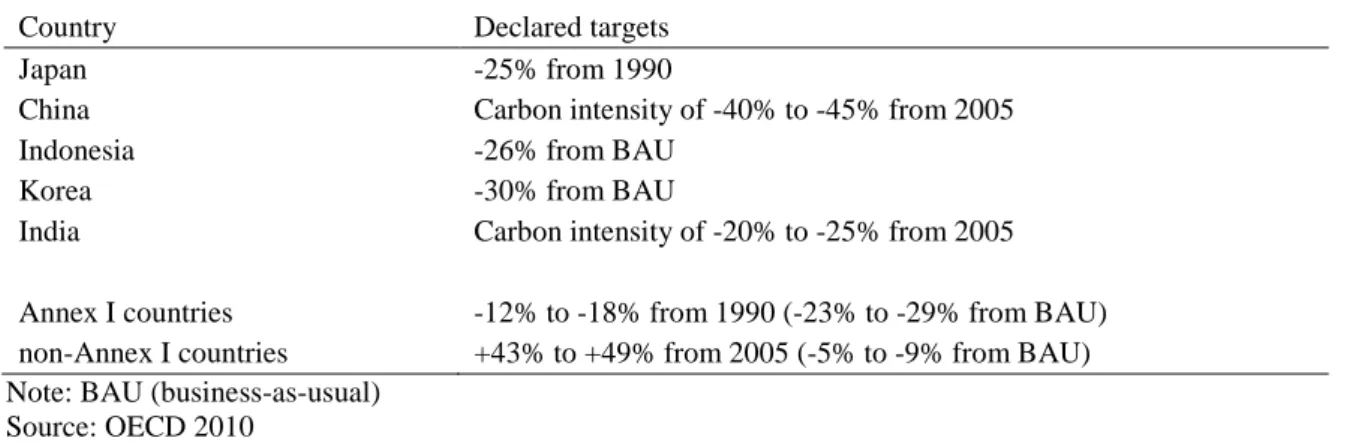
While there were a number of factors that contributed to the rising awareness of sustainability issue, the signing of Kyoto protocol has brought one dimension of sustainability, namely global warming, into the global center stage. Even though the Kyoto protocol was not without criticism and the on-going discussions on next generation agreement is stalling, public awareness towards greenhouse gas emissions (GHG) was raised and many governments – national and sub-national levels-- has pledged to reduce GHG emission reductions. Although the GHG reduction targets are binding only for the Annex I countries, some of non-Annex I countries have announced their own efforts to reduce GHG reduction (see Table 1).
However, according to a recent OECD analysis, even the most ambitious targets announced by the industrialized countries would amount to an 18% reduction in their emissions by 2020 from 1990 levels. While this reduction is a significant amount, it falls short of the required 25-40% reductions to stay within 2 degree Celsius suggested by the Intergovernmental Panel on Climate Change (IPCC) and to achieve this goal, large amount of additional investment ranging from US$500-600 billion a year is needed (UNCTAD 2010;UNEP 2009a). This large need for additional investment creates new industrial opportunities.
4
Table 1: Declared emission reduction targets by Asian countries
Country Declared targets
Japan -25% from 1990
China Carbon intensity of -40% to -45% from 2005
Indonesia -26% from BAU
Korea -30% from BAU
India Carbon intensity of -20% to -25% from 2005
Annex I countries -12% to -18% from 1990 (-23% to -29% from BAU) non-Annex I countries +43% to +49% from 2005 (-5% to -9% from BAU) Note: BAU (business-as-usual)
Source: OECD 2010
This move towards GHG reduction was supported by other policy concerns. Recently the prices of key commodities have been rising. Some could be attributed to speculation, but a significant portion should be ascribed to the rapid growth of large developing countries. This portion represents permanent increase in demand for resources and as such, the expectation is that prices for energy and other commodities will remain high in future.2 Explorations into finding new energy sources and
development have been actively pursued in the past. However, major incidents in recent years are putting some doubts into the viability of such efforts such as the oil spill in the Gulf of Mexico and nuclear power plant meltdown in Fukushima, Japan. 3
The “Arab Spring” movement started in December 2010 in Tunisia is creating uncertainty towards the stability of countries in the Middle East and North Africa. Since many key oil producing countries are located there, increase in uncertainty in that region has resulted in higher oil prices and many oil importing countries are reminded of their energy security issues once again.
The shift towards greener growth strategy received a large boost in 2009 following the global slow started in the late 2008 stemming from the financial crisis in the United States. As a part of stimulus packages, a number of countries such as the US, France, and Germany have included specific components on green spending. In East Asia, Korea allocated US$30.7 billion for green investment to be disbursed during
2 Of course, the price movements will be subject to global economic fluctuations. Given the uncertainty
surrounding the economic health of Euro zones and the US, the price increase may be somewhat muted.
3 Energy industry has experienced a number of significant accidents and incidents. See Sovacool (2008)
for a list of such incidents between 1907 and 2007. The Gulf of Mexico oil spill in mid-2010 was the largest of its kind in United States history (UNCTAD 2010).
5
2009-2012. In addition, Five Year Green Growth Plan covering the period 2009-2013 calls for US$83.6 billion investment in green areas. China has allocated more than US$200 billion as green stimulus package (OECD 2010;UNEP 2009a).
In addition, a growing pool of sophisticated and concerned consumers mainly in developed countries, but increasingly in developing countries and the rise of sustainability-oriented civil societies are shaping the consumer preferences towards more eco-friendly products (UNCTAD 2010).
Concerns on global warming, energy security, high resource prices, development of new industries, and shift in consumer demands towards more environment-friendly products are all coming together now to generate enough momentum to move towards more green and sustainable economic structure globally. Because there seemed to be critical mass of countries (especially measured by income and market size) moving towards this direction, this force is likely to continue in future. Much like the move towards globalization, countries can choose whether to embrace this shift and integrate into their growth strategies or to ignore such development. When the globalization was gathering force, countries that actively took advantage of the new opportunities and utilized that to the full extent (i.e. most East Asian economies) were able to grow rapidly and were successful in integrating their economies to global market, enabled them to reduce poverty significantly. Those that resisted the force of globalization fared worse. The current move towards green economic structure could bring similar kind of choices to developing countries. Once a critical mass of countries move towards this direction, then it is likely that “green” will be the rule of the game in future. Firms in developing countries can utilize this once in a life time opportunity to enter new areas of activities so as to upgrade and diversify their operations and in some cases would be able to leapfrog and quickly emerge as key players. To the extent that there are first mover advantage associated with such move, countries that embrace such change in early stage of the transition would be able to reap the most benefit.
East Asian countries have achieved success in rapidly climbing the development ladder in the past, riding the wave of globalization. However, there are some concerns among policy makers in the region that they are running out of steam and they are being caught in the “middle income trap”. The move towards green economy would offer
6
yet another opportunity for economies in East Asia to grab to accelerate their economic growth.
III. Asia’s characteristics
Green growth strategies in East Asia would need to be different from other regions, especially compared to advanced countries. This stems from the specific characteristics of East Asia. The main differentiating factor is that East Asia is by far the most manufacturing based economies. The success of East Asia relied on rapid industrialization and linkages to global market. This led to East Asia being the workshop of the world.4 Research findings suggest that manufacturing industry is the
only sector that has consistently improved productivity and hence overall growth (Yusuf 2009). Thus, the future growth of East Asia would still need to depend heavily on manufacturing activities. This puts East Asia at a disadvantage in realizing green growth because manufacturing industry tends to be heavier users of natural resources and energy.5
At the same time, this offers new opportunities. Compared to the past, the demand for environmentally friendly products and production processes are increasing, even for those economies that are still in low income range. In addition, rise in resource prices are creating new economic opportunities for resource-frugal products, creating opportunities for new industrial activities that could be less entrenched by incumbents. Leveraging the accumulated manufacturing capabilities, some firms in East Asia would be able to capitalize on these opportunities.
The second characteristic of East Asia is that it is heavily export-oriented. This makes East Asia vulnerable to changes in regulations and standards of major importing economies such as EU. With growing concerns on sustainability, regulations and standards in this area are becoming tougher and more stringent. Furthermore, the nature of these regulations and standards are would require concerted efforts along the supply
4
For the recent development history of East Asia, see for instance, World Bank (1993); Stiglitz and Yusuf (2001);Yusuf and others (2003); and Yusuf, Altaf and Nabeshima (2004).
5 Studies have identified that manufacturing industry, especially exports are contributing to the large
portion of CO2 emission by a country, in particular in East Asia (Atici forthcoming;Hoshino and Taishi 2008;Wagner 2010;Zheng, Qi and Chen 2011). Accelerating economic structural change towards service industries can reduce GHG emission simply because services sector in general emit less GHG. However, doing so could reduce growth rates and not an advisable strategy for developing countries aiming for high growth rates.
7
chain. This also will have a large impact on how production network would be organized in East Asia in future.
The third characteristic is the benefit arising from still being at developing stage. Lower legacy costs faced by developing economies can enable them to adopt more green technologies with relative ease and less opposition. The benefit of this is most apparent in better urban designs6 and infrastructures. This will be important. With growing
concerns on global warming, it would be inevitable that some kind of restrictions on greenhouse gas emission be applied to all countries (by varying degrees). Given the fact that East Asia would be still heavily dependent on manufacturing activities, this puts East Asia at disadvantage in terms of GHG emission. In order to make room for industrial activities in future in East Asia, these economies need to exert greater efforts to minimize such emission coming from other sectors such as urbanization and transport. Much of East Asia is still urbanizing and correct policies and urban planning at this stage can enable East Asian cities to leapfrog and to become more environmentally friendly cities. The urban design will also have a large and lasting impact on the emissions coming from the transport sectors. By making right choices at early stage of urbanization will confer these economies greater room for industrial activities.
These three characteristics will define the Asian Green Growth model.
IV. Industrial and Innovation opportunities
Early attention and development of green economy is likely to improve the competitiveness of an economy. By far, the energy sector is receiving much attention in this regard. There are two approaches that can be taken in the energy sector to make them greener. First is to make the energy sector more efficient. Improvements in energy efficiency are a critical component of reducing carbon emissions. 7 Arguably,
improving energy efficiency of power generation is a low-hanging fruits.
6 Buildings are responsible for 30-40% of all energy use, greenhouse gas emissions, and waste generation
(UNEP 2009b). The type of urban settlement will also have a large influence on the preferred choices of mobility by its citizens. Sprawl will lead to increasing use of automobiles. World transportation energy demand is expected to grow by 2% a year and GHG emission at 80% above 2002 level by 2030 if no actions were taken (UNEP 2009b).
7
In the 450 scenario where the concentration of greenhouse gases in the atmosphere is limited to around 450 parts per million of CO2 equivalent (ppm CO2-eq) to achieve the Copenhagen Accord, 34% reduction in carbon emissions are possible with existing energy efficiency measures. Additional 20% reduction can be achieved by wider adoption of renewable energy (IEA 2010).
8
Improvement in energy efficiency can also contribute to enhanced energy security since higher efficiency implies less reliance on the primary energy sources for a given amount of energy output.
Coupled with the efficiency improvements in the existing power generation capacities, countries are actively pursuing the development of renewable energy sector. Currently, renewable energy accounts for 16% of final energy consumption in 2009 and 2.7% of the transportation fuel in 2010 (REN21 2011). And this is expected to increase significantly in future through various policy supports. The development of renewable energy can address a number of issues and concerns facing policy makers such as energy security, industrial development, and innovation. In addition, creative application of renewable energy can provide clean energy and electricity to those in rural areas where they did not have access to electricity in the past.8
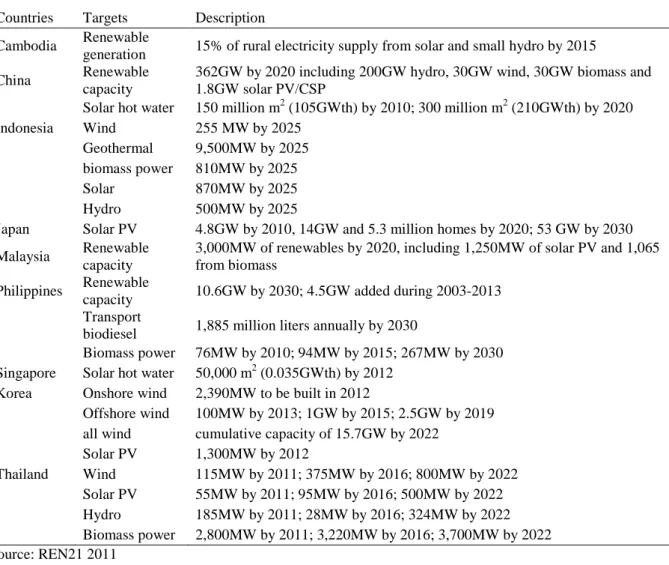
With the support from the stimulus packages and attentions by many countries, the investment in renewable energy sector increased to US$211 billion in 2010, resulting in 25% increase in generating capacity compared to 2009, excluding large hydro. The largest increase in capacity was seen in wind with increase of 39GW, of which China accounting for half of the global increase in wind power installation. Solar photovoltaic (solar PV) added 17GW of additional capacity (REN21 2011). Other sources of renewable energies such as geothermal, solar hot water heaters, biofuels (ethanol and biodiesels), and advanced biomass also increased their capacities to a varying degree. Globally and within East Asia, there is still an ample scope for industrial development based on renewable energy since a number of countries have plans to increase the use of renewable energy (see Table 2).
Arguably China was able to take advantage of this new opportunity to the fullest extent in East Asia. Among the top 10 wind turbine manufacturers around the world, there are four Chinese firms.9 In the solar PV cell manufacturing, seven out of the top
8 Off-grid renewable solutions are increasing acknowledged to be the cheapest and most sustainable
options for rural areas (REN21 2011). For instance, Bangladesh and China have ambitious plan to use home solar PV system and small-scale wind to provide electricity to underserved areas (REN21 2011;UNEP 2009b).
9 They are Sinovel with market share of (10.7%), Goldwind (9.2%), Dongfang (6.5%), and United Power
9
15 are Chinese firms.10 The growth of the industry was supported by favorable
government policies. In July 2009, Chinese government announced that it would subsidies half of the investment costs11 for solar power capacity over 500 MW through
2011 in order to achieve the goal of installing 10GW of solar capacity by 2020 (UNEP 2009a).
Table 2: Renewable policies in selected East Asian countries
Countries Targets Description Cambodia Renewable
generation 15% of rural electricity supply from solar and small hydro by 2015 China Renewable
capacity
362GW by 2020 including 200GW hydro, 30GW wind, 30GW biomass and 1.8GW solar PV/CSP
Solar hot water 150 million m2 (105GWth) by 2010; 300 million m2 (210GWth) by 2020 Indonesia Wind 255 MW by 2025
Geothermal 9,500MW by 2025 biomass power 810MW by 2025 Solar 870MW by 2025 Hydro 500MW by 2025
Japan Solar PV 4.8GW by 2010, 14GW and 5.3 million homes by 2020; 53 GW by 2030 Malaysia Renewable
capacity
3,000MW of renewables by 2020, including 1,250MW of solar PV and 1,065 from biomass
Philippines Renewable
capacity 10.6GW by 2030; 4.5GW added during 2003-2013 Transport
biodiesel 1,885 million liters annually by 2030
Biomass power 76MW by 2010; 94MW by 2015; 267MW by 2030 Singapore Solar hot water 50,000 m2 (0.035GWth) by 2012
Korea Onshore wind 2,390MW to be built in 2012
Offshore wind 100MW by 2013; 1GW by 2015; 2.5GW by 2019 all wind cumulative capacity of 15.7GW by 2022
Solar PV 1,300MW by 2012 Thailand Wind 115MW by 2011; 375MW by 2016; 800MW by 2022 Solar PV 55MW by 2011; 95MW by 2016; 500MW by 2022 Hydro 185MW by 2011; 28MW by 2016; 324MW by 2022 Biomass power 2,800MW by 2011; 3,220MW by 2016; 3,700MW by 2022 Source: REN21 2011
The domestic efforts to develop renewable energy industry are complemented by the inflow of foreign direct investment (FDI).12 To support the development of
10 They are Suntech Power (7%), JA Power (6%), Yingli Green Energy (5%), Trina Solar (5%), Canadian
Solar (2%), NeoSolar (2%), and Hanwha-SolarOne (2%) (REN21 2011).
11 The government share is 70% for remote regions.
12 Three key low-carbon business areas (renewable energy, recycling and low-carbon technology
10
renewable energy productions, there were 806 greenfield investments in manufacturing of environmental-technology between 2003-2009, about half of the manufacturing investments were done in developing countries.13 China, Indonesia, Malaysia,
Philippines, Singapore, and Vietnam are among the major recipients of such investments in East Asia (UNCTAD 2010).14 For instance, Singapore attracted
investment by Neste Oil to produce 900 million liters of renewable diesels, the largest in the world (REN21 2011).
The move to make energy production more efficient or to adopt more renewable energy sources should be complemented by demand side policies such as promotion of resource efficient and econ-friendly products. Most developed countries have some kind of energy and/or resource efficiency requirements, especially aimed at consumer products. For instance, the Top Runner Program introduced in the 1999 in Japan was successful in improving the efficiencies of key products from 15 to 86%, many exceeding the initial expectations (METI 2010).15
A continuous development of energy efficient products does not come free. Firms need to invest heavily in R&D to explore various ways in which more energy efficiency can be squeezed out from a product. In fact, a study by Hamamoto (2011) finds that the Top Runner Program has prompted electric appliance firms to increase their R&D spending by 9.5%.
Stimulating innovation activities
The drive for development in East Asia, especially for middle income countries will necessary include the strengthening of innovation capabilities in these countries (Yusuf and Nabeshima 2009). The move towards embracing green economy can provide the needed catalyst to become more innovative. It is highly likely that the shift towards more sustainable growth path will involve introductions of additional
13 M&A activities are also active. For instance in solar cell manufacturing, Hanwha Corporation
(Korea) acquired 49% stake in Solarfun (China) and Suntech (China) acquired 100% stake in MSK corporation (Japan) (REN21 2011).
14 Other countries are also actively receiving FDI in this area. For instance, Chile has attracted FDI
from UK, France, and Italy after Chile started to promote renewable energy production through the Renewable Energy Law (2008), which requires that at least 10% of electricity must come from renewable sources by 2022 (UNCTAD 2010).
15 There are 23 product categories included in this program and they consume about 60% of electricity of
11
regulations. The question on whether regulations can induce innovation has received fresh attention. According to Porter, the answer is a qualified yes (Porter 1991). As long as the regulations are aimed at the outcomes and the regulations are well-designed, regulations can induce innovation by firms and in some cases, lead to improvements in firms’ performance above the costs associated with compliances to such regulations (Porter and van der Linde 1995). The Porter Hypothesis challenges two aspects of this traditional view. The first is that firms are fully optimized at any given time. The Porter Hypothesis posits instead that most firms are operating well within the production possibility frontier such as improvements in firms’ performance are still possible after the introduction of regulations. Secondly, the Porter Hypothesis takes a dynamic view rather than a static view, which is closer to the decision making of firms. They argue that regulations can provide firms with useful information that current business practices are inefficient and there are scopes for innovation; reduces the uncertainty regarding investment in environmental protection through regulations; leveling the playing fields since all players must comply; and create pressures to innovate (Porter and van der Linde 1995).
The empirical evidence so far firmly suggests that at least the weak version of the Porter Hypothesis16 is well supported (Ambec and others 2011).17 The environmental
technologies also are diffused among countries in response to adoption of stricter environmental regulations.18 The strong version of the Porter Hypothesis goes beyond
the weak version and examines the relationships between the environmental regulations and firms’ performance mediated through innovation activities (Jaffe and Palmer 1997).19
16
The weak version of the Porter Hypothesis that environmental regulations leads to innovation, without examining whether such innovation contributed to improvements in firms’ performance (Jaffe and Palmer 1997).
17 See the appendix of Ambec and others (2011) for a comprehensive review of theoretical and empirical
studies on the Porter Hypothesis.
18 See for instance Popp (2006) who examines the patents associated with pollution abatement
technologies in terms of patents granted in the US, Japan, and Germany and traces the technology diffusion through citations to prior patents in these countries. See other studies such as Lanjouw and Mody (1996) and Brunnermeier and Cohen (2003).
19 Another view is that government can set tougher environmental regulations so as to induce early
innovation in environmental technology to buttress the comparative advantages of its domestic environmental technology industry (Jaffe and Palmer 1997).
12
However, special attention needs to be paid to SMEs which are often strapped for resources to conduct innovation or have limited information and knowledge on necessary technology. In fact, some studies find detrimental impacts of environmental regulations on SMEs (Dean, Brown and Stango 2000). Because such possibilities exist, appropriate policies to SMEs are needed so that they can cope with the environmental regulations.
In this effort to nurture innovation capabilities, due attentions needed to be paid to the intellectual property rights. While some argues that weakening of IPR on green technologies is needed, such weakening of patent protection is not a viable solution in a long run. If a short-run, weakening of patent protections for technologies on environment-related technologies can make diffusion of existing technologies to be easier and wider (OECD 2010). However, there is a risk that such move can harm future streams of innovations in this area in two ways. First, since there is less incentives to develop such technologies, firms may decide not to invest in R&D in such technologies. Second, even if firms invest in such technologies, they make keep it as a trade secret instead of seeking patent protection. This will significantly harm the diffusion of such technologies to others (OECD 2010). One needs to remember that the patent system is designed to provide exclusive limited-time protection to the inventor in exchange for disclosing the underlying technologies for diffusion purpose. Given that much more efforts and innovations are needed, weakening of patent protection is not a desirable policy option.20
V. Trade issues
One hallmark of the East Asia’s development success was their early integration into global production networks. This was achieved through offering stable and favorable investment conditions for FDI such as provision of industrial parks, adequate supply of labors of unskilled to skilled labor, and incentives. Through attracting FDI, East Asian economies were able to participate fully into the global economy and they rode the booming international trade to boost their industrial development efforts. In
20 In addition, For MNCs, stronger IPR protection is often a key attribute that they look before investing
in a country (UNCTAD 2010) and for East Asian countries relying on continuing FDI flows, IPR protection needs to remain robust, including the enforcement of IPR which is more problematic issue.
13
future, this growth strategy based on exports is not likely to change, with the exception of perhaps China because of its size. This means that economies in East Asia need to be aware of changing global economic landscape and be able to quickly adjust to any changes. Even though the importance of intra-regional trade within East Asia is rising, the lucrative markets of the developed countries are still too large to ignore.21
Within this context, one recent development worth paying attention is the changing nature of environmental regulations in advanced countries, especially in EU (such as Restrictions on Hazardous Substances (RoHS) and Registration, Evaluation, Authorization and Restriction of Chemicals (REACH) both aiming at the use of chemical substances in products). Traditionally, environmental regulations have focused on pollution abatement efforts (among others such as worker health and safety) aimed at production activities. The stringency of the domestic regulations affected and determined the level of environmental actions by firms. This has created a tension between the strength of environmental protection and the industrial development or the competitiveness issues. 22
Many countries fear their industries may lose competitiveness if they take on ambitious climate actions (and green) without similar efforts and commitment by other countries. This is often the single most voiced concerns and obstacles in adopting green measures unilaterally (OECD 2010).
However, the emphasis of environmental regulations is now shifting towards products rather than production activities.23 EU is the major player moving towards
this direction, although there are a number of private initiatives to achieve similar kind of effects such as carbon footprint labeling,24 Oeko Tex, and others. While
product-related regulations have existed in the past for many products (for instance,
21 Interviews with firms in developing countries also reveal that their preferences towards exports to
developed countries. Among a number of points raised, firms expressed that they can obtain higher prices for exports to developed countries and also they do not need to worry about the payment issue compared to exports to developing countries.
22 There is a large literature on so-called Pollution Haven Hypothesis. 23
This is not to say that environmental regulations on productions are waning. Instead, it is more of the reflection that in addition to production based regulations, increasingly governments are putting on PRERs.
14
safety requirements),25 the coverage is expanding into environmental issues. This kind
of regulations can affect producers located outside of the original jurisdictions.
The impacts stemming from PRERs differ depending on the firm’s location in the production networks. Most visible impact will be felt by the final good producers/exporters because they need to bear the responsibility of complying with new regulations. Since the product must pass the environmental regulations, the final goods producer must make sure that inputs that are used also comply with these regulations.
Those firms that are located in the mid stream of the production chain would also need to comply with these environmental regulations regardless of whether they export directly. This is because, in many instances, intermediate inputs produced or processed by the mid stream firms are included in goods that would eventually be exported. This means that many different types of firms could be affected by regulations by importing countries. It is obvious that those firms that are supplying to MNCs will be affected. But these firms can be either exporters (supplying to MNCs located outside) or “domestic-oriented” firms (supplying to MNCs located within the same country, fairly likely cases in developing countries with substantial presence of MNCs). Furthermore, there are many SMEs that are non-exporters, yet their products may be used as intermediate inputs to products that will be exported.
This can have a large impact on how the production will be organized in East Asia. Because of the increased burden in the compliance, reporting, and management requirements to these regulations, the lead firms may decide to trim down the production network. The lead firm may also be more careful in selecting firms that can participate in production networks. These two behaviors by the lead firms will have a large influence on the industrialization prospects for East Asia, especially for those firms that are not yet part of production networks or countries still at the initial stage of industrialization such as those in CLMV countries, although Vietnam is ahead of other countries in that group.
25
Sanitary and phytosanitary standards (SPS) are well-known example, often raised in trade disputes. For instance Otsuki, Wilson and Sewadeh (2001) find that some African countries were not able to meet tougher aflatoxin standard in the EU and as a result, their exports to EU decreased significantly or in some cases, ceased altogether.
15
To what extent lead firms provide assistance to existing firms in the production network depends on the industry and the nature of the production networks. For instance, in a “tight” production networks such as the Japanese automotives, while the production chain is long, firms in the entire chain are integrated more relative to others. In this kind of tight production chains characterized by long-term relationship, lead firms typically offer assistance both in terms of information and technological so that firms at every nodes can effectively and efficiently comply with the requirements. In electronics production chains, the relationship among firms in the chain is more arms’ length compared to the automotive chain. Other production networks such as garment and textile may be more arms’ length and rely on spot market. In these kinds of situations, the development of the necessary capability to identify and comply with these regulations will be mainly borne by the supplier themselves. The question is whether firms in developing countries, especially SMEs can develop sufficient capabilities. No doubt, some firms would be able to do so. However, whether this would work as a brake on the industrialization and development is an important question that needs to be fully addressed.
VI. Concluding remarks
Collectively East Asian countries have fared well in terms of their economic performance in the last 40 years. While they experienced their shares of economics crises, they have weathered them well. However, some countries especially those in Southeast Asia have reached a plateau of middle income and they feel that it is increasingly hard for them to move beyond this stage. The emphasis on green economy can provide the needed second wind to these economies. There have been a large collection of studies on the development experience of East Asia. The lessons from these studies are that East Asia was successful because it embraced the globalization from the early stage, and also because it was able to take part in then rapidly expanding industry of electronics, and benefited from the emergence of production networks spanning the region backed by FDI. These were all new developments then and other countries or regions could have grabbed the opportunities but they did not. Decades after, the verdict is rather clear that East Asian countries that
16
embraced new developments in global economic landscape before any other countries have grown rapidly and have been able to sustain such rapid growth performance for a long period of time.
Now, another change has been brewing in the global economic landscape, namely the emphasis on sustainability. Most developed countries are eyeing this area as future growth engines and given the large number of countries showing interest in this area, the shift towards green economy is here to stay. If so, East Asian countries would need to adjust some of their practices in order to take full advantage of this new change. Whether they can adapt well will likely to determine their future prospects.
While the basic tenet of the growth strategies in East Asia will remain the same as in the past, some will need adjustments. To move towards green economy, the necessary first step would be to review the current energy policy, especially subsidies on fossil fuels.26
Removable of such subsidies will be the necessary first step, although this will likely to face significant opposition. However, without getting the energy (and other resources) prices right, the prospects of industrial development in renewable energy sector or development of energy- and resource-efficient products will be slowed. Given the fact that many countries are now reforming their energy policies and stimulating the diffusion of energy- and resource-efficient products especially in lucrative developed countries’ market, being slow in development in these areas will cast a dark shadow in future growth in exports and industrial activities. Even though this paper did not touch upon the urbanization issue, this is one area where careful planning at an early stage pays off handsomely. East Asia is still urbanizing and policies towards making cities more compact and energy- and resource-efficient including many buildings that would be constructed in near future are critical to avoid the mistakes made by advanced countries. Energy policy is another area where due attentions need to be paid. These policies are necessary complements to the industrial development objective, which is still the highest priority for East Asian countries.
26 Energy subsidies amounted to US$312 billion in 2009 and only a small proportion of this subsidies
actually reach the poor, the intended target. Globally the movement to phase out fossil-fuel subsidies is gaining momentum after the G20 meeting in Pittsburgh in September 2009 and similar commitment expressed by APEC at the 17th Economic Leader’s Meeting released on Nov. 15, 2009. Phasing out all fossil-fuel subsidies will reduce primary energy demand by 5%, which is comparable to the current consumption by Japan, Korea, and New Zealand combined (IEA 2010).
17
In terms of industrial development, governments in East Asia need to be on their toes to continuously keep track of changes in policy stances towards energy and resource uses, and regulations in other countries such as PRERs and private initiatives by major firms. As mentioned earlier, many countries are now actively investing in renewable energies, recycling, and improvements in energy efficiency, creating new opportunities. Changes in PRERs and private standards will have an impact on not only the exporters but also domestic firms through their linkages to production networks. Necessary policy assistance especially to SMEs on information dissemination, technical assistances to meet the requirements of major buyers and regulations will be needed.
Finally, concerted efforts at the regional level would be desirable to reduce the uncertainty to stimulate innovation in East Asia. In particular, co-creation of common standards and regulations in emerging areas such as chemical substance management will be beneficial to East Asia because of the way production is organized in the region. Already a wide variety of production networks spanning East Asia are established. With regulations in the importing markets that are more stringent than those in some countries in East Asia could spell problems in future. To meet PRERs, consistent and reliable information need to be transmitted throughout the production network. However, with differences in regulations among East Asia, the management of such information is becoming costly. This is prompting at least some lead firms to trim down their production network and keeping only those that have sufficient capabilities to comply with more stringent requirements imposed by the lead firms. More streamlined regulations across countries in East Asia are needed to maintain production networks in the region and as a result, they would be able to sustain growth momentums in future.
18 References
Ambec, Stefan, Mark A. Cohen, Stewart Elgie and Paul Lanoie. 2011. "The Porter
Hypothesis at 20: Can Environmental Regulation Enhance Innovation and Competitiveness?" Discussion Paper 11-01, Resources for Future, Washington,
DC.
Atici, Cemal. forthcoming. "Carbon Emissions, Trade Liberalization, and the Japan-Asean Interaction: A Group-Wise Examination." Journal of the Japanese
and International Economies
Brunnermeier, Smita B. and Mark A. Cohen. 2003. "Determinants of Environmental Innovation in Us Manufacturing Industries." Journal of Environmental
Economics and Management 45(2):278-293.
Dean, Thomas J., Robert L. Brown and Victor Stango. 2000. "Environmental Regulation as a Barrier to the Formation of Small Manufacturing Establishments: A Longitudinal Examination." Journal of Environmental
Economics and Management 40(1):56-75.
Hamamoto, Mitsutsugu. 2011. "Energy Efficiency Regulation and R&D Activity: A Study of the Top Runner Program in Japan." Low Carbon Economy 2011(2):91-98.
Hoshino, Yuko and Sugiyama Taishi. 2008. "Co2 Content of Trade (in Japanese)." SERC Discussion Paper 08002, Socio-Economic Research Center of Central Research Institute of Electric Power Industry, Tokyo.
IEA. 2010. World Energy Outlook 2010. Paris: International Energy Agency.
Jaffe, Adam B. and Karen Palmer. 1997. "Envrionmental Regulations and Innovation: A Panel Data Study." Review of Economics and Statistics 79(4):610-619.
Lanjouw, Jean Olson and Ashoka Mody. 1996. "Innovation and the International Diffusion of Environmentally Responsive Technology." Research Policy 25(4):549-571.
Lewis, Joanna. 2009. "Can Green Sunrise Industries Lead the Drive into Recovery? The
Case of Wind Power Industry in China and India." Research and Statistics
Branch Working Paper 20/2009, United Nations Industrial Development Organization, Vienna.
METI. 2010. Top Runner Program: Developing World's Best Energy-Efficient
Appliances. Tokyo: Ministry of Economy, Trade and Industry.
OECD. 2010. Interim Report of the Green Growth Strategy: Implementing Our
Commitment for a Sustainable Future. Paris: Organisations for Economic
Cooperation and Development.
Otsuki, Tsunehiro, John S. Wilson and Mirvat Sewadeh. 2001. "Saving Two in a Billion: : Quantifying the Trade Effect of European Food Safety Standards on African Exports." Food Policy 26(5):495-514.
Popp, David. 2006. "Internaitonal Innovation and Diffusion of Air Pollution Control Technologies: The Effects of Nox and So2 Regulations in the Us, Japan, and Germany." Journal of Environmental Economics and Management 51(1):46-71. Porter, Michael E. 1991. "America's Green Strategy." Scientific American 264(4):168.
19
Porter, Michael E. and Claas van der Linde. 1995. "Toward a New Conception of the Environment-Competitiveness Relationship." The Journal of Economic
Perspectives 9(4):97-118.
REN21. 2011. Renewables 2011: Global Status Report. Paris: Renewable Energy Policy Network for the 21st Century.
Shi, Xunpeng. 2010. "Carbon Footprint Labeling Activities in the East Asia Summit
Region: Spillover Effects to Less Developed Countries." Discussion Paper
2010-06, Economic Research Institutes for ASEAN and East Asia, Jakarta. Sovacool, Benjamin K. 2008. "The Costs of Failure: A Preliminary Assessment of
Major Energy Accidents, 1907-2007." Energy Policy 36(5):1802-1820.
Stiglitz, Joseph E. and Shahid Yusuf. 2001. Rethinking the East Asian Miracle. New York: Oxford University Press.
UNCTAD. 2010. World Investment Report 2010. New York: United Nations.
UNEP. 2009a. Global Green New Deal: An Update for the G20 Pittsburgh Summit. Geneva: United Nations Environment Programme.
---. 2009b. Global Green New Deal: Policy Brief. Geneva: United Nations Envrionment Programme.
Wagner, Gernot. 2010. "Energy Content of World Trade." Energy Policy 38(12):7710-7721.
World Bank. 1993. The East Asian Miracle: Economic Growth and Public Policy. Washington, DC: World Bank.
Yusuf, Shahid. 2009. Development Economics through the Decades: A Critical Look at
30 Years of the World Development Report. Washington, DC: World Bank.
Yusuf, Shahid, M.Anjum Altaf, Barry Eichengreen, Sudarshan Gooptu, Kaoru Nabeshima, Charles Kenny, Dwight H. Perkins and Marc Shotten. 2003.
Innovative East Asia: The Future of Growth. New York: Oxford University
Press.
Yusuf, Shahid, M.Anjum Altaf and Kaoru Nabeshima. 2004. Global Production
Networking and Technological Change in East Asia. New York: Oxford
University Press.
Yusuf, Shahid and Kaoru Nabeshima. 2009. Tiger Economies under Threat:
Comparative Analysis of Malaysia's Industrial Prospects and Policy Options.
Washington, DC: World Bank.
Zheng, Yingmei, Jianhong Qi and Xiaoliang Chen. 2011. "The Effect of Increasing Exports on Industrial Energy Intensity in China." Energy Policy 39(5):2688-2698.