第 55 卷 第 2 期
2020 年 4 月
JOURNAL OF SOUTHWEST JIAOTONG UNIVERSITY
Vol. 55 No. 2
Apr. 2020
ISSN: 0258-2724 DOI:10.35741/issn.0258-2724.55.2.45
Research articleMathematics
I
MAGE
C
OMPRESSION
B
ASED WITH
M
ULTI
D
ISCRETE
L
AGUERRE
W
AVELETS
T
RANSFORM
基于多离散拉盖尔小波变换的图像压缩
Ali Malik Hadi, Asma Abdulelah AbdulrahmanApplied Science Department, University of Technology Baghdad, Iraq, [email protected], [email protected]
Received: February 28, 2020 ▪ Review: April 1, 2020 ▪ Accepted: April 25, 2020
This article is an open access article distributed under the terms and conditions of the Creative Commons Attribution License (http://creativecommons.org/licenses/by/4.0)
Abstract
The colored image has a large array of numbers that take up a lot of space, creating a problem with transportation and storage, which needs to be urgently solved. It’s essential to find a mathematical tool that shrinks this space when transferring and storing the colored image over the years. Continuous waves such as Fourier and discrete waves such as Haar Symlet 2, coiflet 2, and daubecheis 2 were founded by shrinkage and expansion and characterized with the help of s and r parameters. With the help of the MATLAB program, these basic wavelets installed supplication and image compression, analysis, and lifting procedures. In this study, new waves based on polynomials were discovered, relying on the parent function and through many calculations, clarifying many theories and important features that this wave possesses, such as the orthogonal feature and approach that qualifies these new waves in image processing such as squeeze, jam, and analyze images by searching for a filter. It is suitable and new for carrying out the analysis and reconstruction process with high-pass and low-pass filters resulting from the scaling and wavelet function. Four samples of color images are shown. The compression process was carried out with the help of MATLAB. The use of new waves is Multi Discrete Laguerre Wavelet Transfer, where the standard criteria resulting from the compression process were calculated and the most efficient results were obtained without losing the original information of the image, compared to the standard waves’ tables, which will demonstrate the efficiency of these new wavelets in Multi Discrete Laguerre Wavelet transform.
Keywords: Multi Discrete Laguerre Wavelets Transform, True Compression, Embeded Zero Tree Wavelet, Set Partitioning in Hierarchical Tree, Threshold Method
多年来在转移和存储彩色图像时缩小该空间的数学工具至关重要。通过收缩和扩展建立连续波( 例如傅立叶)和离散波(例如她的 Symlet 2,coiflet 2 和道贝基 2),并借助 s 和 r 参数进行特征 化。在 MATLAB 程序的帮助下,这些基本小波安装了求和以及图像压缩,分析和提升过程。在 这项研究中,发现了基于多项式的新波,这些波依赖于父函数并通过许多计算,阐明了该波所具 有的许多理论和重要特征,例如正交特征和限定这些新波在图像处理中的方法,例如通过搜索滤 镜来挤压,卡住和分析图像。它是适合通过缩放和小波函数产生的高通和低通滤波器进行分析和 重建过程的新方法。显示了四个彩色图像样本。压缩过程是在 MATLAB 的帮助下进行的。与标 准波表相比,新波的使用是多离散拉盖尔小波传递,其中计算了压缩过程产生的标准标准,并且 在不丢失图像原始信息的情况下获得了最有效的结果。这些新小波在多离散拉盖尔小波变换中的 效率。 关键词: 多离散拉盖尔小波变换,真压缩,嵌入零树小波,分层树中的集划分,阈值方法
I. I
NTRODUCTIONWavelets are important in the field of image compression because they play an important role in analyzing time and frequency simultaneously. This technique is better than Fourier transforms, which requires all the information over time without monitoring the frequencies [1], [2], [3], [4], [5], [6], [7], [8]. Therefore, it will be independent of time. Wavelet transformations are based on wavelengths that vary in frequency over a specified period. The problem of moving or storing an image affects us every day. TV and fax are both examples of image transmission, and
digital video players and web images with large quantities of information are among the main issues that need to be stored. The speed of transmission through modern technology in international communications, in which wavelet applications play an important role in the field of image processing, is an interesting application where wavelets contribute to facilitating the problems facing the compression process. They provide effective solutions to these problems, which are summarized in the quantitative, coding and decoding stages that compose the compression process [9], [10], [11], [12].
Table 1.
The original samples with its normalized histogram
Image 1 Image 2 Image 3 Image 4
Original image Original image normalized histogram
Image processing can be utilized to a larger or smaller extent with a lot of ranges of available: Nondestructive examination methods contain Tunneling Emission Microscope (TEM) images, profilometers, optical microscope, ellipsometer, Raman Spectroscopy, Atomic Force Microscope (AFM), and Scanning Electronic Microscope (SEM) [13], [14], [15], [16], [17], [18], [19], [20], [21], [22], [23], [24], [25], [26], [27], [28], [29], [30], [31], [32], [33], [34], [35], [36], [37], [38], [39], [40].
The purpose of this article is to utilize a new technique to build specific waves using the Matlab program, and tp filter for new waves that have been extracted and programmed.
In this paper, the topic of multi-discrete Laguere wavelets transformed with image
processing is investigated. Section 2 displays multi-discrete Laguere wavelets transform, the approximate function with operational matrices of integration in section 3. Section 4 displays multi-discrete Laguere wavelets transform. Section 5 investigates applied operational matrices of integration to image processing. Section 6 shows the algorithm built for this process. The calculation of Peak Signal to Noise Ratio (PSNR) and Mean Square Error (MSE) is presented in Section 7.
II. M
ULTI-D
ISCRETEL
AGUERREW
AVELETST
RANSFORM(MDLWT)
The wavelets are created from expansion and contraction through the two parameters a and b
which are represented by the parent function from the continuous wavelets.
0
,
)
(
2 1 ,
c
R
d
c
c
d
x
c
t
d c
(1) where
T M t t t
0 ,
1 ,...,
1
.The basis for the above function consists of the elements
0
t ,
1 t ,...,
M 1
t are o bytransfer to the parameters c, d to specific values. The wavelets will turn into discrete wavelets transform as Laguerre wavelet Lu,v
t Lt,u,v,khas four arguments;
1 2 ,..., 2 , 1 ,..., 2 , 1 k u k , is order for
Laguerre polynomials and is normalized time.
The dilation by parameter
c
2
k1 and translation by parameter2
(
2
1
)
) 1 (
u
d
k and use transform ,
t x2k1 2k , substitutedthese transfers in (1) with
c,dby Lu,v will be
) 1 ( ) 1 ( ) 1 ( , ) 1 ( , 2 ) 1 2 ( 2 2 2 ~ 2 k k k k v u k v u u t L t L (2) orthogonal on the [0,1]. The coefficients are(3) Low pass filter high pass filter add the new filter in MATLAB program.
III. T
WO-D
IMENSIONALM
ULTI-D
ISCRETEL
AGUERREW
AVELETT
RANSFORMA
NALYSISIn this section, the effectiveness of new discrete waves in image compression will be demonstrated.
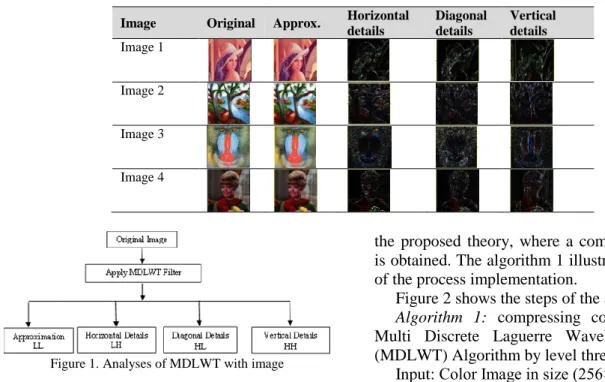
The image is analyzed at level 1 and level 2. Using the Matlab program after constructing the new MDLWT and designing a program to add the newly constructed wavelets to the MATLAB program, the dialog box is called wavemenu and wavelet 2D is chosen, analyzing the image by MDLWT. Four samples were analyzed using the new wavelet. Table 2 shows how to analyze the four images in level 2 according to Figure 1 which means the interpretation scheme for Table 2.
Table 2.
The analyze the four images in level 2
Image Original Approx. Horizontal details Diagonal details Vertical details Image 1 Image 2 Image 3 Image 4
Figure 1. Analyses of MDLWT with image
A. Compression Image by Multi Discrete Laguerre Wavelet Transform (MDLWT) In this section, the focus is on aspects related to the principles of compression image (CI) using
the proposed theory, where a compressed image is obtained. The algorithm 1 illustrates the stages of the process implementation.
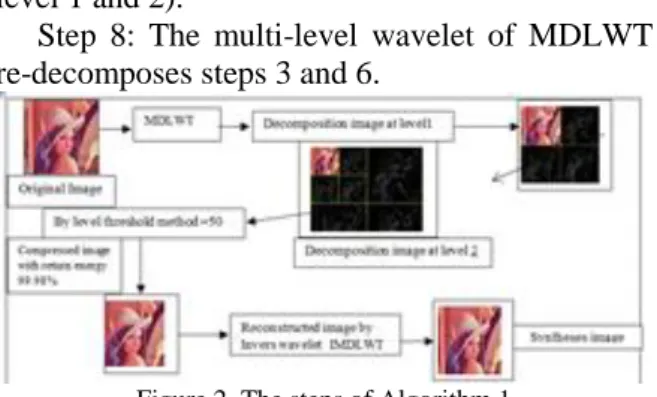
Figure 2 shows the steps of the algorithm.
Algorithm 1: compressing color image by
Multi Discrete Laguerre Wavelet Transform (MDLWT) Algorithm by level threshold method.
Input: Color Image in size (256×256). Output: Compressed Image (CI). Begin
Step 2: The wavelet transform MDLWT is inserted on the image. The color map is smooth.
Step 3: Multi Discrete Laguerre Wavelet Transform (MDLWT) with image divided to two coefficients: Approximate Coefficients (AC) and Details Coefficients (DC).
Step 4: Multi Discrete Laguerre Wavelet Transform (MDLWT), on the image in the first level, the image is divided into four blocks each block (64 × 64) LL1, LH1, HL1, HH1 In the level 2, the first quarter LL1 is divided into four blocks each block (16 × 16), LL2, LH2, HL2, HH2.
Step 5: For each level, the threshold is determined from the detail parameters, that is, to the mentioned factors, the fixed threshold is applied.
Step 6: The image is compressed at this stage for the purpose of storage or transportation after the completion of the process.
Step 7: The reconstruct image by invers Multi Discrete Laguerre Wavelet Transform (IMDLWT) Regenerate an image. (Re-creation of wavelets MDLWT through the original approximation coefficients for level 2 on the other hand. The modified detail coefficients at level 1 and 2).
Step 8: The multi-level wavelet of MDLWT re-decomposes steps 3 and 6.
Figure 2. The steps of Algorithm 1
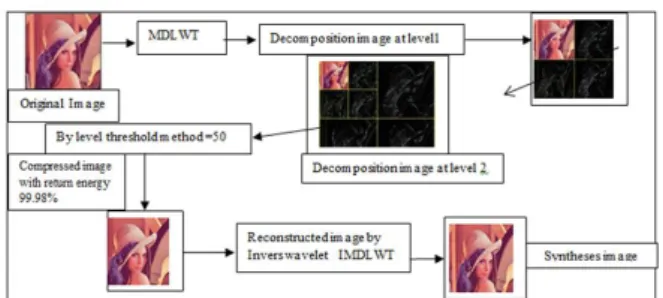
Figure 3 shows the threshold by level method selected between -100 and 100 in the horizontal, diagonal and vertical details coefficients in compressed image returned 99.96% energy and number of zero 29.11% used proposed method the Multi Discrete Laguerre Wavelet Transform.
Figure 3. The threshold in MDLWT in Image 1
IV. T
HRESHOLDCompressing an image using wavelets is done with two tools: is the function with finite energy and is the orthogonal basis of
f is the basis of
Z v v L f f , ,is the coefficient of f by using Eq. 4.
By choosing a fixed number V of transactions - in general, the compression is obtained with a loss - let S be the set of points of V, which determines the coefficients
Z v v vL C f (4) and the Approximate Coefficients (AC). The pressure quality evaluation is obtained using a
square error,
Z v S v vC
f
C
f
f
2 2,
2 2 . The absolute value is the best option in S to maintain the largest coefficient V. Transactions are arranged in descending order . In descending order of transactions, the optimal quadratic error is
V r V VC
rf
f
2 2 , with f being the associated compression curve, which can be determined from the ratio of the energy retained . This is the function of the associated relative quadratic error.V. T
RUEC
OMPRESSIONI
MAGE BYM
ULTID
ISCRETEL
AGUERREW
AVELETT
RANSFORMStep 1: Input color image (256 × 256) in jpg file.
Step 2: Convert input image to gray image. Step 3: Pass the (DChWT|m), where
, coefficients matrices with dimensions (16 × 16) with the gray image.
In this section, the focus will be on the role of the new wavelet MDLWT in the process of True Compression (TC) of the color image through Algorithm 2 in terms of analyzing the color image by determining the threshold and then by one of two methods: EZW or SPIHT. Figure 4 shows the stages through which the True Compression (TC) process passes.
The important goal of compressing images is representation of the necessary bits while reducing the bit length of the bits to maintain image quality information for which the wavelets have an important role in finding effective solutions to the problem. The compression process, which will be clarified, will decompress a gray image or real colors.
The role of wavelets in real compression appears to achieve the main goal of this type of process for a color image. It preserves the acceptable quality information for the image by reducing the length of the bit sequence necessary to represent it.
The true compression process is carried out in two main stages:
1. Compress the color image after converting it to a gray image;
2. Decompress a grayscale image or true colors.
The methods used in these two phases are: 1. Embedded zero tree wavelet (EZW); 2. Set partitioning in hierarchical trees (SPIHT).
Algorithm 2: The algorithm of true compression (TC) for a color image, based on multi-discrete Laguerre wavelet transform (MDLWT), is described in the following steps:
Input: The color image in size 256 × 256 Output: Compressed Image
Step 1: Read color image data.
Step 2: The filter for MDLWT will be the decomposition of the color image into approximation coefficients (AC) and details coefficients (DC), AC in low low block for the image at level 2 ( LL block), DC horizontal in LH block, DC vertical in HL block, and DC diagonal High High block for the image at level 2 (HH block).
Step 3: Set the threshold by choosing a portion of the transactions. This can be done by maintaining the approximation coefficients.
Step 4: Determine the image size by encoding for storage and transfer.
Step 5: Compress the image as much as possible.
Step 6: Decode the image (the inverse of the filter from the image has been taken).
Step 7: Apply inverse MDLWT (IMDLWT). The image is reconstructed.
Step 8: Finally, the compressed image is obtained.
In Figure 4, the compressed image on the right represents the gray stages, and the one on the left shows the compression process associated with MDLWT.
Figure 4. The stages of compression in Algorithm 2
The algorithm represents a type of compression that can cause a loss of information during these two stages:
1. When adjusting some parameters in the threshold
2. When deducting the value of certain coefficients in a quantification
When the threshold is canceled, the error is also canceled, and a role MDLWT with integer or rational coefficients appears.
From the second algorithm, the role of MDLWT begins in the first step of compression when analyzing the image and is in the last step when rebuilding the image using an inverse IMDLWT.
In Figure 4 the tree structure of MDLWT has a role in coding and focuses on the boundaries that connect MDLWT, the threshold, and IMDLWT.
VI. R
ESULTS OFA
PPLIEDA
LGORITHMSFour samples were submitted to the proposed algorithms 1 and 2, and the intermittent MDLWT decomposition was used to analyze them. On the level of decomposition, using the zero-coding tree shows the algorithm's ability to evaluate MSE, peak signal-to-noise ratio (PSNR), CR, and BPP. Tables show the quality of the reconfigured image, with the Mean square error (MSE)equal to zero. For good results, we should have higher values of peak single to noise ratio (PSNR) which based on MSE values. The compression capacity can be analyzed using important metrics for image quality.
Data transfer and image compression depend on compression ratio and PSNR.
bit in size image Compressed bit in size image Original CR (5) image the in pixels of number Total bits in size image Compressed pixel per Bit (6) For storing and viewing photos, this requires more memory per pixel of the image. The picture quality relies on an increased number of bits to represent more color and to view and store the image to provide more memory, which is the error of contrast between the original image I and the reconstructed image G as a decoder.
Table 3.
Effect of MDLWT filter with loops of true compression by Embedded Zero tree Wavelet (EZW) on Image 2
Loops CINH RI DCI CI MSE PSNR CR(%) BPP
2 6642 9.908 0.04 0.001001 3 5822 10.48 0.05 0.011983 4 4732 11.38 0.08 0.018433 5 3042 13.30 0.18 0.043579 6 1782 15.62 0.49 0.11768 7 970.8 18.23 1.31 0.31323 8 507 21.08 3.14 0.75269 9 255 24.06 7.03 1.6881 10 117 27.43 15.51 3.7224 11 37.38 32.4 32.48 7.7959 12 7.867 39.17 55.83 13.3982 13 1.385 46.71 80.49 19.3176 14 0.2414 54.3 104.50 25.0801 15 0.03276 62.28 112.11 26.9061 16 0.03276 62.28 112.11 26.9061 Table 4.
Effect of MDLWT filter with loops of true compression by Embedded Zero tree Wavelet (EZW) on Image 3
Loops CINH RI DCI CI MSE PSNR CR (%) BPP
1 6966 9.701 0.04 0.0096436 2 2694 13.83 0.04 0.010254 3 2694 13.83 0.04 0.010498 4 2694 13.83 0.04 0.10742 5 1901 15.34 0.06 0.015259 6 1686 16.72 0.11 0.025269 7 966.8 18.28 0.21 0.051514 8 703.4 19.66 0.49 0.11829
9 521.2 20.96 1.26 0.30237 10 319.6 23.09 4.42 1.0581 11 131.3 26.95 14.17 3.4008 12 36.76 32.48 32.03 7.6866 13 7.773 39.22 55.16 13.2383 14 1.403 46.66 79.93 19.182 15 0.2647 54.07 103.85 24.9229 16 0.03723 62.42 111.16 26.6781 Table 5.
Effect of MDLWT filter with loops of true compression by Embedded Zero tree Wavelet (EZW) on Image 4
Loops CINH RI DCI CI MSE PSNR CR(5) BPP
1 3343 12.89 0.04 0.0089111 2 1708 15.81 0.04 0.010376 3 1608 16.07 0.05 0.010864 4 1184 17.4 0.06 0.01355 5 860.6 18.78 0.09 0.022217 6 516.8 21 0.18 0.043335 7 326.2 23 0.41 0.098267 8 192.9 25.28 0.99 0.23865 9 100.1 28.13 2.45 0.58801 10 47.12 31.4 5.63 1.3511 11 18.66 35.42 11.98 2.2874 12 6.398 40.07 22.64 5.4342 13 1.791 45.6 38.40 9.2169 14 0.4661 51.45 58.38 14.0106 15 0.1094 57.74 70.11 16.8271
16 0.1094 57.74 70.11 16.8271
Table 6.
Effect of MDLWT filter with loops of true compression by Set Partitioning in Hierarchical Tree (SPIHT) on Image 1
Loops CINH RI DCI CI MSE PSNR CR(%) BPP
1 9983 8.138 0.03 0.0079346 2 3989 12.12 0.03 0.0079346 3 2266 14.58 0.03 0.0079346 4 2136 14.83 0.03 0.0079346 5 1772 15.65 0.04 0.0097656 6 1314 16.95 0.06 0.0148930 7 873.7 18.72 0.14 0.0335690 8 547.1 20.75 0.37 0.0882570 9 320 23.08 1.01 0.2420700 10 167 25.9 2.25 0.6202400 11 75.93 29.33 5.84 1.4015000 12 30.79 33.25 11.23 2.6948000 13 11.79 37.42 19.07 4.5757000 14 4.852 41.27 29.39 7.0487000 15 2.764 43.72 41.47 9.9519000 16 2.263 44.58 55.04 13.209000 Table 7.
Effect of MDLWT filter with loops of true compression by Set Partitioning in Hierarchical Tree (SPIHT) on Image 2
Loops CINH RI DCI CI MSE PSNR CR(%) BPP
2 8384 8.896 0.03 0.0081787 3 6744 9.841 0.03 0.0083009 4 5974 10.37 0.04 0.0085449 5 4859 11.27 0.05 0.012207 6 3287 12.96 0.12 0.029907 7 1991 15.14 0.34 0.081055 8 1131 17.6 0.91 0.21814 9 6079 20.1 2.19 0.52612 10 282.2 23.62 3.45 0.82935 11 144.9 26.52 5.20 1.9681 12 58.15 30.41 19.31 4.6349 13 17.93 35.59 37.97 9.1117 14 6.489 40.01 52.76 12.661 15 3.729 42.41 66.81 16.035 16 3.238 43.03 80.27 19.264 Table 8.
Effect of MDLWT filter with loops of true compression by Set Partitioning in Hierarchical Tree (SPIHT) on Image 3
Loops CINH RI DCI CI MSE PSNR CR(%) BPP
1 6966 9.701 0.04 0.0096436 2 2694 13.83 0.04 0.010254 3 2694 13.83 0.04 0.010498 4 2694 13.83 0.04 0.10742 5 1901 15.34 0.06 0.015259 6 1686 16.72 0.11 0.025269 7 966.8 18.28 0.21 0.051514 8 703.4 19.66 0.49 0.11829
9 521.2 20.96 1.26 0.30237 10 348.6 22.71 3.30 0.79285 11 161 26.06 10.30 2.4725 12 57.93 30.5 21.71 5.2114 13 18.53 35.45 35.65 8.5569 14 6.82 39.79 50.12 12.0288 15 4.022 42.09 64.19 15.4062 16 3.238 43.03 80.27 19.264 Table 9.
Effect of MDLWT filter with loops of true compression by Set Partitioning in Hierarchical Tree (SPIHT) on Image 4
Loops CINH RI DCI CI MSE PSNR CR(%) BPP
1 3390 12.83 0.03 0.0078125 2 1962 15.2 0.03 0.006958 3 1731 15.75 0.03 0.078346 4 1264 17.15 0.04 0.0090332 5 899.2 18.59 0.06 0.014771 6 570.8 20.57 0.12 0.028564 7 361.4 22.55 0.26 0.065232 8 218.2 24.74 0.66 0.15735 9 118.2 27.41 1.65 0.39673 10 58.54 30.46 3.81 0.91443 11 25.56 34.05 7.97 1.913 12 10.21 38.04 14.38 3.548 13 4.017 42.09 36.37 5.8831 14 2.044 45.03 36.37 8.7283 15 1.571 46.17 49.75 11.9398
16 1.571 46.17 49.75 11.9398
VII. D
ISCUSSION OFR
ESULTSIn this research, the proposed wavelets based on Laguerre Polynomials were used. As they were built on the basis of the parent function, a new filter was derived from the scaling function and wavelet function where this filter succeeded in analyzing the color image. After selecting the appropriate threshold for this process, the natural pressure process was performed for the color image. The results shown in the tables above compare one of the recognized standard wavelets that the MATLAB program is equipped with, which is one of the wavelets through which good results were reached.
Table 10.
Comparison results between MDLWT and Symlet 2, coiflet 2 and daubecheis 2 MDLWT Level MSE PSNR BPP CR(%) 1 10.0 38.1 22.5 93.8 2 9.5 38.3 8.1 34.0 3 8.3 38.9 11.2 46.8 4 4.5 41.5 7.1 29.7 5 4.5 41.5 7.1 30.6 6 4.8 41.2 7.3 30.6 7 2.2 44.5 13.2 55.0 8 2.2 44.5 13.2 55.0 SYM 2 Level MSE PSNR BPP CR 1 8.8 38.66 24.1 100 2 6.4 40.02 13.6 56.7 3 4.9 41.2 10.7 44.6 4 4.2 41.83 6.9 28.8 5 4.3 41.79 6.7 27.9 6 4.3 41.79 6.6 27.7 7 4.3 41.8 6.6 27.2 8 2.6 42.89 12.9 53.8 COIF 2 Level MSE PSNR BPP CR 1 9.8 38.1 24.0 100 2 7.7 39.2 13.3 55.5 3 8.5 38.8 7.5 31.44 4 3.9 42.`1 6.7 28.1 5 4.0 42.1 6.5 27.1 6 4.0 42.1 6.4 26.9 7 4.0 42.1 6.4 26.8 8 2.4 40.51 12.5 52.4 db2 Level MSE PSNR BPP CR 1 10.0 38.1 22.5 93.8 2 8.3 33.9 11.2 46.8 3 9.5 38.3 8.1 34.0 4 4.5 41.5 7.3 30.6 5 4.5 41.5 7.1 29.7 6 4.8 41.2 7.0 29.4 7 4.8 41.2 7.0 29.4 8 2.7 4.3.7 9.9 41.4
The results are shown in Table 9 at level 8 MSE value, the lowest value when using MDLWT. However, it is higher when using the standard wavelet Symlet 2, coiflet 2 and daubecheis 2, which leads to better results when using the new wavelet than when using the standard wavelet.
VIII. C
ONCLUSIONThe color image is a large matrix of digits that inhabits a large area and creates a problem in transportation and storage, which leads to an urgent need to find a way to solve this problem. It is necessary to find a mathematical tool that shrinks this space when transporting and storing the color image over several years. Continuous wavelets, such as Fourier and discrete wavelets, Haar Symlet 2, coiflet 2 and daubecheis 2, were found through the contraction and expansion that characterizes wavelets with the help of parameters s and r, as well as the MATLAB program. These basic wavelets were installed during last supplication and work to compress images and analysis via measures to raise them.
In this work, new wavelets based on polynomials have been discovered, relying on the parent function. Through many mathematical operations, many important theorems and attributes demonstrate that this wave possesses the characteristics of an orthogonal approach that qualifies these new wavelets in image processing, such as compression, denoise, and image analysis through finding a filter. A new and suitable method to carry out the analysis and reconstruction process may be done with a high pass filter and low pass filter, resulting from scaling and wavelet function.
Four sample color images were subjected. The compression process was performed with the help of the MATLAB program and the use of new wavelets via Multi Discrete Laguerre Wavelet transform (MDLWT). The standard criteria resulting from the compression process were calculated. The most efficient results were obtained without losing the image's original information compared to the standard wavelets shown in Table 10.