Helium Implantation into Highly
Microstructure-Controlled B4C-based Ceramics
著者
Maki R. S. S., Katabuchi T., Yoshida K.
journal or
publication title
CYRIC annual report
volume
2016-2017
page range
70-73
year
2017
70
CYRIC Annual Report 2016-2017
III. 3. Helium Implantation into Highly Microstructure-Controlled
B
4C-based Ceramics
Maki R. S. S.∗, Katabuchi T., and Yoshida K.
Laboratory for Advanced Nuclear Energy, Institute of Innovative Research, Tokyo Institute of Technology
Introduction
B4C pellets have been used as neutron absorbers in control rods of both boiling water reactors (BWR) and fast breeder reactors (FBR). Volume swelling occurs by accumulation of helium bubbles produced by the 10B(n, α)7Li reaction1-3), which results in failure of a cladding tube due to extensive mechanical interactions between B4C pellets and cladding tubes4). To extend the lifetime of control rods and then improve safety performance of fast reactors, it is essential to develop the high-performance B4C pellets to overcome the above problem. We have synthesized the highly microstructure-controlled B4C-based ceramics for neutron absorbers by controlling the microstructure of B4C pellet such as particle size, crystal-orientation, pore-diameter, pore-shape and pore-orientation. This highly controlled microstructure could release helium gas produced during neutron absorption without excessive accumulation of helium, and thereby suppress volume swelling. The purpose of this research is to mimic helium generation in a B4C pellet by implanting helium ions, instead of neutron irradiation in a fast reactor, and evaluate accumulation and release of helium gas of highly microstructure-controlled B4C-based ceramics.
Experimental procedure
The B4C/ carbon nanotube (CNT) composite was used as target sample in this research. Commercial B4C and CNT mixed with Al powder, sintering additive, were used as starting materials. Powder mixture with a composition of 85 vol% B4C, 10 vol% CNT and 5 vol% Al was pressed into 22×35×1 mm rectangular plate. The fabrication of B4C/CNT
71
composite was performed with a hot-press apparatus (FVPHP-R-5, Hi-Multi-5000, Fuji Dempa Kogyo Co., Ltd., Japan) at around a pressure of 60 MPa at 1950˚C for 1 hour under Ar gas flow (2 L/min). The 10B isotopic composition of the B4C sample was the natural abundance ratio (19.8%). In addition to the B4C/CNT sample, a B4C pellet, which had been irradiated with neutrons as a control rod CR0901 of the fast reactor, JOYO, was prepared for comparison. The burnup was estimated about 80 × 1020 captures/cc from calculation with the code HESTIA5).
A fabricated B4C/CNT sample was bombarded with He ions from a 930 AVF cyclotron of CYRIC. The implantation energy of helium ions was chosen to be 30 MeV. From calculation using the ion transport code SRIM6), the implantation depth from the surface is 300 µm, deep enough that highly controlled microstructure well forms. A target holder was made for irradiation of a B4C-based ceramics as shown in Fig. 1. The B4C/CNT sample was set to the target station the course 1 of the first target room and irradiated with 30 MeV He2+ beam at an average beam current around 1 µA for 8 hours. The front surface of the sample was continually cooled with helium gas flow and the target holder was cooled with circulating water during implantation.
Helium gas release behavior of the He-implanted B4C/CNT sample and the B4C pellet (JOYO) was evaluated with a thermogravimetry mass spectrometer (TG-MS: JMS-Q1500GC, JEOL). Prior to the TG-MS analysis, these samples were pulverized using a B4C mortar. In order to evaluate the dependence of the release behavior of helium gas on the grain size, two powder samples of the B4C pellet (JOYO) with different grain sizes, about 50-400 and 1-10 µm, were prepared (Fig. 2).
Results and discussion
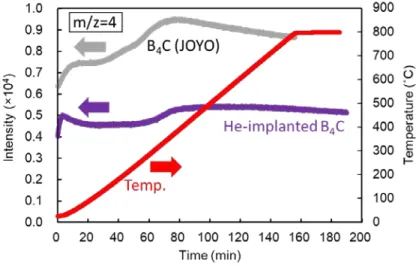
In the helium ion implantation, helium ions were implanted up to 1.1×10¹⁷ ion/cm2, sufficient dose to evaluate the release behavior of helium gas. TG-MS analysis for the B4C (JOYO) showed the dependence of the release behavior of helium gas on the grain size (Fig. 3). The helium gas was released promptly at lower temperature in fine powder than coarse powder. Thus, we prepared fine powder from He-implanted B4C/CNT sample. Its release behavior of the helium gas had relatively good agreement with that of B4C pellet (JOYO) as shown in Fig. 4, but the helium gas release was observed at higher temperature than B4C pellet (JOYO).
72
Conclusion
In the present work, 30 MeV helium ions were implanted into B4C-based ceramics using a He beam from a 930 AVF cyclotron at CYRIC. The release behavior of helium gas in the He-implanted B4C-based ceramics was successfully evaluated with TG-MS analysis. It is found that helium gas release rate depends on the grain size, and He-implanted B4C/CNT sample showed relatively similar behavior to a JOYO’s B4C pellet.
Acknowledgement
This work was supported by The Ministry of Education, Culture, Sports, Science and Technology (MEXT) under the framework of Innovative Nuclear Research and Development Program.
References
1) Jostsons A., Dubose C. K. H., Copeland G. L., Stiegler J. O., J. Nucl. Mater. 49 (1973/74) 136. 2) Hollenberg G. W., Basmajian J. A., J. Am. Ceram. Soc. 65 (1982) 179.
3) Maruyama T., Onose S., Kaito T., Horiuchi H., J. Nucl. Sci. Tech. 34 (1997) 1006. 4) Maruyama T., J. Tech. Assoc. Refr. 30 (2010) 80.
5) Ohkawachi Y., Maeda S., Sekine T., Nagasaki H., Report JNC-TN9400-2002-070, Japan Nuclear Cycle Development Institute (2003). (in Japanese)
6) Ziegler J. F., Ziegler M. D., Biersack J. P., Nucl. Instrum. Methods B 268 (2010) 1818.
73
Figure 2. The pulverized B4C pellet (JOYO) with different grain sizes; (a) coarse
powder and (b) fine powder
Figure 3. TGA curves and mass chromatograph of pulverized B4C pellet (JOYO) with different grain sizes;
(a) coarse powder and (b) fine powder
Figure 4. Mass chromatograph of pulverized B4C pellet (JOYO) and