Posted at the Institutional Resources for Unique Collection and Academic Archives at Tokyo Dental College, Available from http://ir.tdc.ac.jp/
Title
Intraoperative Blood Loss During Orthognathic Surgery: A Comparison of Remifentanil-Based Anesthesia With Sevoflurane or Isoflurane Author(s)
Alternative Wakasugi, Y; Matsuura, N; Ichinohe, T
Journal Journal of oral and maxillofacial surgery, 73(12): 2294-2299
URL http://hdl.handle.net/10130/4985 Right
Original article
Title: Intraoperative blood loss during orthognathic surgery: a comparison of
remifentanil-based anesthesia with sevoflurane or isoflurane
Authors: Yumiko Wakasugi, D.D.S, Ph.D,* Nobuyuki Matsuura, D.D.S, Ph.D,†
and Tatsuya Ichinohe, D.D.S, Ph.D‡
*Post graduate Student
†Senior Assistant Professor
‡Professor and Chairman
Institution: Department of Dental Anesthesiology, Tokyo Dental College, Chiba,
261-8502, Japan.
Corresponding author: Yumiko Wakasugi
E-mail: [email protected]
Address: Department of Dental Anesthesiology, Tokyo Dental College
1-2-2, Masago, Mihama-ku, Chiba-shi, Chiba, 261-8502, Japan.
Int. phone: +81-43-270-3970
1 Abstract
Purpose: The aim of this study was to compare blood loss in remifentanil-based
anesthesia with sevoflurane or isoflurane during orthognathic surgery.
Patients and Methods: In this randomized controlled clinical trial, patients who were
scheduled for orthognathic surgery were divided into one of two groups; sevoflurane
group (Sevo group) and isoflurane group (Iso group). Anesthesia was maintained
using end-tidal concentrations of 1.4% sevoflurane or 0.9% isoflurane. Remifentanil
was continuously infused at 0.05–0.5 µg/kg/min to maintain mean blood pressure
(MBP) at 60–65 mmHg. Intraoperative blood loss (mL/kg) was compared. Student
t-test for unpaired samples was used for statistical analysis. P < 0.05 was considered
statistically significant.
Results: The study sample was composed of 19 men and 45 women (n = 64). The
mean age was 25 years (range, 16 to 50 years). Intraoperative blood loss tended to be
higher in the Iso group (n = 32) (4.79 ± 3.22 mL/kg) compared with the Sevo group (n
= 32) (4.00 ± 1.98 mL/kg), while there was no significant difference between the two
2 Conclusion: In a comparison of intraoperative blood loss in remifentanil-based
anesthesia with sevoflurane or isoflurane during orthognathic surgery, no difference
was observed between the two groups.
3 Introduction
Oral and maxillofacial surgery, and particularly orthognathic surgery, is performed in
areas of high blood flow including the oral mucosa and bone marrow. Blood loss
during surgery can obstruct the visual field, prolong operating times, and increase the
risk of a blood transfusion.1, 2 Blood loss needs to be controlled during surgery to
ensure the operation proceeds smoothly, to avoid the risks with blood transfusion, and
to reduce postoperative complications.3
Volatile anesthetics like isoflurane and sevoflurane are now widely used in
oral and maxillofacial surgery. Previous research in rabbits showed that isoflurane
increased blood flow in the tongue mucosa.4 Another study showed that isoflurane
increased blood flow more than sevoflurane in the mandibular bone marrow and other
oral tissues in rabbits.5 Clinical research has shown that isoflurane increases blood
flow in the oral mucosa6 and sevoflurane reduces microcirculation under the tongue.7
Narcotic analgesics fentanyl and remifentanil are also widely used for pain relief
during oral and maxillofacial surgery under general anesthesia. Recent research has
shown that, like the volatile anesthetics, these narcotic analgesics also affect oral
4
oral mucosa,4 and other studies have suggested that remifentanil may be useful for
oral and maxillofacial surgery because it reduces blood flow in the mandibular bone
marrow without markedly reducing blood pressure.8, 9 Clinical research has shown
that compared with fentanyl, remifentanil reduces blood loss and allows
intraoperative hypotension without serious adverse events.10–12 One study reported
that during nasal septal surgery without a concomitant use of remifentanil, blood loss
was higher with isoflurane than with sevoflurane.13 There are few studies that
compare blood loss during oral and maxiallofacial surgery when remifentanil is used
as an adjunct to inhalation anesthesia,14, 15 and it is unclear what effects the combined
use of isoflurane with strong vasodilating potency and remifentanil have on the blood
loss.
The purpose of this study was to compare blood loss in remifentanil-based
anesthesia with inhalation anesthetics anesthetics during orthognathic surgery. We
hypothesized that blood loss in remifentanil-based anesthesia may be affected based
on the difference of vasodilative activities of inhalation anesthetics. The specific aim
was to compare blood loss in remifentanil-based anesthesia with sevoflurane and that
5 Patients and methods
Study design and sample
This study was designed and implemented as a randomized controlled trial. This study
was approved by the Tokyo Dental College Ethics Committee (approval number 541).
We enrolled patients classified as ASA class I or II, aged between 16 years and 50
years, who were scheduled for Le Fort I osteotomy and sagittal split ramus osteotomy
of the mandible at the Chiba Hospital of Tokyo Dental College. Written informed
consent was obtained from all patients or their guardians. Patients with severe heart
disease, liver/kidney disease, or muscle disease were excluded from the study.
Data collection methods
The patients enrolled were randomized by using a randomization table before surgery
to the sevoflurane group (Sevo group) or the isoflurane group (Iso group). After
transfer into the operating room, the patients were laid in a horizontal position and
venous access was secured using a 20 G catheter inserted into the forearm cephalic
vein. Anesthesia was induced using 0.01 mg/kg atropine sulfate (up to 0.5 mg/kg), 2
µg/kg fentanyl citrate, and 2 mg/kg propofol. Muscle relaxation was achieved using
6
Anesthesia was maintained using 3 L/min air, 1 L/min oxygen, and end-tidal
concentrations of 1.4% sevoflurane or 0.9% isoflurane (0.8 MAC for both groups),
while muscle relaxation was achieved through continuous administration of 5
µg/kg/min rocuronium bromide. Remifentanil continuously infused at 0.05–0.5
µg/kg/min to maintain mean blood pressure (MBP) during anesthesia at 60–65 mmHg.
When MBP was lower than 60mmHg for more than five minutes, 2-8 mg ephedrine
hydrochloride was administered depending on MBP. One percent lidocaine solution
with 1:100,000 epinephrine was administered to the surgical field. The end-tidal
carbon dioxide concentration was maintained during anesthesia in both groups at 35–
45 mmHg through controlled mechanical ventilation. Acetated Ringer’s solution was
administered at 8 mL/kg/h for fluid infusion during surgery. Continuous monitoring
under anesthesia involved pulse oximetry, non-invasive blood pressure measurement,
ECG, invasive arterial pressure measurement via cannulation of the radial artery,
bispectral index (BIS) measurement, and end-tidal anesthetic gas concentrations.
Systolic blood pressure (SBP), MBP, diastolic blood pressure (DBP), heart rate (HR),
and BIS values were recorded every 5 min and final blood loss (mL/kg) was measured
7
volume, mean remifentanil infusion rate (µg/kg/min) were also recorded. When blood
hemoglobin concentration at the time of suturing was less than 10g/dL, autologous
blood transfusion was started after the measurement of final blood loss.16
Study variables
The primary outcome variable was blood loss. Demographic variables included age,
gender, height, weight, body mass index (BMI). Time variables were duration of
surgery and duration of anesthesia. Surgery/anesthesia-related variables were HR,
SBP, MBP, coefficient of variation in mean blood pressure (CVMBP), DBP,
remifentanil infusion rate and BIS value. The other variables of interest included total
volume of local anesthetics, total amount of epinephrine contained in local anesthetic
solution, and total amount of ephedrine hydrochloride to improve hypotension. The
values for HR, SBP, MBP, DBP, and BIS were calculated as mean values during
surgery. The measurements are expressed as mean ± SD.
Data analyses
Based on the results of a previous study to compare blood loss during orthognathic
surgery between sevoflurane and desflurane anesthesia,14 and using α = 0.05 and β =
8
patients per group was estimated. Student t-test for unpaired samples was used for
statistical analysis. P < .05 was considered statistically significant. All statistical
analysis was performed using PASW statistics version 18 (SPSS Inc., Chicago,
9 Results
This study was composed of 64 patients.The mean age and male/female ratios were
25 years (17–50 years) and 10 males, 22 females in the Sevo group and 26 years (16–
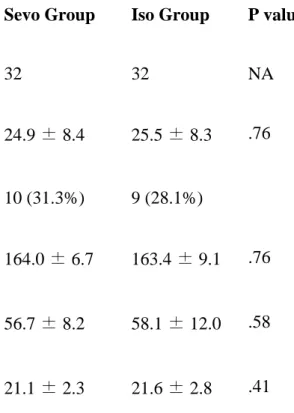
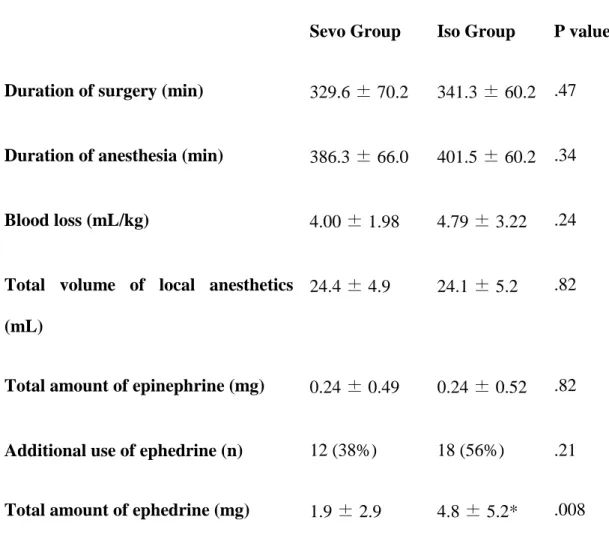
47 years) and 9 males, 23 females in the Iso group. No differences were observed
between the two groups in terms of sex, age, height, weight, BMI, duration of surgery,
duration of anesthesia, the total volume of local anesthetics, and the total amount of
epinephrine (Table 1, 2). Operations were performed by five surgeons, who have
adequate experiences of at least 50 cases in orthognathic surgery. Distribution of the
surgeons in the two groups was similar. The remifentanil infusion rate (µg/kg/min)
was significantly lower in the Iso group compared with the Sevo group (P = .004).
Total amount of ephedrine hydrochloride administered was significantly higher in the
Iso group compared with the Sevo group (P = .008) (Table 2). The BIS value was
significantly lower in the Iso group compared with the Sevo group (P < .001) (Table
3).
Although no significant differences were observed between the groups for
intraoperative HR, SBP, MBP, or DBP, CVMBP was significantly higher in the Iso
10
Intraoperative blood loss was 4.00 ± 1.98 mL/kg in the Sevo group and 4.79 ±
3.22 mL/kg in the Iso group. Although blood loss tended to be higher in the Iso group,
there was no significant difference between the two groups (Figure 1). No
11 Discussion
The purpose of this study was to compare blood loss in remifentanil-based anesthesia
with sevoflurane and that with isoflurane during orthognathic surgery. This study
showed that although blood loss tended to be higher in the Iso group compared with
the Sevo group, the difference was not significant. BIS value under anesthesia was
lower in the Iso group compared with the Sevo group. Total amount of ephedrine
hydrochloride was higher in the Iso group compared with the Sevo group. Mean
remifentanil infusion rate was less in the Iso group compared with the Sevo group.
However, CVMBP was higher in the Iso group compared with the Sevo group.
The combined use of remifentanil with inhalation anesthetics allows sufficient
pain relief and sedation at a low MAC because of drug interactions.17–19 In the clinical
setting, one study reported that anesthesia can be maintained appropriately with
continuous infusion of remifentanil at 0.1–0.3 µg/kg/min and the inhalation anesthetic
maintained at 0.5–0.8 MAC.20 Rossi et al. investigated desflurane or sevoflurane
maintained at 0.8 MAC under a concomitant use of 0.5 µg/kg/min remifentanil during
orthognathic surgery and reported that blood loss was lower with desflurane
12
inhalation anesthetic at 0.8 MAC and remifentanil at 0.05–0.5 µg/kg/min. Blood loss
is lower in patients with MBP maintained at 55–65 mmHg compared with those with
MBP maintained at 75–85 mmHg,21 and that maintaining MBP at 65 mmHg provides
appropriate conditions for surgical procedures and reduces blood loss.22 Circulation in
vital organs can be maintained safely if MBP is 55 mmHg or above.23 We assumed
that blood loss could be reduced and systemic circulation safely maintained if
anesthesia were maintained with MBP at around 65 mmHg. Therefore, we maintained
MBP at 60–65 mmHg in this study.
Research has shown that volatile anesthetics exhibit different BIS values when
maintained at the same MAC.24, 25 Olofsen et al. investigated the relationships of
isoflurane and sevoflurane concentrations to BIS value and reported that the BIS
value declined in a concentration-dependent manner up to a certain concentration of
anesthetic (isoflurane: 0.75% or approx. 0.65 MAC; sevoflurane: 1.5% or approx. 0.9
MAC), and then plateaued at around 40 for higher concentrations.26 The lower BIS
value in the Iso group in our study may reflect the change in brainwaves caused by the
inhalation anesthetic. However, although the BIS value was within the 40–60 range at
13
anesthesia was deeper in the Iso group compared with the Sevo group. However,
because the objective of our study was to compare blood loss when the inhalation
anesthetics were maintained at the same MAC and MBP was maintained at around 60
mmHg, we did not correct for differences in BIS value. If we assume that this
difference in BIS value affects blood loss, we might expect blood loss to be higher in
the Sevo group where depth of anesthesia was light, but no difference was observed
between the two groups in this study. Therefore, we believe that differences in BIS
value did not have a major effect in this study.
In addition, the infusion rate of remifentanil in this study may have been less
in the Iso group compared with the Sevo group because isoflurane dilates the blood
vessels in a concentration-dependent manner27 and renders patients more likely to
develop intraoperative hypotension. According by, blood pressure may have been
lower during the non-invasive procedures in the Iso group, and the anesthesiologist
may have reduced the infusion rate of remifentanil. As a result, more ephedrine
hydrochloride was required in the Iso group. The remifentanil dose might then have
been insufficient for subsequent invasive surgical procedures, which may explain why
14
Research in rabbits has shown that isoflurane increased tissue blood flow in a
concentration-dependent manner in the head and neck region, including bone marrow
and alveolar tissues in the lower jaw, whereas sevoflurane produced no such change
in mandibular bone marrow tissue.5 Özkiris et al. compared blood loss with the use of
sevoflurane or isoflurane anesthesia in nasal septal surgery and reported higher blood
loss with isoflurane. They explained that this occurs because isoflurane is a
vasodilator that lowers arterial blood pressure in a concentration-dependent manner,
and tissue blood flow increases because of vasodilation regardless of low perfusion
pressure.13 Based on these studies, we had expected our comparison of anesthesia
maintained with sevoflurane or isoflurane during surgery in the head and neck region
to show higher blood loss with isoflurane because of its potent vasodilatory effect.
However, no difference in blood loss was seen between the two groups in our study.
The literature includes research on remifentanil-based anesthesia with desflurane or
sevoflurane during orthognathic surgery and remifentanil-based anesthesia with
desflurane or isoflurane during ENT surgery.15, 28 Remifentanil acts to reduce blood
flow in an infusion rate-dependent manner at the site involved, such as in mandibular
15
flow in the mandibular bone marrow tissue and expected blood flow to be around
10% higher in the Iso group compared with the Sevo group. Although we could find a
tendency towards higher blood loss in the Iso group, the difference between groups
was not significant. This suggests that the decrease of blood flow in the mandibular
bone marrow tissue induced by remifentanil was greater than the increase of that
induced by isoflurane, such that any increase in tissue blood flow was suppressed and
blood loss was not affected. However, CVMBP was higher in the Iso group compared
with the Sevo group in our study, which suggests that intraoperative MBP was
unstable. This may have been involved at least in part in the large variability of blood
loss.
We did not directly measure intraoperative blood flow in the head and neck
region in our study. Hence, we cannot determine whether changes in local tissue
blood flow were involved in blood loss variability. The issues will need to be
investigated from multifaceted perspectives because it is extremely difficult to
measure tissue blood flow in the operative field in humans.
Results from this study suggest that both anesthetics may be safely used for
16
considering the low metabolism rate and its cost effectiveness. On the other hand, it
would be better to use sevoflurane considering the emergence profile. Further studies
will be required to compare intraoperative blood loss among three groups including
desflurane.
In conclusion, in a comparison of intraoperative blood loss in
remifentanil-based anesthesia with sevoflurane or isoflurane during orthognathic surgery, no
difference was observed between the two groups. Next research intended for larger
patient population to compare blood loss during surgery among isoflurane,
17 References
1. Chillemi S, Sinardi D, Marino A, et al.: The use of remifentanil for bloodless
surgical field during vertebral disc resection.Minerva Anestesisol 68:645, 2002
2. Carson JI, Altman DG, Duff A, et al.: Risk of bacterial infection associated with
allogeneic blood transfusion among patients undergoing hip fracture repair.
Transfusion 39:694, 1999
3. Precious DS, Splinter W, Bosco D: Induced hypotensive anesthesia for
adolescent orthognathic surgery patients. J Oral and Maxillofac Surg 54:680,
1996
4. Ichinohe T, Homma Y, Kaneko Y: Mucosal blood flow during various
intravenous and inhalational anesthetics in the rabbit. Oral Surg Oral Med Oral
Pathol Oral Radiol Endod 85: 268, 1998
5. Okamoto S, Matsuura N, Ichinohe T: Effects of the change in concentration of
volatile anesthetics on oral tissue blood flow in rabbits. J Jpn Dent Soc
18
6. Homma Y, Kasahara M, Miyachi K, et al.: A comparison of oral submucosal
blood flow changes under propofol anesthesia and isoflurane-nitrous oxide
anesthesia. J Jpn Dent Soc Anesthesiol 26: 219, 1998
7. Nihal GÖ, Banu A, Meral K, et al.: Comparison of the effects of sevoflurane,
isoflurane, and desflurane on microcirculation in coronary artery bypass graft
surgery. J Cardiothorac Vasc Anesth 26:791, 2012
8. Kemmochi M, Ichinohe T, Kaneko Y: Remifentanil decreases mandibular bone
marrow blood flow during propofol or sevoflurane anesthesia in rabbits. J Oral
Maxillofac Surg 67: 1245, 2009
9. Koshika K, Ichinohe T, Kaneko Y: Dose-dependent remifentanil decreases oral
tissue blood flow during sevoflurane and propofol anesthesia in rabbits. J Oral
Maxillofac Surg 69: 2128, 2011
10. Twersky RS, Jamerson B, Warner DS, et al.: Hemodynamics and emergence
profile of remifentanil versus fentanyl prospectively compared in a large
19
11. Kawano H, Manade S, Matsumoto T, et al.: Comparison of intraoperative blood
loss during spinal surgery using either remifentanil or fentanyl as an adjuvant to
general anesthesia. BMC Anesthesiology 13:46, 2013
12. Miłoński J, Zielińska-Bliźniewska H, Golusiński W, et al.: Effects of three
different types of anaesthesia on perioperative bleeding control in functional
endoscopic sinus surgery. Eur Arch Otorhinolaryngol 270:2045, 2013
13. Özkiris M, Kapusuz Z, Öztürk S, et al.: The effects of sevoflurane and isoflurane
in nasal septal surgery. J Craniofac Surg 24:1376, 2013
14. Rossi A, Falzetti G, Donati A, et al.: Desflurane versus sevoflurane to reduce
blood loss in maxillofacial surgery. J Oral Maxillofac Surg 68:1007, 2010
15. Caverni V, Rosa G, Pinto G, et al.: Hypotensive anesthesia and recovery of
cognitive function in long-term craniofacial surgery. J Craniofac Surg 16:531,
2005
16. Ronald DM: Miller’s Anesthesia. 7th Ed. Philadelphia, Churchill Livingstone
Elsevier, 2009, pp 1741
17. Lang E, Kapila A, Shlugman D, et al: Reduction of isoflurane minimal alveolar
20
18. Manyam SC, Gupta DK, Johnson KB, et al: Opioid-volatile anesthetic synergy: a
response surface model with remifentanil and sevoflurane as prototypes.
Anesthesiology 105:267, 2006
19. Murouchi T, Yamakage M, Michifuri Y, et al: Usefulness of remifentanil
anesthesia in oral surgery. J Clin Anesth 32:1167, 2008
20. Yamakage M, Namiki A: A long-waited ultra-short acting opioid –remifentanil-.
J Clin Anesth (Jpn). 29:1739, 2005
21. Lessard MR, Trépanier CA, Baribault JP, et al: Isoflurane-induced hypotension
in orthognathic surgery. Anesth Analg 69:379,1989
22. Schindler I, Andel H, Leber J, et al: Moderate induced hypotension provides
satisfactory operating conditions in maxillofacial surgery. Acta Anaesthesiol
Scand 138:384,1994
23. Choi WS, Samman N: Risks and benefits of deliberate hypotension in
anaesthesia: a systematic review. Int J Oral Maxillofac Surg 37:687, 2008
24. Kim JK, Kim DK, Lee MJ: Relationship of bispectral index to minimum alveolar
concentration during isoflurane, sevoflurane or desflurane anaesthesia. J Int Med
21
25. Kurehara K, Horiushi T, Takahashi M, et al: Relationship between minimum
alveolar concentration and electroencephalpgraphic bispectral index as well as
spectral edge frequency 95 during isoflurane/epidural or sevoflurane/epidural
anesthesia. Masui 50:512, 2001
26. Olofsen E, Dahan A: The dynamic relationship between end-tidal sevoflurane
and isoflurane concentrations and bispectral index and spectral edge frequency of
the electroencephalogram. Anesthesiology 90:1345, 1999
27. Eger EI: The pharmacology of isoflurane. Br J Anaesth 56:71s, 1984
28. Kaygusuz K, Yildirim A, Kol IO, et al: Hypotensive anaesthesia with
remifentanil combined with desflurane or isoflurane in tympanoplasty or
endoscopic sinus surgery: a randomised, controlled trial. J Laryngol Otol
22 Figure legend
Fig. 1
Comparison of blood loss (mL/kg). Mean blood loss in the Sevo group was 4.00 ±
1.98 mL/kg, and that in the Iso group was 4.79 ± 3.22 mL/kg. There was no
23
Table 1 Demographic variables
Sevo Group Iso Group P value
Sample size (n) 32 32 NA Age (yr) 24.9 ± 8.4 25.5 ± 8.3 .76 Sex: male 10 (31.3%) 9 (28.1%) Height (cm) 164.0 ± 6.7 163.4 ± 9.1 .76 Weight (kg) 56.7 ± 8.2 58.1 ± 12.0 .58 BMI (kg/m2) 21.1 ± 2.3 21.6 ± 2.8 .41
Abbreviation: NA, not applicable.
Data are presented as mean ± SD. Student t-test for unpaired samples was used for
24
Table 2 Study variables
Sevo Group Iso Group P value
Duration of surgery (min) 329.6 ± 70.2 341.3 ± 60.2 .47
Duration of anesthesia (min) 386.3 ± 66.0 401.5 ± 60.2 .34
Blood loss (mL/kg) 4.00 ± 1.98 4.79 ± 3.22 .24
Total volume of local anesthetics (mL)
24.4 ± 4.9 24.1 ± 5.2 .82
Total amount of epinephrine (mg) 0.24 ± 0.49 0.24 ± 0.52 .82
Additional use of ephedrine (n) 12 (38%) 18 (56%) .21
Total amount of ephedrine (mg) 1.9 ± 2.9 4.8 ± 5.2* .008
Data are presented as mean ± SD. Student t-test for unpaired samples was used for
25
Table 3 Surgery/anesthesia-related variables
Sevo Group Iso Group P value
HR (beats/min) 77.2 ± 9.3 80.2 ± 9.6 .22
SBP (mmHg) 99.8 ± 5.8 97.3 ± 5.9 .1
MBP (mmHg) 64.0 ± 4.2 62.3 ± 4.2 .1
CVMBP (%) 9.6 ± 2.2 11.2 ± 3.6* .04
DBP (mmHg) 49.3 ± 3.8 47.5 ± 3.6 .06
remifentanil infusion rate (µg/kg/min)
0.19 ± 0.06 0.14 ± 0.06* .004
BIS value 50.5 ± 6.8 44.1 ± 6.4* < .001
Data are presented as mean ± SD. Student t-test for unpaired samples was used for
statistical analysis.