1)神戸常盤大学保健科学部医療検査学科(ライフサイエンス研究センター) 2)神戸大学医学部附属病院医療情報部
3)国立障害者リハビリテーションセンター自立支援局神戸視力障害センター 4)神戸大学人文科学研究科
*These authors contributed equally to this work.
Summary
In Japan, number of people with low vision is increasing along with the increased morbidity of glaucoma or diabetic retinitis pigmentosa, etc. It is difficult for the acquired visually impaired to learn and acquire Braille because most of them are middle-aged and so they usually rely on their residual vision. In addition, the number of Braille teachers are not sufficient and rather reducing in Japan, and this situation makes more difficult for the visually impaired to learn Braille. Therefore, we research and develop three styles of Web-based e-learning programs for Japanese Braille and the Application Programming Interface (API) for displaying Braille characters: one for only computer screen that utilize residual vision (RV), another one which cooperates with Braille display (BD), and the other for tactile Braille that cooperates with Braille display and voice assistance (BDV).
Key words : Acquired visually impaired, Braille, e-learning, Tactile Braille
要 旨
我が国では、緑内障や糖尿病性網膜色素変性症の罹病率の増大に伴い、弱視者の数が増加している。これら の中途視覚障害者の多くは中高年で残存視覚への依存が大きく、点字の習得が困難である。加えて、点字教育 を担当する教師も減っており、これら中途視覚障害者の点字学習をより困難にしている。そこで我々は、残存
原著
Research and development of braille e-learning program for
the visually impaired and its learning effect
Mika OHTA
1),2)*, Tsuyoshi ODA
3)*, Shinichi KITA
4), Eiichi MAEDA
2),
Aki SUGANO
1),2), and Yutaka TAKAOKA
1),2)中途視覚障害者向け点字 e- ラーニングの研究開発と
その学習効果
大田 美香
1),2)*小田 剛
3)*喜多 伸一
4)前田 英一
2)1. Introduction
Braille, which consists of six tactile raised dots, is the only system for the blind and the partially sighted to read and write. After Louis Braille invented Braille in 18251), Kuraji Ishikawa, who was a teacher at a school for the blind and speech-impaired in Tokyo in Japan, adapted the Braille alphabets to Japanese. His idea of adaptation was then introduced as “Japanese Braille for the blind” in the official gazettes in 1901 in Japan. Since then, Japanese Braille has been a basis of education at schools for the visually impaired and a means of gaining information in print for them.
Japanese Braille is different from English Braille in use of indicators to express voiced sounds, long vowels or special sounds, unlike the basic 50 sounds, and in use of text segmentation named Wakachigaki2), like spacing between words in English and European languages.
Regarding the accessibility of blind and partially sighted patients to medical information, Japan’s Ministry of Welfare issued instructions to Regional Medical Affairs Office on the patient compliance instructions for the disabled including the blind (No. 289, Ministry of Health and Welfare, Healthcare Service Bureau, 19th of August, 1998) and Central Social Insurance Medical Council issued the revision in the fiscal year 2000 of remuneration for medical services (Ministry of Health and Welfare, Medical Economics Division, Health Insurance Bureau, 29th of February, 2000). The former encouraged medical institutions to provide drug administration in Braille on medical envelopes and the latter is to cover providing medical information in Braille by Central Social Insurance. Considering this situation that the provision of information in Braille is being required, it is very important for the visually impaired to acquire Braille3).
We have developed Braille translation engine named KUIC which follows the latest Japanese Braille transcription rules 20012) to implement on our program and provided open access to automatic Braille translation program “eBraille” or “eBraille-M”4). We also have started providing medical information in Braille by using our program and are preparing such system in our hospital4). Braille acquisition is considered to be necessary for the blind and the visually impaired in order to avoid the social disadvantages in information disparity.
In the recent years, the number of people with acquired vision loss is more increasing, because of glaucoma, diabetic retinitis pigmentosa, etc., than people with congenital visual impairment. People with acquired vision loss have to change the letters for communication to Braille from what they used to use, that is, letters for the sighted. It is difficult, however, to learn Braille and so many of them give up learning and depend on their residual vision, or change to sound media such as tape recorder. As a result, literacy rate of Braille became lower and it lead to 12.7% for all the blind and visually impaired 視覚 (RV) のみを使用する画面によるプログラム、画面と点字ディスプレイ(BD)が協働するプログラム、 画面と音声アシスト(BDV) が点字ディスプレイと協働するプログラム、の3種類の Web ベースの e- ラーニ ングプログラムと基本 API (Application Programming Interface) を研究開発した。
people in Japan. However, such situation may cause the information gap between visually impaired and sighted people, which is naturally disadvantageous for the visually impaired. Indeed, Braille literacy is considered very important in respect of education or independence as in the activities of American Foundation for the Blind and National Federation of the Blind (ex. https://nfb.org/braille-campaign).
To make an increase for the low rate Braille literacy in the people with acquired vision loss, we have researched and developed three styles of Braille e-learning: one for only computer screen that utilize residual vision (RV), another one which cooperates with Braille display (BD), and the other for tactile Braille with voice assistance (BDV). This paper reports our research development of our program and our analysis whether the program is effective or not to the visually impaired for Braille learning.
2. Methods
2-1. Experiment of Visually Discrimination of Diagram
We examined that the most discriminative diagram, for the visually impaired, as the raised dot of Braille. We used and compared five diagrams, “ ● ” “ ▲ ” “ ■ ” “ ★ ” “+” for the raised dot, because they were used in National Kobe Rehabilitation Center for the Visually Disabled in Japan. This experiment was conducted from 2009 to 2011 in cooperation with 74 visually impaired students in the National Kobe Rehabilitation Center: 60 males and 14 females. The
number of each degree of the impairment, which followed physical disability certificate in Japan was as follows: 48 people in the second grade (total binocular vision if from 0.02 to 0.04 and the rate of visual dysfunction is over 95%), 12 for the third (total binocular vision if from 0.05 to 0.08 and the rate of visual dysfunction is over 90%), 7 for the fourth (total binocular vision if from 0.09 to 0.12), 7 for the fifth (total binocular vision if from 0.13 to 0.2). Their age covers from 18 to 62 and the average was 41.6±12.4.
W e m a d e t h e g r a p h i c B r a i l l e f o r t h e f i v e diagrams in black with white background one cell, sufficiently large on the computer display (17inch, 1920 × 1200 pixel). The rest of the computer screen was set to black in order to reduce the burden to the students’ eyes. Using these Braille images on the computer screen, five diagrams are evaluated through the session as shown in Figure 1. During this session, students were seated and watched the diagrams. When the session was over, they were asked to score each diagram with the range from point 1 to 5. We
Figure 1. Session of Braille images on the screen used in the discriminative diagram experiment
(1) The students who took part in our experiment watched five diagrams, which was randomly displayed on the computer screen for 60 seconds, (2) watched one diagram each for 10 seconds in a different order, (3) watched five diagrams again for 60 seconds with the order is different from that of (1), (4) again watched one diagram by one, each for 10 seconds in another different order, and (5) watched five diagrams together for 60 seconds. The order of diagrams in (5) is differ-ent with that of (1) and (3).
calculated the scores followed by statistically analysis and then used the diagram with the highest score for the raised dot.
2-2. Development of the Braille e-Learning Programs
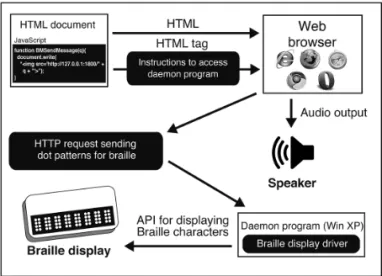
We constructed a Web-based e-learning program for Braille so that the program is independent of computer architecture or OS. For all of our three e-learning, that is RV, BD and BDV, we prepared the three steps: (1) each question for learners is selected randomly and displayed on the screen, (2) learner select the answer and send it to the e-learning server, (3) the answer is checked by the program and the result is displayed with the Braille image(s) on the screen. The selection of the questions in step (1) was realized by Math.random function of JavaScript. For BD and BDV, we prepared Braille display driver program which cooperates with the HTML files in our e-learning as shown in Figure 2: First, Web browser program requires HTTP access from the driver (daemon) program by JavaScript in HTML tags. Then this request is sent to the port of the daemon. The Braille display driver sends this HTTP request to USB port of the Braille display. Lastly, Braille is displayed on the Braille display.
Our Braille display driver program for BD and BDV is a Braille display daemon for Windows XP, based on the specification information of KGS Braille device controller (KBDC), which was provided from KGS corporation, with Microsoft VisualStudio 2008 Professional Edition. We made our driver applicable for the following Braille displays by KGS corporation: Braille Note BN20A, Braille Note BN40A, Braille Note BN46C, Braille Note BN46D, Braille Note BN46X, Braille Memo BM16, Braille Memo BM24. Braille Memo BM46, Braille Memo Pocket BMPK, and so on. For system requirements to use our Braille display driver, .NET Framework 3.5 and Runtime Environment of Visual C++ 2008 are needed. We then confirmed the operation of our e-learning programs with Braille Memo Pocket BMPK (KGS corporation, Saitama, Japan).
For the voice assistance of BDV, we embedded the MP3 audio files of recorded male human voice into HTML files. Each graphic Braille for our e-learning was created by Adobe Illustrator and then converted into JPEG file by Adobe Photoshop in 300dpi, 331 × 248 pixel. Using these graphic files, we prepared total 167 files for Japanese characters called Kana, numbers and symbols.
We provided open access to our three styles of Web-based Japanese Braille e-learning programs. They are accessible from our web site: RV, http:// ebraille.med.kobe-u.ac.jp/edubraille/; BD, http:// bionano.med.kobe-u.ac.jp/edubraille2/; BDV, http:// bionano.med.kobe-u.ac.jp/edubraille2-sound/.
Figure 2. Our web-based e-learning program
Basic construction is the same for our e-learning pro-grams, RV, BD and BDV. In RV, the functions for au-dio output to speaker and the API for displaying Braille characters are excluded. In BD, the API for displaying Braille characters is excluded.
2-3. Evaluation for our e-learning programs
Our e-learning programs were evaluated by visual impaired students in the National Kobe Rehabilitation Center for the Visually Disabled.
For the learning effect of RV, total 12 students took part in the evaluation: 9 males and 3 females. The number of each degree of the impairment: 7 people in the second grade (total binocular vision if from 0.02 to 0.04 and the rate of visual dysfunction is over 95%), 4 for the third (total binocular vision if from 0.05 to 0.08 and the rate of visual dysfunction is over 90%), 1 for the fifth (total binocular vision if from 0.13 to 0.2). Their age covers from 28 to 62 and the average was 42.8±12.4. We tested their proficiency of Braille in advance. Total 20 questions were included in this pre-test: 14 questions of one Kana and 6 questions of one figure in the range of 1 to 20. The level of this test was that of level 2 in our e-learning program. We then divided the students into two groups in the following way of learning: one was self-learning group which used our e-self-learning program and the other was the group which also used our e-learning program and can raise questions to the teacher about what the student is learning. The number of questions was not limited. The students, however, can ask one question at a time and the teacher answered their questions by considering the bias in the time to spend for explanation. After learning, Braille tests for the learning effect was held. The level of the contents of the test is the same as the pre-test, but the contents themselves were different among the tests. In this way, the students of both groups learned Braille for 45 min using our e-learning program, took 15 min break and took the Braille test for 45 min in a day. This cycle of learning and the test was continued for two days. Finally, we compared the scores of the pre-test and the Braille tests for learning effect.
For the learnability of BD and BDV, a questionnaire-based survey was taken. The participants were total 28 people including 22 students and 6 lecturers of National Kobe Rehabilitation Center for the Visually Disabled and consisted of 27 people of acquired vision loss and one person with congenital eye disease. They were asked to use our programs and to compare RV with BD and BD with BDV.
This study was performed according to the Basic Act for Persons with Disabilities (Japan Ministry of Health, Labor and Welfare) and our experiments were approved by National Kobe Rehabilitation Center for the Visually Disabled. One of the authors who is an instructor of National Kobe Rehabilitation Center conducted the experiments after the instructor received consent from the students who participated on their own wills. The students were explained the purpose of this study and that the participants’ personal information will be anonymized for protection. The experimental data were then analyzed by the authors in Kobe University Hospital.
2-4 Statistical analysis
Statistically analyses were performed with GraphPad PRISM software (GraphPad Software, Inc., La Jolla, CA, USA) in 2-1 described above and the R software5) in 2-3. We calculated the scores and used one-way ANOVA, followed by Tukey’s post-hoc test. All values were expressed as means ± SD. Significance level was set at P < 0.05.
3. Results
3-1. Visually Discrimination of Diagram
As a result of experiment for the 5 diagrams as raised the dot(s) for Braille, “+” had significantly higher score than the other diagrams (Figure 3). This result suggest that graphic Braille with the raised dot by “+” is highly visible for visually impaired students.
3-2. Contents of Questions and Learner Operation of our e-learning Program
Contents of questions in our three e-learning programs are commonly as follows: First, learners access the Web page of the program via Web browser.
Learners choose the level of question here: Level 1, numbers from 1 to 20; Level 2, 50 sounds in Kana characters are added to the level 1; Level 3, 140 sounds including diphthongs or special sounds in Kana and 7 special symbols are added to the level 2; Level 4, alphabets are added to the level 3. After the level is chosen, the program randomly selects one question of the level and displays the Braille on the screen and also on the Braille display for BD and BDV.
For each question, the learner then choose the answer from the four options described in Japanese letters and figures by clicking with a mouse or typing the option number. To check the correct answer, the learner clicks the check button or types “q.” The program display if the answer is correct or not. If the answer is wrong, the program displays the correct answer. The learner can go back to the level selection by choosing the button “stop” on each page.
3-3. Learning Effect of Our e-learning
After the test for learning effect of RV, we compared the two groups of students. As a result of learning with our program, both groups achieved significantly higher scores of the Braille test,
Figure 4. Comparison of the scores with or without assistance of teacher
A is a result of the group of students with self-learn-ing usself-learn-ing our e-learnself-learn-ing program RV. B is a result of the group using our e-learning program RV with ex-planations by a teacher upon request. Black bar, the pre-test for the proficiency of Braille; white bar, the Braille test in the first day; gray bar, the Braille test in the second day. *, P<0.05; **, P<0.01.
Figure 3. Result of experiment for visually discrimination of diagrams
compared to the pre-test (Figure 4). The scores for the questions for Kana in the Braille tests were also significantly higher than the pre-test. There was no significant difference between the Braille test held in the first day and the test in the second day.
For learnability of BD and BDV, all of 28 students commented that the e-learning with Braille display had the higher learnability than that of RV, regardless of the degree of the impairment. 26 students with the impairment from one to three degrees preferred BDV rather than BD. Two students out of 28 with the fourth and five degrees preferred the e-learning without the voice assistance because it took time to wait during the voice assistance, which made the learning speed lower.
4. Discussion and conclusion
We developed e-learning program with voice assistance for tactile Braille, by utilizing residual vision of the visually impaired. We provide three styles of e-learning so to meet the diverse needs of the visually impaired. Since our programs is Web-based, it goes well with screen reader programs. Therefore blind or visually impaired learners can use our e-learning with screen readers. For other Braille e-learning program, Takahashi et al reported e-learning system for the sighted learners6). This system is also Web-based, however, their objective is to construct the support system for the sighted, not to raise the Braille literacy rate for the visually impaired. Therefore, their Web pages for learning Braille are not suitable for the people with vision loss and the system does not cooperate with Braille displays.
In this study, the number of students who participated in each experiment is different because each investigation was independently conducted at different period. However, in the field of research of the visually impaired, it is known to be difficult to obtain visually impaired participants for experiments.
Our e-learning program was favorably accepted by the visually impaired people. We consider our future task as to make more difficult question along with the proficiency of Braille learning. The examples of such questions are multiple letters or a sentence. For further improvement, evaluation for our program with more details is underway.
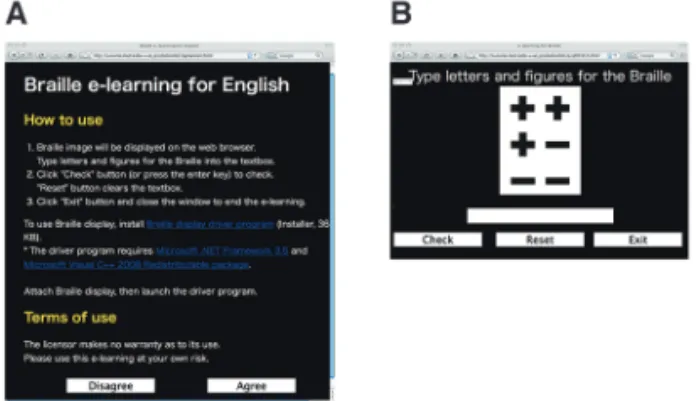
We additionally made an e-learning program on the Web for English Braille as a pilot version and provided open access on the Internet (http://bionano. med.kobe-u.ac.jp/edubraille3/agreement.html) (Figure 5). In addition, we introduced this English Braille e-learning to some organizations supporting the blind and visually impaired people in the USA and the UK, and received the comment that our e-learning can be effective for the sighted learners.
Figure 5. Our e-learning program for English Braille on the Web
Acknowledgments
The authors thank Mr Kenji Miura for his technical assistance and KGS Co., LTD. for disclosure of technical information of their Braille display. This work was supported by the Strategic Information and Communications R&D Promotion Programme (SCOPE) (No. 101707012) of the Ministry of Internal Affairs and Communications, Japan and Research for Promoting Technological Seeds A (No. 11-171) of Japan Science and Technology Agency, JST.
References
1) Jiménez, J.; Olea, J.; Torres, J.; Alonso, I.; Harder, D.; Fischer, K. Biography of louis braille and invention of the braille alphabet. Survey of Ophthalmology, 2009, Vol. 54, No. 1, pp.142-149.
2) Japanese Braille Committee. Japanese Braille Transcription Rules, 2001. Tokyo: Daikatsuji Co. Ltd. (in Japanese)
3) Sugano, A.; Hanaoka, S.; Sagara, K.; Asahara, M.; Miura, K.; Ohta, M.; Matsumoto, Y.; Ohshima, T.; Takaoka, Y. An approach toward a barrier-free hospital using a Japanese-into-Braille translating server “eBraille.” IEICE Technical Report, 2009, Vol.108, No. 488, pp.19-24.
4) Sugano, A.; Ohta, M.; Oda, T.; Miura, K.; Goto, S.; Matsuura, M.; Maeda, E.; Ohshima, T.; Matsumoto, Y.; Takaoka Y. eBraille: A web based translation program for Japanese text to Braille. Internet Research, 2010, Vol. 20, No. 5, pp.582-592.
5) R Core Team: R: a language and environment for statistical computing. R Foundation for Statistical Computing, Vienna, 2013.
6) Takahashi, S.; Sakai, J.; Tokizawa, K.; Hanyuda, H.; Maekawa, Y.; Iyoda, M. Support System for Japanese Braille Learner Using WWW. IEICE Technical Report, 1999, Vol. 98, No. 563, pp.97-104.