Hiroyuki Miyake
1Yayoi Kodama
2Haris Anwar Syafrudie
3Sugeng Utaya
4Ery Tri Djatmika
5Nyoman Sudana Degen
6Contents of this article Introduction
1. ESD at the university level and the enterprise level in Japan
2. Environmental education for sustainable development in formal education in Japan
3. Preventive maintenance, building conditions, and participants of the Adiwiyata School Programs in Indonesia
4. Analysis of environmental education content materials at Adiwiyata junior high schools in East Java Discussion
Keywords: university, enterprise, eco-school, ASPNet, preventive maintenance, school building conditions, main materials, textbooks, environmental education, local content
Introduction
by Hiroyuki MIYAKE The “United Nations Decade of ESD” started in 2005 and ended in 2014. It has been a good influence and impact onto people around the world, although ESD has not spread out as wide as expected. As Japan was an organizing member to call for ESD, it has gradually been introduced
1 University of Kitakyushu 2 University of Kitakyushu 3 Malang University 4 Malang University 5 Malang University 6 Malang University
into Japanese society. In the case of other Asian countries including Indonesia, some universities responded well to this call, but for the most part, ESD has not been spread out in many Asian countries. Although most schools in Asian countries do not know about ESD, partial methods and concepts of education can be introduced into individual schools having similar effects of ESD.
This article covers various aspects of ESD in Japan and Indonesia. Miyake targeted ESD of universities and enterprises in Japan. Kodama researched school facilities and ESD programs in Japan and Kitakyushu. While the Adiwiyata School Program is encouraging, Syafrudie pointed out areas in need of improvement in terms of materials and designs of schools. Utaya and others targeted the content of textbooks of junior high schools in terms of environmental education.
1. ESD at the university level and enterprise level in Japan
by Hiroyuki MIYAKE ESD is a kind of educational style that targets all generations and fields. Both universities and enterprises should, therefore, be covered in this concept. In this chapter, we will explain how universities and enterprises promote ESD in Japan and what they want to inform.
(1) University network on ESD and advanced universities
Before the concept of ESD spread out in Japan, the Ministry of Education, Culture, Sports, Science, and Technology (hereafter, MEXT) subsidized a project called the “Supporting program to meet modern educational requirements (Modern GP)” in order to revitalize higher education. Many universities tried to enhance their curricula and policies to reflect the recommendations made by MEXT and society in general. Such policy issues were raised by various councils and the Comprehensive Science and Technology Conference. In September 2004, MEXT announced that 86 universities were selected out of a total of 559 applications to receive funding.
Cooperation is an important part of ESD, so the Higher Education for Sustainable Development (HESD) Forum was set up to exchange information between universities receiving ESD-related subsidies. Iwate Univ. and Rikkyo Univ. played central roles in managing the HESD Forum. Every year, the forum was held at a different university.
Iwate Univ. held the HESD Forum in 2007 where Iwate Univ.'s Committee of ESD Promotion organized 17 presentations by participants from invited universities. Iwate Univ. gave a presentation about reforming general education to include ESD at the forum. There were seven important factors: 1. a body to gather general educational subjects in all faculties, 2. a bridge between general education and technical education, 3. cooperation with universities in the world, 4. cooperation between kindergartens, primary schools, junior high schools, and high schools at the local level, 5. communication between students of high schools, citizens, and enterprises, 6. cooperation between universities in Japan, 7. an appealed point for evaluation of university. The reformation or reconstruction of the general education system to include ESD was given the name, “Galaxy of Learning,” which relates to Kenji MIYAZAWA. He was a poet and novelist who was famous for incorporating elements from his own local background in his literature1).
An international symposium was held on “Education for a Sustainable Future: the Role of Asian Universities and Opportunities for Collaboration” with members from Korea, China, Cambodia,
UNESCO, and the Chancellor of Iwate Univ.
The forum has been held every year at the following universities: in 2007 at Iwate Univ., in 2008 at Rikkyo Univ., in 2009 at Okayama Univ., in 2010 at Sophia Univ., in 2011 at Tokushima Univ., in 2012 at Kyoto Univ., in 2013 at Kanazawa Univ., in 2014 at Nagoya City Univ., in 2015 at Ryukyu Univ., in 2016 at Hokkaido Univ., and in 2017 at Ritsumeikan Univ. The United Nations Decade of ESD (DESD) ended in 2014, and the second stage of ESD has started to expand the size of HESD, but the discussion in the general meeting of 2014 at Nagoya City Univ., clearly showed the reality and the numerous problems facing HESD. One is related to the expansion and continuity of HESD. The level of recognition about the DESD by people in higher education, namely university teachers, is still low, and successors cannot be found after present participants retire from their universities. It is also difficult to register as an organization, so groups tend to register themselves on a smaller scale such as research groups or individuals2).
On the other hand, there have been positive outcomes of expansion or promotion of ESD in universities. Although the Univ. of Kitakyushu has not been registered to HESD, many kinds of ESD programs and projects are ongoing and many teachers have committed to them. Whether to become a member or not has been in discussion.
Apart from the HESD Forum, there are other university networks related to ESD in the world. Suzuki (2014, p. 94) discussed ProSPER.NET (Promotion of Sustainability in Postgraduate Education and Research Network), ASPUnivNet, and HESI (Higher Education for Sustainability Initiative). ProSPER.NET which was set up in June, 2008 after adoption of its charter in November, 2007 has pursued sustainability of education and research at the graduate school level. The network consists of 28 higher education organizations with graduate school programs dealing with sustainable development in Asia and the Pacific region. ASPUnivNet is a network of universities which support UNESCO-associated schools to improve the present educational level in each region. Okayama Univ. was the secretariat of the body in 2013-14.
The HESI consists of 272 bodies from 47 countries. Bunkyo Univ. and Chuo Univ. are registered universities from Japan. Mainly, they work on 1) teaching the concepts of ESD as a part of core curricula, 2) promoting SD research, 3) making campuses much greener through the reduction of their environmental footprints and purchasing ecofriendly products, and 4) providing sustainable traffic methods, the 3-Rs of waste, and the promotion of sustainable lifestyles.
However, the size of these networks is so small. Therefore, more universities should be included in these networks. The following four points were proposed by Suzuki (2012, p. 95) as
roles for higher education: 1) construction of a base of local knowledge on SD, 2) ESD education for youth, 3) training and retraining of teachers on ESD, and 4) contribution to local society.
Looking at recent trends regarding the needs of university faculty, many universities, particularly in rural areas, are set up for regional development. The curriculums of these faculties already have ESD elements, so host universities of existing networks or influential ones should invite them to join their networks. The larger the size of the networks are, the better the outcomes of ESD produced by discussion among them are.
(2) Introduction of ESD program of Univ. of Kitakyushu as an advanced university
Kitakyushu was very notorious for being a polluted city in the 1950s and 60s. Women could not endure the situation where their families were harmed by pollution, and they started to organize their own movement against severe pollution. They studied about the environment under the guidance of a professor, conducted a survey on the relationship between air pollution level and student absentee rate, and made an 8mm documentary film reporting the reality to others. It resulted in a pollution control agreement between the city’s administrative body and local companies. Influenced by the energy shift from coal to petroleum in 1960s, Kitakyushu succeeded in repairing its environment, and recently received many awards for its commitment to environmental improvement.
The Univ. of Kitakyushu newly set up the Faculty of Environmental Engineering in 2001 and the School of Regional Development in 2006, adding to the existing four faculties. After the UN Decade of ESD started, Kitakyushu was recognized as a Regional Center of Expertise (RCE) in 2006. The Univ. of Kitakyushu has not played an active role in promoting ESD to citizens as well as students. After receiving a grant from MEXT, the Univ. of Kitakyushu opened the Manabito ESD Station located in the center of Kokura, Kitakyushu in 2012. It is a collaboration of 10 Kitakyushu area universities where many students have visited and joined many new projects. So far, there have been 28 projects that aim to contribute to the revitalization of local society as well as problem-solving. The projects have been a good opportunity for students and community members to gather and interact. One project named Green Bird has garnered much attention. It is a volunteer organization that aims to clean local areas and collect litter.
Furthermore, the Univ. of Kitakyushu has set up the Regional Development Center that provides a gathering space for students to work on projects. There have been many projects executed by students under the guidance of university teachers. Over 1500 students have been
involved. Students of the School of Regional Development receive academic credit for these projects. Therefore, the projects are directly linked to the students’ university experience and graduation. An environmental ESD course has also been made available. Successful students can receive a certificate for a secondary major in environmental ESD studies. Most of the subjects in the environmental ESD course are existing ones which teachers of the six faculties have already prepared in their own faculties. In the last four years, the students registered in the environmental ESD course have had a chance to go abroad to places like Danang, Vietnam and Tongyeong, South Korea. In general education subjects, some teachers have tried to teach their subjects in terms of ESD.
2) ESD at the enterprise level
(1) Comprehensive Program of EE (Environmental Education) in Nagoya area
In Aichi prefecture, the Nagoya Chamber of Commerce and Industry (NCCI) is an important coordinator promoting ESD among local businesses. Established in 2010 in Nagoya, the “Meisho Eco Club” consists of 150 enterprises. They have done particularly well in promoting environmental education as part of their ESD activities. They conduct various projects including workshops to observe companies in terms of environmental protection, lectures (for example, the title of one lecture, “Challenge to ZEB, zero-energy building”), nature conservation activities, etc. Member businesses themselves also have their own projects.
According to a survey conducted by NCCI, the most popular activity is to raise awareness of workers through activities such as eco-cap campaigns, campaigns to switch off lights at lunch time, and displays of posters promoting energy-saving. Also, there are examples of groups gathering to clean neighborhood areas near their businesses. Another company offered an environmental education lecture to employees. Reasons for conducting EE include the desire to make contributions to sustainable development, to match management and environmental strategies of the enterprises, and to improve the image of companies. (Nagoya Chamber of Commerce and Industry, 2014, p.1-2)
Nagoya is quite advanced in their promotion of environmental education, so citizens have many opportunities to enjoy learning about environmental education. The Environment Partnership Club, Aichi Environment Job School, and Nagoya Environmental Univ., which have a network among many stakeholders like Nagoya City Hall, enterprises, universities, NPOs, and citizens, are the most popular bodies (NCCI, 2014, p. 19). NCCI explained their EE system to
enterprises in the following Table 1. It suggested to start from the inside of one’s own enterprise at an easy level and gradually change direction to the outside of the enterprise at a higher level. Enterprises which have already introduced EE are classified in accordance with contents of EE.
㼀㼍㼎㼘㼑㻌㻝㻌㻌㻱㼚㼢㼕㼞㼛㼚㼙㼑㼚㼠㼍㼘㻌㻱㼐㼡㼏㼍㼠㼕㼛㼚㻌㼎㼥㻌㼑㼚㼠㼑㼞㼜㼞㼕㼟㼑 㻌㻔㻝㻕㻌㻱㻱㻌㼠㼛㻌㼣㼛㼞㼗㼑㼞㼟 㼘㼛㼣 㼘㼑㼢㼑㼘㼑㻌㼛㼒㻌㼐㼕㼒㼒㼕㼏㼡㼘㼠㼥㻌㼠㼛㻌㼐㼛 㻌㻌㼔㼕㼓㼔 㻿㼛㼡㼞㼏㼑㻦㻌㻺㻯㻯㻵㻘㻌㻞㻜㻝㻜㻘㻌㼜㻚㻟㻚 㻔㻞㻕㻌㻭㼏㼠㼕㼛㼚㻌㼛㼒㻌㼑㼚㼢㼕㼞㼛㼚㼙㼑㼚㼠㼍㼘㻌㻒㻌㼟㼛㼏㼕㼍㼘㻌㼏㼛㼚㼠㼞㼕㼎㼡㼠㼕㼛㼚 㻔㻟㻕㻌㻱㻱㻌㼠㼛㻌㼟㼏㼔㼛㼛㼘㻌㼍㼚㼐㻌㼘㼛㼏㼍㼘㼕㼠㼥 㼕㼚㼟㼕㼐㼑㻌㼛㼒㻌 㼑㼚㼠㼑㼞㼜㼞㼕㼟㼑 㻖㼕㼙㼜㼞㼛㼢㼑㼙㼑㼚㼠㻌㼛㼒㻌㻱㻱㻌㼟㼥㼟㼠㼑㼙 㻖㼏㼘㼍㼟㼟㼣㼕㼟㼑㻌㼠㼞㼍㼕㼚㼕㼚㼓㻌㻒㻌㼟㼠㼡㼐㼥㻌 㼙㼑㼑㼠㼕㼚㼓 㻖㼠㼞㼍㼕㼚㼕㼚㼓㻌㼛㼒㻌㼑㼚㼢㼕㼞㼛㼚㼙㼑㼚㼠㼍㼘㻌 㼘㼑㼍㼐㼑㼞㼟㻌㼍㼠㻌㼣㼛㼞㼗㻌㼜㼘㼍㼏㼑 㻖㼐㼕㼟㼠㼞㼕㼎㼡㼠㼕㼛㼚㻌㼛㼒㻌㼑㼚㼢㼕㼞㼛㼚㼙㼑㼚㼠㼍㼘㻌 㼕㼚㼒㼛㼞㼙㼍㼠㼕㼛㼚 㻖㼞㼑㼏㼛㼙㼙㼑㼚㼐㼍㼠㼕㼛㼚㻌㼠㼛㻌㼓㼑㼠㻌 㼑㼚㼢㼕㼞㼛㼚㼙㼑㼚㼠㼍㼘㻌㼘㼕㼏㼑㼚㼏㼑 㻖㼡㼟㼑㻌㼛㼒㻌㻱㼏㼛㻌㻭㼏㼠㼕㼛㼚㻞㻝㻌㻒㻌 㻵㻿㻻㻝㻠㻜㻜㻝 㻖㼜㼍㼞㼠㼕㼏㼕㼜㼍㼠㼛㼞㼥㻌㼑㼚㼢㼕㼞㼛㼚㼙㼑㼚㼠㼍㼘㻌 㼙㼍㼚㼍㼓㼑㼙㼑㼚㼠㻌㼎㼥㻌㼍㼘㼘㻌㼙㼑㼙㼎㼑㼞㼟 㻖㼏㼘㼑㼍㼚㼕㼚㼓㻌㼍㼏㼠㼕㼢㼕㼠㼥㻌㼛㼒㻌㼘㼛㼏㼍㼘㼕㼠㼥 㻖㼍㼏㼠㼕㼛㼚㻌㼛㼒㻌㼟㼛㼏㼕㼍㼘㻌㼏㼛㼚㼠㼞㼕㼎㼡㼠㼕㼛㼚 㻖㼍㼟㼟㼕㼟㼠㼍㼚㼏㼑㻌㻌㼠㼛㻌 㼑㼚㼢㼕㼞㼛㼚㼙㼑㼚㼠㼍㼘㻌㼜㼞㼛㼠㼑㼏㼠㼕㼛㼚㻌 㼎㼛㼐㼕㼑㼟 㻖㼑㼚㼢㼕㼞㼛㼚㼙㼑㼚㼠㼍㼘㻌㼜㼞㼛㼠㼑㼏㼠㼕㼛㼚㻌 㼏㼍㼙㼜㼍㼕㼓㼚㻌㼣㼕㼠㼔㻌㼍㼐㼙㼕㼚㼕㼟㼠㼞㼍㼠㼕㼢㼑㻌 㼎㼛㼐㼥㻌㻒㻌㻺㻳㻻 㻖㼍㼏㼏㼑㼜㼠㼍㼚㼏㼑㻌㼛㼒㻌㼟㼠㼡㼐㼑㼚㼠㻌 㼕㼚㼠㼑㼞㼚 㻖㻱㻱㻌㼡㼠㼕㼘㼕㼦㼑㼐㻌㼑㼚㼠㼑㼞㼜㼞㼕㼟㼑㻓㼟㻌㼛㼣㼚㻌㼒㼍㼏㼕㼘㼕㼠㼥 㻖㼞㼑㼡㼟㼑㻌㼛㼒㻌㼞㼑㼠㼕㼞㼑㼐㻌㼣㼛㼞㼗㼑㼞 㻖㼐㼕㼞㼑㼏㼠㻌㻱㻱㻌㼍㼠㻌㼟㼏㼔㼛㼛㼘㻌㼎㼥㻌 㼟㼑㼚㼐㼕㼚㼓㻌㼟㼠㼍㼒㼒 㻖㻱㻱㻌㼕㼚㼠㼞㼛㼐㼡㼏㼑㼐㻌㻱㻿㻰㻌㼏㼛㼚㼏㼑㼜㼠 㼛㼡㼠㼟㼕㼐㼑㻌㼛㼒㻌 㼑㼚㼠㼑㼞㼜㼞㼕㼟㼑 㼜㼘㼍㼏㼑㻌㼠㼛㻌㼐㼛
2) Cases of large-scale companies’ ESD programs
Apart from ESD programs done in local areas like NCCI, other types of ESD programs are being carried out by large corporations. The following two cases will be explained here.
One is the SAVE JAPAN PROJECT by Sompo Japan Nipponkoa Insurance Inc., which donated money to environmental NGO/NPOs and other organizations. Such funds were used by environmental NGO/NPOs as well as the Japan NGO Center to hold community-based biodiversity conservation events in various regions of Japan. In the last five years, there have been 30,000 participants in a total of 600 events. Sompo Japan received the Judge Panel Special Award of Encouragement at the 2015 Awards for Companies Promoting Experience-based Learning Activities for the Youth3). Sompo Japan started programs of social contribution in 1992
when the president participated in the Earth Summit in Rio de Janeiro. He made a commitment to reduce the environmental burden of his company, and quickly set up an environmental protection
group (UNDESD related ministries' conference, 2014, p. 91).
The second company is Ito En, a famous tea company which received the Award of Sustainable Development Goals (SDG) Partnership as a special award in the first Japan SDGs Award. In May, 2013, the Ito En group decided to make basic guidelines to promote ESD, in order to promote human resources who can construct a sustainable society as well as promote collaboration with concerned people, and to intensify CSR promotion based on ISO26000. These guidelines include the following promotion points:4) 1) implementation of in-house training on
CSR/CSV and environment, 2) implementation of practical education in cooperation with the people involved like symposiums, introduction of ESD programs of Ito En, etc., 3) promotion of ESD in-house, 4) sending out information on ESD programs in the form of HP and CSR reports, 5) intensifying the cooperative relationship between the company and people involved in activities
It has already started a lot of programs including publishing a sustainability report, creating a long dialogue with stakeholders, and following basic guidelines of ESD promotion.
As shown above, we could understand the scale, contents, and methods of ESD at the university level and enterprise level. But, the expansion of ESD at both levels has been so limited and small overall. Recently, CSV (Creating Shared Value) has garnered attention as it covers basic concepts of education for both universities and enterprises. Enterprises will be required to introduce ESD to promote both CSV and CSR (Corporate Social Responsibility) more and more.
Notes
1) http://esd.iwate-u.ac.jp/semm/hesd01.pdf accessed Jan 7, 2018.
2) http://www.hokuriku-esd.org/wp-content/uproads/2015/07HESD2014.pdf accessed Jan 4, 2018.
3) http://www.sjnk.co.jp/~/media/SJNK/files/English/news/sjnk/2016/e_20160217_1.pdf. Accessed Dec 24, 2017.
2. Environmental education for sustainable development in formal education in Japan
by Yayoi Kodama (1) Changes in school environment and eco-schools
Students spend a large part of their days at a school that is a learning environment and a living environment. The school can be said to be the most basic place to learn about the environment around us. In their daily school lives, they will cultivate their ability to nurture environmental concerns and improve the environment. How do students interact with their school environment? Schools in Japan have been built based on school installation criteria and have maintained a certain level of learning environment and living environment. School environments for students, such as classrooms, playgrounds, gymnasiums, pools, libraries, science rooms, music rooms, home economics rooms, and infirmaries mostly meet nationwide standards. These are the places that students are learning and living for so much of their day. It may come as a surprise to non-Japanese that students clean their classes themselves. Cleaning classrooms is considered as one of their educational activities, and when students come to school, they clean every day. Students become conscious that school is a valuable environment which they should cherish.
Schools in Japan, especially public elementary and junior high schools, have been positioned as schools for the community. The compulsory education system in Japan is a school district system, and the school is basically a system that students live in. Large quantities of school buildings disappeared due to the damage caused by World War II, and restoration of school facilities in large cities such as Tokyo was urgent (from wooden school buildings to reinforced concrete school buildings).5)
Since public elementary and junior high schools were built according to old building standards, earthquake resistance has been a concern in recent years, but as a result of deteriorating fiscal circumstances, earthquake resistance had not progressed at a satisfactory rate. However, since to the Great Earthquake in 2011, public elementary and junior high schools’ earthquake resistance preparations have advanced rapidly. Today, public elementary and junior high schools are getting older, and this change has become a serious problem. Many of these schools were constructed in line with the rapid increase in the number of students (the second baby boom). 53% of public school facility areas were built between 1972 and 1986, and about 70% of the buildings were built 25 years or more ago.6) Buildings built more than 40 years ago have to be
However, in 2014, the Ministry of Education, Culture, Sports, Science and Technology (MEXT) launched a new way of thinking to respond to the aging of schools built in the rapid increase of the baby boom. Rather than a full rebuild, it is the concept of "long life" that enhances durability by partial and full repair. In other words, it acknowledges the struggle between financial difficulties and aging facility problems. The ministry prompts local governments to promote measures based on this idea.
On the other hand, the "Eco School Plus Project" has been implemented as part of environmentally friendly improvement of public facilities. This is a project renamed as "Eco School Pilot Model Project" from 2017. The project is related to the four ministries such as MEXT, the Ministry of Agriculture, Forestry and Fisheries, the Ministry of Economy, Trade and Industry, and the Ministry of the Environment. 1,663 schools were certified from 1997 to 2016. After the "Eco School Plus Project", 41 schools were certified, and in 21 years a total of 1,703 schools were certified as "Eco Schools"
year 1997 1998 1999 2000 2001 2002 2003 2004 2005 2006 2007 accredited schools 18 20 20 41 58 88 97 98 101 70 79 year 2008 2009 2010 2011 2012 2013 2014 2015 2016 2017 計 accredited schools 104 157 175 134 112 112 80 47 52 41 1703
Table 1 Trend in Eco-Schools Certified Schools
According to MEXT, an eco-school is “a school facility that considers reduction of environmental burdens and harmonious coexistence with nature” and “utilization as a teaching method of environmental education”. Moreover, it is not only beneficial for children, it is expected to become “a base for sending environmental and energy education” for the region, and it is expected to play a leading role in measures against global warming, and it is important to pay attention to the following points:7)
Decrease: Insulation and high efficiency of equipment Utilize: Utilize the grace of nature
Create: Utilizing the latest technology
Looks: Visualization of mechanism, principle, energy consumption Grow: to use for education
students can understand the mechanism and use energy efficiently. Eco-schools make the process of environmentally friendly systems easy to see. Teachers use the visuals as a teaching method to help students learn. This is the concept of eco-school. When a school receives eco-school certification, facility equipment funds are also received and new assistance such as preferential adoption of subsidized projects can be received from related ministries in new construction, extension, and refurbishment of school facilities.
Schools accredited as "Eco School Plus" include eight types such as solar or new energy types for schools that utilize solar energy or alternative energies, energy/resource-saving types that use heat insulation and drainage reuse, recycling types that install garbage disposal facilities or utilizes recycled building materials, coexistence with nature types that “green out” buildings and surroundings, and wooden interior types that cooperate with local forestry industry. Among these types, energy-saving and resource-saving eco-schools are the most frequent, followed by types utilizing solar energy, and local wood-based types.
More than 240 schools of coexistence with nature types have been certified from 2008 to 2017. Some of them maintain “green curtains” on the walls of schools or grow lawns on their playgrounds, and the other schools set up biotopes in schoolyards. According to Shibasaki et al. (2016), as schools are made greener in the maintenance of outdoor facilities, the problem of “ignoring suitable land for living organisms” was raised.8) Japan is an island country spreading
north and south, and there is a wide variance in temperature. In addition, the climate is very different due to the difference of rainfall on the Pacific side and the Japan Sea side due to the mountain range and seasonal winds. Such a difference in the environment has nurtured rich nature; however, the environment in the premises of schools did not reflect their natural environment. For that reason Shibasaki and his colleagues propose to plant trees that connect forest nature and agricultural nature in the school grounds as part of the Japanese concept of satoyama. Biotopes in the eco-schools are created while considering the planting in local conditions. Students learn to coexist with nature in small satoyama in school.
Eco-friendly school facilities themselves become good teaching methods for learning. Many teachers who belong to eco-schools have devised lessons using school facilities. They especially have been put to good use when teaching science subjects (units about energy) and social studies (units about the protection of the environment). Other teachers plan to learn about “Eco School” in the “Period for Integrated Studies”. In addition, 96% of certified eco-schools conduct environmental/energy education other than classes, and 76% are conducting activities to
spread eco-school efforts in the area.9) Schools where eco-school facilities are used for teaching
methods can also be seen. For example, in a school where facilities related to the environment such as a rainwater storage tank are installed near students, students learn about the facilities and actually use the facilities to improve environmental awareness. Efforts are under way in various schools where environmental education has been started as a result of being certified as an eco-school. For example, students of one elementary school painted plastic bottles black to heat water using sunlight, use the warm water, and clean the classroom. Students use their knowledge and devise ways to make their school life more comfortable. Another eco-school conducts “zero-meal” feeding (efforts to reduce waste of school lunch). The students of the school not only make efforts to not have leftovers, but they also make compost using EM bacteria when there is leftover waste. The students use that fertilizer in the farms and flower beds of the school.10)
As mentioned above, while the aging of Japanese elementary and junior high schools has proceeded, renovation and repair are proceeding under the idea of “long life”. Although this is a policy against the background of financial difficulties, cherishing existing schools is also an idea of consideration for the environment and how to use finite resources. While many schools tend to renew this kind of school, some schools have taken measures to set up “school-friendly facilities”. In schools with school-friendly facilities, the school itself is the optimal teaching material for environmental education and students can learn about energy conservation and resource saving through the use of school facilities. The school itself is a device that raises awareness of consideration for the environment not only for students but also for teachers and local people.
(2) ESD in curriculum of school education
In eco-schools, by changing the hardware aspect to environmentally-friendly types, the school adopts a methodology to form environmental consciousness of people utilizing that system. However, many schools are not ready for improving the hardware aspects, but while developing software aspects, they nurture the ability to encourage school-related people to be conscious of the environment and encourage the environment. Among the cases with such software enhancement, the characteristic feature is the ASPNet (called UNESCO School in Japan) which will be discussed next.
“Education for Sustainable Development (ESD)” was proposed as an education towards a sustainable society, and the “Decade of ESD” proposed by Japan and adopted by the UN General
Assembly was implemented. In this period, “Period for Integrated Studies” was established in the curriculum guidelines for school education in Japan. The framework implemented since 2002 is a new concept to learn about the environment as part of the education for a "sustainable society", which is used complementary to the learning about the environment of each subject.11)
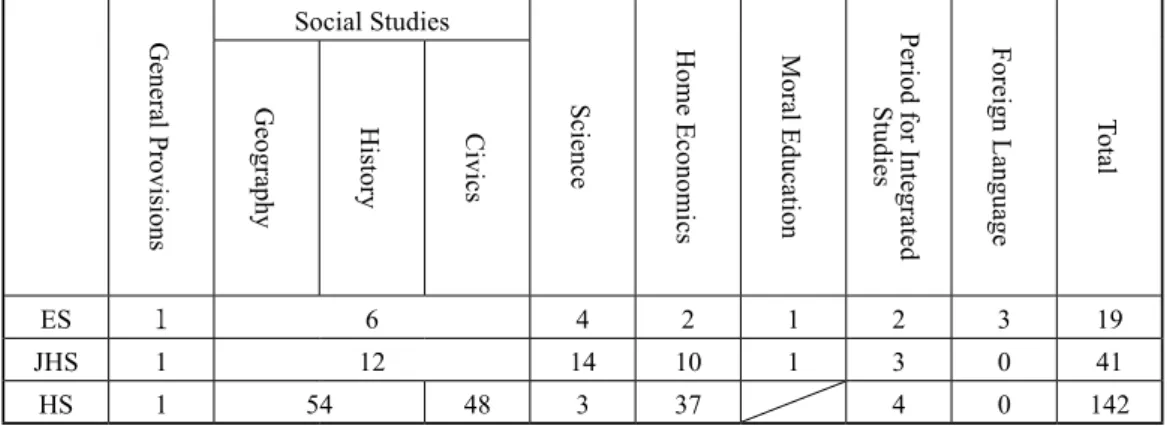
General Provisions Social Studies
Science
Home Economics Moral Education Period for Integrated
Studies Foreign Language Total Geography History Civics ES 1 6 4 2 1 2 3 19 JHS 1 12 14 10 1 3 0 41 HS 1 54 48 3 37 4 0 142
Table 2 "Sustainability" description in the explanation of current Curriculum
In the commentary on current guidelines for teaching (Table 2), the word “sustainable” is centered on in social studies, and there are many in the curriculums at junior and senior high schools. This was a significant change in the sense that it showed the ground for building the ESD curriculum at each school. The word “sustainable” is also used in the educational guidelines of elementary and junior high schools revised in 2017, and the framework of ESD is reflected in the new curriculum.
In general, many more elementary schools practice environmental education than junior high schools. Environmental education as “experience activities” is typical as well as “activities familiar with local nature” and “garbage separation and recycling activities”. Also, in elementary schools, “activities to nurture animals and plants” has been added.
In the case of Japan, schools called “UNESCO School (ASPNet)” promote ESD. According to a survey by the UNESCO National Committee, the contents implemented by the ASPNet in Period for Integrated Studies are environmental education (76.9%), international understanding education (51.7%), and world heritage/regional culture (42.8%). It is reported that schools joining this network make "environment" an important learning theme.12)
The ASPNet began as a network for promoting international understanding education. In Japan, this network of schools is positioned as a community promoting ESD. Currently, there are
about 10,000 schools internationally affiliated with this network.
During the Decade of ESD (2005-2014), ASPNet became the center of ESD promotion internationally. In Japan, ESD in school education expanded rapidly from the time when the wording such as “Building a sustainable society” was entered in the Basic Education Promotion Plan and the Curriculum Guideline in 2008. And it was the ASPNet that contributed to expanding this popularization. In 2007, there were 1,037 ASPNet schools in Japan including 524 elementary schools, 255 junior high schools, and 147 high schools in 2017.13)
By addressing ESD practice throughout the school that is to say with a whole school approach you can create a systematic and ordered school curriculum for all students. The core of school curriculum formation is Period for Integrated Studies crossing the subject. It plays a role of organically connecting learning in other subjects. Many schools that conduct ESD throughout the school plan a one-year school education. This is a curriculum for ESD, and it is created for each grade. Units of each subject are arranged in this table called “ESD calendar”, and related units are connected by lines. In other words, it is an ESD plan where people can understand the relationship of each topic at first glance.14)
Essentially, the unit of content related to ESD learning topics is shown in the calendar, but the units involved in learning skills are also indicated. This is an idea that all subjects and activities are related to ESD, and it is a basic idea when ESD is conducted throughout the school. Since the topics on comprehensive learning time are decided at each school, what kind of learning content is set is the key to advancing ESD.
(3) Environmental ESD at elementary schools in Kitakyushu
How is ESD being promoted at schools in Kitakyushu? In this section we will discuss the environmental education of eco-schools and ASPNet. Elementary schools are certified in both cases, so we will deal mainly with primary school ESD in this paper.
In the case of the city of Kitakyushu, which advocates eco-towns, efforts on the maintenance of environment are promoted by various organizations. Two elementary schools in Kitakyushu were certified as eco-school pilot model projects.15) Minatogaoka Elementary School was
renovated to a photovoltaic-type school as a result of consolidation. Sone-higashi Elementary School has arranged the Sone tidelands habitat within the school district, and has carried out conservation activities in the tidal flats. Since 2007, the renovation of photovoltaic power generation schools has been promoted, but this school traditionally carried out environmental
protection activities taking advantage of local conditions. Energy saving education is introduced in addition to natural environmental education triggered by being certified as an eco-school, but the main environmental education contents of this school are concerned with the nature in the school district, awareness of protecting nature itself, and using environmental preservation as a way to foster behavioral attitudes. Eco-schooling will be positioned as a school supplementing traditional education through facility improvement.16)
Many schools have been certified as eco-schools, and renovations and repairs are proceeding. In the case of Kitakyushu, eco-schools help promote the whole city. As part of the “School New Deal” initiative of the MEXT, solar power generation facilities such as elementary and junior high schools in Kitakyushu were improved and expanded. Only four of 203 schools had solar power generation facilities renewed by 2008. However in 2011, 198 schools (130 elementary schools, 62 junior high schools, and 6 special support schools) had set up some form of solar power generation facilities.17)
By installing photovoltaic power generation, students can learn about the process of power generation at school without going to a power plant (routinization and visualization of energy and resources). School is a place for students to consume energy and can attend a place to generate it. In other words, it is an environment where it is possible for students to think as to how to use energy and resources without waste.
Under these circumstances, six elementary schools in Kitakyushu were certified as ASPNet.18)
These schools are also promoting education and making full use of the conditions of each school district. Ainoshima Elementary School is located on Ainoshima Island in the Hibikinada ocean area north of Kitakyushu. Ainoshima is a historic island that has been documented in old texts. The school conducts environmental education through subjects and experiences. Akasaki Elementary School has taken advantage of the Period for Integrated Studies and has been promoting regional learning from the viewpoint of environment and energy. Ichimaru Elementary School is engaged in conservation activities of the endangered species Gashamoku (aquatic plant) in the school district as part of their environmental education that also shows pride in the countryside. Sayagatani Elementary School is a school that has traditionally worked on welfare education and environmental education. In 2009, this school made a biotope by using the school pond where students can learn about symbiosis with nature. Sugao Elementary School conducts ESD based on the environment as a form of learning about hometown. Fujimatsu Elementary School is conducting environmental education mainly for science education. The school is developing
programs to learn about nature observation and traditional culture making full use of human resources living in the area (school district).
This article considers ESD practice of Ainoshima Elementary School and Sugao Elementary School based on an interview survey. Kitakyushu is a city with a population of less than one million, but the concentration of the population varies greatly. Both schools are located in areas where population has been declining.
In Ainoshima Elementary School, which has been classified as a tiny-scale school, only has 14 students19). Although it is relatively recent that this school was certified as ASPNet, the
history of environmental education is long, and it has continued for about 20 years. The school is organizing a curriculum with activities concerned with “connection with people, society, and the natural environment”. Activities include promotion and preservation of traditional arts remaining in the community, island clean-up, food education that makes full use of the location of the fishery, the observation of Sunameri (finless porpoise) living around Ainoshima, and the survey of the natural environment through seawater. A joint team of companies and the Univ. of Tokyo are conducting research on the island potential for wind power generation as a result of offering cooperation to school education.20)
Sugao Elementary School is a small school of 80 students. It was established when two area elementary schools were closed and reconfigured in 2008. Its predecessors took advantage of the conditions of the area even before the new school was established. Since being accredited as an ASPNet school in 2012, the school has vigorously implemented environmental education making full use of Period for Integrated Studies.21) Sugao Elementary School has farms and a
biotope, and nature and crops are close to the students. Students learn about the changes of the riverbank and the water quality by studying the Murasaki River that flows through the school district. They learn about such efforts to preserve the water quality by the people in the area, as students and local people create bamboo charcoal, and they make pickles using local products. In this way, students learn through experiences that they are doing various activities with their cooperators.
What is common to the two schools is that they are working on a whole school approach. This method of deciding study topics for each grade of their six years in elementary school is effective for students to continuously learn about the environment. Neither school is creating an ESD calendar. However, Ainoshima always puts environmental learning into the annual plan, and the curriculum plan of Sugao is similar in that it is based on comprehensive learning time as
the core, like the ESD calendar.
The other point is to take advantage of the local human network. Public schools in Japan, where faculty members have workplace transfers every few years tend to be struggling to maintain “continuity of education”. In the case of Ainoshima Elementary School and Sugao Elementary School, difficulties are further increased as they are small schools, but the human resources based on the regional human network play a big role in accumulating educational knowledge and experiences. Local people are proud to contribute to local human resource development, and we do not mind cooperating and contributing to education.22) Thus, both schools supplement the
disadvantages of the transfer of faculty with the regional network.
Notes
5) Hiroyuki Horii [1984]: History of school building after the war (Part 1) Some consideration on the accumulation and practice of school facility theory, School management study Vol.9, Univ. of Tsukuba 6) Takeshi Fujio [2017]: From the earthquake-resistance to the long life, the issue of school facilities, articles
on May 16, 2017, Benesse Educational Information Site (access date December 10, 2017)
7) Ministry of Education, Culture, Sports, Science and Technology [2011]: Eco-school that utilizes nature's blessing
8) Shibasaki Naotaka, Nagashima Yasuo [2016]: Biotope: Outdoor school facilities facility supporting biodiversity education, Bulletin of Kanto Gakuen University Liberal Arts Vol. 24
9) Ministry of Education, Culture, Sports, Science and Technology Ministry of Agriculture, Forestry and Fisheries Ministry of Land, Infrastructure and Transport · Ministry of the Environment [2017]: Promoting improvement of school facilities considering eco-school environment
10) Ministry of Education, Culture, Sports, Science and Technology Ministry of Agriculture, Forestry and Fisheries Ministry of Land, Infrastructure and Transport · Ministry of the Environment [2016]: Promoting improvement of school facilities considering eco-school environment Eco-school pilot model project example collection
11) Yayoi Kodama [2017]: Environmental Education for Sustainable Development of UNESCO Associated Schools Project Network in Japan
12) Survey of the UNESCO National Committee
13) UNESCO School HP (Last Accessed Date November 11, 2017)
14) Toshima (current Principal / Yanagawa Elementary School Principal), one of the inventors, explained the ESD calendar as follows. The calendar is created so that any teacher in charge will be able to imagine how
to progress comprehensive learning.
15) Ministry of Education, Culture, Sports, Science and Technology Eco-School Pilot Project Accredited School 16) Initiatives of Ministry of Education, Culture, Sports, Science and Technology Eco-School Pilot Project
Accredited School
17) Kitakyushu City Environment White Paper According to the 2012 edition (2012), the remaining schools are scheduled to be installed according to renovation.
18) UNESCO School Activity Annual Report
19) Elementary and junior high schools in Japan basically need to increase classes if more than 40 students in a class are present, and are systems that arrange teachers according to the number of classes. However, it is possible to reduce the upper limit of one class to 35 people at the discretion of the area. The standard of school size appropriateness is grasped by class number. For elementary school, 12-18 classes are adequate schools (2-3 classes for 1st grade). In addition, schools of 5 classes or less are small schools, 6-11 classes are small schools, 19-30 classes are large schools, and 31 or more classes are oversized schools.
20) Interview with Aijima Elementary School principal, Mr. Hiroyuki Tsubone on August 29, 2017. 21) Interview with Sugao Elementary School vice principal, Mr. Minoru Tahara on June 25, 2017. 22) Interview with the president of the town development council on June 25, 2017.
3. Preventive maintenance, building conditions, and participants of the Adiwiyata School Programs in Indonesia
by Haris Anwar Syafrudie Preventive maintenance according to regulation of Minister of Public Works number: 24/ Prt/M/2008 30 December 2008 about guidance on maintenance of building, including post constricting, post-trauma. At this stage the maintenance of elementary school buildings is done periodically and routinely, when construction work is completed. Maintenance work includes: 1) maintenance of wall painting; 2) maintenance of door and window painting 3) anti-termite maintenance on the floor and around the building; 4) replacement of tile, floor and wall tiles.
According to Minister of Public Works regulation No. 24 the classification of maintenance work includes continuous (regular, routine) care; periodic maintenance, emergency repairs; total improvement and refinement. Continuous care includes: cleaning drainage channels from garbage and dirt: cleaning of rooms and yard from garbage and dirt; cleaning of glass, windows, chairs, tables, cabinets, etc. : grass clearing and irregular shrubs; cleaning and watering the bathroom / WC to maintain health.
Regular maintenance is a means of preventing damage. In other words, the lifetime of tools and means that is treated regularly longer. The maintenance will prevent the huge expenses that the Adiwiyata organizer's elementary school has to spend to replace the damaged components. Care is a conscious form of action to keep elementary school tools and facilities always in a ready-made state. Treatment can also be interpreted as an act of doing repairs until the condition of equipment and facilities can work again. Therefore, maintenance activities are required to be done in a planned, and programmed at certain times.
The activity of facilities and infrastructure of elementary school of Adiwiyata consists of periodic checking, cleaning, painting, and furniture. Tuning, cleaning, replacement, calibration of specific equipment are included. In other forms the treatment may be a small improvement done at one place in an elementary school, and if necessary replacement of components to improve the work force so that the operational cost of using the tool becomes more effective. Planning and utilization of school facilities and infrastructure in supporting the learning process has a direct influence to achieve learning objectives, and at the same time the means of education is one form of educational resources that have the role and function as a supporter of the success of the education process.
Decree of the Minister of National Education Number 031/0/2002 dated March 18, 2002 article 68 explicitly states that the government organizes the preparation of materials and the formulation of the policy of standardization of educational facilities. This is in accordance with Ministerial Decree number 129a / U / 2004 dated 04 October 2004, concerning Minimum Service Standards of Education. In order to improve the quality of education, the government has undertaken various efforts, among others, through improving the quality of school facilities and infrastructure, including building standards and basic school furniture. With the enactment of RI Law no. 32/2004 concerning Regional Government, Directorate General of Basic Education and Higher Education in the framework of improving the quality of education enforces elementary school autonomy through the program of Management of Quality Improvement Based on Elementary School (MPMBS). This program is conducted in various ways such as empowering educational resources that become supporters in the learning process.
Elementary school buildings are often designed to be used for 25 years. But due to the lack of preventive maintenance, the gutters should periodically be cleared of tree litter, during the rainy season, the water spills over the lisplank and the outer ceiling. Small holes due to rust on the guttering water line, which should immediately be sealed with anti-rust coated paint is not done, at 5 years of use, the gutters will be damaged. Because rarely cleaned gutter becomes like a trash bin, a lot of tree litter perforated gutters disposal. When it rains, the gutters that should function to regulate the flow of rain water do not work. As a result, the roof buffer frame becomes obsolete, the ceiling is damaged or collapsed, the color of the wall of the peyles faded due to mossy walls. When the gutter hole is still and regularly cleaned, then the wrong function will not happen. Therefore, preventive maintenance activities are required to be carried out in a planned and programmed manner. By doing preventive maintenance on elementary school buildings / building will directly improve the performance of equipment and supporting facilities. Preventive maintenance will reduce the cost of repairs on a large scale, and will be able to maximize the life of the used of building and its supporting equipment.
Preventive maintenance activities include periodic checking, cleaning, painting of buildings and furniture. Adjustment, cleaning, replacement in other forms preventive maintenance may be small improvements made at one place in the school, and if required replacement of components to improve the workability of the infrastructure so that the operational costs of using the infrastructure become more effective. Conducting preventive care programs encourages elementary schools to produce appropriate information in setting up maintenance schedules
for school buildings, libraries and other supporting buildings. Accurate data and analysis of the condition of the building is the main data to perform preventive maintenance for the life of the elementary school building in accordance with the durability of building as originally planned.
Indonesia is one of the countries that have humid tropical climate. Air humidity reaches approximately 80% with air temperature up to 18-33C during the day (Mangunwijaya, 1980). Natural resources in areas with a very abundant tropical humid climate are sun and wind. The sun provides many benefits to life. The sun provides light, warmth, builds health and provides energy. On the other hand, the wind gives coolness, freshness, aroma cleanliness and breathing relief. High air temperature does not feel disturbing when there is a wind gust. In coastal areas where the air temperature is hot is reduced by constant flow of sea breeze. However, the degree of humidity does not always have a positive effect. High degree of humidity was a negative impact on buildings and buildings. These negative impacts include: 1) the growth of organisms that embraces and destroys wood; 2) the growth of mold and mildew; 3) accelerate the process of rust on metal material
Based on Article 42 of Law No. 19 of 2005 on National Education Standards it is stated that each educational unit shall have facilities covering furniture, educational equipment, educational media, books and other learning resources, consumables, and other equipment necessary to support the learning process regularly and sustainably. It further states that every educational unit is required to have infrastructure covering land, classrooms, educational leadership room, educator room, administrative room, library room, multipurpose room, canteen, power and service installation, sports venues, places of worship, place of creation, and other space / place needed to support the regular and continuous learning process.
Maintenance activities on elementary school buildings are often overlooked. Although there is, often the budget for maintenance of buildings / school buildings is often small or non-existent. Preventive maintenance activities are intended to maintain facilities and infrastructure (physical buildings and other equipment), so that the life of the facilities in accordance with the planning, 25 years. By doing preventive maintenance avoided premature building damage.
Education facilities are one of the educational resources in it including building and school furniture. Basic education facilities need to get attention because it is one of the instrumental factors (instrumental input) which has an important role in the process of basic level learning. There needs to be a mapping of actual conditions in the field as a reference in the planning and procurement of primary school buildings and furnishings that give flexibility to schools to
have various alternative treatments and procurements offered in accordance with the abilities and desires of the school. The Adiwiyata School of implementation conducts school management and schooling to a caring and cultured school environment. The aspects that must be done to achieve Adiwiyata School are required to fulfill four components of Adiwiyata namely; environmentally sound policies, environment-based curriculum, participatory activities and the provision of environmentally friendly supporting facilities and infrastructure. Each school has the same benchmark standards in order to become a national Adiwiyata School.
This research activity aims to map the condition of elementary school building implementation of Adiwiyata and how the schools take care of facilities and infrastructure as base of elementary school physical facility. In elementary schools, the care of facilities and infrastructure is often overlooked. Often found care activities on elementary school buildings passed. There are often budgetary posts for the maintenance of small elementary school buildings. Preventive maintenance activities are intended to maintain facilities and infrastructure (physical buildings and other elementary school equipment), in order for the life of the elementary school infrastructure to be in line with the planning. By doing maintenance will be avoided the damage to elementary school buildings prematurely.
Naturally, the facilities and infrastructure that exist in elementary schools over time will be damaged. Damage caused by weather effects, changes in temperature, dust, dirt, misuse or lack of maintenance. These factors slowly over the long term diminish the function of parts of school infrastructure. Equipment and facilities that are not / less treated will be damaged (Syafrudie, 2003).
METHOD
The design of this research is survey by observing directly condition of the elementary school building section of the Adiwiyata School program implementer, which includes several indicators. These indicators are cleanliness, air circulation, lighting, paint color, wall condition, floor condition, standard area, teachers' room, principal room, bathroom and restroom (KM/WC), UKS, canteen, library, place of worship and warehouse. Other indicators are the availability of clean room facilities, KM/WC condition, School Health Room (UKS) and Canteen. Observation conducted on water sources, sanitation and waste management.
building participant of Adiwiyata program that all components are in good condition or in poor condition. The analytical unit of this research is observation component covering cleanliness, air circulation, lighting, paint color, floor condition, wide standard, condition of classroom wall, teacher room, principal room, bathroom and restroom, UKS, canteen, library, and warehouses that have been used in existing school systems.
Population in this research is the school implementing Adiwiyata program. The population in this study is not the school of cheeses obtained, but the school as the implementation of the Adiwiyata program. She is only participant and implementer of Adiwiyata program in Malang. The schools are SD Percobaan, SD Sarangan, SD Dinoyo II, SD Model Tlogowaru, and SD Kauman which are all located in Malang. Real data of school facilities and infrastructure being administrated then analyzed with descriptive analysis to see trends of each aspect studied on how preventive maintenance efforts done by the elementary school condition of existing school buildings.
Other data that is administered is the basic data belonging to each school. Data on infrastructure facilities, sanitation equipment, and school maintenance schedule of schools, procurement of materials and school maintenance schedule put into School Budget and Expenditure (RAPBS). The observed data were analyzed using descriptive statistic, to see the trend of each observed component. Calculated average, highest score, lowest score and central tendency on aspect observed include cleanliness, air circulation, lighting, paint color, floor condition, wide standard, condition of classroom wall, teacher room, principal room, bathroom and restroom, UKS, canteen, library, place of worship and warehouse
Through this research activity will be got accurate data and analysis result about current condition of school building. The study focused on the conditions and problems that arise during its use as an accurate mile stone mapping of problems that arise. The data can be obtained from research instances administrations. The data collected in this study are notes on the observation sheet, and the response to the instrument. The data obtained were analyzed descriptively to describe trend on each indicator. In order to know how the condition of elementary school preventive maintenance care is, data analysis is done by analyzing the results of field observations by using trends based on Excel worksheets in Office programs.
RESULTS AND DISCUSSION
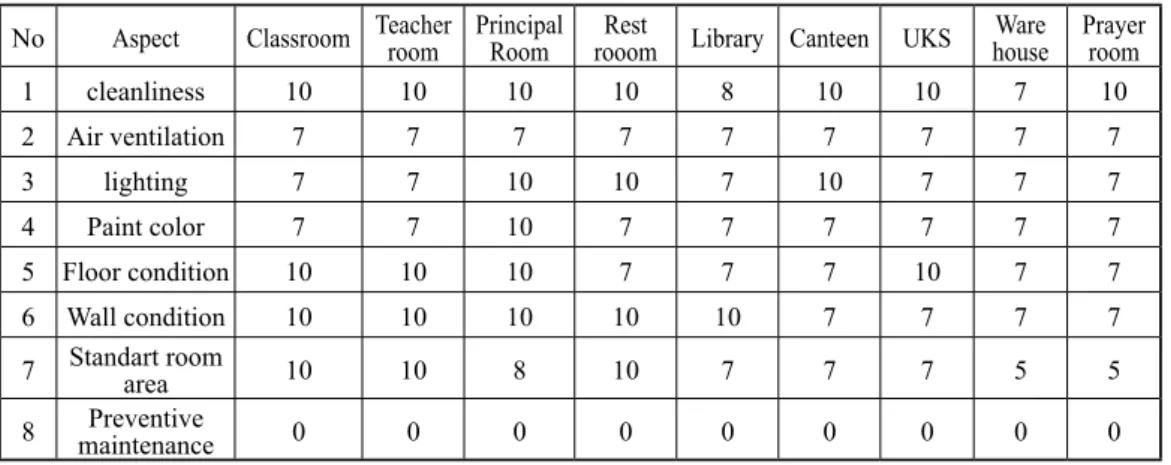
Table 1.1. Component of Research Observation
No Aspect Classroom Teacher room Principal Room rooom Library Canteen UKSRest houseWare Prayer room
1 cleanliness 10 10 10 10 8 10 10 7 10 2 Air ventilation 7 7 7 7 7 7 7 7 7 3 lighting 7 7 10 10 7 10 7 7 7 4 Paint color 7 7 10 7 7 7 7 7 7 5 Floor condition 10 10 10 7 7 7 10 7 7 6 Wall condition 10 10 10 10 10 7 7 7 7
7 Standart room area 10 10 8 10 7 7 7 5 5
8 maintenancePreventive 0 0 0 0 0 0 0 0 0
Scoring scale 1-10
In the classroom observed in all schools with a rating range of 1 to 10, the average classroom condition was average. Derived from the observation of all classes generally the class does not have planned air ventilation, the existing ventilation is generally not good enough to get rid of moisture in a classroom. Light in the classroom is generally dim, not bright enough when measured with lux mater, less bright class for students writing and reading, wall color classroom tends to dark blue, or dark green that makes the class looked darker, generally seen the quality of the wall the quality of the floor and the standard of the room is adequate for the classroom in the Elementary school.
The teachers' rooms, where the teachers gather and do administrative work outside of classroom, are generally in clean and good condition. Some of the teachers' rooms did not have good air ventilation, so the teachers would feel less refreshed while resting or doing other adminstrate work. The lack of air circulation is still followed by wall color conditions that tend to cause the room to be dark and dingy. In general, the teacher room meets adequate space stability, the quality of school walls is generally good and not peeling, and the floor condition with adequate pavement is neither slippery nor popping.
The condition of the principal's rooms is generally good. The school rooms are clean and the lighting is adequate, well enough for writing or reading. The condition of the floor of the principal’s rooms is good, and it does not slip and there is not a peeled place. The wall condition is very good, and the paint condition is generally good and the color is in good condition. It's
just that the principal's room has not yet applied the calculation for air circulation to be good and perfect. Due to poor circulation the school then put AC in the principal's room. Some of the principal’s rooms have a good wide range of standards, but some schools have poor room standards, and tend to be too narrow.
In all schools the library is not seen as a priority place developed by the school. The libraries in all schools are not very clean, lighting, paint colors and air vents are not good, condition of the paint is not good. In some schools a collection of old books is found. Circulation of books is not well organized and there is no special librarian. Officers are mostly teachers who are assisted to take care of the library during the hours when the students are at rest. Therefore, when examined, the officers do not know correctly the history of books circulated, the type of book up to predict the procurement of books in the future that will come for the purposes of updating the book collection. Libraries tend to school complement, not as center of excellence at school.
Not all schools have warehouses. School’s warehouse encountered during the implementation of the study is a space that is left to function to store goods that are not used. Not goods that are reserves and goods that will be used later, but unused waste goods. Because it is the remaining space that is bad, too narrow, difficult and moist. The findings in this study of warehouses are generally less clean, less light, no good air circulation, the paint and the walls condition are not well maintained. The condition of the floor is not very good, because it is not strategic and rarely passed by people.
Though all schools in this research are public schools, places of worship are not places of worship for all religions. Places of worship in public schools in Malang means a place of Islamic religious worship called musholla. Places of worship are generally small, less light space. They do not have good air circulation. Walls of worship tend to be painted a dark color and the condition of the floor is not clear because it is closed using a carpet.
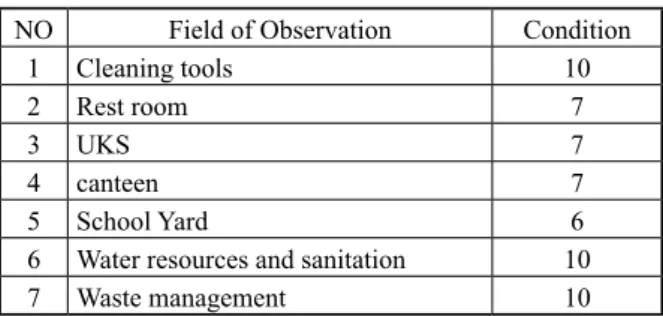
Table 1.2. School Support Room
NO Field of Observation Condition
1 Cleaning tools 10
2 Rest room 7
3 UKS 7
4 canteen 7
5 School Yard 6
6 Water resources and sanitation 10
The result of observation analysis directly, in general all schools in the observation of schools yard cleanliness are adequate. In all schools, each classroom keeps floor brooms in the corner, dustpan, duster and wipe for wall. Most of classrooms have no mat. Each class with its own form attached a class picket schedule, which is a handful of children 5-7 children who every day in charge of cleaning the class in turn.
KM / WC observed are generally clean, adequate light and wall of good quality. KM / WC is dry not mossy and paint is not peeling. In general, the air ventilation room is not good. The paint color causes the room to be dark and the floor conditions of some locations are still wet. On the way to the shower KM/WC researchers did not look for the separate KMWC between boys and girls. KM.WC found in general so one, for male students and female students there is no separation. The number of KM / WC has not followed the 1:40 ratio for males and 1:25 for women in all schools visited. All schools provide separate KM / WC for teachers and for students, however there is no separation also for male teachers and female teachers. The condition of KM / WC teachers is generally clean. The room is bright enough not smelly, not slippery not mossy. Soap are available and there is clean water that flows well for KM / WC students and KM / WC teachers at school, KM / WC is available scoop, available brush near the room and mosquito larva was generally not found.
Results observation on UKS room in general, the school already has UKS room, the room has a bed, in accordance with the requirements of having two beds. In the UKS ranks are available by weight scales, and height measuring instruments. All schools keep Snellen Chart, thermometer, student visit book, simple medication list and medicine storage cabinet are available, first aid kit (cotton, verban, plaster, red medicine, wound medicine, oralit, alcohol, and paracetamol, and simple medicines, available closed and wastavel bins with running water) Wastavel found outside UKS room, it works normal, and has a running water.
For the canteen, all of the schools observed has a canteen laid away from temporary garbage dumps. The canteen is far from the bathroom and the school toilet. In general, the canteen has furniture in a clean, usable, and well maintained condition. The canteens in some schools have functioning wastavels and have running water equipped with soap. In every canteen school sells diverse foods, fast food, cooked food, and packaged food.
At SD Kauman Elementary School, SD Dinoyo II, SD Sarangan besides school cafeteria, there are also food vendors outside school. Foods sold by food vendors outside the school are diverse, banana fry, sempol, meatball (pentol), batagor and others. There is no information and
judgment about the hygiene and health of food sold by traders. These sellers do not have a certificate of food health published by BPPom or a food higine certificate from the nearest public health clinic.
Supporting equipment in the school cafeteria varies widely, because there are schools that offer canteen as lunch places, there is a canteen as a place to sell food. In a canteen that serves as a dining or dining area, the equipment is prepared in general equipment that supports students for lunch. Her desk has many stools, where many hand washing also means cleaning tool. Places where spoons, drinking cups and the workers that always keeps the canteen clean as a dining room is also available.
Canteens for schools do not function as a dining room. It contains fast food vendors and cooked food. Food is served in a sealed place in a glass shelf opened when food will be consumed. Every food vendor in the canteen sells different foods and drinks. Most of these sellers do not have certificates of consumption worth on the food they sell, either the certificate from BPPom or the certificate from the Puskesmas. Schools have the right to request and demand certificates to all food vendors in the school cafeteria to protect students’ health. Schools do not conduct proper checks and cleanliness of food sold in schools. No food information is sold worthy or not, healthy or not, labeled BPPom and there is no periodic check on whether the food is expired or not expired. There is no information on whether food and beverages sold in the canteen have been tested periodically free of formalin, borax, and harmful chemical dyes. Are foods and beverages packaged using clean packets for food and not using styrofom. Schools need to ensure food and drink not using harmful additives (additives). During the observation, most officers in the cafeteria are well-dressed and clean, but no one uses aprons and hoods to keep food clean and sterile. In the presentation of the sellers take food not using tools (spoons, clamps, gloves).
The observations on the school’s yard and the school environment are generally good. In almost all schools observed by the yard and school environment in well-maintained condition, regularly swept by officers, and at certain times swept by students (SD Dinoyo). For the ideal open space is in Model Tlogowaru Elementary school, open space is very wide, lots of tree shading, still a lot of vacant land for children to move and socialize. School that have other adequate open spaces is SD Dinoto II, the open space located in the middle of the school building complex, flanked by class and middle school classroom planted with perennial trees so impressive shade, cold, not glare and not noisy. In general, the school's yard and neighborhoods in all schools observed have a tree, have open spaces, are not waterlogged, and in some places biopores are
made to minimize standing water, when it rains. Plants are generally diverse, not just one type of plant grown in the yard and school environment.
Table 1.3. water sources
NO SD Kauman SD Dinoyo II SD Percobaan SD Model Tlogowaru
1 PAM water ✔ ✔ ✔
2 Well ✔ ✔ ✔
Observation at water source used every day, almost all schools use the source of water from the water source (PAM) provided by the government only at SD Model Tlogowaru water source using wells, because urban drinking water network has not reached Tlogowaru area which is the development area of Malang. All of the school's drains in the form of a sealed drainage flow smoothly and hygienically. From the observation, all schools have septic tank, have a lot of water absorption, and all schools have a swan / closet in the form of a swan neck.
Based on the observation on garbage, all schools observed have tips and waste management system. All schools have covered and separate bins. Each class has a class trash can. Garbage from the classroom is collected to the school's garbage dump, before being transported by local yellow troops dumped to TPA Malang area in Supit Urang. In the temporary garbage disposal at school, there is separation between organic waste and non-organic waste as the learning object about waste management for elementary school students.
All of the school did not inform doing preventive maintenance, there were no data on the implementation of preventive care. Schools do not have regular maintenance documents and building maintenance plan documents and school drawing details. Building drawings as build drawings are not available in all schools, budget plan on building maintenance are not included in the school budged plan (RAPBS).
CONCLUSION
Overall all of the elementary school implementers of the Adiwiyata school program did not have preventive maintenance documents, so that the damage rate and data on repair of damaged building components were not recorded, the maintenance plan was completely non-existent. In elementary schools observed during the elementary school operational period, there were no
document of building completeness such as built drawings and building pictures.
In general, the physical condition of school buildings is good, which views from cleanliness of the room, condition of air ventilation, lighting, wall conditions, floor conditions, paint colors and standard room. The library is not good, has not been systematically functioned, finding observed rest room still not ideal. It is necessary to add rest room by taking into account the proportion of boys and the proportion of girls. School’s yard are often overlooked, schools do not see that school’s yard equipped with trees and crops are important as school lungs and supporting students' health while studying in the school environment. School warehouse less attention, the room is sober, there is no arrangement and organizing goods stored in the school warehouse.
4. Analysis of environmental education content materials at Adiwiyata junior high schools in East Java
by Sugeng Utaya Ery Tri Djatmika Haris Anwar Syafrudie Nyoman Sudana Degeng The environment education is important in the education taught in Indonesian. That is caused by since 1973 the Ministry of Environment has decided the environment education as the key of success of the Sustainable Environmental Development program in the 21st Century (Purnomo, 1999). Urgency of the environment education in education is based on the premise that development activities always cause environmental problems and need a proper solution urgently. According to Resosoedarmo (2002), the solution of environmental problems is associated with the growing awareness of a problem that can only be generated through the environment education.
The important role of the environment education in the response to environmental issues is based on the premise that the environment education can shape students' positive attitudes and behaviors towards the environment (Ministry of National Human Resources Development Directorate, 1999). That's because the environment education is a model of education that is designed to increase public awareness on environmental issues (Tumisem, 2009). According to the Ministry of National Directorate of Human Resource Development (1999), the environment education aims: (1) Providing insight into the environment education to all stakeholders (internal and external of school) in solving environmental problems, (2) Setting up a human resources professional who has an attitude in accordance with the demands of the development of science and technology and the demands of sustainable development, and (3) Increasing the knowledge, awareness, and skills of early-age population as a reflection of responsible behavior towards the environment
Substantially, the environment education is an important subject, but the position in the national curriculum is not a compulsory subject in schools. In the National Education System Law, the environment education is only served as elective subject in the form of local content. Ministry of Education and Culture’s Rule No. 81-A in 2013 stipulates that the environment education is one material that can be used as a local content subject. According to Ministry of