
JAIST Repository: A Study of Classifier Combination and Semi-Supervised Learning for Word Sense Disambiguation
115
0
0
全文
(2) A Study of Classifier Combination and Semi-Supervised Learning for Word Sense Disambiguation. by. LE ANH CUONG. submitted to Japan Advanced Institute of Science and Technology in partial fulfillment of the requirements for the degree of Doctor of Philosophy. Supervisor: Professor AKIRA SHIMAZU. School of Information Science Japan Advanced Institute of Science and Technology March 2007.
(3) c °Copyright 2007 by LE ANH CUONG All Rights Reserved. i.
(4) To My Family. ii.
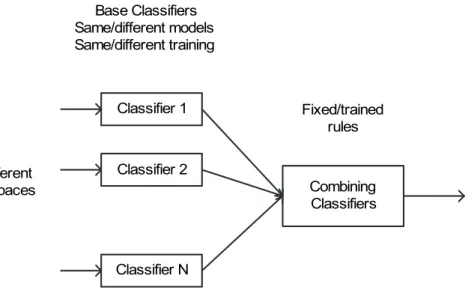
(5) Abstract Word Sense Disambiguation (WSD) involves the association of a polysemous word in a text or discourse with a particular sense among numerous potential senses of that word. This is an “intermediate task” necessary to accomplish most natural language processing tasks. It is obviously essential for language understanding application, such as message understanding and human-machine communication; it is also at least helpful for other applications whose aim is not language understanding, such as machine translation and information retrieval, among others. The automatic disambiguation of word senses has been an interest and concern since the 1950s [Ide et al. (1998)]. Although there have been many studies investigated on various methods for this problem, the performance of available WSD systems or published results are limited (accuracy around 70%). Therefore, WSD is still an open problem and is a challenge in Natural Language Processing (NLP) community. Nowadays, with the strong and fast development of machine learning methods and their success in applying to many NLP tasks, the use of machine learning techniques in WSD has been becoming more interest and attractive. This thesis also lies in this research direction, in which we present a study of classifier combination and semi-supervised learning for WSD. In addition, we also work on context representation and feature selection which play important roles in obtaining high accuracy of WSD task. Particularly, the following three problems are targeted in this research. • The first problem is that of determining useful information for detecting word senses. Concerning this problem, there is a fact that if a classifier contains more useful information, as well as we can extract more useful information from test patterns, then the classifier can recognize patterns more correctly. Therefore, determining useful information for both training and test data plays an important role in a classification. Regarding to WSD, we consider two aspects including context presentation and feature selection. For the former, we will investigate various kinds of knowledge and present them as feature subsets. For the latter, feature selection methods are used to obtain the best combination of these subsets, and to select useful individual features. At the end, we obtain a set of selected features in order to get supervised WSD systems with high accuracy. • The second problem is to improve performance of supervised WSD systems by using classifier combination techniques. As well known, a classification algorithm used with a specific set of features may not be appropriate with a different set of features. In addition, classification algorithms are different in their theories, and hence achieve different degrees of success for different applications. As different classifiers may offer complementary information about the patterns to be classified, combining classifiers in an efficient way, therefore, can achieve better classification results than any single classifier (even the best one). In this work, numerous various combination rules will be investigated and experimented. In particular, beside applying several common rules such as majority voting and average rule, we will develop new frameworks iii.
(6) of classifier combination for WSD based on Dempster-Shafer theory of evidence and Ordered Weighted Aggregating (OWA, for short) operators. Experiments have shown that combining classifiers significantly improves performance of supervised WSD systems. • The third problem is to boost supervised WSD by exploiting unlabeled data. The process of using both labeled and unlabeled data to build a classifier is called semisupervised learning. This work is motivated by an observation that labeled data is expensive and time consuming to build, while unlabeled data is cheap and easy to collect. In this thesis, we follow the semi-supervised learning approach, in which labeled data is iteratively extended from unlabeled data. We first explicitly identify inherent problems in this approach, and then propose corresponding solutions for them. This results in several new variants of the general bootstrapping algorithm. The experimental results show that the proposed solutions improve the conventional bootstrapping algorithms (particulary for self-training and co-training), and at the same time it is shown that unlabeled data is effective in increasing accuracy of supervised WSD systems. In summary, the work in this thesis has concentrated on the two important tasks which have strong impacts on improving accuracy for WSD systems, including knowledge determination and using machine learning approaches. We have analyzed, investigated, and then provided solutions for the selected problems occurring in these tasks. The contributions of this thesis are expressed in both aspects, the theoretical study in developing machine learning methods and the empirical study in improving accuracy of WSD systems. Our experiments were conducted on standard datasets and their outputs were compared with those of state-of-the-art WSD systems in such a way that the research is kept competitive and most up-to-date. Key words: Computational Linguistic, Word Sense Disambiguation, Feature Selection, Classifier Combination, Semi-supervised Learning.. iv.
(7) Acknowledgments First of all, I wish to express my respect and my deepest thanks to my advisor Professor Akira Shimazu, School of Information Sciences, JAIST for his kindly guidance, warm encouragement, and helpful supports before and during this research. He has given me much invaluable knowledge not only how to formulate a research idea or to write a good paper but also the vision and much useful experience in the academic life. I gratefully appreciate his patient supervision, and I am really lucky and proud to be one of his students. I wish to say grateful thanks to Associate Professor Kiyoaki Shirai for his useful comments in some discussions. My study field is very closed to his research, so he gives me more confidence in my work. I wish to say sincere thanks to Professor Yoshiteru Nakamori for his help in my subtheme research. He has given me as good as possible conditions for my work during this time. I would also like to say my special thanks to Professor Ho Tu Bao for his valuable discussions and his supports. I also want to express my gratitude to him for all his helps not only for my study but also for my life from my first day to now in JAIST. I wish to say sincere thanks to Professor Yuji Matsumoto and Professor Satoshi Tojo for serving as members of my dissertation committee and give me valuable comments. Professor Yuji Matsumoto has also given me valuable discussions and helped me much during the time I was an exchange student in NAIST in the year 2001. I specially wish to say grateful thanks to Dr. Huynh Van Nam for all his helps during this research. His valuable comments and advices on research problems as well as the technical insights really help me much. Without his help my work can not run well. I specially wish to express my thanks to Dr. Dam Hieu Chi for all his helps for my life and my study. I have had deeply discussions with him about research problems as well as others. I would also like to say my special thanks to my friend, Dr. Nguyen Le Minh, for his valuable discussions and his help in my research. I would also like to express my grateful appreciation to my former advisors, Professor Ha Quang Thuy and Professor Dinh Manh Tuong, College of Technology, Vietnam National University, Hanoi (VNUH), for their kindly recommendations and constant encouragement before and during my research at JAIST. Without their helps, I could not receive the permission to go to JAIST. I also appreciate the help and the encouragement from Professor Ho Si Dam, Dr. Hoang Xuan Huan, Dr. Pham Hong Thai, and many other faculty members of College of Technology, VNUH. I have received a lot of help from colleagues and friends in Shimazu-Lab and ShiraiLab during last three years. Let me say special thanks to Dr. Makoto Nakamura, and Mr. Kenji Takano for all their helps for my life from the first day I came to Japan. I v.
(8) also would like to thank my colleagues in Shimazu-Lab, Mr. Nguyen Phuong Thai, Mr. Nguyen Van Vinh, Mr. Nguyen Tri Thanh, and others for sharing their research ideas, useful experience, as well as valuable discussions and comments. I also wish to send my deep acknowledgements to the GRP program for supporting me during the past three years; the International Information Science Foundation for supporting me to attend international conferences; JAIST staff for their kind and convenient procedures and services. I am really indebted to them. I specially express my thanks and my respect to my former advisor, Dr. Pham Hong Nguyen. He has guided me to the way of research, specially in Natural Language Processing. I am very proud to be one of his students, and also a member in his group that researches about Machine Translation. Last, but not least, my family is really the biggest motivation behind me. My wife Cao Thi Minh Nghia, my son Le Cao Anh Minh, my daughter Le Bao Anh, my dear parents, my dear brother’s family, together with their unconditional sacrifices, love, and supports are always endless sources of inspiration for me to move forwards.. vi.
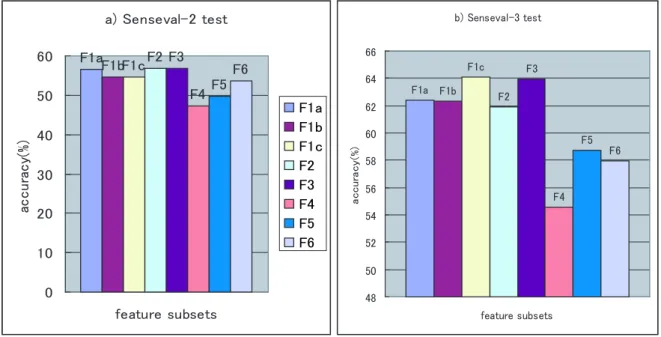
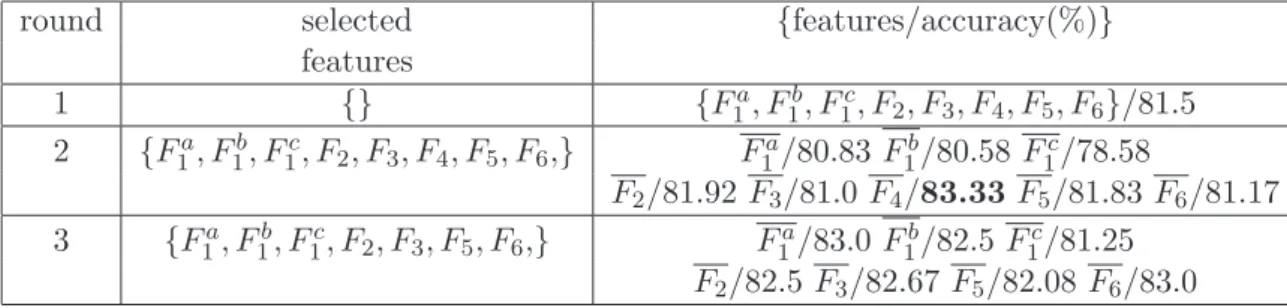
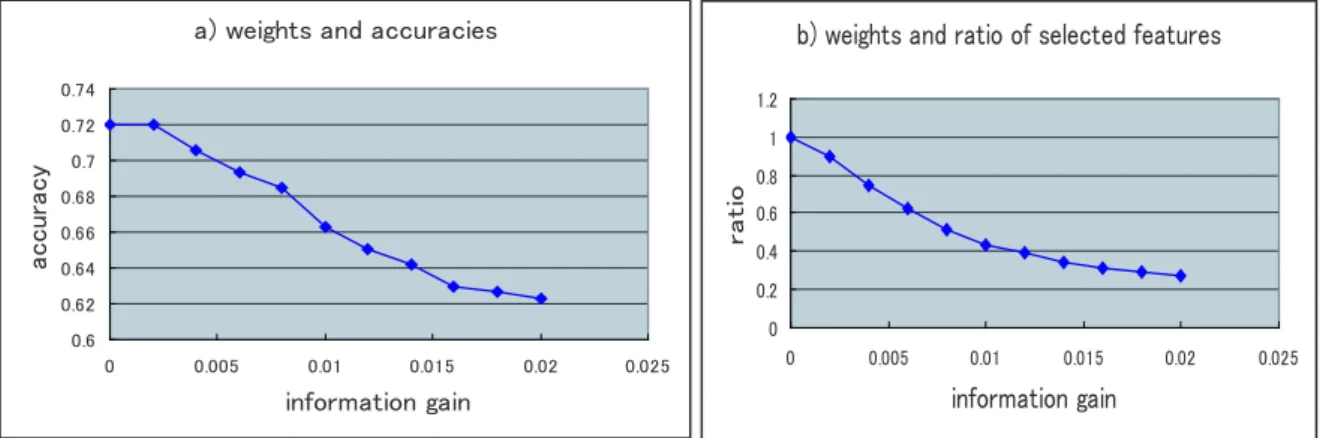
(9) Contents Abstract. iii. Acknowledgments. v. 1 Introduction 1.1 An Overview . . . . . . . . . . . . . . . . . . . . . . 1.1.1 Word Sense Disambiguation (WSD) . . . . . . 1.1.2 Applications of WSD . . . . . . . . . . . . . . 1.1.3 Corpus-Based WSD and Task Description . . 1.2 Motivations and Problems . . . . . . . . . . . . . . . 1.2.1 Context Representation and Feature Selection 1.2.2 Applying and Developing Learning Methods . 1.3 Main Contributions . . . . . . . . . . . . . . . . . . . 1.3.1 Context Representation and Feature Selection 1.3.2 Classifier Combination . . . . . . . . . . . . . 1.3.3 Semi-Supervised Learning . . . . . . . . . . . 1.4 Thesis Structure . . . . . . . . . . . . . . . . . . . . .. . . . . . . . . . . . .. . . . . . . . . . . . .. . . . . . . . . . . . .. . . . . . . . . . . . .. . . . . . . . . . . . .. . . . . . . . . . . . .. . . . . . . . . . . . .. . . . . . . . . . . . .. . . . . . . . . . . . .. . . . . . . . . . . . .. . . . . . . . . . . . .. 1 . 1 . 1 . 3 . 4 . 6 . 6 . 7 . 9 . 9 . 10 . 11 . 11. 2 Background 2.1 Past Research on Word Sense Disambiguation 2.1.1 Knowledge-based Approach . . . . . . 2.1.2 Corpus-based Approach . . . . . . . . 2.1.3 Corpora and Evaluation . . . . . . . . 2.2 Supervised Learning Algorithms . . . . . . . . 2.2.1 Maximum Entropy Models . . . . . . . 2.2.2 Support Vector Machines . . . . . . . . 2.2.3 Naive Bayes . . . . . . . . . . . . . . . 2.3 Summary . . . . . . . . . . . . . . . . . . . .. . . . . . . . . .. . . . . . . . . .. . . . . . . . . .. . . . . . . . . .. . . . . . . . . .. . . . . . . . . .. . . . . . . . . .. . . . . . . . . .. . . . . . . . . .. . . . . . . . . .. . . . . . . . . .. . . . . . . . . .. . . . . . . . . .. . . . . . . . . .. . . . . . . . . .. . . . . . . . . .. 13 13 13 15 18 19 20 22 25 26. 3 Context Representation and Feature Selection 3.1 Context Representation . . . . . . . . . . . . . . 3.1.1 The Kinds of Knowledge . . . . . . . . . 3.1.2 Our Selection . . . . . . . . . . . . . . . 3.2 Feature Selection . . . . . . . . . . . . . . . . . 3.2.1 Selection of Knowledge Sources . . . . . 3.2.2 Selection of Individual Features . . . . . 3.3 Summary . . . . . . . . . . . . . . . . . . . . .. . . . . . . .. . . . . . . .. . . . . . . .. . . . . . . .. . . . . . . .. . . . . . . .. . . . . . . .. . . . . . . .. . . . . . . .. . . . . . . .. . . . . . . .. . . . . . . .. . . . . . . .. . . . . . . .. . . . . . . .. 28 28 28 31 33 33 36 38. vii.
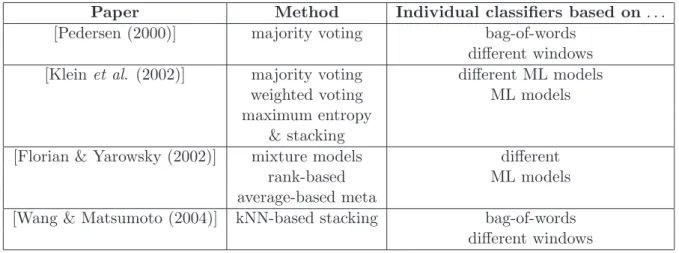
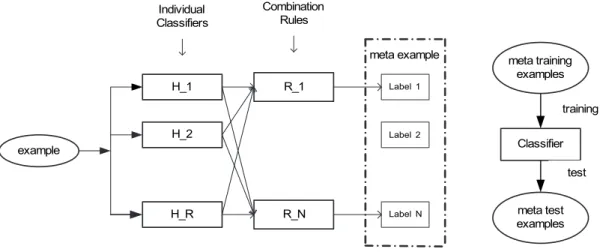
(10) 4 Classifier Combination 4.1 Introduction . . . . . . . . . . . . . . . . . . . . . . . . . . . . . . . 4.1.1 Architecture of Multi-Classifier Combination . . . . . . . . . 4.1.2 Related Work and Proposal . . . . . . . . . . . . . . . . . . 4.2 Common Combination Strategies . . . . . . . . . . . . . . . . . . . 4.2.1 General Framework of Multi-Classifier Combination . . . . . 4.2.2 Naive Bayesian and Product Rules . . . . . . . . . . . . . . 4.2.3 Median/Average Rule . . . . . . . . . . . . . . . . . . . . . 4.2.4 Majority Voting and Weighted Voting . . . . . . . . . . . . . 4.3 Combination Based on Dempster-Shafer Theory of Evidence . . . . 4.3.1 Basic Concepts . . . . . . . . . . . . . . . . . . . . . . . . . 4.3.2 DS Theory Based Combination Scheme . . . . . . . . . . . 4.3.3 The Discounting-and-Orthogonal Sum Combination Strategy 4.3.4 The Discounting-and-Averaging Combination Strategy . . . 4.4 Combination Based on OWA Operators . . . . . . . . . . . . . . . . 4.4.1 OWA Operators . . . . . . . . . . . . . . . . . . . . . . . . . 4.4.2 OWA Operator Based Combination Scheme . . . . . . . . . 4.5 Second-Layer Combination . . . . . . . . . . . . . . . . . . . . . . . 4.5.1 Meta-Combination . . . . . . . . . . . . . . . . . . . . . . . 4.5.2 Meta-Stacking Combination Models . . . . . . . . . . . . . . 4.6 Experiment . . . . . . . . . . . . . . . . . . . . . . . . . . . . . . . 4.6.1 Generation of Individual Classifiers . . . . . . . . . . . . . . 4.6.2 Experimental Results and Discussion . . . . . . . . . . . . . 4.7 Summary . . . . . . . . . . . . . . . . . . . . . . . . . . . . . . . . 5 Semi-Supervised Learning 5.1 Introduction . . . . . . . . . . . . . . . . . . . . . . . . . . 5.1.1 Methods in Semi-Supervised Learning . . . . . . . . 5.1.2 Problems and Motivations . . . . . . . . . . . . . . 5.1.3 Semi-Supervised Learning for WSD: Related Work 5.2 Self-Training and Co-Training . . . . . . . . . . . . . . . . 5.2.1 Co-Training . . . . . . . . . . . . . . . . . . . . . . 5.2.2 Self-Training . . . . . . . . . . . . . . . . . . . . . . 5.2.3 Comparison between Self-training and Co-training . 5.3 Proposed Solutions . . . . . . . . . . . . . . . . . . . . . . 5.3.1 Imbalanced Data . . . . . . . . . . . . . . . . . . . 5.3.2 Increasing Confidence of New Labeled Data . . . . 5.3.3 Generating the Final Classifier . . . . . . . . . . . . 5.3.4 A New Algorithm . . . . . . . . . . . . . . . . . . . 5.4 Experiment for Semi-Supervised Learning . . . . . . . . . 5.4.1 Experimental Models . . . . . . . . . . . . . . . . . 5.4.2 Parameter Setting . . . . . . . . . . . . . . . . . . 5.4.3 Results . . . . . . . . . . . . . . . . . . . . . . . . . 5.5 Combination for Post Data Extension . . . . . . . . . . . . 5.6 Summary . . . . . . . . . . . . . . . . . . . . . . . . . . .. viii. . . . . . . . . . . . . . . . . . . .. . . . . . . . . . . . . . . . . . . .. . . . . . . . . . . . . . . . . . . .. . . . . . . . . . . . . . . . . . . .. . . . . . . . . . . . . . . . . . . .. . . . . . . . . . . . . . . . . . . . . . . . . . . . . . . . . . . . . . . . . . .. . . . . . . . . . . . . . . . . . . . . . . . . . . . . . . . . . . . . . . . . . .. . . . . . . . . . . . . . . . . . . . . . . . . . . . . . . . . . . . . . . . . . .. . . . . . . . . . . . . . . . . . . . . . . .. 40 40 40 42 44 44 45 46 46 47 47 48 50 51 51 52 53 54 55 56 56 57 58 61. . . . . . . . . . . . . . . . . . . .. 64 64 64 67 70 71 71 73 73 74 74 75 78 79 80 80 80 81 85 88.
(11) 6 Conclusion and Future Directions 89 6.1 Summary of the Thesis . . . . . . . . . . . . . . . . . . . . . . . . . . . . . 89 6.2 Future Directions . . . . . . . . . . . . . . . . . . . . . . . . . . . . . . . . 90 References. 92. Publications. 101. ix.
(12) List of Figures 1.1. A General Scheme of Corpus-Based Methods for WSD . . . . . . . . . . .. 3.1 3.2 3.3 3.4. An evaluation of feature subsets on Senseval-2 and Senseval-3 . . . . A test on Senseval with feature selection based on frequency . . . . . A test on Senseval-2 with feature selection based on information gain A test on Senseval-3 with feature selection based on information gain. 4.1 4.2 4.3 4.4 4.5. Architecture of multiple classifier combination . . . . . Stacking method of classifier combination . . . . . . . . Combination Schemes . . . . . . . . . . . . . . . . . . Meta-Stacking Combination Model . . . . . . . . . . . Test on Senseval-2: An overview of the best results of combination . . . . . . . . . . . . . . . . . . . . . . . . Test on Senseval-3: An overview of the best results of combination . . . . . . . . . . . . . . . . . . . . . . . .. 4.6. . . . . . . . . . . . . . . . . . . . . different . . . . . different . . . . .. . . . .. 5. . . . .. . . . .. 32 37 37 38. . . . . . . . . . . . . . . . . . . . . types of . . . . . types of . . . . .. . . . .. 41 42 55 56. . 61 . 62. 5.1. The maximum margin hyper-planes for Transductive Support Vector Machines . . . . . . . . . . . . . . . . . . . . . . . . . . . . . . . . . . . . . . 5.2 A Scheme to Describe the Process of Iteratively Extending Labeled Data . 5.3 An Example of Extending Labeled Data in WSD . . . . . . . . . . . . . . 5.4 A View of Three Problems of the Process of Iteratively Extending Labeled Data . . . . . . . . . . . . . . . . . . . . . . . . . . . . . . . . . . . . . . . 5.5 A Scheme for Co-Training Algorithm . . . . . . . . . . . . . . . . . . . . . 5.6 Test Problem P1 on Senseval-2 and Senseval-3 . . . . . . . . . . . . . . . . 5.7 Test Problem P2 with Self-Training . . . . . . . . . . . . . . . . . . . . . . 5.8 Test Problem P2 with Co-Training . . . . . . . . . . . . . . . . . . . . . . 5.9 Test Problem P2 , Integrating Two Graphs: Self-Training and Co-Training . 5.10 A comparison between bootstrapping models on Senseval-2 and Senseval-3 5.11 Combination Strategy for Post Labeled Data Extension . . . . . . . . . . . 5.12 Summary of Proposed Methods . . . . . . . . . . . . . . . . . . . . . . . .. x. 65 66 67 69 72 82 82 83 83 85 86 87.
(13) List of Tables 1.1. Senses of the word “bank” . . . . . . . . . . . . . . . . . . . . . . . . . . .. 2.1 2.2. Experimental Results on Senseval-2 from Previous Studies . . . . . . . . . 19 Experimental Results on Senseval-3 from Previous Studies . . . . . . . . . 19. 3.1 3.2 3.3 3.4. Results of applying Forward Sequence Selection algorithm . Results of applying Backward Sequence Selection algorithm . Test on Senseval-2 and Senseval-3 . . . . . . . . . . . . . . . A comparison on Senseval-2 and Senseval-3 . . . . . . . . . .. 4.1 4.2 4.3 4.4. Approaches in previous WSD studies on multi-classifier combination . . . Combination with different feature sets . . . . . . . . . . . . . . . . . . Combination with different learning methods . . . . . . . . . . . . . . . . Meta-Voting on the two sets of individual classifiers: using different feature sets and different learning methods . . . . . . . . . . . . . . . . . . . . . Stacking with individual classifiers based on different feature sets . . . . Stacking with individual classifiers based on different learning methods . Combination of Different Feature Sets and Different Learning Methods in Stacking methods . . . . . . . . . . . . . . . . . . . . . . . . . . . . . . . Comparison with previous studies on Senseval-2 and Senseval-3 . . . . .. 4.5 4.6 4.7 4.8 5.1 5.2 5.3 5.4 5.5 5.6. . . . .. . . . .. . . . .. . . . .. . . . .. . . . .. . . . .. Experimental Models of Bootstrapping . . . . . . . . . . . . . . . . . . . Test Problem P1 and P2 . . . . . . . . . . . . . . . . . . . . . . . . . . . Test Problem P3 : Results on Senseval-2 and Senseval-3 . . . . . . . . . . A comparison between Supervised Learning and Semi-Supervised Learning on Senseval-2 and Senseval-3 . . . . . . . . . . . . . . . . . . . . . . . . . Classifier Combination at Post Semi-supervised Learning . . . . . . . . . A Comparison with Current WSD Systems . . . . . . . . . . . . . . . . .. xi. . . . .. 3. 35 35 36 38. . 43 . 58 . 59 . 59 . 59 . 60 . 60 . 63 . 81 . 83 . 84 . 84 . 86 . 87.
(14) Chapter 1 Introduction In this chapter we briefly state the research context, our motivations, as well as the major contributions of this thesis. Firstly, we briefly introduce the problem of word sense disambiguation and its important role in natural language processing. Secondly, we state the research problems which this thesis attempts to solve as well as the main motivations behind the work. Next, the main contributions of the thesis are shortly mentioned. Finally, the structure of the thesis will be outlined.. 1.1. An Overview. Natural language processing (NLP) involves resolution of various type of ambiguity. Lexical ambiguity is one of these ambiguity types, and occurs when a single word (lexical form) is associated with multiple senses or meanings. The task of a word sense disambiguation system is to resolve the lexical ambiguity of a word in a given context.. 1.1.1. Word Sense Disambiguation (WSD). In general, there are two types of lexical ambiguity, that include morpho-syntactic ambiguity and sense ambiguity. Since the earliest day of WSD work there has been general agreement that these problems can be discriminative and become dependent problems in current researches. Therefore, word sense disambiguation has since focused largely on distinguishing sense among homographs belonging to the same syntactic category.. Polysemy and Homonymy Within lexical ambiguity, one can distinguish between polysemy and homonymy. Homonyms are distinct units in the lexicon with identical phonetic (“homophones”) and/or orthographic (“homographs”) shape. Each of the homonyms has its own semantics. An example is bank (“financial institution”) and bank (“slope”). In this example, homophony and homography cooccur. But this need not always be the case, compare peak [pi:k] (“summit”) and peek [pi:k] (“glance”), which are homophones but not homographs. According to the diachronic criterion for homonymy, homonyms cannot be traced back to a common etymological origin. Compare for instance bat: the word for the animal has a Swedish origin, the word for the instrument is related to battle. According to the synchronic criterion, homonyms have no common semantics. 1.
(15) If multiplicity of meanings occurs distributed over several lexical items with the same shape, one speaks of homonymy; if it occurs within a single lexical item, it is polysemy. The different meanings of a polysemous expression have a base meaning in common. Furthermore, the meanings of a polysemous term are often related by means of metaphor or metynomy. An example is point: “punctuation mark”, “sharp end”, “detail, argument” etc. Here we observe several meanings within one lexical unit, the common base meaning of which could be something like “smallest unit”. Either this unit is concrete (“punctuation mark”, “sharp end”) or it is a metaphorical unit as in “detail, argument”. There are cases of idiosyncratic polysemy, e.g. with green (“a certain color”, and “inexperienced”) or with point (see above). But there are also cases of systematic polysemy, e.g. the actual/ dispositional distinction (e.g. with fast in this is a fast car ) or the building/ institution distinction (e.g. with school ). WSD is the task of disambiguating polysemy, in which polysemy characterizes words that have more than one meaning. It means that a single lexical item (same orthographic) has multiple meanings (senses). A such lexical item is called a polysemous word. In this consideration, the phenomenon of homonymy in which homonyms are in the same orthographic (“homographs”) shape is also a case of polysemy. Polysemy is an intrinsic property of words (in isolation from text), whereas “ambiguity” is a property of text. Whenever there is uncertainty as to the meaning that a speaker or writer intends, there is ambiguity. So polysemy indicates only potential ambiguity, and context works to remove ambiguity. For a polysemous word, there is not the unique definition of its senses through different sources (e.g. different dictionaries). Different definitions can be based on different objectives or different sense-makers. Furthermore, word senses is in principle infinitely variable and context sensitive. It does not divide up easily into distinct sub-meanings or senses. Lexicographers frequently discover in corpus data loose and overlapping word meanings, and standard or conventional meaning extended, modulated, and exploited in a bewildering variety of ways.. WSD Task This thesis follows a corpus-based approach, in which for a polysemous word we are given a set of sense-tagged examples for training and the task is to detect senses for senseuntagged examples of this polysemous word. The corpora we deal with in this thesis are English Lexical Samples of Senseval-2 and Senseval-3 1 . There are 73 lexical items and 57 lexical items in English lexical samples of Senseval-2 and Senseval-3, respectively. In these datasets, according to the task description of Senseval organization, senses are organized in sense hierarchy or sense grouping to allow for fine-grained or coarse-grained sense distinctions to be used in scoring. At a coarse-grain a word often has a small number of senses that are clearly different and probably completely unrelated to each other, usually called homographs, for example bank in Bank of England and bank in river bank (it is a kind of homonymy). Such senses are just “accidentally” collected under the same word string. Regarding the objective of finer-grained distinctions the coarse-grained senses break up into a complex structure of interrelated senses, involving phenomena such as general polysemy, regular polysemy, and metaphorical extension. Thus, most sense distinctions are not as clear as the distinction between bank as ’financial institution’ 1. see http://www.senseval.org/. 2.
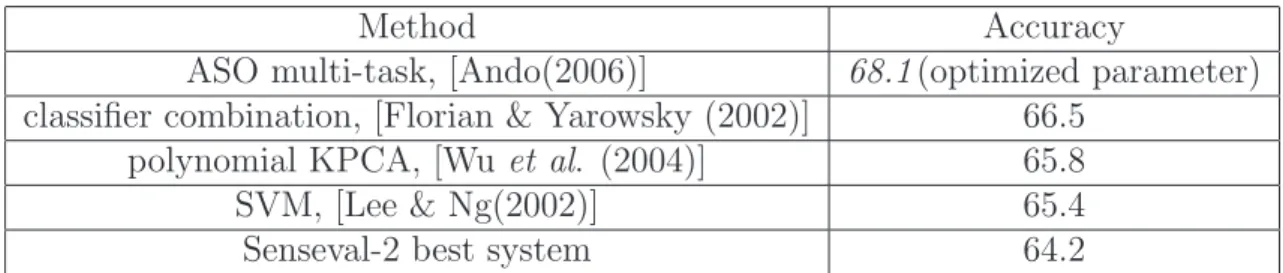
(16) Sense ID bank%1:04:00:: bank%1:06:00:: bank%1:06:01:: bank%1:14:00:: bank%1:14:01:: bank%1:17:00:: bank%1:17:01:: bank%1:17:02:: bank%1:17:02:: bank%1:21:00:: bank%1:21:01::. Table 1.1: Senses of the word “bank” Definition & Examples a flight maneuver; aircraft tips laterally about its longitudinal axis (especially in turning); “the plane went into a steep bank” a building in which commercial banking is transacted; “the bank is on the corner of Nassau and Witherspoon” a container (usually with a slot in the top) for keeping money at home; “the coin bank was empty” a financial institution that accepts deposits and channels the money into lending activities; “he cashed a check at the bank” an arrangement of similar objects in a row or in tiers; “he operated a bank of switches” a long ridge or pile; “a huge bank of earth” sloping land (especially the slope beside a body of water); “they pulled the canoe up on the bank” a slope in the turn of a road or track; the outside is higher than the inside in order to reduce the effects of centrifugal force a slope in the turn of a road or track; the outside is higher than the inside in order to reduce the effects of centrifugal force a supply or stock held in reserve for future use (especially in emergencies) the funds held by a gambling house or the dealer in some gambling games; “he tried to break the bank at Monte Carlo”. and bank as ’river side’. For example, bank as financial institution can split into the following cloud of related senses: the company or institution, the building itself, the counter where money is exchanged, a fund or reserve of money, a money box, the funds in a gambling house, the dealer in a gambling house, and a supply of something held in reserve (according to WordNet 2.1). Table 1.1 shows sense definitions of the polysemous word bank in Senseval-3. Note that, in this example, the senses are distinguished at fine-grain, and if we want to focus on disambiguating these senses at coarse-grain then we map every sense to its parents (in this case, sense “bank%1:14:00::” is a hyponym of sense “bank%1:06:00::”, and sense “bank%1:21:01::” is a hyponym of “bank%1:06:01::”). In this thesis, like other studies using these corpora we will evaluate our method with fine-grained scoring.. 1.1.2. Applications of WSD. For application which are sensitive to semantic denotation, or more precisely lexical semantics, lexical ambiguity can pose a major obstacle. Resolution of lexical ambiguity, which is commonly termed “word sense disambiguation” (WSD), is expected to improve the quality of the such following research fields. Machine Translation (MT). WSD is required for lexical choice in MT for words that have different translations for different senses and that are potentially ambiguous within a given domain (since non-domain senses could be removed during lexicon development). 3.
(17) For example, in an English-French financial news translator, the English noun change could translate to either changement (’transformation’) or monnaie (’pocket money’). In MT, the senses are often represented directly as words in the target language. Information Retrieval (IR). Ambiguity has to be resolved in some queries. For instance, given the query “depression” should the system return documents about illness, weather systems, or economics? A similar problem arises for proper nouns such as Raleigh (bicycle, person, city, etc.). Current IR systems do not use explicit WSD, and rely on the user typing enough context in the query to only retrieve documents relevant to the intended sense (e.g. “tropical depression”). Early experiments suggested that reliable IR would require at least 90% disambiguation accuracy for explicit WSD to be of benefit [Sanderson (1994)]. More recently, WSD has been shown to improve cross-lingual IR and document classification [Vossen et al. (2006)]. Besides document classification and cross-lingual IR, related applications include news recommendation and alerting, topic tracking, and automatic advertisement placement. Information Extraction (IE) and Text Mining. WSD is required for the accurate analysis of text in many applications. For instance, an intelligence gathering system might require the flagging of, say, all the references to illegal drugs, rather than medical drugs. Bio-informatics research requires the relationship between genes and gene products to be catalogued from the vast scientific literature; however, genes and their proteins often have the same name. More generally, the Semantic Web requires automatic annotation of documents according to a reference ontology: all textual references must be resolved to the right concepts and event structures in the ontology: all textual references must be resolved to the right concepts and event structures in the ontology [Dill et al. (2003)]. Name-entity classification, co-reference determination, and acronym expansion (MG as magnesium or milligram) can also be cast as WSD problems for proper names. WSD is only beginning to be applied in these areas. Lexicography. Modern lexicography is corpus-based, thus WSD and lexicography can work in a loop, with WSD providing rough empirical sense groupings and statistically significant contextual indicators of sense to lexicographers, who provide better sense inventories and sense-annotated corpora to WSD. Furthermore, intelligent dictionaries and thesauri might one day provide us with a semantically-cross-referenced dictionary as well as better contextual look-up facilities.. 1.1.3. Corpus-Based WSD and Task Description. WSD is essentially a classification problem: given a polysemous word, its possible senses are considered as classes, and each occurrence of the word should be assigned to one or more of its possible classes based on the information extracted from the context where the word appears. This is the traditional and common characterization of WSD that considers it as an explicit process of disambiguation with respect to a fixed inventory of word senses. Note that while most systems interpret only one polysemous word in the input (called the single-word task), other systems simultaneously interpret all polysemous words appearing in the input (called the all-words task). As the all-word task is just a set of independent single-word tasks, so in this work we will deal with the single-word task. We follow the corpus-based (or data-driven) approach, in which a set of sense-tagged examples of a polysemous word is given and treated as the training data. The task is then 4.
(18) to build a classifier based on the training data to detect senses for untagged examples of this polysemous word. Figure 1.1 shows the general scheme of corpus-based methods for WSD. Annotated examples. Un-annotated examples. Input. Machine Learning Method. Input Train. Test. Classifier. senses. Figure 1.1: A General Scheme of Corpus-Based Methods for WSD For example, suppose that we are dealing with the polysemous word bank in its partof-speech noun, we denote this word by bank.n (this example is extracted from Senseval-3 data). We are given a set of examples (contexts) of bank.n, such that in each given example the word bank.n is assigned with its right sense. The following are two among hundreds of training contexts: senseid=“bank%1:17:01::” <context> All the grass grinds their little molars flat. So, something nest building. Possibly aligned to water a sort of <head>bank</head> by a rushing river. Perhaps something as natty and camp as Ratty in The Wind in the Willows. Dapper, dear, Noel Coward. </context> senseid=“bank%1:14:01::” <context> It was late March. The air was raw and threatened rain but was tinged with the warmth of spring. The sky was a murky, pinkish grey; clouds swirled across it exposing higher, greyer <head>banks</head> of cloud. She snipped crisp green stalks with a pair of scissors. Milky liquid oozed from the stalks. </context> From the training data, we can build the sense inventory of bank.n, as shown in Table 1.1. One important point in the corpus-based approach is that the inventory of word senses is determined as the whole senses appearing in the training data, which is different from knowledge-based approach where the inventory of word senses is determined from a dictionary. Now, the task is to determine the right sense of bank.n (among its potential senses) for new contexts in test data, for example, for the following context: <context> 5.
(19) Original gravity can be roughly translated into alcoholic strength as follows: a 1036 beer has approximately 3.6 percent alcohol, a 1050 beer has 5 percent alcohol and so on. How to ruin perfection: gas connected to a cask of beer keeps the ale under a blanket of CO2, making it unpleasantly fizzy Serving the perfect pint: a fine <head>bank</head> of hand-pumps in a traditional tap room. Examples of different types of electric pumps. The two on the left are metered pumps serving exact half - pints, the ones on the right are free flow pumps. </context> In this test example, we try to find out the right sense of bank.n, that is “ bank%1:14:01::”. Note that, the right senses of test examples are provided in a key-file for evaluation (scoring). The major objective of this thesis is to applying and developing machine methods to improve accuracy of WSD. To this end, we focus on two machine learning aspects: classifier combination and semi-supervised learning, which aim to boost supervised WSD systems (the systems which use supervised learning algorithms such Naive Bayes, Maximum Entropy Models, Support Vector Machines, etc. to build WSD classifiers). In addition, we also work on context representation and feature selection which play important roles in obtaining high accuracy of WSD. The motivations and proposed solutions for the problems mentioned in this thesis are based on investigating and solving the limitations of related WSD studies. Experimental results were conducted on standard datasets (Senseval-2 and Senseval-3) and were compared to state-of-the-art systems in the field.. 1.2 1.2.1. Motivations and Problems Context Representation and Feature Selection. In the corpus-based approach, most studies just consider the information extracted from the context in which the target word appears. From our observation and other investigation such as [Klein et al. (2002)], we see that designing features plays an important role for classifiers to obtain high accuracy. Further, we observed that, in the context of WSD, the choice of what method of feature selection to use may more strongly influence the quality of classifiers than the choice of what machine learning algorithm to apply. In previous studies, [Ng & Lee (1996), Lee & Ng(2002)] determined the feature set by listing features of some kinds of knowledge (called knowledge sources), while others just re-used their selections or with some modifications (add and/or remove more knowledge sources). In our opinion, this selection seems to be heuristic, and lack of a reasonable explanation supporting for this selection. This observation motivates us to study on applying learning approaches to the selection of knowledge sources as well as the selection of individual features. This work can be considered as the work of context representation and feature selection. In particular, we will focus on the following issues. Selection of Knowledge Sources There are various knowledge sources appeared in the context of a polysemous word which can be considered as evidences for disambiguating word senses, such as morphological forms of surrounding words, syntactic relationships, or position relationship. We first collect as many as possible different knowledge sources, which we think useful for determining word senses. Naturally, the question arises here 6.
(20) is that, should we use all these kinds of information or just some of them for the task? Therefore, we aim at finding out such a way that can explain why a selection is more appropriate than others. Individual Feature Selection Feature selection is motivated by an observation that in some pattern recognition problems, there are too many features that require the cost for computation time and storage memory. In addition, some features may be redundant or noise. Therefore, the work on removing some features to reduce the size of the feature set while retaining the accuracy of classifiers is important and significant. This situation may also appear in WSD problem, so it motivates us to address the question whether applying feature selection methods for WSD is effective? There is a few of previous WSD studies regarding this issue, such as [Lee & Ng(2002), Mihalcea (2004), Pham et al. (2005)]. In these studies, the features which have frequencies equal or greater than 3 were selected. However, in this thesis, we will show that this selection much decreases the accuracy of WSD classification. We will also propose the use of a filter method in feature selection approaches to this task, making use of two well-known information measures of features including frequency and information-gain.. 1.2.2. Applying and Developing Learning Methods. Machine learning is always an essential factor in corpus-based approaches. Since corpusbased WSD have been studied for more than one decade, many aspects of machine learning have been investigated and applied. Among them, various supervised learning algorithms have been used, such as in [Mooney (1996), Lee & Ng(2002), Ngai et al. (2004)]. For other aspects in machine learning, classifier combination and semi-supervised learning currently have attracted many researchers in WSD community. Application of these approaches has improved accuracy of supervised WSD, for example, see [Klein et al. (2002)] for advantages of classifier combination, and see [Pham et al. (2005)] for advantages of semi-supervised learning. Even thought, there are some limitations in these studies, which motivated us to do a deeper study on these approaches, as pointed out below. Classifier Combination As observed in studies of machine learning systems, though one of the available learning systems could be chosen to achieve the best performance for a given pattern recognition problem, the set of patterns misclassified by the different classification systems would not necessarily overlap. This means that different classifiers may potentially offer complementary information about patterns to be classified. This observation highly motivated the recent interest in combining classifiers. Some studies of using classifier combination for WSD, such as [Klein et al. (2002)], have applied some combination strategies to obtain better results in comparison with individual supervised systems. However, these studies used only several combination strategies, such as majority voting, weighted voting, and simple mixture models. Some others combination strategies such as Product, Max, Min rules [Kittler et al. (1998)] have not been investigated. Furthermore, approaches in previous studies seem to be lack of describing a general combination framework accompanying with a corresponding theoretical basis, which should become the fundamental for applying the combination rules used. These observations motivate us to apply multiple classifier combination to WSD with a comprehensive collection of combination rules. Moreover, these rules would be used in combination frameworks cor7.
(21) responding to certain theoretical basis. In order to generate individual classifiers, some studies used different supervised learning algorithms, such as [Klein et al. (2002)], and others used different feature spaces such as in [Wang & Matsumoto (2004), Pedersen (2000)]. In this thesis, we will investigate these both types of individual classifiers, in which we will use the different kinds of knowledge (information) to generate individual classifiers of the second type. In addition, we will present a new scheme for classifier combination, in which one more phase of combination is added to the end of common combination strategies. This is motivated by the observation that different results yielded by applying various combination rules on the set of individual classifiers can be again used for one more combination. This new phase of combination is called second-layer combination, and thus the previous combination can be considered as the first-layer combination. This proposal is also motivated by the observation that combination usually gives better result in comparison with individual classifiers, so the second-layer combination is hoped to yield better results in comparison with the first-layer combination. Note that, this scheme can be considered as the generalization of some special cases in previous studies, such as [Klein et al. (2002), Florian & Yarowsky (2002), Wang & Matsumoto (2004)], among them [Klein et al. (2002)] used maximum entropy models, [Florian & Yarowsky (2002)] used median/average rule and majority voting, and [Wang & Matsumoto (2004)] used kNN, for the second-layer combination. Semi-Supervised Learning As well known, labeled data takes long time and is expensive to obtain while unlabeled data is cheap and easy to collect. This observation motivates the use of unlabeled data to enhance the performance of the supervised classifier built on the initial labeled data. However, there are only several studies working on exploiting unlabeled data for WSD, such as [Ando(2006), Pham et al. (2005), Mihalcea (2004)]. In this work, we follow the approach, in which labeled data is iteratively extended from unlabeled data. This approach is encouraged by a natural observation that: if we have some labeled examples at the beginning, which are considered as seed examples, we can built a classifier and use it to assign labels for unlabeled examples. Performing this process iteratively we can obtain an extended labeled data which is hoped to strengthen the initial supervised classifier. In this approach, we explicitly identify and focus on the three following problems: • The first problem regards the imbalance of labeled (training) data. We observe that if a classifier is built based on training data with a bias on certain classes (i.e., one or several classes dominate others), then this bias may become stronger at each extension of the labeled dataset. This is because a classifier tends to detect examples of dominant classes with high confidence, and consequently these examples are prioritized for a new set of labeled examples. Through steps of extending labeled data, the imbalance of labeled data may be increased, which may result in decreasing the accuracy of the initial classifier. Previous studies just solved this by fixing the number of new labeled examples for each class, such as in [Blum & Mitchell (1998), Pierce & Cardie (2001)]. However, this can not be implemented in some certain circumstances, for example in the case when we can not achieve enough confident new labeled examples of a class for the corresponding number which is pre-defined. • The second problem is that of how to determine a subset of new labeled examples 8.
(22) with high confidence. It is clear that adding a large number of misclassified examples into the labeled dataset will probably result in generating a poor classifier in the end. Therefore, one aims at obtaining new labeled examples with the highest accuracy possible. To reach this target, previous studies normally used the so-called threshold-based selection of new labeled examples. In particular, given a new example which is assigned a label with a probability of detection, a threshold value for this probability is predefined to decide whether a new labeled example will be selected or not, such as in [Yarowsky (1995), Blum & Mitchell (1998), Collins & Singer (1999)]. However, this threshold-based method of selection may lead to a situation where choosing a higher threshold will create difficulty in extending labeled data, while it does not always result in correct classification. By contrast, a lower threshold may result in more misclassified examples, but allows more new labeled examples to be added. Therefore, the determination of a “correct” threshold in the approach becomes an important issue. In addition, determining a commonly used threshold for all unknown data is also inappropriate. • The third problem is that of how to generate the final classifier when the process of extending labeled data is completed. This process will be stopped when the number of iterations reaches a pre-specified value, or when the unlabeled dataset becomes empty. Normally, the classifier built on the labeled data obtained at the last iteration is chosen as the final one. Some studies use a development dataset to find the most appropriate value for the number of iterations, such as in [Pham et al. (2005), Mihalcea (2004)]. As mentioned in second problem, the last classifier may be built based on new training data with some misclassified examples, so both advantages and disadvantages are concurrently brought to the last classifier with respect to the initial classifier (built on the original dataset). Thus, choosing the classifier trained on the last labeled dataset as the final classifier may not always be a good solution. This observation suggests that we should combine the initial classifier and the last classifier to utilize advantages of both of them. By reviewing various related studies, especially regarding the WSD problem, we found that most previous studies did not pay adequate attention to these three problems. In this work, we consider simultaneously these three problems for the objective of improving semi-supervised learning.. 1.3. Main Contributions. As stated earlier, this thesis focuses on: (1) context representation and feature selection; (2) applying classifier combination techniques; and (3) exploiting unlabeled data. The main contributions of this thesis are summarized as follows:. 1.3.1. Context Representation and Feature Selection. The uses of various kinds of knowledge (information) with the corresponding representations have been investigated. A method based on Forward and Backward Sequential Selection algorithms was proposed to select the best combination of these knowledge sources (i.e. context representations or feature subsets). Note that, different to previous 9.
(23) studies, we simultaneously used three representations of bag-of-words corresponding to three window sizes including small, medium, and large. In addition, we proposed the use of a filter-based method to select useful individual features. In order to evaluate features, we used two measures including the frequency of features, and the information-gain of each feature obtained from training data. The experiment has shown that this feature selection gives better results in comparison with feature selections from previous studies. At the end, the proposed approach has given us a certain confidence level on the selected features that is still lack in previous studies. Some results of this work are reported in [Le & Shimazu (2004)].. 1.3.2. Classifier Combination. In this thesis, we have presented a general framework for combining classifiers for WSD in which individual classifiers use different representations of context or different learning algorithms. Several common rules used in previous studies, such as majority voting, weighted voting, and average rule are formulated in this framework. On the one hand, various ways of using the context or different learning algorithms could be considered as providing different information sources to identify the meaning of the target word. Moreover, each of these information sources does not by itself provide 100% certainty as a whole piece of evidence for identifying the sense of the target. Under such an observation, we have interpreted the framework of classifier combination in terms of Dempster-Shafer theory of evidence [Shafer (1976)], and then formulated a general rule of classifier combination from which several interesting classifier combination schemes are derived. Particularly, applying the Dempster rule of combination (it is also considered as the orthogonal sum) on this framework, we achieve a new combination rule called DS combination rule. Furthermore, we also applied the discount operator on this framework to derive Discounting-and-Orthogonal sum rule. Under this combination strategy, we also can yield other combination rules, such as Average rule and Discounting-and-Average rule. On the other hand, by considering individual classifiers as experts who have their own soft decisions (for instance, probability distributions over the set of classes) on the word sense identification, we now face with the problem how to derive a consensus decision based on their individual decisions. Intuitively, in such a situation, one (i.e., decision maker) may have a decision making strategy based on linguistic quantifiers, for instance “a decision should be finally selected if LQ experts have supported it”, where LQ is a linguistic quantifier such as all, most, at least half,...”. We have mimicked this decision making behavior of human beings for decision fusion in the context of WSD. In particular, we have used OWA operators for classifier fusion in their semantic relation to linguistic quantifiers [Zadeh 1983]. Under such a formulation, we provided a framework for combining classifiers, which also yields several commonly used decision rules for WSD. In particular, some fuzzy majority voting have been derived, which correspond to the combination rules, such as Max rule, Min rule, and Median rule. The use of fuzzy linguistic quantifiers not only help deriving but also provides a human-like interpretations to these rules. Note that, some of these combination rules are also yielded in the work of [Kittler et al. (1998)], but with some strong assumptions which is difficult to be accepted in WSD problem. Moreover, this approach does provide us a clear interpretation about the semantics of these combination rules. In addition, we have proposed two second-layer combination schemes, called meta10.
(24) combination and meta-stacking. This proposal can be considered as the generalization of some special cases in previous studies, for example [Florian & Yarowsky (2002), Florian et al. (2002)] used the average and voting rules on the outputs of the first-layer combination rules. The results of the work on classifier combination are reported in [Le et al. (2005a), Le et al. (2005b), Le et al. (2005c), Le et al. (2006a), Le et al. (2006c), Le et al. (2006d)].. 1.3.3. Semi-Supervised Learning. A new bootstrapping algorithm with several variants are generated by providing solutions for the three problems: the problem of imbalance of labeled data, the problem of determining new labeled examples with high confidence, and the problem of generating the final classifier. With the proposed solutions, we have developed new variants for the general bootstrapping algorithm. The experiment has shown that unlabeled data is effective in improving supervised WSD with the proposed bootstrapping algorithms, while this improvement does not appear with the conventional bootstrapping algorithms. A novel combination model for post semi-supervised learning was proposed. By this model we can combine advantages from classifier combination and semi-supervised learning. Experimental result of this model has reached the state-of-the-art of WSD systems. This work also implemented a comparison between self-training and co-training with respect to the degree of confidence of new labeled examples. Some discussion was presented. Experimental results showed that self-training give better result than co-training when being used for WSD problem in some particular uses of these algorithms. The results of this work are reported in [Le et al. (2006b), Le et al. (2006e)].. 1.4. Thesis Structure. This chapter presents an overview of the thesis, including an introduction of word sense disambiguation, the motivations and problems of this thesis, and our contributions. The rest of this thesis is organized as follows. - Some backgrounds are presented in Chapter 2. First, we present our survey on approaches in WSD including knowledge-based and corpus-based approach. Second, we present three supervised learning algorithms which will be used as basic algorithms in our proposed methods, including Naive Bayes, Support Vector Machines, and Maximum Entropy Models. - Our work on context representation and feature selection are presented in Chapter 3. This is one of the three main subtasks in this thesis. In this chapter, we first present various kinds of context representation, including results from previous works and our proposal. Next, some new ideas about feature selection for WSD and the corresponding experiments are presented. - Chapter 4 presents our work on classifier combination, which is one of main contents in our thesis. In this chapter we develop a framework of classifier combination based on Dempster-Shafer (DS) theory of evidence and the notion of Ordered Weighted Averaging (OWA) operators with the help of fuzzy quantifiers. As the result, some combination rules are derived such as DS, max, min, fuzzy majority voting, etc. In addition, we also present two second-layer combination strategies based on meta-combination and the. 11.
(25) stacking method. These various methods will be experimented with two kinds of individual classifiers, one is based on different feature selection and the other is based on different supervised learning algorithms. - Chapter 5 presents our work on exploiting unlabeled data to improve performance of supervised WSD (i.e. semi-supervised learning). This work is also a main content of the thesis. We first introduce methods in semi-supervised learning and discuss the reason why we choose the approach in which labeled data is iteratively extended from unlabeled data. Next, we identify the problems that may occur in this approach, and provide solutions for them. As the result, a new semi-supervised learning algorithm with several variants are generated. - Chapter 6 first summarizes the main points of the thesis including the main achievements and contributions of the thesis, as well as the remaining problems. Finally, several open problems that are in part extended from this thesis will be mentioned in terms of the future research directions.. 12.
(26) Chapter 2 Background There are two parts (sections) in this chapter. In the first part, we will investigate the methods used in WSD which provides an overall picture in abstract level of WSD research. In the second part, we will introduce three supervised learning algorithms, including NB, MEM, and SVM, which will be used as basic algorithms in the machine learning methods of the next chapters.. 2.1. Past Research on Word Sense Disambiguation. This section briefly summaries approaches and obtained results in word sense disambiguation studies, specially focusing on current researches. We first present terminologies and describe the task of WSD, and then present the methods which are grouped into rulebased approach and corpus-based approach. Finally, we present the corpora which will be used for experiments in this thesis, and present evaluation metrics of classifiers in WSD. Given a context containing a polysemous word, the task of WSD is to find the correct sense among potential senses of this word. All disambiguation work involves matching the context of the instance of the word to be disambiguated with either information from an external knowledge (knowledge-driven WSD), or information about the contexts of previously disambiguated instances of the word derived from corpora (data-driven or corpus-based WSD).. 2.1.1. Knowledge-based Approach. Work on WSD reached a turning point in the 1980’s and 1990’s when large-scale lexical resources such as dictionaries, thesauri, and corpora became widely available. Efforts began to attempt to automatically extract knowledge from these sources and to construct large scale knowledge bases by hand.. Machine-readable dictionaries As the survey in [Ide et al. (1998)], Machine-readable dictionaries (MRDs) became a popular source of knowledge for language processing tasks since 1980’s. A primary area of activity during 1980’s involved attempts to automatically extract lexical and semantic knowledge bases from MRDs. All methods using MRD rely on the notion that the most. 13.
(27) plausible sense to assign to multiple co-occurring words is the one that maximizes the relatedness among the chosen senses. [Lesk (1986)] created a knowledge base which associated with each sense in a dictionary a “signature” composed of the list of words appearing in the definition of that sense. Disambiguation was accomplished by selecting the sense of the target word whose signature contained the greatest number of overlaps with the signatures of neighboring words in its context. The method achieved 50-70% correct disambiguation, using a relatively fine set of sense distinctions such as those found in a typical learner’s dictionary. Lesk’s method is very sensitive to the exact wording of each definition: the presence or absence of a given word can radically alter the results. However, Lesk’s method has served as the basis for most subsequent MRD-based disambiguation work. In some other studies, [Wilks et al.(1993)] attempted to improve the knowledge associated with each sense by calculating the frequency of co-occurrence for the words in definition texts, from which they derive several measures of the degree of relatedness among words. This metric is then used with the help of a vector method that relates each word an its context. [Cowie et al. (1992)] used the simulated annealing technique for overcoming the combinatorial explosion of the Lesk’s method. Inconsistencies in dictionaries are not the only and perhaps not the major source of their limitations for WSD. While dictionaries provide detailed information at the lexical level, they lack pragmatic information that enters into sense determination. For example, the link between ash and tobacco, cigarette, or tray in a network such as Quillian’s is very indirect, whereas in the Brown corpus, the word ash co-occurs frequently with one of these words. It is therefore not surprising that corpora have become a primary source of information for WSD.. Thesauri and Computational Lexicons Thesauri provide information about relationships among words, most notably synonymy. Roget’s International Thesaurus, which was put into machine-tractable form in the 1950’s and has been used in a variety of applications including machine translation, information retrieval, and content analysis, also supplies an explicit concept hierarchy consisting of up to eight increasingly refined levels. Typically, each occurrence of the same word under different categories of the thesaurus represents different senses of that word; i.e., the categories correspond roughly to word senses [Yarowsky (1992)]. A set of words in the same category are semantically related. [Yarowsky (1992)] derived classes of words by starting with words in common categories in Roget’s (4th edition). A 100–word context of each word in the category is extracted from a corpus (the 1991 electronic text of Grolier’s Encyclopedia), and a mutual information – like statistic is used to identify words most likely to co-occur with the category members. The resulting classes are used to disambiguate new occurrences of a polysemous word: the 100-word context of the polysemous occurrence is examined for words in various classes, and Bayes’ Rule is applied to determine the class most likely to be that of the polysemous word. Since class is assumed by Yarowsky to represent a particular sense of a word, assignment to a class identifies the sense. He reports 92% accuracy on a mean three-way sense distinction. Yarowsky notes that his method is best for extracting topical information, which is in turn most successful for disambiguating nouns (see Section 3.1.2). He uses the broad category distinctions supplied by Roget’s, 14.
(28) although he points out that the lower-level information may provide rich information for disambiguation. Other approaches measure the relatedness between words, taking as a reference a structured semantic net. Thus, [Sussna (1993)] employs the notion of conceptual distance between network nodes in order to improve precision during document indexing. [Agirre & Rigau (1996)] present a method for the resolution of the lexical ambiguity of nouns using the WordNet noun taxonomy and the notion of conceptual density. [Rigau et al. (1997)] combine a set of knowledge-based algorithms to accurately disambiguate definitions of MRDs. [Mihalcea & Moldovan (1999)] suggest a method that attempts to disambiguate all the nouns, verbs, adverbs, and adjectives in a given text by referring to the senses provided by WordNet. [Magnini el al. (2002)] explore the role of domain information in WSD using WordNet domains; in this case, the underlying hypothesis is that information provided by domain labels offers a natural way to establish semantic relations among word senses, which can be profitably used during the disambiguation process. Like machine-readable dictionaries, a thesaurus is a resource created for humans and is therefore not a source of perfect information about word relations. It is widely recognized that the upper levels of its concept hierarchy are open to disagreement (although this is certainly true for any concept hierarchy), and that they are so broad as to be of little use in establishing meaningful semantic categories. Nonetheless, thesauri provide a rich network of word associations and a set of semantic categories potentially valuable for languageprocessing work; however, Roget’s and other thesauri have not been used extensively for WSD. Although knowledge-based systems have been proven to be ready-to-use and scalable tools for all-words WSD because they do not require sense-annotated data, corpus-based systems in general obtain better precision than the knowledge-based ones.. 2.1.2. Corpus-based Approach. In the last fifteen years, empirical and statistical approaches have attracted almost studies in NLP field. Many machine learning methods have been applied to a large variety of NLP tasks with remarkable success. The types of NLP problems initially addressed by statistical and machine learning techniques are those of language ambiguity resolution, in which the correct interpretation should be selected from among a set of alternatives in a particular context (e.g., word-choice selection in speech recognition or machine translation, part-of-speech tagging, word-sense disambiguation, co-reference resolution, etc.). These techniques are particularly adequate for NLP because they can be regarded as classification problems, which have been studied extensively in the ML community. Regarding automatic WSD, one of the most successful approaches in the last ten years is supervised learning from examples, in which statistical or ML classification models are induced from semantically annotated corpora. Generally, supervised systems have obtained better results than unsupervised ones, a conclusion that is based on experimental work and international competitions 1 . This approach uses semantically annotated corpora to train machine learning (ML) algorithms to decide which word sense to choose in which contexts. The words in such annotated corpora are tagged manually using semantic classes taken from a particular lexical semantic resource (most commonly WordNet). 1. http://www.senseval.org. 15.
(29) We divide corpus-based methods into three groups including supervised learning approach, unsupervised learning approach, and semi-supervised approach which are corresponding to three types of data used for training: using only annotated data, using only un-annotated data, and using both annotated and un-annotated data. In the following, we will survey WSD studies followed corpus-based approach with respect to these three groups.. Supervised Learning Based Methods One of the most successful current lines of research is the corpus-based approach, in which statistical or Machine Learning algorithms have been applied to learn statistical models or classifiers from corpora in order to perform WSD. A supervised WSD system requires an annotated dataset which includes labeled (or tagged) examples, in which each example contains the target word w assigned with its right sense. This data, called labeled data or training data, is then used for a supervised learning algorithm to train a classifier for future detection of test examples. Until now, many ML algorithms have been applied, such as: Decision Lists [Yarowsky (1994), Agirre & Martinez (2001)], Neural Networks [Towell & Voorhees (1998)], Bayesian learning [Bruce & Wiebe (1994)], Exemplar-based learning [Ng (1997), Escudero et al. (2000a)], Boosting [Escudero et al. (2000b)], etc. Further, in [Mooney (1996)] some of the previous methods are compared jointly with Decision Trees and Rule Induction algorithms, on a very restricted domain. Recently, [Lee & Ng(2002)] evaluates some strong ML algorithms in WSD, including Naive Bayes, Support Vector Machines, AdaBoost, and Decision Tree. This work was accomplished for the recently competition data including Senseval-1 and Senseval-2. In the contest of Senseval-3, [Ngai et al. (2004)] also investigate the semantic role labeling with Boosting, SVMs, Maximum Entropy, SNOW, and Decision Lists. Reviewing results from these studies, we can conclude that there is no ML algorithm which dominates others. This conclusion is based on two observations that there are no large distance between the accuracies obtained from different algorithms, and the best algorithm are changed via different corpora. Classifier Combination Based Methods As observed in studies of machine learning systems, although one of the available learning systems could be chosen to achieve the best performance for a given pattern recognition problem, the set of patterns misclassified by the different classification systems would not necessarily overlap. This means that different classifiers may potentially offer complementary information about patterns to be classified. This observation highly motivated the recent interest in combining classifiers. Especially, classifier combination for lexical disambiguation in WSD has, not surprisingly, received much attention recently from the community. In the WSD literature, the first empirical study of combining classifiers was presented in [Kilgarriff & Rosenzweig (2000)], in which the authors combined the output of the participating SENSEVAL1 systems via simple voting. [Pedersen (2000)] built an ensemble of Naive Bayesian classifiers, each of which is based on lexical features that represent cooccurring words in varying sized windows of context. [Klein et al. (2002)] use a stacking type of combination techniques with some combination strategies including majority vot16.
(30) ing, weighted voting. [Hoste et al. (2002)] used word experts consisting of four memorybased learners trained on different context. Output of the word experts is based on majority voting or weighted voting. In [Florian et al. (2002)], the authors used six different classifiers as components of their combination. They compared several different combination strategies which include combining the posterior distribution, combination based on order statistics, and several different voting strategies. [Wang & Matsumoto (2004)] presented a kind of stacking; individual classifiers were built using NB with varying sized windows of context that are similar to Pedersen’s approach [Pedersen (2000)], and then used K-nearest neighbors as the meta learning method.. Unsupervised Learning Based Methods Although supervised methods typically achieve better performance than unsupervised alternatives, their applicability is limited to those words for which sense labeled data exists, and their accuracy is strongly correlated with the amount of labeled data available [Yarowsky el al. (2002)]. Furthermore, obtaining manually labeled corpora with word senses is costly and the task must be repeated for new domains, languages, or sense inventories. There are not many studies about unsupervised WSD, that is easy to understand because unsupervised WSD obtains lower accuracy in comparison with supervised learning. However, it is very difficulty to achieve a large annotated corpora for all ambiguous words, which is prerequisite for building a good supervised WSD system. In that case, an unsupervised WSD is necessary. Moreover, this work is useful not only for preparing annotated corpora or constructing dictionary, but also for some other NLP tasks such as Information Retrieval, (see [Schutze (1998)] for an example). The essential problem in unsupervised learning for WSD is how to group the given contexts of an ambiguous word into cluster such that the contexts in the same cluster have the same sense of this ambiguous word. The most popular work is [Schutze (1998)], in which senses are represented in Word Space and the EM algorithm are invoked to optimize the parameters of the obtained classifiers. Recently, Pedersen and his co-workers have tried to build an WSD system and their results are published in [Purandare & Pedersen (2004), Kulkarni & Pedersen (2005)]. [Brody et al. (2006)] used ensemble approach to unsupervised WSD and based on predominant senses which are derived automatically from raw text.. Semi-Supervised Learning Based Methods Due to the difficulty of obtaining labeled data, while unlabeled data is abundant and cheap to collect, recently several WSD studies have tried to use unlabeled data to boost the performance of supervised learning. The process of using both labeled and unlabeled data to build a classifier is called semi-supervised learning. With a small number of labeled examples, we may face two problems: the first one is that we cannot archive the correct probability distribution over feature space; the second one is that there is lack of features in the training data, i.e. we may see new features in test data. There were several studies which aimed to overcome the second problem by using external resources as, e.g., thesaurus or lexicons to disambiguate word senses or automatically generate sense-tagged corpus such as in [Lesk (1986), Lin (1997), McCarthy et al. (2004), Seo et al. (2004), Yarowsky (1992)] or by using similarity between words based on un17.
(31) tagged corpus such as in [Karov & Edelman (1998)], or by basing on the WordNet resource such as in [Leacock (1998)]. There is also another approach in the case of lacking labeled sense-tagged examples, in which word senses are distinguished with the help of a second language. In this approach, the studies exploited the differences between mapping of words to senses in different languages making use of bilingual corpora (e.g. parallel corpora or untagged monolingual corpora in two languages), such as in [Brown et al. (1991), Dagan & Itai (1994), Diab & Resnik (2002), Li & Li, Ng et al. (2003)]. Recently, almost related studies interest in using semi-supervised learning algorithms to extend labeled data. Among them, Yarowsky algorithm in [Yarowsky (1995)] can be considered as the first bootstrapping algorithm. In this algorithm, the author used some labeled examples as seeds and extracted from them the decision rules, which are then used to detect senses for new examples. This algorithm was based on the principle “one sense per collocation”. As the result, new labeled examples were obtained and added to the current labeled dataset. New decision rules were continuously extracted and this process was repeated until converged. [Mihalcea (2004)] did an investigation of application of cotraining and self-training to word sense disambiguation. In another study, [Zheng (2005)] applied the Label Propagation based semi-supervised learning algorithm proposed by [Zhu & Ghahramani (2002)] to WSD. They also suggested an entropy-based method to automatically identify a distance measure to boost the performance of Label Propagation algorithm on a given dataset. [Pham et al. (2005)] applied an algorithm which used co-training in spectral graph transductive(SGT) [Joachims (2003)] for WSD. Instead of directly computing the nearest neighbor graph in SGT, the authors constructed a separate graph for each view, and combined them together to obtain the final graph.. 2.1.3. Corpora and Evaluation. Corpora In the scope of this thesis, we just consider the corpora which aims to serve for corpus-base approach and related for only lexical task. The following are some corpora wildly used in WSD community and will be used in this thesis. – Datasets of the four words, namely interest, line, serve, and hard, which are used in numerous comparative studies of word sense disambiguation methodologies [Pedersen (2000), Leacock (1998), Ng & Lee (1996), Bruce & Wiebe (1994)]. There are 2369 instances of interest with 6 senses, 4143 instances of line with 6 senses, 4378 instances of serve with 4 senses, and 4342 instances of hard with 3 senses. – In 1998, the first contest for word sense disambiguation was organized, and called SENSEVAL-1. Next, the second and the third contests took place in 2001 and 2004 respectively. Their data for the competition are called Senseval-1, Senseval-2, and Senseval-3 respectively, and quickly became the most popular corpora in the community. There are 53 lexical item, 73 lexical items, and 57 lexical items in English lexical sample of Senseval1, Senseval-2, and Senseval-3, respectively. Data for each lexical item contains a training dataset and a test dataset. Note that in each instance (or example) in Senseval’s data the target word may be assigned with multiple senses. For an example which are assigned with K senses (K > 1), we multiple them with K instances, each instance is assigned with one sense in these K senses.. 18.
図

+7


関連したドキュメント
In this, the first ever in-depth study of the econometric practice of nonaca- demic economists, I analyse the way economists in business and government currently approach
Comparing the Gauss-Jordan-based algorithm and the algorithm presented in [5], which is based on the LU factorization of the Laplacian matrix, we note that despite the fact that
It is suggested by our method that most of the quadratic algebras for all St¨ ackel equivalence classes of 3D second order quantum superintegrable systems on conformally flat
Using an “energy approach” introduced by Bronsard and Kohn [11] to study slow motion for Allen-Cahn equation and improved by Grant [25] in the study of Cahn-Morral systems, we
Here we continue this line of research and study a quasistatic frictionless contact problem for an electro-viscoelastic material, in the framework of the MTCM, when the foundation
Analogs of this theorem were proved by Roitberg for nonregular elliptic boundary- value problems and for general elliptic systems of differential equations, the mod- ified scale of
“Breuil-M´ezard conjecture and modularity lifting for potentially semistable deformations after
Then it follows immediately from a suitable version of “Hensel’s Lemma” [cf., e.g., the argument of [4], Lemma 2.1] that S may be obtained, as the notation suggests, as the m A
