Singular parts
of
moduli spaces for cubic
polynomials
and quadratic rational maps
Masayo
$\mathrm{F}..\mathrm{U}$JIMURA
Dept. of Math., College of Sci. and Tech., Nihon Univ.
1.
Quadratic rational
maps
1.1. Moduli space of quadratic rational maps
Let $\overline{\mathrm{C}}$ be the Riemann sphere and
$\mathrm{R}\mathrm{a}\mathrm{t}_{2}(\mathrm{C})$ the space of all quadratic rational maps
from$\overline{\mathrm{C}}$
toitself. The group$\mathrm{P}\mathrm{S}\mathrm{L}_{2}(\mathrm{C})$ ofM\"obiustransformations acts onthe space $\mathrm{R}\mathrm{a}\mathrm{t}_{2}(\mathrm{C})$
by conjugation,
$g\mathrm{o}f\mathrm{o}g^{-1}\in \mathrm{R}\mathrm{a}\mathrm{t}_{2}(\mathrm{C})$ for $g\in \mathrm{P}\mathrm{S}\mathrm{L}_{2}(\mathrm{C}),$ $f\in \mathrm{R}\mathrm{a}\mathrm{t}_{2}(\mathrm{C})$.
Two maps $f_{1},$$f_{2}\in \mathrm{R}\mathrm{a}\mathrm{t}_{2}(\mathrm{C})$ are holomorphically conjugate, denoted by $f_{1}\sim f_{2}$
,
if andonly if there exists $g\in \mathrm{P}\mathrm{S}\mathrm{L}_{2}(\mathrm{C})$ with $g\circ f_{1}\mathrm{o}g^{-1}=f_{2}$. The quotient space of $\mathrm{R}\mathrm{a}\mathrm{t}_{2}(\mathrm{C})$
under this action will bedenoted by $\mathcal{M}_{2}(\mathrm{C})$, and called the moduli space of holomorphic
conjugacy classes $\langle f\rangle$ of quadratic rational maps $f$.
Milnor introduced coordinates in $\mathcal{M}_{2}(\mathrm{C})$ as follows; for each $f\in \mathrm{R}\mathrm{a}\mathrm{t}_{2}(\mathrm{C})$, let $z_{1},$$z_{2,3}z$
be the fixed points of $f$ and $\mu_{i}$ the multipliers of $z_{i}$; $\mu_{i}=f’(z_{i})(1\leq i\leq 3)$. Consider the
elementary symmetric functions of the three multipliers,
$\sigma_{1}=\mu_{1}+\mu 2+\mu 3$, $\sigma_{2}=\mu 1\mu_{2}+\mu 2\mu_{3}+\mu 3\mu_{1}$, $\sigma_{3}=\mu_{1}\mu_{2}\mu 3$.
These three multipliers determine $f$ up to holomorphic conjugacy, and are subject only to
the restriction that
$\sigma_{3}=\sigma_{1^{-}}2$.
Hence the moduli space $\mathcal{M}_{2}(\mathrm{C})$ is canonically isomorphic to
$\mathrm{C}^{2}$ with coordinates
$\sigma_{1}$ and
$\sigma_{2}$ (Lemma 3.1 in [Mi193]).
For each $\mu\in \mathrm{C}$ let $\mathrm{P}\mathrm{e}\mathrm{r}_{n}(\mu)$be the set of all conjugacy classes $\langle f\rangle$ of maps $f$ which having
a periodic point of period $n$ and multiplier $\mu$.
Each of $\mathrm{P}\mathrm{e}\mathrm{r}_{1}(\mu)$ and $\mathrm{p}_{\mathrm{e}\mathrm{r}_{2}}(\mu)$ forms a straight lines as follows:
$\mathrm{P}\mathrm{e}\mathrm{r}_{1}(\mu)=\{\langle f\rangle\in \mathcal{M}_{2}(\mathrm{C});\sigma 2=(\mu+\mu-1)\sigma 1^{-}(\mu^{2}+2\mu^{-1})\}$
(Lemmas 3.4 and 3.6 in [Mi193]).
Remark $\mathrm{P}\mathrm{e}\mathrm{r}_{1}(-1)\subseteq \mathrm{P}\mathrm{e}\mathrm{r}_{2}(1)$ by definition. But, in the case of$\mathcal{M}_{2}(\mathrm{C})$, it is clear that
two families coincide.
By an automorphism of a quadratic rational map $f$, we will mean $g\in \mathrm{P}\mathrm{S}\mathrm{L}_{2}(\mathrm{C})$ which
commutes with $f$. The collection $\mathrm{A}\mathrm{u}\mathrm{t}(f)$ of all automorphisms of $f$ forms a finite group.
It is clear that $\mathrm{A}\mathrm{u}\mathrm{t}(\tilde{f})$ is isomorphic to $\mathrm{A}\mathrm{u}\mathrm{t}(f)$ for any $\tilde{f}\in\langle f\rangle$.
The set
$S=$
{
$\langle f\rangle;\mathrm{A}\mathrm{u}\mathrm{t}(f)$ isnon-trivial}
$\subset \mathcal{M}_{2}(\mathrm{C})$is called the symmetry locus.
Proposition 1 $Tl_{1}e$ symmet
$\mathrm{r}y$ locus$S$ of$qu\mathrm{a}\mathrm{d}r\mathrm{a}ti_{C\mathrm{r}a}$tional $m\mathrm{a}ps$ forms an irred ucible
algebraic curve as follows;
$S(\sigma_{1}, \sigma_{2})=2\sigma_{1}^{3}+\sigma_{1}^{2}\sigma_{2^{-}}\sigma_{1}^{2}-4\sigma-282\sigma 1\sigma 2+12\sigma_{1}+12\sigma_{2}-36=0$. (1)
Proof of Corollary 1.
$\mathrm{A}\mathrm{u}\mathrm{t}(f)$ coincides with the group consisting of all permutations of the fixed points which
preserve the multipliers. In the case of $f$ has the three distinct fixed points, $\mathrm{A}\mathrm{u}\mathrm{t}(f)$ has
order 1, 2, or 6 according as three multipliers are distinct, two are equal, or all the three
are equal, respectively, while, if $f$ has multiple fixed points then $\mathrm{A}\mathrm{u}\mathrm{t}(f)$ is non-trivial if
and only if $f$ has a triple fixed point. The multipliers $\mu_{i}$ are the roots of the equation:
$\mu^{3}-\sigma_{1}\mu^{2}+\sigma_{2}\mu-\sigma 1+2=0$. (2)
The equation (2) has multiple roots if and only ifits discriminant is equal to zero. Hence
we have
$(\sigma_{2^{-}}2\sigma_{1}+3)(2\sigma_{1}^{3}+\sigma_{1}^{2}\sigma_{2}-\sigma_{1}^{22}-4\sigma_{2}-8\sigma_{1}\sigma_{2}+12\sigma_{1}+12\sigma_{2}-36)=0$.
The first factor corresponds with $\mathrm{p}_{\mathrm{e}\mathrm{r}_{1}}(1)$. Considering the line of the first factor $(\mathrm{P}\mathrm{e}\mathrm{r}_{1}(1))$
tangent to the curve of the second factor $(S)$ with tangency of degree three, the second
factor is the required equation.
1
The following result is obtained immediately by the definition of the envelope of the
family of curves.
Corollary 1 $Tl_{l}e$ envelope of$\{\mathrm{p}e\mathrm{f}_{1}(\mu)\}_{\mu}$ coincides with the symmetry locus.
Remark (Theorem 5.$1.\mathrm{o}\mathrm{f}$ [Mi193]) A quadratic rational map has a non-trivial
automor-.
phism if and only if it is conjugate to a map in the unique normal form $f(z)=k(z+ \frac{1}{z})$
1.2. Real moduli space
Let $\mathrm{R}\mathrm{a}\mathrm{t}_{2}(\mathrm{R})$ be the set of real quadratic rational maps. Then the parameters $\sigma_{i}(1\leq$
$i\leq 3)$ are all real, because the $\mathrm{t}\mathrm{h}\mathrm{r}\mathrm{e}\mathrm{e}\sim$
fixed points and the $\mathrm{c}\mathrm{o}\mathrm{r}\mathrm{r}\mathrm{e}\mathrm{s}\mathrm{p}_{0}\mathrm{n}\mathrm{d}\mathrm{i}\mathrm{n}\mathrm{g}$multipliers are
either allreal or one realand apair of complex conjugate numbers. According to J. Milnor,
we define the real moduli space $\mathcal{M}_{2}(\mathrm{R})$ for $\mathrm{R}\mathrm{a}\mathrm{t}_{2}(\mathrm{R})$ to be simply the real $(\sigma_{1}, \sigma_{2})$-plane.
This notation needs some care when used: ifwe put $S_{\mathrm{R}}=S\cap \mathcal{M}_{2}(\mathrm{R})$, and denote by $\langle$ $\rangle_{\mathrm{R}}$
the real conjugacy class, then $( \mathrm{R}\mathrm{a}\mathrm{t}2(\mathrm{R})/^{\mathrm{p}}\mathrm{c}\mathrm{L}2(\mathrm{R}))\backslash \{\langle a(x+\frac{1}{x})\rangle_{\mathrm{R}}, \langle a(x-\frac{1}{x})\rangle_{\mathrm{R}}\}a\in \mathrm{R}^{\cross}$ is
canonically isomorphic to $\mathrm{R}^{2}\backslash S_{\mathrm{R}}$, whereas there is a canonical $\mathrm{t}\mathrm{w}\mathrm{o}^{-}\mathrm{t}\mathrm{o}^{-}\mathrm{o}\mathrm{n}\mathrm{e}$ correspondence
between $\{\langle a(x\pm\frac{1}{x})\rangle\}_{a\in \mathrm{R}^{\mathrm{x}}}$ and $S_{\mathrm{R}}$.
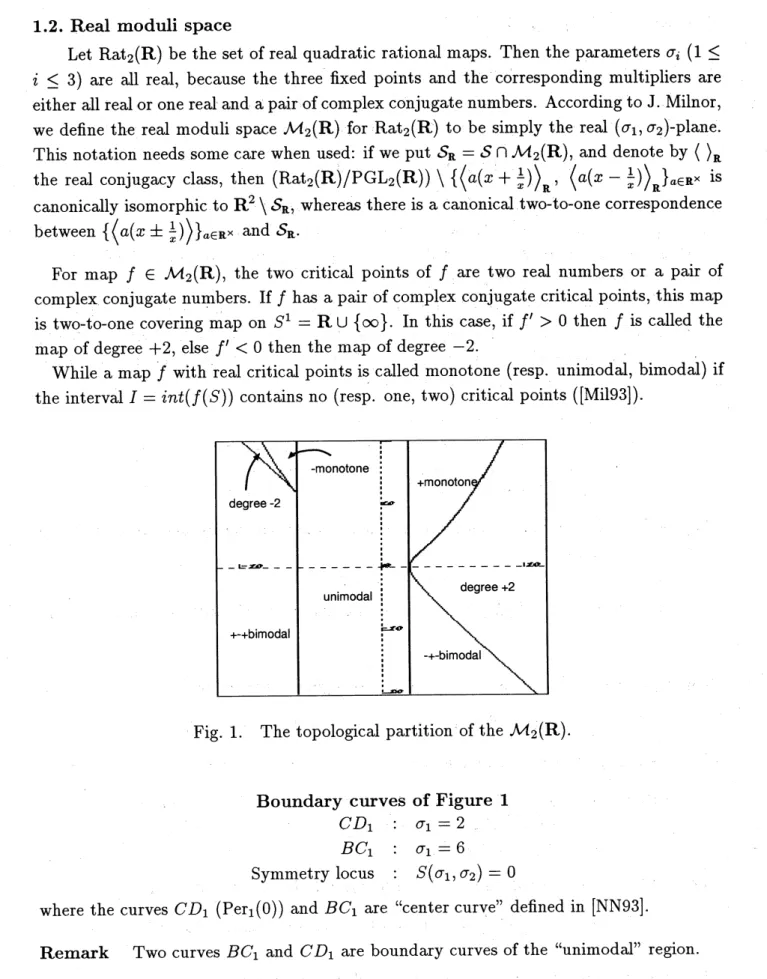
For map $f\in \mathcal{M}_{2}(\mathrm{R})$, the two critical points of $f$ are two real numbers or a pair of
complex conjugate numbers. If$f$ has a pair of complex conjugate critical points, this map
is $\mathrm{t}\mathrm{w}\mathrm{o}^{-}\mathrm{t}\mathrm{o}^{-}\mathrm{o}\mathrm{n}\mathrm{e}$ covering
ma..p
on $S^{1}=\mathrm{R}\cup\{\infty\}$. In thiscase.’
if $f’>0$ then $f$ is called themap of$\mathrm{d}\mathrm{e}\mathrm{g}\mathrm{r}\mathrm{e}\mathrm{e}+2$, else $f’<0$ then the map of degree-2.
While a map $f$ with real critical points is called monotone (resp. unimodal, bimodal) if
the interval $I=int(f(S))$ contains no (resp. one, two) critical points $([\mathrm{M}\mathrm{i}193])$.
Fig. 1. The topological partition of the $\mathcal{M}_{2}(\mathrm{R})$.
Boundary
curves
of Figure 1$CD_{1}$ : $\sigma_{1}=2$ $BC_{1}$ : $\sigma_{1}=6$
Symmetry locus
:
$S(\sigma_{1,2}\sigma)=0$where the curves $CD_{1}(\mathrm{P}\mathrm{e}\mathrm{r}_{1}(0))$ and $BC_{1}$ are “center curve” defined in [NN93].
2.
Cubic
polynomials
2.1. Moduli space of cubic polynomials
Let $\mathrm{P}\mathrm{o}\mathrm{l}\mathrm{y}_{3}(\mathrm{c})$ be the space of all cubic polynomials from $\mathrm{C}$ to itself.
$\cdot$ The group
$\mathrm{P}\mathrm{o}\mathrm{l}\mathrm{y}_{1}(\mathrm{c})$ ofaffine transformations acts on the space
$\mathrm{P}\mathrm{o}\mathrm{l}\mathrm{y}_{3}(\mathrm{c})$ by conjugation,
$g\circ p\circ g^{-1}\in \mathrm{P}\mathrm{o}\mathrm{l}\mathrm{y}_{3}(\mathrm{c})$ for
$g\in \mathrm{P}\mathrm{o}\mathrm{l}\mathrm{y}_{1}(.\mathrm{c})$, $p\in \mathrm{P}\mathrm{o}\mathrm{l}\mathrm{y}_{3}(\mathrm{c})$.
Two maps$p_{1},p_{2}\in \mathrm{P}\mathrm{o}\mathrm{l}\mathrm{y}_{3}(\mathrm{c})$are holomorphically
conjugate,
denoted by$p_{1}\sim p_{2}$, if and
only if there exists $g\in \mathrm{P}\mathrm{o}\mathrm{l}\mathrm{y}_{1}(\mathrm{c})$ with $g\mathrm{o}p_{1}\mathrm{o}g^{-1}=p_{2}$. The quotient space of $\mathrm{P}\mathrm{o}\mathrm{l}\mathrm{y}_{3}(\mathrm{c})$
under this action will be denoted by $\mathrm{M}_{3}(\mathrm{C})$, and called the moduli space of holomorphic
conjugacy classes $\langle p\rangle$ ofcubic polynomials
$p$.
Doing the same as the case of quadratic rational maps, we introduce coordinates in
$\mathrm{M}_{3}(\mathrm{C})$ as follows; for each $p\in \mathrm{P}\mathrm{o}\mathrm{l}\mathrm{y}_{3}(\mathrm{c})$, let
$z_{1},$ $z_{2},$ $z_{3},$ $z_{4}(=\infty)$ be the fixed points of$p$
and $\mu_{i}$ the multipliers of $z_{i};\mu_{i}=p’(Zi)(1\leq i\leq 3)$, and $\mu_{4}=0$.
$\mathrm{C}\mathrm{o}\mathrm{n}\mathrm{S}\mathrm{i}\mathrm{d}\mathrm{e}\mathrm{r}\sim$ the $\mathrm{e}.\cdot.1$ementary
symmetric functions ofthe four multipliers,
$\sigma_{1}=\mu_{1}+\mu 2+\mu 3+\mu 4=\mu_{1}+\mu 2+\mu 3$
$\sigma_{2}=\mu 1\mu_{2}+\mu 1\mu 3+\mu 1\mu_{4}+\mu 2\mu 3+\mu 2\mu_{4}+\mu 3\mu 4=\mu 1\mu 2\sim+\mu 1\mu_{3}+\mu 2\mu_{3}$
$\sigma_{3}=\mu_{1}\mu 2\mu 3+\mu 1\mu 2\mu_{4}+\mu 1\mu_{3}\mu 4+\mu_{2}\mu_{3}\mu_{4}=\mu 1\mu_{2\mu_{3}}$
$\sigma_{4}=\mu_{1}\mu 2\mu 3\mu 4=0$.
These multipliers determine uniquely$p$ up to holomorphic conjugacy, and are subject only
to the restriction that
$3-2\sigma_{1}+\sigma_{2}=0$.
Hence the moduli space $\mathrm{M}_{3}(\mathrm{C})$ is canonically isomorphic to $\mathrm{C}^{2}$
with coordinates $\sigma_{1}$ and
$\sigma_{3}$.
Proposition 2 $Tl_{l}e$ locus $P\mathrm{e}r_{1}(\mu)$ forms a $s$traight lines as follows:
$Per_{1}(\mu)=\{\langle f\rangle\in M_{3}(\mathrm{C});\sigma 3=(-\mu 2+2\mu)\sigma 1+\mu^{3}-3\mu\}$.
The locus $P\mathrm{e}r_{2}(\mu)$ forms an algebraic curve ofdegree three as follows:
$Per_{2}(\mu)$ $=$ $\{\langle f\rangle\in \mathcal{M}_{2}(\mathrm{c});\sigma_{3^{+(\sigma^{2}-}}24(1\mu+57)\sigma_{1}+252)\sigma \mathrm{s}-(4\mu-16)\sigma^{3}1$
$+(61\mu-252)\sigma 12-(4\mu+2426\mu-1134)\sigma 1-\mu^{3}+51\mu^{2}$
$-99\mu-459=0\}$.
Note that this curveis irred$\mathrm{u}$cible if and only if$\mu\neq 1$. In tlle case of
$\mu=1$,
$Per_{2}(1)=P\mathrm{e}r_{1}(-1)\cup\{\langle f\rangle\in \mathcal{M}_{2}(\mathrm{C});\sigma 3+4\sigma_{1}^{2}-61\sigma 1+254=0\}$ .
Using conjugation described in above, we can define symmetrylocus of this moduli space
Theorem 1 The symmetry locus$S$ of cubic polynomials forms
an
irreducible algebraic$cur\mathrm{v}e$:
$S(\sigma_{1}, \sigma_{3})=27\sigma_{3}+(\sigma_{1}-6)(2\sigma_{1}-3)^{2}=0$. (3)
The following result is obtained immediately by the definition of the envelope of the
family ofcurves.
Corollary 2 The envelope of$\{Per_{1}(\mu)\}_{\mu}$ coincides with the symmetry locus.
Remark A cubic polynomial has non-trivial automorphism if and only if it is
conju.gate
to a map in the unique normal form $p(z)=z^{3}+az$.
2.2. Real moduli space
Let $\mathrm{P}\mathrm{o}\mathrm{l}\mathrm{y}_{3}(\mathrm{R})$ be the set of real cubic polynomials. By the same reason for the case of $\mathcal{M}_{2}$, we define the real moduli space $\mathrm{M}_{3}(\mathrm{R})$ for $\mathrm{P}\mathrm{o}\mathrm{l}\mathrm{y}_{3}(\mathrm{R})$ to be simply the real $(\sigma_{1}, \sigma_{3})-$
plane. This notation needs some care when used: if we put $S_{\mathrm{R}}=S\cap \mathrm{M}_{3}(\mathrm{R})$, and denote by
$\langle$ $\rangle_{\mathrm{R}}$the real conjugacy class,then $(\mathrm{P}\mathrm{o}\mathrm{l}\mathrm{y}_{3}(\mathrm{R})/\mathrm{P}\mathrm{o}\mathrm{l}\mathrm{y}_{1}(\mathrm{R}))\backslash \{\langle x^{3}+ax\rangle_{\mathrm{R}}, \langle-x^{3}+ax\rangle_{\mathrm{R}}\}_{a\in \mathrm{R}}\cross$is
canonically isomorphic to $\mathrm{R}^{2}\backslash S_{\mathrm{R}}$, whereas there is a canonical $\mathrm{t}\mathrm{w}\mathrm{o}^{-}\mathrm{t}\mathrm{o}^{-}\mathrm{o}\mathrm{n}\mathrm{e}$ correspondence
between $\{\langle\pm x^{3}+ax\rangle\}_{a\in \mathrm{R}^{\mathrm{x}}}$ and $S_{\mathrm{R}}$.
For map $p\in \mathrm{M}_{3}(\mathrm{R})$, ifthe real filled-in Julia set of$p$ is a single point then it is said that
$p$ in the class $\mathcal{R}_{0}$. Let $J$ be the smallest closed interval which contains the real filled-in
Julia set of$p$. For $p\not\in R_{0}$, it is said that $p$ belongs to the class $\mathcal{R}_{n}$ if the graph of $p$
intersected with $J\cross J$ has $n$ distinct components $([\mathrm{M}\mathrm{i}192])$.
Fig. 2. The topological partition of the M3(R).
$\mathrm{P}\mathrm{e}\mathrm{r}_{1}(1)$ : $\sigma_{1}-\sigma_{3}-2=0$
$\mathrm{P}\mathrm{r}\mathrm{e}_{\mathrm{P})}\mathrm{e}\mathrm{r}_{(1}1$ : $-4\sigma_{1}^{2}+57\sigma_{1^{-\sigma}3}-198=0$
Symmetry locus : $S(\sigma_{1}, \sigma_{3})--0$
$\mathrm{p}_{\mathrm{e}\mathrm{r}_{2}}(1)$ : $-8\sigma_{1}^{3}+180\sigma_{1}^{2}-1809\sigma_{1}-27\sigma_{3}+6966=0$ Preper(1)$2$ : $64\sigma_{1}^{6}-1152\sigma^{5}1+7776\sigma_{1}^{4}+(432\sigma_{3^{-}}25056)\sigma^{3}1$
$+(-3888\sigma_{3}+41796)\sigma_{1}^{2}+(8748\sigma_{3}-34992)\sigma_{1}+729\sigma_{3}^{2}$
$-45198\sigma 3+543105=0$
3. Polynomials of degree
$n$3.1. Moduli space of polynomials of degree $n$
N.ow
we discussab.out
the moduli space $\mathrm{M}_{n}(\mathrm{C})$ for the space,Po.lyn
$(\mathrm{c})\backslash$’ ofpolynomials
ofdegree $n$.
Doing the same as the case of cubic polynomials, we try introducing coordinates in
$\mathrm{M}_{n}(\mathrm{C})$ asfollows; for each$p(z)\in \mathrm{P}\mathrm{o}\mathrm{l}\mathrm{y}7b(\mathrm{c})$, let $z_{1},$
$\cdots,$ $z_{n},$ $z_{n+1}(=\infty)$ be the fixed points
of$p$ and $\mu_{i}$ the multipliers of $z_{i}$; $\mu_{i}=p’(Z_{i})(1\leq i\leq n)$, and $\mu_{n+1}=0$. Consider the
elementary symmetric functions ofthe $n$ multipliers,
$\sigma_{n,1}=\mu_{1}+\cdots+\mu_{n}$,
$\sigma_{n,2}=\mu_{1}.\mu_{2}+\cdots+\mu n-1\mu n\Sigma^{n-}=\mu i\Sigma^{n}i=11j>i\mu_{j}$,
$\sigma_{n,n}=\mu_{1}\mu_{2\mu}\ldots n$’
$\sigma_{n,n+1}=0$.
Example 1 For example, we assume$p(z)\in \mathrm{P}\mathrm{o}\mathrm{l}\mathrm{y}_{4}(\mathrm{c})$;
$\bullet$ fixed points:
$z_{1},$$z_{2,3}Z,$$z_{4},$ $\infty$
$\bullet$ multiplier:
$\mu_{1},$ $\mu_{2},$$\mu_{3,\mu_{4},0}$
$\bullet$ elementary symmetric functions:
$\{$
$\sigma_{4,1}=\mu_{1}+\mu_{2}+\mu 3+\mu 4$
$\sigma_{4,2}=\mu 1\mu_{2}+\mu_{1}\mu 3+\mu 1\mu 4+\mu 2\mu 3+\mu_{2}\mu 4+\mu 3\mu_{4}$
$\sigma_{4,3}=\mu 1\mu_{2\mu\mu_{1}\mu_{2}}3+\mu 4+\mu 1\mu 3\mu 4+\mu_{2}\mu 3\mu_{4}$
$\sigma_{4,4}=\mu_{1}\mu 2\mu_{3}\mu_{4}$
$\sigma_{4,5}=0$
Applying Fatou-index theorem to these fixed points;
$\frac{1}{1-\mu_{1}}+\frac{1}{1-\mu_{2}}+\frac{1}{1-\mu_{3}}+\frac{1}{1-\mu_{4}}+\frac{1}{1-0}=1$, (4)
where $\mu_{i}\neq 1(1<i<n)$. Arranging this equation for the form of elementary symmetric
functions;
4–3$(\mu_{1}+\mu 2+\mu_{3}+\mu 4)+2(\mu 1\mu_{2}+\mu_{1}\mu_{3}+\mu 1\mu_{4}+\mu_{2\mu_{3}}+\mu 2\mu 4+\mu 3\mu 4)$
Hence we have
$4-3\sigma_{4.1}+2\sigma 4,2^{-}\sigma_{4},3=0$. (5)
For the equation (5), the cases $\mu_{i}=1$ are also allowable.
Now we consider a polynomial $p(z)=a_{4}z^{4}+a_{3}z^{3}+a_{2}z^{2}+a_{1}z+a_{0}\in \mathrm{P}\mathrm{o}\mathrm{l}\mathrm{y}_{4}(\mathrm{c})$that has
at least two fixed points. After affine conjugation, we can assume they are $0$ and 1. Then,
we will solve the following question: “Do the
four
multipliers$\mu_{0=}p’(0),$ $\mu_{1}=p’(1),$ $\mu_{2}=p(JZ2),$ $\mu_{3}=p’(Z_{3})$,
where $z_{1},$ $z_{2}$ are
fixed
pointsof
$p(z)$, determine thefive coefficients
$a_{4},$$a_{3},$ $a2,$$a_{1},$$a_{0}$of
$p(z)$?”In fact, the following equations hold;
$a_{0}=0$ because of $f(\mathrm{O})=0$, $a_{1}=\mu_{0}$ because of $f’(0)=\mu_{0}$,
$a_{2}=a_{4}+3-2\mu 0-\mu 1$ because of $f’(1)=\mu_{1}$,
$a_{3}=1-a_{4}-a_{2}-\mu 0$ because of $f(1)=1$,
and $a_{4}$ is a common root of the following two equations;
$A_{1}=(\mu_{2}^{2}-2\mu_{3}\mu 2+\mu_{3}^{2}-\mu_{0}+2\mu 1\mu 0-2\mu 1)24(a4^{+}-4\mu_{0}+3(4\mu 1+8)\mu 0+(2-4\mu 1-8)2\mu 0+4\mu_{1^{-8\mu+}}^{3}21$ $8\mu_{1})a_{4^{+}}^{3}(-6\mu_{0}^{4}+(-4\mu 1+28)\mu 0^{+(-}34\mu 1^{+44}\mu 124)\mu_{0}^{2}+(-4\mu^{3}1^{+}4\mu 1-28\mu 1+32)\mu 0-6\mu_{1}^{4}+$ $28\mu_{1}^{3}-44\mu_{1}^{2}+32\mu_{1}-16)a_{4}^{2}+(-4\mu_{0}^{5}+(-12\mu_{1}+32)\mu_{0}^{4}+(-8\mu_{1}^{2}+64\mu_{1}-96)\mu_{0}^{3}+(8\mu_{1}^{3}-$
$96\mu_{1}+128)\mu_{0}^{2}+(12\mu_{1^{-}}^{4}64\mu_{1}^{3}+96\mu_{1}^{2}-64)\mu 0+4\mu_{1}^{5}-32\mu_{1}^{4}+96\mu_{1^{-1}}^{32}28\mu_{1}+64\mu_{1})a_{4}-\mu^{6}0+$
$(-6\mu_{1}+12)\mu_{0}^{5}+(-15\mu_{1}^{2}+60\mu_{1}-60)\mu_{0}4+(-20\mu_{1}3+120\mu_{1^{-24}}0\mu 12+160)\mu_{0}3+(-15\mu_{1}^{4}+$
$120\mu_{1^{-}}^{3}360\mu_{1}^{2}+480\mu_{1}-240)\mu_{0}^{2}+(-6\mu_{1}^{5}+60\mu_{1^{-}\mu_{1}}^{43}240+480_{\mu_{1}^{2}-}48.\mathrm{o}\mu 1+\wedge 192)\mu 0-\mu^{6}1+$
$12\mu_{1}^{5}-60\mu^{4}1+160\mu_{1^{-}}^{3}240\mu_{1}^{2}+192\mu_{1}-64=0$,
$A_{2}=(\mu_{2}+\mu 3+\mu 0+\mu_{1}-4)a(24^{+}\mu_{0}22-4\mu 0-2\mu_{1^{+4}}\mu_{1})2a4+\mu_{0}+3(3\mu_{1}-6)\mu^{2}0+(3\mu_{1}^{2}-12\mu_{1}+$ $12)\mu_{0}+\mu_{1}^{3}-6\mu_{1}^{2}+12\mu_{1}-8=0$.
Above two equations have common roots if and onlyif$\mu 0,$$\mu_{1},$$\mu_{2},$$\mu_{3}$ satisfy the equation
(5). Since $\mu_{0},$$\mu_{1},$$\mu_{2},$$\mu_{3}$ are the four multipliersof$p(z)$ and they should satisfy the equation
(5), the two equations always have common roots. Hence five coefficients of $p(z)$ are
calculated by its four multipliers, however, this calculation is not decisive when they have
distinct two common roots.
For the case of$\mathrm{P}\mathrm{o}\mathrm{l}\mathrm{y}_{n}(\mathrm{c})$, it is clear from (4) that the equation corresponds to (5) cannot
have the term of $\sigma_{n,n}$. Hence we can put
$c_{0}+c1\sigma n,1+C_{2}\sigma_{n}.2+\cdots+c_{n}-1\sigma n.n-1=0$
where $c_{k}(0\leq k\leq n-1)$ are functions of $n$variable.
Paying attention to the fornl ofelementary symmetricfunctions, we obtain the following
equation;
where
$k= \sum_{0}^{narrow 1}(-1)k(n-\cdot. k)\sigma n.k=0$. (6)
Question Is themoduli space $\mathrm{M}_{n}(\mathrm{C})$ for polynomials of degree $n$canonically isomorphic
to $\mathrm{C}^{n-1}$ with coordinates
$\sigma_{1},$ $\sigma_{2},$ $\cdots,$$\sigma_{n-2}$, and $\sigma_{n}$?
3.2. Symmetry locus
Proposition 3 Apolynomial of degree four has anon-trivial au tomorpllism if and only
if it is conjuga$te$ to a map in the uniq$\mathrm{u}e$normal form
$\{_{Z^{4}+}az\}$, $a\in \mathrm{C}$.
For a map$p(z)$ in this normal form, $Aut(p)$ is a cyclic group of order three.
Outline of proof. Let $p(z)\in \mathrm{P}\mathrm{o}\mathrm{l}\mathrm{y}_{4}(\mathrm{c})$.
1. In the case of a map $p(z)$ with multiple fixed points.
(a) The case of$p(z)$ with a fixed point of order four: $\mathrm{A}\mathrm{u}\mathrm{t}(p)\backslash$is non-trivial.
(b) The case of$p(z)$ with a fixed point of order three: $\mathrm{A}\mathrm{u}\mathrm{t}(p)$ is trivial.
(c) The case of$p(z)$ with two fixed points of order two: there is not such $p(z)$.
(d) The case of$p(z)$ with a fixed point of order two: $\mathrm{A}\mathrm{u}\mathrm{t}(p)$ is trivial.
2. In the case of a map $p(z)$ with four distinct fixed points.
(a) The case offour distinct multipliers: $\mathrm{A}\mathrm{u}\mathrm{t}(p)$ is trivial.
(b) The case that only two ofmultipliers are coincide: $\mathrm{A}\mathrm{u}\mathrm{t}(p)$ is trivial.
(c) The case oftwo pair of same multipliers: there is not such $p(z)$.
(d) The case of three same multipliers: By an affine conjugation, if three fixed points
(whose multipliers are same) are mapped on the vertices of a regular triangle whose
barycenter is the origin and the other fixed point on the origin, then $\mathrm{A}\mathrm{u}\mathrm{t}(p)$ is
non-trivial. Otherwise $\mathrm{A}\mathrm{u}\mathrm{t}(p)$ is trivial.
(e) The case of four same multipliers: there is not such $p(z)$.
Therefore a map$p(z)$ has non-trivial automorphisms if and only if$p(z)$ is in the case $1-(\mathrm{a})$
and the first part of$2-(\mathrm{d})$. We can check $\mathrm{e}\mathrm{a}s$ily that these maps coincide with the normal
form $\{z^{4}+az\}$.
1
Conjecture A polynomial of degree $n$ has a non-trivial automorphism if and only if it
is conjugate to a map in the unique normal form
$\{z^{n}+\sum_{k|(n-1).k\neq n-1}A(k)_{Z}k\}$
参考文献
[FN96] M. Fujimura and K. Nishizawa. Bifurcations of Nusse-Yorke’s family in the quadratic
rational functions. In T. Sugawa, editor, RIMS Kokyuroku 959: Complex Dynamics and
RelatedProblems, pages 90-102. Kyoto Univ., 1996.
[Mi192] J. Milnor. Remarks on iterated cubic maps. Experimental $Ma..themati_{C}s$, 1:5-24, 1992.
[Mi193] J. Milnor. Geometry and Dynamics of Quadratic Rational Maps. Experimental
Mathe-matics, $2(1):37-83$, 1993. . ’ .,
$\dot{i}$ ..
[NN93] K. Nishizawa and A. Nojiri. Center curves in the moduli space of the real cubic maps.