Quasi-random
walk
methods
Christian
L\’ecot*
Laboratoire de
Math\’ematiques,
Universit\’e
de
Savoie
Campus scientifique,
73376
Le Bourget-du-Lac
cedex,
Prance
Abstract
We present particle methods for solving one-dimensional nonlinear
reaction-diffusion or convection-diffusion equations. This is done by afractional step
it-erationin which diffusion issimulated byrandom walk. We investigate the effect of
replacing pseud0-random numbers by quasi-random numbers in the random walk
step. The application ofquasi-random sequences is not straightforward, because of
correlations, and areordering technique is usedineverytime step. For simple
prob-lems, weshow that asignificantimprovement inmagnitude oferror andconvergence
rate is achieved over standard random walk methods.
1Introduction
We
are
interested in mathematical models that involve acombination of reaction anddiffusionor convection and diffusion. The solutions mayhave sharp gradients
or
travelingfronts. Because of this, standard computational algorithms often require very fine grids
to resolve the sharp gradients. With atraveling front solution the method would
incor-porate moving refined grid. An alternative is to consider aparticle-based method that is
automatically adapting to sharpgradients [3]. The methods considered arefractionalstep
methods: the equation to be solved is split into two evolution equations, each of which
is solved separately. The reaction equation is solved with anumerical ordinary
differen-tial equation solver: this is equivalent to altering the particle
masses
[1], The nonlinearadvection equation is approximated by advecting the particles in avelocity field induced
by the particles [10]. In both
cases
one of the fractional steps is the heat equation. Thenumerical solution is obtained by random walkingthe particles.
The major drawback with aprobabilistic method using pseud0-random numbers is
that convergence canbe extremely slow. For example, Monte Carlointegration converges
at arate $\mathcal{O}(N^{-1/2})$ where $N$is the number of nodes. Much of the effortinthe development
of Monte Carlohas been inconstruction ofvariancereduction methods whichspeed upthe
computation. An alternative approach to acceleration is to change the choice ofsequence.
Quasi-Monte Carlo methods
use
quasi-random sequences instead of pseud0-random. Thequasi-Monte Carlo integration with $N$ nodes yields adeterministic
error
bound of theform $\mathcal{O}(N^{-1}(\log N)^{s-1})$ in dimension $s$. There are quasi-Monte Carlo methods not only $*\mathrm{E}$-mail:[email protected]
数理解析研究所講究録 1240 巻 2001 年 103-113
for numerical integration, but also for various other computational problems and it was
found that in certain types of such problems they significantly outperform Monte Carlo
methods. The refinements of quasi-Monte Carlo methods and the expanding scope of
their applications
are
presented in [7].The efficiency of aquasi-Monte Carlo method depends on the quality of the sample
points that
are
used. These points should form alow-discrepancy point set, i.e., apointset with smal star discrepancy. We recall from [6]
some
basic notations and concepts.If $s\geq 1$ is afixed dimension, then $I^{s}:=[0,1)^{s}$ is the $s$
-dimensional
half-0pen unitcube and $\lambda_{s}$ denotes the
$s$-dimensional Lebesgue
measure.
For apoint set $P$consisting of
$\mathrm{P}\mathrm{o}$,$\ldots$ ,$\mathrm{P}N-1$ $\in I^{s}$ and for
an
arbitrary subset $E$ of$I^{s}$we
define the local discrepancyby
$D_{N}(E, P):= \frac{1}{N}\sum_{0\leq j<N}c_{E}(\mathrm{p}_{j})-\lambda_{s}(E)$,
where $c_{E}$ is the characteristic function of $E$
.
The star discrepancy of the point set $P$is
defined by
$D_{N}^{*}(P):= \sup_{J}|D_{N}(J, P)|$,
where $J$
runs
through all subintervals of $I^{s}$ withone
vertex at theorigin. The idea of
$\mathrm{a}(t, m, s)$-net is to consider point sets $P$ for which $D_{N}(J, P)=0$ for alarge family of
intervals $J$
.
Such point sets should have asmall star discrepancy. For integers$b\geq 2$ and
$0\leq t\leq m$, $\mathrm{a}(t, m, s)$-net in base$b$ is
a
point set $P$consisting of$b^{m}$pointsin $I^{s}$ such that
$D_{N}(J, P)=0$ for every subinterval $J$ of$I^{s}$ of the form
$J= \prod_{\dot{|}=1}^{s}[\frac{a_{\dot{1}}}{\mu}$
’ $\frac{a_{\dot{l}}+1}{b^{\mathit{4}}})$,
with integers $d_{\dot{l}}\geq 0$ and $0\leq a:<b^{d_{l}}$ for $1\leq i\leq s$ and of
measure
$\lambda_{s}(J)=b^{t-m}$. The sequence analogof this concept is
as
follows. If$b\geq 2$ and $t\geq 0$are
integers, asequence$\mathrm{P}\mathrm{o}$,$\mathrm{p}_{1}$,$\ldots$ ofpoints in $I^{s}$ is a $(t, s)$-sequence in base $b$ if, for all integers
$n\geq 0$ and $m>t$,
the points $\mathrm{p}_{j}$ with $nb^{m}\leq j<(n+1)b^{m}$ form a $(t, m, s)$-net in base $b$.
Aquasi-random walk method for simulation of diffusion is used in this paper. The
basic idea is to write the desired result of the simulation
as an
integral and toreplace thepseud0-randompointsbylow-discrepancy sequences. But the improved
accuracy
ofquasi-Monte Carlo methods may be lost for problems in which the integrand is not smooth.
Thisproblem canbe
overcome
byaspecialtechnique involving reordering the particles byposition aftereach timestep. This approach, alongwith aconvergence proof, isdeveloped
in [4] for the diffusion equation and in [5] for linear convection-diffusion problems.
The paper is organized
as
follows. First aquasi-random particle method for solvinga1-D
re
ction-diffusion equation of the form $u_{t}=\nu u_{xx}+f(u)$ is presented in section2. This is followed by the description of aquasi-random walk method for the Burgers
equation $u_{t}+uu_{x}=\nu u_{xx}$ in section 3. Finally, in section 4we conclude by summarizing
the results and discussing possible directions for future work.
2Are
ction-diffusion
equation
In this section,
we
study quasi-random particle methods for approximating solutions ofnonlinear reaction-diffusion equations in
one
species and in one spatialdimension. Thesequations
can
be studied as initial-value problems and has the form:$\frac{\partial u}{\partial t}(x, t)=\nu\frac{\partial^{2}u}{\partial x^{2}}(x, t)+f(u)(x, t)$ , $x\in \mathrm{I}\mathrm{R}$, $t>0$, (1) $u(x, 0)=u_{0}(x)$, $\prime x\in 1\mathrm{R}$. (2)
The
action-diffusion
equation appears in problems governed by the simultaneous actionofgradient diffusion and localmultiplication ofconcentration, which may be heat,
chemi-calspecies, population density, or strength of
nerve
signal. The forcing term $f$ is assumedto satisfy the conditions
$f(u)>0$ for $0<u<1$, $f(0)=f(1)=0$, (3)
$f’(u)\leq 1$ for $0<u\leq 1$, $f’(0)=1$. (4)
The initial data is subject to the constraints
$\lim_{xarrow-\infty}u_{0}(x)=1$, $\lim_{xarrow+\infty}u_{0}(x)=0$ and $0\leq u_{0}(x)\leq 1$. (5)
We refer to $[8, 9]$ for analysis ofthe random particle method presented below.
We choose integers $b\geq 2$, $m\geq 0$ and we put $N:=b^{m}$. For the quasi-random walk,
we need alow-discrepancy sequence $P=\{\mathrm{p}_{0}, \mathrm{p}_{1}, \ldots\}\subset I^{2}$ satisfying
$\forall n\geq 0$ $\{p_{j,1} : nN\leq j<(n+1)N\}$ is a $(0, m, 1)$-net in base
$b$. (6)
$\forall j\geq 0$ $p_{j,2}>0$
.
(7)The strategy is to represent the gradient $u_{x}$ by weighted particles. Let
$H$ denote the
Heaviside function
$H(x):=\{$ 0, if$x<0$
1, otherwise.
We begin the method by determining astep function approximation $u^{(0)}$ to the exact
initial data
$u^{(0)}(x)= \sum_{0\leq j<N}w_{J^{1}}^{(0)}H(x_{j}^{(0)}-x)$, (8)
where $x_{j}^{(0)}$ represents the location and $w_{j}^{(0)}$ is the mass of the
$j\mathrm{t}\mathrm{h}$ particle. We
assume
$\forall j$ $0<w_{j}<1$ and
$\sum_{0\leq j<N}w_{j}^{(0)}=1$
.
(9)Let $\triangle t$ be the time step. We put $t_{n}:=n\triangle t$ and $u_{n}(x):=u(x, t_{n})$
.
Given the computedsolution
$u^{(n)}(x)= \sum_{0\leq j<N}w_{j}^{(n)}H(x_{j}^{(n)}-x)$ (10)
at time $t_{n}$, the solution at time $t_{n+1}$ is obtained in two distinct steps.
First we
assume
that the particles have been labeled so that$x_{0}^{(n)}\leq\ldots\leq x_{N-1}^{(n)}$. (11)
Step 1. The first step is the numerical solution of the reaction equation
$\frac{\partial u}{\partial t}(x, t)=f(u)(x, t)$, $x\in 1\mathrm{R}$, $t>t_{n}$, (12)
$u(x, t_{n})=u^{(n)}(x)$, $x\in 1\mathrm{R}$
.
(13)The solution of this equation can be obtained usingan explicit ordinary differential
equa-tion (ODE) solver. When Euler’s method is used, the intermediate solution is
$\overline{u}^{(n+1)}=u^{(n)}+\triangle tf(u^{(n)})$. (14)
This is equivalent to altering the weights so that the new weights satisfy
$\overline{u}^{(n+1)}--\sum_{0\leq j<N}w_{j}^{(n+1)}H(x_{j}^{(n)}-x)$. (15)
This gives
$w_{j}^{(n+1)}=w_{j}^{(n)}+ \triangle t(f(\sum_{j\leq k<N}w_{k}^{(n)})-f(\sum_{j<k<N}w_{k}^{(n)}))$. (16)
Step 2. It remains to solve the diffusion equation for the gradient
$\frac{\partial u_{x}}{\partial t}(x, t)=\nu\frac{\partial^{2}u_{x}}{\partial x^{2}}(x, t)$ , $x\in 1\mathrm{R}$,
$t>t_{n}$, (17)
$u_{x}(x, t_{n})=\tilde{u}_{x}^{(n+1)}(x)$, $x\in 1\mathrm{R}$
.
(18)Let $\lfloor r\rfloor$ denote the greatest integer $\leq r$ and put
$\Phi(x):=\frac{1}{\sqrt{2\pi}}\int_{-\infty}^{x}\exp(-y^{2}/2)dy$, $x\in \mathrm{I}\mathrm{R}$.
Each particle takes astep drawn quasi-randomly from aGaussian distribution with zero
mean and variance $2\nu\triangle t$
.
$x_{\lfloor Np_{j,1}\rfloor}^{(n+1)}=x_{\lfloor Np_{\mathrm{j}.1}\rfloor}^{(n)}+\sqrt{2\nu\triangle t}\Phi^{-1}(p_{j,2})$, $nN\leq j<(n+1)N$. (19)
We refer to [4] for aconvergence analysis of the quasi-Monte Carlo simulation of the
diffusion equation.
There are several ways to obtain amethod which is higher-0rder in time. We may
consider asecond-0rder ODE solver in place of Euler’s method. Define the intermediate
solution as
$\tilde{u}^{(n+1)}=u^{(n)}+\frac{\triangle t}{2}(f\cdot(u^{(n)})+f(u^{(n)}+\triangle tf(u^{(n)})))$. (20)
This is Heun’s method for solving (12)-(13). Then the new weights are as follows:
$w_{j}^{(n+1)}$ $=$ $w_{j}^{(n)}+ \frac{\triangle t}{2}(f(\sum_{j\leq k<N}w_{k}^{(n)})-f(\sum_{g<k<N}w_{k}^{(n)}))$
$+ \frac{\triangle t}{2}(f(\sum_{j\leq k<N}\hat{w}_{k}^{(n+1)})-f(\sum_{j<k<N}\hat{w}_{k}^{(n+1)}))$, (21)
$\hat{w}_{k}^{(n+1)}:=w_{k}^{(n)}+\triangle t(f(\sum_{k<\ell<N}w_{\ell}^{(n)})-f(\sum_{k<\ell<N}w_{\ell}^{(n)}))$.
As noticed in [9], the error due to the operator splitting remains Ct(Xt). To increase the
accuracy, we may employ the following splitting algorithm knownas Strang splitting. Let
$t_{n+1/2}:=t_{n}+\triangle t/2$.
Step 1. Solve (12)-(13) using Heun’s scheme and consider the intermediate solution
at time $t_{n+1/2}$:
$\overline{u}^{(n+1/2)}$ $=$ $u^{(n)}+ \frac{\triangle t}{4}(f(u^{(n)})+f(u^{(n)}+\frac{\triangle t}{2}f(u^{(n)})))$
$=$
$\sum_{0\leq j<N}w_{j}^{(n+1/2)}H(x_{j}^{(n)}-x)$
.
(22)$5tep$ $\mathit{2}$
.
Perform aquasi-random walk$x_{\lfloor Np_{j,1}\rfloor}^{(n+1)}=x_{\lfloor Np_{j,1}\rfloor}^{(n)}+\sqrt{2\nu\triangle t}\Phi^{-1}(p_{j,2})$, $nN\leq j<(n+1)$N. (23)
Assume that the $x_{j}^{(n+1)}$ have been sorted by position and put
$u^{(n+1/2)}(x):= \sum_{0\leq j<N}w_{j}^{(n+1/2)}H(x_{j}^{(n+1)}-x)$
.
Step 3. Use Heun’s scheme to solve
$\frac{\partial u}{\partial t}(x, t)=f(u)(x, t)$, $x\in 1\mathrm{R}$, $t>t_{n+1/2}$, (24)
$u(x, t_{n+1/2})=u^{(n+1/2)}(x)$, $x\in \mathrm{R}$. (25)
This gives
$u^{(n+1)}$ $=$ $u^{(n+1/2)}+ \frac{\triangle t}{4}(f(u^{(n+1/2)})+f(u^{(n+1/2)}+\frac{\triangle t}{2}f(\tau\iota^{(n+1/2)})))$
$=$
$\sum_{0\leq j<N}w_{j}^{(n+1)}H(x_{j}^{(n+1)}-x)$. (26)
We examine one model example to study the effectiveness of quasi-random walk
(QRW) method, as discussed above, when compared with standard random walk (SRW)
method using pseud0-random numbers [9], These experiments allow us to estimate the
rate of convergence of eachmethod, at least for the modelproblem for which an exact
an-swer is available. For $\nu=1$ and aforcing term $f(u)=u(1-u)$, equation (1)$-(2)$ becomes
the Kolmogorov equation and has amoving wave solution of the form $u(x, t)=g(x-\alpha t)$
with speed a $=5/\sqrt{6}$and wave form
$g(x)= \frac{1}{(1+(\sqrt{2}-1)\exp(x/\sqrt{6}))^{2}}$. (27)
If the simulation is advanced up to$T$ with atimestep $\triangle t$, wedefine the averaged
error
$E_{N}:= \frac{\triangle t}{T}\sum_{n=1}^{\tau/\Delta t}||u^{(n)}-u_{n}||_{\infty}$, (28)107
where $||v||_{\infty}$ denotes the essential supremum of the function
$v$. The QRW method uses
a $(0, 2)$-sequence of Faure in base 2for random walk [2]. We compute the solution up to
$T=1$ using three different schemes and time steps for solving the reaction equation:
1. Euler’s method with $\triangle t=2^{-10}$,
2. Heun’s method with $\triangle t=2^{-9}$,
3. Heun’s method with Strang splitting and $\triangle t=2^{-7}$
.
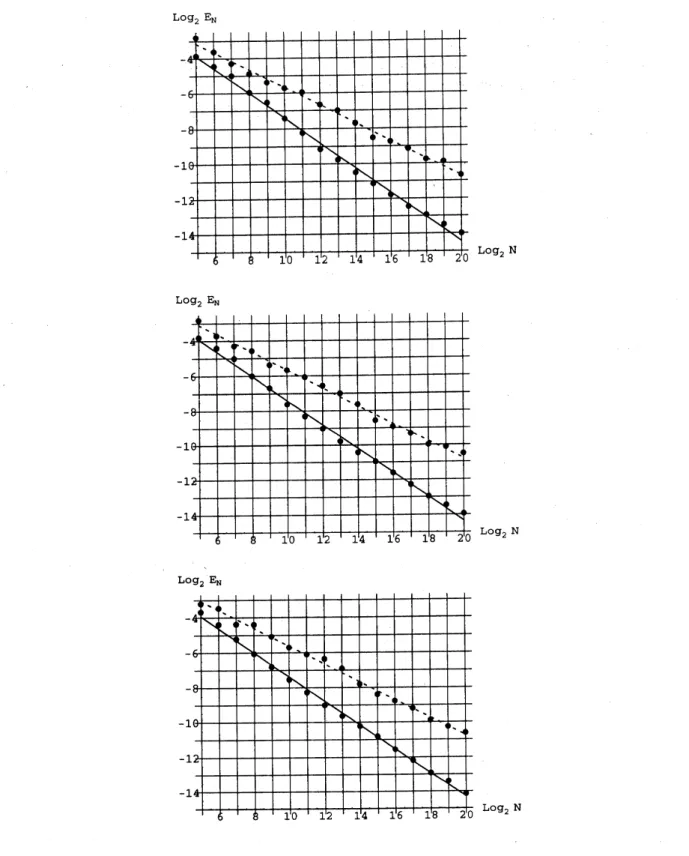
The QRW method is compared with the SRW method in Fig. 1. For all the calculations,
the number of simulated particles ranges from $N=32$ to $N=1,048,576$, with $N$ being
chosen as powers of two. In all cases, the averaged
error
is computed at each $N$, and aline is fitted tothe log-log data to estimate the convergence rate. This
assumes
thatover
this range of $N$, the error may be modeled as $cN^{-d}$. One finds 1. For Euler’s method
$D_{N}( \mathrm{S}\mathrm{R}\mathrm{W})\approx\frac{0.64}{N^{0.50}}$, $D_{N}( \mathrm{Q}\mathrm{R}\mathrm{W})\approx\frac{0.77}{N^{0.70}}$. (29)
2. For Heun’s method
$D_{N}$(SRW) $\approx\frac{0.69}{N^{0.51}}$, $D_{N}$(QRW) $\approx\frac{0.72}{N^{0.69}}$. .(30)
3. For Heun’s method with Strang splitting
$D_{N}( \mathrm{S}\mathrm{R}\mathrm{W})\approx\frac{0.70}{N^{0.51}}$, $D_{N}( \mathrm{Q}\mathrm{R}\mathrm{W})\approx\frac{0.72}{N^{0.69}}$. (31)
For each method, the quasi-random strategy produces sizable gains over pseud0-random
Monte Carlo. One easily sees the trend toward steady reduction oftlue error as
more
andmore
particles are used. Similar results have been observed for example in [4] for simplediffusion problems.
3The
Burgers
equation
In this section we present aquasi-random walk method used to solve the quasilinear
diffusion equation
$\frac{\partial u}{\partial t}(x, t)+(u\frac{\partial u}{\partial x})(x, t)=\nu\frac{\partial^{2}u}{\partial x^{2}}(x, t)$, $x\in \mathrm{R}$, $t>0$, (32)
$u(x, 0)=u_{0}(x)$, $x\in \mathrm{I}\mathrm{R}$,
(33)
with viscosity $\nu>0$. The equation is attributed to Burgers aatd was advanced as a
one
dimensional model for the Navier-Stokes equations. Weassume
that $u_{0}$ is constantoutside acompact set
$u_{0}(x)=\{$
$u_{-}$, if $x<-A$
$u_{+}$, if$x>A$. (34)
$\mathrm{L}\mathrm{o}g_{2}\mathrm{N}$
${\rm Log}_{2}\mathrm{N}$
${\rm Log}_{2}\mathrm{N}$
Figure 1: Kolmogorov equation: Euler’s method (top), Heun’s method (middle) and
Heun’s method with Strang splitting (bottom): SRW (dotted line) $\mathrm{v}\mathrm{s}$
.
QRW (solid line)averaged error
We follow [10] for the description of the random particle method for this equation. The
algorithm is based onaviscous splitting. We refer to [11] for information onthe numerical
solution ofconservation laws.
We choose integers $b\geq 2$, $m\geq 0$, we put $N:=b^{m}$ and we choose aspatial
pa-rameter $h>0$. For the quasi-random walk, we need alow-discrepancy sequence $P=$
$\{\mathrm{p}_{0}, \mathrm{p}_{1}, \ldots\}\subset I^{2}$ satisfying (6) and (7). We suppose that the gradient
$u_{x}$ of the
s0-lution is approximated by acollection of weighted particles. The initial step function
approximation is given by
$u^{(0)}(x)=u_{-}+l \iota\sum_{0\leq j<N}\epsilon_{j}H(x-x_{j}^{(0)})$, (35)
where
$\epsilon_{j}=\pm 1$ and
$\sum_{0\leq j<N}\epsilon_{j}=\frac{u_{+}-u_{-}}{h}$. (36)
Here $x_{j}^{(0)}$ is the location and $h$ is the absolute strength ofthe
$j\mathrm{t}\mathrm{h}$particle.
Let $\triangle t$bethetime step andput
$t_{n}:=n\triangle t$, $u_{n}(x):=u(x, t_{n})$. We denote thecomputed
solution after $n$ time steps as $u^{(n)}$,
$u^{(n)}(x)=u_{-}+l \iota\sum_{0\leq j<N}\epsilon_{j}H(x-x_{j}^{(n)})$. (37)
We assume that the particles have been labeled so that
$j<k\Rightarrow x_{j}^{(n)}\leq x_{k}^{(n)}$. and $\epsilon_{j}\geq\epsilon_{k}$. (38)
The approximate solution at time $t_{n+1}$ is obtained in two steps.
Step 1. Given particles at position $x_{j}^{(n)}$, $0\leq j<N$, we need to evolve the positions
in such away that the associated step function approximates the solution of the inviscid
Burgers equation
$\frac{\partial u}{\partial t}(x, t)+(u\frac{\partial u}{\partial x}.)(x, t)=0$, $x\in \mathrm{R}$, $t>t_{n}$, (39)
$u(x, t_{n})=u^{(n)}(x)$, $x\in \mathrm{R}$. (40)
We solve the Riemann problems associated with each jump separately. Let
$[u^{(n)}]_{j}:=u^{(n)}(x_{j}^{(n)}+0)-u^{(n)}(x_{j}^{(n)}-0)$
be the strength of the jump at $x_{j}^{(n)}$.
$\bullet$ If $[u^{(n)}]j\leq 0$, then we have ashock and the speed of the
discontinuity is
$v_{j}^{(n)}:= \frac{1}{2}(u^{(n)}(x_{j}^{(n)}+0)+u^{(n)}(x_{j}^{(n)}-0))$ .
We define it as the velocity of the $j\mathrm{t}\mathrm{h}$ particle.
o If $[u^{(\mathrm{n})}]_{\ovalbox{\tt\small REJECT}}\ovalbox{\tt\small REJECT}>0$, then we have ararefaction wave. Assume that p A- q particles are
located at
\yen
$*7$$x_{j}^{(n)}$ $=$ $x_{j+1}^{(n)}=\ldots=x_{j+p-1}^{(n)}$, with $\epsilon_{j}=\ldots=\epsilon j+p-1=+1$,
$x_{j}^{(n)}$ $=$ $x_{j+p}^{(n)}=\ldots=x_{j+p+q-1}^{(n)}$, with $\epsilon_{j+p}=\ldots=\epsilon j+\rho+_{l}‘-1=-1$.
We define the velocity of the $(j+k)\mathrm{t}\mathrm{h}$particle to be $v_{j+k}^{(n)}\cdot=\{$
$u^{(n)}(x_{j}^{(n)}-0)+(k. + \frac{1}{2})h$, if $0\leq k<p-q$ $u^{(n)}(x_{j}^{(n)}+0)$, if$p-q\leq k$. $<p+q$.
As time proceeds, the solutions start to interact: at this time we consider the
approxi-mating step function as new initial data. We set
$\delta t_{1}^{(n)}:=\min_{j,k}\{\frac{x_{k}^{(n)}-x_{j}^{(n)}}{v_{j}^{(n)}-v_{k}^{(n)}}$ : $x_{j}^{(n)}<x_{k}^{(n)}$ and $v_{j}^{(n)}>v_{k}^{(n)}\}$ ,
so that $t_{n}+\delta t_{1}^{(n)}$ is the first time ofintersectionof the trajectories ofat least two particles
that were at different positions at time $t_{n}$. For $t_{n}\leq t\leq t_{n}+\delta t_{1}^{(n)}$, the location ofthe
$j\mathrm{t}\mathrm{h}$
particle at time $t$ is
$x_{j}^{(n)}(t)=x_{j}^{(n)}+(t-t_{n})v_{j}^{(n)}$. (41)
If $\delta t_{1}^{(n)}\geq\triangle t$ we set
$x_{j}^{(n+1/2)}:=x_{j}^{(n)}(t_{n+1})$,
and we go to step 2, otherwise we replace $t_{n}$ by $t_{n}+\delta t_{1}^{(\tau\iota)}$ and we repeat step 1until we
reach $t_{n+1}$. Then
$u^{(n+1/2)}(x):=u_{-}+h \sum_{0\leq j<N}\epsilon_{j}H(x-x_{j}^{(n+1/2)})$.
Step 2. The next step involves solving the diffusion equation for $u_{x}$
$\frac{\partial u_{x}}{\partial t}(x, t)=\nu\frac{\partial^{2}u_{x}}{\partial x^{2}}(x, t)$ , $x\in \mathrm{R}$, $t>t_{n}$, (42)
$u_{x}(x, t_{n})=u_{x}^{(n+1/2)}(x)$, $x\in \mathrm{R}$
.
(43)This is accomplished by adding aquasi-randomcomponent to the position of the particles.
We
assume
that the particles have been sorted in order of position:$x_{0}^{(n+1/2)}\leq\ldots\leq x_{N-1}^{(n+1/2)}$. (44)
Then
$x_{\lfloor Np_{j,1}\rfloor}^{(n+1)}--x_{\lfloor Np_{j,1}\rfloor}^{(n+1/2)}+\sqrt{2\nu\triangle t}\Phi^{-1}(p_{j,2})$, $nN\leq j<(n+1)N$. (45)
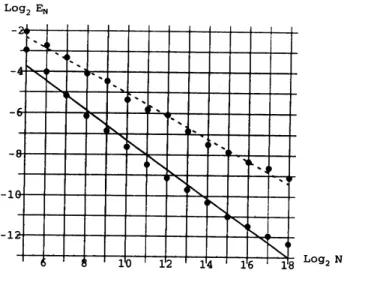
In order tocompare the performance of quasi-random walk (QRW) method described
above and standard random walk (SRW) employing pseud0-random numbers [10], both
${\rm Log}_{2}\mathrm{E}_{\mathrm{N}}$
Figure 2: Burgers equation: SRW (dotted line) $\mathrm{v}\mathrm{s}$. QRW (solid line) averaged
error
methods
are
used to solve amodel problem which hasan
exact known solution. Wecan
use the Cole-Hopftransformation to solve (32)-(33). If$u_{0}(x)=1-H(x)$,
we
obtain:$u(x, t)=. \frac{\Phi((t-\tau)/\sqrt{2\nu t})\exp((t-2x)/4\nu)}{\Phi((t-x)/\sqrt{2\nu t})\exp((t-2x)/4\nu)+\Phi(x/\sqrt{2\nu t})}$
.
(46)We choose $\nu=0.1$ and the solution is computed up to $T=1$ with atime step
$\triangle t=2^{-11}$. The QRW method utilizes a $(0, 2)$
-sequence of Faure in base 2. For all the
calculations, the number $N$ of particles ranges ffom $N=32$ to
$N=262,144$, with $N$
being chosen as powers of two. Figure 2shows alog-log plot of the averaged
error
(28).The least-squares fit convergence rates
are
as follows:$D_{N}( \mathrm{S}\mathrm{R}\mathrm{W})\approx\frac{1.31}{N^{0.54}}.$, $D_{N}( \mathrm{Q}\mathrm{R}\mathrm{W})\approx\frac{0.89}{N^{0.71}}$. (47)
We seethat the QRW method still clearly outperformsthe SRWmethod for thisexample,
although the problem being dealt with here is
more
complicated than simple diffusionproblem.
4Conclusion
In this paper we examine the use ofquasi-random sequences ofpoints in place of
pseud0-randompointsin random walk simulation ofdiffusion. Twoproblems are considered:
one-dimensional nonlinear reaction-diffusion equation and Burgers equation. The algorithm
has been tailored to fitin affactional step scheme. The results for the twoproblemsreveal
that quasi-Monte Carlo methods
can
be successfully applied to simple one-dimensionalequations, producing
errors
which are smaller than standard random walk. Akey elementin successfullyapplying the quasi-random sequencesis atechniqueinvolving renumbering
the particles after each time step
The algorithms arepresently suited for solving scalar, one-dimensionalequations. One
desirable extension would be to systems of equations such as the Hodgkin-Huxley
equa-tions. Afurther possible extension is to problems inmore than one space dimension, such
as the Navier-Stokes equations. On the theoretical side it will be especially interesting to
prove convergence of the schemes.
Acknowledgments
The author wishes to thank the organizer of the RIMS Symposium on Stochastic
Numer-$\mathrm{i}\mathrm{c}\mathrm{s}$, Professor Ogawa S. for inviting him to speak.
Further he gratefully acknowledges the Centre Grenobloisde Calcul Vectoriel du
Com-missariat \‘a l’Energie Atomique for allowing him to use its computer facilities.
References
[1] A.J. Chorin, Numericalmethods
for
use in combustionmodeling, Computing Methodsin Applied Sciences and Engineering (R. Glowinski and J.L. Lions, eds.), North
Holland, Amsterdam, 1980, pP. 229-236.
[2] H. Faure, Discr\’epance de suites associ\’ees \‘a un syst\‘eme de num\’eration (en dimension
s), Acta Arith. 41 (1982), 337-351.
[3] A.F. Ghoniem and F.S. Sherman,
Grid-free
simulationof diffusion
using randomwalk methods, J. Comput. Phys. 61 (1985), 1-37.
[4] C. Lecot and F. El Khettabi, Quasi-Monte Carlo simulation
of
diffusion, J.Com-plexity 15 (1999), 342-359.
[5] C. Lecot and A. Koudiraty,
Grid-free
simulationof
convection-diffusion, MonteCarlo and Quasi-Monte Carlo Methods 1998 (H. Niederreiter and J. Spanier, eds.),
Springer, Berlin, 2000, pP. 311-325.
[6] H. Niederreiter, Random Number Generation and Quasi-Monte Carlo Methods,
SIAM, Philadelphia, 1992.
[7] H. Niederreiter and J. Spanier $(\mathrm{e}\mathrm{d}\mathrm{s}.)\grave,$ Monte Carlo and Quasi-Monte Carlo Methods
1998, Springer, Berlin, 2000.
[8] S. Ogawa, On a robustness
of
the random particle method, Monte Carlo MethodsAppl. 2(1996), 175-189.
[9] E.G. Puckett, Convergence
of
a random particle method to solutionsof
theKol-mogorov equation $u_{t}=\nu u_{xx}+u(1-u)$, Math. Comput. 52 (1989) 615-645.
[10] S. Roberts, Convergence
of
a random walk methodfor
the Burgers equation, Math.Comput. 52 (1989), 647-673.
[11] J.W. Thomas, Numerical Partial
Differential
Equations, Conservation Laws andEl-liptic Equations, Springer, New York, 1999