Japan Advanced Institute of Science and Technology
JAIST Repository
https://dspace.jaist.ac.jp/Title Organizational Learning Oriented Model of
Organizational Adaptation Author(s) Takahashi, Shingo; Goto, Yusuke Citation
Issue Date 2005-11
Type Conference Paper
Text version publisher
URL http://hdl.handle.net/10119/3815
Rights ⓒ2005 JAIST Press
Description
The original publication is available at JAIST Press http://www.jaist.ac.jp/library/jaist-press/index.html, IFSR 2005 : Proceedings of the First World Congress of the International
Federation for Systems Research : The New Roles of Systems Sciences For a Knowledge-based Society : Nov. 14-17, 2025, Kobe, Japan, Symposium 2, Session 2 : Creation of Agent-Based Social Systems Sciences Management Systems
Organizational Learning Oriented Model of Organizational Adaptation
Shingo Takahashi and Yusuke GotoDepartment of Industrial and Management Systems Engineering, Waseda University 3-4-1 Okubo, Shinjuku, Tokyo 169-8555, Japan
[email protected], [email protected]
ABSTRACT
This paper proposes an agent-based simulation model for analyzing adaptive processes of organizations with organizational learning. The model is based on a framework of organizational cybernetics and represents organizational activities both decision-makings and task resolutions. Organizational cybernetics helps us to grasp an organization concretely as an aggregation of functions. The model provides four functional layers (self-organization, adaptation, coordination, and process) and interactions among them. The activities of decision-makings correspond to processes of organizational learning, and the activities of task resolutions are performed as in Computational Organization Theory (COT).
In the COT it should be pointed out that there are few researches to introduce both functional hierarchies and the concept of the organizational learning in each functional layer. In each functional layer, the organizational learning realizes the progress of the ability of making decisions to fulfill good performances of the organization as a whole.
In this paper we confirm several desired factors on effective criteria in an adaptive learning mechanism: how to learn for the adaptation to the environment in each functional layer? In each functional layer, we propose better criteria for the organizational performance. In the self-organization and the adaptation layer, it works to use the inter-organizational learning for the evaluation of individuals’ internal models. And in the coordination and the process layer, it is important to learn from using the differences between the each
layer’s decision variables and individuals’ ones.
Keywords: organizational learning, agent-based simulation, organizational cybernetics, computational organization theory
1. INTRODUCTION
As various researches have shown so far, organizational learning is indispensable to successful organizational adaptation. From the engineering and theoretical perspectives, how organizational learning is implemented in an adaptive process, particularly how to evaluate each individual’s decision making for the learning is a significant problem.
The primary purpose of this paper is to make clear what criteria for the evaluations of each individual’s decision making work effectively. But, for this purpose, there are two difficulties that we have to consider, (1) what is a good criterion for the evaluation is different in each function because the organization consists of essentially different functions that differ from learning activities and (2) complex interactions between functions in the organization affect the learning activities in each function and the behavior of organizational adaptation. To deal with these difficulties, based on our foregoing model [1], we present an adaptive organizational model that has the framework for understanding the learning activities in each function and the behavior of organizational adaptation comprehensively by agent-based modeling. Using agent-based simulation with this model, we confirm several desired factors on
effective criteria in an adaptive learning mechanism.
2. MODEL
We model an environment as a task generator and a response function, and an organization as a set of agents. We define four functional layers that are different in characteristics of decisions and actions as in organizational cybernetics [3]. Each agent belongs to one of the functional layers, and takes learning activities repetitively in a cyclic way: recognizing the environment and forming his internal model, making a decision from his internal model and learning by a revision of his internal model for realizing better performances.
2.1 Environmental model
An environment as a task generator provides an organization with n tasks. For the i th section of the organization, a task is expressed by l -valued i m -long i
strings (i.e.
(
1,4,2,6,5)
). The task means a series of the demand for the service of the product which the section provides. If the j th digit in the task for the i th section is four, then there is the demand of four units in j th term. An environment as a response function evaluates the output of the activities in an organization. An organizational performance is evaluated by calculatingthe response function
+ + + + + + − ′ =∑ g v v v v r s x f n i i i 1 2 3 1 2 3 4 4 1 β β β β α
, where α and i β1~ β4 respectively show a real profit and a cost coefficient, x′i values determined from the performances in the process layer. Organizational costs consist of the total number of agents in the organization s , the amount of resources for the task execution r, the learning intervals in each layer v1 ~ v4, and the number of organizations in an
inter-organizational network g.
2.2 Functional hierarchies in an organization
Figure 1 represents an organizational model which consists of four functional layers: the self-organization layer, the adaptation layer, the coordination layer, and the process layer which has n sections. The descriptions of each functional layer are as follows. • Self-organization layer in which decisions are
made concerning organizational restructuring and domains of organizational actions. Agents decide three variables: the total number of agents in the organization s , the amount of resources for the task execution r, and the active vector a . The active vector a defines which section resolves the task for each section from the environment. These variables affect a policy-making in the adaptation layer, an allocation of agents in the coordination layer, and a task resolution in the process layer.
• Adaptation layer in which environmental situations are recognized and policies of the organization are made to be adaptive to the recognized environment. Agents recognize the real profit and the cost coefficient of the response function. The agents decide the decision variables xi which
correspond x′i in the response function for maximizing f after α and i β1 ~ β4 are recognized. Decision variables xi represent the
policy in the process layer, and the r defines the amount of them.
• Coordination layer in which the agents of the organization are coordinated to be allocated into each functional layer in the organization and each section in the process layer. The allocation represents the variety management in the organization and is expressed by the number of agents for each functional layer and each section
n s
s1 ~ 3+ under given s , where s1 for self-organization, s2 for adaptation, s3 for
coordination and s4 ~ s3+n for the sections in the process layer.
• Process layer in which tasks are resolved according to the policy given by the adaptation layer has n sections corresponding to xi
(i=1 L, ,n). Which tasks are resolved is defined by the active vector a . The active vector a consists of n bit strings which shows whether the
task for the ith section is resolved. The tasks are expressed by multiple-valued strings as in COT, and are resolved to realize the policy xi in each
section. As a result of evaluations of activities, x′j that affect the evaluations of the organization are determined.
Fig. 1. Four functional layers model: decision variables in each functional layer and their relations in the organization.
Organization
Self-organization
Number of agents: s∈N Amount of resources: r∈N Active vector: a=(
a1,L,ai,L,an)
= otherwise 0 active is i section if 1 i aAdaptation
Recognized response function: 4 3 2 1 1, , ˆ , ,ˆ , ˆ , ˆ , ˆ , ˆ ˆ α α β β β β α L i L n Policy:
(
)
∑ = = = n i i n i x x r x x 1 1,L, ,L, , x N x x ai =0, then i =0 .otherwise i∈ ifCoordination
Allocation of agents:(
s s sn)
n∑+s =s s ∈N = + θ θ θ θ, , , , , , 3 1 3 1 L L . 0 s then , 0 and 4 ifθ ≥ aθ−3 = θ =Process
Recognized task:qˆi =(
qˆi1,L,qˆij,L,qˆimi)
Resolution plan:qi′ =(
q′i1,L,q′ij,L,qim′i)
∑ = = ′ ∈ ′ = ′ = i m j ij i ij ij i x q N q q a 1 otherwise . 0 then , 0 if Response function: + + + + + + − ′ =∑ g v v v v r s x f n i i i 1 2 3 1 2 3 4 4 1 β β β β α Task generator:(
)
{
}
i i i ij im ij i i l l q q q q i α == 1,L, ,L, , ∈ 1,L, qEnvironment
Figure 1 also shows decision variables in each layer and their relationships. The task resolution process is performed in the adaptation and the process layer, and management process of the organization is shown in the self-organization and the coordination layer.
2.3 Process of organizational learning
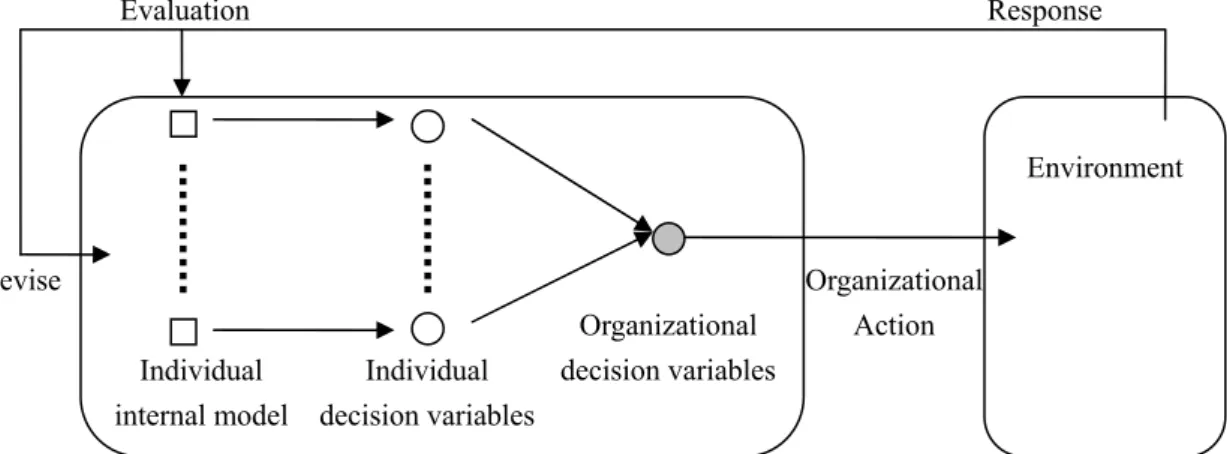
In each functional layer, organizational learning consists of four learning-loops as Argyris defined [2]. According to Takahashi’s operational reinterpretation [5] for agent-based modeling of Argyris’ concept of the four learning-loops, the process of organizational learning is shown below.
1. Each agent recognizes environmental situations and forms his internal model.
2. Each agent makes a decision from his internal model (individual single-loop learning).
3. Organizational decision making is done (organizational single-loop learning).
4. Each agent revises his internal model in an evolutionary manner (individual double-loop
learning).
Figure 2 shows the process of organizational learning. As a result of repeating this process, the organizational double-loop learning can be considered as a
convergence process of agents’ recognitions in the organization, and organizational decision makings in each functional layer will be improved.
2.4 Internal model and decision-making
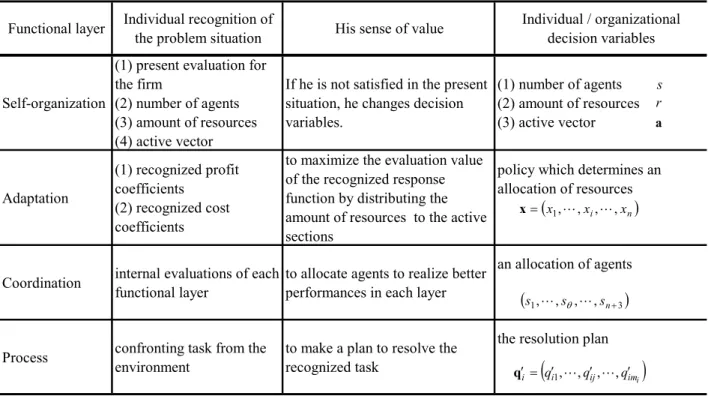
In each functional layer, both individual decisions and an organizational decision are made. The individual decision-makings represent individual single-loop learning, and the organizational decision represents organizational single-loop learning. Individuals make decisions by referring his or her internal model which consists of the recognition of the problem situation and his or her sense of value in the problem situation. Organizational single-loop learning is done by the synthesis of individuals’ decision variables (e.g. in the self-organization layer, if the individual k ’s decision variables are defined as
(
sk,rk,a1k,L,aik,L,ank)
, the organizational decision variables(
s,r,a1,L,ai,L,an)
are determined as ∑ ∑ ∑ ∑ 1 1 1 1 1 , , , , s a s a s r s s k k k k k nk k k L .).We define the relationship between the individual internal model and the individual (organizational) decision variables (Table 1).
Fig. 2. Process of organizational learning. Individual internal model Individual decision variables Organizational decision variables Organizational Action Environment Response Evaluation Revise
Table 1. Relation among elements of internal model and decision variables in each functional layer. Functional layer Individual recognition ofthe problem situation His sense of value Individual / organizationaldecision variables
Self-organization
(1) present evaluation for the firm
(2) number of agents (3) amount of resources (4) active vector
If he is not satisfied in the present situation, he changes decision variables. (1) number of agents (2) amount of resources (3) active vector Adaptation (1) recognized profit coefficients (2) recognized cost coefficients
to maximize the evaluation value of the recognized response function by distributing the amount of resources to the active sections
policy which determines an allocation of resources
Coordination internal evaluations of each functional layer
to allocate agents to realize better performances in each layer
an allocation of agents
Process confronting task from theenvironment to make a plan to resolve therecognized task
the resolution plan
s r a
(
x1,L,xi,L,xn)
= x(
i ij imi)
i = q′ q′ q′ ′ 1,L, ,L, q(
s1,L,sθ,L,sn+3)
3. SIMULATION MODELIn the simulation the organization performs tasks at a time that is predefined by the parameters of the environment α1,L,αi,L,αn, and the agents in the organization revise their internal models by double-loop learning which is implemented by a genetic algorithm process.
This simulation consists of two phase: the task resolution phase and the adaptation phase. And the former is basic and obligatory, the latter is optional and selective in the simulation steps.
Task resolution phase.
1. Generation of tasks. The Environment generates
n tasks at a time (see Fig. 1). For the i th section
of the organization, a task is expressed by i
l -valued m -long strings. The task means a i
series of the demand for the service or the product
which the organization provides. If the j th digit in the task for the i th section is three, then there is the demand of three units in j th term.
2. Activities in the organization. In the organization the adaptation function and the process function engage in the task resolution activities, and the self-organization function and the coordination function engage in the management activities. The activity (decision-making) processes in each layer are as follows: (1) each agent makes a decision from his internal model, (2) the organizational decision making is done based on individual decision-makings, (3) the organizational action is done according to the organizational decision making.
• Self-organization. Three variables are determined: the number of agents s , the amount of resources r , and the active vector
a.
• Adaptation. Agents recognize the situation of the environment as the parameters of the
4 3 2 1 1, ,α , ,α ,β ,β ,β ,β α L i L n , and decide the policy x=
(
x1,L,xi,L,xn)
which means the resource allocation to realize the maximum profit under the restrictions by r and a .• Coordination. Agents recognize internal evaluations of each functional layer
3 1 ~ , , ~ , , ~ + n f f f L θ L . The evaluation 1 ~ f is of the self-organization, ~f2 of the adaptation,
3 ~
f of the coordination, and ~f4,L,~fn+3 of the each section of the process. Agents decide an allocation of agents to realize better performances in each layer:
(
s1,L,sθ,L,sn+3)
.• Process. In active sections (ai =1), based on their recognitions qˆi =
(
qˆi1,L,qˆij,L,qˆimi)
, agents make a resolution plan(
i ij imi)
i = q′ q′ q′
′ 1,L, ,L,
q . When the task i is performed, the degree of resolution is evaluated as ∑ ∑ = = − − ′ = i i m j mj ij ij ij ij i q q q q c 1 1 for an
active section i. The realized profit of the organization is calculated by the real profit coefficient, the degree of resolution, and the policy as αicixi.
3. Evaluation of the organization. The results of the organizational activities are evaluated with the
response function + + + + + + − ′ =∑ g v v v v r s x f n i i i 1 2 3 4 4 3 2 1 β β 1 β β α
which represents the organizational performance in the step. In the experiment parameters
g v v n i, , , , , , , , , , , 1 4 1 4 1 L α L α β L β L α are set
according to the experimental design. If the
double-loop learning is done in the step, go to the next phase (Adaptation phase). If the termination condition is not satisfied, the step t is done and the step t+1 begins (returns to the top of the process), otherwise the simulation ends.
Adaptation phase.
We apply genetic algorithm for implementing a process of organizational learning and adaptation. The double-loop learning is represented by applying the genetic operators; selection, crossover and mutation to agents’ chromosomes which code the internal models of the agents.
4. Evaluation of the results in the functional layers. If the double-loop learning is done in this functional layer, the results of the individual internal models in the functional layer are evaluated with a fitness function representing how much the individual decision-makings adapt to the concerning environment. The proposed fitness functions which are desirable to realize organizational double-loop learning are shown in the next section.
5. Selection of individual internal models. By using the roulette rule of genetic algorithms, in the functional layer, their internal models of the agents in the next step are selected.
6. Crossover. A two-point crossover is applied on the coded internal models of the individuals.
7. Mutation. The mutation is applied on the coded internal models of the individuals. After this revising process of the individual internal models, if the termination condition is not satisfied, the step t is done and the step t+1 begins (returns to the top of the processes), otherwise the simulation ends.
4. EXPERIMENTAL RESULTS
It is hard to evaluate individuals’ internal models directly because they are not explicit for the estimators and themselves. Since, we must evaluate them indirectly, from their decision variables. This is a problem for the
evaluation: how do we judge their decision variables right? The criteria and the methods about this are obscure. We here show better ones for each functional layer.
4.1 Experimental design
In this model, GA and fitness functions in the selection of each functional layer basically provide learning mechanisms of the organization. And the individual internal models are evaluated from the fitness function in each functional layer. Then we expect from the experiments to confirm the following propositions on desired factors for effective learning mechanisms from the simulation results.
• In the self-organization function, it is desirable to learn from the indices of both the existing organizations’ evaluations and the three decision variables (s, r,a) under the environment.
• In the adaptation function, effective improvement comes from using an extent of differences between a realized evaluation and an expected one.
• In the coordination function, it is necessary for the adaptation in the organization that the thresholds of performances in each layer are set by the organization in determining the present resource allocation.
• In the process function, it is important for the successful task resolving to learn from an extent of differences between an adapted decision making
and the decision actually made. 4.2 Inter-organizational learning
We propose an inter-organizational learning method which uses an inter-organizational network [6] as an effective evaluation method of individual internal models in the self-organization and adaptation layer. In this model, the inter-organizational learning means reciprocal one. The organizations in the environment share the information: the decision variables of the organization and the evaluation of the organization in the step t. Each organization utilize these information for evaluate individual internal models in own organization.
The evaluation method of individuals’ decision variables in self-organization layer is shown below. The evaluation value of own organization defines f1 and the decision variables of own organization (s1,r1,a1). And the evaluation value of other organizations are defined f2, ,fu, ,fg
L
L and the decision
variables of other organizations ) , , ( , ), , , ( , ), , , (s2 r2 a2 L su ru au L sg rg ag . The constant g is the number of the organizations in the inter-organizational learning network.
Fig. 3. Evaluation of the individual internal model with the inter-organizational network. Shared information (a)Decision variables (b)Evaluation of the organization
Organizations
(a)Decision variables (b)Evaluation of the organizationFocused organizations
-300 -250 -200 -150 -100 -50 0 50 1 21 41 61 81 101 121 141 161 181 Time (steps) E va lua ti on of th e or ga ni za ti on
Average fitness of random learning Maximum fitness of random learning Average fitness of proposed learning Maximum fitness of proposed learning
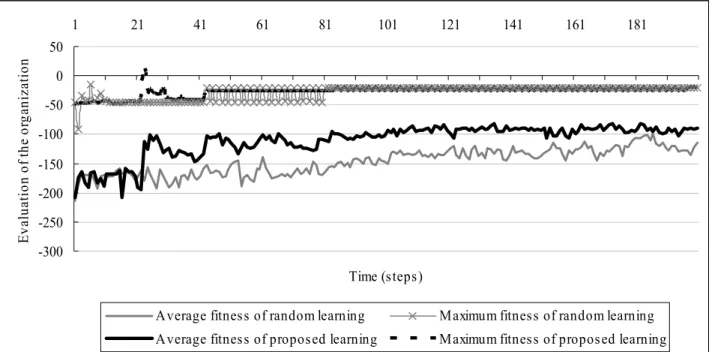
Fig. 4. Comparison of two learning: the proposed learning (with inter-organizational leaning) and the random learning (with no double-loop learning) in the self-organization layer.
The individual k ’s evaluation ek of the decision variables (sk,rk,ak) is estimated as − + − + − = = ∑ = n i u i ik u k u k u u k f u s s r r a a e 1 min arg , in the organization.
Figure 4 shows that the proposed learning is effective rather than random learning. In this model, the random learning means mere changes in individuals’ internal models. From this, we confirmed that it is desirable to learn from the indices of both the existing organizations’ evaluations and the three decision variables (s, r,a) under the environment. And further results will be presented by the conference.
REFERENCES
[1] Takahashi, S. and Goto, Y., “Agent-based Simulation of Adaptive Organizational Structures to Environmental Changes,” Proceedings of the Third International Workshop on AESCS, pp.89–96, 2004.
[2] Argyris, C. and Schon, D.A., Organizational Learning II, Addison-Wesley, 1996.
[3] Takahara, Y., “A Formal Model of Organization,” in Takahashi, S., Kijima, K. and Sato, R. (Eds.), Applied General Systems Research on Organizations, Springer-Verlag, 2004.
[4] Carley, K.M. and Gasser, L., “Computational Organization Theory,” in Weiss, G. (Ed.), Multiagent Systems - A Modern Approach to Distributed Artificial Intelligence, MIT Press, 1999.
[5] Takahashi, S., “Evolutionary Agent-Based Model for Double-Loop Learning,” in Takahashi, S., Kijima, K. and Sato, R. (Eds.), Applied General Systems Research on Organizations, Springer-Verlag, 2004.
[6] Knight, L., “Network learning: Exploring learning by interorganizational networks”, Human Relations, Vol.55, No.4, pp.427-454.