Japan Advanced Institute of Science and Technology
JAIST Repository
https://dspace.jaist.ac.jp/Title
Adaptive Lattice Deployment of Robot Swarms Based
on Local Triangular Interactions
Author(s)
Nishimura, Yasuhiro; Lee, Geunho; Chong, Nak
Young
Citation
2012 9th International Conference on Ubiquitous
Robots and Ambient Intelligence (URAI): 279-284
Issue Date
2012-11
Type
Conference Paper
Text version
author
URL
http://hdl.handle.net/10119/11411
Rights
This is the author's version of the work.
Copyright (C) 2012 IEEE. 2012 9th International
Conference on Ubiquitous Robots and Ambient
Intelligence (URAI), 2012, 279-284. Personal use
of this material is permitted. Permission from
IEEE must be obtained for all other uses, in any
current or future media, including
reprinting/republishing this material for
advertising or promotional purposes, creating new
collective works, for resale or redistribution to
servers or lists, or reuse of any copyrighted
component of this work in other works.
The 9th International Conference on Ubiquitous Robots adn Ambient Intelligence (URAI 2012) Nov. 26-28, 2012 in Daejeon Convention Center (DCC), Daejeon, Korea
Adaptive Lattice Deployment of Robot Swarms Based on Local Triangular
Interactions
Yasuhiro Nishimura, Geunho Lee, and Nak Young Chong
Japan Advanced Institute of Science and Technology, Nomi, Ishikawa 923-1292, Japan (Tel : +81-761-51-1254; E-mail:{y.nishimura, geun-lee, nakyoung}@jaist.ac.jp)
Abstract - This paper addresses the adaptively latticed deployment problem for a swarm of autonomous mobile robots. As our decentralized solution, an adaptive trian-gle generation algorithm is proposed to allow individual robots to form different equilateral triangular configura-tions depending on their local distribuconfigura-tions. Specifically, Delaunay triangulation is applied to examine a local dis-tribution composed of triangles generated around each robot. From the computation of the local distribution, each robot determines an adequate side length and en-ables to form an equilateral triangle with the side length. In addition, two convergence conditions are considered according to the controlling way of the side length. By using the proposed algorithm, robot swarms can self-configure themselves while adapting to their distribution conditions. Through extensive simulations, we verify the effectiveness of the proposed algorithm.
Keywords - swarm robots, adaptive triangle generation,
different equilateral triangles, Delaunay triangulation
1. Introduction
With lots of recent advances in robotic technologies, much attention has been paid to potential applications for swarms of mobile robots. Robotic swarms are expected to be applied to a wide variety of areas such as habitat or environmental monitoring, surveillance, exploration, and so on. In those applications, individual robots are assumed to be simple, cheap, and disposable. In order to enable robot swarms to perform the aforementioned applications, it is necessary to properly coordinate in-dividual motions. Many decentralized coordination ap-proaches [1]-[6] have been using simple local interactions based on the intuition observed from physical phenomena in nature, mainly employing some types of force balance between inter-individual interactions. These interactions result in lattice-type configurations that offer high level coverage and multiple redundant connections, but the in-teractions might over-constrain the swarm and frequently leaded to deadlocks.
Differently from the force-balanced interactions, a ge-ometrically local interaction [7]-[9] was proposed to en-able each robot in a swarm to generate an equilateral tri-angle configuration with an initially assigned side length. One self-configuration scheme based on the geometric interaction allowed robot swarms to establish the uni-form link connectivity among adjacent robots after start-ing from arbitrary initial distributions. This makes it pos-sible to take advantage of the redundancy provided by
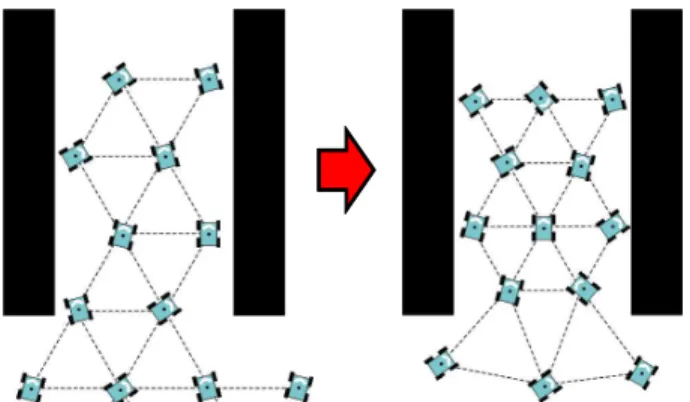
Fig. 1 Concept of potential applications by utilizing the proposed adaptive triangle generation algorithm
a fully connected network topology without the expense and complexity of networking processes. Despite several merits from the networking point of view, the previous works exposed the issue of adaptive and flexible deploy-ments. Since the side length was defined beforehand, it was difficult for robots to generate their motions naturally according to environmental conditions and robot distribu-tions.
To overcome the limitation, this paper addresses the adaptively latticed deployment problem for mobile robot swarms. Towards strong solution approach, it is assumed that robots do not have prior knowledge of their identi-fication numbers, and do not share any common coor-dinate system nor the leader. Within a limited sensing range, they are able to locally interact by observing loca-tions of other robots. Based on the minimal robot model, we present an adaptive triangle generation algorithm in a fully decentralized way. The proposed algorithm allows robots to self-configure their swarm network composed of equilateral triangle lattices with different side lengths. From the standpoint of the uniform self-configuration, a desired distance to neighboring robots is initially as-signed for each robot. When executing the proposed al-gorithm towards forming the equilateral triangles, this pa-per presents two challenges of how to determine conver-gence into a uniform distance.
Next, necessities for the proposed solution are argued as follows. First, robots can self-adjust the side lengths of an target triangle according to the distribution of their ad-jacent robots, leading to enhancing adaptability of their behaviors. Secondly, by generating individual equilat-eral triangles, the swarm of robots can reach the ovequilat-erall equilibrium of the swarm. Thirdly, as illustrated in Fig. 1, forming the different regular triangles reduces the
po-i
r
i y i x i p=(0,0) SB(a) ri’s local coordinates and sensing boundary SB SB i
r
jr
i p kr
lr
j p l p k p 2 (=rn) 1 (=rn) { , 1, 2} i i n n T= p p p { , , }, i j k l O = p p p(b) observation set Oiand triangular configurationTi
Fig. 2 Illustration of definition and notations
tential for a traffic jam (uniform navigation) happening in front of a narrow passageway as well as a disordered distribution or a divergence in a confined space. We de-scribe our algorithm in detail, and perform extensive sim-ulations to demonstrate that a swarm of robots can self-deploy themselves while generating equilateral triangles adapting to the distributions of neighboring robots in a scalable manner.
2. Problem Statement
2.1 Robot Model and Notations
In this paper, we consider a swarm of autonomous mo-bile robots represented as{r1, r2, ··· ,rn}. It is assumed that an initial distribution of all robots is arbitrary and their positions are distinct. Robots have no leader and no identifiers. They do not share any common coordi-nate system. Due to a limited observation range, each robot can detect the positions of other robots only within its line-of-sight. Each of robots autonomously moves on a two-dimensional plane. In addition, robots are not al-lowed to communicate explicitly with other robots in or-der to obtain any information needed for their motion controls.
Next, let’s consider a robot riwith local coordinates~xi and~yi. As illustrated in Fig. 2-(a),~yidefines the vertical axis of ri’s coordinate system as its heading direction. It is straightforward to determine the horizontal axis~xiby rotating 90 degrees counterclockwise. The position of ri is denoted by pi. Note that piis (0,0) with respect to ri’s local coordinates. The distance between piand pjis de-fined as dist(pi, pj). In particular, the desired inter-robot distance between ri and rj is denoted by du. Moreover,
ang(~mi,~ni) denote the angle between two arbitrary vec-tors~miand~ni.
As shown in Fig. 2-(b), ridetects the positions pj, pk, and pl of other robots located within its sensing bound-ary SB, yielding a set of the observed positions Oi(= {pj, pk, pl}) with respect to its local coordinates. When
ri selects two robots rn1 and rn2 in its adjacent robots, namely Oi, located within its SB, rn1and rn2are defined as the neighbors of ri, and their position set{pn1, pn2} is denoted by Ni. Given piand Ni, a set of three distinct po-sitions{pi, pn1, pn2} with respect to riis called triangular configurationTi, namely{pi, pn1, pn2}. Specifically, we
computation observation
motion
INPUT: observing positions of robots by taking a snapshot 1 n r rn2 neighbor selection ( , ) triangle partition
computation of next movement
OUTPUT: next movement position
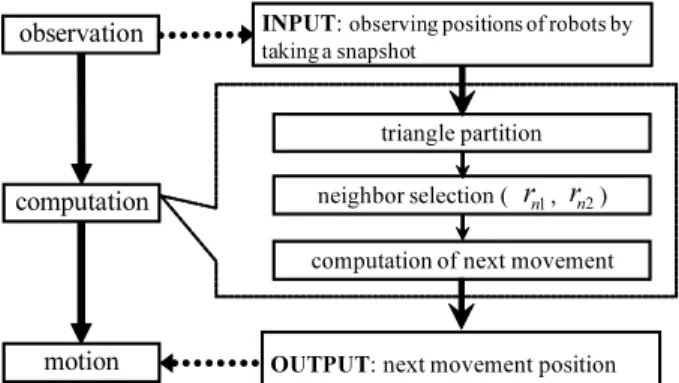
Fig. 3 Flow chart of the adaptive triangle generation algorithm
define an equilateral configuration, denoted byEi, as a configuration that all distance permutations between any two of pi, pn1, and pn2ofTiare identical.
2.2 Problem Definition
UsingTiandEi, we can formally define the local
in-teraction as follows: GivenTi, the local interaction al-lows rito maintain the same side length dist(pi, pn1) and
dist(pi, pn2) to ri’s neighbors at each time (toward co-operatively formingEi). Based on the local interaction, we address the ADAPTIVELYLATTICEDDEPLOYMENT problem as follows: Given a swarm of n robots based on
the aforementioned model, how to enable the swarm to geometrically deploy themselves intoEi while adapting
to the distribution of the ri’s adjacent robots?
Now, to solve the addressed problem, we propose the following decentralized approach: adaptive triangle
generation algorithm. Specifically, by executing the
al-gorithm at each time, geometric self-configuration of n robot swarms can be achieved, allowing larger numbers of robots to converge intoEiadapting to their local dis-tribution. More details on these algorithms will be ex-plained in the next section.
3. Algorithm Description
As illustrated in Fig. 3, the proposed adaptive tri-angle generation algorithm is executed for the input Oi with respect to ri’s local coordinate system to output ri’s next movement position at each time. Each robot per-forms the same algorithm, but acts independently and asynchronously from other robots. Thus, rican either be idle or execute an action. At each time, ri computes its movement position based on Oi, and moves toward the computed position. Such a series of actions is repeated until riconverges into itsEi.
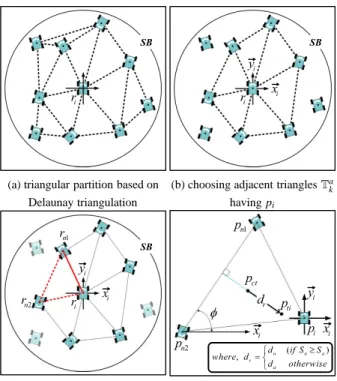
In Fig. 3, we present the schematic flow of the locally adaptive deployment algorithm composed of the follow-ing three functions: triangular partition, neighbor selec-tion, and movement computation functions. Through the first triangular partition function, the triangular partition based on Delaunay triangulation is performed for the el-ements of Oiincluding pi(see Fig. 4-(a)). After the par-tition generation, a relative adjacent ratioαais examined
i
r
SB
(a) triangular partition based on Delaunay triangulation i r SB i y i x
(b) choosing adjacent trianglesTa k having pi i x i y i r SB 2 n r 1 n r
(c) rotation of the upper motor
2 n p 1 n p ti p ct p r d i x i y i p φ i x ( ) , u u a r a d if S S where d d otherwise ≥ =
(d) rotation of the base motor Fig. 4 Illustration of the adaptive triangle generation
algorithm
depending on the current partitions around ri. In detail, as shown Fig. 4-(b), richooses its adjacent trianglesTai,k having pi as one vertex of each triangle where k indi-cates a positive constant. Next, from the obtainedTai,k, two kinds of computations are executed: 1) location set
Diof individual vertices included inTai,k and 2) average
size Safor individualTai,k. Specifically, it is assumed that
Sais the area of an equilateral triangle with side length
da. Under the assumption, the relative adjacent ratioαa is defined as a proportional number between Saand Su that indicates the area of an equilateral triangle with du.
Secondly the neighbor selection function is to deter-mine ri’s two neighbors in Di. As illustrated in Fig. 4-(c), the first neighbor rn1is selected as the one located the shortest distance away from ri. The second neighbor rn2 is selected such that the length of the triangle’s perimeter is minimized. Then, riformsTiwith Ni, and then checks whetherTiis greater than or equal toEi. If the condition is satisfied, ridetermines du to generateEi, resulting in
Su. Otherwise, dais determined.
Thirdly, as presented in Fig. 4-(d), ri finds the cen-troid pctof the triangle△pipn1pn2(=Ti) with respect to its local coordinates, and measures the angleφ between the line pn1pn2 connecting two neighbors and ri’s hor-izontal axis~xi. Using pct andφ, ri calculates the tar-get point pti = (pti,x, pti,y) by the following equations:
(pct,x+drcos(φ+π/2)/ √
3, pct,y+drsin(φ+π/2)/ √
3) where dr indicates either duor da. Then, ri attempts to form an isosceles triangle with its two neighbors at each time. By repeatedly doing this, three robots configure into Ei. Further details on the local interaction can be found in [8][9].
More importantly, two self-configurable options can
(a) (b)
Fig. 5 Initial distributions for a swarm of 40 robots in an open plane without geographical constraints
(a) 1 sec. (b) 6 sec.
(c) 13 sec. (d) 23 sec.
Fig. 6 Simulation result of latticed deployment with
dufrom the initial condition in Fig. 5-(a)
be selected according to da. To begin, riforms a triangle lattice with daas the side length. Here, davaries while generatingEi, and gradually reaches du, resulting in the sameEiwith dufor all robots. On the other hand, once Eiwith the minimum dais generated, unless rjis located shorter distance than the side length da, the generated tri-angle remains unchanged until other robots converge into their desired triangles. Thus target distribution with dif-ferent equilateral triangles is obtained.
4. Simulation Results and Discussion
This section describes simulation results that exam-ined the validity of our proposed adaptive triangle gen-eration algorithm. It is supposed that a swarm of robots attempts to deploy themselves toward a desired distribu-tion state composed ofEi. As mentioned in Section 2, the coordinated deployment is achieved without using any leader, identifiers, global coordinate system, and explicit communication. We assumed that each robot possesses
SB, 2.5 times longer than duwhere duis set to 25 unit in our simulator. Our algorithm terminates when individual robots converge into the distance du± 1% with their two neighbors.
From her, we present simulations demonstrating the convergence property of the proposed algorithm. Fig. 5
(a) 5 sec. (b) 18 sec.
(c) 58 sec. (d) 87 sec.
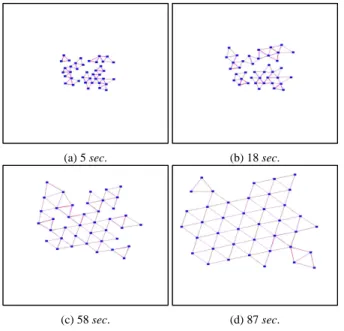
Fig. 7 Simulation result of adaptively latticed deploy-ment from the initial condition in Fig. 5-(a) while changing from dato du
(a) 3 sec. (b) 24 sec.
(c) 33 sec. (d) 51 sec.
Fig. 8 Simulation result of adaptively latticed deploy-ment according to da from the initial condition in Fig. 5-(a)
shows initial distribution conditions for a swarm of 40 robots. By using the initial distribution in Fig. 5-(a), comparative simulations were executed according to the following three conditions: (1) latticed deployment with
du in Fig. 6, (2) adaptively latticed deployment while changing from da to du in Fig. 7, and (3) adaptively latticed deployment depending on da in Fig. 8. From the first simulation of Fig. 6, 40 robots could disperse themselves in an open area with a uniform spatial density based on dufrom a random configuration. By perform-ing the proposed algorithm, the second simulation result in Fig. 7 showed, after individual robots determined da based on the distribution of their adjacent robots, they could finally generate the desired equilateral triangles
(a) distance variations in Fig. 6 (b) angle variations in Fig. 6
(c) distance variations in Fig. 7 (d) angle variations in Fig. 7
(e) distance variations in Fig. 8 (f) angle variations in Fig. 8 Fig. 9 Comparison results for the variations of
dis-tances duand daand internal angles during individ-ual simulations in Figs. 6, 7, and 8
(a) 34 sec. (b) 135 sec.
(c) 146 sec. (d) 177 sec.
Fig. 10 Simulation result of adaptively latticed de-ployment according to dafrom the different initial condition in Fig. 5-(b)
with duwhile changing from dato du. Compared to the second simulation, the third simulation in Fig. 8 pre-sented robots could form differently equilateral triangle configurations according to da. Next, Fig. 9 ploted the variation of both side lengths (daor du) and internal an-gle (ang(−−−→pipn1, −−−→pipn2)) between −−−→pipn1 and −p−−→ipn2 for all
(a) 0 sec. (b) 9 sec.
(c) 18 sec. (d) 55 sec.
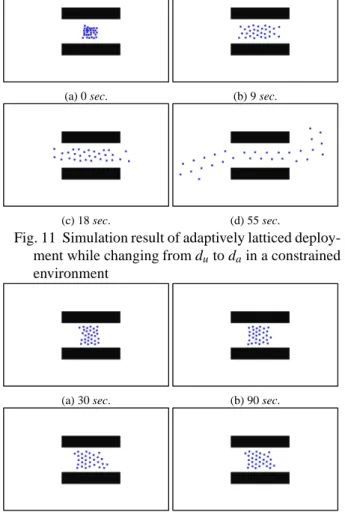
Fig. 11 Simulation result of adaptively latticed deploy-ment while changing from duto dain a constrained environment
(a) 30 sec. (b) 90 sec.
(c) 190 sec. (d) 248 sec.
Fig. 12 Simulation result of adaptively latticed de-ployment according to dafrom the initial condition in Fig. 11-(a)
robots when performing individual simulations. From the analyzed results, it was also observed that the proposed algorithm allowed robots to converge intoEi. Although robots converged into different dain Fig. 9-(e), the angle variations in Fig. 9-(f) could finally reach 60 degrees for their ang(−−−→pipn1, −−−→pipn2). Moreover, Fig. 10 showed sim-ulation result of adaptively latticed deployment accord-ing to dafrom the initial condition in Fig. 5-(b). From this simulation, we confirmed that the adaptive triangular generation algorithm could converge intoEiadapting to the adjacent distributions of individual robots regardless of initial distribution conditions.
Finally, we examined the effect of the adaptively lat-ticed deployment algorithm when robot swarms are de-ployed in an even plane bounded by geographical con-straints. In these simulations as presented in Figs. 11 and 12, it was assumed that there are two objects with flat surfaces and robots are initially located between the objects. To adaptively coordinate the movements of the robots in the constrained area bounded by the objects, our previous scheme published in [7] was employed. Next, two simulation conditions for the proposed algorithm are set: (1) adaptively latticed deployment while changing
from dato duin Fig. 11 and (2) adaptively latticed de-ployment depending on dain Fig. 12. As expected, the robots under the fist condition generated the desired con-figurations while changing their side lengths. Although the robots could conformed to the surface borders, due to the assigned du, their distribution stretched widely from the left side to the right. Compared to the result in Fig. 11, the simulation result in Fig. 12 seems that their dis-tribution was condensed and adapted to the constrained environmental condition. Though the simulations were executed in the simple condition, from the simulation re-sults, it was observed that the adaptive triangle genera-tion algorithm was effective in coverage over an unknown area with a swarm of robots.
We believe that the proposed algorithm will work well under more complex conditions, but several issues re-main to be solved. First of all, as considering any envi-ronmental constraints as potential applications mentioned in Section 1, it is required to develop an additional al-gorithm about how to coordinate the motions of robots under the geographic constraints. Moreover, we need to show a mathematical properties about convergence toEi and analyzed results for various simulations. Next, from the practical point of view, we are planning to deal with recognition issues to distinguish between other robots and various objects quickly and accurately. Specifically, to provide the robots with reliable shape recognition ca-pability for various environments, we are currently work-ing on developwork-ing a more sophisticated proximity sensor prototypes [10][11].
5. Conclusion
This paper was devoted to developing a new coordi-nated adaptively latticed deployment approach for mobile robot swarms. As one preliminary study result, the adap-tive triangle generation algorithm was presented. The proposed algorithm was built on the following assump-tions: anonymity, disagreement on common coordinate systems, no pre-selected leader, and no direct commu-nication. This algorithm was composed of three func-tions: triangular partition, neighbor selection, and move-ment computation functions. After each robot examines its local distributions by the triangular partition, it deter-mines adaptive side length and neighbor selection. Next, each robot attempts to maintain an equilateral triangle configuration with its neighbors while moving toward the computed next movement position. Specifically, two convergence conditions were considered under the algo-rithm, allowing robots to reach final distributions com-posed of uniform or different equilateral triangles, re-spectively. We verified the effectiveness of the algorithm by using our in-house simulator, and the simulation re-sults clearly demonstrated that robots could converge into equilateral triangles adapting to the adjacent distributions of robots. Our adaptive triangle generation algorithm for mobile robot swarms is expected to be applied to naviga-tion applicanaviga-tions such as examinanaviga-tion and assessment of hazardous environments.
References
[1] B. Shucker, T.D. Murphey, and J.K. Bennett, “Convergence-preserving switching for topology-dependent decentralized systems”, IEEE Trans.
Robotics, vol.24, no.6, pp.1405-1415, 2008
[2] Y.F. Zheng and W. Chen, “Mobile robot team
forming for crystallization of protein”, Autonomous
Robots, vol.23, no.1, pp.69-78, 2007
[3] D. Spears, W. Kerr, and W. Spears, “Physics-based robot swarms for coverage problems”, Int. Jour.
In-telligent Control and Systems, vol.11, no.3,
pp.124-140, 2006
[4] Y. Zou and K. Chakrabarty, “Sensor deployment and target localization based on virtual forces”,
Proc. IEEE Infocom Conf., pp.1293-1303, 2003
[5] B. Werger and M.J. Mataric, “From insect to inter-net: situated control for networked robot teams”,
Ann. Math. and Artificial Intelligence, vol.31,
no.1-4, pp.173-198, 2001
[6] J. Reif and H. Wang, “Social potential fields: a dis-tributed behavioral control for autonomous robots”,
Robotics and Autonomous Systems, vol.27, no.3,
pp.171-194, 1999
[7] G. Lee and N.Y. Chong, “Self-configurable mobile robot swarms with hole repair capability”, Proc.
IEEE/RSJ Int. Conf. Intelligent Robots and Sys-tems,” pp.1403-1408, 2008
[8] G. Lee and N.Y. Chong, “A geometric approach to deploying robot swarms”, Ann. Math. and Artificial
Intelligence,” vol.52, no.2-4, pp.257-280, 2009
[9] G. Lee and N.Y. Chong, “Adaptive flocking of robot swarms: algorithms and properties”, IEICE Trans.
Communications, vol.E91-B, no.9, pp.2848-2855,
2008
[10] G. Lee, N. Noguchi, N. Kawasaki, and N.Y. Chong, “An integrated 2D and 3D location measurement system using spiral motion positioner”, Proc. IEEE
Int. Conf. Robotics and Automation, pp.4422-4427,
2012
[11] G. Lee and N.Y. Chong, “Low-cost dual rotating infrared sensor for mobile robot swarm applica-tions”, IEEE Trans. Industrial Informatics, vol.7, no.2, pp.277-286, 2011