
The Mythic Functions of "Efficiency" : A Case Analysis of the Performative Changes in Transactions Keiretsu
15
0
0
全文
(2) Satoko Uenishi. modern myths are more referring sign to act. Using the gap between the abstract and concrete, institutional theory can theoretically explain the myths functions and empirically explain the efficiency observed in the manufacturing industry. In the case, an important aspect of has been reproduced even that the inside of transactions kept changing throughout the ages. Second, although efficiency is an abstract myth, it can suggest a flexible response to changing circumstances. The actions of an organization must be guided by referring to efficiency as an institutional representation from time to time, and by doing so, organizations may face other issues and respond to the new challenges or opportunities that they encounter. For such situations, organizations will find new courses of action by referring to efficiency again. By concerning itself with such performative actions, institutional theory can comprehend some changes never expected by traditional. .. Third, since efficiency is a legitimate representation, it is possible to make some strategic uses by denoting its representation to convince customers about apparently-irrational actions while capturing other stakeholders.. 2. Efficiency in Transaction Cost Theory and Prevailing Institutional Theory In this section, I review the theoretical aspects of efficiency and its meaning in transition cost theory, and then I compare it to institutional theory. Transaction cost theory distances itself from pure market principles and discusses the principal point of departure using bounded rationality. However, they just put a reasonable assumption of rationality to actors and accept such situation as the better implication beyond the pure economic debate. Then, a comparative analysis of the actions of these rational actors is conducted from the perspective of efficiency. In other words, efficiency is used to determine whether the actions of actors were efficient or not. By considering efficiency in this fashion, the term institution can be used to discuss the concept of institutional design and governance making inefficient or opportunistic actors more efficient. Here, it should point out that there is a methodological issue for researchers because they can only perform their analysis if efficiency is the only criterion. According to Rowlinson (1997), researchers decided to determine efficiency implicitly following the institutions they believed in. Following this description of transaction cost theory, the prevailing understanding of.
(3) The Mythic Functions of Efficiency : A Case Analysis of the Performative Changes in the Transaction of Keiretsu. institutional theory seems to contrast with the economical explanation. Institutional theory considers actors as the socialized beings in a society, in contrast to economics, which assumes bounded rationalized individuals. By doing so, organizations continue to become isomorphisms (e.g., Meyer and Rowan, 1997). Specifically, institutional theory provides an answer for why bureaucratic organization showed up about hundred years ago has still commonly seen in modern society. Because people are forced to face in the same direction at all; owing to coercive,. regulative,. and. mimetic. pressures caused by institutional isomorphisms. (DiMaggio and Powell, 1983). Institutional theory is now labeled as an irrational theory for discussing the isomorphism of some technically ineffective organizations (e.g., Tao, 2003). In fact, initial analyses of institutional theory had focused on high-pressure organizations such as hospitals and schools; however, with the increasing awareness in recent years, institutional theory asks the following questions: Is describing just irrational organizations what we truly meant to do? Could even hospitals and schools survive because of the irrational?. 3. Two Conceptual Papers as the Foundation of Institutional Theory In. , it is suggested that we reconsider the. original purpose of institutional theory. Two other pioneering papers by Meyer and Rowan (1977), DiMaggio, and Powell (1983) also discuss reconsidering institutional theory (Greenwood et al., 2008). Meyer and Rowan (1977) discussed institutions as myths. Their paper claims that the hidden implication of discussions on efficiency not as a common belief or understanding of the technical efficiency of the bureaucracy from Weber (1920, 1976). In other words, people conform to bureaucracy because there is a. rationalized myth. that represents modern formal. rationality, not because the bureaucracy has technical advantages under the orthodox concept of rationality (Meyer and Rowan, 1977, p.343). Under such scheme of legitimacy, the myth that conformity to the bureaucracy is legitimate lies at the root of Weber (1920, 1976). This is the one issue to focus on in the discussion. In The Iron Cage Revisited: Institutional Isomorphism and Collective Rationality in Organizational Fields, DiMaggio and Powell (1983) define the types of institutional pressures.
(4) Satoko Uenishi. mentioned in the previous section. As is evidenced by the title, the authors reconsider the notion of Weber s iron cage. Weber pointed out how the negative side of bureaucracy legitimized by legal-rationality dominates us in modern society as an iron cage. However, DiMaggio and Powell emphasize in The Iron Cage Revisited that the modernization Weber s argument might have changed today. In particular, if the main aim of individual rationality that is controlled and coordinated through competitions can be assumed, people might consider that imitating whoever wins a competition is more rational than participating themselves in competitions. The situation that would arise from such a principle of rationality indicated by the concept of collective rationality, as defined by DiMaggio and Powell (1983) (Powell, 1991). Two points can be noted from these two arguments. First, institutional theory never claims to highlight the inefficiencies of an organization over technical efficiencies. Second, institutional theory tries to show the various efficiencies of organizations in ways other than from the economic perspective. Therefore, in recent discussions, its essence has been the focus, that is, institutional representations as myths in which people believe. Actors conform not because of the technically efficient aspects of a bureaucracy but rather the legitimacy of their actions is subject to the bureaucracy as an alternative inspiration of God.. 4. Three Aspects of Mythic Functions Efficiency as the Institutional Representation For the purposes of this paper, it is important to understand some properties of efficiency. Efficiency is a typical institutional representation in modern society as well as an abstract myth that never shows any specific procedures. Specifically, theoretical findings have focused on the efficiency-exteriorized bureaucracy, but the rules and regulations that the bureaucracy establishes are not specifically applicable to individual circumstances. This point is has been a subject of discussion in the reinterpretation of Weber s theory in recent years, and some scholars like Sato (1999) and Takemoto (1996) mention that the bureaucracy leaves room for flexibility for individual actions. Therefore, it is interesting that there are completely different aspects of bureaucracies that contrast with traditional ideas. First, although traditional discussions deem that bureaucracy demonstrates its technical superiority in stable environments, they also describe bureaucracy as a rational organization even when subjected to unstable environments like.
(5) The Mythic Functions of Efficiency : A Case Analysis of the Performative Changes in the Transaction of Keiretsu. those found in modern society. Because an environment is unstable, people seek to legitimize their own actions by conforming to the rules of a bureaucracy. DiMaggio and Powell (1983) say it is for this reason that bureaucracy has still been adopted overwhelmingly in organizations undergoing severe environmental changes. In addition, seeking legitimacy for an alternative inspiration of God is a religious and spiritual event but never means inefficient. Abstract rules for bureaucracy never prescribe one s every dynamic action; rather bureaucracies have the flexibility to respond to changing circumstances. Recently, this aspect has been focused on by many scholars (e.g., Okuyama, 1991; Sato, 1999; Takemoto, 1996, 2001). They point out that bureaucracy is considered a rational form of organization because of ability to act flexibly as an organized form by complying with institutionalized rules during environment changes. For these reasons, this paper has defined three aspects of the mythic functions of institutions. The first aspect is that institutions prescribe the actions of organizations. Institutions can prescribe the actions of organizations ad hoc unless people consider it when they act. Institution does not prescribe actions similar to a blueprint, but rather as an abstract myth that does not support specific actions (Meyer and Rowan, 1977, p.342), so people have to carry experiences and actions. The path-dependent effect of actions is the first mythic function of institutions. The second aspect is that abstract institutions support the production of a variety of actions according to each practical consideration (Meyer and Rowan, 1977, p.357). When actions are made by referring the institutions, new situations are created as a result of these actions and such set of institutionalization will have been repeated. Such abstract institutions have the performative characteristic of creating changes to specific actions in a sequence. The first two aspects are difficult to separate clearly, but through the analysis in this paper, they have been split into regulative and performative aspects. The third aspect is slightly different from the other two. It shows the possibility of taking strategic action by using institution as a believable myth. That is, institution as a believable myth can be used when persuading or engaging others. Hence, institution as a myth has also been thought to bring about the political action of building a new relationship by using such function (Hoogenboom and Ossewaarde, 2005). Looking back this section, the implications of this paper in institutional theory is the vision of efficiency as a myth in the modern society rather than viewed it as a technical rationality..
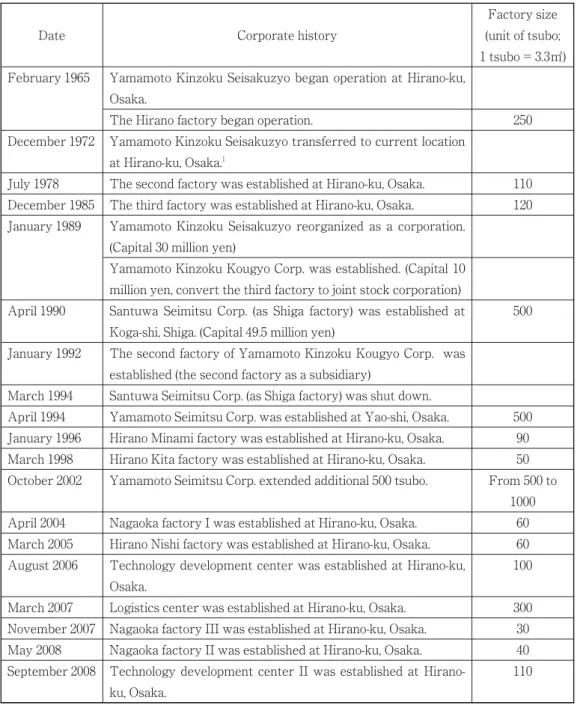
(6) Satoko Uenishi. People believe in myths as institutional representations, and accomplish performative actions because of their abstractiveness, while institutions have the flexibility to respond to the results of actions. In addition, institutions are able to act strategically while upholding such institutional representations. Regarding these aspects of institution as myth, the case of a typical Japanese subcontractor is analyzed in the next section.. 5. A Case Analysis of Transactions Keiretsu The analysis involves a Japanese metalworking company, Yamamoto Kinzoku Seisakuzyo Corp. (hereafter Yamakin), located in Hirano-ku, Osaka. Firstly, this company is used as a theoretical sample; it is quite average when compared to other subcontractors. Although Yamakin conducts transactions in the usual fashion, it does have some peculiarities. This paper focuses on how such a typical subcontractor approaches different transactions with the so-called while forming relationships with necessary stakeholders.. 5.1 Brief Overview of Yamamoto Kinzoku Seisakusho Corp. Yamakin was founded in 1965 as a metalworking company at Higashisumiyoshi-ku, Osaka by the current chairperson, Masayoshi Yamamoto. Yamakin has developed its business around the Kansai area as a typical mid-sized process manufacturer. When it was established, Yamakin had only one factory at Higashisumiyoshi-ku. Now in 2009, Yamakin has a total of 9 factories in Hirano-ku and Yao-shi, Osaka, and also owns two technology development centers. There are a total 150 employees and its revenue in 2007 was 3.4 billion yen. Yamakin s history is summarized in Table 1 below.. 5.2 Problem Setting for the Analysis At the beginning of the analysis, it understood that the original source of competitiveness in manufacturing arose from accumulating company-specific skills that are trained by. and. enable the efficient production of systems (e.g., Asanuma, 1989). However, the introduction of such an efficiency model results in the following three questions. First, is a long-term transaction with a particular assembler an efficient transaction for parts or processing manufacturers who receive orders from assemblers? While analyzing this, I.
(7) The Mythic Functions of Efficiency : A Case Analysis of the Performative Changes in the Transaction of Keiretsu. Table 1. Factory development in Yamakin Factory size Date. Corporate history. February 1965. Yamamoto Kinzoku Seisakuzyo began operation at Hirano-ku,. (unit of tsubo; 1 tsubo = 3.3㎡). Osaka. The Hirano factory began operation.. 250. December 1972. Yamamoto Kinzoku Seisakuzyo transferred to current location. July 1978. The second factory was established at Hirano-ku, Osaka.. 110. December 1985. The third factory was established at Hirano-ku, Osaka.. 120. January 1989. Yamamoto Kinzoku Seisakuzyo reorganized as a corporation.. at Hirano-ku, Osaka.. (Capital 30 million yen) Yamamoto Kinzoku Kougyo Corp. was established. (Capital 10 million yen, convert the third factory to joint stock corporation) April 1990. Santuwa Seimitsu Corp. (as Shiga factory) was established at. 500. January 1992. The second factory of Yamamoto Kinzoku Kougyo Corp. was. March 1994. Santuwa Seimitsu Corp. (as Shiga factory) was shut down.. April 1994. Yamamoto Seimitsu Corp. was established at Yao-shi, Osaka.. 500. January 1996. Hirano Minami factory was established at Hirano-ku, Osaka.. 90. March 1998. Hirano Kita factory was established at Hirano-ku, Osaka.. 50. October 2002. Yamamoto Seimitsu Corp. extended additional 500 tsubo.. From 500 to. Koga-shi, Shiga. (Capital 49.5 million yen) established (the second factory as a subsidiary). 1000 April 2004. Nagaoka factory I was established at Hirano-ku, Osaka.. 60. March 2005. Hirano Nishi factory was established at Hirano-ku, Osaka.. 60. August 2006. Technology development center was established at Hirano-ku,. 100. Osaka. March 2007. Logistics center was established at Hirano-ku, Osaka.. 300. November 2007. Nagaoka factory III was established at Hirano-ku, Osaka.. 30. May 2008. Nagaoka factory II was established at Hirano-ku, Osaka.. 40. September 2008. Technology development center II was established at Hirano-. 110. ku, Osaka.. In 1974, the current address was changed from Higashisumiyoshi-ku to Hirano-ku because of the Osaka strict agenda..
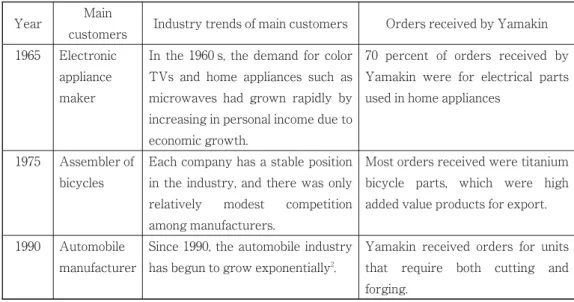
(8) Satoko Uenishi. focused on how and why Yamakin could draw on the current efficient activities from past transactions. Secondly, what is the most efficient organization model for Yamakin? When interviewing a overall factory manager of Yamakin, he always talked about how to become more efficient, but as interviews and reviews of the transactions progressed, efficiency had a completely different context and meaning depending on when and which factory. It must be considered why Yamakin still keeps an irregular-shaped group of 11 small factories and 1 large factory in Yao-shi. In addition, the purposeful creation of a technology development center must be clarified in order to call attention of the customers to own processing technologies.. 5.3 Keiretsu Reproduced by Referring Efficiency It should be mentioned again that Yamakin has run its business as a typical subcontractor that aimed at efficiency since its establishment. Despite being a typical subcontractor, Yamakin has repeatedly changed its focus since it was established; it was first an electronic appliance maker, then an assembler of bicycles, and later, an automobile manufacturer (Table 2). Table 2. Production Changes by Yamakin Year 1965. Main customers. Industry trends of main customers. Orders received by Yamakin. Electronic. In the 1960 s, the demand for color 70 percent of orders received by. appliance. TVs and home appliances such as Yamakin were for electrical parts. maker. microwaves had grown rapidly by. used in home appliances. increasing in personal income due to economic growth. 1975. Assembler of. Each company has a stable position. Most orders received were titanium. bicycles. in the industry, and there was only. bicycle parts, which were high. relatively. added value products for export.. modest. competition. among manufacturers. 1990. Automobile. Since 1990, the automobile industry. manufacturer has begun to grow exponentially .. Yamakin received orders for units that. require. both. cutting. and. forging.. Production of standard-sized cars had been increased rapidly from 494,792 units in 1985 to 1,750,783 units in 1990 (Japan Automobile Manufacturers Association, Inc., Production overlook of four-wheel vehicle, http:// www.jama.or.jp/industry/four_wheeled/four_wheeled_1t1.html, accessed August 20, 2009).
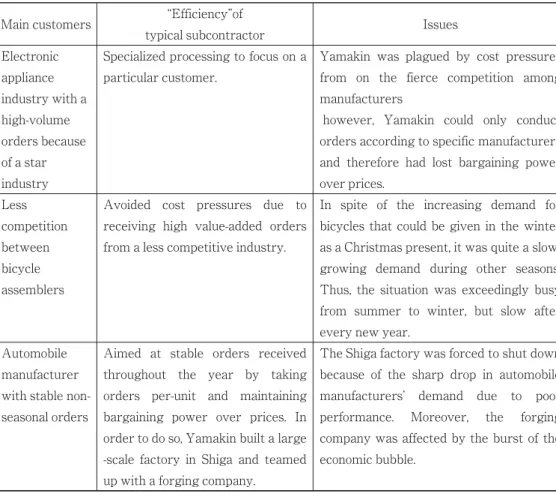
(9) The Mythic Functions of Efficiency : A Case Analysis of the Performative Changes in the Transaction of Keiretsu. Table 2 also shows that the variety of Yamakin s activities resulted from an effort to build relationships with their customers. Yamakin approached these activities using one definition of efficiency, but efficiency is a word with many complex meanings. That is, efficiency for a subcontractor means reproducing given. while responding to variety of issues arisen by the. . Some of the logic behind these relationships summarized in Table 3.. Table 3. The logic behind Yamakin s strategic decisions Main customers. Efficiency of. Issues. typical subcontractor. Electronic. Specialized processing to focus on a. Yamakin was plagued by cost pressures. appliance. particular customer.. from on the fierce competition among. industry with a. manufacturers. high-volume. however, Yamakin could only conduct. orders because. orders according to specific manufacturers,. of a star. and therefore had lost bargaining power. industry. over prices.. Less. Avoided cost pressures due to. In spite of the increasing demand for. competition. receiving high value-added orders. bicycles that could be given in the winter. between. from a less competitive industry.. as a Christmas present, it was quite a slow-. bicycle. growing demand during other seasons.. assemblers. Thus, the situation was exceedingly busy from summer to winter, but slow after every new year.. Automobile. Aimed at stable orders received. The Shiga factory was forced to shut down. manufacturer. throughout the year by taking. because of the sharp drop in automobile. with stable non-. orders per-unit and maintaining. manufacturers. seasonal orders. bargaining power over prices. In. performance.. order to do so, Yamakin built a large. company was affected by the burst of the. -scale factory in Shiga and teamed. economic bubble.. demand Moreover,. due the. to. poor. forging. up with a forging company.. Initially, the electronic appliance industry was one of the star industries, and therefore, the amount of orders rapidly increased. Yamakin expanded its factory to meet growing volume of orders, which ultimately led to the building of the 11 small factories mentioned earlier. However, there was fierce competition because of the star industry s popularity, and Yamakin had to involve in these competitions and improve the specialized processing methods for customers. This resulted in Yamakin losing its bargaining power with customers. Yamakin then changed its biggest customer to an assembler who mainly dealt with.
(10) Satoko Uenishi. bicycles. The bicycle industry was much less competitive than the electronic appliance industry. Yamakin saw a chance for bigger profits by focusing on processing of bike parts made from titanium for export. Bicycles presented another problem, and inconsistent orders resulted from the fact that most people brought these bicycles as a present, so there was only a high volume of orders during the Christmas Season. Yamakin examined its options and decided to switch to the automobile industry. At that time, the automobile industry was stable, but cost pressures were still high. Therefore, Yamakin decided to combine its metalworking process and forging operation to fill both single metalworking orders as well as orders for multiple units. To do so, Yamakin built a large factory in Shiga-prefecture. Unfortunately, it could not maintain the large factory for a long after the world s economy bubble burst. Looking at the history of Yamakin, the keiretsu decay in Japan as a whole is not surprising; there was an enormous effort accompanied by ensuring the participation of the keiretsu in order to achieve efficiency. Yet, Yamakin had participated in keiretsu for a long time. It indicates that Yamakin has believed the need to join in keiretsu from prior experiences to make efficient transactions.. 5.4 Performative Actions Conducted by Referring to Efficiency After the experiences mentioned above, Yamakin shifted the size of its orders from large, to medium, and then to small lots. This shift cannot be understood from the economical point of view of efficiency; however, Yamakin still referred to efficiency in these situations. Yamakin had to shut down the Shiga factory due to the recession in the automobile industry. Afterwards, Yamakin had to build a new factory, called the Yao factory, to house the machines that were already purchased and start productions as soon as possible, because there was no way to repay the lease for the machines already in use. Yamakin was experiencing a crisis at the time, because Yamakin desired to receive large-lot orders from specific companies to keep the machines running at full capacity. This was obviously optimal from the standpoint of efficiency, but it was difficult to receive the right volume of orders to run the machines. Yamakin was facing a problem because it could not achieve efficiency without. .. Yamakin decided to change its focus so that it would receive medium-lot orders from multiple customers in order to keep its machines operating; however, they encountered another problem with this decision. Yamakin could receive the optimal volume of orders to keep its.
(11) The Mythic Functions of Efficiency : A Case Analysis of the Performative Changes in the Transaction of Keiretsu. machines operating, but an unstable situation arose caused by spiraling economic trends and falling customer demand. As a result, Yamakin could not operate its machines at full capacity. Actually, Yamakin had already experienced these situations when it had tramped in. .. Yamakin had reduced the lot size from large to medium, and now Yamakin reduced it again so that it would receive mainly small orders. It may seem counter-intuitive to achieve efficient production with small-lot orders, but Yamakin requires small-lot orders for efficiency because of its previous experiences. Because Yamakin distributes customers with small-lot orders first, it can also disperse the risk of changing economic trends and customer demands without depending its biggest customer. Additionally, small-lot orders can be bundled in a manner that makes them into a medium-lot by doing so. For example, the processing technique of cutting rounded metal is the same for automobile parts, electronic appliance parts, or even bicycle parts. By receiving such orders, Yamakin can operate all machines in a stable fashion. Here is that Yamakin rather prohibited concentrating in one specific transaction. Specifically, Yamakin makes decisions according to the. , which means the amount of orders that come from a certain customer has. to be under 20 percent of the total orders received. This allows the processing of small-lot orders from diverse customers. In spite of the above activities, Yamakin has not completely gotten rid of. , and. problems appear one after the other to ensure their original production. When receiving smalllot orders, it becomes obvious that some processing orders cannot be bundled. It is impossible to receive only orders that accommodate Yakamin s needs; however, Yamakin has an eye on the group of small factories as a bridge of such orders. The efficiency of these small factories has become a problem. Since the size of factory has been small, it cannot be operated by the same logic of the large-scale Yao factory. Yamakin s attention has turned to improving the efficiency in the smaller factories. For example, when processing stainless steel with and other materials, steel powder adheres to the stainless steel and sets off iron corrosion on a material should not corrode. If Yamakin made a small factory that specialized in processing stainless steel, it could be spatially separated from those that process iron, thereby avoiding corrosion and generating sufficient revenue by grouping any stainless steel orders together. The time span of an order is also an important consideration because parts like hydraulic components have different ordering times compared to others. At.
(12) Satoko Uenishi. the time of maintaining, Yamakin suddenly receives a huge amount of hydraulic components orders, but there would be no order until the next maintenance coming. Yamakin has the option of refusing such orders, but if they do so, Yamakin might have to risk losing necessary orders. Therefore, Yamakin establishes a specialized factory for combining the processing of orders that require irregular time spans. Yamakin responds flexibly in this way according to efficiency against temporal and spatial constraints. One issue remains: By specializing in small-scale factories, some processing that cannot be bundled will accumulate. Yamakin has to retool the Nagaoka factory II so that it can be a buffer factory that deals with such orders. As Yamakin performs well and the numbers of orders received are increased overall, the Nagaoka factory II will get more work. When that happens, Yamakin has the opportunity to reconsider their strategy for any specialty-specific factories. The Hirano factory was currently beginning to take on this role for Yamakin at the time this paper was written. In short, Yamakin has established its own production system under the institutional representation of efficiency in order to solve problems that repeatedly occur with Yamakin has maintained efficiency without incorporating into. ;. .. 5. 5 Strategic Uses of Efficiency Finally, this section discusses the strategic use of efficiency. Yamakin was in a formidable situation, yet it was able to build its own production system. The current overall factory manager of Yamakin is responsible for the hard work to change the layout of each factory as it turns out products every month. Yamakin made efforts for stabilizing orders from customers, but to do so, they had to make customers place orders to meet their needs. It is the time to use efficiency as an institutional representation strategically. Yamakin built another specialized factory as a technology development center in order to disclose data to both potential and established customers about how efficient their work is. Of course, customers cannot come to the technology development center directly and performing a convincing simulation. Yamakin aims to persuade product developers by providing digitalized data that indicates Yamakin s efficiency. This is because many customers are large companies,. The factory manager became the second company president in August 2009..
(13) The Mythic Functions of Efficiency : A Case Analysis of the Performative Changes in the Transaction of Keiretsu. and many researchers of these companies graduated in many different fields of science. To convince these potential and established customers, Yakamin believes that using something that can be shown in numbers will achieve the best result. If Yamakin is successful in persuading customers and is able to incorporate their own unique technologies during the design phase, they are able to receive large hassle-free orders. In this way, efficiency is used as a strategic action to ensure customers with a dependence on Yamakin s technologies. It is interesting that Yamakin deliberately targets well-conditioned for new customers. It is a strange strategy to target new customers in should normally be difficult to achieve new orders from. when looking because it. , where existing subcontractors. has advantage because assemblers and subcontractors have established a close relationship and have accumulated. -specific technologies. However, for Yamakin, it considered a rule. of thumb that such subcontractors experiencing a high rate of return always wallow in their early success. In other words, accumulating. -specific technologies in the subcontractors. turned from advantage of assembler to a cause of adverse selection from subcontractors. Yamakin sees this as a business opportunity by upholding the efficiency. Yamakin does not overtly say that its technologies are better than those of existing subcontractors. However, in situations where Yamakin is approaching new customers in , they first secure minor orders since the majority of work is taken by existing subcontractors. These orders are then used to provide the aforementioned efficiency data to customers. Doing so causes customers to consider transferring to Yamakin from their existing subcontractors who rely heavily on their own technologies, so that the assemblers are no longer able to control. This strategy shows that Yamakin aims to strengthen the reliance of customers on its technologies by maintaining efficiency. The interesting point is the strategic use of data indicating efficiency for capturing stakeholders other than customers; for instance, the various stakeholders in the metalworking industry. Yamakin approached material suppliers with a suggestion for the development of more efficient materials for their customers by indicating the accumulated data of processing. Yamakin also attempted to start a joint venture with the industrial tools and cutting oil manufacturers. Unfortunately for Yamakin, the machine tool manufacturers were quite difficult to approach because they also acquire data from their in-house machines and partner with stakeholders as well as Yamakin does. The machine tool manufacturers were the first.
(14) Satoko Uenishi. stakeholder that Yamakin approached, but the effort failed to capture their interest because they almost lost the idea of such alliances to the machine tool manufacturers. An alliance with a material supplier was not the goal that Yamakin was aiming for. Yamakin thought that if the stakeholders demand other companies to reproduce similar results to Yamakin s data, other companies would need to create similar conditions. Therefore, even if the material suppliers succeeded in developing superior materials for processing and sold them to their customers, they would still need Yamakin. At that point, Yamakin could provide the additional data required for specific processes to the stakeholders, but charge additional fees. Even customers who bought materials from the material suppliers required Yamakin s data on specifications of tools and/or cutting oil, providing Yamakin with additional fees. Yamakin participates in the profitable consulting business by creating a dependency on its technologies by making itself an invisible part of the network of stakeholders.. 6. Conclusion In short, efficiency is not something that is obtained by just following prescribed manners; there is no optimal method for achieving efficiency. Efficiency is an abstract concept; however, efficiency as such an abstract representation has characteristics that can reproduce relationships such as. , while it still has the flexibility to lead an efficient production. system without dependency on. . Efficiency even makes it possible to persuade or. capture the customers and stakeholders who all desire efficiency in consolidating their own production systems according to the mythic functions of efficiency. In this paper, I have described the implications of institutional theory in comprehending the rationalized myth as an institution, and these implications will help explain the observed behavior of organizations..
(15) The Mythic Functions of Efficiency : A Case Analysis of the Performative Changes in the Transaction of Keiretsu. References Asanuma, B., (1989), Manufacturer-supplier relationship in Japan and the concept of relation-specific capital, , Vol. 3, No. 1, pp.1-30. DiMaggio, P. J. and Powell, W. W., (1983), The iron cage revisited: Institutional isomorphism and collective rationality in organizational fields,. , Vol. 48, No. (2), pp.147-160.. Hoogenboom, M. and Ossewaarde, R., (2005), From iron cage to pigeon house: The birth of reflexive authority, , Vol. 26, No.4, pp.601-619. Greenwood, R., Oliver, C., Sahlin, K. and Suddaby, R., (2008), introduction, in Greenwood, R., Oliver, C., Sahlin, K. and Suddaby, R. (eds.),. , Sage Publication, pp.1-46.. Matsui, K., (2007), (. ), Miraisha,. (in Japanese). Meyer, J. W. and Rowan, B., (1977), Institutionalized organizations: Formal structure as myth and ceremony, , Vol. 83, No. 2, pp.340-363. Meyer, J. W., (2008), Reflections on institutional theories of organizations, in Greenwood, R., Oliver, C., Sahlin, K. and Suddaby, R. (eds.),. , Sage Publications, pp.790-811.. Okuyama, T., (1991), Soshiki no sekai / Koushikisoshiki toha nanika (World of organizations), in Yoshida, T. (ed.),. (. ), Shinnyo-sha,. pp.153-167, (in Japanese). Powell, W. W., (1991), Expanding the scope of institutional analysis, in Powell, W. W. and DiMaggio, P. J., (eds.), , The University of Chicago Press, pp.183-203. Rowlinson, M., (1997),. , Palgrave Macmillan.. Sato, T., (1999), Kannryousei to kannryouka (Bureaucracy and bureaucratization), in Inoue, T., Matsuura, Y. and Shimazu, I. (eds.),. , University of Tokyo Press,. pp.65-92, (in Japanese). Takemoto, T., (1996), J. Meyer soshikironn ni okeru kindaisei no shiten (Modernity in the discussion of Meyer, J. in organization study),. , Vol. 41, No. 2, pp.75-89, (in Japanese).. Takemoto, T., (2001), Rethinking of Weber s theory of organization,. , 1,. pp.103-111, (in Japanese). Tao, M., (2003),. , (. ), Bunshin-do, (in. Japanese). Uenishi, S., (2009), Wagakuni ni okeru seizougyou no bizinesu innobeisyon: kabushikigaisya yamamoto kinzoku seisakuzyo (Business innovation in the manufacturing industry in Japan: A case of Yamamoto Kinzoku Seisakuzyo Corp.),. , VB-08-06, (in Japanese).. Weber, M., (1920), Die protestantische ethik und der geist des kapitalismus, I, J. C. B. Mohr, pp.17-206. (Otuka H. (tr.). ,. Iwanami Bunko, 1989, (in Japanese)). Weber, M., (1976), Soziologie der herrschaft,. , 5. Aufl., J. C. B. Mohr, (Sera, K. (tr.). , 1960, 1962, (in Japanese)). Yamanouchi, Y., (1997),. (. ), Iwanami Shinsyo, (in Japanese)..
(16)
図
関連したドキュメント
Keywords: continuous time random walk, Brownian motion, collision time, skew Young tableaux, tandem queue.. AMS 2000 Subject Classification: Primary:
Then it follows immediately from a suitable version of “Hensel’s Lemma” [cf., e.g., the argument of [4], Lemma 2.1] that S may be obtained, as the notation suggests, as the m A
Definition An embeddable tiled surface is a tiled surface which is actually achieved as the graph of singular leaves of some embedded orientable surface with closed braid
In order to be able to apply the Cartan–K¨ ahler theorem to prove existence of solutions in the real-analytic category, one needs a stronger result than Proposition 2.3; one needs
Our method of proof can also be used to recover the rational homotopy of L K(2) S 0 as well as the chromatic splitting conjecture at primes p > 3 [16]; we only need to use the
This paper presents an investigation into the mechanics of this specific problem and develops an analytical approach that accounts for the effects of geometrical and material data on
We study the classical invariant theory of the B´ ezoutiant R(A, B) of a pair of binary forms A, B.. We also describe a ‘generic reduc- tion formula’ which recovers B from R(A, B)
While conducting an experiment regarding fetal move- ments as a result of Pulsed Wave Doppler (PWD) ultrasound, [8] we encountered the severe artifacts in the acquired image2.
