線形化可能な分散共有メモリの無待機な実現
Wait-Free
Linearizable Implementation
ofa
Distributed
Shared
Memory井上美智子 須田克朗1 守屋宣
Michiko INOUE Katsuro SUDA Sen MORIYA
増澤利光 藤原秀雄
Toshimitsu
MASUZAWA
HideoFUJIWARA
奈良先端科学技術大学院大学〒 630-0101 奈良県生駒市高山町 8916-5
{kounoe,
katuro-s, sen-m, masuzawa, fuj$\mathrm{i}\mathrm{w}\mathrm{a}\mathrm{r}\mathrm{a}$}
$@\mathrm{i}s$.
aist-nara.$\mathrm{a}\mathrm{c}$.
jpAbstract: We consider wait-free linearizable implementations of shared objects which tol-erate crash faults of any number ofprocesses on a distributed message-passing system. We consider the system where each process has a local clock that runs at the same speed as real-time clock and
an
message delays are in the range $[d-u, d]$ where $d$ and $u(0<u\leq d)$are constants known to every process. We present four wait-free linearizable implementa-tions of $\mathrm{r}\mathrm{e}\mathrm{a}\mathrm{d}/\mathrm{w}\mathrm{r}\mathrm{i}\mathrm{t}\mathrm{e}$ registers and two wait-free linearizable implementations of general
ob-jects for several system settings. These are the first implementations with taking account of wait-freedom. Moreover, the worst-case response times of our wait-free implementations of $\mathrm{r}\mathrm{e}\mathrm{a}\mathrm{d}/\mathrm{W}\mathrm{r}\mathrm{i}\mathrm{t}\mathrm{e}$ registers on a reliable broadcast model is better than any previously known
implementations.
Keywords: message-passing system, distributed shared memory, linearizability, wait-freedom
1
Introduction
How to provide logically shared objects in a
dis-tributed system is a fundamental problem on
concurrent computing. A distributed system with shared objects has good scalability while it needs low-level or complex control to shared data through message-passing paradigm. Logi-cally shared objects greatly simplifies a design of
a user program thanks to its simple and general
computing paradigm. A distributed shared mem-$ory$consisting of such shared objects aims at pro-viding useful and scalable programming environ-ment forhigh-performance computing using mul-tiple processors.
We implement logical shared objects which are
used by multiple application processes
concur-rently. The implemented shared objects should
provide some consistency forconcurrent accesses.
We consider linearizable implementations [1] of
1現在, NTTソフトウェア.
shared objects on a distributed message pass-ing system. Informally, linearizability guarantees
that operations to the implementedobjects seem
to be executed sequentially in some total order,
and, for two operations such that one operation
starts after the other operation completed, this total order preservesthe real-time orderonthem. It has some good properties, such as locality and
nonblocking. Locality means that a system is
lin-earizable if each individual object islinearizable.
Locality allows concurrent system to be designed
and constructed in a modular fashion; each of
linearizable objects can be implemented, verified and executed independently. Nonblocking
prop-erty means that apending operation is never re-quired to wait for another pending operation to
complete. Nonblocking implies that
linearizabil-ity isanappropriate condition for a system where real-time response is important.
An implementation is saidtobe
wait-free
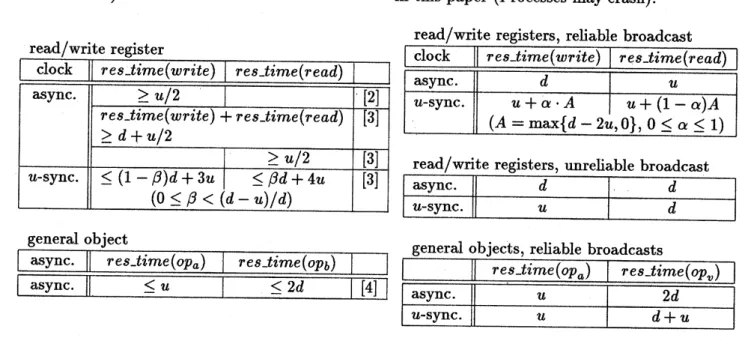
if any operations of the implemented object arecom-Table 1: Linearizable implementations (Processes
do not crash).
Table 2: Wait-free linearizable implementations in this paper (Processesmay crash).
$\mathrm{r}\mathrm{e}\mathrm{a}\mathrm{d}/\mathrm{w}\mathrm{r}\mathrm{i}\mathrm{t}\mathrm{e}$ registers, reliable broadcast
$\ovalbox{\tt\small REJECT}^{\mathrm{a}\mathrm{s}\mathrm{y}\mathrm{n}\mathrm{C}}u- \mathrm{s}\mathrm{y}\mathrm{n}\mathrm{C}u+\alpha Au+(1-\alpha)A(A--\mathrm{m}\mathrm{a}\mathrm{x}\mathrm{t}d-2u,0\},0\leq\alpha\leq 1)du$
pletedin finite time regardlessof otherprocesses’
$\mathrm{b}\mathrm{e}\mathrm{h}\mathrm{a}\mathrm{v}\mathrm{i}\mathrm{o}\mathrm{r}[5]$
.
We consider wait-freeimplementa-tions, which tolerates crash faults of any
num-ber ofprocesses. James et al. showed that there are no wait-free linearizable implementations of
$\mathrm{r}\mathrm{e}\mathrm{a}\mathrm{d}/\mathrm{w}\mathrm{r}\mathrm{i}\mathrm{t}\mathrm{e}$ registers on the system in which
mes-sage delays are $\mathrm{a}\mathrm{r}\mathrm{b}\mathrm{i}\mathrm{t}\mathrm{r}\mathrm{a}\mathrm{r}\mathrm{y}[6]$
.
In this paper, weassume that
au
messagedelaysin the system arein the range $[d-u, d]$ for some constants $d$ and $u\langle 0<u\leq d$) where every process knows these $d$ and$u$, and the systemprovides each process with a local clock that runsat the same rate as global time. We considertwo kinds ofmodels about ex-change of messages, a reliable broadcast and an unreliable broadcast. These two mcdels differ in a
guarantee on acase where a process crashes
dur-ing itsbroadcast. A broadcastedmessage is
guar-anteed to be received by $\mathrm{a}\mathrm{U}$correctprocesses in a
reliable broadcasted model. On the other hand, in
anunreliable broadcast model, if a process crashes
during its broadcast, the message is not guaran-teed to be received by
au
processes. We consider two kinds of models also on local clocks, asyn-chronous clocks and$u$-synchronousclocks. In au-synchronous clock model, the difference between
any pair of two local clock values is at most $u$
.
inan asynchronous clockmodel, we make no
as-sumptionson such a difference. The efficiency of an implementation is measured by the worst-case
response time $reS_{-time(}op$) for each operation $op$
ofthe implemented objects.
Several authors have investigated linearizable
implementationsof sharedobjects on a system in
which no processes crash and $\mathrm{a}\mathrm{U}$ message delays
are in the range $[d-u, d]$ (Tab. 1). In Tab. 1, $op_{a}$ is anyoperationreturning a uniqueresponse,
$\mathrm{c}\mathrm{a}\mathrm{U}\mathrm{e}\mathrm{d}$ to be $ack$-type, and
$op_{v}$ is any operation that is not $\mathrm{a}\mathrm{c}\mathrm{k}$-type,
$\mathrm{c}\mathrm{a}\mathrm{U}\mathrm{e}\mathrm{d}$to be $val$-type. in
this paper, we consider wait-freedom and present six wait-ffee linearizable implementations shown in Tab.2. The response time of our wait-free
im-plementation of$\mathrm{r}\mathrm{e}\mathrm{a}\mathrm{d}/\mathrm{w}\mathrm{r}\mathrm{i}\mathrm{t}\mathrm{e}$ registers on a reliable
broadcastand$u$-synchronousmodelis better than
the previouslyknownimplementationin [3].
2
Definitions
2.1
SystemA distributed message-passing system consists of multiple processes and acommunicationnetwork. A processcommunicateswith any other processes by exchangingmessagesthrough the network. AU message delaysare in therange $[d-u, d]$ for
some
constants $d$ and $u(0<u\leq d)$ known to ev-ery process. Each process has a local clock that runs at the same rate as global time2.
The pro-cess obtains local time from its local clock and2Weusesystem-wideglobaltimeto$\mathrm{s}\mathrm{p}\mathrm{e}\mathrm{c}\mathrm{i}\Phi$ systen
be-havior. Note that the global time is introduced only for specification and no processes canuse it.
uses a timer based on its local clock. We assume the difference between anypairof local clock
val-ues in a system is at most $\epsilon$ for some constant $\epsilon$
.
Such a model is called $\epsilon$-synchronous clockmodel. If $\epsilon$ is the infinity, the model is called
asynchronous clock model. We assume that a
process may crash. After a process crashes, it ceases to operate. We consider two kinds of mod-els about exchange ofmessages, a reliable
broad-cast model and an unreliable broadcast model. In
a reliable broadcast model, if a process crashes
during broadcasting a message, it is guaranteed that all correct processes receive it or no process receives it.
A process$p$ is modeled as astate machine. Its state changeswhen some eventoccursat$p$
.
A $sy_{S}-$$tem$configuration(or we calljust configuration)is
defined as all process states, a set$\Lambda^{(}$ ofin-transit
messages and sets $A_{p}$ of alarms which have been
set to its timer andhave not gone offat each
pro-cess$p$
.
An in-transit message is a triple $(M, s, r)$where $M$ is a message, $s$ is the sender, and $r$ is
the destination. An alarm is a pair $(K,t)$ where
$K$ is the type of an alarm and $t$ is the localtime
for the alarmtogooff. A process cansetmultiple alarms concurrently, and a type ofalarm is used
to identify them. Each process has the following
events.
$\bullet$ Communication events: Broadcast
events BroadCast$(p, M)$ and receive events
Receive$(p, q, M)$ can occur in a reliable
broadcast model. Send events $s_{en}d(p, q, M)$
and receive events Receive$(p, q, M)$ can
oc-cur in an unreliable broadcast model,
.
$-s_{en}d(p, q, M)$ : Process $p$ sends a
mes-sage $M$ to process $q$
.
A triple $(M,p, q)$is added to $N$
.
$-BroadCaSt(p, M)$
:
Process $p$broad-casts a message $M3$
.
For any process$q,$ $(M,p, q)$ is added to$N$
.
$-TimerSet(p,\overline{t}, K)$ : Process $p$ sets its timer oftype $K$ to go off after $\overline{t}$
.
When
an event TimerSet$(p,\overline{t}, K)$ occurs at lo-cal time $t$, a pair ($K,$$t+\overline{t\supset}$ is added to $A_{p}$
.
$-Alarm(p, K)$ : An alarm of type $K$
occurs at process $p$
.
When an event Alarm$(p, K)$ occurs at local time $t$, apair $(K,t)$ is removed from$A_{p}$
.
$-ReadClock(p, s)$ : Process$p$ obtains the
clockvalue $s$ from its local clock.
$\bullet$ $St_{\mathit{0}}p(p)$ : Process$p$crashes. After this event,
$p’ \mathrm{s}$ state changes to
fault
state and $p$ ceasesto operate.
$\bullet$ A process communicates also with the
out-side of the system, which we call environ-ment. We describe events about communi-cation between a process and environment later.
The receive, alarm and stop events are input
events, which arise passively.
The system history (or we call just history) is defined as afinite orinfinite alternating sequence
of configurations and occurrences of events,
$H=c0,$$(e_{1},T1),$$C1,$$\cdots,$ $c_{k},$$(ek+1,\tau k+1),$ $ck+1,$$\cdots$,
where each $c_{k}(k \geq 0)$ is a configuration,
$(e_{k},T_{k})(k\geq 1)$ is an occurrence of an event, $e_{k}$
is the event and$T_{k}$is global time when$e_{k}$ occurs.
Each $T_{k}$ is denoted by $t\dot{i}me(ek)$
.
A process $p’ \mathrm{s}$stateisaprojectionofa configuration $c_{k}$ to$p$
,
de-noted by $c_{k}|p$.
The first configuration $c_{0}$ is calledan initial configuration, inwhich allprocesses are in the initial state, and $N$ and $A_{p}$ for any pro-cess $p$ are empty. For each $k,$ $T_{k}\leq T_{k+1}$ holds.
A history $H$ implies that, for each $k(k\geq 0)$, an
event $e_{k+1}$ occurs at some process $p$ at $T_{k+1}$ in a configuration $c_{k}$, and$p’ \mathrm{s}$ state changes $\mathrm{h}\mathrm{o}\mathrm{m}c_{k}|p$
to $c_{k+1}|p$ (and$N$ or $A_{p}$ also may change). To be
simplified, all eventsina history are distinct. We
assume the followingconditions on anyhistory$H$
.
$-Receive(p, q, M)$ :Process $p$ receives a
message $M$ from process $q$
.
A triple$(M, q,p)$ is removed from$N$
.
$\bullet$ Time events:
3Forconvenience, weassume that a process sends a
mes-sageto
au
processes including itself by a broadcast.$\bullet$ If$A_{p}$ contains a pair $(K,t),$ $Alarm(p,K)$
oc-curs or $p$ is in a fault state at local time $t$
.
Conversely, Alarm$(p, K)$ occurs at $t$, only if $(K,t)_{\overline{1}\mathrm{S}}$ in $A_{p}$
.
$\bullet$ rf a triple $(M,p, q)$ is added to $N$ at global
time $T,$ $Rece\dot{i}ve(q,p, M)$ occurs in $[T+d-$
$N$ contains a triple $(M,p, q)$, a receive event $Rece\dot{i}ve(q,p, M)$ occurs.
2.2
Implementation ofan objectWe define a deterministic shared object (we call
just object in the following). An object is a data
structure to which multiple processes can access
concurrently. An object has a unique name and a type. The type is a tuple $(OP,RES,Q, q_{0}, \delta)$,
where $OP$ is a set of operations, $RES$ is a set
ofresponses, $Q$ is a set of states,
$q_{0}$ is an initial
state, and $\delta$ : $Q\cross OParrow Q\cross RES$
is a
func-tion $\mathrm{c}\mathrm{a}\mathrm{U}\mathrm{e}\mathrm{d}$ sequential specification.
The
sequen-tial specification defines a behavior ofthe object
when operations are applied sequentially: if an
operation $op$ is applied to the object in a state
$s$, the object changes its state to $s’$ and returns
the response $res$ where $\delta(s, op)=(s’, res)$ holds.
Suchanobjectis called to be deterministic, since
the sequential specification is a function. If an
operation $op$ always returns a unique response,
that is $|\{res|\exists s, S’[\delta(s, op)=(s’,res)]\}|=1,$ $op$ is
calledto be $ack$-type. An operation is called to be
$val$-type,ifit is not$\mathrm{a}\mathrm{c}\mathrm{k}$
-type. In the following,$op_{a}$ denotes any $\mathrm{a}\mathrm{c}\mathrm{k}$
-type operation and $op_{v}$ denotes
any $\mathrm{v}\mathrm{a}\mathrm{l}$-type operation.
Next, we define an implementationofan object
$O$ of type $(OP,REs, Q, q_{0}, \delta)$
.
We implementa virtual shared object which is used concurrently
by environment. Figure 1 illustrates the
imple-mentation. An object is implemented by a set of
processes $\{p_{1},p_{2}, \cdots,pn\}$
.
A subscript $i$ of each$p_{i}$ is the process identifier. Environment can
ac-cess an object by communicating with a process
$p_{i}$
.
Communication
between environment and$p_{i}$
is modeled as the following events.
$\bullet$ Invoke$(p_{i}, op)$ : Environment
calls$p_{i}$ to
ap-ply an $.0$peration $op(\in OP)$ to the object $O$
.
$\bullet$ Response$(pi,res)$ :
Process $p_{i}$ returns a
re-sponse $res(\in RES)$ for an invocation to en-vironment.
The invoke event is an input event. We assume
the following conditionabout communication be-tween environment and$p_{i}$ on any history $H$
.
$\bullet$ Once environment
invokes an operation to a process$p_{i}$, it does not invoke the next
oper-ation to$p_{i}$ until$p_{i}$ returns a responseforthe
former
invocation.
Figure 1: Implementation of a sharedobject.
To return consistentresponses, theprocesses may
exchange messages with each other.
For each $p_{i}$, we consider the restricted
se-quence of a history $H$ to $p_{i}’ \mathrm{s}$ invoke and
re-sponse events. It should be an alternating se-quence $Inv_{1},$${\rm Res}_{1},$$Inv_{2},$${\rm Res}_{2},$ $\cdots$ where $Inv_{k}$ is
an invoke event and ${\rm Res}_{k}$ is a response event for
each $k(k\geq 1)$
.
For each invoke event $Inv_{k}$,
thenext event ${\rm Res}_{k}$ is called to be a corresponding
response event. A pair of events ($Inv_{k},$Resk) is
called an operation execution. An invoke event
that has nocorresponding response events is said to be pending. If an invoke event ofanoperation
is not pending, the operation execution is said to
be completed.
We adopt $linea\dot{n}\mathcal{Z}abil_{\dot{i}}ty$asaconsistency
condi-tion of an implementation of an object. Herlihy
etal. showeda local property$\mathrm{o}\mathrm{f}\mathrm{l}\mathrm{i}\mathrm{n}\mathrm{e}\mathrm{a}\mathrm{r}\mathrm{i}\mathrm{z}\mathrm{a}\mathrm{b}\mathrm{i}\mathrm{l}\mathrm{i}\mathrm{t}\mathrm{y}[1]$
.
The locality means that an implementation of multiple shared objectsis linearizableif and only if each object is implementedlinearizably. In this
paper, we consider animplementation ofone ob-ject, and wedefinean implementation of onlyone
object. Fromlocality, we can implement multiple objects fromourimplementations of one object.
Nowwedefinelinearizabilityandwait-freedom.
We consider a sequence of operation executions
$\tau=$ $(Inv1,{\rm Res} 1),$ $(Inv2,{\rm Res} 2),$$\cdots$
.
For each$k(k\geq 1)$, let $Inv_{k}$ and ${\rm Res}_{k}$ be Invoke$(p_{i}k’ p_{k}o)$
and Response($p_{i_{k}},$resk) respectively. For an ob-ject $O$ of type $(oP,REs, Q,q_{0}, \delta)$
,
if thereex-ists a sequence $\theta=q_{0},$$q_{1},$ $\cdots$ of states of $O$,
where $\delta(qk-1, opk)=$ ($q_{k},$resk) holds for each
$k\geq 1,$ $\tau$ is said to be legal.
rn
a systemtwo operation executions $op_{k}$ $=$ $(Inv_{k}, {\rm Res}_{k})$,
$op_{l}=$ ($Inv_{l},$Resl), we say that $op_{k}$ precedes $op_{l}$,
denoted by$op_{k}arrow_{O}Hp\iota$
.
A restricted sequence of$H$tocompletedinvoke events and response events is
denotedby complete$(H)$
.
Definition
1 A history $H$ is said to belineariz-able, $\dot{i}.f$there exists a history $H’$ that
satisfies
thefollowings.
$\bullet$ The history$H’$ is obtained
from
$H$ byappend-ing corresponding response events
for
some(possibly empty) pending invoke events.
$\bullet$ There exists a legal sequence $\tau$ consisting
of
all operation executions in complete$(H’)$such that,
for
any operation executions $op_{1}$and $op_{2}sat\dot{i}S.fyingop_{1}Com_{\mathrm{P}arrow}\iota_{ete}(Hr)op_{2},$
$op_{\underline{1}}$
precedes $op_{2}$ in $\tau$
.
Definition 2 An implementation I is said to be linea$7^{\cdot}\dot{i}Zable$
if
any possible systemhistory$H$ is$lin–$ earizable.
Definition 3 An implementation I is said to be
wait-free if
any invoke event$Inv$ in every possiblehistory$H$
satisfies
oneof
the followings.$\bullet$ There exists a corresponding response event. $\bullet$ For the process
$p_{i}$ in which
$Invoccurs-$,
Stop$(p_{i})$ occurs
after
$Inv$.
The efficiency of an implementation $I$ is
mea-sured by the worst-case response times of op-eration executions. For an operation execu-tion $(Inv, {\rm Res})$, we define the response time as time(${\rm Res}\rangle-time(Inv)$
.
Let $OPE(H)$ denote a set of operation executions that appears in ahistory $H$
.
For an operation execution $ope=$$(Inv, {\rm Res})$, let ope.op denote an operation in-voked in $Inv$
.
For an implementation $I$ of an object $O$ supporting an operation $op$, wede-fine the worst-case response time of $op$, denoted
by $res_{-}time(op)$, as $\max\{res_{-}time(ope)|ope$ $\in$
$OPE(H)$, ope.op$=op,$$H$ is ahistory of$I$
}.
3
$\mathrm{R}\mathrm{e}\mathrm{a}\mathrm{d}/\mathrm{w}\mathrm{r}\mathrm{i}\mathrm{t}\mathrm{e}$registers
In this section, we present four implementations of a $\mathrm{r}\mathrm{e}\mathrm{a}\mathrm{d}/\mathrm{w}\mathrm{r}\mathrm{i}\mathrm{t}\mathrm{e}$ register. We show the type of
a $\mathrm{r}\mathrm{e}\mathrm{a}\mathrm{d}/\mathrm{w}\mathrm{r}\mathrm{i}\mathrm{t}\mathrm{e}$ register on a domain $D$ in
Fig-ure 2. The efficiency of a $\mathrm{r}\mathrm{e}\mathrm{a}\mathrm{d}/\mathrm{w}\mathrm{r}\mathrm{i}\mathrm{t}\mathrm{e}$ register is
measured by $res_{-}t_{\dot{i}}me(read\rangle$ and$reS_{-tim}e(write)$
where write is any write operation write$(v)$
.
$OP=\{write(v)|v\in D\}\cup\{read\}$ $RES=\{\mathrm{a}\mathrm{c}\mathrm{k}\}\cup D$
$Q=D$
$\forall v,v’\delta(v, write(v’))=(v’,\mathrm{a}\mathrm{c}\mathrm{k})$
$\forall v\delta$($v$,read)$=(v,v)$
Figure 2: Type of a $\mathrm{r}\mathrm{e}a\mathrm{d}/\mathrm{w}\mathrm{r}\mathrm{i}\mathrm{t}\mathrm{e}$ register on on a
domain $D$
.
In allimplementations, each process keeps a
lo-cal copy of a $\mathrm{r}\mathrm{e}\mathrm{a}\mathrm{d}/\mathrm{w}\mathrm{r}\mathrm{i}\mathrm{t}\mathrm{e}$ register. When a write
operation is invoked at a process, the process assigns a timestamp to the write operation and broadcasts an update message that contains the writtenvalue and the timestamp of the write op-eration. A process updates its local copy accord-ingto receivedupdate messages. The update
de-pends on a timestamp assigned to the write op-eration execution. In a read operation execution,
the value of its local copy at some time during
the operation is returned. For a read operation execution$R$,let Write($R\rangle$be the write operation
execution whose written value$R$ returns.
We describe eachprogramcodebyevent-driven
form forinput events. A series ofeach event and
the succeeding internal changes of the state is
atomic, that is, the process does not crash
dur-ing the series. If multiple input events occur at
the sametime, they are handled in an order such
that they appear in the described code except a stop event.
3.1
Implementationsusing
reliable
broadcast3.1.1 Asynchronous clocks
The first implementation is on a reliable broad-cast and asynchronous clock model, which we
call$reg_{\dot{i}S}ter_{RBAc}-$ (for”reliable broadcast,
asyn-chronous clocks”). The program code for $p_{i}$ is
givenin Fig.3.
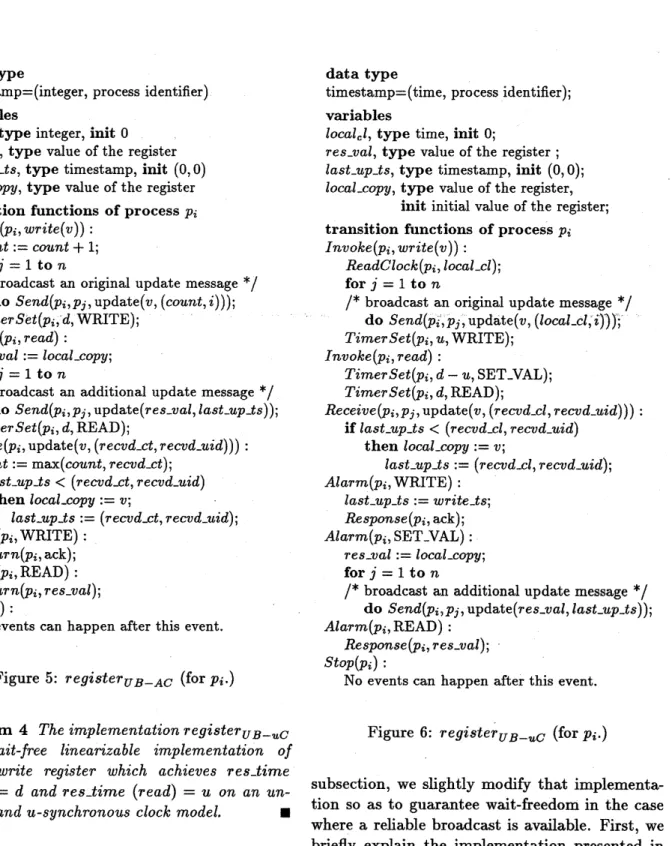
In a write operation execution, the process broadcasts an update message on the invocation. When a process receives the update message, it
updates its local copy according to the message.
Thewrite operationexecutionis completedby re-turning ackafter $d$since the invocation. In a read
operation execution, the process decides the
datatype
timestamp$=$($\mathrm{i}\mathrm{n}\mathrm{t}\mathrm{e}\mathrm{g}\mathrm{e}\mathrm{r}$, process identifier)
variables
count,type integer, init $0$
res-val, type value of the register
$last_{-u}p_{-}t_{S},$ tyPe timestamp, init $(0,0)$
local-copy, type value of theregister
transition functions ofprocess$p_{i}$ Invoke$(p_{i}, write(v))$ :
count:$=count+1$;
BroadCast($pi,$update($v$,(count,$i$)));
$/*_{\mathrm{u}\mathrm{p}}\mathrm{d}\mathrm{a}\mathrm{t}\mathrm{e}$ messae $*/$
TimerSet($pi,$$d$,WRITE);
Invoke($p_{i}$, read):
res-val$:=loCal_{-co}py$;
$\tau imers_{e}t$($p_{i},$$u$,READ);
Receive($pi,p_{j},$update($v$,(recvd-ct, recvd-uid))) :
count:$= \max$(count, recvd-ct);
if$last_{-u}p_{-tS}<^{4}$ (recvd-ct, recvd-uid)
then local-copy:$=v$;
$last_{\vee}up_{-t=}s$: ($recvd_{-}Ct$, recvd-uid);
Alarm($p_{i}$, WRITE):
Response$(p_{i}, \mathrm{a}\mathrm{c}\mathrm{k})$;
Alarm($pi$,READ):
Response($p.i$,res-val);
Stop$(p_{i})$:
No eventscan happen after this event.
Figure 3: $reg_{\dot{i}St}er_{RBAc}-$ (for$p_{i}$).
$t$ ofa write operation execution $W$ is received in
$[t+d-u,t+d]$
.
Therefore, at each process, the update message for$W$ is handledin this interval, or it is ignored. For two read operation executions$R$ and $R’$ such that $R’$ precedes $R$, it is
guaran-teed that $R$returns the value written by the write
operation with timestamp greater than or equal
to $R’$
.
We show that any possible history $H$ in
$register_{R}B-AC$ is linearizable and wait-free. A
pending invoke event of a write operation $W$ is said to be valid if there exists a read operation
execution $R$such that Write$(R)=W$
.
Let $H’$ be a history in which response events correspondingto valid pending events are appendedto $H$in ar-bitrary order. We construct a legal sequence $\tau$ as
follows. First, we assume that$a$sequence$\tau$begins
witha virtualwrite operation $W_{0}$ that writes the
initial value, and arrange allwrite operation
exe-cutionsincomplete$(H’)$ after$W_{0}$ in orderoftheir
timestamps. Next, we put read operation
execu-tions that returns a written value ofawrite oper-ationexecution$W$immediately before$W$in order
oftheir globalinvocationtime. Wecanshow that $op_{1}$ precedes $op_{2}$ in $\tau$ if $op_{1}com_{P}le(\sim^{el}H’)op_{2}$, for
anyoperation executions $op_{1}$ and$op_{2}$
.
Therefore,the following theorem holds. invocation, and it returns the value after $u$ since
it is invoked.
In thi$s$ implementation, a monotone increasing
integer count is used as a timestamp. A process
increase count by 1 when it invokes a write
opera-tion. If thetimestamp containedin a received up-date message is greater than the process’s count
(breaking tie by process identifiers), the process
sets its count to the timestamp. Since any me s-sage delay is not greater than $d$
,
a write opera-tion execuopera-tion $W_{2}$ succeeding another write op-eration execution $W_{1}$ is assigned a greatertimes-tamp than $W_{1}$
.
A process ignores anupdatemes-sage containing smaller timestamp than the last handled timestamp. In this case, the process
con-siders that such an update message was handled
and the value was overwritten by some write op-eration. An update message broadcasted at time
4Thesymbol$<\mathrm{d}\mathrm{e}\mathrm{n}\mathrm{o}\mathrm{t}\mathrm{e}\mathrm{S}$ lexicographic order. A relation
$(a_{1},b_{1})<(a_{2},b_{2})$ implies that $a_{1}<a_{2}$, or $a_{1}=a_{2}$ and
$b_{1}<b_{2}$
.
Theorem 1 The implementation
$registerRB-AC$ is a
wait-free
linearizableimple-mentation
of
a $read/w\dot{n}te$ registerwhich achieves $res_{-t_{\dot{i}}}me(wr\dot{i}te)=d$ and $res$-time (read) $=u$ on a reliable broadcast andan asynchronous clockmodel. $\blacksquare$
3.1.2 $u$-synchronous clock
We present an implementation $registerRB-uC$
on a reliable broadcast and u-synchronous
clock model (Fig.4). The implementation
$regi_{S}terRB-uC$ is a parameterized
implemen-tation with a parameter $\alpha$ $(leq\alpha \leq 1)$
where $reS_{-t_{\dot{i}me(t}}wrie$) $\geq u,$ $reS_{-ti()}mewr\dot{i}te+$
$reS_{-ti(rea}med)\geq d$and$reS_{-ti(r}meead$) $\geq u$hold.
The implementation $registerRB-uC$ uses a
10-cal clock value as a timestamp $\mathrm{i}\mathrm{n}s$tead of count.
Thi$s$ guarantees that a preceding write operation
execution has a smaller timestamp. A returned value ofa read operation execution is
decided
atconstant
$|W|=u+ \alpha\cdot\max\{d-2u, 0\}$,
$|R|=u+(1- \alpha)\max\{d-2u, 0\}$
datatype
timestamp$=$(time, process identifier);
variables
local-cl, type time, init $0$;
res-val, type value of the register ;
$last_{-}up-ts$, type timest$a\mathrm{m}\mathrm{p}$, init $(0,0)$;
local-copy, type value oftheregister,
init initial value of the register;
transition functions of process$p_{i}$
Invoke$(p_{i}, write(v))$ :
ReadClock($pi$,local-cl);
$Broadc_{a}st$($pi,$update($v$, (local-cl,$i$)));
$/*\mathrm{u}\mathrm{p}\mathrm{d}\mathrm{a}\mathrm{t}\mathrm{e}$message $*/$
TimerSet($p_{i},$$|W|$, WRITE);
Invoke($p_{i}$,read) :
$\tau imerset$($pi,$$\min\{|R|,$$d-u\}$, SET-VAL); $\tau imers_{e}t$($p_{i},$$|R|$, READ);
Receive($p_{i},p_{j},$update($v$,(recvd-cl, recvd-uid))) :
if$last_{-}up-t_{S}<$ (recvd-cl, recvd-uid)
then local-copy:$=v$;
$last_{-}up_{-}t_{S}:=$($recvd_{-c\iota}$, recvd-uid);
Alarm($p_{i}$, WRITE)
.
$la\epsilon t_{-u}p_{-t_{S}}:=write_{-}t_{S}$;
Response$(p_{i}, \mathrm{a}\mathrm{c}\mathrm{k})$;
Alarm($p_{i}$, SET-VAL):
res-val:$=loCal$-copy;
Alarm($p_{i}$,READ):
${\rm Res}_{\mathrm{P}^{O}}nSe$($pi$, res-val); Stop$(p_{i})$:
No eventscan happen after this event.
Figure 4: $reg_{\dot{i}Str}eRB-uC$ (for$p_{i}$).
$\min\{d-u,u+(1-\alpha)\max\{d-2u,\mathrm{o}\}\}$
.
Thisguar-antees that, for any read operation execution $R$
and any write operation execution $W$ preceding
$R,$ $Write(R)$ does not have a smaller timestamp
than $W$
.
Furthermore, for any read operationexecution $R’$ preceding $R$, it is guaranteed that
Write$(R)$doesnothave a smaller timest$a\mathrm{m}\mathrm{p}$than $Wr\dot{i}te(R’)$
.
From these facts, we can prove thefollowing theorem.
Theorem 2 The implementation$register_{R}B-uC$
is a
wait-free
lineariz-able implementation
of
a$read/w7^{\cdot}ite$ register whichachieves$res-t \dot{i}me(wr\dot{i}te)=u+\alpha\cdot\max\{d-2u,0\}$
and$res$-time (read) $=u+(1- \alpha)\max\{d-2u,\mathrm{o}\}$
$(0\leq\alpha\leq 1)$ on a reliable broadcast and
u-synchronous clock model. $\blacksquare$
$3.2$ Implementations
without
reliable
broadcast
3.2.1 Asynchronous clocks
Here we present implementation $registerUB-AC$
on an unreliable broadcast and asynchronous clock model (Fig.5). This implementation is based on $register_{RBAc}-\cdot$ Note that a message
broadcasted in an unreliable broadcast model is
not guaranteed to be received by all correct pro-cesses if the sender crashes during its broadcast. A message which all correct processes do not re-ceive is called to be incompletely broadcasted.
If the update message is incompletely
broad-casted, some correct processesdoes not receive it.
In this case, ifsome process receives such a
mes-sage and returns a value written by it, another process that does not receive the message may
violate linearizability. In $register_{\sigma}B-AC$’ a
pro-cess executing $a$ read operation relays an update
message containing a return valueofthis read op-eration execution to other processes. A process
broadcasts suchan additional updatemessage as
soon as it decidesa return valueandwaits for the
response time of a write operation before it
re-turns a response. If a read operation execution is
completed, itmeans thattheprocess doesnot get
faulty during the operation execution and every
correct process can receive the additional update
message. This guaranteeslinearizability.
Theorem 3 The implementation
$reg_{\dot{i}St}er_{UBAc}-$ is a
wait-free
linearizableimple-mentation
of
a $read/write$ register which achievesres-time (write) $=d$ and $res$-time (read) $=d$
on anunreliable broadcast and asynchronous clock
model. $\blacksquare$
$3.2.2$ $u$-synchronous clocks
Here we show an implementation $registerUB-uC$
on a $u$-synchronous clock and unreliable
broad-cast model (Fig.6). This implementation is based on $reg_{\dot{i}S}terRB-uc$ and $a$ process
execut-ingread operation relays an update messages like
$register_{\sigma}B-AC$
.
To minimize response times, weset $\alpha=0$ for $register_{R}B-uC$ and modify it in a
similar fashion to $register_{UBAc}-\cdot$ Consequently,
datatype
timestamp$=$($\mathrm{i}\mathrm{n}\mathrm{t}\mathrm{e}\mathrm{g}\mathrm{e}\mathrm{r}$, processidentifier)
variables
count, type integer, init $0$
res-val, type value of the register
$last_{-^{u}}p-t_{S}$, type timestamp, init $(0,0)$
local-copy, typevalue of the register
transition functions ofprocess $p_{i}$
Invoke$(pi, write(v))$ :
count:$=count+1$;
for$j=1$ to $n$
$/*\mathrm{b}\mathrm{r}\mathrm{o}\mathrm{a}\mathrm{d}\mathrm{c}\mathrm{a}S\mathrm{t}$ an original update $\mathrm{m}\mathrm{e}\mathrm{s}\mathrm{s}\mathrm{a}\mathrm{g}\mathrm{e}*/$
do Send$(pi,p_{j}, \mathrm{u}\mathrm{p}\mathrm{d}\mathrm{a}\mathrm{t}\mathrm{e}(v, (coun.t,i).)).$;
TimerSet($pi,$$d$,WRITE);
Invoke($p_{i}$,read):
res-val:$=local_{-}copy$;
for$j=1$ to$n$
$/*\mathrm{b}\mathrm{r}\mathrm{o}a\mathrm{d}_{\mathrm{C}}\mathrm{a}\mathrm{s}\mathrm{t}$an additional update$\mathrm{m}\mathrm{e}\mathrm{s}\mathrm{s}\mathrm{a}\mathrm{g}\mathrm{e}*/$ doSend$(p_{i},pj, \mathrm{u}\mathrm{p}\mathrm{d}\mathrm{a}\mathrm{t}\mathrm{e}(reS-^{v}al, last-up-ts))$;
$\tau imers_{e}t$($pi,$$d$,READ);
$ReCeive$($p_{i,}$ute($v$, (recvd-ct, recvd-uid))):
count:$= \max$(count,recvd-ct);
if$last_{-}up_{-}tS<$ (recvd-ct, recvd-uid)
then local-copy:$=v$;
$last_{-}up-tS:=$ ($recvd_{-}ct$,recvd-uid);
Alarm($p_{i}$,WRITE): Return$(p_{i},\mathrm{a}\mathrm{c}\mathrm{k})$;
Alarm($p_{i}$, READ):
Return($p_{i}$, res-val);
Stop$(\mathrm{P}i)$ :
No events canhappenafter thisevent.
Figure 5: $regi_{S}ter\sigma B-Ac$ (for$p_{i}.$)
Theorem 4 Theimplementation$registerUB-\cdot uc$
is a
wait-free
$linear\dot{i}Zable$ implementationof
a $read/wr\dot{i}te$ register which achieves res-time(write) $=d$ and $res$-time (read) $=u$ on an
un-reliable and$u$-synchronous clock model. $\blacksquare$
4
General
objects
using
reli-able
broadcast
4.1 Asynchronous
clocks
Wepreviously presenteda linearizable
implemen-tation of a general object on an asynchronous
clockmodel, where we achieved $reS_{-ti}me(op_{a})=$
$u$and$res_{-}t_{\dot{i}}me(op_{v})=2d[4]$
.
However,the imple-mentation is not wait-free in $a$sense that it does not tolerate a crash fault of a process. In thisdata type
timestamp$=$(time, process identifier);
variables
$local_{\mathrm{c}}l$, type time,init $0$;
res-val, type value of the register;
$last_{-}up-ts$, type timestamp, init $(0,0)$;
local-copy, type value of theregister,
init initial value of the register;
transition functions of process$p_{i}$
Invoke$(p_{i},wr\dot{i}te(v))$ :
ReadClock($pi$,local-cl);
for $j=1$ to$n$
$/^{*}$ broadc$a\mathrm{s}\mathrm{t}$ an original update
$\mathrm{m}\mathrm{e}\mathrm{s}\mathrm{s}\mathrm{a}\mathrm{g}\mathrm{e}*/..$
.
do Send($pi,p_{j},$update($v$,(local-d,$i$)))$\cdot$,
$T\dot{i}merset$($p_{i},$$u$, WRITE);
Invoke($p_{i}$, read) :
$\tau imers_{e}t$($pi,$$d-u$,SET-VAL);
TimerSet($p_{i},$$d$, READ);
Receive($p_{i,pj}$, update($v$, (recvd-cl, recvd-uid))) :
if$last_{-}up_{-}ts<$ (recvd-d, recvd-uid)
then local-copy:$=v$;
$last_{-}up-tS:=$ ($recvd_{-}Cl$,recvd-uid);
Alarm($pi$, WRITE):
$last_{-}up-tS:=write_{-}t_{S}$;
Response$(p_{i}, a\mathrm{c}\mathrm{k})$;
Alarm($p_{i}$,SET-VAL):
res-val$:=local$-copy;
for$j=1$ to $n$
$/*_{\mathrm{b}\mathrm{r}\mathrm{o}\mathrm{a}}\mathrm{d}_{\mathrm{C}}\mathrm{a}\mathrm{s}\mathrm{t}$an additionalupdate$\mathrm{m}\mathrm{e}\mathrm{s}\mathrm{s}\mathrm{a}\mathrm{g}\mathrm{e}*/$
do Send$(p_{i},pj, \mathrm{u}\mathrm{p}\mathrm{d}\mathrm{a}\mathrm{t}\mathrm{e}(reS-val, last_{-^{u}}p-tS))$;
Alarm($p_{i}$, READ):
Response$(pi,res_{-}val)$;
stop$(pi)$ :
No eventscan happen after this event.
Figure 6: $reg_{\dot{i}St}er_{U}B-uC$ (for$p_{i}.$)
subsection, we slightly modify that
implementa-tion so as to guarantee wait-ffeedomin the case where a reliable broadcast is available. First, we
briefly explain the implementation presented in [4], and then mention the modification to pro-duce a wait-freedom linearizable implementation, which we call $generalRB-AC$
.
In the implementation in [4], any $\mathrm{v}\mathrm{a}\mathrm{l}$-type
op-eration needs $2d$since its invocationto obt$a\mathrm{i}\mathrm{n}$its
response value, and any operation needs $u$ since its invocation to return $a$ response that
guaran-tees linearizability. Each process applies invoked
operations to the implementedobjectsequentially in some commonorderto all processes. The total order is decided as follows. When an operation
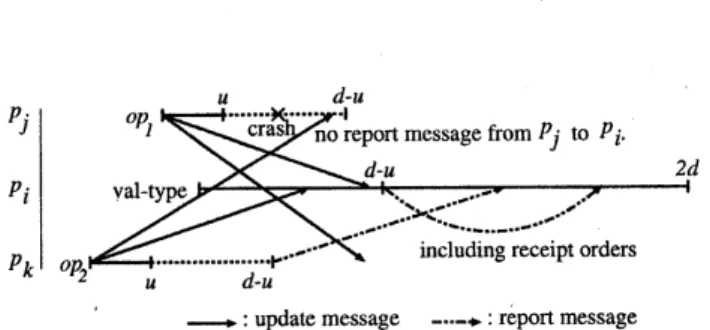
–:upoaremessage $-\sim$.$\mathrm{r}\mathrm{e}\mathrm{p}\mathrm{t}$)$\mathrm{r}\iota$Incssagc
Figure 7: Case where a process crashes before broadcasting a report message.
$op$is invokedat a process$pi,$$p_{i}$ broadcasts an
up-date message to inform of the invocation. After
$d-u$ since this invocation, $p_{i}$ regards the
oper-ation whose update messages $p_{i}$ received before
this time as operations prior to $op$ in the total
order, andbroadcasts this order by areport
mes-sage. We proved that a collection of such
prece-dence relation forms surely a partial order and
every process can obtain a,$\mathrm{c}\mathrm{o}\mathrm{m}\mathrm{m}\mathrm{o}\mathrm{n}$ total order
by extending it locally in a common rule. We
also showed that asubsetof the total order up to an operation $op$ can be decided after $2d$ since its
invocation. Therefore, the process can obtain its
response value at that time. Inthecaseofan
ack-type operation, since its response value is unique,
theprocess does not need$2d$ toobtain $a$response value but needs $u$ for linearizability.
Now we modify this implementation for
wait-freedom. Onlytheproblem is the case where some process crashes soon after some $\mathrm{a}\mathrm{c}\mathrm{k}$-type
opera-tion $op_{1}$ completed in the process. If the pro-cess crashes before broadcasting the correspond-ing report message, any other process is not in-formed of the precedence relation about this op-eration. Ifsome operation execution $op_{2}$precedes another operation execution $op_{1}$ as in Fig.7,
ev-ery process including$p_{i}$ receives an update
mes-sage of$op_{2}$ prior to an update message of$op_{1}$
.
In$general_{RB}-Ac$’ processes broadcast such receipt
orders in their report messages. When a process applies operationstoitslocal copy, ifsome report
message brings that an update message of $op_{2}$ is received before one of$op_{1}$ andno report message brings the reverse,the process applies$op_{2}$ prior to
$op_{1}$
.
This modification can achieve wait-freedomwithout additional response time.
Theorem 5 The implementation$general_{RBAC}-$
is a
wait-free
linea$r\dot{\eta}zable$ implementationof
any$dete7min\dot{i}Sti_{C}$ object which achieves
$re\mathit{8}_{-ti(}meopa)=u$ and $reS_{-ti(}meopv$) $=2d$ on a
reliable broadcast and asynchronous clock model.
$\blacksquare$
4.2 $u$-synchronous clocks
Next we propose an
imple-mentation $general_{RBuC}-$ of a general object on
$u$-synchronous clockmodel.
In this implementation, the common order to all processes is decided by a timestamp assigned to each operation. When an operation $op$ is
in-voked at$p_{i},$ $p_{i}$ assigns the value of its local clock
as a timestamp to $op$, and broadcasts an update
message with the timestamp. When a process re-ceives an update message, it stores the informa-tion in its update-bu$ffer$
.
Since the differencebetween any pair of local clock values is at most $u$ and message delays are at most $d$, the process
does not receive an update message with
smaner
timestamp thanan operation $op$ after $d+u$ since
the invocation of the operation $op$
.
Therefore, if $op$is$\mathrm{v}\mathrm{a}\mathrm{l}$-type,$p_{i}$ can decide thetot$a1$ order of
op-erations with smallertimestamp at that time and obt$a\mathrm{i}\mathrm{n}$ its response value. And then, it returns
the response. For an $\mathrm{a}\mathrm{c}\mathrm{k}$-type operation, the
pro-cess need not obtai$n$ its returned value but need
$u$ for linearizability. If a process crashes while
an operation, the operation is left pending. In
such a case, all correct processes receive the
up-date message, or no processes receive it because
ofareliable broadcast. Therefore, the
implemen-tation $general_{RB}-uc$ works correctly in the case
where a process crashes.
Theorem 6 The implementation$general_{RBuC}-$
is a
wait-free
linearizable implementationof
anydeterministic object which achieves
$reS_{-time(}O\mathrm{P}a)=u$ and $res-time(op_{v})=d+u$
on a reliable broadcast and $u$-synchronous clocks
model. $\blacksquare$
5
Conclusions
In this paper, we have presented the first wait-free linearizable implementations on a synchronous message passing system. We have consideredfour
types of models on exchange of message and
implemen-tations of $\mathrm{r}\mathrm{e}\mathrm{a}\mathrm{d}/\mathrm{w}\mathrm{r}\mathrm{i}\mathrm{t}\mathrm{e}$ registers, which are reli-$\mathrm{a}\mathrm{b}\mathrm{l}\mathrm{e}/\mathrm{u}\mathrm{n}\mathrm{r}\mathrm{e}\mathrm{l}\mathrm{i}\mathrm{a}\mathrm{b}\mathrm{l}\mathrm{e}$ broadcast and
asynchronous/u-synchronous clock models, and two
implemen-tations of general objects using reliable broad-casts on $\mathrm{a}\mathrm{s}\mathrm{y}\mathrm{n}\mathrm{c}\mathrm{h}\mathrm{r}\mathrm{o}\mathrm{n}\mathrm{Q}\mathrm{u}\mathrm{S}/u$-synchronous clock
mod-els (See Tab2).
In general, an implementation on an
asyn-chronous clock model needs longer worst-case re-sponse times than an implementation on a
u-synchronous clock model if the other conditions
are the same. In an asynchronous clock model, if processes in the system execute asynchronization procedure (e.g. procedure $\mathrm{S}\mathrm{y}n\mathrm{C}\mathrm{h}[7]$ for a reliable
broadcast model) to make the difference between any pair of local clock valuesatmost$u$,we can
ap-ply an implementation for a $u$-synchronous clock model. Taking costs of the synchronization pro-cedure into consideration, implementations for a
$u$-asynchronous clock model is more effective in
thecase where operations are invoked manytimes
in an asynchronous clock model.
Some open problems are left. Some lower bound results as to worst-case response times in linearizable implementations were $\mathrm{p}\mathrm{r}\mathrm{e}\mathrm{S}\mathrm{e}\mathrm{n}\mathrm{t}\mathrm{e}\mathrm{d}[2,3$,
4]. There are gaps between their results and our re$s$ults. The other open problem is about
lin-earizable implementations of general objects on
an unreliable broadcast model. We can easily
construct a wait-free linearizableimplementation
whichprovidesoperations with response time
pro-portional to the number of processes. However,
we do not know whether there exists a wait-free
linearizableimplementation which provides
oper-ations with shorter response time.
temational Workshop on Distributed
Algo-rithms$(LNCS\mathit{6}\mathit{4}7)$, pages 346-361, 1992.
[4] M. Inoue, T. Masuzawa, and N. Tokura.
Ef-ficient linearizable implementation of shared
fifo queues and general objects on a
dis-tributed system. IEICE Transactions on
Fun-damentals on Electronics,
Communications
and Computer Sciences, E81-A(5)$:768-775$,May 1998.
[5] M. Herlihy. Wait-free synchronization. A CM Transactions on Programming Languages and Systems, $13(1):124-149$, 1991.
[6] J. James and A. K. Singh. Fault tolerance
bounds for memory consistency. Proceedings
of
the 11th Intemational Workshop on $D_{\dot{i}}s-$tributed Algorithms (LNCS1320), pages
200-214, 1997.
[7] M. MavronicolasandD. Roth. Sequential con-sistency and $\mathrm{l}\mathrm{i}\mathrm{n}\mathrm{e}\mathrm{a}\mathrm{r}\mathrm{i}\mathrm{a}\mathrm{b}\mathrm{i}\mathrm{l}\mathrm{i}\mathrm{t}\mathrm{y}:\mathrm{r}\mathrm{e}\mathrm{a}\mathrm{d}/\mathrm{w}\mathrm{r}\mathrm{i}\mathrm{t}\mathrm{e}$ objects.
Proceedings
of
the 29th Annual Allerton $C_{\mathit{0}n}-$ference
on Communication, Control andCom-puting, Oct. 1991.
References
[1] M. Herlihy and J. Wing. Linearizability: A correctness condition for concurrent ob-jects. ACM Transaction on Programming
Languages and Systems, $12(3):463-492$, 1990. [2] H. Attiya and J. L. Welch. Sequential
con-sistency versus linearizability. ACM Trans-actions on Computer Systems, $12(2):91-122$, May 1994.
[3] M. Mavronicolas and D. Roth.
Effi-cient, strongly consistent implementations of