The
tensor
structure
of the original
Navier-Stokes
equations
SHIGERU MASUDA
Graduate school ofTokyoMetropolitan University, doctoral cource in mathematics E-mail: [email protected]
Abstract
The two-constants theory introduced first by Laplace in 1805 is currently accepted theory describing isotropic, linear elasticity. The original, macroscopically-descriptive Navier-Stokesequations [MDNS
equa-tions]werederivedin thecourseofthe development thetwo-constantstheory. Fromthe viewpoint ofMDNS
equations, we tracetheevolution ofthe equations and the notionof tensor following in historical order the various contributions ofNavier, Cauchy, Poisson, Saint-Venant and Stokesl, and note the concordance be-tween each.
Keywords. the microscopically descriptive equation, the Navier-Stokesequations, mathematicalhistory.
1
Preliminary
Remarks
In this report, we
use
the followingdefinition of the stresstensor, due toI. Imai[7, p.178]:we
calla
$P$ of$3\cross 3$matrix such as $P$ a stress tensor that returns a
new
vector $P_{n}$ when multiplied from the right by the columnvectorof directional cosines :
$\{\begin{array}{l}P_{nx}P_{ny}P_{nz}\end{array}\}=\{\begin{array}{lll}p_{xx} p_{?/x} p_{zx}p_{xy} p_{yy} p_{zy}p_{xz} Pyz p_{zz}\end{array}\}\{\begin{array}{l}lmn\end{array}\}$ $\Rightarrow$ $P_{n}=P\cdot n$
Moreover, if$p_{ij}=p_{ji}$ for all $i.j=x,$$y,$$z$ then this tensor is said to be symmetric. If
we
suppose forexample$t_{ij}$ is the $(i, j)$ element of amatrix, and $t_{tj}=-t_{ji}$ then anti-symmetric
or
skew-symmetric. Troughout thepaper, we display for brevity a tensor by specifying its components, such
as
$\delta_{ij}$ of the well-known Kronecker $\delta$.Furthermore, we write $v_{k,k}= \sum_{i=1}^{3}\vec{\partial x}\partial v$
.
$= \frac{du}{dx}+\frac{dv}{dy}+\frac{dw}{dz}\cdots$ where we have the Einsteinconvention2.
Simpli-fications
occur
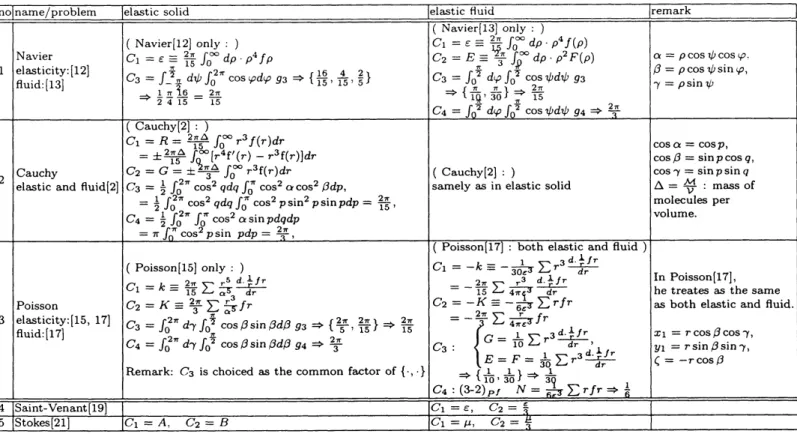
as, for example, in Navier’s elasticity of (1-1) in Table 4 where the tensor can be expressedas
follows:
$- \epsilon[\{+\frac{d_{?}}{d}++3(\frac{d\iota}{d_{t}}\frac\frac{dc\iota}{dydv,/dyv)}++\frac{du}{(dz}\frac{dv}{dx}\frac{du\{}{dx}\frac{dwdvdx}{dz}\frac++\frac\frac{du}{dz}\}]$
$=- \in[+\frac{dvux}{dudx,dz}2\frac{d}{d}$ $\frac{d}{}+\frac{dy\epsilon dvu}{dz}+\frac{\frac ddd\frac xdvvd^{1/}w}{dy}+2$ $\frac{}{\frac{dwdvdx}{dz\epsilon}}++2\frac{\frac{du}{dwd\tau/dwdzdz}}{}+\frac]$
, (1)
where $\epsilon=\frac{du}{dx}+\frac{dv}{d\tau/}+\frac{dw}{dz}$
Expressions in Poisson’selasticity (3-1) in Table 4
are
also ofsimilar style.Moreover,
we
can
easily express Navier’s stress tensor$t_{ij}$ ofelasticityin the form: $t_{ig}=-\epsilon(\delta_{ij}u_{k,k}+u_{\iota,j}+u_{j,i})$.Stokes’ fluid theory (20) or (5) in Table 4 affords a second illustration: $t_{ij}=(-p- \frac{2}{3}\mu?fk,k)\delta_{lJ}+\mu(v_{i,j}+v_{j,i})$,
orthe equivalent expression $\sigma_{ij}=-p\delta_{ij}+\mu(\vec{\partial x_{J}}\partial\tau’+\frac{\partial}{\partial}\lrcorner^{v})-\frac{2}{3}\delta_{ij^{\frac{\partial}{\partial}L}}^{\tau’.3}$ In what follows, ${}^{t}tensor$”means the stress
tensor as defined by I. Imai. 4 When referring to a :fluid“, an “elastic fluid’: is implied.
2
Introduction
We have studied the original MDNS equations as the
progenitors5,
Navier, Cauchy, Poisson, Saint-Venantand Stokes, andendeavor to acertain their aims and conceptual thoughts in formulations these
new
equations.“The two-constants theory” was introduced first introduced in 1805 by
Laplace6
in regard to capillary actionwith constants denoted by $H$ and $K$ (cf. Table 2, 3). Thereafter, various pairsof constants have been proposed
by their originators in formulating MDNS equations
or
equations describing equilibriumorcapillary situations.It is commonly accepted that this theory describes isotropic, linear
elasticity.7
We argue that Poisson hadalready pointed out the special aspect deduced by Laplacewhen, in 1831, he states, ‘elles renferment les deux
constantes sp\’eciales donc$j$’ai parl\’e tout \‘al’heure’ [18, p.4]. Poisson was, wethink, oneof the persons who were
aware
of this issue.lNavier(1785-1836), Cauchy(1789-1857), Poisson(1781-1840), Saint-Venant(1797-1886), Stokes(1819-1903).
2Remark: in general, $n_{k,k}\neq n_{\iota.j}$, because the summationconvention is in forcewhen thereisarepetition of indices.
$3_{c.f}$. Schlichting [20], in ourfootnote(19).
4Numbers on the Left-hand-side of equations referto those given by the author in the original paper while numberson the
right-hand-side correspond toour indexing. The subscript to the original indexing, for example $N^{e}/N^{f}$, referto author andtype
of theory, such as “elastic/fluid by Navier“. For equations indexed by section, the citation is then in the format “section no.-no. by author“.
5Theorder followedis by date ofproposal or publication.
6Ofcapillaryaction, Laplace[8, V.4, Supplement p.2] achnowledges Clailaut[3, p.22], and Clailautcites Maupertuis[10].
7Darrigol [4. p. 121].
3
A
universal
method for the
two-constants
theory
Now, we would like to propose the uniformal methods to describe the kinetic equations for isotropic, linear
elasticity
.
such as:The partial differential equations ofthe elastic solid or elastic fluid areexpressed by using
one
or the pairof$C_{1}$ and $C_{2}^{Y}$ such that
in the elastic solid: $\frac{\partial^{2}}{\partial t}\tau u-(C_{1}T_{1}+C_{2}T_{2})=f$,
In the elastic fluid: $\frac{\partial u}{\partial t}-(C_{1}T_{1}+C_{2}T_{2})+\cdot\cdot$ $=f$,
where$T_{1},$ $T_{2},$$\cdot$ $\cdot$ aretensorsorterms consistingourequations, wherewesuppose the tensorasthe first kind.
Forexample,the MDNSequationsionscorrespondingto incompressible fluid is composed of the kinetic equation
along with the continuity equation andare conventionally written, in modem vector notation,
as
follows :$\frac{\partial u}{\partial t}-\mu\triangle u+u\cdot\nabla u+\nabla p=f$, divu$=0$. (2)
.
$C_{1}$ and $C_{2}$are
the two coefficients of the two-constants theory, for example, $\epsilon$ and $E$ by Navier, or $R$ and$G$ by Cauchy, $k$ and $K$ by Poisson, $\in$ and $\frac{\epsilon}{3}$ by Saint-Venant, or $\mu$ and $\mu 3$ by Stokes. Moreover $C_{1}$ and $C_{2}$
can
be expressed inthefollowing form:
$\{\begin{array}{l}C_{1}\equiv \mathcal{L}r_{1}g_{1}S_{1},\{\end{array}$
$S_{1}= \int\int g_{3}arrow C_{3}$,
$C_{2}\equiv \mathcal{L}r_{2}g_{2}S_{2}$, $S_{2}= \int\int g_{4}arrow C_{4}$,
$\Rightarrow$ $\{\begin{array}{l}C_{1}=C_{3}\mathcal{L}r_{1}g_{1}=\frac{2\pi}{15}\mathcal{L}r_{1}g_{1)}C_{2}=C_{4}\mathcal{L}r_{2}g_{2}=\frac{2\pi}{3}\mathcal{L}r_{2}g_{2}.\end{array}$
.
The two coefficientsare
expressible in terms ofthe operator $\mathcal{L}$$( \sum_{0}^{\infty}$ or $\int_{0}^{\infty})$ by personal principles or
methods, where$r_{1}$ and $r_{2}$ arethe radialfunctions related to the radius ofthe active sphere of the molecules.
$g_{1}$ and$g_{2}$ are thecertain functions which depend on $r$ and
are
describedwithattraction&/or
repulsion.$S_{1}$ and $S_{2}$are thetwo expressions whichdescribe the surface of active unit-sphereatthe center of
a
moleculeby the double integral (or single
sum
incase
ofPoisson’sfluid).$g_{3}$ and $g_{4}$
are
certain compound trigonometric functions to calculatethe momentum in the unit sphere..
$C_{3}$ and $C_{4}$are
indirectly determinedas
thecommon
coefficients from the invariant tensor. Except for Poisson’s fluid case, $C_{3}$ of$C_{1}$ is $\frac{2\pi}{3}$, and $C_{4}$ of$C_{2}$ is $21F$, which are calculated from the total momentumoftheactivesphere of the molecules in computing only by integral, and which are independent
on
personal manner.In Poisson’s case, after multiplying by $\frac{1}{4\pi}$, we get the
same as
above..
The ratio of the two coefficients including Poisson’scase
is alwayssame
as :al
$= \frac{1}{5}$.4
A genealogy and
convergence
of
stress tensor
Weshow in the figure 1, a genealogy tracing in paticular the formofthe tensor $t_{ij}$ appearing in the
Navier-Stokesequations. In Table 4,wedifferentiate the tensors associated with elastic solidsorelasticfluids. $\mathbb{R}om$this
genealogy, it could be asserted that Cauchy[l, 2] wasthe inventor orthefirst
user
of tensors,a
view supportedby the admissionof Poisson[17] that he received the idea of symmetric tensor from Cauchy. Moreover, the idea
ofSaint-Venant reappearsinthe work ofStokes. Here,wedenotethe two routesas NCP and PSS, both of which
are portrayed in
our
figure, and by which,we
can explain the genealogy oftensoras
it applies to the MDNSequations. cf. Table4.
(fig.1) A genealogy
of
stress tensors inthe prototypical Navier-Stokes equationsNavier $[12||’ 13]J[$ $t_{i_{J}}^{e}\cdot=-\in(\delta_{ij}u_{k,k}+u_{i,j}\backslash +u_{j,i}),$ $t_{zj}^{f}=(p-\in u_{k,k})\delta_{ij}-\in(u_{i,j}+u_{j,i})$ $\nearrow$ $(Euler)\Rightarrow^{\backslash }$ ...
$\Downarrow\Uparrow\Vert Poisson[15,17]$
.
$\Rightarrow^{\nearrow}$Saint-Venant[19]$\dagger$ $\Rightarrow$ Stokes$[21]\ddagger$
Cauchy[1, 2] : $t_{ij}^{e,f}=\lambda v_{k,k}\delta_{\iota j}+\mu(v_{ij}+v_{ji})$
$\circ$ Poisson : $t_{ij}^{e}=- \frac{a^{2}}{3}(\delta_{ij}u_{k,k}+u_{i,j}+u_{g,i}),$ $t_{ij}^{f}=-p\delta_{ij}+\lambda v_{kk}\delta_{ig}+\mu(v_{i,j}+v_{g,i})$
\dagger Saint-Venant : $t_{ij}^{j}=$ $( \frac{1}{3} (P.. +P_{yy}+P_{zz})-\frac{2\epsilon}{3}v_{k,k})\delta_{ij}+\in(v_{ij}+v_{j,i}),$ $\frac{1}{3}(P_{xx}+P_{yy}+P_{zz})=-p$
\ddagger Stokes: $t_{ij}^{f}=(-p- \frac{2}{3}\mu v_{k,k})\delta_{ij}+\mu(v_{\iota,j}+v_{g,\iota})$,
O Poisson says his reducing of tensor elements to6 from 9is due to Cauchy. (cf.\S 5.2).
5
Deductions of two constants and tensor
Recently Darrigol [4, p.121] has concluded: ‘it is called that thetwo-constantstheoryis the
one now
acceptedfor isotropic, linear elasticity,’ but Poisson [18, p.4] has stated already in 1831. ‘elles renferment les deux
constantes sp\’eciales donc $j$’ai parl\’e tout \‘a 1‘heure.’ Moreover,
we
believe that the first proposer ofTable 1: $C_{1},$$C_{2},$$C_{3)}C_{4}$ the constant of definitions and computing of total momentum of molecular actionsby
5.1
Navier’s two constants
and
tensor
Inhistheoryof elasticity, Navier deduced thesingleconstant$\in$in(l). Thecorresponding Navier-Stokesequations
by Navier himself forthe incompressible fluid (2)
are
asfollow :$\{\begin{array}{l}\frac{1}{\rho}\overline{d}xdp=X+\epsilon(3\frac{d^{2}}{dx}uF+\frac{d^{2}}{dy}ur+\frac{d}{}dz=^{u}2+2\frac{d^{2}v}{dxdy}+2\frac{d^{2}w}{dxdz})-\frac{du}{dt}-\frac{du}{dx}\cdot u-\frac{du}{dy}\cdot v-\frac{du}{dz}\cdot w;\frac{1}{\frac,\rho\rho 1}dR\frac{d}{d}Rz\frac{d}{d}d2xxTw+d^{2}d=^{w}y+3\frac{d^{2}}{dz}\tau w+\frac{d^{2}uxdyd^{2}u}{dxdz}+\frac{d^{2}yw)d^{2}v}{dydz})-\frac{dwvt}{dt}-\frac{dw}{dx}\cdot u-\frac{dw}{dy}v-\frac{dw}{dz}w=^{v}=^{v}d^{2}d^{2}v;\end{array}$
(3)
along with the equationof continuity: $\frac{du}{dx}+\frac{dv}{dy}+\frac{dw}{dz}=0$. Navier supposes two constants
as
follows :(3-10) $\epsilon\equiv\frac{8\pi}{30}\int_{0}^{\infty}d\rho\rho^{4}f(\rho)=\frac{4\pi}{15}\int_{0}^{\infty}d\rho\rho^{4}f(\rho)$, $E \equiv\frac{4\pi}{6}\int_{0}^{\infty}d\rho\rho^{2}F(\rho)=\frac{2\pi}{3}\int_{0}^{\infty}d\rho\rho^{2}F(\rho)$. (4)
In the
case
of fluid, Navierwas
wellaware
of necessity for the equation of continuity, because from (3) heobtained $\epsilon\Delta$, by defferentiating the equation
ofcontinuity with $\frac{d}{dx},$$\frac{d}{dy},$$\frac{d}{dz}$. For example, the $\in$-terms in (3),
as
wellas
(5)are
reduced to $\epsilon\triangle u$ in (6). This is solely due to the massconservative law, according to the
explaination given by Navier.
As anaside, Navier always used his well-used mathematical methods involvingafour-stepsprocedureto solve
the three equations such
as
the equilibrium equation for thefluid [13], the kinetic equationfor the elastic [12],and thekinetic equation forthefluid [13] with the general methods
as
follows:$\circ$ initially, to deduce
one or
two constants including uncomputablefunctions: $g_{1},$ $g_{2}$ i.e. $f\rho,$ $f(\rho)$
or
$F(\rho)$ inTable 2,
.
then, to construct the indeterminate equation, which he denoted the nomencrature of “equation
undeter-minant” (cf.
.
\S 5.1.1),
then, to make Taylor series expansion and partial integration, exchanging $d$ and $\delta$, and pairing with the
same
.
integral operator,andfinally, to solve the indeterminateequation from the twopoints ofview, theinterior andthe boundary.
We present
more
details of this procedure by outlining Navier’s analysis of fluid flow[13].5.1.1 Indeterminate equation
The indeterminate equation, so-called then by Navier, is
as
follows:(3-24) $f$ $0$ $=$ $\int\int\int dxdydz\{[[Q-\frac{d}{\overline dd}R-\rho\{\begin{array}{l}\frac{du}{dt}+u\frac{du}{dx}+v\frac{du}{dy}+w\frac{du}{dz})]\delta u\frac{dv}{dt}+u\frac{dv}{dx}+v\frac{dv}{dy}+w\frac{dv}{dz})]\delta v\frac{dw}{dt}+u\frac{dw}{dx}+v\frac{dw}{dy}+w\frac{dw}{dz})]\delta w\end{array}$
$-$ $\in\int\int\int dxdydz\{\{\begin{array}{l}3\frac{du}{dx}\frac{\delta du}{dx}+\frac{du}{dy}\frac{\delta du}{dy}+\frac{du}{dz}\frac{\delta du}{dz})+(\frac{dv}{dy}\frac{\delta du}{dx}+\frac{dv}{dx}\frac{\delta du}{dy})+(\frac{dw}{dz}\frac{\delta du}{dx}+\frac{dw}{dx}\frac{\delta du}{dz})\frac{du}{dx}\frac{\delta dv}{dy}+\frac{du}{dy}\frac{\delta dv}{dx})+(\frac{dv}{dx}\frac{\delta dv}{dx}+3\frac{dv}{dy}\frac{\delta dv}{dy}+\frac{dv}{dz}\frac{\delta dv}{dz})+(\frac{dw}{dy}\frac{\delta dv}{dz}+\frac{dw}{dz}\frac{\delta dv}{dy})\frac{du}{dx}\frac{\delta dw}{dz}+\frac{du}{dz}\frac{\delta dw}{dx})+(\frac{dv}{dy}\frac{\delta dw}{dz}+\frac{dv}{dz}\frac{\delta dw}{dy})+(\frac{dw}{dx}\frac{\delta dw}{dx}+\frac{dw}{dy}\frac{\delta dw}{dy}+3\frac{dw}{dz}\frac{\delta dw}{dz})\end{array}$
5.1.2 Determinated equation operated by Taylor expansion and partial integral
Putting $Sds^{2}E(u\delta u+v\delta v+w\delta w)=0$ of indeterminate equation (5) and performing
a
Taylor series expansionto first-order and neglecting higher-order terms,
we
getas
follows:(3-29) $0=$ $\int\int\int dxdydz\{[[[R_{dz}^{-1}Q_{\overline{d}y}^{d}P_{dx}^{d}--dz_{-\rho}z_{-\rho}-\rho\{\begin{array}{l}\frac{du}{dt}+u\frac{du}{dx}+v\frac{du}{dy}+w\frac{du}{dz})+c(\frac{d}{d}xT2u+\frac{d^{2}}{dy}\tau+d=z)]\delta u\frac{dv}{dt}+u\frac{dv}{dx}+\tau\frac{dv}{dy}+w\frac{dv}{dz})+\in(d^{2}vd^{2}vvdxdy\frac{dw}{dt}+u\frac{dw}{dx}+?)\frac{dw}{dy}+w\frac{dw}{dz})+\epsilon(=+\frac{d}{d}=^{w}2y+=d^{2}dzw)]\delta w\end{array}$ (6)
From (6) we get (3) i.e. the kinetic equationwhich is the firstexpression of(2).
5.1.3 Determinated equation deduced from boundary condition
As the boundary condition, Navier
uses
two constants inone
equation. In this aspect, his method is theuniqueamong the original formulators. Navier explains as follows: regardingthe conditions which react at the
points
.
ofthe surface of the fluid. ifwe
substitute$dydz$ $arrow$ $ds^{2}\cos 1$, where
1
: the angles by which the tangent plane makes with the yz-planeon
thesurface frame,
.
$dxdz$ $arrow$ $ds^{2}\cos m$, where $m$ : similarly$m$ is the angles with the xz-plane,
$edxdy$ $arrow$ $ds^{2}\cos n$, where $n$ : samilarly, $n$ is the angles with the xy-plane,
.
$\iint d\tau/dz,$$\iint dxdz$.
$\iint dxdy$ $arrow$ $Sds^{2}$, where $S$ is the unit normal to the surface at this point,then becausethefactorsmultiply$\delta u,$$\delta v$and$\delta w$respectivelyreduce to zero,thefollowing determinated equations
should hold for any points of the surface ofthe fluid element:
(3-32) $\{\begin{array}{l}E_{?)}+\epsilon[\cos l(\frac{dxdudu}{dy}Eu+\epsilon[\cos l2\frac+\cos m(\frac{du}{dy}+\frac{d}{2d}+\cos n+\frac{dv}{dx})+\cos m\frac{xv)dv}{dy}+\cos n\}_{\frac+\frac)])}^{\frac{du}{dzdvdz}+\frac{dw}{dwdydx})]=0}=0’Ew+\in[\cos l(\frac{dw}{dx}+\frac{du}{dz})+\cos m(\frac{dw}{dy}+\frac{dv}{dz})+\cos n2\frac{dw}{dz}]=0.\end{array}$ (7)
Here the value of the constant $E$ must vary in accordance with the nature of solid with which the fluid is in
contact. Theequationsof(7)
are an
expressionofconditions prevailingon
the boundary condition of the surfaceand constitute the so-called boundary conditions. The first terms of the left-hand-side of (7)
are
defined in (4)for the expressionthat
we
seek for thesum
of the momenta ofall interactions arising between the moleculeson
the boundary and the fluid, while the second terms
are
the normal derivatives. Here, derivative termson
theleft-hand-side of (7) areexpressible
as
$\iota_{i,j}+u_{j,i}$.5.2
Cauchy’s two
constants
and tensor
(Definition) We suppose that
$a,$ $b,$ $c$: thecoordinate valuesof
a
molecule $m$in therectanglaraxes
by$x$.
$y_{\rangle}z;$ $\cdot a+\triangle a,$ $b+\triangle b,$ $c+\triangle c$: thecoordinates of
an
arbitrary molecule $m$ ; $\xi,$ $\eta,$ $\zeta$ : the functions of$a$.
$b,$ $c$,which representthe infinitesimaldisplacements, and are parallel to the
axes
of a molecule $m$ ; $o(x. y, z),$ $(x+\triangle x, y+\triangle y, z+\triangle z)$ : thecoordinates of the molecules $m$ and $m$ in the new stateof the system ;
.
$r(1+\in)$ : the distance between themolecule $m$ and $m$ ;
.
$\in:$ the dilatation of the length $r$ in the path from the first state to the second, andthen we have $x=a+\xi,$ $y=b+\eta$. $z=c+\zeta$ ;
.
X. $Y,$ $Z$ . the quantities ofthe algebraic projections.Cauchy deduces the three elements $X,$ $Y,$ $Z$ in the sysytemofmeterial points of elasticity after calculating
the interactions of molecules, the details ofwhich
are
omitted for sake of brevity. Moreover we start with thefollowing equationofelasticity
(40) $\{\begin{array}{l}X=(L+c)_{\partial}^{\partial}A_{a}^{2}+(R+H)\frac{\partial^{2}}{\partial b}\xi+(Q+I)\frac{\partial^{2}}{\partial c}\xi+2R\frac{\partial^{2}\eta}{\partial a\partial b}+2Q\frac{\partial^{2}\zeta}{\partial c\partial a},Y=(R+G)\frac{\partial}{\partial}a\phi 2+(M+H)\partial\partial 4^{2}b+(P+I)\partial\partial 4^{2}c+2P\frac{\partial^{2}\zeta}{\partial b\partial c}+2R\frac{\partial^{2}\xi}{\partial a\partial b},Z=(Q+G)\frac{\partial^{2}\zeta}{\partial a^{2}}+(P+H)\frac{\partial^{2}\zeta}{\partial b^{2}}+(N+I)\frac{\partial^{2}\zeta}{\partial c^{2}}+2Q\frac{\partial^{2}\xi}{\partial c\partial a}+2P_{b\partial_{C}^{L}}^{2}\frac{\partial}{\partial}\lrcorner\end{array}$
(The invariants of the tensor
are
represented by the twoconstants of$G$ and $R$. )Cauchy says about the elements oftensor i.e. the invariable values G. H.$I,$$L$,M.$N,$$P,$$Q,$ $R$:
If we suppose that the molecules $m$.$m’,$$m$“, are originally allocated by the
same
way in relation to thethree planes made by the molecule $m$in parallel with the plane coordinates, then the valuesof these quantities
come
to remain invariable, even though aseries ofchanges are made among the three angles : $\alpha.\beta.\gamma$.Cauchy considers symmetric tensor such that
(46) $\{_{Z(R+G^{\gamma})}Y==(R+G^{Y})\}_{\frac+\frac+\frac}^{\frac+\frac+\frac\}_{+2R\frac}^{+2R\frac}}+2R\frac{\partial a\partial\nu\partial_{\mathcal{U}}}{\partial\nu,\partial c\partial b}\}$ (47) $\iota\nearrow=\frac{\partial\xi}{\partial a}+\frac{\partial\eta}{\partial b}+\frac{\partial\zeta}{\partial c}$
Cauchymaybe theinventorofthe
nomenclature8
of “tensor“, andPoisson backsup thestructure ofsymmetrysuch that his idea reducing from 9 to 6 elements is due to Cauchy,
as
follows :D’un autre c\^ot\’e, il faut, pour l’equilibre d’un parall\’el\’epip\‘ede rectangle d’une \’etendue insensible, que
les neuf composantes des pressions appliqu\’ees \‘ases trois faces non-parall\’elles, se r\’eduisent \‘asix forces qui peuvent\^etre in\’egales. Cette proposition est due \‘aM.Cauchy, et sed\’eduit de laconsid\’eration desmomens.
[17, \S 38, p.83]
Continuing,
we
define the densityof molecules as: (48)$c$ $\triangle=\frac{\mathcal{M}}{v}$, where, $\Lambda\Lambda$ isthesum ofthemass
of moleculescontained inthe sphereandV isthevolume of thesphere. Wethefindexpression forthetwo constants, $G$ and
$R$:
(50)$c$ $\{\begin{array}{l}G=\pm\frac{\Delta}{2}\int_{0}^{\infty}\int_{0}^{2\pi}\int_{0}^{\pi}r^{3}f(r)\cos^{2}\alpha\sin pdrdqdp =\pm\frac{2\pi\Delta}{3}\int_{0}^{\infty}r^{3}f(r)dr,R=\frac{\Delta}{2}\int_{0}^{\infty}\int_{0}^{2\pi}\int_{0}^{\pi}r^{3}f(r)\cos^{2}\alpha\cos^{2}\beta\sin pdrdqdp =\frac{2\pi\triangle}{15}\int_{0}^{\infty}r^{3}f(r)dr=\pm\frac{2\pi\Delta}{15}\int_{0}^{\infty}[r^{4}f’(r)-r^{3}f(r)]dr\end{array}$ (8)
When wecalculate these values in the general
case
then (8) yieldsthe following expressions:(56) $\{B\equiv C\equiv\{\begin{array}{l}(L+G)_{\delta a}^{\partial\xi}+(R-G)\frac{\partial\eta}{\partial b}+(Q-G)\frac{\partial}{\partial}\leq_{c}]\triangle,(R-H)\frac{\partial}{\partial}4a+(M+H)\frac{\partial\eta}{\partial b}+(P-H)_{\partial c}^{\partial}\Delta]\Delta,(Q-I)\frac{\partial\xi}{\partial a}+(P-I)_{\partial b}^{\partial}\Delta+(N+I)\frac{\partial\zeta}{\partial c}]\Delta,\end{array}$ (57) $\{E\equiv D\equiv F\equiv\ovalbox{\tt\small REJECT}$
$(Q+G)+(Q+I)_{\partial c}^{\partial}(P+I) \frac{\partial\eta}{\partial c,\Delta\partial a\partial}+(P+H)_{\partial b}^{\partial}1\Delta f_{\triangle}^{\triangle},$
’
$(R+H)_{\partial b}^{\partial} \angle+(R+G)\frac{\partial\eta}{\partial a}]\Delta$,
$\frac{BA}{\Delta}=2(R+G)_{\check{\partial})}^{t_{a}^{45)_{C},weobtaintefo11owingreucedform:}}y(41)_{C}and4+(R-G)v\frac{hB}{\triangle}=2(R+G)\frac{\partial\eta d}{\partial b}+(R-G)v$
, $\frac{c}{\triangle}=2(R+G)\frac{\partial\zeta}{\partial c}+(R-G)v$,
$\frac{D}{\triangle}=(R+G)(\frac{\partial\eta}{\partial b}+\frac{\partial\zeta}{\partial c})$ , $\frac{E}{\triangle}=(R+G)(\frac{\partial\zeta}{\partial a}+\frac{\partial}{\partial}\xi c)$ , $\frac{F}{\triangle}=(R+G)(\frac{\partial\xi}{\partial b}+\frac{\partial\eta}{\partial a})$
For convenience’sake, in thepaticularcasewhenboth(41) and (45)$c$ hold, itissufficient to have: (59)$c$ $(R+$
$G) \triangle\equiv\frac{1}{2}k$, $(R-G)\triangle\equiv K$, $\Rightarrow$ $2R= \frac{k+2K}{2\triangle}$
.
Equations (56)$c$ and (57)$c$can
be displayed in amore
convenient manner
(60) $\Rightarrow$ $\{\begin{array}{lll}A F EF B DE D C\end{array}\}$ $=$ $[k \frac{\partial\xi}{k,k\partial\alpha\}}+Kv\frac{1}{\{2}k(+\frac{\partial\eta}{\partial a})\frac{1}{2}k\frac{1}{2}\frac{\partial}{\partial}b+\frac{\partial\eta}{\partial,\partial a\leq\partial c}k\frac{\partial\leq\overline{\partial}b\partial\eta}{k(\partial b}+Kv_{\partial_{b}}\frac{1}{)^{2}}k\frac{1}{2}\delta a\partial\zeta+\frac{1}{2}\frac{\partial\eta}{\partial c}+\not\in+^{\partial}Kv\frac+^{\partial}\Delta_{b}\frac{\partial\zeta}{\partial\eta\partial a,\partial c\#^{\partial}}+^{\partial}4]$ (9)
Here, we must remark that the layout ofsymmetric tensor of (58)$c$
or
(60)$c$ is the Cauchy’s invention. If,moreover, the condition (54)$c$ :
$R=-G$
holds, then $k=0$ holds, thus yielding the following identities:(61)$c$
$A=B=C=Kv$
,$D=E=F=0$
.5.2.1 Equilibrium and kinetic equation of fluid by Cauchy
In what follows, equations referringto Cauchy’s work
on
fluids will be designated in the form $(\cdot)_{C}$.
insteadby $(\cdot)_{C}$ to distinguishthese from equations appearing in his work onelasticity above.
$($ Verification of equations in fluid. )
By replacing $(a, b, c)$ of (56) and (57) with $(x, y, z)$, we derive
an
equvalent setofequationsforfluid as forelasticity. We omite for the sake ofbrevity the pricese processes in leading to the two constants or equations
and present the final form
(76)
.
$\{\begin{array}{l}\frac{\partial A}{\partial x}+\frac{\partial F}{\partial y}+\frac{\partial E}{\partial z}+X\triangle=0,\frac{c9F}{\partial x}+\frac{\partial B}{\partial y}+\frac{\partial D}{\partial z}+Y\triangle=0,\frac{\partial E}{\partial x}+\frac{\partial D}{\partial y}+\frac{\partial C}{\partial z}+Z\triangle=0,\end{array}$ $\Rightarrow$ $\{\begin{array}{lll}A F EF B DE D C\end{array}\}$ $[ \frac\frac\frac{\partial\partial j’ff\partial}{\partial z}]$ $+\triangle\{\begin{array}{l}XYZ\end{array}\}$ $=0$We followthe layout ofCauchy’s symmetric tensor as presented originally in (76) $\cdot\cdot$ By replacing $R+G$ and
$motionandinequi1ibriumtothesame2RwithCauchy’ susageC_{1}\equiv R+G=\frac{k}{2\triangle,m},C_{2}\equiv 2R=\frac{k+2K}{e1ast2\triangle},wefor(46)_{C}foundforicity$
. $canreducetheseequationsoffluidsinHowever,here,wewouldliketoadopt$
not Cauchy’s $C_{1}$ and $C_{2}$, but $C_{1}=R$ and $C_{2}=G$, because it is
more
rational to do so,as we
can seen
bychecking the reciprocal coincidence in Table $2^{}$
8The editors of Hamilton’spapers $[$6,p.237, footnote$]$ say, ‘ Thewriter believes that what originally led him to usethe terms
‘modulus’and ‘amplitude,’ was arecollection ofM. Cauchy’s nomenclature respecting the usual imaginaries of algebra.“
(Comparison with and commentd
on
Navier’s equation in elasticity. )Cauchy states: for the reduction of the equations (79) $\cdot\cdot$ and(80)
.
toNavier’sequations( [12]) todeterminethe law ofequilibrium and elasticity, it is necessary to
assume
suchas
the condition whichwe
have mentionedabove : $k=2K$. According to Cauchy$s$ assertion, if $G=0$ then
we
getas
the equations ofequiliblium andthe kineticequations in equal elasticity, then the tensor is equivalent with the tensor not only of the elastic but
also of$\in$ in Navier’s fluid equation (3) (c.f. Table 4).
5.3
Poisson’s
two
constants
and
tensor
5.3.1 Principle and equations in elastic solid
Below, we deduce $K$ and $k$ according to Poisson[15, pp.368-405,
\S 1-\S 16].
For brevity, we introduce thefollowing definitions:
$\{\begin{array}{l}ax_{1}+by_{1}+c(z_{1}-\zeta_{1})\equiv\phi,a’x_{1}+b’y_{1}+c’(z_{1}-\zeta_{1})\equiv\psi,\end{array}$ $\{\begin{array}{l}\phi\frac{du}{dx}+\psi\frac{du}{dy}+\theta\frac{du}{dz}\equiv\phi’.\phi\frac{dv}{dx}+\psi\frac{dv}{dy}+\theta\frac{dv}{dz}\equiv\psi’,\end{array}$
$a”x_{1}+b’’y_{1}+c’’(z_{1}-\zeta_{1})\equiv\theta$, $\phi\frac{dw}{dx}+\psi\frac{dw}{dy}+\theta\frac{dw}{dz}\equiv\theta’$
(10)
We
assume
that $\alpha$ is the average molecular distance, $\omega$ presentsa
finite surface area, and $I\alpha\omega$ is the averagenumberof molecules in $\alpha$). Wethen get the pressure terms.
$P= \sum\frac{(\phi+\phi’)\zeta}{\alpha^{3}r}fr’$, $Q= \sum\frac{(\psi+\psi’)\zeta}{\alpha^{3}r’}fr’$ $R= \sum\frac{(\theta+\theta’)\zeta}{\alpha^{3}r}fr’$. (11)
By using his so-called
effective
transformation,10,
we
get from (11) the following:$1_{R=\int_{0}^{\frac{\pi}{2}}\int}^{Q=\int_{0}^{\frac{\pi}{2}}}= \int^{\pi}\int_{2\pi}\int_{0}^{2\pi}^{P}02\pi\{\begin{array}{l}(9+g’)\sum_{\frac{f}{a}F}\frac{f}{\alpha}\tau fr+(gg’,+hh’+ll’)g\sum\frac{r}{\alpha}F^{\frac{d^{\underline{1}}fr}{\frac{d^{d_{\underline{1}}r}jr}{dr}}]_{\Delta_{1}}^{\Delta}}(h+h’)\sum^{3}fr+(gg+hh’+ll’)h\sum^{5}s5\frac{r}{\alpha}\tau’(l+l’)\sum^{3}\frac{r}{a}\tau fr+(gg’+hh’+ll’)l\sum\frac{r}{\alpha}r^{\frac{d^{\underline{1}}\int r}{dr}]\Delta}5,\end{array}$ $\triangle$ $:=\cos\beta\cdot\sin\beta d\beta d\gamma$, (12)
Later, Poisson recalculates this problem in another book $[$17$]^{}$ , in which he deduces the general principles
behind elasticity and fluid, and hence derives the representive two-constants with $K$ and $k$ for both elasticity
and fluids
as
follows:$1_{R=}^{P=}Q=\{$ (13)
where, for abbreviation, he uses similarly $K$ and $k$. Moreover, instead of $\alpha$ in (11), he introduces $\in$
as
theaverage
.
distance between molecules, and from the following considerations:on voitquela pression$N$ restera]am\^emeen tous
sens
autour dece
point : ellesera
normale\‘ace
plan etdirig\’ee dedehors
en
dedans de $A$,ou
de dedansen
dehors, selonquesa
value serapositiveou
negative, $[\Rightarrow$we
see
thatthe pressure $N$ orients omnidirectionally aroundan
arbitrary point : $A$, and from outward into inwardor from inward tooutward, accordingto that the value willbe positiveornegative, (then weought to consider
as
$\frac{1}{2});]$.
from the suppositionof isotropy and homogeneity, $r^{2}=x^{2}+y^{2}+z^{2}$, $\Rightarrow$ $\Sigma\frac{z^{2}}{r}fr=\Sigma\frac{1}{3}rfr$, (cf. Poisson[17], pp. 32-34) :
(3-8) $K \equiv\frac{1}{6\epsilon^{3}}\sum rfr=\frac{2\pi}{3}\sum\frac{rfr}{4\pi\Xi^{3}}$
.
$k \equiv\frac{1}{30\epsilon^{3}}\sum r^{3}\frac{d..\frac{1}{dr}fr}{r}=\frac{2\pi}{15}\sum\frac{1}{4\pi\epsilon^{3}}r^{3}\frac{d.\frac{1}{r}fr}{dr}$, (14)et \’etendant les
sommes
$\Sigma$ \‘a tous les points mat\’eriels du corps qui sont compris dans la sph\‘ered’activit\’e de M. $[\Rightarrow$ and extending the summation $\Sigma$ to all the material points contained in the
active sphere by $M$. ] (cf. Poisson [17], p. 46) :
$10_{\frac{1}{r’}fr’}= \frac{1}{\tau}fr+(\phi\phi’+\psi\psi’+\theta\theta’)\frac{dfr\underline{1}}{rdr}$
([17, p.42]).
11In Poisson [17], the title of the chaper 3 reads ‘Calcul des Pressions dans les Corps \’elastiques ; \’equations defferentiellesde
12 Poisson’s tensor of the pressures inafluid, which he
assumes
compressible, reads asfollows.
$(k+K)\alpha=\beta$
.
$(k-K)\alpha=\beta’$, $p=\psi t=K$, $\Rightarrow$ $\beta+\beta’=2k\alpha$,where $\chi t$ is the density of the fluid around the point $M$, and $\psi t$ is the pressure. Here $K$ and $k$
are
thesame
one as
in $(3- 8)_{P^{e}}(=(14))$ of the elastic body. Thevelocity and pressureare
definedas
follows :$u=(u, v, w)$, $\frac{dx}{dt}=u,$ $\frac{dy}{dt}=v,$ $\frac{dz}{dt}=w$, $\varpi\equiv p-\alpha\frac{d\psi t}{dt}-\frac{\beta+\beta’}{\chi t}\frac{d\chi t}{dt}$, ($\varpi\equiv p$, ifincompressible.)
which substituted into the equationyields
$\{\begin{array}{l}=d^{2}xdt=\frac{du}{dt}+u\frac{du}{dx}+v\frac{du}{dy}+w\frac{du}{dz},\frac{d^{2}}{dt}\#=\frac{dv}{dt}+u\frac{dv}{dx}+v\frac{dv}{dy}+w\frac{dv}{dz},=d^{2}zdt=\frac{dw}{dt}+u\frac{dw}{dx}+v\frac{dw}{dy}+w\frac{dw}{dz}.\end{array}$ $\Rightarrow$ $(7- 9)_{P^{f}}$ $\{\begin{array}{l}\rho(X_{dt}^{d^{2}x}-=)=\frac{d\varpi}{dx}+\beta(dx+_{y}+_{z}).\rho(Z_{F}^{z}\rho(Y-\#)=\frac{d\varpi}{d\varpi,dzdy}+\beta(=^{v}+\frac{d^{2}}{d,d^{\int_{dy}}}vz+\frac{d^{2}}{dz,dd}7)-\frac{\frac{d^{2}}{d^{2}d}t}{dt})=\frac+\beta(dx++^{2}).\end{array}$ (15)
5.4
Saint-Venant’s tensor
Saint-Venantl3
explains that the object of his paper [19] is to simplfy the description and calculation ofmolecular interactions without specifying the molecularfunction. We show Saint-Venant’s tensor, which from
the extract [19]
seems
to hint Stokes[21]. For this sectionwe
introduce the following parameters: $\xi,$$\eta,$$\zeta$are
the velocity components at the arbitrary point $m$ of
a
fluid in motion in the coordinate directions $x,$ $y,$$z$respectively, $P_{xx},$ $P_{yy},$$P_{zz}$
are
the normal pressures and $P_{yz},$ $P_{zx},$ $P_{xy}$are
the tangential pressures withsub-index pairindicating the perpendicular planeand direction ofdecomposition. His expressions
are:
(1) $\frac{P-P_{yy}}{2(\frac{xxd\epsilon}{dx}-d\Delta)}=\frac{P_{zz}-P_{xx}}{2(\overline{d}dx^{-\frac{d}{d}}z)}=\frac{P-P_{zz}}{2(\frac{yyd\eta}{dy}-d\Delta)}=\frac{P_{yz}}{\frac{d\eta}{dz}+\frac{d\zeta}{dy}}=\frac{P_{zx}}{\Delta d_{xz},d^{+\frac{d}{d}\xi}}=\frac{P_{xy}}{\frac{d}{d}\xi,y^{+\frac{d\eta}{dx}}}=\in$,
where, $\frac{1}{3}(P_{xx}+P_{yy}+P_{zz})-\frac{2\epsilon}{3}(\frac{d\xi}{dx}+\Delta dyd+\overline{d}zd\angle)=\pi$
.
From this last equation,we
solve for normal pressurerespectively
as
follows: (2) $P_{xx}= \pi+2\in\frac{d\xi}{dx}$, $P_{yy}= \pi+2\epsilon\frac{d\eta}{dy}$, $P_{zz}=\pi+2\epsilon_{dz}^{d}\angle$. From (1) ,we
thenobtain the tangential pressures: $P_{yz},$ $P_{zx},$ $P_{xy}$, which then reduces thetensor tosymmetric form
$\{\begin{array}{lll}P_{1} T_{3} T_{2}T_{3} P_{2} T_{1}T_{2} T_{1} P_{3}\end{array}\}$ $=$ $[ \epsilon\}_{dx}^{d}d\Delta f+\{\pi+2\frac{d\eta x\eta)}{dy}\in(+\frac{d\zeta\overline{d}d4}{\epsilon_{d}^{d}dy})^{)}\Xi\angle dydy]$ , (16)
Saint-Venant
says that by using his theory,we
can
obtain concordance with Navier, Cauchy and Poisson:Si 1‘on remplace $\pi$ par $\varpi-\epsilon(\frac{du}{dx}+\frac{dv}{dy}+\frac{dw}{dz})$, et si l’on substitue les \’equations (2) et (3) dans lesrelations connuesentre les pressions et les forces acc\’el\’eratrices, on obtient, ensupposant $\in$ le m\^eme en
tous les points du fluide, les\’equations diff\’erentielles donn\’ees le 18 mars 1822 par M.Navier (Memoires de l’Institut, t.VI), en 1828 par M.Cauchy $($ Exercices de $Mat\Re$matiques, p.187 $)^{14}$, etle 12 octobre 1829 par
M.Poisson $($ m\^eme Memoire, p.152 $)^{15}$. La quantit\’e variable $\varpi$ ou $\pi$n’est autre chose, dans les liquides,
que lapression normale moyenneen chaque point. [19, p.1243]
Saint-Venant’s paper[19]
seems
to provide Stokes aclue to the notion of tensor (20) and his principle, becausewe
can see
the close correspondence bycomparingi6
Saint-Venant’s $t_{ij}$:$t_{ij}=(\pi+2\in v_{i,j}-\gamma)\delta_{ij}+\gamma$, $($where, $\gamma\equiv\epsilon(v_{i,j}+v_{j,i}))$,
$=$ $( \frac{1}{3}(P_{xx}+P_{yy}+P_{zz})-\frac{2\epsilon}{3}(\frac{d\xi}{dx}+\frac{d\eta}{dy}+\frac{d\zeta}{dz})+2\in v_{i,j}-\gamma)\delta_{ij}+\gamma$
$=$ $( \frac{1}{q}(P_{xx}+P_{yy}+P_{zz})-\frac{2\in}{q}v_{k,k})\delta_{ij}+\epsilon i(v_{i,j}+v_{j,i})$ $\Leftarrow$ $2\in v_{i,j}\delta_{ij}=\vee c(v_{i,j}+v_{j_{:}i})\delta_{ij}=\gamma\delta_{ij}$ (17)
12InPoisson$[$17$]$,the titleof the chaper 7 reads ”Calcul des Pressions dans les Fluides en mouvem$ent$;\’equationsdefferentielles
de ce mouvement.”
13Adhe’marJean ClaudeBarr\’ede Saint-Venant $($1797-1886$)$.
14Cauchy$[$1, p.226]
15Poisson $[$17,p.152] $(7-9)_{P^{j}}$.
16Inour paper, wecite thesourceof the tensorial description of$t_{ij}$ of thetensor ofPoisson and Cauchyfrom CTYuesde11[23],
with Stokes’s $t_{\tau g}$ (21). Here, using (17), if we
putl7
$P_{\tau x}=P_{yy}=P_{zz}=-p$ by assuming isotropy andhomogeneity, which Stokes similarly takes as his principle in
\S
5.5, then (17) is equivalent to Stokes’ $t_{\iota\gamma}$ asfollows. For example. if
we
put $\epsilon\equiv l^{l}$, and choose $t_{xx}$ component ofSaint-Venant’s tensor form (16):$\pi+2\in\frac{d\xi}{dx}$ $=$ $-p+(2- \frac{2}{3}\epsilon\frac{d\xi}{dx})-\frac{2\in}{3}(\frac{d\eta}{dy}+\frac{d\zeta}{dz})=-p+2\in\{\frac{2}{3}\frac{d\xi}{dx}-\frac{1}{3}(\frac{d\eta}{dy}+\frac{d(}{dz})\}$
$=$ $-p+2 \in\{\frac{d\xi}{dx}-\frac{1}{3}(\frac{d\xi}{dx}+\frac{d\eta}{dy}+\frac{d\zeta}{dz})\}=-p+2\in(\frac{d\xi}{dx}-\delta)$ $\Rightarrow$ $P_{1}$ ofStokes’ (20).
The other tensor components
are
likewisedemonstrated butweomit the proof here for brevity. Moreover,Saint-Venant proposes that putting$\pi=\varpi-\epsilon(\frac{}{d}d4x+^{d}\Delta dy+\frac{d}{d}z\zeta)=\varpi-\epsilon\tau’ k,k$ then $t_{\iota j}=(\varpi-\in\iota)k,k+2\in u_{t,j}-\gamma)\delta_{ij}+\gamma=$
$(\varpi-\epsilon\iota_{k,k}))\delta_{i_{J}}+\epsilon(\iota\prime_{i,j}+v_{j.i})$. Thisform of histensor playsthe key rolein
common
with Navier’s, Cauchy’s andPoisson’s constants.
5.5
Stokes’ equations and tensor
In expressing the fluidequations in the followingform
(12)$s$ $\{\begin{array}{l}\rho(\frac{Du}{D\downarrow}-X)+\frac{d}{d}g_{-\mu}x(=+\frac{d}{d}\nabla 2yu+=d^{2}dzu)-\mu_{\frac{d}{dx}}3(\frac{du}{dx}+\frac{dv}{dy}+\frac{dw}{dz})=0,\rho(\frac{Dv}{Dt}-Y)+\frac{d}{d}Ry-\mu(dx=d^{2}v+\frac{d^{2}}{dy}7v+\frac{d^{2}}{dz}v\tau)-\mu_{\frac{d}{dy}}3(\frac{du}{dx}+\frac{dv}{dy}+\frac{dw}{dz})=0,\rho(\frac{D\tau v}{Dt}-Z)+z_{-\mu}dzd(\frac{d^{2}}{dx}w\tau+=d^{2}wdy+\frac{d^{2}}{dz}wr)-\mu_{\frac{d}{dz}}3(\frac{du}{dx}+\frac{dv}{dy}+\frac{dw}{dz})=0.\end{array}$ (18)
Stokespoints out the coincidence with Poissonwith the correspondence:
$\varpi=p+\frac{\alpha}{3}(K+k)(\frac{du}{dx}+\frac{dv}{dy}+\frac{dw}{dz})$ $\Rightarrow$ $\nabla\varpi=\nabla p+\rho_{\nabla}3^{\cdot}(\nabla\cdot u)$.
Stokes also makes the comment:
The
same
equations have also been obtained by Navier in thecase
ofan
incompressible fluid$($M\’em. de l’Acad\’emie, $t$
.
VI. p.389 $)^{18}$, but his principles differ from mine stillmore
than doPoisson’s. $[$21, p.77, footnote$]$
Stokes says : observing that $\alpha(K+k)\equiv\beta$, this value of$\varpi$ reduces Poisson’sequation $(7- 9)_{P^{f}}(=(15)$ in
our
renumbering) tothe equation (12) ofthispaper. Stokes proposes theStokes’ approximate equations in [21, p.93]:
(13)$s$ $\{\begin{array}{ll}\rho(\frac{Du}{Dt}-X)+^{dd_{x}^{2}ud^{2}u}dz_{-\mu(+\frac{d^{2}}{dP}7}d=^{u}+=xdz)=0, \rho(\frac{Dv}{Dt}-Y)+\overline{d}yxd_{1-\mu(\frac{d}{d}=^{v}}2+=dydv+arrow d^{2}dzv)=0, \frac{du}{dx}+\frac{dv}{dy}+\frac{dw}{dz}=0.\rho(\frac{Dw}{Dt}-Z)+\lrcorner ddzi-\mu(\frac{d^{2}}{dx}\tau w+\frac{d^{2}}{dy}w\tau+\frac{d^{2}}{dz}w\tau)=0, \end{array}$ (19)
which
are
identical to $(7- 9)_{P^{f}}(=(15)$, adding that: “these equationsare
applicable to the determination of themotionof water in pipes andcanala,to thecalculation of the effect of frictionon the motions of tides and waves,
and such questions.“ ([21, p.93]). Here
we
shall trace his deduction with the Stokes tensor in the form:$\{\begin{array}{lll}P_{1} T_{3} T_{2}T_{3} P_{2} T_{1}T_{2} T_{1} P_{3}\end{array}\}$ $=$ $[p-2 \frac{du}{dx}-\delta)-\mu(\frac+\frac-\mu(\frac{\mu(du}{dw,dxdy}+\frac{dv}{dudx,dz}\{p-2\mu\frac{udvy}{dy}-)-\mu(\frac{(d}{d}+\frac{d}{d}-\mu\frac{d}{(,vzd}+\frac{dv}{w,y)dx5})p-2\mu\frac{dw}{dz}-\delta)-\mu(\frac{dv}{dz,(}+\frac{dw\frac{du}{dz}}{dy})-\mu(\frac{dw}{dx}+)]$, where$3 \delta=\frac{du}{dx}+\frac{dv}{dy}+\frac{dw}{dz}$ (20)
He remarks: “itmay also be very easily provided directly that the value of$3\delta$, the rateofcubical dilatation“.
We find that Stokes’ tensor
can
be described compactlyas
follows:$-t_{\iota g}=\{p-2\mu(v_{\iota,j}-\delta)+\gamma\}\delta_{i_{J}}-\gamma$, $\Leftarrow$where, $\gamma=\mu(v_{i,j}+v_{j,i})$.
$=$ $\{p-2\mu v_{\iota,j}\}\delta_{ig}+\gamma(-\delta_{ig}+\delta_{ig}-1)$ $\Leftarrow$ where, $2\mu v_{ij}\delta_{ij}=\mu(v_{ij}+v_{g,i})\delta_{ij}=\gamma\delta_{ij}$,
$=$ $(p+2 \mu\gamma)\delta_{zj}-\gamma=(p+\frac{2}{3}\mu vk,k)\delta_{i_{J}}-\mu(v_{i,j}+v_{j,\iota})$ (21)
Therefore, the sign of $-t_{zj}$ depends on thelocation ofthe tensor in the
equation.i9
Now, in consideringthecoincidence of (16) with (19),
we see
Stokes’ tensor mayhave originated with Saint-Venant’stensor. The articleby J.J.O’Connor andE.F.Robertson[14] point out thisresemblance. Moreover, in1846, Stokeshas reported
on
the then academic activities within hydromechanics [22], inwhich he citesSaint-Venant[19]. It readsthat, “the
$17_{cf}$.I.Imai [7, p.185].
l8Navier[13]
subject has been considered inaquitedifferent point of view byBarr\’ede Saint-Venant, inacommunication
to the French Academy in 1843,
an
abstruct ofwhich is contained in the Comtes Rendus.“ Therefore, Stokessays: “I shall therefore suppose that for water, and by analogyfor other incompressiblefluids.“ ([21, p.93]).
At any rate,
we
get (13) $(=(19))$ with (20) and the following (22) :$\{\rho\rho\rho\{\begin{array}{ll}\frac{Du}{Dt}-X)+\underline{d}_{\lrcorner}dxyz \frac{\frac{Dv}{DwDtDt}}{}-Z-Y[Matrix]_{\frac{\frac{}{D}DvDwt}{Dt}-Z)}^{-Y)}+Q=0+R=0, where, [Matrix] = [Matrix] [\frac\frac\frac{dffdd(i^{1}}{dz}] (22)\end{array}$
6
Conclusions
It is called that “the
two-constants
theory“ is theone now
accepted for isotropic, homogeneous, linearelas-ticity. (Darrigol[4, p.121]). We showed in
our
report :$\circ$ the originalmathematical evidence to clarify the genealogy of tensor; of which,
.
tensors and the corresponding equations as developed historically by Navier(1822), Cauchy(1828),Pois-son(1829), Saint-Venant(1843) and Stokes(1849)
.
(sic. in order) ; andthe appearance of the notion of tensors especially in the work of Saint-Venant. It is
our
contention thathis
was an
epock-makingcontribution, by simplifying and identifying theconcordance between these pioneersofMDNS equations, for using only tensor without the microscopically descriptions, and providing context for
the contribution of Stokes.
7
Acknoledgements
The author thanks to honoray Professor O. Kcta of Rikkyo University for suggestions of the bibliography about the history oftensor, and acknowledges advice and many suggestions in discussions with hissupervisor, Professor M. Okada ofTokyo Metropolitan University.
References
[1] A.L.Cauchy, Surles\’equationsqui $exp_{7}nment$ les conditnons de l’\’equilibre oules lois du mouvment inte’neur d’uncorps
solide,\’elastique ou non\’elastique, Exercisesde Math\’ematique, 3(1828); (Euvrescompl\‘etes D’Augustin Cauchy, (Ser.
2) 8(1890), 195-226.
[2] A.L.Cauchy, Surl’\’equilibre et lemouvement d’un syst\‘eme depoints $mat\acute{e}\gamma\eta els$sollicite’s par des
forces
d’attraction oude repulsion mutuelle,Exercisesde Math\’ematique, 3(1828); (Euvrescompl\‘etes D’AugustinCauchy (Ser. 2) 8(1890),
227-252.
H.Halberstam and R.E.Ingram, Vol. III, Algebra, Cambridge, 1967.
$|\begin{array}{l}78\end{array}|$ I.Imai, Fluid dynamics, Physical text series, Iwanami Pub. (1970), (Newedition, 1997). (Japanese)
P.S.Laplace, $\mathcal{I}$}$nit\acute{e}$ de $r\ovalbox{\tt\small REJECT} char\iota ique$ ce’leste, Ruprat, Paris, 1798-1805. (We can cite in the original by Culture et
Civilisation, 1967. )
[9] P.S.Laplace, On capillary attraction, Supplement to the tenth book
of
the M\’echanique celeste, translated by N. Bowditch, same as above Vol. IV 685-1018, 1806,1807.[10] T,G.Maupertuis, Oeuvres: avec l’Examen philosophique de la preuve de l’existence de Dieu employee dans l’essai de cosmologie, Vo11-4. G. Olms. (Reprint) 1965-74.
[11] C.L.M.H.Navier, Sur les lois $du$ mouvement des fluides, en ayant \’egard \‘a l’adht\’esion des mol\’ecules, Ann. chimie
phys., 19(1822), 244-260.
[12] C.L.M.H.Navier, M\’emoire sur les lois de l’\’equilibre et $du$ mouvement des corps solides \’elastiques,
M\’emoires de l’Academie des Sience de l’Institute de France, 7(1827), 375-393. $(Lu : 14/mai/1821. )$ $arrow$
http://gallica.bnf.$fr/ark:/12148/bpt6k32227,375- 393$.
[13] C.L.M.H.Navier, M\’emoire sur les lois $du$mouvement des fluides, M\’emoires de l’Academie des Siencedel’Institute
de France, 6(1827), 389-440. $(Lu : 18/mar/1822. )arrow$http://gallica.bnf. $fr/ark;/12148/bpt6k322$ lx, 389-440.
[14] J.J.$O$ ’Connor, E. F. Robertson,$arrow$ http$://www$-groups.dcs.st-and.ac.uk/history/Printonly/Saint-Venant. html.
[15] S.D.Poisson, M\’emoire sur $l’\acute{E}$
quilibre et le Mouvement des $Co\gamma ps$ elastzques, M\’emoires de l’Academie royale des Siences, 8(1829), 357-570, 623-27. $(Lu ; 14/apr/1828. )arrow$ http://gallica.bnf.fr/ark:$/12148/bpt6k3223j$
[16] S.D.Poisson, M\’emoire sur $l’\acute{E}$quilibre des fluides, M\’emoires
de l’Academie royale des Siences, 9(1830), 1-88. (Lu:
$24/nov/1828$. $)arrow$ http://gallica.bnf.fr$/ark:/12148/bpt6k3224v,$ $1- 88$.
[17] S.D.Poisson, M\’emoire sur lesequationsg\’en\’erales de l’\’equiblibre et$du$ mouvement des corps solides\’elastiques et des
fluides, (1829), J.
\’Ecole
Polytech., 13(1831), 1-174. $(Lu : 12/oct/1829. )$$|\begin{array}{l}18l9\end{array}|A.JC.BdeSaint- Venant,Note\grave{a}joindreauMemoiresurladynamiqueSD.Pois.son,Nouvelle\theta ae\prime 07\eta edel’ actioncapil,laire,Paris,1831$
des
fluides.
(Extmit.),Academie des Sciences,Comptes-rendus hebdomadaires des se’ances, 17(1843), 1240-1243. $(Lu : 14/apr/1834. )$
[20] H.Schlichting, Boundary-Layer Theory, 6th ed., McGraw-Hill, 1968. (Englishversiontranslated byJ.Kestin) (The
original title. Grenzschicht-Theone, 1951 in German).
[21] G.G.Stokes, On the theones
of
the intemalfriction of
fluids
in$mot?on$, andof
the equilibrium and motionof
elastic solids, 1849, (read 1845), (From the Transactionsof
the Camb$r^{v}\iota dge$PhilosophicalSociety Vol. VIII.p.287), JohnsonReprint Corporation, New York andLondon, 1966, Mathematical and physical papers 1, 1966, 75-129, Cambridge.
[22] G.G.Stokes, Repon on recent researches on hydrodynamics, Mathematical and physical papers 1, 1966, 157-187,
Cambridge.
[23] C.Truesdell, Notes on the History $oj$ the general equations
of
hydrodynamics, Amer. Math. Monthly 60(1953),445-458.
Remark : we use$Lu$ (: inFrench) in the bibliography meaning “read“ date by the referees of thejoumals, for example