COMBINATORIAL
INEQUALITIES OFKAZHDAN-LUSZTIG
POLYNOMIALS
ON BRUHAT GRAPHSMASATO KOBAYASHI
ABSTRACT. Interms of Bruhat graphs, we establish two combinatorial
inequal-ities on $q=1$ values of $KL$ polynomials for crystallographic Coxeter systems: (1) We give alower bound of their $q=1$ valuesby graph-theoretic distance. (2) We show a sufficient condition for aBruhat interval to be rationally singular by our new idea, “final intervals” as an application ofDeodhar’sinequality.
CONTENTS
1. Introduction 1
2. Bruhat graphs 2
3. $KL$ polynomials 2
4. Main Theorem 1 4
5. Rational singularities and Deodhar’s inequality 5
6. Main Theorem 2 6
References 9
1. INTRODUCTION
What
can
we say about q $=$ 1 specialization of Kazhdan-Lusztig (KL)polyno-mials from
a
combinatorial perspective, particularly in terms of Bruhat graphs?This was a motivation ofour work. Let us begin with
some
background.Kazhdan and Lusztig introduced a family ofpolynomials in 1979 to study Schu-bert varieties as well as Verma modules. They conjectured [14] that q $=$ 1
spe-cialization of these polynomials express multiplicity of composition factors of cer-tain Verma modules (KL conjecture). Soon later, Beilinson-Bernstein [1] and Brylinski-Kashiwara [7] gave proofs from rather geometric and
representation-theoretic points of view.
Combinatorics of KL polynomials” have grown little by little in the 1990s and 2000s. One direction is Dyer’s idea, Bruhat $graph_{\mathcal{S}}$; This graph encodes crucial
Date: October 15, 2012.
2000 Mathematics Subject
Classification.
$Primary:20F55;Secondary:5lFl5.$Key words andphrases. Coxeter groups, Bruhat graphs, Kazhdan-Lusztig polynomials.
$C\circ$mbinatorial Representation Theory and Related Topics, Kyoto RIMS, $O_{C}$
tober 2012.
information of Bruhat order structure
as
an
Eulerian poset together with certain extra edge relations (which do not appear in Hasse diagram). Brenti and Dyer each developed this idea to enumerate label-rising Bruhat paths under reflection orders by $R$- and$\tilde{R}$
-polynomials; see [5, 6] and [9, 10], for example.
The aim of this article is to establish two kinds of combinatorial inequalities of
$KL$ polynomials (Theorems
4.4
and 6.10) in terms of Bruhat graphs forcrystal-lographic
Coxeter
systems;Our
approach isa numerical
pointof
view,somewhat
different from Brenti and Dyer. First, Theorem 4.4 gives a lower bound of$P_{uw}(1)$values in terms of graph-theoretic distance. Second, Theorem 6.10 shows a suffi-cient condition for
a
Bruhat interval to be rationally singular withour
new idea, “final intervals” asan
application of Deodhar’s inequality. Proofsare
elementary throughout.Notation. Wefollow
common
notation in the context ofCoxeter groupsas
booksBj\"orner-Brenti [3] and Humphreys [12]. By $(W, S)$ (or simply $W$) we mean a
Coxeter system with length function $\ell$. Unless otherwise specified,
$u,$ $v,$ $w$ are
elementsof$W$ and$e$is the unit. Let $T= \bigcup_{w\in W}w^{-1}Sw$denotethe set ofreflections.
Write $uarrow w$ if $w=ut$ for
some
$t\in T$ and $\ell(u)<\ell(w)$. Define Bruhat order$u\leq w$ if there exist $v_{1},$ $\ldots,$$v_{n}\in W$ such that $uarrow v_{1}arrow\cdotsarrow v_{n}=w$. For
$u\leq w$, let $[u, w]def=\{v\in W|u\leq v\leq w\}$ denote
a
Bruhat interval. Often$\ell(u, w)^{d}=^{ef}\ell(w)-\ell(u)$ abbreviates the length of intervals.
Convention. Furthermore, we
assume
that $W$ is crystallographic. This is toensure
the validity of Facts 3.2, 3.3 and 5.3.2. BRUHAT GRAPHS
We begin with Bruhat graphs, our main idea. Recall that $uarrow w$ means $w=ut$
for some $t\in T$ and $\ell(u)<\ell(w)$.
Definition 2.1. The Bruhat graph of $W$ is
a
directed graph for vertices $w\in W$and for edges $uarrow w$. By a Bruhat path
we
alwaysmean a
directed path suchas
$uarrow v_{1}arrow\cdotsarrow v_{n}=w.$
Often, we consider also the induced subgraph for each subset $X\subseteq W.$
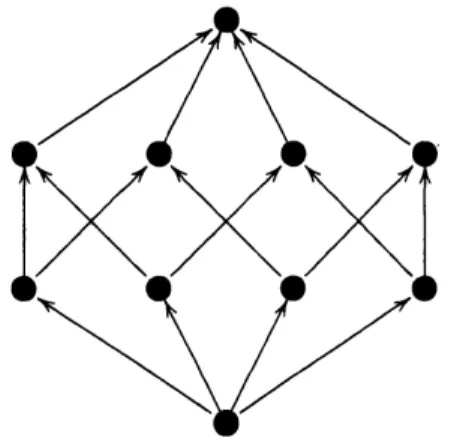
Figure 1 illustrates
an
example. Observe that the underlying graph is 3-regular;every vertex is incident to 3 edges. We will come back to this idea later.
3. KL POLYNOMIALS
We now introduce $KL$ polynomials following [3, Section 5.1]; See $loc.cit$. for
$R$-polynomials which we do not define here.
Fact 3.1. There exists a unique familyofpolynomials $\{P_{uw}(q)|u, w\in W\}\subseteq \mathbb{Z}[q]$
(Kazhdan-Lusztig polynomials) such that
FIGURE
1. Bruhat graph ofa
dihedral interval(2) $P_{uw}(q)=1$ if$u=w,$
(3) $\deg P_{uw}(q)\leq(\ell(u, w)-1)/2$ if $u<w,$
(4) if$u\leq w$, then
$q^{\ell(u,w)}P_{uw}(q^{-1})= \sum_{u\leq v\leq w}R_{uv}(q)P_{vw}(q)$,
(5) $P_{uw}(0)=1$ if $u\leq w,$
(6) if $u\leq w,$ $\mathcal{S}\in S$ and $wsarrow w$, then $P_{uw}(q)=P_{us,w}(q)$.
In what follows, our discussion goes with a fixed element $w\in W$ in mind. Then
we investigate behavior of $P_{uw}(q)$’s with $u$ running over the lower interval $[e, w].$
To emphasize this context, we use notation $X(w)def=[e, w]$. By slight abuse of
language, we refer to $X(w)$
even as
a Bruhat graph.Now recall two key facts under the assumption $W$ to be crystallographic:
Fact 3.2 (Nonnegativity [13, Corollary 4]). All $co$efficients of $KL$ polynomials in
$W$ are nonnegative.
To state another fact, we need this notation: For $f=a_{0}+a_{1}q+\cdots+a_{c}q^{C},$ $g=$
$b_{0}+b_{1}q+\cdots+b_{d}q^{d}\in \mathbb{N}[q](c=\deg f, d=\deg g)$ , define a partial order $f\leq g$ if
$a_{i}\leq b_{i}$ for all $i$ (hence $c\leq d$).
Fact 3.3 (Monotonicity [4, Corollary 3.7]). Suppose $u\leq v\leq w$ in $W$. Then
$P_{uw}(q)\geq P_{vw}(q)$.
In other words, fixing $w$as the secondindex, thefunction $P_{-,w}(q)$ : $X(w)arrow \mathbb{N}[q]$
is weakly monotonically decreasing. Actually, there is a convenient criterion for strict monotonicity:
Proposition 3.4. Let $u<v\leq w$. Then $P_{uw}(q)>P_{vw}(q)\Leftrightarrow P_{uw}(1)>P_{vw}(1)$
.
Proof.
Suppose $u<v\leq w$. Thenwe
have the inequality $P_{uw}(q)\geq P_{vw}(q)$as
assumed above. Say $P_{uw}(q)=1+b_{1}q+\cdots+b_{d}q^{d},$ $P_{vw}(q)=1+a_{1}q+\cdots+a_{d}q^{d}$
with $0\leq a_{i}\leq b_{i}$ for all $i$. If $P_{uw}(q)>P_{vw}(q)$, then $a_{j}<b_{j}$ for
some
$j(1\leq j\leq d)$.Then
$P_{uw}(1)-P_{vw}(1)=(b_{1}-a_{1})+\cdots+(b_{j}-a_{j})+\cdots+(b_{d}-a_{d})>0$
and vice
versa.
$\square$Consequently, $P_{-,w}(1)$ : $X(w)arrow \mathbb{N}$ is also weakly monotonically decreasing.
Definition 3.5. Let $u\in X(w)$. Say $[u, w]$ is mtionally singular if $P_{uw}(1)>1.$
Say it is mtionally smooth if $P_{uw}(1)=1.$
Remark 3.6. We borrowed suchterminologyfrom geometry of Schubert varieties;
see
Billey-Lakshmibai [2] for this theory.Definition 3.7. Rational smooth and singular vertices of $X(w)$ are
$X_{1}(w)=\{u\in X(w)|P_{uw}(1)=1\}$ and $X_{2}(w)=\{u\in X(w)|P_{uw}(1)>1\}.$
4. MAIN THEOREM 1
In this section,
we
prove Theorem 4.4. Before that,we
need several definitions and facts.Definition 4.1. An edge $uarrow v$ in $X(w)$ is strict if $P_{uw}(1)>P_{vw}(1)$.
The following is the key idea for the proofof Theorem 4.4 (author’srecent result [15, Theorem 8.2]$)$.
Lemma 4.2.
If
$P_{uw}(1)>1$, then there exists a strict edge $uarrow v$ in $X(w)$.Since Bruhat order is the transitive closure ofedge relations, thisresult is useful to give a lower bound of $P_{uw}(1)$ in terms of graph-theoretic distance
as
we recall now.Definition 4.3. Let $G$ be a finite directed graph. For
a
vertex$u$ anda
nonemptysubset $A$ of vertices of $G$, define a directed-graph-theoretic distance between the
vertex and the subset
as
dist$(u, A)= \min\{d\geq 0|uarrow v_{1}arrow v_{2}arrow\cdotsarrow v_{d}\in A\}.$
In particular, dist$(u, A)=0\Leftrightarrow u\in A.$
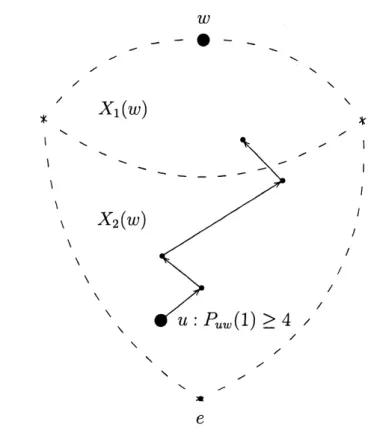
Now consider the case for $G=X(w)$ and $A=X_{1}(w)$. Then such distance gives
a lower bound of $P_{uw}(1)$:
Theorem 4.4. Let $u\in X(w)$. Then we have
$P_{uw}(1)\geq$ dist
FIGURE 2. distance between a singular vertex $u$ and rationally smooth vertices $–\bullet w-\sim$ $/$ $\backslash$ $/$ $\backslash$ $/$ $\backslash$ $\backslash$ $\backslash$ $\backslash$ / / $r$ $e$
Pmof.
For convenience, let $d=$ dist$(u, X_{1}(w))$. If$u$ is rationally smooth, then wehave $d=0$; So the assertion is obvious. Suppose $u$ is singular. Lemma 4.2 implies
that there exists a strict edge $uarrow v_{1}$ in $X(w)$. If $v_{1}\in X_{1}(w)$, then $d=1$ so that
$P_{uw}(1)\geq 2=d+1$. If not, find another strict edge from $v_{1}$ in $X(w)$, say $v_{1}arrow v_{2}.$
We canrepeat this procedure at least $d=$ dist$(u, X_{1}(w))$ times by definition. Thus the path $uarrow v_{1}arrow v_{2}arrow\cdotsarrow v_{d}$ in $X(w)$ (with all strict edges) induces $d$ strict
inequalities of positive integers
$P_{uw}(1)>P_{v_{1}w}(1)>\cdots>P_{v_{d}w}(1)\geq 1.$
Conclude that $P_{uw}(1)\geq d+1.$ $\square$
5. RATIONAL SINGULARITIES AND $DEODHAR’ S$ INEQUALITY
This section recalls some definitions and facts on Deodhar’s inequality for the
discussion in the next section. Definition 5.1. Let $u\leq w$. Set
$\overline{N}(u, w)=\{v\in W|uarrow v\leq w\}$ and $\overline{\ell}(u, w)=|\overline{N}(u, w)|.$
FIGURE
3. an
irregular Bruhat graphThat is, $\overline{N}(u, w)$ is the neighborhood of the bottom vertex
on
the Bruhat graphof $[u, w];\overline{\ell}(u, w)$ is the number of those outgoing edges.
Definition 5.2. The
defect
of $[u, w]$ is $df(u, w)=\overline{\ell}(u, w)-\ell(u, w)$.The defect turns out to be always nonnegative:
Fact 5.3 (Deodhar’s inequality [11]). df$(u, w)\geq 0.$
Definition 5.4. Say $[u, w]$ is rationally singular if$df(x, w)>0$for
some
$x\in[u, w].$Say it is mtionally smooth if $df(x, w)=0$ for all $x\in[u, w]$. Also,
we
say $u$ isrationally singular (smooth) under $w$” for convenience.
This definition is indeed equivalent to Definition 3.5 (in crystallographic cases);
see
[2, Section 13.2].Figure 3 shows the Bruhat graph of [1324, 3412] in the symmetric group $S_{4}$. It
has the positive defect: df(1324, 3412)
$=1=4-3$
. Observe that this graph isirregular because the bottom vertex is incident to four edges while middle vertices
are
incident to only three; About regularity of Bruhat graphs, here isa
significant result of Carrell-Peterson [8]:Fact 5.5. Let $[u, w]$ be a Bruhat interval. Then the following are equivalent:
(1) It is rationally smooth.
(2) Its Bruhat graph is $\ell(u, w)$-regular.
Consequently, if we find
some
vertex incident tomore
than $\ell(u, w)$ edges, thenimmediately $[u, w]$ is rationally singular. We apply this idea for the proofof
The-orem 6.10.
6. MAIN THEOREM 2
In this section, we prove Theorem 6.10 with some new idea, “final intervals” assuming $W$ is
finite.
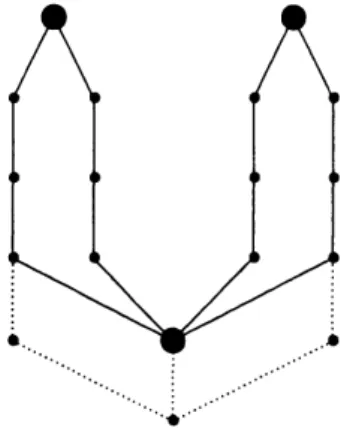
FIGURE 4. a final interval
.
:
Definition 6.1. For $I\subseteq S$, let $W_{I}$ be the standard parabolic subgroup generated
by $I$ and $uW_{I}$ the right $I$-coset containing $u.$
Fact 6.2 (Distinguished coset representative of maximal length). Each $uW_{I}$ has
a
unique element $x$ such that for all $v\in uW_{I}$, we have $v\leq x.$Denote this element by $x= \max uW_{I}.$
Definition 6.3. An interval $[u, w]$ is (right)
final
if there exists $I\subseteq S$ such that $w= \max uW_{I}.$Example 6.4. All right weak edges $uarrow us$ are final by definition. More
inter-esting cases are rank 2 cosets (dihedral intervals); Figure 4 shows an example of a final interval in such a coset (we omitted some edges and heads for simplicity).
Observe that some final intervals might share the bottom element as in Figure 5. Proposition 6.5. Let $[u, w]$ be a
final
Bruhat interval, say $w= \max uW_{I}$ with$I\subseteq S(neces\mathcal{S}$arilyI $\subseteq\{s\in S|wsarrow w\})$. Then there exists a directed path $uarrow us_{1}arrow u\mathcal{S}_{1}\mathcal{S}_{2}arrow\cdotsarrow us_{1}s_{2}\cdots s_{n}=w$ such that $s_{i}\in I$
for
all $i.$Proof.
By definition of a final interval, there exists $x\in W_{I}$ such that $ux=w.$Choose a reduced expression $x=s_{1}s_{2}\cdots s_{n}$ with $s_{i}\in I$ for all $i.$ $\square$
Lemma 6.6. $A$
final
interval $[u, w]$ is rationally smooth.Pmof.
Choose a directed path from $u$ to $w$ as in the previous proposition. Then$P_{uw}(q)=P_{us_{1},w}(q)=P_{us_{1}s_{2},w}(q)=\cdots=P_{us_{1}s_{2}\cdots s_{n},w}(q)=P_{ww}(q)=1$ since
$ws_{i}arrow w$ for all $i.$ $\square$
It follows that $\overline{\ell}(u, w)=\ell(u, w)$ thanks to Deodhar’s inequality. 7
FIGURE 5. final intervals sharing the bottom
Definition 6.7. Let $v\in[u, w]$. Say $v$ is a
final
vertex of $[u, w]$ if $[u, v]$ is final.Definition 6.8. Let $[u, w]$ be an interval of odd length $\geq 3.$ $A$ final vertex $v$ of
$[u, w]$ is
half
if$\ell(u, v)=(\ell(u, w)+1)/2.$Definition 6.9. $A$ pair $(v_{1}, v_{2})$ of final vertices of $[u, w]$ is disjoint if $\overline{N}(u, v_{1})\cap\overline{N}(u, v_{2})=\emptyset.$
Theorem 6.10.
If
there exists a pair $(v_{1}, v_{2})$of half
and disjointfinal
vertices in$[u, w]$, then $[u, w]$ is mtionally singular.
The idea is to show the existence of more than $\ell(u, w)$ edges incident to $u$ in
$[u, w]$. Then, Deodhar’s inequality guarantees that $[u, w]$ is rationally singular.
Pmof.
It is enough to show that $\overline{\ell}(u, w)>\ell(u, w)$. Let $(v_{1}, v_{2})$ beas
above. Bydefinition of the set $\overline{N}(x, y)$, we have $\overline{N}(u, w)\supseteq\overline{N}(u, v_{1})\cup\overline{N}(u, v_{2})$; this union is
disjoint since $(v_{1}, v_{2})$ is disjoint. Hence
$\overline{\ell}(u, w)=|\overline{N}(u, w)|\geq|\overline{N}(u, v_{1})|+|\overline{N}(u, v_{2})|$
$=\overline{\ell}(u, v_{1})+\overline{\ell}(u, v_{2})$
$=\ell(u, v_{1})+\ell(u, v_{2})$ $($finality $of [u, v_{i}])$
$= \frac{\ell(u,w)+1}{2}+\frac{\ell(u,w)+1}{2}$
$=\ell(u, w)+1.$
$\square$
Example 6.11. Let $u=187654329,$ $w=897654312,$ $v_{1}=876543219$ and $v_{2}=$ 198765432 in $W=A_{7}=S_{8}$. Then we
can
show that the pair $(v_{1}, v_{2})$ is halfand disjoint final vertices of $[u, w]$ with $v_{1}=uW_{I},$ $v_{2}=uW_{J},$ $I=\{s_{1}, \ldots, s_{7}\},$ $J=\{s_{2}, \ldots, s_{8}\},$ $s_{i}$ adjacent
number of inversions) and $\ell(u, v_{i})=28-21=7$. Theorem 6.10 guarantees $[u, w]$
is rationally singular $(in fact, P_{uw}(q)=1+q^{6})$. We obtained permutations $u$ and
$w$ from the construction of arbitrary $KL$ polynomials by Polo [16].
Acknowledgment.
I thank the organizer Professor Satoshi Naito for giving
me an
opportunity to talk atCombinatorial
Representation Theory and Related Topics, Kyoto RIMS in October 2012 even with financial support.REFERENCES
[1] A. Beilinson and J. Bernstein, Localisation de $\mathfrak{g}$-modules, C.R. Acad. Sci. Paris 292 (1981),
no. 1, 15-18.
[2] S. Billey and V. Lakshmibai, Singular loci of Schubert varieties, Progress in Math. 182,
Birkh\"auser Boston, Inc., Boston, MA, 2000.
[3] A. Bj\"orner and F. Brenti, Combinatorics of Coxetergroups, GraduateTexts in Math. 231,
Springer-Verlag, New York, 2005.
[4] T. Braden and R. MacPherson, From moment graphs to intersection cohomology, Math.
Ann. 321 (2001), no. 3, 533-551.
[5] F. Brenti, A combinatonalformula for Kazhdan-Lusztig polynomials, Invent. Math. 118
(1994), no. 2, 371-394.
[6] –, Combinatonal expansions ofKazhdan-Lusztig polynomials, J. London Math. Soc.
(2) 55 (1997), no. 3, 448-472.
[7] J.-L. Brylinski and M. Kashiwara, Kazhdan-Lusztig conjectures and holonomic systems, Invent. Math. 64 (1981), no. 3, 387-410.
[8] J. Carrell, The Bruhat graph of a Coxeter group, a conjecture ofDeodhar, and rational smoothness ofSchubert vaneties, Proc. Symp. Pure Math. 56 (1994), 53-61.
[9] M. Dyer, On the Bruhatgraph ofa Coxetersystem, Comp. Math. 78 (1991), no. 2, 185-191.
[10] –, Hecke algebras and shellings of Bruhat intervals, Comp. Math. 89 (1993), no. 1,
91-115.
[11] –, The nil Hecke nng and Deodhar’s conjecture on Bruhat intervals, Invent. Math. 111 (1993), no. 3, 571-574.
[12] J. Humphreys,
Reflection
groups and Coxetergroups, CambridgeStudiesinAdvancedMath. 29, Cambridge University Press, Cambridge, 1990.[13] R. Irving, The soclefiltration ofa Verma module, Ann. Sci. \’Ecole. Norm. Sup. (4) 21 (1988), no. 1, 47-65.
[14] D. Kazhdan andG. Lusztig, Representations of Coxetergroups andHecke algebras, Invent. Math. 53 (1979), no. 2, 165-184.
[15] M. Kobayashi, Inequalities on Bruhat graphs, $R$-and Kazhdan-Lusztigpolynomials, to ap-pear inJ. ofCombin. Theory Ser. A.
[16] P. Polo, Construction of arbitmry Kazhdan-Lusztig polynomials in symmetnc groups, Rep-resent. Theory (electronic) 3 (1999), 90-104.
GRADUATE SCHOOL OF SCIENCE AND ENGINEERING, DEPARTMENT OF MATHEMATICS,
SAITAMA UNIVERSITY, 255 SHIMO-OKUBO, SAITAMA 338-8570, JAPAN.
$E$-mail address: kobayashiQmath.titech.ac.jp