87
疎な多項式計画問題に対する半正定値計画緩
和 1
SDP
relaxations
for sparse
Polynomial Optimization
Problems
東京工業大学大学院情報理工学研究科 脇隼人 (Hayato Waki)
Department of Mathematical and Computing Sciences, Tokyo Institute ofTechnology
東京工業大学大学院情報理工学研究科 小島政和 (Masffiazu Kojima)
Department of Mathematical and Computing Sciences, Tokyo Institute of Technology
Department ofMathematics, Ewha Women’s University SunyoungKim
1
Introduction
POPs (Polynomial optimization problems or optimization problems with polynomial
ob-jectivealldconstraints) represent abroadrangeof applications in science and engineering.
Recently, an important theoretical development has been made by Lasserre [6] toward
achieving optimal values of POPs. According to the paper [4], his method to obtain
a
sequence of SDP relaxations
can
be consideredas
a
primal approach. He proved thatwhen the feasible region of the POP is compact, its optimal value can be approximated
within ally accuracy by the sequence of SDP relaxations. However, the size of
aan
$\mathrm{S}\mathrm{D}\mathrm{P}$relaxation to be solved in the sequence increases veryrapidly
as
ahigher accuracy for allapproximation to the optimal value of the POP is required.
The purpose of this paper is to present generalized Lagrangian duals and their SOS
(sums of squares) relaxations [7] for sparse POPs. This approach may be regarded as
dual of Lasserre’s SDP relaxations [6] mentioned above. Instead of selecting nonnegative
numbers for Lagrangian multipliers,
we
choose Lagrangian multipliers to be SOSpolyn0-mials satisfying similar sparsity to associated constraint polynomials. Then, we define a
generalized Lagrangian dual for a POP over such SOS polynomial multipliers. After a
sequence of sets of SOS polynomials is constructed, $e.g$
.
SOS
polynomials of increasingdegree, for Lagrangian multipliers, a sequence ofLagrangian dualsis obtained. We derive
a
sufficient condition for the sequence of Lagrangian duals to attain the optimal valueof the POP, based
on
the idea of the penalty function method. For practical purposes,each Lagrangian dual in the sequence is relaxed to an SOS optimization problem, which
is further converted into all equivalent SDP. Thus we have sequences ofSOS relaxations
and SDP relaxations of the POP. The resulting sequence of SDP relaxations corresponds
to dual of the sequence ofSDP relaxations obtained from the primal approach
An advantage of the dual approach in this paper is that sparsity of objective alld
constraint polynomials inaPOP
can
be exploited to reduce the size of theSDPrelaxations.The size of the SDP relaxations depends
on
the supports of the polynomials in the dualapproach, whereas the size of the SDP relaxations from the primal approach depends
on
the degree of the polynomials.
Throughout the paper, we
use
the following notation: Let $\mathbb{R}^{n}$ and$\mathbb{Z}_{+}^{n}$ denote the $n$-dimensional Euclidean space and the set of$n$-dimensional nonnegative integer vectors,
respectively. Let $f_{j}$ : $\mathbb{R}^{n}arrow \mathbb{R}$ be
a
real valued polynomial in $c$ $=(x_{1}, x_{2}, \ldots,x_{n})\in \mathbb{R}^{n}$$(j=0,1,2, \ldots, m)$
.
We denote each polynomial $f_{j}$(x)as
$fj(x)= \sum_{a\in \mathcal{F}_{j}}cj(a)x^{a}$, wherea nonempty finite subset $\mathcal{F}_{j}$ of$\mathbb{Z}_{+}^{n}$ denotes a support of the polynomial
$\mathrm{f}\mathrm{j}(\mathrm{x})$, $cj(a)\in \mathbb{R}$
lfThisarticle isashortversion of thepaper [3],
88
and $x^{a}=x_{1}^{a_{1}}x_{2}^{a_{2}}\cdots$$x_{n}^{a_{n}}$ for every $a=$ (ai,a2,
$\ldots$,$a_{n}$) $\in F_{j}(j=0,1,2, \ldots, m)$ and
$x=$ $(x_{1}, x_{2}, \ldots, x_{n})\in \mathbb{R}^{n}$
.
Let$rj$ denote the degree of each polynomial $f_{g}(x)(j=$
$0,1,2$, .
. .
,$m$) ; $r_{j}= \max\{\sum_{l=1}^{n}a_{j} : a\in \mathrm{F}j\}$.
2
Polynomial optimization problems and sparsity
We consider the
POP
(polynomial optimization problem):minimize $fo(x)$ subject to $7_{j}$(z) $\geq 0(j=1,2, \ldots, m)$
.
(1)Let
us
focuson
the support 1$j$ of the polynomial $f_{j}$(x) $(j=0,1,2, \ldots, m)$ to describesparsityof thePOP (1). A polynomial $f$(x) of degree$r$ orits support$\mathcal{F}$is calledsparse if
the number of elements in the support $\mathcal{F}$is much smaller than the number of
elements in
the support $\mathcal{G}(\xi)\equiv\{a\in \mathbb{Z}_{+}^{n} :\sum 7_{1}a_{i}\leq\xi\}$ ofageneral fully dense polynomial of degree
$\xi$
.
In particular, if the number of indices in$I_{+}(\mathcal{F})$ $\equiv$
{
$i$ : $a>0$ forsome
$a\in$ $\mathrm{I}"$}
is muchsmaller than $n$, then $f$(x) is sparse. We present an example below.
Example 2.1 A box constraint POP. Let $m=n$ and $f_{j}(x)=1-x_{j}^{2}(j=1,2, \ldots, n)$
.
In this case,
we
have $Tj$ $=\{0, 2e^{j}\}$ $(j=1,2, \ldots, n)$.
Each $\mathcal{F}_{j}$ has two elements and$I_{+}(\mathcal{F}j)=\{j\}$. Here $e^{j}$ denotes the
$i$th unit coordinate vector of $\mathbb{R}^{n}$ with 1 in the
$j$th
component and 0 elsewhere.
Another example is given in
Section
6 withsome
preliminary numerical results.Let $F$ denote the feasibleregion of the POP (1);
$F$ $=$ $\{ox \in \mathbb{R}^{n} : f_{j}(oe)\geq 0(j=1,2, \ldots,m)\}$
.
Throughout thepaper,
we
assume
that $F$ is nonempty aaxd bounded. Then, the POP (1)hasafinite optimalvalue $\langle$’ at anoptimalsolution $x^{*}\in F.$ In what it follows, wefurther
need a bound $\rho>0$to beknownexplicitly for the feasibleregion. We
are
concernedwiththe following
casss:
$\mathrm{o}$ $F\subset C_{\rho}\equiv\{x \in \mathbb{R}^{n} : \rho^{2}-x_{i}^{2}\geq 0 (i=1,2, \ldots, n)\}$
or
$\mathrm{o}$ $F\subset B_{\rho}\equiv$ $\{x\in \mathbb{R}^{\mathrm{n}} : \rho^{2}-x^{T}x \geq 0\}$
.
If $F\subset C_{\rho}$ holds then the POP (1) is equivalent to
minimize $fo(x)$ subject to $\mathrm{r}_{\mathrm{j}}(x)$ $\geq 0(j=1,2, \ldots, m)$ and
$x$ $\in C_{\rho}$
.
(2)Example 2.1 is a special
case
of the POP (2) wherewe
take $m=0$ alld $\rho=1.$ If$F\subset B_{\rho}$is satisfied, then
we
have $F\subset C_{\rho}$; hence the tvvo POPs (1) and (2)are
equivalent tominimize $fo(x)$ subject to $f_{j}(oe)\geq 0(j=1,2, \ldots,m)$ and $ox$ $\in B_{\rho}$
.
(3)In the next section,
we
present $\mathrm{a}$ (generalized) Lagrangian function,a
Lagrangianre-laxation alld a Lagrangian dual for each of the POPs (2) and (3). For both POPs, the
Lagrangian dual converges to the optimal value (’ ofthe original POP (1) under a
mod-erate assumption. But, only the
SOS
relaxation derived ffom the POP (3) is guaranteedto
converge
to $\langle$’ [3], while the SOS relaxation from the POP (2) inheritsmore
sparsity
89
3
Generalized Lagrangian
duals
3.1
Lagrangian functions
Let $\overline{\Sigma}$
denote the set of
sums
ofsquares of polynomials in $x$ $\in \mathbb{R}^{n}$;$\overline{\Sigma}$
$=$ $\{\sum_{i=1}^{k}\chi_{i}(x)^{2}$ : $\chi_{i}\mathrm{a}11\mathrm{d}$
is$k\mathrm{i}\mathrm{s}\mathrm{a}\mathrm{n}\mathrm{y}\mathrm{f}\mathrm{i}\mathrm{f}\mathrm{i}\mathrm{n}\mathrm{i}\mathrm{t}\mathrm{e}\mathrm{p}\mathrm{o}\mathrm{s}\mathrm{i}\mathrm{t}\mathrm{i}\mathrm{v}\mathrm{e}\mathrm{i}\mathrm{n}\mathrm{t}\mathrm{e}\mathrm{g}\mathrm{e}\mathrm{r}\mathrm{a}\mathrm{p}\mathrm{o}\mathrm{l}\mathrm{y}\mathrm{n}\mathrm{o}\mathrm{m}\mathrm{i}\mathrm{a}\mathrm{l}\mathrm{i}\mathrm{n}x\in \mathbb{R}^{n}(i=\mathrm{l}, 2, \ldots, k)\}\mathrm{t}$
We define two types of (generalized) Lagrangian functions $L_{B}$ : $B_{\rho}\cross\overline{\Sigma}- marrow \mathbb{R}$ for POP
(3) and $L_{C}$ : $\mathbb{R}^{n}\mathrm{x}\overline{\Sigma}^{m+n}arrow \mathbb{R}$ for POP (2):
$L_{B}(x, \varphi)$ $=$ $f_{0}(x)- \sum_{j=1}^{m}\varphi_{j}$(x)$f_{j}$(x)
$L_{C}$(x,$\varphi,$ $\mathrm{A}$) $=$ $f_{0}(x)- \sum_{j=1}^{m}\varphi_{g}(x)f_{j}(x)-\sum_{i=1}^{n}\psi_{i}(x)(\rho^{2}-x_{i}^{2})$
.
Here$\overline{\Sigma}^{\ell}$
denotes the Cartesian product of$\mathrm{f}$-tup
es
of$\overline{\Sigma}\mathrm{i}$$\overline{\Sigma}^{\ell}=$
{
$(\varphi 1,$ $?2,$$\ldots,$ $/$r): $\varphi_{j}\in\overline{\Sigma}(j=1,2,$ $\ldots,\ell)$
}(
$\ell=m$ or $m+n$).Let $(\varphi, \psi)\in\neg n+n\Sigma$ Then
$L_{B}(x, \varphi)$ $\leq$ $\mathrm{y}_{0}($
$L_{C}$(x,$\varphi,$$\psi$) $\leq$ 70(X)
$\mathrm{i}\mathrm{f}ox\in F\cap B_{\rho}\mathrm{i}\mathrm{f}x\in F\cap C_{\rho},$
, $\}$ (4)
$Lc$(oe, ?, $\#$) $\leq$ $L_{B}(x, \varphi)$ if$x$ $\in B_{\rho}$
.
3.2
Lagrangianrelaxations and duals
We introduce a (generalized) Lagrangian relaxation ofthe POP (2):
$L_{C}^{*}(\varphi,\psi)=$inf
{
$Lc$(x,$\varphi,$$\psi)$ : $ox$$\in \mathbb{R}^{n}$
}
foreach fixed $(\varphi, \psi)\in\overline{\Sigma}^{m+n}$, and a (generalized) Lagrangian relaxation of the POP (3):
$L_{B}^{*}(\varphi)=$ inf$\{L_{B}(x, \varphi) : x \in B_{\rho}\}$
for each fixed $\varphi\in\overline{\Sigma}^{\mathrm{m}}$ Let $(\varphi, \psi)\in\neg n+n\Sigma$ By (4),
we
see
that$L_{C}^{*}(\mathrm{s} , /)$
$\leq\zeta’=$
$\mathrm{m}\mathrm{n}^{\{70}(^{X)}$ : $x2$
$\in F$
}
if$F\subset C_{\rho}$,
$\}$ (5)
$L_{C}^{*}(\varphi,\psi)\leq L_{B}^{*}(\varphi)\leq\zeta^{*}$if$F\subset B_{\rho}$
.
For every $(\Sigma, --.)\subset\overline{\Sigma}^{m+n}$, we define a (generalized) Lagr angian dual of$i\mathrm{h}\mathrm{e}$POP (2):
maximize $L_{C}^{*}(\varphi,\psi)$ subject to $(\varphi, \psi)\in\Sigma\cross---\cdot$ (6)
For every $\mathrm{f}2\mathrm{t}$ $\subset\overline{\Sigma}^{m}$, we define a (generalized) Lagr angian dual of the POP (3):
90
Let $L_{C}^{*}(\Sigma\cross---)$ and $L_{B}^{*}(\Sigma)$ denote the optimal values of (6) and (7),
respectively;
$L_{C}^{*}(\Sigma\cross--\cdot)=$
$\sup$ $L_{C}^{*}(\varphi, \psi)$ and $L_{B}^{*}( \Sigma)=\sup L_{B}^{*}(\varphi)1$
$(\varphi, \mathrm{A})\in\Sigma_{\cross-}^{--}$
1$\mathrm{e}\mathrm{X}$
It
follows
from (5) that$L_{C}^{*}(\Sigma\cross---)\leq\zeta^{*}$ if$F\subset C_{\rho}$
,
$L_{C}^{*}(\Sigma\cross--\cdot)\leq L_{B}^{*}(\Sigma)\leq$ ($;’$ if$F\subset B_{\rho}\}$ (8)
holds for every $(\mathrm{E}, ---)$ $\subset\overline{\Sigma}^{m+n}$
Assume that $F\subset C_{\rho}$
.
Then, the two POPs (1) and (2)are
equivalent. Ifwe restrict$(\varphi, \psi)$ to the nonnegative orthant $\mathbb{R}^{m+n}+$ of $\mathbb{R}^{m+n}$,
$Lc$(x, $f$, $f|$) becomes the standard
Lagrangian function for the POP (2).
As
we
takea
larger set $\Sigma$ $\mathrm{x}---\subset\overline{\Sigma}^{?n+n}$, the duality gap between $L_{C}^{*}(\Sigma \mathrm{x}---)$ and $\langle$” is
expected to decrease. We regard $(\varphi, \psi)\in\overline{\Sigma}^{m+n}$
as
“a penaltyparameter”, and
$D_{C}(x,$ $/, \mathit{1})=-\sum_{j=1}^{m}?\mathrm{j}(x)f_{j}(x)-\sum_{i=1}^{n}\mathrm{A}_{9}(x)(\rho^{2}-x_{i}^{2})$
(the terms added to the objective function $f\mathrm{o}(x)$
in the construction of the Lagrangian function $Lc$(x,$\varphi,$$\psi$) $)$
as “a penalty function” with
a
choice of penalty parameters $(\varphi, \psi)=\{\mathrm{x}\mathrm{p}\}\psi^{p})\in\overline{\Sigma}^{m+n}$$(p\in \mathbb{Z}+)$ such that
if$x\in F$ then $\Phi(x, \varphi^{p}, \psi^{p})arrow 0$ as $parrow\infty$,
if$x\not\in$$F$ then $\Phi(x, ?^{p}, \psi^{p})arrow$
oo as
$parrow\infty$.
It is shown that the Lagrangian
function
$Lc$(oe,$\varphi,$$\psi$) $=$ fo(x) $+$ !$c(\mathrm{L}, \varphi, \psi)$ with thepenalty parameter $(\varphi, \psi)=(\varphi^{p}, \psi^{p})\in\neg n+n\Sigma$has
a
globalminimizer $x^{p}$
over
$\mathbb{R}^{n}$with the
objective value $f\mathrm{o}(x^{\mathrm{p}})arrow\zeta^{*}$ as
$parrow$ oo and that $\{x^{p}\}$ has
an
accumulation point in theoptimal solutionset ofthe POP (2).
In order to describe this
observation
precisely,we use some
notation. Takea
realnumber $\gamma\geq 1$ such that
$|$$4_{j}(x)/’ \mathrm{y}|$ $\mathrm{E}$ 1 if $||x||_{\infty}\mathrm{S}$ $\sqrt{2}\rho$,
$|f_{i}(x)/\gamma|$ $\leq$ $||x/\rho||_{\infty}’$ if $||x$$||_{\infty}\geq\sqrt{2}\rho$
$(j=0,1,2, \ldots, m)$, where $r= \max\{r_{0}, r_{1}, \ldots, r_{m}\}$
.
Letting $(\varphi^{p},\psi^{p})$ be
$?(x)$ $=$ $(1-f_{j}(x)/’)$$)^{2p}(j= 1, 2, \ldots, m, p\in \mathbb{Z}_{+})$
,
$\mathrm{S}(x)$ $=$ $(\varphi_{1}^{p}(ox), \varphi_{2}^{\mathrm{p}}(x),$$\ldots$,$\varphi_{m}^{p}(ox))(p\in \mathbb{Z}_{+})$
,
$\psi_{i}^{p}$(x) $=$ $((m+2)\gamma/\rho^{2})(x_{i}/\rho)^{2r(p+1)}(i=1,2, \ldots, n, p\in \mathbb{Z}_{+})$
,
$\psi^{\mathrm{p}}(x)$ $=$ $(\psi_{1}^{p}(x),\psi_{2}^{p}(x),$$\ldots,R(x))(p\in \mathbb{Z}_{+})$
,
the following theorem holds :
Theorem 3.1 /3]
Assume
that $\mathit{5}Xt$ $\mathrm{x}---\subset\neg n+n\Sigma$contains
an
infinite
subsequence
of
$\{(\varphi^{p}, \psi^{p})(p\in \mathbb{Z}_{+})\}$
.
Then $L_{C}^{*}(\Sigma \mathrm{x}---)=\zeta^{*}$if
$F\subset C_{\rho_{\mathit{1}}}$ ancl $L_{C}^{*}(\Sigma\cross---)=L_{B}^{*}(\Sigma)=\zeta^{*}$if
91
3.3
Construction
of
I $\cross--$.
satisfyingthe assumption of
Theorem 3.1For every nonempty subset $A$ of$\mathbb{Z}_{+}^{n}$, we define
$\Sigma(A)$ $=$ $\{\sum_{i=1}^{k}\chi_{i}(x)^{2}$ : $\chi_{i}\mathrm{i}\mathrm{s}$ ($i=$
l,a2p,
$.0.1.\mathrm{y},\mathrm{n}\mathrm{o}\mathrm{m}\mathrm{i}\mathrm{a}1\mathrm{i}\mathrm{n}ox\in \mathbb{R}^{n}\mathrm{w}\mathrm{i}\mathrm{t}\mathrm{h}\mathrm{a}\mathrm{s}\mathrm{u}\mathrm{p}\mathrm{p}\mathrm{o}\mathrm{r}\mathrm{t}\mathrm{i}\mathrm{n}Ak$ ) $\mathrm{a}\mathrm{n}\mathrm{d}k^{\wedge}\mathrm{i}\mathrm{s}\mathrm{a}\mathrm{n}\mathrm{y}\mathrm{f}\mathrm{i}\mathrm{f}\mathrm{i}\mathrm{n}\mathrm{i}\mathrm{t}\mathrm{e}\mathrm{p}_{\mathrm{o}\mathrm{S}}\mathrm{i}\mathrm{t}\mathrm{i}\mathrm{v}\mathrm{e}\mathrm{i}\mathrm{n}\mathrm{t}\mathrm{e}\mathrm{g}\mathrm{e}\mathrm{r}\}$Suppose that $Aj$ $(j=1,2, \ldots, m, q\in \mathbb{Z}_{+})$ and$B_{i}^{q}(i=1,2, \ldots , n, q\in \mathbb{Z}_{+})$
are
nonemptyfinite subsets of$\mathbb{Z}_{+}^{n}$ such that
$\varphi_{j}^{\lambda(q)}\in\Sigma(A_{j}^{q})$ and $\psi_{i}^{\lambda(q)}(x)$ $\in$ $\mathrm{f}2(B_{i}^{q})$ if$q\geq q^{*}$ (9)
for some $q^{*}\in \mathbb{Z}_{+}$ and
some
mapping A from $\mathbb{Z}_{+}$ into itselfsatisfying$\lambda(q)\leq\lambda(q+1)(q\in \mathbb{Z}_{+})$ and $\lim_{qarrow\infty}\lambda(q)=\infty$
.
Let
$\Sigma^{q}=\prod_{j=1}^{m}\Sigma(A_{J}^{q})$, $—q$ $= \prod_{i=1}^{n}\Sigma(B_{i}^{q})$,
$\Sigma"=\bigcup_{q\in \mathbb{Z}_{+}}$
$\mathrm{C}^{q}$ alid
$— \infty=\bigcup_{q\in \mathbb{Z}_{+}}---q$
.
By construction, we
see
that$(\varphi^{\lambda(q)}, \psi^{\lambda(q)})\in\Sigma^{q}\cross---q(q\geq q^{*})$
.
Hence $\Sigma^{\infty}\mathrm{x}---\infty$ contains
an
infinite subsequence $\{(\varphi^{\lambda(q)},\psi^{\lambda(q)})(q\geq q^{*})\}$.
Therefore$\mathrm{C}$ $\mathrm{x}---=Et"$ $\mathrm{x}_{-}--\infty$ satisfies the assumption of Theorem 3.1.
We give
some
$\mathrm{e}\mathrm{x}\mathrm{a}$mplesof$A_{j}^{q}$ $(j=1,2, \ldots , m, q\in \mathbb{Z}+)$alld$B_{i}^{q}(i=1,2, \ldots,n, q\in \mathbb{Z}_{+})$satisfying the assumption (9).
Example 3.2 For every j $=1,2_{\dagger}\ldots$,m, i$=1,$2,\ldots ,n, q $\in \mathbb{Z}+$
’ let $4_{j}^{0}=\{0\}$, $A_{j}^{1}=\{0\}\cup$ $\mathrm{r}$
,
$\cdot$, $A_{j}^{q+1}=\{a+b:a\in A_{j}^{q}$, $b\in$$\mathrm{a}_{\mathrm{j}}^{1}\}$ $(q\geq 1)$
,
$B_{i}^{q}=\{ke^{i} : k=0,1,2, \ldots, (q+1)r\}$
.
Example 3.3 For every$j=1,2$,$\ldots$,$m$,
$\mathrm{j}$$=1,2$,
$\ldots$ ,$n$
,
$q\in \mathbb{Z}+$, let $A_{j}^{0}=\{0\}$,
$A_{j}^{1}=\{0\}\cup\{e^{k}$ : $k\in I_{+}(\mathcal{F}_{j})\}$ ,$A_{j}^{q+1}=\{a+b$ : $a\in A_{j}^{q}$
,
$b\in A^{1}\}j$ $(q21)$,
$B_{j}^{q}=\{ke^{i} : k=0,1, 2, \ldots,q+1\}(q\in \mathbb{Z}+)$
.
Here $I_{+}(\mathcal{F}_{j})=$
{
$i:a_{i}>0$ forsome
$a\in \mathcal{F}_{f}$}.
In all the examples, both $4(\mathrm{j}$ and $B_{i}^{q}$ expand monotonically
as
$q$ increases, and for any$\overline{p}\in \mathbb{Z}_{+}$ there exists $\overline{q}\in \mathbb{Z}_{+}$ suchthat $\varphi_{j}^{\mathrm{p}}(x)\in\Sigma(A_{j}^{q})$ and $\psi_{i}^{\mathrm{p}}(x)$ $\in\Sigma(B_{i}^{q})$ for all $p\leq\overline{p}$and $q\geq\overline{q}$
.
It should be noted that if $F_{j}$ is sparse then $A_{j}^{q}$ remains sparse in Example 3.2.The choice of$A_{j}^{q}$ in Example 3.3 maybe also reasonable when the number of the indices
EI
$\mathit{2}$4
Numerical
methods
for
generalized
Lagrangian
duals
In the
following
three subsections,we
discuss numerical methods for generalizedLa-grangian duals (6) and those for (7) are discussed in [3]. These subsections includ$\mathrm{e}$ h$\mathrm{o}\mathrm{w}$
$L_{C}^{*}(\Sigma^{\infty}\mathrm{X}---\infty)$
can
be approximated numerically. Throughout thissection, we
assume
that $F\subset C_{\rho}$,
so
that $L_{C}^{*}(\Sigma^{\infty--\infty}\cross-)=(^{*}$.
4.1
Approximation of
generalizedLagrangian
duals
We introduce a sequence of subproblems of theLagrangian dual (6) for $q\in \mathbb{Z}_{+}$
.
maximize $L_{C}^{*}(\varphi,\psi)$ subject to $(\varphi, \psi)\in ft^{q}$ $\mathrm{x}_{--q}-$
.
(10)
We donote
an
optimal value of (10)as
$L_{C}^{*}$($\Sigma^{q}$,Eq).Lemma 4.1 [S]
(a) $L_{C}^{*}(\Sigma q\mathrm{x}---q)\leq L_{C}^{*}(\Sigma^{\infty--\infty}\cross-)(q\in \mathbb{Z}_{+})$
.
(b) For any $\epsilon>0,$ there exists a nonnegative integer$\overline{q}$ such that
$L_{C}^{*}(\Sigma^{\infty-\infty}\cross--)-\epsilon\leq L_{C}^{*}(\Sigma^{q} \cross ---q)(q\geq\overline{q})$
.
4.2
Sums
ofsquare
relaxations
Let $q\in \mathbb{Z}+$ be fifixed throughout this subsection. We
can
rewrite theproblems in (10)
as
maximize $\langle$
subject to
$L_{C}(x, \varphi,\psi)-\zeta.\geq(\varphi,\psi)\in\Sigma^{q-q}\cross-\cdot 0(\forall x\in \mathbb{R}^{n})$,
}
(11)Note that $x$ $\in \mathbb{R}^{n}$ is not
a
vector variable but it
serves
asan
index vector for infinitenumber of inequalityconstrains $Lc$(x, $f,$ $I$) $-\zeta\geq 0$ ($\forall x\in$ Rn). Replacing the inequality
constraints$Lc$(x,$\varphi,$$\psi$)$-(;$ $\geq 0(\forall x\in \mathbb{R}^{n})$ bya
sum
ofsquares condition$L_{C}(x, fJ, \psi)$$-\zeta\in$
$\Sigma$ in (11),
we
obtain an SOSOP(sums of squares optimization problem).
maximize $\zeta$
subject to $Lc$(x,$\varphi,$$\psi$) $-\zeta=\varphi \mathrm{o}(x)$ $(\forall x\in \mathbb{R}^{n})$, $\}$ (12)
$(\varphi,\psi)$ $\in\Sigma^{q}\mathrm{x}$ $—q$, $\varphi 0(x)$ $\in\overline{\Sigma}$
.
Let $\zeta_{C}^{q}$ denote theoptimal valueofthe
SOSOP
(12);$\zeta_{C}^{q}=\sup\{$$\zeta$ : $L_{C}(ox, \varphi,\psi)-\zeta=(\varphi,\psi)\in\Sigma^{q-q}\mathrm{x}--$
, $\mathrm{p}\mathrm{o}(x)(\mathrm{v}(x)\mathrm{H}^{\mathrm{C}} \mathbb{R}^{n})$
,
$\}$ ‘If$(\zeta, \varphi, \mathrm{A}_{:}\varphi_{0})$ is
a
feasiblesolution oftheSOSOP
(12), then$(\zeta, \varphi, \psi)$ is
a
feasiblesolutionofthe problem (11). It followsthat$\zeta_{C}^{q}\leq L_{C}^{*}(\Sigma^{q--q}\cross-)$
.
Althoughneither$\zeta_{C}^{q}=L_{C}’(\Sigma^{q}\mathrm{x}_{-}^{--q})$
nor
theconvergence
of$\zeta_{C}^{q}$ to $L_{C}^{*}(\Sigma^{\infty}\mathrm{x}_{-}--\infty)$as
$qarrow$ oo is guaranteed,
we can
solve theSOSOP (12) as weshow in thenext subsection while the problem (11) is difficult to solve
93
4.3
Reduction to
SDPs
Let us fix $q\in \mathbb{Z}_{+}$ throughout this subsection. We show how to solve the SOSOP (12) as
an
SDP (semideflnite program). Ifwe rewrite the constraint $(\varphi, \mathrm{A})$ $\in\Sigma^{q}\cross---q$ for eachcomponent, we have
$\varphi_{j}(x)$ $\in\Sigma(A_{j}^{q})(j=1,2, \ldots, m)$ and$\psi_{i}(x)\in\Sigma(B_{i}^{q})(_{l}|=1,2, \ldots,n)$
.
Notice that finitesupports $4_{j}^{q}$ and$B_{i}^{q}$
are
given for generating variable $\mathrm{p}\mathrm{o}1\mathrm{y}_{11}\mathrm{o}\mathrm{m}\mathrm{i}\mathrm{a}1\mathrm{s}\varphi j(x)$and $\psi_{i}(x)(j=1,2, \ldots, m, i=1,2, \ldots, n)$
.
But, no finite support is specified for thevariable polynomial $\varphi_{0}(x)$
.
The firststepforconstructingan
SDPis to findan
appropriatefinite set ($;\subset \mathbb{Z}_{+}^{n}$
so
that $\varphi \mathrm{o}(x)$can
be chosen from $\Sigma(\mathcal{G})$.
To choose such a ($;\subset \mathbb{Z}_{+}^{n}$, we focus on the support of the left hand side polynomial
$Lc$(x,$\varphi,$$\psi$) $-\langle$ of the equality constraint in the SOSOP (12). From the support
$\mathrm{F}_{0}$ of
the objective polynomial function $\mathrm{f}\mathrm{o}\{\mathrm{x}$), the support of each term $\varphi j$(x)$f_{j}(x)$
$\hat{A}_{j}^{q}\equiv\{a+b$$+c$ : $a\in A_{j}^{q}$, $b\in A_{j}^{q}$, $c\in \mathcal{F}_{j}$
}
$(j=1,2, \ldots, m)$ and the support of term $\psi_{i}(x)(\rho^{2}-x_{i}^{2})$
$F_{i}^{q}\equiv\{a+b+c:a\in B_{i}^{q}, b\in B_{i}^{q}, c\in\{0,2e^{i}\}\}$
$(i=1,2, \ldots, n)$,
we
know that the supportof$Lc$(x,$\varphi,$$\psi$) $-\langle$ becomes$\mathrm{r}_{L}=\mathcal{F}_{0}\cup\{0\}\cup(_{j=1}^{m}\cup\hat{A}_{j}^{q})\cup(_{/=1}^{n}.\cup\hat{B}$
7
$)$Here
{0}
stands for the support of the term $\zeta$.
ByTheorem 1 of [9], we call use
$\mathcal{G}^{0}$ $=$ $(\mathrm{t}\mathrm{h}\mathrm{e}$
convex
hull of $\{$$a/2$ : $\mathrm{e}\mathrm{v}\mathrm{e}a\in$r$\mathrm{y}a_{i}\mathcal{F}_{L}$
,
is even $(i=1,2, \ldots, n)\})\cap \mathbb{Z}_{+}^{n}$
.
for such asupport$\mathcal{G}$ that $\varphi o(ox)$
can
be chosen from$\Sigma(\mathcal{G})$.
Wecan
further applya
methodproposed recently by the authors [5] for reducing the size of $\mathcal{G}^{0}$ to obtain the smallest
support $g*$ in
a
class ofsupports including$\mathcal{G}^{0}$.
See thepaper [5] formore
details.Totransform the
SOSOP
(12) intoan
SDP,we
needsome
notations and symbols. Let$F$ $\in \mathbb{Z}_{+}^{n}$ be
a
nonempty finite set. Let $|$$\mathrm{F}|$ denote the cardinality of 7 and$\mathbb{R}(\mathcal{F})$ the$|$$7|-$
dimensional Euclidean spacewhosecoordinates
are
indexedby$a\in$ T. Although the orderof the coordinates is not relevant in the succeeding discussions, we may
assume
that thecoordinates
are
arranged according to the lexicographical order. Eachelement of$\mathbb{R}(\mathcal{F})$ isdenoted as$v=$ (
va
: $a\in$ $\mathrm{T}$). Weuse
the symbol$S(\mathcal{F})_{+}$ for the set of$|$$\mathrm{F}|\mathrm{x}|$$\mathrm{F}|$ symmetric
positivesemidefinite matriceswith coordinates $a\in$ $\mathrm{F}$; each $V\in S(\mathcal{F})+$ has elements $V_{ab}$
$(a\in F, b\in \mathrm{F})$ such that $V=Vabba$ alld that $L$
TVllJ
$= \sum_{a\in \mathcal{F}}\sum b\in \mathcal{F}Vw_{a}w\geq 0abb$for every $w=$ $(wa:a\in \mathrm{F})$ $\in \mathbb{R}(\mathcal{F})$
.
For every $x$ $\in \mathbb{R}^{n}$, let $u(x, F)$ $=$ $(x^{a} : a\in \mathrm{F})$ be $\mathrm{a}$column vector consisting of elements $x^{a}$ $(a\in 7 )$
.
Lemma 4.2 $/\mathrm{I}$, 5, 7, $\mathit{8}J$ Let$\mathcal{F}$ be
a
nonemptyfinite
subsetof
$\mathbb{Z}_{+}^{n}$.
A polynomial $\varphi(x)$ iscontained in $\Sigma(\mathrm{r})$
if
and onlyif
there eistsa
$V\in S(F)_{+}$ such that$\varphi(x)=u(x, \mathcal{F})^{T}Vu(x, \mathcal{F})=\sum\sum V_{ab}x^{a+b}$
.
(13)94
Applying Lemma 4.2 to the polynomials $\varphi_{j}(x)\in\Sigma(A_{j}^{(\lambda_{j})})(j=1_{\}}2, \ldots, m)$,
$\psi_{i}(x)$ $\in$ $\Sigma(B_{i}^{(\mu_{i})})(i=1,2, \ldots, n)$ and
$\varphi \mathrm{o}(x)\in\Sigma(\mathcal{G}^{*})$, we represent
as follows:
$\varphi j(X)$ $=$ $u(x,A_{j}^{q})^{T}V^{j}u(ox,A_{J}^{q})$,
$V^{J}\in S(A_{j}^{q})_{+}$,
$\psi_{i}(x)$ $=$ $u(x,B_{i}^{q})^{T}V^{m+i}\mathrm{t}\mathrm{t}(X, B_{j}^{q})$, $V^{m+i}\in S(B_{i}^{q})_{+}$
,
$\varphi_{0}(x)$ $=$ $u(x, \mathcal{G}^{*})^{T}V^{0}u(x, \mathcal{G}^{*})$, $V^{0}\in$ $5(\mathrm{C}’)+\cdot$
Substituting
thesefunctions
in theSOSOP
(12) leads tomaximize $\zeta$
subject to $f_{0}(x)-$$\sum_{j=1}^{m}f_{j}(x)u(x,A_{j}^{q})^{T}V^{j}u(x, A_{j}^{q})$
$- \sum_{i=1}^{n}(\rho-x_{i}^{2})u($oe,$B_{i}^{q})^{T}V^{m+i}u$(x,$B_{i}^{q}$)
$-\mathrm{u}(\mathrm{r}, \mathcal{G}^{*})^{T}V^{0}u(x, \mathcal{G}^{*})-\zeta=0$ (Vz $\in \mathbb{R}^{n}$),
$V^{m+i}\in S(B_{i}^{q})_{+}(i=1,2, \ldots, n)$
,$V^{0}\mathrm{E}$ $S(\mathcal{G}^{*})_{+}$
.
$\}$$V^{j}\in S(A_{j}^{q})_{+}(j=1,2, \ldots, m)$,
Since the left hand side of the equality constraint in the problem above is a polynomial
with the support
$\mathcal{F}_{C}=\mathcal{F}_{0}\cup\{0\}\cup(_{j=1}^{m}\cup\hat{A}_{j}^{q})\cup(_{i=1}^{n}\cup\hat{B}$
e
$)\cup fa$$+b:a\in \mathcal{G}_{:}^{*}b\in \mathcal{G}^{*}$
},
alld thecoefficients are linear functionsof matrix variable $V^{j}$
$(j=1,2, \ldots, m)$
,
$V^{m+i}(i=$$1,2$
,
$\ldots$,$n)$,
$V^{0}$ and
$\zeta$
, we can
rewriteequalityconstraint ofthe problem above
as
$\sum d(a, V,\zeta)ox^{a}=0,$
$a\in F_{C}$
where $d(a, V, \zeta)$ is a linear function in the matrix variables $V^{j}(j=0,1,2, \ldots, m+n)$
and areal variable $\langle$ for each $a\in Fc.$ This identity needs to be
satisfied for all $x$ $\in \mathbb{R}^{n}$
in the problem, and the equality constraint is equivalent to
a
systemoflinear equations$d(a, V, \zeta)=0(a\in \mathcal{F}_{C})$
.
Consequently, weobtain the following SDP which isequivalent to the SOSOP (12).
maximize $\langle$
subject to $d(a, V, \zeta)=0(a\in \mathcal{F}_{C})$,
$V^{j}\in S(A_{j}^{q})_{+}(j=1,2, \ldots, m)$,
$V^{m+i}\in S(B_{i}^{q})_{+}(i=1,2, \ldots, n)$,$V^{0}\in \mathit{8}(\mathcal{G}^{*})_{+}$
.
$\}$ (14)
The numerical efficiency of solvingan SDPdependsmainly
on
its size. In theSDP (14)above, thenumber of equality constraint andthe sizes ofmatrixvariables
are
determinedby the supports $Fj$ of the polynomial functions $fj(x)(j=0,1, \ldots, m)$ in the original
POP (1) to besolved and$q\in \mathbb{Z}+\cdot$ Whenthesupports
are sparse,
the size oftheresulting
SDP
becomes
small.As
we
takea
larger $q$ $\in \mathbb{Z}_{+}$,we can
expect to h$\mathrm{a}\mathrm{v}\mathrm{e}$a
more
accuratelower boundfor theunknownoptimalvalue$\zeta^{*}$ of the POP (1), but the number of equality
95
5
Preliminary
numerical
results
We provide
an
illustrative example ofstructured
and sparse POPs and show how thechoice of
SOS
polynomials inSOS
relaxationscan
enhaluce the efficiency ofthe proposedrelaxations greatly while preserving the effectiveness. A$\mathrm{s}$mentioned i$\mathrm{n}$ Remark
4.2
of[3], the supportset$\mathcal{G}^{*}$ in theproposed
SOS
relaxationof (2) becomes dense
even
for sparse $\mathrm{F}$I,
$(j=0,1,2, \ldots,m)$ of the POP (2) because$\mathrm{a}$
polynomial $\varphi \mathrm{o}(x)$ is determined from the support of$Lc($$,$\varphi)-\xi$
.
Theconvergence
resultshown in Section 4 is based
on
this choice of $\varphi_{0}$.
In view of practical implementationof the proposed SOS relaxations, however, it may be
more
important to obtain a goodlower bound with relatively small size SDP relaxations. We show the formulation of
SOS
relaxation presented in this papercan
be easily adapted for the consideration inpractice with the following example. The ainl of theillustrative ex.ample is notto propose
a practical method,for general structured and sparse POPs, but to show how the $\mathrm{S}\mathrm{O}\mathrm{S}$
relaxation with convergent property can be modified for aspecific problem in practice.
We consider
an
exampleminimize $f_{0}(x) \equiv\sum_{i=1}^{n-1}f_{0n}(x_{i}, x_{i+1})$
subject to
$f_{ij}(x_{i}, x_{i+1})\geq 0(i=1,2, \ldots, n-1, j=1,2, \ldots , m)$
.
$\}$ (15)
Here $m\in\{1, n, n^{2}\}$, each $f_{0j}(x_{i}, x_{i+1})$ denotes a (fully dense) polynomial with degree
6 in two variables $x_{i}$, and $x_{i11}$ whose coefficients
are
chosen randomly from the interval{1,
1) $(i=1,2, \ldots, n -1)$, and each $f_{ij}(x_{i}, x_{i+1})$ denotesa
polynomial in two va iables$x_{i}$ and $x_{i+1}$ ofthe form
$1$
–(
$x_{i}^{\ell}$,$x_{i+1}$
)
$( \frac{1}{\lambda_{1}^{2}}$ $(\begin{array}{l}-a_{2}a_{1}\end{array})$ $(-a_{2}, a_{1})+ \frac{1}{\lambda_{2}^{2}}$$(\begin{array}{l}a_{1}a_{2}\end{array})$ $(a_{1}, a_{2}))($xx+\elli
1
$)$
for
some
$a=$ $(a_{1},a_{2})^{T}$ chosen from the unit circle, $\lambda_{1}$,
$\lambda_{2}$ chosen randomly from theinterval (0.5,2) alld $\ell\in\{1,3\}(i=1,2, \ldots, n -1, j=1,2, \ldots, m)$
.
When $\ell=1$, eachconstraint
$7_{ij}(x_{i}, x_{i+1})\geq 0$ forms allellipsoid in the $(Xi, 2\mathrm{i}41)$ space with thecenter at theorigin; if$\lambda_{1}>\lambda_{2}$, $(a_{1}, a_{2})^{T}$ corresponds to the major axis and $(- \mathrm{a}2, a_{1})^{T}$ the minor axis.
Let
us
derive three relaxations of (15): the dual ofLasserre’s
SDP relaxation, the$\mathrm{S}\mathrm{O}\mathrm{S}$relaxation presented in Section 4.2, and
a
practical version of the $\mathrm{S}\mathrm{O}\mathrm{S}$ relaxation. Ifwe
want to have the POP (15) $\mathrm{i}_{11}$ the form of (2) and to follow the theory described
so
farliterally, theredundant inequalities
$1-x_{i}^{2}\geq 0(i=1,2, \ldots ,n)$
need to b$\mathrm{e}$ added to thePOP (15). However, for simplicity ofdiscussion,
we
consider theproblem without these inequalities. Notice that if these inequalities
are
added, strongerrelaxations for the three relaxations
result
in. As faras
the size of the relaxations isconcerned, adding the inequalities increases the size of all three
relaxations.
The biggestincrease in the size
occurs
i$\mathrm{n}$case
of the dualof Lasserre’s SDPrelaxation
given in (16).We also note that all the SOS relaxations presented below remain effective without the
96
Defifine the Lagrangian
function
$L(x, f)$ $=$ $f_{0}(x)- \sum_{i=1j}^{n-1}\sum_{=1}^{m}?ij.(x)7\mathrm{i}\mathrm{j}(x_{\mathrm{i}}, x_{i+1})$
for every $x\in \mathbb{R}^{n}$
azxd every $\varphi\equiv(\varphi_{ij})_{i=1,\ldots,n-1,j=1,\ldots,n}|\in\overline{\Sigma}^{m(n-1)}$
For
every
$i=1,2$,$\ldots$,$n-$ $1$ and $q=0,1$,$\ldots$ , let $A_{i}^{q}$ $=$
$\{\mu e^{i}+\nu e^{i+1} : \mu\in \mathbb{Z}_{+}, \nu\in \mathbb{Z}_{+}, \mu+\nu\leq q\}$ ,
4
$=$ $\{a\in \mathbb{Z}_{+}^{n}:$ $\sum_{i=1}^{n}a_{i}\leq q\}$Then
we
have two types ofSOS relaxations.
Theone
ismaximize $\langle$
subject to $L$(x,$\varphi$) $-\zeta=\varphi \mathrm{o}(x)(\forall x\mathrm{E} \mathbb{R}^{n})$
,
$\varphi 0\in\Sigma(A_{0}^{q+\ell})\varphi_{ij}\in\Sigma(A_{0}^{q})(,i=1,2, \ldots, n-1,j=1,2, \ldots,m)$,
$\}$ (16)
which correspondsto the dual of
Lasserre’s
SDP relaxation appliedto the POP (15). Theother is
maximize $\langle$
subject to $L$(x,$\varphi$) $-\zeta=\varphi \mathrm{o}(x)(\forall ox\in \mathbb{R}^{n})$,
$\varphi_{i_{J}}\in\Sigma(A_{i}^{q})(i=1,2, \ldots, n-1,\dot{\mathrm{y}} =1,2, \ldots, m)$, $\}$ (17) $\varphi_{0}\in C(A_{0}^{q+l})$,
which exploits the sparsity of the constraint inequalities of (15). In both relaxations,
we
take nonnegative integers $q$ and $\ell$ such that
$q+\ell\geq 3;$ hence $q=2,3$
,
$\ldots$ if$\ell=1,$ and
$q=0,1,2$
,
$\ldots$ if$\ell=3.$The$\mathrm{S}\mathrm{D}\mathrm{P}$
relaxation (16)
uses
$m(n-1)$ copies ofsupport sets $A_{0}^{q}$ of size
$\# A_{0}^{q}=(\begin{array}{l}n+qn\end{array})$,
asupport set $\mathit{4}_{0}^{q+\ell}$
of size $\# A_{0}^{q+\ell}=(\begin{array}{l}n+q+\mathrm{g}n\end{array})$,
while the SDP relaxation (17)
uses
$m$copies ofsupportsets $4_{i}^{q}$ of size
$\# A_{i}^{q}=(\begin{array}{ll}2+ q2 \end{array})$ $(i=1,2, \ldots,n-1)$,
a
support set $\mathit{4}_{0}^{q+l}$ of size$\# A_{0}^{q+\ell}=(^{n+}9$
$+\ell$
).
The two SOS
relaxations
(16) and (17) share thesupport set$A_{0}^{q+\ell}$with size $(_{n}^{n+q+\ell})$.
Thedifference
between them lies in thesupport sets $A_{0}^{q}$ alld $A_{i}^{q}$. Wecan see
that the size ofthe $\mathrm{S}\mathrm{O}\mathrm{S}$
relaxation (17) is smaller than the size of the
SOS relaxation
(16). When $q$ is$\mathrm{E}\mathrm{I}7$
relaxation (16) becomes larger
as
$m$ increases. This will be shown in Tables 1, 2 and 3.In the
case
of $m$ fixed, thecommon
support set $A_{0}^{q+\ell}$ dominates all other support setsin both SOS relaxations in terms of size. As
a
result, the advantage from the size whenincreasing $q$is not
as
much as thecase
of$q$ fixedin Table 4.Exploiting the structure of polynomials may improve the weakness of the
SOS
relax-ation (17) of the POP (15). We focus
on
“tridiagonal structure” of the supportof the lefthand side polynomial $L(x, \varphi)-\langle$ of the equality constraint of the SOS relaxation (17),
where $\mathrm{j}\mathrm{i}_{\mathrm{J}}$ i
$\mathrm{s}$assumed to bechosen from $\Sigma(A_{j}^{q})$
.
Specifically, the support of the polynomial$L(x, \varphi)-\langle$ is covered by $\bigcup_{i=1}^{n-1}(A_{i}^{q+\ell}+A_{i}^{q+\ell})$ Here we
assume
that $q+\ell\geq 3.$ Fromthis observation, we
caax
expect that the polynomial $L$(x,$\varphi$) -$\langle$ isrepresentedas sums
ofsquares ofpolynomials, each of which has
a
support in one of$A_{i}^{q+\ell}(i=1,2, \ldots, n-1)$.
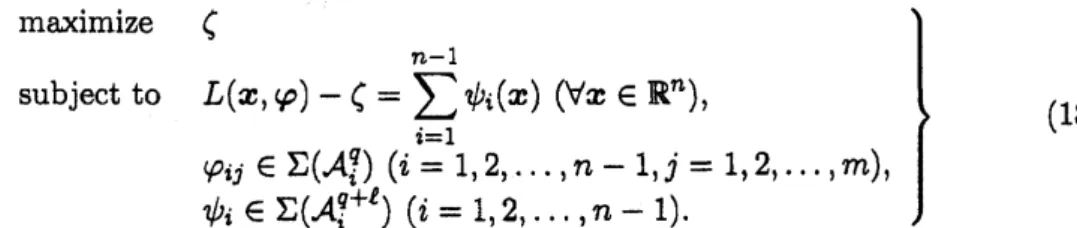
We replace $\varphi \mathrm{o}(x)$ alld$\varphi 0\in\Sigma(A_{0}^{q+\ell})$ by $\mathrm{E}\mathrm{t}7_{=1}^{-}"\psi_{i}$($) and $\mathrm{A}_{\mathrm{i}}$ $\in\Sigma(A_{i}^{q+\ell})(i=1,2, \ldots, n-1)$
in the SOSrelaxation (17), respectively, toobtain
a new
SOS
relaxation ofthePOP (15):subject to $L$(x,$\varphi$) $- \zeta=\sum_{i=1}^{n-1}\psi_{\dot{\mathrm{t}}}(x)(\forall x\in \mathbb{R}^{n})$,
maximize
$\zeta\varphi_{ij}\in\Sigma(A_{i}^{q})(i=1,2, \ldots, n- 1, j=1,2, \ldots,m)$
,
$\}$ (18)
$\psi_{i}\in\Sigma(A_{t}^{q+\ell})(i=1,2, \ldots,n-1)$
.
It should be noted that the size ofevery support set in the SOS relaxation (18) is inde
pendent ofthe dimension $n$ of the POP (15). When $m$ and $q$ are fixed, the total size
ofsupport sets in the SOS relaxation (18) grows linearly with the dimension $n$ while the
growth rate of the total size ofsupport sets in the SOS relaxation (16)
as
wellas
that inthe SOS relaxation (17) are of $O(n^{q+\ell})$
.
This shows that the SOS relaxation (18) hasa
considerable computational advantage in solving the
POP
(15) with large dimension $n$.
The numerical experiment
was
done using SDPA 6.0 [10]on
Pentium IV (XEON) 2.4 GHz with $6\mathrm{G}\mathrm{B}$ memory, and the optimal values of the POP (15) with $m\in\{1, n, n^{2}\}$, $\ell\in\{1,3\}$, and $n\in\{4,5,6,7\}$were
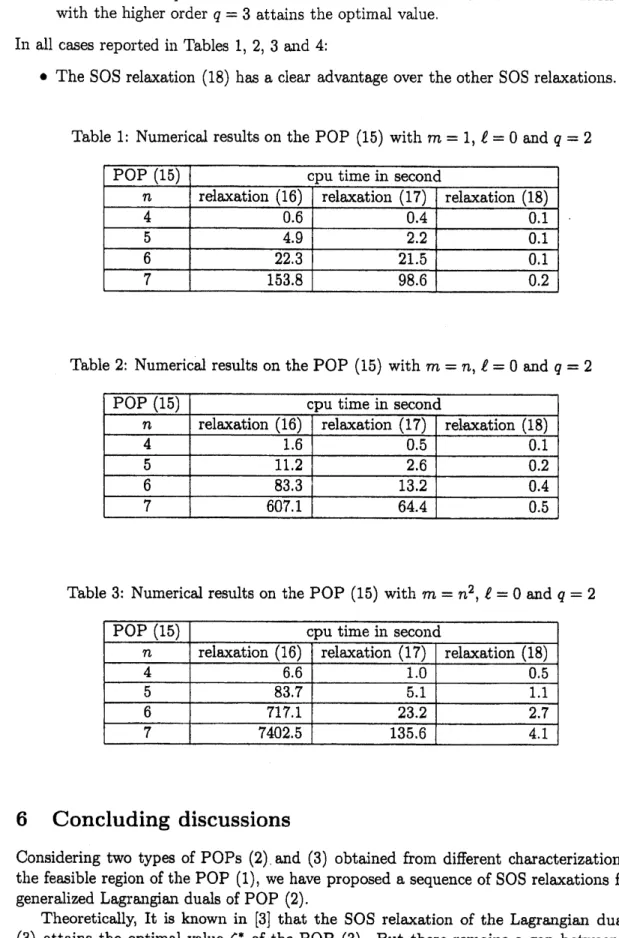
computed byGloptiPoly [2]. Tables 1, 2 azxd3 showsome numerical results from the three SOS relaxations (16), (17) and (18) of the POP
(15) with $m\in\{1, n, n^{2}\}$, $\ell=1$ aaxd dimension $n\in\{4,5,6,7\}$
.
We observe that:.
All the SOS relaxations (16), (17) and (18) attain optimal values of the POP (15)with the lowest order $q=2.$
$\mathrm{o}$ The SOS relaxation (17) requires less cpu time than the SOS relaxation (16), and
the difference in cpu time becomes larger
as
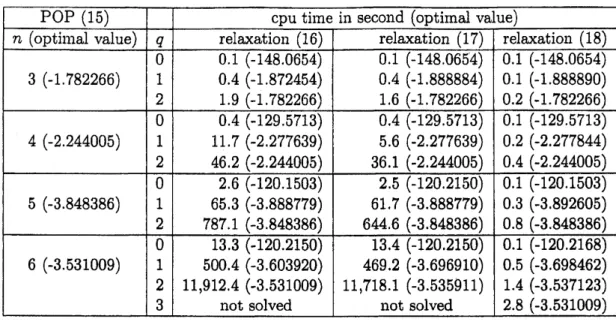
$m$ increases.Table
4
showssome
numerical results ffom the threeSOS
relaxations (16), (17) aatd (18)of the
POP
(15) with $m=n$, $P=3$ anddimension $n\in\{3,4,5,6\}$.
In thiscase:
o The SOS relaxations (17) aaxd (18) attain optimal values of the POP (15)
or
theirlower bounds of(almost) the
same
quality as the SOS relaxation (16).$\circ$ The SOS relaxation (17) requires less cpu time than the SOS relaxation (16), but
the difference is small.
$\mathrm{o}$ When$n=6,$ theSOS relaxation (16) withtheorder$q=2$ attainsthe optimalvalue,
98
bounds for the optimal value. It should also be noted that the SOS relaxation(18)
with thehigher order $q=3$ attains theoptimal value.
In all
cases
reported in Tables 1, 2, 3 alld 4:$\mathrm{o}$ The
SOS
relaxation (18) hasa
clear advantageover
the other SOS relaxations.Table 1: Numerical results
on
the POP (15) with $m=1$,
$\ell=0$ and$q=2$POP (15) $\mathrm{c}\mathrm{p}\mathrm{u}$time in second
$n$ relaxation (16) relaxation ($1\underline{7)}$ relaxation (18)
4 0.6 0.4 0.1 5 4.9 2.2 -0.1 $\overline{6}$ 22.3 21.5 0.1
7
153.8
98.6
0.2
Table 2: Numerical results
on
thePOP (15) with $m=n$,$\ell=0$ and $q=2$POP
(15) cpu time in second$n$ relaxation (16) relaxation (17) relaxation 18)
4 1.6 0.5 0.1
5 $\overline{11}$
.2–
2.6 0.2
683.3
13.2
0.47
607.1
64.4
0.5
Table 3: Numerical results
on
the POP (15) with $m=n^{2}$, $\ell=0$ and $q=2$$\mathrm{P}\mathrm{O}\underline{\mathrm{P}}(15)$ cpu time in second
$n$ relaxation (16) relaxation (17) relaxation (18)
4 6.6 1.0 0.5 5 83.7 5.1 1.1 6 – 717.1 $2\underline{3}$
.2-2.7
7 7402.5 135.6 – 4.16
Concluding
discussions
Considering two types of POPs (2) and (3) obtained from different characterizations of
the feasibleregion ofthe POP (1),
we
have proposeda
sequence of SOS relaxations fromgeneralized Lagraiigian duals of POP (2).
Theoretically, It is known in [3] that the SOS relaxation of the Lagraiigian dual of
$\mathrm{e}\mathrm{e}$
Table 4: Numerical results on thePOP (15) with $m=n$ and $\ell=3$
POP (15) cpu time in second (optimal value)
$n$ (optimal value) $q$ relaxation (16)
– relaxation (17) relaxation (18) 00.1 (-148.0654) 0.1 (-148.0654) $0.\overline{1}$(-148.0654) 3 (-1.782266) 10.4 (-1.872454) 0.4 (-1.888884) 0.1 (-1.888890) 21.9 (-1.782266) $1.6(-$-1.782266$)$ $0.2_{-}(- 1.782266)$ 00.4 (-129.5713)
–0.4
(-129.5713) 0.1 (-129.5713) 4 (-2.244005) 111.7 (-2.277639)5.6
(-2.277639) 0.2 (-2.277844) 246.2
(-2.244005)36.1
(-2.244005) $0\underline{.4}$ $(- 2.244005)$02.6
(-120.1503) 2.5 (-120.2150) 0.1 (-120.1503) 5 (-3.848386) 1 65.3 (-3.888779) 61.7 (-3.888779) 0.3 (-3.892605) 2787.1 (-3.848386) 644.6 (-3.848386) 0.8 (-3.848386)013.3
(-120.2150) 13.4 $(- 120.2\overline{1}50)$ 0.1 (-120.2168) 6 (-3.531009) 1 500.4 (-3.603920)469.2
(-3.696910) 0.5 (-3.698462) 211,912.4 (-3.531009) 11,718.1 (-3.535911) 1.4 (-3.537123)3not solved not solved 2.8 (-3.531009)
Lagrangian dual of(2) alld its SOSrelaxation in Section 4.2; the former attains(’but the
latter is not guaranteed to attain $\zeta^{*}$
.
Thus it is interesting to prove or disprove that theSOS relaxation ofthe Lagrangian dual of (2) attains $\mathrm{s}*$
.
This will bea
subject of futurestudy.
The size of the
SOS
relaxationor
the SDP relaxation obtained from the Lagrangiandualapproach byexploiting sparsity is smallerthan the size of Lasserre’s SDP relaxation.
This is of
course
a nice feature, but this may not necessarilymean
that the former SDPrelaxation is
as
effectiveas
the latter in practice. To attain an approximation to theoptimal value $\langle$’ of the POP (1) with as high accuracy
as
the one from Lasserre’s SDPrelaxation, we may need higher degree SOS polynomials in our dual approach, which
makes the size of the resultingSDP relaxation larger.
One of the advantages of the proposed method is that we have much flexibility in
implementation of the SOS relaxation and the SDP relaxation of the POP (1); sets of
Lagrangian multiplier
SOS
polynomials satisfying the assumption of Theorem 3.1can
befreely chosen to strengthen the resulting relaxations. We have presented all illustrative
example of how the framework of the proposed
SOS
relaxationcan
be used to havea
practical
SOS
relaxation exploitingastructured sparsity. Numerical resultsofthe examplehave indicated that it is possible to drastically improve computational efficiency of SOS
relaxations bymaking proper heuristic choices of supports, depending
on
problems.Additionalnumerical experiments
on
theSDPrelaxation with heuristicaly chosensup-ports
were
performedfor various types ofpolynomial optimization problems with certaintypes of sparsity. We have not included the numerical results from the additional
nu-merical experiments in this paper because
we
believe that the discussion of heuristics isbeyond the scope ofthis paper. The main purposeofthis paperhas been proposing
gen-eral methodsfor sparsity in SDP relaxations forpolynomial optimization and introducing
Lagrangian dual and penalty function approaches into SDP relaxations for polynomial
relax-100
ations could improve the efficiency, it would be
necessary
to address issues such as (i)a
reasonabledefinition
of structured sparsity in polynomial optimization problems, (ii)technical details of heuristic choices of supports, and (iii) extensivenumericalexperiments
on various problems with structured sparsity. These will consist ofa paper
on
practicalperformance ofthe heuristics, which we hope to present in
near
future.References
[1] M. D. Choi, T. Y. Lam, and B. Reznick, “Sums of squares of real polynomials”,
Proceedings
of
Symp.o
sia in Pure Mathematics, 582 (1995)103-126.
[2] D. Henrion and J. B. Lasserre, ”GloptiPoly: Global optimization
over
polynomialswith Matlab andSeDuM\"i, Laboratoire d ’Analyseet d’
Architecture des Syst‘emes,
Centre National de la Recherche Scientiflque, 7 Avenue du Colonel Roche,
31077
Toulouse, cedex 4, Prance, February2002.
[3] S. Kim, M. Kojima and H. Waki, “GeneralizedLagr angian duals axxdsumsofsquares
relaxations of $\mathrm{s}\mathrm{p}\mathrm{a}\mathrm{r}\mathrm{s}\dot{\mathrm{e}}$ polynomial optimization problems, Research Report B-395,
Dept. of Mathematical and computing Sciences, Tokyo Institute of Technology,
Me-guro, Tokyo 152-8552, September2003. Revised July2004. Toappear in SIAM
Jour-nal
on
Optimization.[4] M. Kojima,
S.
Kim and H. Waki, “A generalframework for convex relaxation ofpoly-nomial optimization problems
over
cones”, Journalof
Operations Research Societyof
Japan, 462 (2003) 125-144.[5] M. Kojima, S. Kim and H. Waki, “Sparsity in
sums
of squares of polynomials”,Re-search ReportB-391, Dept.ofMathematical andcomputing Sciences, Tokyo Institute
of Technology, Meguro, Tokyo 152-8552, June
2003.
Revised August 2003. To appearin Mathematical Programming.
[6] J. B. Lasserre, “Globaloptimizationwithpolynomials and the problems of moments”,
SIAM Journal on Optimization, 11 (2001) 796-817.
[7] P. A. Parrilo, “Semidefinite programming relaxations for semialgebraic problems”,
Mathematical Programming, 96 (2003) 293-320.
[8] V. Powers andT. W\"ormann, “An algorithm for
sums
ofsquares of real polynomials”,
Journal
of
Pure and Applied Algebra, 127 (1998)99-104.
[9] B. Reznick, “Extremal psd forms with few terms”, Duke Mathematical Journal, 45
(1978) 363-374.
[10] M. Yamashita, K. Pujisawa and M. Kojima, “Implementation aaxd evaluation of
SDPA 6.0 (SemiDefifinite Programming Algorithm 6.0)”, Optimization Methods and