RECTIFIABLE, UNRECTIFIABLE AND FRACTAL OSCILLATIONS OF SOLUTIONS OF LINEAR AND HALF-LINEAR
DIFFERENTIAL EQUATIONS OF SECONKORDER
MERVANPASIC
Abstract. Inthisexpository paper,we payattentiontoa newkind ofoscillations of solutions of
thesecond-orderdifferential equationsonthe finite interval. Itis the so-calledrectifiable,
unrec-tifiable andfractal oscillations ofreal functions and solutions ofdifferential equations introduced
inPaSi\v{c}[S], [9]andWong[15],andcontinuedto studyin[4], [6], [10],[11], [12],and[16].
1. Motivationfortheoscillations
near
$x=0$Weconsider famous Euler lineardifferentialequation,
$y”+\lambda x^{-2}y=0,$ $x\in(0,\infty),$ $\lambda>0$
.
(1)DEFINITION 1. A function$y(x)$ oscillates
near
$x=0$ ifthere isa
decreasingse-quence
$a_{n}\in(0,1]$ such that $a_{n}\searrow 0$ and $y(a_{n})=0$.
A fimction$y(x)$ oscillatesnear
$x=\infty$ifthere is
an
increasingsequence
$a_{n}\in[T,\infty)$,forsome
$T>0$,such that $a_{n}arrow\infty$.
The following basicfacts
on
the equation (1)are
verywellknown:$\bullet$ if$\lambda>1/4$,thenall solutions$y(x)$ of (1)
are
givenbythe formula$y(x)=c_{1}\sqrt{x}\cos(p\ln x)+c_{2}\sqrt{x}\sin(\rho\ln x)$,
where $\rho=\sqrt{\lambda-1}/4$;
$\bullet$ $y(x)$
are
oscillatingnear
both$x=0$ and$x=\infty$,see
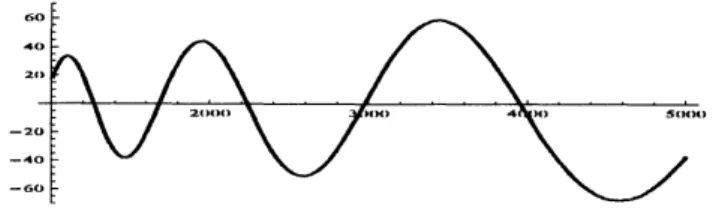
Figures 1 and2below:Figure 1: oscillations
near
$x=0$Mathematics subjectclassification(2000): $26A27,26A45,28A75,28A80,34B05,34C10,34C20$.
Keywords andphrases: oscillations, linear and half-linear equations, singular, Dirichlet boundary
value problem, graph,rectifiability, $\hslash actal$dimension,Minkowskicontent,asymptotics.
Figure2: oscillations
near
$x=\infty$2. Definition oftherectiflable and unrectifiableoscillations
on
$[0,1]$Let $G(y)\subseteq \mathbb{R}^{2}$ denotethegraphof
a
mnction$y:[0,1]arrow \mathbb{R}$,defined by $G(y)=\{(x,y)\in \mathbb{R}^{2} : x\in[0,1],y=y(x)\}$.
Itslengthisdefined by:
length$G(y)= \sup\sum_{i=1}^{m}||(t_{i},y(t_{i})-(t_{i-1},y(t_{i-1}))||_{2}$,
where $0=t_{0}<t_{1}<\cdots<t_{m}=1$ is
a
partitionoftheunitinterval. Ofcourse,in thecase
when$y\in C^{1}((0,1])$,then the length of$G(y)$
can
becalculatedby the formula,length$G(y)= \lim_{\deltaarrow 0}\int_{\delta}^{1}\sqrt{1+y^{\prime 2}(x)}dx$
.
DEFINITION 2. A Rmction$y(x)$ is
rectifiable
oscillatoryon
$[0,1]$ if$y(x)$oscil-lates
near
$x=0$ and length$G(y)<\infty$.
A $fi\iota nctiony(x)$ isunrectifiable
oscillatoryon
$[0,1]$ if$y(x)$ oscillatesnear
$x=0$ and length$G(y)=\infty$.
EXAMPLE 1. Allsolutions ofthe Euler equation
$y”+\lambda x^{-2}y=0,$$x\in(0,1],$ $\lambda>1/4$,
are
rectifiable oscillatoryon
$[0,1]$,where$y(x)$are
explicitlygivenby:$y(x)=c_{1}\sqrt{x}\cos(\rho\ln x)+c_{2}\sqrt{x}\sin(p\ln x),$ $\rho=\sqrt{\lambda-1}/4$
.
EXAMPLE 2. All solutions $y(x)$ ofthe linearequation, $y”+\lambda x^{-4}y=0,$$x\in(0,1],$ $\lambda>0$,
areunrectffiable oscillatoryon $[0,1]$,where$y(x)$
are
explicitlygivenby:3. Rectifiableand unrectiflable oscillations of linear differential equations Accordingto Examples 1 and 2, it is namraly to pose the following questions: what is about the rectffiable and unrectffiable oscillations of the linear second-order differentialequationof Eulertype:
$y”+\lambda x^{-\sigma}y=0,$ $x\in(0,1]$, (2)
where $\lambda>0$ and $\sigma\geq 2$? Does it depend
on
thevaluesof $\sigma$? Inparticular for $\sigma=2$and $\sigma=4$,the
answer
is given inExamples 1 and 2. However,a
completeanswer
tothisquestion is
given
in thefollowingresult. THEOREM 1. We have:(i)
if
$2\leq\sigma<4$, thenallsolutionof
Eq.(2)are
rectifiable
oscillatoryon
$[0,1]$;(ii)
if
$\sigma\geq 4$, thenall solutionof
Eq. (2)are
unrectifiable
oscillatoryon $[0,1]$.
The proof of Theorem 1
was
published in [8] and [15]. Precisely, Theorem 1 in [8]was
considered where the followingproperties ofsolutions$y(x)$ of Eq.(2)are
presumed:
$|y(x)|\leq cx^{\sigma/4}$ and $|y^{f}(x)|\leq cx^{-\sigma/4}$
near
$x=0$.
In [15],the previous statementis verified for all solutions of the equationEq.(2),
see
alsoLemma4 below.
The proofof Theorem 1 is based
on
the followingtwolemmas.LEMMA 1. (see [8])Let$y\in C([0,1])$ oscillate
near
$x=0$. Let $s_{n}\in(0,1]$ beadecreasingsequence, $s_{n^{\backslash }\searrow}0$ and$y^{f}(s_{n})=0$
.
Thenwe have:length$G(y)<\infty$
if
and onlyif
$\sum_{n=1}^{\infty}|y(s_{n})|<\infty$.
LEMMA 2. Let $y(x)$ be a solution
of
Eq. (2). Let $s_{n}\in(0,1]$ be a decreasingsequence, $s_{n}\searrow 0$ and$y’(s_{n})=0$
.
Then thereare twopositive constants $c_{1}$ and $c_{2}$suchthat:
(i)(see [15])
$c_{1}s_{n}^{\sigma/4}\leq|y(s_{n})|\leq c_{2}s_{n}^{\sigma/4}(i. e. |y(s_{n})|\sim s_{n}^{\sigma/4})$,
(ii) (see [8])
$c_{1}n^{-2/(\sigma-2)}\leq s_{n}\leq c_{2}n^{-2/(\sigma-2)}(i. e. s_{n}\sim n^{-2/(\sigma-2)})$
.
Involving the preciseasymptotic behaviourof$s_{n}$ and $|y(s_{n})|$ from Lemma2 intoLemma
1,
we
getthe proof of Theorem 1.The result of Theorem 1 could be generalizedto the general linear differential equations:
where $f\in C^{2}((0,1])$ satisfies:
$f(x)>0$ and$f’(x)<0$
on
$(0,1],$ $f(O+)=\infty$, (4)$\sqrt{f}\not\in L^{1}(0,1)$ and $f^{-1/4}(f^{-\iota/4})’’\in L^{1}(0,1)$
.
(5)THEOREM2. Let $f(x)$
satisff
the conditions (4) and (5). Then all solutionsof
Eq. (3) oscillate
near
$x=0$.
Moreoverlength$G(y)<\infty\iota f$and only
if
$\int_{0+}^{1}\sqrt[4]{f(x)}dx<\infty$.
Theproofof Theorem 2
was
publishedin [4]. It is basedon the following three lemmas.LEMMA 3. (seethe book[1])Let$y\in C([0,1])$. Then
we
have:length$G(y)<\infty$
if
andon$ly$if
$\int_{0+}^{1}|/(x)|dx<\infty$.LEMMA4. (see [15])Let $f(x)$
satisff
(4) and (5). Thereisa
positive constant$c$ such that
for
all solutions ofEq. (3) wehave:$|y(x)| \leq\frac{c}{\sqrt[4]{f(x)}}$ and $|y’(x)|\leq c\sqrt[4]{f(x)}$nearx$=0$.
LEMMA 5. Let $y(x)$ be a solution
of
Eq.(3). Let $s_{n}\in(0,1]$ be a decreasingsequence, $s_{n}\searrow 0$ and$y’(s_{n})=0$
.
Thereare $c_{1}>0$ and$n_{0}\in \mathbb{N}$ such that$\frac{c_{1}}{\sqrt[4]{f(s_{n})}}\leq[\gamma(s_{n})|,$ $\forall n\geq n_{0}$ and $\int_{s_{n}}^{1}\sqrt{f(x)}dx\sim n$ as$narrow\infty$
.
It is not difficult to check that the fimction $f(x)=x^{-\sigma},$ $x\in(0,1]$ and $\sigma>2$,
satisfiestheconditions (4) and (5). Moreover,
$\int_{0+}^{1}\sqrt[4]{f(x)}dx<\infty$ ifand only if $\sigma<4$
.
Hence, Theorem 1 is
an
easyconsequence
ofTheorem2. 4. Someconsequencesof Theorem2Accordin$g$to Theorem2,
we are
ableto establishthe rectffiable andunrectifiableoscillations for
some
classes of linear differential equations whichare
different than the Euler type Eq.(2).COROLLARY 1. Let $f(x)$
satisff
the conditions (4) and (5). Let $f(x)\sim x^{-\sigma}$near
$x=0$.
Thenwe
have:(i)
if
$2\leq\sigma<4$, then all solution$ofy”+f(x)y=0,$ $x\in(0,1]$,are
rectifiable
oscillatoryon
the interval $[0,1]$;(ii)
if
$\sigma\geq 4$, thenall solutionof
$y”+f(x)y=0,$ $x\in(0,1]$,are
unrectifiable
oscillatoryontheinterval $[0,1]$
.
COROLLARY2. Weconsider thefollowing chirp’sequation
$y”+x^{-2}[\beta^{2}x^{-2\beta}+(1-\beta^{2})/4]y=0,$$x\in(0,1]$
.
(6)Thenwehave:
(i)
if
$0<\beta<1$, thenall solution ofEq.(6)are
rectifiable
oscillatoryon
$[0,1]$;(ii)
if
$\beta\geq 1$, then all solutionof
Eq. (6) areunrectifiable
oscillatoryon $[0,1]$.COROLLARY 3. (seeWong[15]) Weconsiderthefollowing linear equation
$y”+\lambda x^{-4}e^{\frac{2}{X}}y=0,$ $x\in(0,1],$ $\lambda>0$
.
(7)Then all solutionofEq. (7)
are
unrectifiable
oscillatoryon
$[0,1]$.
5. OnHartman-Wintnerconditions
Let
us
recall that theHamnan-Winmerconditions (5) playstheesential roleinthe proof of Theorem 2. Therefore,it is worthiletofindtheanswer
to the followingopen question: does it possibleto construct thecoefficient $f(x)$ satisfying (4) andthe firstHartman-Wintner condition ffom (5) but does not satisfy the second
one
ffom (5)? Thatistosay,we
would liketofind$f(x)$ with the followingproperties:$f(x)>0$ and $f’(x)<0$
on
$(0,1],$ $f(O+)=\infty$, (8)$\sqrt{f}\not\in L^{1}(0,1)$ and $f^{-1/4}(f^{-1/4})’’\not\in L^{1}(0,1)$
.
(9)Inthe solving ofthis problem,wefind that the following lemma could be ofsome interest.
LEMMA 6. Let $f(x)$
satisff
(8) and the second Hartman-Vflntnerconditionfrom
(5). Then $f(x)$ must
satisfi
thefirst
Hartman-Wmtner conditionfivm
(9) and thefollowingtwo:
$\lim_{xarrow 0}\Gamma^{3}2(x)f(x)=0$ and $[\Gamma^{3}2f]’\in L^{1}(0,1)$
.
In orderto
prove
this lemma,we
suggest readerto followa
methodpresentedinthe proof of[11,Lemma2].6. Coexistenceof the rectiflableand unrectifiable oscillations AccordingtoTheorem2,weobserve the followingconsequence.
COROLLARY4. Let$f(x)$ satisfythecondition (4) and (5). Let$y_{1}(x)$ and$y_{2}(x)$
be two linearly independentsolutions
of
$y”+f(x)y=0,$ $x\in(0,1]$. Then $y_{1}(x)$ and $y_{2}(x)$are
bothrectifiable
oscillatoryon
$[0,1]$ atthesame
time.Hence it is reasonable topose the following question: it is possible to constmct the coefficient$f(x)$ satisfying (8) and (9) such that$y_{1}(x)$ isrectffiable andatthe
same
time$y_{2}(x)$ is unrectffiable oscillatoryonthe interval $[0,1]$?
The
answer
is yes andit could be found in the last section of[4].7. Rectifiableand unrectifiable oscillations of solutions of the half-linear differential equations
Inthissection,
we
consider half-linear differential equation,$(|y’|^{p-2}y’)’+f(x)|y|^{p-2}y=0,$ $x\in(0,1]$, (10)
where $f(x)$ besides (4) satisfies the following Hartman-Wintnertypeconditions
gen-eralizing the related
ones
in (5) from$p=2$ to $p>1$:$f^{\frac{1}{p}}\not\in L^{1}(0,1)$ and $f^{-\frac{1}{pq}}[f^{-2^{1}}p]’’\in L^{1}(0,1)$
.
(11)
Inparticularfor$p=2$,obviouslyEq. (10) becames the linear equationEq. (3) consid-ered in previoussections. The following resultis
a
naturalgeneralization of Theorem2 from lineartothehalf-linearequations.THEOREM 3. Let$f(x)>0$and$f’(x)<0$
on
$(0,1],$ $f(O+)=\infty$ andsatisfy (11).Then all solutions ofEq.(10) oscillatenear$x=0$. Moreover,
length$G(y)<\infty\iota f$andonly$\iota f\int_{0+}^{1}f^{\frac{1}{p^{2}}}(x)dx<’\infty$
.
The proofofTheorem 3 has been publishedin [11]. It is based
on
the follwing two steps.Firststep. Every solution$y(x)$ ofEq.(10) could bewrittenin the form:
$y(x)=(p-1)^{\frac{1}{pq}}\Gamma^{\frac{1}{pq}}(x)\nabla^{\frac{1}{p}}(x)w(\varphi(x))$,
$|/|^{p-2}y’=-(p-1)^{-\frac{1}{pq}}f^{\frac{1}{pq}}(x)\nabla^{\frac{1}{q}}(x)|w’(\varphi(x))|^{p-2}w^{f}(\varphi(x))$,
where the fimction $w=w(t),$ $t>0$, istheso-calledgeneralizedsinehnction,
$|\sqrt{}(t)|^{p}+|w(t)|^{p}\equiv 1$ for all $t>0$
.
Secondstep. Itis importantto showthat the ffinctions $V(x)$ and $\varphi(x)$
satis
$\theta$theequations:
$\varphi’(x)=\frac{-1}{(p-1)^{\frac{1}{p}}}f^{\frac{1}{p}}(x)+\frac{1}{p}\frac{f(x)}{f(x)}|\sqrt{}(\varphi(x))|^{p-2}w’(\varphi(x))w(\varphi(x))$ ,
$V’(x)=[(p-1)^{\frac{1}{p}}\Gamma^{\frac{1}{p}}(x)]’|y’|^{p}+[(p-1)^{-\frac{1}{q}}f^{\frac{1}{q}}(x)]’|y|^{p}$,
andthe following
asymptotic
conditions:$\varphi’(x)<0$ for all $x\in(0,1]$ and $\lim_{xarrow 0+}\varphi(x)=\infty$, $0< \lim_{xarrow 0+}\nabla(x)<+\infty$
.
Now,accordingtotheprevioustwo stepsandby using the
same
geometric
lemmasas
in the of Theorem2,one can
derive the proof of Theorem3.8.
Furthergeneralization: two-point oscillationsInthissection,
we
presentthe oscillationsofsolutionsofthe$D\ddot{m}chlet$problemon
theunitinterval which
was
introducedin[12].DEFINITION 3. Afimction$y(x)$ istwo-point oscillatory
on
$[0,1]$ if$y(x)$ oscillatesat the
same
timenear
$x=0$ and $x=1$.
That is, if there isa
decreasingsequence
$a_{n}\in$ $(0,1]$ andincreasing
sequence
$b_{n}\in[0,1)$ such that: $a_{n}\searrow 0,$ $b_{n}\nearrow 1$,and$y(a_{n})=$$y(b_{n})=0$,
see
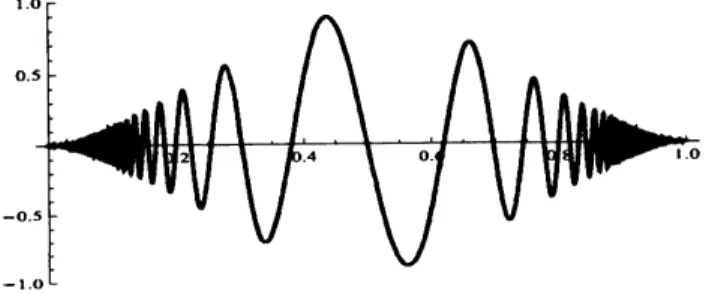
figure below:Figure 3: two-point oscillationswith higher density
near
$x=0$ and$x=1$Themain
motivation
to study this kind ofoscillationswe
obtainffomthe oscilla-tions oftheso-called Riemann-Weber versionof Euler lineardifferentialequation,$y”+x^{-2}( \frac{1}{4}+\frac{\lambda}{|\ln x|^{2}})y=0,$$x\in(0,1),$ $\lambda>0$
.
(12)$\bullet$ if$\lambda>1/4$,then all solutions$y(x)$ of(12)
are
given by the fonnula: $y(x)=\sqrt{x\ln\frac{1}{x}}[c_{1}\cos$(
$p$ln ln$\frac{1}{x}$)
$+c_{2}\sin$(
$p$ln ln$\frac{1}{x}$)
$]$, where $p=\sqrt{\lambda-1}/4$;$\bullet$ $y(x)$
are
oscillatingnear
$x=0$ and $x=1$ atthesame
time. 9. Theexistenceoftwo-point oscillationsWe startwithtwolinearly independent fimctions$y_{1}(x)$ and$y_{2}(x)$ in the form:
$y1(x)=|q’(x)|^{-}2\cos q(x)1$ and $y_{2}(x)=|q’(x)|^{-z}\sin q(x)l$
.
It isnot difficult to
see
thatthe equation which corresponds to the hndamentalset of solutions$y(x)=c_{1}y_{1}(x)+c_{2}y_{2}(x)$, it is:$y”+[ \frac{1}{2}S(q’)(x)+(q’)^{2}(x)]y=0,$ $x\in(O, 1)$, (13)
where $S(q’)(x)$ denotes
as
usualthe Schwarzianderivativeof$q(x)$ defined by$S(q’)(x)= \frac{q’’’(x)}{q’(x)}-\frac{3}{2}[\frac{q’’(x)}{q’(x)}]^{2},$ $x\in(0,1)$.
THEOREM4. Let $q(x)$
satisff
thefollowing condition:$q\in C^{3}(0,1)$, (14)
$|q(0+)|=|q(1-)|=+\infty$ and $|q^{f}(0+)|=|q^{f}(1-)|=+\infty$, (15)
$q’(x)<0$
for
all$x\in(O, 1)$ and $S(q’)\in C(O, 1)$.
(16)Then all solutions
of
Eq. (13)are
two-pointoscillatory on $(0,1)$.
Moreover,for
anyfunction
$f\in C(O, 1)$ suchthat$f(x) \geq[\frac{1}{2}S(q’)(x)+(q’)^{2}(x)],$ $x\in(O, 1)$,
then allsolutions
of
the equation $y”+f(x)y=0,$ $x\in(0,1)$,are
two-pointoscillatoryon $[0,1]$.
Theproofofthis theorem hasbeen publishedin [12].
Some classes ofthe frequences $q(x)$ whichsatis$\theta(14),$ (15),and (16)
are
givenalogarithmic class:$q(x)=\rho$lnln$\frac{1}{X},$$\rho=\sqrt{\lambda-\frac{1}{4}}$ apolynomial class:$q(x)= \frac{1-2r}{(x-x^{2})^{\beta}},$$\beta>0$
10. Some
consequences
ofTheorem 4COROLLARY 5. Let $\rho=\sqrt{\lambda-\frac{1}{4}}$ and $\lambda>\frac{1}{4}$
.
Then all solutionsof
Riemann-Weberequation (13)
are
two-pointoscillatoryon $[0,1]$.Proof.
The fimction$q(x)=p$lnln$\frac{1}{X}$ satisfies the conditions (14), (15), and (16).Moreover,
$\frac{1}{2}S(q’)(x)+(q^{f})^{2}(x)=x\urcorner 1(\frac{1}{4}+\frac{\lambda}{|\ln x|^{2}})$ ,
and thus:
$y”+ \frac{1}{x^{2}}(\frac{1}{4}+\frac{\lambda}{|\ln x|^{2}})y=y’’+[\frac{1}{2}S(q’)(x)+(q’)^{2}(x)]y=0,$ $x\in(0,1)$
.
Hence by Theorem 4, all solutions of
Riemann-Weber
equation (13)are
two-point oscillatoryon
$[0,1]$.
Q.E. D.COROLLARY 6. Let $c(x)$ besmooth andpositive
on
$[0,1]$ and let $\sigma>2$. Thenall solutions
of
theequation;$y”+ \frac{c(x)}{(x-x^{2})^{\sigma}}y=0,$$x\in(0,1)$, (17)
aretwo-point$oscillato,y$on $[0,1]$
.
Proof
At the first, the ffinction $q(x)= \frac{1-2\mathfrak{r}}{(x-x^{2})^{\beta}},$ $\beta>0$, satisfies the conditionsthat $2\beta+2<\sigma$ and
$f(x):= \frac{c(x)}{(x-x^{2})^{\sigma}}\geq\frac{m}{(x-x^{2})^{2\beta+2}}\geq[\frac{1}{2}S(q’)(x)+(q’)^{2}(x)]$,
where $q(x)= \frac{1-2\mathfrak{r}}{(x-x^{2})^{\beta}}$. Hence by Theorem 4, all solutions of Eq.(17)
are
two-pointoscillatory
on
$[0,1]$.
Q.E. D.COROLLARY 7. Let $c(x)$ be a
continuousfunction
on $[0,1]$ such that $c(x)\geq 1$for
all$x\in(0,1)$. Then all solutionsof
theequation:$y”(x)+c(x)e^{\frac{4}{x-x^{2}}}y(x)=0,$ $x\in(O, 1)$, (18)
are
two-pointoscillatoryon
$[0,1]$.Proof.
Thefimction $q(x)=(1-2x)e^{\frac{1}{x-x^{2}}}$ satisfies the conditions(14), (15), and (16). Now,
we
have:$f(x):=c(x)e^{\frac{4}{x-x^{2}}} \geq\frac{e^{\chi-X}=^{2}}{(x-x^{2})^{4}}\geq[\frac{1}{2}S(q’)(x)+(q’)^{2}(x)]$
,
where $q(x)=(1-2x)e^{\frac{1}{x-x^{2}}}$
.
Hence byTheorem4, all solutions of Eq. (18) are
two-point oscillatory
on
$[0,1]$.
Q. E.D.11. Two-point rectifiableand unrectifiable oscillations
DEFINITION 4. A Rmction $y(x)$ is two-point
rectifiable
oscillatoryon
$[0,1]$ if $y(x)$ is two-point oscillatoiy on $[0,1]$ and length$G(y)<\infty$. A hnction $y(x)$ istwo-point
unrectifiable
oscillatoryon
$[0,1]$ if$y(x)$ is two-point oscillatoryon
$[0,1]$ andlength$G(y)=\infty$.
THEOREM 5. Let $q(x)$
satisff
the previous conditions (14), (15), and (16).There holds true:
(i)$\iota f(|q’|^{-2}3|q’’|+|q’|^{1}z)\in L^{1}(0,1)$, then all solutions ofEq.(13)
are
two-pointrectifi-ableoscillatory on $(0,1),\cdot$
(ii) $\iota f|q’(x)|^{-1}$ isincreasing
near
$x=0$ anddecreasingnear
$x=1$ andtheseries, $\sum_{k}|q’(q^{-1^{1}}(k\pi))|^{-z}$ $or$ $\sum_{k}|q’(q^{-1}(-k\pi))|^{-z^{1}}$is divergent, then allsolutions
of
Eq.(13) are two-pointunrectifiable
$oscillato,y$ on$(0,1)$.
COROLLARY 8. Let $c(x)$ besmooth andpositive
on
$[0,1]$.
Wehave:(i)
if
$\sigma\in(2,4)$, then equation (17) is two-pointrectifiable
oscillatoryon
$[0,1]$.
(ii)
if
$\sigma\geq 4$, then equation (17) is two-pointunrectifiable
oscillatoryon $[0,1]$.
Theproofs ofTheorem5 and Corollary8have been publishedin[12].
12. Motivation tointroduce and study theso-called fractal oscillations Inthe application (acoustic, telecomunication, signal processingetc.),
a
signal is called chirpifits ffequence isgrowing upor
down in the time:Figure4: the $(\alpha,\beta)$-chirp: $y(x)=x^{\alpha}\cos(x^{-\beta})$
or
$y(x)=x^{\alpha}\sin(x^{-\beta})$On the rectffiable andunrectffiableoscillationsofthe $(\alpha,\beta)$-chirp
one can
saythefollowing.
THEOREM 6. (see the book [14]) Let $y(x)$ be the $(\alpha,\beta)$-chirp, that is, $y(x)=$ $x^{\alpha}\cos(x^{-\beta})$ or$y(x)=x^{\alpha}\sin(x^{-\beta})$
.
Then wehave:lengthG$(y)=\infty$ $\Leftrightarrow$ $\beta\geq\alpha$
.
How to estimate the density of
an area
filled bya
chirpnear
$x=0$,see
figure above? In ordertogivetheanswer
tothisquestion,we
needtorecallsome
notionsffom the ffactalgeometryof planecurves
like the $\epsilon$-neighbourhood, Minkowski-Bouliganddimension (box dimension) and the s-dimensional Minkowski content of the graph
$G(y)$ denotedrespectively by $G_{\epsilon}(y),$ $\dim_{M}G(y)$ and $M^{s}(G(y))$, and defined
respec-tivelyby:
$G_{\epsilon}(y)=\{(t_{1},t_{2})\in \mathbb{R}^{2} : d((t_{1},t_{2}),G(y))\leq\epsilon\}$,
$\dim_{M}G(y)=\lim_{\epsilonarrow 0}(2-\frac{\log|G_{\epsilon}(\gamma)|}{\log\epsilon})$ ,
$W(G(y))= \lim_{\epsilonarrow 0}(2\epsilon)^{s-2}|G_{\epsilon}(y)|,$ $s\in[1,2]$
.
Let
us
remark that in the general case, in previous definitions it is required the tennItis$elemental\gamma$toobtain the following properties:
(i) $|G_{\epsilon}(y)|arrow 0$
as
$\epsilonarrow 0$ and the densityofanarea
filled by $G(y)$ isequivalenttothe asymptotics of $|G_{\epsilon}(y)|$
as
$\epsilonarrow 0$;(ii) $\dim_{M}G(y)=s,$ $0<M^{s}(G(J))<\infty$ $\Leftrightarrow|G_{\epsilon}(y)|\sim\epsilon^{2-s}$
as
$\epsilonarrow 0$.
Now, the density of
an
area
filledbya
chirpnear
$x=0$, it could be described bythefollowingresult.
THEOREM 7. (see the book [14]) Let$y(x)$ be the $(\alpha,\beta)$-chirp, that is, $y(x)=$ $x^{\alpha}\cos(x^{-\beta})$ or$y(x)=x^{\alpha}\sin(x^{-\beta})$
.
Thenwehave:$\dim_{M}G(y)=2-\frac{1+\alpha}{1+\beta}$ and $|G_{\epsilon}(y)|\sim\epsilon^{\frac{1+\alpha}{1+\beta}}$
as $\epsilonarrow 0$
.
Let
us
remarkthat the box dimension satisfies the followingaxiomatic properties. Thatis, if$P(\mathbb{R}^{2})$ denotesthepartitivesetof$\mathbb{R}^{2}$,thenwehave:
(i) $\dim_{M}:P(\mathbb{R}^{2})arrow[1,2]$;
(ii) if$E\subseteq F$,then $\dim_{M}(E)\leq\dim_{M}(F)$ (monotonicity);
(iii) $\dim_{M}(E\cup F)=\max\{\dim_{M}(E),\dim_{M}(F)\}$ (finite stability);
(iv)if$f$: $\mathbb{R}^{2}arrow \mathbb{R}^{2}$ is
a
bi-Lipschitztransformation,then for all $E\subseteq \mathbb{R}^{2}$,
$\dim_{M}(f(E))=\dim_{M}(E)$ (bi-Lipschitzinvariance).
13. Fractaloscillationsof realfunctions
Now,
we
recall the definitionofthe so-called fractal oscillations of realhnctions introducedin[9].DEFINITION 5. Let $s\in[1,2]$
.
A hnction$y(x)$ is the $s-dimensionalfi^{d}actal$oscil-latory
on
$[0,1]$ if$y(x)$ oscillatesnear
$x=0$ and$\dim_{M}G(y)=s$ and$0<W(G(y))<\infty$.
A fUnction$y(x)$ is called tobe
fractal
oscillatoryon
$[0,1]$ ifthereisan
$s\in[1,2]$ suchthat$y(x)$ isthe
s-dimensionalfractal
oscillatoryon
$[0,1]$.
THEOREM 8. (ageneralizationofTheorem7)Let$y(x)$ be the $(\alpha,\beta)$-chirp, that
is, $y(x)=x^{\alpha}\cos(x^{-\beta})$ or$y(x)=x^{\alpha}\sin(x^{-\beta})$
.
Thenwehave:(i)
if
$\alpha>\beta>0$, then$y(x)$ isthe l-dimensionalfractal
oscillatoryon $[0,1],\cdot$(ii)
if
$\alpha=\beta>0$, then $y(x)$ isnotfractal
oscillatory on $[0,1]$, since $\dim_{M}G(y)=1$and$M^{1}(G(y))=\infty$;
(iii) $lf0<\alpha<\beta$, then $y(x)$ is the s-dimensional
fractal
oscillatoryon $[0,1]$, where14. Fractaloscillations of lineardifferential equations
Suchakind ofresults presented in Theorem8,it could be also verifiedtothe
case
of all solutions of linear differentialequationsofsecond-order.DEFINITION 6. Let $s\in[1,2]$ be
an
arbitrarilygivenrealnumber. Alinearequa-tion $(P):y”+f(x)y=0$ is saidtobethe s-dimensional ffactal oscillatory
on
$[0,1]$,ifallits solutions$y(x)$
are
thes-dimensionalfractal
oscillatoryon
$[0,1]$.
Weknow that:
$\bullet$ Euler equation
$y”+\lambda x^{-2}y=0,$ $x\in(0,1],$ $\lambda>1/4$,
isthe
l-dimensionalffactal
oscillato$y$on
$[0,1]$;$\bullet$ The (2, 3)-chirpequation,
$y”+(9x^{-8}-2x^{-2})y=0,$ $x\in(O, 1]$,
isthe s-dimensional ffactal oscillatory
on
$[0,1]$,where $s=5/4$.
What isabout the ffactal oscillations of the linear second-order differential equa-tion of Eulertype:
$y”+\lambda x^{-\sigma}y=0,$ $x\in(O, 1]$, (19)
where $\lambda>0$ and $\sigma\geq 2$? Does
it
dependon
the values of$\sigma$? Theanswer
is
givenin
the following result.
THEOREM 9. Wehave:
(i)$\iota f2\leq\sigma<4$, then Eq.(19) isthe
l-dimensionalfractal
oscillatoryon
$[0,1],\cdot$(ii)
if
$\sigma=4$, then Eq.(19) isnotfractal
oscillatoryon
$[0,1]$,since$\dim_{M}G(\gamma)=1$ and $M^{1}(G(y))=\infty$;(iii)
if
$\sigma>4$, thenEq. (19) isthes-dimensionalfiactal
oscillatoryon $[0,1]$, wherethedimensional number$s$
satisfies
$s= \frac{3}{2}-\frac{2}{\sigma}$.
REMARK 1. For $\sigma=4$
we
havea
kindofthe s-dimensionalMinkowskidegener-ation. That is,theequation,$y”+\lambda x^{-4}y=0,$$x\in(0,1],$ $\lambda>0$, isnotffactal oscillatory
on $[0,1]$,since $\dim_{M}G(y)=1$ and$M^{1}(G(y))=\infty$ for all solutions$y(x)$
.
That is, $G(y)$isnot $M^{1}$ measurable.
The proof ofTheorem9has been published in [9].
Next,
we
consider the linear second-order differentialequation:$y”+f(x)y=0,$ $x\in(0,1]$, (20)
where $f\in C^{2}((0,1])$ satisfies:
$f(x)>0$ and$f^{f}(x)<0$
on
$(0,1],$ $f(O+)=\infty$, (21)THEOREM 10. Let$f(x)sa\hslash sff$the conditions (21) and(22), andlet$f(x)\sim x^{-\sigma}$
near$x=0$
.
Thenwehave:(i)$\iota f2\leq\sigma<4$, thenEq. (20) is the
l-dimensionalfractal
oscillatoryon $[0,1],\cdot$(ii)$lf\sigma=4$, then Eq.(20) is
notffactal
oscillatoryonthe interval$[0,1]$,since$\dim_{M}G(y)=$$1$ and $M^{1}(G(y))=\infty$;
(iii)$\iota f\sigma>4$, then Eq. (20) isthe
s-dimensionalfractal
oscillatoryon $[0,1]$, where the
dimensional number$s$
satisfies
$s= \frac{3}{2}-\frac{2}{\sigma}$.TheproofofTheorem 10has beenpublishedin [4].
Asa
consequence
weobserveageneralization ofTheorem 8. COROLLARY 9. Weconsiderthe $(\alpha,\beta)$-chirpequation:$y”+( \frac{\beta^{2}}{x^{2\beta+2}}+\frac{1-\beta^{2}}{4x^{2}})y=0,$
$x\in(0,1]$, (23)
where $\alpha=(\beta+1)/2$. Thenwehave:
(i)$\iota f0<\beta<1$, then Eq.(23) isthe
l-dimensionalfractal
oscillatoryon
$[0,1],\cdot$(ii)
if
$\beta=1$, then Eq. (23) isnotfractal
oscillatory on $[0,1]$,since $\dim_{M}G(y)=1$ and$M^{1}(G(y))=\infty$;
(iii)$tf\beta>1$, thenEq. (23) isthe
s-dimensionalfractal
oscillatoryon $[0,1]$, wherethedimensionalnumber $s$
satisfies
$s= \frac{3}{2}-\frac{1}{\beta+1}$.
15. Whatis the
essences
in the fractaloscillations? Thefollowingstatementsare
equivalent:(i)$y(x)$ isfractal oscillatory
on
$[0,1]$;(ii)there isan$s\in[1,2]$ such that:
$\dim_{M}G(y)=s$ and $0<M^{\theta}(G(J))<\infty$;
(iii) $|G_{\epsilon}(y)|\sim\epsilon^{2-s}$ when $\epsilonarrow 0$,that is, there
are
$c_{1},c_{2}>0$ suchthat:$c_{1}\epsilon^{2-s}\leq|G_{\mathcal{E}}(J)|\leq c_{2}\epsilon^{2-s}$ forsmall $\epsilon>0$
.
Hence, in orderto prove that
an
oscillatory ffinction $y(x)$ is the ffactaloscillatoryon
$[0,1]$,we
needtoestimate $|G_{\mathcal{E}}(y)|$ from belowandabove by the term $\epsilon^{2-s}$, forsome
$s\in[1,2]$
.
Thereforeone can
observe that the essential toolsin the ffactal oscillationsplaythefollowingtwolemmas.
LEMMA 7. (a lower bound of $|G_{\mathcal{E}}(y)|$)Let$y\in C([0,1])$ and let $a_{n}\in(0,1]$ bea
decreasingsequence
of
consecutivezeros
of
$y(x)$ such that $a_{n}\searrow 0$. Then there is afunction
$k:(0,\epsilon_{0})arrow N$for
some $q>0,$ $k=k(\epsilon)$, such that:$k(\epsilon)$ is increasingand$k(\epsilon)arrow\infty$
as
$\epsilonarrow 0$.
Moreover,
for
anyfunction $k(\epsilon)$ satisffing (24) and (25),we
have(25)
$\sum_{n=k(\epsilon)^{X}}^{\infty}\max_{\in[a_{n+1}a_{n}]},|y(x)|(a_{n}-a_{n+1})\leq|G_{\epsilon}(y)|$
for
small$\epsilon>0$
.
(26)The proof ofLemma7
was
published in[4, Appendix]andina
corresponding integral formin
[7,Section
2].REMARK 2. Obviously,the term $\max_{x\in[a_{n+1},a_{n}]}|y(x)|$ in (26) could be replaced
byweaker
one:
$[\gamma(s_{n})|$,where $s_{n}\in[a_{n+1},a_{n}]$.
LEMMA 8. (an
upper
bound of $|G_{\epsilon}(y)|$)Let $y\in C([0,1])\cap C^{2}((0,1]),$ $y(O)=0$andlet $a_{n}\in(0,1]$ beadecreasing
sequence
of
inflexion-pointsof
$y(x)$ such that$a_{n}\searrow$ $0$. Then thereisafunction
$m:(0,\epsilon_{0})arrow N$for
some
$\mathfrak{g}\in(0,1),$ $m=m(\epsilon)$, such that: $|a_{n}-a_{n+1}|\geq 4\epsilon$for
all$n=1,2,$$\ldots,m(\epsilon)$ and $\epsilon\in(0,\epsilon_{0})$, (27) $m(\epsilon)$ is increasingand$m(\epsilon)arrow\infty$as
$\epsilonarrow 0$.
(28)Next, thereisapositive constant$M>0$ such
thatfor
anyfunction $m(\epsilon)$ satisfiing (27)and (28),
we
have$|G_{\epsilon}(y)| \leq M[\epsilon+a_{m(\epsilon)}\max_{x\in[0,a_{m(\epsilon)}]}|y(x)|]$
$+M[ \epsilon\sum_{n=2^{X}}^{m(\epsilon)}\max_{a_{n}\in[a_{n+1}]},|y(x)|+\epsilon^{2}m(\epsilon)]$
for
small$\epsilon>0$.
The proof of Lemma 7
was
published in [7, Section 2] in the specialcase
when the boundarycurves
of$G_{\epsilon}(y)$are
regular.16. Open problem$A$
:
fractal oscillations of self-adjontlineardifferentialequations Inthissection,
we
consider the self-adjont equation:$(p(x)y’)’+q(x)y=0,$ $x\in(O, 1]$, (29)
where$y\in C([0,1])\cap C^{2}((0,1])$ and the coefficients$p(x)$ and $q(x)$ satis$\theta$
:
$p\in C^{1}([0,1]),$$p(x)>0$ and$p’(x)\geq 0$
on
$(0,1]$, (30)$q\in C^{2}((0,1]),$ $q(x)>0$ and $q’(x)<0$
on
$(0,1],$ $q(O+)=\infty$, (31)and satisify thefollowingHartman-Wintnertypeconditions:
$\sqrt{\frac{q}{p}}\not\in L^{1}(0,1)$and $\frac{1}{\sqrt[4]{pq}}(p(\frac{1}{\sqrt[4]{pq}})^{f})’\in L^{1}(0,1)$
.
(32)CONJECTURE 1. Let the
functions
$p(x)$ and $q(x)$satisff
the conditions (30),(31) and (32), andlet
$p(x)\sim x^{\mu}$ and $q(x)\sim x^{-\sigma}$
near
$x=0$,where $\mu\geq 0,$ $\sigma>0,$ $\sigma+\mu>2$, and $\sigma-\mu>-4$. Then theequation
$(p(x)y’)’+q(x)y=0,$ $x\in(0,1]$,
is the $s-$
dimensionalfractal
oscillatory on $[0,1]$, where the dimensional number $s$satisfies:
$s= \frac{3}{2}+\frac{\mu-2}{\sigma+\mu}$.It is clear that Conjecture 1 in particular for $p(x)\equiv 1,$ $q(x)=f(x),$ $\mu=0$, and $\sigma=\sigma$, generalizes both Theorem9 andTheorem 10
on
thefractal oscillations oftheequation$y”+f(x)y=0,$ $x\in(0,1]$
.
WhenConjecture 1 isverified,then
we
have the followingconsequence.COROLLARY 10. (aconditional
consequence
ofConjecture 1)Let$f(x)>0$ and $f(x)<0$ on $(0,1],$ $f(O+)=\infty$ andsatisff
the Hartman-Wintnertypeconditions:$\sqrt{f}\not\in L^{1}(0,1)$ and $f^{-\iota/4}(f^{-1/4})’’\in L^{1}(0,1)$
.
If
$\mu\geq 0$ and$f(x)\sim x^{-\sigma},$ $\beta\geq 1$, then thelinearequation:$y”+\mu x^{-1}y^{f}+f(x)y=0,$ $x\in(O, 1]$,
is the s-dimensional
fractal
oscillatory on $[0,1]$, where thedimensional number $s=$$\frac{3}{2}+\frac{\mu-2}{\sigma}$.
It isclear that previous conditionalconsequenceof Conjecture 1 inparticular for
$\mu=0$, generalizes both Theorem9 and Theorem 10
on
the fractal oscillations of theequation$y”+f(x)y=0,$ $x\in(0,1]$
.
Also,itmotivatesa
studypresentedinthefollowingsection.
Some resultsonthe Conjecture 1 willappear in aforthcomingpaper[10].
17. Open problem$B$
:
fractal oscillations of linear differentialequationswithdampingterm
What kind of asymptotic properties
near
$x=0$are
proposedto the coefficients$f(x)$ and$g(x)$ suchthat the linearequation:
$y”+g(x)y’+f(x)y=0,$ $x\in(0,1]$,
isthe s-dimensionalffactal oscillatory
on
$[0,1]$ forsome
$s\in(1,2]$?A motivation tosolve this problem
we
findinthebook [14],which could be for-mulatedinthisway: if$0<\alpha<\beta$,then the $(\alpha,\beta)$-chirpequation:.
$y”+ \frac{\beta-2\alpha+1}{x}y’+(\frac{\beta^{2}}{x^{2\beta+2}}-\frac{\alpha(\beta-\alpha)}{x^{2}})y=0,$ $x\in(0,1]$
.
18. Open problem$C$
:
rectifiable and unrectifiable oscillations ofradiallysymmetricsolutions of
some
pde’sLet$N\geq 2$ and let $B=\{x\in \mathbb{R}^{N}:|x|<1\}$be
a
unit
ballcenteredattheorigin
withits boundary $\partial B$
.
DEFINITION 7. A fimction $u:B\backslash \{0\}arrow \mathbb{R}$ is said to be radially symmetric if
thereis
a
Rmction$y=y(r),$$y:(0,1]arrow \mathbb{R}$ such that $u(x)=y(|x|),$ $x\in B\backslash \{0\}$.
Aradiallysymmetric hnction $u:B\backslash \{0\}arrow \mathbb{R}$ issaidtobe oscillatory
near
$\partial B$ ifcor-respondingfimction$y=y(r)$ oscillates
near
$r=1$.
A radially symmetric function $u:B\backslash \{0\}arrow \mathbb{R}$ is said to be s-dimensional
fractal
oscillatory near $\partial B$ if corresponding fimction $y=y(r)$ oscillates
near
$r=1$ and$\dim_{M}G(y)=s$ and $0<M^{s}(G(y))<\infty$, for
some
$s\in[0,1]$.
EXAMPLE 3. Weconsiderthe radiallysymmetricsolutionsoftheDirichlet prob-lem:
$\{\begin{array}{l}-\Delta u=\frac{\lambda}{|x|^{2}\ln^{2}|x|}u in B\backslash \{0\}\subseteq \mathbb{R}^{2}, \lambda>1/4,u=0 on\partial B.\end{array}$ (33)
Allradially symmetric solutions $u(x)$ of $(3\dot{3})$
are
the l-dimensional ffactal oscillatorynear
$\partial B$.
Itisbecause:$u(x)=\sqrt{\ln\frac{1}{|x|}}[c_{1}\cos(p$ln ln$\frac{1}{|x|})+c_{2}\sin(\rho\ln\ln\frac{1}{|x|})]$ ,
where $x\in B\backslash \{0\}\subseteq \mathbb{R}^{2},\lambda>1/4,$ $\rho=\sqrt{\lambda-1}/4$, and $c_{1},c_{2}\in \mathbb{R}$
.
EXAMPLE4. We considertheradiallysymmetric solutions ofthe$D\ddot{m}chlet$
prob-lem:
$\{\begin{array}{l}-\Delta u=\frac{\lambda}{|x|^{2}\ln^{4}|x|}u in B\backslash \{0\}\subseteq \mathbb{R}^{2}, \lambda>0,u=0 on\partial B,\end{array}$ (34)
Allradially symmetricsolutions $u(x)$ of (34)
are
notffactal oscillatorynear
$\partial B$.
Itisbecause:
$u(x)= \ln|x|[c_{1}\cos(\frac{\sqrt{\lambda}}{\ln|x|})+c_{2}\sin(\frac{\sqrt{\lambda}}{\ln|x|})]$,
where$x\in B\backslash \{0\}\subseteq \mathbb{R}^{2},$ $\lambda>0$ and$c_{1},c_{2}\in \mathbb{R}$
.
Now,
we
consider the one-parameter Dirichlet problem:$\{\begin{array}{l}-\Delta u=\frac{\lambda}{|x|^{2}(-\ln|x|)^{\sigma}}u in B\backslash \{0\}\subseteq \mathbb{R}^{2}, \sigma\geq 2,u=0 on\partial B,\end{array}$ (35)
CONJECTURE 2. (the
case
when$N=2$) Wehave:(i)
if
$2\leq\sigma<4$, then all radially symmetric solutions $u(x)$of
Eq. (35) are the1-$dimensionalf’actal$oscillatorynear $\partial B$;
(ii)
if
$\sigma=4$, then radiallysymmetricsolutions $u(x)$ ofEq.(35) arenotfiactal
oscilla-torynear $\partial B$
, since $\dim_{M}G(y)=1$ and$M^{1}(G(y))=\infty$;
(iii)$lf\sigma>4$, then radiallysymmetricsolutions $u(x)$ ofEq.(35)
are
thes-dimensionalfractal
oscillatorynear $\partial B$, wherethe dimensional number$s$
satisfies
$s= \frac{3}{2}-\frac{2}{\sigma}$.Also,
we
consider theone-parameter$D\ddot{m}chlet$problem:$\{\begin{array}{l}-\Delta u=\frac{\lambda(2-N)^{2}}{|x|^{2N-2}(|x|^{2-N}-1)^{\sigma}}u in B\backslash \{0\}\subseteq \mathbb{R}^{N},u=0 on\partial B,\end{array}$ (36)
where $u\in C^{2}(B\backslash \{0\})\cap C(\overline{B}\backslash \{0\}),$ $N\geq 3,$ $\sigma\geq 2$ and $\lambda>0$
.
CONJECTURE 3. (the
case
when$N\geq 3$) Wehave:(i) $\iota f2\leq\sigma<4$, then all radially symmetric solutions $u(x)$
of
Eq.(36) are the1-dimensionalfractal
oscillatorynear $\partial B$;(ii)
if
$\sigma=4$, then radiallysymmetricsolutions $u(x)$ ofEq.(36) arenotfactal
oscilla-torynear $\partial B$
,since $\dim_{M}G(y)=1$ and$M^{1}(G(y))=\infty$;
(iii)
if
$\sigma>4$, thenradiallysymmetricsolutions $u(x)$ ofEq. (36) arethe s-dimensionalfractal
oscillatorynear $\partial B$, wherethedimensionalnumber$s$
satisfies
$s= \frac{3}{2}-\frac{2}{\sigma}$.For
more
details abouttwoprevious conjecturewe propose
the forthcomingpaper
[6]. REFERENC ES[1] L. C.EVANSAND R. F.GARIEPY,Measure Theory and Fine PropertiesofFunctions, CRCPress,
NewYork, 1999.
[2] K. FALCONER, Fractal Geometry. Mathematical Fondations and Applications, John Willey-Sons,
1999.
[3] S. JAFFARD AND Y. MEYER, Wavelet MethodsforPoitwise Regularity andLocal$o_{SC}ulations$ of
Functions,Mem.of Amer. Math.Soc.,123(1996), 1-110.
[4] M. K. KWONG, M.PA\S I\v{c},AND J. S. W. WONG,Rectifiable Oscillations inSecond Order Linear
DifferentialEquations, J. Differential Equations,245(2008),2333-2351.
[5] P. MATTILA,GeometryofSets and MeasuresinEuclideanSpaces. Fractalsand rectifiability,
Cam-bridge, 1995.
[6] Y.NAITO,M. PA\S I\v{c}ANDH.USAMI,Rectifiableoscillations ofradially symmetricsolutionsoflinear
andquasilinear$PDE’s$,in preparation.
[7] M. $PA\check{S}I\acute{C}$, Minkowski-Bouliganddimension
ofsolutions ofthe one-dimensional p-Laplacian, J.
Differential Equations,190(2003),268-305.
[8] M. $PA\check{S}I\acute{C}$,
Rectifiable andunrectifiable oscillationsfor aclass ofsecond-order lineardifferential equationsofEulertype,J. Math. Anal. Appl.,335(2007),$72\not\subset-738$.
[9] M.$PA\check{S}I\acute{C}$,Fractal oscillations
foraclassofsecond-orderlineardifferentialequationsofEulertype, J.Math. Anal.Appl.,341(2008),211-223.
[10] M.$PA\check{S}I\acute{C}$ANDS. TANAKA,
Rectifiableandffactaloscillations ofself-adjont lineardifferential equa-tionsofsecond-order, inpreparation.
[11] M. PA\S I\v{c}ANDJ.S. W. WONG,Rectifiableoscillations in second-orderhalf-linear differential
[12] M.$p_{A}s_{I}\text{\v{c}}_{AND}$J. S. W.WONG,Two-point oscillations in second-order linear
differenlial
equations,Differ. Equ.Appl., 1,1(2009),85-122.
[13] H. O. PEITGEN, H. JURGENS, AND D. SAUPE, Chaos andFractals. New Frontiers ofScience,
Springer-Verlag, 1992.
[14] C.TRICOT,Curves and FractalDimension,Springer-Verlag, 1995.
[15] J. S.W. WONG,OnrectifiableoscillationofEulertype second order lineardifferentialequations, E.
J.Qualitative Theoryof DiffEqu.,20(2007),1-12.
[16] J.S.W. WONG,OnrectifiableoscillationofEmden-Fowlerequations, Mem. Differential Equations