On
$k$-vertex
guarding simple polygons
Sergey
Bereg*Abstract
The k-vertex guardingproblem isto find a smallest set $G$of vertices in asimple polygon $P$
such thateverypoint in $P$isvisiblefrom at least $k$vertices of$G$
.
Recently, Salleh [8] provedanupper bound of $\lfloor 2n/3\rfloor$ for 2-vertexguarding a simple polygon and an upper bound of
$\lfloor 3n/4\rfloor$
for 3-vertex guarding aconvexlyquadrilateralizable simple polygon.
In this paper we show that Fisk’s coloring argument can be used to prove these bounds.
The proofs lead to linear time guard placement algorithms. We also show that the problem of
k-vertexguarding ofaspiral polygoncan besolved in linear time.
1
Introduction
Let $P$ bc
a
simple polygon. Two points$p,$$q$ of$P$are
visible if the line segment joining$p$ to $q$ doesnot intersect the exterior of $P$
.
Recently, Salleh [8] studied k-vertex guarding. A polygon $P$ iscalled k-vertex guardable if there is a subset $G$ of the vertices of $P$ such that each point in $P$ is
visible from at least $k$ vertices of $G$
.
Obviously, the l-vertex guarding is the classical art galleryproblcm. Salleh proved
an
upper bound for the number of guards for 2-vertex guarding a simplepolygon.
Proposition 1 (Salleh [8]) Forany n-gon $P,$ $\lfloor 2n/3\rfloor$ vert$ex$guards
are
sufficient
andsometimesnecessary to 2-vertex guard P. In particular,
for
every triangulation$T$for
$P$, there existsa
guadset $G$ that 2-vertex guards $P$ such that
(i) each side
of
$P$ contains at leastone
guard, and(ii) each
ear
$e$of
$T$ has guards at bothof
the verticesof
$e$ in $P\backslash e$.
Salleh also proved
an
upper bound for the number of guards for 3-vertex guardinga
convexly quadrilateralizable simplepolygon.Proposition 2 (Salleh [8]) For any convexly quadrilateralizable n-gon $P,$ $\lfloor 3n/4\rfloor$ vertex guards
are
sufficient
and sometimes necessary to 3-vertex guard P. In particular,for
anyconvex
quadri-lateralization$Q$
for
$P$, there existsa
guard set that 3-vertex guards $P$ such that(i) $each$ side
of
$P$ contains at leastone
guard, and(ii) each
ear
$e$of
$Q$ has guards at the verticesof
$e$ in $P\backslash e$ and one guard at any vertexof
$e$ notin $P\backslash e$
.
$*Department$ of Computer Science, University of Texas at Dallas, Box 830688, Richardson, TX 75083, USA.
Propositions 1 and 2
are
proven using Chv\’atal’s inductive argument. For 2-vertex guardingpolygons, the proof
uses
Chv\’atal’sLemma [3] that aiiy triangulation of asimplen-gon withat least6 vertices contains
a
diagonal cutting off exactly 4,5, or 6 edges. For 3-vertex guarding polygons,Salleh [8] provedthat, ifasimplen-gonwith at least 8vertices admits
a
convex
quadrilateralization$Q$, then $Q$ contains
a
diagonal cutting off exactly 5or
7 edges. Using these proofs Salleh providesalgorithms for finding guards in $O(n^{2})$ time.
Inthis paper
we
showthat Fisk’s coloringargumentcan
be used to prove the bounds ofPropo-sitions 1 and 2. Theproofs lead to linear time guard placement algorithms.
The k-vertex guarding problem is to find
a
smallest set $G$ of vertices ina
simple polygon $P$such that every point in $P$ is visible $hom$ at least $k$ vertices of$G$
.
Lee and Lin [6] proved that1-vertex guardingproblem is NP-hard. However, polynomial time algorithmsexistfor
some
classesofpolygons. Forexample, NilssonandWood [7] designedalineartimealgorithm forfinding minimum
number of guards in aspiralpolygon. We design two algorithmssolving k-vertexguarding problem
for spiral polygons for $k=1$ and $k=2$
.
Both algorithms run in linear time.A different kind ofk-guardability has been previously studied byBelleville et al. [1]. A simple
polygon is called k-guardable if there exists
a
set $G$ of points that belong to the interior of edgesof $P$ such that no edge of $P$ contains
more
than one element of $G$, and such that every point of$P$ is visible $hom$ at least $k$ elements of $G$
.
It has been shown [1] that (i) not all simple polygonsare
3-guardable, and (ii) every simple polygon with $n$ vertices is 2-guardable using at most $n-1$guards.
2
Proofs and Algorithms
Theorem 3 For any simplepolygon$P$ with$n$ venices, a 2-vertexguard set
of
size at most $\lfloor 2n/3\rfloor$can be computed in$O(n)$ time.
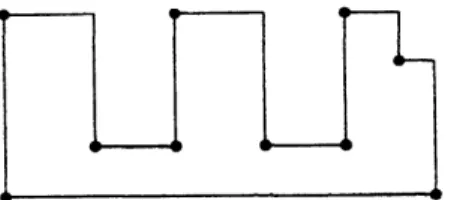
Necessity of $\lfloor 2n/3\rfloor$ is shown in [8] using a hooked version ofChv\’atal’s comb for $n=3m+2$
.
We show
a
slightly different comb for $n=3m+2$ in Fig. 1 (c). For completeness, we also showexamples for $n=3m$ and $n=3m+1$ in Figure 1.
(a) (b) (c)
Figure 1: Lower bound for 2-vertex guarding. (a) $n=3m,$ $m=4$
.
(b) $n=3m+1,$$m=4$.
(c)$n=3m+2,$$m=3$
.
Proof: As in Fisk’s proof [4] take any triangulation and 3-color it. Let $V_{i},$$i=1,2,3$ be the set
ofverticesof ith color and let $n_{i}=|V_{i}|$
.
Without loss ofgenerality $n_{1}\leq n_{2}\leq n_{3}$.
We show that$G=V_{1}\cup V_{2}$ is a2-vertex guard set ofsize at most $\lfloor 2n/3\rfloor$
.
Indeed, every point in$P$ is visiblefromat least 2 vertices in $G$
.
The size of $G$can
be boundedas
follows. We have $n_{3}\geq\lceil n/3\rceil$.
ThenIf $n=3k$ then $n_{3}=k$ and $n-k=\lfloor 2n/3\rfloor$
.
If $n=3k+1$ then $n_{3}=k+1$ and$n-(k+1)=$
$2k=\lfloor 2n/3\rfloor$
.
If $n=3k+2$ then $n_{3}=k+1$ and $n-(k+1)=2k+1=\lfloor 2n/3\rfloor$.
Computation. A triangulation $T$ of $P$
can
be computed in linear timc [2]. The coloring of$T$can
be done in linear time by constructing the dual graph and pruning its lcaves. Therefore thetotal time is $O(n)$
.
.
$\dagger$ $\uparrow$ $\uparrow$ $l$ $\iota$ $\sim\tau^{J}$ $\sim^{J}\sim_{r’}$ (a) (b) (c)
Figure 2: (a) An orthogonal polygon P. (b) A quadrangulation $Q$ and its dual graph D. (c)
4-coloring.
For 3-vertex guarding polygons, we considerconvexlyquadrilateralizable simple polygons.
Or-thogonal polygons (simple polygons whose edges
are
horizontal and vertical) fall into this class.Kahn, Klawe, and Kleitman [5] proved that $\lfloor n/4\rfloor$ guards suffice for l-vertex guarding. They
proved that any orthogonal polygon is convexly quadrilateralizable. Then
a
quadrangulation iscolored into four colors such that the vertices of every quadrangle are distinct, see Fig. 2. The
guards
are
placed at each vertex colored by the least frequently used color. Weuse
the fact thatanyconvexly quadrilateralizablesimple polygon (notjust an orthogonal polygon) can be 4-colored
to prove thc following theorem.
Theorem 4 Let$Q$ be a
convex
quadrangulationof
a simple polygon $P$ with $n$ vertices. A 3-vertexguard set
of
size at most $\lfloor 3n/4\rfloor$ can be computed in $O(n)$ time.Note that any convexly quadrilateralizable simple polygon has
even
number ofvertices.Ne-cessity of $\lfloor 3n/4\rfloor$ is shown in [8] using the orthogonal version of Chv\’atal’s comb for $n=4m$
.
Forcompleteness,
we
showan
example for $n=4m+2$ in Figure 3.Figure3: Lower bound for3-vertex guarding aconvexlyquadrilateralizablepolygonwith$n=4m+2$
Proof: Color $Q$ in four colorssuch that the vertices of every face
are
colored using allfour colorsas
follows. Let $D$ be the dual graph of$Q$.
It has no cycles and is atree (since it is connected). If$n=4$ then the coloring is obvious. Suppose that $n>4$
.
Remove the quadrangle $q$ correspondingto a leaf. Then $P\backslash q$ is a simple polygon with $n-2$ vertices and $Q\backslash q$ is its quadrangulation. $q$
shares two vertices with $Q\backslash q$
.
Assuming that $Q\backslash q$ is 4-colored (the induction hypothesis),we
color two remaining vertices of$q$
.
Let $V_{i},$$i=1,2,3,4$ be the set of verticesof ith color and let $n_{i}=|V_{i}|$
.
Without loss of generality $n_{1}\leq n_{2}\leq n_{3}\leq n_{4}$.
We show that $G=V_{1}\cup V_{2}\cup V_{3}$ is a 3-vertex guard set ofsize at most $\lfloor 3n/4\rfloor$.
Indeed, every point in $P$ is visible from at least 3 vertices in $G$
.
The size of$G$can
be boundedas
follows. We have $n_{4}\geq\lceil n/4\rceil$
.
Then $n_{1}+n_{2}+n_{3}=n-n_{4}\leq n-\lceil n/4\rceil=\lfloor 3n/4\rfloor$.
The latercan
be verified by taking $n$ modulo 4.
If $n=4k$ then $n4=k$ and $n-k=\lfloor 3n/4\rfloor$
.
If $n=4k+1$ then $n_{4}=k+1$ and$n-(k+1)=$
$3k=\lfloor 3n/4\rfloor$
.
If $n=4k+2$ then $n_{4}=k+1$ and $n-(k+1)=3k+1=\lfloor 3n/4\rfloor$.
If $n=4k+3$ then$n_{4}=k+1$ and $n-(k+1)=3k+2=\lfloor 3n/4\rfloor$
.
The algorithm follows from the proof. A coloring of $Q$
can
be computed in linear time byconstructing the dualgraph and pruning its leaves. $\blacksquare$
3
Spiral Polygons
Lee and Lin [6] proved that l-vertex guarding problem is NP-hard. Nilsson and Wood [7] studied
guarding ofspiral polygons. A polygon is spiral if its
convex
vertices form a chain and its reflexvertices form achain. Their approach is basedon the following lemmas.
Lemma 5 (Nilsson and Wood [7]) A collection
of
guardssees
a spiral polygonif
and onlyif
they
see
all the edgesof
thereflex
chain.Lemma 6 (Nilsson and Wood [7]) Let $m$ be the minimum number
of
guards guarding a spiralpolygon. The polygon
can
be guarded by $m$ guards placedon
the convex chainof
the polygon.Note that the guards in Lemma 6 can be placed anywhere in the polygon not just at vertices.
We study the problem of guarding spiral polygons with vertex guards. Lemma 5 still holds for
vertex guards. However, Lemma 6 cannot be used for vertex guards. Figure 4 shows
an
examplewhere the minimumnumberofvertex guardsistwo but they must beselected from the reflex chain.
Figure 4: A spiral polygon such (i) the minimum number ofguards is two and (ii) a unique set of
3.1
Vertex Guards in Spiral
PolygonsLet $P$be aspiral polygonwithreflex vertices$p_{1},p_{2},$$\ldots$,$p_{k}$ and
convex
vertices$q_{1},$ $q_{2},$ $\ldots$,$q_{n-k}$ suchthat $q_{1}p_{1}$ and$p_{k}q_{n-k}$
are
the edges of $P$. By Lemma 5 it suffices to guard only edges of the chain $q_{1}p_{1}p_{2}\ldots p_{k}q_{n-k}$.
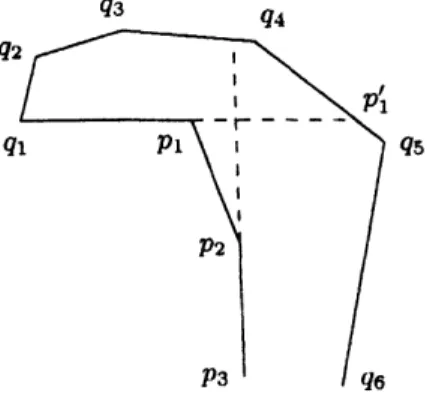
Consider the first segment $q_{1}p_{1}$ of the chain. Draw the ray $q_{1}p_{1}$ and let$p_{1}’$ bethe first crossing with the boundary of $P$,
see
Fig. 5. The polygon $q_{1}q_{2}q_{3}q_{4}p_{1}’$can
be guarded byone
vertex guard. Itcan
be placed at$p_{1}$or
$q_{4}$.
The edge$p_{1}p_{2}$ is visible$hom$ both$p_{1}$ and$q_{4}$.
Since$p_{2}p_{3}$ is visible ffom $q_{4}$ but not$p_{1}$
we
place a guard at $q_{4}$.
Thiscan
be turned intoan
algorithm.Figure 5: The best position for guarding segment $q_{1}p_{1}$ is $q_{4}$
.
Theorem 7 The minimum number
of
vertex guards in a spiral polygon utth $n$ verticescan
becomputed in$O(n)$ time.
Proof: We show that the following algorihm VERTEXGUARDS finds the minimum number of
guards. In the first for loop, we find all vertices of the convex chain that
see
$p_{i-1}p_{i}$.
Then $G$ isinitialized
as
the empty set. Thelast guard added to $G$ is denoted by $g$.
In the second for loop, we check weather $p_{i-1}p_{i}$ is guarded by $g$ or not. Ifit is not guarded
then a guard should be placed at one of the vertices $p_{i-1},p_{i},$$q_{a}.,$$q_{a:+1},$$\ldots,$$q_{b_{i}}$
.
Sincenone
of thevertices$p_{i+1},p_{i+2},$ $\ldots,p_{n-k}$ is visible from$p_{i-1}$ and$p_{0+1}$ is visible from $p_{i},$$p_{i}$ has
a
preferenceover
$p_{iarrow 1}$ for placing aguard. $q_{b_{t}}$ has
a
preferenceover
$p_{i-1},p_{i},$$q_{a}.,$$q_{a_{t}+1},$ $\ldots,$$q_{b_{i}-1}$.
If $i\geq k$ then only
one
guard at $p_{i}$can
be used to guard both $p_{i-1}p_{i}$ and $p.p_{i+1}$ $(if i=k)$.Suppose that $i<k$
.
If$b_{i}<a_{i+2}$ then$p_{i+1}p_{i+2}$ is not visible $homq_{b_{i}}$ and weplace aguard at$p_{i}$.
If$b_{i}\geq a_{i+2}$ then$p_{i+1}p_{i+2}$ is visible from $q_{b_{i}}$ and
we
place aguard at $q_{b_{*}}.$.
Running time. The first for loop can be implemented in $O(n)$ time since the sequences
$a_{1},0_{2},$ $\ldots,$$a_{k+1}$ and $b_{1},$$b_{2},$
$\ldots,$$b_{k+1}$
are
non-decreasing. Clearly, the second for loop takes lineartime. $\blacksquare$
$\ovalbox{\tt\small REJECT} Algorithml:VERTEXGUARDS(P)$
input : AvAertispiralspiral polygonpolygon $P$ with reflexwith reflex tices
$p_{1},p_{2},$ $\ldots,p_{k}$ and
convex
vertices$q_{1},$ $q_{2},$$\ldots,$$q_{n-k}$
.
output: A set $G$ of vertex guards.
$p_{0}arrow q_{1}$
$p_{k+1}arrow q_{n-k}$
for $i=1$ to $k+1$ do
L
Find $a_{i}$ and $b_{i}$ such that$p_{i-1}p_{i}$ is
visible
from theconvex
vertices $\{q_{a_{i}}, q_{a_{i}+1}, \ldots, q_{b_{*}}\}$.
$Garrow\emptyset$$garrow nul1$
for $i=1$ to $k+1$ do
$\{$
$|//p_{i-1}p_{i}isnotguardedyetifg\neq nu||then\lfloor Lcontinue$
if $i\geq k$
or
$b_{i}<a_{i+2}$ then$\llcorner g=p_{i}$
else
$\llcorner g=q_{b_{i}}$
$G=G\cup\{g\}$
–
3.2
2-Vertex
Guards
in
SpiralPolygons
Theorem 8 The minimum number
of
2-vertex guards in a spiral polygon with $n$ verticescan
becomputedin $O(n)$ time.
Proof: A sct $G$ of vertices in a spiral polygon $P$ is 2-vertex guarding if every
edge ofthe reflex
chain is visible kom at least two guardsin $G$
.
The algorithm is similarto computing vertexguardsby
VERTEXGUARDS.
First, compute $a_{i}$ and$b_{i}$ for$i=1,2,$$\ldots,$$k+1$
.
Then, for all$i=1,2,$$\ldots,$$k+1$,find twoguards
as
follows.Ifthe segment$p_{i-1}p_{i}$ is already guarded by two vertices of$G$, then proceed withnext $i$
.
If the segment$p_{i-1}p_{i}$ isnot guardedbyany vertexof$G$, then findaguard
as
in VERTExGuARDsand add it to $G$
.
Suppose that the segment $p_{i-1}p_{i}$ is guarded by exactly one vertex$g$ of$G$
.
If$g=p_{i}$, then add$q_{b_{l}}$ to $G$
.
Suppose that $g=q_{b_{i}}$. Then $i<k$. If$b_{i}-1\geq a_{i+2}$ then add$q_{h-1}$ to $G$; otherwise add$p_{i}$ to $G$
.
Similar to $ERTExGuARDS$, this algorithm
can
be implemented in linear time. $\blacksquare$References
[1] P. Belleville, P. Bose, J. Czyzowicz, J. Urrutia, and J. Zaks. k-guarding polygons
on
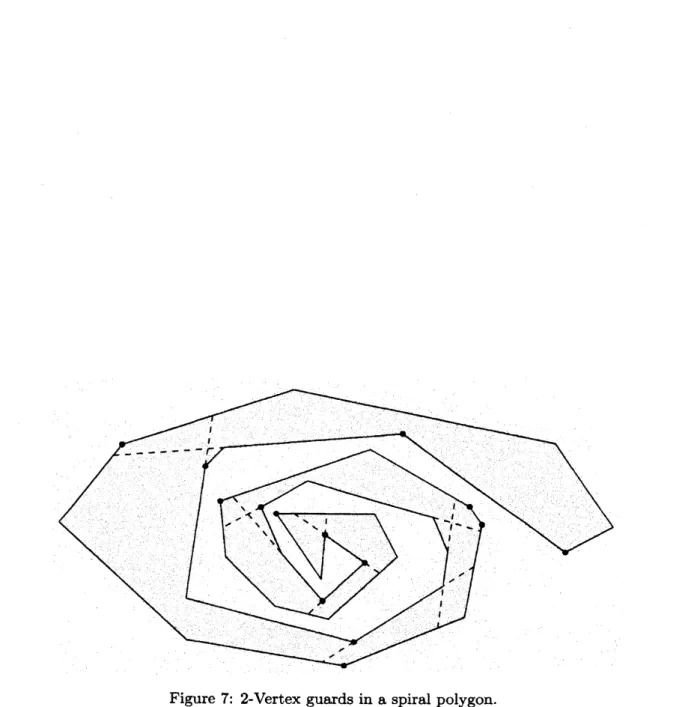
the plane.Figure 6: Vertexguards in aspiral polygon.
[2] B. Chazelle. Triangulatingasimple polygon in lineartime. Discrete Comput. Geom., 6;485-524,
1991.
[3] V. Chv\’atal. A combinatorial theorem in plane geometry. J. Combin. Theory Ser. B, 18:39-41,
1975.
[4] S. Fisk. A short proof of Chv\’atal’s watchman theorem. J. Combin. Theory Ser. B, 24:374,
1978.
[5] J. Kahn, M. M. Klawe, and D. Kleitman. ‘haditional galleriesrequire fewer watchmen. SIAM
J. Algebraic Discrete Methods, 4(2):194-206, 1983.
[6] D. Lee and A. Lin. Computational complexity of art gallery problems. IEEE $\pi ans$
.
Inform.
Theory, $32(2):276-282$, 1986.
[7] B. J. Nilsson and D. Wood. Optimum watchmen routes in spiral polygons. Technical Report
LU-CS-TR:90-55, Dept. of Computer Science, 1990, http://citeseer.ist.
psu.
$edu/158091$.
html. An extended abstract of
a
preliminary version in Proc. of 2ndCanad. Conf.
Comput.Geom., 1990, 269-272.
[8] I. Salleh. k-vertex guarding simple polygons. Comput. Geom. Theory Appl., 2008, http: