General Motors Corporation as
an Armaments Producer
Yuji NISIMUTA, Kyoto University
On June 2, 1941, Federal Bureau of Investigation (FBI), at the request of U. S. State De-partment, began to make the confidential investigation of Mr. Alfred P. Sloan, Jr., Mr. Greame K. Howard, and Mr. James D. Mooney, three of the executives of General Motors Corporation, as a normal procedure that was conducted on all persons connected with the national defense program. Below1) is part of the statements provided by one of the infor-mants concerning James D. Mooney, who was the vice-president of General Motors Corpo-ration in charge of Overseas Division 1922―1940.:After I had published a photograph and several references to MOONEY (in 2)) he requested me, through PAUL GARRETT, General Motors publicity vice-president, to come and see him. I had a two-hour talk with MOONEY with GARRETT present. It was not for publication.
MOONEY explained the purpose of the talk as being his desire to convince me that he, MOONEY, was right, and that I was wrong about MOONEY.
MOONEY insisted that he was a patriotic American. He said he would die for his country if need be. He pointed out (which I knew of course) that he was a Lieutenant Commander in the U. S. Navy. His daughter was then about to marry a British ace, and his daughter was engaged in Red Cross work in Britain. His son was then (if I recalled correctly) on active duty with the U. S. Navy.
You ve got to look at whole picture, MOONEY said. You look at that whole picture and then tell me where I m not a good American.
MOONEY went on to say that he had immediately after the medal from HITLER was presented, sent it down to the U. S. Navy for instructions, and that the Navy up to then had given him no instructions about it.
I then asked him whether he would now (meaning at the time of our conversation―
about mid-October, 1940) give back the medal to HITLER. He said he would not. He thought it might jeopardize General Motors chances of some day getting part of that $100,000,000 of stockholders money invested Nazi Germany. Moreover, he said he thought HITLER was right and he wasn t going to do anything to make him mad. I know, he said, HITLER has all the cards.
sympathies were with the British people, he thought HITLER was sure to win the war ; that there was justice in HITLER S general position ; that Germany needed more room, etc.; that German people were more aggressive, vigorous, etc., and that if we tried to prevent the expansion of the German people under HITLER, it would be just too bad for us, etc.
I made full notes of the conversation that night, but these were the highlights.
I was asked to tell my opinion as to whether MOONEY S attitude might be detrimen-tal to the national defense program.
MOONEY last fall was promoted to assistant to the president of General Motors in charge of all defense liaison work―one of the most important defense jobs for any
in-dustrialist, since General Motors has the biggest total contracts.
This is not a question that can be answered simply if it is answered honestly.
So far as I know, there is nothing Mr. MOONEY has done or thought that violates U. S. law.
In my opinion, however, men of Mr. MOONEY S prominence, holding the views he holds, are potentially dangerous to national security.
James D. Mooney, as the vice-president of General Motors Corporation in charge of Over-seas Division, was also directors of several GM s overOver-seas subsidiaries including the Vaux-holl Motors Ltd. in Britain and the Adam Opel AG in Germany. In the period 1939―1940
he had been engaged in the process of conversion from peace-time automobile production to war-time armaments production of European subsidiaries of GM, especially Adam Opel AG in Germany. And immediately after that, he was appointed as the assistant to GM president in charge of defense liaison work in U. S. and began to enter into the conversion process of General Motors Corporation in U. S. So exactly the same person had promoted the conversion process of GM in both sides of the Atlantic.
How did the management of General Motors Corporation handle these whole processes ? Was there any conflicts or controversies among the executives of GM ? And what were the characteristics in the conversions of GM through these process ?
Firstly let s examine some of the basic facts. Table1 shows the changes in members of Board of Directors (Aufsichsrat in German) and Management Board (Vorstand in Ger-man) of the Adam Opel AG, 100% subsidiary of GM in Germany.
As it can be seen from table 1, the persons of the GM headquarters basically occupied the positions in the Board of Directors of Adam Opel AG.
In 1938, there was 4 German members, i. e., Wilhelm von Opel (Chairman of the Board), Fritz Opel (Vice Chairman of the Board), Fritz Belitz and Carl Luer, in the Board of Di-rectors. On the other hand 4 of the members were American, i. e., Greame K. Howard (Di-rector of General Motors and vice chairman of the Adam Opel s Board of Di(Di-rectors), James D. Mooney (vice president of GM in charge of Overseas Division), Alfred P. Sloan, Jr.(the chairman of General Motors Corporation), and John Thomas Smith(vice president of GM). When we turn to the Management Board of Adam Opel AG, we can see that besides the
Table 1 Changes in members of Board of Directors and Management Board of Adam Opel AG 1938―1942
Board of Directors (Aufsichtsrat) Management Board (Vorstand) 1938
Wilhelm von Opel(Chairman) A. Bangert Fritz Opel (Vice Chairman) R. A. Fleisher Greame K. Howard (Vice Chairman) E. S. Hoglund
F. Belitz C. R. Osborn (president) Carl Luer H. G. Grewenig
James D. Mooney G. S. v. Heydekampf Alfred P. Sloan,Jr. O. C. Mueller J. T. Smith K. Stief
H. Wagner 1939
W. v. Opel (Chairman) A. Bangart F. Opel (Vice Chairman) H. Hansen G. K. Howard (Vice Chairman) E. S. Hoglund
F. Belitz C. R. Osborn (president) C. Luer H. G. Grewenig J. D. Mooney G. S. v. Heydekampf A. P. Sloan,Jr O. C. Mueller G. N. Vansitart K. Stief D. F. Ladin H. Wagner A. A. Maynard K. A. Auerbach 1940
W. v. Opel (Chairman) A. Bangart C. R. Osborn (Vice Chairman) H. Hansen G. K. Howard (Vice Chairman) H. G. Grewenig F. Belitz (Vice Chairman) G. S. v. Heydekampf C. Luer O. C. Mueller J. D. Mooney K. Stief
A. P. Sloan,Jr H. Wagner (president) E. S. Hoglund O. Jacob
D. F. Ladin Heinz Nordhof A. D. Madsen
1941 A. Bangart
W. v. Opel (Chariman) H. Hansen C. R. Osborn (Vice Chairman) H. G. Grewenig G. K. Howard (Vice Chairman) C. Luer(president) F. Belitz (Vice Chairman) G. S. v. Heydekampf J. D. Mooney K. Stief
A. P. Sloan,Jr H. Wagner (vice president) D. F. Ladin O. Jacob
A. D. Madsen Heinz Nordhof
1942 A. Bangart
W. v. Opel (Chairman) C. Luer (president) F. Belitz (Vice Chairman) K. Stief
H. Richter H. Wagner (vice president) A. D. Madsen O. Jacob
H. Nordhof November 1942-May 1945 president Custodian H. Wagner C. Luer
German members, i. e., Bangart, Grewenig, Heydekampf, Mueller, Stief and Wagner, there were American members, i. e., E. S. Hoglund and C. R. Osborn, who were sent from GM headquarters. And Osborn was the president of Management Board of Adam Opel AG. So in this year, the persons from General Motors headquarters had the commanding positions in both the Board of Directors and the Management Board of Adam Opel AG.
Let s see how the composition of both of the boards changed from 1939 to 1942.
In (June) 1939 there was no changes in the basic composition of both boards of Adam Opel AG. The executives from General Motors headquarters occupied the same positions in the Board of Directors and Management Board of Adam Opel AG as before.
On September 1, 1939, the World War Two began between Britain and France on the one side and Germany on the other side. In (June) 1940 we can see some distinctive changes both in Board of Directors and Management Board of Adam Opel AG. In Board of Directors, while Howard, Mooney and Sloan continued to occupy the same positions, E. S. Hoglund and C. R. Osborn, who were previously the members of the Management Board, were transferred to the Board of Directors of Adam Opel AG. And in the Management Board, accordingly, there were only German members. And one of the German executives Heinrich Wagner became the president of the Management Board.
In (June) 1941 there was no changes in the basic composition of the Board of Directors and the Management Board of Adam Opel AG. While Howard, Mooney, Sloan, Hoglund and Osborn continued to occupy the positions in the Board of Directors in Adam Opel AG, the German members occupied the position of the Management Board. This year Carl Luer, a former German member of the Board of Directors, became the president and Heinrich Wagner became the vice president of the Management Board.
In 1942 we can see a fundamental changes both in the Board of Directors and the Man-agement Board of Adam Opel AG. The American members did not occupy any of the po-sitions even in the Board of Directors of Adam Opel AG. German members occupied both in Board of Directors and Management Board. November 1942 Adam Opel AG had become to be under the jurisdiction of the Committee of Enemy Property of German Government. And Carl Luer, former the president of the Management Board, became the Custodian of the Adam Opel AG. And Heinrich Wagner became the president of the Management Board of Adam Opel AG. This structure continued until 1945.
To sum up the situation, even after World War Two began, during the period of the time when United States were a neutral country, American members of General Motors Corporation, at least formally, continued to occupy the positions of the Board of Directors of Adam Opel AG, in Germany.
The first task of this paper is to examine and illuminate the substantial meaning of these composition and their changes in the management of Adam Opel AG during these period. At the same time I would like to illuminate the fact that the overseas policy of General Motors Corporation formed, ultimately, in some dispute and the division of views among the top-class executives on the overseas policy of GM and on U. S. foreign policy as a whole. As the result of the controversy the new policy on overseas operation was
intro-duced and the General Motors Corporation in U. S. began the conversion process from peacetime automobile production to wartime armaments production in large scale.
This issue and the related issue has been discussed by a number of authors so far3). In this paper I would like to re-examine the issue mainly on the basis of James D. Mooney Papers in Georgetown University and GM-Documents relating to World War Two Corporate Activities in Europe in Yale University.
Ⅰ Preliminary history : General Motors and German Automobile Industry in the
1920s GM s acquisition of Adam Opel
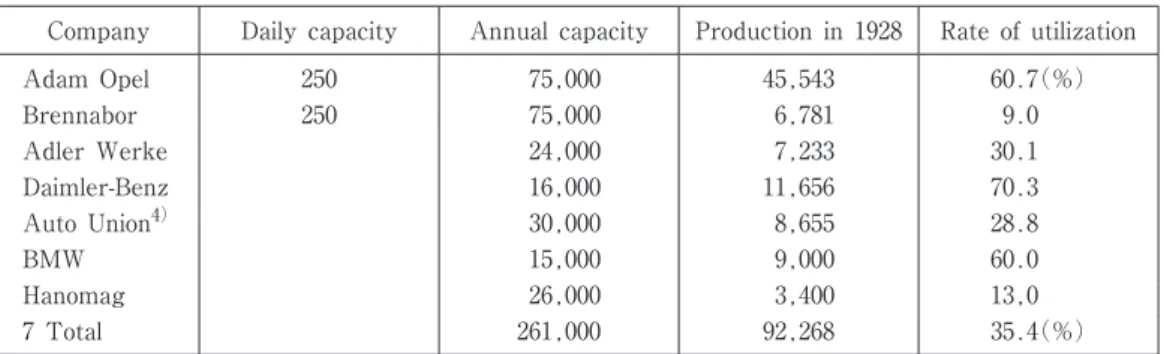
In the 1920s, General Motors had developed an aggressive Merger and Acquisition strat-egy in overseas, especially in Europe, just as the same way as in the United States. And during this period, the corporation s overseas M & A strategy was particularly successful in Germany. Among the German automobile companies Adam Opel was the first to be-come a leading-edge business in the German auto industry by combining its compact car strategy and mass-production system. In 1928, it became the largest auto manufacturer in terms of the number of units produced in Germany. However, the company s seemingly successful operation included many of the problems as well as other German auto compa-nies. This can be known by examining in detail how the German auto manufactures did their operations. Table 2 shows the ratio of factory utilization of each of the German auto manufactures in 1928. Opel was the best among them. But even in this year when the company achieved its peak in terms of the volume of production, its factory utilization rate was as low as 60% . The average operating rate of all German automobile companies were only 35.4%.
Comparing the data with that of American auto manufacturers in 1928 (GM 80.0% , Ford 89.3% , Chrysler-Dodge 80.0%), we can find very important differences. The mass production system of automobiles in those days absolutely requires high factory utilization rate for cost reduction because of the very size of the capital expenditure involved. During the period, Adam Opel was not a joint-stock company but a family owned company. Since it did not disclose information about its operation, no specific figures are available to deter-mine whether it recorded net profits. However it may be tolerable to assume that the utili-zation rate of 60% was close to the break-even point. If so, it can be said that company was in financial difficulties despite the stunning growth of its production. Naturally, General Motors saw Adam Opel as a business with great potential which, if shored up properly, could be placed back on track and provide means to dominate the German automobile market. For Adam Opel, therefore, there was a good reason to affiliate itself with GM which had tremendous funds plus a wealth of expertise in mass production and mass mar-keting. On the other hand, in this period, Deutsche Bank, which arranged the merger of Daimler and Benz in 1926, was considering pushing with its German automobile trust plan ( Deutsche Autotrust Plan) by realizing the merger of Daimler-Benz and Adam Opel. In his memo dated May 15, 1928, Emil Georg von Stauss, who was a Deutsche Bank director
and the chairman of the board of directors of Daimler-Benz AG, examined the situation of the German auto industry5). His major concern was the merger problem of automobile man-ufacturers in Germany. The focus was how to acquire promising compact car manufac-tures. Needless to say, the most promising of all was Adam Opel. But the plan ended up with the GM s acquisition of Adam Opel in March, 1929. After that GM had sent persons not only to the Board of Directors but also Management Board of Adam Opel AG.
Dispute between RDA and GM centering on German government s automobile industrial policy
The year of 1930 and 1931 saw increasing criticism by the German auto industry associ-ation (Reichsvervand der Automobilindustrie, RDA) against the German government s transportation policy in general and automobile related policy in particular. The criticism was as follows:
Automobile industry in Germany is badly treated more than in any other countries. Instead of increasing the protective tariff, the German government intends to reduce it. The Import of foreign automobile is increasing rapidly. German automobile industry are in crisis.
In RDA Daimler-Benz spearheaded the criticism. But there was another influence that did not conform with RDA, that is GM. The company was against RDA s policy criticism and submitted a proposal6) of its own to the German government, which can be summarized as follows:
It is not good and too narrow to take the standpoint of protecting the German national automobile industry only. It is expected to establish the general conditions of promoting automobile transportation in Germany. This then in consequence strengthens the German national automobile industry.
Table 2 Rate of factory-utilization of major German automobile companies in 1928
Company Daily capacity Annual capacity Production in 1928 Rate of utilization Adam Opel 250 75,000 45,543 60.7(%) Brennabor 250 75,000 6,781 9.0 Adler Werke 24,000 7,233 30.1 Daimler-Benz 16,000 11,656 70.3 Auto Union4) 30,000 8,655 28.8 BMW 15,000 9,000 60.0 Hanomag 26,000 3,400 13,0 7 Total 261,000 92,268 35.4(%)
Source : F. Lederman, Stuttgart
Ⅱ Adam Opel and GM in the 1930s
Germany s automobile related policies took a sharp turn under the Nazi administration established on January 30, 1933. The president of General Motors Export Corporation and the vice president of GM in charge of Overseas Division, James D. Mooney, eyewitnessed the beginning of the policy changing. Let s see one of the testimony7).:
It so happened that shortly after his arrival he was the chief speaker at the annual convention of the International Road Congress (European equivalent of our American Automobile Association) at Berlin. Mooney s speech was to the effect that the automobile business in Europe was crippled by high license fees (then averaging around $100 per car per year); that more tax revenue would result, more cars be sold, more roads built, etc., if European countries would follow the United States idea of low annual license fees. Mooney sat down. The man next to him stood up when the polite clapping was over. This man identified himself as the head of the Nazi governmental division having to do with automobile taxation. I announce that the German government automobile tax is herewith reduced to $10 as Herr Mooney has suggested , he announced. This made a profound impression upon Mr. Mooney naturally. From that time on the high Nazis show-ered him with flattering attentions.
Actually the management of Adam Opel AG by General Motors Corporation was intensi-fied in 1930s very much. We can see one of the examples of this in the article in
the periodical of General Motors Overseas Division, Vol. XIII, June 1934, ti-tled “ James D. Mooney Discuss Automotive Industry with Hitler Visit Follows Atten-dance at May Day Celebration in Berlin8)”:
While in Berlin on his recent European trip, James D. Mooney attended the May Day celebration and the following day called on Chancellor Hitler. Mr. Mooney has given
the privilege of being the first publication to carry the story of these two interesting events.
The May Day celebration in Berlin, duplicated in every city and town throughout Ger-many, marked the first anniversary of German New Deal under Herr Hitler s guidance. In Berlin the most important events were the Children s Festival at which the Chancel-lor spoke to six hundred thousand children and the meeting at the Tempellhof Field where he talked face to face with two million men and women and over the radio to ev-ery German within reach of a receiving set ……
The Chancellor s office had sent Mr. Mooney a special windshield card for his car and, as he left the hotel to go to the Field, he found that the card was an open sesame to every street leading to the Field. ……
At quarter to four, Herr Hitler entered the Field in a car and was driven rapidly up and down the long files to review the assembled multitude. At four, all planes and the
blimp were grounded and a hush came over the vast Field as the Chancellor arrived at the platform from which he was to speak. Dr. Goebbels concluded his short introductory speech with, Your Leader Speaks!” ……
Hitler opened his speech by saying that he wished to report to his people the prog-ress they had made as a nation in the past year. He quoted statistics and reminded them of the many improvements in the German economy accomplished under his plan for giving everyone an opportunity to work to improve his own condition---and thus to restore Germany to her place as a leading nation ……
After reviewing and interpreting the achievements of Germany during the first year of the New Deal , he passed on to what remained yet to be done adequately to raise the standard of living in every German home ……
Mr. Mooney and Opel Executives Visit the Chancellor
When he visited the Chancellor the next day, Mr. Mooney was accompanied by R. K. Evans and R. A. Fleisher of Opel. As they entered his long office room, Herr Hitler arose from his desk and walked to meet them halfway. He shook hands cordially and in a mo-ment the General Motors men, the Chancellor and two of his Aides were seated at a ta-ble. Throughout the interview, Mr. Mooney found Herr Hitler as easy and as satisfactory to talk to as any intelligent business man, with no air of bureaucracy about him.
They plunged at once into a discussion of the Automotive Industry in Germany and Opel s important place in it as the leading manufacturer of motor-cars in the Reich. Herr Hitler showed a remarkable grasp of the fundamentals of the Industry and keen desire to know more. He characterized the 1.2 Liter Opel as his conception of the true Volk-swagen , the car for the German masses, his desire for which he has expressed emphati-cally in speeches at automobile shows and elsewhere. This was welcome news to the General Motors men as many interpretations of what Herr Hitler would consider a Volkswagen have leaned toward a baby car, a vehicle in the cycle-car class. He defi-nitely stated that any car giving less package size and less performance than the 1.2 Opel would be an imposition upon the German people.
Herr Hitler Interested in Means of Increased Motor Buying
The Chancellor estimated, that using the United Stated as a standard, Germany should have twelve million motorcars, but he realized that the difference of conditions would make three million cars a more logical number for the German nation.
In a discussion of how to enable more German families to enjoy the benefits of motor-car ownership, Dr. Fleisher demonstrated to Herr Hitler that while the buyer pays only 1,880 RM for the 1.2 Opel sedan, he must spend an additional 7,700 RM in operating costs during the expected seven years of use. Therefore, simply reducing the first cost would not make possible the much wider use of cars that the Chancellor desires. Herr Hitler immediately admitted the validity of this conclusion and said that he definitely would see it that operation costs were reduced. He said there was no logic in a small, dark garage costing 30―40 RM a month when comfortable furnished rooms are available
building inspection regulations relating garages. Further, be asked Mr. Mooney if it would damage a car to park it in front of the owner s house, while Mr. Mooney replied that a car that can withstand rain and wind and dust while being driven at 40 to 60 miles an hour would obviously not be damaged by the same elements while stand still, the Chan-cellor said he would make street parking legal as the old ordinances against it are not suited to the spirit of the times.
In further pursuit of operating cost reduction, Herr Hitler asked that Opel s experience with car insurance costs be placed at his disposal as he thought insurance costs could also safely cut. He also mentioned possibility of reducing gasoline taxes and prices to ac-celerate the motorization of Germany.
Expresses Appreciation of Adam Opel s Contribution to German Industry
The Chancellor expressed his appreciation of the Opel organization as an integral part of German industry, giving employment to 17,000 men, and helping the economic situa-tion by its exports of cars to other countries. He definitely stated that Capital, honestly devoted to the manufacture of useful products, is as properly entitled to a fair return as the good workmen is to his fair wages.
That the Chancellor s promises during the interview were not just an expression of good-will, but truly a part of his forward program, was evidenced by the fact that the following day, Herr Keppler, the Chancellor s chief Aide, was sent for Dr. Fleischer and asked him for much more information about the Industry. He prefaced his request by saying, When Herr Hitler came to the office this morning, the first thing he did was to say, ‘ I have been thinking all night about many things that those Opel men told me ;
Table 3 The positions of manufacturers in the German passenger car market 1931―1938
Company 1931 1932 1933 1934 Adam Opel 16,135(28.8%) 12,436(32.2%) 28,494(43.7%) 52,586(40.2%) Auto Union 8,665(15.5%) 6,756(16.4%) 16,460(20.1%) 28,590(21.8%) Daimler-Benz 3,653( 6.6%) 5,325(13.0%) 7,844( 9.6%) 8,873( 6.4%) Adler 4,436( 7.9%) 4,735(11.5%) 7,476( 9.1%) 10,274(7.8%) Ford 3,995( 7.1%) 1,569( 3.9%) 3,996( 4.9%) 6,699(5.1%) Hanomag 5,290( 9.4%) 2,496( 6.1%) 4,675( 5.7%) 6,321(4.8%) BMW 3,668( 6.5%) 2,525( 6.1%) 5,322( 6.5%) 6,598( 5.0%) Total 56,039 41,118 82,048 130,938 Company 1935 1936 1937 1938 Adam Opel 77,126(42.8%) 78,500(40.6%) 75,803(35.0%) 81,983(36.8%) Auto Union 38,154(21.2%) 50,962(23.9%) 54,765(25.3%) 52,184(23.4%) Daimler-Benz 11,529( 6.4%) 19,816( 9.3%) 23,679(10.9%) 20,889( 9.4%) Adler 17,658( 9.8%) 15,325( 7.2%) 17,177( 7.9%) 15,467( 6.9%) Ford 8,087( 4.5%) 11,721( 5.5%) 16,139( 7.5%) 17,366( 7.8%) Hanomag 8,171( 4.5%) 8,216( 3.9%) 8,411( 3.9%) 7,607( 3.4%) BMW 7,226( 4.0%) 6,981( 3.3%) 6,826( 3.2%) 7,311( 3.3%) Total 180,113 213,117 21,658 222,778 Source : W. Oswald, ― S. 531
get in touch with them before they leave Berlin and find out, etc.’” And since the inter-view, all automobile operating laws have been taken out of the hands of Local authori-ties, put under Federal control and are to be liberalized and made uniform throughout Germany.
Mr. Mooney Impressed with Chancellor s Leadership of the Reich
Mr. Mooney s observation during the May Day celebration ; at the interview ; and in Russelsheim where the Opel plant is located, have convinced him that Herr Hitler is a strong man, well fitted to lead the German people out of their former economic distress and that he is leading them, not by force or fear, but by intelligent planning and execu-tion of fundamentally sound principles of government. ……
Here we can see the GM executives as one of the important adviser to the German Gov-ernment of policy-making about the promotion of motorization in Germany.
During the period, Adam Opel was rapidly entrenching its leading position in the com-pact car market. The company s headquarters factory at Russelsheim was expanded in ca-pacity to produce 100,000 cars annually, becoming the largest automobile works in Europe. Table 3 shows the positions of manufacturers in the German passenger car market in 1930s.
Table 4 Performances of several German automobile companies 1932―1935
1932 1933 1934 1935 Adam Opel Total Sales(million RM) 60 90 184 230 Unit Sales 21,581 35,599 68,204 102,759 Workers 6,600 13,000 18,000 18,300 Gross Income(million RM) 25.94 47.73 82.60 112.81 Net Profit(million RM) −0.84 5.01 13.40 19.76 Daimler-Benz Total Sales(million RM) 65 100 147 226 Workers 8,700 14,000 22,600 26,600 Gross Income(million RM) 31.22 49.34 82.24 111.1 Net Profit(million RM) −4.95 2.47 4.13 3.22 Dividend rate(%) 0 0 0 5 Auto Union Total Sales(million RM) 40 65 116 181 Workers 4,359 7,371 12,256 16,500 Gross Income(million RM) 19.01 28.45 49.75 77.38 Net Profit(million RM) −0.57 0.68 0.91 1.60 Dividend rate(%) 0 0 4 6 Adler Total Sales(million RM) 30.75 47.75 64.20 83.30 Unit Sales 4,773 7,476 10,249 18,233 Gross Income(million RM) 11.38 21.00 29.98 38.38 Net Profit(million RM) −5.02 1.11 1.57 1.42 Dividend rate(%) 0 0 0 4
Adam Opel AG occupied the leading position with the share of approximately 40% in German passenger car market. Table 4 shows performances of several German automobile companies 1932―1935.
We can see Adam Opel AG have been getting especially good net profits. The only con-cern of otherwise successful Adam Opel was the German regulation of remittance imple-mented due to the country s foreign currency crisis. This forced the company to keep its profit in Germany without making its remittance to U. S. General Motors had to explain the situation to its shareholders in America. The situation forced GM to arrange a meeting between German Chancellor Adolf Hitler and James D. Mooney, vice president in charge of GM s Overseas Division.
Let us examine the testimony of a member of the Export Managers Committee of the American Automobile Manufacturers Association, who had served in Europe from 1920 to 1938, and during this time had come in contact with Mooney on many occasions and felt that he knew Mooney fairly well9).
…… In this connection it seems that the operations of General Motors in Germany were highly successful and in 1936 the General Motors organization had built up a fund of some twenty-five million marks (worth about ten million dollars) which could not be taken out of Germany. It was the informant s idea that Mooney realized that his position would be very week when the stockholders demanded an explanation for all of this mon-ey being tied up in Germany and that he, accordingly, went to Berlin to see what could be done, having in mind the possibility that if he could have an interview with Hitler, this would probably suffice to give him a breathing spell in which something would turn up, which he could opportunely turn to his advantage and justify his position. Through various Berlin bankers, and particularly, Henry Mann, an interview was arranged with Hitler which was supposed to last for about five minutes. However, to Mooney s great surprise Hitler took a personal liking to him, being impressed by Mooney s personality and the power of General Motors which was, of course, behind Mooney and therefore the interview lasted for about an hour, during which time the particular problem was never even mentioned. Mooney was there upon pleasantly amazed the following day to be invited back and in another extensive interview with Hitler, a series of concessions were made which were ostensibly for the purpose of enabling General Motors to obtain some advantage out of this ten million dollar surplus which had been built up in Germa-ny. However, it would appear that Hitler was a better salesman than Mooney since the program which was agreed upon at the conference included the following points:
1)The Opel Motor Works was to be classed as pure Aryan. This meant that the cars could now be purchased freely by the officials and members of the Nazi Party, it had not therefore been the case.
2)The Opel Motor Works would expend approximately ten million dollars in the German truck plant at Berlin which would be laid out according to the latest Detroit principles but in which the management was to be entirely German.
3)The export commission to be paid to General Motors on Opel cars sold outside of Germany was increased but in order to obtain this commission, Mooney had to agree to sell a large number of cars.
This Adam Opel s truck factory in Berlin=Brandenburg will supply about 50% of mili-tary trucks to the German army during the World War Two.
Ⅲ Adam Opel management by General Motors Corporation in the early period
of World War Two
September 1, 1939, against the invasion of German Army into the Poland, Britain and France declared war, with which World War Two began. Under this condition Adam Opel AG made some restructuring their organization, conferring with General Motors Corpora-tion headquarters.
When we see the annual report of the General Motors Corporation for the fiscal year ended December 31, 1939 (issued in April, 1940), we can find the following description:
As a result of the declaration of war, and in the line with the Corporation s operating policies, with full recognition of the responsibility that the manufacturing facilities of Adam Opel A. G. must now assume under a war regime, the Corporation has withdrawn the American personnel formerly in executive charge of this operation, and has turned the administrative responsibility over to German nationals. Its relationship now limited to representation on the Board of Directors. …… In the case of Vauxhall Motors Ltd., the administrative responsibilities continue to be in the hands of English nationals.
We have to examine what was the substantial meaning of representation on the Board of Directors ”, because sometimes this description have been treated as the evidence of GM s substantial withdrawal from Germany after World War Two began.
Here I would like to examine the Minutes of the Meeting of the Board of Directors of the Adam Opel A. G. held on November 15, 1939 and also the Minutes of the Meeting of the Board of Directors of Adam Opel A. G. held on March 10, 1940.
Minutes
Of the Meeting of the Board of Directors Of the Adam Opel A. G. held on November 15, 1939
in Munich at the Hotel Continental10). The following were present;
Members of the Board of Directors : Geheimrat Dr. W. von Opel, Chairman Mr. James D. Mooney
Mr. Franz D. Belitz Mr. E. S. Hoglund
Prof. Carl Luer Mr. C. R. Osborn
Mr. Heinrich Richter, Attorney at Law The Board of Directors in this formation properly formed a quorum.
Gehaimrat von Opel, in his capacity as Chairman, called the properly constituted Meeting to order at 1.50 p. m. and apologized for the absence of those Member of the Borad of Di-rectors who could not be present, viz.: Mr. Alfred P. Sloan, Jr., Mr. Greame K. Howard, and Mr. A. G. Madsen.
Resolution and Discussion:
① The resignation of Mr. Osborn, Mr. Hoglund, Mr. Maynard and Mr. Mueller from the Management Board of the Adam Opel A. G.
The resignation of Mr. Maynard and Mr. Mueller is a self-explanatory measure, because they have been recalled to New York.
In view of the fact that the Russelsheim facilities of Adam Opel A. G. are to be utilized for the manufacture of new materials for the State, it is assumed that the German Authori-ties may welcome the elimination of direct participation by American personnel in the act of Management of the Company. For this reason we feel it desirable that Messrs. Osborn and Hoglund resign from the Management.
② Election of Messrs. Osborn, Hoglund and Madsen as members of the Board of Direc-tors.
Since it appears desirable to retain and utilize the valuable services and connections of Mr. Osborn and Mr. Hoglund for the benefit of Adam Opel A. G. and particularly since it has been emphasized on all sides that the connections between the Adam Opel A. G. and General Motors, which are particularly valuable from an export point of view, should not be impaired by the present hostilities, it seems obvious that the solution rests in the elec-tion of both gentlemen to membership in the Board of Directors. For the same reason it is recommended that Mr. Madsen, Managing Director of General Motors International Copen-hagen, be elected to the Board of Directors.
③ The Management Board for the duration of the war will consist entirely of German members.
Herr Wagner will be appointed Chairman(president) of the Management Board.
④ Appointment of an Executive Committee of the Board of Directors, consisting of Mr. Osborn, Mr. Hoglund and a German member of the Board of Directors(Mr. Franz Be-litz and Prof. Carl Luer).
Even though under the present circumstances normal operations and the previous com-position of Management cannot function, it is desired to continue to follow the basic opera-tion policies which have existed in the past. It is well-known that the Adam Opal A. G. has worked within the framework of General Motors policy, particularly in a financial, technical and commercial sense. Consequently, it is desirable that Mr. Osborn and Mr. Hoglund s ex-perience, connections and intimate knowledge of the Opel organization as well as of the
General Motors organization should be made available to the German Management under present circumstances. The approval of this committee(the Executive Committee) should, therefore, be obtained by the Management Board on the following matters:
a)general financial policy b)general export policy
c)any change in policy affecting the engineering, manufacture and sale of cars, trucks and spare parts,
d)projects over RM. 10,000. e)general pricing policy.
Mr. Mooney s feeling on Geheimrat von Opel s suggestion was that since Mr. Osborn and Mr. Hoglund had had management responsibility for a considerable number of years, it was desirable not to abruptly sever the opportunities for consultation and advice which should be made available to the new German Management. It was the purpose of this committee (the Executive Committee) to clearly identify and emphasize and to give the necessary moral support to the new positions of Mr. Osborn and Mr. Hoglund, again from this stand-point that the transfer of Management responsibility should be effected with the least loss of operating efficiency.
⑤ Manufacture of New Material for the State:
Funds required for the manufacture of materials, other than cars, trucks and parts, changing of factory, tooling, inventories, payroll, etc. will be provided by Junkers or Gov-ernment agency.
Geheimrat von Opel, Prof Luer and Mr. Belitz pointed out that the recommendations made involved the danger that Junkers or the respective government agency could gain an overwhelming influence in the internal affairs of Opel ……
Mr. Mooney expressed his full agreement with this viewpoint and pointed out that the Adam Opel A. G. has made in the past and will continue to make a tremendous contribu-tion to Germany through the manufacture of cars and trucks and through export of these articles, which are now of vital importance to Germany under present conditions of war. Further, that in any decisions considered relating to the manufacture of new products we should not lose sight of the importance in the general scheme of the efficient manufacture of the old Opel products. This fact should always be kept in mind.
Geheimrat von Opel made the suggestion to include in the center line of policy the fol-lowing points:
a)current cash payment for deliveries,
b)protection of Opel through cash payment for investments, such as new tools, equip-ment and change in buildings,
c)any inventory, materials in process, investments and expenses incurred shall be re-imbursed to Opel in full at the termination of the war.
Mr. Mooney restated the firm policy that the Adam Opel A. G. should under no circum-stances become engaged in the manufacture of any material peculiar to war alone and that Opel should not invest any money for this purpose.
⑥ It is understood that the changes suggested above pursue no other purpose but an adaptation of the Adam Opel A. G. and its business to present emergencies. It is under-stood and agreed that upon the termination of war the Board of Directors will recon-stitute the Management and fill positions of responsibility therein with personnel in keeping with the board overall activities of the Company existing during peace times. Here we can find that the presence of the American executives in the Board of Direc-tors of Adam Opel AG in the time of November 15, 1939, i. e. after the beginning of the World War Two, was not only a matter of form without substance. But, especially James D. Mooney, vice president of GM in charge of Overseas Division, was very actively engaged in the decision making of Adam Opel AG. Under his approval Adam Opel s entering into manufacturing of the New Products for German Government, i. e. Aero engine of Junkers aircraft. Moving of C. R. Osborn and E. S. Hoglund from the Management Board to the Board of Directors was rather planed in order to maintain the substantial executive power and ability of both of them. According to this purpose the Executive Committee was newly introduced in the Board of Directors of Adam Opel AG.
Next let us examine the Minutes of the Meeting of the Board of Directors of Adam Opel AG held on March 10, 1940.
MINUTES
of the Meeting of the Board of Directors of the Adam Opel A. G., held on March 10,
1940 in Munich at the Hotel Continental11) The following were present;
Members of the Board
of Directors : Geheimrat Dr. W. v. Opel, Chairman Mr. C. R. Osborn, Deputy Chairman Mr. Franz Belitz, Deputy Chairman Mr. James D. Mooney
Mr. E. S. Hoglund Prof. Carl Luer Member of the Management Board : Mr. Hanns Grewenig
Mr. Herman Hansen Mr. Heinrich Wagner
Mr. Heinrich Richter, Attoney-at-Law
In agreement with the members of the Board, who are present, the Meeting was con-vened by the Chairman of the Board and all members waived notice of the Meeting. The Board of Directors in this formation properly formed a quorum. Geheimrat v. Opel, in his capacity as Chairman, called the properly constituted Meeting to order at 10.10 a. m. and apologized for the absence of those Members of the Board of Directors who could not
be present, viz.: Mr. Alfred P. Sloan, Jr., Mr. Greame K. Howard, Mr. A. G. Madsen and Mr. D. F. Ladin.
Resolutions and Discussion:
① The re-arrangements for the special production were practically completed on March 1st, 1940. Our delivery obligations towards Junkers and its branches can be fulfilled,
provided the supply of the necessary materials is not delayed. And on the other hand it will be possible to re-arrange the plant for its regular production within three weeks after peace will have been concluded.
Since the special production in general involves new products for the Adam Opel A. G., difficulties have, naturally, appeared which, however, have been practically eliminated through a close co-operation and by way of mutually exchanging experiences and sugges-tions. It should be stated in this connection that we have been given the necessary assis-tance by all firms involved.
Some parts which contrary to our own practice in the automobile manufacture were not quite ready yet to be released for production and therefore could not yet be used for mass production, were therefore supplemented and re-designed by our Engineering Department. The strength of the organization, the knowledge and co-operation on the part of our staff proved to be of the highest value in carrying through the entire re-arrangement of the Plant. We believe that our deliveries, both in regard to quality and quantity, will satisfy the highest authorities of the Luftfahrt industry in every respect, thus creating a good name for the workmanship of the Adam Opel A. G. also for the future.
② We have decided to continue, even though on a small basis only, the manufacture of automobiles at Russelsheim, thus emphasizing to the public that we stick to our main line of manufacture, namely the automobile.
In accordance with a decision of Unterstaatssekretar Generalmajor von Schell, passenger cars are not to be delivered any more to dealers within Germany after March 15, 1940. Consequently, from this date on our production will be destined for export only. Accord-ing to forecasts made by the Export Department regardAccord-ing passenger car production, it will be possible to sell and ship 25 to 30 passenger cars daily during the entire year 1940. The production of our Brandenburg Truck Plant was almost entirely absorbed by the Army. During the last few months the supply of material has not always met our de-mands. Transportation difficulties as well as difficulties in the coal supply have unfavorably interfered with the production figures. At present we are trying by all means to complete about 1800 trucks, so that they will be ready for shipment. The Russelsheim Plant will be given its fullest co-operation and support to Brandenburg in this respect.
③ With regard to the Russelsheim production for export we have ordered the material for 3000 cars taking care of the requirements until September 30, 1940. By October 1, 1940 we will still have available quantities of productive material at total value of RM 5,300,000. After deduction of the material required for export deliveries during the fourth quarter of 1940 the total productive material will amount to 4.8 millions of Reichsmarks at the end of 1940.
The present conditions for the export to trucks are, however, quite different. According to the latest decision of Unterstaatssekretar Generalmajor von Schell, all trucks produced in March and April for export must be placed at the disposal of the Army with the excep-tion of 200 trucks only. It remains to be seen whether an unrestricted export of truck will be allowed after month of April.
Mr. Mooney emphasized again that the question of material is closely interlocked with the question of exports and he could not help but have the impression that the vital im-portance of exports for this country is not fully realized in all quarters.
In summing up Mr. Mooney stated that the export should be forced as far as possible : The exports were not only important for the company but also and above all for the Ger-man Government. In his negotiations in Berlin he has been assured again and again of the vital necessity of exports for this country, a necessity which ranks equally with the neces-sity to produce for military purposes. Under such circumstances everything should be done to get the material required for the maintenance and the increase of exports of cars. The Management is requested to prepare and to develop the new models so that the company will be in the position to supply the market with the new models immediately af-ter the end of the war.
Here we can see also very active commitment of American executive, especially James D. Mooney. It was resolved that smooth re-arrangement of the Plant for the special produc-tion and also re-arrangement of the Plant from special producproduc-tion for regular producproduc-tion will be possible. And proudly declared that it will be possible to re-arrange the plant for its regular production within three weeks after peace will have been concluded.
I think this was a process of establishing the policy about the principle of conversion from peace time, automobile production to war time, armaments production and a process of accumulating its special experience and know-how.
We can see also the importance of the export business of Adam Opel AG in General Motors Corporation group in the world market. Opel brand was positioned as the second, next to Chevolet, in Total GM brand worldwide and the first in the export business of GM group worldwide. This was important for the export business of GM group as well as for giving indispensable foreign exchange to Germany.
Thus, according to the analysis of both of the Minutes of the Board of Directors of Adam Opel AG, held on November 15, 1939 and held on March 10, 1940, we can see that during the time after the World War Two began and while United States was a neutral country, the occupation of the American executives in the Board of Directors of the Ger-man subsidiary was not only a matter of formality but had the substantial meaning. I think it was demonstrated that General Motors Corporation was at that time the very inte-grated elements for the military motorization of Nazi Germany.
Ⅳ James D. Mooney s diplomacy as a businessman 1939
―1940
James D. Mooney was in Germany on September 1, 1939 when World War Two broke out. Since that time, he was to have various sorts of activity as it were the informal diplo-mat as a businessman .
Upon back home to America in December, 1939, he tried to contact with President Roos-evelt. Actually, he exchanged opinions with the President through two interviews, which took place in December,1939 and January, 1940 and a lot of correspondence12).
In February, 1940 J. D. Mooney returned to Germany in the appearance of an ordinary business trip. While making preparations for talks with high officials of the German govern-ment, he made tours of Adam Opel facilities. First, he made a tour of the sales and repair net work around Berlin and then the Brandenburg truck factory. After that he visited the headquarters factory at Russelsheim and dealt with its production conversion problem, that is, conversion to aircraft parts production. With his approval, the headquarters factory con-verted to aircraft parts production as we saw before.
On March 4, 1940, he met Hitler. This was one of his several times of meeting with Hit-ler, but this time he was assigned the role of President Roosevelt s secret envoy. The fol-lowing is a summary of Roosevelt s proposal to Hitler which was outlined by James D. Mooney13).:
Roosevelt s state of mind as assumptions:
1)I (Roosevelt) am by no means against Germany.
2)The United States of America wants to help resolve the current world political and economic issues on a global scale.
3)In this respect, the United States of America is in a position of providing a substan-tial contribution by means of its surplus material (cotton, wheat, copper and even gold).
4)The United States of America thinks that all countries (including Germany) should be able to have broader, freer access to raw materials.
5)I (Roosevelt) am ready to serve as a moderator, not as an arbitrator or a peace-maker, for peace.
6)This proposal is based on the public opinion of America, which can be summarized as follows14):
a)The public wants their leaders to have a general sense of security, provide job op-portunities and improve the standard of living.
b)Religious freedom is important as a basic right of the Americans. In this regard, the Americans have misgivings about the current religious situation in Germany. c)War does not make sense.
d)Europe and America are bonded deep by blood. e)The current war should be put to an end immediately.
f)Self-interests of all belligerent countries lies in ending the war now. g)Something could be done to put end to the war immediately.
h)The United States has its share of responsibility for the current situation. i)It would be too late if the war gets in earnest.
j)Many of the Americans believe there is a high possibility of solving the current issues equitably.
k)Neither side can make a permanent settlement by means of blitzkrieg .
l)Germany s strength has already been proved and acknowledged. In the current state of things, refraining from excessive military offence would not harm but add to the prestige.
m)The average American rather stands with the United Kingdom and France. n)Sentiment against America s entry into the war has been growing by the day. o) War demand will not bring any industrial benefit.
p)Invading Belgium or Holland would cause a strong reaction on the part of the Americans.
q)The same can be said for mass bombing.
r)If broad autonomy is given to Czechs and Poles, Americans do not hesitate to ap-prove Germany s political and economic influence on these countries.
s)As for the annexation of Austria, the Americans are also of opinion that they are ready to acknowledge that Austria is an integral part of German Reich politically, economically and culturally.
t)The British Empire is a world-wide bulwark of the white race.
u)Public sentiments in the United States is strongly in favor of the American Neu-trality Legislation.
Hitler s response was as follows15):
I think I would be able to reach agreement with President Roosevelt immediately pro-vided the following common ground is established:
1)Germany is willing to acknowledge that the United Kingdom is actually a world power. This is also true for France. However, Germany demands that it also be recog-nized as a world power.
2)If these world powers pay respect to each other, peace would be brought about. 3)Once peace is established, armaments could be reduced, allowing a large number of
workers engaged in munitions production to be used for more productive purposes in international trade.
Georing made the following supplement16) (March 7, 1940):
1)As for relations between Germany and America, Germany has no intention to do any single step against America s interest.
2)As for the British Empire, Germany thinks it has made the most important contribu-tion to the world and is able to continue to do so. Germany has no intencontribu-tion to en-croach on the British Empire per se. But its interference with European issues outside its boundary is another matter.
On March 11, acting on the result of the meeting, J. D. Mooney telegraphed his proposal for intervention of Roosevelt17).
On May 9, 1940, Mooney went back to America.
On June 1, 1940, he delivered a speech to appeal to the public.
The following was the gist of his address War or Peace in America ?’18). 1) European people do not want war.
2) Total war means the death of European civilization.
3) What we should do immediately is push discussion for truce and peace. 4) America s potential power has the key to peace.
5) Peace with honor is required for both sides.
6) With its great economic power and war potential, America is able to get the parties concerned round the table and should do that right now.
Later the speech was carried in the August 3, 1940 issue of
If we are to evaluate Mooney s speech considering the state of things at that point, we may say that it would have been a very rational and persuasive argument, setting aside the fact that it accepted Germany s standpoint as well.
Naturally, Mooney s speech caused reactions in some quarters in the United States.
Ⅴ Inner organizational discussion in General Motors Corporation March ∼ June, 1940
Table 5 shows some movements in General Motors Corporation during the period of March ∼ June, 1940. We can see there emerged some kind of disputes and controversy among the top rank executives of General Motors Corporation.
On the other hand, in international situation, on April 10, the Northern Champaign began and on May 10 the Western Champaign started.
In that situation the conflict in GM culminated at the extreme tension that leaded to making some new policy at the top management level of the Corporation. Let s follow the situation.
J. D. Mooney had reported about his activity not only to the President of United States but also to the top management of General Motors Corporation. On March 27, 1940, W. B. Wachtler, Mooney s secretary of GM Overseas Division and being with Mooney in this pe-riod, returned to U. S. before Mooney and on the next day visited Alfred P. Sloan, Jr. in or-der to report about the operation of Adam Opel and had a intensive conversation with Sloan about Mooney s activity to German government.
Let us see the Memo by Wachtler19):
SAMMARY OF CONVERSATION WITH MR. SLOAN
I spoke to Mr. W. F. Andersen on my arrival in New York on March 27, to the effect that perhaps that Mr. Sloan would be interested in the current Opel position as we had found it through recent contacts with Messer. Osborn and Hoglund and other members of the Opel organization, through our visits to the Brandenburg and Russelsheim plants and finally, through the meeting of the Opel Board of Directors in Munich on March 10. Mr. Andersen said that he knew Mr. Sloan would like to hear about these matters, as well as conditions generally in Germany and suggested that I see Mr. Sloan at 10 o clock on March 28.
During the one and one-quarter hours I spent with Mr. Sloan, I covered first the cur-rent Opel picture, regarding which Mr. Sloan asked numerous questions, dealing primari-ly with the status of the Opel organization and activities in the general political and war-time industrial framework of Germany.
Without describing this lengthy discussion in detail, Mr. Sloan s attitude can be summa-rized by saying that he seemed pleased with the handling of this situation, and satisfied that under the circumstances, Opel and General Motors were in about as favorable a position as anyone had any right to expect.
He asked about the production arrangements regarding cars and trucks, and also about Opel s special product activities. In this connection he said that of course it would be ridiculous for anyone to attempt to offer any objection or interference to these activi-ties, and that the organization setup, as it stood, placed General Motors on exactly the right basis with reference to these activities. He also expressed surprise and satisfaction that the Government permitted the forward car and truck product development to pro-ceed on the basis I described, including the clay, wood and metal models which we ex-amined, and that the technical personnel involved in this development work had not been drafted for other activities elsewhere.
After the Opel topic had been quite fully covered, in about three-quarters of an hour, Mr. Sloan asked When is Jim coming back ?” I said that at the moment this was some-what indefinite and would depend on certain factors which were now in process of de-velopment. He then asked whether Mr. Mooney felt he had gotten anywhere with his special errand in Germany, to which I replied that Mr. Mooney had had some very satis-factory and constructive discussions with several German government leaders, and that I believed he was quite well pleased with the developments thus far.
Mr. Sloan then asked whether Mr. Mooney, or even whether I felt that anything really lasting could be accomplished through dealing with the present government in Germany. He for one did not believe that, and he said “ Jim sat right there in the chair you re in and told me about what he was trying to do, and I didn t have the heart to tell him he was wasting his time dealing with that crowd, although that s how I felt.
He said that by all means it would be a wonderful thing and by far the best that could be hoped for, for the world as a whole, if the present situation could be solved without first putting all Europe through a blood-bath. However, he had come to the con-clusion that this could not be brought to pass until about twenty -five of the ringleaders
over there in Germany had been lined up against a wall and shot. Not until then was there any hope of a lasting peace through negotiation.
He asked about Hitler s status with the German people --- principally the middle class-es, with the Army, and what the Goering-Hitler relationship was. He expressed doubt as to whether any voluntary resignation or retirement of Hitler would be of any use as long as he was in the background, from which he could emerge at any instant that suit-ed him.
During the discussion which formed the basis of these expressions, I touched more or less upon most of the principal points covered in the first four messages (of Mooney to the President Roosevelt20)) , but did not discuss the messages as such nor did I have a copy of the messages with me at the time.
Mr. Sloan s attitude throughout was friendly and sympathetic, though extremely frank. As indicated, he made no attempt to conceal or minimize his skepticism as to the
ulti-Table 5 Some Movements in General Motors Corporation March ∼ June, 1940
March 27, 1940 A letter from Mooney to W. Knudsen, the president of GM, about the operation of Adam Opel AG
27, W. B. Wachtler, the secretary of Mooney, returned to U. S.
28, Wachtler made a report to Sloan, GM chairman, and made a conversation with Sloan about Mooney s deplomatic activity
April 1, Edward Riley (General Manager of GM Overseas Division) made a report to and discussion with Knudsen about Mooney s activity to the German government 2, Riley had a discussion with Donaldson Brawn, GM s treasurer, about Mooney s
activity to the German government
3, Riley had a discussion with O Conner, Roosevelt s political adviser about Mooney s activity to the German government
4, Riley made a memo about O Conner 10, The beginning of Northern Campaign May 9, Mooney returned to U. S.
10, The beginning of Western Campaign
30, F. D. Roosevelt established National Defense Advisory Committee, inviting GM president Knudsen as its president.
June 1, Mooney made a speech for asking a negotiated peace.
3, Press release of a leave of Knudsen, GM president, who was appointed as a post in the national defense program
4, Wachtler made a memo about the plan involving Secretary of State, Cordell Hull and Knudsen to realize the Mooney s plan
17, Sloan made an address at the National Editorial Association: Democracy was un-der jeopardy now. Gearing mass production to the needs of national defense (is necessary)” Kettering s address:”We are the only country in the world that ever had the peculiar kind of problem. We have got excesses of men, money and materials. The only thing that means is that we haven t got any (new) projects. 18, Sloan announced changes in the GM organization : J. D. Mooney being Executive
Assistant to the President of GM in full charge of all negotiations involving de-fense program
Source : GM Documents relating World War Two Corporate Activities in Europe, Box 3,7,8, Yale University, Sterling Memo-rial Library
mate effectiveness of any effort along these lines under existing circumstances.
On April 1, Edward Riley, the General Manager of Overseas Division visited William Knudsen, the President of GM, and made a report about Mooney s activities to the German Government. Next day Riley made a discussion with Donaldson Brawn, Vice-president of GM in charge of Finance, about Mooney s activity to the German Government. Below is a Memorandum of Riley s of this conversation.
Edward Riley s Memorandum April 4, 194021):
Tuesday afternoon, April 2nd, Edgar Smith came to my office. A week previous he had discussed Mr. Wachtler s return with me and had intimated that he would like to read whatever was available of Mr. Mooney s reports. Mr. Wachtler and I decided that we were not authorized to disclose this information to anyone in General Motors. At the same time, Edgar said that at Mr. Mooney s request and just after Mr. Mooney s depar-ture, he, Edgar, had discussed with Donaldson Brown in broad outline the general pur-pose of Mr. Mooney s trip. He said he thought it would be very useful for him to further report to Mr. Brown at this time, and he tied up the necessity of so doing with his re-quest for copies of the reports. A busy weekend intervened, and it was not until Tues-day, as mentioned above, that Edgar came to see me. He again brought up the necessity to his originally having taken the matter up at Mr. Mooney s request. He did not, howev-er, ask again for the reports.
I outlined to Edgar the broad background of the factual of reporting part of the re-ports, some of which had been referred to in previous conversations with him. I did not mention in any way any part of Report 522), containing Mr. Mooney s own view. I told Ed-gar that I had called on Mr. Knudsen Monday, April 1st, and I had him read the memo-randum of my discussion with Knudsen. He asked me if I know what had passed be-tween Mr. Wachtler when called on Mr. Sloan and I told him, only in a general way, suggesting that Bill would be glad to cover the matter broadly with him. He said that he thought it would be very useful if I would see Mr. Brown and cover with Mr. Brown the points I had just covered with him, Edgar. I replied that I would be glad to do this if Mr. Brown wanted to see me. Edgar thereupon phoned Mr. Brown, who said he would be glad to see us both and, accordingly, we went to Mr. Brown s office at about 4 : 00 p. m. that afternoon.
I told Mr. Brown what I had told Mr. Knudsen, which is covered in the other memo-randum, and, in addition, gave in broad outline the general purport of factual reporting part of the reports. Again, I did not mention any of Mr. Mooney s own view, as outlined in Report 5. Mr. Brown listened very attentively. Reference was made to my conversa-tion with Mr. Knudsen, and Mr. Brown asked what Mr. Knudsen s comment had been. I told him it had been most sympathetic and that he had said that if Mr. Mooney could shorten the war by so much as one day it was worth-while. I told him that Mr. Knudsen had said that this country would have to bail out the belligerents anyway and that we
might better do it now than wait until a couple of million lives had been lost. Reference was made to Mr. Sloan, and I told Mr. Brown how I had, by chance, been drawn into a conversation in the lunchroom with Mr. Sloan, prior to Mr. Wachtler s return, at which time Mr. Sloan brought up the question of the war. I had made the observation that, in my opinion, a negotiated peace at the present time would be better for the Allies than an eventual peace following a military decision. The reason for my feeling this way was that I felt that the cost to the Allies for a negotiated peace now would be less severe than it would if they waited for a military decision, which I felt would be some time off. Mr. Sloan, with a laugh, remarked that some of us were rather pro-Nazi. I told him that was a strange construction to place on my comments ; that with me it was an honest conviction concerning the realities as I saw them ; and he then mentioned what he con-sidered to be the only way to settle the way. I told him that his solution was quite all right with me if he could put it over, but I didn t think he could.
In talking to Mr. Brown about this, I made the point that if the thing went to any mil-itary decision in my opinion it would take a long time and that in the process this coun-try would inevitably be the loser. I wasn t crossing the bridge as to whether we actually got into the war or whether we did not. The economic repercussions, in my opinion, would be very severe, not only in the belligerent counties but also in neutrals, including this country. I took the opportunity of saying to Mr. Brown that if that was pro-Nazism they could all make the best of it. Mr. Brown replied that he happened to be agree with me but that I must understand that anyone with that point of view or anyone engaged in the activities that Jim had been engaged in must expect to be charged with pro-Nazi leanings.
Here we can see the distinctive differences of opinion among the top-rank executives of General Motors Corporation. But it was not about GM s German business activity, i. e. the management of Adam Opel AG itself. Sloan said, he seemed pleased with the handling of this situation, and satisfied that under the circumstances, Opel and General Motors were in about as favorable a position as anyone had any right to expect.
Then where was the differences of opinion among the top rank executives of GM and about What ?
It was about the attitudes of General Motors Corporation to the German Government and the attitudes of the General Motors Corporation to the United States Foreign Policy as a whole. And it was also about the attitudes of General Motors Corporation to U. S. public opinion of the situation23).
How should General Motors Corporation handle the differences of opinion among them-selves ?
And how should the United States Government handle these situation ? I think these two handling proceeded simultaneously.