
トップページ - 横浜国立大学学術情報リポジトリ
32
0
0
全文
(2) -2-. }. Analysis of Pay Comparability A Macro-economic Interpretation of Wage Changes 6. Causes of Industrial Peace in Japan's Public Sector Macro-societal Fundamental Reforms Industrial Relations Factors after the Oil Crisis Challenges to the Present System References. Introduction. Public sector industrial relations has been one of the most critical elements in the post-war social history in Japan. For the first few years after World War II, militant unionism of public employees was the core of the revolutionary labor movement until around 1950. Without the supreme power of the Occupation Forces, the Japanese government could not have stabilized the upheavals of public employee unions by itself. Taking advantage of America's altered occupation policies due to the development of the cold war, the government was able to reorganize the legal framework of public sector industrial relations before regaining sovereignty in 1952. Throughout the period of high economic growth until the first oil crisis in the fall of 1973 and the concomitant turmoil of the next year, the main stream of public employee unionism had been strongly influenced by the left-wing forces of Sohyo (General Council of Japanese Trade Unions). This condition produced a series of conflicts with the government. As a result of prolonged disputes concerning the ratification of ILO Convention No. 87, regarding the freedom of association and the right to organize public employees, the government was forced to modernize and rationalize its industrial relations policies. During the same period, several court decisions, including those by the Supreme Court, also influenced the development of public sector industrial relations. Joint strikes by private railway workers in concert with employees of public corporations and national enterprises, particularly of the Japan National Railways, in the course of their annual "Spring Offensive" augmented the bargaining power of unions for obtaining wage increases. In contrast, from the 1960's, major unions in the private sector had been making strenuous efforts to develop cooperative labor-management relations in the face of intensified international competition. By the second half of the 1970's the gravity of industrial relations in the economy as a whole began to shift swiftly from conflict-prone public sector unionism to business-minded private sector unionism. The strike failure by Sohyo's public employee unions in December 1975 to restore their right to strike became the turning point of public sector industrial relations. Behind this strike failure, there were several background factors: (1) social ideas became more conservative after the first oil crisis; (2) private employee unions were obliged to accept reduced workforce and to refrain from wage increases in order to preserve their job opportunities as industries restructured themselves to cope with higher energy costs..
(3) 0993.6). PUBLIC SECTOR INDUSTRIAL RELATIONS IN JAPAN. -3-. Furthermore, several adverse changes forced public employee unions to retreat further. They were: (1) the Supreme Court's conservative decision of May 1977 which reaffirmed the right to press criminal charges against illegal industrial actions by postal workers; (2) the government promoted administrative reforms aiming at smaller government throughout the late 1970's and the 1980's. Among others, privatization of three public corporations, including that of JNR in April 1987, put an end to the longenduring problem of the right of public employees to strike. When employees of these public corporations regained their right to strike, they turned their strategies toward more cooperative labor-management relations, although minority left-wing forces inside the JR and elsewhere are still disputing with the management. They filed their unfair labor practices cases to local labor relations commissions and these cases are now reexamined by the Central Labor Relations Commission. We can say that wage determination has been the central issue of public sector industrial relations throughout the past four decades. The principle of "pay compara.hility" was first established in July 1948 to compensate public employees for the denial of their basic rights to collective actions. As a result of restricted rights of public employees, the National Personnel Authority has become responsible for protecting the economic interest of non-industrial national civil service and the Central Labor Relations Commission (or the Public Corporation and National Enterprise Labor Relations Commission before its merger with the CLRC in the fall of 1988) for arbitrating labor disputes involving national industrial civil servants. These two institutions through recommendations or arbitration awards have been expected to maintain an appropriate level of wages for respective public employees who have not had the full right to collective actions. However, until 1970, the government was not always able to fully respect these recommendations (or until 1956 in the case of arbitration awards) due partly to financial difficulty and partly to political considerations. Even after that date, the implementation of the recommended pay hikes has often become the source of political confrontation during the time of fiscal difficulties. The formation of Rengo (Japan Confederation of Labor Unions) in November 1989 and the resulting cooperation of most former Sohyo and Domei public employee unions promoted the development of harmonious industrial relations in the public sector, particularly in the national enterprises. But the majority of the unions of national nonindustrial civil service, as well as the minority factions of national industrial civil service, still remain outside of Rengo. This ideological split of the labor movement in the public sector is still a potential cause of instability within the system. Preservation of the functional neutrality of both the NP A and the CLRC has been and will continue to be an essential prerequisite for the maintenarice of peaceful industrial relations in Japan's public sector..
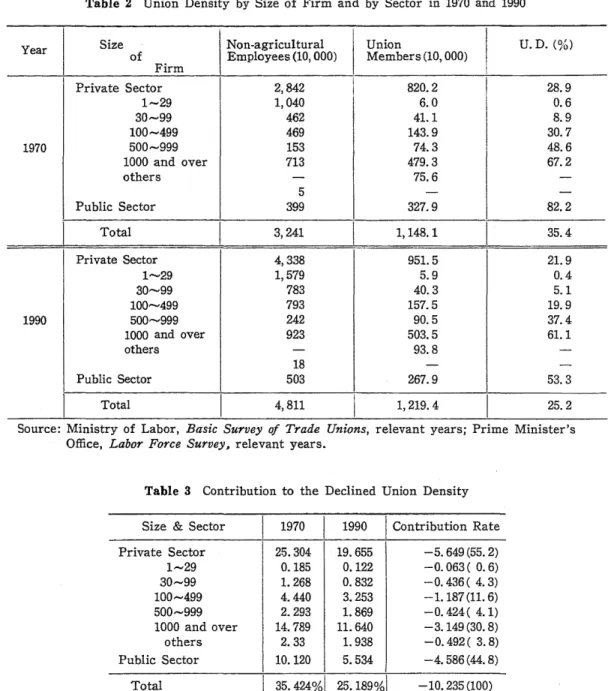
(4) -4-. .:t:.. :t. J. 1. EMPLOYMENT AND UNION MEMBERS IN THE PUBLIC SECTOR. The Declining Share of Public Employment In 1953 public employees, both national and local, constituted 17.7percent of total employees. The legal framework of public sector industrial relations was fully reorganized in accordance with the Japan's independence in 1952. But, by 1988, first because of expanded employment in the private sector in the following decades; second because of restraint of recruitment of new public employees; and third because of privatization of public corporations, the relative share of public employment has diminished to less than 10percent of total employment. While the number of national government employees, both nonindustrial and industrial, has decreased in absolute terms, that of local civil service has increased considerably due to the expanded numbers of local public service employees such as policemen, fire-fighters, school teachers, garbage collectors, and medical services (Table 1). Besides these civil servants, there are hundred thousands of quasi-public employees who are employed by various public organizations such as the Bank of Japan (central bank) and other governmental banks, NHK (Japan Broadcasting Corporation), JETRO (Japan External Trade Organization), Housing Corporation, Metropolitan Highway Corporation, and the Japan Institute of Labor. These workers, however, are covered by the Trade Union Law in terms of industrial relations and they have, theoretically, the full right of collective actions as workers in the private sector. Therefore, their labor problems need not be the subject of this paper despite the fact that financial control by the Ministry of Finance over these institutions often causes disputes. Union Members and Density Labor unions of public employees have been and still are powerful numerically, financially, and politically. For example, the largest labor union in Japan now is Iichiro, Federation of Local Government Employees. In 1992 it claimed about one million members. Public employees' labor unions can concentrate their financial resources unlike decentralized enterprise-wide unions in the private sector. The former can integrate their political votes in national and local elections: for example, the Teachers' Union (JTU) , the Local Government Employees, Postal Workers,and the Metropolitan Transport Workers succeeded in electing to the Diet 34 members of the Japan Socialist Party. The labor unions of the NTT and the JR, although they do not belong to the public sector any more, elected 15 representatives to the Diet, while sixteen industrial unions in the private sector elected only 37 representatives in the general election of 1990 (Koshiro [1992b], pp. 166-172) . Union density has been declining in Japan since around 1970. It declined to 25.2 percent by 1990 and further down to 24.4 percent by 1992 (Table 2). The decline was most evident in the public sector (Table 3)..
(5) C <0. Table 1 Employment by Sector and Government Occupations, 1953-88. <0. ~ 0'>. <:». 1953FY. 1965FY. 1970FY. 1980FY. 1988FY. Total Employees. 16, 600(100). 29,130 (100). 33, 400 (100). 39, 970(100). 45,720 (100). Private Sector. 13,661(82.3). 25,007(85.8). 28, 948(86.7). 34,802 (87.1). 41,320(90.4). 2,939(17.7) 1,528 ( 9.2). 4,123(14.2) 1,910( 6.6). 4, 453(13.3) 1,993( 6.0). 5,168(12.9) 2,003( 5.0). 4,400( 9.6) 1,188( 2.6). 469 2 363 744 1,107. 478 2 363 798 1,161. 507 2 348 792 1,140. 499 2 327. 278. 259 93. 270 84. 274 86. 1-0. Public Sector National Government Employees General Class Covered by the Salary Law Public Procurators Covered by the Special Salary Law Public Corporations (B). (A) (B). (C). + (C). Others Self-defence officials Other Special Class, etc. Local Government Employees General Administrative Service Teachers Police Fire-fighters Medical Service Others Public Enterprises Technical Laborers. 475 a b 285 645 930 123 b. (D). (E) (F) (E) + (F). 1,411 ( 8.5) 568 d 656 89 32 e e 66 7 73. 2, 213( 7.6) 654 744 145 47 81 365 141 36 177. 2,460 759 775 172 64 102 402 154 32. 186. 3, 165( 7.9) 1,035 967 210 119 161 450 166 57 223. oc 327.. 3, 212( 7.0) 1,053 1,000 220 129 195 404 159 52 211. Source: Prime Minister's Office, Labor Force Survey; Yearbook of Japanese Statistics; Japan's Long-term Statistics, Vol. 5, p.345. Note: a includes b. c reflects privatization of NTT and Japan Tobacco in 1985 and that of JR in 1987. d includes e. F is a part of "technical laborers" employed by local governments. The total of (E) + (F) is available from the Ministry of Labor's Basic Survey of Trade Unions. Deducting the number of (E) from the total of (E) + (F) gives (F).. C. to. r-. I-l. o. (j). tx:1. ...,o 0 :::d I-l. Z t:l C (j). ...,. :::d I-l :;t>. t""' :::d tr.l. t""' :;t>. t-? ...... 0. Z. (j). ....... Z. '-t. :;t> 'tl. :;t>. Z.
(6) -6-. ::r. .:r.. J. 7. Table 2 Union Density by Size of Firm and by Sector in 1970 and 1990. Year. I. Size. Non-agricultural Employees (10, OOO). of Firm. 1970. Total Private Sector 1......29 30--99 100......499 500--999 1000 and over others. 5 399. 327.9. 82.2. 3,241. 1,148.1. 35.4. 4,338 1,579 783 793 242 923. 951.5 5.9 40.3 157.5 90.5 503.5 93.8. 21. 9 0.4 5.1 19.9 37.4 61.1. -. -. Public Sector Total. U.D. (%). 820.2 6.0 41.1 143.9 74.3 479.3 75.6. 2,842 1,040 462 469 153 713. Private Sector 1--29 30--99 100-499 500--999 1000 and over others Public Sector. 1990. I. Union 11embers (10, OOO}. -. 28.9 0.6 8.9 30.7 48.6 67.2. -. -. -. -. 18 503. 267.9. 53.3. 4,811. 1,219.4. 25.2. Source: Ministry of Labor, Basic Survey of Trade Unions, relevant years; Prime Minister's Office, Labor Force Survey, relevant years.. Table 3 Contribution to the Declined Union Density Size & Sector Private Sector 1-29 30-99 100-499 500......999 1000 and over others Public Sector Total. I. 1970. 1990. 25.304 0.185 1. 268 4.440 2.293 14. 789 2.33 10. 120. 19.655 0.122 0.832 3.253 1. 869 11. 640 1. 938 5.534. I Contribution Rate. 35. 424%1 25. 189%1. -5. 649(55.2) -0.063 ( 0.6) -0. 436( 4.3) -1. 187(11.6) -0. 424( 4.1} -3.149 (30.8) -0.492( 3.8) -4.586 (44.8) -10.235 (100). Source: Same as Table 2.. Union Members in the Public Sector by Applied Labor Relations Laws Among total labor union members in Japan, public employees in 1953 occupied 35.5 percent in 1953. But, their relative share among the total union members has declined to 22.1percent by 1987 and further down to 20.9 percent by 1992 as a result of the reasons stated above (Table 4)..
(7) (1993.6). -7-. PUBLIC SECTOR INDUSTRIAL RELATIONS IN JAPAN. Table 4 Union Members by Applied Labor Relations Law (Unit: Person in thousands, Covered by. 1953. 1963. 1973. I. 1985(b). I. 1987(c). %) 1992. I. Total Trade Union Mem~ 5,927 (100) \9,357 (100) 12,098(100) bers Of whom covered by 3,822 (64.5) I 6,519 (69.7) 8,841 (73.1) Trade Union Law PCNELR Law (a) 861 (14.5) 973(10.4) 1,014( 8.4) Local Public Enterprise 73 ( 1. 2) 220 ( 1. 8) 166( 1. 8) Law National Government 221( 3.7) 285( 3.0) 284( 2.3) Employees Law Local Government Em951(16.1) 1,415 (15.1) 1, 738 (14.4) ployees Law Sub-total of the Public 2, 105(35.5) 2,838 (30. 3) 3,257(26.9) Sector. 12, 416(100) 12,272 (100) 12, 541(100) 9,393 (75.6) 9,562(77.9) 9, 919(79.1) 552( 4.4). 288( 2.3). 273( 2.2). 222( 1.8). 204( 1.7). 197( 1. 6). 283( 2.3). 279 ( 2.3). 271( 2.2). 1, 968(15. 9) 1,939 (15. 8) 1, 880(15. 0) 3, 025(24. 4) 2,710(22.1) 2,621 (20. 9). Source: Ministry of Labor, Basic Survey of Trade Unions (conducted in June each year); Koshiro (1987) p.249. Note: (a) Amended as National Enterprise Labor Relations Law since 1987. (b) NTT and Japan Tobacco were privatized in April 1985. (c) JR was privatized in April 1987.. Public employees are classified into four groups in terms of their legal status in industrial relations: (a) national government employees of general class covered by the Law Concerning Salary; (b) local government employees of general administrative service and other .occupations except for those employed by local public enterprises; (c) personnel employed by national public enterprises (prior to the privatization, employees of three public corporations were also covered by the same law); (d) personnel employed by local public enterprises. Their basic rights differ and each group is provided for different kind of compensatory procedures to preserve their economic interests. 2. THE LEGAL FRAMEWORK OF PUBLIC SECTOR INDUSTRIAL RELATIONS. The Right to Organize Article 28 of the Constitution of Japan guarantees "the right of workers to organize, to bargain, and to act collectively". Thus, Article 1, Section 2 of the Trade Union Law grants criminal immunity for appropriate acts of trade unions and Article 8 for civil immunity (free from indemnity). These protections were fully applied to all workers including public employees right after World War II when the Trade Union Law was first enforced. The only exception was the exclusion of policemen, firefighters, and prison officers who were not allowed to organize trade unions (Article 3, Section 1 of the Original Trade Union Law). This prohibition was continued and is still effective as a result of the Amended National Government Employees Law (Article 108) and the Amended Local Government Employees Law (Article 52). The depreviationof the right to organize for fire-fighters has been challenged by Iichiro (Local Government Employees) at ILO and will be.
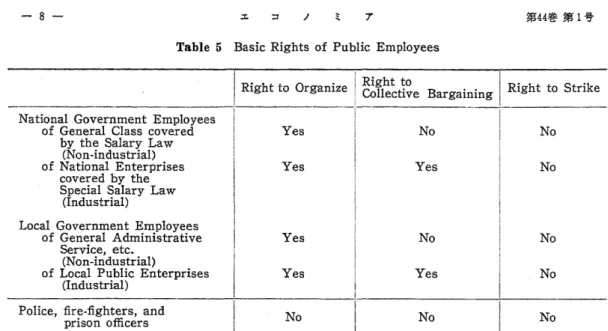
(8) -8-. .J. 7. Table 5 Basic Rights of Public Employees. I Right to Organize I ~fl~~t~e National Government Employees of General Class covered by the Salary Law (Non-industrial) of National Enterprises covered by the Special Salary Law (Industrial) Local Government Employees of General Administrative Service, etc. (Non-industrial) of Local Public Enterprises (Industrial) Police, fire-fighters, and prison officers. Bargaining. I Right to Strike. Yes. No. No. Yes. Yes. No. Yes. No. No. Yes. Yes. No. No. No. No. Note: For details about legal aspects of industrial relations in the public sector, see Minemura (1961).. further discussed in June 1993. Other general class government employees are all guaranteed the right to organize. Remunerations for those who do not have the right to organize, including Defense officials and maritime security officials, are substantially protected by linking their pay with that of general class civil service, either at the national or at the local level.. The Right to Strike Public employees are classified into five categories with respect to their legal status concerning industrial relations which are exhibited in Table 5. For a few years after World War II under the Trade Union Law, ordinary government employees of both national and local levels enjoyed the full right of collective bargaining and strikes. But, policemen, fire-fighters, prison officers as well as non-industrial civil service engaged in administrative and judicial work were prohibited to undertake acts of dispute by the Labor Relations Adjustment Law in October 1946. This was the time when communists led strong electric power generator workers in a successful strike for a wage increase and established the historic "living wage" formula. Under the detriorated economic condition of October 1946 to February 1947, government employee unions tried to organize a general strike on the 1st of February,· 1947. It was prohibited by the order of General MacArthur. But, they again organized widespread local guerilla actions in the early summer of 1948 which were again stopped by the order of the Supreme Commander. Following his letter to the prime minister, the government issued Decree 201,by which strike actions of all government employees were prohibited despite the existence of Acticle 28 of the Constitution. Furthermore, non-industrial government employees were deprived of their right to collective bargaining. These modified principles were incorporated into the amended.
(9) (1993.6). PUBLIC SECTOR INDUSTRIAL RELATIONS IN JAPAN. -9-. National Government Employees (NGE) Law of 1948. As a compensation for the deprevation of their rights to strike and collective bargaining, the National Personnel Authority was established to protect and improve the working condition of these employees. Similarly, the Local Government Employees Law of December 1950 deprived local government employees of their rights to strike and to bargain collectively. Local Personnel Commissions or equity commissions (in the case of small cities and villages) were established as a compensation and expected to perform the comparable function with respect to local non-industrial government employees. Industrial public employees of the national government were also deprived of their right to strike during the process of reform stated above, but, they retained their right to collective bargaining by the Public Corporation and National Enterprise Labor Relation (PCNELR) Law of 1948. Similarly, industrial public employees of local governments were deprived of their right to strike but retained their right to collective bargaining by the Local Public Enterprise Labor Relations Law of 1952.. The Right to Collective Bargaining As a result of reforms in the industrial relations system of the public sector in 1948, national industrial public employees were separated from non-industrial government employees. Article 8 of PCNELR Law allowed collective bargaining on wages, hours of work, and other working conditions. Matters pertaining to the management and operation of the public corporation and national enterprise were excluded from the scope of collective bargaining. Employees of Japan National Railways (privatized as JR in 1987) and Tobacco Monopoly (privatized as JT in 1985) became covered by the PCNELR Law from June 1949. Postal workers and other industrial public employees were covered by the NGE Law for another few years because the government was afraid of giving militant postal workers the right to collective bargaining. Telecommunication workers were separated from postal workers and reorganized into the Japan Telephone and Telegram Public Corporation (privatized as NTT in 1985) in July 1952 (Parenthetically, we should note that, overseas telecommunication service was privatized by establishing KDD). From January 1953, these three public corporations and five national enterprises (Postal Service, National Forestry, Government Printing Office, Mint, and Alcohol Monopoly) all became covered together by the PCNELR Law. Despite the preservation of the right to collective bargaining, budgetary control by the Ministry of Finance was strengthened step by step in 1949 and 1956. As a result, the management of these public corporations and national enterprises were not able to retain enough autonomy at the bargaining table. They were obliged to ask for mediation and arbitration services from the Public Corporation and National Enterprise Labor Relations Commission (Koroi): In fact, all major wage disputes since 1949 have been.
(10) -10 -. /. 7. settled finally through arbitration awards of the PCNELR (or NELR since 1987) Commission. Furthermore, even arbitration awards of the PCNELR Commission were not necessarily fully respected by the government until 1956,. a factor which aggravated industrial relations in this part of the public sector.. Local Government Employees Local government employees include various occupations: (a) most of policemen, firefighters and prison officers are local government employees and do not have any basic right as workers as explained earlier; (b) teachers of primary and junior secondary schools who are for compulsory education are mostly local government employees, but a half of their pay is subsidized by the central government. Teachers are allowed to organize unions of their own choosing but do not have the rights to collective bargaining and strike. However, partly because their pay is in substance controlled by the national government, and partly because they want to participate in educational policies of the government, they have often dared to conduct illegal industrial actions against the Ministry of Education. Employees of general administration service of local governments as well as these two groups of non-industrial local public employees do not have their rights to collective bargaining and strike. But, there are other industrial local government employees who have the right to collective bargaining: (a) those who are engaged in the operation of such various local public enterprises as hospitals, water supply, transportation, sewage system, and so on; (b) of the above groups, nurses have special problems. Public hospitals are under budgetary control of the local government as well as that of the national medical care insurance schemes. Remuneration for medical service have not necessarily been determined reasonably and nurses have been obliged to be exploited by inadequate manning and insufficient pay despite their increasing labor shortage, although they are better treated than many nurses in private hospitals; (c) technical laborers numbered 334,000 in FY 1989. They are engaged in sanitary work, garbage collection, and the like. Because of the indispensable nature of their work, they have strong voice in the unions of IOCll government employees. Some of them are covered by the Local Government Enterprise Labor Relations Law together with employees of other local public enterprises. Their potential bargaining power is said to be a main source of higher wages of local public employees in metropolitan areas. The impasses of negotiation in local public enterprises are to be settled through conciliation, mediation, and arbitration of each local (prefectural) labor relations commission. Because of diversified occupational composition of local government employees, the structure of their unions is also diversified. For example, in Osaka and Kobe, nonindustrial public employees on the one hand, and industrial public employees such as sanitary workers on the other are organized into separate unions respectively. But, in Tokyo, Metropolitan Government Employees Union (Toshokuro) includes not only non-.
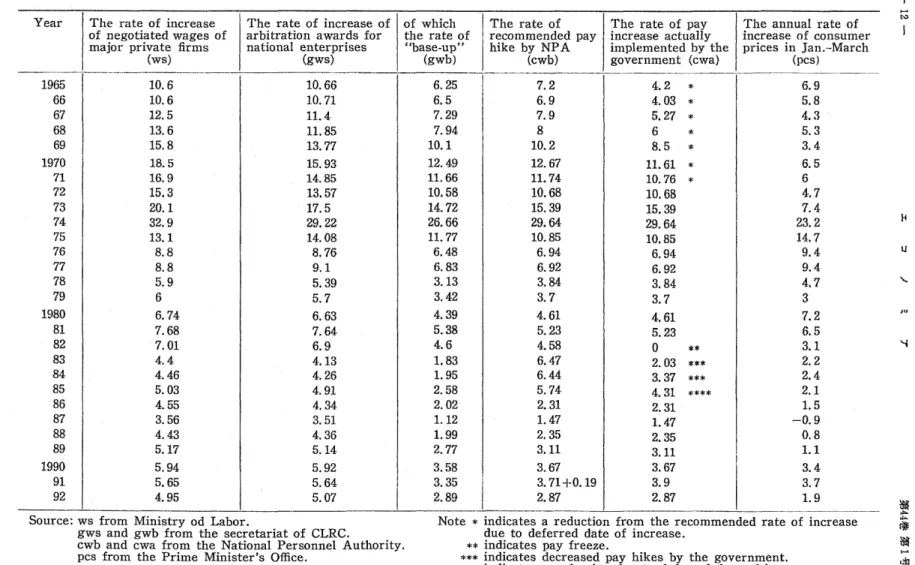
(11) (1993.6). PUBLIC SECTOR INDUSTRIAL RELATIONS IN JAPAN. -11-. industrial administrative employees but also industrial employees en bloc. Employees of metropolitan transport, water supply, teachers of compulsory education, senior high school teachers, and professors of the Tokyo Metropolitan University have a separate union of each group respectively apart from Toshokuro. 3. PAY DETERMINATION FOR NON-INDUSTRIAL GOVERNMENT EMPLOYEES. Recommendation by NPA. The National Personnel. Authority is responsible for reporting and recommending appropriate measures to the Diet and to the Cabinet whenever the changed conditions determining remunerations require changes of 5 percent or more of remunerations set by pay schedules (Article 28, National Government Employees Law). In fact, NPA has continued to recommend pay increase even in the years when the rate of increase of consumer prices or wage increase in the private sector did not exceed 5 percent (Table 6). About a half million general class government employees are covered by the Salary Law. Several different pay schedules are applied separately to each occupational group of which the most important are Administrative Grade (I) and (II). The former is applied to general administrative officials and the latter to the manual or technical staff in the administration such as chauffeurs, telephone operators, and typists. Other pay schedules are linked to the administrative grade (I) schedules based upon job classification. Every spring, NP A conducts a comprehensive wage survey of comparable workers in the private sector employed by establishments of 50 employees or more among the firms employing 100 or more. This means that the average pay level of the national government employees should be comparable with that of the majority of workers in the private sector. Historically, civil service were paid much better than many of private employees. After World War II, due to democratization of the society, civil service were deprived of their privileged status on the one hand but were guaranteed a reasonably comfortable standard of living which was enjoyed by the majority (50 percent or more) of private employees. Therefore, they are guaranteed higher wages than private workers employed by small firms employing less than 100 employees. For example, NPA found out in the spring of 1992 that private employees in those selected samples were paid 2.87 percent higher wages than comparable national public employees after the Spring Offensive. Then, in August, NP A recommended to both the government and to the Diet to increase the average pay level of those national government employees by 2.87 percent which was fgUy accepted by the government with the consent of the Diet. This increase was implemented by the end of December retroactive to April 1992. However, the government often rejected or reduced the recommended pay hikes in the early days before 1970 (Koshiro [1973]). Even in recent years, the government in.
(12) Table 6 The Rate of Increase of Wages in the Private and Public Sectors, 1965-92 (%) ........ Year. The rate of increase of negotiated wages of major private firms (ws). The rate of increase of arbitration awards for national enterprises (gws). of which the rate of "base-up". The rate of recommended pay hike by NPA (cwb). (gwb). The rate of pay increase actually implemented by the government (cwa). The annual rate of increase of consumer prices in Jan.-March (pes) ------~------------~-. 1965 66 67 68 69 1970 71 72. 73 74 75 76 77 78 79 1980 81 82 83 84 85 86 87 88 89 1990 91 92. 10.6 10.6 12.5 13.6 15.8 18.5 16.9 15.3 20.1 32.9 13.1 8.8 8.8 5.9 6 6.74 7.68 7.01 4.4 4.46 5.03 4.55 3.56 4.43 5.17 5.94 5.65 4.95. 10.66 10.71 11.4 11.85 13.77 15.93 14.85 13.57 17.5 29.22 14.08 8.76 9.1 5.39 5. 7 6.63 7.64 6.9 4.13 4.26 4.91 4.34 3.51 4.36 5.14 5.92 5.64 5.07. Source: ws from Ministry od Labor. gws and gwb from the secretariat of CLRC. cwb and cwa from the National Personnel Authority. pes from the Prime Minister's Office.. 6.25 6.5 7.29 7.94 10.1 12.49 11.66 10.58 14.72 26.66 11.77 6.48 6.83 3.13 3.42 4.39 5.38 4.6 1.83 1.95 2.58 2.02 1.12 1.99 2.77 3.58 3.35 2.89 Note. I. *. 7.2 6.9 7.9 8 10.2 12.67 11.74 10.68 15.39 29.64 10.85 6.94 6.92 3.84 3.7 4.61 5.23 4.58 6.47 6.44 5.74 2.31 1.47 2.35 3.11 3.67 3.71+0.19 2.87. 4.2 * 4.03 * 5.27 * 6 * 8.5 * 11.61 * 10.76 * 10.68 15.39 29.64 10.85 6.94 6.92 3.84 3.7 4.61 5.23 0 ** 2.03 *** 3.37 *** 4.31 **** 2.31 1.47 2.35 3.11 3.67 3.9 2.87. 6.9 5.8 4.3 5.3 3.4 6.5 6 4.7 7.4 23.2 14.7 9.4 9.4 4.7 3 7.2 6.5 3.1 2.2 2.4 2.1 1.5 -0.9 0.8 1.1 3.4 3.7 1.9. indicates a reduction from the recommended rate of increase due to deferred date of increase. ** indicates pay freeze. *** indicates decreased pay hikes by the government. **** indicates a reduction due to deferred date of increase.. t..:>.
(13) (1993.6). PUBLIC SECTOR INDUSTRIAL RELATIONS IN JAPAN. -13 -. 1982 totally froze pay hikes recommended of 4.58 percent (except for annual periodical increment which was estimated to amounting to 2. 1 percent of the total wage bill) due to financial difficulties. Furthermore, the government reduced the rate of pay increase from a recommended 6.47 percent to 2.03 percent in 1983 and from 6.44 percent to 3.37 percent in 1984 respectively. In 1985, the government changed the implementation of the recommended pay hike waiting until July instead of April (see Table 6 above). The government has continuously accepted since 1986 the full implementation of recommended pay hikes in terms not only of percentage increase but also of the date of implementation.. Pay Comparability NPA has been following two basic principles of pay determination: (1) comparability with the private sector; and (2) equitable balance inside the public service. Firstly, comparability of pay with the private sector has been maintained through a comprehensive wage survey covering about a half million employees in the private sector as stated above. Considering. the existence of wide wage differentials by size of firm in the private economy, the pay level of government employees should be balanced with that of the majority of private employees in comparable occupations: Not better, but not worse either than the average wage level of private workers. Secondly, there are various occupational groups inside the government employees besides the general administrative groups; tax administration, public safty, maritime affairs, education (including national university professors), research, medical treatment and designated positions. The pay schedules of these various groups are theoretically balanced with that of the general administrative grade (I) based originally on the job classification schemes which were introduced by the Occupation Forces after World War II. Pay differentials existed in the pre-war days were destroyed by hyper-inflation and democratization in the late 1940's. Comparing objectively with similar principles applied in other developed countries, the author tends to conclude that the present system of pay comparability in Japan has been elaborated to a satisfactory level despite some continuing criticisms by public employee unions (Koshiro [1980J). The major criticism against the present system of pay determination by NP A is as follows: (a) First of all, public employee unions insist that their basic rights of collective bargaining and strike should be restored. In fact, NP A meets frequently with representatives of public employee unions during the process of pay research, although such meetings are by no means collective bargaining but are practices of "meet and confer"; (b) unions insist that the size of comparable private firms should be raised to large firms employing 1,000 or more; (c) unions were dissatisfied with the government freezing or reducing recommended pay hikes which constituted the violation of the compensatory nature of NP A.. Pay Differentials between National and Local Government Employees.
(14) -14 -. J. 7'. Until the introduction of new government employee systems in 1947, all government employees were considered to be servants of the Emperor. Under that ancient regime, local public employees were also under strict control of the central government. The Ministry of Interior was responsible for controlling local public employees whose pay was unilaterally determined by the government as a part of the old civil service system. Among local public employees, there were rigid differentation and differentials between classes and status from top Emperor's servants to laborers. After the introduction of the new government employee system, they became "public servants" under the democratic government and class distinction among them was abolished. Each. local government became responsible for pay and other conditions of work of its OW11 employees. Financially poor local governments are entitled to receive subsidies from the central government. The Ministry of Local Autonomy is responsible for maintaining reasonable balance between pay levels of different local government employees and those of national government employees. In each local government, the local personnel commission (or equity commission in the case of small villages and municipalities) is responsible for maintaining pay comparability between its own employees and corresponding private sector employees in each locality, and forrecommending to both the local assembly and the local government authorities. Pay increase must be agreed in the local assembly and be implemented through local ordinances. Unions in large and/or rich local governments tend to have larger bargaining power than unions in small and/or poor ones, although they do not have the official bargaining right. Local governments whose head is socialist, or communist-influenced tend to be more generous in granting higher pay than others. Thus, in the early days during the period of high economic growth, some local governments paid 40 or more percent higher pay than the average pay level of the national government employees compared by the Laspeyres formula, taking into account years of service and educational attainment of employees as the basic elements of comparing pay levels. The Ministry of Local Autonomy has exerted pressure on those higher-paid local governments, urging them to press down the differentials within some reasonable extent. The pay differentials with the national government employees have been reduced throughout the second half of the 1970's and thereafter when public opinion tended to swing toward small government. Table 7 shows that the average pay level of Designated Cities such as Tokyo, Yokohama, and Osaka in 1973 was 16. 2 percent higher than that of the administrative grade (I) of national government employees. But, the differentials has been disminished to 6.7 percent by 1991. Taking the pay level of all local government employees, the differentials have been reduced to only 2. 7 percent by 1991. Therefore, the Ministry of Local Autonomy stopped its loud denunciation of "excessive pay levels" of some local governments.. Teacher's Pay Public school teachers constitute a special group among local public employees. They.
(15) PUBLIC SECTOR INDUSTRIAL RELATIONS IN JAPAN. (1993.6). -15 -. Table 7 Pay Differentials of Local Government Employees against National Government Pay as of April 1,1991. Laspeyres Index as of. Average Monthly Pay as of April 1, 1991. Numbers Ofl Monthly IAverage 197311978119831198811991 Employees Average Years of (1, 000) Pay (yen) Service Prefectures Designated Cities Cities Towns and villages Special wards Total Local Gov. National Gov.. 110.1 107.2 106.2 104.51 104. 1 1 116.2 111.4 109.4 107.61106. 7 111.4 110.5 109.0 105.4 104.2 96.6 99.0 98.3 96.8 96.6 - 110.4 109.4 107.0 106.5 108.7 '107.3 105.9 103.4 102.7 100.0 100.0 100.0 100.0 100.0. 328 I 86 364 232 53 1,082 224 b. 286,468 294,028 290,068 257,801 268,655 280,898 263,949. 18.4 18.6 19.2 18.8 16.1 18.7 18.7. I Age Average 39.4 39.4 39.9 38.9 37.1 39.4 38.9. Source: Ministry of Local Autonomy, Chiho Komuin Kyuyo no [ittai (Survey of Local Public Employees' Pay), 1991. p.39. Note: a Laspeyres Index is composed as follows: :£PIqO!XPOqO where Po is wages of national government employees of a particular group PI is wages of local government employees of the corresponding group qo is the number of national government employees of a particular group Groups are classified by educational levels and years of service. b National government employees of Administrative Grade (I).. are employed by each municipality, village, town, prefecture, or metropolice according to their status as public employee. However, their pay is to be determined by a prefectural ordinance irrespective of their employment status. Furthermore, their pay level is required to be equal to that of teachers employed by the state (Article 25-5 of Special Law for Educational Public Servants). This is because the government wants to maintain the quality of education throughout the nation irrespective of locality. The national government, therefore, shares half of teachers' pay according to the stipulation of the Teacher's Pay Cost Sharing Law of August, 1952. However, there is a problem of pay differentials between national and local governments as explained in the previous section. Then, the Ministry of Education sets the maximum permissible pay differentials of only 4.5 percent (to be reduced to 2.5 percent from FY 1993) above the corresponding pay level of national school teachers. If any local government pays much higher wages for its teachers, then the residual differentials should be borne financially by the local government. Historically, teachers were strongly influenced by left-wing ideology after World War II and their main union, Nikkyoso (Japan Teachers Union) has been in conflict with the Ministry of Education not only for the purpose of improving their working conditions but also for the purpose of pursuing their own educational philosophy (such as "so-called peace education" "anti-national anthem", and "anti-merit-rating") which totally contradicts with the government's policy. For these purposes they repeatedly conducted illegal industrial actions until recent years. Nikkyosconce organized 86.3 percent of teachers in 1958 but it has lost its share down to 35.2 percent by 1991. Once only a minority of teachers remained outside of teachers' unions, but now 41 percent of them are remaining outside of any union (Ministry of Education [1992] pp, 44-47) ..
(16) -. 16-. :r.. :r. I. '7. In order to pacify teachers' movements against the Government, several measures to improve teachers' remuneration have been introduced. Firstly in May 1971, the government enacted a special law providing teachers a 4 percent allowance of their basic pay as a means to compensate for their overtime work which had not been paid and thus had been demanded by teachers' unions for many years, Secondly, a law to induce high quality human resources in education was enacted in February 1974 based upon a recommendation of the Central Deliberation Council on Education of the Ministry of Education, The government LDP party strongly urged bureaucrats to introduce this law. Initially, the LDP insisted that teachers' pay should be doubled or increased at least by 50 percent. But, because of financial limitation, the initial increment was 10 percent in F, Y. 1973; then additional two increments were implemented by 1979 in various forms, totaling to 25 percent premiums for teachers, Among those measures were (a) improvement of starting pay, (b) increased basic salary, (c) introduction of "cheif's allowance" which was strongly opposed by Nikkyoso for several years, (d) allowance for teachers' work to help pupil's out-of-class activities, and (e) improvement of managerial staff's allowance (Ministry of Education [1993]). As a result of the introduction of the semeasures to improve teachers' pay, its relativity was improved as follows: (a) ordinary teachers' pay was comparable with that of group chief in the local administrative civil service before the reform, but became better than that of section manager after the reform; (b) vice-principals' pay was no better than ordinary teachers before the reform but became higher than that of leading section manager in the local civil service; and (c) principals' pay was comparable with that of leading section chief before the reform but improved to a comparable level with that of a deputy director of a department in local civil service. The Ministry of Education judges that the quality of teachers has been improved as a result of these improvements. Moreover, newly-recruited teachers of higher quality tended to loose their loyalty to Nikkyoso and other unions. In 1960, 87,4 percent of newly-employed teachers became union members, but the ratio has continued to decline to only 30.3 percent by 1990 and 30.9 percent in 1991 (Ministry of Education [1992] p. 53). Nikkyoso itself has tried to change its policies since the middle of the 1970's and affiliated to Rengo in November 1989. But, the left-wing forces inside Nikkyoso split to form Zenkyo (All Japan Teachers Union) which organized 10.7 percent of teachers in October 1991. Besides the two largest unions, there are several other unions organizing in total 13.7 percent of teachers as of October 1, 1991 (Ministry of Education [1992], p. 42). 4. WAGE DETERMINETION OF NATIONAL ENTESPRISES. Limited Autonomy of the Authorities Wage determination in public corporations started with a very unfortunate incidence.
(17) (1993.6). PUBLIC SECTOR INDUSTRIAL RELATIONS IN JAPAN. -17 -. in 1949. The arbitration committee for Japan National Railways handed down its first award amounting to 4. 5 billion yen increase of the wage bill in December 1949. The authorities of JNR asked the Minister of Finance that 1. 8 billion out of 4.5 billion yen be transfered from items other than wages and salaries within the fixed budget of the corporation. But the minister only allowed the transfer of 1. 5 billion yen from other budget items and rejected implementation of the remaining amount of awarded wage increase. The president of JNR proposed to borrow the insufficient funds in a supplementary budget, but the government and the Diet rejected this proposal as well. This decision of the government was based upon Articles 16 and 35 of the Public Corporation Labor Relations Law. Article 16 stipulates that any agreement involving the expenditure of funds not available from the appropriated corporation budget or corporation funds shall not be binding on the Government and no funds shall be disbursed until an appropriate action has been taken by the Diet. Article 35 stipulates that "An award of the Commission shall be final and binding upon both parties, provided that an award involving the expenditure of funds not available from the appropriated corporation budget or corporation funds shall be dealt with in accordance with the provision of Article 16." Therefore, whenever the wage increase awarded by the Commission exceeds the appropriated corporation budget or corporation funds, then the government must ask the consent of the Diet before implementing the awarded wage increase. These stipulations were products of disastrous experiences in the pre-war days when military expenditures expanded beyond the control of the Diet. In other words, these articles were not expected to be used in order to restrain wage increases awarded by arbitration commissions because that procedure was a compensation for the deprived right to strike of employees. This dispute developed into a series of confrontations between unions, the authorities, and the government. The Supreme Court supported the decision of the government. And the Ministry of Finance introduced an additional control against wage increases in the form of a "limited payroll system" in the budget of each public corporation. Because of this new restraint, the authorities of public corporations lost their autonomy as management at the bargaining table. Furthermore, the Ministry of Finance introduced another restraint in 1956 which prohibited the transfer of money from the fund for overtime payments into basic wages as contrivance innvated by the annoyed management of public corporations. These decisions by the Ministry of Finance, supported by the Conservative ruling party, irritated unions of public employees of not only three public corporations but also of five national enterprises which became covered by PCNELR Law between 1950 and 1953 as explained earlier. They finally appealed to the ILO in the second half of the 1950's, claiming that the government policies were violating the International Labor Convention No. 87. In order to pacify aggravated industrial relations in the public sector, the government modified in 1956 the stipulation of Article 35 of PCNELR Law so as to let the govern-.
(18) -18 -. ment endeavour as much as possible so that the arbitration award of labor commission may be implemented. This was a great improvement in the history of industrial relations in the field, 'but that was too late to improve labor-management relations of the public sector because by that time the disputes between the unions concerned and the conservative government had already escalated into a more serious and fundamental strife: namely, over ratification of the ILO Convention No.87 and disputes concerning the restoration of the right to strike of public employees.. Compulsory Arbitration As explained earlier, PCNELR Law allows collective bargaining on wages for national enterprise workers. But from the very beginning of the public corporation system in 1949, the authorities and unions concerned were obliged to rely upon compulsory mediation and arbitration by the PCNELR Commission for wage increases. In the 1960's, the labor commission handed down more favourable arbitration awards than in the previous decade. In 1964, Prime Minister Ikeda and Sohyo Chairman, Mr. Ohta, met together and agreed to establish p3.y comparability between private workers and national industrial government employees. The basic principles of maintaining the pay comparability which were developed by the PCNELR Commission in the late 1960's were four-fold: (1) the pay level of public employees should be comparable with that of private workers employed in firms of 100 or more employees; (2) comparison should be made by the Laspeyres formula, taking into account age, gender, and education levels of both employees; (3) the rate of increase of wages negotiated at major private companies (now about 295) should be referred to as the bench mark of wage increase at national enterprises; (4) pay comparability with non-industrial civil service should also be maintained, although the concrete content of this concept is not clearly defined in the Special Salary Law for Employees of National Enterprises. Of course, these are. principles which should be applied to changing economic and social environmental conditions surrounding the national enterprises every year. In other words, simple statistical comparisons are not the only criteria to set wage increase in national enterprises. Wages between the private and public sectors are compared based upon the result of the Basic Survey of Wage Structure, undertaken by the Ministry of Labor in June every year. The average rate of increase of major private firms is surveyed by the secretariat of the PCNELR (NECR now) Commission during the process of mediation (mostly in April every year when wage increases are negotiated in the private sector). The mediation committee of each national enterprise (they are usually consolidated into a single mediation panel in the last. stage of mediation) and the arbitration committee take into account these basic statistical information carefully. But, they must also take into account political elements in the Diet because the arbitration awards should be implemented with the consent of the Diet according to the stipulations of Articles 16·and 35 of NELR Law..
(19) (1993.6). PUBLIC SECTOR INDUSTRIAL RELATIONS IN JAPAN. -19 -. Throughout 44 years history of wage settlement in public corporations and national enterprises, the final solution has only been achieved by arbitration. From the very beginning of public corporations and national enterprises, the Ministry of Finance as well as the conservative government seemed to be afraid of "conspiracy" between management and labor of these organizations because they tended to share "mutual interests" when they maintain friendly relations. If they could freely negotiate wage increases, they might use collusion to increase wages which might contravene the public interest. Therefore, the Ministry of Finance set an additional constraint against the autonomy of the authorities in the form of "limited payroll system" in 1949 as explained earlier. Similarly, settlement by mediation by a labor commission has in effect the same meaning from the view point of the Ministry of Finance, because mediation is in principle a procedure to facilitate negotiation by breaking impasses with the help of a labor commission. In order to avoid the possibility ofcollusion by the parties concerned, the Ministry as well as conservative political forces tried hard to nulify Article 8 of PCNELR Law which allowed free collective bargaining on wages. Thus, the parties were obliged to rely upon arbitration by PCNELR Commission as a last resort. Only when this neutral agency decides appropriate rates of wage increase is the government ready to accept wage increases without being forced to accept excessive wage increase under the threat of conspired pressure of the parties concerned. Theoretically speaking, in order to proceed to arbitration, the parties can not agree at the stage of mediation. However, the facts are as follows: at the final stage of mediation (mediation committees consist of three parties), the public interest commissioners offer both parties a certain percentage of wage increase. Before agreeing to the offered rate, it usually takes long hours. Hard negotiation is undertaken between mediating commissioners and labor representatives of the mediation committee. Finally, they come to a de facto agreement on a certain rate of increase which is automatically to become the rate of the arbitration awards a month later. Then, the parties "reject" the mediation plan as a ritual just for the purpose of proceeding to the next stage, arbitration.. Union Claims Labor unions of national enterprises have been raising serious criticism of the present system of compulsory arbitration. Even during the days in which powerful unions of three public corporations were in the ranks of public employees, they were not able to make any significant changes in the basic framework of wage determination in this field. They dared to undertake illegal industrial actions so as to push up the rate of wage increase, the most influential of which was concerted strikes with private railway workers. Their strategies seemed to be successful- to some extent sometimes so far as the rate of increase itself was concerned. But they were not able to realize any significant change in the very system of wage determination. Their bargaining power has been reduced due to (a) moderated attitudes of private.
(20) ~. 20-. .,.. railway workers since the second half of the 1970's (they stopped asking CLRC's conciliation since 1977 and also stopped coordinated industrial actions with national railway workers duringSpring Offensive since 1983), and (b) privatization of public corporations (NTT and JT were privatized in April, 1985 and JR in April, 1987). Also, a small national enterprise, the Alcohol Monopoly, was privatized in the fall of 1982. Therefore, at present, there remain only four national enterprises, of which the largest is the Postal Service. However, postal workers are under stringent control of the Postal Law which stipulates criminal punishment (imprisonment of less than one year or a fine of less than 20,000 yen) against intentional stoppage of mail service (Article 79, section 1). The applicability of this stipulation to stoppages of mail service by labor disputes was reconfirmed by the Supreme Court decision in the Nagoya Central Post Offiice Case on May 5, 1977. The second largest national enterprise, the National Forest, has been in the red for more than twenty years mainly because of increased importation of cheap timbers from abroad. Having huge amount of deficits of more than 2.6 trillion yen, the authorities have little bargaining power against the Ministry of Finance, much less than the case of the Postal Service. The National Forest has been obliged to rationalize its operation by reducing the number of employees which was halved almost. Other two national enterprises, the Mint and the Government Printing Office, are branches of the Ministry of Finance. The main points of unions' claims against the present system of wage determination are as follows: (1) Comparability of pay with the private sector should be based upon a comparison with large private firms employing 1, 000 or more; (2) Years of service should be taken into account as one of the elements of comparison of wage levels by the Laspeyres formula; (3) Comparability of pay with non-industrial civil service should be maintained. The Central Labour Relations Commission responds to these claims as follows: (1) If we choose large firms employing 1,000 or more as the reference group, the employees of national enterprise will be treated more favourably than the majority of private workers. In other words, only less than a third of private workers are employed in those large firms; (2) Public employees are guaranteed employment status by the law, whereas private workers are not. Although the practice of life-time employment prevailed among large firms, they are subject to the risk of losing jobs under market competition. Therefore, public employees tend to have longer years of service than private workers. If this factor is taken into account, that means that in fact wages of public employees will become comparable with those of very large firms where many workers tend to have long years of service; (3) The Special Salary Law for employees of national enterprises certainly stipulates comparability of pay between industrial and non-industrial civil service (Article 3). But, it also requires that remuneration should be corresponding to the content and responsibility of job. These factors can not necessarily be reflected enough by wage comparison by the three elements of workforce.
(21) 0993.6). PUBLIC SECTOR INDUSTRIAL RELATIONS IN JAPAN. -21-. composition (age, gender, and education). There is no satisfactory way of simple statistical comparison between the two groups which will meet the requirement of the stipulation. But unions succeeded in asking for progress in achieving their demands in the past two years. The NP A was obliged to make additional wage increases for middle-class non-industrial civil service due to increased labor shortage in the last phase of booming economy in 1990-92. It recommended a 0.19 percent additional wage increase in its 1991 pay recommendation because private firms increased wages of middle class personnel under the pressure of ,labor markets. Civil service has been adversely affected by continuous labor shortage because the candidates of top civil service should be recruited from the students of best quality who are competitive with private large companies. The quality of young civil service of top ranking is said to be declining due to continuous relative decline of their pay levels compared with that of very large Therefore, the NPA felt obliged to make special consideration to imprivate firms. prove the pay levels of those civil service to the level comparable with that of large firms employing 500 and over instead of 100 and over. Reflecting this changed policy on the part of the NPA, the labor commission was also obliged to take into account the new balance with the pay level of non-industrial civil service which had been demanded by unions of national enterprises. In the arbitration award of 1992, the labor commission granted 5.07 percent wage increase which exceeded the average wage increase of 4. 95 percent in the 295 major private firms surveyed. The difference of 0.12 percent might be understood to correspond to the 0.19 percent additional increase for non-industrial civil service by the NPA recommendation. 5. QUNTITATIVE ANALYSES OF WAGE CHANGES IN THE PUBLIC SECTOR IN COMPARISON WITH THOSE OF THE PRIVATE SECTOR. The Economic Rationale of the Pay Comparability Principle The principle of pay comparability is usually considered to be an essential element of a democratic society where public employees should not be treated more favourably than the mass of people, but, at the same time, they should be treated equally well as the average workers in the society as a whole. In this sense, this is a universal principle applicable in any advanced society. However, in some advanced countries, public employee unions often lead in wage increases that may not be compatible with economic stability. Or, even when the public sector unions follow wage increase in the private sector, if the latter is not determined within a certain range of economic rationality, then the comparability principle does not make sense by itself. If public employees have enough bargaining power in a society, the economy needs some institutional frameworks which reasonably restrain the free exercise of their bar-.
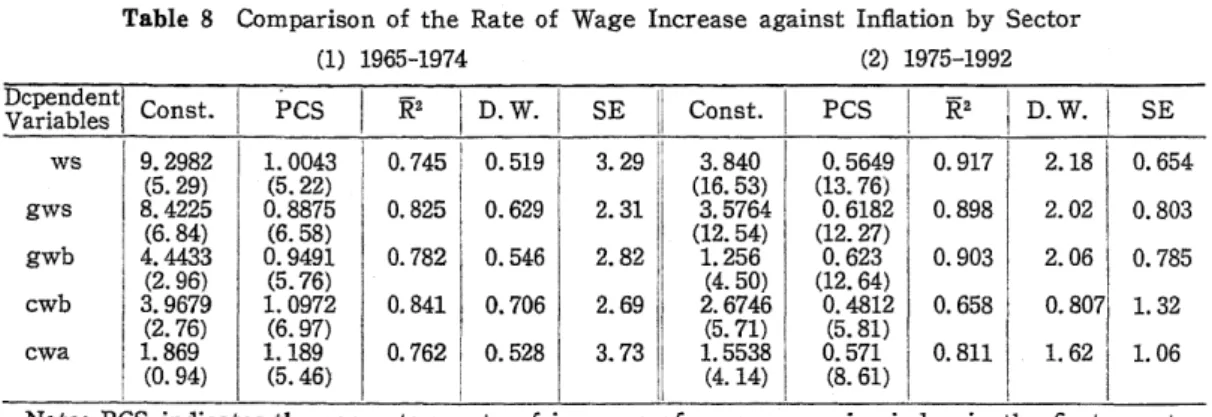
(22) -. 22-. .:r:.. ';:I. 7. /. Table 8 Comparison of the Rate of Wage Increase against Inflation by Sector (1) 1965-1974. Dependentl Variables Canst. I. ws. 9.2982 (5.29) 8.4225 (6.84) 4.4433 (2.96) 3.9679 (2.76) 1.869 (0.94). gws. gwb cwb cwa I. PCS. I I. 1. 0043 (5.22) 0.8875 (6.58) 0.9491 (5.76) 1. 0972 (6.97) 1.189 (5.46). R2 0.745. (2) 1975-1992. I D. W. I SE. I. 0.519 I. I. 3.29 III I. 0. 825. 0.629. 0.782. 0.546. 2.31 2.82. 0.841. 0.706. 2.69. 0.762. 1. I I I. 0.528. 3.73. I. I. Canst. 3.840 (16.53) 3.5764 (12.54) 1.256 (4.50) 2.6746 (5.71) 1. 5538 (4.14). I I. I. PCS 5649 0. 1 (13.76) 0.6182 (12.27) 0.623 (12.64) 0.4812 (5.81) 0.571 (8.61) I. R2. I D. W. I. SE. 0.917. 2.18. 0.654. 0.898. 2.02. 0.803. 0.903. 2.06. 0.785. 0.658. 0.807. 1. 32. 0.811. 1. 62. 1. 06. Note: PCS indicates the percentage rate of increase of consumer price index in the first quarter (January-March) of each year compared with that of the previous year.. gaining power in order to maintain economic stability of the society as a whole. One of the basic features of the public sector is that it is not subject to market forces by itself, whereas the nature of their service is often essential for the daily life of the people (Wellington and Winter [1970J). Thus, strong public employee unions can often pursue their own economic interests without enough taking into account the economic effects of their actions. The Japan's experiences also support that such considerations are indispensable for the stable management of the economy. In the early days after World War II, public employee unions were too powerful for the then fragile economy to endure. Therefore, the Supreme Commander of the Allied Powers (SCAP) intervened in industrial relations in the public sector to circumscribe their bargaining power and established a modified system of industrial democracy which would be compatible with stable economic growth within the framework of market economy. The Japanese government reinforced that modified system of industrial relations in the public sector, which often fell into "excessive legalism" (ILO [1966]). However, the wage setting machineries in the public sector as a whole have become stabilized and effective since the middle of the 1960's, although it was not until the second half of the 1970's that the public sector really became the follower, not the pacesetter, in wage negotiations. Reflecting these changes, the rate of wage increase in both sectors have become stabilized. Wage changes have become almost predictable by changes in basic macroeconomic indicators since the middle of the 1970's.. Wage Increase and Inflation: A Comparison between the Two Sectors Before the first oil crisis, two-digit wage increases had continued in both sectors (Table 6 above) due to continued high economic growth and a tightening labor market. A considerable degree of vicious circle between inflation and wages was observed. The rate of wage increase of major private firms (ws) including the annual periodical increment increased by about 9.3 percent even if consumer prices did not increase at all. Wages further increased a little more than the rate of increase of consumer prices between.
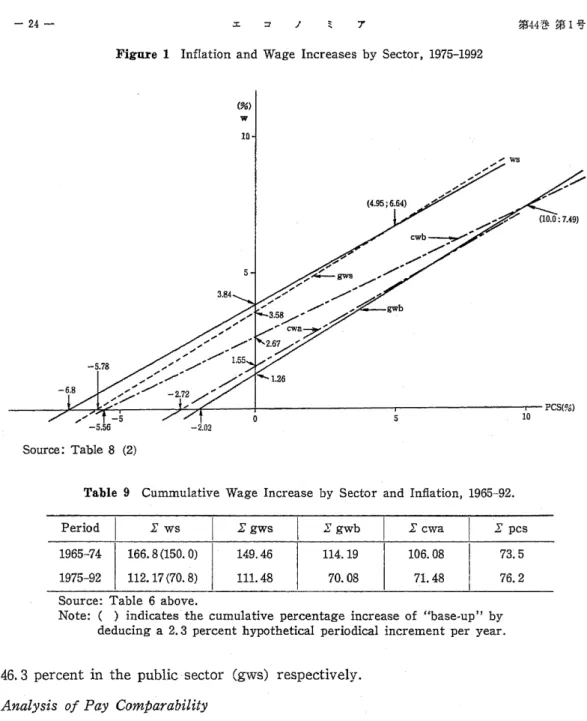
(23) (1993.6). PUBLIC SECTOR INDUSTRIAL RELATIONS IN JAPAN. -. 23-. 1965 and 1974 (Table 8).. In contrast, the rate of wage increase awarded by the arbitration panel of the PCNEL R Commission (gws) was less than ws: a 8.4 percent increase (constant term) when CPI did not rise and an additional O. 8875 percent for each one percent increase of CPr. In the case of NPA, pay recommendation (cwb) which does not include an annual periodical increment, corresponds to so-called "base-up" part of wage increase in the private sector. The annual average periodical increment for national non-industrial civil service is estimated as between 2. 1 and 2.3 percent per year depending upon workforce composition of the.year, Therefore, for the purpose of comparing with wage increase in the private sector (ws) , 2.1 or 2.3 percent should be added to the zero-inflation part of national non-industrial civil service's pay increase (about 3.97 percent). The resultant constant term including annual increment is about 6.07 or 6.27 percent which is far less than the constant term of either ws or gws above. Moreover, the government did not fully accept the recommended pay hikes for national non-industrial civil service. Thus, the actual wage increase for them (cwa) was much less than cwb although the coefficient of inflation induced part of wage increase for them was larger than unity. The relationship between inflation and wage increase was further improved in the second period (1975-92) after the oil crisis. The coefficient of the zero-inflation part of wage increase (i. e. constant term) decreased remarkably in all of the three sectors, and the coefficient of inflation-induced part of wage increase has declined far below in all of ws, gws, gwb, cwb, and cwa. This was shown in the second part of Table 8 and is illustrated in Figure l. It seems quite impressive to note that ws keeps the highest position if the rate of inflation remains below 5 percent and that gws or cwa stays below ws. If the annual periodical increment for national non-industrial civil service is added upon cwa above, the result is almost comparable with W.3, despite the fact that the government froze and cut down recommended pay hikes several times (see Table 6 above). That is to say, pay determination in the public sector (both for industrial and non-industrial) has been non-inflationary as in the private sector, and yet it has kept close comparability with the private sector despite conflicts with the government and resulting frustration on the part of public employee unions. To sum up, the results of wage increase in these three sectors can be compared in the form of cumulative wage increases vis-a-vis cummulative inflation during the two periods (Table 9). In the first period (1965..,.74), the net "base-up" part of wage increase as well as allinclusive wage increase were considerably larger than the cumulative rate of inflation so that real wages almost doubled in both private and public sectors. In contrast, in the second period (1975-92), the "base-up" part fell a little behind inflation in each of the three sectors, but wage increase including periodical increment has increased more than inflation; real wages increased by 47.2 percent in the private sector (ws), and.
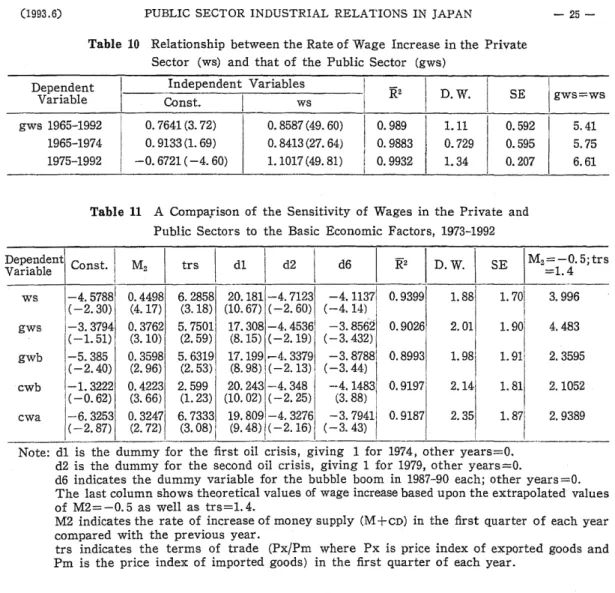
(24) - 24-. /. ,.. Figure 1 Inflation and Wage Increases by Sector, 1975-1992. (%). w 10. gwb. ----:J.<::::.-~~---_.).:.~~--+_---------,--------,r-- PCS(%). 10. -2.02. Source: Table 8 (2) Table 9 Cummulative Wage Increase by Sector and Inflation, 1965-92. Period. I. ~. ws. :E gws. 1: gwb. 1: cwa. :E pes. 1965-74. 166. 8 (150.0). 149.46. 114.19. 106.08. 73.5. 1975-92. 112.17 (70.8). 111.48. 70.08. 71.48. 76.2. Source: Table 6 above. Note: ( ) indicates the cumulative percentage increase of "base-up" by deducing a 2.3 percent hypothetical periodical increment per year.. 46.3 percent in the public sector (gws) respectively. Analysis of Pay Comparability Further analysis shows the extent the rate of wage increase in the public' sector exceeded or kept comparability with that of the private sector. Table 10 indicates the results of a simple regression analysis between ws and gws, Theoretically, gws is considered to follow ws according to the principle of pay comparability. Therefore, in Table 10, gws is explained by ws. Throughout the period (1965-92), gws falls behind ws so far as ws remains below 5.41 percent. This is indicated in the last column of the table (gws =ws) dividing the period into two parts. The ceiling point below which gws remains less than ws moved up from 5. 75 in the first period to 6.61 percent in the second period..
(25) PUBLIC SECTOR INDUSTRIAL RELATIONS IN JAPAN. (1993.6). -. 25-. Table 10 Relationship between the Rate of Wage Increase in the Private Sector (ws) and that of the Public Sector (gws) Independent Variables Const. ws. Dependent Variable. I. gws 1965-1992 1965-1974 1975-1992. I. 0.7641(3.72) 0.9133 (1. 69) -0.6721 ( -4. 60). 0.8587 (49.60) O. 8413(27.64) 1.1017 (49.81). I. R'. I D. W. I. SE. 0.989 0.9883 0.9932. 1.11 0.729 1.34. 0.592 0.595 0.207. Igws=ws 5.41 5.75 6.61. Table 11 A Comparison of the Sensitivity of Wages in the Private and Public Sectors to the Basic Economic Factors, 1973-1992. I. Dependentl C Variable onst. I ws gws gwb cwb cwa. 1-4.5788 (-2.30) -3.3794 (-1. 51) -5.385 (-2.40) -1. 3222 (-0.62) -6.3253 (-2.87). M. 2. 0.4498 (4.17) 0.3762 (3.10) 0.3598 (2.96) 0.4223 (3.66) 0.3247 (2.72). trs 6.2858 (3.18) 5.7501 (2.59) 5.6319 (2.53) 2.599 (1. 23) 6. 7333 (3.08). d1. d2. 20.181 -4.7123 (10.67) (-2.60) 17.308 -4.4536 (8.15) (-2.19) 17.199 ..-4.3379 (8.98) (-2.13) 20.243 -4.348 (10.02) (-2.25) 19.809 -4.3276 (9.48) (-2.16). d6 -4.1137 (-4.14) -3.8562 (-3.432) -3.8788 (-3.44) -4.1483 (3.88) -3.7941 (-3.43). 0.9399. 1.88. 1. 701. 3.996. 0.9026. 2.01. 1. 90. 4.483. 0.8993. 1. 98. 1. 91. 2.3595. 0.9197. 2.141. 1. 81. 2. 1052. 35. 1. 87. 2.9389. 0.9187. 2.. 1. Note: d1 is the dummy for the first oil crisis, giving 1 for 1974, other years=O. d2 is the dummy for the second oil crisis, giving 1 for 1979, other years=O. d6 indicates the dummy variable for the bubble boom in 1987-90 each; other years =0. The last column shows theoretical values of wage increase based upon the extrapolated values of M2= -0. 5 as well as trs=1. 4. M2 indicates the rate of increase of money supply (M+CD) in the first quarter of each year compared with the previous year. trs indicates the terms of trade (Px/Pm where Px is price index of exported goods and Pm is the price index of imported goods) in the first quarter of each year.. A Macro-economic Interpretation of Wage Changes The final problem to be addressed is how and why wage determination in both sectors of the economy has been maintained within a range of reasonable changes in the macroeconomy. The author discovered and has continued to stress that wage changes in major private firms in Japan since the first oil crisis can well be explained by two basic macro-economic indicators: the rate of change of money supply (M2) and the terms of tradeCPx/Pm where Px indicates export prices and Pm import prices). Table 11 shows that changes of ws can be explained by these two variables together with three dummy variables: dummy 1 is the outside shock by the first oil crisis; dummy 2 shows the impact of the second oil crisis; and dummy 3 indicates the impact of the appreciation of yen in the middle of the 1980's. Interstingly, the same specification can be applied to wage changes in the public sector and the estimated results are not so much worse statistically than that for the private sector (ws). Table 11 also implies that under the present macroeconomic conditions.
(26) -. 26-. :::r. /. where the money supply declines by 0.5 percent compared with the same period of the previous year, the rate of wage increase will be reduced in both sectors. The sensitivity of wage increase to money supply is greater in the private sector than in any of the public sectors. Theoretical values based on hypothetical changes of these independent variables (which are in fact very close to the present situation in Japan's economy) are exhibited in the last column of Table 1l. This analysis supports the conclusion that the comparability principle in determining wage increase in Japan's public sector has been working effectively on the whold toward maintaining macro-economic stability in ombination with reasonable wage settlements in the major parts of the private sector. 6.. CAUSES OF INDUSTRIAL PEACE IN J APAN'S PUBLIC SECTOR. Fundamental Social Reforms In conclusion, it is desirableto describe briefly the major causes of industrial peace at the present stage in Japan's public sector. As explained in details in the previous sections, Japan has experienced a considerable degree of turmoil in public sector's industrial relations. However, the following five factors seem to have contributed to overcome these difficulties: (a) Three fundamental social reforms after World War II. Dissolution of Zaibatsu financial complexes, land reform, and labor emancipation provided a solid, basic social structure upon which later economic development was able to take place. (b) Among others, as a part of democratization, class distinction between blue and white collar workers was abolished. Class distinction used to be most conspicuous in the public sector before democratization. (c) As a result of these reforms, income distribution in Japan became very equalized. The Gini coefficient regarding family income in Japan is now one of the lowest among OECD countries. (d) The standard of living has increased considerably during four decades of economic growth from which public employees have also benefited. (e) After a short period of turmoil due to labor emancipation after World War II, discipline among public servants was restored through imposing some limitations on basic rights of public employees whose service were essential for the daily life of the people. This was comparable with restored management prerogatives in the private sector. (f) As a compensation for the limited basic rights of public employees, the National Personnel Authority and the Labor Relations Commission (PCNELRC and afterwards CLRC) were established to protect basic economic. interests of public employees based upon the comparability principle. Despite several difficulties, these neutral institutions have functioned with considerable satisfaction..
(27) (1993.6). PUBLIC SECTOR INDUSTRIAL RELATIONS IN JAPAN. - 27-. Industrial Relations Factors after the Oil Crisis On the basis of these social reforms and achievements, several additional factors consecutively increased industrial peace in the public sector after the first oil crisis: (1) Intensified scarcity consciousness of good job opportunities among employees of large private companies. They are the core workforce privileged by life-time employment and constitute the essential part of enterprise unionism. Due to redundancy after the oil crisis, large companies were obliged to reduce their workforce. The employees there felt threatened by the possible 10s3 of their well-paid job opportunities which made their behavior more cautious and defensive. They became more sensitive to competitive pressures in the marketplace (Koshiro [1983cJ). Such changed mentality among them paved the way to abondoning old-fashioned conflict-prone labor movement and culminated in the Formation of Rengo in 1987. (2) Social ideas as a whole become more conservative reflecting the end of high economic growth as well as changed mentality of private employees stated above. (3) Failure of a 8-day strike' aimed at restoring the right to strike of public employees in November-December 1975 had a detrimental and adverse effect upon public opinion. Public employee unions lost sympathy for their movement and were isolated in society. (4) In the 1977 decision on the Nagoya Central Post Office Case, the Supreme Court turned down its previous decision in 1966 which was rather favourable for public employee unions' industrial actions. In a sense, the 1966 Supreme Court decision ruled that prohibition of acts of disputes by public employees should be confined to such essential public service that was indispensable for the daily life of the people. But, the new decision confirmed the criminal punishability of deliberate hindrance of mail service so that postal workers' acts of disputes should be subject to criminal punishment. Because of this decision by the Supreme Court, postal workers were forced to refrain from committing illegal industrial actions. (5) Private railway. workers' unions used to undertake concerted industrial actions with National Railway Workers' Unions until the middle of the 1970's. But, they changed their strategies for wage negotiation and preferred to settle their wage disputes without strikes or appealing to the Central Labor Relations Commission. This means that public employee unions of JNR and other national enterprises lost their opportunity to take advantage of public opinion that was threatened by the incovinience of losing transportation. Until the middle of the 1970's, the threat of concerted industrial actions by both private and public transportation workers was statistically significant in pushing up wages in the Spring Offensive (Koshiro [1977]). (6) Privitization of NTT and JT in 1985 followed by JR in 1987 dismantled the militancy of public enterprise workers. Unions of NTT and JT prefer to negotiate higher wages by themselves. JR unions prefer to cooperate with management for the purpose of maintaining job opportunities. The unions of four remaining national enterprises do.
図


+6

関連したドキュメント
This means that finding the feasible arrays for distance-regular graphs of valency 4 was reduced to a finite amount of work, but the diameter bounds obtained were not small enough
It is suggested by our method that most of the quadratic algebras for all St¨ ackel equivalence classes of 3D second order quantum superintegrable systems on conformally flat
[11] Karsai J., On the asymptotic behaviour of solution of second order linear differential equations with small damping, Acta Math. 61
Hong: Asymptotic behavior for minimizers of a Ginzburg-Landau type functional in higher dimensions associated with n-harmonic maps, Adv. Yuan: Radial minimizers of a
This paper develops a recursion formula for the conditional moments of the area under the absolute value of Brownian bridge given the local time at 0.. The method of power series
Answering a question of de la Harpe and Bridson in the Kourovka Notebook, we build the explicit embeddings of the additive group of rational numbers Q in a finitely generated group
Then it follows immediately from a suitable version of “Hensel’s Lemma” [cf., e.g., the argument of [4], Lemma 2.1] that S may be obtained, as the notation suggests, as the m A
In our previous paper [Ban1], we explicitly calculated the p-adic polylogarithm sheaf on the projective line minus three points, and calculated its specializa- tions to the d-th
