The Application of Risk Management
in Processing Trade Supervision of China Customs
by
Tao Wei
A thesis
submitted to the Ritsumeikan Asia Pacific University
in partial fulfillment of the
requirements for the degree of
Master of Business Administration
Beppu, Oita, Japan, 2011 © Tao Wei 2011
Author‟s Declaration
I hereby declare that I am the sole author of this thesis. This is a true copy of the thesis, including any required final revisions, as accepted by my examiners.
Table of Contents List of Tables…... vi Abstract…...vii Acknowledgements...ix CHAPTER 1………..1 RESEARCH BACKGROUND………....1
1.1.1 DEVELOPMENT OF PROCESSING TRADE………..1
1.1.2 CURRENT RISK OF PROCESSING TRADE SUPERVISION………7
1.1.3 THE APPLICATION OF RISK MANAGEMENT IN PROCESSING TRADE SUPERVISION………12
1.2 PURPOSE STATEMENT………..16
1.3 RESEARCH OBJECTIVES………..16
CHAPTER 2……….18
LITERATURE REVIEW……….18
2.1 THE STUDY ON RESEARCH VALUE OF PROCESSING TRADE………….18
2.2 RESRACH ON SUPERVISION OF PROCESSING TRADE………..23
2.3. RISK MANAGEMENT OF PROCESSING TRADE SUPERVISION………...28
CHAPTER 3……….36
RESEARCH METHODS……….36
3.1 METHODOLOGY……….36
3.2 STATEMENT OF METHODOLOGY………..36
3.3 POPULATION AND SAMPLE………40
3.4 DATA ANALYSIS………41
3.5 LIMITATION OF THE STUDY………...41
CHAPTER 4……….43
RESEARCH FINDINGS ………43
4.1. ANALYSIS OF SMUGGLING CASES………..………43
4.2 ANALYSIS OF QUESTIONAIRE AND INTERVIEW TO PROCESSING TRADE COMPANIES………..46
4.3 ANALYSIS OF THE INTERVIEW TO CUSTOMS INTERNAL DEPARTMENT……….50
4.4 SUMMARY………...56
CHAPTER 5……….58
MODEL FORMULATION………..58
5.1 INTRODUCTION OF RESEARCH OBJECTIVES……….58
5.2 MODEL OF EARLY WARNING MECHANISM………...59
5.3.1 BUSINESS DETAIL ANALYSIS………..63
5.3.1.1 SOLVENCY……….63
5.3.1.2 PROFITABILITY………69
5.3.1.3 STABILITY……….73
5.3.2 BUSINESS TREND ANALYSIS………...77
5.3.2.1 DEVELOPMENT AND SURVIVE ABILITY ANALYSIS………..78
5.3.2.2 ASSETS OPERATING ANALYSIS………...80
5.4 FLOW OF EARLY WARNING MECHANISM………..82
5.5 VALIDATION TEST………87
5.5.1 TEST………...88
5.5.2 LIMITATION OF THE TEST………92
5.5.3 VALIDATION RESULT.………..92
CHAPTER 6……….94
List of Tables
Table 1 Types of Smuggling Activities Arose from Smuggling Case Analysis……..44
Table 2 Smuggling Methods Analysis……….45
Table 3 Results of Questionnaire……….47
Table 4 Solvency Analysis………...64
Table 5 Profitability Analysis………..69
Table 6 Stability Analysis………74
Table 7 Validation Test………89
Abstract
This study establishes an initial understanding of the application of risk management in processing trade supervision of China Customs. Two specific objectives are fulfilled; (a) to find and analyze the risk of processing trade supervision from customs point of view, and (b) to establish an early- warning mechanism to manage the risk of customs supervision in the intermediate period of processing trade activities.
Processing trade constitutes a high proportion in foreign trade in China. Since processing trade activity has closely relationship with tax revenue and customs supervision, customs supervision of processing trade is really important for the prevention of tax fraud and prevention of smuggling activities.
A literature review identifies the current state of processing trade in China and the main risk of processing trade supervision. Smuggling case analysis, interview to customs officials and questionnaire to processing trade companies identify the main problems of processing trade supervision in intermediate period in recent years and how these problems shows up.
The results indicate that the main risk in processing trade supervision is the unfeasibility of customs real time monitoring to processing trade companies, which include: 1.customs real time monitoring to the business condition of processing trade
companies cannot be conducted; 2.customs real time monitoring to the inventory condition of processing trade companies cannot be conducted.
Based on the research findings, this paper establishes an early- warning mechanism using financial analysis, which is composed of business trend analysis and business detail analysis. This early- warning mechanism is highly expected to act on the business condition of processing trade companies, and the results of test to the validation for this early-warning mechanism show that it is workable.
Acknowledgements
It is with respect and gratitude that I would like to thank my research advisor, Professor OTAKE Toshitsugu, who spent many time, provided many guidance and gave a lots of support throughout the writing of the thesis.
Many thanks to the committee members, Professors Zhang Wei-Bin, ASGARI Behrooz and Suzuki Kanichiro who offered invaluable guidance to this thesis. .
I would like to take this opportunity to thank my colleagues at Guangzhou Customs who help me to distribute the questionnaires, arrange interview and collect feedbacks.
Deep appreciation is expressed to all of the participants who took part in the interview.
Finally, I would like to thank my family for their understanding and support, and for the encouragement given in order to complete this thesis.
CHAPTER 1
Research Background
This chapter describes the development of processing trade in China and current risk of processing trade supervision from customs point of view. As mentioned in the abstract, the purpose of this research is to establish an initial understanding of the application of risk management in processing trade supervision of China customs. Based on the analysis, the research is expected to establish an early-warning mechanism to manage the risk of customs supervision in the intermediate period of processing trade activities.
1.1.1 Development of Processing Trade
Because the processing trade is based on the operation of the storage, processing and assembling and related to customs‟ supervision policies and tax preference from the very beginning, whenever the processing trade is discussed either from academic point of view or from government supervision point of view, processing trade is such kind of trade supervised by customs and recorded especially. Also we can see in this sense that customs processing trade supervision is the key characteristic of processing trade activities. In order to enlarge foreign trade and abstract foreign merchant
investment in the condition of high tariff restrictions and non-tariff barriers, the materials imported in the form of customer's processed materials or imported
processed materials are supervised by the customs in the way of bonded supervision in China.
According to “Administer Method of Processing Trade Approval and Administration” issued by General Administration of China Customs, processing trade is such kind of activities which companies import the whole or part of materials, components and parts and wrapping materials in the way of processing trade and export the products made by the materials imported after processing and assembling in China.
Processing trade activities are composed of operation of customer‟s processed materials and operation of imported processed materials. Operation of customer‟s processed materials is that foreign customer provides materials, components and parts and wrapping materials to Chinese company, ask Chinese company to proceed
according to the required format, quantity and technical standard and pay for Chinese company the processing fees. The foreign customer sells the products itself.
Sometimes foreign customer provides not only materials, components and parts and wrapping materials but also machines, instruments, tools, moulds and packing equipments, whose price will be deducted from the processing fees. It is quite common that the foreign trade department of China makes processing or assembling contracts with foreign customers and transfers to Chinese companies like a trade agent. Operation of imported processed materials is that Chinese company imports materials, components and parts and wrapping materials according to its plan or the market
demanding and exports the products to foreign customers. The price difference between exported products and imported materials, components and parts and
wrapping materials, is the profit. Operation of imported processed materials started in Chin during the development process of operation of customer‟s processed materials and foreign investment. According to “Provision of Encouraging Foreign Investment” (General Customs Administration, 1986) and “Administer Method of Import, Export and Taxation of Foreign Investment Enterprises” (General Customs Administration, 1992), the subject of operation of imported processed materials is foreign investment enterprises.
Since 1970s, export processing zones has become popular all over the world. Actually export processing zones have many advantages which could give full play to labor, land and resources advantage, such as good infrastructure, preferential policy and advanced management experience and so on. Asia's "four little dragons", which were Singapore, Korea, Hong Kong and Taiwan, and the developing countries in South America and Africa were attracting foreign investment by taking the advantage of their labor markets. Setting up many export processing zones was the main method to develop foreign trade in these countries. Till the World Processing and Export
Conference at Manila in March 1978 there were 33 countries and districts who have export processing zones. Moreover some developed countries also established export processing zones to attract foreign investment and develop poor areas.
Since this kind of processing model was suitable to developing countries at that time, China also started to develop processing trade referring to other countries‟ experience and combine with self-practical condition. Processing trade grew up rapidly since 1980s in China. The export money amount of processing trade was 1.6 billion dollars in 1981 and increased by19.8 billion dollars in 1989 (Bin Bai, 2004). The growth speed was nearly 45% annually which was much bigger than the growth speed of total export money amount. The proportion of processing trade export is increasing
because of the development of processing trade. Now the processing trade becomes one of the most important foreign trade methods. The development mentioned above can be proved by the following figures: The import money amount of processing trade was 6.7 billion dollars and the export money amount of processing trade was 0.62 billion dollars in 1986. However these two figures were 93.97 billion dollars and 147.43 billion dollars in 2001, which increased 14 times and 26.2 times comparing with 1986‟s (General Customs Administration, 2001). In the year 1986 processing trade import accounted for 15.6% of total national import and processing trade export accounted for 18.2% of total national export. However these two figures increased to 41.4% and 55.3% in 2002 (Bin Bai, 2004).
Processing trade centralizes in eastern of China at present, especially in Guangdong province and Fujian province. Comparing with the development of processing trade in other area of China, processing trade in the eastern of China has many advantages for capital, human resource, technology and management. Even though being dominant
in China processing trade, the processing trade in the eastern part of China started upgrading of an industry structure. Now the added value and technology of processing trade products in the eastern part of China is increasing which promotes the
development of infrastructure, logistic, communication and finance. Because of the development of processing trade, the supporting industries grow rapidly. However, in the other area of China, the development of processing trade is still quite low because of the natural condition and poor economics. Even comparing the scale of single processing trade activity, processing trade activity in the eastern part of China is much bigger than in other area. In the year 2002, the proportion of processing trade in Sichuan province, where the processing trade has the highest growth in the middle part and the western part of China, was only 1/96 of the proportion of processing trade in Guangdong province. The growth of processing trade in middle and western of China is so slow that in some area the processing trade has negative growth.
At early stage, textiles, clothing, toys and shoes and hats were the main processing trade products. Because more and more foreign investor came into China to do processing trade, the percentage of mechanical and electrical products in all the processing trade products was increasing. In 1995 the export amount of mechanical and electrical products exceeded the export amount of textiles and became the No. one export product. In 2001, the money amount of processing trade export of mechanical and electrical was 88.27 billion dollars, which took 60% of the total money amount of processing trade export in that year and 74.3% of the total export of
mechanical and electrical products (General Customs Administration, 2001). The export of computer, communication equipment and audio-video equipment is quite important in all the processing trade export, which could not only improve the grade of China‟s export products but also change the product mix greatly.
65% of processing trade imports in China are from the neighboring countries and areas, such as Japan, Taiwan, Association of South East Asian Nations and Korea. Chinese main processing trade products are exported to America, Japan and Europe, which aggregate to 56.2% of total China‟s processing trade export. China has a huge market with big potential and wide prospect. There are abundant labor resource, low-cost land and series of preferential processing trade policies to encourage the processing trade export issued by the government, that‟s why China become the best place to transfer the labor-intensive industries of the mentioned countries. However unitary trade partners extensively affected the economics and foreign trade of related areas and industries. America and EU initiated many anti-dumping investigations to China concerning household electrical appliances, clothing and chemical products and so on, which caused many trade frictions between the mentioned countries and China. And meanwhile because of the unique feature of processing trade, the huge amount import of cheap materials deeply preclude the development of relative domestic industry, such as cotton planting, textile, oil industry and mental industry.
1.1.2 Current Risk of Processing Trade Supervision
Because of the unique feature of tax free, most of the smuggling activities are against processing trade activities and it seems to become more and more popular though the customs is placing more important on processing trade supervision. With the
development of processing trade activities in recent years, the number of type and money amount of processing trade activities increased a lot. Meanwhile, processing trade activities are becoming more and more diversify and complex. Compared with the diversity and complexity of processing trade activities, resources of customs processing trade supervision are quite limited which make the customs processing trade supervision become risky.
First of all, customs supervision of deeper processing activities is becoming more and more risky. According to the statistics from 2003 to 2005, the total money amount of import and export of deeper processing transferring in Guangzhou customs rose by 12.5%, 26.6% and 16.6% respectively. With the increase of deeper processing
transferring, supervision risk of deeper processing transferring was increasing. In the recent 3 years, the smuggling cases clamped down on deeper processing transferring take the percentage of more than 50% in all the smuggling cases clamped. Customs supervision in deeper processing is still poor even now.
companies take 60%-70% of all the companies doing foreign trade in Guangzhou customs. The lack of supervision resources and old pattern of supervision leave a gap for the smuggling activities. More and more smuggling activities of unpriced
equipment were clamped down and appropriating, sell, transferring, lower price quoting were quite popular in smuggling activities of unpriced equipment. It seems that improving customs supervision of unpriced equipment is quite emergent.
The third risk, which always exists, is the unit cost management. According to the principle of unit cost management and “Customs Law”, customs‟ unit cost
management should be based on the objective writing-off, which means that the judgment of unit cost provided by processing trade companies could be not only based on the unit cost database but also based on the practical situation of processing trade companies. However at present the situation is that there are more than 100000 processing trade companies and the number is still increasing, but the processing trade supervisors are less than 3000. Because of the limitation of supervising human
resource, objective writing-off is impossible. Even if the judgment of unit cost based on the unit cost database is accurate enough, this method still cannot meet the demand of practical unit cost management. For example, because the change of processing trade activities from simple processing to high value-added processing, processing trade activities became more and more diversity, which causes either there is no unit cost information in the unit cost database at all or the unit cost information in the unit cost database could not be updated in time to meet the demand of practical unit cost
management. If such unit cost database is used for unit cost management, it will destroy the principle of unit cost management. Moreover, the judgment of unit cost runs through the producing process. The differences between companies and between products make unit cost management difficult. Limited product knowledge is also an obstacle of unit cost management. Some companies are taking advantage of this loophole, lying about actual unit cost and making money by selling the entrapped processing trade materials.
Fourth, because of the limitation of processing trade supervision human resource, the actual inspection rate of import processing trade materials is barely 10% and the inspection rate of export processing trade goods is only 5%, which is even worse. Instead of preventing smuggling activities, the low inspection rate is becoming the driving force of smuggling activities. Based on the case analysis, taking the advantage of low inspection rate and inadequate supervision coverage is becoming the main smuggling method, such as concealing and fraudulent statement.
Fifth, there are many system risks which exist all the time:
1. The record-keeping period of processing trade activities is a kind of virtual and planned supervision. Under this kind of supervision model, it is really hard to normalize the processing trade activities and eliminate the possibility of smuggling activities from the very beginning. And also the length of supervision period is another obstacle.
2. The unit cost of processing trade production is hard to be measured. Because of the diversity and variability of processing trade goods, there are no unit cost standards for many processing trade goods in the unit cost database. For these processing trade goods, combining the declaration of processing trade companies and experience of customs officials themselves is the main method to identify the unit cost. Obviously this method is objective and risk, which is hard to minimize the opportunities and incentives of smuggling activities.
3. Issue of processing trade handbook is arbitrary. Since the financial condition and production of processing trade companies always change, processing trade
supervision department of customs may not sufficiently make an evaluation of processing trade companies before issuing the processing trade handbook. Therefore it is quite possible that some companies who are not fully qualified may obtain the processing trade handbook.
4. Deeper processing transferring supervision is not effective. At present documents approval of customs is the main supervision method to deeper processing transferring. This kind of supervision method lacks the identification of the amount and quality of practical deeper processing transferring goods, which may be taken advantage by smuggling companies to do deeper processing transferring fraud.
5. According to statistics, physical inspection is supposed to be the most effective method to track down smuggling activities. However, because of the limited human resource of customs processing trade supervision, physical inspection during the writing-off period can not be conducted to needed the processing trade companies.
This to a certain extent limits the tracking down and prevention of smuggling activities.
Sixth, the relative legislation is retardant. With the development of processing trade, the smuggling activities against processing trade are also becoming more variable. However the relative laws and provisions are not modified correspondingly and no new laws or provisions are issued against the new smuggling activities. As a result of retardant legislation, many smuggling activities could not be judged correctly or probably after tracked down, even if the evidence is conclusive. For instance, some processing trade companies smuggled processing trade materials and was tracked down by customs, but it was the employee of customs clearance department of this company who smuggled processing trade materials in the name of company. Therefore the company was not willing to response for this and indeed there is not such law or provision covering this situation. So the result was that only the employee was held responsible. Now smuggling activities by taking advantage of legislation loopholes is becoming a serious problem in customs supervision.
Seventh, customs declarer management is still weak. Customs declarer likes a bridge between customs and company who response for pass by the supervision information from customs to the governors of companies so that the necessary decision could be made to cooperate with customs supervision. But actually the quality of customs declarer is poor and that‟s why the case I mentioned above could happen. Customs
declarer management is expected to improve the quality of customs declarer so that customs declarer could really be helpful to customs processing trade supervision, or at least could not be the obstacle of customs processing trade supervision.
Eighth, cooperation between customs and other government departments is not as well as expected. There are many government departments who also have relationship with processing trade approval. But the fact is that only customs response for the processing trade supervision. The cooperation between customs and other government departments doesn‟t work well in the processing trade supervision, which still need to be improved so that a supervision situation could appear to instruct the correct
processing trade activities.
1.1.3 The Application of Risk Management in Processing Trade Supervision
In 1990s, economic globalization developed faster and faster. The growth of foreign trade was nearly two times faster than the growth of economics in worldwide because the foreign investment, which distributed resources all over the world, was becoming the driver of world economic growth. For example, in 1960s, the ratio of worldwide import and export to worldwide GDP was 25.4%, which rose up to 27.9% in 1970s and 38.7% in 1990s, and reached to 45% in 2003. According to the forecast of growth of worldwide economics and trade by World Bank, the ratio of worldwide import and export to worldwide GDP will increase to more than 60% in 2015.
During the process of such large-scale transaction of money and goods, it is quite sure that such activities which break the law will also exist. This kind of situation makes the customs supervision more difficult. Customs supervision encounters a dilemma: on one hand, foreign trade supervision and preventing smuggling activities are the duty of customs. Customs delinquency will led to the damage of national security and economics, and also negative effect of public advantages; on the other hand, rambling and pointless supervision will not only waste the supervision resource and lower the efficiency but also block the normal production and transaction of enterprises, which will cause huge economic loss and even negative effect to national foreign trade and economic development. The contradiction between Serving the national foreign trade and preventing the smuggling activities makes customs move ahead with plans for innovation of previous customs administration model so that the new one could suitable for the development of economics.
Therefore, from 1990s some developed countries such as America, Holland and Australia and so on acted as pioneers in introducing the idea and methodology of risk management into the issue and implementation of national customs development strategy to solve the contradiction above mentioned. At the same time, World
Customs Organization (WCO) also considered the concept of risk management when the “Kyoto Convention” was modified and finally used risk management as a concrete measure to simplify and adjust customs procedure. Asia-Pacific Economic
Co-operation (APEC), however, put risk management into the collective actions plan of all membership customs. Also there were many countries considered risk
management as the important driving force of national customs development and because of this a trend of customs management innovation and introducing risk management into customs management appeared in all over the world. Based on the information technology and risk management system, risk management is now used to forecast, analyze and evaluate the potential risk of customs clearance supervision. According to the risk management, managed objects are divided into four categories based on the risky degree. And also risk management is expected to rationally allocate the limited customs supervision resources. In conclusion, now risk management has become the best choice for customs to cope with the new situation and solve the problems.
In China, according to the latest “Framework Program of Establishing Customs Risk Management System”, customs risk management is defined as “a scientific
management method by which customs could recognize, identify, analyze and control the risk formed during the customs management, collect and sum up the possibility and damage of all kinds of customs risk, use modern electronic management method to deal with the risk so that the security and return could be maximized”(Framework Program of Establishing Customs Risk Management System, 2002). Customs risk management could not only use systematic and scientific method to analyze the potential return from certain risk prevention program and try to find the best
combination of various programs, but also identify and measure the potential risk and the damage caused and therefore provide suggestion and recommendation to customs risk management. Besides this, customs risk management is a comprehensive risk prevention method, which could manage the risk by taking the advantages of different risk warning and risk control methods. The substance of customs risk management is to manage risk from a strategic altitude.
The application of risk management in processing trade supervision is very popular now. but still there are some problems.
There is a misunderstanding of risk management in processing trade supervision that risk management in processing trade supervision is just a kind of tool and the process of developing tools, such as database and information system, is risk management. Actually as mentioned above, risk management in processing trade supervision should be a system which manages customs problems with the thought of risk management so that the optimum allocation of management resource could be achieved. Risk management in processing trade supervision not only include database and
information system, but also include the systematic thought of risk management in processing trade supervision, the method to populate the thought, the working mechanism which could embody the idea of risk management in processing trade supervision, and related risk management procedures.
From the mechanism aspect, risk management in processing trade supervision should not be the single units which located in the different department. Therefore, risk management in processing trade supervision should be a unifying system which covers the whole processing trade supervision of customs but not only single customs department.
1.2 Purpose Statement
The purpose of this research is to establish an initial understanding of the application of risk management in processing trade supervision of China customs. In addition to the general goal, Two specific objectives were fulfilled; (a) to find and analyze the risk of processing trade supervision from customs point of view, and (b) to establish an early-warning mechanism to manage the risk of customs supervision in the intermediate period of processing trade activities.
1.3 Research Objectives
Based on the research of weakness and their reasons of customs supervision in intermediate period of processing trade activities, the research is expected to establish an early-warning mechanism to manage the risk of customs supervision in the intermediate period of processing trade activities.
In conclusion, this chapter has provided a brief summary of the development of processing trade in China, and the application of risk management in China customs, especially in processing trade supervision aspect. Because the processing trade is a unique trade model, it is quite necessary for a greater understanding of the mechanism of the trade model and the main characteristics of processing trade activities that may help the future development of policies and customs supervision provisions.
Chapter 2 will show us the literature tools which were used to direct this paper. The literature review provides greater understanding and research direction in regards to the public consciousness of processing trade activities in China.
CHAPTER 2
Literature Review
There are three sections in the literature review. The first is an overall view of the processing trade activities in China, including the development of processing trade activities and the mainly research regarding processing trade. The second is customs supervision of processing trade. In this section the current supervision weakness and some suggestion of improvement will be discussed. The last section offers an in depth discussion of risk management of processing trade supervision.
2.1 The Study on Research Value of Processing Trade
At present, there are several opinions of the development of local processing trade in China. One of them argues that the profit of processing trade is limited, and this trade could raise the problems such as trade friction, carry-over smuggler and normal trade extrusion, moreover, this trade even can lead to lack of technology innovation, which may influence development of China economy in the long run (Kelin, YE, 2001). Thus, it is proposed that China economy should adopt the exploitation ideology model (Rui, Li,2005), which means that China should abandon processing trade and choosing the way of “Smile Curve” instead. “Smile Curve” means that on one hand, China should focus on technology innovation and brand strategy; One the other hand, based on the capacity of China market, large corporation, which should control the
core technology, should be established. Meanwhile, both the tertiary- industry which is high-tech industry and the service trade need to be vigorous developed. In addition, this argument is also comment the problem rising by processing trade from many aspects, such as: added value of products; the utilization of local recourses; comparative advantage; competitive strength of domestic products and the scarcity of national brand.
One of the remarkable features of processing trade is material processing. It is understood that the processing trade in China focuses on producing and processing. “The materials used in the producing and processing are main imported from foreign markets. The utilization ratio of domestic materials is fairly low” (Yanan Wang, 2006). This situation is bad for the development of domestic industry and the achievement of boasting industry upgrade, which will be an obstacle of the implementation of the policy that taking advantage of processing trade to promote the growth of upstream and downstream.
The products exported in the way of processing trade are normally cheaper than the products exported in the way of normal trade, which is becoming the main reason why Chinese products often encounter trade frictions. Weiqing Ling (2006) pointed that “most processing trade companies are high-tech production companies who are engaged mainly in OEM (Original Equipment Manufacturing) Business without playing an active role in the proliferation of the market. They only participate in
international division of labor in producing process but seldom participate in product design, sales and service process. That‟s the main source of lower price”.
Some people also believe that the processing trade not only changes the situation of China international trade negatively, but also slows done the domestic economic growth. Processing trade has shorter domestic industrial chain than international industrial chain, and lower incremental rate. “Processing trade will cause the deficiency of domestic manufacturing supplies & services, and the long-term development have revealed sign of insufficient reserve force” (Rui Zhang, 2006). Actually there are some problems which will restrict the extension of processing trade industrial chain: first, human resource is deficiency; second, core competency of domestic products is lower; third, core patent, technology and own brand are deficiency.
Actually processing trade indeed has some deficiency, but in some places the local government issuing some polices which are not helpful for the development of processing trade also affect the improvement of processing trade, such as the limitation in labor resources and power resources. In some district where the processing trade is prospect the supplement of labor and power are quite limited not only because of the nature deficiency but mostly because of the polices. Chunhui Ma pointed that “some of current processing trade policies should be changed to guarantee the smooth and healthy development of processing trade”.
The other opinions is that although the problems which mentioned above are indeed existing, the quickly development of processing trade is an important impulse power for both the national economy and the growth of external trade. In fact, processing trade is one of most important force for increasing the trade of China. It not only attracts foreign capitals but also relieves the pressure of unemployment in some extent. Meanwhile, it directly spurs resource putting into manufacturing, promotes China‟s industrialization and continues the movement of international industries.
Guoqiang Long (2003) pointed that “processing trade is one of the most important method for China to participate in international division in the circumstance of internationality”. Promoted by the development of processing trade, materials are directly put into manufacturing industry, which develops the manufacturing with great international competence and promotes the industry upgrade of China economy. The appearance of lots of new products and new technology promotes the development of emerging manufacturing. Spill-over effect between technology of processing trade and management is the key factor of the companies‟ technology development and industry upgrade. Moreover, “processing trade improved the contracture of China international trade and laid the foundation of Chinese world famous companies with self-renovation capability” (Xiaoying Liu, 2008).
that “there is a consistency in the trend and conclusive changes for the period between the development of processing trade and the change of industry structure. Considering the promoting function of foreign investment in capital, technology and market of processing trade activities, it is quite sure that foreign investment and the development of processing trade have a positive impact on China‟s industry upgrade”(Qing Wang, 2003 ).
Yuliang, Shen, Churen, Sun and Xueling, Ling(2007) maintained that the cost and feasibility of promotion of processing trade are de termined by the multinational corporation‟s capability of charging value chain which processing trade is located on. When the developing countries make the transition and promotion of processing trade, it is suggested that they should search and develop the industry which located on the value chains which are little controlled by multinational corporations or do not modeled yet. Zhong Zhang (2006) indicates there is a positive relation between the increase of import and export of processing trade and the growing of China economy. Either the share occupied in GDP growth or pull for economy growth is proved the importance of processing trade.
Also there are many other viewpoints about the positive impact of processing trade. Wang Yong and Zhao Bo (2006) indicated the promotion of processing trade to the growth of economics from the angle of foreign exchange income, job opportunity supplement and attracting foreign capital. Xiaochen Zhao (2006) pointed that the
development of processing trade could change the structure of exported goods by technical diffusion and technology spillover.
From the literature review we can see processing trade is very important to the economic growth, reform and opening-up and industrialization. But upgrade of processing trade is also necessary because of many current problems such as the entry barrier of processing trade is low and the development of processing trade is unbalanced in terms of regional distribution.
2.2 Research on Supervision of Processing Trade
During these thirty years, processing trade supervision was conducted by both Customs and Foreign Trade Department. After foreign trade department approval processing trade companies‟ foreign trade contract, customs issues processing trade handbook based on the comments of foreign trade department. However, the quick change of market circumstances in the 21 century, such as the development of the information technology in management, sale internalization, product individuation and delivery rapidness, all indicate that the approval procedure of processing trade activities shown above cannot satisfy with the demand of market and business itself.
Closely following the change of global market and customers‟ demand, production moving in the new direction of enlarged scale and collectivization are the essential
ability of enterprise in market system. Changing the mind that their products are going to serve the global market but not only single customer is the first step of globalization. Therefore “it becomes quite common that when company begins to import materials and arrange production there may be no neither exact customers nor export contracts” (Qing Lin, 2007). The problem is that according to processing trade provision, processing trade handbook could be only issued after processing trade company made export contract with customers. So many processing trade companies have no choices but to make some virtual export contract.
Processing trade handbook administration not only restricts the business development of processing trade companies but also is a limitation of rational distribution of resources. One processing trade company is a single unit with variable function, such as producing, operation and import and export. But the processing trade handbook administration, which is a snap- in management according to the contract, breaks up the whole company into parts and make the company‟s integral business operation become hard to realize. The unreasonable division of processing trade handbook makes the amount of materials used for exported products be harder than amount of import materials recorded on the processing trade handbook, which will definitely cause that another processing trade hand book cannot be written off because of the variance between actual inventories of processing trade materials and theoretic amount in the processing trade handbooks. In this condition, processing trade companies have no other choices but to put most attention to match up actual
inventories of processing trade materials and theoretic amount in the processing trade handbooks meanwhile the normal production and export sho uld also be operated. “From customs supervision point of view, this point-to-point batch supervision actually is supervision blank or risk of processing trade supervision” (Dai Jia, 2007).
With the development of processing trade, in order to meet market demand, processing trade companies have to constantly upgrading their products, and therefore their business cycles are becoming shorter and shorter, bringing the increasing numbers application of contract changes which even more than the amount of new handbook application. For example, there were more than 60000 processing trade handbooks in 2004 in Guangzhou Customs, which included nearly 50000 changed processing trade handbooks. Variability of products and more and more detailed and high-tech processing procedures has become a trend of the development of processing trade activities. So relying on manual paper management, customs‟ document work was doubled in facing the managing requirement of standardization and stringent. Most of the supervision resources are depleted on the paper approval, paper issuing, stamping, calculation and data collection so that the development of processing technology can hardly be well known and few time can be spend on supervision in the intermediate period of processing trad e activities and practical inspection. It seems that customs processing trade supervision in intermediate period of processing trade supervision, which is taking more and more percentages of whole customs processing trade supervision, is becoming less and less important.
Weak supervision directly results the decrease of supervision power. From the year 2003 to 2008, the total money amount of processing trade import and export in Guangzhou customs increased from 20.7 billion RMB to 72 billion RMB. In these five years, 6 customs specially supervised districts, 47 supervision branches, 79 bonded storage, 6000 processing trade companies and more than 80000 processing trade handbooks were added. Compared with the increase of supervision demand, the amount of processing trade supervisors only increased 3.7% annually. In 2008, there were only about 300 processing trade supervisors in Guangzhou customs, which means that the average supervising money amount of processing trade was more than 240 million RMB. However, only about 50 processing trade supervisors were in charge of the supervision in intermediate period of processing trade activities. Compared with more than 7000 processing trade companies, each processing trade supervisor was in charge of more than 140 processing trade companies. The contradiction between the limitation of processing trade supervision resources and increasing processing trade supervising demand makes the strictness of processing trade supervision is more than reasonable and become risky and risky. According to investigation the amount of total scale of processing trade, processing trade companies and related people in China are much higher than in foreign developed countries, but related customs supervisors are only 1/5 of what in developed countries. Li Li (2009) pointed that the deficiency of supervision resources will lead to poor supervision of processing trade goods and processing trade companies, inefficient
monitoring of products‟ producing process and imperfect improvement of inspection and statistics systems. This is the main reason of lower quality of customs supervision.
Mingfeng Jin, Ming Chen and Qinghua Zhan (2003) pointed the necessity, possibility and advantage of using processing trade company as basic managing unit. They believed that “the change of supervision model is the basement of innovation of processing trade supervision in China”. Actually others also suggested that using “company handbook” to instead of current “contract handbook”. Xiaoming Wang (2004) indicated that “”company handbook” costs less than “contract handbook” and is easy to be conducted, which will be helpful to reverse the passive situation of current processing trade supervision, relocate management resources and improve practical supervision”.
Another viewpoint about system innovation of processing trade supervision is the networking reform. Compared with the system innovation of customs clearance, system innovation of processing trade supervision is relatively lagged, which has become the weakness of customs supervision and obstacle of establishing modern time customs system. In the condition that processing trade is becoming more and more important and national economy is becoming globalized, state polices and systems are gradually adjusted and improved. System innovation of processing trade seems to be more necessary and urgent. “Networking reform is the fundamental way
of achieving efficiency and effectiveness of customs administration” (Wang Tan, 2006).
2.3 Risk Management of Processing Trade Supervision
It is really necessary to reform the customs processing trade supervision because of the reasons mentioned above, one of the solutions of which is to in-depth introducing risk management in customs supervision of processing trade activities. From 2000 the analysis of the main five risk assessment of processing trade supervision had been conducted and finally the conclusion of risk degree of processing trade supervision was drawn. Genlong Chen (2005) pointed that “according to the qualitative analysis of risk degree of processing trade supervision, risk control is a basic measure, such as risk orientated system innovation of processing trade supervision”. From 1990s some developed countries such as America, Holland and Australia and so on acted as pioneers in introducing the idea and methodology of risk management into the issue and implementation of national customs development strategy, and had made the remarkable result.
A popular viewpoint says that compared with risk management in other period of processing trade supervision, risk management of processing trade supervision in the record-keeping period is most important, since processing trade supervision in the record-keeping period is a kind of forehead administration which could prevent the
tax fraud. (Yan Huanong, 2007)
In record-keeping period of processing trade supervision, subject to
company-examine controlling the total amount of contract recorded is supposed to be an effective way. Yongqing Li (2009) suggested using database technology to
integrate the information in H2000 system such as the amount of processing trade handbook, information of customs clearance and record-keeping information of processing trade company. Xia Wang (2009) indicated that based on the database, business-related risk parameters could be set so that according to processing trade data collected annually or monthly the risk analysis could be conducted. It is universally acknowledged that following risk parameters and information are quite helpful to risk analysis: total money amount of export in the last year, amount of total existing processing trade handbooks, remaining export amount of existing processing trade handbooks, total money amount of import and export of processing trade handbooks, the proportion between import and export of processing trade handbooks, value of remaining processing trade materials of processing trade handbooks, related tax of remaining processing trade materials of processing trade handbooks, processing trade company‟s customs‟ category, registered capital and years of processing trade activities and so on. Ying Liu (2009) pointed that customs supervision of exceeding processing capacity will firstly benefit from the risk parameters and risk analysis. For example, risk management department could use contract test to select processing trade companies whose remain processing trade materials are more than the industry‟s
reasonable inventories, whose remain export amount of processing trade handbooks are larger than the exported amount in last year and whose proportion between import and export are quite unreasonable, to conduct practical inspection so that exceeding processing capacity could be prevented forehead.
Another viewpoint agrees to improve the risk management of processing trade activities in the intermediate period. Liu dan (2009) said “Since the validity of processing trade handbook is quite long and there will be many processing trade handbooks at same time for one company, it is quite difficult for customs supervision because of the lack of supervision resources. And moreover the poor customs
supervision will deeply affect the customs taxation and writing-off of handbooks”. So in order to maximize the function of limited supervision resource, changing the original “human supervision” to the “data supervision” is an effective way, which means the customs supervision will completely base on the processing trade data analysis of processing trade companies. After the data analysis of processing trade companies, customs could only target to the processing trade companies whose data are unreasonable to conduct practical inspection. For example, normally there are at most two months between processing trade materials were imported at the first time and products were exported at the first time. So if there are some companies who have not exported products three months later than the first time processing trade materials were imported, this company should be practically inspected.
Li Sun (2008) suggested that risk management of processing trade activities in the intermediate period should use processing trade company as basic managing unit. “Based on the data monthly collected from H2000 database, such as the existing amount of processing trade handbooks, total money amount of import and export of processing trade handbooks, the remaining import and export amount of processing trade handbooks and the remaining available period of processing trade handbooks, processing trade department could realize the progress of certain processing trade activities so that they could urge processing trade companies to adjust the progress of processing trade activates and apply for writing-off on time”. Also using data analysis, risky processing trade handbooks and risky processing trade companies could be found forehead so that serious smuggling activities could be prevented.
Zhongquan Wang (2009) proposed that export-oriented companies take more than 50% of the whole processing trade companies in China. So the data analysis could main concentrate on these export-oriented companies. One of the main features of these companies is the money amount of import and export is stable and directly
proportional to the productivity, which means the productivity data could be used to analyze the business condition of companies. Collecting the money amount of import and export weekly and comparing with the amount in the last year could be helpful to find the companies with comparatively large variation. Then strict supervision method will be used so that the risk of insolvency and tax fraud could be prevented.
Besides two viewpoints mentioned above, there is another viewpoint which supported by many processing trade supervisors. These people believe that processing trade administration of customs should not only introduce risk management into record keeping period and intermediate period of processing trade supervision, but also introduce risk appraisal into whole processing trade supervision. The core concepts of risk management and risk appraisal of customs processing trade administration are “selection and give up”, which means based on the phenomenon analysis or data analysis, risky management objectives and comparatively lower risk management objectives or risk-free management objectives could be selected, so that more supervision resource could be allocated to the risky management objectives, such as risky processing trade companies and risky processing trade progresses, however, supervision resources originally targeted to the comparatively lower risk management objectives and risk-free management objectives could be released. By this way, the processing trade management could be maximized. Yi Yang (2009) suggested 80/20 theory can be used in risk appraisal of processing trade administration. Ratios such as recorded money amount of processing trade handbooks, imported and exported money amount of processing trade handbook and value of unpriced equipment could be set as set off to selecte totally 20% of processing trade companies in Guangzhou customs as intensive supervision objectives. So 80% of processing trade activities could be ensured according to customs supervision by focusing on these 20% processing trade companies. “Risk appraisal also should act on the cost management of customs processing trade supervision” (Hai Geng, 2009). Basically the cost
management of customs processing trade supervision should start from developing the strong sense of cost. The supervision investment and the risk of customs processing trade supervision should be balanced. Neither high supervision investment nor high risk of customs processing trade supervision is acceptable. Obviously “the higher the supervision investment invested the lower risk of customs processing trade
supervision is” (Ye Yang, 2008), but optimality principle is that supervision
investment should be the lower the better, meanwhile the risk of customs processing trade supervision should be the lower the better. In any way the management based on the high cost is not the good management, neither the scientific management. And moreover it is impossible for customs to achieve intensive processing trade
supervision by infinite investment in supervision resources. “The ultimate target of customs risk management is to realize highly effective supervision with low
supervision cost” (Bo Peng, 2008).
Since the customs supervision of processing trade activities is conducted based on spot-check, there are many other points about spot-check.
One of the points indicated that processing trade involve many industries and processing trade products are variable and diversified, so according to the practical situation of processing trade supervision, selecting the main processing trade
companies in industries and targeting to these companies is considered as an effective method to improve the direction and effectiveness of processing trade supervision.
Yixing Liang (2008) suggested that “the selection of the main processing trade companies should relate to the industry background. Generally the champion companies are more powerful than others in industries, whose import and export amount of processing trade activities are much more than others and who is more representative from customs processing trade supervision point of view”. Actually processing trade supervision targeting to the champion companies has two advantages: First, normally the import and export amount of processing trade activities of
champion companies takes a great percentage of the import and export amount of processing trade activities of the whole industry, so supervision of champion companies could ensure that majority of processing trade activities are under the control. Second, normalizing the processing trade activities of champion companies could form a kind of demonstration effect to the whole industry or even the whole processing trade companies in local customs.
Theoretically the best way of processing trade supervision is to enclose the processing trade activities in a particular locality, but it is hard to realize and the fact is that processing trade companies are distributed inequality in the whole region of local customs. So one point about the emphasis of processing trade supervision is to divide the supervision resources of processing trade supervision according to the distribution of processing trade companies. Yang Liu (2008) indicated that “based on the appraisal of the condition of processing trade supervision in different administration division and the feedback from anti-smuggling department, inspection department and
enterprises administration department, customs should establish discrepant management of processing trade supervision according to the location”.
CHAPTER 3
Research Methods
3.1 Methodology
In order to improve the implementation of risk management in the processing trade supervision, especially in the intermediate period,it is necessary to develop this early-warning mechanism. Chapter 3 will describe the methods of research which were used to achieve the goal. There are three sections in this chapter: 1) Statement of methodology; 2) The population and sample; 3) Data analysis. Basically the research can be divided into three parts. First part of the research establishes a foundation of how to conduct the interview and design the questionnaire. Second part of the research is the interviewing and questionnaire process. Third part of the research is development process of early-warning mechanism.
3.2 Statement of Methodology
Three different types of investigation are used in this research. The research is iterative as the first step of investigation, literature review, leads to the second step, personal interviewing and finally ends at questionnaire investigation. These three types of investigation run through the whole research. Content analysis is used as the first step. Content analysis is defined as “any technique for making inferences by
systematically and objectively identifying special characteristics of messages” (Berg, 2001, p.240). This analysis looks for: first, the research value of processing trade activities; second, the main problems of processing trade supervision from customs point of view; finally, the feasibility of risk management implementation in the intermediate period of processing trade supervision. During the process of literature reviewing, the researcher takes notes of all the viewpoints when they appear. If one kind of viewpoint which related to my research was introduced by different people more than three times, then this is considered a topic. The reason why the three times is chosen as a point of reference is that according to the related research that issues could be considered as hold significance to the topic if they were mentioned three or more times. In the questionnaire design process, those topics which were quite popular are selected to form the basis of the questionnaire.
Case study is what the researcher expected to get the conclusion of the weakness of customs processing trade supervision. All the cases are tracked down by customs regarding as processing trade smuggling, which is proved by the law and provision department of Guangzhou customs and the researcher has also got the permission to study. First, these cases are categorized to four categories by researcher according to the period of processing trade activities when the smuggling happened: smuggling happened during the record-keeping period of processing trade activities, smuggling happened during the intermediate period of processing trade activities and smuggling happened during the writing-off period. Then researcher studies these cases from a
different aspect, smuggling method analysis. Each kind of smuggling methods is recorded by researcher so that all the smuggling cases could be analyzed both from period of processing trade activities and smuggling methods. After that researcher indicates the solutions for each kind of smuggling method from customs processing trade supervision point of view, and analyzes the feasibility of each solutions based on current supervision situation. Finally researcher draws the conclusion of the weakness of customs processing trade supervision and gets some ideas of the implementation obstacles of such solutions mentioned above.
Based on the work experience, researcher designed the questions for the interview aiming at the sufficiency of the processing trade supervision resource, the efficiency of current processing trade supervision method, the support of policies and the deficiency of current processing trade supervision and so on. Then based on the literature review, these questions were modified so that the more direct and effective results could be collected. All the customs departments which either has direct relationship with processing trade supervision or has indirect relationship with processing trade supervision are chosen as the target for the interview of customs administration department since it is important that each interviewee should have enough knowledge of processing trade supervision and relative experience of processing trade supervision. Here the relationship is defined as having relations in processing trade supervision.
The interviews are conducted some by email and some by telephone which were recorded on message recorder. All the questions to interviewees are open-ended questions and there is no simply right or wrong in data collection. After the interview researcher categorizes the answers according to the questions and summarizes them. Finally some points based on these answers form the reasons of weakness of
processing trade supervision from customs interna l aspect.
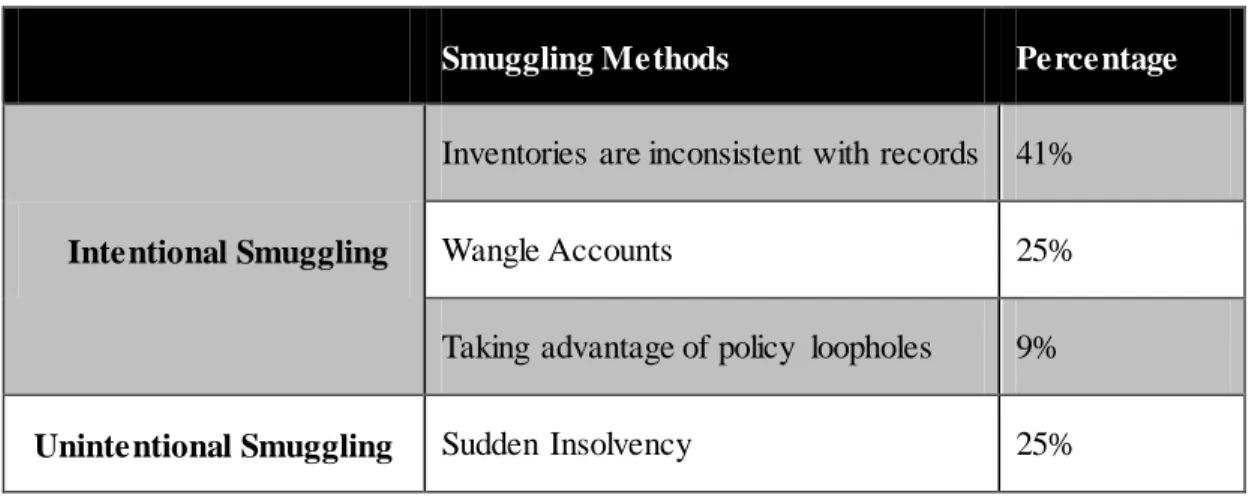
It is found that fraud mainly comes from two aspects by cases study: first, intentional tax fraud to maximize the profit; second, accidental tax fraud because of insolvency. The research of the reasons of processing trade supervision risk showed that customs real time monitoring to inventory condition of processing trade companies is hard to be conducted because of confidential restrict. So this early- warning mechanism, which is composed of business trend analysis and business detail analysis, was designed with the feature which is to analysis the healthy condition of business running of companies. This early- warning mechanism is composed of two parts, business trend analysis and business detail analysis. Based on the literature review, financial analysis method is adopted as the main analysis method of early-warning mechanism. “Financial analysis is an applied subject which uses a series of special technical method to analyze and evaluate the investment activities, financial activities, liquidity, profitability and competence based on the accounting, financial statements and other relevant materials” (Guoqing Liu, 2007). Qiang zhang (2006) pointed that “financial analysis could also provide accurate information about the past financial
condition, current situation of business and future for the potential investors, creditors, managers and others who are concerned about the enterprise”.so the financial analysis could serve for the early- warning mechanism sufficiently. Financial ratios and cut-offs are the body of the early-warning mechanism, such as quick ratio, liability/asset ratio, ROCE and Gearing ratio and so on.
3.3 Population and Sample
Another aspect of processing trade supervision analysis was conducted from processing trade companies‟ aspect. Researcher used questionnaire to collect the necessary information. The research population consists of all the processing trade companies in the administration of Guangzhou customs. 66 large-scale and key companies of these companies, the sum of money amount of annual export of which take more than 70% of the total money amount of annual export of whole processing trade companies in the administration of Guangzhou customs and which cover all the processing trade industry, was chosen as sample. ( According to “the administration provision of large-scale and key enterprises”, the large-scale and key enterprise was defined as processing trade company whose annual money amount of the sum of export and import is more than 5 million dollars.)
For the interview of customs internal department, researcher picked technology department of Guangzhou customs, processing trade supervision and administration