
トップページ - 横浜国立大学学術情報リポジトリ
21
0
0
全文
(2) 6( 142 ). 横浜経営研究 第28巻 第2号(2007). traffic (Blattberg, Briesch, and Fox, 1995). A loss leader strategy, one of the common methods of traffic building, has both advantages and disadvantages. In terms of merits, a loss leader item will build customer traffic, develop customers' attention to the product, and, accordingly, increase the total sales at the store. Moreover, a retailer-level sales increase is, in turn, beneficial for the supplier. However, deep price discounts also have demerits. For example, frequent price discounts may generate "dealprone" customers who won't buy unless items are on sale. This may lead to price wars and may ultimately damage firms in the long run (Kotler and Armstrong, 2004). Moreover, marketing research states that too much promotion and too many price discounts undermine brand equity in the long run. Therefore, one question that we address is whether a loss leader strategy is really beneficial for both the retailer and the supplier under a supply chain framework. We also pose an operational question. If a retailer and a supplier make stocking decisions sequentially (hereafter we call this a decentralized system), the total profit will be lower than the optimum profit determined by one decision-maker in a centralized system, which is defined as a system in which a retailer and a supplier are aggregated. This is a double marginalization problem (Tirole, 1988). Note that one resolution for double marginalization is to make the wholesale price the same as the unit production cost--that is, to set zero margins for a supplier. Although the supplier's zero margins can resolve double marginalization, zero margins generate another question: i.e., what is the supplier's incentive for business participation? A loss leader strategy sometimes sets a retail price lower than a wholesale price. Hence, another question of ours is to examine whether a loss leader strategy can coordinate a supply chain. We shall emphasize that, although a loss leader strategy is common in real retail business, little research has addressed this important issue. We believe that Hess and Gerstner (1987) is one of the most cited papers discussing a loss leader strategy. They analytically address a loss leader item from the marketing point of view. To the best of our knowledge, however, no one has addressed a loss leader effect on the supply chain, particularly in light of horizontal competition, supply chain coordination, and the long-term effect of price discount. In this paper, we try to answer the following business questions. First, we consider a twostage supply chain system without retail-level competition; then, we study the difference in the optimal order size and retail price between the loss leader model and the traditional model. Second, we determine whether a loss leader strategy can resolve a double marginalization problem, as other supply chain contracts (e.g., buyback contract, flexible quantity contract) are able to do. Third, we propose a two-stage supply chain model with horizontal competition between two retailers; then, we investigate how a loss leader strategy offered by one retailer influences either the other retailer or the supplier. Fourth, we explore what the long-term effect of a loss leader strategy is on supply chain performance. The rest of the paper is organized as follows. Section 2 presents our model formulation. In Section 3, we explore the behavior of a loss leader strategy using the model without.
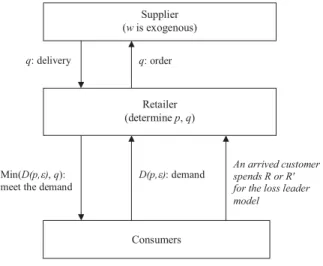
(3) Impact of a Loss Leader Strategy on Supply Chain Pricing and Stocking(Hisashi Kurata and Seong-Hyun Nam) ( 143 )7. horizontal competition. In Section 4, we extend the model to a horizontal competition case and investigate the long-term effect of a loss leader pricing on supply chain performance. Finally, we connect our analytical findings with managerial implications and conclude this paper in Section 5.. 2. Models We consider a two-stage supply chain consisting of a manufacturer and a retailer. A schematic representation of our supply chain structure is provided in Figure 1. All the notations, symbols, and subscripts are listed in Tables 1 and 2.. Figure 1: Supply Chain Structure. Table1 Symbols and Notations. Symbols D = D = (p, f) q y (p) p w a b b. f c P R. customer demand, D = y (p) + f order made by the retailer average value of the demand function, y (p) = a - bp retail price wholesale price the potential market size for the retailer, a >> 0 the self-price effect for the retailer, b > 0 The cross-retailer price effect, b > b > 0 i.i.d. normal error term for the demand, f + N (0, v 2 ) production cost retailer's profit average dollar spent by a customer who buys the loss leader item (i.e., average shopping basket size).
(4) 8( 144 ). 横浜経営研究 第28巻 第2号(2007). Rl. h s z n 0. pk. average dollar spent by a customer who visits the store but cannot buy the loss leader item unit overstock cost unit understock cost safety stock level, z = q - y (p) average demand = (a + bw + n)/ 2b for the non-competition case, and = (a + bw + n + bp k l )/ 2b for the competition case, = k l. where k Y B. # (u - z) f (u) du. Θ (z). =. F (d) f (d). cumulative demand distribution function probability distribution function for the demand. z. Table2 Subscriptions. Subscripts T L C A. (B) TT LT LL. Traditional pricing scenario Loss leader pricing scenario Centralized model Retailer A (B) in the competition model Traditional retail competition Loss leader vs. traditional retail competition Loss leader vs. loss leader retail competition. Model formulation. Note that our model formulation is based on the seminal work by Petruzzi and Dada (1999). This paper considers two scenarios: a Traditional (T) Scenario, in which a retailer determines the optimal price and order quantity of some item to maximize the expected profit that the sales of the item generates, and a Loss Leader (L) Scenario, in which a retailer decides the best price and order quantity to maximize the expected total customer spending. For simplicity, we consider a linear demand function: D (p, f) = a - bp + f, where a, b > 0 and f + N (0, v 2 ) is random effect. Our decision variables are a retail price, p, and an order quantity, q. Note that we have chosen to use a linear demand function for several reasons. First, a linear demand function is tractable. Second, we follow the tradition of microeconomics analysis (for example, Tirole 1988, Wolfstetter 1999) and marketing research about brand management and pricing, such as Raju, Sethuraman, and Dhar (1995), Sayman, Hoch, and Raju (2002). Also, we set that a is large enough and v is small enough so that the demand is always positive for the range of price p. This assumption is common in operations management research with a linear demand (e.g., Petruzzi and Dada 1999, Lee, So, and Tang 2000, Talluri and Van Ryzin 2004). We also assume that the cumulative demand.
(5) Impact of a Loss Leader Strategy on Supply Chain Pricing and Stocking(Hisashi Kurata and Seong-Hyun Nam) ( 145 )9. distribution F(.) is continuous and nondecreasing. Basket size. Note that this paper borrows an idea for modeling a loss leader strategy from Hess and Gerstner (1987). A loss leader scenario focuses on how much money will be spent by a customer who visits the store . We call such spending the basket size of the customer. Thus, for a given basket size, a loss leader model maximizes customers` total expenditure in a store after the loss leader item generates traffic. Note that demand D in the loss-leader scenario can also be interpreted as the number of customers who visit the store. Our lossleader model assumes that the store has the following sources of revenue: If a loss leader item is available, one revenue source is the sales of the loss-leader item (p) and the other is additional sales (R) made to a customer who comes into the store to buy a loss-leader item. Alternatively, if a loss leader item is out of stock, there is only one source of revenue (Rl), which is the expenditure that a customer who comes to the store may make even if he/she cannot buy the loss leader item he/she wants. Note that R (or Rl) represents a basket size when the loss-leader item is available (or not available). If a customer cannot buy the loss leader item for which he/she originally comes to the store, disappointment at such an out-of-stock experience may negatively affect his/her purchasing motivation. Hence, it is reasonable to assume the following: Assumption 1. R $ Rl $ 0. Traditional (T) Scenario. Following Petruzzi and Dada (1999), we define the profit of the retailers in the T scenario as follows. Π T (p, q) = * =*. pD (p, f) - wq - h [q - D (p, f)] if D (p, f) # q pq - wq - s [D (p, f) - q] if D (p, f)> q p [y (p) + f] - w [y (p) + z] - h [z - f] if f # z p [y (p) + z] - w [y (p) + z] - s [f - z] if f > z. Note that we use a transformation y (p) = a - bp and z = q - y (p). The expected profit can be obtained as follows. z. E [Π T (p, q)] =. # _ p [y (p) + u] - h [z - u]i f (u) du A B. # _ p [y (p) + z] - s [u - z]i f (u) du - w [y (p) + z] .. + z. The first- and second-order conditions (FOCs and SOCs) are: 2E [Π T (p, q)] = (h + s + p)( 1 - F (z)) - (w + h) . 2z 2 2 E [Π T (p, q)] =- (h + s + p) f (z)< 0. 2z 2 2E [Π T (p, q)] 0 = 2b b pT - p l - Θ (z) , 2p. (1) (2) (3).
(6) 10( 146 ). 横浜経営研究 第28巻 第2号(2007). 0. where pT =. B. a + bw + n and Θ (z) = 2b. 2 2 E [Π T (p, q)] =- 2b < 0. 2p 2. # (u - z) f (u) du z. (4). We follow the logic of Petruzzi and Dada (1999) to obtain the optimum: First, we solve the optimum value of p for a given z, then we search the optimal z for Π T (p *, q (p *)) = Π T (p *, z (p *)) . We assume for the sake of simplicity that the expected profit is concave in z. Thus, for the T scenario, the optimal safety stock, price, and order size are decided by (1) and (3) as follows. J * N p +s-wO z T* = F - 1 K T* K pT + s + h O L P 0 pT* = pT - Θ (z T* )/ 2b. (5) (6). qT* = y (pT* ) + z T* .. Loss Leader (L) Scenario. Each customer who comes to the store will make additional purchases either on average R if he/she can get the loss leader item or on average R' if the loss leader item is out of stock. The profit function for the L scenario can be determined as follows. Π L (p, q) = * =*. (p + R) D (p, f) - wq - h [q - D (p, f)] if D (p, f) # q (p + R) q - wq + (Rl- s)[ D (p, f) - q] if D (p, f)> q (p + R)[ y (p) + f] - w [y (p) + z] - h [z - f] if f # z (p + R)[ y (p) + z] - w [y (p) + z] + (Rl- s)[ z - f] if f > z. The expected profit can be obtained as follows. z. E [Π L (p, q)] =. # _(p + R)[ y (p) + u] - h [z - u]i f (u) du A B. # _(p + R)[ y (p) + z] + (Rl- s)[ u - z]i f (u) du - w [y (p) + z] .. + z. The FOCs and SOCs are: 2E [Π L (p, q)] = (h + s + p + R - Rl)( 1 - F (z)) - (w + h) 2z 2 2 E [Π L (p, q)] =- (h + s + p + R - Rl) f (z)< 0. 2z 2 2E [Π L (p, q)] a + bw + n 0 0 = 2b b p L - p l - Θ (z) + bR, where p L = . 2p 2b.
(7) Impact of a Loss Leader Strategy on Supply Chain Pricing and Stocking(Hisashi Kurata and Seong-Hyun Nam)( 147 )11. 2 2 E [Π L (p, q)] =- 2b < 0. 2p 2. Using the same approach as the T scenario, the optimal price and order size for the L scenario are decided as follows. J * N p + s - w + R - Rl O z *L = F - 1 KK L* . p L + s + h + R - Rl O L P 0 p *L = p L - Θ (z *L )/ 2b - R/2 . q *L = y (p *L ) + z *L .. 3. Model Analysis Optimums for a non-competition model. Section 2 already determines the optimal order size and prices for both the T and L scenarios. Proposition 1 compares the solutions.. Proposition 1. For any R > 0, (a) The optimal order, safety stock, and price have the following relationship between the traditional model (subscript 'T') and the loss leader model (subscript 'L'): qT* < q *L , z T* < z *L , and pT* > p *L .. (b) It is beneficial for both a retailer and a manufacturer to switch from the traditional to the loss leader pricing strategy. Proof. See the Appendix. Proposition 1 shows that the retailer is better off with the loss leader strategy. Note that the supplier's profit is proportional to the order size from the retailer when w and c are exogenous. Hence, the loss leader scenario benefits the supplier more than does the traditional policy. Consequently, offering a loss leader item is valuable for a retailer as well as for a supplier under our framework. Section 4 extends Proposition 1 to discuss the interaction of store competition with a loss leader strategy. Supply chain coordination and a loss leader strategy. So far we have considered a decentralized system. However, theoretically the centralized system outperforms the decentralized system. The optimal solution for the centralized model in the traditional scenario can be obtained by just changing w to c in (1) through (4) as follows. N J * p *+ s - c O z C* = F - 1 KK C* . (7) pC * + s + h O P L.
(8) 12( 148 ). 横浜経営研究 第28巻 第2号(2007). pC* = pC - Θ a z C* k /2b 0. (8). qC* = y b pC l + z C* . 0. a + bc + n where pC = . Note that the subscript "C" represents the centralized system. 2b The relationship of the optimums between the centralized and decentralized systems is as follows.. Lemma 1. The optimal order, safety stock, and price have the following relationship between the traditional model (subscript 'T') and the centralized model (subscript 'C'): qT* < qC* , z T* < z C* and pT* > pC* .. Proof. See the Appendix. Lemma 1 shows a double marginalization effect: in the decentralized system, the retail price tends to be higher and the retailer's order size is discouraged compared to the centralized system. In our model, the profit function is concave in p and z so that it is enough to answer whether the optimal price and order size in the loss-leader model are the same as those of the centralized system in order to confirm whether a loss leader strategy can coordinate the supply chain. Proposition 2 shows the answer.. Proposition 2. = p *L and z C* Y = z *L , that is, a loss-leader model cannot If R > Rl or if w - c > R , then pC* Y coordinate the system. Proof. See the Appendix.. It is not realistic that all the customers who cannot buy the loss leader item have no regret (i.e., R = Rl) or that the manufacturer's margin is exactly the same as the customer's basket size (i.e., w - c = R). Thus, Proposition 2 implies that, in realistic retail situations, the lossleader strategy cannot resolve a double marginalization problem. In sum, Lemma 1 and Proposition 2 conclude that adopting a loss leader strategy can improve the profit of the system but cannot coordinate the system; the global optimum is not achieved.. 4. Horizontal Competition and Loss Leader Strategy 4.1. Three horizontal competition types. This section examines the impact of horizontal competition between two retailers on the optimal prices, order sizes, and expected profit under a loss leader strategy. Figure 2 illustrates our retailer-competition model. Assuming no cooperation between the two retailers, we determine a Nash solution for the optimal price and.
(9) Impact of a Loss Leader Strategy on Supply Chain Pricing and Stocking(Hisashi Kurata and Seong-Hyun Nam)( 149 )13. order quantity. We also assume that the two retailers are similar so that the parameter values in the model are symmetric between the retailers. This symmetric assumption is tractable and common when one analytically explores store competition (Raju et al. 1995, Sayman et al. 2002).. Note: An arrived customer spends R or R' for the loss leader model Figure 2: Supply Chain Structure with Competition. Traditional (TT) competition case. First, we investigate the Nash solutions when both Retailers A and B use a traditional profit maximization objective. Hereafter we call this situation a traditional competition case under retail-level competition. The symbol "TT" represents this traditional competition case. Under two-retailer competition, we define the demand function for Retailers A and B as follows. D A (p A , q A | p B ) = a - bp A + bp B + f A , where f A + N (0, v 2 ) D B (p B , q B | p A ) = a - bp B + bp A + f B , where f B + N (0, v 2 ) Note that b > 0 is a given cross-brand price sensitivity and subscript A (or B) represents Retailer A (or B) in the competition model. As we did before, we also define y A (p A ) = a - bp A + bp B and z A = q A - y A (p A ) y B (p B ) = a - bp B + bp A and z B = q B - y B (p B ) The expected profit function for Retailer A for the traditional case is defined as z. E [Π TT , A (p A , q A )] =. #_p. TT , A. [y A (pTT , A ) + u] - h [z - u]i f (u) du. A B. #_p. + z. The FOCs of (9) are:. TT , A. [y A (pTT , A ) + z] - s [u - z]i f (u) du - w [y A (pTT , A ) + z] .. (9).
(10) 14( 150 ). 横浜経営研究 第28巻 第2号(2007). 2E [Π TT , A (pTT , A , qTT , A )] = (h + s + pTT , A )( 1 - F (z TT , A )) - (w + h) = 0. 2z TT , A 2E [Π TT , A (pTT , A , qTT , A )] 0 = 2b b pTT , A - pTT , A l - Θ (z TT , A ) = 0, 2pTT , A 0. where pTT , A =. a + bw + n + bpTT , B and Θ (z TT , A ) = 2b. B. # (u - z. TT , A. ) f (u) du .. z TT , A. Concavity is guaranteed by the SOCs. Hence, we can obtain the Nash solution as follows. J * N p +s-wO - 1 K TT , A * z TT = F (10) ,A KK p * + s + h OO . TT , A L P p. * TT , A. =p. 0 TT , A. - Θ az. * TT , A. k /2b , where p. 0 TT , A. * a + bw + n + bpTT ,B = . 2b. * * * qTT = y A a pTT + z TT ,A , Ak ,A. (11) (12). Note that the solutions for Retailer B can be obtained by switching subscript “A” with subscript “B” in Equations (10), (11), and (12). Loss leader traditional (LT) competition case. Here we examine the optimums when Retailer A adopts a loss reader strategy while Retailer B retains the tradition scenario. Hereafter we call this setting a loss leader traditional competition case under retail-level competition. The symbol "LT" represents this competition. If the total order size in the LT competition is more than (or less than) that of the TT competition, we conclude that offering a loss leader item is advantageous (or disadvantageous) for the supplier. The expected profit for Retailer A, which uses a loss leader strategy under retail competition, can be defined as, z. E [Π LT , A (p LT , A , q LT , A )] =. # _(p. LT , A. + R)[ y A (p LT , A ) + u] - h [z - u]i f (u) du. A B. # _(p. +. LT , A. + R)[ y A (p LT , A ) + z] + (Rl- s)[ u - z]i f (u) du - w [y A (p LT , A ) + z] . (13). z. Note that the solutions for Retailer B using a traditional scenario are defined by Equations (9) through (11). The FOCs of (11) are defined as follows. 2E [Π LT , A (p LT , A , q LT , A )] a + bw + n + bp LT , B - bR = 2b ) - p LT , A 3 - Θ (z) = 0. 2p LT , A 2b 2E [Π LT , A (p LT , A , q LT , A )] = (p LT , A + s - w + R - Rl) - (p LT , A + s + h + R - Rl) F (z LT , A ) = 0. 2z LT , A. Hence, the optimal solutions for Retailers A and B in the LT competition case are:.
(11) Impact of a Loss Leader Strategy on Supply Chain Pricing and Stocking(Hisashi Kurata and Seong-Hyun Nam)( 151 )15. For Retailer A: J * N K p LT , A + s - w + R - Rl O z *LT , A = F - 1 K * . K p LT , A + s + h + R - Rl OO L P 0 p *LT , A = p LT , A - Θ a z *LT , A k /2b , 0. where p LT , A =. (14) (15). a + bw + n + bp *LT , B - bR and Θ (z LT , A ) = 2b. B. # (u - z. LT , A. ) f (u) du .. z LT , A. q *LT , A = y A (p *LT , A ) + z *LT , A .. (16). For Retailer B: J * N K p LT , B + s - w O z *LT , B = F - 1 K * , K p LT , B + s + h OO L P 0 p *LT , B = p LT , B - Θ (z *LT , B )/ 2b , 0. where p LT , B =. a + bw + n + bp *LT , A and Θ (z LT , B ) = 2b. B. # (u - z. LT , B. ) f (u) du .. z LT , B. q *LT , B = y B (p *LT , B ) + z *LT , B .. Loss-leader vs. Loss-leader (LL) competition case. Thirdly, we examine the case in which both Retailers A and B adopt a loss leader strategy. Hereafter we call this setting a loss leader vs. loss-leader competition case under retail-level competition. The symbol "LL" represents this competition. Here, (14), (15), and (16) can be applied to determine the optimum price, safety stock, and order size of the LL competition. For Retailer A: J * N p LL , A + s - w + R - Rl O -1K * z LL , A = F K * . (17) K p LL , A + s + h + R - Rl OO L P 0 p *LL , A = p LL , A - Θ a z *LL , A k /2b , (18) where p. 0 LL , A. a + bw + n + bp *LL , B - bR = and Θ (z LL , A ) = 2b. B. # (u - z. LL , A. ) f (u) du .. z LL , A. q *LL , A = y A (p *LL , A ) + z *LL , A .. (19). Note that the solutions for Retailer B can be obtained by switching subscript “A” with subscript “B” in Equations (17), (18), and (19). Next, we compare the optimal prices, safety stocks, and order sizes among the aforementioned three competition types. Proposition 3 shows the result..
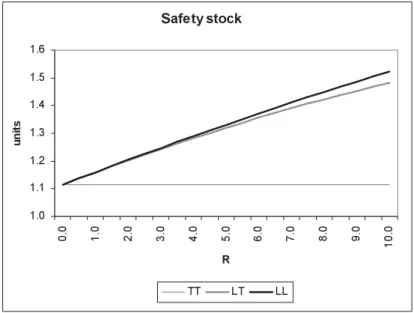
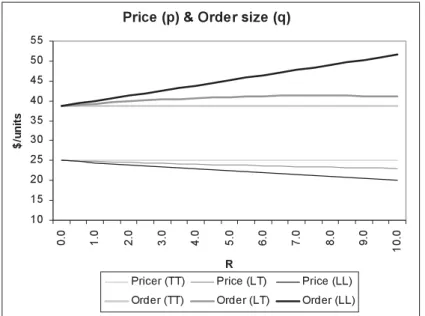
(12) 16( 152 ). 横浜経営研究 第28巻 第2号(2007). Proposition 3. For R > 0, when retail-level competition is included, the optimal prices, safety stocks, and order sizes have the following relationship among the traditional vs. traditional competition (subscript 'TT'), the loss-leader vs. traditional competition (subscript 'LT'), and the loss-leader vs. loss-leader competition (subscript 'LL'): * * = pTT > p *LT , A > p *LT , B > p *LL , A = p *LL , B . (a) pTT ,A ,B * * (b) z TT , A = z TT , B < z *LT , B < z *LT , A < z *LL , A = z *LL , B . * * = qTT < q *LT , B < q *LT , A < q *LL , A = q *LL , B . (c) qTT ,A ,B Proof. See the Appendix. Proposition 3 mentions that as more stores use loss leader pricing, the retail price tends to be lower, but the safety stock level and order size tend to be larger. A sum of the orders from Retailers A and B, q.,* A + q.,* B , determines the supplier's profit. Hence, we conclude that the manufacturer can obtain more profitable from loss leader pricing as more retailers offer it. We numerically confirm Proposition 3. Figures 3-a and 3-b illustrate the general behavior of the safety stocks and prices for the three competitive types. We assume that demand follows y k, A = 100 - 5p k, A + 2.5p k, B , where k represents one of the three competition types, the error term follows a normal distribution with E (f) = 0 and Var (f) = 3 2 , and other parameters are w=10, s=5, h=1, and R'=0, respectively. Figures 3-a and 3-b show that, as the basket size R increases, the safety stocks increase while the retail prices decrease. Also, about he impact of R , the LL model is the strongest, the LT model is next, and the TT model is the weakest.. Figure 3-a: Effect of R on the stock levels for the three competition types.
(13) Impact of a Loss Leader Strategy on Supply Chain Pricing and Stocking(Hisashi Kurata and Seong-Hyun Nam)( 153 )17. Figure 3-b: Effect of R on the prices and order sizes for the three competition types. Next, Proposition 4 answers the question of whether the loss leader strategy is beneficial for retailer(s),.. Proposition 4. The relationship of the retailer's expected profits among the three competition types is as follows. (a) Always E (Π *TT , A )< E (Π *LT , A ) (b) Whether the LL competition outperforms the LT competition (i.e., E (Π *LL , A )> E (Π *LT , A ) ) depends on the sign of. 2E [Π LT , A ] 2E [Π LT , A ] 2E [Π LT , A ] dp LT , A + dp LT , B + dz LT , A . 2p LT , B 2p LT , B 2z LT , A. Proof. See the Appendix. Proposition 4 implies that a retailer is always better off with a loss leader strategy as long as its competitor does not also use loss leader pricing. However, once all the retailers are selling a loss leader item, the result is quite different: there is a possibility that the retailer's profit might decrease. Hence, adopting a loss leader strategy does not always benefit the retailer under the price war situation. In contrast, it is interesting to note that even intense price competition at retail level does not harm the supplier. 4.2. Long-Term Effect of a Loss Leader Strategy. Marketing studies empirically conclude that too much promotion and price discounting might undermine customers' brand equity, and.
(14) 18( 154 ). 横浜経営研究 第28巻 第2号(2007). that customers tend to be more price-sensitive (Papatla and Krishnamurthi 1996, and Jedidi, Mela, and Gupta 1999). One approach of ours is to compare the long-term effect of loss leader pricing on business performance with the short-term effect. We apply a comparative statics approach here. That is, assuming that the parameter b which represents price sensitivity may increase in the long run, we analyze the behavior of the expected profit.. Proposition 5. (a) Effect of b: For all the TT, LT, and LL models, as b increases, all the optimum price p *, the safety stock size z * , the expected profits of the retailers E (r * ) , and the expected profit of the supplier (w - c) q * decrease if. 2b - b 1 - F a z *A k. >. 2z *A . 2p *A. (b) Effect of b: For all the TT, LT, and LL models, as the cross-price sensitivity increases, the optimum price p *, the safety stock size z *, the expected profits of the retailers, E (r * ) , and the profit of the supplier (w - c) q * increases if. 2b - b 1 - F a z *A k. >. 2z *A . 2p *A. Proof. See the Appendix. Note that price increase will usually lead to order size increase. Thus, it is safe to say that the if-condition in Proposition 5 is true in common situations. Proposition 5 demonstrates that both the retailer and the supplier are worse off from making customers more price sensitive (i.e., greater b) by offering too much price discount. However, as the frequency of customer store switching increases (i.e., b increases), both the retailer and the supplier can be better off. To illustrate the effect of b on the profits, we plot the profits of the LT and LL competitions with respect to various values of b in Figure 4. We assume that the demand represents y k, A = 100 - bp k, A + 2.0p k, B where b changes from 2.05 to 3.00, and the error term follows a normal distribution with E (f) = 0 and Var (f) = 3 2. The parameters are set as p=20, w=10, s=5, h=1, R=10, and Rl=0. Figure 4 shows which is more profitable for the retailer, either the LT or LL competition, depending on the parameters: when b is small the LL competition outperforms the LT competition, while if b is large, the retailer is better off from the LT competition. In addition, Figure 4 shows that retailer profits generally decrease in b when price sensitivity b is high enough..
(15) Impact of a Loss Leader Strategy on Supply Chain Pricing and Stocking(Hisashi Kurata and Seong-Hyun Nam)( 155 )19. Figure 4: Long-term effect of a loss leader strategy. 5. Managerial implications and conclusions. Loss leader pricing is a common marketing strategy for the retailer. In this paper, we have examined the consequences of the loss leader strategy on the pricing, ordering, and expected profit of the firm in a two-stage supply chain. We show that, in the short run, the supplier is always better off with loss leader pricing, while the retailer's benefit is dependent upon whether two retailers offer the loss leader strategy. In contrast, in the long run, the benefit from the loss leader strategy is not guaranteed, for the retailer or for the supplier. We obtained managerial insights that can be applied to retail management. First, note that all the results in Propositions 3 and 4 are held even if we use R - Rl instead of R in their statements and proofs. Hence, the effect of a loss leader strategy is boosted much more when being able to buy the loss leader item encourages customers' total purchase (i.e., large R) and when missing the loss leader item discourages their purchasing motivation (i.e., small Rl). Such a customer purchasing situation can be achieved when a store offers a popular and attractive product as a loss leader item. In fact, one can observe that actual retail business often deeply discounts a hot seller. For instance, it is reported that Amazon.com often deeply discounts best-seller books to compete with its major rival, barnesandnoble.com (Publishers Weekly, July 1, 2002). It is important to notice that loss leader pricing differs from clearance pricing, which sells over-stocked or obsolete items at a very low price. A loss leader strategy also differs from a bait-and-switch strategy, in which a retailer lets customers buy the other product instead of the advertised discounted item. The second implication is that, in the long run, a loss leader strategy might spoil the performance of both the retailer and the manufacturer. In fact, brand management always emphasizes that building brand equity is the most important method for successful business..
(16) 20( 156 ). 横浜経営研究 第28巻 第2号(2007). For instance, Lehman and Winer (1997) state "...companies have seen that the only way to combat lower-priced competitors, whether private labels for supermarket products or clones for computers, is to reemphasize their brand names." Hence, our analysis confirms that it is risky for management, especially manufacturers, to rely heavily on a loss leader pricing as a method of increasing sales. In contrast, we suggest that sales managers carefully watch customer reactions to a loss leader and conduct some make-up actions after employing the loss leader strategy. An additional finding in the paper is that loss leader pricing does not work as a supply chain contract method, which is used as a tool for supply chain coordination. Consequently, our result concludes that a supplier must prepare another approach for coordination, such as revenue sharing or a flexible quantity contract, so as to resolve double marginalization. Finally, we have demonstrated how a loss leader strategy influences the supply chain performance in a static framework. Hence, one extension of our research is to set up a dynamic model and determine how long and how often a retailer should offer a loss leader strategy in order to eliminate the negative long-term effect. This paper, however, concentrates on a static model and we will keep a dynamic analysis for our future research.. Appendix. Proof of Proposition 1. (a) Under Assumption 1, if R = 0, then Rl= 0, and q *L = qT* , p *L = pT* , and E (Π L ) = E (Π T ) . Note that 2Θ (z)/ 2z = F (z) - 1 < 0 , and from F (z) =. p L + s - w + R - Rl , p L + s + h + R - Rl. 2F (z) ((2p L /2R) + 1)( h + w) = . 2R (p L + s + h + R - Rl) 2 2Θ (z) 2F (z) 2z 2Θ (z) ((2p L /2R) + 1)( h + w) F (z) - 1 = = Thus, . 2R 2R 2F (z) 2z f (z) (p L + s + h + R - Rl) 2 2p *L ((2p *L /2R) + 1)( h + w) 1 - F (z) =- 1 += Hence, . 2R 2 2b (p L + s + h + R - Rl) 2 f (z). (A-1). 1 - F (z) h+w . 2b (p L + s + h + R - Rl) 2 f (z) 2p *L 2p *L - 0.5 + B L = (1 - B L ) =- 1/2 + B L . Then, (A-2) can be rewritten as . 2R 2R 1 - BL Here we set the following assumption regarding (A-3).. (A-2). Set B L =. (A-3). 2p *L < 0 , equivalently B L < 0.5. 2R Assumption 2 is reasonable because the amount of price discount tends to increase as customer's basket size increases. The retail price p L and the effect of a loss leader item R are usually much greater than other cost variables so that B L tends to be small enough. Moreover (1 - F (z))/ f (z) can be interpreted as the reciprocal of the hazard function. The service level in real retail business is usual high and close to 100% so that, assuming commonly-used normal. Assumption 2..
(17) Impact of a Loss Leader Strategy on Supply Chain Pricing and Stocking(Hisashi Kurata and Seong-Hyun Nam)( 157 )21. demand, the value of (1 - F (z))/ f (z) is close to zero. From Assumption 2, p *L decreases in R. Consequently, we obtain p *L < pT* for R > 0. Also, from Assumption 2, 0 < B L < 0.5 so that - 0.5 <. 2p *L 2Θ (z) < 0 from (A-1). < 0. Then, 2R 2R. Hence, 2z > 0. Thus, we know z *L > z T* for R > 0. Finally, q *L > qT* . 2R (b) The manufacturer's profit is proportion to the order size q. Thus, from qT* < q *L , offering a loss leader is profitable for the manufacturer. Next, we compare the maximum expected profits of the retailer's between the two scenarios. Set ΔΠ = E [Π L (p, q)] - E [Π T (p, q)] . 2ΔΠ 2E [Π L (p, q)] 2E [Π T (p, q)] = = (R - Rl)( 1 - F (z))> 0 2z 2z 2z 2ΔΠ 2E [Π L (p, q)] 2E [Π T (p, q)] = =- bR < 0 2p 2p 2p 2 2 ΔΠ 2 2 ΔΠ = (R - Rl)( - f (z))< 0 , = 0. 2 2z 2p 2 2ΔΠ 2ΔΠ > 0 and < 0. If the pricing policy switches from the TR to the LL, dz > 0 Always 2z 2q. and dp < 0 will occur from Proposition 1-(a). Thus, the total differentiation shows dΔΠ =. 2ΔΠ 2ΔΠ dp + dz > 0. In conclusion, switching from the TR to LL strategy is 2p 2z. beneficial for the retailer. □ Proof of Lemma 1. If assuming w = c, obviously z C* = z T* and pC* = pT* , and qC* = qT* . Note that the approach by Petruzzi and Data (1999) sequentially determines the solution. First, if w > c, then pT* - pC* = (w - c)/ 2 > 0 from (6) and (8). Thus, pC* < pT* . Next, a pT* + s - w k - a pC* + s - c k = (w - c)/ 2 - (w - c)< 0, and a pT* + s + h k - a pC* + s + h k = (w - c)/ 2 > 0. Hence, the inside of () in (5) is greater than the inside of () in (7). Therefore, z C* > z T* . Finally, qC* = y (pC* ) + z C* > y (pT* ) + z T* = qT* . □ Proof of Proposition 2. Assume z C* = z *L . At this time, p *L - pC* = (w - c)/ 2 - R/2 from (6). If z C* = z *L , then =. p *L + s - w + R - Rl pC* + s - w = * . p *L + s + h + R - Rl pC + s + h. (A-4). Substitute p *L = pC* + (w - c)/ 2 - R/2 into the RHS of (A-4), pC* + s - w + (w - c)/ 2 + R/2 - Rl pC* + s - w = * . pC* + s + h + (w - c)/ 2 + R/2 - Rl pC + s + h. The following equation must be held for (A-5) to be always held. (w - c)/ 2 + R/2 - Rl= 0 and. (A-5). (A-6).
(18) 22( 158 ). 横浜経営研究 第28巻 第2号(2007). Also, if we assume p *L = pC* , then (w - c)/ 2 - R/2 = 0. (A-7) From (A-6) minus (A-7), R = Rl. Then, w - c = R. □ * * * * * * Proof of Proposition 3. If R = 0, then Rl = 0, and z LT , A = z LT , B = z LL , A = z LL , B = z TT , A = z TT , B , * * p *LT , A = p *LT , B = p *LL , A = p *LL , B = pTT = pTT , and E (Π LT , A ) = E (Π LT , B ) = E (Π LL , A ) = E (Π LL , B ) ,A ,B = E (Π TT , A ) = E (Π TT , B ) . From (18), the optimal prices can be expressed by matrix form as follows. J N J N J 1 - b/2b N K p *LL , A O K A - 2Θ (z *LL , A )/ 2b - Rh A /2 O a + bw + n K O = , where A = , and h k K - b/2b 2b 1 OKK p *LL , B OO KK A - 2Θ (z *LL , B )/ 2b - Rh B /2 OO L PL P L P is a 0-1 parameter for k = A or B, which this proof technically needs. J * N J N * J 1 b/2b N K A - 2Θ (z LL , A )/ 2b - Rh A /2 O p 1 K O Ñ KK *LL , A OO = . K p LL , B O 1 - (b/2b) 2 K b/2b 1 OKK A - 2Θ (z *LL , B )/ 2b - Rh B /2 OO L P L L P P Equivalently, p *LL , A =. p. Thus,. * LL , B. * Θ (z *LL , A ) Rh A b b Θ (z LL , B ) 1 1 A + , d n * 2 2 4 2 2 2 2 b b b b 1 - (b/2b). * Θ (z *LL , B ) Rh B b b Θ (z LL , A ) 1 = * d1 + 2b n A - 2b 2b - 2b - 2 4 . 1 - (b/2b) 2. * * 2p *LL , A 1 1 2Θ (z LL , A ) - b 2Θ (z LL , B ) - h A , = * 2 4 2R 2R 2R 2b 1 - (b/2b) 2 (2b) 2. (A-8). * 2p *LL , B 2Θ (z *LL , B ) h B b 2Θ (z LL , A ) 1 1 = . * - (2b) 2 2 4 2R 2R 2R 2b 1 - (b/2b) 2. (A-9). Set B K =. (h + w) F (z LT , k ) - 1 , where k = A or B. 2 f (z LT , k ) (p LT , k + s + h + R - Rl). J * N 2Θ (z LL , k ) K 2p LL , k O =K + 1O B k . Note 2R K 2R O L P Thus, (A-8) and (A-9) can be rewritten as 2p *LL , A B A + (b/2b) B B + h A b = . 2R 2b - b 2 /2b + B A + (b/2b) B B * 2p LL , B (b/2b) B A + B B + h B b = . 2R 2b - b 2 /2b + (b/2b) B A + B B. (A-10) (A-11). From (A-10) and (A-11), the derivatives for the LL case (i.e., h A = h B = 1) are obtained as:.
(19) Impact of a Loss Leader Strategy on Supply Chain Pricing and Stocking(Hisashi Kurata and Seong-Hyun Nam)( 159 )23. 2p *LL , A B A + (b/2b) B B + b =. 2R 2b - b 2 /2b + B A + (b/2b) B B * 2p LL , B (b/2b) B A + B B + b =. 2R 2b - b 2 /2b + (b/2b) B A + B B. (A-12) (A-13). The derivatives for the LT case (i.e., h A = 1 and h B = 0) are: 2p *LT , A B A + (b/2b) B B + b =. 2R 2b - b 2 /2b + B A + (b/2b) B B * 2p LT , B (b/2b) B A + B B =. 2R 2b - b 2 /2b + (b/2b) B A + B B. (A-14) (A-15). The derivatives for the TT case (i.e., h A = 0 and h B = 0) are: * 2pTT B A + (b/2b) B B ,A =. 2R 2b - b 2 /2b + B A + (b/2b) B B * 2pTT , B (b/2b) B A + B B =. 2R 2b - b 2 /2b + (b/2b) B A + B B. (A-16) (A-17) * LL , A. 2p 2R. Hence, from (A-12) through (A-17) and, we can know * TT , A. =. * LL , B. 2p 2R. <. * LT , A. 2p 2R. <. * LT , B. 2p 2R. <. * TT , B. 2p 2p < 0. Note that the LL and TT cases have a symmetric model structure so that = 2R 2R * * * * 2p LL , A 2p LL , B 2pTT 2pTT ,A ,B = = and . Also, as the price decreases, the safety stock increases 2R 2R 2R 2R 2p 2z because 2z = and 2z > 0. Finally, we know that, for R > 0, z *LL , A = z *LL , B > z *LT , A 2p 2R 2R 2p * * * * = z TT = pTT > z *LT , B > z TT , and p *LL , A = p *LL , B < p *LT , A < p *LT , B < pTT . Finally, we obtain ,A ,B ,A ,B * * * * * * qTT , A = qTT , B < q LT , B < q LT , A < q LL , A = q LL , B . □. Proof of Proposition 4. (a) If R = 0, E [Π LT , A ] = E [Π TT , A ] . + u) f (u) du +. B. # (y (p. LT , A. z. 2E [Π LT , A ] = 2R. z. # (y (p. LT , A. ). A. ) + z) f (u) du = y (p LT , A ) + n - Θ (z LT , A )> 0. Thus, for R > 0, E [Π LT , A ]. > E [Π TT , A ] .. (b) w. 2E [Π LT , A ] = 2p LT , B. #. z. A. (p LT , A + R). 2y (p LT , A ) f (u) du + 2p LT , B. #. z. B. (p LT , A + R). 2y (p LT , A ) f (u) du 2p LT , B. 2y (p LT , A ) = b (p LT , A + R - w)> 0. From the unimodality of the profit function, 2p LT , B. 2E [Π LT , A ] > 0 when p LT , A < p *LT , A or p LT , B < p *LT , B . Therefore, when the prices and safety 2p LT , B.
(20) 24( 160 ). 横浜経営研究 第28巻 第2号(2007). stock level change from p *LT , A , p *LT , B , and z *LT , A to p *LL , A , p *LL , B and z *LL , A , respectively, then the change of Retailer A's profit is determined by the total differentiation, 2E [Π LT , A ] 2E [Π LT , A ] 2E [Π LT , A ] dE [Π LT , A ] = dp LT , A + dp LT , B + dz LT , A . Considering the 2p LT , A 2p LT , B 2z LT , A signs of the derivatives and p *LT , A - p *LL , A > 0, p *LT , B - p *LL , B > 0 and z *LT , A - z *LL , A < 0, the sign of dE [Π LT , A ] can take either positive or negative. □ Proof of Proposition 5. (a) Since the models are symmetric, pTT , A = pTT , B and z TT , A = z TT , B . 2Θ (z TT , A ) 2 = 2b 2b. From (11),. From (10),. B. # (u - z. TT , A. z. ) f (u) du = d -. 2z TT , Z 2b n. # f (u) du = 2z2b B. z. TT , A. (F (z TT , A ) - 1) .. 2pTT , A 2pTT , B = 1 2 ) 2bb - 2 (a + n + bpTT , B ) 3 2b 2b 4b. 2z TT , A 2b. 2z TT , A - 12 ( 2b (F (z TT , A ) - 1) - 2Θ (z TT , A ) 2 . (A-18) 2b 4b pTT , A + s - w 2F (z TT , A ) 2pTT , A 2 2z TT , A f (z TT , A ) = = . Then, 2z TT , A 2b 2pTT , A e pTT , A + s + h o 2b. (w + h) (w + h) 2pTT , A 2z TT , A 2pTT , A = . Thus, . 2b (pTT , A + s + h) 2 2b 2b * f (z TT , Z )( pTT , A + s + h) 2 4 2pTT , A 2pTT , B = 1 2 ) 2bb - 2 (a + n + bpTT , B ) 3 Plug in (A-19) into (A-18), 2b 2b 4b 1 * 2pTT , A 2b (F (z TT , A ) - 1)( w + h) - 2Θ (z TT , A ) 4 . Rewrite this as, 2b 4b 2 f (z TT , Z )( pTT , A + s + h) 2 (w + h)( 1 - F (z TT , A )) 2pTT , A b - *1 + =- 1 2 $ a + n + bpTT , A - Θ (z TT , A ) . . 2b 2bf (z TT , A )( pTT , A + s + h) 2 4 2b 2b 1-. b. 2b. (A-19). (A-20). > 0 from the assumption. In (A-20), the insides of { } in the RHS is positive since it's. easy to show (2b - b) -. n > Θ (z TT , A ).. Also, if (2b - b) -. (w + h)( 1 - F (z TT , A )) > 0, equivalently if f (z TT , A )( pTT , A + s + h) 2. 2z TT , A (1 - F (z TT , A ))> 0, then the inside of { } in the LHS in (A-20) is positive. 2pTT , A. 2z * 2pTT , A 2pTT , A 2b - b 2z TT , A > A* . Next, the sign of < 0 if is the same as that of . * 2b 2b 2b 1 - F (z A ) 2p A 2z * 2qTT , A 2pTT , A 2z TT , A 2b - b 2z TT , A =- pTT , A - (b - b) + > A* . Next, from (12), < 0 if Thus, . * 2b 2b 2b 2b 1 - F (z A ) 2p A 2z * 2E (Π TT , A ) 2qTT , A 2b - b 2z TT , A 2 =- pTT , A + > A* . Finally, (pTT , A + s - w) < 0 if Thus, * 2b 2b 2b 1 - F (z ) 2p. Thus,. A. A. 2z * 2b - b 2z TT , A * * > A* , then at the optimum point pTT (pTT , A + s + b) F (z TT , A ) . If and z TT , * ,A ,A 2b 1 - F (z A ) 2p A 2E (Π TT , A ) p ,z < 0. The same approach can be used for the proofs of the LT and LL 2b * TT , A. * TT , A.
(21) Impact of a Loss Leader Strategy on Supply Chain Pricing and Stocking(Hisashi Kurata and Seong-Hyun Nam)( 161 )25. cases. 2pTT , A 2pTT , B = 1 )b + pTT , B 3 (b) From (11), 2b 2b 2b. +. 1 2z TT , A (F (z TT , A ) - 1) . 2b 2b. (A-21). (w + h) 2z TT , A 2pTT , A = . (A-22) 2b 2b * f (z TT , A )( pTT , A + s + h) 2 4 (w + h)( 1 - F (z TT , A )) 2pTT , A pTT , A b + = Plug in (A-22) into (A-21), *1 . (A-23) 2b 2bf (z TT , A )( pTT , A + s + h) 2 4 2b 2b 2z * pTT , A 2b - b > A* leads to the fact that the inside of { } in the LHS in > 0. Also, Always * 2b 1 - F (z A ) 2p A 2z * 2pTT , A 2b - b 2z TT , A > A* , then > 0 and > 0. Also, (A-23) is positive. Therefore, if * 2b 2b 1 - F (z ) 2p. From (10),. A. A. 2E (Π TT , A ) 2qTT , A 2pTT , B 2z TT , A 2pTT , A = pTT , B + b + = > 0 from assuming pTT , A >> . Finally, 2b 2b 2b 2b 2b (pTT , A + R - w) pTT , A + * * At pTT and z TT , ,A ,A. 2z TT , A 2z TT , A (pTT , A + s - w + R - Rl) (pTT , A + s + h + R - Rl) F (z TT , A ) . 2b 2b. 2E (Π TT , A ) * * = (pTT + R - w) pTT > 0. ,A ,A 2b. □. References Berman B, Evans JR. Retail Management: A Strategic Approach, 6th Edition. Prentice Hall: Englewood Cliffs, NJ; 1995. Blattberg RC, Briesch R, Fox EJ. 1995. How Promotions Works. Marketing Science 1995;14 (3); G122132. Hess JD, Gerstner E. Loss Leader Pricing and Rain Check Policy. Marketing Science 1987; 6 (4); 358374. Jedidi K, Mela CF, Gupta S. Managing Advertising and Promotion for Long-Run Profitability. Marketing Science 1999; 18 (1); 1-22. Kotler P, Armstrong G. Principles of Marketing, 10th Edition. Pearson/Prantice Hall: Upper Saddle River, NJ; 2004. Lehman DR, Winer RS. Product Management. Irwin/McGraw-Hill: Boston, MA; 1997. Lee HL, So KC, Tang CS. The Value of Information Sharing in a Two-Level Supply Chain. Management Science 2000; 46; 626-643. Papatla P, Krishnamurthi L. Measuring the Dynamic Effect of Promotions on Brand Choice. Journal of Marketing Research 1996; 33 (February); 20-35. Petruzzi N, Dada M. Pricing and the Newsvendor Problem: A Review with Extensions. Operations Research 1999; 47 (2); 183-194. Publisher Weekly. Dot-Com Price War Redux. 2002; July 1. Raju JS, Sethuraman R, Dhar SK. The Introduction and Performance of Store Brands. Management Science 1995; 41 (6); 957-978. Sayman S, Hoch SJ, Raju JS. Positioning of Store Brands. Marketing Science 2002; 21 (4); 378-397..
(22)
図

関連したドキュメント
The proposed model in this study builds upon recent developments of integrated supply chain design models that simultaneously consider location, inventory, and shipment decisions in
By con- structing a single cone P in the product space C[0, 1] × C[0, 1] and applying fixed point theorem in cones, we establish the existence of positive solutions for a system
Using general ideas from Theorem 4 of [3] and the Schwarz symmetrization, we obtain the following theorem on radial symmetry in the case of p > 1..
For instance, Racke & Zheng [21] show the existence and uniqueness of a global solution to the Cahn-Hilliard equation with dynamic boundary conditions, and later Pruss, Racke
In this note, we consider a second order multivalued iterative equation, and the result on decreasing solutions is given.. Equation (1) has been studied extensively on the
In this work, we present a new model of thermo-electro-viscoelasticity, we prove the existence and uniqueness of the solution of contact problem with Tresca’s friction law by
In Section 13, we discuss flagged Schur polynomials, vexillary and dominant permutations, and give a simple formula for the polynomials D w , for 312-avoiding permutations.. In
From the local results and by Theorem 4.3 the phase portrait is symmetric, we obtain three possible global phase portraits, the ones given of Figure 11.. Subcase 1 Subcase 2
