Early Duplication of a Single MHC IIB Locus
Prior to the Passerine Radiations
John A. Eimes1, Sang-im Lee2*, Andrea K. Townsend3, Piotr Jablonski1, Isao Nishiumi4, Yoko Satta5
1Seoul National University, Department of Biological Sciences, Seoul, Korea, 2 Seoul National University, Institute of Advanced Machines and Design, Seoul, Korea, 3 Hamilton College, Department of Biology, Clinton, NY, United States of America, 4 National Museum of Nature and Science, Department of Zoology, Tsukuba, Japan, 5 The Graduate University for Advanced Studies, Department of Evolutionary Studies of Biosystems, Hayama, Japan
Abstract
A key characteristic of MHC genes is the persistence of allelic lineages over macroevolu- tionary periods, often through multiple speciation events. This phenomenon, known as trans-species polymorphism (TSP), is well documented in several major taxonomic groups, but has less frequently been observed in birds. The order Passeriformes is arguably the most successful terrestrial vertebrate order in terms of diversity of species and ecological range, but the reasons for this success remain unclear. Passerines exhibit the most highly duplicated MHC genes of any major vertebrate taxonomic group, which may generate increased immune response relative to other avian orders with fewer MHC loci. Here, we describe phylogenetic patterns of the MHC IIB in the passerine family Corvidae. Our results indicate wide-spread TSP within this family, with at least four supported MHC IIB allelic line- ages that predate speciation by many millions of years. Markov chain Monte Carlo simula- tions indicate that divergence of these lineages occurred near the time of the divergence of the Passeriformes and other avian orders. We suggest that the current MHC diversity observed in passerines is due in part to the multiple duplication of a single MHC locus, DAB1, early in passerine evolution and that subsequent duplications of these paralogues have contributed to the enormous success of this order by increasing their ability to recog- nize and mount immune responses to novel pathogens.
Introduction
The evolution of the vertebrate adaptive immune system is distinguished by periodic gene duplications and rearrangement, notably those genes that code for the major histocompatibility complex (MHC) [1]. These molecular rearrangements, which include both mass duplications of entire blocks of genes as well as individual genes such as those that bind and present pep- tides, are potentially important milestones in transitionary phases of major taxonomic groups among vertebrates [2]. Among MHC genes, the MHC IA and IIB, which code for proteins involved in peptide binding, pathogen recognition and subsequent immune response, are the a11111
OPEN ACCESS
Citation: Eimes JA, Lee S-i, Townsend AK, Jablonski P, Nishiumi I, Satta Y (2016) Early Duplication of a Single MHC IIB Locus Prior to the Passerine Radiations. PLoS ONE 11(9): e0163456. doi:10.1371/journal.pone.0163456
Editor: Michael Schubert, Laboratoire de Biologie du De´veloppement de Villefranche-sur-Mer, FRANCE
Received: June 22, 2016 Accepted: September 8, 2016 Published: September 22, 2016
Copyright:© 2016 Eimes et al. This is an open access article distributed under the terms of the Creative Commons Attribution License, which permits unrestricted use, distribution, and reproduction in any medium, provided the original author and source are credited.
Data Availability Statement: All sequences used are available at NCBI Genbank (http://www.ncbi. nlm.nih.gov/), accession numbers: KP888319– KP888555; KU851041–KU851133.
Funding: This project was funded by grants from the Korean National Research Fund
#2013R1A1A2005769 (SL),http://www.nrf.re.kr/ nrf_eng_cms/, and The Ministry of Education, Culture, Sports, Science and Technology of Japan
#22133007 (YS),http://www.mext.go.jp/english. The funders had no role in study design, data
most polymorphic coding loci among vertebrates, and this polymorphism is thought to be maintained by pathogen mediated balancing selection, although sexual selection and maternal- fetal interactions are also known to play an important role [3–6]. Duplications of these specific genes may influence ecological adaptation and thus have important consequences for species survival and the radiation of major taxonomic groups.
Although MHC loci are duplicated in many vertebrate lineages, there is considerable varia- tion in the number of MHC loci expressed between divergent taxonomic groups. For example, among mammals, humans can express up to five MHC (HLA) class IIB loci while most amphibian species express just two loci [7,8]. No terrestrial vertebrate order exhibits a higher level of MHC gene duplication than the avian order Passeriformes, specifically, the oscine sub- order Passeri (songbirds), with some species expressing over 20 MHC IIB loci [9]. The Passeri- formes is arguably the most diverse order of terrestrial vertebrates in terms of number of families and species as well as ecological diversity, rivaled in these attributes only by the reptil- ian order Squamata [10–12]. This unusually rich species diversity (69% of all birds are passer- ines) was the product of several taxonomic radiations among the Passeriformes beginning with the split of the passerines from Psittaciformes (parrots) ca 53 ma [13]. The parrot group, indeed all non-passerines with rare exceptions [14] lack highly duplicated MHC loci, and it is unclear to what extent MHC duplications influenced the great passerine radiations, but it would seem to be an unlikely coincidence.
A distinguishing characteristic of MHC genes is that alleles that code for the peptide binding region (PBR) often share more similarity between species, rather than among loci within spe- cies. This phenomenon is known as “trans-species polymorphism” (TSP), and there is strong evidence that orthologous MHC allelic lineages are maintained by selection, often over macro- evolutionary time-scales, and persist through speciation events [15]. Trans-specific clustering (TSP) of MHC loci is a potential signature of selection and the persistence of these polymor- phisms among divergent lineages has been well documented in a variety of vertebrate taxa including mammals, fish and some birds [16–21]. TSP has been shown in a few recently diverged, or geographically isolated, species of passerines, with the notable exception of a recent study that showed some intermingling of MHC IIB alleles among three different passer- ine families [22–25]; however, a general pattern among nearly all bird species studied to date has emerged: in phylogenetic reconstructions, MHC IIB variants tend to cluster by species, rather than by locus (e.g. [26]).
There are at least two possible explanations for this observed pattern. The first possibility is that MHC IIB loci in birds is the result of ancient gene duplication, followed by episodic gene conversion that had the effect of homogenizing the MHC IIB within species or genera [27]. If this is true, there appears to be a time limit in which TSP can be detected in passerines. Indeed, a recent analysis of plant resistance genes showed that recombination (and hence, gene conver- sion) had a significant impact on the terminal branch lengths and the gene topologies in phylo- genetic studies, which suggests that the signal of TSP in passerines can become eroded by such recombination-like processes over time [28]. Consistent with this idea, our recent study dem- onstrated TSP in crows and estimated a recent divergence time (< 2My) between all three spe- cies. Our results were consistent with TSP in that the combined MHC IIB sequences grouped together as if they were representative of a single species, irrespective of actual ancestry, similar to the results reported for Darwin’s finches [23].
Another explanation for the general lack of TSP in passerines is recent gene duplication, or the “birth and death” model, in which new genes continually arise via duplication with some alleles diverging further due to recombination and mutation while others become pseudogenes that may be lost or remain in the genome and contribute to increased polymorphism by recom- bining with functional genes [1,29]. A variation of the birth and death model is the accordion
collection and analysis, decision to publish, or preparation of the manuscript.
Competing Interests: The authors have declared that no competing interests exist.
model, in which the MHC expands and contracts over time due to selection from pathogens (Klein et al. 1993).
Here, we use a systemic approach to attempt to answer two basic questions: First, is TSP truly rare in passerines, or is the general lack of evidence for TSP in passerines due to the absence of comprehensive systematic analysis of MHC variants among the passerines? The strategy we employed to answer this first question was to focus on a single family within the passerines, the Corvidae, a basal group within the passerines, which incidentally also represents the lesser of the two great oscine radiations (the core Corvoidia), and thus may represent a sim- pler pattern of MHC evolution than that seen in the larger Eupasseri radiation [30]. By focus- ing on a single passerine family, we predicted that the signal of trans-specific retention of MHC IIB allelic lineages will be evident in phylogenetic reconstructions as opposed to typical passer- ine phylogenies that include inter-familial and inter-generic species, in which MHC sequences usually cluster by species (e.g. [26]).
The second question addressed by this study, is, if indeed there are ancient MHC IIB line- ages within the Corvidae (as revealed by patterns of TSP), how old are these gene lineages? We used Markov chain Monte Carlo (MCMC) simulations to date the divergence of MHC IIB line- ages that were found in at least four different genera of corvids, indicating that these are very old lineages, predating speciation by many millions of years. We propose that these lineage diver- gences represent MHC locus duplications of the single DAB1 locus that has been proposed as the progenitor of all MHC IIB loci in the Passeriformes [31]. Our calculations indicate that this duplication occurred just prior to the passerine radiations, near the time of the split between the passerine and parrot avian lineages. We propose that extant forms of these ancient lineages repre- sent groups of paralogous loci that continue to be duplicated, neofunctionalized and often deleted in a manner consistent with the birth and death/accordion models of MHC evolution.
Materials and Methods
Sample collection, library preparation and sequencing
The collection and processing of the crow samples (n = 18 individuals of each species) are described elsewhere [22]. gDNA for the other corvid species (N = 4 for P. pica, G. glandarius; N = 3 C. Cyanus, C. frugilegus) was obtained from the Japanese National Museum of Nature and Science (Tsukuba, Japan) and the Yamashina Institute of Ornithology (Chiba, Japan). These samples were collected between 1994 and 2010 from the Japanese archipelago and Korea. Sample locations and dates for each species are listed inS1 Table.
Library preparation was carried out according to the methods described in [22]. Briefly, Fusion primers were synthesized (Fasmac, Japan) according to the Roche “Basic Amplicon” design by ligating the standard Roche multiplex identifiers (MIDs) to both the forward and reverse MHC IIB primers and the 454 adaptor primers. This method ensures that reads are sorted by unique MIDs on both ends of each amplicon which reduces the possibility of “tag switching”, which can lead to variant misidentification [32,33]. These MHC IIB primers, ComaiF2 and ComaEx2RA, were developed during our previous study and amplified a 248 bp fragment (excluding primers) of MHC IIB exon 2 in three species of Corvus (6). PCRs con- tained 25–50 ng of template, 0.5 μM of each fusion primer, 0.5 mM of each dNTP, 1.5mM MgCl2, 1X PCR buffer, 5% DMSO and 0.5 U of ExTaq (Takara, USA) polymerase (25 μL total volume). The cycling conditions included an initial denaturation at 94 °C for 30 s followed by 28 cycles of 94 (20 s), 60 (20 s) and 72 (45 s) °C. Samples were purified, quantified and quality checked according to the methods described in [22].
The amplicons were pooled and sequenced using the Roche GS Junior Titanium Sequencing System at the Japanese National Museum of Nature and Science in Tsukuba, Japan.
Amplicons were bi-directionally sequenced, and reads that passed the initial 454 Roche Junior quality filter were de-multiplexed using jMHC [34]. The sequences used in this study are the products of two independent 454 runs. The first run, described in [22], contained only MHC IIB amplicons from jungle crows, America crows and carrion crows. The second run contained a MHC IA library of crows (for a separate study) with the addition of the IIB ampli- cons from the corvid species described above. Because the amplicons (MHC IA and IIB) were nearly identical in size (248 bp versus 246), it is highly unlikely that there was read bias due to preferential 454 amplification of smaller reads. De-multiplexed FASTA files (excluding primers and MIDs) were then imported into Geneious v. 6.1 (Biomatters, NZ) and aligned with pub- lished Corvus class IIB sequences. Sequences less than 270 bp in length or containing indels were removed from the data set at this time.
MHC IIB variant validation and individual genotyping was carried out using a modified protocol of Galan et al. (2010) [35] as described previously [22]. Briefly, variants were validated if at least three identical reads were confirmed by two independent PCRs of the same individ- ual. Independent PCR greatly reduces the inclusion of PCR generated chimeras, as the proba- bility of amplifying the exact chimera twice is highly unlikely. To reduce the probability of erroneously including single base substitutions, we classified sequences as true variants only when they differed by at least three nucleotide substitutions from more common variants.
Selection, phylogenetics and genetic lineage dating
Unique, validated MHC IIB variants were pooled for each species and aligned (both nucleotide and amino acid sequences) using Genious v. 6.1. Codons previously identified belonging to the PBR in humans [36] were identified and partitioned. We tested for selection by completing a dN/dSratio based test for selection (Codon Z Test; modified Nei-Gojobori with Jukes-Cantor correction) in MEGA v. 6.0 [37]. In order to construct a phylogeny, we first performed a best fit model test in MEGA. A Kimura 2-parameter (K2) model had the lowest BIC scores and a maximum likelihood (ML) tree was constructed in MEGA using a 248 bp MHC IIB fragment comparing all nucleotide substitutions with 500 bootstrap replicates. Rather than partitioning the fragments, we chose to use the entire 248 bp fragment because, although trees constructed from synonymous sites are thought to better reflect genetic ancestry (TSP) than those that include non-synonymous sites, [15] the low synonymous substitution rate typically found in coding genes requires fragments much larger than 248 bp in order to have enough statistical power to construct supported trees. While it has been shown that analyses using intron 2, rather than exon 2, provide less distorted evolutionary histories of MHC [20,38], robust phylo- genetic analyses, including investigations of TSP, using exon 2 in passerines have been success- fully performed [23].
Allelic lineage dating
In order to estimate the time of gene divergence, we calculated the time to the most recent com- mon ancestor (MRCA) for each group of variants that clustered on the tree with at least 75% bootstrap support in the ML tree. In order to focus on those lineages that are likely to be ancient ones within the Corvidae, we limited these lineages to those that included representa- tives from all four corvid genera. We tested for nucleotide saturation using DAMBE [39]. The MRCA for each lineage was estimated in BEAST v. 2.0 using a HKY site model, with a Gamma setting of 4 and estimated Gamma shape value. A Yule process speciation prior for branching rates was used [40]. In order to account for heterogeneity of evolutionary rates within and between allelic lineages, we completed the simulations using two different clock settings: a relaxed clock-exponential setting and a random local clock [41]. In addition, we used the above
methods to estimate the divergence time of each lineage from each other as well as the diver- gence time estimate for all lineages together. In order to reconstruct the probable evolutionary relationships of the lineages to each other, we reconstructed parsimony ancestral relationships with a Jukes Cantor model in Mesquite v.3.04 [42].
Substitution rates for MHC IIB lineages
The use of previously estimated neutral nuclear gene mutation rates was inappropriate to esti- mate divergence of these allelic lineages because these genes are assumed to be under functional constraint, and thus, they are not evolving neutrally [43]. Therefore, we accounted for the func- tional constraint for each gene lineage by calculating an “adjusted mutation rate” in the follow- ing way: The synonymous substitution rate was plotted against the total substitution rate for all possible sequence pairs in a specific, supported gene lineage and the slope of this line (the esti- mate of functional constraint) was then multiplied by the previously estimated neutral nuclear gene mutation rates calculated for zebra finch (Taeniopygia guttata): 2.21 × 10⁻⁹site-1year-1 and domestic chicken (Gallus gallus): 1.91 × 10⁻⁹site-1year-1[43,44]. In this manner, we cal- culated estimated substitution rates for input into BEAST v. 2.0 for each gene lineage. For the divergence of lineage pairs, we used the average substitution rate of all four lineages. Next, Mar- kov chain Monte Carlo (MCMC) analyses were run for 107generations (10,000 iteration burn in); the mean and 95% highest posterior density interval (HPD) for divergence times and other parameters were calculated in Tracer v. 1.6 [40]. While we report the results for using both zebra finch and chicken adjusted mutation rates, we highlight results using the passerine zebra finch estimate. While this rate is relatively high compared to other vertebrates, it was calculated using a whole genome approach, and is therefore, to our knowledge, the most comprehensive neutral mutation rate estimate for a passerine species [44]. We note that the generation time of zebra finches (ca. 3 months– 1 year [45] is considerably less than the corvid birds used in this study (ca. 1–3 years, [46,47]), and therefore may underestimate divergence times [48]; how- ever, the corvids used in this study are not physiologically constrained to long generation times, but rather social adaptations induce delayed breeding in some, but not all corvid species, and thus longer generation may be a recently derived trait [49]. In addition, there is no way to know if current passerine mutation rates are reflective of ancestral rates throughout the passer- ine radiation. Therefore, there is no “good” estimate for the mutation rate throughout the pas- serine radiations, and so we report results using both passerine and chicken estimated rates.
Results
Pyrosequencing
From the first sequencing run (fully described in [22]), a total of 107,279 reads passed the ini- tial 454 filter. After excluding reads of less than 270 bp, there were 90,203 reads with an average length of 340 nucleotides. Individuals had between 275–1121 reads. From the second sequenc- ing run, a total of 98,569 reads passed the initial filter, and after excluding reads less than 270 bp, there was a total of 84,254 reads with an average length of 349 nucleotides. We extracted the corvid MHC IIB sequences from the rest of the data set and calculated an average of 189– 1544 reads per individual. GenBank Accession numbers for all sequences used in the study are: KP888319—KP888555; KU851041—KU851133.
Genetic variation, test for selection and phylogenetic reconstruction Because the MHC IIB sequence variation was over represented in the three crow species (N = 18 birds) relative to the other species (N = ~ 4 birds), we selected a subset of sequences
from these three crow species to use in subsequent analyses. This was necessary in order to gen- erate a tree of manageable size for visualization. This was done by constructing an ML tree using all of the crow sequences and then removing crow variants from supported clusters that were over-represented. We retained up to six sequences from each crow species in the four sup- ported intergenic lineages.
For the species from the second sequencing run, after trimming the sequences and removing those with indels and stop codons, an alignment with previously published Corvus MHC IIB exon 2 sequences showed that the primer pair amplified the same MHC IIB region as in crows [22].Table 1provides the relevant genetic information for each species genotyped including average number of variants/species, overall nucleotide variation, synonymous and non-synon- ymous substitution rates (dSand dN, respectively), dN/ dSand the results of the Z-test for selec- tion using both the entire fragment and the PBR partition and Tajima’s D. All seven species exhibited similar nucleotide variation (range: 0.160–0.188) across the 248 bp fragment. While there was substantial variation of dNand dSbetween species, in all cases the dN/ dSwere similar (range: 1.3–1.6) and positive selection in all species was detected using both the entire fragment and the PBR partition (Table 1).
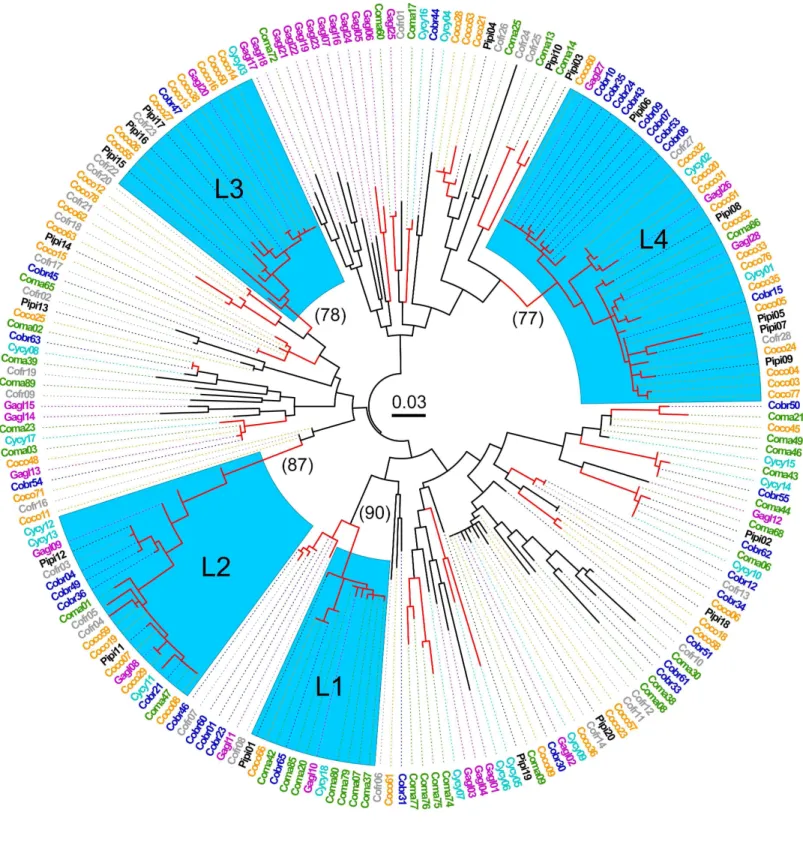
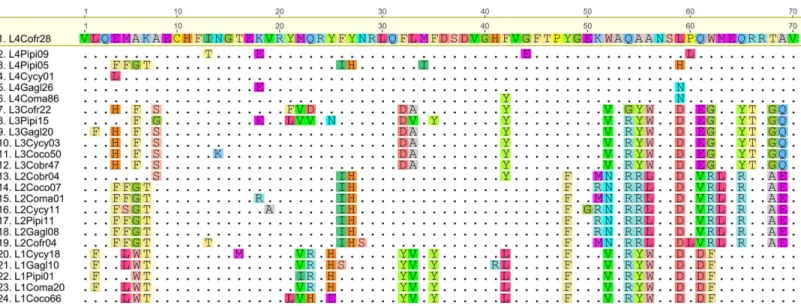
The ML tree revealed four well supported clades (>75% bootstrap support) with each con- taining all four genera, and one lineage with three genera (Fig 1). Further evidence of TSP was shown in the amino acid alignments of the four major allelic lineages which showed striking motif sharing within lineages, and even in some cases, identical amino acid sequences shared among genera (Fig 2). While it was not possible to assign alleles to specific loci, the four allelic lineages identified share distinct nucleotide and amino acid motifs, and group into well sup- ported clades, suggesting that these lineages belong to either individual loci, or, more likely, to distinct groups of paralogous loci (Figs1and2).
Age of allelic lineages
The test for saturation in DAMBE revealed little saturation effect: Iss < Iss.c. (P < 0.0000). The adjusted mutation rates for each lineage using the zebra finch rate were calculated at: L1 = 0.00191, L2 = 0.00162, L3 = 0.00182, L4 = 0.0014 (per site/million years). Using the chicken adjusted rate these values were L1 = 0.00212, L2 = 0.00148, L3 = 0.00165, L4 = 0.00132. The aver- age adjusted rate (across all four lineages) was 0.00160 using the zebra finch rate and 0.00177 using the chicken rate.
Table 1. Statistics for 248 bp fragment of MHC IIB exon 2 in corvid birds used in this study. Cobr= American crow; Coco = carrion crow; Coma = jun- gle crow; Cofr = Asian rook; Gagl = Eurasian jay; Pipi = Eurasian magpie; Cycy = azure-winged magpie.
Species n Variants (total) Variants (individual) π1 π dS2 π dN3 dN/ dS P-value Z-test4 P-value Z-test PBR5
Cobr 18 33 11–18 0.162 0.119 0.177 1.5 <0.0001 0.008
Coco 18 56 12–20 0.160 0.113 0.179 1.6 0.001 0.005
Coma 18 31 7–18 0.168 0.134 0.181 1.3 0.004 0.01
Cofr 3 27 8–15 0.179 0.136 0.194 1.4 0.001 0.006
Gagl 4 28 9–19 0.177 0.147 0.188 1.3 0.002 0.0015
Pipi 4 20 9–11 0.175 0.128 0.194 1.5 <0.0001 0.003
Cycy 3 18 8–12 0.188 0.151 0.201 1.3 0.001 0.008
1nucleotide diversity
2synonymous substitution rate
3non-synonymous substitution rate
4codon test for selection using entire fragment
5codon test for selection using the peptide binding region partition from Brown et al. [36]
doi:10.1371/journal.pone.0163456.t001
Fig 1. Maximum likelihood tree of MHC IIB variants (248 bp) in seven species of Corvidae.Four lineages (L1-L4) that contained four different genera clustered with> 75% bootstrap support (blue highlight). Pertinent bootstrap values are in parentheses. Cobr = American crow; Coco = carrion crow; Coma = jungle crow; Cofr = Asian rook; Gagl = Eurasian jay; Pipi = Eurasian magpie; Cycy = Azure-winged magpie. Red branches indicate> 70% bootstrap support. Scale bar in center indicates substitutions/site.
doi:10.1371/journal.pone.0163456.g001
MCMC simulations using the zebra finch adjusted mutation rate The estimate of the mean posterior distribution to the MRCA was similar whether using the random local clock or the relaxed log normal clock; however, the HPDs using the random local clock had considerably lower ranges than those calculated from the relaxed clock. Summary statistics for both clock models are reported inS2andS3Tables. When comparing the HPDs, the mean range when using the random local clock was 27.7 my while the mean range for the relaxed clock was 37.7 my, a difference of ~27%. In addition, the standard errors of the mean as well as the standard deviations were less using the random clock and BEAST output esti- mated sample size (ESS) values for all statistical categories were > 100. Thus, the following results are reported using the random local clock setting.
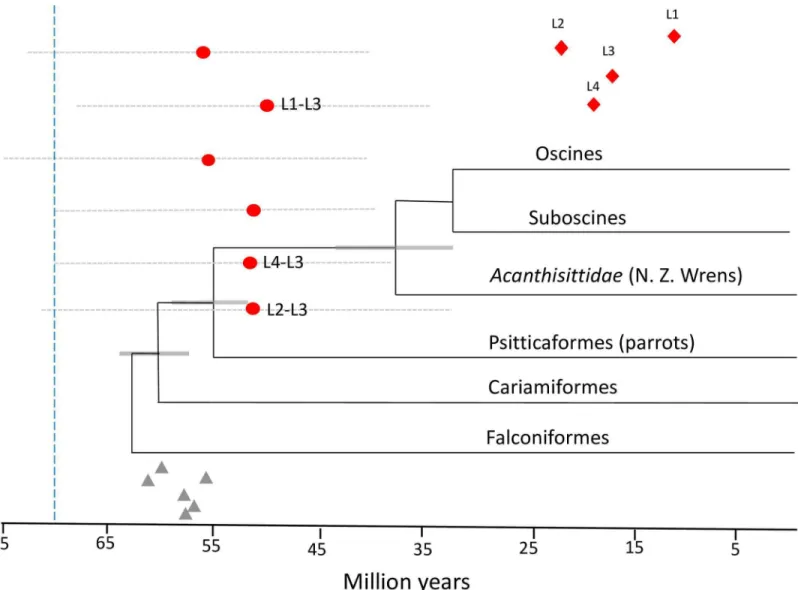
The time to the MRCA for each of the four allelic lineages ranged from a mean of 10.0–23.3 ma. Divergence time estimates for all lineages and lineage-lineage divergences are found inFig 3. Summary statistics, including MRCA (mean posterior distribution), HPDs, standard errors of the means and standard deviations are reported inS2 Table. By combining the ancestral recon- structions from the Mesquite analysis, the ML tree and the estimated divergence times, a picture of the evolutionary history of these lineages emerges as such: The L2, L3 and L4 lineages diverged from each other ca. 53 ma., while the L1 lineage diverged from the L3 lineage ca. 49.1 ma (Fig 4; S1 Fig). The estimated time to the MRCA for all lineages was 61.5 ma (HPD: [46.9; 76.4]).
As expected, the results of MCMC simulations using the chicken adjusted mutation rate revealed slightly older divergence times across all lineage comparisons. The same pattern of smaller HPD ranges and as well as standard errors and standard deviations when employing a random local clock versus a relaxed clock were also observed in these simulations. Summary statistics for divergence time using the chicken adjusted rate are shown inS3 Tableand mean divergence times of lineages from each other are shown inFig 3.
Discussion
In this study we have provided evidence for the maintenance of ancient MHC IIB lineages among several genera of corvid birds, and to our knowledge, the strongest evidence for TSP in
Fig 2. Amino acid alignment of representative sequences from each of six supported MHC IIB lineages.Each lineage (L1 –L4) contains four genera. Dots indicate amino acids identical to reference (L4Cofr28). Cobr = American crow; Coco = carrion crow; Coma = jungle crow; Cofr = Asian rook;
Gagl = Eurasian jay; Pipi = Eurasian magpie; Cycy = Azure-winged magpie. doi:10.1371/journal.pone.0163456.g002
passerines to date. In addition, using phylogenetic and ancestral state reconstruction in combi- nation with MCMC simulations we show that these MHC lineages likely represent the descen- dants of a single MHC IIB locus, which was previously shown by Burri et al. (2008) to be DAB1 [20].We suggest that this ancestral locus was duplicated multiple times at or near the time of the split between the Passeriformes (which appear to share the characteristic of highly dupli- cated MHC IIB) from the rest of the avian orders (which, except in rare cases, exhibit two– three MHC IIB loci [14]). Furthermore, sample size limitations mean that we likely did not uncover all of the MHC IIB lineages present within the Corvidae, as several intergenic clusters were observed, but not supported in the tree. The inclusion of additional corvid genera and increased sample sizes within species may resolve more allelic lineages within this family, with the implication that the DAB1 locus has experienced more than three duplications just prior to the major passerine radiations than the data presented here suggest.
Fig 3. MCMC simulations performed in BEAST v. 2.0 using the zebra finch adjusted mutation rate.Mean estimates of divergence between each pair of lineages (red circles) and the associated 95% highest posterior density interval (HPD) for each posterior distribution (gray dotted lines). Lineage divergences proposed by simulated ancestral states are labeled: L1-L3, L4-L3, L2-L3. Red diamonds = mean divergence time in millions of years (ma) of four supported MHC IIB lineages (L1-L4) in the Corvidae. Gray triangles are the mean estimates of the MRCA for the all lineage dyads using the adjusted chicken mutation rate. The phylogenetic reconstruction and estimated divergence times of major clades are from Jarvis et al. (2014). Blue vertical dashed line indicates an alternate estimated divergence time of suboscine and oscine clades (Ericson et al. 2014).
doi:10.1371/journal.pone.0163456.g003
Our data suggest an early duplication of the MHC in passerines, which is consistent with a recent analysis of the MHC IIB in Australian basal songbird lineages that showed supported clustering of MHC IIB alleles (TSP) among different families [25]. There are, however, two potentially contentious issues in this study that we would like to address; firstly, the effects of gene conversion on population genetic statistics and the phylogenetic signal of the MHC, and secondly, the avian divergence times that we used to relate our findings.
Gene conversion and MHC
Gene conversion is known to affect the both the pattern of nucleotide substitutions and diver- gence estimates. Teshima and Innan (2004) assessed the effect gene conversion had on diver- gence time estimates on a system consisting of duplicated genes (such as the MHC). Using simulations, the authors determined that analyzing duplicated genes based on the molecular clock may be misleading if gene conversion is common [50]. Similarly, in an empirical study on gene conversion (recombination) in plant resistance genes (R genes), Jouet et al. (2015) found that this evolutionary force significantly altered the divergence time estimates of taxa, as well as the overall gene tree topology. Increased levels of polymorphism in recombinant regions resulted in a 14.3% overestimation of the age of the taxa in the phylogenetic tree using the total alignment compared to the tree with recombinant regions removed [28]. Given that gene con- version can result in concerted evolution, i.e. in the homogenization of MHC alleles within spe- cies, loci may appear less diverged from one another. This mechanism has been proposed to explain patterns observed in MHC phylogenies of songbirds, which often cluster by species rather than by locus (as in mammals etc. e.g. [27,38,51]). However, the MHC lineages used in our analysis showed a remarkable amino acid motif similarity between species, which we inter- pret as evidence against a strongly homogenizing force such as gene conversion. Indeed, it is difficult to envisage how this pattern could have been maintained over many millions of years under constant gene conversion across MHC loci. Nevertheless, in order to minimize the effect of gene conversion, we based our estimates on a random local clock, rather than a strict clock, and used calibration points which have been proposed to minimize the bias in age estimates introduced by recombination [28].
A further complication of gene conversion is its potential effect on substitution patterns and signals of selection. New MHC alleles are thought to be generated through both intra and
Fig 4. Proposed evolutionary history of the major MHC IIB lineages in corvids.The cladogram was constructed from the ancestral state reconstruction conducted in Mesquite combined with the ML tree and MCMC divergence time data. Mean divergence times are indicated next to major nodes. Inclusion of DAB1 as the progenitor locus is based on evidence provided by Burri et al. (2008) [20].
doi:10.1371/journal.pone.0163456.g004
inter-locus gene conversion, and while gene conversion does not increase overall MHC nucleo- tide diversity, it does increase functional allelic diversity [29]. Short-block gene conversion has been suggested to contribute to MHC diversity and increase the dN/dSratios, potentially lead- ing to spurious signals of positive selection [38]. On the other hand, Spurgin et al. (2011) showed that short-block gene conversion (which they called “micro-recombination”) increased both dNand dS, but that it had little impact on the dN/dSratios. Their study of Berthelot’s pipit (Anthus berthelotii), showed significantly elevated synonymous and non-synonymous substi- tutions in the peptide binding region of the MHC, and of the 29 sequences that evolved in the last 75,000 years, 27 gene conversion events and two point mutations could potentially explain all the MHC sequence variation in the pipit populations [52]. It is unclear how this pipit MHC system relates to the corvid species in our study; however, it is likely that gene conversion con- tinues to generate allelic diversity in the species examined here. Indeed, most of the MHC IIB sequences inFig 1do not group into supported clades, and thus the loci these alleles are associ- ated with may indeed experience higher rates of recombination than the established lineages (L1-L4). Our results and conclusions, however, rely on the sequence similarities found within the supported lineages, and it is unlikely that these similarities resulted from independent gene conversion events within each species.
Avian divergence times
Our conclusion that multiple duplication events of a single MHC IIB locus occurred just prior to or during the split between the passerines and parrots is based on the avian divergence times estimated by Jarvis et al. (2014) (Fig 3). This analysis combined multiple fossil calibrations and genome wide nucleotide data sets to construct a highly resolved total evidence nucleotide tree (TENT). While the Jarvis et al. (2014) avian tree is by far the most comprehensive and arguably the most accurate estimate of divergence times within the avian class, we do not discount another recent estimate for the divergence times of the Passeriformes carried out by Ericson et al. (2014) [30]. This estimate argues for an older suboscine/oscine split within the Passeri- formes (ca. 71 ma); although it was based on only nine nuclear genes and fewer fossil calibra- tions than the Jarvis et al. (2014) estimate. If the suboscine/oscine split is indeed much older than generally accepted (ca. 71 vs. ca. 31 ma), our results indicate that the MHC IIB duplication event occurred after the suboscine/oscine split, near the beginning of the major songbird radia- tions (Fig 3). This is conceivable, and the possibility could be resolved by analysis of suboscine MHC IIB systems; however, no studies to date have provided any estimates of the number of MHC IIB loci found in extant suboscines.
Evolutionary success of passerines
The reasons for the unparalleled success of songbirds, in terms of species diversification and range expansion, remain to be answered; however, a few key adaptations have been proposed. These passerine-specific adaptations, or synapomorphies, include spermatozoa and palate morphology, relatively larger brains and higher cognitive ability compared to other birds, increased vocalization skills and generally small body size [10,53,54]. In this study, the diver- gence time of three of the four corvid MHC IIB allelic lineages was ca. 53 ma, which corre- sponds to the divergence of the passerine clade from the parrot clade [13]. We suggest that the similar timing of these ancient duplications and the divergence of passerines from other avian groups may not be coincidental, but rather may be related to the success of this clade.
These first duplications have likely been followed by further duplications (and deletions) that explain the high number of MHC loci observed in extant passerines. Highly duplicated MHC genes, whether functional or not, could serve as reservoirs for pathogen-resistance
associated genetic polymorphisms [1,29] that enabled the passerines to radiate faster and wider than any other avian group, and thus should be considered among the possible synapo- morphies that explain their unrivaled taxonomic and ecological diversity among terrestrial vertebrates.
While research on adaptive evolution and speciation theory has historically focused on the MHC, there are many other multigene families in the immune genome of birds that show high levels of polymorphism and strong signatures of positive selection, perhaps most notably the avianβ-defensins (AvBDs) and Toll-like receptor (TLRs) [55,56]. Further analyses of these immune gene families and comparisons with the MHC are warranted to examine whether the unique expansion of the MHC has indeed been instrumental in the evolutionary success of passerines.
Conclusions
The results presented here provide compelling evidence that the highly duplicated MHC IIB observed in passerine birds is primarily the result of ancient gene duplication, although more recent duplication and recombination likely continue to shape the MHC IIB of songbirds. Esti- mates of divergence between different corvid lineages suggest that a major MHC IIB duplica- tion event coincides with the divergence of the Passeriformes from other avian orders ca. 53 ma. Since the MHC is a critical component of pathogen recognition and immune response, the expansion of this gene complex in passerines may have facilitated more rapid range expansion and increased species survival relative to other avian orders. We argue that duplication of the MHC early in the passerine radiations is a potential synapomorphy that contributed to the unparalleled success of this order.
Supporting Information
S1 Fig. Ancestral state reconstruction of each MHC IIB lineage found among four corvid genera using parsimony jukes cantor analysis in Mesquite.Included is a cladogram showing the bootstrap values (500 replicates) from a ML reconstruction using the K-2 model.
(DOCX)
S1 Table. Collection sites and dates for all samples in this study. (DOCX)
S2 Table. Comparison of MCMC clock settings using the adjusted mutation rate of zebra finch in BEAST v.2.0.
(DOCX)
S3 Table. Comparison of MCMC clock settings using the adjusted mutation rate of chicken in BEAST v.2.0.
(DOCX)
S4 Table. Specimen identification numbers for samples from the Japanese National Museum of Nature and Science and from the Yamashina Institute of Ornithology. (DOCX)
Acknowledgments
We would like to thank Naoyuki Takahata for help in data analysis and manuscript prepara- tion. We also thank Chelsea Didinger for help with laboratory work and sequence analysis. We thank Reto Burri for initial evaluation and advice regarding the conclusions of the analysis.
Author Contributions
Conceptualization:JAE YS SL PJ IN AKT. Data curation:JAE.
Formal analysis:JAE AKT YS SL. Funding acquisition:YS SL. Investigation:JAE YS IN SL. Methodology:JAE YS.
Project administration:YS SL. Resources:YS SL PJ.
Supervision:SL YS. Validation:JAE. Visualization:JAE YS. Writing – original draft:JAE.
Writing – review & editing:JAE YS AKT SL.
References
1. Nei M, Gu X, Sitnikova T. Evolution by the birth-and-death process in multigene families of the verte- brate immune system. Proc Natl Acad Sci. 1997; 94(15):7799. PMID:9223266
2. Kulski JK, Shiina T, Anzai T, Kohara S, Inoko H. Comparative genomic analysis of the MHC: the evolu- tion of class I duplication blocks, diversity and complexity from shark to man. Immunol Rev. 2002; 190 (1):95–122. doi:10.1034/j.1600-065X.2002.19008.xPMID:WOS:000179946400008.
3. Janeway C, Travers P, Walport M, Shlomchick M. Immunobiology: the immune system in health and disease. New York: Garland Press; 2005.
4. Sommer S. The importance of immune gene variability (MHC) in evolutionary ecology and conserva- tion. Front in Zool. 2005; 2:16.
5. Zelano B, Edwards SV. An Mhc component to kin recognition and mate choice in birds: predictions, progress, and prospects. Am Nat. 2002; 160:S 225–37.
6. Haig D. Maternal-fetal interactions and MHC polymorphism. J Reprod Immunol. 1997; 35(2):101–9. PMID:9421795.
7. Kiemnec-Tyburczy K, Richmond J, Savage A, Zamudio K. Selection, trans-species polymorphism, and locus identification of major histocompatibility complex class IIβ alleles of New World ranid frogs. Immunogenetics. 2010; 62(11):741–51. doi:10.1007/s00251-010-0476–6
8. Klein, Satta Y, Ohuigin C, Takahata N. The molecular descent of the Major Histocompatibility Com- plex. Annu Rev Immunol. 1993; 11:269–95. PMID:ISI:A1993KX30600011.
9. Bollmer JL, Dunn PO, Whittingham LA, Wimpee C. Extensive MHC Class II B Gene Duplication in a Passerine, the Common Yellowthroat (Geothlypis trichas). J Heredity. 2010; 101(4):448–60. doi:10. 1093/jhered/esq018
10. Raikow RJ, Bledsoe AH. Phylogeny and evolution of the passerine birds. Bioscience. 2000; 50 (6):487–99. doi:10.1641/0006-3568(2000)050[0487:Paeotp]2.0.Co;2PMID:ISI:000087483000007. 11. Barker FK, Cibois A, Schikler P, Feinstein J, Cracraft J. Phylogeny and diversification of the largest
avian radiation. Proc Natl Acad Sci U S A. 2004; 101(30):11040–5. doi:10.1073/pnas.0401892101 PMID:15263073; PubMed Central PMCID: PMC503738.
12. Pyron RA, Burbrink FT, Wiens JJ. A phylogeny and revised classification of Squamata, including 4161 species of lizards and snakes. BMC Evol Biol. 2013; 13. Artn 93 doi:10.1186/1471-2148-13-93PMID: WOS:000320308700001.
13. Jarvis ED, Mirarab S, Aberer AJ, Li B, Houde P, Li C, et al. Whole-genome analyses resolve early branches in the tree of life of modern birds. Science. 2014; 346(6215):1320–31. doi:10.1126/science. 1253451PMID:25504713; PubMed Central PMCID: PMC4405904.
14. Alcaide M, Munoz J, Martinez-de la Puente J, Soriguer R, Figuerola J. Extraordinary MHC class II B diversity in a non-passerine, wild bird: the Eurasian coot Fulica atra (Aves: Rallidae). Ecol and Evol. 2014; 4(6):688–98. doi:10.1002/ece3.974PMID:WOS:000332902900002.
15. Klein, Sato A, Nagl S, O’hUigı´n C. Molecular trans-species polymorphism. Annu Rev Ecol Syst. 1998; 29(1):1–21. doi:10.1146/annurev.ecolsys.29.1.1
16. Lenz TL, Eizaguirre C, Kalbe M, Milinski M. Evaluating patterns of convergent evolution and trans-spe- cies polymorphism at MHC immunogenes in two sympatric stickleback species. Evolution. 2013; 67 (8):2400–12. doi:10.1111/evo.12124PMID:23888860.
17. Bryja J, Galan M, Charbonnel N, Cosson JF. Duplication, balancing selection and trans- species evolu- tion explain the high levels of polymorphism of the DQA MHC class II gene in voles (Arvicolinae). Immunogenetics. 2006; 58(2–3):191–202. doi:10.1007/s00251-006-0085–6PMID:16467985. 18. Ottova´ E, Simkovaa A, Martin J, de Bollocq JG, Gelnar M, Allienne J, et al. Evolution and trans-species
polymorphism of MHC class IIB genes in a cyprinid fish. Fish and Shellfish Immunology. 2005; 18:199–222. PMID:15519540
19. Edwards SV, Chesnut K, Satta Y, Wakeland EK. Ancestral polymorphism of Mhc class II genes in mice: Implications for balancing selection and the mammalian molecular clock. Genetics. 1997; 146 (2):655–68. PMID:ISI:A1997XD21600020.
20. Burri R, Hirzel HN, Salamin N, Roulin A, Fumagalli L. Evolutionary Patterns of MHC Class II B in Owls and Their Implications for the Understanding of Avian MHC Evolution. Mol Biol Evol. 2008; 25 (6):1180–91. doi:10.1093/molbev/msn065PMID:18359775
21. Alcaide M, Edwards SV, Negro JJ. Characterization, polymorphism, and evolution of MHC class II B genes in birds of prey. J Mol Evol. 2007; 65:541–54. PMID:17925996
22. Eimes JA, Townsend AK, Sepil I, Nishiumi I, Satta Y. Patterns of evolution of MHC class II genes of crows (Corvus) suggest trans-species polymorphism. PeerJ. 2015; 3:e853. doi:10.7717/peerj.853 PMID:25802816; PubMed Central PMCID: PMC4369332.
23. Sato A, Tichy H, Grant PR, Grant BR, Sato T, O‚A¨oˆhUigin C. spectrum of MHC Class II variability in Darwin’s finches and their close relatives. Mol Biol Evol. 2011; 28(6):1943–56. doi:10.1093/molbev/ msr015PMID:21273633
24. Zagalska-Neubauer M, Babik W, Stuglik M, Gustafsson L, Cichon M, Radwan J. 454 sequencing reveals extreme complexity of the class II Major Histocompatibility Complex in the collared flycatcher. BMC Evol Biol. 2010; 10:395. Epub 2011/01/05. doi:10.1186/1471–2148-10-395PMID:21194449; PubMed Central PMCID: PMC3024992.
25. Balasubramaniam S, Bray RD, Mulder RA, Sunnucks P, Pavlova A, Melville J. New data from basal Australian songbird lineages show that complex structure of MHC class II beta genes has early evolu- tionary origins within passerines. BMC Evol Biol. 2016; 16(1):112. doi:10.1186/s12862-016-0681-5 PMID:27206579; PubMed Central PMCID: PMC4875725.
26. Sutton JT, Robertson BC, Grueber CE, Stanton JAL, Jamieson IG. Characterization of MHC class II B polymorphism in bottlenecked New Zealand saddlebacks reveals low levels of genetic diversity. Immu- nogenetics. 2013; 65(8):619–33. doi:10.1007/s00251-013-0708–7PMID:ISI:000321779300006. 27. Hess C, Edwards S. The evolution of the major histocompatibility complex in birds. Bioscience. 2002;
52:423–31.
28. Jouet A, McMullan M, van Oosterhout C. The effects of recombination, mutation and selection on the evolution of the Rp1 resistance genes in grasses. Mol Ecol. 015; 24(12):3077–92. doi:10.1111/mec. 13213PMID:25907026.
29. Ohta T. Effect of gene conversion on polymorphic patterns at major histocompatibility complex loci. Immunol Rev. 1999; 167(1):319–25.
30. Ericson PGP, Klopfstein S, Irestedt M, Nguyen JMT, Nylander JAA. Dating the diversification of the major lineages of Passeriformes (Aves). BMC Evol Biol. 2014; 14. Artn 8 doi:10.1186/1471-2148-14-8 PMID:WOS:000334374600001.31.
31. Burri R, Salamin N, Studer RA, Roulin A, Fumagalli L. Adaptive divergence of ancient gene duplicates in the avian MHC Class II B. Mol Biol Evol. 2010; 27(10):2360–74. doi:10.1093/molbev/msq120 PMID:20463048
32. Kircher M, Sawyer S, Meyer M. Double indexing overcomes inaccuracies in multiplex sequencing on the Illumina platform. Nucleic Acids Res. 2012; 40(1):e3. doi:10.1093/nar/gkr771PMID:22021376; PubMed Central PMCID: PMCPMC3245947.
33. Lighten J, van Oosterhout C, Bentzen P. Critical review of NGS analyses for de novo genotyping multi- gene families. Mol Ecol. 2014; 23(16):3957–72. doi:10.1111/mec.12843PMID:24954669.
34. Stuglik MT, Radwan J, Babik W. jMHC: software assistant for multilocus genotyping of gene families using next-generation amplicon sequencing. Mol Ecol Res. 2011; 11:739–42. doi:10.1111/j.1755- 0998.2011.02997.x
35. Galan M, Guivier E, Caraux G, Charbonnel N, Cosson JF. A 454 multiplex sequencing method for rapid and reliable genotyping of highly polymorphic genes in large-scale studies. BMC Genomics. 2010; 11:296. Epub 2010/05/13. doi:10.1186/1471-2164-11-296PMID:20459828; PubMed Central PMCID: PMC2876125.
36. Brown JH, Jardetzky TS, Gorga JC, Stern LJ, Urban RG, Strominger JL, et al. 3-dimensional structure of the human class-II histocompatibility antigen Hla-Dr1. Nature. 1993; 364(6432):33–9. PMID:ISI: A1993LK81800048.
37. Tamura K, Peterson D, Peterson N, Stecher G, Nei M, Kumar S. MEGA5: Molecular evolutionary genetics analysis using likelihood, distance and parsimony methods. Mol Biol Evol. 2011; 28:2731–9. doi:10.1093/molbev/msr121PMID:21546353
38. Miller HC, Lambert DM. Gene duplication and gene conversion in class II MHC genes of New Zealand robins (Petroicidae). Immunogenetics. 2004; 56(3):178–91. PMID:ISI:000222059000006.
39. Xia X, Xie Z. DAMBE: Software package for data analysis in molecular biology and evolution. J Hered. 2001; 92(4):371–3. doi:10.1093/jhered/92.4.371PMID:WOS:000170799400016.
40. Bouckaert R, Heled J, Kuhnert D, Vaughan T, Wu CH, Xie D, et al. BEAST 2: A software platform for Bayesian evolutionary analysis. PLoS Comp Biol. 2014; 10(4). ARTN e1003537 doi:10.1371/journal. pcbi.1003537PMID:WOS:000336507500022.
41. Arbogast BS, Edwards SV, Wakeley J, Beerli P, Slowinski JB. Estimating divergence times from molecular data on phylogenetic and population genetic timescales. Annu Rev Ecol Syst. 2002; 33:707–40. doi:10.1146/annurev.ecolsys.33.010802.150500PMID:ISI:000180007000024. 42. Maddison WP, Maddison DR. Mesquite: a modular system for evolutionary analysis.http://
mesquiteprojectorg. 2015.
43. Fay JC, Wu CI. Sequence divergence, functional constraint, and selection in protein evolution. Annu Rev Genomics Hum Genet. 2003; 4:213–35. 0.1146/annurev.genom.4.020303.162528. PMID: 14527302.
44. Nam K, Mugal C, Nabholz B, Schielzeth H, Wolf JBW, Backstrom N, et al. Molecular evolution of genes in avian genomes. Genome Biol. 2010;11(6). ARTN R68 doi:10.1186/gb-2010-11-6-r68PMID: WOS:000283775700011.
45. Zann RA, Sr M, JONES KR, BURLEY NT. The Timing of breeding by zebra finches in relation to rainfall in central Australia. Emu. 1995; 95:208–22. PMID:WOS:A1995TE64200006.
46. McGowan K. Demographic and behavioral comparisons of suburban and rural American crows. Nor- well, MA: Kluwer Academic Press; 2001.
47. Madge S, Burn H. Crows and jays. London, UK: Helm; 1993.
48. Li WH, Tanimura M, Sharp PM. An evaluation of the molecular clock hypothesis using mammalian DNA-sequences. J Mol Evol. 1987; 25(4):330–42. doi:10.1007/Bf02603118PMID:WOS: A1987J853400009.
49. Ekman J, Ericson PG. Out of Gondwanaland; the evolutionary history of cooperative breeding and social behaviour among crows, magpies, jays and allies. Proc Biol Sci. 2006; 273(1590):1117–25. doi: 10.1098/rspb.2005.3431PMID:16600890; PubMed Central PMCID: PMCPMC1560265.
50. Teshima KM, Innan H. The effect of gene conversion on the divergence between duplicated genes. Genetics. 2004; 166(3):1553–60. PMID:15082568; PubMed Central PMCID: PMC1470786. 51. Edwards SV, Wakeland EK, Potts WK. Contrasting histories of avian and mammalian Mhc genes
revealed by class II B sequences from songbirds. Proc Natl Acad Sci U S A. 1995; 92(26):12200–4. PMID:8618869; PubMed Central PMCID: PMC40324.
52. Spurgin LG, van Oosterhout C, Illera JC, Bridgett S, Gharbi K, Emerson BC, et al. Gene conversion rapidly generates major histocompatibility complex diversity in recently founded bird populations. Mol Ecol. 2011; 20(24):5213–25. doi:10.1111/j.1365-294X.2011.05367.xPMID:
WOS:000298089300010.
53. Sheldon FH, Gill FB. A reconsideration of songbird phylogeny, with emphasis on the evolution of tit- mice and their sylvioid relatives. Syst Biol. 1996; 45(4):473–95. doi:10.2307/2413526PMID:WOS: A1996WK35000004.
54. Raikow RJ, Bledsoe AH. Why so many kinds of passerine birds? Response from Raiko and Bledsoe. Bioscience. 2001; 51(4):269–70. doi:10.1641/0006–3568(2001)051[0269:Rfrab]2.0.Co;2PMID: ISI:000168960100003.
55. Gilroy D, van Oosterhout C, Komdeur J, Richardson DS. Avian beta-defensin variation in bottlenecked populations: the Seychelles warbler and other congeners. Conserv Genet. 2016; 17(3):661–74. doi: 10.1007/s10592-016-0813-xPMID:WOS:000376087200013.
56. Grueber CE, Wallis GP, Jamieson IG. Episodic positive selection in the evolution of avian toll-like receptor innate immunity genes. PLoS One. 2014; 9(3):e89632. doi:10.1371/journal.pone.0089632 PMID:24595315; PubMed Central PMCID: PMC3940441.