Article
Sustainable Development or Eco-Collapse: Lessons
for Tourism and Development from Easter Island
Eugenio Figueroa B. and Elena S. Rotarou *
Department of Economics, University of Chile, Diagonal Paraguay 257, Office 1506, Santiago 8330015, Chile; [email protected]
* Correspondence: [email protected]; Tel.: +56-2-978-3455; Fax: +56-2-978-3413
Academic Editor: Marcus Stephenson
Received: 29 June 2016; Accepted: 12 October 2016; Published: 26 October 2016
Abstract:While tourism brings many benefits to islands, it can also cause negative effects, especially when tourism development is a disorganised process, with significant environmental impacts. This has been the case of Easter Island: the recent, uncontrolled growth in tourist numbers together with social and political tensions, are signs of a socioeconomic process pursuing development that has neglected the institutional, environmental, social, and economic imperatives of sustainability for tourism management. The study initially presents the environmental impacts of tourism growth, including waste disposal and management issues, problems with sewage system, threats to water quality, and biodiversity loss. Next, using data from in situ fieldwork, interviews and surveys, it focuses on residents’ perceptions regarding environmental consequences of the vast tourism growth, as well as on the serious governance issues that Easter Island is currently facing and that complicate even further its sustainable development. Overall, our results indicate that—while acknowledging the negative impacts that uncontrolled tourism development has brought to the island and the need for it to become more sustainable—residents are in favour of tourism since it is the island’s main source of income and employment. The paper draws lessons for islands involved in the “development-through-tourism” model regarding the difficulties these islands will face in attaining their goals if they are not able to build and implement cooperative agreements among stakeholders to properly manage the common-pool resources involved. This is a warning sign for islands that enthusiastically promote tourism without implementing sound sustainability criteria to guide the management of their tourism sector.
Keywords: sustainable development of islands; sustainable tourism; residents’ perceptions; Easter Island; Chile; environmental degradation; sustainability governance; tourism management
1. Introduction
The concept of sustainability has been surrounded by epistemological and practical problems, contestation about its meaning and determinants [1], and criticism about the inability of the sustainability discourse to provide a basis to assess policies [2]. However, during the almost three decades from the inception of the concept of sustainability in 1987, the efforts made in many countries to provide practical content to sustainable development has produced some relevant fruits. One of them is a sort of a consensus on the relevance of taking into account four key imperatives of sustainability—the institutional, environmental, social and economic imperatives [3,4]—and their interconnections to produce practical criteria to make sustainable development operative in the day-to-day world. These four imperatives of sustainable development point to the need to strengthen participation, safeguard social cohesion, limit throughput of environmental resources, and foster economic competitiveness. However, as Springett [1] explains it, in this conceptualisation, economic competitiveness is linked not only to eco-efficiency, but also, as in the original vision of the Brundtland
Report [5], to justice, democracy and social cohesion, hence the multidisciplinary character of the concept of sustainability [6].
Islands are viewed as ideal locations to explore sustainability issues [7,8], since the sustainability challenges of limited resources and carrying capacity can be more readily observed and analysed in island societies [9]. In addition, due to their isolation, remoteness, and fragile environment, islands are epitomes of places where the imperatives of sustainable development are most relevant. These characteristics, however, are not the only handicaps that islands face in their path towards socioeconomic progress. In a recent study by Moncada et al. [10], twelve main key challenges related to islands’ sustainable development were identified. These challenges include: (1) extreme population dynamics; (2) low potential for economic diversification; (3) negative impact of land development; (4) marine water quality; (5) water status; (6) waste management challenges due to small size and remoteness; (7) tourism pressures; (8) insularity and peripherality; (9) declining agriculture and fisheries; (10) degradation of natural resources and loss of biodiversity; (11) high cost and impact of energy use; and (12) low levels of education and training.
These characteristics are not generally consistent with the principles of economic attractiveness according to the current prevailing economic development model based on economies of scale, low transport costs, and availability of physical and human capitals and natural resources. Because of these complexities, most islands suffer from resource management and governance issues, especially concerning the successful implementation of environmental protection policies, sustainable development strategies, and the achievement of regulatory compliance [11].
Among the different conceptual ways of dealing with the aforementioned challenges is the so-called Small Island Tourism Economies(SITEs) model. This model applies to small economies (with size being a relative concept in this case) that are island economies (with particular characteristics, such as remoteness and delicate ecosystems), and which rely heavily on tourism as the principal engine of economic growth and development [12]. While there are substantially wide differences among SITEs—including variations in economic growth rates, per capita income, poverty rates, environmental degradation, and social policies—their main features are their narrow production base and small domestic market that pushes them to focus on tourism development as a growth mechanism.
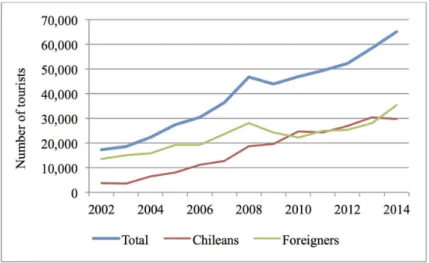
Easter Island is a perfect example for a study case of an insular economy and society that has embraced and is implementing the “development-through-tourism” model. During the last decade, the tourism industry in this Chilean island has experienced a tremendous growth, with tourist numbers reaching 65,064 people in 2014, an almost three-fold increase from a decade ago [13]. Research indicates that tourism is the backbone of the economy and that most residents work in the tourism sector [14,15]. However, Easter Island is currently facing a series of threats due to a large extent to the environmental effects that the uncontrolled and unplanned growth of tourism, as well as the mismanagement of common-pool resources, can have on a closed ecosystems such as islands. While many SITEs have to overcome additional barriers to their economic development, poor tourism management can turn a very promising economic sector into the main reason behind the decline in place attractiveness.
constitutes an exceptionally appropriate study case to analyse today the sustainability of the current “development-through-tourism” model and to provide lessons to avoid repeating past experiences
that are extremely costly in human and ecological terms.
Whereas tourism impacts can cover various economic, social, and cultural aspects, this paper focuses on the environmental side, by presenting residents’ perceptions on environmental impacts of the tourism sector on Easter Island. Nevertheless, while this paper deals mostly with the environmental aspect of tourism growth and residents’ perceptions, it addresses as well some very serious governance issues and challenges that the island is currently facing. These governance issues have a direct impact not only on the adoption of effective tourism management solutions but on the island’s general socio-economic well-being as well. As it is possible to argue directly from the generally accepted conclusions of Ostrom [18,19] on the appropriate stewardship of common-pool resources, to propose any tourism policies without at least referring to the complex governance issues and conflicts among the various stakeholders would be providing an incomplete picture of the challenges that Easter Island is currently facing in an effort to achieve sustainable development.
This complex side of governance in a fragile island environment, coupled with an explosive tourism growth, is what also makes our study particularly relevant for sustainable tourism development. Unlike other islands that rely heavily on tourism for their economic development and that may experience governance issues—for example, the Galápagos archipelago in Ecuador—Easter Island stands out on two reasons: (a) it might be the only such environment that experienced almost a total collapse of its civilisation and now, it is again, under threat due to unsustainable development practices; and (b) promotion of sustainable development and sustainable tourism depend largely on the solution of serious governance issues, that are further complicated by historical and ethnic reasons that underscore every aspect on Easter Island (such reasons, for instance, are not behind the Galápagos governance problems).
The next section presents a literature review regarding islands, tourism, and sustainable development, as well as residents’ perceptions of environmental impacts brought by tourism development. In Section3, the analytical, survey and fieldwork methodologies used are explained. Section 4describes the tourism sector on Easter Island, explores the current state of the tourism industry, and analyses the environmental impacts caused largely by tourism. Section5provides the results of the residents’ surveys and their perceptions regarding environmental impacts of tourism. Finally, Section6presents the governance challenges on Easter Island, and makes some recommendations regarding sustainable tourism management on islands; and Section7provides the conclusions and final comments.
2. Literature Overview: Islands, Tourism, and Sustainable Development
Tourism is often viewed as a panacea for the development of many islands, because it can lead to economic gains, employment, opportunities for small- and medium-size enterprises, infrastructure development, protection of natural and cultural resources, training and transfer of technology, management and technical skills, and poverty reduction [20–24]. Despite these benefits though, tourism is also associated with negative impacts, the seriousness of which depends on factors, such as characteristics of particular islands, national policies, and type of tourism [25]. The negative effects can be economic (increase in prices, infrastructure costs, economic leakage, and seasonality), socio-cultural (loss of authenticity, cultural exploitation, crime, and social tension), and environmental (land degradation, air pollution and noise, deforestation, waste and sewage problems, water pollution, overexploitation of natural resources, and biodiversity loss) [26–31]. Since the sustainability of many islands is directly related and connected to tourism—especially in the case of SITEs—sustainable tourism has become a key concept in the development debate. According to Butler [32], sustainable tourism is defined as:
degrade or alter the environment (human and physical) in which it exists to such a degree that it prohibits successful development and wellbeing of other activities and programmes.
Sustainable tourism aims at providing a balance between the economic, socio-cultural and environmental dimensions of tourism development [33]. The sustainable management of tourism focuses on the following areas:
• Economic sustainability aiming at achieving economic viability, local prosperity, and employment quality;
• Socio-cultural sustainability aiming at attaining social equity, visitor fulfilment, local control, community well-being, and cultural richness; and
• Environmental sustainability aiming at achieving physical integrity, biological diversity, resource efficiency, and environmental purity [25].
A number of studies have focussed on the relationship between tourism and sustainable development in island environments (see for example, Apostolopoulos and Gayle [34], Grandoit [35] on Caribbean, Pacific, and Mediterranean experiences; Baldacchino [36], Epler [37] on Galapagos archipelago; Briguglio and Briguglio [38] on Malta; [Christofakis, Mergos, and Papadaskalopoulos [39] on Greek islands; Graci and Dodds [40] on sustainability in various island destinations; Sharpley [41] on Cyprus; Sheldon, Knox, and Lowry [42] on Hawaiian Islands; Wilkinson [43] on Cuba). While geographical location and distance from tourist origin market have been widely acknowledged as an enabling or deterring factor for islands’ sustainable development [44–46], studies have also shown other determinants of tourism success in small islands. Some of these factors include general high level of development, good tourism infrastructure, dependent political status, transport and communications infrastructure, and reduced level of crowding [47–49].
Another important factor behind the success or failure of tourism development is the support and acceptance of host communities [50,51]. Research has focussed on various factors that are likely to influence residents’ perception towards tourism, such as the development stage of a destination [52,53], seasonality [54,55], various demographic variables, including gender, language, and marital status [56,57], level of participation and access to recreational facilities [58], personal reliance on tourism [59,60], knowledge about tourism [61], and tourism density [62].
Concerning residents’ perceptions of environmental impacts caused by the tourism sector and their attitude towards its further growth, research has not provided a definite answer. On the one hand, Smith and Krannich [63] argue that when tourism density is high, residents become more aware of environmental problems and costs arising from tourism. Pearce [64] and Liu and Var [65] find that high tourism development leads to resident dissatisfaction due to traffic and parking problems, crime, inflation, waste generation and pollution, and destruction of local flora and fauna, causing an increasing resistance and opposition to tourism development. On the other hand, Bujosa-Bestard and Roselló-Nadal [66] argue that higher tourist density leads to lesser concern of residents about environmental impacts, because residents depend financially on tourism. In general, studies have shown that there is a strong relationship between respondents’ socioeconomic characteristics and their perceptions of further tourism development [67–69]. These studies have confirmed the social exchange theory (SET), which states that residents perform a cost–benefit analysis and support or reject tourism development depending on the outcome [70]. Thus, a host community will tend to have groups that benefit largely from tourism (for example, people working in the tourism sector) and therefore, tend to support it and downplay its negative impacts, but also groups that see little or few benefits from tourism and underline its negative social and environmental consequences [71].
new NEP scale and showed that strong environmental attitudes influenced opinions on tourism in a negative way. Gursoy, Jurowski and Uysal [58] showed that residents with a high level of NEP scale scores perceived that tourism has higher costs and lower benefits, compared to residents expressing lower scores.
While in many cases the economic benefits of tourism are very large, the negative impacts on the environment can also be equally large, mainly due to the high pressure applied to the carrying capacity of their environment by the scale and type of tourist activities implemented. If this carrying capacity is exceeded, the resource basis erodes, visitor satisfaction decreases, and adverse effects on the society, economy, and culture follow [78]. Especially in closed and fragile ecosystems, such as islands, the environmental impacts of tourism are more easily observable, since the tourism industry itself is an important user of resources and producer of negative externalities, including waste, sewage, and noise [79,80]. Especially tourist accommodation and food service providers have a high environmental footprint [81]. Resource efficiency measures—such as, energy and water saving measures, waste reduction, and recycling—have been increasingly adopted by these providers not only so as to reduce operating costs but also to improve business image in the market, on account of altruistic and environmental values of individual managers and corporations, increased staff loyalty, demand and expectations of customers, and anticipation of future changes in legislation [81–83].
Sustainable management of the tourism sector that includes measures, such as tourism development plans, impact assessment, consumer education, resource efficiency, promotion of conservation, internalisation of costs, building of strong cohesion, setting standards and monitoring, community inclusion and consultation, is needed in order for islands to develop their tourism industry in accordance with the principles of sustainable development [38,84,85]. Policy frameworks and partnerships that go beyond individual businesses are also necessary [86].
3. Methodology
This paper relies on both primary and secondary sources regarding Easter Island’s tourism industry. Besides information from existing studies and research on Easter Island, SITEs, and sustainable tourism management especially regarding islands, we also use data obtained from two research trips, undertaken in September and December 2012 [87]. It should be mentioned here that the main purpose of these trips was the investigation and assessment of the island’s economic situation; since the main growth engine is tourism, our focus concentrated on that sector. However, in order to gain a fuller picture, we also gathered information on other sectors, mainly agriculture and fishing. Our study was part of a much bigger project aimed at establishing the possibility of introducing a large marine protected area (MPA) around Easter Island. While we focused on the economic aspect, other universities analysed the social, anthropological, and marine side of establishing a MPA.
During both trips, the researchers (the two authors of this paper and three of their graduate students) carried out 23 interviews in total with Easter Island residents and local actors, such as the Municipality, Chamber of Tourism, provincial government, tourism agencies, various environmental departments, and private businesses and companies, with the aim of acquiring information on the island’s economic sectors, tourism management, sustainability issues, environmental concerns, and immigration and governance problems. These open-ended interviews lasted between 45 min and 1.5 h each, and were conducted in Spanish, with the interviewers taking notes on the answers provided. The questions depended largely on the type of work of each of the people interviewed (for instance, when we interviewed people in charge at the Department of Environment of the Municipality of Easter Island, most questions involved environmental issues, recycling, waste management, etc.); however, all interviews included questions regarding tourism, for example, tourism’ role in the local economy, positive and negative impacts of tourism, whether tourism should increase, suggestions for improving tourism aspects, etc.
(see Appendix A). A total number of 171 surveys were carried out: 99 for residents and 72 for tourists. The residents’ surveys were all conducted in Spanish, while the tourists’ surveys were conducted in English for the foreign visitors and in Spanish for the local ones or the ones coming from Spanish-speaking countries [88]. The surveys employed neutral language and the reliability or internal consistency of tested items was checked and found to be “acceptable” (Cronbach’s alpha wasα> 0.700 for all questions regarding residents’ perceptions of tourism impacts, as well as for all questions regarding tourists’ perceptions of services on the island, their experience, and tourism impacts). Due to time and budget constraints, as well as the size of the research team, it was not possible to perform more surveys; hence, the small sample size, which still allowed for an acceptable sampling statistical error of 9%. Nevertheless, the results of the surveys support the observations made during the two-week research work on the island as well as the information received during the interviews carried out [89].
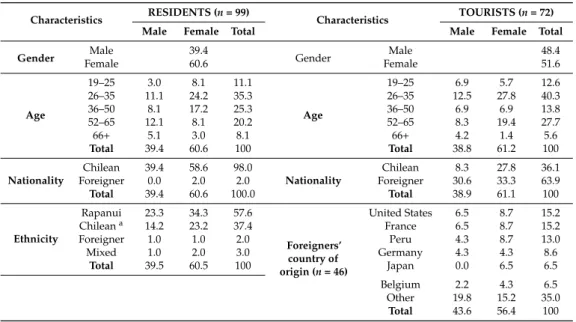
The sample population was selected through simple random sampling and the basic descriptive statistics for both residents and tourists are presented in Table1. The surveys were face-to-face, lasted for about twelve to fifteen minutes each, and included five- or seven-point Likert-type questions as well as a few open-ended questions.
Table 1.Population sample characteristics (residents and tourists).
Characteristics RESIDENTS (n= 99) Characteristics TOURISTS (n= 72)
Male Female Total Male Female Total
Gender FemaleMale 39.460.6 Gender FemaleMale 48.451.6
Age
19–25 3.0 8.1 11.1
Age
19–25 6.9 5.7 12.6
26–35 11.1 24.2 35.3 26–35 12.5 27.8 40.3
36–50 8.1 17.2 25.3 36–50 6.9 6.9 13.8
52–65 12.1 8.1 20.2 52–65 8.3 19.4 27.7
66+ 5.1 3.0 8.1 66+ 4.2 1.4 5.6
Total 39.4 60.6 100 Total 38.8 61.2 100
Nationality
Chilean 39.4 58.6 98.0
Nationality
Chilean 8.3 27.8 36.1
Foreigner 0.0 2.0 2.0 Foreigner 30.6 33.3 63.9
Total 39.4 60.6 100.0 Total 38.9 61.1 100
Ethnicity
Rapanui 23.3 34.3 57.6
Foreigners’ country of origin (n= 46)
United States 6.5 8.7 15.2
Chileana 14.2 23.2 37.4 France 6.5 8.7 15.2
Foreigner 1.0 1.0 2.0 Peru 4.3 8.7 13.0
Mixed 1.0 2.0 3.0 Germany 4.3 4.3 8.6
Total 39.5 60.5 100 Japan 0.0 6.5 6.5
Belgium 2.2 4.3 6.5
Other 19.8 15.2 35.0
Total 43.6 56.4 100
aChileans from mainland Chile; Source: Own elaboration.
As mentioned previously, the goal of our interviews and surveys was to gain as much knowledge on the economic situation on the island as possible. This was particularly important, especially taking into account that official information is scarce, fragmented, and incomplete. While generally more information is available regarding tourism than any other economic activity, data still remains inadequate: for example, there is not even an official and exact number of tourists visiting the island each year. Besides the difficulty in acquiring up-to-date and complete information, during our research trips we also had to face the occasional suspicion of local rapanui, who are distrustful of government officials and researchers from outside the island, especially when it concerns the release of sensitive information.
4. Tourism Industry and Its Environmental Impacts on Easter Island
4.1. Easter Island: General Information and the Tourism Industry
places in the world: the nearest populated place is Pitcairn Islands, 2806 km away. The permanent population of Easter Island is about 5800 people [90], out of which 60% are ethnic Rapanui and 40% are Chileans from the continent and foreigners, usually married to Rapanui [91].
Figure 1. Location and map of Easter Island, Chile (Source: Wikimedia Commons [92]).
Figure 1.Location and map of Easter Island, Chile (Source: Wikimedia Commons [92]).
Research indicates that tourism is indeed the main economic sector on Easter Island [14,91,93]. While there are no available data on the exact number of people working in the tourism industry, various sources—as well as our field observation and interviews undertaken on the island—underline that most residents are employed in the tourism sector [15,91]. It is estimated that the total annual income from tourism in 2012 ranged between US $46 and 90 million; and the annual income per capita was in the range of US $8000–15,500 [14].
Chileans [98]. In 2013, out of the foreign tourists to the Rapa Nui National Park, 15.9% came from the United States, 11.7% from France, and 9.3% from Brazil [99].
Figure 2. Tourist arrivals to Easter Island, 2002–2014 (Source: Own elaboration with data from [98,100,10 Figure 2.Tourist arrivals to Easter Island, 2002–2014 (Source: Own elaboration with data from [98,100,101]).
Although the vast majority of tourists do go to the Rapa Nui National Park and the figures provided above by CONAF are a relatively close approximation, it is considered that they are an underestimation of the total number of tourists on the island. This lack of exact information on tourist arrivals hinders current assessment or projections of tourist numbers, as well as calculation of present carrying capacity. Nevertheless, an estimate by Figueroa et al. [14] shows that, taking into account the current growth in tourist numbers, by 2020 tourist arrivals are expected to range from 92,000 to 118,000; and, by 2030, this range could be between 168,000 and 215,000 tourists.
The surveys we applied to Chilean and foreign tourists in the island showed that the three most important reasons for visiting the island were the following: (a) archaeological heritage (69% among Chileans and 78% among foreigners); (b) cultural heritage (73% among Chileans and 52% among foreigners); and (c) tranquillity (65% among Chileans and 24% among foreigners) (see Figure3).
Figure 3. Tourists’ main reasons for visiting Easter Island (Source: Figueroa et al. [14]). Figure 3.Tourists’ main reasons for visiting Easter Island (Source: Figueroa et al. [14]).
89% of tourists questioned declared that they were satisfied or very satisfied with the services that the island offers.
4.2. Environmental Challenges in Easter Island
Despite the recent economic flourish that the island has experienced, in the mind of many people, Easter Island is almost synonymous with “ecocide”, i.e., the ecological self-destruction of the environment by the island’s ancient inhabitants through deforestation, in order to build their megalithic statues, the Moai [103,104]. The island’s increasing population eventually led to exhaustion of natural resources—mainly wood—that in turn, led to population collapse and destruction of their civilisation [105–107]. As a result, Easter Island is viewed as an example of inefficient and unsustainable use of limited natural resources that, coupled with population growth, resulted in economic and social collapse [16,17,108].
In the last few years, the perceived environmental degradation on Easter Island has been so extensive that many reports talk about it as being “on the verge of environmental collapse” [15,109,110]. The constant increase in tourist numbers together with the growth of the local population pose a great challenge to the island’s carrying capacity and future sustainability. The last report on the carrying capacity of Easter Island underlined that while carrying capacity had not been exceeded yet, it was imperative for local authorities to solve problems related to public services, such as solid waste management, water sewage and potable water, and electricity, due to the increasing growth in tourist numbers [111]. While a more up-to-date report is needed regarding the island’s carrying capacity, the above issues need to be addressed, since—according to calculations by Figueroa et al. [14]—the people residing or vacationing on Easter Island (i.e., permanent residents, temporary workers, and tourists) on an average day might reach about 14,400 people by 2020 and about 20,000 people by 2030 [112].
The following sub-sections describe the main sustainability issues that currently affect Easter Island, and that have been greatly exacerbated by the arrival of an increasing amount of tourists. The information below has been gathered from secondary sources and our own interviews on the island.
4.2.1. Waste Disposal
The countries/regions with the highest per capita rates of waste generation are islands, most likely due to higher waste generated by the tourism industry [113]. In the case of Easter Island, as local residents become more affluent due to income stemming from the tourism industry, the generated waste also increases; thus, per capita waste in Easter Island increased from 0.8 kg per day in 2001 to about 1 kg in 2009 [111,114]. According to the Municipality of Easter Island, the increase in tourist numbers during the last fifteen years has led to a triplication of waste: daily waste is currently estimated at fifteen tons [115]. Waste is taken to the island’s two landfills (Orito and Vai a Ori), both lacking compliance with sanitary regulations [116].
A number of positive steps have been taken towards dealing with waste disposal and treatment. In 2010, for example, the Undersecretary of Regional Development delivered compost containers to 200 families on the island, in order to decrease waste disposal in the landfills [117]. The most recent development is the creation of an eco-park, with an investment estimate of US $4 million, which will allow the recycling of 80% of solid waste; its activities will also include environmental education and tourism [118].
4.2.2. Sewage System
Easter Island does not have a system for wastewater collection and treatment. Currently, 5% of houses use septic tanks installed in 2004, while the remaining use cesspits where they dispose the waste without any treatment [91]. Currently, the septic sludge is collected by one private operator and is being dumped into the environment, untreated [119].
in local population and tourists, can seriously jeopardise the water quality of the island’s aquifer. The intrusion of sewage waste into the aquifer could result in potable water contamination, health emergencies, as well as seawater contamination, which in turn could lead to damages to marine ecosystems and depletion of fish stocks, with dire consequences for local fishermen and tourists.
It has been suggested that a mixed sewerage system should be installed in Easter Island, which would include septic systems or composting toilets in distant areas that are outside the main urban area of Hanga Roa [119]. Nevertheless, research has indicated that the construction of such a system on the island is not an easy task, mainly due to the very high price of excavation of a sewage system, the implementation of sewage treatment, and the existence of buried archaeological artefacts that would be put at risk by excavations [111].
In the meantime, residents need to take advantage of existing state funding in order to acquire septic tanks. Another alternative for the in situ waste treatment would be the use of Californian worms (technology developed by the University of Chile), a system that is inexpensive, does not require sewerage, and that transforms wastewater into humus and water acceptable for irrigation.
4.2.3. Water Quality
Unlike many other islands, Easter Island does not face a problem with water quantity. Nevertheless, there are certain issues regarding water quality—and most likely—future water quality. The island’s soil is volcanic, with many fissures and caverns, fact that could eventually lead to intrusion of seawater into the aquifer. Milad [120] has identified a number of high-risk factors that could contaminate the island’s aquifer, including landfills, lack of sewage system, agricultural activities, informal wells, health centre, fuel zones, abattoir, quarries, and city’s cemetery.
Regarding water quality, we were unable to obtain access to periodical water analyses during our research trips to Easter Island. However, interviews with SASIPA (the island’s water and energy private company) personnel revealed that while the tests performed so far were negative, there is a real potential danger for water contamination in the future, especially since travel contaminants and population and tourism growth may generate an increase in the flow rate of the wells and thereby accelerate the migration of contaminants into them [120].
In order to improve existing water system and avoid contamination, SASIPA is in charge of a hydrologic project aiming at investigating the aquifer, its capacity, quality, and level of contamination (our team, however, was unable to obtain any relevant information during the research trips to the island). There are also plans to identify and close unused open wells, especially those that are very close to the seashore [91].
4.2.4. Biodiversity
Biodiversity is greatly affected by the way in which tourism and population grow, especially in developing countries or regions that are more vulnerable to economic, social, and environmental changes [121]. Easter Island, being a small and isolated area, is even more at danger from habitat destruction and biodiversity reduction, because of the increasing growth of the tourism industry and settlement expansion.
On Easter Island, the construction of tourist facilities is highly disorganised, informal and often without accompanying environmental impact assessment. Unregulated land use and building, overloaded and inadequate infrastructure, lack of basic services, and excessive vehicular traffic are the outcomes of the fast changes occurring in the last few decades [91]. These negative consequences are mainly the result of rapid tourism growth that has led to an increase in population—including floating population—so as to cater to the needs of an increasing amount of tourists.
The surveys also revealed that 34% of residents believe that tourism is a very significant or significant reason behind the destruction of flora and fauna on the island.
Another point of concern is the expanding land erosion on Easter Island. The main reason behind this process is overgrazing caused by the zebu Brahma cattle and horses [7]. While the increase in number of horses is directly associated to their perceived status symbol on Easter Island, it is also due to the increase in horse-riding activities offered to tourists. These activities are undertaken at beaches, archaeological sites, and hills, and often result in degradation not only of the archaeological patrimony—with horses grazing freely everywhere on the island—but also in the destruction of habitats.
4.3. Residents’ Perceptions Regarding Environmental Challenges
All the residents that we interviewed were Chileans (either rapanui, Chileans from the mainland, or mixed) with the exception of one foreign permanent resident. The majority were women (about 60%) (see Table1for more details).
Residents interviewed confirmed the central role of the tourism sector as a source of employment and income: 96% of the residents replied that tourism is important or very important for Easter Island, while 82% believed that the overall impact that tourism has on the island is positive, very positive or excellent. These results corroborated similar research on the role of tourism for Easter Island (see for instance, Ecopolis [91]). Residents also confirmed the answers provided by tourists (Figure3) regarding the reasons why visitors come to the island: 96% of them answered that it was because of the archaeological heritage, 90% due to the cultural heritage, and 62% because of the tranquillity.
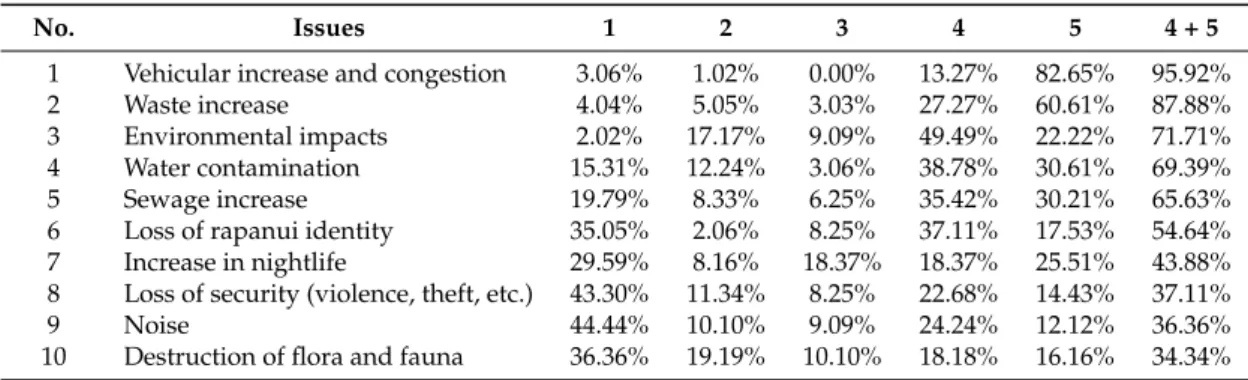
Concerning problems that Easter Island might be facing, initially residents were asked to respond with regards to the severity of any problems caused by tourism growth. Table2presents the perceived main tourism impacts in Easter Island and their importance. As it can be seen, the most important problems associated with tourism development on Easter Island, i.e., where residents believed that tourism has a significant or very significant impact, were vehicular increase and congestion (96%), waste increase (88%), environmental impacts (72%), water contamination (69%), and sewage increase (66%).
Table 2.Tourism impacts and their importance: Easter Island *.
No. Issues 1 2 3 4 5 4 + 5
1 Vehicular increase and congestion 3.06% 1.02% 0.00% 13.27% 82.65% 95.92% 2 Waste increase 4.04% 5.05% 3.03% 27.27% 60.61% 87.88% 3 Environmental impacts 2.02% 17.17% 9.09% 49.49% 22.22% 71.71% 4 Water contamination 15.31% 12.24% 3.06% 38.78% 30.61% 69.39% 5 Sewage increase 19.79% 8.33% 6.25% 35.42% 30.21% 65.63% 6 Loss of rapanui identity 35.05% 2.06% 8.25% 37.11% 17.53% 54.64% 7 Increase in nightlife 29.59% 8.16% 18.37% 18.37% 25.51% 43.88% 8 Loss of security (violence, theft, etc.) 43.30% 11.34% 8.25% 22.68% 14.43% 37.11%
9 Noise 44.44% 10.10% 9.09% 24.24% 12.12% 36.36%
10 Destruction of flora and fauna 36.36% 19.19% 10.10% 18.18% 16.16% 34.34%
* Order of importance, according to the answers provided by the residents interviewed; Note: Grade 1 means “insignificant problem” while grade 5 means “very significant problem”. Source: Own elaboration.
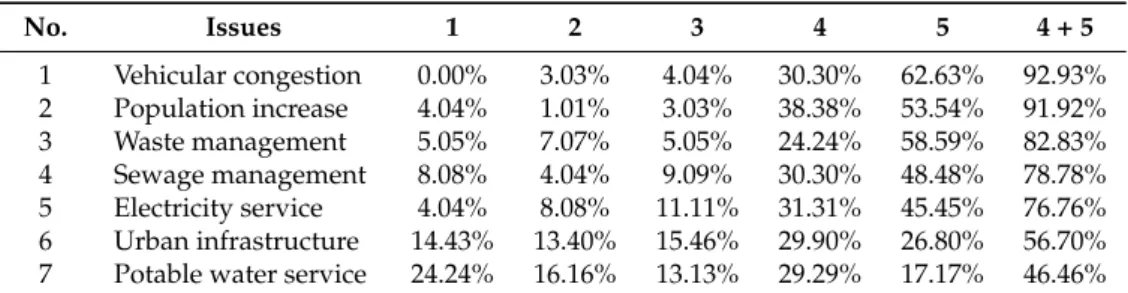
Table 3.Issues faced by modern islands: Easter Island *.
No. Issues 1 2 3 4 5 4 + 5
1 Vehicular congestion 0.00% 3.03% 4.04% 30.30% 62.63% 92.93% 2 Population increase 4.04% 1.01% 3.03% 38.38% 53.54% 91.92% 3 Waste management 5.05% 7.07% 5.05% 24.24% 58.59% 82.83% 4 Sewage management 8.08% 4.04% 9.09% 30.30% 48.48% 78.78% 5 Electricity service 4.04% 8.08% 11.11% 31.31% 45.45% 76.76% 6 Urban infrastructure 14.43% 13.40% 15.46% 29.90% 26.80% 56.70% 7 Potable water service 24.24% 16.16% 13.13% 29.29% 17.17% 46.46% * Order of importance, according to the answers provided by the residents interviewed; Note: Grade 1 means “insignificant problem” while grade 5 means “very significant problem”. Source: Own elaboration.
The same questions regarding tourism impacts on Easter Islands were asked of tourists. However, the vast majority was not particularly aware of any economic, social or environmental problems associated with tourism growth or otherwise; the main reason that they provided was that they were staying on the island for only a few days or that they were on a package holiday, and therefore they did not have the chance or time to notice any problems. A few issues that some of them underlined did not have to do with any environmental concerns, for example, existence of stray dogs and slow Internet. It should be mentioned at this point that one of the main issues that residents are concerned about—especially the rapanui—is population increase, since many tourists and Chileans from the mainland that arrive as temporary workers decide to stay permanently (this point was reiterated to us often during both interviews and residents’ surveys). This has led to a large increase in the non-rapanui population, with the rapanui themselves feeling under threat and abandoned to their fate by the Chilean government, despite the importance of the island as one of the most famous tourist attractions in the country [122]. Residents’ concerns, however, are mostly related to mainland Chileans or foreigners who decide to remain permanently on the island, and not so much with the increase in tourist numbers. This can be observed by the fact that 61% of those interviewed believed that tourism in Easter Island should increase because it is the main source of employment and income. Residents recognise though that tourism needs to be more sustainable, more selective, and according to the island’s carrying capacity. Residents that opposed an increase in tourism numbers sited that “there are no basic services for an increase in tourism”, “there are too many tourists already”, and “we need to manage what we have, we are overpopulated”.
Residents were also asked whether they believed that the island had been properly organised for the massive increase in tourism numbers. Twenty-six per cent of residents interviewed believed that tourism has been organised poorly or very poorly, 27% neither poorly nor well, 32% that it has been done well, and 14% that tourism has been organised very well or in an excellent manner. Some of the comments of people that believed that tourism organisation and management has been done poorly included the following: “tourism is discriminatory, with only large businesses being prepared and getting most rewards”, “there is an explosive growth of tourism without first taking care of electricity, water, etc.”, “quality of tourism services need to increase”, “tourism is becoming massive without any proper planning”, and “it has not been very well organised since during high season, we are overwhelmed”.
on the island to improve tourism facilities and infrastructure, and thus, provide a better experience for tourists (according to interviews).
All these aforementioned issues indubitably imply significant challenges for the future of tourism, especially when coupled with the serious governance problems that the island is facing. In the following section, we analyse some of the current issues regarding eventual obstacles on the governance front that Easter Island needs to address. The comments and conclusions provided below are based on literature review, but mostly on our own observations on the island, after having concluded our interviews and residents’ surveys.
5. Governance Challenges on Easter Island
Attractiveness and competitiveness of a tourist destination can be increased by proper environmental management [123] and, according to the Calgary model of competitiveness in tourism model [124], they can be enhanced by proper managerial and marketing efforts. However, due to the fact that these tasks involve the appropriate collective management of common pool resources, they require concerted actions [18], which, in turn, demand adequate degrees of social cohesion and governance. The accelerated growth of the tourism industry, however, has not only generated environmental problems on Easter Island but it has also accentuated some significant governance issues, which often are particularly challenging in a context characterised by a relatively small population, a very isolated environment, some underlying unresolved ethnic issues, and complex pending problems of political governance.
Environmental problems are generally the result of the misuse of available resources that, in turn, is traceable back to faulty decision-making, usually accompanied by lack of governance. The case of tourism expansion and environmental problems in Easter Island is not an exception. In fact, sustainable tourism management in Easter Island depends on a large degree on the level of cooperation and partnership between the various stakeholders [125]. As Ostrom [18,19] suggests, the socially optimal use of common pool resources—may they be natural resources, tourism or culture—requires cooperative solutions. Multi-stakeholder collaboration is necessary in order to deal with friction that arises from often-contradictory needs, and to reach dynamic sustainability equilibrium [126].
On Easter Island, the main obstacle in the promotion of sustainable tourism lies with the lack of cooperation among the relevant stakeholders [14]. These stakeholders have a conflicting relationship that has culminated in recent years in a series of demonstrations and violent protests on the island (regarding issues such as the management of the Rapa Nui National Park, the immigration law that is currently under discussion in the Chilean Parliament, and the island’s self-determination). During our stay on the island, we were witnesses to tensions and even hostility between rapanui clans, different public organisations, between government officials and rapanui representatives, or between rapanui and non-rapanui residents.
Thus, the failure to collectively agree on appropriate decision-making mechanisms to solve critical sustainability issues remains. This is what led Caswell [129], when analysing the early collapse of Easter Island civilisation some two to seven centuries ago [130], when the island’s population slowly overextended itself and 90% of all plant and animal life on the island became extinct, to conclude that mankind’s inability to solve its problems is a historical example of Proverbs 29(18): “Where there is no vision, the people perish”.
6. Sustainable Management of Tourism: Lessons from Easter Island
As mentioned previously, governance and sustainable tourism management on Easter Island is particularly difficult due to the existence of many stakeholders involved—each with different interests, points of view and visions—thus, making the decision-making process extremely difficult and slow [14]. Unfortunately, tourism management in many islands around the world—not just on Easter Island—has been largely disorganised, unregulated, and unsustainable, with authorities lacking a clear vision (for example, the Galápagos archipelago, islands in Thailand, Malta, and some islands in Greece).
Especially in the case of islands that base their economy on tourism—the SITEs—sustainable management of the tourism sector is of paramount importance for their future. Understanding this, the goals of sustainable management of tourism should be on the one hand, the increase in tourism’s positive contribution to the local economy, the preservation of natural and cultural heritage, and quality of life for both residents and tourists, and on the other hand, the reduction and mitigation of negative impacts on society and environment [25]. Figure4presents some guiding principles and approaches for sustainable tourism management.
Figure 4. Guiding principles and approaches for sustainable tourism management (Source: Adapted
Figure 4.Guiding principles and approaches for sustainable tourism management (Source: Adapted from United Nations Environment Programme (UNEP)–World Tourism Organisation (WTO) [25]).
mainland). Thus, no set of rules can be applied to all SITEs with regards to sustainable tourism development. Nevertheless, a sustainable tourism sector can be achieved through higher investment in infrastructure, especially transport, telecommunications, and tourism-related facilities; well-designed enforced regulations to deal with urban and environmental externalities; improvement of the quality of services and tourist experiences; a more equitable distribution of tourism gains; and provision of high-quality training for people employed in the tourism and hospitality industries [131]. This, in turn, can lead to economic diversification that can create opportunities for local economic growth, by creating employment opportunities in both tourist and non-tourist related businesses [132].
What, however, seems to be the common denominators behind sustainable management of tourism in islands are responsible governance and collectively-agreed management of islands’ natural resources and its tourism activities. In addition, while taking into account the different social structures and types of governance around the world, the answer for sustainable tourism practices seems to be the engagement and empowerment of local communities, since they are the ones that are directly affected by unregulated and unsustainable tourism growth. Local communities together with local or regional government institutions and other stakeholders should engage into meaningful dialogue and agree upon the on-going direction of tourism and deal with current and future economic, socio-cultural and environmental impacts linked to tourism development. This is a difficult task, especially in cases such as Easter Island, where there are many visions regarding the island’s future and sustainability, as well as conflicting views and lack of cooperation among the various stakeholders concerning economic development and social progress. Fragmentary and parochial visions, typical of small and closed communities, can only lead to heterogeneous strategies regarding sustainable tourism planning and management [133]. However, especially in the era of increasing globalisation and growing competition between old and new destinations, it is paramount that stakeholders find common ground so as to ensure a good quality of life for residents but also to maintain and increase tourists’ satisfaction.
7. Conclusions and Final Comments
While remoteness and difficult access pose extra pressure for islands’ sustainable development, the key is to achieve balance among the various interdependent systems—such as economic, social/demographic, cultural, political, physical and ecological—so as to be able to face external influences and internal adjustments. Disequilibrium takes place when pressures are so high that one type of society, economy or environment replaces another, without providing the necessary time or conditions for all the systems to adjust [134]. This has happened throughout history to various societies, and is especially pronounced in the case of islands [8,134], and particularly in the case of small islands with less than 800 km2and fewer than 100,000 people [135].
Our study adds to existing literature by connecting five issues: (a) a small, remote, and fragile ecosystem; (b) an impressive but uncontrolled tourism growth; (c) a previous historical collapse of civilisation; (d) a large number of stakeholders; and (e) historical and ethnic problems, endangering governance. Thus, Easter Island is a unique and complex case that poses significant problems for sustainable development. Only a collectively agreed, responsible and purposely-driven management of the island’s natural and cultural resources and its tourism activities—as suggested by Ostrom [18,19]—will avoid a new ecocide in Easter Island with most undesirable social consequences for its residents.
Paradoxically, tourism—which is currently the only promising economic sector for a sustainable future for Easter Island—could become the driving cause of a modern and soon collapse of its society, as the construction of the moai statues drove its previous collapse some centuries ago. Fortunately, unlike the ancient inhabitants of Easter Island that were most likely unaware of the slow deterioration of their environment and destruction of their civilisation, modern islanders have understood the necessity to take action in order to avoid the same fate. What remains to be seen is whether this realisation will be accompanied by concrete actions, cooperative behaviour, and resolution of various conflicts and opposing interests.
The past and modern history of Easter Island should be a lesson on sustainability for other islands, especially the ones that ardently promote tourism without first designing and undertaking sustainable tourism management strategies. It is paramount that national, regional, and local governments investigate whether their tourism policies adhere to the principles of sustainable development. Then, it is equally important that all the stakeholders are involved—especially through partnerships and cooperation at the local level—in order to tackle the common-pool resource management problems and to proceed to the necessary planning, networking, capacity building, and monitoring, that will integrate the tourism sector into the local sustainable development. In this context, sustainable tourism management is an indispensable tool for islands, primarily for those that see tourism as the backbone of their economy, in the sense that it can help island communities avoid the disastrous consequences of uncontrollable tourism growth.
Acknowledgments:Eugenio Figueroa B. acknowledges the financial support of the Centre of Natural Resource and Environmental Economics (CENRE), University of Chile. Elena S. Rotarou acknowledges the financial support received by Conicyt-Fondecyt, Postdoctorate Programme, under Project No. 3140481.
Author Contributions: Both authors conceived, designed, and performed the surveys. Eugenio Figueroa analysed the data and revised the paper written by Elena S. Rotarou. Both authors have read and approved the final manuscript.
Conflicts of Interest:The authors declare no conflict of interest.
Appendix A
Appendix A.1. Residents’ Survey—Easter Island 1. Please indicate age range
19–25 26–35 36–50 51–65 66+
2. Sex: M
onality: _____
M M
onality: _____
F
3. Nationality: _________________________
4. According to you, which are the reasons why tourists visit Easter Island? Indicate order of importance: 1st, 2nd, 3rd most important (maximum 3 reasons)
Archaeological heritage Cultural heritage Climate
Sea and beach Entertainment Tranquillity
Other reasons. Which?
5. Tourism in Easter Island has grown immensely during the last years: according to you, how has Easter Island organised and managed its tourism sector?
1 2 3 4 5 6 7
Extremely
badly Very badly Badly
Neither badly
nor well Well Very well Excellently
6. According to you, is tourism important for Easter Island?
1 2 3 4 5
Insignificant Almost insignificant Neither significant nor
insignificant Significant Very significant
7. According to you, from a scale from 1 to 5, the intensity or importance that tourism has had on the following issues is:
1 2 3 4 5
Insignificant Almost Insignificant
Neither Significant
Nor Insignificant Significant
Very Significant
Noise
Flora and fauna destruction
Waste increase
Water contamination
Sewage increase
Nightlife increase
Vehicular increase and congestion
Loss of safety (violence, robberies, etc.)
Loss of rapanui identity
Other reasons. Which?
8. Concerning environmental impacts of tourism and tourists, according to you, on a scale from 1 to 5, environmental impacts have been:
1 2 3 4 5
9. Concerning the most common problems of modern island societies, from a scale of 1 to 5, how would you characterise the situation of the following problems on the island?
1 2 3 4 5
Non-Existent Little Moderate Large Very Large
Population increase
Electricity service
Vehicular congestion
Waste management
Sewage management (sewerage, treatment)
Urban infrastructure
Potable water service
Other reasons. Which?
10. According to you, who should invest in order to address the island’s main problems?
Central government Rapa Nui community Tourism sector Business sector Other party. Who?
11. According to you, is it necessary to increase tourism on the island?
Yes Why?
No Why?
12. According to you, on a scale from 1 to 7, the effect that tourism has had on Easter Island is:
1 2 3 4 5 6 7
Disastrous Very
negative Negative
Neither negative
nor positive Positive
Very
positive Excellent
Appendix A.2. Tourists’ Survey—Easter Island 1. Please indicate age range
19–25 26–35 36–50 51–65 66+
2. Sex: M
onality: _____
M M
onality: _____
F
3. Nationality: _________________________
4. Country of residence: _________________________ 5. Where are you staying on Easter Island?
Hotel Cottage Hostel Inn Camping
6. Which are the main reasons you are visiting Easter Island? Indicate order of importance: 1st, 2nd, 3rd most important (maximum 3 reasons)
Archaeological Heritage Cultural heritage Climate Sea and beach Entertainment Tranquillity
Other reasons. Which?
7. From a scale from 1 to 5, please indicate the intensity or importance of the problems below that you have noticed:
1 2 3 4 5
Insignificant Almost Insignificant
Neither Significant
nor Insignificant Significant
Very Significant
Noise
Flora and fauna destruction
Waste problems
Water contamination
Sewage problems
Nightlife issues
Vehicular congestion
Loss of safety (violence, robberies, etc.)
Other reasons. Which?
8. Concerning the most common problems of modern island societies, from a scale of 1 to 5, how would you characterise the situation of the following problems on the island?
1 2 3 4 5
Non-Existent Little Moderate Large Very Large
Population increase
Electricity service
Vehicular congestion
Waste management
Sewage management (sewerage, treatment)
Urban infrastructure
Potable water service
Other reasons. Which?
9. Considering the most common services that the island offers, from a scale from 1 to 5, how would you evaluate the price of the following services, and in relation to what they offer?
1 2 3 4 5
Very Cheap Cheap Neither Cheap
Nor Expensive Expensive Very Expensive
Food
Transport
Accommodation
Entrance to the Park
Tourist attractions
10. Considering all the services previously mentioned, how would you evaluate the island in terms of prices?
1 2 3 4 5
Very cheap Cheap Neither cheap nor expensive Expensive Very expensive
11. From a scale from 1 to 5, how would you evaluate your staying on the island, taking into account all the services previously mentioned?
1 2 3 4 5
Very dissatisfied Dissatisfied Somehow satisfied Satisfied Very satisfied
References and Notes
1. Springett, D. Editorial: Critical perspectives on sustainable development. Sustain. Dev. 2013,21, 73–82. [CrossRef]
2. Christen, M.; Schmidt, S. A formal framework for conceptions of sustainability—A theoretical contribution to the discourse in sustainable development.Sustain. Dev.2012,20, 400–410. [CrossRef]
3. Di Castri, F.; Figueroa, E. El cohete de tres etapas.Induambiente1997,5, 52–55. (In Spanish)
4. Spangenberg, J.H. The linkage of economy, environment and social organization in the concept of sustainability. InDiscussions on Sustainable Production and Consumption in Europe: Report of the United Nations Environment Programme; UNEP/ROE: Geneva, Switzerland, 1996; pp. 49–56.
5. World Commission on Environment and Development (WCED). Report of the World Commission on Environment and Development: Our Common Future. Available online: http://www.un-documents.net/ our-common-future.pdf (accessed on 3 May 2016).
6. Shao, G.; Li, F.; Tang, L. Multidisciplinary perspectives on sustainable development. Int. J. Sustain. Dev. World Ecol.2011,18, 187–189. [CrossRef]
7. Di Castri, F. Sustainable tourism in small islands: Local empowerment as the key factor.Int. J. Isl. Aff.2004, 13, 49–56.
8. McElroy, J.L.; de Albuquerque, K. Tourism penetration index for the small-island Caribbean.Ann. Tour. Res.
1992,28, 145–168. [CrossRef]
9. Nagarajan, P. Collapse of Easter Island: Lessons for sustainability of small islands. J. Dev. Soc. 2006,22, 287–301. [CrossRef]
10. Moncada, S.; Camilleri, M.; Formosa, S.; Galea, R. From Incremental to comprehensive: Towards island-friendly European Union policymaking.Isl. Stud. J.2010,5, 61–88.
11. Douglas, C.H. Small island states and territories: Sustainable development issues and strategies—Challenges for changing islands in a changing world.Sustain. Dev.2006,14, 75–80. [CrossRef]
12. Shareef, R.; Hoti, S.; McAleer, M.The Economics of Small Island Tourism: International Demand and Country Risk Analysis; Edward Elgar: Cheltenham, UK, 2008.
13. CONAF. Estadísticas de Visitantes años 2004–2015. 2016. Available online: http://www.conaf.cl/parques-nacionales/visitanos/estadisticas-de-visitacion/ (accessed on 10 March 2016).
14. Figueroa, E.; Rotarou, E.; Aguilar, M.; Salazar, A.; Gutiérrez, P.; Mellafe, R. Impacto Económico del Establecimiento de un Área de Protección Marina en la Provincia de Isla de Pascua-Chile: Informe de Avance; PEW Foundation (PEG-Chile): Santiago, Chile; CESUCC and CENRE: Santiago, Chile; University of Chile: Santiago, Chile, 2013. (In Spanish)
15. Pérez, M.; Rodríguez, C. Impactos ambientales generados por el desarrollo turístico en la Isla de Pascua. Revista Interamericana Ambiente Turismo2011,7, 42–48. (In Spanish)
16. Foot, D.K. Easter Island: A case study in non-sustainability.Greener Manag. Int.2005,48, 11–20.
17. Flenley, J.R. The palaeoecology of Easter Island, and its ecological disaster. In Easter Island Studies; Fischer, S.R., Ed.; Oxbow Monograph Series; Oxbow: Oxford, UK, 1993; pp. 27–45.
19. Ostrom, E. Common-pool resources and institutions: Toward a revised theory. InHandbook of Agricultural Economics; Gardner, B., Rausser, G., Eds.; Elsevier: Amsterdam, The Netherlands, 2002; Volume 2, pp. 1315–1339.
20. Cole, S. Information and empowerment: The keys to achieving sustainable tourism.J. Sustain. Tour.2006,14, 629–644. [CrossRef]
21. Hall, D.; Brown, F.Tourism and Welfare; CABI: Wallingford, UK, 2006.
22. Harrison, D. Pro-poor tourism: A critique.Third World Q.2008,29, 851–868. [CrossRef]
23. Manwa, H.; Manwa, F. Poverty alleviation through pro-poor tourism: The role of Botswana forest reserves. Sustainability2014,6, 5697–5713. [CrossRef]
24. Scheyvens, R.; Momsen, J.H. Tourism and poverty reduction: Issues for small island states.Tour. Geogr.2008, 10, 22–41. [CrossRef]
25. Dynamic tourism growth can pose more threats to: (a) marine and coastal environments; (b) historic towns and cities, and cultural heritage sites; and (c) fragile natural environments. Islands share most of the above characteristics, and in our case, Easter Island, shares all of them. (UNEP; WTO.Making Tourism More Sustainable: A Guide for Policy Makers; UNEP: Paris, France; WTO: Madrid, Spain, 2005.).
26. Balletto, G.; Mei, G.; Garau, C. Relationship between quarry activity and municipal spatial planning: A possible mediation for the case of Sardinia, Italy.Sustainability2015,7, 16148–16163. [CrossRef]
27. Berno, T.; Bricker, K. Sustainable tourism development: The long road from theory to practice. Int. J. Econ. Dev.2001,3, 1–18.
28. Gerosa, V. Tourism: A viable option for pro-poor growth in Africa? In Proceedings of the Expert Group Meeting Munyonyo Speke Resort, Kampala, Uganda, 23–24 June 2003.
29. Gössling, S. Tourism, economic transition and ecosystem degradation: Interacting processes in a Tanzanian coastal community.Tour. Geogr.2010,3, 430–453. [CrossRef]
30. Krausse, G.H. Sustainable tourism for remote atolls in the Pacific.Int. J. Sustain. Dev. World Ecol.1995,2, 166–181. [CrossRef]
31. Peeters, P.; Landré, M. The emerging global tourism geography—An environmental sustainability perspective.Sustainability2011,4, 42–71. [CrossRef]
32. Butler, R.W. Tourism—An evolutionary perspective. InTourism and Sustainable Development: Monitoring, Planning, Managing; Nelson, J.G., Butler, R.W., Wall, G., Eds.; Department of Geography, University of Waterloo: Waterloo, ON, Canada, 1993; pp. 27–43.
33. While it is indispensable to include the notion of sustainability into tourism development, there has been an increasing amount of criticism regarding how tourism as a private-driven economic activity can be linked to the goals of sustainable development (Saarinen, J. Critical sustainability: Setting the limits to growth and responsibility in tourism.Sustainability2013,6, 1–17.). With voices claiming that ‘sustainable tourism is perhaps an impossible dream’ (p. 41) (Swarbrooke, J.Sustainable Tourism Management; CAB International: Wallingford, UK, 1999.)
34. Apostolopoulos, Y.; Gayle, D.Island Tourism and Sustainable Development: Caribbean, Pacific and Mediterranean Experiences; Praeger Publishers: Westport, CT, USA, 2002.
35. Grandoit, J. Tourism as a development tool in the Caribbean and the environmental by-products: The stresses on small island resources and viable remedies.J. Dev. Soc. Transform.2005,2, 89–97.
36. Baldacchino, G.Island Enclaves: Offshoring Strategies, Creative Governance, and Sustainable Island Jurisdictions; McGill-Queen’s University Press: Montreal, QC, Canada, 2010.
37. Epler, B.Tourism, the Economy, Population Growth, and Conservation in Galapagos; Charles Darwin Foundation: Puerto Ayora, Ecuador, 2007.
38. Briguglio, L.; Briguglio, M. Sustainable tourism in small islands: The case of Malta. InTourism, Biodiversity and Information; Di Castri, F., Balaji, V., Eds.; Backhyus Publishers: Leiden, The Netherlands, 2002; pp. 169–184. 39. Christofakis, M.; Mergos, G.; Papadaskalopoulos, A. Sustainable and balanced development of insular space:
The case of Greece.Sustain. Dev.2009,17, 365–377. [CrossRef]
40. Graci, S.; Dodds, R.Sustainable Tourism in Island Destinations; Earthscan Ltd.: London, UK, 2010. 41. Sharpley, R. Tourism in Cyprus: Challenges and opportunities.Tour. Geogr.2010,3, 64–86. [CrossRef] 42. Sheldon, P.; Knox, J.; Lowry, K. Sustainable tourism in mass destinations: The case of Hawaii.Tour. Rev. Int.
2005,9, 47–59. [CrossRef]
44. Armstrong, H.W.; Read, R. Comparing the economic performance of dependent territories and sovereign micro-states.Econ. Dev. Cult. Chang.2006,48, 285–306. [CrossRef]
45. McElroy, J.L.; Morris, L. African island development experiences: A cluster of models. Bank Valletta Rev. 2002,26, 38–57.
46. Prasad, N. Small islands quest for economic development.Asia Pac. Dev. J.2003,10, 47–67.
47. Khadaroo, J.; Seetanah, B. Transport infrastructure and tourism development. Ann. Tour. Res. 2007,34, 1021–1032. [CrossRef]
48. Page, S.J.; Brunt, P.; Busby, G.; Connell, J.Tourism: A Modern Synthesis; Thomson Learning: London, UK, 2001. 49. Parry, C.E.; McElroy, J.L. The supply determinants of small island tourist economies.ARA2009,2, 13–22. 50. Choi, H.C.; Murray, I. Resident attitudes toward sustainable community tourism.J. Sustain. Tour.2010,18,
575–594. [CrossRef]
51. Dyer, P.; Gursoy, D.; Sharma, B.; Carter, J. Structural modelling of resident perceptions of tourism and associated development on the Sunshine Coast, Australia.Tour. Manag.2007,28, 409–422. [CrossRef] 52. Dietrich, A.; García-Buades, E. Locals perceptions of tourism as indicators of destination decline.Tour. Manag.
2008,30, 1–10. [CrossRef]
53. Kim, K.; Uysal, M.; Sirgy, M.J. How does tourism in a community impact the quality of life of community residents?Tour. Manag.2013,36, 527–540. [CrossRef]
54. Gu, H.; Ryan, C. Place attachment, identity and community impacts of tourism—The case of a Beijing Hutong.Tour. Manag.2008,29, 637–647. [CrossRef]
55. Vargas-Sánchez, A.; Porras-Bueno, B.; Plaza-Mejía, M. Residents’ attitude to tourism and seasonality. J. Travel Res.2014,53, 581–596. [CrossRef]
56. Madrigal, R. Residents’ perceptions and the role of government.Ann. Tour. Res.1995,22, 86–102. [CrossRef] 57. Petrzelka, P.; Krannich, R.S.; Brehm, J.; Trentelman, C.K. Rural tourism and gendered nuances.Ann. Tour. Res.
2005,32, 1121–1137. [CrossRef]
58. Gursoy, D.C.; Jurowski, C.; Uysal, M. Resident attitudes: A structural modelling approach.Ann. Tour. Res.
2002,29, 79–105. [CrossRef]
59. Haley, A.J.; Snaith, T.; Miller, G. The social impacts of tourism: A case study of Bath, UK.Ann. Tour. Res.
2005,32, 647–668. [CrossRef]
60. Harrill, R. Residents’ attitudes toward tourism development: A literature review with implications for tourism planning.J. Plan. Lit.2004,18, 251–266. [CrossRef]
61. Andereck, K.L.; Valentine, K.M.; Knopf, R.C.; Vogt, C.A. Residents’ perceptions of community tourism impacts.Ann. Tour. Res.2005,32, 1056–1076. [CrossRef]
62. Pizam, A. Tourism’s impacts: The social costs to the destination community as perceived by its residents. J. Travel Res.1978,16, 8–12. [CrossRef]
63. Smith, M.; Krannich, R.S. Tourism dependence and resident attitudes.Ann. Tour. Res. 1998,25, 783–802. [CrossRef]
64. Pearce, J. Host community acceptance of foreign tourists: Strategic considerations.Ann. Tour. Res.1980,7, 224–233. [CrossRef]
65. Liu, J.; Var, T. Residents’ attitudes toward tourism impacts in Hawaii.Ann. Tour. Res. 1986,13, 193–214. [CrossRef]
66. Bujosa-Bestard, A.; Rosselló-Nadal, J. Attitudes towards tourism and tourism congestion.Rég. Dév.2007,25, 193–207.
67. Brida, J.G.; Disegna, M.; Osti, L. Residents’ perceptions of tourism impacts and attitudes towards tourism policies in a small mountain community.Benchmark. Int. J.2011. [CrossRef]
68. Chazapi, K.; Sdrali, D. Residents’ perceptions of tourism impacts on Andros Island, Greece. WIT Trans. Ecol. Environ.2006,97. [CrossRef]
69. Inbakaran, R.; Jackson, M. Resident attitudes inside Victoria’s tourism product regions: A cluster analysis. J. Hosp. Tour. Manag.2006,13, 59–73. [CrossRef]
70. Pearce, P.L.; Moscardo, G.; Ross, G.F.Tourism Community Relationships; Pergamon: Oxford, UK, 1996. 71. Garau-Vadell, J.B.; Díaz-Armas, R.; Gutierrez-Taño, D. Residents’ perceptions on tourist impacts on island
72. Grbac, B.; Težak, A.D.; Safti´c, D. Environmental Attitudes of Tourists. In Proceedings of the 23rd CROMAR Congress, Congress Proceedings Marketing in a Dynamic Environment—Academic and Practical Insights, Lovran, Croatia, 24–26 October 2013; Available online: http://www.academia.edu/10952270/ ENVIRONMENTAL_ATTITUDES_OF_TOURISTS (accessed on 4 April 2016).
73. Grybovych, O.; Ariana, C.; Yuka, I.; Lankford, S.V. An exploratory study of environmental values and beliefs of Japanese adventure tourists in Hawaii.e-Rev. Tour. Res.2005,3, 23–30.
74. López-Bonilla, L.M.; López-Bonilla, J.M. From the new environmental paradigm to the brief ecological paradigm: A revised scale in golf tourism.Anatolia2015,27, 227–236. [CrossRef]
75. Halkos, G.; Matsiori, S. Environmental Attitude, Motivations and Values for Marine Biodiversity Protection. Available online: https://mpra.ub.uni-muenchen.de/63947/1/MPRA_paper_63947.pdf (accessed on 23 April 2016).
76. Kaltenborn, B.P.; Andersen, O.; Nellemann, C.; Bjerke, T.; Thrane, C. Resident attitudes towards mountain second-home tourism development in Norway: The effects of environmental attitudes.J. Sustain. Tour.2008, 16, 664–680. [CrossRef]
77. Jurowski, C.; Uysal, M.; Williams, D.R. A theoretical analysis of host community resident reaction to tourism. J. Travel Res.1997,36, 3–11.
78. Ceballos-Lascuráin, H.Tourism, Ecotourism, and Protected Areas; IUCN: Mexico City, Mexico, 1996.
79. Becken, S. Water equity—Contrasting tourism water use with that of the local community.Water Resour. Ind.
2014,7–8, 9–22. [CrossRef]
80. Scott, D.; Amelung, B.; Becken, S.; Ceron, J.P.; Dubois, G.; Gossling, S.; Peeters, F.; Simpson, M.C.Climate Change and Tourism: Responding to Global Challenges; UNWTO–UNEP: Madrid, Spain; Paris, France, 2008. 81. Becken, S.; Dolnicar, S. Uptake of resource efficiency measures among European small and medium-sized
accommodation and food service providers.J. Hosp. Tour. Manag.2016,26, 45–49. [CrossRef]
82. Bohdanowicz, P. Environmental awareness and initiatives in the Swedish and Polish hotel industries—Survey results.Int. J. Hosp. Manag.2006,25, 662–682. [CrossRef]
83. Chan, E.S.W.; Wong, S.C.K. Motivations for ISO 14001 in the hotel industry.Tour. Manag.2006,27, 481–492. [CrossRef]
84. Chand, S.; Singh, S.; Parappurathu, S.; Dam, S.R.; Kumar, A. Explaining the status and scope of ecotourism development for livelihood security: Andaman and Nicobar Islands, India.J. Sustain. Dev. World Ecol.2015, 22, 335–345. [CrossRef]
85. Eligh, J.; Welford, R.; Ytterhus, B. The production of sustainable tourism: Concepts and examples from Norway.Sustain. Dev.2002,10, 223–234. [CrossRef]
86. Becken, S. Operators’ perceptions of energy use and actual saving opportunities for tourism accommodation. Asia Pac. J. Tour. Res.2013,18, 72–91. [CrossRef]
87. Although the research trips were performed three years ago, the results and consequent analysis and conclusions are still relevant, because the most fundamental aspect of the island situation for our analysis have not changed significantly. We have been closely following any news regarding Easter Island, studying new reports, and keeping in touch with the local partners that helped us during our stay on the island. Tourism is still rising both in numbers and importance for the island’s economy, the relevant authorities are still trying to address environmental issues, while the residents—in spite of acknowledging the negative impacts of tourism and the necessity for sustainable tourism practices—are still very much in favour of its development.
88. Our team designed and used our own survey and did not employ the NEP scale. The goal of our survey was to understand the tourism sector on Easter Island, its overall benefits and disadvantages, and not to investigate exclusively tourism’ environmental impacts.
89. One of the main reasons behind interviewing tourists was to see whether there was any increased interest for them in coming to Easter Island if the MPA was introduced (this question was asked at the end of the survey and it was an open-ended question). Since all tourists answered that an MPA would not be an additional reason for coming to Easter Island, we did not consider it necessary to conduct any more tourist surveys. Tourists replied that their main reason for coming to Easter Island are the Moai; many of them said characteristically that if they want an MPA they can always go to the Galápagos.
![Figure 1. Location and map of Easter Island, Chile (Source: Wikimedia Commons [92]).](https://thumb-ap.123doks.com/thumbv2/123deta/6881040.248061/7.892.123.772.205.676/figure-location-easter-island-chile-source-wikimedia-commons.webp)