Republic of Korea
Bond Market Guide
Acknowledgement ... ix
I. Structure, Type, and Characteristics of the Bond Market ...1
A. Classification and Descriptions of the Korea Bond Market ... 1
B. Descriptions of Public Offering and Private Placement Markets ... 4
C. Exchange Listed Market ... 4
D. Professional (Wholesale) Market and Retail Market ... 5
E. Definition of Professionals and Professional Investor... 5
F. Methods of Issuing Bonds ... 5
G. Credit Rating Agencies and the Credit Rating of Bonds ... 9
H. Bond-Related Systems for Investor Protection ... 13
I. Listing of Bonds and Medium-Term Notes ... 18
J. Governing Laws on Bond Issuance... 25
K. Related Legal and Regulatory Issues of the Market ... 25
L. Self-Governing Rules of the Market ... 26
II. Primary and Secondary Market-Related Regulatory Framework ...27
A. Related Rules and Regulations on Issuing Debt Instruments ... 27
B. Regulations and Rules related to Buying Debt Instruments in the Secondary Market ... 30
C. Taxation Framework and Tax Requirements ... 40
III. Trading of Bonds and Trading Market Infrastructure ...43
A. Over-the-Counter Trading of Bonds ... 43
B. Exchange Trading of Bonds ... 44
C. Bond Repurchase Market ... 50
D. FreeBond ... 61
E. Secondary Market Yields and Terms of Bond Issues ... 64
F. Transparency in Bond Pricing ... 65
G. Business Process Flowchart (Over-the-Counter Market/Delivery versus Payment) ... 66
H. Business Process Flowchart (Exchange Market/Delivery versus Payment) ... 67
J. Short Sale of Bonds ... 76
K. Korea Treasury Bonds Exchange-Traded Funds Market ... 76
M. Bond-Related Futures Market: Korea Treasury Bonds Futures Market ... 78
Contents
Section 5: Republic of Korea Bond Market Guide
iv
ASEAN+3 Bond Market Guide | Volume 1 | Part 2
IV. Possible Impediments for the Realization of a Cross-Border Market ...82
A. Tax-Related Issues ... 82
B. Disclosure and Investor Protection Rules for Issuers ... 83
C. Restriction for Qualified Institutional Investors in Private Placement ... 87
D. Registration Requirement for Foreign Investors ... 88
E. Reporting Requirements for Non-Resident Trade Report and Foreign Exchange- Denominated Instruments ... 89
F. Non-Resident Requirements ... 89
G. Restrictions on Over-the-Counter Transactions by Non-Residents ... 89
H. Credit Rating System and Its Relation to Regulations ... 90
I. The Use of Omnibus Accounts for Settlement ... 90
J. Availability of Information in English ... 92
K. Restrictions in Accounting Standard ... 92
L. Limited Opportunities to Utilize Bond Holdings ... 93
M. Degree of Lack of Liquidity in the Secondary Market ... 93
V. Description of the Securities Settlement System ...94
A. Existence of Uniform Legal Framework for All Types of Securities ... 94
B. Dematerialization or Immobilization versus Physical Securities ... 94
C. Legal Ownership Structure of Dematerialized or Immobilized Securities ... 94
D. Legal Ownership Transfer Mechanism ... 95
E. Existence of a Central Securities Depository and Book-Entry System for Debt Instruments ... 95
F. Settlement System in Korea... 96
G. Existence of Delivery versus Payment and Real-Time Gross Settlement Mechanism ... 97
H. Existence of Post-Trade Matching Mechanism ... 98
I. Existence of Execution Matching Mechanism ... 98
J. Settlement Scheme for Corporate Bonds, Government Bonds and Others (Gross-Gross, Gross-Net, Net-Net) ... 99
K. Settlement Cycle for Corporate Bonds, Government Bonds and Other Debt Securities ... 99
L. Brief History of the Development of the Securities Settlement Infrastructure ... 100
M. Issues on Current Settlement Infrastructures ... 101
N. Expected changes on settlement infrastructures ... 101
VI. Costs and Charging Methods ...103
A. Registration Fee at the Central Securities Depository ... 103
B. Transfer Fee (Book-Transfer Fee) at the Central Securities Depository ... 103
C. Average Ongoing Costs for Debt Instruments ... 103
D. Market Charges ... 104
VII. Market Size and Statistics ...105
A. Bonds Issued ... 105
B. Outstanding Amount of Bonds Issued ... 106
C. Bond Trading Volume and Value (Over the Counter) ... 106
D. Bond Trading Volume and Value (Exchange) ... 107
E. Statistics of Over-the-Counter Institutional Repo Market ... 108
F. Size of Local Currency Bond Market in US Dollars... 109
G. Size of LCY Bond Market in % of GDP ... 110
H. Size of FCY Bond Market in % of GDP (BIS) ... 112
I. Size of FCY Bond Market in USD (Local Sources) ... 113
Boxes, Figures, and Tables
Boxes
Box 1.1 Korea Financial Investment Association Rules on Securities Underwriting ...8
Box 1.2 Financial Services Commission Regulation on Public Disclosure of Information on Over-the-Counter Trading ...14
Box 1.3 Korea Financial Investment Association Regulation on Reporting on the Records of Over-the-Counter Trading ...15
Box 1.4 Financial Services Commission Regulation on Reporting Quote Information ...15
Box 1.5 Korea Financial Investment Association Regulation on Reporting on the Information on Quotation 16 Box 1.6 Korea Financial Investment Association Regulation on Disclosure of the Closing Quotes ...17
Box 2.1 Definition of Foreign Corporation ...36
Box 2.2 Scope of Foreign Corporation ...36
Box 2.3 Definition of Foreign Nationals ...36
Box 2.4 Definition of Omnibus Account Regarding Foreign Investment in Bonds ...37
Box 2.5 Regulations Regarding Exemptions from Registration...37
Box 2.6 Regulations on Special Cases for Foreigner Investment Registration ...38
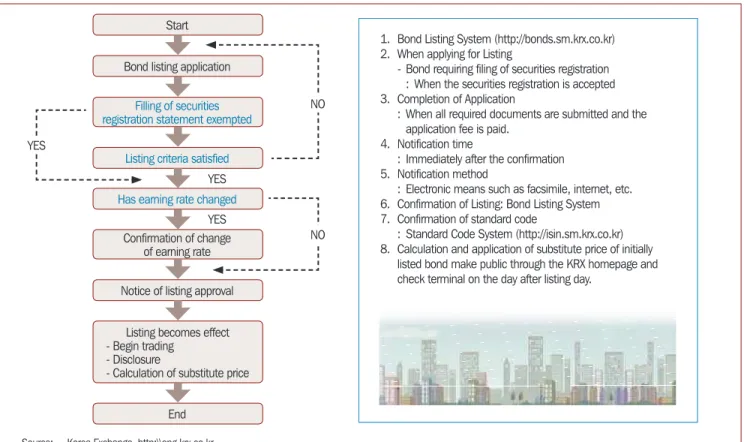
Figures Figure 1.1 Bond Listing System ...19
Figure 2.1 Procedure for Applying for Foreign Investor Investment Registration Certificate through a Local Agent ...40
Figure 2.2 Procedure for Applying for Foreign Investor Investment Registration Certificate in Person ...40
Figure 3.1 Structure of the Bond Over-the-Counter Market ...44
Figure 3.2 Repo Trading Mechanism ...50
Figure 3.5 Operation of FreeBond ...62
Figure 3.6 Process to List or Trade KTB ETF on the KRX ...77
Figure 3.7 Separate Trading of Registered Interest and Principal of Securities ...78
J. Issuance Volume of LCY Bond Market in USD ... 114
K. Foreign Holdings in LCY Government Bonds ... 116
L. Trading Volume ... 117
M. Domestic Financing Profile ... 118
VIII. Next Step ...119
A. Group of 30 Compliance ... 119
B. Group of Experts Final Report: Summary of Barriers Market Assessment – Korea (April/2010) ... 120
C. Revision of the Commercial Act and Corporate Bond Effective 2012 ... 122
D. Commissioned Company System for Bondholders ... 124
E. Bankruptcy Procedures ... 125
Appendixes ...127
References ...133
Section 5: Republic of Korea Bond Market Guide
vi
ASEAN+3 Bond Market Guide | Volume 1 | Part 2
Tables
Table 1.1 Korean Credit Rating Agencies ...9
Table 1.2 Bond Grades and Definitions ...10
Table 1.3 Grade Hierarchy and Definition ...11
Table 1.4 Korean Bond Pricing Agencies ...12
Table 1.5 Initial Listing Criteria for Domestic and Foreign Bonds ...18
Table 1.6 Listing Fees ...23
Table 2.1 Minimum Net Asset Requirement for Investment Trading Business (W Billion) ...32
Table 2.2 Minimum Net Asset Requirement for Investment Brokerage Business (W Billion) ...33
Table 2.3 Minimum Net Asset Requirement for Collective Investment, Trust, Investment Advisory, and Discretionary Investment Businesses (W Billion) ...34
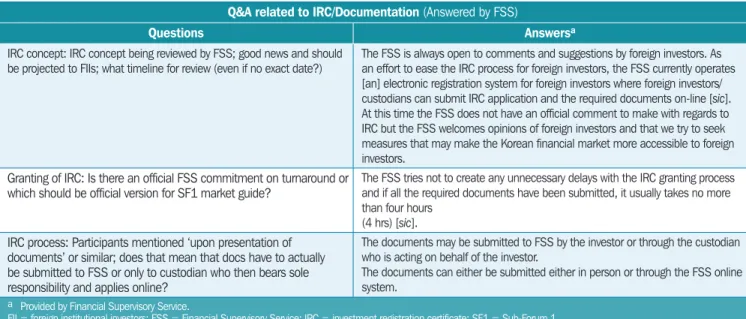
Table 2.4 Questions and Answers on Investment Registration Certificate and Documentation ...35
Table 2.5 Official Documents that Authenticate the Lawful Identity of the Investor ...39
Table 3.1 Proportion of Korea Exchange Bond Market (W trillion, %) ...43
Table 3.2 Classification of Quotation Price, Quantity, and Trading Units ...45
Table 3.3 Description of Settlement Process ...46
Table 3.4 Trading Rules for Small-Lot Bond ...47
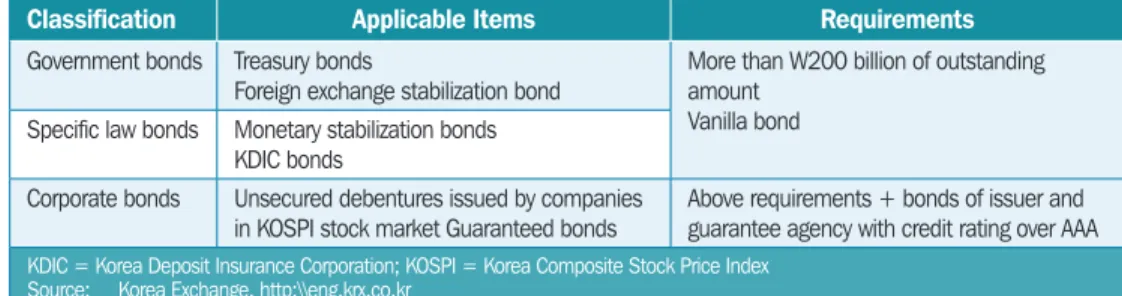
Table 3.5 Bonds Eligible for Trading in the Special Market ...47
Table 3.6 Requirements for Appointment as PPD ...49
Table 3.7 Bonds Eligible for Trading at the Repo Market ...51
Table 3.8 Settlement in the Repo Market ...53
Table 3.9 Settlement at the REPO Market ...55
Table 3.10 KRX Repo Trading System ...55
Table 3.11 KRX Repo Settlement System ...56
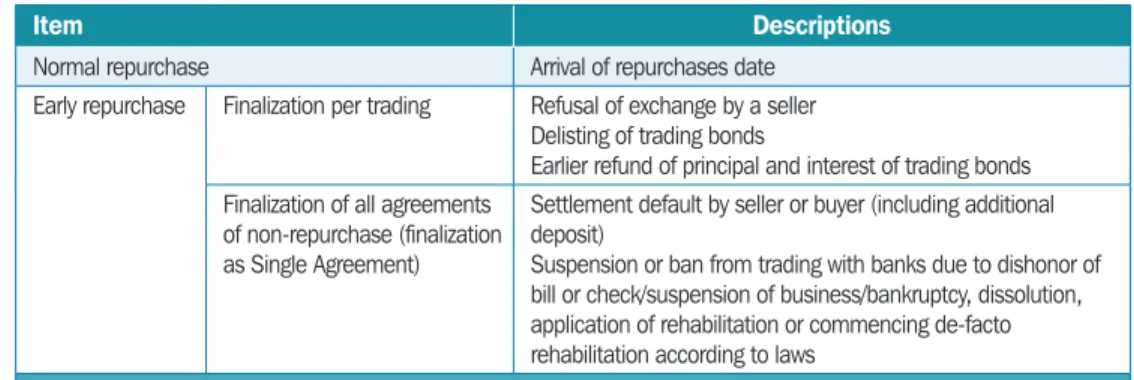
Table 3.12 Expiration of Repo ...57
Table 3.13 Details of the Repo Trade Submitted by Repo Sellers or Brokerage Firms ...59
Table 3.14 Questions and Answers on FreeBond and Over-the-Counter Trade Matching ...64
Table 3.15 Secondary Market Yield and Terms of Bond Issues ...64
Table 3.16 Types of Real-Time Bond Index ...65
Table 3.17 Questions and Answers related to Market Infrastructure: InSet and SAFE ...71
Table 3.18 Questions and Answers related to Clearing/Securities Settlement (Answered by KSD) ...75
Table 3.19 Listed Korea Treasury Bond Exchange-Traded Funds ...77
Table 3.20 Korea Treasury Bond Exchange-Traded Funds Trading System ...77
Table 3.21 Korea Treasury Bonds Futures Trading System ...79
Table 3.22 3-Year Korea Treasury Bonds Futures ...79
Table 3.23 Underlying Basket Bonds for 3-Year Korea Treasury Bonds Futures ...79
Table 3.24 Specification of 5-Year Korea Treasury Bonds Futures ...80
Table 3.25 Underlying Basket Bonds for 5-Year Korea Treasury Bonds Futures ...80
Table 3.26 Specification of 10-Year Korea Treasury Bonds Futures ...81
Table 3.27 Underlying Basket Bonds for 10-Year Korea Treasury Bonds Futures ...81
Table 4.1 Overview of Credit Rating Framework and Governing Regulations ...90
Table 5.1 Brief History of the Development of the Securities Settlement Infrastructure ...100
Table 5.2 Korea Securities Market Settlement System ...101
Table 5.3 Main Contents of the New Securities Settlement System...101
Table 6.1 Fee Rates by Classification of Bond ...103
Table 6.2 Maintenance Fee (Deposit Fee) at the Central Securities Depository (monthly basis) ...103
Table 6.3 Brokerage Commission ...104
Table 7.1 Bonds Issued (W billion)...105
Table 7.2 Outstanding Amount of Bonds Issued (W billion) ...106
Table 7.3 Bonds Issued (W100 million)...106
Table 7.4 Bond Trading Volume and Value Exchange (W100 million) ...107
Table 7.5 Trading Value and Balance (W100 million) ...108
Table 7.6 Trading Volume of the Purchased Securities (W 100 million) ...108
Table 7.7 Size of LCY Bond Market in USD (Local Sources) ($ billion) ...109
Table 7.8 Size of LCY Bond Market in % GDP (Local Sources) (% GDP, $ billion) ...110
Table 7.9 FCY Bonds to GDP Ratio ($ billion) ...112
Table 7.10 FCY Bonds Outstanding (Local Sources) ($ billion) ...113
Table 7.11 Issuance Volume of LCY Bond Market in USD ($ billion) ...114
Table 7.12 Foreign Holdings in LCY Government Bonds (W billion) ...116
Table 7.13 Trading Volume ($ billion) ...117
Table 7.14 Domestic Financing Profile ($ billion) ...118
Table 8.1 Global Clearing and Settlement – A Plan of Action ...119
Table 8.2 Summary of Barriers Market Assessment – Korea (April 2010) ...120
Table 8.3 Question and Answer related to the New Commercial Act Scripless Provisions (Answered by KSD) ...124
T
he Asian Development Bank (ADB) Team, comprising Satoru Yamadera (Economist, ADB Office of Regional Economic Integration, - September 2011), Seung Jae Lee (Principal Financial Sector Specialist), Shinji Kawai (Senior Financial Sector Specialist [Banking]), Shigehito Inukai (ADB consultant), Taiji Inui (ADB consultant), and Matthias Schmidt (ADB consultant), would like to express their sincere gratitude to national member and expert institutions Korea Financial Investment Association (KOFIA), Korea Exchange (KRX), Korea Securities Depository (KSD) and Korea Capital Market Institute (KCMI). They kindly provided answers to the questionnaires prepared by the ADB team, thoroughly reviewed the draft of the Market Guide, and gave their valuable comments.It is also noteworthy to mention that the creation of the so-called ASEAN+3 Bond Market Forum-Korea (ABMF-K) group comprising of the abovementioned members, experts, and other volunteer supporters is a major achievement (as market associations go, it is an excellent suggestion for other markets) and the effort undertaken and the commitment given by the group was substantial.
The ADB team also would like to express special thanks to Citibank, Deutsche Bank AG, HongKong Shanghai Banking Corporation (HSBC), J.P. Morgan, and State Street for their contribution as international experts in providing information from their respective market guides, as well as their valuable expertise. Because of their cooperation and contribution, the ADB Team started the research on solid ground. Last but not least, the Team would like to thank all the interviewees who gave their comments and responses to questions during the market consultations.
It should be noted that any part of this report does not represent official views and opinions of any institution which participated in this activity as ABMF members and experts. The ADB Team bears responsibility for the contents of this report.
February 2012
Asian Development Bank (ADB) Team
Acknowledgement
ASEAN+3 Bond Market Guide | Volume 1 | Part 2 Section 5: Republic of Korea Bond Market Guide
x
ASEAN+3 Bond Market Guide | Volume 1 | Part 2
List of Interviewees: Seoul, 27 June 2011
Korea Exchange (KRX)
Korea Capital Market Institute (KCMI)
Korea Financial Investment Association (KOFIA) Financial Supervisory Service (FSS)
Korea Securities Depository (KSD) Seoul, 28 June 2011
SC First Bank Citibank Korea Lee & Ko (Law Firm) Bank of Korea Seoul, 29 June 2011
HSBC
J.P. Morgan Chase
A. Classification and Descriptions of the Korea Bond Market
1. Classification of Bonds
Publicly offered bonds are classified by type of issuer into the following: i. Government bond,
ii. Municipal bond,
iii. Special bonds including monetary stabilization bond (MSB), bank bonds, and other financial bonds,
iv. Corporate bonds, and
v. Asset-backed securities (ABS). 2. Description of Bonds
a. Government Bonds
The first government bonds in the Republic of Korea were the nation-building government bonds in 1949. Since then, a wide variety of government bonds have been issued and integrated into Korea Treasury bonds (KTB) since the “Bonds on Fund for Management of Government Bonds” were issued in 1994.
Currently, government bonds issued include KTB, National Housing Bond (NHB) Type 1 and 2, and Foreign Exchange Equalization Fund Bonds (FEEFB), which are denominated in foreign currency. Among these, KTB are issued in the largest volume and trading is active. Accordingly, the on-the-run KTB market yields serve as a benchmark yield.
There are currently four types of KTB issued by maturity—3-year, 5-year, and 20-year—depending on the rate of interest. These fall into fixed-interest type bonds (3-year, 5-year, 10-year, and 20-year) and inflation-linked KTB (10-year maturity). Inflation-linked KTB links the principal and coupon rate of the KTB to prices, thereby eliminating inflation risk that comes with investing in KTB, thus ensuring the purchasing power parity of the bonds.
I. Structure, Type, and
Characteristics of the
Bond Market
Section 5: Republic of Korea Bond Market Guide
2
ASEAN+3 Bond Market Guide | Volume 1 | Part 2
b. Municipal Bonds
Municipal bonds are issued by local governments, which comprise industrial development bonds and subway construction bonds.
c. Special Bonds
Special bonds consist of MSB issued by Bank of Korea, bank bonds issued by commercial banks, and other financial bonds issued by financial institutions excluding commercial banks.
d. Corporate Bonds
i. Issuance of Corporate Bonds
Corporate bonds issuances are divided into direct issuances and indirect issuances depending on who issues the bonds.
(1) Direct issuance
(2) Indirect issuance. Indirect issuance comprises of firm commitment, stand-by agreements, and a best-effort-basis depending on who handles the risk related to the underwriting. In addition, bonds comprise of par value, discount issue, and issues at a premium.
ii. Types of Corporate Bonds
Corporate bonds can be categorized into bonds with guarantees or collateral, ways of paying interest, and the rights given to holders of corporate bonds.
(1) Bonds with Guarantees or Collateral. Bonds with guarantees or collateral can be classified further into guaranteed bonds, collateral bonds, and non-guaranteed bonds.
(a) Guaranteed Bonds
Guaranteed bonds refer to corporate bonds where a financial institution guarantees the redemption of the principal and interest. Guarantees of the principal and interest payments are provided by banks, Korea Credit Guarantee Fund, Korea Technology Finance Corporation, merchant banks, financial investment companies, and surety insurance companies. The issuing company pays a guarantee fee to the guaranteeing company.
(b) Collateral Bonds
Collateral bonds are secured by physically guaranteeing redemption of the principal and payment of interest. They are issued in accordance with the Secured Bond Trust Act.
(c) Non-guaranteed Bonds
Non-guaranteed bonds are issued by the issuer’s credit without the guarantee or collateral provided by a financial institution for principal redemption. Most Korean corporate bonds are issued as debentures. The underwriters of the bonds are required to undergo credit assessment of
the debentures from two or more different credit rating agencies. (2) Bonds Categorized by Interest Payment
Bonds categorized by their interest payment are coupon bonds, discount bonds, and compound bonds.
Coupon bonds refer to corporate bonds with coupons denoting the payment of interest at a regular schedule.
Discount bonds are corporate bonds where the principal and interest rate are the par value, and the interest is discounted in the lump sum.
Compound bonds involve the computation of compound interest for the interest cycle. Thereafter, the principal and interest are paid in a lump sum on the date of maturity.
(3) Bonds Categorized by Redemption Period
Depending on the redemption periods, bonds can be divided into short-term bonds, medium-term bonds, and long-term bonds. Generally, short-term bonds have redemption periods under 1 year; medium-term bonds, between 1 year and 5 years; and long-term bonds, over 5 years. Of note, long-term bonds refer to bonds that mature in 10 or 20 years in the United States of America.
(4) Bonds Categorized by Method of Interest Payment
In addition, there are fixed-income bonds and floating rate notes (FRN) depending on how interest is paid. Fixed-income bonds involve the payment of fixed periodic returns, and FRN has a variable interest rate that is linked to the benchmark interest rate.
(5) Bonds categorized by Bondholder
Bonds categorized by the holder of bonds are convertible bonds, bonds with warrant, exchangeable bonds, participating bonds, and bonds with embedded option.
Convertible bonds (CB) can be converted to the issuing company’s equity on certain conditions. Meanwhile, bonds with warrants entitle the holder to purchase a certain quantity of any future issue of the company’s stocks at a fixed price after a set period of time has passed.
Exchangeable bonds permit the holders to exchange their bond holding for the listed shares of a company under previously agreed conditions within a set timeframe. Participating bonds entitle the holder to receive dividends.
Bonds with embedded options allow the issuer to redeem all or part of the bond before it reaches its maturity date. The options include call options where the issuer can redeem the principal and interest before maturity and put options, which allows the holder of the bond the right to demand the issuer to repay the principal on the bond.
e. Asset-Backed Securities
An ABS is a security issued based on underlying assets originating from corporations or financial institutions. By standardizing and pooling the financial assets from originators in specific terms, such assets are securitized utilizing the cash flows of underlying assets and credit enhancement. The ABS then channels the principal and interest to the concerned parties.
Section 5: Republic of Korea Bond Market Guide
4
ASEAN+3 Bond Market Guide | Volume 1 | Part 2
B. Descriptions of Public Offering and Private Placement Markets
1. Public offering
Public offerings generally refer to actions with the aim of selling to multiple ordinary investors. The Financial Investment Service and Capital Market Act (FSCMA) defines public offering as public offering and public sale.
The term “public sale” in the Act refers to gathering 50 or more investors, as calculated by a formula prescribed by presidential decree and Financial Services Commission (FSC) regulation on issuance, public disclosure, etc. of securities, to make an offer to sell or invite offers to purchase securities already issued (see FSCMA Art. 9. 9 in Appendix 1).
In other words, this means soliciting 50 or more investors (the sum of those who have received recommendations) that have not made, applied to, or bought the same type of securities as the securities being offered within 6 months from the day offers to buy are made. As such, the FSCMA refers to recommendations for application for public offering and sale to the public during the previous 6 months. Here, “public” refers to parties that are subject to the offers and sale, consisting of 50 or more investors. 2. Private Placement
Private placement refers to a private offering of securities for new issuance to investors. It entails that the issuer issues securities directly to certain demand-side parties to raise capital from them. This means that the bond certificate is only issued to the subscriber, or has undergone third-party underwriting. It is referred to as private placement since it is not intended for the public.1
An official definition of “private placement” can be found in Art. 9, Financial Investment Service and Capital Market Act (see Appendix 1.1).
C. Exchange Listed Market
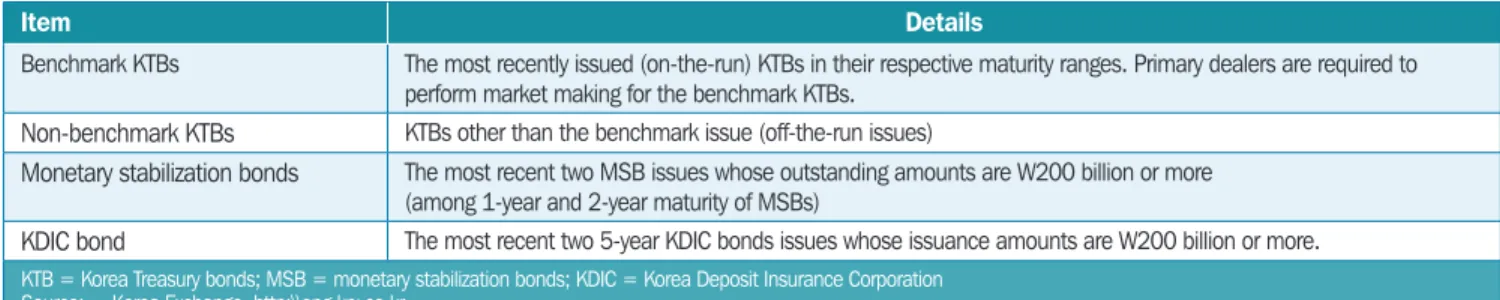
The Korean bond exchange market is comprised of the inter-dealer market (IDM) and the retail market. Between these markets, primary dealers mainly participate in the IDM.
Before the Asian financial crisis in the late 1990s, the Korean bond market comprised mostly corporate bonds. In 1998, during the financial crisis, the International Monetary Fund (IMF) bailout prompted the Korean government to announce the
“Measure to Improve Government Bond Policies and Vitalize the Bond Market.” As part of the process to facilitate development of the government bond market, primary dealers (PDs) were introduced in 1999, and the IDM was opened in the Korea Exchange (KRX). Participants in the IDM are limited to financial investment firms and banks. The bid-and-ask order details presented by each dealer are collected and disclosed on the system, and transactions are made among dealers. The tick size is W1 and uses the limit-order method. The order quantity is a whole number multiple of W1 billion. The market is open from 9:00 a.m. to 3:00 p.m., and transactions are
1 Korea Financial Investment Association, 2010 Capital Market in Korea. Korea Financial Investment Association, p.117–118.
made through individual competitive bidding using multiple prices depending on the priority of best quotation and time principle from the presented bid-ask price. Settlement generally takes place through Bank of Korea (BOK)-Wire and the bonds are transferred through escrow accounts at the Korea Securities Depository (KSD). It is thus similar with, yet slightly different from the over-the-counter (OTC) market- delivery versus payment (DVP) method. In other words, the OTC-DVP method settles the total amount for each transaction, while in the exchange market, the funds are settled depending on the participant, and bonds are subtracted depending on the participant and bond issues. The settlement date is T+1.
In the ordinary bond market, transactions generally involve retail bonds, small-cap government and public bonds, and equity-linked corporate bonds, with ordinary investors being the main participants. Retail and small-cap bonds are traded in units of W1,000, while equity-related corporate bonds and ordinary bonds are traded in units of W100,000. Transactions are concluded through individual competitive bidding through four types of competitive bidding principles, depending on the priority of price, time, brokerage, and quantity.
D. Professional (Wholesale) Market and Retail Market
Discussion on the professional (wholesale) market is currently under “Qualified Institutional Buyer (QIB) market.”
E. Definition of Professionals and Professional Investor
The FSCMA classifies an ordinary investor and a professional investor based on their professional knowledge and experience, as well as the amount of assets. A professional investor refers to an investor who does not need any strong investor protection measures considering its own expertise and experience, such as a nation, a local municipality, a central bank, and a financial institution. Most individual investors fall under the classification of an ordinary investor with the exception of an investor whose financial investments exceeds W5 billion. Such classification aims to protect ordinary investors from taking huge risks in making investments due to the lack of such understanding of the financial investment instruments.2
F. Methods of Issuing Bonds
1. Government Bonds (Korean Treasury Bonds)
The procedure for issuing KTBs is enumerated below:3 a. Establish Plans to Issue Korean Treasury Bonds
The Ministry of Strategy and Finance should discuss with relevant agencies any plans to issue KTBs and the issue is subject to deliberation by the National Assembly. A detailed issuing plan should also be established within the annual KTB issuance limit approved by the legislature. An announcement of issuing plans and bidding should
2 Footnote 1, p. 297.
3 Footnote 1, p. 125.
Section 5: Republic of Korea Bond Market Guide
6
ASEAN+3 Bond Market Guide | Volume 1 | Part 2
then be released. The Minister of Strategy and Finance announces annual/monthly plans for each year. In principle, the date and time of bidding the issuing amount, coupon rate and settlement will be disclosed up to 3 days prior to the commencement of bidding.
b. Bidding
The bidding date for KTBs is as follows: i. 3-year KTB: Every first Monday ii. 5- year KTB: Every second Monday
iii. 10-year KTB: Every third Monday (Wednesday for inflation-linked KTB) iv. 20-year KTB: Every fourth Monday
Bidding time are scheduled from 10:40 a.m. to 11:00 a.m. Bidding is done through the BOK-Wire, a network operated by the BOK. The bid interest rates are grouped in intervals of 3 basis points (bp) from the highest successful bid downwards within the range of amount to be issued. The highest successful bid’s interest rate in each group is applied. Participants in the bidding are:
i. Only KTB primary dealers are eligible to participate in KTB auctions.
ii. Non-primary dealer bidders may bid through KTB primary dealers who act as proxy agents.
iii. However, if a retail investor bids through a primary dealer, the bid security deposit and written bid should be submitted in advance.
c. Announcement of Bidding and Results
The Minister of Strategy and Finance announces the details of bidding and the accepted bids when they are complete.
d. Issuance of Korean Treasury Bonds and Settlement of Successful Bids
The issuance of KTB and payment of the successful amount are done after the bidding date. On the day of settlement, the KSD is notified by BOK-Wire immediately after the underwritten amount is remitted, and the settlement and issuance are completed. All KTB types are registered, issued and deposited at the KSD. Accordingly, transaction and exercise of rights are possible without issuance of physical bond certificates. 2. Corporate Bonds
The procedure for issuing corporate bonds is enumerated below:4 a. Company Registration
An entity seeking to issue corporate bonds must register with the FSC for public issue of non-guaranteed bonds.
b. Acquire Credit Rating
The company, after registration with FSC, must submit itself for credit assessment. The evaluation will require a period of 2 to 4 weeks. A credit rating from two or more credit rating agencies is also required.
4 Footnote 3.
c. Decision by Board of Directors
Issues related to issuing corporate bonds are decided through a resolution by the company’s board of directors, which indicates the issuing amount, issuing interest rate, managing company, and other relevant information.
d. Sign to Pay Principal and Interest as Agent
The company must decide where to pay corporate bond and which institution will pay the principal and interest after the corporate bond is issued as indicated by its agent in the application form and bond certificate.
e. Select Manager and Trustee
The company will then select a managing company that will underwrite and manage the corporate bonds, and a trustee that will take the necessary measures to protect the bond holders from the period of time involving payment for bonds to principal repayment.
f. Due Diligence
The lead manager then checks for risk factors through due diligence of companies. g. Submit Securities Report
The company subsequently Submit securities report and attached documents (subscription agreement, trustee agreement, principal and interest payment agency agreement, etc.) to the Korea Financial Investment Association (KOFIA).
h. Effectivity
Unsecured corporate bonds take effect 7 days after the registration statement submission. Secured bonds, collateral bonds, and ABS take effect 5 days after the registration statement has been submitted. Shelf registration for corporate bonds is 5 days after registration statement submission.
i. Submit Prospectus
When the bond takes effect after the submission of the registration statement, the issuer distributes and discloses the prospectus to its branches, KOFIA, and firms that will accept applications.
j. Issuance and Payment
Issuance, payment and listing take place simultaneously. k. Issuance Reporting
After issuance is complete, an issuance report is submitted to the Financial Supervisory Service (FSS).
l. Report Underwriting by Managers
Managers must report underwriting performance to KOFIA 5 days from issuance day. Regulations on securities underwriting is detailed in Chapter 3 of KOFIA Rule (Box 1.1).
Section 5: Republic of Korea Bond Market Guide
8
ASEAN+3 Bond Market Guide | Volume 1 | Part 2
KOFIA Rule
3. REGULATIONS ON SECURITIES UNDERWRITING BUSINESS CHAPTER III UNDERWRITING OF NON-GUARANTEED BONDS
Article11. (Underwriting of Non-Guaranteed Bonds)
(1) In the case of an underwriter underwriting non-guaranteed bonds, such bonds shall be those that have been rated by at least two (one agency, in the case of underwriting ABS issued in the form of bonds pursuant to the Act on ABS or in inevitable cases such as the business suspension of credit rating agencies) credit rating agencies from among those approved for the credit ratings business pursuant to the provisions of the Act on Use and Protection of Credit Information. However, non-guaranteed bonds issued by foreign corporations, etc., shall be deemed as those rated in accordance with this provision if they are rated by two or more credit rating agencies (referring to international credit rating agencies as prescribed by the Governor of the Financial Services Commission in Item e of [Article 2-11(2)1] of the FSC’s Regulations on Securities Issuance and Disclosure; the same hereinafter in this chapter). [Amended on 26 February 2009]
(2) In the case of underwriting non-guaranteed bonds, the issuer of non-guaranteed bonds and the trustee for the subscription of such bonds (hereinafter referred to as “trustee”) shall enter into a standard trustee agreement on non-guaranteed bonds (hereinafter referred to as “standard trustee agreement”). However, this provision shall not apply to non-guaranteed bonds falling under any of the following Items:
1. Bonds issued by credit-specialized financial companies under the Credit-Specialized Financial Business Act;
2. Bonds issued by merchant banking corporations;
3. Bonds issued by banking institutions under the Banking Act; 4. Bonds issued by financial investment companies;
5. ABS issued in the form of bonds pursuant to the Act on ABS;
6. ABS issued in the form of bonds pursuant to the Act on Mortgage Backed Bonds Companies; and
7. Bonds announced by the Association, among those issued by corporations subject to other special acts.
(3) Notwithstanding Paragraph (2), in the case of underwriting non-guaranteed bonds issued by foreign corporations etc., a trustee agreement modified from the standard trustee agreement may be used upon the Association’s approval.
(4) The standard trustee agreement on non-guaranteed bonds mentioned in Paragraph (2) shall be determined by the Association.
(5) The issuer and trustee of non-guaranteed bonds shall not have a relationship falling under any Item of [Article 6(1)]. However, this provision shall not apply to non-guaranteed bonds issued by the Korea Exchange and other securities financial companies.
Article 12. (Determination of Issuing Conditions of Non-Guaranteed Bonds)
The lead manager shall, in relation to the underwriting of non-guaranteed bonds, determine the issuing conditions, such as the coupon rate, upon consultation with the issuer.
Article 13. (Restrictions on the Managing Underwriter of Non- Guaranteed Bonds)
(1) A financial investment company in any of the following relationships with the issuer shall not be allowed to engage in the business of managing underwriter for non-guaranteed bonds of the financial investment company concerned. However, this provision shall not apply to non-guaranteed bonds issued by the Korea Exchange and securities financial companies:
3. Relationships where an issuer or a related party of the issuer holds 5/100 or more of a managing underwriter’s stocks, etc.;
4. A managing underwriter or a related party of the managing underwriter holds 5/100 or more of the issuer’s stocks; and
5. Relationships falling under any Items of [Article 6 (1) 4 through 6].
(2) The lead manager of non-guaranteed bonds shall not, if the underwriter and issuer have a relationship as defined in [Article 6 (1)1], allow the underwriter concerned to underwrite the largest portion of stocks, or to engage in practical managing affairs such as participation in determining the underwriting price; provided, however, that this provision shall not apply to non-guaranteed bonds issued by the Korea Exchange and securities financial companies.
Box 1.1 Korea Financial Investment Association Rules on Securities Underwriting
continued on next page
Article 14. (Underwriting of Won-Denominated Bonds)
A financial investment company shall underwrite won-denominated bonds that satisfy the requirements of any of the following Items:
1. Won-denominated non-guaranteed bonds shall receive a rating from two or more (one in unavoidable case such as the agency’s suspension of business) credit rating agencies. [Amended on 26 February 2009]; and
2. Won-denominated bonds shall be registered and issued pursuant to [Article 309 (5)] of the Act (excluding the bonds sold overseas).
Article 18. (Disclosure of Business Records of a Managing Underwriter of Bonds)
(1) The managing underwriter (including a broker for offering and private placement) for bond issuance (including the privately-placed bond issues) shall prepare and report to the Association the matters related to an issuer, in accordance with <Annexed Paper 3: Forms>, within five (5) days from the date of issuance. However, in the case of jointly engaging in the managing affairs, the managing underwriter that prepares the securities registration statement shall report to the Association. [Amended on 26 February 2009]
(2) The Association may post the information that it was notified of by the managing underwriter pursuant to Paragraph (1) on its Internet website.
Source: Korea Financial Investment Association. 23/12/2009. Regulations on Securities Underwriting Business. Box 1.1 continuation
G. Credit Rating Agencies and the Credit Rating of Bonds
1. Private Credit Rating Agencies for Bonds
There are four credit rating companies in Korea—Korea Ratings, KIS Pricing, NICE Pricing Services, and SCI Pricing. Table 1.1 provides a general overview of Korean credit rating agencies.
Table 1.1 Korean Credit Rating Agenciesa
Korea Ratings KIS NICE SCI
Capital W34.05 billion W5 billion W5 billion W17.75 billion
No. of employees 170 109 121 217
Web site www.korearatings.com www.kisrating.com www.nicerating.com www.sci.co.kr
M/S (%)b 34.3 33.4 31.6 0.6
Largest shareholder Fitch (73.55%) Moody’s (50%+1 share), KIS (50%–1)
NICE (100%)
SP Partners (19.19%) Initiation of
operations
November 1987 September 1985 June 1987 Established April 1992
Began credit assessment from January 2000 Bonds for evaluation Corporate bonds, CP,
ABS
Corporate bonds, CP, ABS
Corporate bonds, CP, ABS
CP, ABS Partner companies
in credit assessment
Fitch Moody’s Japan R&I,
China Dagong Rating
Japan JCR
a As of June 2009.
b Market share source was generated from the Financial Supervisory Service press release. ABS = asset-backed securities; CP = commercial paper
Sources: Press Release 279 of the financial Supervisory Service, 13 March 2009: Credit Information Services Providers’ Operating results: 2008
Section 5: Republic of Korea Bond Market Guide
10
ASEAN+3 Bond Market Guide | Volume 1 | Part 2
2. Credit Rating Assessment
a. Corporate Bond Assessment
When a company issues corporate bonds to raise long-term capital for over 1 year from the direct financing market, they are required to obtain a credit rating from a specialized credit rating agency for all non-guaranteed bonds to protect small-cap investors who lack professional knowledge on the issuer, and to induce a reasonable price in the bond market.
All non-guaranteed corporate bonds, excluding government bonds and bonds for which the government has guaranteed the payment of principal and interest as well as municipal bonds and MSBs issued by BOK, must receive a credit rating to be included in the trusted assets of banks and investment trust companies. In other words, bonds being issued without guarantee, including those by ordinary companies, specialized lenders, financial investment firms, commercial banks, the Korea Development Bank, government-funded agencies and pension funds, must first receive a credit assessment from a specialized credit rating agency. Corporate bonds’ credit ratings are used as criteria for deciding upon investment when issuing and trading non- guaranteed bonds. It is also used as criteria for the mark-to-market value of funds that are subject to mark-to-market.
Bonds are rated in 10 grades depending on how much of the principal and interest is payable, from AAA to D. AAA to BBB are investment grade where the principal and interest are deemed to be recoverable, while BB to C are classified as speculative grade as they are heavily influenced by change in the investment environment.
Table 1.2 Bond Grades and Definitions
Grade Definition
AAA Highest ability to repay principal and interest
AA Excellent ability to repay principal and interest but slightly less than AAA-rated bonds A Very good ability to repay principal and interest but vulnerable to economic conditions and
environment
BBB Good ability to repay principal and interest but possibility exists of economic conditions and environment deterioration lowering its ability to repay principal and interest going forward BB Although its ability to repay principal and interest is not immediately problematic, the bonds have
speculative factors since stability to go forward is not guaranteed
B Ability to repay principal and interest is lacking; is speculative; in recession repayment of interest is not certain
CCC Uncertainties currently exit in its ability to repay principal and interest. Highly speculative given the high risk of default.
CC Higher uncertainty factors exit compared with the upper grades. C High risk of default; lacks ability to repay principal and interest
D Unable to repay
Note: Among the above grades, AA to B are marked with the signs + or – to denote the superior or inferior recoverability of principal and interest.
Source: Korea Investors Service.
b. Commercial Paper Assessment
Issuance condition and the decision to invest are determined by the credit rating of the issuers of commercial paper (CP), which is issued to raise short-term operating funds.
Accordingly, the government has objective credit rating agencies grade the credit of issuing companies and disclose the results to develop the commercial-note market into one where blue-chip companies may raise short-term capital. This assessment is used to protect investors and enable financial institutions to serve as brokerages, and ensure financial soundness of management.
Companies that seek to obtain short-term financing by issuing unsecured debentures or notes to borrow and lend money among customers with merchant banks, brokerage houses, and banks acting as intermediaries are required to undergo credit assessments for their commercial paper.
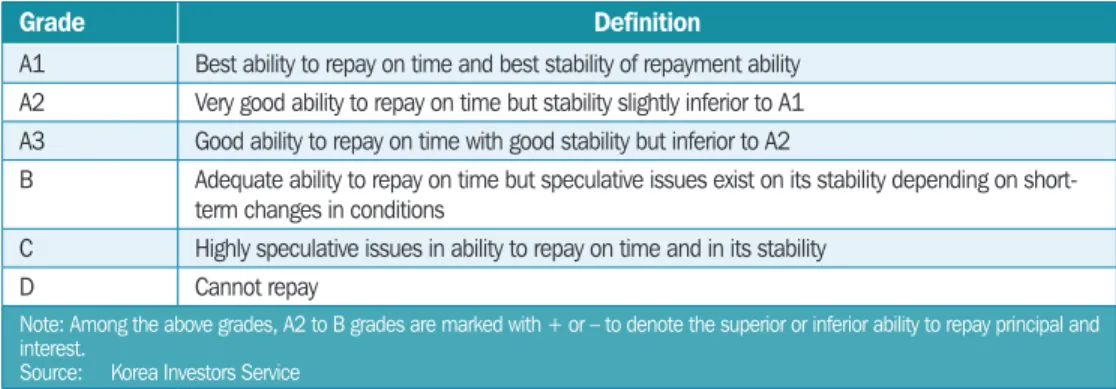
Credit rating grades for commercial paper are used to determine the soundness of the commercial paper (unsecured commercial paper and merchant bank intermediary notes) issuance and are used as criteria for deciding terms and conditions of issuance. Credit ratings for commercial paper comprise six grades from A1 to D. Among the grades, A1 to A3 are investment grades where the issuers have been acknowledged to have the ability to repay principal and interest in a timely manner; B and C are speculative grades where the repayment of principal and interest on time is heavily influenced by changes in the environment.
Table 1.3 Grade Hierarchy and Definition
Grade Definition
A1 Best ability to repay on time and best stability of repayment ability A2 Very good ability to repay on time but stability slightly inferior to A1 A3 Good ability to repay on time with good stability but inferior to A2
B Adequate ability to repay on time but speculative issues exist on its stability depending on short- term changes in conditions
C Highly speculative issues in ability to repay on time and in its stability
D Cannot repay
Note: Among the above grades, A2 to B grades are marked with + or – to denote the superior or inferior ability to repay principal and interest.
Source: Korea Investors Service
c. Asset-backed Securities Assessment
Asset-backed securities (ABS) are given credit rating grades the same way as non- guaranteed corporate bonds or commercial paper, depending on the type (ABS and Asset Backed Commercial Paper ). The credit rating system and definitions are made the same as the system and definition of non-guaranteed corporate bonds and commercial paper, thereby easing decisions on the issuer’s ability to repay principal and interest on the ABS.
3. Mark-to-Market of Bonds
a. Summary
In November 1998, after the Asian financial crisis, the government introduced the mark-to-market policy to enhance transparency of trusted asset management, secure confidence, and raise the asset quality of financial institutions. Before the mark- to-market system was introduced, bonds were evaluated on book value. This latter method prompted questions on its accuracy, given that it derived a mathematical
Section 5: Republic of Korea Bond Market Guide
12
ASEAN+3 Bond Market Guide | Volume 1 | Part 2
average of the principal and interest during the time it was held, regardless of any changes in the value of the bonds due to interest changes in the market. This resulted in a difference between the market price and book value and became problematic when it was sold before maturity or if a company went bankrupt.
Mark-to-market aligns market value and valuation by assessing the value of a bond by reflecting changes in the interest and credit of the issuer. Bond prices change depending on the market interest rate, akin to daily fluctuations in the price of equity. Mark-to-market refers to evaluating this changing bond price and using the market or fair price. To this end, KOFIA announced the “mark-to-market base yield” in November 1998 to enhance the mark-to-market system.
After valuations by bond rating agencies became mandatory in 2004, KOFIA halted its mark-to-market and changed its mark-to-market base yield to types of bonds, yield to maturity (YTM), and market yield, which is a type of reference yield that KOFIA discloses. From November 2009, the yield-reporting companies for deriving yield by bond type, YTM, and market yields changed from financial investment firms to credit assessment companies. In addition, KOFIA has also been monitoring the valuation price of each credit rating agency according to its sampling standards aiming to evaluate each bond rating agency as per the Regulations on the Operations and Business of a Financial Investment Company. KOFIA monitors approximately 10,000 issues per month by various rating agencies. The results are reported to each company and to the FSS. These results are posted at KOFIA Bond Information Service (www.kofiabond.or.kr) each quarter.
b. Private Credit Rating Agencies for Bonds Established
In July 2000, the FSS designated three companies—Korean Bond Pricing Co., Ltd., NICE Pricing Services, and KIS Pricing—to implement the mark-to-market policy by providing the market value of all bonds held by financial institutions, thereby increasing the effectiveness of the mark-to-market policy’s risk management. The three companies have been rating bonds from November 2000.
Table 1.4 Korean Bond Pricing Agencies
Name KBP KIS Pricing Nice Pricing Services
Capital W5 billion W3 billion W6.55 billion
Largest shareholder Korea Ratings KIS NICE
Sources: Korea Financial Investment Association, Chapter 9 in 2010 Capital Market in Korea
c. Effect of Bond Mark-to-Market Valuation
The bond mark-to-market valuation has brought about the following changes in Korea’s bond market:5
i. Vitalizing the Secondary Bond Market
With bond transactions being limited to a few issues, the trading of certain issues that had not been purchased or sold recently often plunged due to price uncertainty. However, with the mark-to-market policy resulting in the disclosure of the fair prices of all issues, their prices were benchmarked and trading became reinvigorated. In
5 Footnote 1, p. 149–150.
addition, with the price of bonds and the value of funds changing each day, financial institutions started trading bonds proactively, avoiding the previous practice of holding them until maturity.
ii. Energizing of the Primary Bond Market
Previously, trading of corporate bonds was severely restricted, which meant that trading prices were uncertain despite the bond ratings, making setting yields difficult. This depressed lead managers’ business and underwriting. However, due to the introduction of the mark-to-market policy, the fair prices of issued corporate bonds given by bond rating agencies are now benchmarked as market prices. This has facilitated greater issuance of corporate bonds.
iii. Facilitation of New Product Development
Providing fair prices for new products that are issued in response to market demands including option embedded bonds, swaps, and structured notes has facilitated the issuance and distribution of these products. It has also enabled the design of structured notes and pricing models to be presented to financial institutions and the market, thereby facilitating investment and new issuances. In addition, it has provided market prices and spot yield curves, which are the basics of risk management and enable prior analysis of risk factors for new products.
iv. Enhancement of Transparency and Expertise of the Investment Trust Industry
The practice of mark-to-market pricing of bonds included in funds has enhanced the transparency of fund management. It has also promoted specialization in bond investment and the rational valuation of investment performance, thereby raising investor awareness of trust products. In addition, through mark-to-market pricing of held bonds, the rational valuation of assets was enabled, providing market values to all bonds held by financial institutions, which increased the effectiveness of the mark- to-market policy’s risk management.
H. Bond-Related Systems for Investor Protection
1. Overview
KOFIA places the highest of priority on protecting investors. As a self-regulatory organization, KOFIA promotes discipline and fair practices in the securities markets. It also recommends policies to the government to improve regulations and laws to better protect all market participants, especially investors. KOFIA also contributes to the protection of bond investors through the standard debenture entrustment contract, which sets forth the roles and responsibilities of the trustees, and monitors whether they are maintaining their ability to repay the principal and interest on their loans.
When an event of default occurs to the issuer, which is one of the major details of an entrustment contract based on relevant provisions in the contract, the trustee announces this information to the trust and Bond Information Service (BIS), which enables notification to all the investors.
Section 5: Republic of Korea Bond Market Guide
14
ASEAN+3 Bond Market Guide | Volume 1 | Part 2
2. Disclosure in the Secondary Market
a. Disclosure of Over-the-Counter Trade Execution Details
After a brokerage house sells a bond in the OTC market, it must report to KOFIA the details of the transaction within 15 minutes, categorized by the nature of transaction. KOFIA then discloses this information.
The disclosure mandate was introduced in 2000 to enhance market transparency and increasing credibility in trade price. Aspirations towards enhancing market transparency and encouraging more bond derivatives into the market was the reason behind the introduction of the 15-minute rule. Previously, the details of a transaction were reported to KOFIA after 3:00 p.m. when the market was closed. Under such system, transaction details could not serve as market information in a timely manner, undermining discovery function of the appropriate price, which hindered the development of bond derivatives.
In 2000, when the disclosure of trade execution details was introduced, the details of the transaction had to be reported within 30 minutes. This was reduced the following year to within 5 minutes, and then settled to within 15 minutes in 2002. In order to increase the accuracy of reporting details of OTC bond transactions, KOFIA created the Bond-Trade Report and Information Service (B-TriS), which enables real-time management of data between KOFIA and financial investment companies. As of June 2010, an average of 3,724 trade executions was reported daily. The 15-minute rule not only enhanced market transparency, but reduced the cost of searching for price information. Furthermore, it increased the pace of the information distributed through the real-time provision of issues, trading volume, yields, and investor categorization codes, and encouraged more investors to trade bonds.
The disclosure mandate is stipulated under Art. 5–8 of the FSC Regulation on Financial Investment Business and the Regulations on Business Conduct and Services of Financial Investment Companies of KOFIA (Boxes 1.2 and 1.3).
Box 1.2 Financial Services Commission Regulation on Public Disclosure of Information on Over-the-Counter Trading
Article 5–8. (Public Disclosure of Information on Over-the-Counter Trading)
(1) The Association (KOFIA) shall systematically manage information about the issuance of bonds and disclose it to the public, such as terms and conditions of issuance that investment traders or investors need for over-the-counter trading.
(2) The Association shall manage the data of yields from trading bonds in the over-the- counter market, the quote information and the details of trading or brokerage by cases and disclose them to the public, so that investment traders or investors can refer to them for over-the-counter trading.
Source: Financial Services Commission (FSC). 2010. Regulations on Financial Investment Business.
Box 1.3 Korea Financial Investment Association Regulation on Reporting on the Records of Over-the-Counter Trading
Article 7–5. (Reporting on the Records of Over- the-Counter Trading, etc.)
(1) A financial investment company engaged in bond trading shall, when trading or brokering bonds with investors in the OTC market, report the records on the case-specific trading and brokering related on such bond trading within 15 minutes from the point of settlement of the sales agreement through the electronic media, etc. to the Association. In this case, the details on the scope of reporting, etc. shall be prescribed by the chairman of the Association.
Source: Korea Financial Investment Association. 26/03/2010. Regulations on Business Conduct of Financial Investment Companies.
b. Disclosure of Over-the-Counter Quotation Information
Besides the 15-minute rule, which promotes post-trade transparency, it was also necessary to introduce a service for enhancing pre-trade transparency so that market transparency in general and liquidity could be enhanced. Therefore, KOFIA introduced the Bond Quotation System (BQS) in 2007. At that time, most OTC bond trades were using private messenger services, such as Yahoo and MSN, as a negotiating method. Compared with telephone negotiation, private messenger contributed, in part, to a reduction in bid-ask spreads and increased liquidity. However, it also comprised of multiple messenger groups, and thus dispersed liquidity and made it difficult to access market quotation information in real time. In fact, private messenger served as an entry barrier for new participants such as retail investors and foreigners. Therefore, the government announced the introduction of the disclosure of OTC quotation information in line with the “Reformation of Bond Trading Market” (12 December 2006).
KOFIA requires financial investment firms (including banks and merchant banks), as well as inter-dealer brokers (IDBs), to report, in real time, all the information on quotes and exercise price of all bonds traded in the OTC market through the BQS. Through this system, all OTC quotes are collected and disclosed, enhancing the function of price discovery and increasing transparency and liquidity in the OTC market. Disclosure of quotation information is provided for in Art. 5-9 of the FSC Regulations on Financial Investment Business and Art. 7-3 of KOFIA’s Regulations on Business Conduct and Services of Financial Investment Companies (Boxes 1.4 and 1.5). Box 1.4 Financial Services Commission Regulation on Reporting Quote Information
Article 5–9. (Reporting on Quote Information) Every investment trader or inter-dealer broker shall report quote information and the details of trading or brokerage by case to the Association when engaging in over-the-counter trading or brokerage.
Source: Financial Services Commission. 18/01/2011. Regulations on Financial Investment Business.
Section 5: Republic of Korea Bond Market Guide
16
ASEAN+3 Bond Market Guide | Volume 1 | Part 2
Box 1.5 Korea Financial Investment Association Regulation on Reporting on the Information on Quotation
Article 7–3. (Reporting on the Information on Quotation)
(1) A financial investment company engaging in bond trading shall report the information on quotation in relation to OTC trading or the brokering of OTC trading of bonds through the proprietary bond trading system to the Association without delay. [Amended on 26 February 2010]
(2) Notwithstanding Paragraph (1), in cases where a company falling under Sub-item b of Item 8 of [Article 5–1] of the Regulations on the Financial Investment Business (hereinafter referred to as the “banks, etc.” in this Article) trade or broker bonds in the OTC market through a financial investment company engaged in bond trading excluding banks, etc., the reporting shall be substituted by such financial investment company engaged in the bond trading thereof.
(3) In cases where the Association judges that reporting on the information on quotation cannot be conducted ordinarily due to Acts of God [sic], emergencies and computing errors, etc., it may designate the methods and timing of reporting differently. [Amended on 26 February 2010]
(4) Details on the scope of reporting on the information on quotation pursuant to Paragraph (1) shall be prescribed by the chairman of the Association. [Amended on 26 February 2010] [The Title of this Article Amended on 26 February 2010]
Source: Korea Financial Investment Association. 2010. Regulations on Business Conduct of Financial Investment Companies.
c. Disclosure of Final Quotation Yields
When the market closes, KOFIA posts the yield of each bond that represents the Korean bond market on its BIS. Thus, they can be used as major indices for economic policies, financial institutions’ asset management, and the appraisal of investment performance (tallied at 11:30 a.m. and 3:30 p.m. each working day and/or disclosed at 12:00 noon and 3:30 p.m. each working day). The final quotation yield disclosed by KOFIA comprises of the final quotation yields for particular yields to maturity (eight types, 15 yields) and final quotation yields by yield to maturity (five types, 47 yields). In addition, to help energize the OTC bond market, KOFIA discloses base yields that are used for daily closings and derives the final settlement price for government bonds (3-year, 5-year) and MSB (364 days), and market-making quotation yields for bond- specialized dealers. KOFIA also discloses CP issuance information management, yields and indices, Certificate of Deposit (CD) yields and transaction status, customer repurchase agreement (RP) transaction status, and intermediary transactions of RP among institutions. Moreover, since December 1999, KOFIA has announced on a daily basis the KOFIA-Bloomberg Bond Index, an indicator of changes in the bond value of certain groups over time.
From 27 February 2009, KOFIA began to disclose default rates and recovery rates to enhance the price discovery function of the high-yield bond market, and promote the development of new bond-related products, and to use as raw data for risk management. In addition, from June 2009, KOFIA has provided real-time bond indices, enabling real-time assessment of the bond market and the development of new index-linked bond products, including exchange-traded funds (ETFs). Related to this, the first Korean KTB ETF was listed on KRX on 29 July 2009. Art. 7–8 of the KOFIA Regulations on Business Conduct and Services of Financial Investment Companies stipulates the disclosure of closing quotes.
Box 1.6 Korea Financial Investment Association Regulation on Disclosure of the Closing Quotes
Article 7–8. (Disclosure of the Closing Quotes)
(1) The Association shall disclose the closing quotes in each of the following Items through the electronic media, etc.:
1. The yield of a particular remaining period; and 2. The yield for each maturity of the remaining period; 3. [Deleted on July 21, 2009].
(2) The selection standards of a financial investment company engaged in bond trading to report the yield in relation to the disclosure of the closing quotes and the yield disclosure methods in accordance with Paragraph (1) shall be prescribed by the chairman of the Association. Source: Korea Financial Investment Association. 26/03/2010. Regulations on Business Conduct of Financial Investment Companies.
3. Introduction of the Electronic Disclosure System
KOFIA has played a key role in improving transparency of OTC bond trading and valuation. Starting in July 2002, all securities companies have been required to report trading details to KOFIA within 15 minutes after trading execution. KOFIA has built a sophisticated website (www.kofia.or.kr) which discloses pricing information to public and vendors. Information disclosed include name of the firm, branch number, type of transaction, counterparty, and other details about the securities traded. KOFIA publishes an average of more than 2,000 transactions a day involving W10 trillion to W15 trillion.
To keep the public informed about interest rate movement in benchmark bonds, KOFIA releases on a daily basis two important daily bond yields to the public. The first one, the representative bond yield (RBY), represents a weighted-average yield of certain bonds in terms of trading volume. The second is the final quotation bond yield (FQBY), which is the final yield at which bonds are traded or the last yield quoted for daily transactions. FQBYs of certain types of different bonds are regarded as benchmark yields in the Korean bond markets. FQBYs are currently released twice daily at 12:00 noon and 4:00 p.m.
On 4 December 2007, KOFIA launched the BQS, the OTC BQS, which is a system that collects and disseminates all data pertaining to quote information on OTC trading. With the implementation of the system, quotes are collected in a single, centralized system. This is expected to gradually contribute to better price discovery, and enhance transparency and liquidity in the secondary market. The market rate formed through this system will function as a benchmark rate and improve the efficiency of the secondary market.
Under the existing supervision regulation of securities business, securities companies, banks, and specialized bond brokers are required to report to the KOFIA in real-time the OTC quotes for the bonds they hold. The quote information collected is then released by the KOFIA in real time. As of January 2008, 84 financial institutions report their quotes to the BQS.
From 27 February 2009, KOFIA has disclosed default rates and recovery rates to enhance the price-discovery function of the high-yield bond market, to develop new bond-related products, and to use as raw data for risk management. In addition, from
Section 5: Republic of Korea Bond Market Guide
18
ASEAN+3 Bond Market Guide | Volume 1 | Part 2
June 2009, it has announced real-time bond indices, enabling real-time assessment of the bond market and the development of new index-linked bond products including ETFs. Related to this, the first Korean KTB ETF was listed on the KRX on 29 July 2009. As of April 2011, seven types of bond ETFs are listed and traded with a total value of about $1.3 billion.
I. Listing of Bonds and Medium-Term Notes
1. Criteria
a. Rationale
Bond listings mean that bonds issued on the stock market are allowed to be traded.6 b. Advantages of Bond Listings
The advantages of bond listing include:
i. Improving public confidence in the issuing firm. This is made possible by making public the company’s operations and information on bond listings. ii. Used as substitute securities and collateral assets. Listing is used as the
consignment guarantee money of stocks, futures, and options trading, and as the deposit money and security deposit to be paid to the public institution.
iii. Selected to be incorporated as an investment for financial products. Financial institutions like investment trusts incorporate mostly listed securities as constituents for funds.
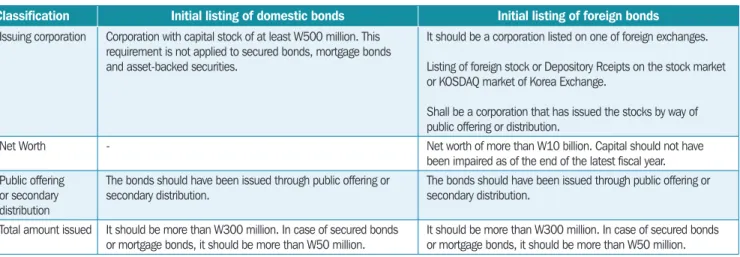
c. Listing Criteria
Bonds are listed in accordance with the provisions specified in the Listing Regulation. The KRX lists the bonds whose listing has been requested after careful examination of listing eligibility. Table 1.5 shows the listing criteria for domestic and foreign bonds. Table 1.5 Initial Listing Criteria for Domestic and Foreign Bonds
Classification Initial listing of domestic bonds Initial listing of foreign bonds Issuing corporation Corporation with capital stock of at least W500 million. This
requirement is not applied to secured bonds, mortgage bonds and asset-backed securities.
It should be a corporation listed on one of foreign exchanges. Listing of foreign stock or Depository Rceipts on the stock market or KOSDAQ market of Korea Exchange.
Shall be a corporation that has issued the stocks by way of public offering or distribution.
Net Worth - Net worth of more than W10 billion. Capital should not have
been impaired as of the end of the latest fiscal year. Public offering
or secondary distribution
The bonds should have been issued through public offering or secondary distribution.
The bonds should have been issued through public offering or secondary distribution.
Total amount issued It should be more than W300 million. In case of secured bonds or mortgage bonds, it should be more than W50 million.
It should be more than W300 million. In case of secured bonds or mortgage bonds, it should be more than W50 million.
6 Korea Financial Investment Association. Art. 390 (2) 1 of the FSCMA on listing regulations stipulates that:
“Listing regulations shall include… matters regarding listing standards and listing review of securities.” continued on next page