T his doc ument is downloaded at: 2018-03-23T 18:11:38Z
T itle
Pancreatic D uct-to-mucosa versus Invagination or C omplete E xternal
D rainage A nastomosis in C ase of S mall Pancreatic D uct after
Pancreaticoduodenectomy: C omparative Historical R eview
A uthor(s )
Nanashima, A tsushi; S umida, Y orihisa; T ominaga, T etsuro; A rai, J unichi;
T obinaga, S huichi; W akata, K ouki; Murakami, Goushi; Hidaka, S higekazu;
S awai, T erumitsu; Nagayasu, T akeshi
C itation
A cta medica Nagasakiensia, 61(3), pp.97-103; 2018
Is s ue D ate
2018-01
UR L
http://hdl.handle.net/10069/37957
R ig ht
NA O S IT E : Nag as aki Univers ity's A c ademic O utput S IT E
Introduction
Surgical techniques and adequate perioperative manage-ment after pancreaticoduodenectomy (PD) has been improved recently (1,2) and, however, morbidities associated with anastomotic procedures between the pancreas and the intestine (stomach or jejunum) remain problematic, such as pancre-atic fistula (PF).(3,4) Pancreatic duct-to-mucosa anastomosis (PDM) has been widely and usually applied worldwide to prevent PF by matching both orifices with a tiny suture.(5) However, in cases of a pancreas with a small pancreatic duct
of less than 3 mm, suturing is often difficult and inadequate suturing might injure the pancreatic ducts and its parenchyma. In some cases, insertion of a drainage tube or finding the duct seemed to be difficult. Thus, alternative options were necessary in such cases.
In our surgical experience for the 20 years between 1994 and 2013, the procedure of pancreatic anastomosis changed. (6) Between 1994 and 1999, we applied pancreaticogastros-tomy or -jejunospancreaticogastros-tomy by the invagination (IV) procedure with a lost stent tube in the pancreatic duct. This procedure has also been widely applied worldwide because of its low
MS#AMN 07195
Pancreatic Duct-to-mucosa
versus
Invagination or Complete External Drainage
Anastomosis in Case of Small Pancreatic Duct after Pancreaticoduodenectomy:
Comparative Historical Review
Atsushi Nanashima1,2, Yorihisa Sumida2, Tetsuro Tominaga2, Junichi Arai2, Syuichi Tobinaga2,
Kouki Wakata2, Goushi Murakami2, Shigekazu Hidaka2, Terumitsu Sawai2, Takeshi Nagayasu2
1Division of Hepato-biliary-pancreas Surgery, Department of Surgery, University of Miyazaki Faculty of Medicine, Miyazaki, Japan 2Department of Surgical Oncology, Nagasaki University Graduate School of Biomedical Sciences, Nagasaki, Japan
After pancreaticoduodenectomy (PD), pancreatic duct-to-mucosa anastomosis (PDM) has been usually applied which may
prevent risk of pancreatic istula (PF). In cases with a small pancreatic duct, however, PDM is dificult to complete. Procedures involving the invagination (IV) or complete external tube drainage (CED) are supposed to be alternative options for anastomosis. We retrospectively compared clinical results between PDM and IV or CED in 104 patients with a tiny pancreatic duct who underwent PD. The 77 patients undergoing PDM (the control group) and 27 patients undergoing other procedures, including 19 for CED and 8 for IV, were comparatively examined. Fatty pancreas was commonly observed in CED group. Pancreaticoje
-junostomy was signiicantly more frequently applied in CED group, and the operating time in the IV group was signiicantly longer than in control group (p<0.05). The anastomotic time in CED group tended to be shorter than those in control and IV groups (18 versus 29 and 37 min). The incidences of PF were not signiicantly different among groups (31% in control, 47% in CED and 14% in IV, respectively); however, a grade B or C level of PF was not observed in the IV group. PDM is often dificult to achieve and inadequate suturing may injure the pancreatic parenchyma in cases of very small pancreatic duct. Re-evaluation of the CED or IV procedure as an alternative option was suggested to be warranted.
ACTA MEDICA NAGASAKIENSIA 61: 97−103, 2017
Key words: pancreaticoduodenectomy; pancreatic duct-to-mucosa anastomosis; small pancreatic duct; invagination;
complete external tube drainage
Address correspondence: Atsushi Nanashima, MD., Division of Hepato-biliary-pancreas Surgery, Department of Surgery, University of Miyazaki Faculty of Medicine, 5200 Kihara Kiyotake, Miyazaki 889-1692, Japan
Tel.: +81-985-85-2905, Fax: +81-985-85-3780, E-mail: [email protected]
98 Atsushi Nanashima et al.: Anastomosis for small pancreatic duct
rate of PF.(5,7) However, we have changed the anastomotic procedure to pancreaticojejunostomy since 2000. In the early part of this period starting in 2000, the complete external tube drainage of pancreas juice (CED) was sometimes applied. Subsequently, in the late part of this period, the PDM procedure with a lost stent tube was applied. CED was developed by Miyagawa et al., which has the advantage of avoiding fatalities because the procedure itself is very simple; however, clinical usefulness was not fully clarified yet.(8,9) The PDM procedure was mainly applied even in very small pancreatic ducts at the recent time (10) and, however, the prevalence of PF still remains in cases with a soft pancreas by applying such a suturing technique.(11) By considering the difficulty of PDM in cases with a very small pancreatic duct, the previous procedure was supposed to be preferable.
Clarifying the relative advantages and problems associated with IV or CED in comparison with PDM procedures based on early-term our experiences is required. The present study thus retrospectively and historically examined 104 patients who underwent pancreatic anastomosis after PD and com-pared clinical or surgical records and postoperative early outcomes between each procedure to clarify the clinical usefulness of IV or CED.
Patients and Methods
Patients
Between 1994 and 2014, 168 patients with peri-pancreatic pancreatobiliary diseases underwent pancreaticoduodenec-tomy at the Department of Surgical Oncology at Nagasaki University Hospital. Of these patients, 104 showed a non-dilated (small size of less than 3 mm) pancreatic duct with a soft pancreas. The patients consisted of 67 men and 37 wom-en with a mean (±standard deviation (SD)) age of 66.1±12.5 years (range, 25-87 years). Underlying pancreatobiliary diseases among the enrolled patients included pancreatic carcinoma (n=14), intraductal papillary mucin-producing neoplasm (n=9), ampullary carcinoma (n=16), bile duct carcinoma (n=42), gall bladder carcinoma (n=5), other pan-creatic tumors (n=11) and benign disease (n=7).
The present study compared clinical and operative fi nd-ings and postoperative complications among PDM (n=77; a control group), IV (n=8) and CDE groups (n=19). This study involved a retrospective historical analysis and was not a randomized control study. The patient information was obtained by opt-out procedure. The ethics of the present study was approved by the Institutional Review Board at Nagasaki University Hospital (#17041721) at April 18,
2017. There were no conflict of interest (COI) in this study and this was approved by COI committee of Nagasaki University Hospital at April 17, 2017. These procedures were performed by co-author, Y. Sumida.
Operative Procedures and Perioperative Management
In pancreaticoduodenectomy, pyrolus-preserving pancre-aticoduodenectomy (PD) was performed in 45 patients and subtotal stomach-preserving PD was performed in 59. In anastomosis, pancreaticogastrostomy was performed in 7 patients and pancreaticojejunostomy was performed in 97. In the PDM group, the pancreas and seromuscular layer of the jejunum were anastomosed by interrupted suture using 4-0 absorbable suture thread and the pancreatic duct was sutured to the jejunal mucosa by interrupted suture using 5-0 absorbable suture thread with a lost tube stent (Figure 1a). The CED and IV technique are also indicated in Figures 1b and c. In the procedure of CED (Figure 1b.), the 5mm-in-diameter of drainage tube was placed into the pancreatic duct and the tube was completely tied with pancreatic duct at the resected stump using the rapidly absorbable suture thread to drain all pancreatic juice via tube outside. The pancreas and seromuscular layer of the jejunum were anastomosed by interrupted suture as well as the procedure of PDM. In the procedure of IV, in case of pancreatico-jejunostomy (Figure 1C-a), pancreatic tube was not placed and the pancreatic stump was covered by double sutures with the all layer and submucosal layer of the intestinal stump. In case of pancrea-ticogastrostomy (Figure 1C-b), the gastric anterior wall was cut and opened and the pancreatic parenchyma and all layer of the stomach were anastomosed by interrupted suture using absorbable suture thread inside the stomach. A lost tube stent was placed and fixed with the pancreatic duct by ligation with absorbable suture thread and, finally, the gastric wall was sutured after anastomosis. The duodenum or gas-tric stump was anastomosed with an end-to-side procedure via the antecolic route. Anastomotic sites were sprayed with 3.0 ml of fibrin glue (Beriplast P®; Aventis Behring, USA) to prevent pancreatic fistula in 78 patients. The grade of pancreatic fistula was defined according to the International Study Group of Pancreatic Surgery (ISGPS) grading.(12)
Statistical Analysis
considered significant. SPSS for Windows version 18.0 software (SPSS, an IBM Company, Chicago, IL) was used for all statistical analyses.
Results
Demographics, Clinical Parameters and Early Outcomes
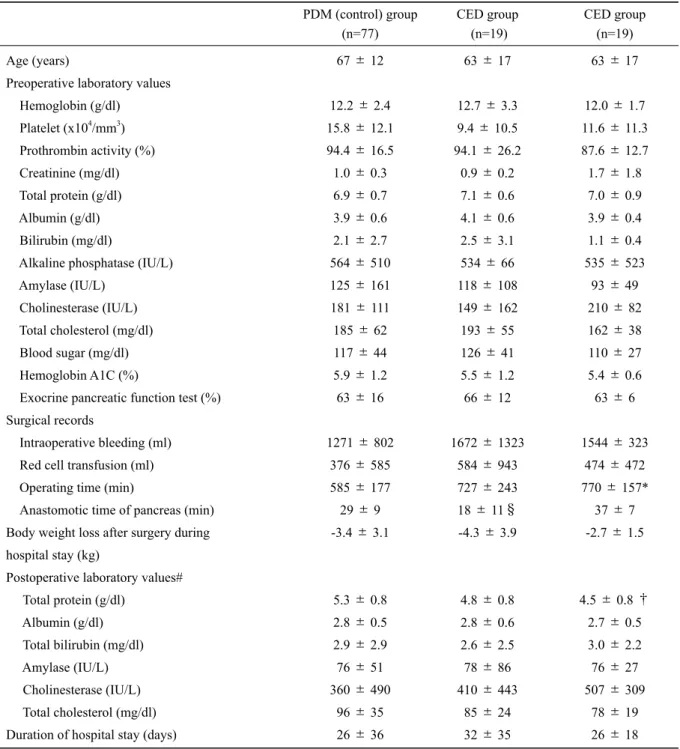
Age, gender, main diseases, background pancreas, co-morbidity and preoperative laboratory data did not differ significantly among the groups (Tables 1 and 2). The preva-lence of fatty pancreas in the CED group was significantly higher than that in the control group (p<0.05) (Table 2). The degree of experience of the main operators did not differ significantly among the groups. Pancreaticojejunostomy was significantly more frequently applied in the CED group than in the control group (p<0.05) (Table 2).
Surgical records showed that blood loss and transfusion did not differ significantly among the groups (Table 2). Op-erating time in the IV group was significantly longer than in the control group (p<0.05) (Table 1). The anastomotic time in the CED group tended to be shorter than those in the control and IV groups, but the differences were not statisti-cally significant (Table 1). The rate of pancreaticogastrosto-my in the CED group was lower than that in the IV group (p<0.05). Tumor stage in malignancies did not differ signifi -cantly among the groups (Table 2).
Postoperative laboratory data and complications in the early postoperative period are indicated in Tables 1 and 2. The lowest total protein level after surgery in the IV group tended to be lower than that in the control group, but the difference was not statistically significant (Table 1). Weight loss and other laboratory data after surgery did not differ significantly among the groups (Table 1), nor did the
dura-‐
Fig1C‐b
Figure 1: Anastomotic techniques: (a) pancreatic duct-to-mucosa (PDM) anastomosis with tight anastomosis between pancreatic cut stump and intestinal seromuscular layer; (b) complete external tube drainage of pancreas juice (CED) without duct-to-mucosa anastomo-sis; and (c) invagination procedure (IV) anastomosis in pancreaticogastrostomy or -jejunostomy.
(A)
(C-a) (C-b)
100 Atsushi Nanashima et al.: Anastomosis for small pancreatic duct
tion of hospitalization. The incidences of PF did not differ significantly among the groups; however, grade B or C level of PF was not observed in the IV group (Table 2). The
prev-alence rates of other complications and diabetes also did not differ significantly among the groups (Table 2).
PDM (control) group (n=77) CED group (n=19) CED group (n=19) Age (years)
Preoperative laboratory values
Hemoglobin (g/dl)
Platelet (x104/mm3)
Prothrombin activity (%)
Creatinine (mg/dl)
Total protein (g/dl)
Albumin (g/dl)
Bilirubin (mg/dl)
Alkaline phosphatase (IU/L)
Amylase (IU/L)
Cholinesterase (IU/L)
Total cholesterol (mg/dl)
Blood sugar (mg/dl)
Hemoglobin A1C (%)
Exocrine pancreatic function test (%) Surgical records
Intraoperative bleeding (ml)
Red cell transfusion (ml)
Operating time (min)
Anastomotic time of pancreas (min) Body weight loss after surgery during
hospital stay (kg)
Postoperative laboratory values#
Total protein (g/dl)
Albumin (g/dl)
Total bilirubin (mg/dl)
Amylase (IU/L)
Cholinesterase (IU/L)
Total cholesterol (mg/dl)
Duration of hospital stay (days)
67±12
12.2±2.4 15.8±12.1
94.4±16.5 1.0±0.3
6.9±0.7 3.9±0.6
2.1±2.7
564±510
125±161
181±111
185±62
117±44
5.9±1.2
63±16
1271±802
376±585
585±177
29±9 -3.4±3.1
5.3±0.8 2.8±0.5
2.9±2.9
76±51
360±490
96±35
26±36
63±17
12.7±3.3 9.4±10.5
94.1±26.2 0.9±0.2
7.1±0.6 4.1±0.6
2.5±3.1
534±66
118±108
149±162
193±55
126±41
5.5±1.2
66±12
1672±1323
584±943
727±243
18±11§
-4.3±3.9
4.8±0.8 2.8±0.6
2.6±2.5
78±86
410±443
85±24
32±35
63±17
12.0±1.7 11.6±11.3
87.6±12.7 1.7±1.8
7.0±0.9 3.9±0.4
1.1±0.4
535±523
93±49
210±82
162±38
110±27
5.4±0.6 63±6
1544±323
474±472
770±157*
37±7 -2.7±1.5
4.5±0.8†
2.7±0.5
3.0±2.2
76±27
507±309
78±19
26±18
Table 1. Patient demographics and surgical records with continuous parameters in each anastomosis group
Discussion
PD is a standard procedure performed to achieve com-plete removal of peri-pancreatic head malignancies with sur-rounding tissues. Central pancreatectomy or pancreatic transection is performed in cases with benign disease, trau-ma or low-grade trau-malignancies of the pancreas. In these
situ-ations, pancreaticojejunostomy with duct-to-mucosa anasto-mosis has been established to prevent leakage of pancreas juice,(4-6,9,10,11) but PF still remains as a problematic complication in small pancreatic ducts with a soft pancreas. (3,4,8,9) Complication of PF in the soft pancreas is thus a significant obstacle to recovery after PD, and may lead to lethal complications or prolonged hospitalization. Although
PDM (control) group (n=77) CED group (n=19) IV group (n=8) Gender Male/female Diseases Pancreatic cancer IPMN
Biliary tract cancer
Ampullar cancer
Gall bladder cancer
Other malignancy
Benign diseases
Background of pancreas
Normal pancreas/fatty/accompanied pancreatitis
Comorbidity
Diabetes (no/yes)
Smoking (no/yes)
Alcoholism (no/yes)
Attack of pancreatitis (no/yes)
Operators
Staff/fellow/resident
Pancreatic anastomosis
pancreaticogastrostomy/pancreaticojejunostomy
Pancreatic duct tube stent (no/yes)
Lymph node dissection (D0/1/2 or more)
Tumor stage in malignant diseases (I or II/III or IV)
Postoperative complications
Pancreatic fistula (no/A/B/C)† Intra-abdominal infection (no/yes)
Hemorrhage (no/yes)
Prolonged ascites (no/yes)
Reoperation (no/yes)
Postoperative diabetes (no/yes)
52/25 11 4 34 14 4 6 4 73/0/5 60/17 51/26 43/34 72/5 41/34/2 12/65 0/77 0/5/72 23/50 53/16/6/2 57/20 71/6 69/8 70/7 62/15 10/9 2 3 4 1 1 5 3 11/4/4** 13/6 15/4 14/5 14/5 12/6/1 1/18* 0/19 2/2/15 4/12 10/6/2/1 11/8 17/2 16/3 18/1 14/5 5/3 1 2 4 1 0 0 0 5/1/2 7/1 5/3 3/5 8/0 5/3/0 5/3 1/7 1/1/6 2/6 7/1/0/0 7/1 8/0 5/3# 8/0 6/1
Table 2. Patient demographics and surgical records with categorical parameters in each anastomosis group
*p<0.05 vs. IV group, **p<0.05 vs. control group, #p=0.09 vs. control group †ISGPS classification for pancreatic fistula12
102 Atsushi Nanashima et al.: Anastomosis for small pancreatic duct
duct-to-mucosa anastomosis is preferable, this procedure is technically difficult in such a situation. Incomplete anasto-mosis or injury of the anastomotic site by the suturing needle may lead to anastomotic leakage and pronounced PF.
An invagination procedure in pancreaticojejunostomy or pancreaticogastrostomy has also been reported. This proce-dure was applied because of a low incidence of pancreatic leakage; unfortunately, disadvantages in the long term after surgery in comparison with duct-to-mucosa anastomosis were pointed out. However, by considering the operative safety, the invagination procedure is supposed to be a useful option to secure severe PF in cases with a small pancreatic duct.
In the present study, we focused on the surgical results in patients with a soft pancreas and a small pancreatic duct, which is a risk factor of postoperative PF, by historical ex-amination at a single institute. Although we first applied complete external tube drainage of pancreas juice, we changed the procedure because the trend of pancreatic anas-tomosis was towards duct-to-mucosa suturing anasanas-tomosis in Japan. While we applied the CED procedure, however, severe postoperative PF was rarely observed. Therefore, we attempted to compare the advantages and disadvantages be-tween each procedure in the present study. In this cohort, the CED procedure might be used in cases with a fatty fragile pancreas because suturing of the duct or pancreas substance would be difficult. A previous report showed that surgical injury was a concern in fatty pancreas. Any technical effort in anastomosis might not resolve pancreas injury or tear. In cases of pancreaticogastrostomy, the invagination method with a lost tube stent was applied in our series. However, other background parameters such as disease, co-morbidity and preoperative laboratory data did not differ among the groups.
With respect to a comparison of the surgical records among the groups, the levels of operator experience were similar among the groups, although the anastomotic proce-dure was decided by the teaching staff (author A.N.). CED anastomosis was mainly performed for pancreaticojejunos-tomy. Pancreaticogastrostomy was basically performed in the 1990s in line with our department protocol.(6) The main reason for changing the anastomotic procedure from pan-creaticogastrostomy to pancreaticojejunostomy was the lat-terʼs technical simplicity; furthermore, we experienced a se-vere complication with pancreaticogastrostomy. Specifically, at day 7 after operation in one case, the anastomotic pan-creas fell down after a large hiccup and vomiting by the pa-tient; re-anastomosis of pancreaticojejunostomy was then
necessary. In cases with a small remnant pancreas or infl am-matory adhesion with splenic vein, it is difficult to perform vertical mobilization for attachment to the posterior wall of the stomach. Thus, our decision changed to pancreaticoje-junostomy in the present series. However, pancreaticogas-trostomy was still selected in western and some Japanese institutes.(13,14) Otherwise, the extent of dissection or tumor factors did not differ significantly among the groups. Anastomotic time was the lowest in the CED group because of the simplicity of its procedure; operating and anastomotic times were the longest in the IV group. In this technique, seromuscular suture covering the pancreatic stump was additionally necessary, which might have led to the longer time. A similar technique was reported in China and a sim-pler procedure of invagination was recommended.(15) If simple invagination is safe and not associated with a pancre-atic fistula, operating and anastomotic times should be sig-nificantly shortened.
With respect to the patient outcomes, serum protein level was lower due to prolonged ascites in the IV group than in the other groups in our series. In this group, the background patient demographics, preoperative status and extent of dis-section did not differ significantly compared with those in the other groups, so the anastomotic procedure itself should be one of the reasons for this complication. By considering the IV technique in pancreaticogastostomy or -jejunostomy, mobilization and bending of pancreatic substance were ad-ditionally necessary. Furthermore, it was speculated that in-testinal covering suture might cause edema of the intestines. As the rate of other complications and nutritional status did not differ significantly among the groups, the lengths of hos-pital stay were eventually similar in the groups. Previous reports regarding the invagination procedure did not show the specific postoperative complications.
References
1. Diener MK, Knaebel HP, Heukaufer C, et al. A systematic review and meta-analysis of pylorus-preserving versus classical pancreaticoduo-denectomy for surgical treatment of periampullary and pancreatic carcinoma. Ann Surg. 2007;245:187-200.
2. Horstmann O, Markus PM, Ghadimi MB, et al. Pylorus preservation has no impact on delayed gastric emptying after pancreatic head re-section. Pancreas. 2004;28:69-74.
3. Lai EC, Lau SH, Lau WY. Measures to prevent pancreatic fistula after pancreatoduodenectomy: a comprehensive review. Arch Surg. 2009; 144:1074-1180.
4. Tran KT, Smeenk HG, van Eijck CH, et al. Pylorus preserving pan-creaticoduodenectomy versus standard Whipple procedure: a pro-spective, randomized, multicenter analysis of 170 patients with pan-creatic and periampullary tumors. Ann Surg. 2004;240:738-745. 5. Osada S, Imai H, Sasaki Y, et al. Reconstruction method after
pan-creaticoduodenectomy. Idea to prevent serious complications.JOP. 1997;185:373-379.
6. Nanashima A, Sumida Y, Abo T, et al. Comparative study of anasto-mosis in pancreaticogastrostomy and pancreaticojejunostomy after pancreaticoduodenectomy. Hepatogastroenterology. 2007;54:1243-1246.
7. Zhu B, Geng L, Ma YG, et al. Combined invagination and duct-to-mucosa techniques with modifications: a new method of pancreati-cojejunal anastomosis. Hepatobiliary Pancreat Dis Int. 2011;10:422-427.
8. Miyagawa S, Makuuchi M, Kawasaki S, et al. Second-stage pancre-atojejunostomy following pancreatoduodenectomy in high-risk patients. Am J Surg. 1994;168:66-68.
9. Sekino Y, Kobayashi A, Takagi S, et al. Successful treatment for combined pancreatoduodenal injury by a second-stage pancreatojejunostomy fol-lowing pancreatoduodenectomy. Hepatogastroenterology. 2004;51: 1674-1675.
10. Suzuki Y, Fujino Y, Tanioka Y, et al. Selection of pancreaticojejunosto-my techniques according to pancreatic texture and duct size. Arch Surg. 2002;137:1044-1047.
11. Heeger K, Fendrich V, Waldmann J, et al. Reduced complication rate after modified binding purse-string-mattress sutures pancreatogastros-tomy versus duct-to-mucosa pancreaticojejunospancreatogastros-tomy. Surgeon. 2013; 11:246-252.
12. Malleo G, Pulvirenti A, Marchegiani G, et al. Diagnosis and manage-ment of postoperative pancreatic fistula. Langenbecks Arch Surg. 2014;399:801-810.
13. Lei P, Fang J, Huang Y, et al. Pancreaticogastrostomy or pancreaticoje-junostomy? Methods of digestive continuity reconstruction after pan-creaticodudenectomy: A meta-analysis of randomized controlled trials. Int J Surg. 2014;12:1444-1449.
14. Chen Z, Song X, Yang D, et al. Pancreaticogastrostomy versus pancrea-ticojejunostomy after pancreaticoduodenectomy: a meta-analysis of randomized control trials. Eur J Surg Oncol. 2014;40:1177-1185. 15. Zhang X, Xuan W, Jiang T, et al. Effect of end-to-end invagination