sustainability
ISSN 2071-1050www.mdpi.com/journal/sustainability Article
Eco-Self-Build Housing Communities: Are They Feasible and
Can They Lead to Sustainable and Low Carbon Lifestyles?
Steffie Broer 1,2,* and Helena Titheridge 1
1
Department of Civil, Environmental and Geomatic Engineering, University College London, Gower Street, London, WC1E 6XA, UK; E-Mail: [email protected]
2
Bright Green Futures Ltd., 232 Mina Rd., Bristol, BS2 9YP, UK
* Author to whom correspondence should be addressed; E-Mail: [email protected]; Tel.: +44-117-942-8996.
Received: 11 June 2010 / Accepted: 22 June 2010 / Published: 12 July 2010
environmental as well as economic sustainability objectives. If implemented correctly they could succeed in making sustainable lifestyles attractive, and foster the development of pro- environmental social norms.
Keywords: sustainable lifestyles; behavior changes; comparative perspective; housing
1. Introduction and Background
The UK Government has set challenging carbon emission reduction targets for all new homes to contribute towards an countrywide 80% carbon emission reduction target over 1990 levels by 2050 [1,2]. Since 2002, Part L of the building regulations [3] require high energy efficiency standards in all new homes in the UK. The Government intends to gradually further improve on these requirements to achieve a 25% emission reduction over Part L by 2010, 44% by 2013 and a final leap to “zero carbon” by 2016 [2]. A zero carbon home is defined as a home that produces no net CO2 emissions from
energy used by the people living in the home (i.e., to heat and light the home). This however does not include energy used in the construction of the dwelling, energy embodied in the construction materials, emissions from lifestyle” appliances such as TVs, computers and DVD players, energy embodied in goods consumed in the home, energy consumed in travelling to and from the home, or emissions from dealing with waste generated by the household. There are currently no specific national policies relating directly to new homes that limit, or require an assessment of carbon emissions from these other ways in which energy is consumed in the construction of or by future occupants of new dwellings.
Previous research by Broer and Titheridge [4,5] found that soft measures not usually required by the development control authorities or as part of the building regulations, could be more effective at reduction carbon emissions than the zero carbon homes approach advocated by the Government and would cost less. In addition, Broer and Titheridge [5] identified a number of wider sustainability benefits. Residents’ involvement in the design and construction of new housing has been identified as a possible opportunity to create such momentum [5]. This may help create more sustainable developments—places where it is “cool to be green”, places which communicate that being green can be fun—thereby changing awareness and behavior not only within the community itself, but which support a shift in social norms in the wider society.
systems, communal recycling facilities, a shared garden, bulk purchase and sharing skills and advice during construction with each other. Thus the community self-build route to new housing may present an opportunity for creating more sustainable and low carbon communities. This paper assesses the potential of using the self-build model for creating sustainable communities in the UK.
2. Literature Review
Literature was reviewed to understand the demand for both self-build and for sustainable homes and self-build communities, as well as industry, market and customer preferences relating to new homes. 2.1. Defining Sustainable Communities
Both the terms sustainability and community appear to be used differently in political discourse. For this reason we here define the use of both terms in the context of this paper.
Sustainability has no single or agreed meaning. ‘It takes on meaning within different political ideologies and programmes underpinned by different kinds of knowledge, values and philosophy’ [12]. A ‘weak’ view of sustainable development looks to continuing economic growth on terms that favor existing financiers and corporations [13]. A strong view ‘represents a revised form of self-reliant community development which sustains people’s livelihoods using appropriate technology’ [12]. The former would fit in with what we might now describe as the mainstream of politics in many northern countries; the latter represents a greener and more holistic vision. It echoes the concerns of E. F. Schumacher [14] when he argued for a concern with appropriate scale, wholeness and connectedness [13]. We here define sustainability as the latter.
In a similar fashion discussion of 'community' is fraught with difficulties. For some it means little more than a glorified reworking of the market, and the term “sustainable community” is often used to describe environmental sustainability features of a housing development without including social factors [15]. Others use the term community associated with the hope and the wish of reviving once more the closer, warmer, more harmonious type of bonds between people, bringing together solidarity, commitment, mutuality and trust [15,16]. The term can be associated with a particular place, or it can be applied to a network or group of people with a shared interest. We here use the term community as meaning a place with increased neighborhood attachment as can be measured through social bonding and behavioral rootedness as defined by Riger and Lavrakas [17].
2.2. Demand for Sustainable Homes
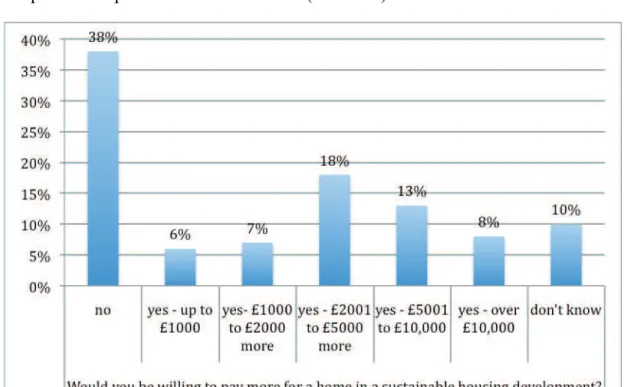
and “good value”. Consumers want access to clear information on the environmental standards of the homes they are buying. The majority of consumers surveyed (52%) said that they are willing to pay more when they purchase a sustainable home (Figure 1). Nearly 40% of home owners were willing to pay over £2,000 more. Respondents also claimed that they would pay a monthly charge for sustainability services such as convenient recycling facilities, a green caretaker and car sharing [7]. Whilst it cannot be taken for granted that willingness to pay as stated in an interview translates into actual willingness to pay, limited empirical data confirms the trend: for example two EcoHomes Excellent projects developed by Cornhill Estates at Poundbury and Northampton sold at premium and off-plan [18] and the carbon-neutral homes built by Lowry Renaissance at Titanic Mill near Huddersfield also sold off-plan prior to completion [18].
Figure 1. Willingness to pay more for a home in a sustainable housing
development—responses from UK residents (Source: 7).
2.3. Demand for Self-Build
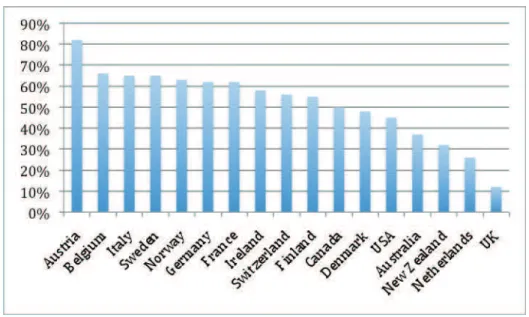
In the UK around 12% of all new homes currently belong to the self-build sector [6]. The market has grown steadily from 2,000 homes in 1978 to 15,000 homes (8%) in 1999 to 20,000 homes in 2007 (12%) [6]. Yet two thirds of UK residents state that they are interested in building their own home [20]. Demand is likely to be driven by the mainstream media, a specialist press, and regular exhibitions [6,10]. In many European countries, self-build represents more than 50% of all new houses built [6,10] (see Figure 2).
regulations in place to govern the sale of single plots for self-build and are used to dealing with planning permission requests from single plot holders, this is not the case in Great Britain. In Northern Ireland, for example, which has proportionately a far larger self-build sector than England and Scotland, planning consent on greenbelt land is granted on basis of need and policies are in place to regulate the design of self-build homes [10]. Barlow [10] suggests that in England, Scotland and Wales planning authorities are more “dictatorial” over design issues in the case of self-build proposals, compared to proposals from speculative developers who may be building similar sized multiple housing in the same area [10]. It is interesting to note that in the recession of the early 1990s, when house prices dropped by more than 10%, the self-build rate rose [6]; this may be due to increased land availability as a result of reduced competition from property developers.
Figure 2. Percentage of new homes which are self-build homes in different countries (Data Source: 6).
2.4. Demand for Community Self-Builds
2.5. The Market for Self-Build and Sustainable Homes
The market consists of homebuyers who are interested in living in a sustainable housing development and a proportion of these are some who want to get involved in design and/or construction themselves. Eighty-three percent interviewees in the Ipsos MORI study want to live in a sustainable housing development and 18% of these are interested in a community feel [7]. Just over 60% of UK residents are interested in building their own home and eco-friendly designs are popular amongst self-builders [6,19].
Of all the people who would both like to self-build and live in a sustainable housing community only a small proportion is likely to be ready, able and willing when confronted with the opportunity. Broer [20] makes a series of assumptions in order to calculate the addressable market (effective demand). Only 15% of total number of UK house buyers in a typical year are specifically interested both in living in a sustainable housing development and in a development with a close-knit community feel. Out of this group about 60% would like to self-build and 40% would like to purchase a completed sustainable home. Out of the willing self-build group, Broer [20] assumed only half would actually build their own home when confronted with the opportunity. The home purchaser group would be smaller still as not everyone would be willing to pay more for a sustainable home [7]. However, Broer assumed that this would not apply to self-build to the same extent as savings from building one’s own home oneself may outweigh the extra cost of sustainability gadgets [20]. Based on these assumptions, Broer estimated that the addressable UK market may be in the order of £11.5 billion/yr for completed sustainable homes, and £6.3 billion per year for plots, equivalent to 53,000 homes and 60,000 plots [20]. This is equivalent to 32% and 36% of all new homes build in the UK respectively. Whilst these figures seem to provide a reasonable view of the overall market for sustainable and self-build housing, given the percentage of new homes that are self-build in other European countries [6], this amounts to a significant proportion of all new UK housing.
2.6. Industry and Competition
The self-build industry currently largely consists of individual self-builders who purchase available single plots, typically infill in urban area or small brownfield sites. The supply for self-build plots is currently limited to single plots, as multiple plot sites tend to be sold to house builders who specialize in building and selling homes. Community self-build projects look to purchase larger sites [10] suitable for multiple plots and therefore compete against conventional housing developers for land.
There are two main groups of house-builders serving the UK housing market for multiple plot sites, differentiated by their size:
1. Volume house-builders who tend to build large developments of hundreds or thousands of homes, but sometimes also build smaller developments.
2. A builder with his team, who is likely to build and sell small groups of properties at a time.
requirements of the building regulations. They do not see the opportunities presented by and customer demand for sustainable construction. A small minority of house-builders and developers are starting to pioneer the sustainability market. No company is currently coordinating the construction of private individual self-build homes, though a number of companies are looking into this opportunity, without however a thoroughly developed concept that delivers sustainability and low carbon living [20].
The supply of sustainable and self-build community homes may not only be constrained by the lack of companies offering such frameworks, but also by the availability of land in locations where demand exists, and where planners would be open to this sort of development. For example, some development opportunities are in inner cities, which local planning authorities would expect to be developed to very high densities. Blocks of high-rise apartments may not lend themselves easily to self-build and community projects.
2.7. Home Buyers Priorities
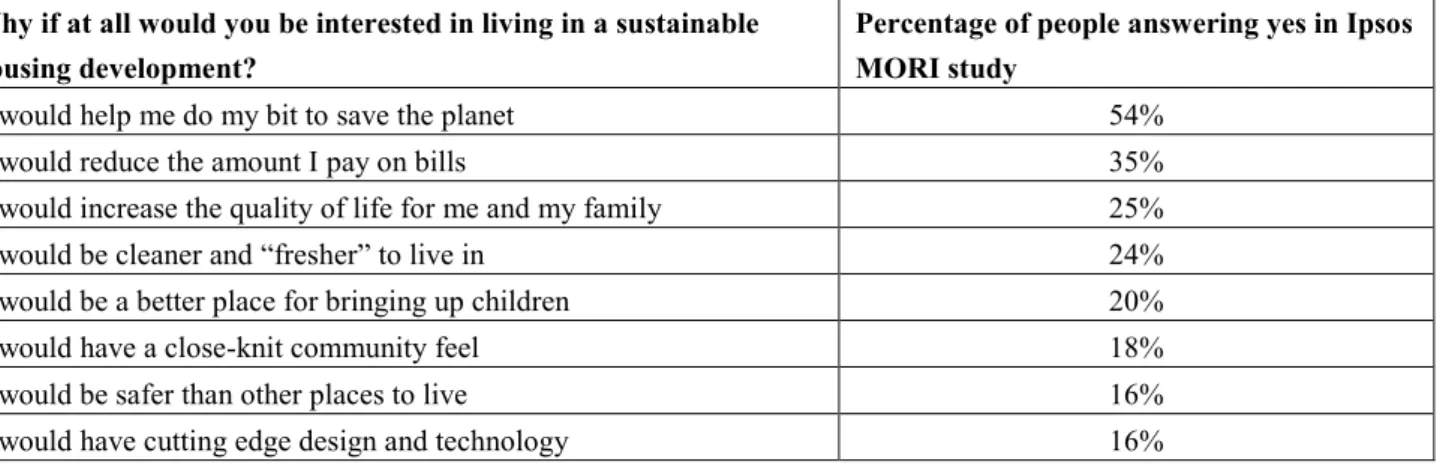
There are a number of motivations for living in a sustainable housing development. Table 1 displays the reasons people listed for an interest in living in a sustainable housing development as part of Ipsos MORI’s survey [7] to identify the preferences of home-buyers. Here it is interesting to note that many people are not only attracted to reducing their environmental impact (which was listed by over half of the respondents as a reason for their interest in living in a sustainable housing development) but also to community features, such as “a better quality of life”, “cleaner and fresher”, “better for children”, “safer”, and “a close-knit community feel”.
Table 1. What attracts people to sustainable housing developments (Data Source: 7).
Why if at all would you be interested in living in a sustainable
housing development?
Percentage of people answering yes in Ipsos
MORI study
It would help me do my bit to save the planet 54% It would reduce the amount I pay on bills 35% It would increase the quality of life for me and my family 25%
It would be cleaner and “fresher” to live in 24% It would be a better place for bringing up children 20% It would have a close-knit community feel 18%
It would be safer than other places to live 16% It would have cutting edge design and technology 16%
Participants in the discussion groups which formed part of the same study [7] were particularly attracted by the idea of sustainable housing developments creating a psychological community to foster sustainable behavior.
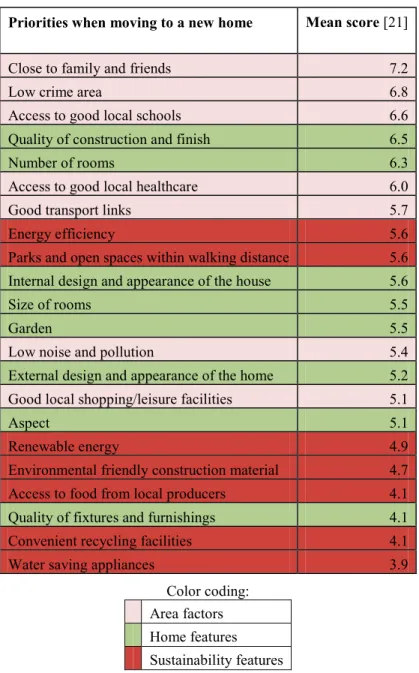
overall importance when moving to a new home. Table 2 below reflects the overall priorities when moving to a new home with the mean scores provided for each feature. These are color coded into area factors, home features and sustainability features. The categorization is taken from the Ipsos MORI report [7].
Table 2. Priorities when moving to a new home.
Priorities when moving to a new home Mean score [21]
Close to family and friends 7.2
Low crime area 6.8
Access to good local schools 6.6
Quality of construction and finish 6.5
Number of rooms 6.3
Access to good local healthcare 6.0
Good transport links 5.7
Energy efficiency 5.6
Parks and open spaces within walking distance 5.6
Internal design and appearance of the house 5.6
Size of rooms 5.5
Garden 5.5
Low noise and pollution 5.4 External design and appearance of the home 5.2
Good local shopping/leisure facilities 5.1
Aspect 5.1
Renewable energy 4.9
Environmental friendly construction material 4.7 Access to food from local producers 4.1
Quality of fixtures and furnishings 4.1
Convenient recycling facilities 4.1 Water saving appliances 3.9
Color coding: Area factors Home features
Sustainability features
As can be seen area factors dominate home owners’ overall priorities, followed by housing and then sustainability features. These findings were supported by the discussion groups (held as part of the survey) who stated that the primary concern when moving to a new house is to secure “basic wants” such as security, minimal travel, child facilities and space [7]. Only once these are satisfied (to an extent) do environmental features become more prominent in influencing the choice of house to purchase, even though ideologically they may be important to the participant. Market research by Knight and Frank [8] supports the Ipsos MORI findings.
In summary it is clear that in the UK many people want sustainable homes and that there is a demand for self-build homes. It is also clear that the quality of the local area, including having a close-knit community feel, is an important priority in house purchase decisions. Eco-self-build communities could meet all three demands. However, very few eco-self-build community projects are being built in the UK. If eco-self-build communities are to provide sustainable living in the UK then we need to understand why so few projects of this type exist in the UK, whether there is scope for increasing this, and how this might be achieved.
4. Methodology
A semi-structured approach was chosen in recognition that there may be unknown issues. These interviews were held during 2007–2009. A number of stakeholders and other relevant people were identified. Three representatives from each stakeholder group were interviewed. The exceptions to this are two groups which were judged to be of greater importance: representatives from an eco-self-build community at Ashley Vale in Bristol (see Box 1), UK and potential customers. In these cases, 10 representatives were interviewed for each group.
The stakeholder groups covered are:
1. Potential customers: Individuals interested in sustainable housing and self-build communities were interviewed in order to understand what in particular attracts them to this type of development, their characteristics and their expectations. Individuals with insufficient financial reserves to realistically partake in a self-build project (i.e., with less than £70,000 available capital) were excluded.
2. Self-builders and semi-self builders from the Ashley Vale development to understand the lessons they have learned, what they would replicate and what they would do different if they did it again, the types and profiles of households that were attracted to the project. The idea was to learn how their business model could be improved upon and replicated through an ethical enterprise.
3. People who would not be interested in partaking in an eco-self-build community project in order to find out what dissuades people from this type of scheme.
4. Financiers in order to test the perceived investment potential of eco-self-build community projects and to investigate what loans and investment agreements may be available.
5. House builders from conventional property companies in order to find out why conventional house builders are not interested in the proposed concept, and what the construction challenges may be. 6. House builders who build “green” homes in order to investigate the challenges and opportunities
they have faced and the lessons they have learned from building sustainable homes. 7. Land Agents to understand issues around purchasing land.
9. Local and regional planning representatives in order to understand the impact of current housing development policy, the impact of any likely changes in planning policy, how planning decisions are made, and how these may impact on the success of eco-self-build community projects.
10.Self-build organizations to further understand the challenges and opportunities of the self-build market and the customer demand.
Box 1. Ashley Vale Action Group.
Ashley Vale eco-self-build community is the only one of its kind in the UK. The development was set up by the Ashley Vale Action Group - a community group based in inner-city Bristol. The group formed a not-for-profit company to take control of the re-development of a brown-field site in their neighborhood. They believed that building developments should be community-based, environmentally-sensitive initiatives. In May 2001, they succeeded in buying a 2.2 acre development site at market rate in order to create innovative and sustainable self-build housing and office, workshop and community space. Once the site had been acquired the initial group members advertised for others to join them in this eco-self-build-community venture through local leafleting and word-of-mouth. Those who responded to the recruitment campaign were interviewed. Selection to participate in the project was made on the basis of shared ideals with the founding members, financial ability to resource a self-build dwelling and the skills that each person could contribute.
The land was split into 20 building plots, with space allocated for a communal garden and for an access road. It was decided to refurbish the derelict office block of about 400 m2 floor-space which was on the site. The sale of the building plots at £35 k each was sufficient to pay for the whole of the site (£600 k), legal fees, services to each plot and construction of the road. Six of the 20 self-builders chose to form terraced or semi-detached town houses as a way to have bigger houses or gardens. At a second stage further income was generated through the sale of part of the office block to a further six self-build parties converted part of the block to apartments. Part of this income paid for a biomass boiler for the whole of the office block, a large community room, and three workshop spaces which have since been rented to local businesses.
psychological, legislative, environmental, and technical interrelated issues associated with the development of eco-self-build communities.
In order to fully comprehend the advantages and disadvantages of the proposition and to be able to gather enough information to understand who would be attracted to participate in eco-self-build community development and how the development of eco-self-build communities could be supported, it was critical to understand what Mullins [22] calls discovering the “Unk-Unks”. The “Unk-Unks” are the critical barriers and customer needs, which the researcher does not know they do not know, and what the potential customer does not know they do not know. Mullins [22] states that the most exiting breakthroughs that innovators bring to market are innovations that customers have not known they needed. In order to provide the depth of understanding and exploration required, the “long interview technique”, as developed by McCracken [23], was used. Schuman’s phenomenological approach to in-depth interviewing [24] was also considered, but was decided against as it uses three separate interviews and this was considered to significantly reduce response rate and would have been difficult to complete within our time constraints.
In the long interview, the interviewer asks open-ended questions that let the respondent go where he or she may. A series of prompts, barely questions since they are so short, are then used to encourage the respondent to say more about a theme just mentioned, or to address, again in an open and non-directed way, another topic that is on the interviewer’s mind but has gone unmentioned so far. In order not to influence the direction of the responses, direct questions are only asked as a second stage. Interview scripts were based on McCracken long interview methods [23] and specific recommendations by Mullins for its application in business innovation [22]. On this basis a combination of direct and open-ended questions were prepared for each group. Initially only one person from each group was randomly identified for interview. During these interviews, each interviewee was asked if they knew anyone else whose views should be sought. These were then used to help select the further two candidates for interview from each category. Where interviewees had been recommended by another participant, their general attitude towards the proposition was assessed through questions and considered in the analysis. Furthermore, they were specifically asked whether they felt that their view was representative for other people in their profession. The final list of interviewees is given in Table 3.
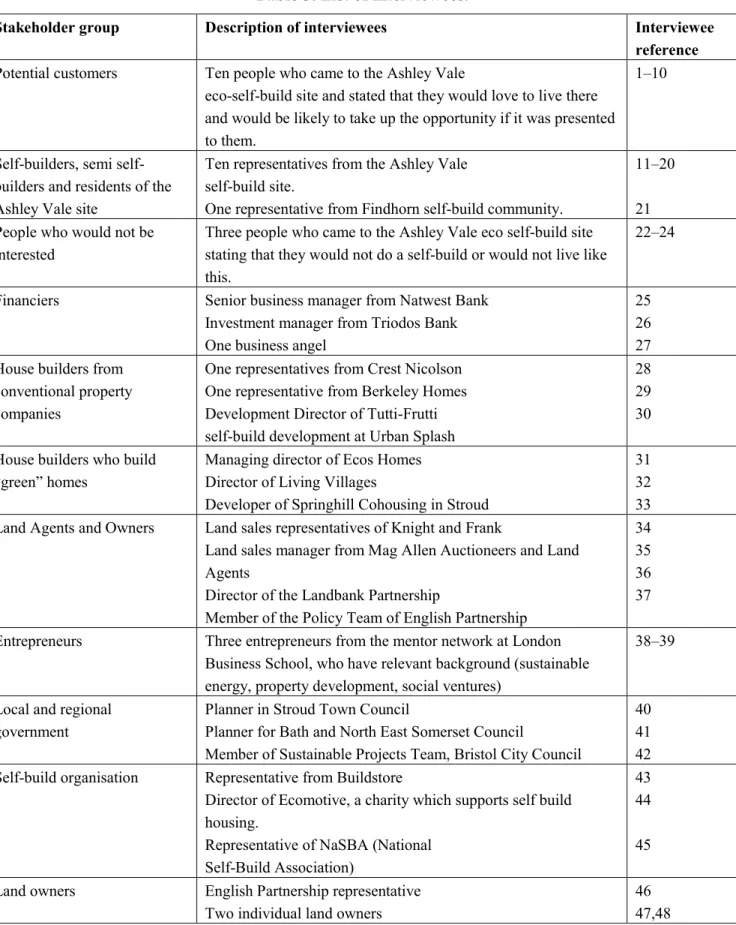
Table 3. List of Interviewees.
Stakeholder group Description of interviewees Interviewee
reference
Potential customers Ten people who came to the Ashley Vale
eco-self-build site and stated that they would love to live there and would be likely to take up the opportunity if it was presented to them.
1–10
Self-builders, semi self-builders and residents of the Ashley Vale site
Ten representatives from the Ashley Vale self-build site.
One representative from Findhorn self-build community.
11–20
21 People who would not be
interested
Three people who came to the Ashley Vale eco self-build site stating that they would not do a self-build or would not live like this.
22–24
Financiers Senior business manager from Natwest Bank
Investment manager from Triodos Bank One business angel
25 26 27 House builders from
conventional property companies
One representatives from Crest Nicolson One representative from Berkeley Homes Development Director of Tutti-Frutti self-build development at Urban Splash
28 29 30
House builders who build “green” homes
Managing director of Ecos Homes Director of Living Villages
Developer of Springhill Cohousing in Stroud
31 32 33
Land Agents and Owners Land sales representatives of Knight and Frank
Land sales manager from Mag Allen Auctioneers and Land Agents
Director of the Landbank Partnership
Member of the Policy Team of English Partnership
34 35 36 37
Entrepreneurs Three entrepreneurs from the mentor network at London
Business School, who have relevant background (sustainable energy, property development, social ventures)
38–39
Local and regional government
Planner in Stroud Town Council
Planner for Bath and North East Somerset Council
Member of Sustainable Projects Team, Bristol City Council
40 41 42
Self-build organisation Representative from Buildstore
Director of Ecomotive, a charity which supports self build housing.
Representative of NaSBA (National Self-Build Association)
43 44
45
Land owners English Partnership representative
Two individual land owners
5. Results
In general many responses confirmed the literature review findings that there is demand for eco-self-build communities. Only one person interviewed stated that they would not want to live like this and another two clearly did not have the funds or know how to do so. Some of the people at the Ashley Vale Site made reference to the number of people asking them how to get involved in a similar scheme, for example:
• Interviewee 20: A tenant living at the Ashley Vale site (also referred to as the Yard):
“Whenever I tell anyone that I live in the Yard they say: Whow, how did you manage that, are there any other places coming up?”
• Interviewee 12 and 19 (eco-self-builders from Ashley Vale) report on response of visitors who come to the Ashley Vale site because they have heard about the interesting looking houses:
“This is amazing. How did you do it? Can you tell us how we can do the same?”
Furthermore the literature findings that getting land is the main obstacle were supported by the survey. All interviewees from the potential customer category stated as their main obstacle the availability of building plots. When Ashley Vale Eco-self-builders were asked why there were no other schemes like it in the UK, nine out of ten of them stated that they thought getting land was a major obstacle. Interviewee 13 for example said:
“As a group you are up against professional property developers who can act quickly when a good plot of land becomes available. Compare this to a group of individuals who have to agree on price at which to bid, have to get funding individually, and have to agree on a structure to manage the community build. As a result it can take much longer, and there is a lot more uncertainty and delay for the landowner, who unless ethically driven is more likely to accept a cash bid from a property company”.
The speculation that the community dimension adds value to eco-self-build was also confirmed and 96% (18 out of 20) of the potential customers and self-builders from Ashley Vale interviewed said that they would prefer to build as part of a community scheme—like the Ashley Vale development rather than on their own.
The following themes emerged from the stakeholder interviews. They are here divided into categories: design of the community and site, barriers and support for self-build communities, financing and timing, customer types and characteristics, and critical factors in developing eco-self-build communities. Each category has a number of subthemes. The themes and subthemes are presented in Sections 5.1 to 5.5.
5.1. Design of Community/Site
Respondents were asked about their aspirations for the design of the site and their community. The following subthemes emerged:
1. A mixture of fully self-build, semi-self-build and completed homes is desirable 2. Design features and site characteristics
A mixture of fully self-build, semi-self-build and completed homes is desirable From a customer perspective:
Interviewing potential customers and the general public showed that there is a range of people interested in living in a sustainable housing development. About half of these would like to build their homes themselves and a quarter would prefer to move into a completed home. There is a group of “in-betweeners” (25%), who would like to have some input, such as completing the interior, but who would find building a whole home too challenging. Not all interviewees were certain about which category they would fit into.
From a construction perspective:
In terms of construction practices, smaller units such as flats would lend themselves well to the concept of semi-self-build as partition walls and floors together with the shell could be built by a company rather than the individual parties involved having to agree on timing and construction. This view was expressed by the three “conventional” and the three “green” house builders.
From the perspective of the Financier:
Financially this mix is also desirable. There is a limit of what people may pay for a plot and the uplift that can be charged. Experience at the Ashley Vale site, and at other eco-villages, has shown that the value of homes goes up significantly once the site takes shape (Interviewee 8 and 35). One of the entrepreneur interviewees suggested a route to benefiting from the value created would be for a company to build a proportion of the houses and sell them either half completed or fully finished. The other two entrepreneurs interviewed backed this view.
Desirable design features and site characteristics
All potential customers felt attracted by the community features such as a shared garden, communal recycling facilities, bike parking and pedestrian friendly streets, and a safe place for children to play. The majority of people (8 out of 10) are less in favor of organized communal activities such regularly cooking and eating together as done in many cohousing communities. Shared activities such as gardening, a meal, or a party should be voluntary, ad-hoc, resident-led and encouraged by the site facilities, for example by building a barbeque in the communal garden.
Sustainability features such as renewable energy sources, energy efficiency, recycling bins, opportunities for growing food, are also desired, particularly where people directly benefit from them, for example a woodstove which is not just a renewable energy source but also a nice design feature. Where people do not benefit directly there is a limit to what people are willing to pay purely to be green. On the Ashley Vale site for example, only two people chose to pay for solar hot water systems (these are costly and have no direct benefit) whereas nine people have a wood stove. Therefore the focus should be on measures that combine benefit for residents with benefits for the environment.
Many interviewees stressed how they were attracted particularly to the sense of community as well as the sustainability features at the Ashley Vale site. Some example quotes are:
• Interviewee 3: A pensioner visiting the Ashley Vale site:
• Interviewee 5: A single man living at the Ashley Vale site:
“I was searching for opportunities to do the right thing. I buy fair trade coffee and organic food. It was great when finally the opportunity came up to make an ethical choice towards the purchase that most people take most pride in: your own home.”
• Interviewee 11: A young man who built a house at the Ashley Vale site:
“I was not really aware or interested in sustainability prior to joining Ashley Vale Action Group. I was simply interested to building my own dream home. I have learned a lot about sustainability and climate change and have changed the way I am doing things.”
“Many of us are now working from home and have designed our homes and community to enable this. There is a yoga teacher who teaches yoga in the yoga room in her house, people working from home from a home office, and a furniture maker with a workshop. At the weekend many of us choose to stay on site rather than traveling far to socialise. This means that we spend much less time in the car getting frustrated with traffic and polluting the planet”.
A good place to bring up children
This is something mentioned again and again by people as something that they value a lot. Both people already living on the Ashley Vale site and those visiting the site were very attracted to the possibility of a safe place for children through car free zones, pedestrian friendly streets and a communal garden directly accessible without crossing a big road.
Some quotes from the interviews which exemplify this are:
• Interviewee 13 and 14: a young couple who purchased a home at Ashley Vale:
“We want to have children and we want to bring them up in a safe place and show them that one can make a difference.”
• Interviewee 17 and 18: a couple who has built a house and are living at Ashley Vale:
“It’s not just about doing what we believe in, it’s also about improving our lives. It’s much easier here to look after our children. They can play on the communal land or on the street safely and they spend time with the neighbor’s children or the neighbor’s children come round to ours. This way it is easy to leave your children with a neighbor when one needs to, and we do not spend endless amount of times going to organized play schemes, etc. Our 5 year old is very confident at talking to other adults and children and is already organizing his own play and sleepovers with his friends in our neighborhood. It’s like going back in time were people lived in big families, with all the benefits, but without being told of by your mother in law.” • Interviewee 20: A single parent building a house at Ashley Vale:
“I had to move her. It wasn’t really a question of how much money do I have and can I afford it, but how do I find the money that it takes. As a single parent I had to be in a safe community, with this support framework, the ability for my son to play with the other children and to mix with adults other than myself. I had no money myself at all but I managed to scrap it together and borrow from generous relative who wanted to help me.”
the majority of potential clients. Five respondents from the potential customer category and five respondents from the Ashley Vale self-build group were asked how to rank the following according to their foremost priority:
• A good place to bring up children • Green lifestyle
• A close-knit community feel • Quality of construction • Price
Of those interviewed who had children (normally those with small children), four out of ten of them made this their top or second priority. However, four of the respondents selected it as the last or second last priority. Interestingly, out of the group without young children, the Ashley Vale self-builders gave child-friendliness a much greater priority than other potential customers interviewed and made specific comments about how they enjoyed having the children around on site. It allows us to speculate that becoming part of their community may have changed their perception on children or that those who chose to participate in the Ashley Vale project had a positive attitude towards children’s needs.
5.2. Barriers/Support for Communities
A range of themes evolved from the interviews which clarified the barriers and support mechanisms for communities to form. Here such support structures and barriers are described and the potential to overcome them is discussed. These are covered in the following subthemes:
1. A supportive Local Authority should be a site selection criteria
2. A tight legal structure that achieves the right balance between choice and structure 3. Land owners and deal structure
4. All stakeholders, particularly the clients value the shared purpose
5. Take people impact into account when choosing eco and low carbon features 6. Offer support to self-builders
7. Sustainable community eco-self-build developments can improve the neighborhood overall A supportive local authority should be a site selection criterion
A tight legal structure that achieves the right balance between choice and structure
Interviewee 7 from the Ashley Vale site stated that one of the problems for them was a lack of a defined structure specifying what one could and could not build. This led to endless meetings of communal decision making and in some cases decisions were perceived as unfair. Whilst Ashley Vale self-builders and potential clients highly value the flexibility of designing their own home, a structure that ensures that minimum sustainability and design criteria are achieved was felt to be useful—a framework so not all of the decisions were left to the group itself. It was important to create a culture where people feel encouraged, but are not forced to go further. A tight legal structure that ensures that the set framework is followed was seen as an important means of avoiding potential problems and pitfalls. This view was shared by all the self-builders interviewed. Opinions varied slightly as to where the balance between structure and flexibility should lie.
Land owners and deal structure
One way of reducing risk and the need for investment and bank loans is to enter into an option of a joint venture agreement with the land owner. Here an option is agreed or purchased to buy the site by and agreed date for an agreed value. This buys time to advertise individual plots to self builders and to do site specific work to refine the actual value for the proposed business. If enough plot buyers are found, the site is then bought at the agreed date. If not, the sale does not go ahead. In a joint venture agreement, each plot could be sold with a proportion of the sale price going to the land owner, and a proportion to the eco-self-build company.
Landowners are likely to be pleased to see a positive, innovative and eco-friendly development happening. However two landowners interviewed (47 and 48) said that they were not willing to accept a lower price for the site as a result. English Partnership sells land for lower value in exchange for high sustainability targets, which they set. So far these do not include some of the less tangible sustainable lifestyle and people empowerment achievements that eco-self-build communities offers. However, a subjective judgment of the team or company and their proposed development is considered in the selection of the bidder (Interviewee 46, employee of English Partnership).
As the cost of the land is by far the largest cost of any housing development it is critical to financial success of any housing development project that a low price is paid for the land.
All stakeholders, particularly the clients value the shared purpose
of Sustainable Projects team in a local authority: Interviewee 37; and Member of Policy Team at English Partnership: Interviewee 42).
Take people impact into account when choosing eco and low carbon features
Both potential customers (Interviewees 11, 12 14, 15, 16, 18, 19 and 20) and conventional and “green” house builders (Interviewees 31, 32, 33) felt that they would be unlikely to pay for high-cost sustainability features (e.g., photovoltaics) which they do not benefit from directly. Lifestyle solutions such as communal gardens, pedestrian friendly streets with car share schemes, woodstoves, passive solar design, and the opportunity to grow food were popular.
Offer support to self-builders
The majority of potential customers approached stated that they are dreaming about building their own home. Some however wondered if they could actually do it and said that if the opportunity came up they were not sure if they would actually do it. People were attracted to the concept of doing it as a group and being able to advise each other. They also said that they would be attracted to support and training from a company.
The skills and motivation of the self-builders to contribute to their neighborhood are crucial to the success of the venture. One person being critical and difficult could create significant problems. On the other hand a group of people each constructively contributing to the scheme would have the opposite effect. As a result plot sales should not be based purely on a highest bidder basis. Rather customers could be selected both on a financial basis and a judgment of what they may bring to the scheme, if they have the ability to successfully build or manage the build of a sustainable home, and if they have got the right attitude and personality to contribute to the scheme. A third criterion can be taken from and ethical perspective: on this basis people are chosen if they are most likely to benefit from joining the scheme. This could include people in need of affordable housing, families with young children, single parents, and older people who would benefit from living in the community.
Sustainable community eco-self build developments can improve the neighborhood overall
Sustainable community self build developments (also referred to as eco-villages) have been built in many countries and it is thought that they tend to have a beneficial influence upon the overall neighborhood in terms of creating community interaction, reducing crime rates, etc. Whilst no direct evidence for this is available, house price assessment in the neighborhood suggests that this is indeed the case. House prices within eco-villages and of the neighboring properties in the Ashley Vale Eco-self-build community in Bristol have risen above the trend line, a trend also reported in other self-build eco-housing communities on the continent (Ashley Vale Self-builders: Interviewee 5 and 9).
5.3. Financing and Timing
Here we discuss issues related to financing and timing of an organization which catalyses eco- self-build community developments. The subthemes here are:
1. Financing 2. Affordability
3. Customer types and characteristics Financing
Banks will typically provide 50 to 70% of loan financing to building projects with an interest rate of about 4% above base rate. Triodos and Nat West representatives both stated that the eco-self-build concept would qualify, providing an acceptable business plan was submitted. Additional financing needs to be provided by private investors. The self-build community concept reduces the amount of risk to be taken especially if land is only purchased once individual plot purchasers are identified. Having a mix of plots, semi-completed homes and completed homes also helps spreading the risk, especially if the site can be designed with off plan and plot purchasers already identified, thereby meeting the needs specifically of those interested. For property projects, private investors typically would want to see 150% return on investment over a two year period (Interviewee 11), although people in the UK have invested money into a green building fund for Ecos Homes which only gave them a 7% return on investment. This suggests that there is, therefore, an opportunity to set up a fund and allow for smaller investments by a larger number of investors, people who are not business angels, but may like to put small savings (£1,000+) into a fund on the basis that they will get slightly greater returns than can be gained typically from putting their money into the bank.
Affordability
Eco-community self-builders at the Ashley Vale site (Interviewees 1–10) said that they have saved between 30 and 50% on build costs. Several reasons were stated for this. Firstly, through avoiding the middle-man and self-managing the build, management costs are saved. Secondly, self-builders contributed to the build themselves; they worked in exchange on each other’s houses. In addition there was a personal dimension that brought down costs and increased build quality—other people were brought in to work on the houses. Most of these were friends or friends of friends and where their work was good, other self-builders would employ them consecutively. Interviewee 8 stated:
“Because it was a nice place to work with a vision for the environment, people were keen to work here and would typically charge less than for other projects. To get more work and be recommended on site they’d make a special effort. For us self-builders working on each other’s houses we also wanted to do a good job for our future neighbors and friends, as we knew they’d do the same for us. It was a bit of a culture where everyone took pride in what they were doing”.
save the profit margin that house builders would add onto the cost –which is typically around 20% of the total value (Conventional house builder Interviewees: 28,29,30). A significant tax incentive is granted to self-builders: all self-build homes, providing they become the self-builders primary residence, are except from capital gains tax (Interviewee 43: representative of self-build organization). 5.4. Customer Types and Characteristics
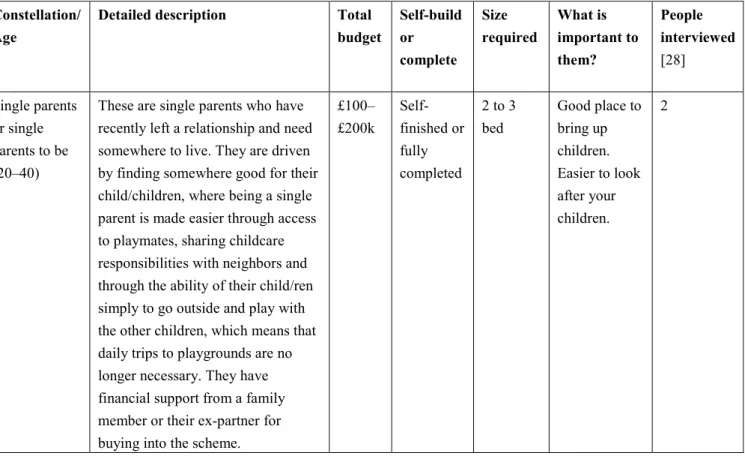
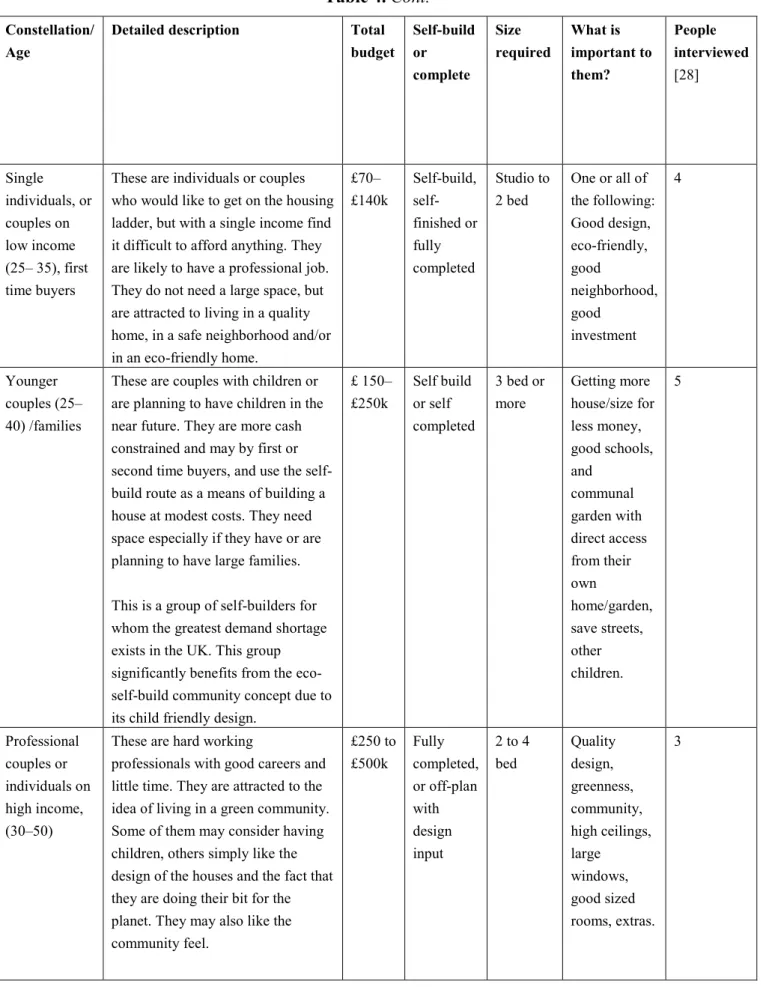
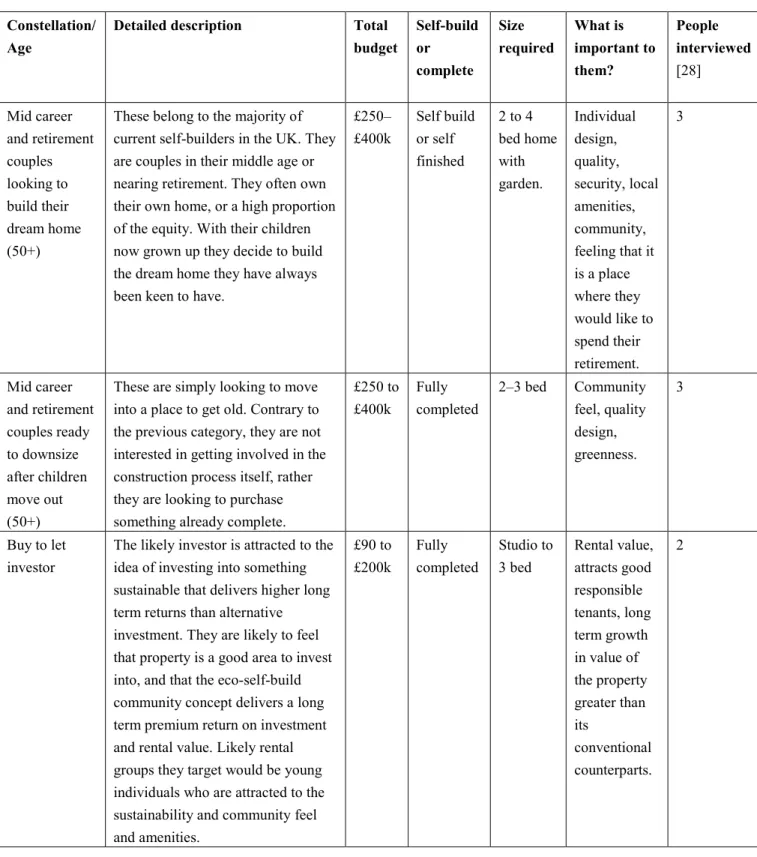
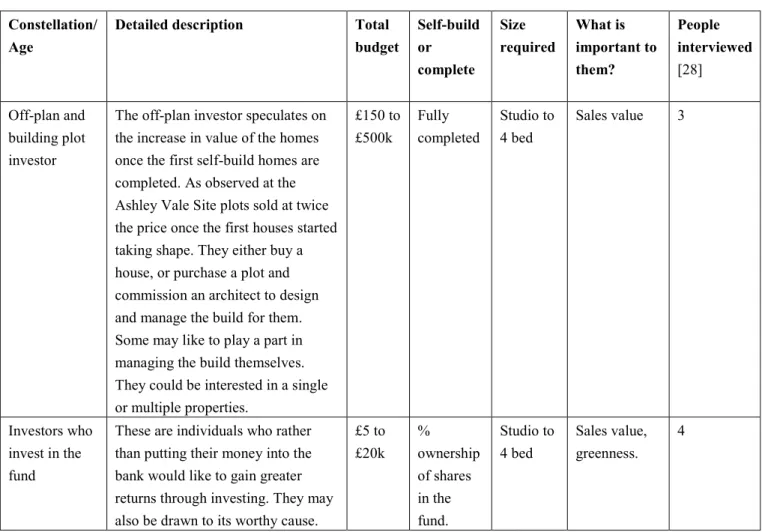
Based on the interview responses we can see that there is a strong relationship between life stages, budgets and housing needs. Table 4 describes the different groups that eco-self-build communities could serve. In the table these are organized by their life stages. The table is not purely based on the specific profile of the people interviewed. Three of the Ashley Vale self-builders were asked to group and the sort of people interested in their concept.
A mixture of people, (age, sex, race, income level, professions) was desired by most of those interviewed. However a joint connection of wanting to do something for the planet and living in a nice community was considered essential. It was seen as important for the success of an eco-self-build community venture that those involved are the sort of people who are pro-active in contributing to their neighborhoods; people who share a common believe and are ready to act upon it.
Table 4. Customer Segmentation, profiles and characteristics. Better to make this table “landscape”.
Constellation/
Age
Detailed description Total
budget
Self-build
or
complete Size
required
What is
important to
them?
People
interviewed
[28]
Single parents or single parents to be (20–40)
These are single parents who have recently left a relationship and need somewhere to live. They are driven by finding somewhere good for their child/children, where being a single parent is made easier through access to playmates, sharing childcare responsibilities with neighbors and through the ability of their child/ren simply to go outside and play with the other children, which means that daily trips to playgrounds are no longer necessary. They have financial support from a family member or their ex-partner for buying into the scheme.
£100– £200k
Self-finished or fully completed
2 to 3 bed
Good place to bring up children. Easier to look after your children.
Table 4. Cont.
Constellation/
Age
Detailed description Total
budget Self-build or complete Size required What is important to them? People interviewed [28] Single individuals, or couples on low income (25– 35), first time buyers
These are individuals or couples who would like to get on the housing ladder, but with a single income find it difficult to afford anything. They are likely to have a professional job. They do not need a large space, but are attracted to living in a quality home, in a safe neighborhood and/or in an eco-friendly home.
£70– £140k Self-build, self-finished or fully completed Studio to 2 bed
One or all of the following: Good design, eco-friendly, good neighborhood, good investment 4 Younger couples (25– 40) /families
These are couples with children or are planning to have children in the near future. They are more cash constrained and may by first or second time buyers, and use the self-build route as a means of self-building a house at modest costs. They need space especially if they have or are planning to have large families.
This is a group of self-builders for whom the greatest demand shortage exists in the UK. This group significantly benefits from the eco-self-build community concept due to its child friendly design.
£ 150– £250k
Self build or self completed
3 bed or more Getting more house/size for less money, good schools, and communal garden with direct access from their own home/garden, save streets, other children. 5 Professional couples or individuals on high income, (30–50)
These are hard working
professionals with good careers and little time. They are attracted to the idea of living in a green community. Some of them may consider having children, others simply like the design of the houses and the fact that they are doing their bit for the planet. They may also like the community feel. £250 to £500k Fully completed, or off-plan with design input
Table 4. Cont.
Constellation/
Age
Detailed description Total
budget Self-build or complete Size required What is important to them? People interviewed [28] Mid career and retirement couples looking to build their dream home (50+)
These belong to the majority of current self-builders in the UK. They are couples in their middle age or nearing retirement. They often own their own home, or a high proportion of the equity. With their children now grown up they decide to build the dream home they have always been keen to have.
£250– £400k
Self build or self finished
2 to 4 bed home with garden. Individual design, quality, security, local amenities, community, feeling that it is a place where they would like to spend their retirement. 3 Mid career and retirement couples ready to downsize after children move out (50+)
These are simply looking to move into a place to get old. Contrary to the previous category, they are not interested in getting involved in the construction process itself, rather they are looking to purchase something already complete.
£250 to £400k
Fully completed
2–3 bed Community feel, quality design, greenness.
3
Buy to let investor
Table 4. Cont.
Constellation/
Age
Detailed description Total
budget Self-build or complete Size required What is important to them? People interviewed [28] Off-plan and building plot investor
The off-plan investor speculates on the increase in value of the homes once the first self-build homes are completed. As observed at the Ashley Vale Site plots sold at twice the price once the first houses started taking shape. They either buy a house, or purchase a plot and commission an architect to design and manage the build for them. Some may like to play a part in managing the build themselves. They could be interested in a single or multiple properties.
£150 to £500k Fully completed Studio to 4 bed
Sales value 3
Investors who invest in the fund
These are individuals who rather than putting their money into the bank would like to gain greater returns through investing. They may also be drawn to its worthy cause.
£5 to £20k % ownership of shares in the fund. Studio to 4 bed Sales value, greenness. 4
5.5. Critical Factors in Building Eco-Self-Build Communities
Reviewing the listed themes, the following factors are seen as crucial to the success of an eco-self-build community venture, both in terms of being financially viable and in terms of being able to leave a social and environmental legacy:
• Select participants based on the social capital that they can bring—therefore sell at a fixed price, to people you interview and take up references. Participants must be motivated to live sustainably, have the know-how and finances to do it, be likely to contribute and to be proactive.
• Create a child friendly development—this is by far the most important factor that potential residents seemed to be attracted by.
• Land deal—land is the largest expense for self-builders. Therefore it is an important factor influencing financial profit margins.
• Community provisions whilst creating spaces for privacy—the design needs to allow both for privacy and encourage community interaction.
• A shared purpose—the shared purpose of creating a brighter greener future is important for bringing the community together. The shared purpose is vital for achieving low carbon lifestyles within the development.
6. Discussion
6.1. Meeting Customer Priorities
The literature review and interviews showed that in general there is a case for sustainable housing and self-build. However it is important to consider priorities when buying a new home through an eco-self-build community scheme. Table 5 displays the priorities identified in the Ipsos MORI survey [7] on sustainable housing and presents an assessment of how the self-build option could affect these valued characteristics. This assessment is based on an evaluation of the findings from the survey. The categories in the table are listed in order of priority with the highest priority first. For further detail on the relative attractiveness of each category please refer to Table 1.
Table 5. What attracts people to sustainable housing developments and what the eco-self-build community approach adds.
Reasons given for wanting to live in a sustainable housing development?
Potential impact of the eco-self-build community proposition compared to conventional house building
It would help me do my bit to save the planet
Self-builders have more input in making decisions regarding the sustainability of their home and can therefore go further.
It would reduce the amount I pay on bills
Again self-builders can choose their own energy efficiency technology and directly financially benefit from this choice. Therefore they are able to go further than property developers. In addition they have a personal interest in making sure that the installation is done to high quality and that no energy is wasted due to bad workmanship (e.g., poorly insulated walls).
It would increase the quality of life for me and my family
The community self-build concept allows residents to make choices, for example to compromise a larger personal private garden for a communal garden. They can have input into the design in a way that is suitable to their lifestyle, for example not allowing cars on some of the road, or locating the communal garden in a way that children do not have to cross a road to access it. Such choices can directly improve the quality of lives of families. For example, a communal garden with children play features, safely accessible by children can improve life of children and of parents. Instead of taking children to the playground parents can get on with their responsibilities whilst children have continuous access to outdoor play, playmates and physical activity whenever they need or want it.
It would be cleaner and “fresher” to live in
Table 5. Cont.
Reasons given for wanting to live in a sustainable housing development?
Potential impact of the eco-self-build community proposition compared to conventional house building
It would be a better place for bringing up children
In addition to what is said in row 4, the self-build concept brings together people with a can-do attitude, people who do not shy away from the challenge of building their own home. They get to know and can support each other. They are able to make choices for creating an environment that is better for their children. They can make choices, which are child friendly such as a communal garden where children can socialize with other children and adults. This supports the social development of the children and, for example, may teach them conflict resolution skills, speaking confidently to adults, etc.
It would have a close-knit community feel
Building homes together as a group will by default be a way for people to get to know each other even prior to moving into their homes.
It would be safer than other places to live
In a place where everybody knows each other criminals are easier to spot and it become harder to commit a criminal offence, and thus leads to a safer environment.
It would have cutting edge design and technology
Self-builders are able to choose their own design and technology.
The analysis in Table 5 shows that the community self-build approach has the potential to positively affect the delivery of all the valued sustainable housing and community characteristics listed in the Ipsos MORI study [7]. The main ones are:
• Reducing their environmental impact: 54% of people would like to live in a sustainable housing development to do their bit to save the planet [7]. The eco-self-build approach gives people the opportunity at each stage of the design to choose the environmentally preferred option.
• A better place to live: 16 to 25% of people were attracted to one or all of the following characteristics: a safer place to live, increased quality of life, cleaner and fresher, better for bringing up children, close knit community feel [7]. As explained in more detail in the table, the eco-community self-build approach can score highly on all of these.
• Save money: 35% of people are attracted by saving money on bills [7]. The survey did not go into other money saving options. However it is likely that people attracted to saving money on bills would also be drawn to other money saving opportunities. Here the self-build approach delivers many opportunities for significant financial savings through taking part in the building process and tax breaks.
• Cool technology features: 16% were attracted to cutting edge design and technology, which is something that many self-builders choose to integrate into their homes [7]. Some examples that our interviewees mentioned were: a ground source heat pump with underfloor heating, a woodchip boiler, solar electricity, passive solar design, and emerging sustainable building materials. All these would be more difficult or impossible to retrofit into an existing home.
priorities when moving to a new home listed in order of priority taken from the market research by Ipsos MORI [7]. Again the categories are here listed in order of priority starting with the highest priority and are color coded by feature type. Our analysis of how the proposed concept impacts upon these priorities. This assessment was made based on the results from the interviews.
The eco-community self-build concept scores positively on most of the priorities which people have when moving to a new home and negatively on none. It is interesting here to note that whilst conventional eco-housing is likely to score well amongst sustainability features, adding the community self-build component means that many area and home feature characteristics which people want can be met as well. Examples of the area factors that the eco-community-self-build approach scores on are: • Being close to family and friends—doing a self-build together allows friendships to form, or to
build a house for the whole big family, for example through including a granny flat. • Low crime—a place where the community looks out for each other can reduce crime.
Examples of the home features where the eco-community self-build approach scores highly are construction quality and design of the home, which with the self-design and self-build approach is fully in the hands of the home owner, and other design features such as size and number of room and garden, again these can be decided by the home owner, and features such as open spaces for example a communal garden that the community could choose to incorporate into the overall design. Most of the area and home factors were given a higher priority by the survey respondents than the sustainability features indicating that the eco-community self-build approach may be desired by many people.
It needs to be recognized however that all these positive aspects are achieved in exchange for the owner taking on some of the responsibility for building their home.
Table 6. Ability of the eco-self-build community proposition to score against home buyers priorities.
Priorities when
moving to a new
home
Impact of the eco self-build community approach Overall
rating of
impact
Close to family and friends
Community formation and friendships encouraged through building their homes and community together, events places to meet, community activities for volunteers
+ positive
Low crime area Spillover effect due to community formation, there is more care in the community, people know each other, and hence criminals are spotted more easily. Due to this cultural shift where altruism is appreciated there may be less crime, from within the community itself.
+ positive
Access to good local schools
Table 6. Cont.
Priorities when
moving to a new
home
Impact of the eco self-build community approach Overall
rating of
impact
Quality of construction and finish
Quality of construction is in the control of the self-builders themselves. Driven by personal interest self-build homes are often of high construction quality.
+ positive
Number of rooms Because with self-build people get more for their money, they can afford to have a bigger house, than if they were buying one.
+ positive
Access to good local healthcare
No impact, unless a health professional joins the scheme and offers their service to their neighborhood. At the Ashley Vale site people have done this and offered their service at a reduced rate to their neighbors on the site.
0 neutral
Good transport links A carshare scheme and good cycle parking will help. Other site search could use brownfield sites with good access to amenities as a selection criterion.
+ positive
Energy efficiency Basic criteria can be that all homes are designed to meet best practice standards on energy. In addition self-builders can go further if they choose to do so.
+ positive
Parks and open spaces within walking distance
A communal garden forms an integral part of the site. + positive
Internal design and appearance of the house
The internal design of the houses is done by the home owners themselves. Thus it can be in the exact styles and to the taste of the owner.
+ positive
Size of rooms Because with self-build people get more for their money, they can afford to have a bigger house, than if they were buying one.
+ positive
Garden The mixture of small private and communal gardens and balconies allows more flexible and accessible use of outdoor space. A barbeque and play features in the communal garden can encourage its use for communal activities.
+ positive
Low noise and pollution
Pedestrianized areas and encouragement of low carbon transport reduces noise from cars. Environmental paints and floor coverings can be used to reduce indoor toxins.
+ positive
External design and appearance of the home
With individuals designing their homes themselves using sustainable building materials, the homes are likely to look different and innovative. An overall theme and framework can ensure that the design works as a whole. Self-builders are likely to put more energy into making their homes and gardens look nice, as this is one of the reasons they decide to do a self-build.
+ positive
Good local shopping/leisure facilities
To be determined according to site selection 0 neutral
Aspect To be determined according to site selection 0 neutral
Renewable energy Renewable energy solutions will be part of the basic requirement. +positive
Environmental friendly construction material
Table 6. Cont.
Priorities when
moving to a new
home
Impact of the eco self-build community approach Overall
rating of
impact
Access to food from local producers
Areas set aside for growing your own food. In addition organic vegetable box schemes can be recommended. If viability permits a weekly farmer stall can be arranged in the communal garden.
+ positive
Quality of fixtures and furnishings
These can be selected by owners themselves according to taste. + positive
Convenient recycling facilities
Convenient recycling facilities and their management are part of the site design. + positive
Water saving appliances
Water saving appliances are part of the basic requirement and specific products will be recommended.
+ positive.
Color coding: Area factors Home features Sustainability features
6.2. Environmental Sustainability Check
Whilst the analysis in Section 7 shows that the eco-self-build community concept may be better than conventional developments at meeting peoples’ priorities and needs, the question here is: will they really result in residents living a more sustainable lower carbon lifestyle. Whilst measuring the carbon footprint and other sustainability criteria achieved by existing eco self-build communities is out of the scope of this research, the comments made by interviewees—existing residents and potential customers give some indication about the ability of eco self-build housing development to meet this aim. They also permit gaining a better understand as to how the eco self-build housing communities need to be set up to lead to such achievements.
The methodology and analysis of sustainable homes used by Broer and Titheridge [4] was used to determine cost implications and carbon savings for various technical and behavioral sustainability measures. It was assumed that each self-build household would be willing to pay a £4,000 uplift for sustainability features. According to the Ipsos MORI [7] research and the Knight Frank [8] research about 20 to 35% of all customers would be willing to pay this level of uplift. People wanting to buy into an eco-self-build community are more likely to belong to this group than the general public, and 19 of the 21 (90%) of the customer group interviewee respondents (Interviewees 1 to 21) stated that they belonged to this group). Some said that they would pay significantly more.
line with what a typical new home would achieve if it was designed to be carbon neutral according to the Government’s definition. This would be 2.9 t CO2e per yr [4], at a cost of over £20,000 [28].
Speaking to the self-builders at the Ashley Vale and Findhorn Community the measures in Table 6 are seen as realistic and interviewees 11–21 agreed that the level of emission reduction and the types of measures are likely to representative of what has been achieved in their developments. They were then asked whether they are the sort of people who would have done this anyway and whether the savings were therefore additional due to the eco-self-build development. While most of them consider themselves as already having been environmentally minded prior to joining the self-build, they answered that under normal circumstances the infrastructure and community support would not have been present and therefore any progress would have been of a much smaller order of magnitude. Potential customers (Interviewees 1–10), generally agreed that the list of proposed measures were realistic. Four of the interviewees (2, 3, 8 and 10) stated that they would see themselves going much further. Therefore the responses both from experienced eco-self-builders and from potential customers support the thesis that eco-self-build communities are very likely to deliver significant emission reductions. Whilst confirmation through empirical measurement is out of the scope of this research, the interview responses indicate that the order of magnitude that is likely to be achievable with our proposition.
Table 7. Estimated CO2e savings per household at generic eco-self-build community
development for measures that go beyond current building regulations.
Measures Annual CO2e reduction
(tCO2e/household/yr) Low cost energy efficiency measures (air tightness, low e lighting, low
flow tabs and showers)
0.3
Solar hot water or wood stove 0.3
20% increase in waste reduction and recycling through good provisions and awareness raising and shared purpose
0.5
15% carbon emission reduction of food carbon footprint through awareness raising and advice on organic veggie box schemes, once a week local farmers market, and shared purpose
0.6
25% reduction in commuting transport emissions though choosing a location with jobs close to the homes, increased cycling, car share scheme and public transport, and the ability for people to design their homes so that they can work from home [30]. Ability to work from home and stay at home for recreational activities and socialising through a communal garden.
0.6
Low cost building material with low embodied carbon is chosen (timber frame, timber and tile flooring, timber cladding, site construction waste reduction, minimizing the use of concrete and lead)
0.3
Awareness raising achieves a further 10% uplift in waste reduction and recycling rates, sustainable food uptake, uptake of sustainable transport options, and home energy management .
0.3