Analyzing Semantic Changes in Japanese Loanwords
Hiroya Takamura
Tokyo Institute of Technology
Ryo Nagata
Konan University
Yoshifumi Kawasaki
Sophia University
Abstract
We analyze semantic changes in loan-words from English that are used in Japanese (Japanese loanwords). Specifi-cally, we create word embeddings of En-glish and Japanese and map the Japanese embeddings into the English space so that we can calculate the similarity of each Japanese word and each English word. We then attempt to find loanwords that are semantically different from their original, see if known meaning changes are cor-rectly captured, and show the possibility of using our methodology in language ed-ucation.
1 Introduction
We often come across advertisements that have ex-travagant images. In Japan, such images are usu-ally accompanied by the following sentence1:
This sentence sounds like a nonsense tautology, but actually meansthis image is only for illustra-tive purposes and may differ from the actual prod-uct. Bothgaz¯oandim¯ejiare Japanese words, each meaningimage. However, the latter is a loanword from English, i.e.,image2. In the sentence above, im¯eji, the loanword for image, is closer in mean-ing to the wordimpression, and it makes the sen-tence roughly meanthis image is just an
impres-1
TOP and COP respectively mean a topic marker and a copula in interlinear glossed text (IGT) representation. The last line is a literal translation of the Japanese sentence.
2Note that althoughgaz¯ois also from ancient Chinese, we
focus on loanwords from English, which are usually written inkatakanaletters in Japanese.
sion that you might have on this product. What happens in this seeming tautology is that the word changes meaning; i.e., the sense of the loan-word deviates from the sense of its original loan-word.
Loanwords from English occupy an important place in the Japanese language. It is reported that approximately 8% of the vocabulary of contem-porary Japanese consists of loanwords from En-glish (Barrs, 2013). One noteworthy characteris-tics of loanwords in Japanese is that their mean-ings are often different from their original words, as in the above example.Indeed, the meanings of loanwords in any language are not generally the same as those in the language, but according to Kay (1995), Japanese has particularly a strong ten-dency of changing the meanings of loanwords; Kay argued that in Japan there is no deep cul-tural motivation to protect their original meaning. Daulton (2009) also argued that Japanese loan-words are malleable in terms of meanings. Thus, Japanese loanwords would be an interesting sub-ject to work on in the study of meaning change.
Japanese loanwords from English are also im-portant in language education (Barrs, 2013). Japanese learners of English often make mistakes in using English words that have corresponding loanwords in Japanese but with very different meanings. By contrast, learners are able to make better use of a loanword in conversation if they know that its meaning is the same as that of the original. It is thus important to know which loan-words are semantically different from their origi-nal and which are not.
With this background in mind, we work on Japanese loanwords derived from English. Since the word embedding vectors (or simply, embed-dings), which have become very popular recently, are powerful tools for dealing with word mean-ings, we use them to analyze Japanese loanwords. Specifically, we create word embeddings of
glish and Japanese, and map the Japanese embed-dings into the English space so that we can cal-culate the similarity of each Japanese word and each English word. We then attempt to find loan-words that are semantically different from their original, see if known meaning changes are cor-rectly captured, and show the possibility of using our methodology in language education.
In this paper, we use the termsemantic change ormeaning changein a broad sense. Some loan-words are semantically different from the origi-nal words because the loanwords or the origiorigi-nal words semantically changed after they were intro-duced into Japanese or because only one of the multiple senses of the original words were intro-duced. Moreover, some loanwords did not come directly from English, but from words in other lan-guages, which later became English words. Thus, in this paper, the terms semantic change or mean-ing change cover all of these semantic differences.
2 Related Work
Japanese loanwords have attracted much interest from researchers. Many interesting aspects of Japanese loanwords are summarized in a book written by Irwin (2011). In the field of natu-ral language processing, there have been a num-ber of efforts to capture the behavior of Japanese loanwords including the phonology (Blair and In-gram, 1998; Mao and Hulden, 2016) and seg-mentation of multi-word loanwords (Breen et al., 2012). The rest of this section explains the compu-tational approaches to semantic changes or varia-tions of words. In particular, there are mainly two different phenomena, namely diachronic change and geographical variation.
Jatowt and Duh (2014) used conventional distributional representations of words, i.e., bag-of-context-words, calculated from Google Book (Michel et al., 2011)3 to analyze the di-achronic meaning changes of words. They also attempted to capture the change in sentiment of words across time. Kulkarni et al. (2014) used dis-tributed representations of words (or word embed-dings), instead of the bag-of-context-words used by Jatowt and Duh, to capture meaning changes of words and in addition used the change point detection technique to find the point on the time-line where the meaning change occurred.
Hamil-3https://books.google.com/ngrams/ datasets
ton et al. (2016) also used distributed representa-tions for the same purpose and attempted to re-veal the statistical laws of meaning change. They compared the following three methods for creat-ing word embeddcreat-ing: positive pointwise mutual information (PPMI), low-dimensional approxima-tion of PPMI obtained through singular value de-composition, and skip-gram with negative sam-pling. They suggested that the skip-gram with negative sampling is a reasonable choice for study-ing meanstudy-ing changes of words. We decided to fol-low their work and use the skip-gram with nega-tive sampling to create word embeddings.
Bamman et al. (2014) used a similar technique to study differences in word meanings ascribed to geographical factors. They succeeded in correctly recognizing some dialects of English within the United States. Kulkarni et al. (2016) also worked on geographic variations in languages.
With some modification, the methods used in the literature (Kulkarni et al., 2014; Hamilton et al., 2016) can be applied to loanword analysis.
3 Methodology
We use word embeddings to analyze the seman-tic changes in Japanese loanwords from the corre-sponding English. Among the methods of anal-ysis, we chose to use the skip-gram with nega-tive sampling for the reason discussed in Section 2 with reference to Hamilton et al.’s work (2016).
First, we create word embeddings for two lan-guages. We then calculate the similarity or dis-similarity between the embedding (or vector) of a word in a language (say, Japanese) and the embed-ding of a word in another language (say, English). For this purpose, words in the two languages need to be represented in the same vector space with the same coordinates. There are a number of meth-ods for this purpose (Gouws et al., 2015; Zou et al., 2013; Faruqui and Dyer, 2014; Mikolov et al., 2013a). Among them, we choose the simplest and most computationally efficient one proposed by Mikolov et al. (2013a), where it is assumed that embeddings in one language can be mapped into the vector space of another language by means of a linear transformation represented by W. Sup-pose we are given trained word embeddings of the two languages and a set of seed pairs of embed-ding vectors{(xi, zi)|1 ≤ i≤n}, each of which
equiva-lents of each other. The transformation matrixW
is obtained by solving the following minimization problem :
min
W n
∑
i=1
||W xi−zi||2, (1)
where, in our case, xi is the embedding of a
Japanese seed word andziis the embedding of its
English counterpart. Thus, the Japanese word em-beddings are mapped into the English vector space so that the embeddings of the words in each seed pair should be as close to each other as possible. Although Hamilton et al. (2016) preserved cosine similarities between embedding vectors by adding the orthogonality constraint (i.e., WTW = I, whereI is the identity matrix) when they aligned English word embeddings of different time pe-riods, we do not adopt this constraint for two reasons. The first reason is that since we need an inter-language mapping instead of across-time mappings of the same language, the orthogonality constraint would degrade the quality of the map-ping; the two spaces might be so different that even the best rotation represented by an orthogo-nal matrix would leave much error between corre-sponding words. The second reason is that we do not need to preserve cosine similarities between words in mapping embedding vectors, because we do not use the cosine similarities between mapped embedding vectors of Japanese words.
After mapping the Japanese word embeddings to the English vector space, we calculate the co-sine similarity between each Japanese loanword and its original English word. If the cosine sim-ilarity is low for a pair of words, the meaning of the Japanese loanword is different from that of its original English word.
4 Empirical Evaluations
Since it is generally difficult to evaluate methods for capturing semantic changes in words, we con-duct a number of quantitative and qualitative eval-uations from different viewpoints.
4.1 Data and Experimental Settings
The word embeddings of English and Japanese were obtained via the skip-gram with negative sampling (Mikolov et al., 2013b)4 with differ-ent dimensions as shown in the result. The data
4https://code.google.com/archive/p/ word2vec/ with options “-window 5 -sample 1e-4 -negative 5 -hs 0 -cbow 0 -iter 3”
used for this calculation was taken from Wikipedia dumps5 as of June 2016 for each language; the text was extracted by using wp2txt (Hasebe, 2006)6, non-alphabetical symbols were removed, and noisy lines such as the ones corresponding to the infobox were filtered out7. We performed word segmentation on the Japanese Wikipedia data by using the Japanese morphological ana-lyzer MeCab (Kudo et al., 2004)8with the neolo-gism dictionary, NEologd9, so that named entities would be recognized correctly.
The list of Japanese loanwords was obtained from Wiktionary10. Only one-word entries were used and some errors were corrected, resulting in 1,347 loanwords from English11.
We extracted seed word pairs from an English-Japanese dictionary, edict (Breen, 2000)12; these were used in the minimization problem expressed by Equation (1). Specifically, we extracted one-word English entries that were represented as a single Japanese word. We then excluded the 1,347 loanwords obtained above from the word pairs, which resulted in 41,366 seed word pairs.
4.2 Evaluation through Correlation
To see if the differences in word embeddings are related to the meaning changes of loanwords, we calculate an evaluation measure indicating the global trend. We first extracted one-to-one trans-lation sentence pairs from Japanese-English News Article Alignment Data (JENAAD) (Utiyama and Isahara, 2003). We then use this set of sentence pairs to calculate the Dice coefficient for each pair of a loanwordwjpnand its original English word
weng, which is defined as
2×P(wjpn, weng)
P(wjpn) +P(weng)
, (2)
5https://dumps.wikimedia.org/enwiki/ https://dumps.wikimedia.org/jawiki/ 6https://github.com/yohasebe/wp2txt 7https://en.wikipedia.org/wiki/Help: Infobox
8http://taku910.github.io/mecab/ 9https://github.com/neologd/ mecab-ipadic-neologd
10https://ja.wiktionary.org/wiki/%E3%82 %AB%E3%83%86%E3%82%B4%E3%83%AA%3A%E6%97% A5%E6%9C%AC%E8%AA%9E %E5%A4%96%E6%9D%A5%E 8%AA%9E
11
Some of these loanwords may have been introduced into Japanese via other languages. However, in this paper, we regard them as from English as long as they are also used in English.
dimension correlation coefficient dimjpn dimeng Pearson Spearman
100 100 0.363 0.443
200 100 0.386 0.471
200 200 0.402 0.474
400 200 0.404 0.487
300 300 0.422 0.492
600 300 0.432 0.506
Table 1: Correlation coefficients between the Dice coefficient and the cosine similarity. dimjpn
and dimeng are respectively the dimensions of
the Japanese and English word embeddings; i.e., the dimjpn-dimensional space is mapped to the
dimeng-dimensional space. All the coefficients are
statistically significant (significance level0.01).
where P(wjpn, weng) is the probability that this
word pair appears in the same sentence pair, and
P(wjpn)andP(weng)are the generative
probabil-ities ofwjpn andweng. All the probabilities were
obtained using the maximum likelihood estima-tion. The Dice coefficient is a measure of coocur-rence and can be used to extract translate equiv-alents (Smadja et al., 1996). If the Dice coeffi-cient of a word pair is low, the words in the pair are unlikely to be translation equivalents of each other. Therefore, if the meaning of a loanword has changed from the original English word, its Dice coefficient should be low. In other words, the sine similarity should be correlated to the Dice co-efficient if the cosine similarity is a good indicator of meaning change. We thus calculate the Pear-son’s correlation coefficient between the two. In addition, we calculate the Spearman’s rank-order correlation coefficient to examine the relation of the orders given by the Dice coefficient and the cosine similarity.
Note that although we use a parallel corpus for evaluation, it does not mean that we can simply use a parallel corpus for finding meaning changes in loanwords. Parallel corpora are usually much smaller than monolingual corpora and can cover only a small portion of the entire set of loanwords. With the model described in Section 3, we will be able to find meaning changes in loanwords that do not appear in a parallel corpus.
The results for different Japanese and English dimensions, dimjpn and dimeng, are shown in
Table 1. Pearson’s correlation coefficients sug-gest that the cosine similarity is moderately
0 0.2 0.4 0.6 0.8 1
0 0.2 0.4 0.6 0.8 1
Cosine Similarity
Dice Coefficient
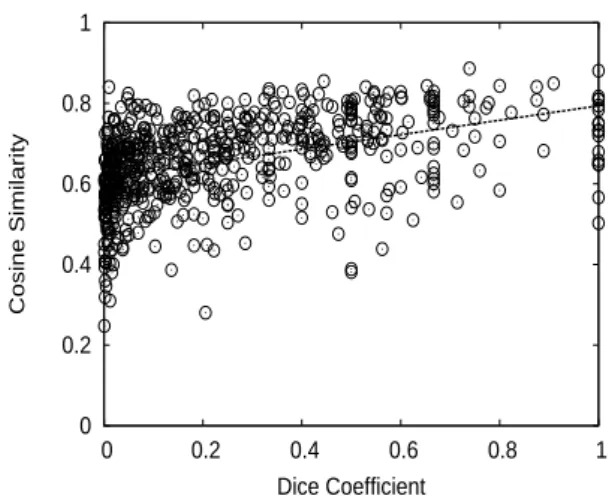
Figure 1: Dice coefficient vs. cosine similarity. Dice coefficients are extracted from a parallel cor-pus. Cosine similarities are for the embedding vectors of the Japanese loanwords and their En-glish counterparts. The line in the figure is ob-tained by linear regression.
related with the Dice coefficient except for the case dimeng=100, which shows weak
correla-tion. Spearman’s rank-order correlation coeffi-cients also suggest that these two are moderately correlated with each other. The result depends on the dimensions of the word embeddings. Basi-cally, larger dimensions tend to have higher cor-relation coefficients. In addition, when the di-mension is decreased (e.g., dimjpn = 600 to
dimeng = 300), the correlation coefficients tend
to be higher, compared with the case where the dimension remains the same (e.g., dimjpn = 300
to dimeng = 300). This result is consistent with
the report by Mikolov et al. (2013a) thatthe word vectors trained on the source language should be several times (around 2x-4x) larger than the word vectors trained on the target language.
To examine the relation between the Dice coef-ficient and the cosine similarity in more detail, we plot these values for the bottom row in Table 1, i.e., where the dimensions for Japanese number 600and the dimensions for English number300. The scatter plot that we obtained is shown in Fig-ure 1. The line obtained by linear regression is also drawn in the figure.
4.3 Detailed Evaluation on Known Change
Ta-cos(weng, wa) cos(wjpn, wb)
weng wjpn wa wb −cos(wjpn, wa) −cos(weng, wb)
image im¯eji photo impression 0.097 0.274
corner c¯on¯a crossroad section 0.099 0.115
digest daijesuto dissolve summary 0.047 0.291
bug bagu insect glitch 0.092 0.200
idol aidoru deity popstar 0.127 0.086
icon aikon deity illustration −0.035 0.145
cunning kanningu shrewd cheating 0.259 0.273
pension penshon annuity hotel 0.368 0.445
nature neich¯a characteristics magazine 0.106 0.202
driver doraib¯a chauffeur screwdriver −0.063 0.158
Table 2: Differences in cosine similarity. The Japanese loanword fromcornercan mean a small section in a larger building or space. The Japanese loanword frombugusually means a bug in a computer program. The Japanese loanword fromcunningusually means cheating on an exam. The Japanese loanword from nature is often used to indicate the scientific journalNature. The Japanese loanword from driver can mean both a vehicle driver and a screwdriver (the latter meaning was not one of the original word).
ble 2 that are supposed to have different mean-ings compared with the original English words. Some of these words were taken from a book about loanwords written by Kojima (1988). The others were collected by the authors. We also added twopivotwordswaandwbfor each word13.
For the first nine words, the meaning of pivot word wa is supposed to be closer to the English
word weng than to the Japanese loanword wjpn,
and the meaning of the pivot word wb is
sup-posed to be closer to the Japanese loanwordwjpn
than to the English word weng. It is thus
ex-pected that cos(weng, wa) −cos(wjpn, wa) > 0
andcos(wjpn, wb)−cos(weng, wb) >0hold true.
The last Japanese loanword in Table 2 is used as both pivot wordswaandwb, but the original
En-glish word is not used as wb. It is thus expected
thatcos(wjpn, wb)−cos(weng, wb)>0holds true,
butcos(weng, wa)−cos(wjpn, wa)>0might not
be necessarily true. The differences in cosine sim-ilarities are shown in Table 2. As expected, al-most all the differences are positive, which sug-gests that the difference of the word embeddings captures the meaning change. However, there was one exception:
cos(icon, deity)−cos(iconjpn, deity) =−0.035.
13Pivot words are not necessarily synonyms of the
corre-sponding English words. They are the words that we think are useful for capturing how the meanings of the loanwords and the original English are different. We also made sure that pivot words themselves are unambiguous.
The cosine similarity betweeniconanddeitywas 0.266, which is smaller than expected. We ran-domly sampled 100 lines containingiconfrom En-glish Wikipedia text, which we used for calculat-ing word embeddcalculat-ings, and found that the domi-nant sense oficonin Wikipedia is nota religious painting or figure, buta representative person or thing’as in the Wikipedia page of a football super-star David Beckham14:
Beckham became known as a fashion icon, and together with Victoria, the couple became· · ·
Thus, the reason oficon’s anomalous behavior is that the distribution over senses in Wikipedia was a lot different from the expected one.
4.4 Nearest Neighbors
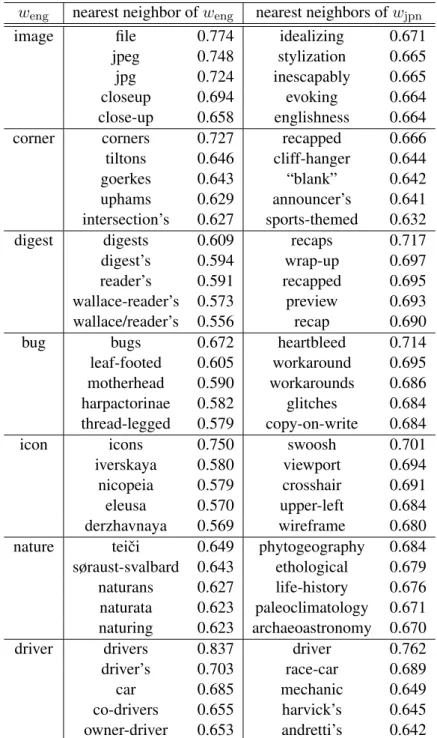
We show in Table 3 the English nearest neighbors of the English word weng and the Japanese
loan-word wjpn in the 300-dimensional space of
En-glish. Japanese loanwords are mapped from the 600-dimensional space of Japanese into the 300-dimensional space of English. The English word imageis close in meaning to the word picture, as suggested byjpegandclose-up, while its loanword seems to have a more abstract meaning such as idealizing. The nearest neighbors of the English word digest are influenced by an American
weng nearest neighbor ofweng nearest neighbors ofwjpn
image file 0.774 idealizing 0.671
jpeg 0.748 stylization 0.665
jpg 0.724 inescapably 0.665
closeup 0.694 evoking 0.664
close-up 0.658 englishness 0.664
corner corners 0.727 recapped 0.666
tiltons 0.646 cliff-hanger 0.644
goerkes 0.643 “blank” 0.642
uphams 0.629 announcer’s 0.641
intersection’s 0.627 sports-themed 0.632
digest digests 0.609 recaps 0.717
digest’s 0.594 wrap-up 0.697
reader’s 0.591 recapped 0.695
wallace-reader’s 0.573 preview 0.693
wallace/reader’s 0.556 recap 0.690
bug bugs 0.672 heartbleed 0.714
leaf-footed 0.605 workaround 0.695
motherhead 0.590 workarounds 0.686
harpactorinae 0.582 glitches 0.684
thread-legged 0.579 copy-on-write 0.684
icon icons 0.750 swoosh 0.701
iverskaya 0.580 viewport 0.694
nicopeia 0.579 crosshair 0.691
eleusa 0.570 upper-left 0.684
derzhavnaya 0.569 wireframe 0.680
nature teiˇci 0.649 phytogeography 0.684
søraust-svalbard 0.643 ethological 0.679
naturans 0.627 life-history 0.676
naturata 0.623 paleoclimatology 0.671 naturing 0.623 archaeoastronomy 0.670
driver drivers 0.837 driver 0.762
driver’s 0.703 race-car 0.689
car 0.685 mechanic 0.649
co-drivers 0.655 harvick’s 0.645
owner-driver 0.653 andretti’s 0.642
Table 3: English words that are nearest weng andwjpn. wjpn is a Japanese loanword and weng is the
original English word.wjpnis mapped into the English vector space. Only words that appear more than
ily magazineReader’s Digest15 by Wallaces, but the terms related tosummarydo not appear in the top-5 list, except for digestitself. In contrast, its loanword seems to mean wrap-up. We now re-turn to the English wordiconthat was mentioned as an exception in Section 4.3. Besidesicons, the nearest neighbors oficonareiverskaya,nicopeia, eleusa, andderzhavnaya. These four words are all related to religious paintings or figures, but they have low cosine similarities. The other parts of the table are also mostly interpretable. The nearest neighbors ofwengnaturelook uninterpretable at a
first glance, but they are influenced by the Søraust-Svalbard Nature Reserve in Norway, and Natura naturans, which is a term associated with the phi-losophy of Baruch Spinoza.
4.5 Ranking of Word Pairs According to Similarity
Here, we investigate the possibility of whether the similarity calculated in the mapped space can be used to detect the loanwords that are very differ-ent from or close to the original English words. We show the 20 words with the lowest cosine ilarities and the 20 words with highest cosine sim-ilarities in Table 4. First, let us take a look at the words on the right, which have high similarities. Most of them are technical terms (e.g., hexade-cane and propylene), and domain-specific terms such as musical instruments (e.g., piano and vi-olin) and computer-related terms (computer and software). This result is consistent with the fact that the meanings of technical terms tend not to change, at least for Japanese (Nishiyama, 1995). Next, let us take a look at the words on the left, which have low similarities. Many of them are ac-tually ambiguous, and this ambiguity is often due to the Japanese phonetic system. For example, lighterandwriter are assigned to the same loan-word in Japanese, because the Japanese language does not distinguish the consonantslandr. The words clause, closeand clothe are also assigned to the same loanword also because of the Japanese phonetic system. Other words are used as parts of named entities, also resulting in low similarity. For example, the Japanese loanword forreferis more often used asRifaa, the name of a city in Bahrain, but hardly asrefer. The loanword forirregularis often used as part of a video game titleIrregular Hunter. However, we can also find words with
sig-15http://rd.com
dissimilar pair similar pair
weng cosine weng cosine
lac 0.225 piano 0.886
refer 0.245 violin 0.881
police 0.247 cello 0.881
spread 0.251 hexadecane 0.864
mof 0.261 propylene 0.857
pond 0.270 keyboard 0.855
inn 0.274 clarinet 0.851
ism 0.279 cheese 0.849
lighter 0.280 mayonnaise 0.848
root 0.281 software 0.847
tabu 0.284 methanol 0.843
gnu 0.293 hotel 0.843
thyme 0.296 chocolate 0.841
clause 0.310 computer 0.840
board 0.315 engine 0.840
present 0.319 globalization 0.835
coordinate 0.337 tomato 0.833
expanded 0.341 trombone 0.832
irregular 0.342 recipe 0.831
measure 0.346 antimony 0.829
Table 4: Twenty words with the lowest similarities and twenty words with the highest similarities.
nificant changes in meaning, such aspresent16and coordinate17. Therefore, the result suggests that the similarity calculated by our method has the ca-pability of detecting changes in the meanings of loanwords, but we need to filter out the words that are ambiguous in the Japanese phonetic system.
We manually evaluated the 100 words that have the lowest similarities to the corresponding loan-words including the 20 loan-words shown in Table 4. Among the 100 words, 21 words are influenced by ambiguity, and 19 are influenced by named entities. Among the remaining 60 words, 57 are judged to be semantically different from their loanwords. For the other three words, the embed-dings would not be quite accurate probably due to their infrequency in either the English or the Japanese corpora used for training.
4.6 Evaluation for Educational Use
To see if the obtained word embeddings of En-glish and Japanese can assist in language
learn-16
In Japanese, presentusually means a gift, or to give a gift, but hardly to show or introduce.
17In Japanese, this word usually means to match one’s
ing, for purposes such as lexical-choice error cor-rection, we evaluate their usefulness by using the writings of Japanese learners of English. Specif-ically, we use the Lang-8 English data set (Mizu-moto et al., 2011)18 to calculate the Dice coeffi-cient instead of JENAAD. This dataset consists of sentences originally written by learners, some of which have been corrected by (presumably) native speakers of English. Because we target embed-dings of English and Japanese, we only use En-glish sentences written by Japanese among other learners of English. Of those, approximately one million sentences have corresponding corrections. With these sentence pairs, we calculate the Dice coefficient just as in Section 4.2. The coefficient measures how often a word co-occurs in the orig-inal sentences and corresponding corrections. If a word is often corrected to another, it tends to ap-pear only in the original sentences and not in the corresponding corrections, and thus, its Dice co-efficient becomes small, and vice versa. In other words, the Dice coefficient roughly measures how often a word is corrected in the Lang-8 English data. Considering this, we compare the cosine similarity based on the proposed method with the Dice coefficient by means of the Pearson’s corre-lation to evaluate how effective the cosine similar-ity is in predicting words in which lexical-choice errors likely occur19; the higher the correlation is,
the better the cosine similarity is as an indicator of lexical-choice errors. Note that we apply lemma-tization to all words both in the original sentences and in the corresponding corrections when calcu-lating the Dice coefficient in order to focus only on lexical-choice errors20.
It turns out that the value of the Pear-son’s correlation coefficient shows a milder cor-relation (ρ=0.302; significant at the signifi-cance level α=0.01) in this dataset than in JENAAD. Some loanwords having the almost equivalent senses in English have high values both for the cosine similarity and the Dice coefficient; examples are musical instruments
18http://cl.naist.jp/nldata/lang-8/ 19Some of the words in the loanword list are too infrequent
to calculate the Dice coefficient in the Lang-8 data set. Ac-cordingly, we excluded those appearing fewer than 30 times in it when calculating the Pearson’s correlation.
20Other grammatical errors including errors in number and
inflection often appear in the Lang-8 English data, which are mistakenly included in lexical-choice errors in the calculation of the Dice coefficient. Lemmatization reduces their influ-ences to some extent.
such as piano (cos=0.886, Dice=0.951) and vi-olin (cos=0.881, Dice=0.914); computer terms computer (cos=0.840, Dice=0.865) and software (cos=0.847, Dice=0.880) as has discussed in Sec-tion 4.5. Moreover, some that do not have equiva-lent senses show mild correspondences (e.g., sen-tence(cos=0.493, Dice=0.346); note (cos=0.470, Dice=0.352)).
By contrast, most of the others show less cor-respondence. One possible reason is that in the Lang-8 English data, corrections are applied to grammatical errors other than lexical choices, which undesirably decreases the Dice coefficient. Typical examples are errors in number (singu-lar countable nouns are often corrected as corre-sponding plural nouns; e.g.,book→books) and in inflection (e.g.,book→booked). Therefore, loan-words whose corresponding English loan-words un-dergo word-form changes less often tend to show strong correspondences as can been seen in the above examples (i.e., softwareand piano). This can be regarded as noise in the use of the Lang-8 data set. As mentioned above, we applied lemmatization to reduce the influences by noise. More sophisticated methods such as word align-ment might improve the accuracy of the evalua-tion.
5 Conclusions
We computationally analyzed semantic changes of Japanese loanwords. We used the word em-beddings of Japanese and English, and mapped the Japanese embeddings to the space of English, where we calculated the cosine similarity of a Japanese loanword and its original English word. We regarded this value as an indicator of semantic change. We evaluated our methodology in a num-ber of ways.
used word embeddings to show the relation be-tween semantic changes and polysemy. It would be interesting to see if similar results are obtained for loanwords.
Acknowledgments
This work was partly supported by Grant-in-Aid for Young Scientists (B) Grant Number JP26750091. Yoshifumi Kawasaki is supported by JSPS KAKENHI Grant Number 15J04335.
References
David Bamman, Chris Dyer, and Noah A. Smith. 2014. Distributed representations of geographically situ-ated language. In Proceedings of the 52nd Annual Meeting of the Association for Computational Lin-guistics (Volume 2: Short Papers), pages 828–834.
Keith Barrs. 2013. Assimilation of English vocabulary into the Japanese language. Studies in Linguistics and Language Teaching, 24:1–12.
Alan D. Blair and John Ingram. 1998. Loanword for-mation: a neural network approach. In Proceed-ings of SIGPHON Workshop on the Computation of Phonological Constraints, pages 45–54.
James Breen, Timothy Baldwin, and Francis Bond. 2012. Segmentation and translation of Japanese multi-word loanwords. In Proceedings of Aus-tralasian Language Technology Association Work-shop, pages 61–69.
Jim W. Breen. 2000. A WWW Japanese dictionary.
Japanese Studies, pages 313–317.
Frank E. Daulton. 2009. A sociolinguist expla-nation of Japan’s prolific borrowing of English.
The Ryukokou Journal of Humanities and Sciences, pages 29–36.
Manaal Faruqui and Chris Dyer. 2014. Improving vector space word representations using multilin-gual correlation. In Proceedings of the European Chapter of Association for Computational Linguis-tics, pages 462–471.
Stephan Gouws, Yoshua Bengio, and Greg Corrado. 2015. Bilbowa: Fast bilingual distributed represen-tations without word alignments. In David Blei and Francis Bach, editors,Proceedings of the 32nd Inter-national Conference on Machine Learning (ICML-15), pages 748–756.
William L. Hamilton, Jure Leskovec, and Dan Juraf-sky. 2016. Diachronic word embeddings reveal sta-tistical laws of semantic change. InProceedings of the Annual Meeting of the Association for Compu-tational Linguistics (ACL2016), pages 1489–1501. Association for Computational Linguistics.
Yoichiro Hasebe. 2006. Method for using Wikipedia as Japanese corpus (in Japanese). Doshisha studies in language and culture, 9(2):373–403.
Mark Irwin. 2011.Loanwords in Japanese. John Ben-jamins Publishing Company.
Adam Jatowt and Kevin Duh. 2014. A framework for analyzing semantic change of words across time. In
Proceedings of the 14th ACM/IEEE-CS Joint Con-ference on Digital Libraries, pages 229–238. IEEE Press.
Gillian Kay. 1995. English loanwords in Japanese.
World Englishes, pages 67–76.
Yoshiro Kojima, editor. 1988. Nihongo no imi eigo no imi (meanings in Japanese, meanings in English (translated by the authors of this paper)). Nan’un-do.
Taku Kudo, Kaoru Yamamoto, and Yuji Matsumoto. 2004. Applying conditional random fields to Japanese morphological analysis. InProceedings of the 2004 Conference on Empirical Methods in Nat-ural Language Processing (EMNLP-2004), pages 230–237.
Vivek Kulkarni, Rami Al-Rfou, Bryan Perozzi, and Steven Skiena. 2014. Statistically significant detec-tion of linguistic change. InProceedings of the 24th World Wide Web Conference (WWW), pages 625– 635.
Vivek Kulkarni, Bryan Perozzi, and Steven Skiena. 2016. Freshman or fresher? quantifying the geo-graphic variation of language in online social media. InProceedings of the Tenth International AAAI Con-ference on Web and Social Media (ICWSM 2016), pages 615–618.
Lingshuang Jack Mao and Mans Hulden. 2016. How regular is Japanese loanword adaptation? A com-putational study. InProceedings of the 26th Inter-national Conference on Computational Linguistics (COLING), pages 847–856.
Jean-Baptiste Michel, Yuan Kui Shen, Aviva Presser Aiden, Adrian Veres, Matthew K. Gray, The Google Books Team, Joseph P. Pickett, Dale Hoiberg, Dan Clancy, Peter Norvig, Jon Orwant, Steven Pinker, Martin A. Nowak, and Erez Lieber-man Aiden. 2011. Quantitative analysis of cul-ture using millions of digitized books. Science, 331(6014):176–182.
Tomas Mikolov, Quoc V. Le, and Ilya Sutskever. 2013a. Exploiting similarities among languages for machine translation. CoRR, abs/1309.4168.
Tomoya Mizumoto, Mamoru Komachi, Masaaki Na-gata, and Yuji Matsumoto. 2011. Mining revi-sion log of language learning SNS for automated Japanese error correction of second language learn-ers. In Proceedings of the 5th International Joint Conference on Natural Language Processing (IJC-NLP), pages 147–155.
Sen Nishiyama. 1995. Speaking English with a Japanese mind. World Englishes, pages 1–6.
Frank Smadja, Kathleen R. McKeown, and Vasileios Hatzivassiloglou. 1996. Translating collocations for bilingual lexicons: a statistical approach. Computa-tional Linguistics, pages 1–38.
Masao Utiyama and Hitoshi Isahara. 2003. Reliable measures for aligning Japanese-English news arti-cles and sentences. In Proceedings of the Annual Meeting of the Association for Computational Lin-guistics (ACL), pages 72–79.