- 平平1 -
Annual Report of Pro Natura Fund Vol.20 (2011
Development and implementation of research-based techniques
to suppress impact of fires on crane and stork habitats at Muraviovka Park,
Amur Region, Russia Final Report on 2009-2010 activities
to Pro Natura Fund Japan
Sergei M. Smirenski
Muraviovka Park for Sustainable Land Use Amur Region, Russia
Under 2008/2009 Pro Natura Foundation funding we discovered high dependence of crane and stork breeding success on surface water level and impact of fires. Under 2009/2010 funding we studied impact of prescribed burnings on breeding success of cranes and their habitats; determined optimal conditions, methods, and equipment for safe and efficient controlled burning; and raised public awareness about dangerous consequences of uncontrolled burning. Ongoing monitoring of weather parameters established correlations between these parameters and the occurrences of fires that allowed forecasting days with elevated fire danger and optimal days for controlled burning. Burned parts of wetlands serve as fire breaks and provide breeding habitats needed for some other rare birds and offer available food items to many birds. Legislation adjustment is crucial to define responsibility for fire safety in agriculture lands and exclude spring hunting near wetlands
important for endangered species. On-going research and tests will study impacts of wildfires and climate change. Regular prescribed burning schools for firefighters, farmers, and staff of nature protected territories will be organized. The project results will be disseminated and used in the Amur River Basin. The region government expressed intention to support further implementation of these research activities.
This project activities in 2009-2010 had set up and completed the field research designed to understand origin and impact of wild fires as well as to test new approaches for fire suppression that will increase breeding success of Red-crowned and White-naped Cranes and Oriental White Storks in the Muraviovka Park area.
By removing dead vegetation, which acts as an insulation layer above the soil, wildfire reduces above-ground biomass, increases the amount of solar radiation available for photosynthesis and faster growth of new biomass in spring. This is the main reason to burn hayfields and pastures for people in rural areas. Fire effects vary with vegetation communities, timing and frequency of burn, fuels, soil types, moisture conditions. Monitoring of burned and untouched plots located inside one type of grassland communities has shown that, if spring fires happen before the plants begin growing, the plants start reproduction earlier and grow faster in burned areas than in intact spots until their biomass has
- 平平平 - reached the density of vegetation in untouched areas.
Fires also change species composition of grasslands and forests. The result depends on season/conditions and intensity of fires. In the southern part of Tambovka District in areas protected from wildfires the Japanese White Birch Betula platyfylla is more common than the Dahurian Birch. In areas that suffer from regular fires the Dahurian Birch B. dahurica is common and the Japanese White Birch is extremely rare because the Dahurian Birch has thick bark that make this tree more tolerant to fires. In 1984, when the Park was established, we found only 4 Japanese White Birches near the Headquarters. In 2010, after 15 years of fire suppression in the same places we registered 37 Japanese White Birches.
During the first days after burning wetlands attracted many birds because it was easier to find food items in the areas where dead litter has been removed. In a while, however, such areas became less attractive as feeding habitats. Different species also demonstrated different preferences to burned and untouched wetlands as breeding and roosting sites
Table1 . Bean and Whitefronted Geese during spring stopover in the Park used only burned areas as roosting sites. The Menzbier's Pipit Anthus mezbiery gustavi preferred burned areas as breeding habitats to untouched ones.
In the south of the Amur Region, wild fires destroy annually up to 90% nests, as well as some broods and even molting cranes, pheasants, quails, and ducks. Indirect impact of fires is elimination of dead grass that cranes need as camouflage around the nest during period of incubation. In May 2010 a major grassfire destroyed at least two nests of the Oriental White Stork and one nest of White-naped Cranes in the Park.
Table1 Number of birds per square kilometer in burned and untouched areas in April-May 2010
- 平平年 -
Due to its climate and natural conditions, it is not a surprise that the Amur Region is the leader in number of wildfires and burned areas in Russia. An enormous amount of biomass of dead grass and legume is being created every summer that becomes perfect fuel for wildfires from September to mid June, when dry weather with strong gusty winds predominates in the region. In the fall wetlands freeze early and melt late in the spring. Human factor-deforestation, flood regulation and wetland reclamation, easy access to wetlands for people even during the fire alert period, added to the natural conditions, create favorable environment for ignition and spread of wildfires.
Fire promotes rapid release of nutrients tied up in above-ground biomass rather than slow release through decaying process. So farmers also burn hay fields and pastures trying to clean the fields from dead grass.
Fig. 1. Farmers continue using bailers in their harvesters, storing piles of straw close to field edges and then burning them during dry and windy days.
Fires easily spread to surrounding grasslands and wetlands with no one trying to stop them. Due to strong winds that prevail in spring and fall in the Amur Region ashes are blown away. As a result crop fields, hay fields and pastures lose organic matters and farmers need to spent funds to restore soil fertility. The Park uses straw mulching equipment in its fields that removes the fuel and returns nutrients to the soil.
Fig1 Bails of straw get burned soon after the harvest.
A
For many decades the Amur Region government, as well as regional governments all over Russia, has been following the same routine: they would announce a certain day in April and in October, after or before which controlled burnings are banned in the entire region. Such regulation did not and could not produce practical results because it ignores existed sharp differences in microclimatic conditions between districts inside the Region, as well as during different hours of the day in the same area. On the other hand, since the law enforcement is mostly on paper, arsonists do not pay attention to these restrictions.
Another problem is that all governmental measures and funds are devoted to fight forest fires while grass fires have been traditionally ignored as insignificant. Only in the last decade, when over 500 houses and buildings were lost in open areas, the regional government has begun to notice grass fires. Reactive approach is low efficient because a grassfire builds up its power within minutes and it take hours to bring a team of firefighters to the fire site. In most cases firefighters could not stop a fire until it had been suppressed by heavy rains or snow, or stopped at river shores or other
- 平平4 -
natural firebreaks. Even today it is very difficult to get any financial, logistic or organizational support for fire prevention, and there are no specialists trained to fight and prevent grass fires.
The policy of State Nature Reserves and Game Refuges is to exclude any fires in grasslands by developing wide firebreaks around protected territories. This is extremely costly and proved to be effective only during rare rainy years. Besides, after fires were prevented during one year or even one season, biomass of dead grass quickly accumulates and next fires produce more catastrophic impact. In spite of all these facts, governmental agencies responsible for natural protected territories strongly oppose to any attempts to use prescribed burning as a tool to suppress wild fires.
, ,
Through analysis and personal long-term involvement in fire suppression we found out those reactive measures are inefficient. They fail environment and economy from huge damages.
Taking into account that there is no silver bullet a single activity cannot solve this problem , we developed a comprehensive workplan to diminish negative impact of grass fires on endangered birds and their habitats. Proactive measures included the following activities.
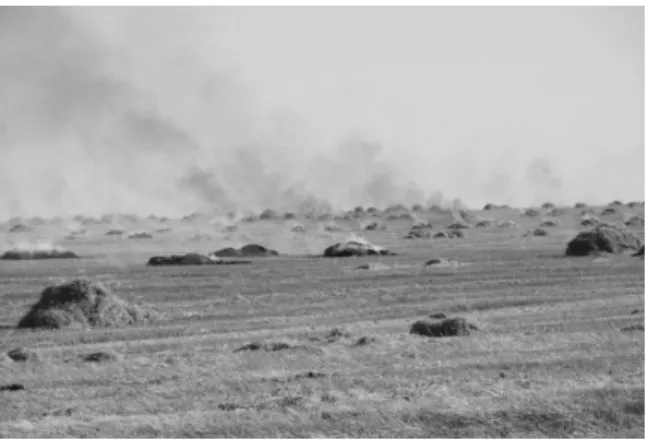
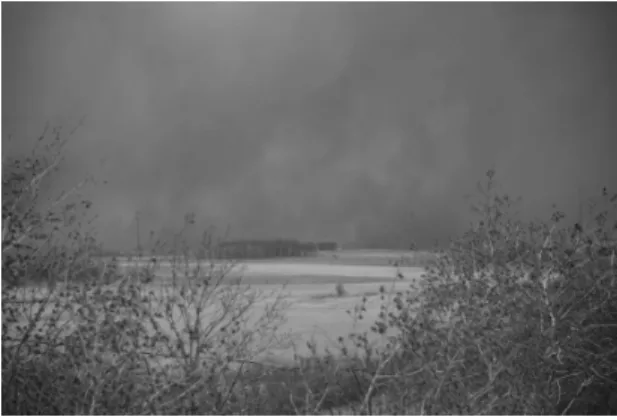
The first prescribed burning under this project was conducted on November 1, 2009. I noticed that during two days after a snowfall on October 29, some types of vegetations kept moisture and some already became dry. All my attempts to ignite wet grass fires failed but dry grass burned well that allowed me within two hours develop three parallel stripes of fire breaks 20-40 m wide Fig2 . These fire breaks played a key role in spring of 2010. When the legal 6 season for prescribed burning was closed, local farmers began burning straw in their fields on the border with the Park. On 2 May, with the first gusty and strong winds, the fire was started near the road Muraviovka-Korfovo in south-west corner of the Park. During the next 1.5 hours the fire was rushing straight north Fig3 , soon reaching the village of Dukhovskoye. Then in less than 30 seconds the wind turned by 90 degrees and a front of flame ~14 km wide began roaring east. It crossed over 4 km of wetlands in 15 minutes.
Fig2 Firebreaks developed by prescribed burning in November 2009 saved the Headquarters and crane breeding sites from wild fire in May 2010.
Fig3 Catastrophic wild fire, mid day of May 2, 2010.
- 平平5 -
Thanks to the three firebreaks made in November 2009 and the heroic efforts of staff members of the Park and firefighters Fig4 and 5 , the fire was stopped in few meters from the Park's buildings headquarters and the campgrounds with cabins .
The fire engulfed over 90% of the old grass in the Park, destroying two nests of Oriental White Storks that we know of and one nest of the White-naped Crane. Nevertheless, several small grassy patches in the middle of the fire storm remained intact and were used by two pairs of Redcrowned and by four pairs of White-naped Cranes to build their nests. In mid October 2010 we conducted several prescribed burnings to determine optimal nature conditions for this activity Fig6 .
During three attempts I had to work alone and was able to create only a small firebreak total length of 300 meters, with 20-30 meter width because the grass was not yet dry enough to burn. I had a helper for the fourth burning. I failed to notice that during that night there was a frost that dried the grass. That was a big mistake since within few minutes the flames went out of control. With the help of staff and the fire team from Muraviovka village we were able to contain the fire and develop a fire break in wetlands south from the headquarters to the road Muraviovka- Korfovo. It created an excellent mosaic of big islands of untouched grass surrounded by wide belts of burned wetlands. These islands are now well protected from the next spring wildfires. Because the surface water this fall was deeper than in any of the last 8 years, this area should be very good for cranes and other waterbirds in 2011.
Prescribed burning is a brand-new method of fire suppression for Russia. We do not have any manuals or other information for conducting safe burnings so we used the techniques that I observed at the International Crane Foundation. To monitor air temperatures, relative humidity, wind speed and direction, atmospheric stability we used the weather station purchased with Pro Natura's support in 2009. We also studied land topography and the behavior of fire during our controlled burnings.
W :
1 50% relative humidity RH was the optimal condition to conduct a prescribed burning ; 2 Safe prescribed burning can be conducted when air temperatures are below 100C°.
3 Fire can be contained when the wind speed is low, around 1-5 meters per second; With the higher wind speed it is easy to lose control of the burning, and with the lower speed the direction in which the fire would spread becomes unpredictable ;
4 Late afternoon and evening are the best times for burning because RH is high and growing, wind speed and temperature are going down.
We are planning to conduct a comprehensive research on optimal conditions for prescribed burning in the Park area during the next several years.
During many years of fire suppression activities we determined that some pieces of equipment used in the Amur Region should be replaced and some should be added to the arsenal of local firefighters. Plastic water pumps for backpack fire extinguishers manufactured in Russia often break down during the first hours of their use in the midst of fire that creates a life threat situation for firefighters. Brass pumps that I purchased in the US had are sturdy and easy to clean during the fire Fig7 and they served us well for many years. At first, the local firefighters did not even want to
- 平平ゥ -
test these pumps because they are heavier than the plastic ones. This year, helping us to fight the huge May fire, they have finally discovered the benefits of this pump and asked to bring more of them. Therefore Muraviovka Park used the grant from Pro Natura to purchase in USA 26 brass pumps, carry them to Moscow by plane in checked-in luggage, and ship by freight train to Blagoveshchensk. Then we donated 23 pumps to the Fire Department of the Regional Forest Service
Fig8 , whose help in prescribed burnings and firefighting is crucial to the Park.
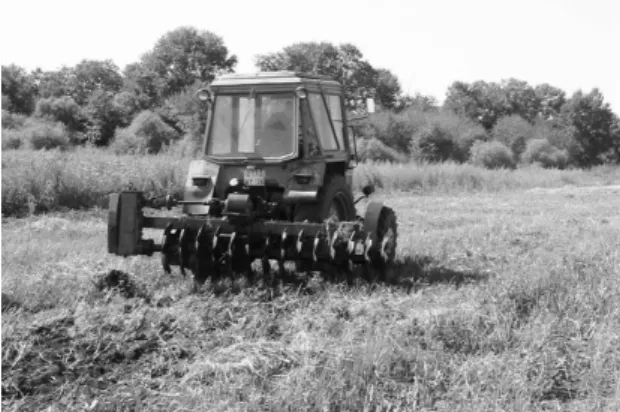
The Park also introduced the Amur Region Fire Department to the drip torches that allow igniting the fire quickly wherever and whenever needed. It is very difficult to develop initial firebreak stripe in wetlands with tall grasses. For these purpose the Park purchased, with co-financing from Pro Natura grant, rotor discs Fig9 developed by the Institute for Agriculture Mechanics in Blagoveshchensk. We used it in early spring when wetlands are still frozen.
Rotor discs demolished the dead grass on the surface without damaging soil or plants.
Communication was a big problem in the Amur Region for a long time that made it extremely difficult to inform the firefighter team about an approaching fire. Recently a telephone tower was installed in Muraviovka village that improved the situation. With support from Pro Natura we purchased regular cell phones that allow us to keep good communication between staff members of the Park, firefighters, and the local officials. It helped us coordinate prescribed burnings and timely inform fire department about wild fires that happened in the Park and its vicinity.
Fig4 Firefighter from Muraviovka village helps to stop wild fire.
Fig6 Park staff use prescribed burning to make firebreaks.
Fig5 Firefighter from Muraviovka village helps to stop wild fire.
Fig7 Brass water pump.
- 平平ウ - Fig8 Official presentation of donating a suitcase full of
brass water pump to the Head of the Amur Region Forest Service.
Fig9 Tractor with rotor discs is developing a firebreak.
The Park uses equipment that mulch straw into small pieces and disperses it during the harvest. Environmental benefit from this practice is obvious. It improved air quality and diminished soil and water pollution. Crop fields of the Park work like wide fire breaks and protect wetlands from fires started by neighbors. But there is also an economic benefit from this practice. In 5-7 years the organic leftovers become fully decomposed and add nutrients to the soil. So even without use of fertilizers soil fertility in the Park is growing.
For many years local farmers were very skeptical about this practice but in time they learned that the Park crop production is growing and for small grain it is close to those co-ops that heavily use costly mineral fertilizers. As a result, number of co-ops that replace bailers by mulching equipment is growing every year.
, ,
In the middle of Muraviovka Park wetlands, there is a chunk of slightly elevated arable land surrounded by crane breeding and roosting habitats Fig10 .
During the last 20 years, this land had changed hands multiple times and lay abandoned and covered by dense weeds for years. As a result, wildfires often originated from these former crop fields and spread to wetlands.
Poachers could easily walk into the middle of the Park's wetlands through this grassy dry area and the Park did not have any legal rights to ban their access.
Poachers use ranger stations as fortresses where they can hide from the public eyes Fig11 .
A plan to build a ranger station on this chunk of land would only aggravate the problem since it would become, in fact, a hunters' lodge. The Park did not give its approval to this project. In 2009, this agency tried to take ownership over these lands that were abandoned by a co-op. But the Regional government rented out 514 hectares for 49 years to the Park at the eve of 2010. The poachers were very angry and did not like to accept it. Through an individual farmer they initiated an appeal to the government to gain 35 hectares of land by a lake as a way to sneak inside the Park. Although the farmer could not provide any legal documents to prove his ownership, another governmental agency was aggressively lobbying for his actually poachers' interests. As a result all of us spent a substantial amount of time collecting documents, meeting with lawyers, and preparing for the court hearing. Finally the court rejected the appeal and confirmed lease of the
- 平平8 -
land by Park. It was a great victory for crane conservation and the first precedent in Russia when the government and the court sided with an NGO's against a governmental agency.
In late 2009, we received another Christmas gift: the Amur Region House of Representatives on their own initiative had exempted the Park from 98% of our land lease taxes! It saved us funds for wildlife conservation and public education.
Because the Russian laws require that arable lands are used exclusively for agricultural purposes, and the Park has a shortage of funds, machinery, and farmhands we developed an Agreement on Cooperation with the Amur Institute of Agriculture Mechanics. Staff of the Institute will test new environmentally-friendly methods of farming using the Park's fields, sharing the profit of crop sales with the Park.
Fig10 Map of the Park with shadowed areas over 500 hectares that were leased to the Park in December 2009.
Fig11 Poachers use ranger stations as fortresses where they can hide from the public eyes.
- 平平9 -
Climate, water, fire, endangered birds and people were in focus of our diverse education activities in 2009-2010. Presentations and classes. During the project period, we gave 18 presentations in three districts in the Amur Region for over 350 schoolchildren Fig12 , seminars for over 40 students of Moscow and Wisconsin State Universities, classes for over 100 participants of summer camps at Muraviovka Park Fig13 and 14 and at Zeyski State Nature Reserve, and classes for over 230 social orphans at summer camp in Belogorski District of the Amur Region.
Nature tourism for education. Muraviovka Park is a pioneer in nature tourism in the Amur Region, hosting a growing number of visitors from Russia and abroad. Park annually organizes special days such as Crane Festival, Day of Wetlands, Birds of Prey Festival, etc. and during the project term gave presentations about negative impacts of wildfires to over 1,500 visitors. The 12 Park's exposition at the Amur Expo Forum, June 2010. Oleg Kozhemyako, Governor and Victor Logachiov, Deputy Chairman, House of Representatives of the Amur Region in the center and on the right , highlighted Muraviovka Park role in nature tourism Fig15 . In 2010, we have also organized the first nature tour at the Park for blind and visually impaired people Fig16 .
A
A children art contest Prevent the Fire was organized in the Amur Region and the winners of the contest Fig17 received awards from the Park and the Fire Department gifts and free of charge participation in the Park's summer camp .
Twenty three interviews about wildfires; their causes, and their impact on endangered birds, as well as human health and the economy, were aired Fig18 through regional and national mass media; also see attached copies of publications. Enormous damage to wetlands and cranes caused by fires touched the hearts of a wide variety of people. A zookeeper from Seattle, an entomologist from Moscow, a manager of a Chinese Ecotourism Company, and a school principal from the Amur Region sent their personal donations to the Park to be used for reforestation and fire suppression programs.
Fig12 Presentation about impact of fires in a rural school in Tambovka District.
Fig13 Class at a summer environmental camp in Muraviovka Park, June 2010.
- 平年0 - Fig14 Educators and students from Amur and
Khabarovsk Regions of Russia and from USA at summer camp 2010.
Fig16 Field identification of trees during the first birding tour for blind and visually impaired.
Fig18 Marina Kolodina gives interview to the Amur Region TV.
Fig15 Oleg Kozhemyako , Governor and Victor Logachiov, Deputy Chairman, House of Representatives of the Amur Region in the center , Sergei Smirenski and Marina Kolodina, Director of the Park on the left near Muraviovka Park exposition at the Amur Expo Forum, June 2010.
Fig17 An art work from the children contest Prevent the fire".
- 平年1 -
,
Workshops. The international symposium was organized May to 3 June 2010 by ICF and Muraviovka Park in cooperation with the Wetlands International - IUCN SSC Crane Specialist Group SG and the Amur Region Government. The workshop examined two issues vitally important to cranes in general and to the Red-crowned Crane in particular: cranes and agriculture, and the impacts of climate variability and change on cranes and wetlands. The themes were global in scope. Overall, around 50 experts represented over 31 federal, state and public agencies and non-governmental organizations from 14 countries and all five “crane"continents: Australia, Canada, China, France, Germany, Hungary, Israel, Japan, Russia, the Netherlands, South Africa, South Korea, Sweden, and USA participated in the workshop. Natalia Pugachiova, Senator of the National Parliament, Sergei Smirenski and Yuri Privalov, Minister of Natural Resources of the Amur Region Fig19 participated in the first day of the workshop and in the press conference in Blagoveshchensk Fig20 and 21 . On the last day of the workshop, at a press conference hosted by the Amur Fair the participants shared examples of wetland management and successful solutions for conflicts between wildlife and farmers in different countries. A booklet of 30 paper abstracts was prepared for the workshop.
We also gave presentation at International seminar in EtnoMir in Kaluga Region for over 50 participants, and for more than 70 participants of Russian American Pacific Partnership at 15th Anniversary Annual Meeting, in Portland, Oregon, USA.
Donation of water pumps. In late October at a public ceremony the Park donated 21 brass water pumps for back packs fire extinguishers to the Amur Region Forest Service see also paragraph 2.3. . These excellent heavy-duty pumps that are not available in Russia we brought from USA to Moscow in late September and shipped by freight train to Blagoveshchensk. The Forest Service officials were extremely pleased and distributed the pumps among the region fire fighter teams. This event was well covered by the Regional TV, radio, and newspapers and all mass media highlighted the initiative and activities of Muraviovka Park in proactive approaches to fire prevention and suppression to protect the endangered species.
During the fire suppression we had experienced difficulties due to the staff shortage. This donation helped the Park to solve this problem. In return of donation of water pumps the firefighters from Muraviovka village helped us free of charge to fight the catastrophic May fire and conduct prescribed burnings in 2010; the Amur Fire Department is now eager to help us with prescribed burning in 2011.
Reforestation. Over 200 students from schools in Sadovoye, Muraviovka, Kuropatino, Kozmodemyanovka, Lermontovka Tambovka District , Verkhnya and Srednaya Poltavka Konstantinovka District and the city of Blagoveshchensk participated in reforestation and planted in May, 2010 over 300 trees Fig22, 23 .
Meetings with officials. Problem of fires and necessity to introduce prescribed burning was discussed with a State Senator from the Amur Region, the Deputy Governor of the Amur Region, the Minister of Natural Resources, the Minister of Agriculture, the Director if the Amur Forest Service, and the Head of Tambovka District Branch of the Amur Ministry of Emergencies. All these meetings were quite productive and we are confident that we will have good cooperation with all of the above.
- 平年平 - Fig19 Natalia Pugachiova, Senator of the National
Parliament, Sergei Smirenski and Yuri Privalov, Minister of Natural Resources of the Amur Region during the opening ceremony of the international symposium Climate-Cranes-People at the Park's nature center, May 2010.
Fig21 At press-conference in Blagoveshchensk, June, 2010.
Fig23 Schoolchildren during reforestation after the catastrophic fire, May, 2010.
Fig20 Press-conference with the participants of the symposium in Blagoveshchensk: From left to right: Roger Jaensh, Coordinator, East Asian-Australasian partnership, Rich Beilfuss, President, International Crane Foundation ICF , and Elena Smirenski, Program Assistant, ICF.
Fig22 Marina Kolodina and schoolchildren during reforestation after the catastrophic fire, May, 2010.
- 平年年 -
The analysis of data collected during the project, as well as studies of the history of wildfires and fire suppression in the Amur Region had revealed that:
1 Reactive measures cannot guarantee full protection to wetlands from uncontrolled grass fires;
2 Successful protection from wildfires of wetlands without biannual controlled burnings lead to accumulation of enormous amount of bio fuel and increase threat of catastrophic fires;
3 Proactive measures that include a combination of prescribed mosaic burnings and prevention of wildfires exclude catastrophic fires and create safe breeding sites for cranes and other waterbirds;
4 Burned parts of wetlands serve not only as fire breaks but provide breeding habitats needed for some other rare birds as well as offer available food items for many birds;
5 Regular prescribed burning schools for firefighters, farmhands, staff of nature protected territories should be organized;
6 Relatively low cost brass pumps and drip torches could significantly increase efficiency and safety of fire fighters; 7 Appropriate conditions for prescribed burnings should be determined for each particular crane habitat;
8 Development of new legislation that will determine responsibility for fire safety in agriculture lands as well as exclude spring hunting near wetlands that important for endangered species should be lobbied for.
The Park will continue research and tests of fire suppression practices in the following years even after the completion of the activities under the Pro Natura project work plan.
The Amur Region Fire Department had already proposed cooperation with Muraviovka Park and asked us to organize training in prescribed burning for firefighters. Originally we planned to conduct, with support from the Trust for Mutual Understanding, training workshops in the Amur Region in 2012, but because the problem is so urgent we are aiming now for earlier dates. Jeb Barzen, Director of the Field Ecology Department of ICF had agreed to come to the Park in spring 2011. We hope to get Lufthansa support for his travel from USA to Moscow, with the Amur Region government supporting his travel expenses from Moscow to Blagoveshchensk as well as expenses at the Park for the workshop leader and participants from the Amur Region.
During this training workshop its students local firefighters will be conducting the actual prescribed burning of crane habitats in the Park. It will save us substantial expenses and time and will allow protecting much larger area of wetlands from wild fires. We will discuss and decide on the program and dates for this workshop in December.
Fire studies and management of crane habitats will be a part of the Comprehensive Conservation Plan that will begin in 2011 with support from Trust for Mutual Understanding, International Crane Foundation, USA, and the Amur Ministry of Natural Resources.
Thanks to the Pro Natura grants in 2008 and 2009, the proactive approaches in wetland management have been initiated in the Amur Region.
Participants of the Project: S.M.Smirenski, M.V.Kolodina, S.A.Kazachinskaya,S.M.Yakovenko, N.E.Tihutin, A.I.Kolotyi, V.K.Ignatov, G.Nosachenko and A.E.Varlamov.