The number of subordinates moderates
intrasexual competition among males in
cooperatively breeding meerkats
Nobuyuki Kutsukake
1,2,* and Tim H. Clutton-Brock
11Large Animal Research Group, Department of Zoology, University of Cambridge, Cambridge CB2 3EJ, UK
2Department of Biological Sciences, Graduate School of Sciences, The University of Tokyo, 7-3-1 Hongo, Bunkyo-ku, Tokyo 113-0033, Japan
For dominant individuals in cooperatively breeding species, the presence of subordinates is associated with both benefits (i.e. increased reproductive output and other group-living benefits) and costs (i.e. intrasexual competition on reproduction). The biological market theory predicts that dominant individuals are tolerant to same-sex group members when there are only a few subordinates, so as to maximize their own reproductive success. We investigated factors affecting aggression by dominant males and submission by subordinate males for a cooperatively breeding mammal, meerkats, Suricata suricatta. In this species, reproductive conflict occurs between the dominant male and the non-offspring males. As predicted, the number of subordinates in a group was positively associated with the aggression frequency by the dominant male and with the submission frequency by the subordinate males. Relative to the aggression frequency against male offspring, the frequency of aggression against non-offspring males was comparable in small groups, but was higher in large groups. These results indicate that reproductive conflict is present between the dominant male and the non-offspring males but is moderated in groups with small numbers of subordinates. This study provides an empirical data agreeing with the biological market theory in the context of intrasexual competition in cooperatively breeding species.
Keywords: aggression; intrasexual competition; meerkats Suricata suricatta; cooperative breeding; biological market
1. INTRODUCTION
In cooperatively breeding vertebrates, reproduction is usually monopolized by a dominant pair (Stacey & Koenig 1990; Solomon & French 1997; Koenig & Dickinson 2004). Subordinate individuals rarely reproduce and instead help rear the offspring produced by the dominant pair. Helping by subordinates can be ultimately explained by both indirect (kin selection) and direct (group augmentation) benefits to subordinates (reviewed in Clutton-Brock (2002)). For dominant individuals, sub- ordinates can be regarded as important social resources because a large number of helpers or a low offspring/helper ratio reduces the per capita work burden of group members and is positively related to the reproductive success of the dominant individuals (Jennions & MacDonald 1994; Emlen 1997;Cockburn 1998;Hatchwell 1999;Clutton- Brock et al. 2001b). The number of subordinates is also positively associated with group-living benefits such as reduced risk of predation or increased probability of victory during inter-group aggression (Krause & Ruxton 2002).
At the same time, the presence of same-sex subordinates within a group occasionally induces intrasexual conflict for reproduction with the dominant individual (Emlen 1997; Pruett-Jones 2004; Clutton-Brock et al. 2006). In most cooperatively breeding species, intrasexual competition is
hindered by the reduced reproductive capacity of sub- ordinate individuals, resulting from either a lack of access to unrelated group members (incest avoidance;O’Riain et al. 2000) or behavioural and physiological reproductive suppression by dominants (Creel & Creel 1991, 2002; Creel et al. 1992;Creel & Waser 1997;Faulkes & Abbott 1997;Moehlman & Hofer 1997;Bennett & Faulkes 2000; Russell 2004;Schoech et al. 2004). However, subordinates do occasionally reproduce (Creel & Waser 1991; Keane et al. 1994; Creel & MacDonald 1995; French 1997; Clutton-Brock et al. 2001a; Creel & Creel 2002), and dominant individuals attempt to prevent subordinate reproduction (e.g. harassment and aggressive interference of mating by subordinates:Creel et al. 1992,Solomon & French 1997; and eviction from a group: Clutton-Brock et al. 1998; infanticide:Young & Clutton-Brock 2006; egg destruction:Pruett-Jones 2004). In eusocial naked mole- rats, Heterocephalus glaber, for example, the queen more frequently shows aggression against distantly related subordinates (workers) relative to closely related subordi- nates (Reeve & Sherman 1991). Reproduction by sub- ordinates decreases the reproductive success of the dominant individual because the helping efforts that should be directed towards the offspring of the dominant individual are also directed towards the offspring of subordinates. Furthermore, reproductive subordinates may perform infanticide or may overthrow the dominant position (Clutton-Brock et al. 1998; Young & Clutton- Brock 2006).
doi:10.1098/rspb.2007.1311 Published online7 November 2007
*Author and address for correspondence: Laboratory for Biolinguistics, RIKEN Brain Science Institute, 2-1 Hirosawa, Wako-shi, Saitama 351-0198, Japan ([email protected]).
Received23 September 2007 209 This journal is q 2007 The Royal Society
As discussed, the degree with which dominant individuals should interrupt subordinates’ reproduction is a fundamental, but not a straightforward, problem for dominant individuals because the presence of same-sex subordinates can provide both benefits (e.g. helping and group-living benefits) and costs (intrasexual competition). By behaving aggressively or evicting subordinates to interrupt their reproduction, subordinates may disperse from a group and dominant individuals may lose the benefits given by the presence of subordinates. The biological market theory (Noe¨ & Hammerstein 1994, 1995;Barrett et al. 1999) predicts that when there are only a small number of subordinates in a group, the value of each subordinate to the dominant individual is high and the dominant individuals are tolerant to the subordinates, even if they represent reproductive rivals, so as to maximize their own reproductive output and group-living benefits. By contrast, dominant individuals living in a large group do not face a critical trade-off because the benefit given by each subordinate per capita is low. In such condition, the intensity of intrasexual competition alone should determine the nature of social relationships between dominant and subordinates. So far, the import- ance of subordinates in small groups has been shown in cooperatively breeding mammals. For example, dominant individuals of captive Wied’s black tufted-ear marmosets, Callithrix kuhli, increase the number of subordinates by accepting immigrant individuals into small groups and that dominant individuals are more aggressive in large groups compared with small groups (Schaffner & French 1997). In moustached tamarins Saguinus mystax, the comparison of two groups of different group size suggests that grooming, a proxy of affiliation, by dominant female towards group members was longer in the small group than in the large group (Lo¨ttker et al. 2007).
We investigated factors affecting intrasexual compe- tition among males of a cooperatively breeding mammal, meerkats, Suricata suricatta, a small South African mongoose. Dominant pairs of meerkats breed approxi- mately three times per year, and a dominant female resumes her oestrous soon after the birth of pups. Dominant females are in oestrous for approximately one week during which the dominant male is persistently following and guards the dominant female. By doing so, the behaviour of the dominant male is constrained by the guarding at the expense of other activities, such as social interactions with other group members. In this species, the ratio of pups to helpers is related to juvenile growth and survival, the future possibility of reproduction by sub- ordinates and the reproductive success of dominant individuals (Clutton-Brock 2002; Russell et al. 2002, 2003). Males voluntarily disperse from their natal groups by forming a coalition with other group males and seeking extra-group mating by roving (Doolan & MacDonald 1996; Young et al. 2007). The reproductive capacity of subordinate males is not physiologically suppressed (O’Riain et al. 2000; Moss et al. 2001). This species demonstrates incest avoidance (O’Riain et al. 2000;Griffin et al. 2003); natal males do not have a chance to reproduce within their natal group. Therefore, all of the dominant male’s rivals, in the context of reproduction, are non-natal males and are not related to the dominant female. Molecular data have revealed that the reproductive skew is high among males, with almost 90% of pups being sired
by the dominant male (Spong et al. submitted;Griffin et al. 2003). Non-offspring subordinate males reproduce at a lower rate than dominant males and account for more than 10% of the paternity of pups born by the dominant female and approximately 20% of the pups born by subordinate females (Griffin et al. 2003; Spong et al. submitted). The reproductive success of the dominant male decreases with the increasing number of competitors (non-offspring males in the group and extra-group males), but is positively associated with group size (Spong et al. submitted).
We analysed the effect of relationships between the dominant and subordinate males (i.e. offspring or non- offspring), the number of subordinates and the oestrous condition of the dominant female on the frequency of aggression performed by the dominant male and the spontaneous submission by subordinate males, which are social interactions that reflect the risk of aggression imposed by the dominant male and intrasexual competition in this species (Clutton-Brock et al. 2006;Kutsukake & Clutton- Brock 2006a,b). From the intrasexual competition for reproduction and the biological market theory, we predicted that (i) dominant males would show aggression towards non-offspring subordinate males more frequently than against male offspring, (ii) non-offspring subordinate males would submit more frequently than subordinate male offspring, (iii) the frequency of aggression and submission between a dominant male and subordinate males would be higher in large groups compared with small groups, and (iv) dominant males would be less aggressive when dominant females were in oestrous because dominant males guard dominant females during oestrous and this guarding would reduce the time available for aggression against other males.
2. MATERIAL AND METHODS (a) Study animals and field site
This study was conducted in Kalahari, South Africa, close to Vanzylsrus (268580S, 218490E ), between October and November 2005. The study site consisted of the dry riverbeds of the Kuruman River, herbaceous flats and vegetated dunes. The ecological conditions and climate of this region are described elsewhere (Clutton-Brock et al. 1999a,b; Russell et al. 2002). The study population consisted of 257 individuals living in 12 social groups. All individuals were habituated to close observation (i.e. from less than 1 m). The ages of most individuals were known to within a few days because they had been observed since birth. Groups were visited at least once in every 3 days to collect demographic and behavioural data.
(b) Observation methods
The first author conducted continuous focal observations (Altmann 1974) of the dominant male in five meerkat groups that varied in size from 8 to 38 individuals at the beginning of the observation period (medianZ16). One or two non-offspring subordinate males who are unrelated to dominant females were present in all of the study groups. Here, we define ‘offspring’ as offspring of the dominant female born during the dominant male’s tenure. The route by which non-offspring males reside in a group is multifold. In meerkats, new groups are formed when dispersing males encounter unrelated females that were expelled from a group (Clutton-Brock et al. 1998). One male
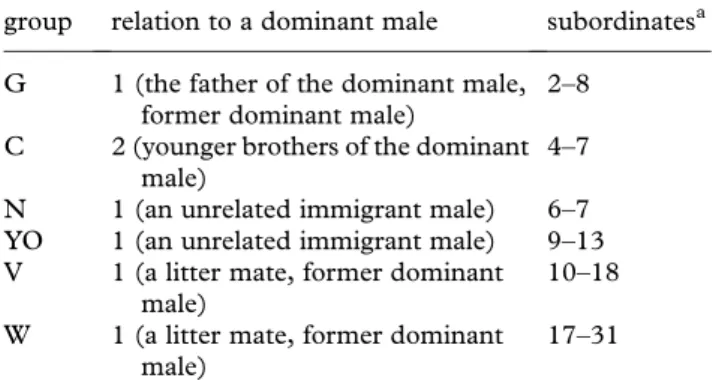
then becomes dominant after a dominance competition among the coalition partners, and the other males become subordi- nates and remain in the newly formed group. Also, non- offspring males occasionally immigrate into groups. Further- more, after losing a dominance competition, previously dominant males occasionally remain within a group, taking on the role of a non-offspring subordinate male. Owing to these various processes, the kin relationships between non-offspring and dominant males in the study groups were highly variable, including littermates, brothers, father–son or unrelated male pairs (table 1). In all study groups, the dominance relationships had been established for at least four months (the mean duration of the dominance in the six study groups was 1.1 years; max: 2.7 years) and the dominance relationship was stable during the study period.
Morning focal observations began when the group emerged from the sleeping burrow and continued while the group foraged until they became inactive at midday. Evening focal observations began when the group was located and ended when the dominant female entered the sleeping burrow. On average, each focal session lasted 2 hours and 50 min; sessions lasting less than 1 hour were excluded. A mean of 18 focal observations were conducted for each group (rangeZ11–24, total observation hoursZ312 hours).
During observations, we recorded all individuals that came within a 1 m radius of the dominant male (hereafter, these are referred to as ‘encounters’) and all social interactions involving the focal dominant male; that is, all aggression received and performed, all submission received and the identity of the interacting partner. Aggressive behaviour was classified as follows: ‘charge’ (running directly at the subordinate), ‘hip-slam’ (slamming its hip against the side of a subordinate), ‘chin mark’ (rubbing its chin on a subordinate), ‘hit’ (swatting a subordinate with one paw),
‘chase’ and physical contact by ‘biting’. Aggression was excluded when it was a result of competition over a food item because such interactions may not reflect reproductive conflict. Submissive behaviour included high-pitched vocali- zations that typically lasted more than a few seconds and grovelling movements or assuming a crouching posture in the presence of the dominant male. We did not include submission when it occurred soon after aggression by the dominant male because, in such a case, it was a response to the immediate aggression. In other words, our data include only spontaneous submission by subordinate males. The total numbers of observed interactions were 749 cases for
encounter, 231 cases for aggression and 455 cases for submission. Submission was sometimes intense and included the subordinate male persistently following and grooming the dominant male. These types of submission, which we labelled
‘intensive’ submission, consist of 7.0% (32/455) of observed cases of submission and are believed to have substantial costs for an actor in terms of time and energy.
(c) Statistical analysis
First, we investigated the association between the frequency of aggression by dominant males and that of submission or intensive submission by subordinate males by running generalized linear mixed models (GLMMs; Schall 1991). Mixed models allow both fixed and random terms to be fitted. Random terms take into consideration repeated sampling; we included the group (six groups; the number of repeated measures: 25–273), the identity of the litter (30 litters; the number of repeated measures: 9–69) and the identity of each subordinate male (44 males; the number of repeated measures: 9–24) as random terms. The amount of time that each subordinate female encountered the dominant female was included as a covariate.
We used separate GLMMs to examine the predictors of each response variable: the aggression frequency of the dominant male against each subordinate male; the submission frequency of each subordinate male to the dominant male; and the frequency of intensive submission by each subordinate male. To analyse aggression, we set the number of times that a dominant male attacked each subordinate male as a dependent term with a Poisson distribution. Similarly, we used the number of times that each subordinate male spontaneously submitted to the dominant male as a dependent term to investigate the factors affecting submission.
In these models, we used the same set of predictor variables: category of subordinate males (categorical: 37
‘male offspring’; ‘brothers’: 4 non-offspring males who are brothers of dominant males; ‘non-brothers’: 3 other non- offspring males); the number of subordinates (continuous; defined as subordinates older than six months; Clutton-Brock et al.2001b,2002;Russell et al. 2003); and oestrous condition of the dominant female (categorical). Again, we controlled for the amount of time that each subordinate female encountered the dominant female by including it as a covariate. We did not include the age of each subordinate male as an independent term because non-offspring males are usually older than subordinate male offspring (mean ageZ4.6 years, max- imumZ9.5 years, minimumZ1.8 years for non-offspring males; mean ageZ1.4 years, maximumZ4.0 years, max- imumZ0.6 years for male offspring) and because the subordinate male category had more explanatory power than did age. Following Crawley (2002), we included all probable independent terms and possible interactions in the maximal model and excluded terms sequentially until the model contained only statistically meaningful terms.
3. RESULTS
The frequency of aggression positively associated with both the frequency of submission (bGs.e.Z0.175G0.024, zZ7.261, p!0.0001) and the frequency of intensive submission (bGs.e.Z0.336G0.131, zZ2.565, pZ0.01) after controlling for the effect of the encounter frequency. The number of subordinates in a group influenced the aggression frequency after controlling for the encounter Table 1. Group composition of the study groups.
group relation to a dominant male
the number of subordinatesa G 1 (the father of the dominant male,
former dominant male)
2–8 C 2 (younger brothers of the dominant
male)
4–7 N 1 (an unrelated immigrant male) 6–7 YO 1 (an unrelated immigrant male) 9–13 V 1 (a litter mate, former dominant
male)
10–18 W 1 (a litter mate, former dominant
male)
17–31
aThe number of subordinates varied during the study period owing to temporal roving by subordinate males and eviction of subordinate females by dominant females.
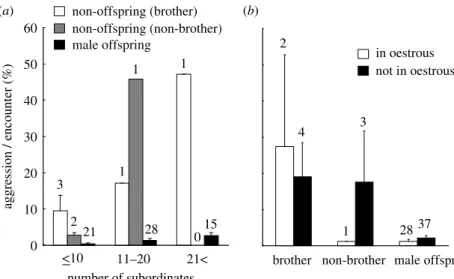
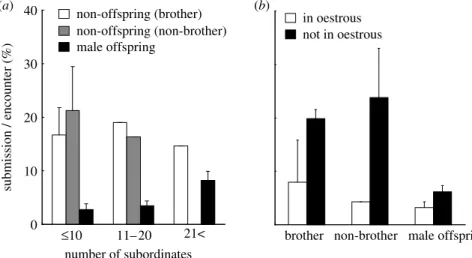
frequency, with a probability of aggression in the encounter by dominant males towards subordinate males being higher in groups with a large number of subordi- nates (table 2). A two-way interaction between the number of subordinates and male category (table 2) suggests that the effect of the number of subordinates on aggression frequency varied with male category. That is, the increase of the aggression by the increasing number of subordinates is steeper for non-brother males than brothers and male offspring, and the increase for brothers is steeper than that for male offspring. In other words, the differences of a probability of aggression in an encounter by the dominant male against each category of subordi- nate males were small in small groups, but these differences became pronounced in large groups (figure 1). After controlling for the encounter frequency, the submission frequency was affected by the number of subordinates, female oestrous condition and a two-way interaction between female oestrous condition and male category (table 3). Similar to the results for aggression, a probability of submission in an encounter by subordinate males was positively related to the number of subordinates
and was higher when the dominant female was not in oestrous than when the dominant female was in oestrous (figure 2). The decrease of the submission frequency by non-brother males was higher than that by brothers and male offspring, and the decrease of that by brothers was higher than that by male offspring (figure 2).
After controlling for the encounter frequency, the frequency of intensive submission by subordinate males was positively related to the number of subordinates (table 4). In addition, the frequency of intensive submission by non-offspring males (i.e. brothers and non-brothers) was higher than that by male offspring (table 4). Intensive submission was never observed when the dominant female was in oestrous.
4. DISCUSSION
In cooperatively breeding meerkats, the number of subordinates in a group was positively associated with the frequency of intrasexual aggression by the dominant male and the frequency of submission by subordinate males, with the dominant male being tolerant to 0
10 20 30 40 50 60
11–20 21< 0 1 1
1
brother non-brother male offspring in oestrous not in oestrous
number of subordinates
aggression / encounter (%)
3
2 21 28 15
2
4
1 3
2837 non-offspring (brother)
non-offspring (non-brother) male offspring
<10
(a) (b)
Figure 1. Effects of the number of subordinates, the male category, and the oestrous condition of the dominant female on a probability of aggression during an encounter by dominant males. For each dyad between a dominant and a subordinate male, we calculated a probability of aggression (i.e. the number of times dominant males behaved aggressively towards each subordinate male divided by the number of times each subordinate male was in proximity to the dominant male for each observational day) and next calculate the dyad mean for each classification of the male category, the number of subordinates (classified into three categories: 10 and more; 11–20; and 21 and more) and the oestrous condition of the dominant female. (a) The effects of the male category and the number of subordinates and (b) the effects of the male category and the oestrous condition of dominant females. Graphs show the mean (Cs.e.) and the number of dyads for each category. The study groups classified into each classification of the number of subordinates were as follows (less than or equal to 10: G, C, N and YO; 11–20: YO and V: 21%W).
Table 2. Factors affecting aggression frequency by the dominant male.
independent term b(s.e.) z p
oestrous condition (non-oestrousOin oestrous) 0.646 (0.234) 2.756 0.006
the number of subordinates 0.458 (0.142) 3.226 0.001
male category
male offspring versus brother K0.994 (0.800) K1.243 0.214
male offspring versus non-brother non-offspring males 1.825 (1.512) 1.208 0.227
brother versus non-brother non-offspring males K2.815 (1.590) K1.771 0.077
male category!the number of subordinates
male offspring!brother K0.072 (0.039) K1.848 0.064
male offspring!non-brother non-offspring males K0.419 (0.144) K2.922 0.003
brother!non-brother non-offspring males 0.346 (0.145) 2.378 0.017
subordinate males in small groups. Owing to the various types of benefits brought by the presence of subordinates in cooperatively breeding species (see §1), the biological market theory predicted that the value of each subordinate was higher in small groups compared with that in large groups. Our results fit to this prediction and suggest that the dominant male adjusts his social relationships with subordinate males according to the number of subordi- nates. The high tolerance by the dominant males in small groups can be regarded as an incentive for subordinate males to stay in the group and cooperate.
The differences of aggression and submission frequen- cies according to male category suggest that reproductive conflict occurs between the dominant male and non- offspring males (i.e. brothers and non-brothers of dominant males). However, expression of the reproduc- tive conflict is reduced in small groups relative to that in large groups—the difference in the aggression frequency between against non-offspring males and against male offspring was comparable in small groups, but was higher in large groups (figure 1). In large groups, the dominant male may be able to reinforce his reproduction with the
(a) (b)
non-offspring (brother) non-offspring (non-brother) male offspring
0 10 20 30 40
£10 11– 20 21< brother non-brother male offspring
submission / encounter (%)
number of subordinates
in oestrous not in oestrous
Figure 2. The effects of the number of subordinates, the male category, and the oestrous condition of the dominant female on a probability of submission during an encounter by subordinate males. For each dyad between a dominant and subordinate male, we calculated a probability of submission (i.e. the number of times subordinate males submitted to the dominant male divided by the number of times each subordinate male was in proximity to the dominant male for each observational day) and next calculate the dyad mean for each classification of male category, the number of subordinates (classified into three categories: 10 and more; 11–20; 21 and more) and the oestrous condition of the dominant female. (a) The effects of the male category and the number of subordinates and (b) the effects of the male category and the oestrous condition of dominant females. Graphs show the mean (Cs.e.) and the number of dyads for each category (for sample size of dyads and classification of the groups, seefigure 1).
Table 3. Factors affecting submission frequency by subordinate males.
independent term b(s.e.) z p
oestrous condition (non-oestrousOin oestrous) 0.690 (0.138) 5.000 !0.0001
the number of subordinates 0.064 (0.013) 4.779 !0.0001
male category
male offspring versus brother K2.442 (0.523) 4.669 !0.0001
male offspring versus non-brother non-offspring males K0.981 (0.740) K1.326 0.185
brother versus non-brother non-offspring males 1.464 (0.814) 1.798 0.072
oestrous!male category
male offspring!brother 0.594 (0.288) 2.065 0.039
male offspring!non-brother non-offspring males K1.249 (0.534) K2.339 0.019
brother!non-brother non-offspring males 1.844 (0.544) 3.388 0.0007
Table 4. Factors affecting intensive submission frequency by subordinate males. (‘Z’ indicates no statistical difference.)
independent term b(s.e.) z p
oestrous conditiona — — —
the number of subordinates 0.060 (0.029) 2.095 !0.04
male category
male offspring!brother K2.284 (0.645) K3.538 0.0004
male offspring!non-brother non-offspring males K2.517 (0.877) K2.870 0.004
brotherZnon-brother non-offspring males 0.260 (0.911) 0.285 0.776
aIntensive submission was never observed when the dominant female was in oestrous.
dominant female by attacking and putting the non- offspring males in positions peripheral to the centre of the group. By contrast, the small number of subordinates increased ‘value’ of each subordinate and masked the reproductive conflict among dominant and non-offspring males in small groups.
The oestrous condition of the dominant female affected the frequencies of aggression and submission between the dominant male and subordinate males. The aggression frequency when the dominant female was not in oestrous was higher than the aggression frequency when the dominant female was in oestrous. This is because dominant males are constrained by intense mate guarding and have neither the time nor the energy to attack rival males while they are following and guarding the dominant female. Probably owing to the reduced risk for subordinate males, the submission frequency by subordinate males was lower when dominant females were in oestrous, and this decrease was evident particularly in non-offspring males relative to male offspring (table 3;figure 2). In conjunction with the positive relationships with the number of subordinates, the analyses of submission indicate that subordinate males also flexibly adjust their behaviour according to the risk of aggression which is determined by the biological market theory and female oestrous condition.
We previously investigated the aggression by dominant female meerkats against subordinate females and found that the number of subordinates did not affect the reproductive conflict among females (Kutsukake & Clutton-Brock 2006a). Instead, dominant females attacked older subordinate females that were likely to reproduce (Clutton-Brock et al. 2001a), and the fre- quency of attack increased as the birth of pups approached (Kutsukake & Clutton-Brock 2006a). The difference in results between males and females suggests that the dominant males and females have different strategies for intrasexual conflict in reaction to the number of sub- ordinates. We suspect that this sex difference reflects the intensity of intrasexual competition in meerkats and the reproductive costs caused by the presence of same-sex subordinates. First, intrasexual competition for reproduc- tion is more intense among female than among male meerkats (Clutton-Brock et al. 2006). Pregnant subordi- nate females perform infanticide, but subordinate males rarely do (Clutton-Brock et al. 1998), probably because the presence of subordinate females’ pups will reduce the subordinates’ helping efforts on pups of dominant females (Clutton-Brock et al. 2001a) and owing to the funda- mental sex difference of high certainty of parentage for females over males. Finally, the dominant males can prevent non-offspring males from mating with the dominant female by guarding her, whereas the dominant female cannot completely control the reproduction of subordinate females with extra-group males (Clutton- Brock et al. 2001a;Young et al. 2007).
Our results have two implications for our broad understanding of cooperatively breeding vertebrates. First, the dominant individual has a flexible behavioural strategy to modulate reproductive conflict according to social factors (i.e. the number of subordinates) as is predicted by the biological market theory. The explana- tory use of the biological market effect has been shown in multiple contexts in animal behaviour, such as exchanges of cooperation (Barrett & Henzi 2006) and interspecific
mutualism (Bshary 2001;Hoeksema & Schwartz 2001). So far, the idea of the biological market has been less frequently applied in cooperatively breeding species (exception:Reyer 1986,Lo¨ttker et al. 2007). This study added an empirical data showing a use of the biological market theory in the context of intrasexual competition in cooperative breeding species. We predict that similar behavioural modifications that fit to the biological market theory occur in other cooperatively breeding species in which the intrasexual competition on reproduction is present and the number of subordinates results in benefits for dominant individuals. Second, our results emphasize the importance of detailed observations of social interactions that provide direct information about social relationships among group members. The presence of intrasexual conflict cannot be inferred from analyses based solely on reproductive and demographic data, and researchers may miss complex interactions among multiple social and reproductive factors that determine the intrasexual conflict and reproductive skew. Focusing on the social interactions, our results suggest a possibility that the high reproductive skew in meerkats is achieved by active interference by the dominant males.
The study was conducted with permission of the Northern Cape Conservation Service, South Africa.
We would like to thank Thornton, A., Ridley, M., Raihani, N., Sheehan, M., Snelson, R., Dyer, N., Turner, K., Lanfear, S., Freeman, H., Sutcliffe, R., Hedworth, H., Staff, R., Lederie, K., Rasmussen, M., van Wyk, A., le Roux, A., Tayar, N., Browning, L., Nelson, M, Oates, J., Kunc, H. and Radford, A. for their support over the course of this study. We especially thank Flower, T., Russell, A., Spong, G. F., Hodge, S., Young, A. and Fujisawa, K. K. for supporting this study and discussions. This study was financially supported by Japan Society for Promotion of Science and RIKEN Special Postdoctoral Researchers Program.
REFERENCES
Altmann, J. 1974 Observational study of behavior: sampling methods. Behaviour 49, 227–265.
Barrett, L. & Henzi, S. P. 2006 Monkeys, markets and minds: biological markets and primate sociality. In Cooperation in primates and humans: mechanisms and evolution(eds P. M. Kappeler & C. P. van Schaik), pp. 209–232. Berlin, Germany: Springer.
Barrett, L., Henzi, S. P., Weingrill, T., Lycett, J. E. & Hill, R. A. 1999 Market forces predict grooming reciprocity in female baboons. Proc. R. Soc. B 266, 665–670. (doi:10. 1098/rspb.1999.0687)
Bennett, N. C. & Faulkes, C. G. 2000 African mole-rats: ecology and eusociality. Cambridge, UK: Cambridge University Press.
Bshary, R. 2001 The cleaner fish market. In Economics in nature: social dilemmas, mate choice and biological markets (eds R. Noe, J. A. R. A. M. van Hooff & P. Hammerstein), pp. 146–172. Cambridge, UK: Cambridge University Press.
Clutton-Brock, T. H. 2002 Breeding together: kin selection and mutualism in cooperative vertebrates. Science 296, 69–72. (doi:10.1126/science.296.5565.69)
Clutton-Brock, T. H., Brotherton, P. N. M., Smith, R., McIlrath, G. M., Kansky, R., Gaynor, D., O’Riain, M. J. & Skinner, J. D. 1998 Infanticide and expulsion of females in a cooperative mammal. Proc. R. Soc. B 265, 2291–2295. (doi:10.1098/rspb.1998.0573)
Clutton-Brock, T. H., Gaynor, D., McIlrath, G. M., Maccoll, A. D. C., Kansky, R., Chadwick, P., Manser, M., Skinner, J. D. & Brotherton, P. N. M. 1999a Predation, group size and mortality in a cooperative mongoose, Suricata suricatta. J. Anim. Ecol. 68, 672–683. (doi:10.1046/ j.1365-2656.1999.00317.x)
Clutton-Brock, T. H., Maccoll, A., Chadwick, P., Gaynor, D., Kansky, R. & Skinner, J. D. 1999b Reproduction and survival of suricates (Suricata suricatta) in the southern Kalahari. Afr. J. Ecol. 37, 69–80. (doi:10.1046/j.1365- 2028.1999.00160.x)
Clutton-Brock, T. H. et al. 2001a Cooperation, conflict and concession in meerkat groups. Science 291, 478–481. (doi:10.1126/science.291.5503.478)
Clutton-Brock, T. H., Russell, A. F., Sharpe, L. L., Brotherton, P. N. M., McIlrath, G. M., White, S. & Cameron, E. Z. 2001b Effects of helpers on juvenile development and survival in meerkats. Science 293, 2446–2449. (doi:10.1126/science.1061274)
Clutton-Brock, T. H., Russell, A. F., Sharpe, L. L., Young, A. J., Balmforth, Z. & McIlrath, G. M. 2002 Evolution and development of sex differences in cooperative behavior in meerkats. Science 297, 253–256. (doi:10. 1126/science.1071412)
Clutton-Brock, T. H., Hodge, S. J., Spong, G., Russell, A. F., Jordan, N. R., Bennett, N. C., Sharpe, L. L. & Manser, M. B. 2006 Intrasexual competition and sexual selection in cooperative mammals. Nature 444, 1065–1068. (doi:10. 1038/nature05386)
Cockburn, A. 1998 Evolution of helping behavior in cooperatively breeding birds. Annu. Rev. Ecol. Syst. 29, 141–177. (doi:10.1146/annurev.ecolsys.29.1.141) Crawley, M. J. 2002 Statistical computing: an introduction to
data analysis using S-Plus. Chichester, UK: Wiley. Creel, S. R. & Creel, N. M. 1991 Energetics, reproductive
suppression and obligate communal breeding in carni- vores. Behav. Ecol. Sociobiol. 28, 263–270. (doi:10.1007/ BF00175099)
Creel, S. R. & Creel, N. M. 2002 The African wild dog: behavior, ecology, and conservation. Princeton, NJ: Prince- ton University Press.
Creel, S. & MacDonald, D. W. 1995 Sociality, group size, and reproductive suppression among carnivores. Adv. Study Behav. 24, 203–257.
Creel, S. R. & Waser, P. M. 1991 Failures of reproductive suppression in dwarf mongooses (Helogale parvula): accident or adaptation? Behav. Ecol. 2, 7–15. (doi:10. 1093/beheco/2.1.7)
Creel, S. R. & Waser, P. M. 1997 Variation in reproductive suppression among dwarf mongooses: interplay between mechanisms and evolution. In Cooperative breeding in mammals(eds N. Solomon & J. A. French), pp. 150–170. Cambridge, UK: Cambridge University Press.
Creel, S., Creel, N., Wildt, D. E. & Monfort, S. L. 1992 Behavioral and endocrine mechanisms of reproductive suppression in Serengeti dwarf mongooses. Anim. Behav. 43, 231–245. (doi:10.1016/S0003-3472(05)80219-2) Doolan, S. & MacDonald, D. 1996 Dispersal and extra-
territorial prospecting by slender-tailed meerkats (Suricata suricatta) in the south-western Kalahari. J. Zool. 240, 59–73.
Emlen, S. T. 1997 Predicting family dynamics in social vertebrates. In Behavioural ecology: an evolutionary approach(eds J. R. Krebs & N. B. Davies), pp. 228–253. 4th edn.. Oxford, UK: Blackwell Scientific.
Faulkes, C. G. & Abbott, D. H. 1997 Proximate mechanisms regulating a reproductive dictatorship: a single dominant female controls male and female reproduction in colonies
of naked mole-rats. In Cooperative breeding in mammals (eds N. Solomon & J. A. French), pp. 268–301. Cambridge, UK: Cambridge University Press.
French, J. A. 1997 Proximate regulation of singular breeding in callitrichid primates. In Cooperative breeding in mammals (eds N. Solomon & J. A. French), pp. 34–75. Cambridge, UK: Cambridge University Press.
Griffin, A. S., Pemberton, J. M., Brotherton, P. N. M., McIlrath, G. M., Gaynor, D., Kansky, R. & Clutton- Brock, T. H. 2003 A genetic analysis of breeding success in the cooperative meerkat (Suricata suricatta). Behav. Ecol. 14, 472–480. (doi:10.1093/beheco/arg040)
Hatchwell, B. J. 1999 Investment strategies of breeders in avian cooperative breeding systems. Am. Nat. 154, 205–219. (doi:10.1086/303227)
Hoeksema, J. D. & Schwartz, M. W. 2001 Modelling interspecific mutualisms as biological markets. In Economics in nature: social dilemmas, mate choice and biological markets (eds R. Noe, J. A. R. A. M. van Hooff & P. Hammerstein), pp. 173–183. Cambridge, UK: Cambridge University Press. Jennions, M. D. & MacDonald, D. W. 1994 Cooperative breeding in mammals. Trends Ecol. Evol. 9, 89–93. (doi:10. 1016/0169-5347(94)90202-X)
Keane, B., Waser, P. M., Creel, S. R., Creel, N. M., Elliott, L. F. & Minchella, D. J. 1994 Subordinate reproduction in dwarf mongooses. Anim. Behav. 47, 65–75. (doi:10.1006/ anbe.1994.1008)
Koenig, W. D. & Dickinson, J. L. 2004 Ecology and evolution of cooperative breeding in birds. Cambridge, UK: Cambridge University Press.
Krause, J. & Ruxton, G. D. 2002 Living in groups. Oxford, UK: Oxford University Press.
Kutsukake, N. & Clutton-Brock, T. H. 2006a Aggression and submission reflect reproductive conflict between females in cooperatively breeding meerkats. Behav. Ecol. Sociobiol. 59, 541–548. (doi:10.1007/s00265-005- 0079-7)
Kutsukake, N. & Clutton-Brock, T. H. 2006b Social function of allogrooming in cooperatively breeding meerkats. Anim. Behav. 72, 1059–1068. (doi:10.1016/j.anbehav.2006.02. 016)
Lo¨ttker, P., Huck, M., Zinner, D. P. & Heymann, E. W. 2007 Grooming relationships between breeding females and adult group members in cooperatively breeding mous- tached tamarins (Saguinus mystax). Am. J. Primatol. 69, 1159–1172. (doi:10.1002/ajp.20411)
Moehlman, P. D. & Hofer, H. 1997 Cooperative breeding, reproductive suppression, and body mass in canids. In Cooperative breeding in mammals(eds N. Solomon & J. A. French), pp. 76–128. Cambridge, UK: Cambridge University Press.
Moss, A. M., Clutton-Brock, T. H. & Monfort, S. L. 2001 Longitudinal gonadal steroid excretion in free-living male and female meerkats (Suricata suricatta). Gen. Comp. Endocrinol. 122, 158–171. (doi:10.1006/gcen.2001.7622) Noe¨, R. & Hammerstein, P. 1994 Biological markets: supply and demand determine the effect of partner choice in cooperation, mutualism and mating. Behav. Ecol. Socio- biol. 35, 1–11.
Noe¨, R. & Hammerstein, P. 1995 Biological markets. Trends Ecol. Evol. 10, 336–339. (doi:10.1016/S0169-5347(00) 89123-5)
O’Riain, M. J., Bennett, N. C., Brotherton, P. N. M., McIlrath, G. M. & Clutton-Brock, T. H. 2000 Reproduc- tive suppression and inbreeding avoidance in wild populations of cooperatively breeding meerkats (Suricata suricatta). Behav. Ecol. Sociobiol. 48, 471–477. (doi:10. 1007/s002650000249)
Pruett-Jones, S. 2004 Summary. In Ecology and evolution of cooperative breeding in birds (eds W. D. Koenig & J. L. Dickinson), pp. 228–238. Cambridge, UK: Cambridge University Press.
Reeve, H. K. & Sherman, P. W. 1991 Intracolonial aggression and nepotism by the breeding female naked mole-rat. In The biology of the naked mole-rat (eds P. W. Sherman, J. U. M. Jarvis & R. D. Alexander), pp. 337–357. Princeton, NJ: Princeton University Press.
Reyer, H.-U. 1986 Breeder–helper-interactions in the pied kingfisher reflect the costs and benefits of cooperative breeding. Behaviour 96, 277–303.
Russell, A. F. 2004 Mammals: comparisons and contrasts. In Ecology and evolution of cooperative breeding in birds (eds W. D. Koenig & J. L. Dickinson), pp. 210–227. Cambridge, UK: Cambridge University Press.
Russell, A. F., Clutton-Brock, T. H., Brotherton, P. N. M., Sharpe, L. L., McIlrath, G. M., Dalerum, F. D., Cameron, E. Z. & Barnard, J. A. 2002 Factors affecting pup growth and survival in cooperatively breeding meerkats Suricata suricatta. J. Anim. Ecol. 71, 700–709. (doi:10.1046/j.1365-2656.2002.00636.x)
Russell, A. F., Brotherton, P. N. M., McIlrath, G. M., Sharpe, L. L. & Clutton-Brock, T. H. 2003 Breeding success in cooperative meerkats: effects of helper number and maternal state. Behav. Ecol. 14, 486–492. (doi:10. 1093/beheco/arg022)
Schaffner, C. M. & French, J. A. 1997 Group size and aggression: ‘recruitment incentives’ in a cooperatively breeding primate. Anim. Behav. 54, 171–180. (doi:10. 1006/anbe.1996.0413)
Schall, R. 1991 Estimation in generalized linear models with random effects. Biometrika 78, 719–727. (doi:10.1093/ biomet/78.4.719)
Schoech, S. J., Reynolds, S. J. & Boughton, R. K. 2004 Endocrinology. In Ecology and evolution of cooperative breeding in birds(eds W. D. Koenig & J. L. Dickinson), pp. 128–141. Cambridge, UK: Cambridge University Press.
Solomon, N. & French, J. A. 1997 Cooperative breeding in mammals. Cambridge, UK: Cambridge University Press. Spong, G. F., Hodge, S. J., Young, A. J. & Clutton-Brock, T.
H. Submitted. Factors affecting reproductive success in male meerkats.
Stacey, P. B. & Koenig, W. D. 1990 Cooperative breeding in birds. Cambridge, UK: Cambridge University Press. Young, A. J. & Clutton-Brock, T. H. 2006 Infanticide by
subordinates influences reproductive sharing in coopera- tively breeding meerkats. Biol. Lett. 2, 385–387. (doi:10. 1098/rsbl.2006.0463)
Young, A. J., Spong, G. & Clutton-Brock, T. H. 2007 Subordinate male meerkats prospect for extra-group paternity: alternative reproductive tactics in a cooperative mammal. Proc. R. Soc. B 274, 1603–1609. (doi:10.1098/ rspb.2007.0316)