A. General Course
Special entrance exam for recommended applicants
Entrance exam for recommended applicants
Academic achievement exam
Entrance exam for international students
Entrance exam for working adult applicants
B. Global Technology Architects Course (GAC)
GAC special entrance exam for recommended students
GAC entrance exam for recommended students
GAC general exam (for Japanese applicants)
GAC general exam (for international students)
(students who expect to graduate from a marine technology program of a technical college or high school in the 2019 academic year)
Third-year Student Application Guidelines
2020 Academic Year
Toyohashi University of Technology’s Admission Policy
The mission of Toyohashi University of Technology (TUT) is to provide integrated
technological education from the undergraduate through to graduate level in addition to quality
research with the aim of furthering innovation in the science of technological fields. Based on
this mission, we strive to foster global engineers and researchers who are practical, creative and
possess leadership skills; pioneers who can undertake groundbreaking research that leads the
next generation of technological advances. We also value social diversity and embrace active
collaboration with the local community. Through these efforts, we aim to establish ourselves as a
top class engineering university that is open to the world.
TUT extensively recruits the following types of applicants:
1. applicants who care for humanity and the environment, and aspire to making contributions
to both local communities and the global community as a whole
2. applicants who aspire to acquire expertise in technology and science, and possess the basic
academic abilities necessary for that study
Admission Policy for Each Department
Department of Mechanical Engineering
For the Department of Mechanical Engineering, the objective is to train engineers and
researchers who possess not only basic knowledge in the various academic fields that form the
foundation of mechanical engineering (including dynamics, controls, system engineering,
materials engineering, production process engineering and energy conversion engineering), but
also exhibit practical, creative leadership skills. We foster the desire and skills to apply that
knowledge to the advancement of manufacturing and production. Therefore, the department
extensively recruits the following types of applicants:
・
applicants who possess a strong interest in manufacturing and production, and a desire to
actively contribute to its development
・
applicants who have a foundation in natural sciences, math and information technology, and
are able to view things logically and comprehensively
・
applicants who have a strong interest in acquiring extensive knowledge in mechanical
engineering and are willing to take the lead in learning autonomously
Courses students should take before entering TUT
It is best if students acquire the basics of all courses and subjects in line with the educational
program stipulated by their particular educational institution, such as technical colleges, so that
they can move forward with their studies at university. In order to understand the content of
mechanical engineering courses, it is desirable that students acquire an understanding of general
education subjects such as English, math and technical subjects stipulated by the each technical
college.
As for math, even if students have not studied functions, sequences, vectors, matrices, and
integral and differential calculus, it would be best if they study the basics of these subjects on
Department of Electrical and Electronic Information Engineering
For the Department of Electrical and Electronic Information Engineering, the objective is to
train engineers and researchers who possess practical, creative, and leadership skills and can play
an active role in the fields of basic technology (electrical and electronic materials and energy
systems, which support growth of the electrical and electronic information engineering field,
etc.), integrated electronic devices and sensors, and telecommunications (wireless
communication systems, information networks, etc.). Therefore, the program extensively recruits
the following types of applicants:
・
applicants who have a basic knowledge of electrical and electronic engineering, information
communication engineering and material sciences as well as possessing a strong interest in
related technological fields
・
applicants with strong curiosity who desire to actively study autonomously
・
students who understand and can apply the fundamentals of math and physics in order to
approach technology in a scientific manner
・
applicants who aspire to actively study English and Japanese and to develop advanced
self-expression and communication skills
Courses students should take before entering TUT
It is best if students acquire the basics of all courses and subjects in line with the educational
program stipulated by their particular educational institution, such as technical colleges, so that
they can move forward with their studies at university.
In order to understand the content of electrical and electronic information engineering
subjects, it is desirable that students understand general education subjects such as English and
Department of Computer Science and Engineering
For the Department of Computer Science and Engineering Department, the objective is to
train engineers and researchers who can master 1) the technology of advanced and large-scale
information systems for development of next-generation technology; 2) the new fields of
information science based on knowledge of life, the environment, and society; and 3) the
applied technologies for this field. The objective is also to train engineers who can create
cutting-edge information systems in various industrial fields and possess practical and creative
skills as well as leadership abilities. Therefore, the department extensively recruits the following
types of applicants:
・
applicants who possess not only a broad interest in information engineering, information
communication engineering and information science, but also a desire to develop these
cutting-edge fields and expand them into applied fields
・
applicants who possess the basic theoretical knowledge of natural sciences, math and
information science
・
applicants who have mastered the ability to communicate at an international level and are
aiming to play a role both in Japan and overseas
Courses students should take before entering TUT
As for communication abilities, students should possess the ability to explain their own ideas
to others.
It is best if students acquire the basics of all courses and subjects in line with the educational
program stipulated by their particular educational institution, such as technical colleges, so that
they can move forward with their studies at university. In particular, students should have an
understanding of English and the following fields of math and technology so that they can
understand the content of courses in computer science and engineering.
Department of Environmental and Life Sciences
For the Department of Environmental and Life Sciences, the objective is to train engineers
and researchers who possess a basic knowledge in the fields of life sciences, applied chemistry
and environmental sciences; the desire and skills to develop the knowledge from those fields into
technology that supports the next generation by deepening their knowledge through
specialization; and practical, creative, and leadership skills. Therefore, the department
extensively recruits the following types of applicants:
・
applicants who aspire to become engineers who can contribute to the construction and
development of a sustainable society that can establish a foundation for coexistence
between humans and the environment
・
applicants who want to become engineers who can make use of leading technology and
knowledge in the fields of life sciences, applied chemistry and environmental sciences
・
applicants who have mastered the ability to communicate at an international level and are
aiming to play a role both in Japan and overseas
Courses students should take before entering TUT
It is best if students acquire the basics of all courses and subjects in line with the educational
program stipulated by their particular educational institution, such as technical colleges, so that
they can move forward with their studies at university. In particular, students should have an
extensive understanding of not only science and technology subjects related to the field they
Department of Architecture and Civil Engineering
For the Department of Architecture and Civil Engineering, the objective is to train engineers
and researchers who have acquired a balanced mastery in the specialized fields of architecture
and social infrastructure and possess practical, creative and leadership skills as well as the ability
to not only design urban and rural architectural and social infrastructure facilities, and the
environments in which they are located with an eye toward the future, but also to manage them
as systems. Therefore, the program extensively recruits the following types of applicants:
・
applicants who possess an interest in and intellectual curiosity toward a broad range of
issues related to human life, including the natural environment, social systems and local
culture
・
applicants who have mastered a sufficient basic theoretical grounding in order to respond to
various problems in the fields of architecture and social infrastructure
・
applicants who possess abundant creative ideas and the desire to independently and actively
work to resolve difficult problems
Courses that students should take before entering TUT
It is best if students acquire the basics of all courses and subjects in line with the educational
program stipulated by their particular educational institution, such as technical colleges, so that
they can move forward with their studies at university. In particular, students should understand
not only the specialized fields of architecture and civil engineering, which are required subjects
for understanding courses in architecture and urban systems, but also have a grounding in math,
Table of Contents
I. Number of applicants to be accepted ……… 1
II. Method for applying and taking the entrance exam ……… 3
A. General Course 1. Special entrance exam for recommended applicants ……… 3
2. Entrance exam for recommended applicants ……… 4
3. Academic achievement exam ……… 5
4. Entrance exam for international students ……… 7
5. Entrance exam for working adult applicants ……… 9
B. Global Technology Architects course (hereafter, "GAC") 1. GAC special entrance exam for recommended applicants ……… 10
2. GAC entrance exam for recommended applicants ……… 11
3. GAC general entrance exam (for Japanese) ……… 12
4. GAC general entrance exam (for international students) ……… 13
III. Application procedures ……….……… 16
1. Application period ……….……… 16
2. How to apply ……….……… 16
3. Application material, etc ……….……… 17
Ⅳ. Advice for Applicants ……….……… 20
V. Expenses (expected) ……… 21
VI. Other ……… 21
- 1 -
Third-year Student Application Guidelines
The following nine methods are used to select incoming third-year students:
A. General course
(1) Special entrance exam for recommended applicants (2) Entrance exam for recommended applicants (3) Academic achievement exam
(4) Entrance exam for international students (5) Entrance exam for working adult applicants B. Global Technology Architects course (GAC)
(1) GAC special entrance exam for recommended applicants (2) GAC entrance exam for recommended applicants (3) GAC general entrance exam (for Japanese applicants) (4) GAC general entrance exam (for international students)
* “GAC” is an abbreviation for the Global Technology Architects course. The same applies hereafter.
I. Number of applicants to be accepted
The number of applicants to be accepted through each type of exam and for each program are provided below.
A. General course
Program Applicants to be accepted
Entrance exam category (people)
(1) Special entrance exam for recommended
applicants
(2) Entrance exam for recommended applicants (3) Academic achievement exam (4) International students (5) Working adult applicants De p a rt m e n ts o f e n gi n e e rin g
Mechanical engineering 81
15
42 39 Few Few
Electrical and electronic
information engineering 69 36 33 Few Few Computer science and
engineering 69 36 33 Few Few Environmental and life sciences 47 24 23 Few Few
Architecture and civil engineering 44 23 21 Few Few
Total 310 161 149 Few Few
Notes: 1. Regarding the special entrance exam for recommended applicants, the overall number of applicants to be accepted is given. The number is not broken down for each program.
2. The number of applicants accepted for each program through the entrance exam for recommended applicants includes those accepted through the special entrance exam for recommended applicants (15 places).
3. Applicants accepted through the special entrance exam for recommended applicants are assigned to their desired program. 4. The number of applicants accepted for each program through Academic achievement exam includes those accepted through the
exam for International students and Working adult applicants.
B. Global Technology Architects course (GAC)
Program Applicants to be accepted
Entrance exam category (people)
(1) GAC special entrance exam for
recommended applicants
(2) GAC entrance exam for recommended
applicants
(3) GAC general entrance exam (for Japanese
applicants)
(4) GAC general entrance exam (for international
students) D ep a rt m en ts o f en g in eer in g Mechanical
engineering 14 1
13
4 4
Electrical and electronic
information engineering 11 1 4 3 Computer science and
engineering 11 1 4 3
Environmental and life
sciences 8 1 3 3
Architecture and civil
engineering 6 1 2 2
Total 50 5 13 17 15
Note: 1. For the special entrance exam for recommended applicants, the overall number of applicants to be accepted is given. The number is not broken down for each program.
- 2 -
Selection schedule for 3rd year incoming students
A. General course B. GAC
(1)Special entrance exam for recommended applicants
(2)Entrance exam for recommended applicants
(3)Academic achievement exam (4)Entrance Exam for international students (5)Entrance exam for working adult applicants
(1)GAC special entrance exam for recommended
(2)GAC entrance exam for recommended applicants
(3)(4)GAC general exam (for Japanese or international students)
Middle of April End of April Beginning of May Middle of May
End of May
Beginning of June Middle of June End of June Beginning of July Middle of July
【Other entrance exams that applicants can take if they fail the first exam】
In case applicants fail the first exam, they can take other exams marked with a circle (○) only if they indicated their
desire to do so in the “desire to take exam” section when registering their application. In this case, it is not necessary to submit the application material or pay the exam fee for the second exam.
Exams that applicants can take if they fail the first exam
A. General course B. GAC Entrance exam for
recommended applicant
Academic achievement
entrance exam international students Entrance exam for
GAC entrance exam for recommended students Fir st ex a m ta ke n A. G e n e ra l co u rs e
Special entrance exam for
recommended applicants ○ Entrance exam for recommended
applicants ○ ○
B
. G
AC
GAC special entrance exam for
recommended applicants ○
GAC entrance exam for
recommended applicants ○ GAC general entrance exam
(Japanese students) ○ GAC general entrance exam
(international students) ○
Note 1. Only exams marked with a circle (○) can be taken.
2. If applicants can pass the second-choice program of the first exam, they cannot take other exams even if they indicated their desire to do so in the “desire to take exam” section when registering their application.
Registration period (April 13 - April 30)
Entrance exam
(May 31)
Entrance exam(June 1)
Announcement of successful applicants(June 18)
Announcement of successful applicants
(June 18)
Exam day(June 30)
Announcement of successful applicants (July 20) Document
screening Second round of screening (Exam day: June 1) Results of first round of
screening (May 18) First round of screening
(document screening)
- 3 -
II. Method for applying and taking the entrance exam
A General course
1. Special entrance exam for recommended applicants
(1) Eligible parties
Students of technical colleges who expect to graduate in the 2018 academic year, or students studying marine technology at technical college who expect to graduate in the 2019 academic year, whom the president of the college they are attending can responsibly recommend, as well as meeting the following requirements, but limited to those pledge to enroll at TUT if accepted.
(1) Recognized to possess the quality to become a next generation leader
(2) Recognized to possess outstanding character, academic abilities and physical and mental health
(3) Having an overall grade point average of 4.3 or greater and ranked in the top three in terms of grades in their fourth year in each of their classes
In this case, it is not possible to recommend the same student for other national universities.
- 4 -
2. Entrance exam for recommended applicants
(1) Eligible parties
Students of technical colleges who expect to graduate in the 2018 academic year, or students studying marine technology at technical college who expect to graduate in the 2019 academic year, have some of the top grades at their school, are recognized as possessing outstanding character and academic ability and being physically and mentally healthy, and whom the president of the college they are attending can responsibly recommend, but limited to those pledge to enroll at TUT if accepted.
In this case, it is not possible to recommend the same student for other national universities.
- 5 -
3. Academic achievement exam
(1) Eligible parties
Parties who meet one of the following requirements are eligible to apply.
a. Graduated from a technical college or expect to do so in the 2018 academic year (for marine technology departments at marine technical colleges or technical colleges, parties who expect to graduate in 2019 academic year)
b. Graduated from a junior college or expect to do so in the 2018 academic year
c. Attended a college or university for at least two years (excluding leaves of absence) and have earned 65 or more credits or expected to do so by March 31, 2019 (including those who will have been enrolled at college for two or more years by March 31, 2019)
d. Completed a technical program at an advanced vocational school that meets criteria stipulated by the Minister of Education, Culture, Sports, Science and Technology or expect to do so in the 2018 academic year (limited to those eligible to enroll at university as stipulated in Article 90, Item 1, of the School Education Act)
e. Completed a major at a high school (including the latter course of a secondary educational school and senior school course of a special vocational school, that is at least two years long) that meets criteria stipulated by the Minister of Education, Culture, Sports, Science and Technology or expect to do so in the 2018 academic years (limited to those eligible to enroll at university as stipulated in Article 90, Item 1, of the School Education Act) f. Graduated from a junior college in a foreign country or expect to do so or parties who have completed a
program designated separately by the Minister of Education, Culture, Sports, Science and Technology in Japan at a facility with a junior college program and positioned as an educational institution within the education system of a foreign country, or expect to do so in the 2018 academic year (limited to those eligible to enroll at university as stipulated in Article 90, Item 1, of the School Education Act)
g. Completed a fourteen-year educational program in a foreign country or expect to do so in the 2018 academic year
h. Completed a fourteen-year educational program by taking classes in Japan through correspondence course conducted by the school in a foreign country or expect to do so in the 2018 academic year
i. Possess qualifications equivalent or greater than those in a.‒h. above
Notes 1. For requirement d., “criteria stipulated by the Minister of Education, Culture, Sports, Science and Technology” refers to “requiring
at least two years to complete the course of study and at least 1,700 hours of class time to complete the program.”
2. Applicants applying meeting one of the requirements g.–i. should contact the Entrance Examination Division by no later than
April 10, 2018, so that their eligibility can be checked.
3. Credits successful applicants earned at schools attended before enrolling at TUT are generally recognized after applicants enroll, but they may not be recognized depending on the subject. There are situations when students must attend TUT for at least three years to satisfy the credit requirements.
(2) Program selection
Applicants can select up to two programs they would like to study from those listed in section “I. Number of applicants accepted” on page 1.
Applicants should select exam subjects (technical subjects) for the academic achievement exam from those
- 6 -
(3) How successful applicants are selected
The examinations will be held only in Japanese.
The selection of successful applicants is made as an overall judgment based on various factors, such as the academic achievement exam and the report submitted by the president of the applicant’s college.
Details of the academic achievement exam are provided below.
1. For general subjects, the exam consists of written tests for Japanese and English
2. For technical subjects, the exam consists of written tests for the following subjects.
It should be noted that for applicants who select environmental and life sciences program as their desired program, an interview exam is conducted instead of a technical subject written exam.
• Applied math
• Technical subject for desired program*
• Interview (only for environmental and life sciences program)*
* See Table of Technical Subjects by Desired Program on page 8.
The point distributions for the academic achievement exam subjects, etc., are given below.
• Point distribution for mechanical engineering, electrical and electronic information engineering, computer science and engineering, and architecture and civil engineering programs
Subject
General subjects Technical subject
Total Japanese English Applied math Technical subject for particular desired program
Points 100 150 100 150 500
• Point distribution for environmental and life sciences program
Subject
General subjects Technical subject
Total Japanese English Applied math Interview*
Points 100 150 100 150 500
* In the interview, the applicant’s motivation for their desired programs, desire to study, basic academic abilities, theoretical
thinking, and communication abilities are comprehensively evaluated.
(4) Date and location of academic achievement exam
Date Subject Time Location
June 30 G en er a l su bj e ct
Japanese 9:00 a.m.–10:00 a.m. (60 minutes)
Toyohashi University of Technology
English 10:30 a.m.–12:00 (noon) (90 minutes, which includes listening)
T ech n ica l su bj e ct
Applied math 1:00 p.m.–2:00 p.m. (60 minutes) Technical subjects for desired program (all programs
except environmental and life science)
2:30 p.m.–4:00 p.m. (90 minutes) Interview
(environmental and life science program) 2:30 p.m.–
* Before taking the exam, applicants should carefully read section “IV. Advice for Applicants” on page 20.
(5) Announcement of successful applicants
The exam number of successful applicants will be posted at TUT at 10:00 p.m., July 20, 2018.
An Admission Notification will be sent to successful applicants. In addition, the exam number of successful applicants will be posted on TUT’s website (entrance exam information) at 11:00 a.m. on the same day as reference. TUT does not respond to inquiries regarding exam results by phone, etc.
Successful applicants will be notified of enrollment procedure details in mid-January 2019 (for those in the
- 7 -
4. Entrance exam for international students
(1) Eligible parties
Parties with a “student” status of residence as stipulated in Japan’s Immigration Control and Refugee
Recognition Act and parties who can change their status of residence to “student” after enrolling in the university and who meet one of the requirements in (1)Eligible parties (a.–i.) on page 5.
(2) Program selection
Applicants can select up to two programs they would like to study from those given in section “I. Number of applicants to be accepted” on page 1. Applicants should select exam subjects (technical subjects) for the academic achievement exam from those given in the Table of Technical Subjects by Desired Program on page 8.
(3) How successful applicants are selected
The examinations will be held only in Japanese. a. How successful applicants are selected
Applicants are selected as explained in section (3) on page 6, but for the academic achievement exam, applicants are exempted from the general subject Japanese.
The point distribution for academic achievement exam, etc., is given below.
• Point distribution for mechanical engineering, electrical and electronic information engineering, computer
science and engineering, and architecture and civil engineering programs
Subject General subject Technical subject Total English Applied math Technical subject for desired program
Points 150 100 150 400
・Point distribution for environmental and life sciences program
Subject General subjects Technical subject Total English Applied math Interview*
Points 150 100 150 400
*In the interview, the applicant’s motivation for their desired programs, desire to study, basic academic abilities, theoretical thinking,
and communication abilities are comprehensively evaluated.
b. Technical subject by desired program.
Applicants should select the necessary exam subjects (including interview) from the Table of Technical
Subjects by Desired Program on page 8.
(4) Date and location of academic achievement exam
Date Subject Time Location
June 30 G en er a l su bj e
ct English 10:30 a.m.–12:00 (noon) (90 minutes, which includes listening)
Toyohashi University of Technology T ech n ica l s u b ject s
Applied math 1:00 p.m.–2:00 p.m. (60 minutes) Technical subjects for desired program
(all programs except for environmental and life science)
2:30 p.m.–4:00 p.m. (90 minutes) Interview
(environmental and life science program) 2:30 p.m.–
- 8 -
(5) Announcement of successful applicants
The exam number of successful applicants will be posted at TUT at 10:00 p.m., July 20, 2018.
An Admission Notification will be sent to successful applicants. In addition, the exam number of successful applicants will be posted on TUT’s website (entrance exam information) at 11:00 a.m. on the same day as reference. TUT does not respond to inquiries regarding exam results by phone, etc.
Successful applicants will be notified of enrollment procedure details in mid-January 2019 (for those in the
field of maritime technology, in mid-January, 2020).
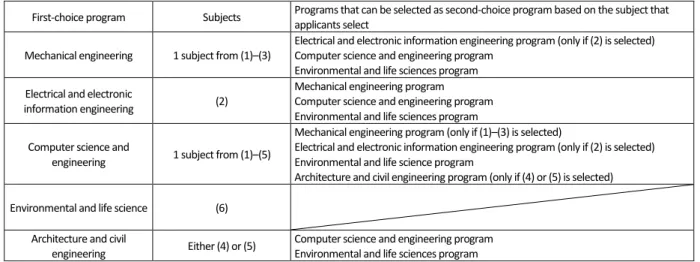
Table of Technical Subjects by Desired Program
Using the following table as reference, applicants should select one subject from (1)–(6) (subject code) when applying.
For applicants who select the environmental and life sciences program as their second-choice program, it is not necessary to undergo the interview conducted for the same program. (Taking the written test for the technical subject for their first-choice program can replace the interview exam).
First-choice program Subjects Programs that can be selected as second-choice program based on the subject that applicants select
Mechanical engineering 1 subject from (1)–(3)
Electrical and electronic information engineering program (only if (2) is selected) Computer science and engineering program
Environmental and life sciences program Electrical and electronic
information engineering (2)
Mechanical engineering program Computer science and engineering program Environmental and life sciences program Computer science and
engineering 1 subject from (1)–(5)
Mechanical engineering program (only if (1)–(3) is selected)
Electrical and electronic information engineering program (only if (2) is selected) Environmental and life science program
Architecture and civil engineering program (only if (4) or (5) is selected) Environmental and life science (6)
Architecture and civil
engineering Either (4) or (5)
Computer science and engineering program Environmental and life sciences program
Notes 1 The figures in parenthesis in the above table are technical subject code, and the actual subject name, etc., is given below. (1) Basic technical subjects related to mechanical engineering
(2) Basic technical subjects related to electrical and electronic information engineering (3) Basic technical subjects related to computer science and engineering
(4) Basic technical subjects related to architecture
(5) Basic technical subjects related to civil engineering (6) Interview
2. The following are the details on the type of questions and how to choose.
(1) Answer all four questions on hydrodynamics and fluid dynamics; thermodynamics; materials dynamics; and process
sciences and materials.
(2) Select and answer three questions from the fields of electromagnetism, electrical circuits, electronic circuits, information and communications, and physical chemistry.
(3) There are questions from the fields of math (analysis, algebra, and probability), theoretical circuits, programing (including data structure and algorithms)
(4) There are questions from the fields of structures, environment, and planning.
- 9 -
5. Entrance exam for working adult applicants
(1) Eligible parties
Parties who graduated from a technical college and meet one of the application requirements on page 5 (a.– i.), will have worked at the same company for at least two years as a regular employee by March 31, 2019, are recognized to have outstanding performance by the head of the organization they belong to, and desire to enroll while continuing to work.
(2) Program selection
Applicants can select up to two programs they would like to study from those listed in section “I. Number of applicants accepted” on page 1. Applicants should select exam subjects (technical subjects) for the academic achievement exam from those given in the Table of Technical Subjects by Desired Program on page 8.
(3) How successful applicants are selected The examinations will be only in Japanese.
Selection of applicants is conducted as explained in section (3) on page 6. In addition to the academic achievement exam, there is an oral exam and interview on various topics including the basics of the engineering that the applicant wants to study and the submitted performance report.
The point distribution for academic achievement exam, etc., is given below.
Subject
General subject Technical subject
Oral exam and interview Total Japanese English Applied math
Points 100 150 100 150 500
(4) Time and location of academic achievement test, oral exam, and interview
Date Subject Time Location
June 30
G
en
er
a
l
su
bj
e
ct
s
Japanese 9:00 a.m.–10:00 a.m. (60 minutes)
Toyohashi University of Technology English 10:30 a.m.–12:00 (noon)
(90 minutes, including listening) Technical
subject Applied math
1:00 p.m.–2:00 p.m. (60 minutes) Oral exam and interview 2:30 p.m.–
* Before taking the exam, applicants should carefully read section “IV. Advice for Applicants” on page 20.
(5) Announcement of successful applicants
The exam number of successful applicants will be posted at TUT at 10:00 p.m., July 20, 2018.
An Admission Notification will be sent to successful applicants. In addition, the exam number of successful applicants will be posted on TUT’s website (entrance exam information) at 11:00 a.m. on the same day as reference. TUT does not respond to inquiries regarding exam results by phone, etc.
Successful applicants will be notified of enrollment procedure details in mid-January 2019 (for those in the
field of maritime technology, in mid-January 2020).
(6) How successful applicants are handled
- 10 -
B. Global Technology Architects course (hereafter, “GAC”)
1. GAC special entrance exam for recommended applicants (1) Eligible parties
Students of technical colleges who are Japanese nationals or have permanent residence status, expect to graduate from a technical college in the 2018 academic year, or students studying marine technology at technical college who expect to graduate in the 2019 academic year, meet all of the following conditions, and who the president of their college can responsibly recommend, but limited to those pledge to enroll at TUT if accepted.
① Are recognized to possess the quality to become a next generation leader
② Are recognized to possess outstanding character and academic abilities and are physically and mentally
healthy
③ Have an overall grade point average of 4.3 or greater and are ranked in the top five in terms of grades in
their 4th year in each of their classes
④ Have taken the TOEIC (SP, IP), TOEFL (iBT, PBT), or IELTS English proficiency test since April 2016 and meet
one of the following criteria.
TOEIC (SP) 400 points
TOEIC (IP) 400 points
TOEFL (iBT) 40 points
TOEFL (PBT) 430 points
IETLS 3.5 points
* For the TOEIC (IP), this is limited to parties who take it at the technical college they attend.
In this case, it is not possible to recommend the same student for other national universities.
- 11 -
2. GAC entrance exam for recommended applicants (1) Eligible parties
Students of technical colleges who are Japanese nationals or have permanent residence status, expect to graduate from a technical college in 2018 academic year, or students studying marine technology at technical college who expect to graduate in the 2019 academic year, have some of the top grades at their school, are recognized as possessing outstanding character and academic ability and being physically and mentally healthy, meet the following requirements, and whom the president of the college they are attending can responsibly recommend, but limited to those pledge to enroll at TUT if accepted.
Have taken the TOEIC (SP, IP), TOEFL (iBT, PBT), or IELTS English proficiency test since April 2016 and have achieved one of the following criteria.
For TOEIC (IP), only those who took the exam at the technical college they attend.
Class ranking
(average ranking for junior and senior year)
English Proficiency Test (minimum score for each level) (points) TOEIC
(SP)
TOEIC (IP)
TOEFL (iBT)
TOEFL (PBT)
IELTS
Level 1 10% or less 400 400 40 430 3.5
Level 2 20% or less 450 450 45 450 4.0
Level 3 30% or less 500 500 52 470 4.5
Level 4 ――― 550 550 60 500 5.0
In this case, it is not possible to recommend the same student for other national universities
- 12 -
3. GAC general entrance exam (for Japanese)
- 13 -
4. GAC general entrance exam (for international students)
(1) Eligible parties
Parties with a “student” status of residence as stipulated in Japan’s Immigration Control and Refugee Recognition Act and parties who can change their status of residence to “student” after enrolling in the university and who meet one of the conditions listed in (A) (a.–i.) and the condition listed in (B).
(A) a. Graduated from a technical college or expect to do so in the 2018 academic year (for marine technology departments at marine technical colleges or technical colleges, parties who expect to graduate in 2019 academic year)
b. Graduated from a junior college or expect to do so in the 2018 academic year
c. Attended a college or university for at least two years (excluding leaves of absence) and have earned 65 or more credits or expect to do so by March 31, 2019 (including those who will have been enrolled at college for two or more years by March 31, 2019).
d. Completed a technical program at an advanced vocational school that meets criteria stipulated by the Ministry of Education, Culture, Sports, Science and Technology or expect to do so in the 2018 academic year (limited to those eligible to enroll at university as stipulated in Article 90, Item 1, of the School Education Act)
e. Completed a major at a high school (including the latter course of a secondary educational school and senior school course of a special vocational school, that is at least two years long) that meets criteria stipulated by the Ministry of Education, Culture, Sports, Science and Technology or expect to do so in the 2018 academic years (limited to those eligible to enroll at university as stipulated in Article 90, Item 1, of the School Education Act)
f. Graduated from a junior college in a foreign country or expect to do so or have completed a program designated separately by the Ministry of Education, Culture, Sports, Science and Technology in Japan at a facility with a junior college program and positioned as an educational institution within the education system of a foreign country, or expect to do so in the 2018 academic year (limited to those eligible to enroll at university as stipulated in Article 90, Item 1, of the School Education Act)
g. Completed a fourteen-year educational program in a foreign country or expect to do so in the 2018 academic year
h. Completed a fourteen-year educational program by taking classes in Japan through correspondence course conducted by a school in a foreign country or expect to do so in the 2018 academic year
i. Possess qualifications equivalent or greater than those in a.‒h. above
Notes 1. For requirement d., “criteria stipulated by the Ministry of Education, Culture, Sports, Science and Technology” refers to
“requiring at least two years to complete the course of study and at least 1,700 hours of class time to complete the program.” 2. Applicants applying since they meet one of the requirements g.–i. should contact the Entrance Examination Division in advance
by no later than April 10, 2018, so that their eligibility to apply can be checked.
- 14 -
(B) Have taken the TOEIC (SP, IP), TOEFL (iBT, PBT), or IELTS English proficiency test since April 2016 and have achieved one of the following criteria.
Graduate of a technical college (meet requirement (A) a.) Achieved one of the following levels (1–4).
For TOEIC (IP), only those who took the exam at the technical college they attend.
Class ranking
(average ranking for junior and senior year)
English Proficiency Test (minimum score for each level) (points) TOEIC
(SP)
TOEIC (IP)
TOEFL (iBT)
TOEFL (PBT)
IELTS
Level 1 10% or less 400 400 40 430 3.5
Level 2 20% or less 450 450 45 450 4.0
Level 3 30% or less 500 500 52 470 4.5
Level 4 ――― 550 550 60 500 5.0
Not a graduate of a technical college (meet requirement other than a. in (A) on page 13.) Achieved one of the following levels.
English proficiency test (minimum score)
TOEIC (SP) TOEFL (iBT) TOEFL (PBT) IELTS
550 60 500 5.0
(2) Program selection
Applicants can select up to two programs they would like to study from those given in section “I. Number of applicants accepted” on page 1.
(3) How successful applicants are selected
The selection of successful applicants consists of a first round of screening submitted material and a second round of screening based on an interview of applicants who make it through the first round of screening.
a. First round of screening (submitted material screening)
The selection of successful applicants made as an overall judgment based on; the report submitted by the president of the applicant’s college (for applicants who are not technical college students, the transcripts and letter of recommendation), statement of reason for applying (English or Japanese), essay (English or Japanese), and English proficiency test scores.
b. Second round of screening (final screening) The decision is based on the interview.
①Interview (both English and Japanese)
The applicant’s aptitude for study at the university is judged using various factors including desire to study, interest in technology, reason for wanting to make contributions on an international level, self-promotion, etc.
②Evaluation criteria
Various aspects including character, abilities, desire to study at TUT, and aptitude for doing so are evaluated.
③Date and location of the interview
Date: June 1, 2018*
* The meeting time is given on the admission notification of the first round of screening. Location: Toyohashi University of Technology
(4) Announcement of successful applicants
a. First round of screening (submitted material screening)
- 15 -
b. Second round of screening (final selection)
The exam number of successful applicants will be posted at TUT at 10:00 a.m., June 18, 2018. An Admission Notification will be sent to successful applicants. In addition, the exam number of successful applicants will be posted on TUT’s website (entrance exam information) at 11:00 a.m. on the same day as reference. TUT does not respond to inquiries regarding exam results by phone, etc.
Successful applicants will be notified of enrollment procedure details in January 2019 (for those in the
field of maritime technology, in January 2020).
(5) Applicants who fail to make it through the first round of screening for the GAC general entrance exam (for international students)
- 16 -
III. Application procedures
1. Application period:
Submission by mail Friday, April 20, 2018 to Thuesday, May 1, 2018 (5:00p.m.)
Online application
registration Friday, April 13, 2018 (9:00a.m.) to Mondy, April 30, 2018 (11:59p.m.)
Payment deadline Monday, April 30, 2018 (11:59p.m.)
※Applications that arrive after the deadline will not be accepted.
2. How to apply
The application process consists of the following 4 steps.
【Step 1】Register
Applicants should access the following URL and enter the necessary application information over the internet. The instructions given on the screen should be followed when filling out the information.
URL:https://www.tut.ac.jp/exam/exam-webentry.html
【Step 2】Pay the examination fee
Applicants should pay the examination fee by credit card or at a convenience store by the payment deadline.
【Step 3】Submit application material
Applicants should submit all application documents listed in section “3.Application material, etc” on page 17 to the Entrance Examination Division of Toyohashi University of Technology by registered express mail within application period.
Application materials of Special entrance exam for recommended applicants, Entrance exam for recommended applicants, GAC special entrance exam for recommended applicants, and GAC entrance exam for recommended applicants should be gathered all together by the applicants affiliated technical college and sent by registered express mail. Application materials of other exams such as Academic achievement exam can be also enclosed together.
Only applications sent by mail will be accepted.
○Mail application material, etc., to
Entrance Examination Division, Toyohashi University of Technology 1-1 Hibarigaoka, Tempaku-cho, Toyohashi, Aichi, 441-8580
【Step 4】Print out exam admission slip
After application material is received, exam admission slip can be printed out after May 11, 2018. Please log in to the application tracking screen and print it out on A4 sized paper by yourself. Be sure to bring the printed exam admission slip with you on the exam day.
- 17 -
3. Application material, etc.
(1) Special entrance exam for recommended applicants, Entrance exam for recommended applicants, GAC special entrance exam for recommended students, GAC entrance exam for recommended students
Special entrance exam for recommended
applicants
Entrance exam for recommended
applicants
GAC special entrance exam for
recommended students GAC entrance exam for recommended students Notes Application
confirmation slip ○ ○ ○ ○
After completing application registration procedures, print out the form on A4 paper.
Photo sheet ○ ○ ○ ○
After completing application registration, print out the form on A4 paper, and attach a photo. The photo (40 mm (h), 30 mm (w)) must be of the upper half of the body taken no more than three months before applying. The person must be facing forward and cannot be wearing a hat.
Letter of
recommendation ○ ○ ○ ○
The form can be downloaded from TUT’s website
(https://www.tut.ac.jp/exam/exam-webentry.html). The president of the school the applicant is attending should complete the form and then seal it.
Report* ○ ○ ○ ○
The form can be downloaded from TUT’s website
(https://www.tut.ac.jp/exam/exam-webentry.html). The president of the school the applicant is attending should complete the form, attach transcripts, and then seal it. Forms for several applicants can be collectively sealed.
For applicants who transferred to a technical college, a report created and sealed by the principal of the high school that the applicant graduated from should also be submitted.
However, if the high school the applicant graduated from is overseas, originals of the transcripts created by the principal of the high school and the original of the standardized graduation exam for that country should also be submitted. Notes: 1. Both of which can be original certificates issued by the applicant’s school
2. Both of which may be either in English or Japanese Description form ○ ○
The form can be downloaded from TUT’s website
(https://www.tut.ac.jp/exam/exam-webentry.html) and should be filled out by the applicant.
Score certificate,
etc. ○ ○
Applicants should read section (4) Score certificate of English proficiency test on page 19.
Statement of reason for applying
○ ○
The form can be downloaded from TUT’s website
(https://www.tut.ac.jp/exam/exam-webentry.html) and should be filled out by the applicant.
Exam fee* ○ ○ ○ ○
30,000 yen
Applicants should complete the payment procedures before submitting the application documents.
Certificate of
residence (copy) △ △ △ △
(Non-Japanese applicants living in Japan only)
Nationality, residence status and period of stay should be indicated. Copy of residence card (Alien registration card) is also acceptable.
Items marked with a circle (○) are applicable for all examinees. Items marked with a triangle (△) are only for applicable parties.
* Class rankings of international students
For international students (ones from a technical college), too, it is necessary to provide their class ranking among all students, including
Japanese, for the particular subject. Care should be taken since applications will not be accepted if the class ranking is not included in the
report.
If it is impossible to provide an overall class ranking among all students, including Japanese students, for any particular reason, such as part
of the curriculum for international students being different to that for Japanese students, an evaluation should be made for fields/subjects
within the curriculum that both Japanese and foreign students take for the subject, and then the ranking of the international student
among students including Japanese students should be noted as “equivalent to a ranking of xxx.” If there is anything unclear, inquiries
should be directed to the Entrance Examination Division before the application is submitted.
*The fee must be paid even for applicants who are receiving a scholarship as an international student on a Japanese government
scholarship (Ministry of Education, Culture, Sports, Science and Technology). (For students who apply for a scholarship extension
assuming they will be accepted by TUT, the fee will be refunded after the extension decision is made. After receiving the decision
notification, the refund request should be submitted to the Entrance Examination Division, TUT. The fee will only be refunded if the
student is accepted to TUT.)
Notes 1. For handwritten application material, a black fountain or ball-point pen should be used.
2. The form should be downloaded from TUT’s website and handwritten or typewritten. Modification of form is not acceptable.
3. The exam fee is nonrefundable.
- 18 -
5. Submitted application material will not be returned. Once application material is submitted, it cannot be altered. However, if there is a change in address (contact address) after the material has been submitted, applicants should promptly notify TUT of
the change.
(2) Academic achievement exam, Entrance exam for international students, GAC general exam (for Japanese applicants and international students)
Eligibility
a B c Notes
d-f g-i
Application
confirmation slip ○ ○ ○ After completing application registration procedures, print out the form on A4 paper.
Photo sheet ○ ○ ○
After completing application registration, print out the form on A4 paper, and attach a photo. The photo (40 mm (h), 30 mm (w)) must be of the upper half of the body taken no more than three months before applying. The person must be facing forward and cannot be wearing a hat.
Report from applicant’s
school* ○ ○ ○
The form can be downloaded from TUT’s website (https://www.tut.ac.jp/exam/exam-webentry.html). The president of the school the applicant is attending should complete the form, attach transcripts, and then seal it.
For applicants who transferred to a technical college, or who graduated from a junior college or expect to do so, or who completed a technical program at an advanced vocational school or expect to do so, a report created and sealed by the principal of the high school that the applicant graduated from should also be submitted.
If the high school the applicant graduated from is overseas, originals of the transcripts created by the principal of the high school and the original of the standardized graduation exam for that country should also be submitted.
Notes: 1. Both of which can be original certificates issued by the applicant’s school 2. Both of which may be either in English or Japanese
Applicants except for students of technical colleges in Japan should submit Letter of recommendation that is issued by the applicant’s supervisor (free form in A4 paper) and official transcripts of academic records that are issued by the applicant’s university and officially sealed. Also, the applicants don’t need to submit the report.
High school
report △ ○ ○
Score certificate,
etc. △ △ △
(GAC general exam for Japanese applicants and international students)
Applicants should read section (4) Score certificate of English proficiency test on page 19. Exam fee* ○ ○ ○ 30,000 yen
Applicants should complete the payment procedures before submitting the application documents. Certificate of
residence (copy) △ △ △
(Non-Japanese applicants living in Japan only)
Nationality, residence status and period of stay should be indicated. Copy of residence card (Alien registration card) is also acceptable. Certificate of
student
registration △ Certificate of
course △
Certificate of period of
enrollment △
Items marked with a circle (○) are applicable for all examinees. Items marked with a triangle (△) are only for applicable parties.
Parties eligible to apply because they meet requirements d., e., or f. on page 13 (excluding those who graduated from an overseas junior college or are expected to do so) should also submit material that proves that the advanced vocational school meets the standards sets by the Ministry of Education, Culture, Sports, Science and Technology (certificate issued by the advanced vocational school).
In addition, applicants who are eligible to apply because they meet requirements g., h., or i., must submit material that proves their eligibility (this will be indicated separately when the application eligibility is confirmed).
* Class rankings of international students
For international students (ones from a technical college), too, it is necessary to provide their class ranking among all students, including
Japanese, for the particular subject. Care should be taken since applications will not be accepted if the class ranking is not included in the
report.
If it is impossible to provide an overall class ranking among all students, including Japanese students, for any particular reason, such as part
of the curriculum for international students being different to that for Japanese students, an evaluation should be made for fields/subjects
within the curriculum that both Japanese and foreign students take for the subject, and then the ranking of the international student
among students including Japanese students should be noted as “equivalent to a ranking of xxx.” If there are unclear points, inquiries
should be directed to the Entrance Examination Division before the application is submitted.
*The fee must be paid even for applicants who are receiving a scholarship as an international student on a Japanese government
scholarship (Ministry of Education, Culture, Sports, Science and Technology). (For students who apply for a scholarship extension
assuming they will be accepted by TUT, the fee will be refunded after the extension decision is made. After receiving the decision
- 19 -
student is accepted to TUT.)
Notes 1. For handwritten application material, a black fountain or ball-point pen should be used.
2. The form should be downloaded from TUT’s website and handwritten or typewritten. Modification of form is not acceptable. 3. The exam fee is nonrefundable.
4. Incomplete application material will not be accepted.
5. Submitted application material will not be returned. Once application material is submitted, it cannot be altered. However, if there is a change in address (contact address) after the material has been submitted, applicants should promptly notify TUT of the change.
(3) Entrance exam for working adult applicants
Applicants should submit the various items listed in section “3. Application material, etc.” on page 17 along with the following items.
(a) Letter of recommendation
The head of the organization that the applicant belongs to should fill out the form. (b) Performance report
A summary of work conducted by the applicant (no set form, but no more than 1,000 characters. If there is related material, the material should be attached) and copies of documents that indicate the performance of the
applicant, such as research papers, research reports, patents and utility models, etc. (c) Written approval to take exam
Written approval to take exam created by the head of the organization the applicant belongs to (no set form). (d) Entrance exam for working adult applicants and interview form
The designated form should be filled out by the applicant.
(4) Score certificate of English proficiency test
Following are the details on how to submit the score certificate of English proficiency test. If the score does not arrive by the application deadline, it will be invalid.
・Applicants who took the TOEIC (SP) should also submit the score certificate (only an original with attached photo).
・Applicants who took the TOEIC (IP) do not need to submit the score report since the score is included in the report
created by the president of the college they attend.
・Applicants who took the TOEFL should complete the ETS request procedures so that the official score is sent to the
Entrance Examination Division, Toyohashi University of Technology (DI-CODE 9381, DI-NAME TOYOHASHI UNIV OF TECHNOLOGY) by the deadline.
・Applicants who took the IELTS should complete the Eiken Foundation of Japan request procedures so that the
- 20 -
IV. Advice for Applicants
(For Academic achievement exam, Entrance exam for international students)
(1) Be sure to check the exam room at Building A on TUT Campus and enter the exam room 15 minutes before the exam starts.
(2) Bring the exam admission slip with you. In case of loss of it, please notify us immediately. (3) The following are only the items you are allowed to place on your desk;
An exam admission slip, a pencil, a mechanical pencil, and eraser, a watch (with the function of watch only), tissue papers without a package and a pair of glasses.
(4) Applicants can enter the exam room up to 20 minutes after the exam starts, but after that, no applicants will be allowed in.
(5) Examinees who need to communicate during the exam should raise their hand and obtain permission from the proctor.
(6) Examinees who behave in an inappropriate way in the exam room may be ordered to leave the exam room by the proctor.
(7) Alarm on device that makes sound such as on mobile phones should be deactivated, and the device turned off before entering the exam room. Put them in your bag, and do not carry them with you.
(8) The use of calculators, devices such as watches with a calculator function, and slide rules is prohibited. (9) In case of sudden illness or accident, tell the proctor or a person in charge immediately.
(10) Food such as lunches can be obtained at the cafeteria or kiosk.
Front Gate Bus stop East Parking lot
Building D
South Parking lot
Library
Cafeteria and kiosks
Administrative office
Meet here
Successful applicants
Security office
No. 2 East Parking Lot
Building C
Building B
- 21 -
V. Expenses (expected)
・Admission fee 282,000 yen
・Tuition 535,800 yen (annual)
(267,900 first semester, 267,900 second semester)
If expenses are changed when applicants enroll or while attending TUT, the new admission fee and tuition will be applicable after the revisions.
VI. Other
1. Applicants with disabilities, etc., (based on the level of the physical disability as stipulated in Article 22.3 of the
School Education Act Enforcement Ordinance and the Services and Supports for Persons with Disabilities Act) should contact the Entrance Examination Division in advance because special consideration may be required for taking the exam and studying.
2. If an applicant or the main breadwinner of an applicant’s household is a victim of a disaster or falls under the
Disaster Relief Act because of a natural disaster etc., the applicant many be exempt from paying the fee for the various types of entrance exams (undergraduate and graduate).
Applicants who think this may apply to them should contact the Entrance Exam Division in advance. 3. Entrance exam fee is nonrefundable except in the following situations;
(1) Applicants paid the fee twice.
(2) Applicants paid the fee but did not apply for the exam.
(3) Applicants paid the fee but the application was not accepted.
TUT will separately contact applicants regarding refund procedures.
4. Toyohashi University of Technology has established the Toyohashi University of Technology Security Export Control Regulations in accordance with the Foreign Exchange and Foreign Trade Act, and conducts strict examinations for acceptance of international students, etc.
International applicants who fall under any of the conditions set out in said regulations may be unable to enter their desired course or program.
5. There are student dormitories on TUT campus. All GAC students are expected to live in TUT Global House (A shared-house style of accommodation for International and Japanese students). Details of moving-in will be enclosed with Letter of Acceptance.
VII. Inquiries regarding the entrance exam
Inquiries regarding the entrance exam should be directed to the following: Entrance Examination Division, Toyohashi University of Technology 1-1 Hibarigaoka, Tempaku-cho, Toyohashi, Aichi, 441-8580 Tel: 0532-44-6581