Grammatical Error Correction with Neural Reinforcement Learning
Keisuke Sakaguchi† and Matt Post‡ and Benjamin Van Durme†‡ †Center for Language and Speech Processing, Johns Hopkins University ‡Human Language Technology Center of Excellence, Johns Hopkins University
{keisuke,post,vandurme}@cs.jhu.edu
Abstract
We propose a neural encoder-decoder model with reinforcement learning (NRL) for grammatical error correction (GEC). Unlike conventional maximum likelihood estimation (MLE), the model directly opti-mizes towards an objective that considers a sentence-level, task-specific evaluation metric, avoiding the exposure bias issue in MLE. We demonstrate that NRL outper-forms MLE both in human and automated evaluation metrics, achieving the state-of-the-art on a fluency-oriented GEC corpus.
1 Introduction
Research in automated Grammatical Error Correc-tion (GEC) has expanded from token-level, closed class corrections (e.g., determiners, prepositions, verb forms) to phrase-level, open class issues that consider fluency (e.g., content word choice, id-iomatic collocation, word order, etc.).
The expanded goals of GEC have led to new proposed models deriving from techniques in data-driven machine translation, including phrase-based MT (PBMT) (Felice et al.,2014; Chollam-patt et al., 2016; Junczys-Dowmunt and Grund-kiewicz, 2016) and neural encoder-decoder mod-els (Yuan and Briscoe, 2016). Napoles et al.
(2017) recently showed that a neural encoder-decoder can outperform PBMT on a fluency-oriented GEC data and metric.
We investigate training methodologies in the neural encoder-decoder for GEC. To train the neu-ral encoder-decoder models, maximum likelihood estimation (MLE) has been used, where the ob-jective is to maximize the (log) likelihood of the parameters for a given training data.
As Ranzato et al. (2015) indicates, however, MLE has drawbacks. The MLE objective is based
Algorithm 1:Reinforcement learning for neu-ral encoder-decoder model.
Input:Pairs of source (X) and target (Y)
Output: Model parameterθˆ
1 initialize(θˆ)
2 for(x, y)∈(X, Y)do
3 (ˆy1, ...yˆk),(p(ˆy1), ...p(ˆyk)) =sample(x, k,θˆ) 4 p(ˆy)= normalize(p(ˆy))
5 r¯(ˆy) = 0 // expected reward
6 foryˆi ∈yˆdo
7 r¯(ˆy)+ =p(ˆyi)·score(ˆyi, y)
8 backprop(θ,ˆ ¯r) // policy gradient ∂
∂ˆθ 9 returnθˆ
onword-levelaccuracy against the reference, and the model is not exposed to the predicted out-put during training (exposure bias). This becomes problematic, because once the model fails to pre-dict a correct word, it falls off the right track and does not come back to it easily.
To address the issues, we employ a neural encoder-decoder GEC model with a reinforcement learning approach in which we directly optimize the model toward our final objective (i.e., evalua-tion metric). The objective of the neural reinforce-ment learning model (NRL) is to maximize the ex-pected reward on the training data. The model up-dates the parameters through back-propagation ac-cording to the reward from predicted outputs. The high-level description of the training procedure is shown in Algorithm1, and more details are elab-orated in §2. To our knowledge, this is the first attempt to employ reinforcement learning for di-rectly optimizing the encoder-decoder model for GEC task.
We run GEC experiments on a fluency-oriented GEC corpus (§3), demonstrating that NRL outper-forms the MLE baseline both in human and auto-mated evaluation metrics.
2 Model and Optimization
We use the attentional neural encoder-decoder model (Bahdanau et al.,2014) as a basis for both NRL and MLE. The model takes (possibly un-grammatical) source sentences x ∈ X as an in-put, and predicts grammatical and fluent output sentencesy ∈ Y according to the model param-eter θ. The model consists of two sub-modules, encoderand decoder. The encoder transforms x
into a sequence of vector representations (hidden states) using a bidirectional gated recurrent neural network (GRU) (Chung et al.,2014). The decoder predicts a wordytat a time, using previous token yt−1 and linear combination of encoder informa-tion as atteninforma-tion.
2.1 Maximum Likelihood Estimation
Maximum Likelihood Estimation training (MLE) is a standard optimization method for encoder-decoder models. In MLE, the objective is to maxi-mize the log likelihood of the correct sequence for a given sequence for the entire training data.
L(θ) = X
hX,Yi
T X
t=1
logp(yt|x, yt1−1;θ) (1)
The gradient ofL(θ)is as follows:
∂L(θ) ∂θ =
X
hX,Yi
T X
t=1
∇p(yt|x, y1t−1;θ) p(yt|x, yt1−1;θ)
(2)
One drawback of MLE is the exposure bias (Ranzato et al., 2015). The decoder predicts a word conditioned on the correct word sequence (y1t−1) during training, whereas it does with the predicted word sequence (yˆ1t−1) at test time. Namely, the model is not exposed to the predicted words in training time. This is problematic, be-cause once the model fails to predict a correct word at test time, it falls off the right track and does not come back to it easily. Furthermore, in most sentence generation tasks, the MLE objec-tive does not necessarily correlate with our final evaluation metrics, such as BLEU (Papineni et al.,
2002) in machine translation and ROUGE (Lin,
2004) in summarization. This is because MLE op-timizes word level predictions at each time step instead of evaluating sentences as a whole.
GEC is no exception. It depends on sentence-level evaluation that considers grammaticality and fluency. For this purpose, it is natural to use GLEU (Napoles et al., 2015), which has been used as a
fluency-oriented GEC metric. We explain more details of this metric in§2.3.
2.2 Neural Reinforcement Learning
To address the issues in MLE, we directly op-timize the neural encoder-decoder model toward our final objective for GEC using reinforcement learning. In reinforcement learning,agentsaim to maximize expectedrewardsby takingactionsand updating thepolicyunder a givenstate. In the neu-ral decoder model, we treat the encoder-decoder as an agent which predicts a word from a fixed vocabulary at each time step (the action), given the hidden states of the neural encoder-decoder representation. The key difference from MLE is that the reward is not restricted to token-level accuracy. Namely, any arbitrary metric is ap-plicable as the reward.1
Since we use GLEU as the final evaluation met-ric, the objective of NRL is to maximize the ex-pected GLEU by learning the model parameter.
J(θ) =E[r(ˆy, y)]
= X
ˆ
y∈S(x)
p(ˆy|x;θ)r(ˆy, y) (3)
whereS(x)is a sampling function that producesk
samplesyˆ1, ...yˆk,p(ˆy|x;θ)is a probability of the
output sentence, andr(ˆy, y) is the reward for yˆk
given a reference sety. As described in Algorithm
1, given a pair of source sentence and the reference
(x, y), NRL takesksample outputsyˆ1, ... yˆk and
their probabilitiesp(ˆy1), ... p(ˆyk)(line 3).2 Then,
the expected reward is computed by multiplying the probability and metric score for each sample
ˆ
yi(line 7).
In the encoder-decoder model, the parameters
θ are updated through back-propagation and the number of parameter updates is determined by the partial derivative ofJ(θ), called thepolicy gradi-ent (Williams, 1992;Sutton et al.,1999) in rein-forcement learning:
∂J(θ)
∂θ =αE[∇logp(ˆy){r(ˆy, y)−b}] (4)
where α is a learning rate and b is an arbitrary baseline reward to reduce the variance. The sam-ple mean reward is often used for b (Williams,
1992), and we follow it in NRL.
It is reasonable to compare NRL to minimum risk training (MRT) (Shen et al., 2016). In fact,
1The reward is given at the end of the decoder output (i.e.,
delayed reward).
mean chars # sents. Corpus # sents. per sent. edited
NUCLE 57k 115 38%
FCE 34k 74 62%
Lang-8 1M 56 35%
Table 1: Statistics of training corpora
NRL with a negative expected rewardcan be re-garded as MRT. The gradient of MRT objective is a special case ofpolicy gradientin NRL. We show mathematical details about the relevance between NRL and MRT in the supplemental material (Ap-pendixA).
2.3 Reward in Grammatical Error Correction
To capture fluency as well as grammaticality in evaluation on such references, we use GLEU as the reward. We have shown GLEU to be more strongly preferred than other GEC metrics by na-tive speakers (Sakaguchi et al.,2016). Similar to BLEU in machine translation, GLEU computes
n-gram precision between the system hypothesis (H) and the reference (R). In GLEU, however,n -grams in source (S) are also considered. The pre-cision is penalized when then-gram inHoverlaps with the source and not with the reference.
GLEU=BP·exp
4
X
n=1
1 nlogp
′
n !
p′n= N(H, R)−[N(H, S)−N(H, S, R)] N(H)
BP= (
1 ifh > r exp(1−r/h) ifh≤r
whereN(A, B, C, ...)is the number of overlapped
n-grams among the sets, and BP brevity penalty is compute based on token length in the system hypothesis (h) and the reference (r).
3 Experiments
Data For training the models (MLE and NRL), we use the following corpora: the NUS Cor-pus of Learner English (NUCLE) (Dahlmeier et al.,2013), the Cambridge Learner Corpus First Certificate English (FCE) (Yannakoudakis et al.,
2011), and the Lang-8 Corpus of learner English (Tajiri et al.,2012). The basic statistics are shown in Table1.3 We exclude some unreasonable edits (comments by editors, incomplete sentences such
3All the datasets are publicly available, for purposes of
reproducibility. For more details about each dataset, refer to
Sakaguchi et al.(2017).
Models Methods # sents. (corpora)
CAMB14 Hybrid 155k
(rule + PBMT) (NUCLE, FCE, in-house)
AMU PBMT + 2.3M
GEC-feat. (NUCLE, Lang8)
NUS PBMT + 2.1M
Neural feat. (NUCLE, Lang8) CAMB16 enc-dec (MLE) + 1.96M
unk alignment (non-public CLC)
MLE/NRL enc-dec 720k
(MLE/NRL) (NUCLE, Lang8, FCE) Table 2: Summary of baselines, MLE and NRL models.
as URLs, etc.) using regular expressions and set-ting a maximum token edit distance within 50% of the original length. We also ignore sentences that are longer than 50 tokens or sentences where more than 5% of tokens are out-of-vocabulary (the vo-cabulary size is 35k). In total, we use 720k pairs of sentences for training (21k from NUCLE, 32k from FCE, and 667k from Lang-8). Spelling er-rors are corrected in preprocessing with the En-chant open-source spell checking library.4
Hyperparameters For both MLE and NRL, we set the vocabulary size to be 35k for both source and target. Words are represented by a vector with 512 dimensions. Maximum output token length is 50. The size of hidden layer units is 1,000. Gra-dients are clipped at 1, and beam size during de-coding is 5. We regularize the GRU layer with a dropout probability of 0.2.
For MLE we use mini-batches of size 40, and the ADAM optimizer with a learning rate of10−4. We train the encoder-decoder with MLE for 900k updates, selecting the best model according to the development set evaluation.
For NRL we set the sample size to be 20. We use the SGD optimizer with a learning rate of
10−4. For the baseline reward, we use aver-age of sampled reward followingWilliams(1992). The sentence GLEU score is used as the reward
r(ˆy, y). Following a similar (but not the same) strategy of the Mixed Incremental Cross-Entropy Reinforce (MIXER) algorithm (Ranzato et al.,
2015), we initialize the model by MLE for 600k updates, followed by another 600k updates using NRL, and select the best model according to the development set evaluation. Our NRL is imple-mented by extending the Nematus toolkit ( Sen-nrich et al.,2017).5
4https://github.com/AbiWord/enchant
5NRL code is available at https://github.com/
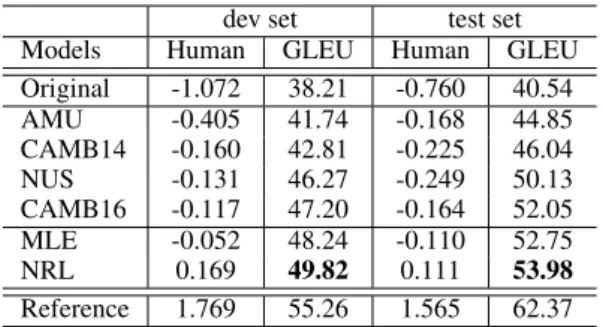
dev set test set Models Human GLEU Human GLEU Original -1.072 38.21 -0.760 40.54 AMU -0.405 41.74 -0.168 44.85 CAMB14 -0.160 42.81 -0.225 46.04 NUS -0.131 46.27 -0.249 50.13 CAMB16 -0.117 47.20 -0.164 52.05 MLE -0.052 48.24 -0.110 52.75
NRL 0.169 49.82 0.111 53.98
Reference 1.769 55.26 1.565 62.37 Table 3: Human (TrueSkill) and GLEU evaluation of system outputs on the development and test set.
Baselines In addition to our MLE baseline, we compare four leading GEC systems. All the sys-tems are based on SMT, but they take different approaches. The first model, proposed byFelice et al. (2014), uses a combination of a rule-based system and PBMT with language model reranking (referring as CAMB14). Junczys-Dowmunt and Grundkiewicz (2016) proposed a PBMT model that incorporates linguistic and GEC-oriented sparse features (AMU). Another PBMT model, proposed by Chollampatt et al. (2016), is inte-grated with neural contextual features (NUS). Fi-nally, Yuan and Briscoe (2016) proposed a neu-ral encoder-decoder model with MLE training (CAMB16). This model is similar to our MLE model, but CAMB16 additionally trains an unsu-pervised alignment model to handle spelling er-rors as well as unknown words, and it uses 1.96M sentence pairs extracted from the non-public Cam-bridge Learner Corpus (CLC). The summary of baselines is shown in Table2.6
Evaluation For evaluation, we use the JFLEG corpus (Heilman et al.,2014;Napoles et al.,2017), which consists of 1501 sentences (754: dev, 747: test) with four fluency-oriented references.
In addition to the automated metric (GLEU), we run a human evaluation using Amazon Mechani-cal Turk (MTurk). We randomly select 200 sen-tences each from the dev and test set. For each sentence, two turkers are repeatedly asked to rank five systems randomly selected from all eight: the four baseline models, MLE, NRL, one randomly selected human correction, and the original sen-tence. We infer the evaluation scores by compar-ing pairwise rankcompar-ings with the TrueSkill algorithm (Herbrich et al.,2006;Sakaguchi et al.,2014).
6The four baselines are not tuned toward the same dev set
as MLE and NRL. Also, they use different training set (Table
2). We compare them just for reference.
Models Precision Recall M2 (F0.5)
AMU 69.95 18.81 45.32
CAMB14 65.09 22.84 47.51
NUS 69.59 29.19 54.50
CAMB16 64.35 32.26 53.67
MLE 66.00 34.62 55.87
NRL 65.93 37.28 57.15
Table 4: M2 (F0.5) scores on the dev set.
Models Precision Recall M2 (F0.5)
AMU 69.39 20.79 47.29
CAMB14 63.52 23.44 47.33
NUS 68.08 32.30 55.73
CAMB16 65.66 35.93 56.34
MLE 65.19 37.66 56.88
NRL 65.80 40.96 58.68
Table 5: M2 (F0.5) scores on the test set.
NRL>MLE NRL=MLE NRL<MLE
Dev 33% 45% 22%
Test 30% 57% 13%
Table 6: Ratio of pairwise (preference) judgments between NRL and MLE. NRL>MLE: NRL correction is preferred
over MLE. NRL<MLE: MLE is preferred over NRL. NRL
=MLE: NRL and MLE are tied.
Results Table3shows the human evaluation by TrueSkill and automated metric (GLEU). In both dev and test set, NRL outperforms MLE and other baselines in both the human and automatic evalua-tions. Human evaluation and GLEU scores corre-late highly, corroborating the reliability of GLEU. With respect to inter-annotator agreement, Spear-man’s rank correlation between Turkers is 55.6 for the dev set and 49.2 for the test set. The correla-tions are sufficiently high to show the agreement between Turkers, considering the low chance level (i.e., ranking five randomly selected systems con-sistently between two Turkers).
Table 4 and 5 show the M2 (F0.5) scores
(Dahlmeier and Ng, 2012), which compute phrase-level edits between the system hypothe-sis and source and compare them with the ora-cle edits. Although this metric has several draw-backs such as underestimation of system perfor-mance and indiscrimination between “no change” and “wrong edits” (Felice et al.,2014), we see that the correlation between the M2 scores and human evaluation is still high in the result.
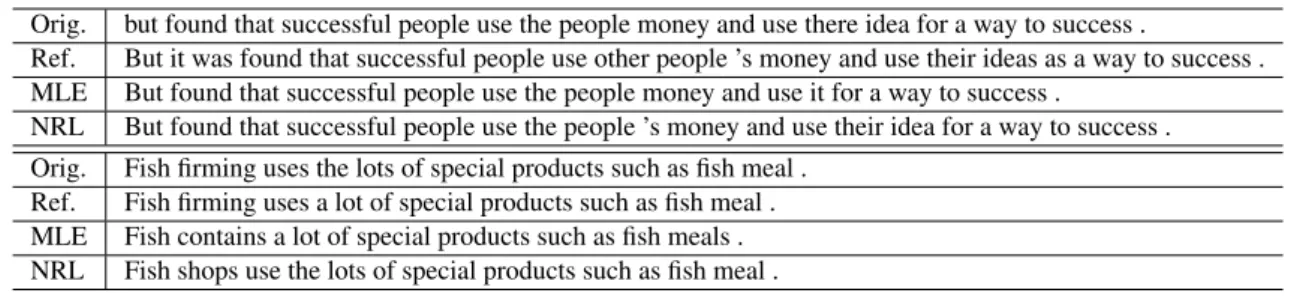
Orig. but found that successful people use the people money and use there idea for a way to success .
Ref. But it was found that successful people use other people ’s money and use their ideas as a way to success . MLE But found that successful people use the people money and use it for a way to success .
NRL But found that successful people use the people ’s money and use their idea for a way to success . Orig. Fish firming uses the lots of special products such as fish meal .
Ref. Fish firming uses a lot of special products such as fish meal . MLE Fish contains a lot of special products such as fish meals . NRL Fish shops use the lots of special products such as fish meal .
Table 7: Example outputs by MLE and NRL
Analysis Table7presents example outputs from MLE and NRL. In the first example, both MLE and NRL successfully corrected the homophone error (there vs. their), but MLE changed the mean-ing of the original sentence by replacmean-ingtheir idea to it. Meanwhile, NRL made the sentence more grammatical by adding a possessive ’s. The sec-ond example demonstrates challenging issues for future work in GEC. The correction by MLE looks fairly fluent as well as grammatical, but it is se-mantically nonsense. The correction by NRL is also fairly fluent and makes sense, but the meaning has been changed too much. For further improve-ment, better GEC models that are aware of the context or possess world knowledge are needed.
4 Conclusions
We have presented a neural encoder-decoder model with reinforcement learning for GEC. To alleviate the MLE issues (exposure bias and token-level optimization), NRL learns the policy (model parameters) by directly optimizing toward the fi-nal objective by treating the fifi-nal objective as the reward for the encoder-decoder agent. Using a GEC-specific metric, GLEU, we have demon-strated that NRL outperforms the MLE baseline on the fluency-oriented GEC corpus both in hu-man and automated evaluation metrics. As a sup-plement, we have explained the relevance between minimum risk training (MRT) and NRL, claiming that MRT is a special case of NRL.
Acknowledgments
This work was supported in part by the JHU Hu-man Language Technology Center of Excellence (HLTCOE), and DARPA LORELEI. The U.S. Government is authorized to reproduce and dis-tribute reprints for Governmental purposes. The views and conclusions contained in this publica-tion are those of the authors and should not be interpreted as representing official policies or en-dorsements of DARPA or the U.S. Government.
References
Dzmitry Bahdanau, Kyunghyun Cho, and Yoshua Ben-gio. 2014. Neural machine translation by jointly learning to align and translate. arXiv:1409.0473.
Shamil Chollampatt, Duc Tam Hoang, and Hwee Tou Ng. 2016. Adapting grammatical error correction based on the native language of writers with neural network joint models. In Proceedings of the 2016 Conference on Empirical Methods in Natural Lan-guage Processing, pages 1901–1911, Austin, Texas. Association for Computational Linguistics.
Junyoung Chung, Caglar Gulcehre, KyungHyun Cho, and Yoshua Bengio. 2014. Empirical evaluation of gated recurrent neural networks on sequence model-ing.arXiv:1412.3555.
Daniel Dahlmeier and Hwee Tou Ng. 2012. Better evaluation for grammatical error correction. In Pro-ceedings of the 2012 Conference of the North Amer-ican Chapter of the Association for Computational Linguistics: Human Language Technologies, pages 568–572, Montr´eal, Canada. Association for Com-putational Linguistics.
Daniel Dahlmeier, Hwee Tou Ng, and Siew Mei Wu. 2013. Building a large annotated corpus of learner english: The NUS Corpus of Learner English. In
Proceedings of the Eighth Workshop on Innova-tive Use of NLP for Building Educational Applica-tions, pages 22–31, Atlanta, Georgia. Association for Computational Linguistics.
Mariano Felice, Zheng Yuan, Øistein E. Andersen, He-len Yannakoudakis, and Ekaterina Kochmar. 2014. Grammatical error correction using hybrid systems and type filtering. In Proceedings of the Eigh-teenth Conference on Computational Natural Lan-guage Learning: Shared Task, pages 15–24, Bal-timore, Maryland. Association for Computational Linguistics.
Michael Heilman, Aoife Cahill, Nitin Madnani, Melissa Lopez, Matthew Mulholland, and Joel Tetreault. 2014. Predicting grammaticality on an ordinal scale. In Proceedings of the 52nd Annual Meeting of the Association for Computational Lin-guistics, pages 174–180, Baltimore, Maryland. As-sociation for Computational Linguistics.
Proceedings of the Twentieth Annual Conference on Neural Information Processing Systems, pages 569– 576, Vancouver, British Columbia, Canada. MIT Press.
Marcin Junczys-Dowmunt and Roman Grundkiewicz. 2016. Phrase-based machine translation is state-of-the-art for automatic grammatical error correction. In Proceedings of the 2016 Conference on Empiri-cal Methods in Natural Language Processing, pages 1546–1556, Austin, Texas. Association for Compu-tational Linguistics.
Chin-Yew Lin. 2004. Rouge: A package for automatic evaluation of summaries. In Text Summarization Branches Out: Proceedings of the ACL-04 Work-shop, pages 74–81, Barcelona, Spain. Association for Computational Linguistics.
Courtney Napoles, Keisuke Sakaguchi, Matt Post, and Joel Tetreault. 2015. Ground truth for grammati-cal error correction metrics. InProceedings of the 53rd Annual Meeting of the Association for Compu-tational Linguistics and the 7th International Joint Conference on Natural Language Processing, pages 588–593, Beijing, China. Association for Computa-tional Linguistics.
Courtney Napoles, Keisuke Sakaguchi, and Joel Tetreault. 2017. JFLEG: A fluency corpus and benchmark for grammatical error correction. In Pro-ceedings of the 15th Conference of the European Chapter of the Association for Computational Lin-guistics, pages 229–234, Valencia, Spain. Associa-tion for ComputaAssocia-tional Linguistics.
Franz Josef Och. 2003. Minimum error rate train-ing in statistical machine translation. In Proceed-ings of the 41st Annual Meeting of the Association for Computational Linguistics, pages 160–167, Sap-poro, Japan. Association for Computational Linguis-tics.
Kishore Papineni, Salim Roukos, Todd Ward, and Wei-Jing Zhu. 2002. Bleu: a method for automatic eval-uation of machine translation. In Proceedings of 40th Annual Meeting of the Association for Com-putational Linguistics, pages 311–318, Philadelphia, Pennsylvania. Association for Computational Lin-guistics.
Marc’Aurelio Ranzato, Sumit Chopra, Michael Auli, and Wojciech Zaremba. 2015. Sequence level training with recurrent neural networks.
arXiv:1511.06732.
Keisuke Sakaguchi, Courtney Napoles, Matt Post, and Joel Tetreault. 2016. Reassessing the goals of matical error correction: Fluency instead of gram-maticality.Transactions of the Association for Com-putational Linguistics, 4:169–182.
Keisuke Sakaguchi, Courtney Napoles, and Joel Tetreault. 2017. GEC into the future: Where are we going and how do we get there? In Proceed-ings of the 12th Workshop on Innovative Use of NLP
for Building Educational Applications, pages 180– 187, Copenhagen, Denmark. Association for Com-putational Linguistics.
Keisuke Sakaguchi, Matt Post, and Benjamin Van Durme. 2014. Efficient elicitation of annota-tions for human evaluation of machine translation. InProceedings of the Ninth Workshop on Statistical Machine Translation, pages 1–11, Baltimore, Mary-land. Association for Computational Linguistics.
Rico Sennrich, Orhan Firat, Kyunghyun Cho, Alexan-dra Birch, Barry Haddow, Julian Hitschler, Marcin Junczys-Dowmunt, Samuel L¨aubli, Antonio Valerio Miceli Barone, Jozef Mokry, and Maria Nadejde. 2017. Nematus: a toolkit for neural machine trans-lation. InProceedings of the Software Demonstra-tions of the 15th Conference of the European Chap-ter of the Association for Computational Linguistics, pages 65–68, Valencia, Spain. Association for Com-putational Linguistics.
Shiqi Shen, Yong Cheng, Zhongjun He, Wei He, Hua Wu, Maosong Sun, and Yang Liu. 2016. Minimum risk training for neural machine translation. In Pro-ceedings of the 54th Annual Meeting of the Asso-ciation for Computational Linguistics, pages 1683– 1692, Berlin, Germany. Association for Computa-tional Linguistics.
Richard S Sutton, David A McAllester, Satinder P Singh, Yishay Mansour, et al. 1999. Policy gradient methods for reinforcement learning with function approximation. In NIPS, volume 99, pages 1057– 1063.
Toshikazu Tajiri, Mamoru Komachi, and Yuji Mat-sumoto. 2012. Tense and aspect error correction for ESL learners using global context. In Proceed-ings of the 50th Annual Meeting of the Association for Computational Linguistics, pages 198–202, Jeju Island, Korea. Association for Computational Lin-guistics.
Ronald J Williams. 1992. Simple statistical gradient-following algorithms for connectionist reinforce-ment learning. Machine learning, 8(3-4):229–256.
Helen Yannakoudakis, Ted Briscoe, and Ben Medlock. 2011. A new dataset and method for automatically grading ESOL texts. InProceedings of the 49th An-nual Meeting of the Association for Computational Linguistics: Human Language Technologies, pages 180–189, Portland, Oregon. Association for Compu-tational Linguistics.
Zheng Yuan and Ted Briscoe. 2016. Grammatical er-ror correction using neural machine translation. In
A Minimum Risk Training and Policy Gradient in Reinforcement Learning
We explain the relevance between minimum risk training (MRT) (Shen et al.,2016) and neural re-inforcement learning (NRL) for training neural encoder-decoder models. We describe the detailed derivation of gradient in MRT, and show that MRT is a special case of NRL.
As introduced in §2, the model takes ungram-matical source sentencesx ∈ X as an input, and predicts grammatical and fluent output sentences
y ∈ Y. The objective function in NRL and MRT are written as follows.
J(θ) =E[r(ˆy, y)] (5)
R(θ) = X
(X,Y)
E[∆(ˆy, y)] (6)
wherer(ˆy, y)is therewardand∆(ˆy, y)is therisk for an output (yˆ).
For the sake of simplicity, we consider expected loss in MRT for a single training pair:
˜
R(θ) =E[∆(ˆy, y)]
= X
ˆ
y∈S(x)
q(ˆy|x;θ, α)∆(ˆy, y) (7)
where
q(ˆy|x;θ, α) = p(ˆy|x;θ) α
P
ˆ
y′∈S(x)p(ˆy′|x;θ)α (8)
S(x)is a sampling function that producesk sam-plesyˆ1, ...yˆk, andαis a smoothing parameter for
the samples (Och, 2003). Although the direction to optimize (i.e., minimizing or maximizing) is different, we see the similarity betweenJ(θ) and
˜
R(θ)in the sense that they both optimize models directly towards evaluation metrics.
The partial derivative of R˜(θ) with respect to the model parameterθis derived as follows.
∂R˜(θ) ∂θ =
∂ ∂θ
X
ˆ
y∈S(x)
q(ˆy|x;θ, α)∆(ˆy, y)
= X
ˆ
y∈S(x)
∆(ˆy, y) ∂
∂θq(ˆy|x;θ, α) (9)
We need ∂θ∂q(ˆy|x;θ, α) in (9). For space ef-ficiency, we use q(ˆy) asq(ˆy|x;θ, α) and p(ˆy) as
p(ˆy|x;θ)below.
∂
∂θq(ˆy) = ∂q(ˆy) ∂p(ˆy)
∂p(ˆy)
∂θ (∵chain rule)
= ∂q(ˆy)
∂p(ˆy)∇p(ˆy) (10)
For ∂q∂p(ˆ(ˆyy)), by applying the quotient rule to (8),
∂q(ˆy) ∂p(ˆy) =
{P
ˆ
y′p(ˆy′)α}
∂
∂p(ˆy)p(ˆy)α−p(ˆy)α
∂ ∂p(ˆy)
P
ˆ
y′p(ˆy′)α
{P
ˆ
y′p(ˆy′)α}2
= αp(ˆy) α−1
P
ˆ
y′p(ˆy′)α
−αp(ˆy)
αp(ˆy)α−1
{P
ˆ
y′p(ˆy′)α}2
=α p(ˆy) α−1
P
ˆ
y′p(ˆy′)α
(
1− p(ˆy)
α
P
ˆ
y′p(ˆy′)α
)
=α p(ˆy) α
P
ˆ
y′p(ˆy′)α
1 p(ˆy)
(
1− p(ˆy)
α
P
ˆ
y′p(ˆy′)α
)
(11) Thus, from (10) and (11), (9) is
∂R˜(θ) ∂θ =
X
ˆ
y∈S(x)
∆(ˆy, y)∇p(ˆy)
"
α p(ˆy) α
P
ˆ
y′p(ˆy′)α
1 p(ˆy)
(
1− p(ˆy)
α
P
ˆ
y′p(ˆy′)α
)#
=αE
∇p(ˆy)· 1
p(ˆy){∆(ˆy, y)−E[∆(ˆy, y)]}
=αE[∇logp(ˆy){∆(ˆy, y)−E[∆(ˆy, y)]}]
(12) According to the policy gradient theorem for REINFORCE (Williams, 1992; Sutton et al.,
1999), the partial derivative of (5) is given as fol-lows:
∂J(θ)
∂θ = ˜αE[∇logp(ˆy){r(ˆy, y)−b}] (13)
whereα˜is alearning rate7andbis arbitrary base-line reward to reduce the variance of gradients. Finally, we see that the gradient of MRT (12) is a special case of policy gradient in REINFORCE (13) withb =E[∆(ˆy, y)]. It is also interesting to see that the smoothing parameterαworks as a part of learning rate (α˜) in NRL.
7In this appendix, we use
˜
αto distinguish it from