Interaction Networks for Learning about Objects,
Relations and Physics
Anonymous Author(s)
Affiliation Address
Abstract
Reasoning about objects, relations, and physics is central to human intelligence, and 1
a key goal of artificial intelligence. Here we introduce theinteraction network, a 2
model which can reason about how objects in complex systems interact, supporting 3
dynamical predictions, as well as inferences about the abstract properties of the 4
system. Our model takes graphs as input, performs object- and relation-centric 5
reasoning in a way that is analogous to a simulation, and is implemented using 6
deep neural networks. We evaluate its ability to reason about several challenging 7
physical domains: n-body problems, rigid-body collision, and non-rigid dynamics. 8
Our results show it can be trained to accurately simulate the physical trajectories of 9
dozens of objects over thousands of time steps, estimate abstract quantities such 10
as energy, and generalize automatically to systems with different numbers and 11
configurations of objects and relations. Our interaction network implementation 12
is the first general-purpose, learnable physics engine, and a powerful general 13
framework for reasoning about object and relations in a wide variety of complex 14
real-world domains. 15
1
Introduction
16
Representing and reasoning about objects, relations and physics is a “core” domain of human common 17
sense knowledge [25], and among the most basic and important aspects of intelligence [27, 15]. Many 18
everyday problems, such as predicting what will happen next in physical environments or inferring 19
underlying properties of complex scenes, are challenging because their elements can be composed 20
in combinatorially many possible arrangements. People can nevertheless solve such problems by 21
decomposing the scenario into distinct objects and relations, and reasoning about the consequences 22
of their interactions and dynamics. Here we introduce theinteraction network– a model that can 23
perform an analogous form of reasoning about objects and relations in complex systems. 24
Interaction networks combine three powerful approaches: structured models, simulation, and deep 25
learning. Structured models [7] can exploit rich, explicit knowledge of relations among objects, 26
independent of the objects themselves, which supports general-purpose reasoning across diverse 27
contexts. Simulation is an effective method for approximating dynamical systems, predicting how the 28
elements in a complex system are influenced by interactions with one another, and by the dynamics 29
of the system. Deep learning [23, 16] couples generic architectures with efficient optimization 30
algorithms to provide highly scalable learning and inference in challenging real-world settings. 31
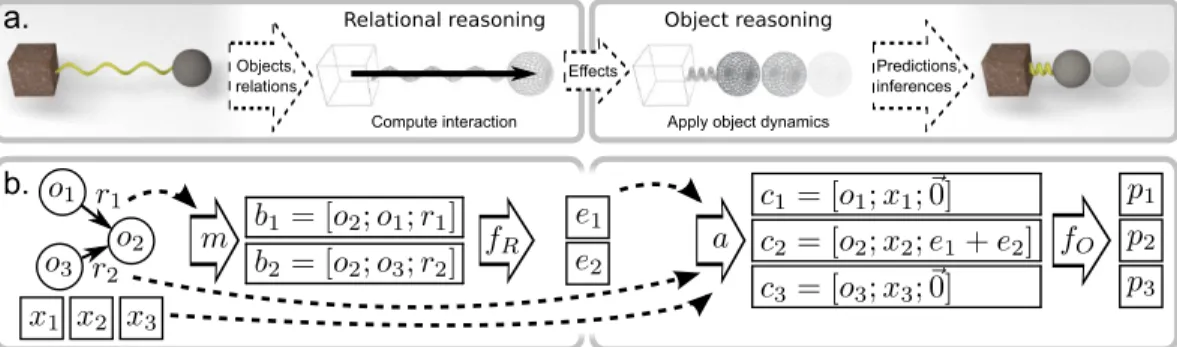
Interaction networks explicitly separate how they reason about relations from how they reason about 32
objects, assigning each task to distinct models which are: fundamentally object- and relation-centric; 33
and independent of the observation modality and task specification (see Model section 2 below 34
and Fig. 1a). This lets interaction networks automatically generalize their learning across variable 35
Object reasoning Relational reasoning
Compute interaction Apply object dynamics Effects
Objects, relations
Predictions, inferences
a.
b.
Figure 1:Schematic of an interaction network.a.For physical reasoning, the model takes objects and relations as input, reasons about their interactions, and applies the effects and physical dynamics to predict new states.b.
For more complex systems, the model takes as input a graph that represents a system of objects,oj, and relations, hi, j, rkik, instantiates the pairwise interaction terms,bk, and computes their effects,ek, via a relational model,
fR(·). Theekare then aggregated and combined with theojand external effects,xj, to generate input (ascj), for an object model,fO(·), which predicts how the interactions and dynamics influence the objects,p.
and interactions in novel and combinatorially many ways. They take relations as explicit input, 37
allowing them to selectively process different potential interactions for different input data, rather 38
than being forced to consider every possible interaction or those imposed by a fixed architecture. 39
We evaluate interaction networks by testing their ability to make predictions and inferences about var-40
ious physical systems, including n-body problems, and rigid-body collision, and non-rigid dynamics. 41
Our interaction networks learn to capture the complex interactions that can be used to predict future 42
states and abstract physical properties, such as energy. We show that they can roll out thousands of 43
realistic future state predictions, even when trained only on single-step predictions. We also explore 44
how they generalize to novel systems with different numbers and configurations of elements. Though 45
they are not restricted to physical reasoning, the interaction networks used here represent the first 46
general-purpose learnable physics engine, and even have the potential to learn novel physical systems 47
for which no physics engines currently exist. 48
Related work Our model draws inspiration from previous work that reasons about graphs and 49
relations using neural networks. The “graph neural network” [22] is a framework that shares learning 50
across nodes and edges, the “recursive autoencoder” [24] adapts its processing architecture to exploit 51
an input parse tree, the “neural programmer-interpreter” [21] is a composable neural network that 52
mimics the execution trace of a program, and the “spatial transformer” [11] learns to dynamically 53
modify network connectivity to capture certain types of interactions. Others have explored deep 54
learning of logical and arithmetic relations [26], and relations suitable for visual question-answering 55
[1]. 56
The behavior of our model is similar in spirit to a physical simulation engine [2], which generates 57
sequences of states by repeatedly applying rules that approximate the effects of physical interactions 58
and dynamics on objects over time. The interaction rules are relation-centric, operating on two or 59
more objects that are interacting, and the dynamics rules are object-centric, operating on individual 60
objects and the aggregated effects of the interactions they participate in. 61
Previous AI work on physical reasoning explored commonsense knowledge, qualitative representa-62
tions, and simulation techniques for approximating physical prediction and inference [28, 9, 6]. The 63
“NeuroAnimator” [8] was perhaps the first quantitative approach to learning physical dynamics, by 64
training neural networks to predict and control the state of articulated bodies. Ladický et al. [14] 65
recently used regression forests to learn fluid dynamics. Recent advances in convolutional neural 66
networks (CNNs) have led to efforts that learn to predict coarse-grained physical dynamics from 67
images [19, 17, 18]. Notably, Fragkiadaki et al. [5] used CNNs to predict and control a moving 68
ball from an image centered at its coordinates. Mottaghi et al. [20] trained CNNs to predict the 3D 69
trajectory of an object after an external impulse is applied. Wu et al. [29] used CNNs to parse objects 70
2
Model
72
Definition To describe our model, we use physical reasoning as an example (Fig. 1a), and build 73
from a simple model to the full interaction network (abbreviated IN). To predict the dynamics of a 74
single object, one might use an object-centric function,fO, which inputs the object’s state,ot, at 75
timet, and outputs a future state,ot+1. If two or more objects are governed by the same dynamics,
76
fO could be applied to each, independently, to predict their respective future states. But if the 77
objects interact with one another, thenfOis insufficient because it does not capture their relationship. 78
Assuming two objects and one directed relationship, e.g., a fixed object attached by a spring to a freely 79
moving mass, the first (thesender,o1) influences the second (thereceiver,o2) via their interaction.
80
The effect of this interaction,et+1, can be predicted by a relation-centric function,fR. ThefRtakes 81
as inputo1,o2, as well as attributes of their relationship,r, e.g., the spring constant. ThefO is 82
modified so it can input bothet+1and the receiver’s current state,o2,t, enabling the interaction to
83
influence its future state,o2,t+1,
84
et+1=fR(o1,t, o2,t, r) o2,t+1=fO(o2,t, et+1)
The above formulation can be expanded to larger and more complex systems by representing them 85
as a graph,G=hO, Ri, where the nodes,O, correspond to the objects, and the edges,R, to the 86
relations (see Fig. 1b). We assume an attributed, directed multigraph because the relations have 87
attributes, and there can be multiple distinct relations between two objects (e.g., rigid and magnetic 88
interactions). For a system withNOobjects andNRrelations, the inputs to the IN are, 89
O={oj}j=1...NO , R={hi, j, rkik}k=1...NRwherei6=j,1≤i, j≤NO , X={xj}j=1...NO TheOrepresents the states of each object. The triplet,hi, j, rkik, represents thek-th relation in the 90
system, from sender,oi, to receiver,oj, with relation attribute,rk. TheXrepresents external effects, 91
such as active control inputs or gravitational acceleration, which we define as not being part of the 92
system, and which are applied to each object separately. 93
The basic IN is defined as, 94
IN(G) =φO(a(G, X, φR(m(G) ) )) (1)
95
m(G) = B = {bk}k=1...NR
fR(bk) = ek
φR(B) = E = {ek}k=1...NR
a(G, X, E) = C = {cj}j=1...NO fO(cj) = pj
φO(C) = P = {pj}j=1...NO
(2)
The marshalling function, m, rearranges the objects and relations into interaction terms, bk = 96
hoi, oj, rki ∈ B, one per relation, which correspond to each interaction’s receiver, sender, and 97
relation attributes. The relational model,φR, predicts the effect of each interaction,ek ∈ E, by 98
applyingfRto eachbk. The aggregation function,a, collects all effects,ek∈E, that apply to each 99
receiver object, merges them, and combines them withOandXto form a set of object model inputs, 100
cj ∈C, one per object. The object model,φO, predicts how the interactions and dynamics influence 101
the objects by applyingfOto eachcj, and returning the results,pj ∈P. This basic IN can predict 102
the evolution of states in a dynamical system – for physical simulation,Pmay equal the future states 103
of the objects,Ot+1.
104
The IN can also be augmented with an additional component to make abstract inferences about the 105
system. Thepj ∈P, rather than serving as output, can be combined by another aggregation function, 106
g, and input to an abstraction model,φA, which returns a single output,q, for the whole system. We 107
explore this variant in our final experiments that use the IN to predict potential energy. 108
An IN applies the samefRandfOto everybkandcj, respectively, which makes their relational and 109
object reasoning able to handle variable numbers of arbitrarily ordered objects and relations. But 110
one additional constraint must be satisfied to maintain this: theafunction must be commutative and 111
associative over the objects and relations. Using summation withinato merge the elements ofEinto 112
Csatisfies this, but division would not. 113
Here we focus on binary relations, which means there is one interaction term per relation, but another 114
option is to have the interactions correspond ton-th order relations by combiningnsenders in eachbk. 115
The interactions could even have variable order, where eachbkincludes all sender objects that interact 116
with a receiver, but would require afRthan can handle variable-length inputs. These possibilities are 117
Implementation The general definition of the IN in the previous section is agnostic to the choice 119
of functions and algorithms, but we now outline a learnable implementation capable of reasoning 120
about complex systems with nonlinear relations and dynamics. We use standard deep neural network 121
building blocks, multilayer perceptrons (MLP), matrix operations, etc., which can be trained efficiently 122
from data using gradient-based optimization, such as stochastic gradient descent. 123
We defineOas aDS×NOmatrix, whose columns correspond to the objects’DS-length state vectors. 124
The relations are a triplet,R=hRr, Rs, Rai, whereRrandRsareNO×NRbinary matrices which 125
index the receiver and sender objects, respectively, andRais aDR×NRmatrix whoseDR-length 126
columns represent theNRrelations’ attributes. Thej-th column ofRris a one-hot vector which 127
indicates the receiver object’s index;Rsindicates the sender similarly. For the graph in Fig. 1b, 128
Rr=
h0 0
1 1 0 0
i
andRs=
h1 0
0 0 0 1
i
. TheXis aDX×NOmatrix, whose columns areDX-length vectors 129
that represent the external effect applied each of theNOobjects. 130
The marshalling function,m, computes the matrix products,ORrandORs, and concatenates them 131
withRa: m(G) = [ORr;ORs;Ra] = B. 132
The resultingBis a(2DS+DR)×NRmatrix, whose columns represent the interaction terms,bk, 133
for theNRrelations (we denote vertical and horizontal matrix concatenation with a semicolon and 134
comma, respectively). The waymconstructs interaction terms can be modified, as described in our 135
Experiments section (3). 136
TheBis input toφR, which appliesfR, an MLP, to each column. The output offRis aDE-length 137
vector,ek, a distributed representation of the effects. TheφRconcatenates theNReffects to form the 138
DE×NReffect matrix,E. 139
TheG,X, andEare input toa, which computes theDE×NOmatrix product,E¯=ERrT, whose 140
j-th column is equivalent to the elementwise sum across allekwhose corresponding relation has 141
receiver object,j. TheE¯is concatenated withOandX: a(G, X, E) = [O;X; ¯E] = C. 142
The resultingCis a(DS+DX+DE)×NOmatrix, whoseNOcolumns represent the object states, 143
external effects, and per-object aggregate interaction effects. 144
TheCis input toφO, which appliesfO, another MLP, to each of theNOcolumns. The output offO 145
is aDP-length vector,pj, andφOconcatenates them to form the output matrix,P. 146
To infer abstract properties of a system, an additionalφAis appended and takesPas input. Theg 147
aggregation function performs an elementwise sum across the columns ofPto return aDP-length 148
vector,P¯. TheP¯is input toφA, another MLP, which returns aDA-length vector,q, that represents 149
an abstract, global property of the system. 150
Training an IN requires optimizing an objective function over the learnable parameters ofφRandφO. 151
Note,mandainvolve matrix operations that do not contain learnable parameters. 152
BecauseφRandφOare shared across all relations and objects, respectively, training them is statisti-153
cally efficient. This is similar to CNNs, which are very efficient due to their weight-sharing scheme. 154
A CNN treats a local neighborhood of pixels as related, interacting entities: each pixel is effectively 155
a receiver object and its neighboring pixels are senders. The convolution operator is analogous to 156
φR, wherefRis the local linear/nonlinear kernel applied to each neighborhood. Skip connections,
157
recently popularized by residual networks, are loosely analogous to how the IN inputsOto both 158
φRandφO, though in CNNs relation- and object-centric reasoning are not delineated. But because
159
CNNs exploit local interactions in a fixed way which is well-suited to the specific topology of images, 160
capturing longer-range dependencies requires either broad, insensitive convolution kernels, or deep 161
stacks of layers, in order to implement sufficiently large receptive fields. The IN avoids this restriction 162
by being able to process arbitrary neighborhoods that are explicitly specified by theRinput. 163
3
Experiments
164
Physical reasoning tasks Our experiments explored two types of physical reasoning tasks: pre-165
dicting future states of a system, and estimating their abstract properties, specifically potential energy. 166
We evaluated the IN’s ability to learn to make these judgments in three complex physical domains: 167
n-body systems; balls bouncing in a box; and strings composed of springs that collide with rigid 168
objects. We simulated the 2D trajectories of the elements of these systems with a physics engine, and 169
In the n-body domain, such as solar systems, alln bodies exert distance- and mass-dependent 171
gravitational forces on each other, so there weren(n−1)relations input to our model. Across 172
simulations, the objects’ masses varied, while all other fixed attributes were held constant. The 173
training scenes always included 6 bodies, and for testing we used 3, 6, and 12 bodies. In half of 174
the systems, bodies were initialized with velocities that would cause stable orbits, if not for the 175
interactions with other objects; the other half had random velocities. 176
In the bouncing balls domain, moving balls could collide with each other and with static walls. 177
The walls were represented as objects whose shape attribute represented a rectangle, and whose 178
inverse-mass was 0. The relations input to the model were between thenobjects (which included the 179
walls), for (n(n−1)relations). Collisions are more difficult to simulate than gravitational forces, and 180
the data distribution was much more challenging: each ball participated in a collision on less than 1% 181
of the steps, following straight-line motion at all other times. The model thus had to learn that despite 182
there being a rigid relation between two objects, they only had meaningful collision interactions when 183
they were in contact. We also varied more of the object attributes – shape, scale and mass (as before) 184
– as well as the coefficient of restitution, which was a relation attribute. Training scenes contained 6 185
balls inside a box with 4 variably sized walls, and test scenes contained either 3, 6, or 9 balls. 186
The string domain used two types of relations (indicated inrk), relation structures that were more 187
sparse and specific than all-to-all, as well as variable external effects. Each scene contained a string, 188
comprised of masses connected by springs, and a static, rigid circle positioned below the string. The 189
nmasses had spring relations with their immediate neighbors (2(n−1)), and all masses had rigid 190
relations with the rigid object (2n). Gravitational acceleration, with a magnitude that was varied 191
across simulation runs, was applied so that the string always fell, usually colliding with the static 192
object. The gravitational acceleration was an external input (not to be confused with the gravitational 193
attraction relations in the n-body experiments). Each training scene contained a string with 15 point 194
masses, and test scenes contained either 5, 15, or 30 mass strings. In training, one of the point masses 195
at the end of the string, chosen at random, was always held static, as if pinned to the wall, while the 196
other masses were free to move. In the test conditions, we also included strings that had both ends 197
pinned, and no ends pinned, to evaluate generalization. 198
Our model takes as input the state of each system,G, decomposed into the objects,O(e.g., n-body 199
objects, balls, walls, points masses that represented string elements), and their physical relations,R 200
(e.g., gravitational attraction, collisions, springs), as well as the external effects,X(e.g., gravitational 201
acceleration). Each object state, oj, could be further divided into a dynamic state component 202
(e.g., position and velocity) and a static attribute component (e.g., mass, size, shape). The relation 203
attributes,Ra, represented quantities such as the coefficient of restitution, and spring constant. The 204
input represented the system at the current time. The prediction experiment’s target outputs were the 205
velocities of the objects on the subsequent time step, and the energy estimation experiment’s targets 206
were the potential energies of the system on the current time step. We also generated multi-step 207
rollouts for the prediction experiments (Fig. 2), to assess the model’s effectiveness at creating visually 208
realistic simulations. The output velocity,vt, on time steptbecame the input velocity ont+ 1, and 209
the position att+ 1was updated by the predicted velocity att. 210
Data Each of the training, validation, test data sets were generated by simulating 2000 scenes 211
over 1000 time steps, and randomly sampling 1 million, 200k, and 200k one-step input/target pairs, 212
respectively. The model was trained for 2000 epochs, randomly shuffling the data indices between 213
each. We used mini-batches of 100, and balanced their data distributions so the targets had similar 214
per-element statistics. The performance reported in the Results was measured on held-out test data. 215
We explored adding a small amount of Gaussian noise to 20% of the data’s input positions and 216
velocities during the initial phase of training, which was reduced to 0% from epochs 50 to 250. The 217
noise std. dev. was0.05×the std. dev. of each element’s values across the dataset. It allowed the 218
model to experience physically impossible states which could not have been generated by the physics 219
engine, and learn to project them back to nearby, possible states. Our error measure did not reflect 220
clear differences with or without noise, but rollouts from models trained with noise were slightly 221
more visually realistic, and static objects were less subject to drift over many steps. 222
Model architecture ThefRandfOMLPs contained multiple hidden layers of linear transforms 223
plus biases, followed by rectified linear units (ReLUs), and an output layer that was a linear transform 224
True Model True Model True Model
T
im
e
T
im
e
T
im
e
inputs (exceptRrandRs) were normalized by centering at the median and rescaling the 5th and 95th 226
percentiles to -1 and 1. All training objectives and test measures used mean squared error (MSE) 227
between the model’s prediction and the ground truth target. 228
All prediction experiments used the same architecture, with parameters selected by a hyperparameter 229
search. ThefRMLP had four,150-length hidden layers, and output lengthDE= 50. ThefOMLP 230
had one,100-length hidden layer, and output lengthDP = 2, which targeted thex, y-velocity. The 231
mandawere customized so that the model was invariant to the absolute positions of objects in the 232
scene. Themconcatenated three terms for eachbk: the difference vector between the dynamic states 233
of the receiver and sender, the concatenated receiver and sender attribute vectors, and the relation 234
attribute vector. Theaonly outputs the velocities, not the positions, for input toφO. 235
The energy estimation experiments used the IN from the prediction experiments with an additional 236
φAMLP which had one,25-length hidden layer. ItsP inputs’ columns were lengthDP = 10, and 237
its output length wasDA= 1. 238
We optimized the parameters using Adam [13], with a waterfall schedule that began with a learning 239
rate of0.001and down-scaled the learning rate by0.8each time the validation error, estimated over 240
a window of40epochs, stopped decreasing. 241
Two forms of L2 regularization were explored: one applied to the effects,E, and another to the model 242
parameters. RegularizingEimproved generalization to different numbers of objects and reduced 243
drift over many rollout steps. It likely incentivizes sparser communication between theφRandφO, 244
prompting them to operate more independently. Regularizing the parameters generally improved 245
performance and reduced overfitting. Both penalty factors were selected by a grid search. 246
Few competing models are available in the literature to compare our model against, but we considered 247
several alternatives: a constant velocity baseline which output the input velocity; an MLP baseline, 248
with two300-length hidden layers, which took as input a flattened vector of all of the input data; and 249
a variant of the IN with theφRcomponent removed (the interaction effects,E, was set to a0-matrix). 250
4
Results
251
Prediction experiments Our results show that the IN can predict the next-step dynamics of our task 252
domains very accurately after training, with orders of magnitude lower test error than the alternative 253
models (Fig. 3a, d and g, and Table 1). Because the dynamics of each domain depended crucially on 254
interactions among objects, the IN was able to learn to exploit these relationships for its predictions. 255
The dynamics-only IN had no mechanism for processing interactions, and performed similarly to the 256
constant velocity model. The baseline MLP’s connectivity makes it possible, in principle, for it to 257
learn the interactions, but that would require learning how to use the relation indices to selectively 258
process the interactions. It would also not benefit from sharing its learning across relations and 259
objects, instead being forced to approximate the interactive dynamics in parallel for each objects. 260
The IN also generalized well to systems with fewer and greater numbers of objects (Figs. 3b-c, e-f 261
and h-k, and Table SM1 in Supp. Mat.). For each domain, we selected the best IN model from the 262
system size on which it was trained, and evaluated its MSE on a different system size. When tested 263
on smaller n-body and spring systems from those on which it was trained, its performance actually 264
exceeded a model trained on the smaller system. This may be due to the model’s ability to exploit its 265
greater experience with how objects and relations behave, available in the more complex system. 266
We also found that the IN trained on single-step predictions can be used to simulate trajectories over 267
thousands of steps very effectively, often tracking the ground truth closely, especially in the n-body 268
and string domains. When rendered into images and videos, the model-generated trajectories are 269
usually visually indistinguishable from those of the ground truth physics engine (Fig. 2; see Supp. 270
Mat. for videos of all images). This is not to say that given the same initial conditions, they cohere 271
perfectly: the dynamics are highly nonlinear and imperceptible prediction errors by the model can 272
rapidly lead to large differences in the systems’ states. But the incoherent rollouts do not violate 273
people’s expectations, and might be roughly on par with people’s understanding of these domains. 274
Estimating abstract properties We trained an abstract-estimation variant of our model to predict 275
potential energies in the n-body and string domains (the ball domain’s potential energies were always 276
10-2
10-3
g. 15, 1 h. 5, 1 i. 30, 1 j. 15, 0 k. 15, 2
String
1 10-1
10 102
MS
E
(l
o
g
-sca
le
) a. 6 b. 3 c. 12
n-body
10-2
10-1
10-3
d. 6 e. 3 f. 9
Balls
IN (15 obj, 1 pin) IN (5 obj, 1 pin) IN (15 obj, 0 pin)
IN (30 obj, 1 pin) IN (15 obj, 2 pin) IN (3 obj) IN (12 obj)
IN (6 obj)
Constant velocity Baseline MLP Dynamics-only IN IN (3 obj) IN (9 obj) IN (6 obj)
10-2
Figure 3:Prediction experiment accuracy and generalization. Each colored bar represents the MSE between a model’s predicted velocity and the ground truth physics engine’s (the y-axes are log-scaled). Sublots (a-c) show n-body performance, (d-f) show balls, and (g-k) show string. The leftmost subplots in each (a, d, g) for each domain compare the constant velocity model (black), baseline MLP (grey), dynamics-only IN (red), and full IN (blue). The other panels show the IN’s generalization performance to different numbers and configurations of objects, as indicated by the subplot titles. For the string systems, the numbers correspond to: (the number of masses, how many ends were pinned).
Table 1: Prediction experiment MSEs
Domain Constant velocity Baseline Dynamics-only IN IN
n-body 82 79 76 0.25
Balls 0.074 0.072 0.074 0.0020
String 0.018 0.016 0.017 0.0011
(n-body MSE19, string MSE425). The IN presumably learns the gravitational and spring potential 278
energy functions, applies them to the relations in their respective domains, and combines the results. 279
5
Discussion
280
We introduced interaction networks as a flexible and efficient model for explicit reasoning about 281
objects and relations in complex systems. Our results provide surprisingly strong evidence of their 282
ability to learn accurate physical simulations and generalize their training to novel systems with 283
different numbers and configurations of objects and relations. They could also learn to infer abstract 284
properties of physical systems, such as potential energy. The alternative models we tested performed 285
much more poorly, with orders of magnitude greater error. Simulation over rich mental models is 286
thought to be a crucial mechanism of how humans reason about physics and other complex domains 287
[4, 12, 10], and Battaglia et al. [3] recently posited a simulation-based “intuitive physics engine” 288
model to explain human physical scene understanding. Our interaction network implementation is the 289
first learnable physics engine that can scale up to real-world problems, and is a promising template for 290
new AI approaches to reasoning about other physical and mechanical systems, scene understanding, 291
social perception, hierarchical planning, and analogical reasoning. 292
In the future, it will be important to develop techniques that allow interaction networks to handle 293
very large systems with many interactions, such as by culling interaction computations that will have 294
negligible effects. The interaction network may also serve as a powerful model for model-predictive 295
control inputting active control signals as external effects – because it is differentiable, it naturally 296
supports gradient-based planning. It will also be important to prepend a perceptual front-end that 297
can infer from objects and relations raw observations, which can then be provided as input to an 298
interaction network that can reason about the underlying structure of a scene. By adapting the 299
interaction network into a recurrent neural network, even more accurate long-term predictions might 300
be possible, though preliminary tests found little benefit beyond its already-strong performance. 301
By modifying the interaction network to be a probabilistic generative model, it may also support 302
probabilistic inference over unknown object properties and relations. 303
By combining three powerful tools from the modern machine learning toolkit – relational reasoning 304
over structured knowledge, simulation, and deep learning – interaction networks offer flexible, 305
accurate, and efficient learning and inference in challenging domains. Decomposing complex 306
systems into objects and relations, and reasoning about them explicitly, provides for combinatorial 307
generalization to novel contexts, one of the most important future challenges for AI, and a crucial 308
References
310
[1] J Andreas, M Rohrbach, T Darrell, and D Klein. Learning to compose neural networks for question
311
answering.NAACL, 2016.
312
[2] D Baraff. Physically based modeling: Rigid body simulation.SIGGRAPH Course Notes, ACM SIGGRAPH,
313
2(1):2–1, 2001.
314
[3] PW Battaglia, JB Hamrick, and JB Tenenbaum. Simulation as an engine of physical scene understanding.
315
Proceedings of the National Academy of Sciences, 110(45):18327–18332, 2013.
316
[4] K.J.W. Craik.The nature of explanation. Cambridge University Press, 1943.
317
[5] K Fragkiadaki, P Agrawal, S Levine, and J Malik. Learning visual predictive models of physics for playing
318
billiards.ICLR, 2016.
319
[6] F. Gardin and B. Meltzer. Analogical representations of naive physics.Artificial Intelligence, 38(2):139–
320
159, 1989.
321
[7] Z. Ghahramani. Probabilistic machine learning and artificial intelligence.Nature, 521(7553):452–459,
322
2015.
323
[8] R Grzeszczuk, D Terzopoulos, and G Hinton. Neuroanimator: Fast neural network emulation and control of
324
physics-based models. InProceedings of the 25th annual conference on Computer graphics and interactive
325
techniques, pages 9–20. ACM, 1998.
326
[9] P.J Hayes.The naive physics manifesto. Université de Genève, Institut pour les études s é mantiques et
327
cognitives, 1978.
328
[10] M. Hegarty. Mechanical reasoning by mental simulation.TICS, 8(6):280–285, 2004.
329
[11] M Jaderberg, K Simonyan, and A Zisserman. Spatial transformer networks. Inin NIPS, pages 2008–2016,
330
2015.
331
[12] P.N. Johnson-Laird.Mental models: towards a cognitive science of language, inference, and consciousness,
332
volume 6. Cambridge University Press, 1983.
333
[13] D. Kingma and J. Ba. Adam: A method for stochastic optimization.ICLR, 2015.
334
[14] L Ladický, S Jeong, B Solenthaler, M Pollefeys, and M Gross. Data-driven fluid simulations using
335
regression forests.ACM Transactions on Graphics (TOG), 34(6):199, 2015.
336
[15] B Lake, T Ullman, J Tenenbaum, and S Gershman. Building machines that learn and think like people.
337
arXiv:1604.00289, 2016.
338
[16] Y LeCun, Y Bengio, and G Hinton. Deep learning.Nature, 521(7553):436–444, 2015.
339
[17] A Lerer, S Gross, and R Fergus. Learning physical intuition of block towers by example.arXiv:1603.01312,
340
2016.
341
[18] W Li, S Azimi, A Leonardis, and M Fritz. To fall or not to fall: A visual approach to physical stability
342
prediction.arXiv:1604.00066, 2016.
343
[19] R Mottaghi, H Bagherinezhad, M Rastegari, and A Farhadi. Newtonian image understanding: Unfolding
344
the dynamics of objects in static images.arXiv:1511.04048, 2015.
345
[20] R Mottaghi, M Rastegari, A Gupta, and A Farhadi. " what happens if..." learning to predict the effect of
346
forces in images.arXiv:1603.05600, 2016.
347
[21] SE Reed and N de Freitas. Neural programmer-interpreters.ICLR, 2016.
348
[22] F. Scarselli, M. Gori, A.C. Tsoi, M. Hagenbuchner, and G. Monfardini. The graph neural network model.
349
IEEE Trans. Neural Networks, 20(1):61–80, 2009.
350
[23] J. Schmidhuber. Deep learning in neural networks: An overview.Neural Networks, 61:85–117, 2015.
351
[24] R Socher, E Huang, J Pennin, C Manning, and A Ng. Dynamic pooling and unfolding recursive
autoen-352
coders for paraphrase detection. Inin NIPS, pages 801–809, 2011.
353
[25] E Spelke, K Breinlinger, J Macomber, and K Jacobson. Origins of knowledge.Psychol. Rev., 99(4):605–
354
632, 1992.
355
[26] I Sutskever and GE Hinton. Using matrices to model symbolic relationship. In D. Koller, D. Schuurmans,
356
Y. Bengio, and L. Bottou, editors,in NIPS 21, pages 1593–1600. 2009.
357
[27] J.B. Tenenbaum, C. Kemp, T.L. Griffiths, and N.D. Goodman. How to grow a mind: Statistics, structure,
358
and abstraction.Science, 331(6022):1279, 2011.
359
[28] P Winston and B Horn.The psychology of computer vision, volume 73. McGraw-Hill New York, 1975.
360
[29] J Wu, I Yildirim, JJ Lim, B Freeman, and J Tenenbaum. Galileo: Perceiving physical object properties by
361
integrating a physics engine with deep learning. Inin NIPS, pages 127–135, 2015.