Chemistry of Fluoride Leaching and Associating Influential Factors in
Plaster Board Waste
by
Venkataraman SIVASANKAR* and Kiyoshi OMINE**
Plaster board waste generated from industries, usually contains major proportion of
calcium as calcium sulfate. In addition, fluoride is remarkably one among the constituents of this
waste material. Experimental studies were conducted to determine the fluoride leaching as a
function of particle size, pH of leaching solvent (distilled water) and water: PBP ratio. The
influence of sodium salts on the leaching of fluoride from PBP was studied. It was explored that
one gram of plaster board waste contains 18.54 mg F per gram of PBP. High leaching of 3.70 mg
F per liter was studied at pH 6.02 with Ca2+ and TDS contents of 1050 mg L-1 and 1640 mg L-1
respectively. The influence of fluoride leaching by sodium phosphate recorded a high value of
12.75 mg L-1 with no detectable amount of calcium ions. The leaching mechanism was predicted
significantly by the exchange of Na+ and Ca2+ ions. The leaching rate as a consequence of shaking
and stirring dynamics was also investigated at different conditions.
Key words: Plaster board; fluoride leaching, characterizations
成 9 月 日受理
* JSPS Research Fellow, Graduate School of Engineering, Nagasaki University, Japan
1. Introduction
Every year, the discharge of waste plaster board (PB) is estimated to be 1.091 million tons
in Japan. The PB discharge includes 0.796 million tons from demolition works and 0.295 million
tons from new construction works. The estimated discharge is expected to reach 2.5 million tons
in 30 years. The hazardous elements present reported in PB are arsenic (As), cadmium (Cd) and
fluoride (F). Fluoride is considered as one of the major pollutants in Japan [1]. The Japanese
Environmental Standard limit for fluoride is 0.8 mg L-1 [2]. Fluoride contamination in drinking
water and its associated problems are well known [3]. It is reported [4] that groundwater fluoride
causes disease in an exponential manner among the people (108) across the world. A recent study
disseminated that children victims of dental fluorosis become insufficiently nutritious [5] and the
high concentration of fluoride could cause learning disabilities in children [6]. Excessive fluoride
ingestion occurs through foodstuff [7], toothpaste and products of dental health [8] in addition to
drinking water. Fluoride enrichment in groundwater at the Western Part of Kumamoto area in
Japan was studied [9] and reported that shallow groundwater and deep groundwater samples of
58% and 26% were found above the safe fluoride level of Japanese standard. The hydro-chemical
reactions of Toki granite containing fluorite and mica enriched the fluoride level in groundwater
in the Mizunami area of central Japan [10]. Yamada and co-workers [11] studied the leaching and
control of fluoride in plasterboard powder using light burned magnesite. Sakanakura et al. [12]
explored the control of soil property over fluoride leaching from plaster board. In the present
research contribution, the fluoride leaching from PB powder as a consequence of its interaction
with other associating ions which are commonly present in the soil environment has been studied.
This study has been envisaged to cater for better insight in choosing the suitable soil environment
Fig. 1 Waste plaster board recycling process: Crushing and dumping (A) Separation (B) Drying (C) Packing and Recycle (D, E) and Samples after thermal treatment (F)
2. Materials and methodology
2.1 Instrumental characterizations
PB powder was characterized using FTIR (Nexus 870 FTIR, Thermo Scientific), X – Ray
Diffraction (Rigaku, MiniFlex 600 Benchtop XRD, operated using 0.625 DS and 10 mm HIS with
SS of 13.0 mm at 40 kV and 15 mA), FE – SEM (JEOL JSM – 7500FA) with EDS system and
DTG (DTG – 50, Shimadzu simultaneous DTA – TG Analyzer) studies. Fluoride was analyzed
with Thermo Scientific Orion Versa Star using Orion fluoride ion – selective electrode
(254792-001).
2.2 Fluoride leaching experiments
The waste plaster board (Fig. 1) was procured from an industry located at Omura, Japan. The PB
sheets were initially processed by separating the wrappers on the surface followed by grinding into
powder using steel mixer grinder. Then the powdered mass was oven – dried at 110˚C for 10 h
and sieved for the particle size of 250 – 106 µm. The sieved PB powder was preserved in desiccator
(to keep away the moisture) for experimental studies. Leaching experiments were carried out using
were run using Thomas (T – 2S) thermostatic shaking bath using amber-colored and glass – lid
conical flasks of 0.2 L capacity. pH adjustments in solutions were done by 0.1 N HCl or NaOH
solutions using pH meter. All the chemicals and reagents used in the study are of analar grade.
3. Results and discussion
3.1 Characterization of Plaster Board Powder (PBP)
The FE-SEM image shows the appearance of smooth, transparent and needle-like
morphology of PBP at magnification of 10k. The colored images each for Ca, S and O elements
are also represented in Fig. 2. The x – ray diffraction pattern (Fig. 3) reveals the presence of –
CaSO4. 0.5 H2O and its anhydrite (syn) based on the DB card numbers 00-045-0848 and 00-037-1496 respectively. The crystallite size recorded for form of CaSO4. ½ H2O of 40 nm was less
than that of its anhydrite form of 43 nm. The identification of α – SiO2 (Card No. 01-089-8937)
along with CaSO4 (Card No. 01-070-0909) after heating the PBP at 1000˚C was evident from the
thermal study. The amount of carbon was analyzed to be 0.633% by mass and the amount of
material loss due to ignition was 8.74% by mass [13]. Although similar lattice angles were
exhibited (α = = 90˚), the angle ( ) in the heated PBP was 1β0˚ unlike in – CaSO4. 0.5 H2O with 90˚. The presence of bassanite form (CaSO4. ½ H2O) in PBP could be characterized in the
special region 3500 cm-1 and 1600 cm-1. In the mid – IR spectra (Fig. 4), the peaks at 3560 cm-1
and 3600 cm-1 are ascribed respectively to the symmetric (υ
1) and anti-symmetric (υ3)stretch
vibrational modes of water. The O-H bending vibration mode was observed at 1620 cm-1. A sharp
peak at 1140 cm-1 with a shoulder at 1080 cm-1 indicated the asymmetric stretching mode (υ3) of
SO42- group. The combination modes of SO42- and H2O vibrations was reported to occur in the
Fig. 3 X – ray diffraction pattern of PBP
Fig. 4 FTIR pattern of basanite phase in PBP
3.2 Effect of contact time
The concentration of fluoride leaching as a function of time was carried out at β5˚C using the PBP (particle size < 250µm) amount of 1 g (in 0.1 L of water as the leaching solvent) and
along with fluoride was also analyzed to be 1000 mgL-1 with the corresponding TDS value of 1940
mgL-1. The aliquots which were drawn two times every hour were with an averaged pH of 6.85.
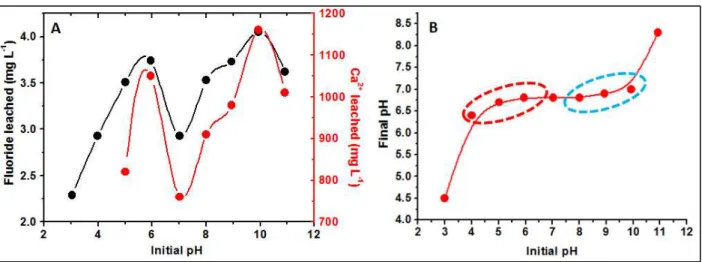
Fig. 5 Influence of pH on fluoride and calcium leaching in PBP (A) and plot of initial versus final pH; Conditions: agitation time – 4 h; Volume of LS – 0.1 L; Quantity of PBP – 1 g; Size of PBP < 106 µm
3.3 Effect of pH on fluoride leaching from PBP
The pH of a solution plays a significant role towards the leaching of fluoride in PBP. The
effect of pH on the leaching of fluoride (Eq. 1) from PBP was studied from pH 3.04 to 10.92 as
shown in Fig. 5A. The presence of CaF2 in PBP leached less effectively under pH < 6 and pH >
10 in addition to the neutral pH. Under acidic conditions, the tendency towards the protonation of
ionisable fluoride from CaF2 increased on decreasing the pH and resulting in the formation of
hydrofluoric acid, a very weak acid. As a consequence of HF formation, the fluoride leaching
decreased on decreasing the pH (Eq. 2). Conversely under basic conditions, the generation of
hydroxide ions (between pH 8 and 10) tend to combine with Ca2+ ions and pulls the equilibrium
towards the right hand side (Eqs. 1 and 3) by releasing more Fˉ ions.As the OHˉ ion was consumed,
the solution was controlled with its final pH of 7. Nevertheless, at pH > 10, the lessening of fluoride
leaching might be attributed to the exchange of Fˉ and OHˉ in Ca(OH)2 to form Ca (OH)F and
CaF2 (Eq. 4 and Eq. 5). The exchange mechanism resulted in the ejection of OHˉ in solution and
there by increased the pH as shown in Fig. 5B.
→ � ++ �− ………. (1)
++ �− → � � � � ………. (γ)
� + �− → � � + �− ………. (4)
� + �−→ � + �− ………. (5)
The leaching curves for calcium and fluoride are directly proportional to each other. The
similarity in gradation patterns could be pertinent to the association of calcium and fluoride ions
reversibly to form CaF2 or the dissociation of CaF2 into the constituent ions at the respective
conditions. The fluoride leaching from PBP was studied based on the effect of the quantity of PBP
with different H2O/PBP ratios (Fig. 6A). It is apparent from the fluoride leaching graph that the
ionisable fluoride was studied proportional to the amount of PBP. The amount of fluoride leached
from 3.12 mgL-1 to 6.25 mg L-1 for the respective PBP: H
2O ratios from 1:200 to 1:10. Despite
two times increase in fluoride leaching, the leached amount of Ca2+ was 1020±60 mgL-1 in the
studied range of PBP: water ratio. It can also be taken into account that, the more the quantity of
PBP, the more the amount of CaF2 in it and ultimately resulting in the leaching of more fluoride
in water. But the amount of leachable calcium ions become saturated with the volume of leaching
solvent (LS), water. The final pH of the resulting solutions was recorded in the range of 6.84 –
7.10.
Fig. 6 Influence of PBP: Water ratio on fluoride leaching (A) Ionic effect on fluoride leaching by
(PBP: Sodium salt ratio – 1:5); agitation time – 4h (shaking) & 3h (stirring); volume of LS – 0.1 L; size of PBP < 106 µm
3.4 Effect of other associating anions
The influence of anions such as chloride, nitrate, acetate, hydrogen carbonate, carbonate,
sulfate, tetra-borate and phosphate on the leaching of fluoride from PBP was performed as shown
in Fig. 6B. This study was carried out with a notion of imitating the practical soil environments
with varied proportions of minerals which are naturally present. In order to fulfill this, the PBP
was added with five proportions of sodium compounds by maintaining the PBP: NaAn ratio from
1:1 to 1:5. The conditions were envisaged with a purpose of catering the real systems where the
soil and groundwater contaminated with fluoride under the influence of plaster powder. The
following chemistry (Eq. 6) played a significant role towards the solubility of NaF and thereby
influencing contamination in the environment [15].
� + � � + � � ………… (6)
ℎ � � � � & = ,
Based on the results, the leaching of fluoride was observed with a varied in the range of
0.1 – 1.13 mgL-1 between shaking and stirring methods. On comparing the two agitation methods,
the positive gradation in fluoride increase was quite explicable except the two systems in which
PBP was added to phosphate and groundwater. The effectiveness of stirring dynamics than shaking
was discussed in the case of fluoride sorption systems [16]. Among the influencing anions, the
maximum leaching of fluoride was highly driven by phosphate followed others as hydrogen
carbonate > carbonate = sulfate > acetate > nitrate > chloride > tetra-borate. The contemporary
ion, Ca2+ was decreased when the influential ions were sulfate and tetra-borate. This may be due
to the backward reaction which associates the calcium and its counter ions or the enhanced
precipitation of calcium borate which lessens the Ca2+ concentration. On accompanying the other
sodium compounds such as chloride, nitrate and acetate, the Ca2+ concentration was higher (1.8 –
3 times) than its usual solubility in water. This corroborates the enhanced leaching of Ca2+ in the
presence of sodium compounds which tend to drive the forward reaction. In cases like sodium
carbonate, sodium hydrogen carbonate and sodium phosphate, the presence of Ca2+ in solution was
evident that calcium and fluoride in groundwater are inversely proportional to each other [17]. In
supporting the above statement, the concentration of fluoride surmounted when Ca2+ in solution
becomes unaddressed.
In addition, the impact of groundwater on fluoride leaching was studied by shaking (and
stirring) 1 g of PBP in 0.1 L of groundwater. The leached content of fluoride in groundwater was
4.02 mg L-1 and 3.60 mg L-1 by shaking and stirring agitations respectively with the respective 4
h and 3 h of optimized agitation time. The groundwater (initial TDS = 83 mg L-1 ) with neutral
nature (pH 7.08) raised to the highly alkaline nature with pH of 8.82 (shaking) and 7.73 (stirring)
with respective Ca2+ concentration of 1200 mg L-1 and 940 mg L-1. The final pH of leached
solutions were neutral (pH 7.35±0.15) after agitation with chloride, sulfate and nitrate salts and the
exception was the one used with acetate, in which the solution was buffered with pH 6. For the
other solutions agitated with borate, carbonate, hydrogen carbonate and phosphate, the final pH
was measured to be 9.1, 11.4, 7.9 and 12.0 respectively. Nevertheless, the pH difference was
meagre (±0.4) in these systems.
Fig. 7 Profile of continuous attempts on the leaching of fluoride using 1 g PBP (A) Profiles on the leaching of calcium and total dissolved solids from PBP (B) Conditions: agitation time – 4 h; Volume of LS – 0.1 L; Quantity of PBP – 1 g; Size of PBP < 106 µm
In order to quantify the total amount of fluoride present in 1 g of PBP, a series of agitations
was attempted. During every attempt, the undissolved PBP was again taken with a fresh volume
was taken to dissolve 1 g of PBP as shown in Fig. 7A. The graph illustrates the gradual decrease
in the concentration of fluoride from 3.7 mg L-1(1st attempt) to 1.5 mg L-1 (7th attempt). It could
be concluded that one gram of PBP contains a total amount of 18.54 mg F which is about 14.3
times higher than the naturally existing granite powders with 200 – 1300 mg F per kg [10]. The
three parameters namely F¯ , Ca2+ and TDS decreased gradually after every attempt and found to
be proportional to one another (Fig. 7B).
4. Conclusions
Based on the above results and discussion, the following can be drawn. They are:
1. The characterization results of PBP ascertained the presence of basanite (CaSO4. ½ H2O),
anhydrite CaSO4, α- SiO2 and carbon of 0.633% by mass.
2. Plaster board leaches the highest amount of fluoride at pH 6 of 3.7 mg L-1.
3. The total amount of contained fluoride in 1 g of PBP was quantified to be 0.0185 g. The
sodium forms of phosphate, carbonate and hydrogen carbonate were able to leach high
amount of fluoride with no detectable calcium ions in water.
4. The stirring agitation was observed effective than shaking in view of leaching rate of
fluoride and other ions encountered.
Acknowledgement
The authors thank Japanese Society for the Promotion of Science (JSPS) for the grant –
in – aid for Scientific Research (L16544) and also Nagasaki University, Japan.
References
[1] wepa-db.net/
[2] Ministry of Health, Labor and Welfare, Japan;
http://www.mhlw.go.jp/english/policy/health/water_ supply/4.html
[3] Sivasankar, V., 2016, Surface Modified Carbons as scavengers for fluoride from water, Springer.
[5] Irigoyen-Camacho, M.E., Perez, A.G., Gonzalez, A.M., Alvarez, R.H., 2016. Nutritional status and dental fluorosis among schoolchildren in communities with different drinking water fluoride concentrations in a central region in Mexico. Sci. Total Environ. 541, 512–519.
[6] Rocha-Amador, D., Navarro, M.E., Carrizales, L., Morales, R., Calderon, J., 2007. Decreased intelligence in children and exposure to fluoride and arsenic in drinking water. Cadernos De Saude Publica. 23, pp. S579–S587
[7] Battaleb-Looie, S., Moore, F., Malde, M., Jacks, G., 2013. Fluoride in groundwater, dates and wheat: estimated exposure dose in the population of Bushehr, Iran. J. food Compos. Anal. 29, 94-99.
[8] Ozsvath, D.L., 2009. Fluoride and environmental health: a review. Rev. Environ. Sci. Bio. 8, 59-79.
[9] Hossain, S., Hosono, T., Yang, H., Shimada, J., 2016, Geochemical processes controlling fluoride enrichment in groundwater at the Western Part of Kumamoto area, Japan, Water Air Soil Pollution, 227, pp. 385 (1 – 14). doi: 10.1007/s11270-016-3089-3.
[10] Abdelgawad, A.M., Watanabe, K., Takeuchi, S., Mizuno, T., 2009, The origin of fluoride – rich groundwater in Mizunami area, Japan – Minerology and geochemistry implications,
Engineering Geology, 108, pp. 76 – 85.
[11] Yamada, M., Sano, H., Tsubokawa, S., 2012, Fluoride leaching control of Waste Plasterboard Powder using light burned Magnesite and its applicability to the
stabilization/solidification of Clay, Journal of the Society of Materials Science, Japan, 61 (1), pp.25 – 30.
[12] Sakanakura, H., Endo, K., Inoue, Y., 2012, Leaching behavior of fluorine from soil stabilized with recycled gypsum from plaster board, Journal of ASTM International, 9 (1) pp. 1 – 8.
[13] Sano, H., 2008, Reports of the Faculty of Engineering, Nagasaki University, 38 (70), pp. 44 – 54.
[14] Liu, Y., Wang, A., Freeman, J.J, Raman, MIR, and NIR spectroscopic study of calcium sulfates: Gypsum, Bassanite, and anhydrite, 40th Lunar and Planetary Science Conference, 2009.
[15] Subba Rao, N., 2017, Controlling factors of fluoride in groundwater in a part of South India, Arabian Journal of Geosciences, 10, pp.524 (1-15), doi: 10.1007/s12517-017-3291-7.
[16] Sivasankar, V., Rajkumar, S., Murugesh, S., Darchen, A., 2012, Influence of shaking and stirring dynamic methods in the defluoridation of activated tamarind fruit shell carbon, Chemical Engineering Journal, 197, pp. 162 – 172.
[17] Sivasankar, V., Omine, K., Msagati, T.A.M., Senthil Kumar, M., 2013, Evaluation of
groundwater quality in Madurai District, South India for drinking, irrigation and construction