1. Introduction
• Typology: comparative study of the different grammatical patterns that are found across languages e.g. basic sentential word order
Out of 1377 languages that Dryer (2005a) looked at:
SVO (488): English, Yoruba (Niger-Congo; Nigeria), Igbo (Niger-Congo; Nigeria), Mandarin
SOV (565): Japanese, Ijo (Ijaw) (Niger-Congo; Nigeria), Kanuri (Saharan, Nilo-Saharan; Nigeria, Niger, Chad, and Cameroon)
VSO (95): Modern Standard Arabic (Semitic, Afro-Asiatic; Middle East and North Africa), Irish
VOS (25): Malagasy (Austronesian; Madagascar), Nias (Austronesian; Indonesia) OVS (11): Päri (Nilotic, Nilo-Saharan; South Sudan), Hixkaryana (Carib; Brazil) OSV (4): Nadëb (Nadahup; Brazil)
No dominant order (189): Nunggubuyu (Gunwinyguan; Australia)
Dryer, Matthew S. 2005. Order of subject, object, and verb. In Haspelmath, Martin, Matthew S. Dryer, David Gil, and Bernard Comrie (eds.), The World Atlas of Language Structures, 330–333. Oxford: Oxford University Press.
Online version description http://wals.info/chapter/81
map http://wals.info/feature/81A - 2/18.3/134.8 Questions (about a phenomenon like sentential word order) that typologists ask:
(i) the range of attested types
(ii) how common or uncommon the different types are
(iii) whether there are noteworthy geographic patterns in the distribution of the types (iv) what correlations may hold across different linguistic types
• Differences between generative linguists and typologists
Generative linguists Typologists
in-depth study of a few languages broader study of as many languages as feasible deductive (theory-driven):
theory/hypothesis => data
inductive (data-driven): data => theory/hypothesis
rule-writing not rule-writing; more informal description
emphasis on formal notions (e.g. binding, command)
emphasis on substantive notions used in traditional grammar (e.g. adjective, object, verb agreement, ergative)
associated with more abstract analysis associated with more concrete analysis based on descriptions using categories that are
supposed to be universal: There are Indo- European biases.
based on descriptions which are motivated within a language (using categories emergent from the data within the language)
language-internal explanations (synchronic
explanations) language-external, functional, or diachronic
explanations
less natural data naturalistic data
• Different levels of typological studies
1) language description – fundamental to typology
2. Describing and explaining linguistic universals 2.1. Universals and tendencies
[A] Two types of language universals: unrestricted and implicational
[B] Two types of cross-linguistic tendencies (statistical universals, soft universals): unrestricted and implicational
[C] (Cross-linguistically operational) grammatical hierarchies
[A-1] Unrestricted universals: patterns that are supposed to hold across all of the languages of the world without exception
e.g.1. All languages have consonants and vowels.
e.g.2. Greenberg’s (1963[1966]:84) Universal #14: In conditional statements, the conditional clause precedes the conclusion as the normal order in all languages.
http://pkdas.in/JNU/typo/lu.pdf [A-2] Implicational universals: universals that can be stated in a form like If a language has property X, then it also has property Y.
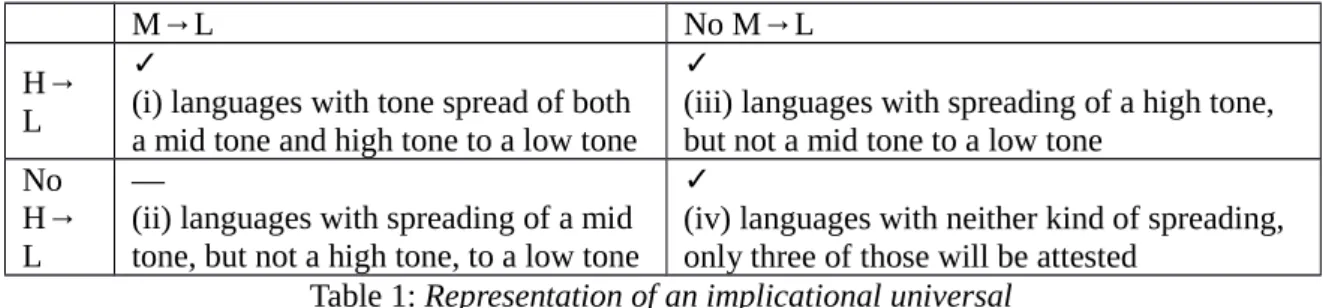
e.g. 1 Hyman and Schuh’s (1974:89) claim that in a given language: If tone spreading takes place from a mid tone into a following low, then tone spreading also takes place from a high tone into a following low tone.
M→L No M→L
H→ L
✓
(i) languages with tone spread of both a mid tone and high tone to a low tone
✓
(iii) languages with spreading of a high tone, but not a mid tone to a low tone
No H→ L
—
(ii) languages with spreading of a mid tone, but not a high tone, to a low tone
✓
(iv) languages with neither kind of spreading, only three of those will be attested
Table 1: Representation of an implicational universal Example of H→L
In Aghem (Niger-Congo; Nigeria), a prefixal H tone spreads onto a following L tone root, thereby creating a HL falling tone: /é-zù/ → [é-zû] ‘to skin’
Hyman, Larry M. 2003. African languages and phonological theory. GLOT International, 7.6, 153-163.
http://www.linguistics.berkeley.edu/~hyman/GLOT_Phonology_African_Lgs.pdf e.g.2. If Dem-N (e.g. English: that person) and Adj-N (e.g. English: tall person), then Dem-Adj-N
(e.g. English: that tall person, *tall that person).
[B-1] Unrestricted cross-linguistic tendencies: patterns that are supposed to hold across most languages of the world
e.g. Greenberg’s (1963[1966]:77) Universal #1: In declarative sentences with nominal subject and object, the dominant order is almost always one in which the subject precedes the object.
=> SOV, SVO, and VSO word orders (1056 out of 1228 languages in Dryer 2005a) are more common than OVS, VOS, and OSV word order.
(Only SOV, SVO, and VSO word orders are possible.)
[B-2] Implicational cross-linguistic tendencies: A language with property X tends to have property Y. e.g. A language with OV order tends to use postpositions, and a language with VO order tends to
use prepositions.
OV (head-final) VO (head-initial)
Prep (head-initial) rare ✓ (head-initial)
Post (head-final) ✓ (head-final) rare
Table 2: Representation of an implicational tendency Tables 1 and 2:
Table 2 (only a strong tendency) is weaker than Table 1 (a universal) in one sense, but Table 2 (a two-way implication) is stronger than Table 1 (only a one-way implication) in another sense. [C] (Cross-linguistically operational) grammatical hierarchies
possible patterns of cross-linguistic variation at an abstract level: a range of patterns that are attested across all languages in a given grammatical domain without directly specifying exactly how those patterns will manifest themselves concretely in any particular language
Figure 1: An implicational hierarchy for grammatical number marking singular < plural < dual < trial/paucal
Croft (1990:97)
• Statements of linguistic universals: verifiable, and potentially falsifiable, claims about what kinds of grammatical patterns will or will not be found in the world’s languages, based on examination of a considerable proportion of the languages of the world for which data is available (rather than all the languages in the world)
=> A claim about a language universal or a cross-linguistic tendency may turn out to be falsified with data from (an) undescribed or poorly described language(s).
e.g. Bayso (Cushitic, Afro-Asiatic; Ethiopia) (Corbett 2000:39, Hayward 1979:102) singular, plural, and paucal markers, but no dual marker => Figure 1 is not a true universal, but a tendency.
2.2. Explanations for universals
Three types of explanations for universals (not mutually exclusive)
(i) Synchronic explanation: languages pattern in a particular way because of restrictions on the human cognitive capacity for language, often referred to as universal grammar.
e.g. Unrestricted universal/tendency: All languages have nouns and verbs.
<= Generative linguists: the distinction between nouns and verbs can be attributed to universal grammar
(ii) Diachronic explanation: the existence of the relevant pattern is due to the nature of language change.
(Common processes of change may independently affect different languages in ways that cause their overall grammars to converge on common structures.)
(iii) External explanation For example,
the frequency in which a particular kind of meaning is expressed e.g. definiteness of possessed nouns (Haspelmath 1999)
possessed nouns (e.g., English: my book, his car) are more likely to be definite when referred to since speakers tend to have a particular item in mind when they modify it with a possessor. English
definite possessed noun my book *the my book
indefinite possessed noun a book of mine *a my book Vai (Mande, Niger-Congo; Liberia and Sierra Leone)
(3a) definite suffix on the noun in a non-possessive construction
(3b) definite suffix on the possessor noun (but not on the possessed noun) in the possessive construction [possessor noun possessed noun]
(3c) *definite suffix both on the possessor noun and on the inalienable possessed noun in the possessive construction [possessor noun possessed noun]
(3d) definite suffix both on the possessor noun and on the alienable possessed noun in the possessive construction [possessor noun linker possessed noun]
=> A possessed noun cannot be marked for definiteness when the possessum is to inalienably possessed.
(Inalienably possessed nouns are most likely to be definite in the real world.) Possessed nouns are more often used to refer to definite items.
<= the way people speak: people tend refer to definite possessed nouns more often than indefinite ones independent of the languages they speak, and the grammars of some languages seem to be shaped by this extragrammatical preference.
A hierarchy of definiteness:
inalienably possessed <–––––––––––––––––––––––––––––> alienably possessed more likely to be definite less likely to be definite
3. African languages in a typological perspective
http://africamedia.typepad.com/africa-maps/African_language_families.png
3.1. Introduction
• Perhaps a quarter to a third of all the world’s languages are spoken in Africa, and most of these have not been properly studied.
• a number of grammatical features of African languages that have captured the attention of typologists, as well as formal linguists
e.g.1. clicks in Khoisan languages e.g.2. tone in African languages 3.2. Adjectives
• In many languages,
there is either very little evidence for a distinct class of adjectives, or the class of true adjectives is so small that it appears to be a closed lexical class rather than an open one.
Igbo (Niger-Congo; Nigeria) (Welmers & Welmers 1969:321): a language with eight adjectives (5a)-(5c): associative construction (similar to the X of Y construction in English)
=> tonal differences between the isolation word tones and the tones when they words are joined together
(5a): the addition of a downstep between the first and second high tones of the second word (5b), (5c): raising of a final tone of the first word of the phrase
(5d): N Adj
<= No tonal alternation unlike (5a)-(5c); The property word follows the noun, unlike in (5c)
• Certain semantic categories, like dimension (i.e., large vs. small) and age (i.e., old vs. new) are more likely to be adjectives in languages with a small adjective class than other categories (e.g., words denoting speeds like fast or slow). (Dixon 1977, 2006:3–5)
<= likely to be expressed by likely to be expressed by likely to be expressed by => adjectives in languages adjectives in languages with a adjectives only in some langs with a small adjective class medium or large adjective class with a large adjective class dimension (‘large’, ‘small’, ...) physical property (‘hard’, ‘soft’, ...) difficulty
age (‘old’, ‘young, ‘new’, ...) human propensity (‘jealous’, ‘happy’, ...) similarity value (‘good’, ‘bad’, ...) speed (‘fast’, ‘quick’, ...) qualification
color quantification
position
cardinal numbers 3.3. Word order
• Sentential word order in the world’s languages
SOV, SVO about 76%
VSO about 7%
no dominant basic word order about 14%
VOS, OVS, and OSV about 3%
• Relative order of nouns and adjectives
slightly less than two thirds of the world’s languages show basic noun-adjective order (e.g. French)
• Sentential word order in African languages
(i) SVO word order predominant in Subsaharan Africa
(ii) Mande languages (e.g. Bambara) are atypical SOV languages
(6b) SOVX in Bambara unlike SOXV pattern of Japanese in (6a) X: adpositional phrases and nonargument noun phrases
http://wals.info/chapter/84 http://wals.info/feature/84A (iii) the marking of negation
VONeg in central Africa: relatively common in Africa but otherwise poorly attested elsewhere e.g. Kisi (Atlantic–Congo, Niger–Congo; Liberia and Sierra Leone) in (7a)
c.f. NegVNegO in French unlike NegVO in English
http://wals.info/chapter/144 http://wals.info/feature/144K
3.4. Applicatives and double object constructions
http://wals.info/chapter/109 http://wals.info/feature/109 Double object constructions in Bantu languages – two objects follow the verb with an applicative suffix.
e.g. Chichewa (Atlantic–Congo, Niger–Congo; Malawi)
(8a) transitive construction: no applicative suffix on the verb, only one object
(8b) applicative construction: applicative suffix on the verb, two (full noun phrase) objects
=> asymmetrical pattern: The benefactive object can be realized as a prefix, but the theme cannot.
(10a) applicative construction: applicative suffix on the verb
(10b) applicative construction: applicative suffix on the verb, pronominal object prefix on the verb for the benefactive object
*(10c): applicative suffix on the verb, pronominal object prefix on the verb for the direct object (theme)
e.g. Chaga (Atlantic–Congo, Niger–Congo; Tanzania)
=> symmetrical pattern: Both objects in a double object construction can be realized as prefixes.
(9a) applicative construction: applicative suffix on the verb, two (full noun phrase) objects (9b) applicative construction: applicative suffix on the verb, pronominal object prefix on
the verb for the benefactive object, only one (full noun phrase) object (theme)
(9c) applicative construction: applicative suffix on the verb, pronominal object prefix on the verb for the direct object (theme), only one (full noun phrase) object (benefactive)
3.5. Serial verb constructions
serial verb constructions in West African languages: constructions wherein a series of verbs or verb phrases are joined together in a single sentence to create a single complex predicate
(11) Edo (Benue-Congo, Niger-Congo; Nigeria) (12) Yoruba (Benue-Congo, Niger-Congo; Nigeria)
=>
posed problems for formal theories of grammar based on the assumption that sentential structures will be headed by only a single verb.
Typological issues involving serial verb constructions: - the conditions under which argument sharing is possible
- possibilities for the individual verbs in serial verb constructions to be independently negated and have distinct tenses and aspects from each other
- the factors influencing the kinds of verbs that can be combined in serial verb constructions
3.6. A “missing” feature in Africa
• It is quite typical for languages of Western Europe to make use of definite articles like the. Slavic languages of Eastern Europe like Polish and Russian can be characterized by their lack of definite articles.
• Case marking on subjects and objects appears to be less common on Africa than in the rest of the world.
Lack of case marking is especially notable in Niger-Congo languages. cf.1 English
cf.2. Latin and Greek
http://wals.info/chapter/98 http://wals.info/feature/98A Case systems of the ergative type are especially rare in Africa.
Ergative (more fully, ergative-absolutive) case system:
There is an ergative case suffix that is used for the subject of transitive verbs, while the subject of intransitive verbs and the object of transitive verbs both occur in the absolutive case (almost always morphologically zero).
e.g. West Greenlandic (Eskimo; Greenland)
(1) aNut-ø sana-vuq.
man-ABS work-3SG
‘The man works.’
(2) aNut-ip arnaq-ø taku-vaa.
man-ERG woman-ABS see-3SG,3SG
‘The man saw the woman.’
=>
- Why is case marking less common in Africa than elsewhere?
- Why is tone marking so common Africa but relatively rare in Europe, and, perhaps more surprisingly, completely absent in the indigenous languages of Australia?
4. The discipline of typology 4.1. Introduction
Four topics pertaining to typological studies:
(i) how typological variables are devised and used (section 4.1) (ii) the importance of sampling (section 4.2)
(iii) some contrasts between the typological approach and the generative approach (section 4.3) (iv) the relationship between the typologist and the descriptive linguist (section 4.4)
4.2. Devising typological variables
How to devise an appropriate set of typological variables with which to categorize diverse languages Problem 1: Two different languages may be classified into the same category even though they are very different from each other.
e.g. word order typology
Both Japanese and Bambara could be classified as SOV languages, though they are different kinds of SOV languages – Japanese is an SOXV language and Bambara is an SOVX
language.
<= There is no solution to this dilemma.
The classification may be correct depending on what goal(s) of a particular study is/are.
Problem 2: Variation within a single language e.g. Leggbó (Benue-Congo, Niger-Congo, Nigeria)
(13a) affirmative clauses: SVO (13b) negative clauses: SOV
We could say that this language is an SVO language, but only in a subset of all sentences. The classification depends on the goal(s) of a particular study.
Typologists will inevitably have to try to reduce the incredible diversity they encounter to a relatively small set of types which they can work with manageably.
=> Some level of “simplification” and “lumping” is inherent to the basic goals of typology. But descriptive linguistics should not ignore the results of typological study.
Typological studies are limited in two ways:
1) Described languages of the world may not be representative of the actual languages of the world. 2) Typological classifications can only be accurate if the grammars and other descriptive works they refer to are also accurate.
4.3. Sampling
Whether or not the sample of languages they study is sufficiently representative of the world’s grammatical diversity
(A) some factors that the typologist has no control over e.g. languages that have gone extinct
(B) some variables that the typologist can try to control for (B1) Genetic relations
Genetically related languages would be grammatically more similar than languages which are completely unrelated. => Genetically-balanced samples need to be created.
The ability for a typologist to create a genetically-balanced sample is directly dependent on the quality of our reconstructions of the world’s language families.
e.g. Nilo-Saharan
Saying “We don’t know if these languages are related” may be better than giving the false impression that two languages are clearly related even when the evidence for the relationship is very weak. (B2) Geography
Certain geographic areas share linguistic features regardless as to whether or not the languages of those areas are genetically related
e.g.1. labiovelar consonants /kp/ and /ɡb/ limited to an east-west band within central Africa found across different language families (Niger-Congo, Afro-Asiatic, and Nilo- Saharan)
e.g.2. negative marking in some African languages
=>
In order to create balanced samples, both (B1) and (B2) may need to be taken into account.
4.4. The typological approach compared to the generative approach
Typologists and generative linguists share one interest in common – the discovery of linguistic universals.
But their approaches are strikingly different.
Typologists typically search for universals by examining data from as many languages as possible, whereas generative linguistics typically search for universals by examining a small subset of languages in great detail.
Typologists
a relatively shallow examination of each language Generative linguistics
in-depth account of the languages it does cover.
Typological investigations and generative investigations should be able to complement each other, but have diverged from each other at least in the last thirty years or so.
Reason: the rapidity with which theoretical devices evolve within transformationalist approaches to syntax makes it difficult for typologists to maintain a sufficient understanding of them to make good use of the analyses of specific languages done by many generative linguists.
4.5. The relationship between the typologist and the descriptive linguist data needed to conduct typological studies
<=
typologists descriptive linguists
=>
how the features of the languages they work on compare to what is found in the world’s languages generally
5. Conclusion