取干ウウ取 取
Annual Report of Pro Natura Fund Vol.18 2009
Biodiversity conservation and evaluation of human disturbances
on the cool montane evergreen broad-leaved forest
in the mid hills of the Bhutan Himalaya
Pema Wangda
1, Rebecca Pradhan
2, Kunzang Choden
1and Dorji Gyalthsen
1The study revealed that Gedu-Darla evergreen broad-leaved forest was under strong human intervention since late 1960s. A total of 1689.79 ha forest was logged and planted with either fast growing Alnus nepalnensis or exotic Cryptomeria japonica a conifer species in the evergreen broad-leaved forest. Socio-economically, the study area was suitable for cattle rearing based on the large broad-leaved area as open pasture. The local community were aware of the change in land use for the past decades. The land use has changed drastically over the past few years. The forest area has reduced and the climate becomes warmer. Interestingly, the community’s perception of land use change and climate change was confirmed by the actual observed meteorological data. The data showed sharp increase in annual mean temperature from about 12°C in 1986 to about 15°C in 2006. The quantitative vegetation and soil survey of the 13 sampling plots showed that artificial plantation reduces species diversity both at canopy and ground level. The study found out that a total of 96 tree species belonging to 44 families were recorded. The entire forest was classified into four different forest habitats/types using cluster analysis; 1. Alnus neplanensis plantation and natural pioneer forest, 2. Natural relict complex forest, 3. Natural forest Rufous necked hornbill habitat and 4. Cryptomeria japonica plantation forest respectively. Three major life forms of deciduous broad-leaved and conifer types as results of a plantation and evergreen broad-leaved type of the natural forests were depicted. Human intervention on the natural forest caused a huge loss in species diversity, structure and soil properties. The species diversity was reduced by almost 90 % while structurally the forest becomes thinner after plantation. Similarly, the soil formation was greatly affected and no definite soil layers were formed in the plantation forest. The plantation forest showed no relict and a few species when compared to the natural forest. Particularly, the nut bearing tree species and food bearing tree species for the Rufous necked hornbill were not found in the plantation forest. The impact of human intervention was not only on the tree but also on the soil, regeneration and even at the ground vegetation. The study found that if present forest destruction is not controlled, intact forest and its resources will be lost in the near future leading to the loss of rare fauna species. Therefore, the study suggested having strong policy based on the findings of the study to conserve and protect the pristine forest for sustainable utilization and harmonious relationship between human and nature.
The forests of Gedu-Darla fall under the subtropical/warm-temperate montane vegetation zone Ohsawa 1987 situated roughly between 1500 and 2300 m a.s.l. just above the southern lowland plains of the Brahmaputra river basin Van Ijssel 1991 . This forest harbors high flora and fauna diversity and it is also the last remain of subtropical to
1 Department of Biology, Faculty of Science, Andalas University, Padang, West Sumatra, Indonesia. 2 Primate Research Institute, Kyoto University, Inuyama, Japan
取干ウェ取 取
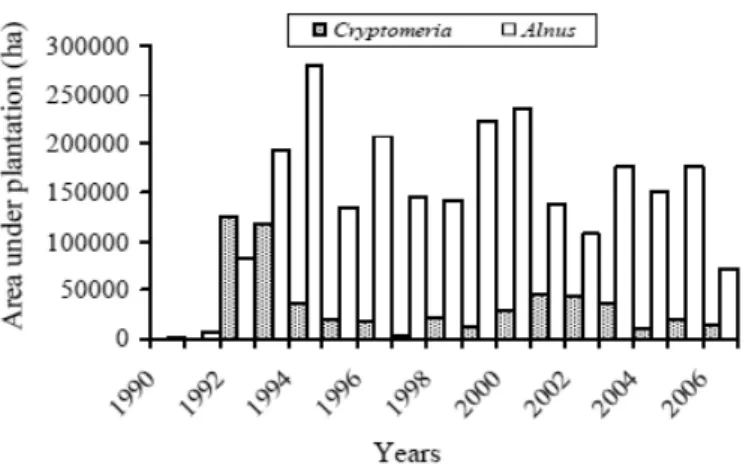
Fig1取 Total area under forest plantation of Alnus nepalnensis open bar and Cryptomeria japonica shaded bar from 1990 to 2006
warm-temperate evergreen broad-leaved forest of the Himalaya and Bhutan is indeed the responsible country to preserve it for future. This complex forest forms one of the reservoirs of natural resources for the people around as they depend on forest directly or indirectly. Accordingly, the abundant palatable grasses, shrubs, and fodder trees in the forest have encouraged farmers to keep large number of cattle.
Climatically, the study area falls under mesic type forest receiving a total mean annual rainfall of 3350 mm 1986-2000 with the peak rainfall occuring in June, July and August. Similarly, the mean temperatures vary from 2°C in January to 30°C in July. The mean relative humidity changed from 66% in January to 90% in July. They belong to a belt of fog forests as part of the transition between tropical and temperate zones. The combination of diverse forest and climatic conditions contributed to the formation of complex forest ecosystem. Interestingly, a very little is known about the ecology of these forests and the impacts of human actvities on the forests.
However, a strong human intervention was occured when forest industries were established in Gedu such as a wood based saw mill in 1969, a plywood mill in 1982, and a Bhutan Board Particle Limited BBPL in 1990. Further, the logged off areas were planted over 100 hectares per year by BBPL with either fast growing species of Alnus nepalnensis or exotic conifer species of Cryptomeria japonica resulting in the change of forest ecosystem Fig1 . A total area of 1691.61 ha was planted with either Cryptomeria or Alnus BBPL 2008 . Therefore, present study was designed to save and protect this complex forest from further degradation. The study specifically aims to achieve the following goals:
1 Assess the socio-economic status of the area using ethno-botanical survey; 2 Study the forest ecosystem using vegetation survey of the area;
3 Investigate the impact of human intervention on the natural forest and soil properties, 4 Classify vegetation types for different habitats and;
6 Finally, propose establishment of protection areas for different land-use.
取干ウエ取 取
Fig2取 A Map of Bhutan showing the study area Gedu-Darla , B Satellite image and, C topography map 取 取 取 showing the 13 vegetation plots and HOBO data loggers.
The study area is located in Gedu-Darla 89°31’44’’E, 26°55’39’’N , under Chhukha District/Dzongkhag Fig2A-C . The study was carried out in 13 different forest sites Fig2, Table1 covering different forest types within the altitudinal range of 900-2,540m a.s.l. including plantation forests and forest habitat for Rufous necked hornbill.
In addition ethno-botanical survey was also conducted in eight villages under two blocks/geogs covering 78 households of the study area.
取干ェ0取 取 Fig3取 Litter and soil sampling methods
A quadrat sampling with four sub-quadrat S1-S4 and, B taking samples from the plots under Cryptomeria japonica forest P4 .
Air temperature and relative air humidity were recorded using HOBO Onset data logger Onset Computer Co. MA, USA mounted on the trees in the forest to avoid human disturbances. Eight data loggers were installed along the altitudinal gradients from conifer forest at 3,370m on the mountain top including cool temperate and warm evergreen broad-leaved forest around 2,500-1,000m a.s.l. to sub-tropical broad-leaved forest at 250m a.s.l. at the southern foothills. The HOBO data loggers were set at hourly interval data recording. The data was downloaded every after six months of recording and batteries were replaced after resetting the loggers. In addition, 20 years of meteorological data 1986-2006 at Gedu, 2,000m a.s.l. was gathered from Agro-Met division, Council for RNR Research of Bhutan, Ministry of Agriculture to investigate the change in climate conditions over the time span of twenty years.
Surface soil moisture content and soil temperature was measured by using two HOBO micro stations loggers having two sensors under plantation forest and under the natural forest for comparison. The loggers were set at hourly interval recordings since late November 2007 to October 2008.
Litter and soil samples were collected by setting small quadrats 0.5m by 0.5m in each sampling plot Fig3 . The samples were separated into litter, fermentation-humus, and soil surface layer. The samples were measured for the fresh weights FW and oven dry weights ODW at 45℃ after 48 hours. Dried samples were then analyzed at the Soils and Plant Analytical Laboratory SPAL , Semtokha, Bhutan.
取干ェ干取 取
The socio-economic survey was conducted using semi-structured format and conducted interview. One farmer from each household was interviewed from 8 villages and a total of 78 households were covered.
Vegetation survey was conducted on two levels; 1 tree layer survey and 2 ground/herb layer survey. We adopted quadrat sampling both for tree layer and herb/ground layer with different plot sizes of the two layers.
For tree, all tree individuals occurring within the quadrat attaining a height greater than 1.3 m H≧1.3m were measured, identified and recorded for tree height H, m , height of the lowest living branch HB , height of the lowest living leaf HL and diameter at breast height DBH, cm at 1.3m above ground .
For regeneration survey, all seedlings and saplings occurring inside the plot measuring 2m by 20 m were identified and their height and age were estimated by counting branch tiers and/or bud-scale scars. For ground/herb layer vegetation, the height cm of the tallest living herb measured at the tip of the foliage and its percent coverage % were recorded in each quadrat.
Fieldwork was carried out from November 2007 to October 2008. Nomenclature of plants followed after Flora of Bhutan Grierson and Long 1983-2000; Noltie 1994-2000 , The Orchids of Bhutan Pearce and Cribb 2002 , Weeds of Bhutan Parker 1992 , Wild Rhododendrons of Bhutan Pradhan 1998 , Flowers of the Himalaya: A supplement Stainton 1988 , Flowers of Bhutan Nakao and Nishioka 1984 , Flowers of the Himalaya Polunin & Stainton 1984 , and Photo-album of plants of Eastern Himalaya Hara 1968 .
HOBO Onset data loggers were downloaded after every six months using BoxCar Pro for Windows, Version 4.3 provided by Onset Computer Co. After each downloading, batteries were replaced and reset the logger for further measurements.
Similarly, HOBO Micro station was also downloaded using the same program. However, the logger was wrapped inside the airtight container and the sensors were inside the soil. The logger was buried under the soil to avoid human disturbances.
Species basal area BA, cm2 was calculated from DBH data of tree individuals and calculated the relative proportion of each species’ basal area in percent Relative Basal Area, RBA % . The RBA of each species was used as abundance measure of species in a community. The dominant species of the altitudinal plots were determined based on the dominance analysis Ohsawa 1984, Kikvidze and Ohsawa 2002 . For the herb layer, we applied volume or biomass estimate by multiplying height of the herb species cm with its coverage % within the sample quadrat. The volume estimate or relative biomass was than used for the analysis of dominance or dominant species and for further statistical tests. The preliminary data was processed using pivotal table of the Microsoft Excel. Once the data was processed, analyisis was carried out by using PC-ORD version 4 McCune and Mefford 1999 and cluster analysis was performed using distance measure of Sorensen Bray-Curtis method .
取干ェ平取 取 Fig4取 Climatic conditions of the study area
A Measured mean air temperature open circle and total rainfall closed circle of Gedu 1986-2006 Agromet-CoRRB, MoA 2008 ; and B Farmer’s perception of climate change over the past decades.
The climate data for the past 20years 1986-2006 showed slight increase in temperature while the rainfall fluctuates during the recent years Fig4A . Gedu receives fairly high rainfall throughout the year with a total mean rainfall of 3,504mm annually and the peak rainfall occurred during July-August months of the year. This data suggested that Gedu-Darla remains under humid and wet conditions throughout the year round. The average temperature of Gedu-Darla was 16.7°C and reached a maximum temperature of 28.4°C in July with a sharp drop to 3.4°C in December. The combination of high rainfall and relatively high/moderate temperature contribute to the humid high diversity evergreen broad-leaved forest ecosystem of Gedu-Darla regions.
The farmers from eight villages were also interviewed to understand their perception of the climate change during the past decades. More than 40% of the farmers interviewed said the rainfall has reduced in the area while about 20% said that the temperature has increased and about 10% said it becomes cooler recently Fig4B . There were also some farmers who were ignorant of the climate changes Fig4B . Farmer’s perception of climate change correlates with the actual meteorological data of the area Fig4AB . This result showed the effect of global climate change even at the local level.
The soil moisture and temperature loggers were installed under the two forest types to compare the impact of conifer exotic plantation on the soil moisture and temperature in the evergreen broad-leaved forest. Unfortunately, the logger under the natural forest control failed to record data from May onwards Fig5AB . The recorded data showed relatively low soil moisture content and higher soil temper under natural forest compared to Cryptomeria plantation Fig5AB . The low soil moisture content in the natural forest could be directly related to higher transpiration of the under story shrubs which is absent under the Cryptomeria plantation.
取干ェ年取 取
Fig5取 Environmental factors of A surface soil moisture contents and B surface soil temperatures measured under matured Cryptomeria plantation and under natural forest at Darla
The data logger under natural forest was stopped since May .
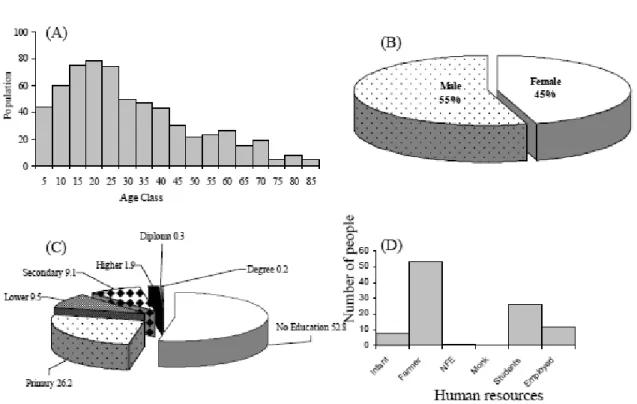
A total of seventy eight 78 households in eight villages under two blocks/Geogs were interviewed. The result showed that the population peak correspond to age class between 15-25 Fig6A . This signifies presence of potential producers rather than consumers. The population decreases sharply from 60 onwards while the ages 5 and below showed higher but population showed slight decreasing trend. The ratio of male to female revealed slightly male dominates over female Fig6B with a sex ration between male to female 55:45 . The present scenario of the population structure showed stable trend with the slight decreasing trend.
The literacy rate is 38.7 % with including non formal education, Primary/Elementary, Diploma and Degree level Fig6C . The survey showed lower literacy rate when compared to the national literacy rate of about 65%. However, majority of the non educated were farmers Fig6D . Monks and non formal educated lot were the least in the human resource.
Livestock rearing was found to be the main source of income for the farmers of Gedu-Darla. They keep different types of livestock poultry, cattle etc. . Among the livestock, a cattle rearing was found to be the maximum followed by poultry chiken , Goat and the least Pig Fig7A .
Accordingly, land use consists of different types such as pasture, shifting cultivation, wet and dry land cultivation and orchard Fig7B . High number of cattle rearing corresponds to high percentage of pasture land over other land uses Fig7AB . This suggested that farmers were dependent on livestock and the forest remains their main source of living such as fodder, non wood forest products and timber for construction.
取干ェィ取 取 Fig6取 Demographic trend of the study area
A population structure; B Sex ratio; C literacy rate and D human resources.
Fig7取 Livestock rearing and land use pattern of the study area A Livestock rearing, and B land use practices. 取
取干ェイ取 取 Table1取Plot details of the study sites in Gedu-Darla area
A total of 96 tree species comprising of 44 families were recorded in the 13 sampling plots of the study area. On comparison between the natural forest and the plantation forest, plantation forest P4 has only 9 species while the natural forest P8 showed 35 species Table2 . Similarly, plantation forest has only 1 dominant while natural forest showed 6 dominants. Natural forest was mainly dominated by oak-laurel species while plantation forest composed of either exotic species Cryptomeria or fast growing Alnus only. This clearly revealed the negative impact of plantation
human intervention on the natural forest Table1 .
Three major life-forms were shown in the classified in the study area Fig8 . Plots P1, P6 and P7 showed deciduous broad-leaved life-form. These plots were planted with fast growing deciduous broad-leaved species Alnus nepalnesis while P4 and P5 were planted with exotic conifer species Cryptomeria japonica and they emerged as conifer life-form in the humid evergreen broad-leaved forest Fig8 . Except P1, P4, P5 and P6 rest all the other plots were established in the natural forest. Natural forest plots appeared as evergreen broad-leaved life-form including the Rufous necked hornbill habitat forest P8 . The figure clearly revealed the impact of human intervention by changing the life-form spectrum of the forest Fig8 .
取干ェゥ取 取 Table2取Floristic composition of the tree layers in the four sample plots
取干ェウ取 取 Table2取continued-1
取干ェェ取 取 Table2取continued-2
Fig8取Life-form distribution of the sampling plots Five life-forms are compared between the 13 plots.
取干ェエ取 取
Fig9取 Cluster dendrogram showing different forest ecosystem in the study area Four forest ecosystems habitats were identified using cluster analysis.
The three major life-forms were classified into forest types by cluster dendrogram arbitrarily at 40 % similarity threshold Fig9 . Four forest types were defined by their dominants and natural habitats Fig9 , i.e., 1. Alnus nepalnensis plantation and young natural pioneer forest P1, P6, and P7 of Alnus, Macaranga, Rapanea, Syzygium, Croton, and Elaeocarpus types, 2. Natural forest type P2, P3, P10, P11, P12 and P13 of mainly oak-laurel types Fig9 , 3. Rufous necked hornbill habitat type forest P8 and P9 of Lindera, Betula, Schima, Terminalia, Lithocarpus, Castanopsis, Ficus, and Cinnamomum, and 4. Cryptomeria japonica plantation forest P4 and P5 . Plot P4 was established in the old Cryptomeria plantation forest c. 30years while P5 was established in the young Cryptomeria plantation forest c. 6 years Fig9 . The young Cryptomeria plantation forest showed diverse species while old Cryptomeria plantation forest reduced diversity of the forest. The impact of the plantation was also investigated by using the forest structural traits Fig10 .
Forest structural features represented in figure 10A-F showed the difference in structures of different forest ecosystems including man made plantation forest and natural forest of the study area. Floristically, the plantation forest showed very limited species P1, P4, P5, P6 and P7 compared to natural forest including the Rufous necked hornbill habitat forest with a species number of 35 P8 Fig10A . Similarly, the dominants were found higher in the natural forest but plots P10, P12 and P13 also showed lower dominants Fig10B . The big emergent trees in those plots contributed to the low dominants because of higher basal area as can be seen in figures 10 C, D and F. the maximum dominants were recorded in P2, P3 and P11 with 9 dominants each followed by other natural forests Fig10B . The maximum DBH of 210 cm was recorded in P13 Lithocarpus pachyphylla followed by 176 cm of Terminalia myriocarpa in plot 9 Fig10C . The maximum height of Daphnephyllum chartaceum tree 45m was
取干エ0取 取
Fig10取 Forest structural features A-F of the sample plots around Gedu-Darla study sites
recorded in plot 2 followed by tall trees in the natural forest compared to the plantation forest. However, the stem density was found relatively higher in plot 7 young natural regenerated forest Fig10E . Accordingly, total basal area was found very low in the newly created plantation forest and higher basal area in the natural forest Fig10F .
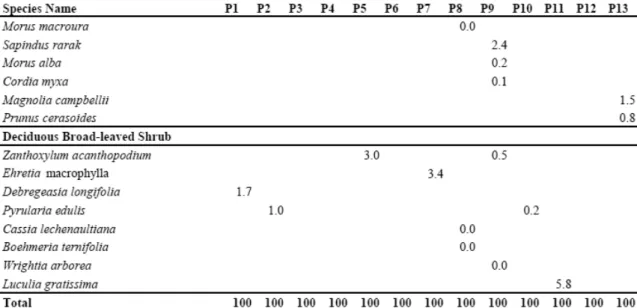
The floristic composition of the regenerating tree species and ground vegetation under each forest types were shown in table1, 2 Fig11 . Generally, the plantation forest P1 and P4 showed relatively lower regenerating tree species compared to natural forest particularly P8 Fig11C . Diversity of regenerating tree species was found fluctuating. However, Alnus plantation forest P1 , young Cryptomeria plantation forest P5 and two natural forest
P10 and P12 showed relatively high diversity Fig11A . The herb diversity was recorded high in plantation forest P1, P5 and P7 and in the natural forest of P12 Fig11A . Similarly plantation forest saw relatively lower regenerating tree species richness compared to the natural forest Fig11B, Table3 . On the contrary ground vegetation of plantation forest recorded higher number of species than in the natural forest Fig11C, Table4 .
取干エ干取 取
Fig11取 Forest tree regenerations and ground vegetation features in the study area
A Regenerating tree and herb diversity, B Species richness of regenerating trees and herbs, C Regeneration density and D Herb biomass Volume of Gedu-Darla study sites.
The regeneration density was found higher under the natural forest except in the intact forest P11, P12 and P13 compared to the plantation forest P1, P4, P5, P6 and P7 Fig11D . The ground vegetation biomass was recorded highest in P2 natural forest because of the dominant fern Dryopteris Fig11D, Table4 .
Litter and soil samples were collected under each forest types P1~P13 and analyzed for chemical properties. The samples were collected from different layers Litter, Fermentation-humus and Organic Fig12A . Old Cryptomeria plantation forest P4 did not show any organic matter and fermentation-humus layer Fig12A . However, when the plantation was young P5 , a well developed layers were observed, due mainly to associate species that helped to accumulate litters and organic matter respectively Fig12A . Whereas, a very few under story species were observed and recorded under the old growth Cryptomeria plantation forest P4 .
On the other hand, plots established in the natural forest showed all three layers litter, Fermentation-Humus and Organic layer including the Alnus plantation forest Fig12A . The intact forest P11, P12 showed even higher accumulation of litter and organic matter. The result clearly revealed that plantation forest is not favorable for the development of the soil layers as can be seen in plot 4.
The soil pH revealed slight acidic in the plantation forest compared to the natural forest Fig12B . Similarly, the available phosphorous was found higher in the natural forest though it fluctuates in some natural forest plots
Fig12C .
取干エ平取 取
Table3取 Floristic composition of the regenerating tree and shrub species in 13 sampled plots Relative density
取干エ年取 取
Table4取 Floristic composition of ground vegetation under different forest types in the study area
取干エィ取 取 Table4取 continued-1
取干エイ取 取 Table4取 continued-2
Fig12取 Litter, organic matter accumulation and soil properties of the studied forest
A Accumulation of three layers, B Soil pH and C soil available phosphorus under each forest types. Note; Samples from plots 10-13 are still under analysis .
取干エゥ取 取
Fig13取 Comparison of natural forest with that of plantation forest of the study area A Diversity difference and B structural difference.
The study found out that human impact on the natural forest at Gedu-Darla caused huge loss in species diversity as well as loss of habitats for many fauna including the rare Rufous necked hornbill habitats. On comparing the natural forest Hornbill habitat with two types of plantation forest exotic Cryptomeria japonica and Alnus nepalnensis after logging showed clear difference both diversity and structure Fig13 . After the plantation, the forest losses many of its species which were present before logging. There were no relict species recorded in the Cryptomeria plantation forest and a few in the Alnus plantation forest. Similarly, the species richness in the natural forest was found four times higher than in the plantation forest Fig13A . The dominant species were also observed very high in the natural forest forming complex canopy structure whereas, only one dominant was observed in the plantation forest. The figure clearly revealed strong human impacts in terms of diversity.
Structurally, natural forest appeared superior compared to the plantation forest Fig13B . Maximum diameter at breast height 1.3m of the tree in the natural forest was about three times bigger than the diameter of the planted trees. Similarly, the maximum height of the tree was also found taller in the natural forest than the plantation forest. The high complex forest was found suitable habitat for the rare bird Rufous necked hornbill and destroying of such natural forest lead to loss of such fauna species from the area.
Gedu-Darla oak-laurel forest also served as a open pasture for the local community and the humid climate favors presence of high species diversity. Probably, such cloud evergreen broad-leaved relict forest is the only remaining forest in the Himalayan region. The present study presented the highlights of the Gedu-Darla forest both floristically, and structurally. The negative impacts of the human activities were clearly shown. These results will be presented to the policy makers and concrete measures will be taken in future.
We thank PRO NATURA FUND for the research grant.
取干エウ取 取
ハュンヂダゝヴメンネ゙ンチ第18期 助成成果報告書 2009
要約
ノヴシンナブメボ中腹域 る冷温帯性常緑広葉樹山地林
生物多様性保全 人 撹乱 評価
曓研究 1960 代以来 Gedu-Drala地域 常緑
広葉樹林 強い人 あ を示
計1,689.79ha 森林 伐採 れ 跡地 成長 早
いAlnus nepalensis 常緑広葉樹林 生育 る外国産
針葉樹種 Cryptomeria japonica ケウ 植林 れ
社会経 学的 視 ら 広大 広葉樹林を開
牧 地 利 用 る よ り 調 査 地 域 家 畜
飼 養 適 土 地 あ る 地 域 カ プ ポ ッ ゾ ゛ ヴ
人々 過去数十 間 起 土地利用 変
い 認識 い 土地利用 数 間 う
大 変 森林 減少 局所的 気候
温暖 土地利用 変 気候変 関
るカプポッゾ゛ヴ 人々 認識を 実 気候タヴ
シ よ 裏 ら れ 興 味 深 い あ
る 均気温 1986 12℃ ら2006 15℃
急激 昇 13箇所 キンハモンエハュセダ
る植生 土壌 調査 より 人工林 林冠
林 床 両 方 種 多 様 性 を 減 少 る 示
れ 曓調査を通 44科96種 木曓種 記録
れ ェメケシヴ分析 より 全 ハュセダ
1: Alnus nepalensis植林ン自然 駆相林 2: 自然林 遺存種混交林 3: 自然林 Rufous necked hornbill
[ ヂ ヂ プ ザ キ ゜ ス ョ ゞ ] 生 息 地 4: Cryptomeria
japonica ケウ 植林 4 森林デニシ セダ/シ
゜ハ 区分 れ 植林 結果 出現 る落葉
広葉樹シ゜ハ 針葉樹シ゜ハ 自然林 常緑広葉
樹シ゜ハ いう 3 主要 生活型 関 見ら
れ 自然林 る人 種多様性 群落構
造 土壌特性 大 影響 い 植林 よ
種多様性 よそ90%減少 構造 純
様 土壌組成 植林 よ 大 影響を
植 林 地 明 確 土 壌 層 構 造 形 成 れ い
植林地 遺存種 生育 い 自然林
比較 わ 値 特 ヂヂプザ
キ ゜ ス ョ ゞ 好 堅 果 を る 樹 種 や そ 他 餌
る樹種 植林地 生育 い
人 ゜ンドェダ 森林 樹木
土壌や樹木 更新 林床植生 影響 い
曓研究 現在 森林破壊をカンダュヴャ
る い ら 原生林 そ ら得られ
る資源 近い将来失われ 希少 動物種 滅を引
起 を示 森林資源 持 的利用 よ
び 人 間 自 然 調 和 的 関 原 生 林 を 保
全ン保護 る研究 ら得られ 所見 基 い
り 策を る必要 示唆 れ
推薦者: 澤 哲弥