2x3D: Real-Time Shader for Simultaneous 2D/3D Hybrid Theater
Wataru FUJIMURA∗ Yukua KOIDE Robert SONGER† Takahiro HAYAKAWA Akihiko SHIRAI‡ Kazuhisa YANAKA
Kanagawa Institute of Technology
Abstract
2x3D is a simultaneous 2D/3D hybrid theater and its real-time shader for image hiding. In this project, 2x3D concealment pro- cessing is performed using a pixel shader to support the hiding of dynamic motion pictures in real time. In this way, multiplex-hidden images are possible with multiple videos in real-time and stereo- scopic 3D can be achieved. 2x3D method does not require any electronic devices such as active shutter glasses for viewers’ side, and it reduces the number of required screens and cost of glasses overall. As an experiment, a stereoscopic 3D left-eye image is shown as the 2D image for viewing with the naked eye while the right-eye image can be seen through a polarized filter. In this way, audience members can experience a stereoscopic effect by placing a filter over the right eye only. A difference in brightness exists between the two images, but this is not a problem for depth per- ception as in the anaglyph method. Not only is this 2D/3D hybrid theater cost-effective for cinemas, it can provide a universal design that accounts for the hazards posed by stereoscopic 3D glasses for children, the stereo blind, and people whose eyes fatigue easily or who already wear glasses.
CR Categories: I.3.3 [Computer Graphics]: Picture/Image Generation—Display Algorithms I.3.1 [Computer Graphics]: Hardware Architecture—Parallel processing, Three-dimensional displays;
Keywords: stereoscopic 3D, multiplex, hidden imaging
1 Motivation
In recent years, stereoscopic displays paired with glasses that make 3D movies possible are a popular research topic and continue to become widespread. These stereoscopic displays can create the ap- pearance of three-dimensional images by simply wearing a pair of special glasses; however, when seen with the naked eye, the images for the left and right eyes can be seen overlapping. Therefore, a method has been developed for viewing both 2D and 3D images simultaneously on one screen, called “2x3D Real-Time Shader”. With this technique, it is no longer necessary to screen 2D and 3D movies separately, reducing the number of required screens overall.
Figure 1: ”2x3D” is a 2D/3D Hybrid Theater and glasses. A par- allax effect results from both glasses and the naked eye (left).
Some techniques already exist for the given context. “Thirdeye”
∗e-mail:[email protected]
†Kanazawa Technical College
‡e-mail:[email protected]
[Mistry 2009] enabled multiple viewers to see different content on a single display using shutter glasses. A similar idea has also been produced by SONY as “SimulView”. These techniques are differ- ent from ours because they produce a doubled image when the user views the displays without glasses.
“Snared Illumination” [McDowall et al. 2004] seems to be a pi- oneer of the display in which both an image for naked eyes and a hidden image can be provided simultaneously by using glasses with active shutters. Although this idea might be applicabe to our 2D/3D compatible display, glasses which are lighter, more inexpensive and batteryless are more desirable for our application.
2 Core Technologies
2.1 Past Research: ScritterH
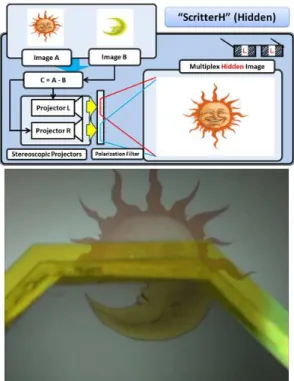
A system for projecting multiple images on a single screen through multiplexing, called ”Scritter”, has been developed by Nagano and Utsugi and associates [Koki. N. and N. 2010] [Nagano et al. 2011]. ScritterH uses two projectors to compose a naked-eye image (im- age A) through the polarized projection of a hidden image (image B) and its difference with the naked-eye image (image C) onto a screen. Image A is visible with the naked eye while image B is vis- ible only to users wearing polarized glasses.
However, gamma values should be taken into account in order to achieve full concealment. Additionally, the ScritterH technique did not have support for dynamic images. Although a method was pro- posed for viewing both 2D and 3D images simultaneously on one screen [Shirai Akihiko 2012], only an experimental system which can treat only still images was made.
2.2 Gamma Correction Algorithm
A concealment processing technique has been developed to support the hiding of dynamic images using a pixel shader.
First, arbitrary images A and B (with respective pixel luminance values a and b) are defined where A is the naked-eye image and B is the hidden image. Here the respective pixel luminance for the naked-eye image and hidden image a and b are given values in the range of 0 - 255.
a′= a ×255 − amin
255 + amin (1)
b′= b ×amin
255 (2)
Where aminis the minimum value of a′, which is set to 128 as the middle value of a 256 gradient in the case that gamma is not taken into consideration, or in the case that gamma is taken into consider- ation, it can be used for contrast reduction of the same levels as A and B by setting it to the middle value of the output luminance.
c =(a′γ− b′γ)1γ (3)
γ is the gamma value for the projector and is set to 2.2 by default.
Figure 2: The ScritterH system and real-time example: image B is shown only through a polarization filter. Only still images were possible.
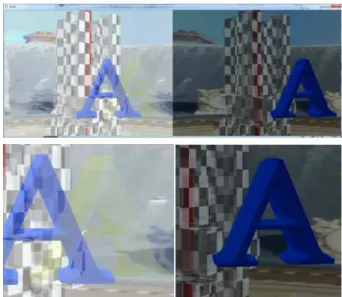
Figure 3: Testing charts for hidden imagery. Normal (top-left bottom-left) and with gamma correction (top-right bottom-right).
Figure 4: Image sets representing the ScritterH technique. Viewers can see the ”hidden” images on the right side through a linear polarization filter.
1
3 2x3D: A New Style of Hybrid Theater
“2x3D” is an application of ScritterH hidden imagery. It can con- figure a stereoscopic image using the naked eye image as the left side image and the filtered image as the right side image.
3.1 Implementation Using the GPU
In the past, a pre-processed algorithm was used for still images; however, the new technique applies to all kinds of dynamic images as a real-time video shader (Figure 5).
Figure 5: Real-time shader process
A pixel shader is used to support the hiding of dynamic motion pic- tures in real-time (Figure 6). In this way, multiplex-hidden images
Figure 6: An abstract dynamic image with a color chart. The fil- tered image can be configured for a new style of augmented reality displays without requiring electric devices for the user.
are possible with multiple videos in real-time and stereoscopic 3D can be achieved.
3.2 From ScritterH to 2D/3D Compatible Projection
Figure 7: A layout of 3D objects and viewers: the 3D Objects (letters) rotate around the “zero point” of parallax.
Figure 7 shows an ideal setup. In Figure 8, the word “Left” is hid- den by a polarized filter. The word “Right” is hidden for the naked eye. This technique can be used to realize a hybrid 2D/3D theater- for all kinds of images. In the stereoscopic 3D imaging, the “Left” image is shown as the 2D image for viewing with the naked eye. The “Right” image can only be seen through a polarized filter. The 2x3D method does not require any electronic devices for the viewer such as active shutter glasses, and it reduces the number of required screens and the cost of glasses overall.
As an experiment, a stereoscopic 3D left・eye image is shown as the 2D image for viewing with the naked eye while the right-eye image can be seen through a polarized filter. In this way, audience members can experience a stereoscopic effect by placing a filter over the right eye only. A difference in brightness exists between the two images, but this is not a problem for depth perception as in
Figure 8: The word “Left” is hidden by the polarized filter. The word “Right” is hidden for the naked eye.
Figure 9: A real-time output of the 2x3D shader program. A computer-generated MPEG movie is processed on the GPU then outputs “image C” on the left. It uses a yellow character “A” to cancel “image B” and show a blue character “A”. The composed projection image is perceived as a single “A” on the left side.
Figure 10: Examples of filters: The glasses can be configured with a ND filter to adjust intensity.
2
the anaglyph method.
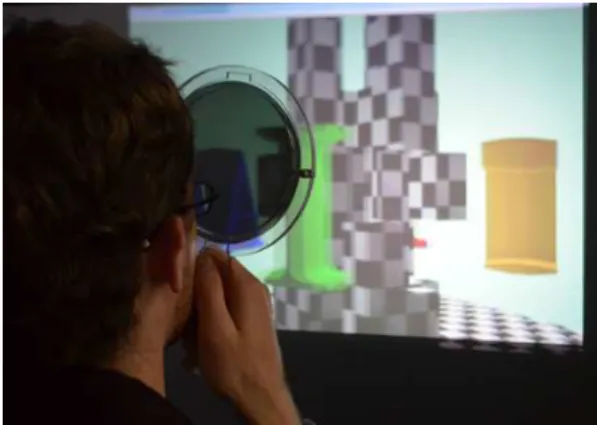
Figure 11: The audience can see the stereoscopic effect with po- larized glasses.
4 Potential Applications
Not only is this 2D/3D hybrid theater cost-effective for cinemas, it can provide a universal design that accounts for the hazards posed by stereoscopic 3D glasses for children, the stereo blind, and people whose eyes fatigue easily or already wear glasses.
This method does not require electronic devices such as active shut- ter glasses. Being cost-effective, various glasses can be designed. Using this same technique, it is also possible to implement closed captioning or commentary overlay as closed caption.
5 Future Development
In stereoscopic 3D, contrast is equally distributed between the left and right images (at 50 % each), however, it is also possible to constrict the contrast of the hidden image by passing a mixture ra- tio to the GPU as “mixture ratio” parameter (Figure 12). Using this technique, it is also possible to implement closed captioning or commentary overlay.
Figure 12: Mixture ratio = 0.2, 0.5, 0.8
Glasses with a darker lense on a single side can have consequences on human cognition such as the Pulfrich effect. This system should be tested from the point of view of ergonomic safety.
In the future, greater image quality can be achieved using the wide range color spaces of HDR projectors and optical configuration [Michimi. I. and H. 2011].
This technique also gives a reason for upgrading current cinema projectors for a wider range of color expression. 2x3D is a unique solution for improving the current 3D cinema industry for various users of the next generation.
References
KOKI. N., TAKERU. U., M. H. T. H. A. S.,ANDN., M. 2010. A new multiplex content displaying system compatible with cur- rent 3d projection technology. ACM SIGGRAPH 2010 Posters. MCDOWALL, I. E., BOLAS, M. T., HOBERMAN, P., AND
FISHER, S. S. 2004. Snared illumination. In ACM SIGGRAPH 2004 Emerging technologies, ACM, New York, NY, USA, SIG- GRAPH ’04, 24–.
MICHIMI. I., MIE. S., M. K.,ANDH., N. 2011. High dynamic range with multiple projectors. ITE Technical Report, vol.35, no.8, pp. 45–48.
MISTRY, P. 2009. Thirdeye: a technique that enables multiple viewers to see different content on a single display screen. In ACM SIGGRAPH ASIA 2009 Posters, ACM, New York, NY, USA, SIGGRAPH ASIA ’09, 29:1–29:1.
NAGANO, K., UTSUGI, T., YANAKA, K., SHIRAI, A., AND
NAKAJIMA, M. 2011. Scritterhdr: multiplex-hidden imaging on high dynamic range projection. In SIGGRAPH Asia 2011 Posters, ACM, New York, NY, USA, SA ’11, 52:1–52:1. SHIRAIAKIHIKO, YANAKA KAZUHISA, U. T., 2012. Informa-
tion display device. Pub. No. WO/2012/035768 (22.03.2012). International Application No. PCT/JP2011/005179.