Article
Are Tourists Really Willing to Pay More for
Sustainable Destinations?
Juan Ignacio Pulido-Fernández * and Yaiza López-Sánchez
Department of Economics, University of Jaén, Campus de Las Lagunillas, s/n, 23071 Jaén, Spain; [email protected]
* Correspondence: [email protected]
Academic Editor: Giuseppe Ioppolo
Received: 17 October 2016; Accepted: 22 November 2016; Published: 30 November 2016
Abstract: The understanding of pro-sustainable behavior and its true economic implications is an important subject for tourism destination marketers and policymakers, especially given that limited research has focused on the economic implications of tourist preferences for more sustainable destinations. Following the identification of three different demand segments using the concept of “sustainable intelligence” (level of commitment, attitude, knowledge and/or behavior with regard to sustainability), this study hypothesizes that the tourist segment with high level of “sustainable intelligence” (called “pro-sustainable tourist”) is willing to pay more to visit a more sustainable destination. The main aim of this paper is to use the logistic regression model to estimate the premium price that each segment is willing to pay to visit a sustainable destination. This paper reports the result of a willingness to pay study using data from 1118 respondents visiting the Western Costa del Sol (Andalusia, Spain), a mature sun-and-sand destination that is currently facing several developmental challenges supposedly associated with sustainability. The results obtained from this research study indicate that the tourist segment with high levels of “sustainable intelligence” is willing to pay more to visit a more sustainable tourism destination. However, there is little willingness to pay if the destination’s commitment to sustainability increases the price of the tourism product (26.6% of respondents).
Keywords: willingness to pay; sustainable intelligence; pro-sustainable tourist; sustainability; destination management; Western Costa del Sol (Spain)
1. Introduction
Different issues related to the sustainability field, including sustainable consumption, have gained significant institutional, scientific, academic, corporate and social momentum over the past two decades. However, even though the idea of sustainable development has been discussed in tourism research for almost a quarter of a century, the inclusion of the tourist in this debate has been delayed and partial. In that sense, Sharpley [1] (p. 37) declares “the exclusion of the tourist from the majority of the research”. However, for over a decade, tourist behaviour has been fundamental issue in tourism studies [2].
The subject areas in sustainable tourism research have significantly changed over the 25-year period of analysis and, in particular, sustainable tourist behavior is currently a thriving field of study [3,4], experiencing significant growth since 2008 [5]. Nevertheless, in academic discussions, the conceptual basis of the sustainable tourist has been controversial and somewhat bewildering, thus resulting in different conceptualizations of “sustainable or pro-sustainable tourists”.
The role of tourists is crucial to research on the challenge of sustainability. As the World Tourism Organization already noted over a decade ago, “sustainable tourism should also maintain a high level
of tourist satisfaction and ensure a meaningful experience to the tourist, raising there awareness about sustainability issues and promoting sustainable tourism practices amongst them” [6] (p. 7).
It is undeniable that tourists’ profile has changed significantly in recent years. Numerous studies on tourist consumer behavior indicate that there is a growing awareness of the environmental, social and cultural impact that tourism activity can generate. Tourists who promote and consume sustainable tourism are sensitive to the impacts that this activity can generate and therefore try to protect the destination [7–9].
However, the scientific debate regarding consumer behavior in sustainability issues is intense. Hence, many contemporary academics, e.g., [10–13] suggest that most consumers pay little attention to ethical considerations in their final purchase decisions; therefore, there is a gap between the expressed attitudes and actual purchase behavior (attitude–behavior or word–deed gap).
From a management and research perspective, it is important to obtain a greater understanding of consumer attitudes and economic implications of the current tourist regarding sustainability, with the aim of achieving a new tourism model whose central value is sustainability. In that sense, an important challenge facing policymakers and marketing managers is to identify which tourists are willing to pay more for sustainable destinations and if pro-sustainable tourists spend more than their less-sustainable counterparts [14].
This paper’s aim is to contribute an understanding of the role played by tourists to a destination as a strategic element of differentiation. Drawing on contemporary research on sustainable behavior and the “pro-sustainable tourist”, this article begins by outlining the ways in which the “pro-sustainable tourist” has been understood and the importance of determining the economic value of sustainability from the tourist perspective.
This research extends previous work regarding the concept of “sustainable intelligence” as a component of tourism demand, to which a latent class analysis can be applied. Using this method, the resulting three segments (“reflective tourist”, “unconcerned tourist” and “pro-sustainable tourist”) were compared, showing their different levels of commitment, attitude, knowledge and behavior with regard to sustainability (“sustainable intelligence”) [15].
To further expand and refine the theoretical understanding of “sustainable intelligence”, this work estimates the premium price that each segment is willing to pay to visit a sustainable destination.
The paper is structured as follows. The paper’s introduction gives an overview of the approach. The theoretical framework presents a review and update of key concepts on which this study is conducted. Then, prior to the empirical study, a brief analysis of the context in which the research is conducted is presented, an emblematic coastal tourism destination, the Western Costa del Sol (Andalusia, Spain), which is recognized as mature by the scientific literature that has carried out an expensive strategy of repositioning in the market through investment in sustainable tourism development (PlanQualifica(Contained in theRequalification Program for Mature Tourism Destinations
(Spanish Tourism Plan Horizon 2020)) of Western Costa del Sol) [16].
In the following section, the methodology adopted in the study is described and the accepted methods in the literature to derive WTP (Willingness to Pay) are compared. Then, the study findings are presented. The results enrich the understanding pro-sustainable tourist background and portray the practical and theoretical contributions of the suggested conceptual model, as well as its limitations. The article concludes by exposing the future research themes in the field of pro-sustainable tourism.
2. Literature Review
2.1. What Does It Mean to Be a “Sustainable Tourist”?
overlook, the role of tourists, even though they should be the focus of discussion by exploring what it means to be a “sustainable tourist”—that is, a tourist with sustainable or pro-sustainable attitudes and behaviors [1,18].
It should be stressed that tourists’ sustainability must be understood as a continuous process rather than a static state; it must be considered a permanent process of adaptation and balance to adjust their relationship with ecological, economic and social systems.
Many studies have looked at tourists who identify themselves as being sustainable in some way. In fact, an overview of the state of sustainable tourism in the scientific literature indicates that sustainable tourist behavior is currently a thriving field of study [3]. In the literature, there are many definitions that have been developed around tourists’ sustainability according to different criteria and using different methodological approaches. A problem in the study and analysis of pro-sustainability consumerism is the variety of variables that can be considered when analyzing sustainable behavior, which vary according to how the researcher understands sustainability. For example, some authors relate sustainable tourism behavior only to environmental issues [19–21], but in the search of the conditions under which tourism development, improvements in environmental quality and economic growth can simultaneously occur [22], it is important to analyze the effect and the importance of tourist in the sustainable tourism. In that sense, other authors (although there are few contributions) study the relationship between tourists and sustainability from a more holistic and inclusive perspective [8]. In the past two decades, there have been a significant number of conceptual approaches to the idea of “sustainable tourist”. Not all of these, of course, have been accepted. Worthy of special mention is the green, environmental or ecological tourist [2,9,23,24], ethical tourist [3,25–27] or sustainable tourist [8,28]. Additionally, other conceptualizations related to different aspects of sustainability are the nature-based tourist [29–31], slow tourist [32,33], responsible tourist [34,35], community-based tourist [36,37], geotourist [38–40], people-first tourist [41], pro-poor tourist [42], and just tourist [43].
Progress has not been made solely in the conceptualization of tourists’ sustainability; there is also an extensive body of literature that analyzes the relationship between individuals’ values, attitudes and behavior. Indeed, previous research has shown an existing relationship between individuals’ values, attitudes and behavior [23,44–47]. Moreover, numerous studies on tourist consumer behavior indicate that there is a growing awareness of the environmental, social and cultural impact that tourism activity can generate [3,48–51].
As Peeters [52] and Weaver [13] argue, although sustainable development is now a well-established term, its implementation has not been particularly successful. In fact, several authors submit that this proposed mass awareness of the environmental, social and cultural impact that tourism activity can generate in destinations is not directly reflected in actual consumer behavior, particularly regarding tourism-related decisions [13,53]. Additionally, other studies argue that there is an important difference between the declared values and the actual tourist behavior [13,53–56]. Aside from this, other authors argue that most consumers pay little attention to ethical considerations in their final purchase decisions, so there is a gap between the expressed attitudes and actual purchase behavior (attitude–behavior or word–deed gap) [10–12,57,58].
Several authors [53,59,60] support the idea that consumers make their purchasing decisions on the basis of the environmental, social and economic quality of products and are willing to transfer these habits to the purchase of tourism products. As a matter of fact, consumer behavior shows trends towards the consumption of green brands and sustainability, as these factors are important when booking their holiday destinations [20,61–64]. For this reason, as Edgel [65] recognizes, destinations try to respond to these new demands and show a greater concern to develop more sustainable tourism. Furthermore, as noted by Darnall et al. [66], sustainable consumption is often perceived as a business opportunity.
social and economic quality of products and are willing to transfer these habits to the purchase of tourism products. In fact, recent studies demonstrate the real potential of “sustainable” consumers in different types of companies directly linked to tourism (hotels, restaurants, transportation companies, etc.), showing the profitability of tourists with sustainable behavior [67–69]. In short, the academic debate regarding the sustainable behavior of tourism consumers and real economic implications on sustainability issues is intense and even controversial.
2.2. Should Tourists Be Willing to Pay More for More Sustainable Destinations?
Another highly pertinent issue being widely discussed in the scientific sphere is whether investment in sustainability involves higher costs for the destination and, therefore, an increase in price. If, on the other hand, this commitment to sustainability leads to the improvement of efficiency and the price rises, this process is put forward solely as a differentiation strategy. In this regard, recent studies contribute to breaking with one of the most widespread myths about sustainability—which tourism sustainability can be obtained only at the expense of economic progress [70]. It is important to note that a commitment to sustainability does not necessarily mean that the destination should be more expensive, but rather, it can be a price strategy. As León [71] (p. 8) states, “sustainability plays a determining role in product differentiation, which allows to offer a price above the level of perfect competition, exercising a market power that would increase the profitability of tourism for the destination society”. As stated by Hedlund [63] (p. 279), “many ecologically sustainable tourism alternatives are more expensive than their less sustainable counterparts” and, in that case, tourists need to be willing to pay more in order to be more sustainable. An interesting question is: are pro-sustainable tourists a higher spending market? Furthermore, is it true that, as stated by Nickerson et al. [14] (p. 176), “sustainable tourists have significantly higher spending patterns than less-sustainable tourists?”
In the field of tourism, numerous studies have analyzed the WTP of tourists on issues related to the conservation and protection of natural areas [72–74], ecotourism services [75], sustainable products [8], sustainable destinations [76], climate change [54], natured-based tourism [29], etc. Other studies support the relevance of the WTP, showing the existence of tourists willing to pay more for sustainability-related issues from different perspectives (hotels, transport, products, etc.), [62,77,78].
Accordingly, it is interesting to examine the willingness to pay as an economic instrument for sustainable tourism management, especially in destinations that try to restructure their business model towards sustainability as a differentiating element in the market [79] and demonstrate that in regard to tourism, it pays to be sustainable.
3. Case Study
This analysis has been conducted on the Western Costa del Sol (Andalusia, Spain) (Figure1), which stands out as a typical mature and obsolete sun-and-sand tourism destination with recognized problems of unsustainability [80–82] in need of renewal of its tourism development patterns. It is a destination that has carried out an expensive repositioning strategy in the market through investment in sustainable tourism development (Plan Qualifica).
Figure 1. Territorial situation of the Western Costa del Sol (Malaga Province). Source: Authors’ own elaboration.
It is particularly striking that all strategies proposed in the Plan Qualifica are based exclusively on supply-side measures (mainly infrastructure projects such as construction, remodeling, rehabilitation, etc.). However, there are no strategies aimed at tourists, nor has any specific analysis of the demand for this destination been made. This crucial issue is indispensable to adjust strategies and actions, considering the actual or desired tourist demand (redirecting to new segments) for that destination.
Since tourism began to develop in Malaga in the mid-1950s, it has become a powerful driving force for the transformation and modernization of Spain’s entire coastline [83]. However, this process has generated notable pressure on the land, which, in turn, has radically changed the coast’s character. The historical imposition of unsustainable tourism has caused a serious impact on the landscape that has resulted in a new reality that is more complex from a territorial and sustainable point of view. This has led to a chaotic tourism development model [84] that requires the implementation of new tourism policies supported by planned action based on sustainability criteria (To gain an understanding of the transformation and impacts of the tourism sector in Western Costa del Sol, it is recommended to read, among others, [82,85–88]). This is precisely the aim of the Plan Qualifica, whose ultimate goal is to achieve a profound change in the Western Costa del Sol traditional tourism model from a development model based on growth to a new one based on quality, innovation and sustainability. This fact underlies the final decision to select this destination for the methodological application of this research.
4. Methodology
4.1. Questionnaire and Survey
Table 1.Survey data sheet.
Universe Tourists (domestic and foreign) staying overnight at one of the cities of the destination
Scope Benalmádena, Casares, Estepona, Fuengirola, Manilva, Marbella, Mijas and Torremolinos (Plan Qualificamunicipalities)
Type of survey Structured questionnaire conducted by personal interview Sample size 1188 valid surveys
Sampling error ±2.843% Confidence level 95% (p=q= 0.50) Fieldwork period July and August 2013
Source: Authors’ own elaboration.
Given the impossibility of identifying the target population (tourists visiting the Western Costa del Sol), due to the lack of adequate statistical information, a simple random sampling method was conducted, carrying out 1188 valid surveys with domestic and foreign tourists who stayed overnight in any of the cities that comprise this destination.
During the month of June (2013), the survey was validated by five specialists in this paper’s area of analysis, with the intention of improving, supplementing and corroborating the final content of the survey.
The survey was divided into three parts: (i) characterization of tourism demand; (ii) characterization of tourism demand in terms of sustainability; and (iii) economic implications associated with improving the sustainability of the destination.
4.2. Segmenting the Tourism Market: A Latent Class Analysis Based on Tourists’ “Sustainable Intelligence”
In an attempt to delve further than the current literature’s partial consideration of several attitudes and values in order to segment the tourism demand concerning sustainability, López-Sánchez and Pulido-Fernández [15] (p. 61) introduce the concept of “sustainable intelligence” as a latent variable considered as “an inherent capacity to a certain type of tourist, whose possession conditions their motivations, expectations and behaviors”. According to the authors, a tourist with high “sustainable intelligence” is one who shows empathy towards sustainable tourism development in the territory where he enjoys holidays. Consequently, he has an intellectual understanding of sustainability and takes measures to facilitate the incorporation of sustainability in the processes of production and tourism consumption. Therefore, the development of “sustainable intelligence” is essential for tourists to adapt their motivations, expectations and behaviors towards a much more sensible and responsible stance regarding the destination.
4.3. Most Common Methodologies to Study the WTP: Reasons to Choose This Concrete Method
Within the direct methods group/declared preferences, the Contingent Valuation Method allows calculating the Willingness to Pay (WTP) through different models. The final model choice depends on the sample size or on the question format. Some of these formats are referendum, multiple, auction and open format. However, there is still no standard about which is the best format, under which circumstances it should be applied, or which is the appropriate statistical model to estimate the WTP trustworthily.
Contingent valuation (CV) is a stated preferences method widely used to measure, in monetary units, people’s preferences concerning environmental assets and public goods. It consists of creating a hypothetical market by asking people how much they would be willing to pay for a certain nonmarket good as “sustainability”.
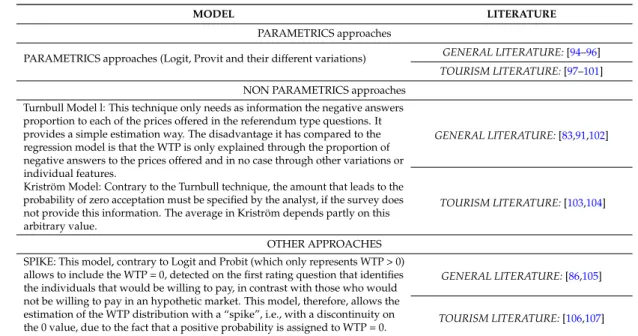
Parametric approaches (such as logit and probit models) are most used, but non-parametric methods have some advantages with respect the parametric approaches since the WTP estimators are easily calculated and are more robust to wrong specifications of the probability distribution function. The non-parametric approach presented by Kriström [89] is based on a theorem developed by Ayer et al. [90], but it can be considered a particular case of the Turnbull’s algorithm [91], which faces the problem posed by Ayer et al. [90] as an extreme case of double censoring. Later, Kriström [92] developed a parametric estimation based on a specific likelihood function that allows for zero responses in the WTP: the spike model.
To summarize, in Table2, the main methodologies used to estimate the WTP are revised and summarized, even quoting as a reference some general studies and others within the tourism area that define and/or use these models.
The next step is to estimate, using a logistic regression model, the probability that any of the identified segments would be willing to pay for Western Costa del Sol to become a more sustainable tourist destination. The extent to which any segment is willing to pay more than the rest is also included.
Using referendum question requires a large sample size. In this regard, Hanemann and Kanninen [93] recommend a sample size between 500 and 1000 (in this case, the initial sample size was 1188 surveys).
The statistical analysis differentiated real zeros from protest zeros, and protest zeros were eliminated. Real zeros correspond to tourists who participate in the hypothetical market but do not recognize the worth of it, whilst protest zeros correspond to tourists showing a clear discomfort with the suggestion of paying an additional amount. This type of tourist, corresponding to protest zeros, is not included in the hypothetical market; therefore, it should be excluded from the analysis.
In order to identify protest zeros, tourists who were not willing to pay more for their stay in Western Costa del Sol were asked to give a reason for their negative response. Thus, protest zeros are considered tourists whose negative response is one of the following:
- I am not interested in this type of issue.
- I do not believe in this type of contribution; at the end of the day, nothing will change.
- I do not think a sustainable destination has to be more expensive, but rather, it should use its resources more efficiently.
Consequently, the initial sample comprised 1188 tourists; however, records with missing data and “protest zeros” were dismissed, so, finally, there were 666 valid surveys, with a sampling error of 3.797%, for a confidence level of 95% (p=q= 0.50).
Table 2.Willing to pay approaches.
MODEL LITERATURE
PARAMETRICS approaches
PARAMETRICS approaches (Logit, Provit and their different variations) GENERAL LITERATURE:[94–96]
TOURISM LITERATURE:[97–101] NON PARAMETRICS approaches
Turnbull Model l: This technique only needs as information the negative answers proportion to each of the prices offered in the referendum type questions. It provides a simple estimation way. The disadvantage it has compared to the regression model is that the WTP is only explained through the proportion of negative answers to the prices offered and in no case through other variations or individual features.
Kriström Model: Contrary to the Turnbull technique, the amount that leads to the probability of zero acceptation must be specified by the analyst, if the survey does not provide this information. The average in Kriström depends partly on this arbitrary value.
GENERAL LITERATURE:[83,91,102]
TOURISM LITERATURE:[103,104]
OTHER APPROACHES SPIKE: This model, contrary to Logit and Probit (which only represents WTP > 0) allows to include the WTP = 0, detected on the first rating question that identifies the individuals that would be willing to pay, in contrast with those who would not be willing to pay in an hypothetic market. This model, therefore, allows the estimation of the WTP distribution with a “spike”, i.e., with a discontinuity on the 0 value, due to the fact that a positive probability is assigned to WTP = 0.
GENERAL LITERATURE:[86,105]
TOURISM LITERATURE:[106,107] Source: Authors’ own elaboration.
4.4. Logistic Regression Model
Removing the “zeros” as a complaint has significantly reduced the number of valid questionnaires to undertake this research. As a consequence, the available information is much more limited, and the application of traditional methodologies in order to estimate the WTP was completely fruitless, as the results obtained in all cases were not statistically significant. Therefore, it has been necessary to look for a different methodology that allowed to the intended analysis to be achieved and that included statistically significant results.
Models of logistic regression are commonly used to model, through a linear predictor, the probability of the occurrence of an event [87,108–110]. Our research applies this type of model to predict the probability of positive WTP.
The dependent variable was defined for Yi= 1 when WTP is positive and Yi= 0 when WTP is negative. Logistic regression analyzes data of binomial distribution Yi~B (Pi, ni), were, for i = 1, . . . , n, where the numbers of Bernoulli trial niare known and the probabilities of success Piare unknown. The applicable model follows the Logit function:
Logit P(Yi= 1|β, Xi) =β0+β1Xi1+β2Xi2+...+βkXik, i=1, ..., n
where
- Logit P (Yi= 1|β, X) = ln [P (Yi = 1|β, X)/(1−P (Yi = 1|β, X))];
- βjis the parameter associated with the variable j, j = 1, . . . , k, that has been estimated through the maximum likelihood method; and
- Xjaredummyvariables; in other words, Xij(value of variable j on the individual i) takes values 0 and 1.
An algebraic transformation provides the corresponding logistic model that indicates the probability of predicted occurrence by the predictive linear function that subject i presents a positive WTP:
where Odds refer to the following ratio:
Odds = P (Yi = 1|β, X)/(1−P (Yi = 1|β, X)
The calculation of two Odds concerning a unitary increase in one of the explicative variables of the model leads to the concept of the Odds-ratio as the ratio of the two Odds:
Odds-ratio=Odds2/odds1=exp(βj)
Software SPSS, version 22.0 was used. The reference category to analyze the adjusted model is the last one (pro-sustainable tourists).
5. Results
5.1. Segmented Analysis Regarding Willingness to Pay
As shown in Table3, only 26.6% of the survey (n = 666) is willing to pay more for Western Costa del Sol to become a more sustainable destination than it is at present. The vast majority of this type of tourist willing to pay more money for destination sustainability is part of the segment called “pro-sustainable tourists”. In fact, 97.8% of this segment shows their availability to pay more, versus a small number of tourists from the other two segments who have shown willingness to pay an additional charge.
This lack of commitment shown by survey respondents in terms of accepting a higher cost of travel to a destination that is making relevant efforts to improve its sustainability is confirmed, as seen in Table3, by the notion that even the people willing to pay would only pay a very reduced additional amount, which is limited, in general, to 10% of the total amount of the cost of travel.
Again, “pro-sustainable tourists” are the ones who are willing to pay more money, even identifying a small group who is willing to pay up to 50% of the current amount paid, although this group should be considered a merely testimonial case because the vast majority (85.4%) of people estimate their additional payment to not exceed 10%.
Table 3.Willingness to pay more for a more sustainable tourist destination.
Are You Willing to Pay More?
Total Reflective Tourist
Unconcerned Tourist
Pro-Sustainable Tourist
N % N % N % N %
No 489 73.4 379 93.6 107 86.3 3 2.2
Yes 177 26.6 26 6.4 17 13.7 134 97.8
10% 146 21.9 16 4.0 13 10.5 117 85.4
20% 11 1.7 2 0.5 3 2.4 6 4.4
30% 3 0.5 2 0.5 - - 1 0.7
40% 2 0.3 1 0.2 - - 1 0.7
50% 5 0.8 2 0.5 - - 3 2.2
75% 1 0.2 - - - - 1 0.7
Double 10 1.5 4 1.0 1 0.8 5 3.6
Total 666 100.0 405 100.0 124 100.0 137 100.0
Source: Authors’ own elaboration.
The mean is the most used average measure, as all opinions are taken into account, and offers a more exact value; however, it may be affected by the so-called “asymmetry” that represents the distribution of observations in relation to a central value and may be caused by the existence of extreme values that distort its meaning. Therefore, the mean is used to prevent the arithmetic mean from becoming excessively distorted by the existence of extreme values.
In general, Table4shows that, amongst the people willing to pay more, the group of people who would pay over 100 euros is greater than the group of people willing to pay less than 100 euros. It is also noticeable that the difference between both groups (in favor of the ones willing to pay over 100 euros) is more significant in “reflective tourists” and “unconcerned tourists” than in “pro-sustainable tourists”.
Table 4.Tourists willing to pay over 100 euros more than at present.
Total Reflective Tourist
Unconcerned Tourist
Pro-Sustainable Tourist
N % N % N % N %
0 488 73.3 378 93.3 107 86.3 3 2.2
<100 euros 77 11.6 6 1.5 6 4.8 65 47.4
>100 euros 101 15.2 21 5.2 11 8.9 69 50.4
Total 666 100.0 405 100.0 124 100.0 137 100.0
Source: Authors’ own elaboration.
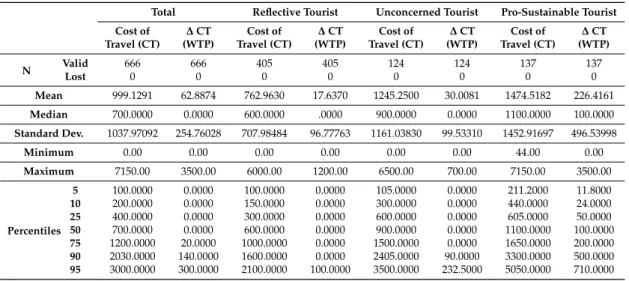
Table5summarizes the descriptive statistical principles. In general, the people included in the analyzed survey are willing to pay (WTP) 6.29% (62.89 euros) more than the amount actually paid (cost of travel (CT)) to visit a more sustainable tourist destination. However, when the survey is segmented into the three previously identified groups, it is shown that “reflective tourists” are willing to increase the amount paid by only 2.31% (17.64 euros), whereas the “unconcerned tourists” would overpay 2.41% (30 euros). “Pro-sustainable tourists” have expressed their intention to pay the highest amount in relation to the cost of travel. The tourists in this segment express their intention to pay 15.35% (226.42 euros).
Table 5.Descriptive statistics.
Total Reflective Tourist Unconcerned Tourist Pro-Sustainable Tourist Cost of
Travel (CT)
∆CT (WTP)
Cost of Travel (CT)
∆CT (WTP)
Cost of Travel (CT)
∆CT (WTP)
Cost of Travel (CT)
∆CT (WTP)
N ValidLost 6660 6660 4050 4050 1240 1240 1370 1370
Mean 999.1291 62.8874 762.9630 17.6370 1245.2500 30.0081 1474.5182 226.4161 Median 700.0000 0.0000 600.0000 .0000 900.0000 0.0000 1100.0000 100.0000 Standard Dev. 1037.97092 254.76028 707.98484 96.77763 1161.03830 99.53310 1452.91697 496.53998
Minimum 0.00 0.00 0.00 0.00 0.00 0.00 44.00 0.00
Maximum 7150.00 3500.00 6000.00 1200.00 6500.00 700.00 7150.00 3500.00
Percentiles
5 100.0000 0.0000 100.0000 0.0000 105.0000 0.0000 211.2000 11.8000 10 200.0000 0.0000 150.0000 0.0000 300.0000 0.0000 440.0000 24.0000 25 400.0000 0.0000 300.0000 0.0000 600.0000 0.0000 605.0000 50.0000 50 700.0000 0.0000 600.0000 0.0000 900.0000 0.0000 1100.0000 100.0000 75 1200.0000 20.0000 1000.0000 0.0000 1500.0000 0.0000 1650.0000 200.0000 90 2030.0000 140.0000 1600.0000 0.0000 2405.0000 90.0000 3300.0000 500.0000 95 3000.0000 300.0000 2100.0000 100.0000 3500.0000 232.5000 5050.0000 710.0000
Source: Authors’ own elaboration.
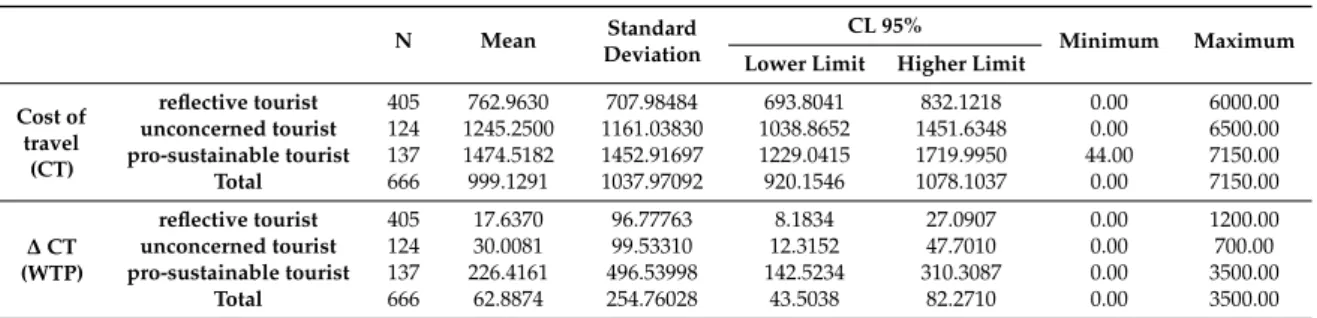
Since variances are not homogeneous, the robust statistical testing under the violation of homogeneity assumption has been estimated. The overall F test indicates that there are significant differences among the three segments within the two analyzed variables: Cost of travel (F(2288.8) = 20.558;p< 0.001)) and WTP (F(2152.5) = 22.291;p< 0.001)). The overall F test also indicates that there are significant differences among the three segments; however, it does not specify the segments.
Table 6.ANOVA to analyze the differences of WTP between the three segments.
N Mean Standard
Deviation
CL 95%
Minimum Maximum Lower Limit Higher Limit
Cost of travel
(CT)
reflective tourist 405 762.9630 707.98484 693.8041 832.1218 0.00 6000.00 unconcerned tourist 124 1245.2500 1161.03830 1038.8652 1451.6348 0.00 6500.00 pro-sustainable tourist 137 1474.5182 1452.91697 1229.0415 1719.9950 44.00 7150.00 Total 666 999.1291 1037.97092 920.1546 1078.1037 0.00 7150.00
∆CT (WTP)
reflective tourist 405 17.6370 96.77763 8.1834 27.0907 0.00 1200.00 unconcerned tourist 124 30.0081 99.53310 12.3152 47.7010 0.00 700.00 pro-sustainable tourist 137 226.4161 496.53998 142.5234 310.3087 0.00 3500.00
Total 666 62.8874 254.76028 43.5038 82.2710 0.00 3500.00
Source: Authors’ own elaboration.
Multiple comparisons carried out by the use of Tukey’s HSD test reveal (Table7) that there are differences regarding the cost of travel (CT) among the three groups, being highest in “pro-sustainable tourists” with respect to “reflective tourists” and similar to “unconcerned tourists”, as well as in “unconcerned tourists” with respect to “reflective tourists”. The increase in cost of travel (WTP) is higher among “pro-sustainable tourists” in relation to “unconcerned tourists” and “reflective tourists”, with the last two groups having the same value.
Table8shows that “pro-sustainable tourists” would mostly be willing to pay more for their stay in Western Costa del Sol, in case projects to improve the sustainability of this destination would imply an increase in prices. For its part, the independence hypothesis test, carried out through Pearson’s chi-squared test, demonstrates that there is a relationship between both variables (identified segments and willingness to pay).
Table 7.Multiple comparisons (Tukey’s HSD).
(I) Class (J) Class
Mean Difference
(I−J)
Standard Error Sig. CL 95% Lower Limit Higher Limit Cost of travel (CT) reflective tourist
unconcerned tourist −482.28704 * 102.04355 0.000 −721.9858 −242.5883 pro-sustainable tourist −711.55529 * 98.26705 0.000 −942.3831 −480.7275 unconcerned
tourist
reflective tourist 482.28704 * 102.04355 0.000 242.5883 721.9858 pro-sustainable tourist −229.26825 123.23816 0.151 −518.7528 60.2163 pro-sustainable
tourist
reflective tourist 711.55529 * 98.26705 0.000 480.7275 942.3831 unconcerned tourist 229.26825 123.23816 0.151 −60.2163 518.7528
∆CT (WTP)
reflective tourist
unconcerned tourist −12.37103 24.74296 0.871 −70.4919 45.7498 pro-sustainable tourist −208.77902 * 23.82725 0.000 −264.7489 −152.8092 unconcerned
tourist
reflective tourist 12.37103 24.74296 0.871 −45.7498 70.4919 pro-sustainable tourist −196.40799 * 29.88211 0.000 −266.6006 −126.2154 pro-sustainable
tourist
Table 8.Contingency table—chi-squared tests.
In Case Sustainability for This Destination Implies an Increase in Prices; Would You Be
Willing to Pay More to Stay in This Destination? Total
No Yes
Segments
reflective tourist
Count 379 26 405
Percent within the segment 93.6% 6.4% 100.0%
unconcerned tourist
Count 107 17 124
percent within the segment 86.3% 13.7% 100.0%
pro-sustainable tourist
Count 3 134 137
percent within the segment 2.2% 97.8% 100.0%
Total percent within the segmentCount 73.4%489 26.6%177 100.0%666 Value Gl Asymptotic sig. (bilateral)
Pearson’s Chi-squared test 451.099 2 0.000
Source: Authors’ own elaboration.
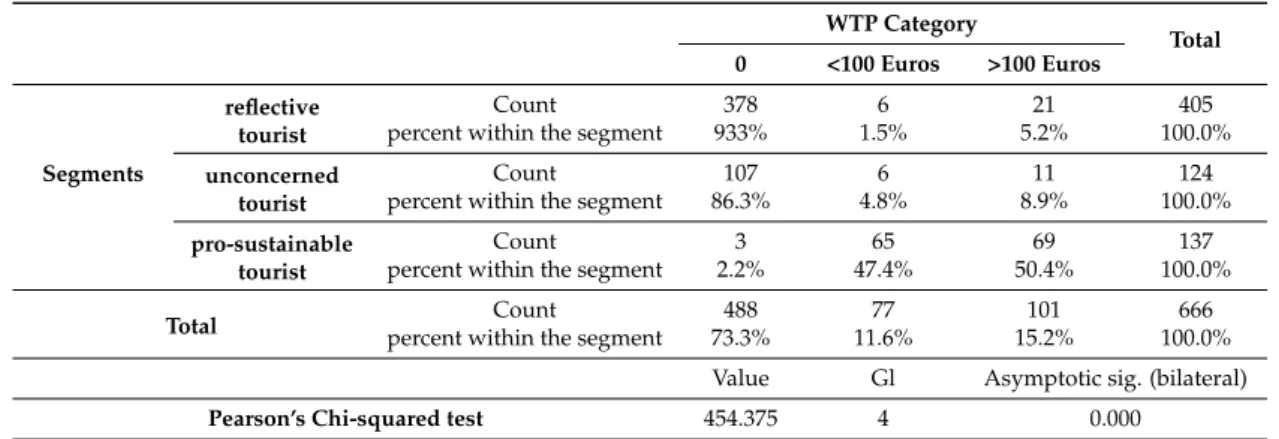
Finally, having broken down the value WTP = yes based on the median of WTP (Table9), “pro-sustainable tourists” are divided equally between both values.
Table 9.Contingency table—Chi-squared tests.
WTP Category
Total 0 <100 Euros >100 Euros
Segments
reflective tourist
Count 378 6 21 405
percent within the segment 933% 1.5% 5.2% 100.0%
unconcerned tourist
Count 107 6 11 124
percent within the segment 86.3% 4.8% 8.9% 100.0%
pro-sustainable tourist
Count 3 65 69 137
percent within the segment 2.2% 47.4% 50.4% 100.0%
Total percent within the segmentCount 73.3%488 11.6%77 15.2%101 100.0%666
Value Gl Asymptotic sig. (bilateral)
Pearson’s Chi-squared test 454.375 4 0.000
Source: Authors’ own elaboration.
The results shown in Table9reveal two relevant issues. First, the issue is focused on not paying or paying over 100 euros of the actual cost of travel because, within the three segments, the percentage of people willing to pay over 100 euros is higher than the percentage of people willing to pay less than 100 euros. Second, although “pro-sustainable tourists” are the ones showing higher WTP for a sustainable destination, when responses regarding the median of WTP are analyzed, this group shows a smaller difference between the people willing to pay more than 100 euros and the group willing to pay less than 100 euros. Finally, it is worth highlighting that the chi-squared test shows a relationship between the segment and the willingness to pay with a threshold of 100 euros.
It is possible to identify a segment willing to pay more than the rest of tourists due to extra costs to improve the sustainability of the destination of the Western Costa del Sol.
5.2. Are Pro-Sustainable Tourists Willing to Pay More to Visit a More Sustainable Destination?
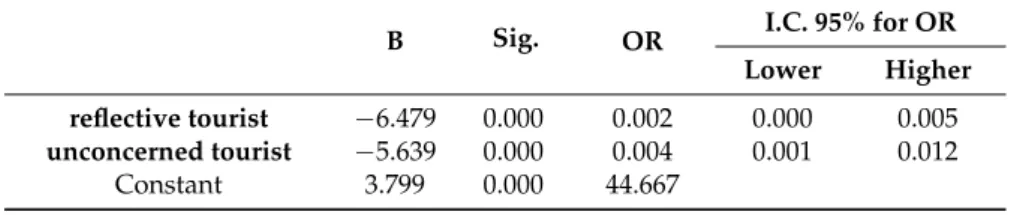
Results regarding the adjustment of logistic regression are shown in Table10, including the estimation of the maximum likelihood of the model parameters for the variables that are statistically significant (it should be noted that, in this case, segments are used as explicative variables of WTP).
become more sustainable in relation to the probability of not having WTP. As it can be demonstrated, the beta estimation is a negative number, which implies that an increase in the respective variables will produce a decrease in the probability of willingness to pay.
The signs of parameter estimations correspond to the expected results. The analysis in Table10 supports statements made so far. In fact, it has been verified that “reflective tourists” have a lower probability to contribute with an additional payment for the destination subject to this research to improve sustainability than “pro-sustainable tourists” (reference category).
The same situation can be found with “unconcerned tourists” to a lesser extent, which also shows less probability to pay an additional amount to visit a sustainable destination than “pro-sustainable tourists”.
Table 10.Model adjustment of logistic regression.
B Sig. OR I.C. 95% for OR
Lower Higher reflective tourist −6.479 0.000 0.002 0.000 0.005 unconcerned tourist −5.639 0.000 0.004 0.001 0.012
Constant 3.799 0.000 44.667
Source: Authors’ own elaboration.
Accordingly, it has been stated that pro-sustainable tourists are the group of tourists showing more WTP due to the efforts made by Western Costa del Sol to become a more sustainable tourist destination.
Finally, it should be mentioned that the omnibus test on the model coefficients indicates that this model includes an appropriate adjustment, in which not all coefficients are null (Chi-squared test (2) = 450.178;p= 0.000).
The coefficient of Cox and Snell R2(0.491) and the coefficient of Nagelkerke R2(0.716) indicate that the variation in the dependent variable explained by the model is very high. The chi-squared coefficient of the Hosmer and Llemeshow test, evaluating the goodness of the overall adjustment of the model, shows that there are no significant differences between the observed values and the values predicted by the model (Chi-squared test (1) = 0.000;p= 1.000).
6. Discussion and Conclusions
The results obtained from this research support the hypothesis raised at the beginning of this paper: the tourist segment with high levels of “sustainable intelligence” (commitment, attitude, knowledge and/or behavior with regard to sustainability) is willing to pay more to visit a more sustainable tourism destination. The combination of pro-sustainable behavior and increased spending provides evidence of a market segment in which destinations can benefit [14].
It is undeniable that not all tourists visiting the Western Costa del Sol have the same degree of awareness with regard to what sustainability means and implies; therefore, their behavior is very different, demonstrating that “pro-sustainable tourists” have a greater WTP and are also willing to pay a higher amount.
On the other hand, there is little willingness to pay if the destinations’ commitment to sustainability would increase the price of the tourism product (26.6% of respondents). These data are significant, especially in view of the fact that a large majority of those who are willing to pay more would not pay more than 10% above the cost of travel. As Budeanu [28] (p. 499) states, “the low support from customers is one of the main barriers for progress towards sustainable tourism. One reason can be that existing initiatives are missing customers' attention, discouraging industry and governments to continue promoting sustainable tourism”.
their economic implications. It seems incongruous to be obsessed with the creation of a tourism offer for which, a priori, there seems to be no demand. However, although customers are not willing to pay a significant premium, the supply of sustainable tourism products can be a successful differentiation strategy to gain market share.
The solution to be raised could be twofold: either by trying to change the behavior patterns of the present tourists (especially “unconcerned tourists”), improving their knowledge on sustainability, their environmental awareness and, consequently, their empathy with the destination, to the point of increasing their WTP and the maximum amount that they are willing to pay or through repositioning itself in the market, trying to find other demand segments that value the new tourism offer that will emerge after this process (pro-sustainable tourists). Both cases must be undertaken with strategic actions aimed at supply and demand. Thus, public authorities, the receiving community, private companies and, finally, tourists should cooperate and have a share in the commitment to achieve comprehensive management based on sustainability criteria.
Not only is it important to change the character of the destination, to which most of the restructuring plans of mature coastal destinations have been devoted, at least in Spain, or even its tourism model, but it is also necessary to inform the tourism demand, both real and potential, for its new philosophy and the need to be accompanied by a change in the behavior. However, for this to occur, tourists need to obtain relevant information regarding the destinations’ commitment to sustainability. However, achieving comprehensive information about destination sustainability could be difficult because, ultimately, it will depend on the transparency and credibility of destination. In short, the destination must first offer products and services that are really based on the philosophy of sustainability, as this can help becoming revalued as a unique, differentiated and responsible destination. Finally, it should communicate the change to current and potential tourists. Another important first step in fostering a productive public debate on the transformation is a better understanding of its benefits and costs.
To summarize, market segmentation in tourism is useful for the sake of planning and managing demand-oriented policies. Hence, a segmentation based on tourists’ “sustainable intelligence” could be a crucial tool for improving sustainable destination development. To identify “pro-sustainable” tourists would be extremely useful, especially in destinations whose public policies are committed to sustainability, such as Western Costa del Sol, because within the extensive body of literature on sustainable tourism, its successful implementation is an emerging and important theme [111].
The results obtained suggest, in fact, the need for complementing supply policies with demand policies in order to overcome the current actions exclusively from the supply perspective, which has resulted in little success. As Pulido-Fernández [112] (p. 260) highlights, “sustainability cannot be covered exclusively from a supply perspective. On the contrary, tourism demand—i.e., tourists—plays a key role in achieving sustainable tourism”.
In other words, it is not sufficient to guide tourism supply towards more sustainable practices; it is also necessary that tourists appreciate these efforts and are willing to make their own efforts by improving their behavior, of course, and by paying a higher price to enjoy a destination that is making an effort to be more sustainable. In this way, the demand would support the actions undertaken on the supply side. The long-run sustainability of tourism is not a utopian idea, but it requires a careful management and strategic planning [113].
Finally, with an eye to future research directions, it would also be interesting to discover whether there is a significant difference between the attitudes (and motives) of each segment identified regarding the establishment of a tax for projects to improving the sustainability of the destination [115–117].
Another interesting route to extend this research might be comparing the different levels of satisfaction with the destination and the social carrying capacity of each segment identified.
In addition, another challenge will be to develop a strategic agenda highlighting the priorities that policymakers and managers of destinations must face to attract, keep or increase “pro-sustainable” tourists.
Finally, going a step further in the analysis of the WTP due to the sustainability of the destinations, it is proposed, once the sample has been broadened, to carry out a comparative analysis of the WTP to check the sustainability of the segments identified through different models (logit, probit, spike, etc.) [105,118] (Del Saz-Salazar and García-Menéndez, 2001; Bengochea-Morancho et al., 2005). In conclusion, an interesting question could be, “which factors affect the willingness of tourists to pay for sustainable destinations?”
Author Contributions: Juan Ignacio Pulido-Fernández and Yaiza López-Sánchez introduced the concept of tourists’ “sustainable intelligence” (level of commitment, attitude, knowledge and/or behavior with regard to sustainability) to provide a richer understanding of tourists’ heterogeneous preferences for sustainable destinations. Following the identification of three different demand segments using the concept of “sustainable intelligence”, their studies allow ascertaining the current tourist profile with respect to sustainability and to identify tourists’ willingnes to pay more for a more sustainable destination and the explanatory variables that influence tourists’ willingness to pay to enjoy a more sustainable destination.
Conflicts of Interest:The authors declare no conflict of interest.
References
1. Sharpley, R. Host perceptions of tourism: A review of the research.Tour. Manag.2014,42, 37–49. [CrossRef] 2. Swarbrooke, J.; Horne, S.Consumer Behaviour in Tourism, 2nd ed.; Routledge: Oxford, UK, 2007.
3. Weeden, C.Responsible and Ethical Tourist Behaviour; Routledge: London, UK, 2013.
4. Cohen, S.A.; Higham, J.E.; Gossling, S.; Peeters, P. (Eds.)Understanding and Governing Sustainable Tourism Mobility: Psychological and Behavioural Approaches; Routledge: New York, NY, USA, 2014.
5. Ruhanen, L.; Weiler, B.; Moyle, B.D.; McLennan, C.L.J. Trends and patterns in sustainable tourism research: A 25-year bibliometric analysis.J. Sustain. Tour.2015,23, 517–535. [CrossRef]
6. World Travel Organization (WTO).Indicators of Sustainable Development for Tourism Destinations; WTO: Madrid, Spain, 2004.
7. Harrison, R.; Newholm, T.; Shaw, D. (Eds.)The Ethical Consumer; Sage: London, UK, 2005.
8. Werhrli, R.; Egli, H.; Lutzenberger, D.; Pfister, J.; Scwarz, J.; Steettler, J.Is There Demand for Sustainable Tourism?
Working Papers Series Tourism 001/2011; Lucerne University of Applied Sciences and Arts: Lucerne, Switzerland, 2011.
9. Hedlund, T. Tourists’ Vacation Choice Structure: Influence of Values and Implications for Green Tourism. Ph.D. Thesis, Umeå School of Business and Economics, Umeå, Sweden, 2013.
10. Auger, P.; Devinney, T.M. Do what consumers say matter? The misalignment of preferences with unconstrained ethical intentions.J. Bus. Ethics2007,76, 361–383. [CrossRef]
11. Belk, R.W.; Devinney, T.; Eckhardt, G. Consumer ethics across cultures.Consum. Mark. Cult.2005,8, 275–289. [CrossRef]
12. Carrigan, M.; Attalla, A. The myth of the ethical consumer-do ethics matter in purchase behavior?
J. Consum. Market.2001,18, 560–578. [CrossRef]
13. Weaver, D.B. Organic, incremental and induced paths to sustainable mass tourism convergence.Tour. Manag. 2012,33, 1030–1037. [CrossRef]
14. Nickerson, N.P.; Jorgenson, J.; Boley, B.B. Are sustainable tourists a higher spending market?Tour. Manag. 2016,54, 170–177. [CrossRef]
16. De Andalucía, J. Decreto 78/2007, de 20 de Marzo, Por el Que se Aprueba el Programa de Recualificación de Destinos de la Costa del Sol Occidental de Andalucía “Plan Qualifica”. Available online: http://www. juntadeandalucia.es/boja/2007/75/13 (accessed on 10 April 2016). (In Spanish)
17. Gössling, S.; Scott, D.; Hall, C.M.; Ceron, J.P.; Dubois, G. Consumer behavior and demand response of tourists to climate change.Ann. Tour. Res.2012,39, 36–58. [CrossRef]
18. Stanford, D. ‘Exceptional visitors’: Dimensions of tourist responsibility in the context of New Zealand.
J. Sustain. Tour.2008,6, 258–275. [CrossRef]
19. Gilg, A.; Barr, S.; Ford, N. Green consumption or sustainable lifestyles? Identifying the sustainable consumer.
Futures2005,37, 481–504. [CrossRef]
20. Rheem, C. PhoCusWright’s Going Green: The Business Impact of Environmental Awareness on Travel. Available online: http://travelgreen.org/files/PhocusWright.pdf (accessed on 15 March 2016).
21. Dolnicar, S.; Crouch, G.I.; Long, P. Environment-friendly tourists: What do we really know about them?
J. Sustain. Tour.2008,16, 197–210. [CrossRef]
22. Cerina, F. Tourism specialization and environmental sustainability in a dynamic economy.Tour. Econ.2007,
13, 553–582. [CrossRef]
23. Bergin-Seers, S.; Mair, J. Emerging green tourists in Australia: Their behaviors and attitudes.Tour. Hosp. Res. 2009,9, 109–119. [CrossRef]
24. Juvan, E.; Dolnicar, S. Green tourists: Insights from prompted and unprompted recall research. In Proceedings of the CAUTHE 2014 Tourism and Hospitality in the Contemporary World: Trends, Changes & Complexity, Brisbane, Australia, 10–13 February 2014.
25. Fennell, D.A.; Malloy, D.C. Measuring the ethical nature of tourism operators. Ann. Tour. Res. 1999,26, 928–943. [CrossRef]
26. Ruhi, H.; Gurel, E. Ethical ideologies of tourism marketers.Ann. Tour. Res.2006,33, 470–489. [CrossRef] 27. Wheeler, M. Tourism marketing ethics: An introduction.Int. Market. Rev.1995,12, 38–49. [CrossRef] 28. Budeanu, A. Sustainable tourist behavior—A discussion of opportunities for change.Int. J. Consum. Stud.
2007,31, 499–508. [CrossRef]
29. Luzar, E.J.; Diagne, A.; Gan, C.E.C.; Henning, B.R. Proling the nature-based tourist: A multinomial logit approach.J. Travel Res.1998,37, 48–55.
30. Chhetri, P. Arrowsmith, C.; Jackson, M. Determining hiking experiences in nature-based tourist destinations.
Tour. Manag.2004,25, 31–43. [CrossRef]
31. Mehmetoglu, M. Typologising nature-based tourists by activity—Theoretical and practical implications.
Tour. Manag.2007,28, 651–660. [CrossRef]
32. Dickinson, J.E.; Robbins, D.; Lumsdon, L. Holiday travel discourses and climate change.J. Trans. Geogr.2010,
18, 482–489. [CrossRef]
33. Yurtseven, H.R.; Kaya, O. Slow tourists: A comparative research based on Cittaslow principles.Am. Int. J. Contemp. Res.2011,2, 91–98.
34. Spenceley, A. (Ed.)Responsible Tourism: Critical Issues for Conservation and Development; Routledge: London, UK, 2010.
35. Sharpley, R. Responsible tourism: Whose responsibility. InThe Routledge Handbook of Tourism and Environment; Holden, A., Fennell, D., Eds.; Routledge: London, UK, 2013.
36. Reed, M.G. Power relations and community-based tourism planning.Ann. Tour. Res. 1997,24, 566–591. [CrossRef]
37. Lee, T.H.; Jan, F.H.; Yang, C.C. Conceptualizing and measuring environmentally responsible behaviors from the perspective of community-based tourists.Tour. Manag.2013,36, 454–468. [CrossRef]
38. Dowling, R.K.; Newsome, D. (Eds.)Geotourism; Elsevier: Oxford, UK, 2006.
39. Dowling, R.K.; Newsome, D. Geotourism. In Proceedings of the Inaugural Global Geotourism Conference, ‘Discover the Earth Beneath our Feet’, Fremantle, Australia, 17–20 August 2008.
40. Dowling, R.K.; Newsome, D. (Eds.)Global Geotourism Perspectives; Goodfellow Publishers: Oxford, UK, 2010. 41. Morais, D.B.; Heath, E.; Tlhagale, M.; Payton, F.C.; Martin, K.; Mehta, K.; Bass, J. Concept testing people-first
tourism in rural South Africa.Knowl. Manag. Tour.2012,4, 115–128.
43. Mihaliˇc, T.; Fennell, D. In pursuit of a more just international tourism: the concept of trading tourism rights.
J. Sustain. Tour.2014,23, 1–19. [CrossRef]
44. Hansla, A.; Gamble, A.; Juliusson, A.; Gärling, T. The relationships between awareness of consequences, environmental concern, and value orientations.J. Environ. Psychol.2008,28, 1–9. [CrossRef]
45. Mehmetoglu, M.; Hines, K.; Graumann, C.; Greibrokk, J. The relationship between personal values and tourism behaviour: A segmentation approach.J. Vacat. Market.2010,16, 17–27. [CrossRef]
46. Wurzinger, S.; Johansson, M. Environmental concern and knowledge of ecotourism among three groups of Swedish tourists.J. Travel Res.2006,5, 217–226. [CrossRef]
47. Kim, A.K.; Weiler, B. Visitors’ attitudes towards responsible fossil collecting behaviour: An environmental attitude-based segmentation approach.Tour. Manag.2013,36, 602–612. [CrossRef]
48. Kouni. Holiday Report: ¿Cómo Son Los Españoles Cuando van de Vacaciones? Available online: http: //cr.kuoni.com/docs/110503_holiday_report_2011_spanien_0.pdf (accessed on 15 April 2016). (In Spanish) 49. Travelhorizons. American Travelers More Familiar with “Green Travel” but Unwilling to Pay More to Support It. Available online: http://www.ustravel.org/news/press-releases/american-travelers-more-familiar-%E2%80%98green-travel%E2%80%99 (accessed on 2 April 2016).
50. TUI Group. A Future-Gazing Study of How Holidays Are Set to Change Over the Next 20 Years. The Thomson Future Holiday Forum: Londres. Available online: http://www.ahp-monitor.pt/?data= download_file.obj&fid=111 (accessed on 15 April 2016).
51. Dwyer, L.; Edwards, D.; Mistilis, N.; Roman, C.; Scott, N. Destination and enterprise management for a tourism future.Tour. Manag.2009,30, 63–74. [CrossRef]
52. Peeters, P. A clear path towards sustainable mass tourism? Rejoinder to the paper ‘Organic, incremental and induced paths to sustainable mass tourism convergence’ by David B. Weaver.Tour. Manag.2012,33, 1038–1041. [CrossRef]
53. Miller, G. Consumerism in sustainable tourism: A survey of UK consumers.J. Sustain. Tour.2003,1, 17–39. [CrossRef]
54. Araña, J.E.; Carmelo, J.; Moreno-Gil, S.; Zubiaurre, A.R. A comparison of tourists’ valuation of climate change policy using different pricing frames.J. Travel Res.2013,52, 82–92. [CrossRef]
55. Gössling, S.; Bredberg, M.; Randow, A.; Svensson, P.; Swedlin, E. Tourist perceptions of climate change.
Curr. Issues Tour.2006,9, 419–435. [CrossRef]
56. McKercher, B.; Prideaux, B.; Cheung, C.; Law, R. Achieving voluntary reductions in the carbon footprint of tourism and climate change.J. Sustain. Tour.2010,18, 297–317. [CrossRef]
57. Follows, S.B.; Jobber, D. Environmentally Responsible Purchase Behavior: A test of a consumer model.
Eur. J. Market.2000,34, 723–746. [CrossRef]
58. Hibbert, J.F.; Dickinson, J.E.; Gössling, S.; Curtin, S. Identity and tourism mobility: an exploration of the attitude–behaviour gap.J. Sustain. Tour.2013,21, 999–1016. [CrossRef]
59. Yeoman, I.Tomorrow’s Tourist: Scenarios & Trends; Elsevier: Oxford, UK, 2008.
60. Boniface, B.; Coope, C.Worldwide Destinations Casebook—The Geography of Travel and Tourism; Elsevier Butterworth-Heinemann: Burlington, MA, USA, 2005.
61. Adlwarth, W. Corporate social responsibility: Customer expectations and behavior in the tourism sector. InTrends and Issues in Global Tourism 2010; Conrady, R., Buck, M., Eds.; Springer: Heidelberg/Berlin, Germany, 2010.
62. Dodds, R.; Graci, S.R.; Holmes, M. Does the tourist care? A comparison of tourists in Koh Phi Phi, Thailand and Gili Trawangan, Indonesia.J. Sustain. Tour.2010,18, 207–222. [CrossRef]
63. Hedlund, T. The impact of values, environmental concern, and willingness to accept economic sacrifices to protect the environment on tourists’ intentions to buy ecologically sustainable tourism alternatives.
Tour. Hosp. Res.2011,11, 278–288. [CrossRef]
64. Wehrli, R.; Priskin, J.; Schaffner, D.; Schwarz, J.; Stettler, J.Do Sustainability Experienced Travellers Prefer a More Rational Communication of the Sustainability of a Tourism Product?Hochschule Luzern-Wirtschaft, ITW Institut für Tourismuswirtschaft: Luzern, Switzerland, 2013.
66. Darnall, N.; Ponting, C.; Vazquez-Brust, D.A. Why consumers buy green. InGreen Growth: Managing the Transition to a Sustainable Economy; Vazquez-Brust, D.A., Sarkis, J., Eds.; Springer: Dordrecht, The Netherlands, 2012.
67. Chen, A.; Peng, N. Green hotel knowledge and tourists’ staying behavior.Ann. Tour. Res.2012,39, 2211–2219. [CrossRef]
68. Law, A.; de Lacy, T.; McGrath, G.M.; Whitelaw, P.A.; Lipman, G.; Buckley, G. Towards a green economy decision support system for tourism destinations.J. Sustain. Tour.2012,2, 823–843. [CrossRef]
69. Teng, Y.M.; Wu, K.S.; Liu, H.H. Integrating altruism and the theory of planned behavior to predict patronage intention of a green hotel.J. Hosp. Tour. Res.2013,37, 1–18. [CrossRef]
70. Pulido-Fernández, J.I.; Andrades-Caldito, L.; Sánchez-Rivero, M. Is sustainable tourism an obstacle to the economic performance of the tourism industry? Evidence from an international empirical study.
J. Sustain. Tour.2015,23, 47–64. [CrossRef]
71. León, C.J. Desarrollo sostenible, medio ambiente y preferencias en el turismo.Papel. Econ. Española2004,102, 287–297.
72. Casey, J.F.; Brown, C.; Schuhmann, P. Are tourists willing to pay additional fees to protect corals in Mexico?
J. Sustain. Tour.2010,18, 557–573. [CrossRef]
73. Piriyapada, S.; Wang, E. Modeling willingness to pay for coastal tourism resource protection in Ko Chang Marine National Park, Thailand.Asia Pac. J. Tour. Res.2015,20, 515–540. [CrossRef]
74. Subade, R.F.; Francisco, H.A. Do non-users value coral reefs? Economic valuation of conserving Tubbataha Reefs, Philippines.Ecol. Econ.2014,102, 24–32. [CrossRef]
75. Cheung, L.T.; Jim, C.Y. Expectations and willingness-to-pay for ecotourism services in Hong Kong’s conservation areas.Int. J. Sustain. Dev. World Ecol.2014,21, 149–159. [CrossRef]
76. López-Sánchez, Y.; Pulido-Fernández, J.I. Factors determining the willingness to pay for a more sustainable destination. The case of the Western Costa del Sol.Cuad. Turis.2014,33, 199–231.
77. Namkung, Y.; Jang, S.S. Are consumers willing to pay more for green practices at restaurants? J. Hosp. Tour. Res.2014. [CrossRef]
78. Choi, A.S.; Ritchie, B.W. Willingness to pay for flying carbon neutral in Australia: An exploratory study of offsetter profiles.J. Sustain. Tour.2014,22, 1236–1256. [CrossRef]
79. Birdir, S.; Ünal, Ö.; Birdir, K.; Williams, A.T. Willingness to pay as an economic instrument for coastal tourism management: Cases from Mersin, Turkey.Tour. Manag.2013,36, 279–283. [CrossRef]
80. Agarwal, S.; Shaw, G. Managing coastal tourism resorts. InA Global Perspective; Channel View: Clevedon, UK, 2007.
81. Bramwell, B. Mass Tourism, Diversification and Sustainability Development in Southern Europe’s Coastal Regions. InCoastal Mass Tourism. Diversification and Sustainable Development in Southern Europe; Bramwell, B., Ed.; Channel View Publications: Clevedon, UK, 2004.
82. Navarro, E. La Costa del Sol Occidental y el Plan Qualifica, ¿renovación de un destino maduro? InRenovación y Reestructuración de Destinos Turísticos en Áreas Costeras: Marco de Análisis, Procesos, Instrumentos y Realidades; Vera, F., Rodríguez, I., Eds.; Universidad de Valencia: Valencia, FL, USA, 2012. (In Spanish)
83. Barke, M.; Towner, J. Learning from experience? Progress towards a sustainable future for tourism in the Central and Eastern Andalucían littoral. InCoastal Mass Tourism: Diversification and Sustainable Development in Southern Europe; Bramwell, B., Ed.; Channel View Publications: Clevedon, UK, 2004.
84. Paneque, P.; Corral, S.; Guimaraes, A.; del Moral, L.; Pedregal, B. Participative multi-criteria analysis for the evaluation of water governance alternatives. A case in the Costa del Sol (Malaga).Ecol. Econ.2009,68, 990–1005. [CrossRef]
85. Almeida, F. Análisis y Propuestas de Ordenación Territorial Para la Costa del Sol Oriental: El Conflicto Entre la Agricultura y el Turismo. Ph.D. Thesis, University of Málaga, Málaga, Spain, 1999. (In Spanish)
86. Almeida, F.Transformaciones Territoriales en la Costa del Sol Oriental: Análisis Territorial y Urbanístico; Servicio de Publicaciones e Intercambio Científico, University of Málaga: Málaga, Spain, 2009. (In Spanish) 87. Navarro, E.; Tejada, M.T.; García, F.A.; González, J.C.; Macías, R.C.; Peña, J.D.; Gutiérrez, F.F.; Fernández, G.G.;
Gallego, M.L.; García, G.M.; et al. Carrying capacity assessment for tourist destinations. Methodology for the creation of synthetic indicators applied in a coastal area.Tour. Manag.2012,33, 1337–1346. [CrossRef] 88. Navarro, E.; Damian, I.M.; Fernández, A. Carrying capacity model applied in coastal destinations.
89. Kriström, B. A non-parametric approach to the estimation of welfare measures in discrete response valuation studies.Land Econ.1990,66, 135–139. [CrossRef]
90. Ayer, M.; Brunk, H.D.; Ewing, G.M. An empirical distribution function for sampling with incomplete information.Ann. Math. Stat.1955,26, 641–647. [CrossRef]
91. Turnbull, B.W. The empirical distribution function with arbitrary grouped, censored and truncated data.
J. R. Stat. Soc. B1976,38, 290–295.
92. Kriström, B. Spike models in contingent valuation.Am. J. Agric. Econ.1997,79, 1013–1023. [CrossRef] 93. Hanemann, W.; Kanninen, B.The Statistical Analysis of Discrete-Response cv Data Valuing Environmental
Preferences: Theory and Practice of the Contingent Valuation Method in the US, EC and Developing; Oxford University Press: Oxford, UK, 1996.
94. Loureiro, M.L.; Hine, S. Discovering niche markets: A comparison of consumer willingness to pay for local (Colorado grown), organic, and GMO-free products.J. Agric. Appl. Econ.2002,34, 477–487. [CrossRef] 95. Whittington, D.; Briscoe, J.; Mu, X.; Barron, W. Estimating the willingness to pay for water services in
developing countries: A case study of the use of contingent valuation surveys in Southern Haiti.Econ. Dev. Cult. Chang.1990,38, 293–311. [CrossRef]
96. Cameron, T.A.; James, M.D. Estimating willingness to pay from survey data: An alternative pre-test-market evaluation procedure.J. Market. Res.1987,24, 389–395. [CrossRef]
97. Lee, C.K.; Han, S.Y. Estimating the use and preservation values of national parks’ tourism resources using a contingent valuation method.Tour. Manag.2002,23, 531–540. [CrossRef]
98. Kim, S.S.; Wong, K.K.; Cho, M. Assessing the economic value of a world heritage site and willingness-to-pay determinants: A case of Changdeok Palace.Tour. Manag.2007,28, 317–322. [CrossRef]
99. Dharmaratne, G.S.; Sang, F.Y.; Walling, L.J. Tourism potentials for financing protected areas.Ann. Tour. Res. 2000,27, 590–610. [CrossRef]
100. Wang, P.W.; Jia, J.B. Tourists’ willingness to pay for biodiversity conservation and environment protection, Dalai Lake protected area: Implications for entrance fee and sustainable management.Ocean Coast. Manag. 2012,62, 24–33. [CrossRef]
101. Yacob, M.R.; Radam, A.; Shuib, A. A contingent valuation study of marine parks ecotourism: The case of Pulau Payar and Pulau Redang in Malaysia.J. Sustain. Dev.2009,2, 95. [CrossRef]
102. Carson, R.T.; Steinberg, D. Experimental design for discrete choice voter preference surveys. InProceeding of the Survey Methodology Section of the American Statistical Association; American Statistical Association: Alexandria, VA, USA, 1990.
103. Brouwer, R.; Brander, L.; van Beukering, P. “A convenient truth”: Air travel passengers’ willingness to pay to offset their CO2emissions.Clim. Chang.2008,90, 299–313. [CrossRef]
104. Edwards, P.E. Sustainable financing for ocean and coastal management in Jamaica: The potential for revenues from tourist user fees.Mar. Policy2009,33, 376–385. [CrossRef]
105. Del Saz-Salazar, S.; Garcia-Menendez, L. Willingness to pay for environmental improvements in a large city evidence from the spike model and from a non-parametric approach.Environ. Resour. Econ.2001,20, 103–112. [CrossRef]
106. Hanley, N.; Colombo, S.; Kriström, B.; Watson, F. Accounting for negative, zero and positive willingness to pay for landscape change in a national park.J. Agric. Econ.2009,60, 1–16. [CrossRef]
107. Farr, M.; Stoeckl, N.; Beg, R.A. The non-consumptive (tourism) ‘value’ of marine species in the Northern section of the Great Barrier Reef.Mar. Policy2014,43, 89–103. [CrossRef]
108. Greene, W.Econometric Analysis; Prentice Hall: Upper Saddle River, NY, USA, 1997.
109. Hosmer, D.; Lemeshow, S.Applied Logistic Regression. Wiley Series in Probability and Mathematical Statistics; A-Wiley-Interscience Publication: Etobicoke, ON, Canada, 1989.
110. Maddala, G.Limited Dependent and Qualitative Variables in Econometrics; Cambridge University Press: London, UK, 1983.
111. Waligo, V.M.; Clarke, J.; Hawkins, R. Implementing sustainable tourism: A multi-stakeholder involvement management framework.Tour. Manag.2013,36, 342–353. [CrossRef]
112. Pulido-Fernández, J.I. Turismo Sostenible. InEstructura General del Mercado Turístico; Pulido, J.I., Sáez, A., Eds.; Síntesis: Madrid, Spain, 2011. (In Spanish)
114. Farr, M.; Stoeckl, N.; Esparon, M.; Larson, S.; Jarvis, D. The importance of water clarity to tourists in the Great Barrier Reef and their willingness to pay to improve it.Tour. Econ.2014,22, 331–352.
115. Palmer, T.; Riera, A. Tourism and environmental taxes. With special reference to the Balearic ecotax.
Tour. Manag.2003,24, 665–674. [CrossRef]
116. Gooroochurn, N.; Thea Sinclair, M. Economics of tourism taxation: Evidence from Mauritius.Ann. Tour. Res. 2005,32, 478–498. [CrossRef]
117. Do Valle, P.O.; Pintassilgo, P.; Matias, A.; André, F. Tourist attitudes towards an accommodation tax earmarked for environmental protection: A survey in the Algarve. Tour. Manag. 2012, 33, 1408–1416. [CrossRef]
118. Bengochea-Morancho, A.; Fuertes-Eugenio, A.M.; del Saz-Salazar, S. A comparison of empirical models used to infer the willingness to pay in contingent valuation.Empir. Econ.2005,30, 235–244. [CrossRef]