Malaysia
Bond Market Guide
Contents
Acknowledgement ... vii
I. Structure, Type, and Characteristics of the Market ...1
A. Overview of the Market ... 1
B. Types of Bonds ... 2
C. Methods of Issuing Bonds ... 9
D. Bonds and Sukuk Listed under the Exempt Regime on Bursa Malaysia ... 9
E. Offers of Bonds to Professionals ... 10
F. Definition of “Sophisticated Investors” in Malaysia ... 10
G. Quick Reference on Sophisticated Investors ... 13
H. Credit-Rating Agencies and Credit Rating of Bonds ... 13
I. Financial Guarantee Institution ... 15
J. Governing Laws on Bond Issuance... 15
K. Transfers of Interests in Bonds ... 17
L. Definition of Securities ... 17
M. Sukuk... ... 18
N. Self-Governing Rules behind the Market... 19
O. Investor Protection ... 21
P. Trustees... ... 22
Q. Meetings of Bondholders ... 24
R. Bankruptcy Procedures ... 25
S. Event of Default ... 25
T. Currency of the Bonds ... 26
U. Parties Involved in Bond Issue and Their Respective Roles ... 26
V. Issuer... ... 30
W. Investor ... ... 31
X. Authorized Depository Institution ... 32
Y. Quick Reference for Information on Cross-Border Issuance and Investment ... 32
II. Market Regulations in Malaysia ...35
A. Market Entry Requirements for Non-Residents ... 35
B. Market Regulators ... 36
C. Related Regulations and Rules on Issuing Debt Instruments ... 39
D. Rules and Regulations on Investment in Debt Securities ... 40
E. Taxation Framework and Tax Requirements ... 40
F. Tax Incentives ... 41
III. Trading of Bonds and Trading Market Infrastructure ...43
A. Over-the-Counter Market Trading ... 43
B. Exchange trading ... 43
C. Bond Market Infrastructure Diagram ... 44
D. Business Process Flowchart: Bond Market (Over-the-Counter Market)/Delivery versus Payment ...44
E. Over-the-Counter Bond Transaction Flow for Foreign Investors ... 45
IV. Possible Items of Future Improvement ...47
V. Description of the Securities Settlement System ...48
A. Securities Settlement Infrastructure ... 48
F. Definition of Clearing and Settlement ... 49
VI. Presence of Sukuk Market ...51
A. Sukuk Market ... 51
B. Structure of Sukuk ... 51
C. Growth and Acceptance of Sukuk ... 52
D. Malaysia as an Islamic Capital Market Center ... 52
E. Regulatory Framework for Islamic Finance ... 53
F. Types of Instruments Available, Segments, and Tenure ... 53
G. Basic Market Infrastructure Required to Facilitate Islamic Finance ... 54
H. Tax-Related Issues ... 54
VII. History of Debt Market Development ...55
A. Market Development History ... 55
N. Regulatory Framework and Market Infrastructure Building ... 56
O. Regional Cooperation ... 59
VIII. Market Size and Statistics ...60
A. Market Size ... 60
B. Sukuk Market ... 60
C. Equity Market ... 60
D. Size of Local Currency Bond Market ... 61
E. Size of Foreign Currency Bond Market in Percentage of Gross Domestic Product (Bank for International Settlement) ... 62
F. Size of Foreign Currency Bond Market in US Dollars (Local Sources) ... 63
G. Foreign Holdings in Local Currency Government Bonds... 64
H. Domestic Financing Profile ... 65
I. Trading Volume ... 66
IX. Next Step Future Direction: Extract from the Capital Market Masterplan II ...67
A. Growth Prospects to 2020 ... 67
B. Widen Access to the Bond Market ... 68
C. Growth Prospects for Bond Market to 2020 ... 69
D. Expand International Intermediation Capabilities ... 69
E. Group of 30 Compliance ... 71
F. Group of Experts Barrier Report Market Assessment – Malaysia (April/2010) ... 72
Appendixes ...74
Appendix 1.1 Extracts from the Capital Markets and Services Act 2007 (CMSA)... 74
Appendix 1.2 List of Registered Credit Rating Agencies ... 94
Appendix 1.3 List of Registered Bond Pricing Agency ... 94
Appendix 1.4 List of Guidelines ... 95
References ...96
Boxes, Figures, and Tables
Boxes Box 1.1 Framework for Sophisticated Investors ...11Box 1.2 Exemptions from Need for Trust Deed (1) ...23
Box 1.3 Exemptions from Need for Trust Deed (2) ...24
Box 9.1 Securities Commission Survey on International Expansion Plans of Intermediaries ...70
Box A1.1 DIVISION 1: Proposals in Relation to Securities Proposals to be submitted to Commission Section 212 ...74
Box A1.2 Division 3: Prospectus ...76
Box A1.3 DIVISION 4: Debentures ...84
Box A1.4 B. Part VIII: Self-Regulatory Organisations ...89
Figures Figure 3.1 Bond Market Infrastructure Diagram (MY: T+2) ...44
Figure 3.2 Business Process Flowchart: Over-the-Counter Market/Delivery versus Payment ...44
Figure 3.3 Over-the-Counter Bond Transaction Flow for Foreign Investors ...45
Tables Table 1.1 Quick Reference on Sophisticated Investors ...13
Table 1.2 Categories of Principal Advisers and Permitted Types of Corporate Proposals ...27
Table 1.3 Quick Reference on Cross-Border Issuance and Investment in Malaysia ...32
Table 5.1 Market Charges ...50
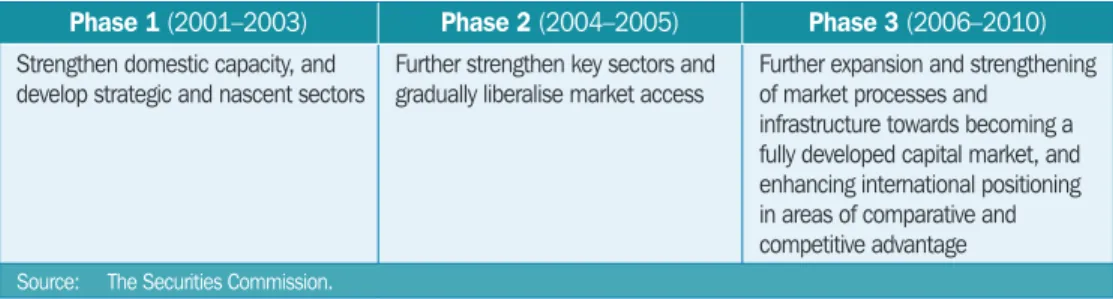
Table 7.1 Strategic Development Initiatives for the Malaysian Bond Market ...55
Table 7.2 Implementation Plan for the Capital Market Masterplan ...58
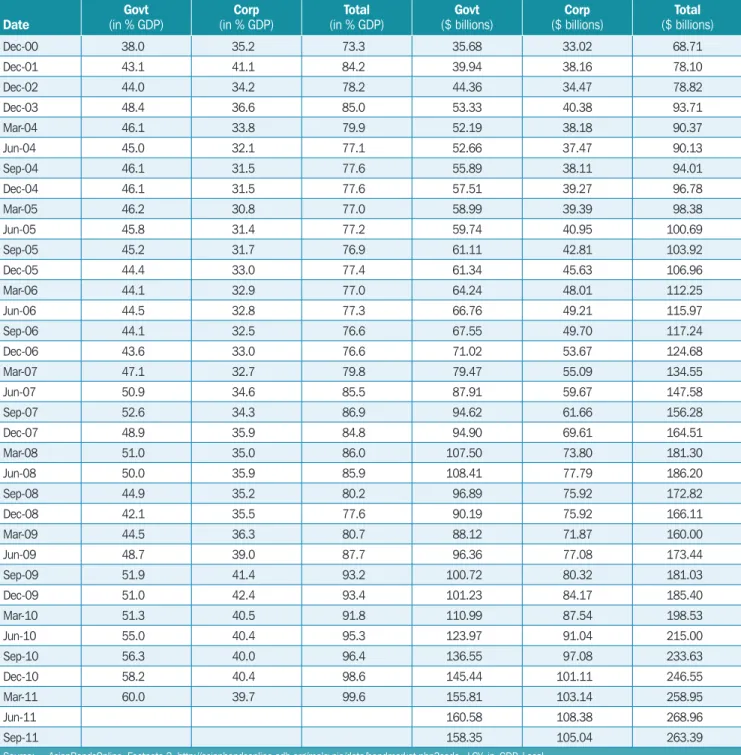
Table 8.1 Size of Local Currency Bond Market in USD (Local Sources) (% GDP) ...61
Table 8.2 Foreign Currency Bonds to Gross Domestic Product Ratio ...62
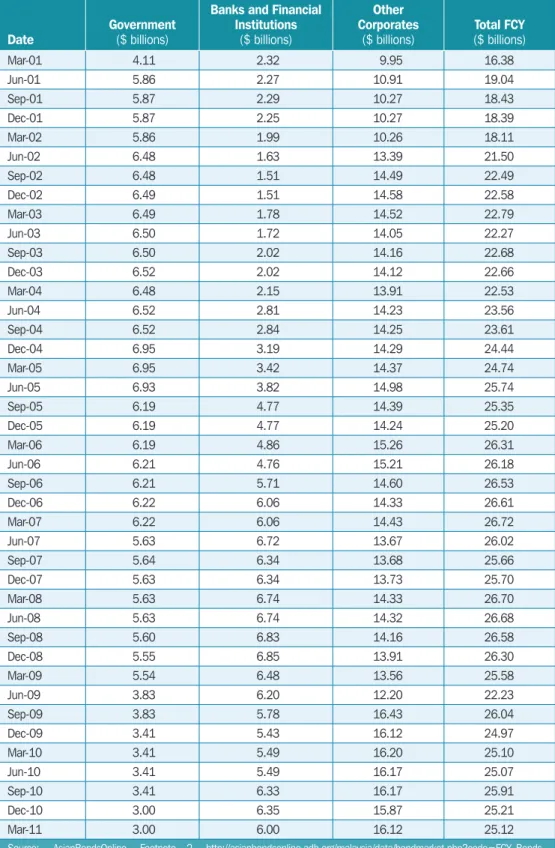
Table 8.3 Foreign Currency Bonds Outstanding (Local Sources) ...63
Table 8.4 Foreign Holdings in Local Currency Government Bonds (MYR billions) ...64
Table 8.5 Domestic Financing Profile ...65
Table 8.6 Trading Volume ($ billions) ...66
Table 9.1 Group of Thirty Compliance ...71
Table 9.2 Barrier Report Market Assessment for Malaysia ...72
Table A1. List of Registered Credit Rating Agencies ...94
Acknowledgement
T
he Asian Development Bank (ADB) Team, comprising Satoru Yamadera (Economist, ADB Office of Regional Economic Integration, - September 2011), Seung Jae Lee (Principal Financial Sector Specialist), Shinji Kawai (Senior Financial Sector Specialist, Banking), Shigehito Inukai (ADB consultant), Taiji Inui (ADB consultant), and Matthias Schmidt (ADB consultant), would like to express their sincere gratitude to national members and expert institutions: Securities Commission Malaysia (SC), Bank Negara Malaysia, CIMB Investment Bank Berhad, and Bond Pricing Agency Malaysia (BPAM). They kindly provided answers to the questionnaires prepared by the ADB Team, thoroughly reviewed the draft of the Market Guide, and gave their valuable comments.The ADB Team also would like to express special thanks to Citibank, Deutsche Bank AG, HongKong Shanghai Banking Corporation (HSBC), J.P. Morgan, and State Street for their contribution as international experts to provide information from their respective market guides, as well as their valuable expertise. Because of their cooperation and contribution the ADB Team started the research on solid ground. Last but not least, the Team would like to thank all the interviewees who gave their comments and responses to questions during the market consultations.
It should be noted that any part of this report does not represent the official views and opinions of any institution which participated in this activity as the ABMF members and experts. The ADB Team bears responsibility for the contents of this report. February 2012
Asian Development Bank (ADB) Team
List of Interviewees: Kuala Lumpur, 11 May 2011
Deutsche Bank AG Malaysia Citibank Malaysia
Rahmat Lim & Partners Bank Negara Malaysia (BNM) CIMB Malaysia
Securities Commission Malaysia (SC)
A. Overview of the Market
The Malaysian bond market is one of the most developed and dynamic bond markets in the region. It is the largest local currency bond market in the Association of Southeast Asian Nations (ASEAN). As of 31 December 2011, the market has reached the size of MYR848 billion (equivalent to $282.3 billion).
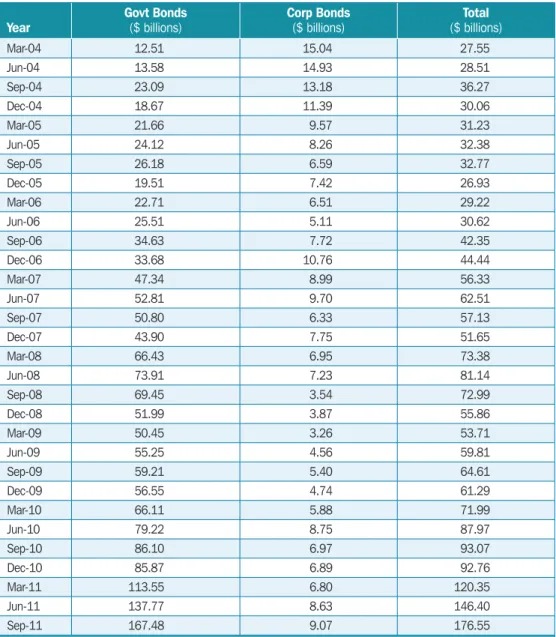
This phenomenal development of the Malaysian bond market has largely been achieved through the exceptional growth of the corporate bonds and Sukuk markets. Malaysia’s well- developed government bond market is complemented by a sizeable corporate bond market, which constituted 40% of the market size as of the end of the third quarter of 2011.1 Malaysia’s bond market is predominantly offered to and traded by sophisticated investors, which are generally associated to those listed in Schedule 6 and 7 under the Capital Market and Services Act 2007 (CMSA) Appendix 1.1A.
The market also offers a wide range of instruments, considering the fact it has the largest Sukuk market in the world. Sukuk, or Islamic bonds which are issued on Islamic principles, play a major role in Malaysia’s capital market development. With the Sukuk market providing the springboard, the past decade has also witnessed the rapid growth of Malaysia’s Islamic capital market.
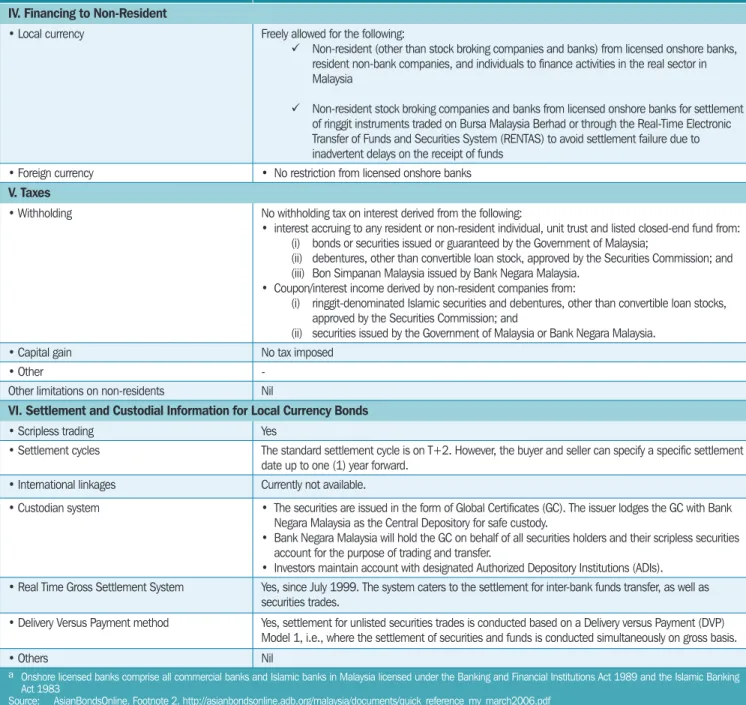
A testament to the significance of the Malaysian fixed-income market in the global bond markets is its inclusion in a number of global indices, such as the inclusion of Malaysian government bonds in the World Government Bond Index, which is one of the most referenced benchmark market indices by the international investing community, as well as in the Barclays Global Aggregate Index. Malaysian government Sukuk are also included in the Dow Jones Citigroup Sukuk Index, the world’s first Sukuk index. Malaysia has allowed a diverse group of foreign entities to issue ringgit- denominated bonds in the country. By the end of September 2011, 34.5% of Malaysian government bonds outstanding were held by foreign investors, compared with 21.5% by the end of December 2010 and 18.1% by the end of June 2010.
1 As of September 2011 based on data from AsianBondsOnline. http://asianbondsonline.adb.org/malaysia/ data/bondmarket.php?code=LCY_in_USD_Local
I. Structure, Type, and
Characteristics of the Market
Domestic and foreign investors can buy and sell conventional and Islamic debt instruments through over-the-counter (OTC) markets. Rules on hedging have been liberalized to allow residents and non-residents into hedging arrangements with licensed offshore banks.
In Malaysia, nearly all securities are scripless, with securities transferred electronically via Bank Negara Malaysia (BNM)’s Real-Time Electronic Transfer of Funds and Securities (RENTAS) system, which is operated by its wholly-owned subsidiary, Malaysian Electronic Clearing Corporation (MyClear). Transfer instructions are conducted on a trade-by-trade basis.
Securitization in Malaysia began in 2001, following the introduction of the Asset-Backed Securities Guidelines by Securities Commission Malaysia. The special purpose vehicle (SPV) set up by National Mortgage Corporation (Cagamas) is currently the largest issuer of securitized instruments in Malaysia through the securitization of housing loans of government staff. Cagamas is also an active issuer of bonds in Malaysia.
In 2004, the Securities Commission Malaysia (SC) on its website allowed public access to the Principal Terms and Conditions for all corporate bond and Sukuk issuances approved by the SC. Full access to all issuance documents, however, was made available to Schedule 6 CMSA investors upon subscription. This facility allows investors to utilize the information available and enables them to make their own evaluation on the merits and risks of the investment.
In 2006, BNM launched Bond Info Hub, a one-stop centre detailing all bond-related information in Malaysia. Bond Info Hub is a single source of information on the Malaysian bond market for the global investment community. In addition to being a key initiative to promote the domestic bond markets, Bond Info Hub acts as a conduit to correct misconceptions, especially among foreign investors, about the state of market development in Malaysia. Also in 2006, the Securities Commission issued Guidelines on the Registration of Bond Pricing Agencies to complement the government's objective of buiding more efficient and liquid bond and Sukuk markets.
B. Types of Bonds
Malaysia’s local currency bond market is active for both conventional and Islamic bonds. A futures market is also available for Malaysian government securities. Investors may employ different investment and risk management techniques. Also, licensed and non-financial institutional investors may enter into repo and reverse- repo transactions.
1. By Issuer Category
a. Bonds Issued by Public Entities i. Government Securities
The types of government debt securities and Sukuk include: (1) Malaysian Government Securities
Malaysian Government Securities (MGS) are long-term bonds issued by the
government to raise funds from the local financial market. These coupon-bearing bonds are the most actively traded bonds in the Malaysian bond market. Aside from MGS, callable MGS have also been issued in 2006 to provide the government an alternative to “redeem the bond ahead of its maturity date” 2
(2) Malaysian Treasury Bills (MTB)
Malaysian Treasury bills (MTBs) are “short-term securities issued by BNM on behalf of the government. Treasury bills are used for working capital.”3
(3) Malaysian Islamic Treasury Bills (MITB)
Malaysian Islamic Treasury bills (MITBs) are short-term securities issued by the Government of Malaysia based on Islamic principles. MITBs are usually issued on a weekly basis, with original maturity of 1 year.
(4) Government Investment Issues
“Government investment issues (GIIs) are non-interest-bearing government securities based on Islamic principles issued by the government and placed on a competitive tender with maturities of 3 to 10 years. Funds are used for development expenditures.”4
(5) Sukuk Simpanan Rakyat
Sukuk Simpanan Rakyat, issued on a scripless basis by BNM on behalf of the government, is an investment instrument for Malaysian citizens who are 21 years old and above.
(6) Merdeka Savings Bonds
These are scripless bonds structured on Shariah principles. These bonds represent an additional savings instrument for Malaysian citizens who are 56 years old and above. Merdeka savings bonds are “targeted at retirees by offering a slightly higher return than the market rate, and a tax exemption. A unique feature of [the] Merdeka savings bonds is that they are all based on the Islamic banking concept of bai’ al-inah (sell-and- buy-back arrangement).”5
ii. Bank Negara Monetary Notes (BNMN) (1) Bank Negara Monetary Notes
Bank Negara Monetary Notes (BNMNs) are discounted or coupon-bearing government securities with maturities of 91, 182, 364 days, and 1 to 3 years. BNMNs are issued for the purpose of managing liquidity in both conventional and Islamic financial markets, and can be discount-based or coupon-based. “BNMNs are offered through competitive auction through principal dealers.”6 The maximum maturity of BNMN is 3 years. BNMNs replaced the Bank Negara Bills and Bank Negara Negotiable Notes. (2) Floating Rate Bank Negara Monetary Notes
Floating Rate Bank Negara Monetary Notes (BNMNF) are instruments used for
2 AsianBondsOnline. http://asianbondsonline.adb.org/malaysia/structure/instruments/bond_types.php
3 Footnote 2.
4 Footnote 2.
5 Footnote 2.
6 Footnote 2.
implementing monetary policy and in managing liquidity in the financial market. Floating rate BNMN issuance is conducted through competitive Dutch auction (uniform price) via the Principal Dealer network where market participants bid the tender based on spread.
iii. Sukuk Bank Negara Malaysia Issues
Sukuk Bank Negara Malaysia Ijarah (SBNMI) are zero-coupon bonds with maturities of 1 to 2 years. SBNMI are based on the concept of sale and lease back (al-Ijarah).7 A special-purpose vehicle (SPV) has been established to issue the Sukuk Ijarah. b. Bonds and Notes Issued by Private Entities
Financial institutions are the main issuers of corporate bonds and notes. i. Financial Institutions
ii. Local and Foreign Corporates
The types of corporate bonds issued on the Malaysian capital market are classified as straight, convertible, bonds with warrants, floating rate, zero coupon, mortgage bonds, Islamic bonds, secured and unsecured bonds, and guaranteed bonds.
(1) Medium-Term Notes
As the name implies, medium-term notes (MTNs) are debt papers issued on a medium- term basis, with tenures of more than 1 year and redeemable at par on maturity. They may carry fixed- or floating-rate coupons, and may be issued both on conventional and Islamic principles and by direct placement or tender. Based on the Private Debt Securities Guidelines of the SC of Malaysia, which was revised in August 2011, if a debt program involves an issuance of commercial papers (CPs) or a combination of MTNs and CPs, the tenure for such programs must not exceed 7 years. For a stand- alone MTN program, the 7-year tenure restriction does not apply.
Islamic MTNs provide semi-annual dividends depending on the structure used. This type of instrument was introduced to bridge the gap between short-term CPs and long-term corporate bonds. They differ from corporate bonds in that they are sold in relatively small amounts either on a continuous or on an intermittent basis. This type of debt program is used by a company to obtain a constant stream of cash flow from its debt issuance. It allows a company to tailor its debt issuance to meet its financing needs, only tapping the market for funds as and when required.
MTNs allow a company to register with the SC only once, instead of registering for every issue with differing maturities.
(2) Floating-Rate Notes
Floating-rate notes (FRNs) are debt securities with variable (floating) interest rates that are linked to those in the money markets. Their tenures range from 3 to 7 years. FRNs are usually pegged at a fixed spread to interbank rates corresponding to the maturity periods of the notes. In contrast to a coupon rate that is fixed for the entire life of the bonds, the coupon rate for FRNs is pegged to an agreed benchmark. It is
7 Footnote 2.
periodically reset at a stated margin over a reference rate, usually the Kuala Lumpur Interbank Offered Rates (KLIBOR), e.g., the 6-month KLIBOR for semi-annual coupons, or 12-month KLIBOR for coupons payable annually.
FRN investors are usually financial institutions with floating rate liabilities. Other investors use FRNs as substitutes for money market instruments and as hedges against rising interest rates.
(3) Commercial Paper
A CP is a short-term revolving promissory note, with maturities from 1 month to 1 year. In practice, a CP is often rolled over upon maturity until the expiry of the issue program. Most investors hold CPs until maturity as these are short term in nature. (4) Notes Issuance Facility
Under this facility, a borrower can issue short-term notes of less than 1 year maturity, with common tenures being 1, 3 and 6 months. The tenure of the facility typically ranges from 3 to 5 years. The notes are issued in specific denominations and sold at a discount to their face value. The total amount of outstanding notes is capped by the approved facility amount.
The notes are subscribed by participating investors, normally financial institutions. Upon maturity, the notes are either redeemed at par or the principal is rolled over with the issuance of new notes. In the latter scenario, the discounted interest is paid to note holders at the time of the rollover.
The notes issuance facility (NIF) is a low-cost substitute for syndicated bank loans since its rates are pegged to the KLIBOR and not to the base lending rate (BLR), as in the case of bank loans.
(5) Revolving Underwritten Facility and Revolving Underwritten Notes Issuance Facility (RUNIF):
When the NIF includes underwriting services, the arrangement takes the form of a revolving underwritten facility (RUF) or revolving underwritten notes issuance facility (RUNIF). In the event that the notes are undersubscribed, the underwriters are committed to take up the unsold portion at a pre-determined rate.
(6) Multilateral Development Banks
The World Bank defined Multilateral Development Banks (MDBs) as institutions that provide financial support and professional advice for economic and social development activities in developing countries. The term Multilateral Development Banks typically refers to the World Bank Group and four Regional Development Banks:
(i) World Bank
(ii) African Development Bank (iii) Asian Development Bank
(iv) European Bank for Reconstruction and Development (v) Inter-American Development Bank Group8
8 World Bank. http://web.worldbank.org/WBSITE/EXTERNAL/EXTABOUTUS/0,,contentMDK:20040614- menuPK:41699-pagePK:43912-piPK:44037-theSitePK:29708,00.html
(7) Other Types of Government-Related Bonds (a) Khazanah Bonds
Khazanah bonds are issued by Khazanah National, the investment holding arm of the Government of Malaysia. These unsecured zero-coupon bonds are based on the Islamic principles of murabahah,9 with maturities of 3, 5, 7 or 10 years. (b) Cagamas Bonds
Securities issued by Cagamas are called Cagamas bonds (CAGB) in the domestic market.
Cagamas papers are unsecured bearer bonds issued by Cagamas, the national mortgage corporation established in 1986 to promote the secondary mortgage market in Malaysia. Cagamas issues debt securities and Sukuk to finance the purchase of housing loans and other consumer receivables from financial institutions, selected corporations, and the government. It is the second largest issuer of securities after the Government of Malaysia, and the major issuer of asset-backed securities in Malaysia. Various types of Cagamas papers are available in the market:
(i) Cagamas fixed-rate bonds. These have tenures of 1.5 to 10 years with fixed coupon rates determined through tenders submitted by principal dealers. Interest is paid semi-annually.
(ii) Cagamas floating-rate bonds. These have tenures of up to 10 years and an adjustable interest rate pegged to the 3- or 6-month KLIBOR. The interest rate is reset every 3 or 6 months, with interest paid at those intervals. (iii) Cagamas notes (CAGN). CAGNs are short-term instruments with
maturities of 1 to 12 months, and issued at a discount from face value to reflect the implied interest rate.
(iv) Sanadat Mudharabah Cagamas (SMC). SMCs are Islamic bonds issued under the Islamic principle of mudharabah (profit sharing) to finance the purchase of Islamic home-financing debts, granted on the basis of bai’ bithaman ajil10 and the purchase of Islamic hire-purchase debts, which are allowed under the principle of ijarah thumma al-bai.11 They are redeemable at par at maturity unless there is principal diminution. Tenures extend up to 10 years.
(v) Cagamas Bithaman Ajil Islamic Securities (CAGABAIS). Formerly known as Sanadat ABBA Cagamas (SAC), CAGABAIS are Islamic bonds issued under the Islamic principle of bai bithaman ajil to finance the purchase of Islamic home-financing debts and Islamic hire-purchase debts. The bonds
9 According to Financial Islam.com, murabaha is a form of sale where the cost of the goods to be sold as well as the profit on the sale is known to both parties. The purchase and selling price and the profit margin must be clearly stated at the time of the sale agreement. Payment of the Murabaha price may be in spot, in instalments or in lump sum after a certain period of time.
10 Bai’ bithaman ajil means deferred payment scale.
11 ijarah thumma al-bai means hire purchase.
are redeemable at par together with the dividend due on maturity date. They also have tenures of up to 10 years.
2. By Type of Bonds
a. Straight Bonds (Government Bonds and/or Corporate Bonds)
These are bonds with a fixed coupon rate, maturing on a date fixed at the time of issue. They are called “plain vanillas” in some debt markets, as these bonds do not have any enhancement like warrants attached to them, or additional features such as put or call options. They also tend to carry relatively higher coupon rates. Coupon or interest payments are made either semi-annually or annually. Upon maturity, the principal or par value is paid to the bond holder.
b. Floating-Rate Notes
Please refer to page 8 for details. c. Zero-Coupon Bonds
Zero-coupon bonds are fixed-income securities sold at a discount. They pay no periodic interest or coupon, and have a final redemption value equal to par. The difference between the purchase price and the redemption value equals the return on the investment.
Funds are not blocked off until maturity, as investors are free to trade the bonds and, if necessary, liquidate the bonds for cash.
d. Islamic Bonds
Islamic bonds, also called Sukuk, are structured to comply with Shariah principles, which prohibit the charging of interest.
Malaysian authorities have taken the lead in developing and innovating new Islamic securities structures and in pioneering the Islamic capital market.
e. Medium-Term Notes
Please see discussion on MTNs on page 8. f. Convertible Bonds
Convertible bonds are fixed-rate securities that grant the bondholders the right to convert the bonds into a specific number of the issuer’s common shares at a predetermined conversion rate and price. This feature makes convertible bonds more desirable to prospective purchasers seeking a combination of equity and fixed-income features. Convertible bonds appeal to investors who seek both cash flow and safety of a bond while still enjoying the prospects of capital appreciation should the company’s ordinary shares perform well.
g. Bonds with Warrants
Fixed-rate bonds are commonly issued with detachable warrants (or transferable subscription rights). A warrant is a type of deferred-rights issue that gives the holder the option to purchase a specified number of the issuer’s shares at a set price (exercise price) within a certain time period (exercise period). The exercise price of a warrant is predetermined and is the price that would have to be paid by a warrant holder to
convert his warrants into ordinary shares. The warrants are usually detached from the bonds and sold to a different group of investors. Both instruments are then traded separately. Investors find it an attractive option to buy shares at a predetermined price, although at the outset the cost of the warrant is effectively subsidizing the issuer’s borrowing cost.
Bonds with warrants allow listed companies to raise capital, initially in the form of debt and subsequently in the form of equity, at a premium to its current share price and at a lower interest cost than would be achievable through a straight-bond issue. When the warrants are exercised, new money is used to subscribe for the shares, increasing the borrower’s capitalization. This is in contrast to a convertible bond where an exchange of shares for bonds takes place.
As a warrant entitles the bondholder to an option to purchase a specified amount of the company’s shares, bonds issued with warrants have low coupon rates to compensate the issuers.
In addition, there are also stapled securities issued in the market. These are debt securities issued with preference shares, which enable the issuer to pass on its tax credit to the holders of the papers.
h. Asset-Backed Securities
Asset-backed securities (ABS) are securities backed by assets. Among others, these assets could be mortgages, loans or receivables. ABS are also issued based on Islamic principles in Malaysia. Apart from mortgage-backed securities (MBS), other examples of ABS are collateralized loan obligations and securitization of receivables.
Cagamas is the pioneer in local residential MBS. 3. Money Markets Instruments
a. Commercial Paper
Commercial papers refer to either conventional or Islamic short-term papers issued with original tenor of 1 year or less.
b. Repo
A repo is a contract to sell and, subsequently, repurchase securities at a specified date and price. It is also known as buyback arrangement.
4. By Listing Status
a. Debt Securities and Sukuk Listed and Traded on Bursa Malaysia
Debt securities listed on the exchange, called loan stocks, have three types: (a) Redeemable Convertible Loan Stocks
These are debt securities that give the holders the right to convert the loan stocks into new ordinary shares during a specified period at a predetermined conversion rate and price. The issuer has the obligation to redeem the loan stocks at par upon maturity, together with interest, if the loan stocks have not been converted into shares.
(b) Irredeemable Convertible Loan Stocks
These are debt securities that confer the holders the right to convert the stocks into new ordinary shares. Nonetheless, the issuer will not redeem the stocks and such stocks will automatically be converted into ordinary shares on maturity.
(c) Redeemable Non-convertible Loan Stocks
These are debt securities that cannot be converted into ordinary shares. The company is obligated to redeem the loan stocks upon maturity.
b. Debt Securities and Sukuk Traded Over the Counter
Debt securities and Sukuk that are traded over the counter are those issued, offered, or subscribed in accordance with Sec. 229(1) and Sec. 230(1) of CMSA. These bonds can be listed under Bursa Malaysia’s Exempt Regime, but not traded on Bursa Malaysia.
C. Methods of Issuing Bonds
1. Auction
Auction is undertaken by BNM for government bonds and Principal Dealers for BNM notes.
a. Auction by BNM
BNM, via competitive auction, issues government bonds on behalf of the government. Successful bidders are determined according to the lowest yields offered, and the coupon rate is fixed at the weighted average yield of successful bids.
b. Auction by Principal Dealers
Principal Dealers offer BNM notes through competitive auction. 2. Direct Placement or Tender
Bonds issued by other statutory bodies and government-owned corporations, as well as corporate bonds, are issued via direct placement or tender.
D. Bonds and Sukuk Listed under the Exempt Regime on Bursa Malaysia
1. Listing of Bonds and Sukuk in Bursa Malaysia
The term “sophisticated investor” is not explicitly defined in the CMSA. However, Schedules 6 (Sec. 229) and 7 (Sec. 230) (see Appendix) of the CMSA exempt these type of issues and offers to sophisticated or professional investors and their transactions from prospectus requirements.
To promote the Malaysian debt securities and Sukuk market while enhancing the breadth and depth of investment options on the Malaysian capital market, debt securities and Sukuk can now be listed on Bursa Malaysia under a new exempt regime by both listed and non-listed issuers. Under an exempt regime, debt securities or Sukuk which are listed on the Exchange will not be quoted nor traded on the Exchange. Debt securities or Sukuk listed on the Exchange may be denominated in foreign currencies but must have original maturity of more than 1 year.
For the features under an exempt regime, refer to Bursa Malaysia’s Chapter 4B on listing under an exempt regime.12
2. Size of the Market
Listing under the Bursa Malaysia exempt regime currently comprises of 17 Sukuk issuers and five conventional bonds issuers. The total listed foreign currency Sukuk and bonds amounted to USD6.65 billion, SGD1.5 billion and CNY500 million, respectively. Total listed Malaysian ringgit-denominated Sukuk and bonds amounted to MYR16.7 billion with Cagamas MBS topping the list with MYR4.12 billion conventional bonds and MYR3.37 billion Sukuk, respectively. More details may be found in the Bursa Malaysia website on listed bonds under an exempt regime.13
E. Offers of Bonds to Professionals
According to Schedules 6 and 7 of the CMSA, professional investors are referred to as 'sophisticated investors':
(i) A holder of a Capital Markets and Services Licence who carries on the business of dealing in securities.
(ii) A holder of a Capital Markets and Services Licence who carries on the business of fund management.
(iii) A licensed offshore bank under the Offshore Banking Act 1990. (iv) A licensed offshore insurer under the Offshore Insurance Act 1990.
(v) A licensed institution under the Banking and Financial Institution Act 1989 or an Islamic Bank under the Islamic Banking Act 1983.
(vi) An insurance company registered under the Insurance Act 1996.
As stated above, under the exempt regime, prospectus exemption is adapted to the offers of bonds to sophisticated investors.
F. Definition of “Sophisticated Investors” in Malaysia
In Malaysia, a definition for sophisticated investors exists under items 9, 10, and 11 of Schedules 6 and 7 of the Capital Markets and Services Act. The background on the review of the categories of investors who are referred to as ‘sophisticated investors’ and the current framework of ‘So-called Sophisticated Investors’ are explained as follows:
12 Bursa Malaysia. http://www.bursamalaysia.com/website/bm/regulation/rules/listing_requirements/
13 Footnote 8. http://www.bursamalaysia.com/website/bm/market_information/listed_bonds/exempt_ regime.htm
Box 1.1 Framework for Sophisticated Investors
2.1 Current framework
2.1.1 The determination as to whether an investor is a “sophisticated investor” or a “retail investor” is important for several reasons.
First, only sophisticated investors should have access to complex and risky capital market investment products such as structured products and units in wholesale funds.a
This approach is consistent with the SC’s regulatory policy of not encouraging retail investors to have exposure to complex investment products, as retail investors may not have the necessary knowledge and risk tolerance to invest in such products.b
Second, the disclosures that are to be made to retail investors are more extensive and prescriptive as opposed to the disclosures that are made to sophisticated investors. For example, when an offering of securities is made to retail investors, the offering must be accompanied with a registered prospectus.
2.1.2 The term “sophisticated investor” is not explicitly defined in the Capital Markets and Services Act 2007 (CMSA). However, Schedules 6 and 7 of the CMSA exempt the following investors and transactions from prospectus requirements:
(a) A unit trust scheme or prescribed investment scheme;
(b) A holder of a Capital Markets and Services Licence who carries on the business of dealing in securities; (c) A holder of a Capital Markets and Services Licence who carries on the business of fund management;
(d) The aggregate consideration for the acquisition is not less than MYR250,000 or its equivalent in foreign currencies for each transaction whether such amount is paid for in cash or otherwise;
(e) An individual whose total net personal assets exceed MYR3 million or its equivalent in foreign currencies;
(f) A corporation with total net assets exceeding MYR10 million or its equivalent in foreign currencies based on the last audited accounts; (g) A licensed offshore bank under the Offshore Banking Act 1990;
(h) A licensed offshore insurer under the Offshore Insurance Act 1990;
(i) A licensed institution under the Banking and Financial Institution Act 1989 or an Islamic Bank under the Islamic Banking Act 1983; (j) An insurance company registered under the Insurance Act 1996;
(k) A statutory body established by an Act of Parliament or an enactment of any State; and (l) A pension fund approved by the Director General of Inland Revenue:
1.1.3 The above classification was adopted in year 2000 by the Securities Commission (“SC”) when the prospectus requirements for the offer and invitation of securities were moved from the Companies Act 1965 to the Securities Commission Act 1993 via the Securities Commission (Amendment) Act 2000.
1.1.4 In drafting the excluded offers above, the SC has adopted and expanded the exempted offers list which existed under section 47B of the Companies Act 1965 and the Companies (Exempt Purchasers) Order 1997. Since year 2000, no review has been undertaken on the classification of “sophisticated investors”.
1.1.5 Although the original intention behind Schedules 6 and 7 of the CMSA (Schedules 6 and 7 of CMSA were in fact Schedules 2 and 3 of the Securities Commission Act 1993.) was to clarify situations when an offer of securities would not need to be accompanied with a registered prospectus, over time, the use of the Schedules have expanded and are now used as a means to determine who are sophisticated investors for the purposes of offering complex investment products.
3.1 Qualifying criteria and classification of “sophisticated investors”
3.1.1 Our research indicates that the qualifying criteria to determine whether a person is a “sophisticated investor” can be either one or more of the following:
(a) the financial means test where consideration would be given to the net assets, portfolio of investments held by the investor or the income earned by the investor.
In some jurisdictions, this test may take into account assets, portfolio of investments or income that is held or received jointly by the investor and his immediate family members.
Where these criteria are imposed on an individual and that individual satisfies the criteria, that individual is usually referred to as a high net worth individual. Where an entity satisfies this criteria, that entity is then referred to as a high net worth entity; and
continued on next page
(b) the requisite knowledge test where consideration is given to the knowledge that is presumed to be held or exhibited to be held by the investor.
Some jurisdictions impose the knowledge test as an additional criterion that must be satisfied by an individual who has met the financial means test.
The reason for imposing this additional knowledge requirement is that once it is satisfied, certain processes in respect of sales practices need not be observed when dealing with such investors.
In some cases, the investor concerned is deemed to have such knowledge where it involves entities which have been licensed or whose ordinary course of business includes making investments.
These include licensed banks, corporations, unit trust funds, collective investment schemes[,] and those who hold a licence to carry out a regulated activity.
This category of sophisticated investors is commonly referred to as professional investors. 3.6 Professional investors
3.6.1 Professional investors, by virtue of their experience and knowledge [,] would be in a better position to make informed decisions and protect their own interests.
3.6.2 Within Schedules 6 and 7 of the CMSA, professional investors would include—
a. A holder of a Capital Markets and Services Licence who carries on the business of dealing in securities; b. A holder of a Capital Markets and Services Licence who carries on the business of fund management; c. A licensed offshore bank under the Offshore Banking Act 1990;
d. A licensed offshore insurer under the Offshore Insurance Act 1990; e. A licensed institution under the Banking and Financial Institution Act 1989 or f. an Islamic Bank under the Islamic Banking Act 1983; and
g. An insurance company registered under the Insurance Act 1996.
a For example, the Guidelines on the Offering of Structured Products provides that an issue, offer or invitation of unlisted structured products can only be made to investors listed in Schedules 2 and 3 of the SCA (now Schedules 6 and 7 of the Capital Markets and Services Act). The Guidelines on Wholesale Funds states that units in a wholesale fund can only be offered to qualified investors. A qualified investor is an individual whose total net personal assets exceed MYR3 million or its equivalent in foreign currencies, or a corporation with total net assets exceeding MYR10 million or its equivalent in foreign currencies based on the last audited accounts.
b Moving forward the SC may consider whether retail investors should have exposure to some of these products, particularly structured products and unlisted debt securities. Exposing retail investors to such products, however, will be complemented with an enhanced sales practices regime. Proposals to enhance the existing sales practices regime are further discussed in Part 2 of this paper.
Note: Emphases added by the authors.
Source: Public Consultation Paper No. 1/2010. Review of Sophisticated Investors and Sales Practices for Capital Market Products, Securities Commission. Box 1.1 continuation
Sec. 229 of the CMSA defines excluded offers or excluded invitations, and Sec. 230 defines excluded issues.
Both Schedule 6 and Schedule 7 specify certain provisions in Division 3 that a prospectus shall not apply to “excluded offers” or “excluded invitations” and
“excluded issues”.
An information memorandum issued by a person or his agent purporting to describe the business and affairs of the person in respect of any excluded offer or excluded invitation shall, however, be deemed to be a prospectus as it relates to the liability of the person or his agent for any statement or information that is false or misleading, or from which there is a material omission.
G. Quick Reference on Sophisticated Investors
Table 1.1 Quick Reference on Sophisticated Investors
Sophisticated Investor Sophisticated
Investor
Professional Investor
Qualified Investor
a. A unit trust scheme or prescribed investment scheme;
b. A holder of a Capital Markets and Services Licence who carries on the business of dealing in securities;
c. A holder of a Capital Markets and Services Licence who carries on the business of fund
management;
d. The aggregate consideration for the acquisition is not less than MYR250,000 or its equivalent
in foreign currencies for each transaction whether such amount is paid in cash or otherwise; e. An individual whose total net personal assets exceed MYR3 million or its equivalent in foreign
currencies;
f. A corporation with total net assets exceeding MYR10 million or its equivalent in foreign currencies based on the last audited accounts;
g. A licensed offshore bank under the Offshore Banking Act 1990;
h. A licensed offshore insurer under the Offshore Insurance Act 1990;
i. A licensed institution under the Banking and Financial Institution Act 1989 or an Islamic Bank
under the Islamic Banking Act 1983;
j. An insurance company registered under the Insurance Act 1996;
k. A statutory body established by an Act of Parliament or an enactment of any State; l. A pension fund approved by the Director General of Inland Revenue: Source: Schedules 6 and 7 of the Capital Markets and Services Act, 2007, as amended.
H. Credit-Rating Agencies and Credit Rating of Bonds
There are two credit-rating agencies (CRAs) in Malaysia that provide independent opinions on the credit risks and potential default risks of specific issuers. The first rating agency, Rating Agency Malaysia (now known as RAM Ratings Services, RAM), was established in November 1990; and the second, Malaysian Rating Corporation (MARC), was incorporated in October 1995.
Malaysia is one of the first countries in the world to require the recognition of CRAs for rating a bond or Sukuk issue. This is in recognition of their vital role in evaluating the probability of default of debt securities or a Sukuk issue, and the importance investors place on ratings for their investment decisions, despite the fact that all rating reports carry a disclaimer expressly stating that “a rating is not a recommendation to purchase, sell or hold a security’s market price or its suitability for a particular investment, nor does it involve any audit by the rating agency.”
CRAs are required to be registered by the SC for rating debt or Sukuk issues in Malaysia, pursuant to the “Guidelines on Registration of Credit Rating Agencies,” which was revised in March 2011. A CRA is also required to adopt the International Organization of Securities Commissions (IOSCO) CRA Code in its own code of conduct, and to disclose this on its website. Where the CRA’s code of conduct differs in substance from the provisions of the IOCSO CRA Code, the rating agency must explain where and why these differences exist, and fully disclose such explanation on its website.
In Malaysia, generally all debt securities and Sukuk issues are required to be accompanied by a credit rating at all times. A credit rating is a mechanism through which an independent third party, i.e. the CRA, makes an assessment on the likelihood of a corporate issuer’s default on its debt repayments. A credit rating focuses on a specific debt instrument and not the overall creditworthiness or financial standing of the corporate issuer. A rating will take into consideration various enhancement tools like guarantees, sinking funds, letters of credit, or any other mechanism devised to reduce the default risk of specific issues.
Hence, the work of a CRA provides the benefits detailed in the next few paragraphs: 1. Information Disclosure
As the debt securities and Sukuk market develops and the nature and variety of debt instruments and Sukuk increase, even experienced investors may find it difficult to make informed choices because of lack of accessibility or the complexity of information about the corporate issuer. The nature and specialization of a CRA place it in a position where it has access to public as well as private information pertinent to the assessment of credit risk. Such information is not usually accessible to the individual investor. A competent CRA, therefore, bridges this information gap between the issuers of debt or Sukuk and investors. Conversely, markets that are inefficient will lead to incorrectly-priced securities, which do not reflect the fundamental values of the assets and, thus, lack information necessary to investors. In providing information on default risk, investors have access to information that enables them to establish benchmarks for comparing the risks and returns on their investments.
2. Investor Protection
The independent, objective analysis of the credit quality of debt and Sukuk issues aids the investor in making informed choices to determine the level of risk and associated returns they are willing to undertake for their investment.
Besides the predictive value of ratings, the continuous surveillance of a rated instrument acts as an early-warning system for investors on any changes in the quality of the rated debt or Sukuk, so that investors may reassess their positions and realign their portfolios accordingly.
3. Lower Cost of Borrowing
A high rating assigned to a corporate borrower translates into lower cost of borrowing for the issuer as the risk premium demanded by investors is lower. Corporate borrowers are thus motivated to improve their financial structures and operating risks to obtain high ratings for their private debt securities (PDS) or Sukuk issues. This, in turn, enables companies to raise more funds to finance their expansion and the management of their activities, resulting in higher allocative efficiency.
4. Aids Pricing Decisions
The interest payable on corporate debts and profit payments for Sukuk are linked to their assigned ratings. Therefore, credible and objective ratings are invaluable aids to investment bankers, underwriters and brokers when determining the pricing of debt instruments. To promote transparency in the debt securities and Sukuk market, information on ratings is widely disseminated to all existing and potential PDS and Sukuk investors in a timely manner.
Obligation to be Rated by a Recognised Rating Agency
Currently, all Malaysian ringgit corporate bonds are required to be rated by a rating agency registered by the SC. However, the SC exempts certain corporate bonds from being rated, such as those listed below:
(i) Irredeemable convertible loan stocks.
(ii) Foreign currency-denominated private debt securities.
(iii) Convertible bonds or loan stocks and exchangeable bonds which fulfill the following requirements:
(a) Investors of bonds or loan stocks are given the right to convert or exchange the instruments into the underlying share at any time or within a reasonable period or periods during the tenure of the bond issue; and
(b) The underlying shares are listed on the stock exchange. (iv) Private debt securities:
(a) which are non-transferable and non-tradable; (b) whose investors do not require a rating; and
(c) the principal adviser to ensure that both criteria above are met prior to the applicable issue, offer or invitation.
Please refer to Chapter 7.09 of the Private Debt Securities Guidelines for full details.
I. Financial Guarantee Institution
Financial guarantee institutions (FGIs) help raise the credit rating of bond issues, which otherwise would normally be below investment grade, to a level deemed as investment grade by investors by lending their own sterling ratings to these bond issues. Issuers will need to pay a premium, commensurate with the perceived risk of the issuer, to these FGIs who will undertake to pay the interest and capital repayment in the event that the issuer fails to do so.
Danajamin Nasional (Danajamin), Malaysia’s first financial guarantee insurer, was established in May 2009 to provide financial guarantee insurance for bonds and Sukuk issuances, which enabled access to the PDS market to viable Malaysian companies. Jointly owned by the Minister of Finance Incorporated (50%) and the Credit Guarantee Corporation Malaysia (50%), Danajamin is rated AAA by both RAM and MARC. Danajamin have an issued and paid-up capital of MYR1 billion and another MYR1 billion callable capital. Its underwriting capacity is up to MYR15 billion. This important initiative is also expected to help stimulate the local economy by guaranteeing bonds issued by companies in key sectors like infrastructure and services to finance viable projects.
J. Governing Laws on Bond Issuance
Under the governing law on bond issuances in Malaysia, all issuances of primary securities are governed under Sec. 212 (Part VI: Issues of Securities and Take- Overs and Mergers, Division 1, Proposals in Relation to Securities Proposals to be
submitted to Commission) of the CMSA with the exception of government bonds. Any person or entity dealing in government or corporate bonds is required to be licensed under CMSA.
Specific laws governing different types of bonds are summarized as follows: 1. Government Bonds
Government securities dealers are typically banking institutions licensed and regulated by BNM. Besides commercial banks and Islamic banks, investment banks are also participants in the inter-bank market for government securities.
The “Malaysian Code of Conduct for Principals and Brokers in the Wholesale Money and Foreign Exchange Markets,” issued by BNM, sets out best market practices, principles and standards to be observed in the Malaysian market. The objective is to uphold market integrity and promote the highest level of professionalism.
In addition, BNM also issues rules and guidelines governing the issuance, allotment, interest payment, redemption, and settlement of scripless securities under the Fully Automated System for Issuing/Tendering (FAST) and RENTAS. The aim of these guidelines is to provide a uniform set of rules to promote operational efficiency, market integrity and market transparency.
Detailed information on the rules and guidelines issued by BNM can be obtained from the FAST website.14
2. Corporate Bonds and Sukuk
The CMSA, which is administered by the SC, governs a substantial part of the activities in the domestic corporate debt securities and corporate Sukuk markets. On 1 July 2000, the SC became the single regulator for the Malaysian corporate debt securities and corporate Sukuk markets, and moved towards a full disclosure-based regulatory regime with the issuance of the Guidelines on the Offering of Private Debt Securities. This was followed by the issuance of the Guidelines on the Offering of Islamic Securities.
The SC issues guidelines on the issuance of corporate bonds and Sukuk, supervises trading activities in the secondary market, and conducts joint examinations and inspections of investment banks together with BNM. The SC’s guidelines and regulations relating to corporate bonds and Sukuk issuances represent part of the government’s initiatives to develop the debt securities and Sukuk market in Malaysia, by putting in place an efficient and facilitative issuance process. Towards this end, the regulatory framework for the issuance of corporate bonds and Sukuk has been developed with the following objectives:
(i) To rationalize a fragmented regulatory structure;
(ii) To expedite and create a facilitative and transparent approval scheme for corporate debt securities and corporate Sukuk;
(iii) To impose greater disclosure requirements for better protection of corporate
14 Fully Automated System for Issuing/Tendering (FAST). https://fast.bnm.gov.my/fastweb/public/ MainPage.do
debt securities and corporate Sukuk investors, and to enhance legal protection afforded to these investors; and
(iv) To enhance secondary market liquidity for corporate debt securities and corporate Sukuk.
Over the years, the SC has issued a comprehensive set of guidelines, regulations and practice notes to guide and clarify the requirements for all aspects of corporate debt securities and corporate Sukuk issues. A complete set of these guidelines, regulations and practice notes is available on the SC’s website.15
K. Transfers of Interests in Bonds
Malaysian Government debt securities are scripless, thus securities transfer is electronic. In the RENTAS system operated by MyClear (a wholly-owned subsidiary of BNM), transfer instructions are done on a trade-by-trade basis, with the transfer of securities running simultaneous with the transfer of funds for payment.16
L. Definition of Securities
1. Securities
Securities are defined as:
(i) debentures, stocks or bonds issued or proposed to be issued by any government; (ii) shares in, or debentures of, a body corporate or an unincorporated body; or (iii) unit trusts or prescribed investments, and includes any right, option or interest
in respect thereof, but does not include futures contracts.17 2. Debentures
Debenture includes debenture stock, bonds, notes and any other evidence of indebtedness of a corporation for borrowed monies, whether or not constituting a charge on the assets of the corporation, but shall not be construed as applying to any of the following:
(i) any instrument acknowledging or creating indebtedness for, or for money borrowed to defray the consideration payable under, a contract for sale or supply of goods, property or services, or any contract of hire in the ordinary course of business;
(ii) a check, banker’s draft or any other bill of exchange or a letter of credit; (iii) a banknote, guarantee or an insurance policy;
(iv) a statement, passbook or other documents showing any balance in a current, deposit or savings account;
15 The complete guidelines regulations and practice notes are also available in the Securities Commission of Malaysia (SC) website. http://www.sc.com.my
16 More information is available on the Bank Negara Malaysia website. http://bondinfo.bnm.gov.my/ portal/server.pt?open=514&objID=27257&parentname=CommunityPage&parentid=3&mode=2& in_hi_userid=22874&cached=true; http://bondinfo.bnm.gov.my/portal/server.pt?open=514&objID=27 271&parentname=CommunityPage&parentid=4&mode=2&in_hi_userid=22874&cached=true
17 Government of Malaysia. Capital Markets and Services Act 2007 (CMSA), sec. 2(1).
(v) any agreement for a loan where the lender and borrower are signatories to the agreement and where the lending of money is in the ordinary course of business of the lender, and any promissory note issued under the terms of such an agreement; or
(vi) any instrument, product, or class of instruments or products as the Minister of Finance may, on the recommendation of the SC, prescribe by order, published in the Gazette.
M. Sukuk
1. Sukuk
Malaysia has emerged as the largest Islamic securities, or Sukuk, market in the world, with MYR334 billion or 61% of all outstanding Sukuk worldwide originating from Malaysia as of September 2011. In its simplest form, Sukuk are certificates of equal value that represent an undivided interest (proportional to the investor’s interest) in the ownership of an underlying asset (both tangible and intangible), usufruct, services, or investments in particular projects or special investment activities. Unlike conventional debt securities that mirror debts or loans on which interest is paid, Sukuk can be structured based on innovative applications of Islamic principles and concepts. Nonetheless, Sukuk share some similarities with conventional debt securities in that they are similarly structured based on the ability of the issuer to pay the periodic distribution and principal repayment.
2. The Legality of Sukuk
Sukuk represent ownership claims on a pool of assets, or rights to receivables or participation. The various transaction contracts that form the genesis for a Sukuk issue have different legal implications for investors. Sukuk investors should, therefore, be fully apprised and knowledgeable on their rights and obligations under the various Islamic concepts and principles.
c. Rights to Underlying Asset and Its Cashlow
For Sukuk that represent ownership of assets, their usufruct or services (the underlying asset), the claim embodied in the Sukuk is not just a claim on the underlying asset used in the Sukuk transaction, but also the right to the cash flow and proceeds from the sale of the asset. For example, in Sukuk Ijarah, the Sukuk are akin to trust certificates establishing undivided ownership of the leased asset and the right to the cashflow arising from it.
d. Rights to Cashlow from the Contract of Exchange but not the Asset
For Sukuk issued as evidence of indebtedness arising from the sale of asset based on contracts of exchange other than Ijarah, such as those originating from bai’ bithaman ajil, murabahah and istisna’, the claim is on the obligations stemming from the applied contract of exchange, and not ownership of the physical asset, as ownership has been transferred to the obligor.
e. Rights to Undivided Interest in Speciic Investments
For special investment activities funded through musyarakah (loss-sharing scheme) or mudharabah, the Sukuk represent the holders’ undivided interests in the specific
investments. Sukuk musyarakah is used to raise funds for projects on the basis of partnership contracts. Sukuk musyarakah holders or investors then become the owners of the project, in proportion to their respective shares. Profits are distributed according to a pre-agreed proportion while losses are pro-rated according to their equity share.
Each Sukuk mudharabah holder or investor, on the other hand, holds equal value in the mudharabah equity. Profits will be shared on a pre-agreed ratio between the mudharabah investors and the Sukuk shared equally among the mudharabah investors.
N. Self-Governing Rules behind the Market
The following organizations support the market: 1. Bursa Malaysia
Bursa Malaysia is an exchange holding company approved under Sec. 15 of the CMSA. It operates a fully-integrated exchange, offering a complete range of exchange-related services including trading, clearing, settlement and depository services. Bursa Malaysia today is one of the largest bourses in Asia with just under 1,000 listed companies offering a wide range of investment choices to the world. Companies are either listed on Bursa Malaysia Securities Main Market or the ACE Market18.
Bursa Malaysia is guided by the following regulatory principles aimed at achieving regulatory goals and ensuring a consistent and cohesive approach to its actions and decisions. These principles are also embedded in the rules and regulatory framework of Bursa Malaysia. The regulatory principles will ensure greater parity of regulatory actions across the different segments of parties regulated and overall greater effectiveness in regulation. The regulatory principles are as follows:
(a) Clear and easily accessible rules and requirements (b) No more regulation than necessary
(i) Balance competing needs of regulation and business efficacy; and
(ii) Ensure costs and burden of regulatory compliance are proportionate to the benefits.
(c) Principle-based approach where appropriate
Bursa Malaysia works towards a principle-based approach to regulation where appropriate, but issue guidance where necessary.
(d) Outcome focused
(i) Target outcomes through its regulatory actions or decisions rather than mere compliance with rules.
(ii) Use discretion to modify or waive the rules, where the spirit of the rules
18 Main market is the merging of main board and second board while the ACE market is a revamp of the MESDAQ Market. More details can be found in the Bursa Malaysia website: http://www.bursamalaysia. com/website/bm/listed_companies/main_ace_market.html.
can still be achieved, business can be facilitated without harming other stakeholders, or where the burden of complying far outweighs the benefits. (iii) Always be guided by its regulatory objectives and the current regulatory
concern.
(iv) Consider the impact of its regulatory actions or decisions before and after taking each action or decision.
(e) Innovative and competitive
Facilitate innovation, for example, by avoiding unreasonable restrictions on regulatees (f) Risk-based approach
(i) Emphasize risk-based supervision rather than “one-size-fits-all” regulation (ii) Facilitate early detection of problems, issues and trends, enabling prompt
pre-emptive actions (g) Values-based approach
(i) Enforce the rules without fear or favor (ii) Act professionally with integrity and fairness
(iii) Exercise its powers and discretion consistently while also considering the particular facts of each case and different points of view
(iv) Act swiftly in a proactive manner (h) Transparency
(i) Make regulatory approaches and processes more transparent (ii) Communicate clearly and effectively about what it does (i) Benchmarked and globally collaborative
(i) Observe and benchmark international standards and best practices
(ii) Create and maintain close coordination among domestic and foreign regulators
(j) Consultative approach
(i) Adopt a consultative approach and actively seek feedback from industry participants, other stakeholders, and the public
(ii) Interact and leverage on relationships with stakeholders
Bursa Malaysia adopts a thematic approach to achieve its goals and objectives of ensuring effective market regulation. Under this approach, Bursa Malaysia will focus on certain key themes in discharging its regulatory role. These themes are regularly reviewed to ensure relevance in a progressive environment. The six themes are as follows:
(i) Enhancing standards of corporate governance among listed issuers; (ii) Improving standards of disclosure;
(iii) Promoting high standards of business conduct and self-regulation among brokers;
(iv) Enhancing the effectiveness of enforcement;
(v) Elevating the level of education and awareness in the industry; and (vi) Managing crisis in light of the global financial turmoil.
2. Financial Market Association of Malaysia
The Financial Markets Association of Malaysia (ACI Malaysia) was established in 1974 with the objective of providing an association for those who are actively engaged in the wholesale financial markets in Malaysia. Besides offering a platform for social and friendly contact among its members, ACI Malaysia is also actively involved in education to develop and enhance the knowledge and skills of its members. ACI Malaysia, whose membership comprises staff from treasury operations of Malaysia’s financial institutions (including insurance companies), has adopted a code of conduct for the industry. It has five categories of membership: Provisional, Ordinary, International and Associate, and may invite any person to become an Honorary Member. In its effort to upgrade members’ knowledge and skills, ACI Malaysia has, since December 1995, imposed qualifying examinations for its new members. Members must now pass the four modules of the ACI Certificate Examinations before they are licensed to participate in the financial markets. ACI Malaysia also organizes talks, seminars, conferences, meetings, and related gatherings for its members and the general public to improve and update their knowledge.
ACI Malaysia’s key objectives are:19
(i) Promote and develop any scheme which may elevate the status and/or advance the interests of the Association.
(ii) Afford opportunities for social and friendly contact among members.
(iii) Establish liaison with associations or bodies overseas having similar objectives, and to seek their assistance to participate in any seminar, forum, conference, meeting, or gathering organized by the association overseas.
(iv) Organize talks, seminars, conferences, meetings and similar gatherings for members and for the public to improve and update their knowledge on the financial markets.
(v) Educate, train and assess by examination or otherwise the members of the Association skilled financial markets, to award any certificate to those who successfully complete the examinations, and to award prizes to outstanding candidates in examinations.
(vi) Establish and maintain libraries and collection of publications, research papers, papers delivered at seminars and conferences, and other documents and effects whether the same are in written form or otherwise.
The other main objective of ACI Malaysia is to constantly review the techniques and practices in the financial markets to develop, improve and maintain high standards comparable to international practices and techniques.
O. Investor Protection
1. Bondholders Rights
Bondholder rights are protected under the Companies Act 1965 and Capital Markets and Services Act 2007, and in their various amendments. Under the Companies Act, creditors, including bondholders, can file a winding-up petition for a company when debtors are unable to pay their debts. When a winding-up order is made, the court appoints a liquidator who oversees the liquidation process.
19 Persatuan Pasaran Kewangan Malaysia. http://www.ppkm.net/v2/articles.php?article_id=2