Socially Efficient Scheme to Protect Property Entitlements:
A Property Rule vs. A Liability Rule
Toshihiro Tsuchihashi∗
November 2012
Abstract
This paper introduces a bargaining model to examine socially optimal regal rules for protecting entitlements. We suggest a bargaining model explicitly considering both bargaining cost and administrative cost of a liability rule. We consider two bargain- ing procedures: an ultimatum bargaining and a sequential bargaining. We show that allocation and social welfare sensitively depend upon the bargaining procedure. We obtain the following results. First, a voluntary bargain does not always realize even though the bargaining cost is sufficiently low and bargaining is available to both par- ties. Furthermore, a voluntary bargain never occurs under a liability rule, and an entitlement is traded through taking. This result agrees the traditional view that a property rule enhances a voluntary bargain. Second, a liability rule certainly allo- cates the entitlement efficiently, while a property rule does not always. The efficient allocation is obtained under a property rule if and only if the sequential bargaining is employed and the bargaining cost is sufficiently low. Therefore, in terms of es post efficiency, a liability rule is superior to a property rule. Third, a liability rule with low administrative yields the highest social welfare; thus, a liability rule is socially preferable to a property rule from a viewpoint of social surplus. The result follows Louis Kaplow and Steven Shavell’s and Ian Ayres and Eric Talley’s studies where bargaining models are employed.
1 Introduction
Guido Calabresi and A. Douglas Melamed compare liability and property rules for pro- tecting legal entitlements.1 When an entitlement is protected by a property rule, nobody can remove the entitlement without a permission from its holder. However, if a potential buyer bargains over its price with the holder and they reach an agreement, the entitlement is then traded voluntarily. In this transaction, the price should lie between subjective val- ues of the holder and the buyer. On the other hand, when an entitlement is protected by a liability rule, a potential buyer can take the entitlement without any permission from its
∗Faculty of Economics, Daito Bunka University; 560 Iwadono, Higashi-matsuyama, Saitama, JAPAN, 355-8501; [email protected]
1Guido Calabresi and A. Douglas Melamed, Property Rules, Liability Rules, and Inalienability: One View of the Cathedral, 85 Harvard Law Review 1089 (1972) (hereinafter Cathedral ).
holder even after they fail to reach an agreement in a voluntary bargain. In this case, the buyer must compensate the holder by paying damages objectively determined by a court. The damages will often equate to a market price.2
Calabresi and Melamed argue that a property rule is basically preferable to a liability rule because a liability rule requires society extra costs to enforce the rule, i.e. a court has to determine damages at an appropriate level and force the infringer to pay the damages smoothly. However, a property rule sometimes does not work. Therefore, they discuss when a liability rule should be employed to protect legal entitlements by the society. The key concept is transaction cost. In Calabresi and Melamed’s context, the transaction cost refers to obstacle to (i) a voluntary bargain over the price of an entitlement and (ii) a successful agreement in a bargain. First, a potential buyer cannot negotiate probably because the potential buyer needs too many entitlements and he must contact with each holder for his purpose, or because the single entitlement is commonly owned with many members and they cannot reach a consensus to sell the entitlement due to so-called a hold-up problem.3 Second, if there exists asymmetric information between an entitlement holder and a potential buyer, they may not reach an agreement of a price of the entitlement, because a seller is likely to tell its value higher while a buyer is likely to tell its value lower,
2Calabresi and Melamed consider a property rule as a rule consisting of a procedure to choose who is endowed with an entitlement. See supra note 1, at 1092. In addition, Calabresi and Melamed classify legal rules into four types according to (i) who is endowed with an entitlement, and (ii) what rule is employed to protect the entitlement. Suppose that a resident wants to enjoy clean air while a polluter wants to manage manufactures polluting air. Initially, the resident is endowed with a right to clean air, or the polluter is endowed with a right to pollution. In their term, Rule 1 is a property rule protecting the resident’s right to clean air, Rule 2 is a liability rule protecting the resident’s right to clean air, Rule 3 is a property rule is a property rule protecting the polluter’s right to pollution, and Rule 4 is a liability rule protecting the polluter’s right to pollution. Avraham notes that Rule 4 was applied to the actual case, Spur Industries v. Del Webb Development Co., 494 P.2d 700 (Ariz. 1972). See Avraham, Ronen Modular Liability Rules 24 International Review of Law and Economics 269 (2004). Avraham also notes that the Rule 2 has been interpreted as a call option held by a polluter. The polluter exercises a call option and buys the entitlement without any consensus from the resident if the exercise price is lower than the polluter’s subjective value. Similarly, the Rule 4 gives a call option to a resident. The resident exercises a call option and enjoins the polluter to quit pollution without any consensus from the polluter if the exercise price is lower than the resident’s subjective value. See also infra Section 2.
3Calabresi and Melamed gives examples of eminent domain and accidents, respectively. In the case of eminent domain, many members commonly own a tract of land. Some of owners may think that they can benefit from telling a lie about their values for the land. As a consequence, a potential buyer cannot start to negotiate. This problem occurs due to asymmetric information within a party. If each member has private information about a value of the ownership, then the party cannot obtain a consensus of a selling price because the individual is not willing to reveal his actual valuation for the ownership; thus, the parties cannot begin to bargain. See supra note 1, at pages 1106-7. In the example of accidents, the potential buyer of the entitlement is an injurer and its holder is a victim. A victim has a property entitlement not to be accidentally injured; thus, an injurer has to bargain over its price against all potential victims before an accident. Clearly, there are too many such potential victims, and thus the injurer cannot try bargaining with all of them. See supra note 1 at page 1108.
resulting in a disagreement.
Calabresi and Melamed conclude that, in terms of economic efficiency, when high trans- action cost prevents parties from voluntarily bargaining over the price of an entitlement, the society needs a liability rule. This is because the entitlement is never traded under a property rule even though the initial allocation is inefficient. However, a property rule is socially preferable to a liability rule whenever transaction cost is sufficiently low and parties can get a bargain. This is because the society can save cost of setting damages and enforcing the compensation.
A long list of papers have contributed to this issue. Some papers construct bargaining models to discuss the optimal legal rule to protect entitlements.4 In the literature, the ex- isting studies mainly focus on a situation where there are two individuals: one is endowed with an initial entitlement and another wants to obtain the entitlement. Each individual values the entitlement differently. Both parties may know the valuation each other (sym- metric information), or they privately know their own values (asymmetric information). In addition, a court, who determines damages under a liability rule, may or may not know the valuations. The individuals get a bargain if transaction cost is low, while they cannot if transaction cost is high.
However, those studies using the bargaining models may leave room to be filled with. 1. The existing studies assume that parties surely bargain over the price whenever they can. However, parties may avoid a bargain with each other because at least one party wants to save the bargaining cost or expects that the bargain fails. Therefore, it seems natural to assume that both parties get a bargain when and only when both of them want to bargain with each other.
2. The existing studies often adopt an ultimatum bargaining as a bargaining procedure. However, a responder may usually have an opportunity to make a counteroffer. Therefore, it may be valuable to consider a sequential bargaining as well.5
3. The existing studies do not explicitly consider that a court bears the cost of setting damages under a liability rule. However, Calabresi and Melamed think that the cost plays important role in deciding the socially optimal legal rule.
4See infra Section 2.
5Actually, as we will see later, what legal rules should be employed depends on a bargaining procedure sensitively. See infra Section 6.
This paper examines an optimal legal rule for protecting entitlements by using a bar- gaining model. We focus on a nuisance problem where a resident is initially endowed with a property entitlement to clean air and a polluter wants the entitlement in order to operate a factory. We assume that there is no information asymmetry between parties, because Calabresi and Melamed implicitly restrict their attention to a case where there is no asymmetric information between parties (but there is asymmetric information within a party), leading to a successful agreement if a bargain is possible.6 A court has to set damages in case of infringement under a liability rule. We assume that by bearing cost the court can correctly set damages equating to the resident’s actual loss. The administrative cost is considered as social cost. The bargaining cost is not so expensive, and both parties can bargain over the price of the entitlement with each other if they want a bargain. We consider two bargaining procedures: an ultimatum bargaining where the resident makes a take-it-or-leave-it offer, and a sequential bargaining where the resident first makes an offer and the polluter then makes a counteroffer.
The organization of this paper is as follows. Section 2 views related literature. Section 3 provides a model. Section 4 analyzes the ultimatum bargaining, and Section 5 analyzes the sequential bargaining. Section 6 compare legal rules, and Section 7 concludes.
2 Related literature
Many studies compare liability rules with property rules from a viewpoint of social effi- ciency. We briefly review existing studies that analyze the optimal legal rules by using bargaining models.
The existing studies using bargaining model often separately analyze some cases. Par- ties can meet to bargain in a case of low transaction cost, while bargaining is never available to parties in a case of high transaction cots. In addition to obstacle to starting a bargain, information asymmetry may exist between the parties. The information asymmetry can prevent the parties from reaching agreement even though they start to bargain in a case of low transaction cost.7 The existing studies compare outcomes under property and liability rules in each case.
6Calabresi and Melamed discuss the optimal legal rule in an example of eminent domain. In their example, the society and parties understand that the park makes everyone happy, which means that there is no information asymmetry among the society and parties. See supra note 1, at page 1107.
7Information asymmetry can be a problem in a case of high transaction cost as well under a liability rule. A court sets damages under a liability rule, but the damages cannot equate to the entitlement holder’s subjective value if the subjective value is the holder’s private information.
Louis Kaplow and Steven Shavell provided a bargaining model where a party (an entitlement holder, for example) posts a take-it-leave-it offer if bargaining is available.8 Kaplow and Shavell considered both situations with and without information asymmetry between the parties. In an asymmetric information case, each party privately knows his subjective value to the entitlement. From a viewpoint of social surplus, Kaplow and Shavell obtained the following results. First, in a case of high transaction cost, i.e., no bargaining is available, both property and liability rules induce the same allocation of an entitlement with symmetric information, while a liability rule is superior to a property rule with asymmetric information. A liability rule can use the taker’s private information through the taker’s voluntary behavior of taking. The result is rather consistent with the one of Calabresi and Melamed. Kaplow and Shavell found that a liability rule works better than a property rule even though damages do not equate to the entitlement holder’s private value. The statement contradicts the traditional views in the literature that a liability rule with incorrect damages leads to social inefficiency. Second, in a case of low transaction cost, i.e., bargaining is available, with asymmetric information, both property and liability rules yield the same allocation through a voluntary bargain. Especially, the outcome under zero transaction cost corresponds to Coasian Theorem. The result is inconsistent with one of Calabresi and Melamed. Third, in a case of low transaction cost, property and liability rules cannot be ranked with asymmetric information. Both property and liability rules facilitate the bargaining in different ways, but do not always induce an efficient allocation. This assertion is against a traditional view that property rules facilitate the bargaining, reducing social costs, but liability rules burden courts with decisions about correct damages, increasing social costs (Calabresi and Melamed, 1972). However, perhaps a property rule is socially preferable to a liability rule in terms of “reciprocal takings”.
Ian Ayres and Eric Talley explicitly described a bargaining procedure, and showed that a liability rule is socially preferable to a property rule regardless of whether parties can meet at a bargain or not in the sense that (i) a liability rule yields higher joint surplus and (ii) a liability rule is more likely to enhance consensual trades.9 The latter result demolished the traditional view that a property rule is efficient because a property rule enhances bargaining. Furthermore, Ayres and Talley showed that an untailored liability
8Louis Kaplow and Steven Shavell, Property rules versus liability rules: An economic analysis, 109 Harvard Law Review 713 (1996).
9Ian Ayres and Eric Talley, Solomonic bargaining: Dividing a legal entitlement to facilitate Coasean trade, 104 The Yale Law Journal 1027 (1995).
rule, i.e., damages are objectively set as expected values of a victim, increases social welfare more than a tailored liability rule, i.e., damages are set as compensating the victim’s subjective value. In their argument, a liability rule gives a divided entitlement to a non-owner, while an entitlement holder alone owns the entitlement under a property rule. The non-owner can take the entitlement from the original owner without any consensuses under a liability rule; thus, the non-owner holds an option to take the entitlement. This option can be considered as the divided entitlement. The main message is that a liability rule weakens strategic behaviors, because each party is a seller and a buyer as well at the same time, and therefore each party is hardly to take extreme position in bargaining. As a consequence, a liability rule leads to a consensual trade via bargaining. To show this, Ayres and Talley used a bargaining model with bilateral information asymmetry, i.e., each party has private information on its value to an entitlement. If a bargain is available, then an entitlement holder firstly states either that she wants to sell her entitlement or that she wants to buy the option from a non-owner, secondly the non-owner offers a price of either the entitlement or the option, and thirdly the holder either accepts or rejects the offer. The non-owner can take the entitlement if his offer is rejected.
Keith N. Hylton employed the similar model with Kaplow and Shavell, and discussed property and liability rules.10 Unlike Kaplow and Shavell, however, Hylton focused on viewpoints of a subjective value of an entitlement holder and likelihood of bargaining failure, and argued that most of the conclusions of Calabresi and Melamed are valid. Hylton illustrated a situation where a victim is endowed with an entitlement (a bicycle, for example) and a taker may take the entitlement. There are two types of the victim (a high-valuing and a low-valuing victims) and two types of the taker (a high-valuing and a low-valuing taker). Hylton first considered a symmetric information case where the victim and the taker certainly know their values each other, and then an asymmetric case where the types are private information. In both cases, a court does not know the types; thus, the court sets a damage as a mean of the victim’s values in a case of taking under a liability rule. The first finding is that, with asymmetric information, if the bargaining cost is high and the parties cannot meet to bargain, then a liability rule is superior to a property rule because under a property rule the entitlement is never traded even though the entitlement is owned by the party who values it lower.11 Secondly, if the bargaining cost is low and
10Keith N. Hylton, Property Rules and Liability Rules, Once Again, 2 Review of Law and Economics 137 (2006) (hereinafter Once Again).
11Hylton pointed out that both rules yield the same efficient outcome if the entitlement is initially
the parties can meet to bargain, then both rules yield the same outcomes, i.e., the party valuing the entitlement higher finally owns the entitlement. The entitlement is traded through a voluntary bargain under a property rule, while the taker takes and compensates the victim under a liability rule. However, the compensation under a liability rule may not enough for the victim.12 In addition, a liability rule needs enforcement costs which reduces social welfare whenever the taker takes the entitlement. Therefore, a property rule is superior to a liability rule even though both rules generate the same allocations.13 In the asymmetric case, Hylton argued a likelihood of bargaining failure. Even though the parties can meet to bargain, they cannot reach agreement due to severe information asymmetry (a case of high transaction costs) or they can agree with the price (a case of intermediate transaction costs). If the parties face information asymmetry, especially bilateral information asymmetry, inefficient allocations may take place under both a prop- erty and a liability rules. Hylton concluded that a liability rule is sometimes preferable to a property rule in a case of intermediate transactions costs, while a property rule is preferable to a liability rule in a case of high transaction costs.14
Avraham suggested new liability rules that give a put option to either a resident or a polluter.15 Suppose that a liability rule protecting a polluter gives a put option to the polluter (referred to as Rule 5 ). The polluter can exercise the put option and sell his entitlement (right to pollution) to the resident without any consensus from the resident. In this case, the polluter stops polluting and earns money regardless of whether the resident wants clean air at the price. Suppose next that a liability rule protecting a resident gives a put option to the resident (referred to as Rule 6 ). The resident can exercise the put option and sell her entitlement (right to clean air) to the polluter without any consensus
endowed with the party who values it higher. See Hylton Onece Again supra note 9 Proposition 2 at page 151. In this case, many reasons outside the bargaining model may conclude that a property rule is socially preferable to a liability rule. See Hylton Onece Again supra note 9 at page 152.
12A liability rule can fail to protect the victim’s subjective value. See Hylton Onece Again supra note 9 at page 158.
13Hylton, in addition, gave another reason that a property rule is socially preferable to a liability rule. A liability rule may cause the taking, resulting in demoralization. The potential victim may become careless to hold the entitlement, while the potential taker may invest in technology for taking. A liability rule bears this kind of denormalization costs, reducing social welfare. However, the denormalization costs are outside the model. See Hylton Onece Again supra note 9 at pages 158-9.
14Eminent domain can be considered as an application of a liability rule, which works better for efficient allocation than a property rule in a presence of the intermediate transaction cost. See Hylton Onece Again supranote 9 at page 166. In addition, Hylton argues that although in terms of ex post efficiency the rules cannot be ranked (Kaplow and Shavell, 1996; Ayres and Talley, 1995), “the law has responded to the problem by deviating from a simple property rule protecting the victim.” See Hylton Onece Again supra note 9 at page 165.
15Avraham, Modular Liability Rules supra note 2.
from the polluter. In this case, the resident forces the polluter to pollute air and earns money regardless of whether the polluter wants to pollute air to operate his factory at the price.
Avraham then argued that a modular liability rule, which combines the Rule 5 and the Rule 6, improves efficiency in terms of social welfare when there exists bilateral asymmetric information between the parties and bargaining is infeasible because of high transaction cost.16 Under the modular liability rule, a court first sets the identical exercise price for both options, which is a damage. The resident then decides whether to exercise her option, and finally the polluter decides whether to exercise his option. Under an optimal exercise price, only the resident with a low subjective value exercises her option. The polluter then exercises his option if his subjective value is low, while he does not otherwise. The important point here is that the modular liability rule uses private information of both parties and achieves high performance in allocating the entitlement. However, a (regular) liability rule uses one party’s private information.17
In line of intellectual property, Mark Schankerman and Suzanne Scotchmer compared property and liability rules from a viewpoint of patent holder’s profits.18 Schankerman and Scotchmer separately discussed ways to calculate damages under a liability rule: one is damages based on lost profits and another is unjust enrichment. They pointed out that difference among the rules is a disagreement point in a bargain. The potential infringer either infringes the patent (taking the entitlement) or enters into a licensing agreement (getting a voluntary bargain) depending on the legal rules, generating the different profits to the patent holder. In their setting, the patent holder cannot alone benefit from its patent, while the potential infringer can introduce new products and earn money by using the patent.
16Avraham, in addition, assumed that bargaining is infeasible after a court sets a damage. Avraham Modular Liability Rules supranote 2 at page 273.
17Suppose that the resident and polluter are involved in bilateral information asymmetry, and that the resident is endowed with right to clean air. Assume that the damage is set as the resident’s expected value for her entitlement. The polluter takes the entitlement if and only if he evaluates the entitlement at a higher price than the damage. The liability rule can reach efficiency more than a property rule because no trade takes place under a property rule. The liability rule, however, leaves place to improve efficiency if the resident’s subjective value is actually higher than the polluter’s one. In this case, the polluter should not take the entitlement even if the polluter’s value is greater than the resident’s expected value. The modular liability rule serves for this purpose. See Avraham Modular Liability Rules supra note 2 Section 4 for detail.
18Mark Schankerman and Suzanne Scotchmer, Damages and Injunctions in Protecting Intellectual Prop- erty, 32 RAND Journal of Economics 199 (2001).
3 The model
We consider a nuisance situation where there are a single resident and a single polluter. The resident is initially endowed with the entitlement (right to clean air). The resident values clean air at vRwhile the polluter earns vP by operating a factory with air pollution. We assume that both parties know the values each other.
The parties can get a bargain over the price of the entitlement if they want to do so, unless the bargaining cost ε > 0 is sufficiently low. The parties simultaneously decide whether to bargain (Bargain) or not (No Bargain). The parties can go to the negotiating table if both parties choose Bargain, while they get no bargain otherwise. If expensive bargaining cost impedes a bargain or the parties do not get a bargain even if it is available, or if the parties reach no agreement on the price in a bargain, then the resident keeps holding her entitlement and the game ends under a property rule while the game moves on to the next stage under a liability rule. The polluter decides whether to take the entitlement (Take) or not (Not to Take) under a liability rule. If the polluter chooses Take, then the polluter obtains the entitlement but has to compensate the resident. A court then orders the polluter to pay damages, equal to the resident’s value vR, to the resident.19 We assume that when the polluter chooses Take, the court bears the administrative cost c > 0 because the court has to make an effort to calculate the resident’s loss and to force the polluter to pay the damages. The cost can be considered as a social loss. If the polluter, on the other hand, chooses Not to Take, then the resident keeps holding the entitlement. Table 1 shows the timing under a property rule and Table 2 shows that under a liability rule. We consider two bargaining procedures, and next we describe the bargaining procedures.
Next, we present a bargaining procedure and the corresponding parties’ payoff.
Ultimatum bargaining The resident makes a take-it-or-leave-it offer pR. If the polluter accepts the offer, then the entitlement is sold to the polluter at price pR. Since each party bears cost of bargaining ε > 0, the transaction yields payoff pR− ε to the resident and vP − pR− ε to the polluter.
If the polluter rejects the offer, the payoff depends on legal rules. Under a property
19We assume that trial automatically begins if the polluter infringes the resident’s property. In addition, we assume that neither party bears cost of the trial, for the sake of simplicity.
Table 1: Property Rule: Timing of the Model
Time Event Allocation
0 Resident is endowed with the entitlement
1 Parties simultaneously choose Bargain(→ 2) or No Bargain(→ 3)
2 Agreement: Resident sells the entitlement Polluter
No Agreement: → 3
3 No trade Resident
Table 2: Liability Rule: Timing of the Model
Time Event Allocation
0 Resident is endowed with the entitlement
1 Parties simultaneously choose Bargain(→ 2) or No Bargain(→ 3)
2 Agreement: Resident sells the entitlement Polluter
No Agreement: → 3
3 Polluter chooses Take or Not to Take
4 Take: Polluter takes the entitlement and pays damages (= vR) Polluter
Not to Take: No trade Resident
rule, the resident keeps holding the entitlement, yielding payoff vR− ε to the resident and payoff −ε to the polluter. Under a liability rule, the polluter then chooses whether to take the entitlement or not. If the polluter does not take the entitlement, then the resident keeps holding her entitlement, yielding payoff vR− ε to the resident and payoff −ε to the polluter. On the other hand, if the polluter takes the entitlement, the entitlement is then traded and the polluter pays damages vR to the resident, yielding payoff vR− ε to the resident and payoff vP − vR− ε to the polluter.
Sequential bargaining The resident first makes a offer pR. If the polluter accepts the offer, then the entitlement is sold to the polluter at price pR. Since each party bears cost of bargaining ε > 0, the transaction yields payoff pR− ε to the resident and vP − pR− ε to the polluter.
If the polluter rejects the offer, then the polluter makes a counteroffer pP. If the resident accepts the counteroffer, then the entitlement is sold to the polluter at price pP. We assume that unless both parties immediately reach an agreement, they bear cost of delay, i.e. the payoff is discounted by a discounting factor δ ∈ (0, 1). Therefore, the transaction yields payoff δpP − ε to the resident and δ(vP − pP) − ε to the polluter.
If the resident rejects the counteroffer, the game moves on to the next stage.
Under a property rule, the resident keeps holding the entitlement, yielding payoff δvR− ε to the resident and payoff −ε to the polluter. Under a liability rule, the polluter then chooses whether to take the entitlement or not. If the polluter does not take the entitlement, then the resident keeps holding her entitlement, yielding payoff δvR− ε to the resident and payoff −ε to the polluter. On the other hand, if the polluter takes the entitlement, the entitlement is then traded and the polluter pays damages vR to the resident, yielding payoff δvR− ε to the resident and payoff δ(vP − vR) − ε to the polluter.
4 Ultimatum bargaining
In this section, we employ an ultimatum bargaining as a bargaining procedure. We derive a subgame perfect equilibrium by backward induction. We separately analyze property and liability rules.
4.1 Property rule
Bargain. We consider a subgame after both parties choose Bargain. Suppose vR< vP. First, we consider the resident’s offer pR. If the polluter accepts the offer, then the resident obtains payoff pR− ε while the polluter obtains payoff vP − pR− ε. On the other hand, if the polluter rejects the offer, then the parties meet no agreement. Therefore, the resident obtains payoff vR− ε while the polluter obtains payoff −ε, because the entitlement is no traded. Given this, the polluter’s optimal action is:
{accept if pR≤ vP ⇔ vP − pR− ε ≥ −ε reject if pR> vP ⇔ vP − pR− ε < −ε.
Given the polluter’s optimal action, the resident should post an offer p∗R = vP, which is accepted, because the resident’s payoff is:
{pR− ε if she posts pR≤ vP
vR− ε if she posts pR> vP. Note that p∗R− ε = vP − ε > vR− ε holds.
Therefore, in case of vR < vP, the parties immediately reach an agreement, and the entitlement is traded through a voluntary bargaining. The resident obtains payoff vP − ε while the polluter obtains payoff −ε. The equilibrium in this subgame is described by thick lines in Figure 1.
R P
Accept
Reject
Figure 1: Equilibrium in Subgame of Ultimatum Bargaining with Property Rule (vR< vP)
Next, suppose vR ≥ vP. First, we consider the resident’s offer pR. If the polluter accepts the offer, then the resident obtains payoff pR− ε while the polluter obtains payoff vP− pR− ε. On the other hand, if the polluter rejects the offer, the resident obtains payoff vR− ε while the polluter obtains payoff −ε, because the entitlement is no traded. The polluter’s optimal reply is:
{accept if pR≤ vP ⇔ vP − pR− ε ≥ −ε reject if pR> vP ⇔ vP − pR− ε < −ε.
Given the polluter’s optimal action, the resident should post an offer p∗R > vP, which is rejected, because the resident’s payoff is:
{pR− ε if she posts pR≤ vP
vR− ε if she posts pR> vP.
Therefore, in case of vR≥ vP, the bargain fails and the entitlement is not traded. The resident obtains payoff vP − ε, while the polluter obtains payoff −ε. The equilibrium in this subgame is described by thick lines in Figure 2.
R P
Accept
Reject
Figure 2: Equilibrium in Subgame of Ultimatum Bargaining with Property Rule (vR> vP)
No bargain. We consider a subgame after at least one party chooses No Bargain. In this case, the parties have no bargain, and the entitlement is never traded. Therefore, the resident obtains payoff vP while the polluter obtains zero payoff.
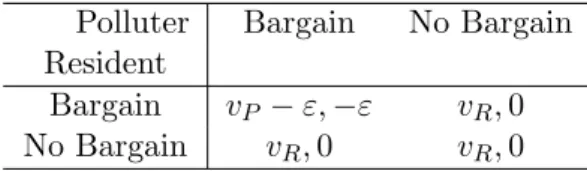
Bargain vs. No bargain We now derive a subgame perfect equilibrium of the whole game, and consider whether the parties get a bargain or not under a property rule. The resident and polluter simultaneously choose Bargain or No Bargain. In both cases of vR < vP and vR ≥ vP, the bargain brings payoff vP − ε to the resident and −ε to the polluter. The payoff matrix is shown in Table 3. If the polluter values the entitlement higher than the resident, i.e. vR < vP, then the resident weakly prefers Bargain to No Bargain. However, if the resident values the entitlement higher than the polluter, i.e. vR ≥ vP, then the resident weakly prefers No Bargain to Bargain. In both case, however, the polluter weakly prefers No Bargain to Bargain; thus, they get no bargain. We summarize this as the following lemma.
Lemma 1. Suppose that the parties choose a weakly dominant strategy. Under a prop- erty rule, there exists a unique subgame perfect equilibrium where a bargain never realizes. In the equilibrium, (i) if the polluter values the entitlement higher than the resident, i.e. vR < vP, then the polluter who values the entitlement higher cannot obtain the entitle- ment through a voluntary bargain; thus, the inefficient allocation realizes. The resident obtains payoff vP while the polluter obtains zero payoff, and the social welfare is vP. (ii) If the resident values the entitlement higher than the polluter, i.e. vR ≥ vP, then the entitlement is not traded, and the resident who values the entitlement higher owns the entitlement; thus, the efficient allocation realizes. The resident obtains payoff vP while the polluter obtains zero payoff, and the social welfare is vP.
The result is somewhat surprising.A property rule does not enhance a voluntary bar- gain even if it is possible, leading to inefficiency. The reason is as follows. The ultimatum bargaining brings zero payoff to the polluter. Thus, the polluter chooses not to bargain in order to save the bargaining cost. Note that the result remains unchanged even if the polluter makes a take-it-or-leave-it offer. In addition, the result remains unchanged under a random proper bargaining where a proper is equally likely chosen from the resident and
Table 3: Property rule
Polluter Bargain No Bargain Resident
Bargain vP − ε, −ε vR,0 No Bargain vR,0 vR,0
polluter.
4.2 Liability rule
Bargain. We consider a subgame after both parties choose Bargain. Suppose vR< vP. First, suppose that the bargaining is over. If the polluter chooses Take, then the resident obtains payoff vR− ε while the polluter obtains payoff vP − vR− ε. If the polluter, on the other hand, chooses Not to Take, the resident obtains payoff vR− ε while the polluter obtains payoff −ε. Therefore, the polluter chooses Take because vP − vR− ε ≥ −ε holds. Second, we consider the resident’s offer pR. If the polluter accepts the offer, then the resident obtains payoff pR− ε while the polluter obtains payoff vP− pR− ε. On the other hand, if the polluter rejects the offer, then the parties meet no agreement. Therefore, the resident obtains payoff vR− ε while the polluter obtains payoff vP − vR− ε, because the polluter will take the entitlement after the bargain is over. The polluter’s optimal reply
is: {
accept if pR≤ vR ⇔ vP − pR− ε ≥ vP − vR− ε reject if pR> vR ⇔ vP − pR− ε < vP − vR− ε.
Given the polluter’s optimal action, the resident should post an offer p∗R = vR, which is accepted, because the resident’s payoff is:
{pR− ε if she posts pR≤ vR
vR− ε if she posts pR> vR. Note that p∗R− ε = vR− ε holds.
Therefore, in case of vR > vP, the parties immediately reach an agreement, and the entitlement is traded through a voluntary bargaining. The resident obtains payoff vR− ε while the polluter obtains payoff vP− vR− ε. The equilibrium in this subgame is described by thick lines in Figure 3.
Next, suppose vR ≥ vP. First, suppose that the bargaining is over. If the polluter chooses Take, then the resident obtains payoff vR− ε while the polluter obtains payoff
P
P R
Accept
Reject
Take
Not to Take
Figure 3: Equilibrium in Subgame of Ultimatum Bargaining with Liability Rule (vR< vP)
vP − vR− ε. If the polluter, on the other hand, chooses Not to Take, the resident obtains payoff vR− ε while the polluter obtains payoff −ε. Therefore, the polluter chooses Not to Take because vP − vR− ε ≤ −ε holds.
Second, we consider the resident’s offer pR. If the polluter accepts the offer, then the resident obtains payoff pR− ε while the polluter obtains payoff vP− pR− ε. On the other hand, if the polluter rejects the offer, then the parties meet no agreement. Therefore, the resident obtains payoff vR−ε while the polluter obtains payoff −ε, because the entitlement is no traded after the bargain is over. The polluter’s optimal reply is:
{accept if pR≤ vP ⇔ vP − pR− ε ≥ −ε reject if pR> vP ⇔ vP − pR− ε < −ε.
Given the polluter’s optimal action, the resident should post an offer p∗R > vP, which is rejected, because the resident’s payoff is:
{pR− ε if she posts pR≤ vP
vR− ε if she posts pR> vP.
Therefore, in case of vR≥ vP, the bargaining is over and the entitlement is not traded. The resident obtains payoff vR− ε, while the polluter obtains payoff −ε. The equilibrium in this subgame is described by thick lines in Figure 4.
P
P R
Accept
Reject
Take
Not to Take
Figure 4: Equilibrium in Subgame of Ultimatum Bargaining with Liability Rule (vR≥ vP)
No bargain. We consider a subgame after at least one party chooses No Bargain. In this case, if vR < vP, then the polluter takes the entitlement; thus, the resident obtains payoff vR while the polluter obtains payoff vP − vR. On the other hand, if vR≥ vP, then the polluter does not take the entitlement and entitlement is never traded. Therefore, the resident obtains payoff vP while the polluter obtains zero payoff.
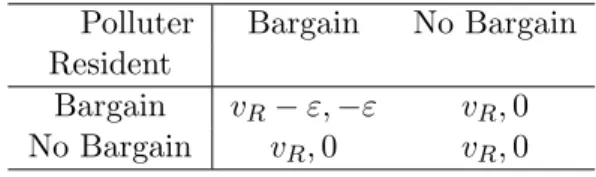
Bargain vs. No bargain We now derive a subgame perfect equilibrium of the whole game, and consider whether the parties get a bargain or not under a property rule. The resident and polluter simultaneously choose Bargain or No Bargain. The payoff matrix is shown in Table 4 and Table 5. In both cases of vR < vP and vR ≥ vP, both parties weakly prefer No Bargain to Bargain; thus, they get no bargain. We summarize this as the following lemma.
Lemma 2. Suppose that the parties choose a weakly dominant strategy. Under a liability rule, there exists a unique subgame perfect equilibrium where a bargain never realizes. In the equilibrium, (i) if the polluter values the entitlement higher than the resident, i.e. vR < vP, then both parties choose No Bargain; thus, they get no bargain. However, the polluter takes the entitlement. The polluter who values the entitlement higher takes the entitlement and compensates the resident; thus, the efficient allocation realizes. The resident obtains payoff vRwhile the polluter obtains payoff vP− vR, and the social welfare is vP− c. (ii) If the resident values the entitlement higher than the polluter, i.e. vR≥ vP, then both parties choose No Bargain; thus, they get no bargain. The entitlement is not traded, and the resident who values the entitlement higher owns the entitlement; thus, the efficient allocation realizes. The resident obtains payoff vP while the polluter obtains zero payoff, and the social welfare is vP.
The efficient allocation always realizes because there is no information asymmetry between the parties.
Table 4: Liability rule: The polluter values the entitlement higher than the resident (vR< vP)
Polluter Bargain No Bargain
Resident
Bargain vR− ε, vP − vR− ε vR, vP − vR
No Bargain vR, vP − vR vR, vP − vR
Table 5: Liability rule: The resident values the entitlement higher than the polluter (vR≥ vP)
Polluter Bargain No Bargain Resident
Bargain vR− ε, −ε vR,0 No Bargain vR,0 vR,0
5 Sequential bargaining
In this section, we employ a sequential bargaining as a bargaining procedure. We derive a subgame perfect equilibrium by backward induction. We separately analyze a property and liability rules.
5.1 Property rule
Bargain. We consider a subgame after both parties choose Bargain. Suppose vR< vP.
First, we consider the polluter’s counteroffer pP. If the resident accepts the counteroffer, then the resident obtains payoff δpP−ε while the polluter obtains payoff δ(vP−pP)−ε. On the other hand, if the resident rejects the counteroffer, then the parties meet no agreement. Therefore, the resident obtains payoff δvR−ε while the polluter obtains payoff −ε, because the entitlement is no traded. Given this, the resident’s optimal action is:
{accept if pP ≥ vR ⇔ δpP − ε ≥ δvR− ε reject if pP < vR ⇔ δpP − ε < δvR− ε.
Given the resident’s action, the polluter should post a counteroffer p∗P = vR, which is accepted, because the polluter’s payoff is:
{δ(vP − pP) − ε if he posts pP ≥ vR
−ε if he posts pP < vR.
Notice that δ(vP − p∗P) − ε = δ(vP − vR) − ε > −ε since vR< vP holds.
Second, we consider the resident’s offer pR. If the polluter accepts the offer, then the resident obtains payoff pR− ε while the polluter obtains payoff vP − pR− ε. Note that the payoff is not discounted because the agreement is immediately reached. On the other hand, if the polluter rejects the offer, the polluter then posts the counteroffer described as above. The polluter’s optimal reply is:
{accept if pR≤ (1 − δ)vP + δvR ⇔ vP − pR− ε ≥ δ(vP − vR) − ε reject if pR>(1 − δ)vP + δvR ⇔ vP − pR− ε < δ(vP − vR) − ε.
Given the polluter’s optimal action, the resident should post an offer p∗R= (1−δ)vP+δvR, which is accepted, because the resident’s payoff is:
{pR− ε if she posts pR≤ (1 − δ)vP + δvR
δvR− ε if she posts pR>(1 − δ)vP + δvR. Note that p∗R− ε = (1 − δ)vP + δvR− ε > δvR− ε holds.
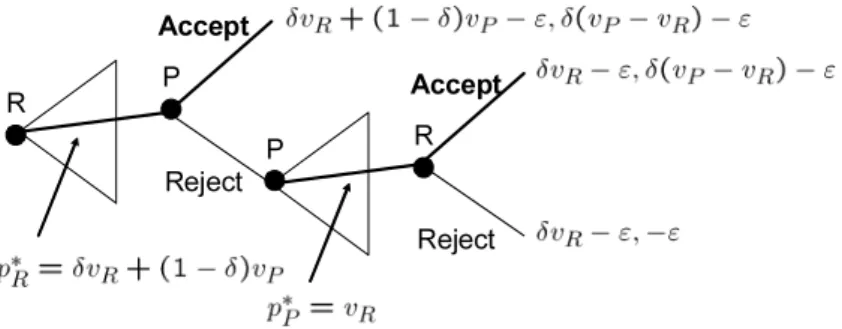
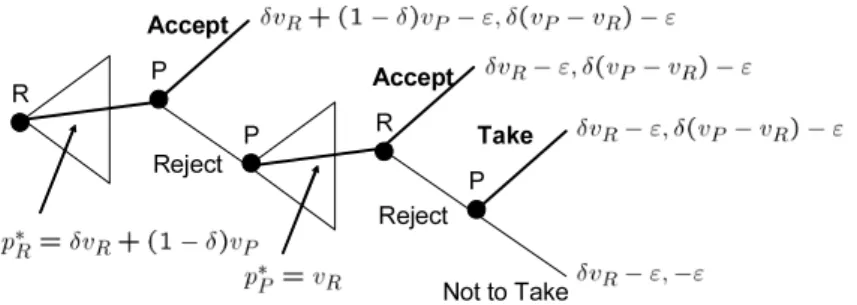
Therefore, in case of vR < vP, the parties immediately reach an agreement, and the entitlement is traded through a voluntary bargaining. The resident obtains payoff (1 − δ)vP + δvR− ε while the polluter obtains payoff δ(vP − vR) − ε. The equilibrium in this subgame is described by thick lines in Figure 5.
P
P
R R
Accept
Reject
Accept
Reject
Figure 5: Equilibrium in Subgame of Sequential Bargaining with Property Rule (vR< vP)
Next, suppose vR≥ vP. First, we consider the polluter’s counteroffer pP as the same as above. If the resident accepts the counteroffer, then the resident obtains payoff δpP− ε while the polluter obtains payoff δ(vP− pP) − ε. On the other hand, if the resident rejects the counteroffer, then the parties meet no agreement. Therefore, the resident obtains payoff δvR− ε while the polluter obtains payoff −ε, because the entitlement is no traded. Given this, the resident’s optimal action is:
{accept if pP ≥ vR ⇔ δpP − ε ≥ δvR− ε reject if pP < vR ⇔ δpP − ε < δvR− ε.
Given the resident’s action, the polluter should post a counteroffer p∗P < vR, which is rejected, because the polluter’s payoff is:
{δ(vP − pP) − ε if he posts pP ≥ vR
−ε if he posts pP < vR.
Notice that δ(vP − p∗P) − ε = δ(vP − vR) − ε ≤ −ε since vR≥ vP holds.
Second, we consider the resident’s offer pR. If the polluter accepts the offer, then the resident obtains payoff pR− ε while the polluter obtains payoff vP − pR− ε. Note that the payoff is not discounted because the agreement is immediately reached. On the other hand, if the polluter rejects the offer, the polluter then posts the counteroffer described as above. The polluter’s optimal reply is:
{accept if pR≤ vP ⇔ vP − pR− ε ≥ −ε reject if pR> vP ⇔ vP − pR− ε < −ε. Given the polluter’s optimal action, the resident should post an offer:
{p∗R= vP (which is accepted) if vP ≥ δvR ⇔ vP − ε ≥ δvR− ε p∗R> vP (which is rejected) if vP < δvR ⇔ vP − ε < δvR− ε, because the resident’s payoff is:
{pR− ε if she posts pR≤ vP δvR− ε if she posts pR> vP.
Therefore, in case of vR ≥ vP, the parties immediately reach an agreement and the entitlement is traded through a voluntary bargaining if δ ∈ (0,vvP
R], while the bargaining is over and the entitlement is not traded if δ ∈ (vvP
R,1). The resident obtains payoff vP− ε in the former case and δvR− ε in the latter case, while the polluter obtains payoff −ε. The equilibrium in this subgame is described by thick lines in Figure 6 (a case of δ ∈ (0,vvP
R])
and Figure 7 (a case of δ ∈ (vvP
R,1)).
P
P
R R
Accept
Reject
Accept
Reject
Figure 6: Equilibrium in Subgame of Sequential Bargaining with Property Rule (vR≥ vP)
P
P
R R
Accept
Reject
Accept
Reject
Figure 7: Equilibrium in Subgame of Sequential Bargaining with Property Rule (vR≥ vP)
No bargain. We consider a subgame after at least one party chooses No Bargain. In this case, the parties have no bargain, and the entitlement is never traded. Therefore, the resident obtains payoff vRwhile the polluter obtains zero payoff.
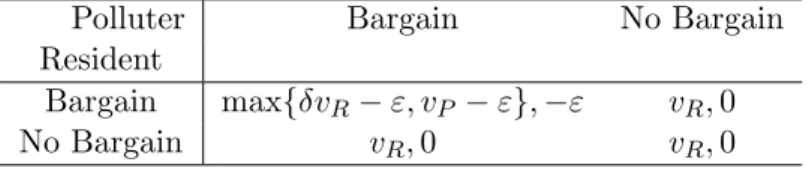
Bargain vs. No bargain We now derive a subgame perfect equilibrium of the whole game, and consider whether the parties get a bargain or not under a property rule. The resident and polluter simultaneously choose Bargain or No Bargain. The payoff matrix is shown in Table 6 and Table 7.
Suppose that the polluter values the entitlement higher than the resident, i.e. vR< vP.
The resident weakly prefers Bargain if and only if ε < (1−δ)(vP− vR) holds. On the other hand, the polluter weakly prefers Bargain if and only if ε < δ(vP − vR) holds. Therefore, if the bargaining cost ε is low enough such that ε < min{(1 − δ)(vP − vR), δ(vP − vR)}, then they get a bargain. Otherwise, they get no bargain.
Suppose next that the resident values the entitlement higher than the polluter, i.e. vR ≥ vP. In this case, both the resident and polluter weakly prefer No Bargain; thus, they get no bargain. We summarize this as the following lemma.
Lemma 3. Suppose that the parties choose a weakly dominant strategy. Under a prop- erty rule, there exists a unique subgame perfect equilibrium. In the equilibrium, (i) if the polluter values the entitlement higher than the resident, i.e. vR< vP, then for sufficiently low bargaining cost ε < min{(1 − δ)(vP− vR), δ(vP− vR)}, both the resident and polluter choose Bargain; thus, they get a bargain. The parties immediately reach an agreement and the payoff is not discounted. The polluter who values the entitlement higher obtains the entitlement through a voluntary bargain; thus, the allocation is efficient. The resident obtains payoff (1 − δ)vP + δvR− ε while the polluter obtains payoff δ(vP − vR) − ε, and
Table 6: Property rule: The polluter values the entitlement higher than the resident (vR< vP)
Polluter Bargain No Bargain
Resident
Bargain (1 − δ)vP + δvR− ε, δ(vP − vR) − ε vR,0
No Bargain vR,0 vR,0
Table 7: Property rule: The resident values the entitlement higher than the polluter (vR≥ vP)
Polluter Bargain No Bargain
Resident
Bargain max{δvR− ε, vP − ε}, −ε vR,0
No Bargain vR,0 vR,0
the social welfare is vP − 2ε.
However, if the bargaining cost is not so low such that ε > min{(1−δ)(vP−vR), δ(vP− vR)}, then at least one party chooses No Bargain; thus, they get no bargain. The entitle- ment is not traded; thus, the allocation is inefficient. The resident obtains payoff vRwhile the polluter obtains zero payoff, and the social welfare is vR.
(ii) If the resident values the entitlement higher than the polluter, i.e. vR ≥ vP, then both the resident and polluter choose No Bargain; thus, they get no bargain. The entitlement is not traded, and the resident who values the entitlement higher owns the entitlement; thus, the allocation is efficient. The resident obtains payoff vR while the polluter obtains zero payoff, and the social welfare is vR.
The sequential bargaining generates the efficient allocation whenever the bargaining cost is sufficiently low. A property rule enhances a voluntary bargain.
5.2 Liability rule
Bargain. We consider a subgame after both parties choose Bargain. Suppose vR< vP. First, suppose that the bargaining is over. If the polluter chooses Take, then the resident obtains payoff δvR− ε while the polluter obtains payoff δ(vP − vR) − ε. If the polluter, on the other hand, chooses Not to Take, the resident obtains payoff δvR− ε while the polluter obtains payoff −ε. Therefore, the polluter chooses Take because δ(vP − vR) − ε > −ε
holds.
Second, we consider the polluter’s counteroffer pP. If the resident accepts the counterof- fer, then the resident obtains payoff δpP−ε while the polluter obtains payoff δ(vP−pP)−ε. On the other hand, if the resident rejects the counteroffer, then the parties meet no agree- ment. Therefore, the resident obtains payoff δvR− ε while the polluter obtains payoff δ(vP − vR) − ε, because the polluter will take the entitlement after the bargain is over. Given this, the resident’s optimal action is:
{accept if pP ≥ vR ⇔ δpP − ε ≥ δvR− ε reject if pP < vR ⇔ δpP − ε < δvR− ε.
Given the resident’s action, the polluter should post a counteroffer p∗P = vR, which is accepted, because the polluter’s payoff is:
{δ(vP − pP) − ε if he posts pP ≥ vR
δ(vP − vR) − ε if he posts pP < vR.
Third, we consider the resident’s offer pR. If the polluter accepts the offer, then the resident obtains payoff pR− ε while the polluter obtains payoff vP − pR− ε. Note that the payoff is not discounted because the agreement is immediately reached. On the other hand, if the polluter rejects the offer, the polluter then posts the counteroffer described as above. The polluter’s optimal reply is:
{accept if pR≤ (1 − δ)vP + δvR ⇔ vP − pR− ε ≥ δ(vP − vR) − ε reject if pR>(1 − δ)vP + δvR ⇔ vP − pR− ε < δ(vP − vR) − ε.
Given the polluter’s optimal action, the resident should post an offer p∗R= (1−δ)vP+δvR, which is accepted, because the resident’s payoff is:
{pR− ε if she posts pR≤ (1 − δ)vP + δvR
δvR− ε if she posts pR>(1 − δ)vP + δvR. Note that p∗R− ε = (1 − δ)vP + δvR− ε > δvR− ε holds.
Therefore, in case of vR < vP, the parties immediately reach an agreement, and the entitlement is traded through a voluntary bargaining. The resident obtains payoff (1 − δ)vP + δvR− ε while the polluter obtains payoff δ(vP − vR) − ε. The equilibrium in this subgame is described by thick lines in Figure 8.
Next, suppose vR ≥ vP. First, suppose that the bargaining is over. If the polluter chooses Take, then the resident obtains payoff δvR− ε while the polluter obtains payoff
P P
R R
Accept
Reject
Accept
Reject P
Take
Not to Take
Figure 8: Equilibrium in Subgame of Sequential Bargaining with Liability Rule (vR< vP) δ(vP−vR)−ε. If the polluter, on the other hand, chooses Not to Take, the resident obtains payoff δvR− ε while the polluter obtains payoff −ε. Therefore, the polluter chooses Not to Take because δ(vP − vR) − ε ≤ −ε holds.
Second, we consider the polluter’s counteroffer pP as the same as above. If the resident accepts the counteroffer, then the resident obtains payoff δpP−ε while the polluter obtains payoff δ(vP − pP) − ε. On the other hand, if the resident rejects the counteroffer, then the parties meet no agreement. Therefore, the resident obtains payoff δvR− ε while the polluter obtains payoff −ε, because the entitlement is no traded after the bargain is over. Given this, the resident’s optimal action is:
{accept if pP ≥ vR ⇔ δpP − ε ≥ δvR− ε reject if pP < vR ⇔ δpP − ε < δvR− ε.
Given the resident’s action, the polluter should post a counteroffer p∗P < vR, which is rejected, because the polluter’s payoff is:
{δ(vP − pP) − ε if he posts pP ≥ vR
−ε if he posts pP < vR. Notice that δ(vP − vR) − ε ≤ −ε since vR≥ vP holds.
Third, we consider the resident’s offer pR. If the polluter accepts the offer, then the resident obtains payoff pR− ε while the polluter obtains payoff vP − pR− ε. Note that the payoff is not discounted because the agreement is immediately reached. On the other hand, if the polluter rejects the offer, the polluter then posts the counteroffer described as above. The polluter’s optimal reply is:
{accept if pR≤ vP ⇔ vP − pR− ε ≥ −ε reject if pR> vP ⇔ vP − pR− ε < −ε. Given the polluter’s optimal action, the resident should post an offer:
{p∗R= vP (which is accepted) ifvP ≥ δvR ⇔ vP − ε ≥ δvR− ε p∗R> vP (which is rejected) ifvP < δvR ⇔ vP − ε < δvR− ε,
because the resident’s payoff is:
{pR− ε if she posts pR≤ vP δvR− ε if she posts pR> vP.
Therefore, in case of vR ≥ vP, the parties immediately reach an agreement and the entitlement is traded through a voluntary bargaining if δ ∈ (0,vvPR], while the bargaining is over and the entitlement is not traded if δ ∈ (vvPR,1). The resident obtains payoff vP− ε in the former case and δvR− ε in the latter case while the polluter obtains payoff −ε. The equilibrium in this subgame is described by thick lines in Figure 9 (a case of δ ∈ (0,vvP
R])
and Figure 10 (a case of δ ∈ (vvP
R,1)).
P P
R R
Accept
Reject
Accept
Reject P
Take
Not to Take
Figure 9: Equilibrium in Subgame of Sequential Bargaining with Liability Rule (vR≥ vP)
P
P
R R
Accept
Reject
Accept
Reject
Figure 10: Equilibrium in Subgame of Sequential Bargaining with Liability Rule (vR≥ vP)
No bargain. We consider a subgame after at least one party chooses No Bargain. In this case, the parties have no bargain. If vR< vP, the polluter takes the entitlement and pays damages vRto the resident. The resident obtains payoff vRwhile the polluter obtains vP − vR. If vR ≥ vP, the polluter does not take the entitlement; thus, the entitlement is never traded. Therefore, the resident obtains payoff vR while the polluter obtains zero payoff.
Bargain vs. No bargain We now derive a subgame perfect equilibrium of the whole game, and consider whether the parties get a bargain or not under a property rule. The resident and polluter simultaneously choose Bargain or No Bargain. The payoff matrix is shown in Table 8 and Table 9.
Suppose that the polluter values the entitlement higher than the resident, i.e. vR< vP.
The resident weakly prefers Bargain for sufficiently low bargaining cost ε < (1−δ)(vR−vP), while polluter weakly prefers No Bargain; thus, they get no bargain. On the other hand, for bargaining cost ε < (1 − δ)(vR− vP), the polluter weakly prefers No Bargain.
However, if the resident values the entitlement higher than the polluter, i.e. vR≥ vP, then both the resident and polluter weakly prefer No Bargain; thus, they get no bargain. We summarize this as the following lemma.
Lemma 4. Suppose that the parties choose a weakly dominant strategy. Under a liability rule, there exists a unique subgame perfect equilibrium. In the equilibrium, (i) if the polluter values the entitlement higher than the resident, i.e. vR < vP, then they get no bargain for any bargaining cost. The polluter takes the entitlement and pays the damages vR to the resident, the polluter who values the entitlement higher obtains the entitlement; thus, the allocation is efficient. The resident obtains payoff vR while the polluter obtains payoff vP − vR, and the social welfare is vP − c.
(ii) If the resident values the entitlement higher than the polluter, i.e. vR≥ vP, then they get no bargain for any bargaining cost. The entitlement is not traded, and the resident who values the entitlement higher owns the entitlement; thus, the allocation is efficient. The resident obtains payoff vR while the polluter obtains zero payoff, and the social welfare is vR.
The efficient allocation always realizes because there is no information asymmetry between the parties.
6 Result
This section compares a property rule with a liability rule. Table 10 provides results obtained in the previous sections. When the resident values the entitlement higher than the polluter, the resident keeps her entitlement under each legal rule, leading to efficiency.