Algorithmic Randomness and Lowness Notions
NingNing Peng
Mathematical Institute, Tohoku University, Sendai 980-8578, Japan [email protected]
May 14, 2010
NingNing Peng Algorithmic Randomness and Lowness Notions
1 Randomness and Kolmogorov Complexity Complexity & Randomness
Some theorems
2 Main Result: X-Randomness X-Randomness
Facts about X-random sets Future research
3 Lowness properties and Randomness Three lowness properties
Proof (iV) of Main theorem
The Cantor Space
2ω is the space of infinite binary strings: the reals
NingNing Peng Algorithmic Randomness and Lowness Notions
The Cantor Space
2ω is the space of infinite binary strings: the reals 2<ω is the space of finite binary strings.
The Cantor Space
2ω is the space of infinite binary strings: the reals 2<ω is the space of finite binary strings.
The standard topology on 2ω is induced by the basic open sets: [σ] ={σX : X ∈ 2ω} for all σ ∈ 2<ω.
NingNing Peng Algorithmic Randomness and Lowness Notions
The Cantor Space
2ω is the space of infinite binary strings: the reals 2<ω is the space of finite binary strings.
The standard topology on 2ω is induced by the basic open sets: [σ] ={σX : X ∈ 2ω} for all σ ∈ 2<ω.
Lebesgue measure on the Cantor space: the measure of a basic open set [σ] is λ([σ]) = 2−|σ|.
The Cantor Space
2ω is the space of infinite binary strings: the reals 2<ω is the space of finite binary strings.
The standard topology on 2ω is induced by the basic open sets: [σ] ={σX : X ∈ 2ω} for all σ ∈ 2<ω.
Lebesgue measure on the Cantor space: the measure of a basic open set [σ] is λ([σ]) = 2−|σ|.
NingNing Peng Algorithmic Randomness and Lowness Notions
Selective history of Kolmogorov Complexity
Solomonoff (1964) and Kolmogorov (1965) independently definedKolmogorov complexity, measuring the information content of finite strings.
Selective history of Kolmogorov Complexity
Solomonoff (1964) and Kolmogorov (1965) independently definedKolmogorov complexity, measuring the information content of finite strings.
Martin-L¨of (1966) defined the randomreals (elements of 2ω) as those avoiding certain effective measure zero sets.
NingNing Peng Algorithmic Randomness and Lowness Notions
Selective history of Kolmogorov Complexity
Solomonoff (1964) and Kolmogorov (1965) independently definedKolmogorov complexity, measuring the information content of finite strings.
Martin-L¨of (1966) defined the randomreals (elements of 2ω) as those avoiding certain effective measure zero sets.
Levin (1973) and Chaitin (1975) modified Kolmogorov complexity to characterize random sequences. (We will use this modified version.)
Plain Kolmogorov complexity
Definition
The machine R is calleduniversal if for each machine M, there is a constant eM such that
∀x[CR(x)≤ CM(x) + eM].
NingNing Peng Algorithmic Randomness and Lowness Notions
Plain Kolmogorov complexity
Definition
The machine R is calleduniversal if for each machine M, there is a constant eM such that
∀x[CR(x)≤ CM(x) + eM].
Let U : 2<ω → 2<ω be a universal machine: Definition (Plain Kolmogorov complexity)
Then the plain Kolmogorov complexity of a string σ with respect to U is
C (σ) := min{|τ | : U(τ ) = σ}
Martin-L¨of randomness
Idea:“ Effectively random” reals (elements of 2ω) should avoid the
“ effective measure zero” sets.
NingNing Peng Algorithmic Randomness and Lowness Notions
Martin-L¨of randomness
Idea:“ Effectively random” reals (elements of 2ω) should avoid the
“ effective measure zero” sets. Definition
A Martin-L¨of testis a uniformly c.e. sequence (Gm)m∈N of open sets such that∀m ∈ N λGm ≤ 2−m.
A isML-random if it passes every Martin-L¨of test (Z 6∈TmGm).
Martin-L¨of randomness
Idea:“ Effectively random” reals (elements of 2ω) should avoid the
“ effective measure zero” sets. Definition
A Martin-L¨of testis a uniformly c.e. sequence (Gm)m∈N of open sets such that∀m ∈ N λGm ≤ 2−m.
A isML-random if it passes every Martin-L¨of test (Z 6∈TmGm).
Fact: Almost all sequences are Martin-L¨of random.
NingNing Peng Algorithmic Randomness and Lowness Notions
n-Randomness
There are two ways we could definen-randomness. Definition (I)
Let n > 0. A set Z is calledn-random if Z is ML-random relative to∅n−1.
n-Randomness
There are two ways we could definen-randomness. Definition (I)
Let n > 0. A set Z is calledn-random if Z is ML-random relative to∅n−1.
Definition (II)
A isn-randomif whenever (Gm)m∈N is a uniform sequence of Σ0n
class such that µ(Gm)≤ 2−m, then A6∈Ti∈NGm.
NingNing Peng Algorithmic Randomness and Lowness Notions
n-Randomness
There are two ways we could definen-randomness. Definition (I)
Let n > 0. A set Z is calledn-random if Z is ML-random relative to∅n−1.
Definition (II)
A isn-randomif whenever (Gm)m∈N is a uniform sequence of Σ0n
class such that µ(Gm)≤ 2−m, then A6∈Ti∈NGm.
Important observation: a Σ0n class is not necessarily open, hence not necessarily a Σ01[∅n−1] class.
n-Randomness
There are two ways we could definen-randomness. Definition (I)
Let n > 0. A set Z is calledn-random if Z is ML-random relative to∅n−1.
Definition (II)
A isn-randomif whenever (Gm)m∈N is a uniform sequence of Σ0n
class such that µ(Gm)≤ 2−m, then A6∈Ti∈NGm.
Important observation: a Σ0n class is not necessarily open, hence not necessarily a Σ01[∅n−1] class.
However, Kurtz proved that I ⇔ II .
NingNing Peng Algorithmic Randomness and Lowness Notions
Weak 2-Randomness
What if we drop the condition that λ(Gm)m∈N≤ 2−m ?
Weak 2-Randomness
What if we drop the condition that λ(Gm)m∈N≤ 2−m ? Consider a uniform sequence (Gm)m∈N of Σ01 classes such that limiλ(Gm) = 0.
NingNing Peng Algorithmic Randomness and Lowness Notions
Weak 2-Randomness
What if we drop the condition that λ(Gm)m∈N≤ 2−m ? Consider a uniform sequence (Gm)m∈N of Σ01 classes such that limiλ(Gm) = 0. ThenTmGm is exactly a measure zero Π02 class.
Weak 2-Randomness
What if we drop the condition that λ(Gm)m∈N≤ 2−m ? Consider a uniform sequence (Gm)m∈N of Σ01 classes such that limiλ(Gm) = 0. ThenTmGm is exactly a measure zero Π02 class.
Definition
A isweak 2-randomif it is in no Π02 null class.
NingNing Peng Algorithmic Randomness and Lowness Notions
Weak 2-Randomness
What if we drop the condition that λ(Gm)m∈N≤ 2−m ? Consider a uniform sequence (Gm)m∈N of Σ01 classes such that limiλ(Gm) = 0. ThenTmGm is exactly a measure zero Π02 class.
Definition
A isweak 2-randomif it is in no Π02 null class. Fact
2-random ⇒ weak 2-random ⇒ 1-random. The reverse implications fail (Kurtz, Kautz).
Prefix-free (Kolmogorov) complexity
Idea. The“ information content” of σ is the length of the shortest description of σ.
NingNing Peng Algorithmic Randomness and Lowness Notions
Prefix-free (Kolmogorov) complexity
Idea. The“ information content” of σ is the length of the shortest description of σ.
It is important what kind of descriptions we allow.
Prefix-free (Kolmogorov) complexity
Idea. The“ information content” of σ is the length of the shortest description of σ.
It is important what kind of descriptions we allow. One approach – due to Levin and Chaitin:
Definition
A⊆ 2<ω isprefix-free if σ, τ ∈ A implies that σ 6≺ τ (σ is not a proper prefix of τ ).
NingNing Peng Algorithmic Randomness and Lowness Notions
Prefix-free (Kolmogorov) complexity
Idea. The“ information content” of σ is the length of the shortest description of σ.
It is important what kind of descriptions we allow. One approach – due to Levin and Chaitin:
Definition
A⊆ 2<ω isprefix-free if σ, τ ∈ A implies that σ 6≺ τ (σ is not a proper prefix of τ ).
LetU : 2<ω→ 2<ω be universal prefix-free Turing machine .
Prefix-free (Kolmogorov) complexity
Idea. The“ information content” of σ is the length of the shortest description of σ.
It is important what kind of descriptions we allow. One approach – due to Levin and Chaitin:
Definition
A⊆ 2<ω isprefix-free if σ, τ ∈ A implies that σ 6≺ τ (σ is not a proper prefix of τ ).
LetU : 2<ω→ 2<ω be universal prefix-free Turing machine . Definition (Prefix-free complexity)
Given a string σ∈ 2<ω, define the prefix-free Kolmogorov complexity of σ as K (σ) = min{|τ | : U(τ ) = σ}.
NingNing Peng Algorithmic Randomness and Lowness Notions
Incompressibility
Prefix-free complexity gives us a nice characterization of 1-randomness.
Theorem (Schnorr)
A is1-randomiff (∀n)K (A ↾ n) ≥ n − O(1).
Incompressibility
Prefix-free complexity gives us a nice characterization of 1-randomness.
Theorem (Schnorr)
A is1-randomiff (∀n)K (A ↾ n) ≥ n − O(1).
Open Question
Is there an initial segment complexity characterization of weak 2-randomness?
NingNing Peng Algorithmic Randomness and Lowness Notions
Counting Theorem
Chaitin showed that the bound given in this theorem is tight, as part of the following result.
Theorem (Counting Theorem)
(1) max{K (σ) : |σ| = n} = n + K (n) ± O(1).
(2) |{σ : |σ| = n ∧ K (σ) ≤ n + K (n) − r }| ≤ 2n−r +O(1), where the constant O(1) does not depend on n and r .
Counting Theorem
Chaitin showed that the bound given in this theorem is tight, as part of the following result.
Theorem (Counting Theorem)
(1) max{K (σ) : |σ| = n} = n + K (n) ± O(1).
(2) |{σ : |σ| = n ∧ K (σ) ≤ n + K (n) − r }| ≤ 2n−r +O(1), where the constant O(1) does not depend on n and r .
Note that, For any σ∈ 2<ω, P
σ∈2<ω
2−K (σ)≤ P
U(τ )↓
2−|τ | ≤ 1 where U is prefix-tree universal Turing machine.
NingNing Peng Algorithmic Randomness and Lowness Notions
Some theorems
We proved the following result: Theorem
(∀x)(∃y ) such that K (xy ) > |xy |. Proof.
We use the same technique in the proof of Counting Theorem.
New theorems
By our theorem,we have following corollary. Corollary
(∃∞n)K (X ↾ n) > n− O(1) does not imply (∀n)K (X ↾ n) > n − O(1).
NingNing Peng Algorithmic Randomness and Lowness Notions
New theorems
By our theorem,we have following corollary. Corollary
(∃∞n)K (X ↾ n) > n− O(1) does not imply (∀n)K (X ↾ n) > n − O(1).
Note that, (∀n)K (X ↾ n) > n − O(1) is 1-randomness. But, It is easy to know that 1-randomness imply
(∃∞n)K (X ↾ n) > n− O(1).
New theorems
By our theorem,we have following corollary. Corollary
(∃∞n)K (X ↾ n) > n− O(1) does not imply (∀n)K (X ↾ n) > n − O(1).
Note that, (∀n)K (X ↾ n) > n − O(1) is 1-randomness. But, It is easy to know that 1-randomness imply
(∃∞n)K (X ↾ n) > n− O(1).
Question
(∃∞n)K (X ↾ n) > n− O(1) is an initial segment complexity characterization of KL-randomness?
NingNing Peng Algorithmic Randomness and Lowness Notions
Proof sketch of corollary
Proof idea: Construction of X such that:
Step 0: Pick up σ0 such that: K (σ0) >|σ0|.
Pick up τ0 such that: K (σ0τ0) <|σ0| + |τ0|.(τ0= (00· · · 0)) Pick up σ1 such that: K (σ0τ0σ1) >|σ0| + |τ0| + |σ1| − b1
Step n+1: We already construct σ0, τ0σ1,· · · , σn, τn.Let σ′ = σ0, τ0,· · · , σn−1, τn−1, σn, and
˜
σ = σ0, τ0,· · · , σn−1, τn−1, σn, τn such that: K (σ′) >|σ′|.
K (˜σ) <|˜σ| − n. Then,
Pick up σn+1 such that: K (˜σσn+1) >|˜σσn+1| by our theorem. Pick up τn+1 (τn+1= (00· · · 0)) such that:
K (˜σσn+1τn+1) <|˜σσn+1τn+1| − (n + 1). Let X = σ0, τ0, σ1, τ1,· · · .
Maximal complexity
Definition (Loveland)
A∈ 2ω is Kolmogorov randomif
∃∞n(C (A ↾ n)≥ n − O(1))
This notion was studied earlier in several forms, see Martin-L¨of, Schnorr and Solovay.
NingNing Peng Algorithmic Randomness and Lowness Notions
Maximal complexity
Definition (Loveland)
A∈ 2ω is Kolmogorov randomif
∃∞n(C (A ↾ n)≥ n − O(1))
This notion was studied earlier in several forms, see Martin-L¨of, Schnorr and Solovay.
Definition (Solovay)
A∈ 2ω is strongly Chaitin randomif
(∃∞n)K (A ↾ n)≥ n + K (n) − O(1)
Relationships between these classes
Theorem (Solovay)
3-random⇒ strongly Chaitin random ⇒ Kolmogorov random.
NingNing Peng Algorithmic Randomness and Lowness Notions
Relationships between these classes
Theorem (Solovay)
3-random⇒ strongly Chaitin random ⇒ Kolmogorov random.
Theorem (Miller, 2004)
2-random⇒ Kolmogorov random.
Relationships between these classes
Theorem (Solovay)
3-random⇒ strongly Chaitin random ⇒ Kolmogorov random.
Theorem (Miller, 2004)
2-random⇒ Kolmogorov random.
Theorem (Nies, Terwijn, stephan, 2005) Kolmogorov random⇒ 2-random.
NingNing Peng Algorithmic Randomness and Lowness Notions
Relationships between these classes
Theorem (Solovay)
3-random⇒ strongly Chaitin random ⇒ Kolmogorov random.
Theorem (Miller, 2004)
2-random⇒ Kolmogorov random.
Theorem (Nies, Terwijn, stephan, 2005) Kolmogorov random⇒ 2-random.
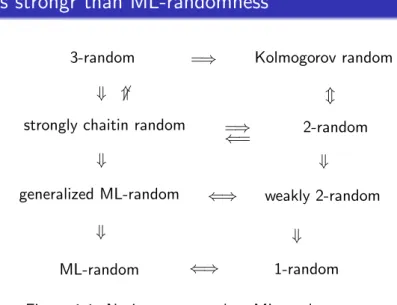
Notions strongr than ML-randomness
3-random
strongly chaitin random
generalized ML-random
2-random Kolmogorov random
weakly 2-random
ML-random
⇓
⇓ ⇓
m
=⇒
⇐⇒
⇓
=⇒
1-random
⇓
⇐⇒ 6⇑
⇐=
Figure 1.1: Notions strongr than ML-randomness
NingNing Peng Algorithmic Randomness and Lowness Notions
New Randomness: X-Randomness
We study randomness notions between Martin-L¨of randomness and 2-randomness.
New Randomness: X-Randomness
We study randomness notions between Martin-L¨of randomness and 2-randomness.
We propose a new definitions of randomness : ML-randomness in any low set. Moreover, Moreover, we will give some truly
fascinating results for our new randomness along this work.
NingNing Peng Algorithmic Randomness and Lowness Notions
New Randomness: X-Randomness
We study randomness notions between Martin-L¨of randomness and 2-randomness.
We propose a new definitions of randomness : ML-randomness in any low set. Moreover, Moreover, we will give some truly
fascinating results for our new randomness along this work. Definition
(i) AX-testis a sequence (Gm)m∈N of open sets, which is uniformly c.e in some low set such that
∀m ∈ N λGm ≤ 2−m.
New Randomness: X-Randomness
We study randomness notions between Martin-L¨of randomness and 2-randomness.
We propose a new definitions of randomness : ML-randomness in any low set. Moreover, Moreover, we will give some truly
fascinating results for our new randomness along this work. Definition
(i) AX-testis a sequence (Gm)m∈N of open sets, which is uniformly c.e in some low set such that
∀m ∈ N λGm ≤ 2−m.
(ii) A set Z ⊆ Nfailsthe test if Z ∈TmGm, otherwise Z passes the test.
NingNing Peng Algorithmic Randomness and Lowness Notions
New Randomness: X-Randomness
We study randomness notions between Martin-L¨of randomness and 2-randomness.
We propose a new definitions of randomness : ML-randomness in any low set. Moreover, Moreover, we will give some truly
fascinating results for our new randomness along this work. Definition
(i) AX-testis a sequence (Gm)m∈N of open sets, which is uniformly c.e in some low set such that
∀m ∈ N λGm ≤ 2−m.
(ii) A set Z ⊆ Nfailsthe test if Z ∈TmGm, otherwise Z passes the test.
New Randomness: X-Randomness
We study randomness notions between Martin-L¨of randomness and 2-randomness.
We propose a new definitions of randomness : ML-randomness in any low set. Moreover, Moreover, we will give some truly
fascinating results for our new randomness along this work. Definition
(i) AX-testis a sequence (Gm)m∈N of open sets, which is uniformly c.e in some low set such that
∀m ∈ N λGm ≤ 2−m.
(ii) A set Z ⊆ Nfailsthe test if Z ∈TmGm, otherwise Z passes the test.
(iii) Z isX-randomif Z pass each X-test.
NingNing Peng Algorithmic Randomness and Lowness Notions
New Randomness: X-Randomness
By Schnorr’ theorem,there is a characterization of X-randomness via a growth condition on the initial segment complexity. So we can definedX-randomas follows:
New Randomness: X-Randomness
By Schnorr’ theorem,there is a characterization of X-randomness via a growth condition on the initial segment complexity. So we can definedX-randomas follows:
Definition
A set Z isX-randomif
(∀n)(KA(Z ↾ n) > n− O(1)) for any set A such that A′ ≡T φ′.
NingNing Peng Algorithmic Randomness and Lowness Notions
Main theorem
Theorem
The following statements hold:
(i) Every 2-randomness is X-randomness.
Main theorem
Theorem
The following statements hold:
(i) Every 2-randomness is X-randomness. (ii) Every X-randomness is ML-randomness.
NingNing Peng Algorithmic Randomness and Lowness Notions
Main theorem
Theorem
The following statements hold:
(i) Every 2-randomness is X-randomness. (ii) Every X-randomness is ML-randomness. (iii) ML-randomness does not imply X-randomness.
Main theorem
Theorem
The following statements hold:
(i) Every 2-randomness is X-randomness. (ii) Every X-randomness is ML-randomness. (iii) ML-randomness does not imply X-randomness. (iv) Weak 2-randomness does not imply X-randomness.
NingNing Peng Algorithmic Randomness and Lowness Notions
Main theorem
Theorem
The following statements hold:
(i) Every 2-randomness is X-randomness. (ii) Every X-randomness is ML-randomness. (iii) ML-randomness does not imply X-randomness. (iv) Weak 2-randomness does not imply X-randomness.
Proof of Main theorem (Sketch)
(i): Every 2-randomness is X-randomness: Suppose X is 2-random, By the definition,
∀n(K∅(X ↾ n) > n− O(1)). Because, f ≤T ∅′,
So, K∅′(X ↾ n)≤+Kf(X ↾ n). Then,∀n(Kf(X ↾ n) > n− O(1)).
NingNing Peng Algorithmic Randomness and Lowness Notions
Proof of Main theorem (Sketch)
(i): Every 2-randomness is X-randomness: Suppose X is 2-random, By the definition,
∀n(K∅(X ↾ n) > n− O(1)). Because, f ≤T ∅′,
So, K∅′(X ↾ n)≤+Kf(X ↾ n). Then,∀n(Kf(X ↾ n) > n− O(1)).
(ii): Every X-randomness is ML-randomness.: Because, K (X ↾ n)≥+Kf(X ↾ n),
So, (∀n)(Kf(X ↾ n) > n− O(1)) ⇒ (∀n)(K (X ↾ n) > n − O(1)).
Proof of Main theorem (Sketch)
(i): Every 2-randomness is X-randomness: Suppose X is 2-random, By the definition,
∀n(K∅(X ↾ n) > n− O(1)). Because, f ≤T ∅′,
So, K∅′(X ↾ n)≤+Kf(X ↾ n). Then,∀n(Kf(X ↾ n) > n− O(1)).
(ii): Every X-randomness is ML-randomness.: Because, K (X ↾ n)≥+Kf(X ↾ n),
So, (∀n)(Kf(X ↾ n) > n− O(1)) ⇒ (∀n)(K (X ↾ n) > n − O(1)). (iii): ML-randomness does not imply X-randomness
Fact: ∃ 1-random X such that X′≡T ∅′ X is not 1-random in X .
NingNing Peng Algorithmic Randomness and Lowness Notions
2-random
X-random weak 2-random Demuth random
1-random
?
? i
ii
iii
iv
Some theorem
We proof some properties of X-randomness. Proposition
Each low set is not X-random.
NingNing Peng Algorithmic Randomness and Lowness Notions
Some theorem
We proof some properties of X-randomness. Proposition
Each low set is not X-random. Proof.
For any set Z , Z is not 1-random in Z . If low set A is X-random, then A is 1-random in A.
Some theorem
It is not hard to prove the following result. Then we show there is no universal X -test.
Theorem
∀A: low, ∃B: low ,
∃X (X is A-random & X is not B-random).
NingNing Peng Algorithmic Randomness and Lowness Notions
Some theorem
It is not hard to prove the following result. Then we show there is no universal X -test.
Theorem
∀A: low, ∃B: low ,
∃X (X is A-random & X is not B-random). Corollary
There is no universal X -test.
Some theorem
It is not hard to prove the following result. Then we show there is no universal X -test.
Theorem
∀A: low, ∃B: low ,
∃X (X is A-random & X is not B-random). Corollary
There is no universal X -test. Proposition
Each X -random set Z satisfies the law of large numbers.
NingNing Peng Algorithmic Randomness and Lowness Notions
Questions
Question
X-randomness does not imply 2-randomness ?
Questions
Question
X-randomness does not imply 2-randomness ?
If this question is true, then X-randomness will lies in between 2-randomness and ML-randomness.
NingNing Peng Algorithmic Randomness and Lowness Notions
Questions
Question
X-randomness does not imply 2-randomness ?
If this question is true, then X-randomness will lies in between 2-randomness and ML-randomness.
Also, X-randomness be really different from weak 2-randomness.
Questions
The following question also be important. Question
Does the Van Lambalgen’theorem hold for X-randomness ?
NingNing Peng Algorithmic Randomness and Lowness Notions
Questions
The following question also be important. Question
Does the Van Lambalgen’theorem hold for X-randomness ?
Question
X-random and Demuth random are incomparable ?
Important work 1999-2005
“ Lowness for the class of random sets” (1999) by Kucera and Terwijn;
“ R.e. reals and Chaitin Omega numbers” by Calude, Hertling, Khoussainov, Wang (2001); subsequent paper
“ Randomness and recursive enumerability” by Kucera and Slaman (2001);
“ Trivial reals” by Downey, Hirschfeldt, Nies, Stephan (2003).
“ Lowness properties and randomness” by Nies (published 2005).
NingNing Peng Algorithmic Randomness and Lowness Notions
Lowness properties and Randomness
In this section, We study three lowness properties that will later turn out to be equivalent: low for ML-randomness, low for K , and a base for ML-randomness.
Lowness properties and Randomness
In this section, We study three lowness properties that will later turn out to be equivalent: low for ML-randomness, low for K , and a base for ML-randomness.
Further, we will introduce the K-trivial sets which are far from random.
NingNing Peng Algorithmic Randomness and Lowness Notions
Lowness properties and Randomness
In this section, We study three lowness properties that will later turn out to be equivalent: low for ML-randomness, low for K , and a base for ML-randomness.
Further, we will introduce the K-trivial sets which are far from random.
Then, we will use this properties to show that weak 2-randomness does not imply X randomness.
Lowness properties and Randomness
In this section, We study three lowness properties that will later turn out to be equivalent: low for ML-randomness, low for K , and a base for ML-randomness.
Further, we will introduce the K-trivial sets which are far from random.
Then, we will use this properties to show that weak 2-randomness does not imply X randomness.
ALowness properties of a real A says that, in some sense, A how computational power when used as an oracle.
NingNing Peng Algorithmic Randomness and Lowness Notions
Recall: K (x) = length of a shortest prefix free description of string x.
A set is K-trivial via a constant b if
∀nK (A ↾ n) ≤ K (n) + b. Let K denote that class of K-trivial sets. (Chaitin, 1975).
A islow for ML-randomnessif each ML-random set is already ML-random relative to A (Zambella, 1990).
We will see that these two concepts are equivalent.
More concepts
Further lowness properties have introduced:
Base for ML-randomness (Kuˇcera, APAL 1993). Low for K (Muchnik jr., in a Moscow seminar, 1999). Low for K ⇒ Low for MLK-randomness ⇒ Base for ML-randomness.
NingNing Peng Algorithmic Randomness and Lowness Notions
Base for ML-randomness
LetMLRdenote the class of Martin-L¨of-random sets. We will call such a set A abase for ML-randomness:
A≤T Z for someZ ∈ MLRA . They were studied by Kuˇcera (1993).
A is low for ML-randomness then A is base for ML-randomness.
For, there is a ML-random Z such that A≤T Z . Then Z is ML-random relative to A.
Two theorem
(1) Each base for ML-randomness is low for K .(Hirschfeldt, Nies,Stephan, 2007).
(2) Each K -trivial set is low for K . (Nies,Hirschfeldt, 2005). We have already seen the easy implications:
Low for K ⇒ Low for MLK-randomness ⇒ Base for ML-randomness.
Low for K ⇒ K-trivial.
Then, by Theorem (1), all three classes are the same. by Theorem (2), all four classes are the same.
NingNing Peng Algorithmic Randomness and Lowness Notions
Low for K easy
K-trivial
easy Low for ML easy
Base for ML
Harder
Very hard
Proof Sketch
In proving part (iv) of main theorem, we will use the following theorems:
Theorem (Downey, Nies, Weber, and Yu, (2008)) Low(W2Rand, MLRand) = Low(MLRand).
In other words, if each weakly 2 random is Martin-L¨of random relative to A, then A is in fact low for Martin-L¨of randomness.
NingNing Peng Algorithmic Randomness and Lowness Notions
Proof Sketch
In proving part (iv) of main theorem, we will use the following theorems:
Theorem (Downey, Nies, Weber, and Yu, (2008)) Low(W2Rand, MLRand) = Low(MLRand).
In other words, if each weakly 2 random is Martin-L¨of random relative to A, then A is in fact low for Martin-L¨of randomness.
Theorem (Nies,2005)
Each K-trivial set A is superlow.
Theorem (Bickford/Mills and Mohrherr (1986))
Proof (iv) of Main theorem
Putting above facts together,we get following fact.
NingNing Peng Algorithmic Randomness and Lowness Notions
Proof (iv) of Main theorem
Putting above facts together,we get following fact. Fact
If each weakly 2 random is ML-random relative to A, then A is superlow.
Proof (iv) of Main theorem
Putting above facts together,we get following fact. Fact
If each weakly 2 random is ML-random relative to A, then A is superlow.
Proof of Weak 2-randomness does not imply X-randomness: Assume that∀X (X is weak 2-random ⇒ X is X-random). Pick up A be low but not superlow.
Then, by our assumption:
Any weak 2-random X is 1-random in A. By above fact, A should be superlow. This contradiction.
NingNing Peng Algorithmic Randomness and Lowness Notions
Thank you very much!