Ogata, H. et al. (Eds.) (2015). Proceedings of the 23rd International Conference on Computers in Education. China: Asia-Pacific Society for Computers in Education
Analysis of Preview and Review Patterns in
Undergraduates’ E-Book Logs
Misato OI*, Fumiya OKUBO, Atsushi SHIMADA, Chengjiu YIN, & Hiroaki OGATA Faculty of Arts and Science, Kyushu University, Japan
Abstract: The purpose of this study is to investigate the relationship between academic achievement and learning patterns of students using e-book logs. Specifically, we examined patterns of students’ e-book logs before and after the main content learning in class (that is,
‘Preview’ and ‘Review’). Logs were collected from first-year students in an information science course at Kyushu University. To measure preview and review learning, we analyzed data using three types of measurement: Change indicates how many times a student changed e-books over the course of one hour. Duration indicates how many seconds a student access a given e-book for during one Change (i.e., one turn). Page flip indicates how many pages of a given e-book a student flipped through during one Change. To analyze the relationship between academic achievement and preview/review, the students were categorized into six groups according to their scores on midterm and final (term-end) examinations. For preview, students who had consistent good achievement showed higher values for all three measurements than students who showed poor achievement. In contrast, for review, none of the three measurements showed differences among the six groups. These results suggest that preview is more deeply relevant to academic achievement and assessment than review.
Keywords: E-book, log, preview, review
1. Introduction
In recent years, many countries (e.g., Japan, South Korea, and Singapore) have implemented and begun the assessment of information and communication technology (ICT)-based education and learning materials in schools, especially of electronic textbooks, called e-books (Nakajima, Shinohara, & Tamura, 2013). Shepperd, Grace, & Koch (2008) pointed out several advantages of e-books over paper textbooks: e-books are physically lighter, require less space, contain multimedia functions, and are able to connect readers with supplementary materials. The next question, however, is whether these putative advantages of e-books actually play a beneficial role in education. This issue is still controversial. Some studies reported negative effects of e-books (e.g., Liu, 2005; Woody, Daniel, & Baker, 2010). For example, Liu asked participants to respond the questions (e.g., percentage of time spent on reading printed and electronic documents, percentage of time spent on in-depth reading). Liu reported that participants spent less time on in-depth reading and concentrated reading for e-book reading than paper-based reading. Several studies reported there are no differences between e-books and printed books (e.g., Eden & Eshet-Alkalai, 2013; Shepperd et al. 2008). In the study of Shepperd et al., no significant difference was detected in final course grade between students who adopted the electronic text versus the paper text.
2. Investigating student learning patterns using e-book logs
Previous research has mainly focused directly on the effectiveness of e-books for students (e.g., Eden & Eshet-Alkalai, 2013; Liu, 2005; Shepperd et al., 2008; Woody et al., 2010) and on their technical or functional features (Nakajima et al., 2013). In contrast, the present study focused on e-book logs1 as a research tool to investigate students’ learning patterns and their relationship with academic
1 More information (in Japanese) can be found at http://www.kccs.co.jp/ict/cloud-booklooper/.
achievements. The e-book log is a Cloud-based system for e-book usage monitoring. It provides a detailed of which student used which e-book when and for how long, and which pages they looked at.
To achieve effective learning, it is important to cover the same content before and after the main learning of the content in class (see review in Shinogaya, 2012). Hereafter, we call learning before
‘preview’ and after, ‘review’. Most of previous studies asked students to answer a questionnaire to examine e-book usage (e.g., Liu, 2005; Shepperd et al. 2008; Woody et al., 2010) and preview and review patterns (e.g., Shinogaya, 2010; 2014). These subjective measurements are suitable to investigate students’ learning strategies, but not to objectively determine details of usage of e-books, that is, which content was previewed/reviewed and when. Thus, the present study, using e-book logs as an objective measure, examined the relationship of preview and review with the academic achievement of students.
3. Methods
3.1 Participants and data collection
Logs for this analysis were collected from 98 first-year students in an information science course taken in the second semester of the 2014/2015 school year at Kyushu University in Fukuoka, Japan, via BookLooper (Kyocera Maruzen Systems Integration Co., Ltd.).Nineteen e-books were used in the course.Figure 1 shows samples of logs. The data from 15 students who did not take the midterm or the final (term-end) examination for the course were discarded from further analysis.
Figure 1. Samples of e-book logs.
3.2 Data analyses
3.2.1 Three types of measurement
To determine how long before and after class a participant read the same e-book with the class, each e-book log was calculated the duration from the class. Then, how many seconds a student accessed a given e-book (i.e., Duration) and how many pages of the e-book a student flipped (i.e., Page flip) were calculated for each e-book over one hour. Finally, we calculated how many times a student changed e-books over the course of one hour, for each e-book for each hour (i.e., Change). For example, if a student accessed e-books C-01, C-02, and C-03 within the same hour in the following order: C-01 -> C-02 -> C-01 -> C-03 -> C-02, the number of changes for C-01 would be 2; for C-02, 2; and for C-03, 1.
3.2.2 Categorization of academic achievement
First, we coded quartiles of students’ midterm and term-end examination scores (first quartile: A, second quartile: B, etc.). Then, the students were categorized into six groups according to a combination of midterm and term-end coded scores. Figure 2 shows the six groups and the number of students in each. Students who received the same scores on their midterm and term-end examinations were subcategorized into A (A-A), B (B-B). Since C-C and D-D students were too few as groups, they were combined into a group CD. Students who improved their scores were categorized into two groups: Students in group U1 got a B, C, or D on the midterm examination and an A on the term-end examination, while students in group U2 got a better score on the term-end examination than on the
midterm examination, but not an A (thus, B or C). The last group, L, got worse scores on the term-end than on the midterm examination.
Term-end Midterm A B C D
A 10 6 4 6 B 9 11 6 4 C 3 10 1 7 D - - 2 4
Figure 2. The six groups and the numbers of students of each group. Yellow: A, Green: B, Blue: CD, Red: U1, Pink: U2, Gray: L
4. Results and Discussion
4.1 Distribution of three measurements
Figure 3 shows the distribution of all logs for recorded time (Figure 3A), Duration (Figure 3B), and number of Page flips (Figure 3C). To reveal how frequently e-books were used by students before and after the class, for each e-book log, recorded time was converted based on the time when a teacher used the e-book during class as 0. If the recorded time was before the class, it would be converted as – hr (e.g., -4 hr), and if the recorded time was after the class, it would be converted as + hr (e.g., +4h). Approximately 80% of the logs cover a period from before 500 hr to after 500 hr (see Figure 3A). This result indicates that the students performed preview and review within three weeks of each other, before and after class.
4.2 Visualized Preview and Review patterns for each student
To confirm preview and review patterns, we calculated averages number of Changes, Duration, and number of Page flips for each hour for each student across the 19 e-books. Figure 3 shows preview and review patterns for each student for each measurement, from -500 hr to +500 hr.
Hour 0 (i.e., during class) shows the highest values for number of Changes, Duration, and number of Page flips. These results may simply reflect that the students read the e-books during class. Few logs were observed before class (i.e., -1 to -500 hr) for any of the three measurements. In contrast, log data for Duration and number of Page flips reveal that the students performed these frequently one week after (i.e., +168 hr) and two weeks after (i.e., +336 hr) the class. These results indicate that most students performed review but not preview frequently.
Figure 3. Preview and Review patterns of each student from -500 hr to +500 hr. A. the number of Changes, B. Durations (s), C. the number of Page flips. More red means higher value.
1 Change 17
UUUUUUUUUUUUUUUUUUUUUUUULLLLLLLLLLLLLLLLLLLLLLLLLLLLLLLLL
0 +168+336 -168
-336
-500 +500
Hour
UUUUUUUUUUUUUUUUUUUUUUUULLLLLLLLLLLLLLLLLLLLLLLLLLLLLLLLL
U1 U2 A B CD
L
UUUUUUUUUUUUUUUUUUUUUUUULLLLLLLLLLLLLLLLLLLLLLLLLLLLLLLLL
Duration (s)
1 ≤2550 1 Page flip ≤650
0 +168+336 -168
-336
-500 +500
Hour
0 +168 +336 -168
-336
-500 +500
Hour
A B C
4.3 Relationship between academic achievement and e-book logs—Preview and Review.
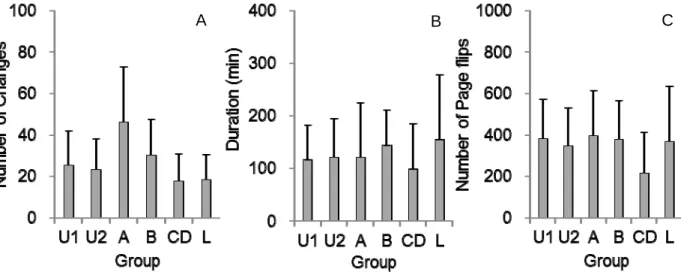
To examine whether preview and review patterns differed among the six groups of students, the sum of preview and that of review were calculated for each student and each measurement. Then, averages for each group were calculated for each measurement across the 19 e-books. Figure 4 shows these averages.One-way analyses of variances (ANOVAs) with group (U1, U2, A, B, CD, and L) as a between-participant factor were conducted on the sums of preview and of review for all three measurements. Table 1 shows the (preview and review) results. Significant differences among groups were observed for preview but not for review. Post-hoc analyses with Bonferroni adjustment (with significance level at 5%) revealed that group A showed significantly more frequent Change than did groups U2, CD, or L, and significantly more Page flips than groups U2, CD, or L. For review, no significant differences among groups were found for any measure. These results reveal that regardless of academic achievements, all students performed review in a similar way, at least when using e-books. In contrast, for preview, group A showed significantly higher values than groups U2 and L, across changes and page flips.
These results suggest that preview may be more deeply relevant to academic achievement than review. However, we note also that in this course, the students took quizzes in every class, and knew that their scores on the quizzes would be part of their final grade in the course. These characteristics of the course may have facilitated the students who have higher motivation to perform preview.
Figure 4. The averages of preview and review for each group for each measurement. A. the number of Changes, B. Durations (min), C. the number of Page flips.
Table 1: The results of ANOVAs of preview and review.
Change Duration Page flip
Preview Review Preview Review Preview Review
F 3.43 0.77 2.28 0.53 3.76 0.59
p 0.01 0.57 0.05 0.75 0.00 0.71
ηp2 0.18 0.05 0.13 0.03 0.20 0.04
Note. Degree of freedom of factor = 5. Degree of freedom of error = 77.
4.4 Relationship between academic achievement and e-book logs during class.
To confirm whether differences among students during class were similar to those on preview or review, we once again conducted the same design using one-way ANOVAs for each of the three types of measurement during class (i.e., at 0 hr). Figure 5 shows the averages for each measurement for each group (A. Change, B. Duration, C. Page flip), and Table 2 shows the results of the ANOVAs. Post-hoc
B C
A
analyses with Bonferroni adjustment with significance level at 5% revealed that during class, group A showed significantly more frequent Changes than all five other groups, and significantly more Page flips than group U2, CD, or L.
Figure 5. The averages of each measurement for each group during class. A. the number of Changes, B. Durations (min), C. the number of Page flips.
Interestingly, the frequent Changes and Page flips in group A were consistent from preview to during class. These results suggest that students who maintain good academic achievement using e-books actively link (Hartman, 1995; Strømsø & Bråten, 2002) different texts not only within an e-book but also among different e-books, and understand content more deeply as a result.
Table 2: The results of ANOVAs of during class.
Change Duration Page flip
F 4.85 0.58 0.51
p < 0.01 0.72 0.77
ηp2 0.24 0.04 0.03
Note. Degree of freedom of factor = 5. Degree of freedom of error = 77.
5. Conclusion and future work
The present study investigated the relationship between academic achievement and preview and review patterns using students’ e-book logs. The results can be summarized as follows. For preview, students who had consistent good achievement more frequently read different e-books and its pages, and spent more time on that than students who showed poor achievement. In contrast, for review, there were no significant differences between them. These results suggest that preview may be more deeply relevant to academic achievement than review. Students who maintain good academic achievements may do so in part because they link texts within an e-book and/or between different e-books. In future work, we will investigate the links between these texts in more details to clarify more effective preview and review patterns.
Acknowledgements
A B C
The research results have been achieved by under the theme of “Research and Development on Fundamental and Utilization Technologies for Social Big Data” (178A03), as the Commissioned Research of the National Institute of Information and Communications Technology (NICT), Japan.
References
Bounie, D., Eang, B., Sirbu, M., & Waelbroeck, P. (2013; 2012). Superstars and outsiders in online markets: An empirical analysis of electronic books. Electronic Commerce Research and Applications, 12(1), 52-59. Chen, C., & Chen, F. (2014). Enhancing digital reading performance with a collaborative reading annotation
system. Computers & Education, 77, 67-81.
Eden, S., & EshetAlkalai, Y. (2013). The effect of format on performance: Editing text in print versus digital formats. British Journal of Educational Technology, 44(5), 846-856.
Hartman, D. K. (1995). Eight readers reading: The intertextual links of proficient readers reading multiple passages. Reading Research Quarterly, 30(3), 520–561.
Japanese Ministry of Education, Culture, Sports, Science and Technology (2011). “The Vision for ICT in Education”,
http://www.mext.go.jp/b_menu/houdou/23/04/__icsFiles/afieldfile/2012/08/03/1305484_14_1.pdf Liu, Z. (2005). Reading behavior in the digital environment. Journal of Documentation, 61(6), 700-712.
Nakajima, T., Shinohara, S., & Tamura, Y. (2013). Typical functions of e-Textbook, implementation, and compatibility verification with use of ePub3 materials. Procedia Computer Science, 22, 1344–1353. Reynolds, R. (2011). Trends influencing the growth of digital textbooks in US higher education. Publishing
Research Quarterly, 27(2), 178-187.
Shepperd, J. A., Grace, J. L., & Koch, E. J. (2008). Evaluating the electronic textbook: Is it time to dispense with the paper text? Teaching of Psychology, 35(1), 2–5.
Shinogaya K. (2010). Strategies in preparation for learning and during lectures: Using path analysis to develop a relational model. Japanese Journal of Educational Psychology, 58, 452–463.
Shinogaya K. (2012). Learning strategies: A review from the perspective of the relation between learning phases. Japanese Journal of Educational Psychology, 60, 92–105.
Shinogaya K. (2014). Students’ strategies in preparation and lectures: Direct and moderating effects of teachers’ teaching strtegies. Japanese Journal of Educational Psychology, 62, 197–208.
Strømsø, H. I., & Bråten, I. (2002). Norwegian law students’ use of multiple sources while reading expository texts. Reading Research Quarterly, 37(2), 208–227.
Woody, W. D., Daniel, D. B., & Baker, C. A. (2010). E-books or textbooks: Students prefer textbooks. Computers
& Education, 55(3), 945-948.