From Describing to Reconstructing Life Trajectories:
How the TEA (Trajectory Equifinality Approach) explicates
context-dependent human phenomena
1,
2Tatsuya Sato, Yuko Yasuda, Mami Kanzaki (Ritsumeikan University, Japan) and Jaan Valsiner (Aalborg University, Denmark).
Culture is a difficult term to define. It is similar to any other meta-level notion. We easily use them—but the very moment we are asked to clarify their meaning we are in trouble. We may end up giving very general explanations. Thus, Klempe (2013) started his lecture on cultural psychology in Aalborg with the most basic understanding that culture is about everything human beings are experiencing. But how do we experience everything? What is the value of bringing the notion of culture as a general scientific term back to psychology?
Crossroad within psychology
In psychology as a scientific discipline, there are two different approaches to treat cultural phenomenon. One of these is habitually called cross-cultural psychology and another -- cultural psychology. Why this distinction?
Cross-cultural psychology often employs (but is not necessarily limited to) the traditional strategy of group comparisons in establishing knowledge about the abstract collective entities psychologists call “cultures” (Valsiner, 2003; Fig.1). Each person in Japan can be said to “belong to” the abstract conglomerate of human beings unified the label “the Japanese culture”. Similarly, people in Jylland and Saelland are assumed to
“belong” to the “Danish culture”. Cross-cultural psychologists would then proceed to compare samples from each with one another, assuming that the “cultures” that are thus compared are qualitatively homogeneous abstract entities. From this viewpoint,
1 This chapter is based on the lecture at Two Seminars in Aalborg: Inauguration of the Niels Bohr Professorship, on March, 15, 2013—“Methodological affordances of TEM (Trajectory Equifinality Model)”
2 Authors especially thank to communication with Brady Wagoner and Nandita Chaudhary .
we can say that the person "belongs to" culture. Culture exists by itself and people are
“bathing in culture”. Human beings in the United States “take the shower” in
“American culture”, while the people in Japan “sit in the bath-tub” of “the Japanese culture”. And they take into themselves what they are immersed in—they become
“American” or “Japanese”—and can be therefore compared as such. This kind of discourse is understandable for us at the level of common sense. But for advancing our scientific knowledge it may be an impasse. Global migration of human beings makes the previous national borders more unclear. Countries in European Union open their borders for movement of labor—the “English culture” seen this way may soon be mostly Polish, in a similar way as the “German culture” may soon gain a strong Turkish accent. From the point of view of cross-cultural psychology, a culture is a kind of salad bowl, and person in it is a kind of vegetable. Persons stay in culture, like vegetables are in a salad bowl.
"Culture shock" is a representative phenomenon based on the cross cultural paradigm. If one person from one culture goes and stays in another culture, s/he may experience a psychological shock in many aspects. In this view, different cultures have existed before the person transits cultures.
In contrast, culture in cultural psychology has a different role. Culture can be seen as systemic organizer of the psychological systems of individual persons. So we have to say that culture "belongs to" the person. At first glance this seems counter-intuitive – how can something that designates a collective entity "belong to" each individual person. It is irrelevant to which ethnic group, or country, the persons
"belong to", since culture is functioning within the intra-psychological systems of each person. But how? Cultural psychologists answer that culture belongs to person through their involvement in social institutions and through the notion of human use of signs—linking this psychology with semiotics. Thus cultural psychology starts from the sampling of an individual person together with his/her participation in social institutions (Valsiner, 2001; p. 36, Valsiner, 2003;).
Cultural psychology and the importance of the promoter sign
We need authentic methodology for cultural psychology. Cultural psychology is developmental in its core; it studies people of any age level as a developing system within a developing social context (Valsiner, 2007). And the notion of the human capacity to construct signs is key to its methodology. The relationship between a subject and an object is mediated by a medium such as language and sign. Even though this tradition of thought extends back at least to figures such as Wundt and Peirce, Vygotskian triangle has a glorious position in cultural psychology (figure 1). However, we should point out
that this famous scheme of the triangle is rather static, not dynamic.
Figure 1. The Vygotskian triangle (Subject-Means-Object)
From our point of view, the Vygotskian triangle is timeless and seems to be based on the closed systemic view. So it is a stable model. The means—tools or signs—are presented as if these are given. Yet they are not—they are created.
People create artificial signs. Artificial signs make it possible for indicating adequate and/or inadequate behavior. Of course, various kinds of natural stuff might work as a sign in some situations, but the act of sign construction is that of creating human artifacts. Anything from inventing baby diapers to that of clothes shown off at fashion shows are human constructed objects—functional, yet with meanings that go far beyond their use value.
One of the important characteristics of the sign-mediation process is its redundancy. There are so many signs around one person in his/her life. Though we are surrounded by signs, almost all signs are selectively utilized. A sign affects a person in a particular way at one place and at one time. Even though one sign may affect many persons, this is not essential for thinking about the sign.
It is important that irreversible time is introduced into this picture – a sign is created by a person within a chronotope. The notion of chronotope was coined by Bakhtin for purposes of literary criticism in the 1930s (Bakhtin, 1930s/1981). Here we use the notion of chronotope to indicate the complementary nature of time and place. Time and place are not opposite components in human lives. In philosophical thinking, we can divide the two notions in the sphere of ideas. The notion of chronotope expresses the complementary nature of time and place.
Furthermore, the notion of promoter sign (a sign that provides meta-level guidance for approaching the future) is suitable for explaining the nature of the chronotope in cultural psychology. The promoter sign is novel and innovative for both person and environment. It is not the “stimulus” of unconditioned reflex--the same objective thing/event rarely activates/inhibits the same actions of different people.
For example, can you find the rabbit on the mountain in the photo below (Figure
2)? The mountain is Azuma Fuji in Fukushima prefecture. The snow that remains on the mountain in the photo takes on the form of a “rabbit.” Farmers in Fukushima call it the “seed-planting rabbit”, because it represents the climate favorable for planting and informs the proper temperature for the start of spring rice crop. Whenever rice farmers see the snow rabbit, they start the planting. Farmers never obey the calendar time. That means farmers start their work on a different day each year. The shape of the rabbit is a promoter sign for Fukushima farmers (Sato & Valsiner, 2010).
Figure 2. Finding the rabbit
Not all outer events stimulate the person to action. Sometimes a sign emerges and sometimes a sign promotes conduct. Vygotskian triangle of sign mediated process fails to express the dynamic aspect of the sign. Hence we admit the need to introduce the notion of “promoter sign” (Valsiner, 2004; 2007, chap1). The promoter sign is not an immediate sign a person uses to act, but a meta-level sign that guides the direction of use of other signs that in their turn guide actual conduct.
Complementary equifinality with TEA (Trajectory Equifinality Approach).
Cultural psychologists have to abandon the simple “cause - effect” kind of explanation. Elementalistic causality (factor X causes Y; e.g., “intelligence” causes success in problem solving) is not important for cultural psychology. Instead, cultural psychologists take systems theory seriously for constructing new methodology, theory and epistemology. The Trajectory Equifinality Approach (TEA) is such a methodological, theoretical and epistemological construct, invented in 2004 and developed gradually since then. This accomplishes three tasks that psychology has had difficulties in conceptualizing:
(a) uniting the psychologically real and the imaginary through the construction of a model of life trajectories within irreversible time;
(b) creating molar (Gestalt—“analysis into minimal functional wholes”—in the words of Lev Vygotsky) units of analysis rather than moving to the reductionist “analyses into elements”, and
(c) creating the arena for developing ways of analyzing oppositions (tensions) that cross the line of past and future.
TEA is a triarchic construction in cultural psychology which consists of three sub-components. These are the Three Layer Model of Genesis (TLMG), Historically Structured Sampling (HSS) and Trajectory Equifinality Model (TEM). As we would explain later, TEM is the flagship of TEA, which is a methodology for describing life within irreversible time (Kadianaki, 2009;Mattos, 2013; Sato, Fukuda and Hidaka, 2009; Sato, Fukuda, Hidaka, Kido, Nishida, and Akasaka, 2012). It has some basic notions, such as Bifurcation Point (BFP), Equifinality point (EFP) and Trajectory. The notion of irreversible time originates in Henri Bergson’s philosophy, and is a premise of TEM. TEM without irreversible time doesn't exist principally.
Figure 3 Basic notions of TEM within irreversible time
In figure 3, BFP is depicted as ellipse and EFP is depicted as rectangle. Simply speaking, BFP is a point that has alternative options to go and EFP is a point that multiple trajectories to reach. Later, these notions will be discussed in more theoretical way.
Historically Structured Sampling (HSS) is a methodology of sampling for qualitative inquiry (Valsiner and Sato, 2006; Sato, Yasuda, Kido, Arakawa, Mizoguchi and Valsiner, 2007). HSS is inevitably related to Equifinality Point (EFP) as a research focus. Researchers set their spontaneous interesting research focus by themselves (neither obeying professor’s instruction nor reading antecedent references). Then HSS makes it possible to pick up participants who experienced an Equifinality point while arriving there through very different life course trajectories (neither random sampled people nor
college students).
On the other hand, the Three Layer Model of Genesis (TLMG) is related to (Bifurcation Point) BFP. TLMG is a framework for understanding the transactional nature of signs as they are organized into a working in dialogical system of self at the levels of microgenesis, mesogenesis, and ontogenesis. Here it is implied that self is not homogeneous entity but complex process of different voices. TLMG makes it possible to understand how signs emerge at a particular time and place (i.e., at bifurcation) in a life trajectory.
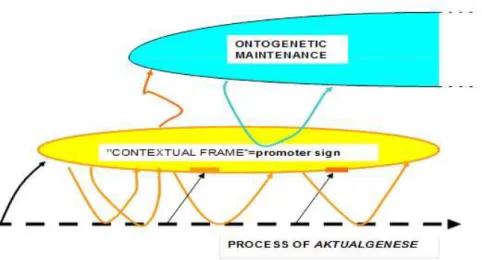
The human immediate living experience is primarily microgenetic, occurring as the person faces the ever-new moments (Valsiner, 2007; Chap. 7). Mesogenetic process is activity context dependent and mesogenetic level consists of relatively repetitive situated activity frames, or setting. Ontogenesis level is the most enduring aspect of human (cultural) life. In this level some selected experiences become into relatively stable meaning structures that guide the person within his or her life course (Valsiner, 1998). So the ontogenetic level is a kind of value system of person.
Figure 4 Relation between ontogenesis, mesogenesis, microgenesis (Aktualgenese)
In figure 4, the dash line on the bottom expresses the process of microgenesis (in German, Aktualgenese), ellipse of the middle expresses mesogenetic level and half ellipse on the top expresses the ontogenesis. Here, the very mesogenetic level is a really interesting focus for cultural psychology. Neither direct living experiences nor stable value and/or personality is suitable for TEM in cultural psychology. BFP is a point where/when activities are guided to move in one direction. And the central issue is that of mesogenetic selectivity. Irreversible and pervasive time becomes irreversible and asymmetry after the moment the promoter sign emerges on BFP. Restating it from the reverse perspective, BFP is a moment of “broom of time (Anisov, 2001)” that makes
PRESENT time as a boundary between half past and half future within irreversible time.
Figure 5. Anisov’s (2001) model of “broom of time”: Past and future are asymmetric
The notion of irreversible time derives from phenomenology of Bergson in the first place, here this notion may approach the existentialism of Kierkegaard through the notion of broom of time. Irreversible time is asymmetric—the past is not isomorphic with the future (Figure 5).
The triarchic scheme of TEA is depicted as a figure below (Figure 6).
Figure 6. The TEA complex
HSS, TEM and TLMG are indispensable wheels of a triarchic scheme for understanding the human life course within irreversible time. TEM is the flagship of these three sub-components of TEA. Trajectory Equifinality Model (TEM) is a new proposal to describe human development from the perspective of cultural psychology. Simply speaking, TEM focuses on the human experience of transformation within irreversible time in an individual’s life course. And TEM expresses the idiographic life trajectories using many conceptual tools. TEM aims to describe the transaction between human and environment. People construe their life courses by selecting one possible option from a range of options at one time.
The TEM relies heavily upon the notion of equifinality that originated in the general systems theory (GST) of Von Bertalanffy (1968) and is rooted in the early biological work of Hans Driesch. Von Bertalanffy pioneered the organismic conception of biology from which the GST developed (Valsiner and Sato, 2006). He regarded living organisms including human beings as not closed systems but as open systems—which exist due to relating with their surroundings. Equifinality—a defining property of open systems-- means that the same state may be reached from different initial conditions and in different ways within irreversible time. The notion of equifinality implies the multi-courses for the same equifinality point (EFP). The Equifinality Point (EFP) is the research focus in which researchers have interests in comparing different developing systems-- people, entering higher education, the infertile experience of married women, an occasion for authentic reflection of delinquent adolescent, decision to go study abroad and so on. All these examples involve the convergence of different unique developmental trajectories temporarily to one area- EFP-- through which they need to move in order to develop further (Figure 7). EFP sets the stage for bifurcation—trajectories of different developing systems need to first converge in order to have a possibility for further divergence. EFPs are the places where cultural processes can be studied precisely, because EFP is the common ground for construction of new divergence between different life courses.
Figure 7. The basic notion of bifurcation as it emerges after EFP (Equifinality Point)
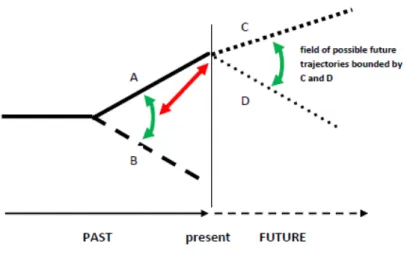
TEM is not usable across different developmental courses, but within each of them—looking at tensions that are present at the given moment, generated across the boundary between the past and the future of the given developing system. As showed in Figure 8, TEM involves comparison of two tensions – one in the past (real A and B—the imagined past of “what could have happened had circumstances been different”) and one in the future (C and D, both imaginary projections into the future). Based on the meta-level coordination of the two tensions (A<>B and C<>D) we can analyze the development of the system towards its future.
A complementary notion to EFP is its imaginary alternative—Polarized Equifinality Point (PEFP). This is an alternative equifinality point to which the different trajectories could have converged, had the past imaginary trajectory (B in Figure 8) been selected. It creates the contrast – real EFP here-and-now with that of its polarized counter-point (PEFP). Finding oneself in the middle of a joint productive seminar (EFP) can be contrasted by one participant with the polarized opposite of “what a miserable day it seems to be” (PEFP) that s/he felt in the morning waking up. The contrast of the productivity at the seminar is made with another state—“miserable day”—which could have happened, but did not.
This process of finding appropriate PEFP is neither inductive nor deductive, it’s abductive. In this case, “Miserable daily life” may be a PEFP. Or “fruitful work at home” may be another. Another participant could feel “the seminar is interesting (EFP), but I could have been more productive staying at home and working there (PEFP)”. These are only abductive hypotheses, so researchers think deeper and deeper both inductively and deductively. And at last researchers end up with an abductive thinking to find appropriate concept of EFP and PEFP in the given case. Because this is an imaginary example, we cannot go further. What we want to say is that PEFP represents not opposite but something complementary, and is a core of TEM (and TEA). In this imaginary case, the person had difficulty deciding and fluctuated between two complementary PEFPs.
Figure 8. The minimal basic unit of TEM—an idiographic analytic scheme at the border of time between past and future.
The generalized notion of complementarity3 leads us to look at the other side of experiences—contrasting the realized with the unrealized. Realized experiences and un-realized experiences should not be exclusively divided. Rather, complementary experiences are under a condition of inclusive separation (Valsiner, 1987). These experiences have boundaries that function as a psychological membrane (Marsico, Cabell, Valsiner and Kharlamov, 2013). In an analogy with biological membranes, psychological boundaries are structures that enable the maintenance and development of the human psyche in its cultural organization. Signs people create regulate the conditions of such membranes. This is similar to the experience of looking at Rubin’s classic “vase versus faces” figure. Vase and profile of two faces are emerging in our perception moment to moment, and fluctuating, back and forth. Nevertheless, Rubin’s
“vase versus faces” figure doesn’t express time itself4. The triarchic frame of TEA (TEM, HSS and TLMG) in cultural psychology directs us to describe the moment-to-moment fluctuations in irreversible time. And such an approach leads cultural psychology towards a Wissenschaft of human experience.
3 The notion of complementarity is, first and foremost, a meta-theoretical notion that was arrived at by Niels Bohr inductively, as an effort to make sense of experimental evidence (Valsiner, 2013).
4 Gestalt psychology originated in Ehrenfels' essay "On Gestalt Qualities [Über Gestaltqualitäten]" (Ehrenfels, 1890/1988). From his perspective gestalt qualities are not structure but process. In other word, if time doesn’t exist, gestalt qualities cannot be perceived by person.
References
Anisov, A. (2001). Svoistva vremeni [features of time]. Logical Studies, 6, 1-22.
Bakhtin, M. M. (1930s/1981) The Dialogic Imagination: Four Essays. Ed. Michael Holquist. Trans. Caryl Emerson and Michael Holquist. Austin and London: University of Texas Press. [written during the 1930s]
Bertalanffy, von L. (1968). General systems theory. New York: Braziller.
Ehrenfels von C. (1890) Über Gestaltqualitäten. Vierteljahresschr. für Philosophie, 14, 249-292. Ehrenfels von C. (1890/1988) On "Gestalt Qualities". In B. Smith (Ed. & Trans.) Foundations of Gestalt Theory. Wien: Philosophia Verlag. pp 82-117.
Kadianaki, I. (2009). Dynamic Process Methodology in the Social and Developmental Sciences In Jaan Valsiner, Peter C. M. Molenaar, Maria C. D. P. Lyra, Nandita Chaudhary(Eds.) Dramatic Life Courses: Migrants in the Making Chapter 22 pp 477-492.
Klempe, S. H. (2013). Kierkegaard, Kitchen, Complementarity and Cultural Psychology: A Thought Experiment. Paper presented at the Inaugural Conference of the Niels Bohr Professorship Centre of Cultural Psychology, University of Aalborg, Aalborg, March, 15, 2013.
Marsico, G., Cabell, K. R., Valsiner, H., and Kharlamov, N. (2013). Interobjectivity as a border The fluid dynamics of “betweenness”. In G. Sammut, P. Daanen, and F. Moghaddam (Eds.) Understanding Self and Others: Explorations in Intersubjectivity and Interobjectivity / London: Routledge.
Mattos, E. de and Chaves, A. M. (2013). Semiotic Regulation through Inhibitor Signs: Creating a Cycle of Rigid Meanings. Integrative Psychological and Behavioral Science, 47, pp 95-122.
Sato, T., Fukuda, M., Hidaka, T., Kido, A., Nishida, N. and Akasaka, M. (2012). The Authentic Culture of Living Well: Pathways to psychological well-being. In J. Valsiner (Ed.), The Oxford handbook of culture and psychology. New York: Oxford University Press.
Sato, T., & Valsiner, J. (2010). Time in life and life in time: between experiencing and accounting. Ritsumeikan Journal of Human Sciences, 20, 79–92.
http://www.ritsumeihuman.com/uploads/publication/ningen_20/p079-092.pdf
Sato, T., Hidaka, T. & Fukuda, M. (2009). Depicting the Dynamics of Living the Life: The Trajectory Equifinality Model. In J. Valsiner, P. Molenaar, M. Lyra and N. Chaudhary (Eds), Dynamic process methodology in the social and developmental sciences (p. 217‐240). New York: Springer.
http://www.bath.ac.uk/csat/davidparkin/documents-nov09/Paper3_13-11-09.pdf
Sato, T., Yasuda, Y., Kido, A., Arakawa, A., Mizoguchi, H., and Valsiner,J. (2007). Sampling reconsidered: Idiographic science and the analyses of personal life trajectories. In J. Valsiner, J., & A. Rosa, A. (Eds.), Cambridge Handbook of Socio-Cultural Psychology (pp. 82-106). New York: Cambridge University Press.
Valsiner, J. (1987). Culture and the development of children’s action. Chichester: Wiley. Valsiner, J. (1998). The guided mind. Cambridge, Ma.: Harvard University Press.
Valsiner, J. (2001) Comparative study of human cultural development. Madrid: Fundacion Infancia y Aprendizaje.
Valsiner, J. (2003). Culture and its Transfer: Ways of Creating General Knowledge Through the Study of Cultural Particulars. In W. J. Lonner, D. L. Dinnel, S. A. Hayes, & D. N. Sattler (Eds.), Online Readings in Psychology and Culture (Unit 2, Chapter 12), Center for Cross-Cultural Research, Western Washington University, Bellingham, Washington USA.
http://www.wwu.edu/culture/Valsiner.htm
Valsiner, J. (2004). The Promoter Sign: Developmental transformation within the structure of Dialogical Self. Paper presented at the Biennial Meeting of the International Society for the Study of Behavioural Development (ISSBD), Gent, July, 12 ( Symposium Developmental aspects of the dialogical self - Hubert Hermans, Convener)
Valsiner, J. (2007). Culture in minds and societies. New Delhi: Sage.
Valsiner, J. (2013). Cultural psychology and its future: complementarity in a new key. Paper presented Inaugural Lecture of the Niels Bohr Professorship Centre of Cultural Psychology, University of Aalborg, Aalborg, March, 15, 2013
Valsiner, J., & Sato, T. (2006). Historically Structured Sampling (HSS): How can psychology’s methodology become tuned in to the reality of the historical nature of cultural psychology? In J. Straub, D. Weidemann, C. Kölbl & B. Zielke (Eds.), Pursuit of meaning (pp. 215-251). Bielefeld: transcript.
http://dl.dropbox.com/u/21182085/valsiner2006.pdf