Al l oc at i on i n D
2D
Enabl ed Cel l ul ar N
et w
or ks
著者
ZH
O
U
Zhenyu, O
TA Kaor u, D
O
N
G
M
i anxi ong, XU
Chen
j our nal or
publ i c at i on t i t l e
I EEE Tr ans ac t i ons on Vehi c ul ar Tec hnol ogy
vol um
e
66
num
ber
6
page r ange
5256- 5268
year
2017- 06
U
RL
ht t p: / / hdl . handl e. net / 10258/ 00009561
Energy-Efficient Matching for Resource Allocation
in D2D Enabled Cellular Networks
Zhenyu Zhou,
Member, IEEE,
Kaoru Ota,
Member, IEEE,
Mianxiong Dong,
Member, IEEE,
and Chen Xu,
Member, IEEE
Abstract—Energy-efficiency (EE) is critical for device-to-device (D2D) enabled cellular networks due to limited battery capacity and severe co-channel interference. In this paper, we address the EE optimization problem by adopting a stable matching approach. The NP-hard joint resource allocation problem is formulated as a one-to-one matching problem under two-sided preferences, which vary dynamically with channel states and interference levels. A game-theoretic approach is employed to analyze the interactions and correlations among user equipments (UEs), and an iterative power allocation algorithm is developed to establish mutual preferences based on nonlinear fractional programming. We then employ the Gale-Shapley (GS) algorithm to match D2D pairs with cellular UEs (CUs), which is proved to be stable and weak Pareto optimal. We provide a theoretical anal-ysis and description for implementation details and algorithmic complexity. We also extend the algorithm to address scalability issues in large-scale networks by developing tie-breaking and preference deletion based matching rules. Simulation results validate the theoretical analysis and demonstrate that significant performance gains of average EE and matching satisfactions can be achieved by the proposed algorithm.
Index Terms—energy-efficient matching, resource allocation, nonconvex optimization, D2D communications, game-theoretical approach.
I. INTRODUCTION
D
UE to the explosive growth of Internet of things (IoT) and cellular technology, it is predicted that billions of devices will be interconnected and the corresponding data traffic will grow more than 1000 times by 2020 [1]–[4]. Device-to-device (D2D) communication that enables ubiqui-tous information acquisition and exchange among devices over a direct link [5], is a key enabler to facilitate future 5G mobile systems [6]. D2D communications can be operated as an underlay to cellular networks through spectrum reusing [5], which brings numerous benefits and significant performanceCopyright (c) 2016 IEEE Personal use of this material is permitted. However, permission to use this material for any other purposes must be obtained from the IEEE by sending a request to [email protected]. Manuscript received January 2, 2016; revised May 16, 2016; accepted July 16, 2016. This work was partially supported by the Fundamental Research Funds for the Central Universities under Grant Number 2014MS08, 2015MS04, and 2016MS17. This work was also partially supported by JSPS KAKENHI Grant Number 26730056, 15K15976, 16K00117, and JSPS A3 Foresight Program.
Z. Zhou and C. Xu are with the State Key Laboratory of Alternate Electrical Power System with Renewable Energy Sources, School of Electrical and Electronic Engineering, North China Electric Power University, Beijing, China, 102206. (E-mal: zhenyu [email protected], [email protected]) K. Ota and M. Dong are with the Department of Information and Electric Engineering, Muroran Institute of Technology, Muroran, Hokkaido, Japan. M. Dong is the corresponding aurthor. (E-mail: [email protected], [email protected])
improvements to network capacity and user experience [7], [8].
The operation of distributed D2D communications within centralized cellular networks does give rise to new challenges in resource allocation optimization due to limited spectrum and battery capacity. One major line of works aims at maximizing the spectrum efficiency (SE) through resource allocation. A three-stage joint optimization of admission control, power allocation, and link selection was studied in [9]. An evaluation of SE performance under various resource sharing modes was performed in [10]. Resource allocation problems with queuing models and delay constraints were considered in [11]. In [12], the authors employed reverse iterative combinatorial auction (ICA) to solve the system sum-rate optimization problem. Spectrum-efficient resource allocation algorithms have been proposed to address problems under different scenarios such as relay-aided transmission [13], [14], constrained network capacity [15], wireless video networks [16], software-defined multi-tier cellular networks [17], [18], and energy harvesting [19], etc. Comprehensive surveys and overviews of spectrum-efficient resource management for D2D communications were provided in [13], [20].
UEs (CUs). A common assumption is that every UE is willing to accept and obey a resource allocation decision even though it can achieve a better performance by disrupting this decision. Detailed modeling of preference from the perspective of EE is missing. Several significant challenges arise when UEs’ prefer-ences and satisfactions are taken into consideration. First of all, it is difficult to model preferences of UEs because they vary dynamically with channel states and aggregate interference levels. Second, it is impossible to make every UE always feel satisfied with the same resource allocation decision because UEs may have different or even conflicting preferences. Last but not least, communication overhead and transmission delay caused by obtaining the complete knowledge of every UE’s preference may lead to infeasibility and scalability issues with two-sided preferences.
To address these challenges, we propose an energy-efficient stable matching algorithm to solve the NP-hard resource allocation problem by combining advantages of game theory, matching theory, and nonlinear fractional programming. In computational complexity theory, NP-hard problem represents that the problem is at least as hard as any NP-complete problem, which cannot be solved by using polynomial-time algorithms [31]. Game theory that enables in-depth analysis of UEs with conflicting objectives has been widely applied for optimizing resource allocation in D2D communications [13], [20], [32]. Despite its popularity and potential benefits, most game-theory based approaches such as the Nash equilibrium, only validate unilateral stability notions per player by showing that any strategy deviating from the equilibrium cannot achieve better performance [33]. Such one-sided stability may be impractical when performing resource allocation between two disjoint sets of players with individualized mutual preferences. In comparison, matching theory provides a distributed self-organizing and self-optimizing approach for solving combi-natorial problems of matching resources in two disjoint sets [34]–[36]. In particular, it is suitable for wireless resource management due to its ability to handle complex objective functions related to heterogeneous UEs through generally defined preferences. Matching theory based resource allocation algorithms have been developed for cellular networks [33], [37], cognitive radios [38], D2D communications [33], and mobile energy-harvesting networks [39], etc.
Related works that employ matching theory to solve re-source allocation problems for D2D communications are sum-marized and compared as follows. In [40], matching theory was exploited to solve the resource allocation problem in a multi-tier heterogeneous network which consists of macro UEs, small cell UEs, and D2D UEs. The work was then extended to the scenario of relay-aided D2D communications under channel uncertainties, which were modeled as ellipsoidal uncertainty sets by exploiting robust optimization theory [41]. In [42], matching theory was used for solving the relay selection problem in full duplex D2D communications. The interactions and interconnections between D2D UEs and CUs were not taken into consideration. In [43], cheating was introduced into the matching process to further improve UEs’ satisfactions by falsifying certain UEs’ preference profiles. However, we believe that the energy-efficient joint partner
selection and power allocation problem with UEs’ preferences and satisfactions considered in this paper has not been well addressed in the above mentioned works.
The main contributions of this paper are summarized as follows:
• A problem formulation for optimizing energy efficiency of any D2D pair or CU under transmission power, channel reusing, and QoS constraints is derived. The formulation obtained is an mixed integer nonlinear programming (MINLP) problem, which uses a binary variable to in-dicate partner selection (which UE should be selected to form a channel-reusing partnership), and a continuous variable for power allocation (how much transmission power should be allocated for the potential D2D-CU pair). To solve the MINLP problem, we introduce a
one-to-one matching model which matches D2D pairs with CUs according to mutual preferences. In this way, the original NP-hard joint partner selection and power allocation problem can be decoupled into two separate subproblems and solved in a tractable manner.
• One main focus of this work is how to establish mutual preferences from the perspectives of EE. We model a D2D pair (or CU)’s preference over a CU (or D2D pair) as the maximum achievable EE under the specified matching. The power allocation problem developed for obtaining UE preference is modeled as a noncooperative game, in which each UE aims at optimizing its indi-vidual EE given the transmission power strategies of its channel-reusing partner. A nonlinear fractional program-ming and Lagrange dual decomposition based iterative algorithm is developed for establishing preference profiles of both D2D pairs and CUs [44], [45]. The existence and uniqueness properties of the Nash equilibrium and its relationships with optimum power allocation strategies are analyzed theoretically via mathematical proofs.
• Finally, we propose to advocate the Gale-Shapley (GS) algorithm to solve the formulated energy-efficient match-ing problem under established two-sided preferences and corresponding power allocation strategies. The proposed matching algorithm is also extended to address scala-bility issues encountered in large-scale networks. De-tailed discussion and in-depth analysis of matching sta-bility, distributed/centralized implementation, and com-putational complexity are presented. Simulation results show that the proposed algorithm can obtain significant EE performance gains and remarkably improve matching satisfactions for a wide range of satisfaction threshold values.
II. ENERGY-EFFICIENTRESOURCEALLOCATION PROBLEMFORMULATION
In this section, we firstly provide a detailed description of the system model of D2D communications underlaying cellular networks with UE preferences, and then present the formulation of the energy-efficient resource allocation prob-lem.
A. System Model
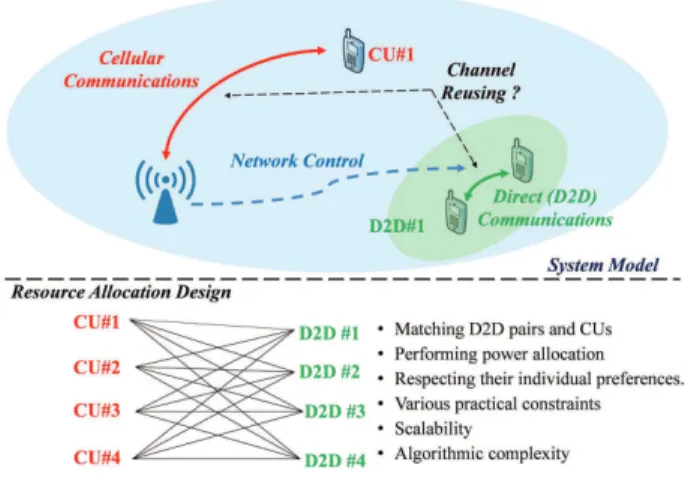
We consider uplink spectrum sharing in D2D communica-tions underlaying cellular networks, which is shown in Fig. 1. Uplink spectrum sharing is considered in particularly because firstly, uplink spectrum resources are usually under-utilized compared to the downlink in frequency division duplexing (FDD) based cellular systems [27]; secondly, co-channel inter-ference caused by D2D UEs can be handled more easily by a powerful base station (BS) than CUs. We assume that each CU is allocated with an orthogonal channel (e.g., an orthogonal resource block in LTE), i.e., K active CUs occupy a total of
Korthogonal channels and there is no co-channel interference among CUs. A pair of D2D transmitter and receiver that meet D2D communication requirements form a D2D pair, and are allowed to reuse at most one CU’s channel for transmission. The scenario that each D2D pair reuses more than one channel is equivalent to aone-to-many matchingproblem, which is out of the scope of this paper and left to future works.
As a result, all of active D2D transmitters cause co-channel interference to the BS, and a CU causes co-co-channel interference to the D2D receiver that operates in the same channel. QoS requirements are imposed for both CUs and D2D pairs. In this paper, we assume that the D2D mode and peer selection process has already been finished, and we mainly focus on the resource allocation part. The joint optimization of mode selection, peer selection, and resource allocation is a completely new problem, which is out of the scope of this paper and will be treated in our future works. Regarding how to perform mode selection and peer selection, interested readers may refer to [7], [11], [46] and references therein for more details.
There are a total of N D2D pairs and K CUs. Through-out the paper, the index sets of active D2D pairs and CUs are denoted as D = {d1,· · ·, di,· · · , dN}, and C
={c1,· · · , ck,· · ·, cK}, respectively.
Definition 1. The partner selection matrix of D2D pairs is denoted as XN×K, where the(i, k)-th element xi,k ∈ {0,1}
indicates the selection decision of the D2D-CU partnership
(di, ck) for the D2D pairdi,∀di ∈ D,∀ck ∈ C. If xi,k = 1,
di prefers to forming a partnership with ck, and ifxi,k = 0,
otherwise.
Definition 2.The partner selection matrix of CUs is denoted as YK×N, where the(k, i)-th elementyk,i∈ {0,1} indicates
the selection decision of the D2D-CU partnership (ck, di)for
the CU ck, ∀ck ∈ C, ∀di ∈ D. If yk,i = 1, ck prefers to
forming a partnership with di, and ifyk,i= 0, otherwise.
Remark 1. Due to the individualized and differentiated preferences ofdiandck, it is very possible to have conflicting
Fig. 1. Practical implementation and resource allocation design for D2D communications underlaying cellular networks with UE preferences.
partner selection decisions, i.e.,xi,k6=yk,i. A D2D-CU
part-nership(di, ck)can be formed if and only ifxi,k=yk,i = 1.
Regarding channel models, both fast fading and slow fading which are caused by multi-path propagation, shadowing, and pathloss are taken into consideration [9]. The channel gain of the interference fromck todi is given by
gk,ic =̟βck,iζk,ic d−k,iα, (1)
where̟ is the pathloss constant, βc
k,i is the fast-fading gain
with exponential distribution,ζc
k,i is the slow-fading gain with
log-normal distribution, αis the pathloss exponent, and dk,i
is the transmission distance. In a similar way, we can define the channel gain of di as gid, the interference channel gain
between the transmitter ofdi and the BS asgdi,B, and define
the channel gain betweenck and the BS as gck,B.
The achievable SE (defined as bits/s/Hz) ofdi is given by
Uid=
X
ck∈C
log2 1 +
xi,kyk,ipdigid
N0+xi,kyk,ipckgk,ic
!
, (2)
wherepd
i and pck represent the transmission power of di and
ck, respectively. N0 is the noise power on each channel. The
achievable SE ofck is given by
Uc
k = log2 1 +
pc kgck,B
N0+Pdi∈Dxi,kyk,ip
d igi,Bd
!
. (3)
The total power consumptions ofdi andck are given by
Ed i =
X
ck∈C
1
ηxi,kyk,ip
d
i + 2pcir, (4)
Ekc=
1 ηp
c
k+pcir. (5)
pcir is the total circuit power consumption which includes
consumption of the BS is not considered because it is powered by external grid power.
B. Problem Formulation
Eventually better channel conditions and proper transmis-sion power strategies can improve the EE performance more efficiently. Therefore, for any D2D pair or CU, the following questions need to be answered before reaching a decision:
• How to select a partner to form a D2D-CU channel-reusing pair for optimizing EE performance?
• How to perform power allocation for the expected
D2D-CU pair?
• How to satisfy various practical resource allocation
con-straints such as maximum transmission power levels, QoS requirements, and channel-reusing rules, etc?
• How to avoid disruptions from other D2D pairs or CUs
which also wish to be matched with the preferred D2D pair or CU?
The above questions indicate that the optimization of EE involves solving a joint partner selection and power allocation problem. To be more general, denoting xi = {xi,1,· · · , xi,k,· · ·, xi,K} and
yk = {yk,1,· · ·, yk,i,· · ·, yk,N} as di’s and ck’s binary
partner selection strategy sets, respectively, and denoting pd i
andpc
kasdi’s andck’s continuous power allocation strategies,
respectively, the objective function in terms of EE (bits/J/Hz) is defined as the SE (bits/s/Hz) divided by the total power consumption (W) [47]. The EE objective functions of di
(including both the transmitter and receiver) andck are given
by
Ud
i,EE(xi, pdi) =
Ud i(xi, pdi)
Ed i(xi, pdi) =
P
ck∈Clog2
1 + xi,kyk,ipdigdi
N0+xi,kyk,ipckgck,i
P
ck∈C
1
ηxi,kyk,ip d i + 2pcir
, (6)
Uc
k,EE(yk, pck) = Uc
k(yk, pck) Ec
k(pck)
= log2
1 + pckgk,Bc
N0+P
di∈Dxi,kyk,ipdigdi,B
1
ηpck+pcir
. (7)
The joint partner selection and power allocation problem for di can be formulated as
max (xi,pd i)
Ui,EEd (xi, pdi)
s.t. Ci,d1: 0≤pdi ≤pdi,max,
Cd
i,2:Uid(xi, pdi)≥Ui,mind ,
Cd
i,3:xi,k ={0,1},∀ck ∈ C,
Ci,d4: X
ck∈C
xi,k≤1. (8)
Cd
i,1ensures that the power allocation ofdi should not exceed
the maximum allowed transmission powerpd
i,max.Ci,d2
speci-fies the QoS requirement which represents that the minimum
SE should not fall belowUd
i,min.Ci,d3andCi,d4are the
channel-reusing constraints which make sure that at most one channel can be shared simultaneously bydi and one existing CU.
The problem formulation forck is given by
max (yk,pc k)
Uc
k,EE(yk, pck)
s.t. Cc
k,1: 0≤pck≤pck,max,
Cc
k,2:Ukc(yk, pck)≥Uk,minc , Cc
k,3:yk,i ={0,1},∀di∈ D,
Ck,c4: X
di∈D
yk,i≤1. (9)
Cc
k,1 andCk,c2 specify the transmission power and QoS
con-straints.Cc
k,3 andCk,c4 ensure that at most one D2D pair can
share the same channel with ck simultaneously.
Remark 2. By observing (8) and (9), we find that the partner selection problem is coupled with the power allocation problem. The formulation obtained is an NP-hard MINLP problem, which involves both binary and continuous variables for resource allocation optimization. Thus, the formulations obtained in neither (8) nor (9) cannot be solved directly by using either nonlinear fractional programming or integer programming. Furthermore, neither of the two programming approaches has taken UEs’ preferences and satisfactions into consideration, which may lead to unstable and unsatisfied resource allocation decision.
To solve (8) and (9), we introduce a one-to-one matching
model to match D2D pairs with CUs according to their mutual preferences. In this fashion, the original NP-hard MINLP problem can be decoupled into two separate subproblems and solved in a tractable manner. We use the triple (C,D,P) to denote the formulated matching problem, i.e., D,C represent the two finite and distinct sets of D2D pairs and CUs, respec-tively, andP is the set of mutual preferences. Both D2D pairs and CUs seek to form proper channel-reusing partnerships to maximize EE under constraints of QoS and transmission power. The definition of a matchingµ is given by [35]:
Definition 3. For the matching problem (C,D,P), µ is a point-by-point mapping fromC∪Donto itself under preference
P. This is, for anyck∈ C anddi∈ D,µ(ck)∈ D ∪ {ck}and
µ(di)∈ C ∪ {dk}.µ(ck) =di if and only if µ(di) =ck.
If µ(di) =di or µ(ck) =ck, di or ck stays single. Either
di or ck can send a request for forming a partnership with
its preferred partner based on its preference (which is the partner selection subproblem), and demonstrate the allocated transmission power for the formed partnership (which is the power allocation subproblem). Both di and ck are assumed
to only care about their own matched partners and show little concerns to matching results of others. This assumption is valid because UEs are privately owned and operated by independent individuals.
III. ENERGY-EFFICIENTSTABLEMATCHING FORD2D COMMUNICATIONS
Subsection III-A. Then, the derivation of the energy-efficient matching based on the GS algorithm is presented in Subsection III-B. Finally, in-depth discussions and theoretical analysis of matching stability, distributed/centralized implementation, and computational complexity are provided in Subsection III-C.
A. Preference Establishment
1) Noncooperative Game based Preference Modeling: The set of UEs’ preferences P is necessary for developing the energy-efficient matching. We model di’s preference overck
as the maximum achievable EE under the matchingµ(di) =ck
(xi,k =yk,i = 1). Thus, the partner selection decision of di
has been already fixed, and only the power allocation strat-egy needs to be optimized. The formulated power allocation problem is given by
max
pd i
Ud i,EE(pdi)
µ(d
i)=ck
s.t. Cd
i,1, Ci,d2. (10)
The power allocation problem for ck under the matching
µ(ck) =di is given by
max
pc k
Uk,EEc (pck)
µ(ck)=di
s.t. Cc
k,1, Ck,c2. (11)
There are two challenges when solving the above optimiza-tion problems. First, from (6) and (7), Ud
i,EE andUk,EEc are
inter-correlated through the interference terms, i.e.,pc
kgck,iand
pd
igi,Bd . Second, the problems formulated in (10) and (11) are
still nonconvex due to the fractional form ofUd
i,EEandUk,EEc .
In order to study the inter-connections between D2D pairs and CUs (to solve the first challenge), we adopt a game-theoretic approach to model the distributed power allocation problem as a noncooperative game G. UEs are assumed as rational and selfish [48], i.e., each di ∈ D (or ck ∈ C)
cares about its individual objective Ud
i,EE (or Uk,EEc ), but
is not otherwise concerned with Ud
j,EE,∀dj ∈ D\{di} (or
Uc
m,EE,∀cm ∈ C\{ck}). The game G can be described as
G = (C,D,A,U), wherein A={Ad
1,· · ·, AdN, Ac1,· · ·, AdK}
is the set of possible strategies that a UE can take, and
U = {Ud
1,EE,· · · , UN,EEd , U1c,EE,· · ·, UK,EEc } is the set of
UEs’ utilities. For example, if Ad
i ={[0, pdi,max]}, then di is
allowed to select pd
i from the interval [0, pdi,max].
2) Objective Function Transformation: To overcome the second challenge, nonlinear fractional programming is em-ployed to transform the nonconvex problem in the fractional form to equivalent convex ones. The optimum result of (10) is defined as
qdi∗= max pd
i
Ui,EEd (pdi)
µ(di)=ck
=U
d i(pdi∗)
Ed i(pdi∗)
, (12)
where pd∗
i is the optimum power allocation strategy of di.
Based on [44], we have Theorem 1:qd∗
i is achieved if and only if
max
pd i
Ud
i(pdi)−qid∗Eid(pdi) =Uid(pdi∗)−qid∗Edi(pdi∗) = 0.
(13)
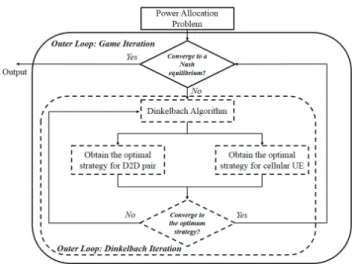
Fig. 2. The relationship between inner loop and outer loop iterations of the iterative power allocation algorithm.
Theorem 1 reveals that there exists an equivalent trans-formed problem with an objective function in subtractive form, which leads to the same maximum EE obtained by directly solving (10). The equivalent optimization problem in subtractive form is given by
max
pd i
Ud
i(pdi)−qid∗Eid(pdi)
s.t. Cd
i,1, Ci,d2. (14)
(14) is actually a multi-objective convex optimization problem where the variable qd∗
i can be regarded as a negative weight
ofEd
i. In the same way, definingqck∗ andpck∗ as the optimum
EE and the corresponding strategy of ck, respectively, the
transformed problem that is equivalent to (11) is given by
max
pc k
Uc
k(pck)−qkc∗Ekc(pck)
s.t. Ck,c1, Ck,c2. (15) 3) Distributed Iterative Power Allocation: Both (14) and (15) are standard convex optimization problems and can be solved efficiently. However, the specific values ofqd∗
i andqck∗
are required to solve (14) and (15), respectively. In order to obtain qd∗
i andqkc∗, an iterative algorithm is developed based
on Dinkelbach’s method and is given in Algorithm 1 [44]. The iterative Algorithm 1 consists of two loops: the outer loop with the iteration indexlrepresents iterations of the noncooperative game, and the inner loop with the iteration indexnrepresents iterations of Dinkelbach’s algorithm. The relationship between inner loop and outer loop iterations is shown in Fig. 2. For each round of the game, the inner loop is executed to find the corresponding optimum power allocation strategy for each player, which stops if either the iteration stopping criteria or the maximum loop number Nmax is reached. The game
Algorithm 1Distributed Iterative Power Allocation Algorithm for Obtaining qd∗
i andqkc∗
1: Input: gd
i, pˆdigi,Bd ,gk,Bc ,pˆkcgk,ic ,pdi,max, pdk,max, Ci,mind ,
Cc k,min.
2: Output: qd∗
i ,qkc∗,pid∗,pck∗.
3: Initialize: qd
i,qkc,Nmax,∆g,∆d,∆c,pˆck,pˆdi
4: while|qdi∗(l)−qdi∗(l−1)|≤∆g,
&|qck∗(l)−qkc∗(l−1)|≤∆g do
5: whilen < Nmax do
6: obtainpˆd
i(n)using (20)
7: ifUd
i[ˆpdi(n)]−qid(n)Eid[ˆpdi(n)]>∆d then
8: Update:qd
i(n+ 1) =Uid[ˆpdi(n)]/Eid[ˆpdi(n)]
9: else
10: pdi∗= ˆpdi(n), andqd∗
i =Uid(pdi∗)/Eid(pdi∗)
11: end if
12: obtainpˆck(n)using (23) 13: ifUc
k[ˆpck(n)]−qck(n)Ekc[ˆpck(n)]>∆c then
14: Update:qc
k(n+ 1) =Ukc[ˆpck(n)]/Ekc[ˆpck(n)]
15: else
16: pck∗= ˆpck(n), andqc∗
k =Ukc(pck∗)/Ekc(pck∗)
17: end if
18: Update the Dinkelbach iteration index:n→n+ 1
19: end while
20: Update:qdi(l) =qd∗
i ,qck∗(l) =qkc∗
21: Update the game iteration index :l→l+ 1
22: end while
At the n-th iteration of the l-th round game, pd i(n) and
pc
k(n) are obtained by solving the following problems with
qd
i(n)andqck(n)obtained from the (n−1)-th iteration:
max
pd i
Ud
i[pdi(n)]−qdi(n)Eid[pdi(n)]
s.t. Cd
i,1, Ci,d2. (16)
max
pc k
Uc
k[pck(n)]−qkc(n)Ekc[pck(n)]
s.t. Ck,c1, Ck,c2. (17)
The augmented Lagrangian of (16) is given by
LEE
i (pdi, δid, θid) =Uid[pdi(n)]−qid(n)Edi[pdi(n)]
−δd
i(n)[pdi(n)−pdi,max] +θid(n) Uid[pdi(n)]−Ui,mind
,
(18)
where δd
i andθid are the Lagrange multipliers for constraints
Cd
i,1 and Ci,d2, respectively. By using Lagrange dual
decom-position, (18) is decomposed as [45]
min (δid, θid≥0)
max (pdi)
LEE
i (pdi, δid, θid). (19)
By exploiting Karush-Kuhn-Tucker (KKT) conditions, the optimal value pˆd
i(n)corresponding toqid(n)is given by
ˆ pdi(n) =
η[1 +θd
i(n)] log2e
qd
i(n) +ηδid(n)
−pˆ
c
kgck,i(n) +N0
gd i
+ , (20)
Algorithm 2Iterative Preference Establishment Algorithm for ObtainingP
1: Input:the set of CUs and D2D pairs,C,D. 2: Output: the set of preference profilesP. 3: fordi∈ D do
4: forck∈ C do
5: calculate maximum achievable qd∗
i
µ(d
i)=ck
and
qc∗
k
µ(ck)=di
for the D2D-CU pair (di, ck) by
em-ploying Algorithm 1. 6: end for
7: end for 8: fordi∈ D do
9: sort all of CUsck ∈ Cin a descending order according
toqd∗
i
µ(di)=ck
.
10: end for 11: forck∈ C do
12: sort all of D2D pairs di ∈ D in a descending order
according toqc∗
k
µ(ck)=di
.
13: end for
where [x]+ = max{0, x}. Then, by employing the gradient
method [49], we update the Lagrange multipliers as
δd
i(n, τ+ 1) =
δd
i(n, τ) +ǫi,δ(n, τ) ˆpdi(n, τ)−pdi,max
+
,
(21)
θdi(n, τ+ 1) =
θdi(n, τ)−ǫi,θ(n, τ) Uid(n, τ)−Ui,mind
+
,
(22)
whereτis the iteration index of Lagrange multiplier updating,
ǫi,δ and ǫi,θ are the step sizes. The step sizes should be
carefully chosen to guarantee convergence and optimality. Then,pˆd
i(n)obtained in (20) is used to updateqid(n+1)for
the(n+1)-th iteration asqd
i(n+1) =Uid[ˆpdi(n)]/Eid[ˆpdi(n)]. In
the final iteration of the inner loop, settingpd∗
i = ˆpdi,qid∗ can
be obtained by using (12) and saved as thel-th element of the vectorqdi, i.e.,qdi(l) =qd∗
i . The optimization problem (17) is
solved in the same way. The optimal valuepˆc
k(n)corresponds
toqc
k(n)is given by
ˆ pc
k(n) =
"
η[1 +ξc
k(n)] log2e
qc
k(n) +ηρck(n)
−pˆ
d
i(n)gdi,B+N0
gc k,B
#+
. (23)
Details for how to obtain qc∗
k are omitted due to space
restrictions. The outer loop stops if the maximum EE(qd∗
i , qkc∗)
obtained in the l-th round of the game varies little from the optimization result achieved in the previous round, where the corresponding optimum strategy set (pd∗
i , pck∗) has converged
to a Nash equilibrium.
4) Preference Profile Establishment: Algorithm 2 presents how to establish the set of preference profiles P. For every
di ∈ D, the maximum achievable qdi∗ under the matching
µ(di) =ck,∀ck ∈ C, is denoted as qdi∗
µ(di)=ck
, and can be obtained by using Algorithm 1. We writeck ≻dicmto mean
di prefers ck tocm, which is defined as
ck ≻di cm⇔q
d∗
i
µ(di)=ck
> qid∗
µ(di)=cm
where≻is a complete, reflexive, and transitive binary prefer-ence relation [35]. In addition, we write ck di cm to mean
di likes ck at least as well ascm, which is defined as
ckdi cm⇔q
d∗
i
µ(d
i)=ck
≥qd∗
i
µ(d
i)=cm
. (25)
Similarly, we write di ≻ck dj to mean ck prefers di to dj,
which is defined as
di≻ck dj ⇔q
c∗
k
µ(ck)=di
> qkc∗
µ(ck)=dj
. (26)
After obtaining qd∗
i
µ(di)=ck
,∀ck ∈ C, the preference profile
P(di) ={· · ·, ck, cm· · · }is obtained by sorting all of CUs in
a descending order according to the criteria of qd∗
i
µ(di)=ck
,
∀ck ∈ C. The preference profile of ck is denoted as P(ck),
which is obtained by sorting all of available D2D pairs accord-ing toqc∗
k
µ(ck)=di
,∀di∈ D. The total setP is constructed as
P ={P(d1),· · ·, P(dN), P(c1),· · · , P(cK)}.
B. Energy-Efficient Stable Matching
After obtainingP(di)andP(ck)for eachdi∈ Dandck∈
C, we propose Algorithm 3 to match D2D pairs with CUs by employing the GS algorithm [34]. In the first iteration, everydi∈ Dsends a partner request to its most preferred CU
max{qd∗
i
µ(di)=ck
,∀ck∈ C}. Then, everyck∈ C receives the
request and rejects the D2D pair if it already holds a better candidate. Any di ∈ D that is not rejected by the CUs at
this step is held as a candidate. In the next step, any di ∈ D
that has been already rejected sends a new request to its most preferred choice from the set of CUs that have not yet issued a rejection. If a D2D pair is rejected by all of its preferred CUs, it will give up and send no further request. Eachck∈ C
compares all of the received requests including the candidate that was held from previous steps and only accepts the most preferred D2D pair. The request sending and rejection process finishes when every di ∈ D has already found a partner or
has been rejected by all of CUs to which it has sent requests. Algorithm 3 has the property of deferred acceptance due to the fact that the best candidate kept at any step can be rejected later on if a better candidate appears.
C. Discussion and Analysis
In this subsection, we provide an in-depth theoretical anal-ysis for the proposed energy-efficient matching algorithm.
1) Nash Equilibrium Analysis: Theorem 2: Under the matching µ(di) = ck, ∀i∈ N,∀k ∈ K, the power allocation
strategy set (pd∗
i , pck∗) obtained by the iterative algorithm
constitutes a Nash equilibrium, which exists but is not unique. Furthermore, none individual UE is able to unilaterally get better performance by deviating from the Nash equilibrium.
Proof: Please see Appendix A.
Algorithm 3 Energy-Efficient Stable Matching Algorithm
1: Input:C,D,P. 2: Output: µ.
3: Initialize: µ=φ,Φ =D. 4: while Φ6=φdo
5: fordi∈Φdo
6: di chooses the CU with the highest ranking from
P(di).
7: end for 8: forck∈ C do
9: ifck receives a request fromdi, and prefersdi to its
current candidate dj held from previous steps, i.e.,
di≻ck dj then
10: di is held as a new candidate, while ck issues a
rejection to dj, i.e.,µ(ck) =di;
11: adddj into Φ, removedi from Φ, and remove ck
fromP(dj).
12: else
13: ckissues a rejection todi, and holdsdjcontinually
as its candidate, i.e., µ(ck) =dj.
14: remove ck fromP(di).
15: end if 16: end for 17: end while
2) Stability and Optimality: The stability and optimality properties can be easily proved due to the structures of the GS algorithm. A short version of proofs are provided here for reference and more details can be found in [35], [50].
Assuming that di andck are not matched with each other
underµ, i.e.,µ(di)6=ck andµ(ck)6=di,(di, ck)can form a
blocking pair thatblocksµifdi≻ckµ(ck), andck ≻diµ(di).
µis said to be unstableif there exists a blocking pair [35]. Theorem 3: The proposed energy-efficient matching µ is stable for every di∈ D andck ∈ C.
Proof:Please see Appendix B.
Theorem 4: For every di ∈ D andck ∈ C underµ(di) =
ck, qˆid
µ(di)=ck
and qˆc k
µ(di)=ck
obtained by Algorithm 1
converges to unique qd∗
i
µ(di)=ck
and qc∗
k
µ(di)=ck
in finite iterations, respectively [44], [49].
Theorem 5: The obtained energy-efficient stable matching
µis weak Pareto optimal for every di∈ D.
Proof:Please see Appendix C.
3) Scalability: Implementing the proposed algorithm in cellular networks with a large number of UEs will encounter scalability problems. For example, it becomes difficult to have channel state information (CSI) of every link due to limited processing capability, increasing signalling overhead, and strict QoS requirement, etc. If di and ck only have
limited information about each other, Algorithm 1 is not be able to produceqd∗
i
µ(di)=ck
andqc∗
k
µ(ck)=di
, which leads to
the matching problem under incomplete preference lists. To address such challenges, we modify Algorithm 3 to handle this problem by deleting di and ck from P(ck) and P(di),
P(di) and P(ck) are consistent if deleting ck from P(di)
represents thatdiis also removed fromP(ck)[36]. For every
di ∈ D and ck ∈ C, P(di) and P(ck) are assumed to be
consistent. With consistent preference profiles, the modified algorithm is able to proceed in the same fashion as Algorithm 3 and obtain a matching in polynomial time. The new matching may be partial stable due to the fact that some UEs that are deleted from preference profiles may be left unmatched.
Another frequent scalability problem is that some D2D pair or CU may have more than one best potential matching part-ners, e.g., a tie exists such thatqd∗
i
µ(di)=ck
=qd∗
i
µ(di)=cm
. To break the tie, we propose some tie-breaking rules to force di to choose between ck and cm at any step by
comparing new criteria such as the optimum SE Ud i, or the
total power consumption Ed
i. The modified algorithm can
handle situations such as qd∗
i
µ(d
i)=ck
= qd∗
i
µ(d
i)=cm
and
qc∗
k
µ(ck)=di
= qc∗
k
µ(ck)=dj
, ∀di, dj ∈ D, ∀ck, cm ∈ C,
etc. In the following, we assumes that any ck ∈ C does
not care which D2D pair would reuse its spectrum, that is, qc∗
k
µ(ck)=di
= qc∗
k
µ(ck)=dj,∀dj6=di
. This scenario can be
considered as a special case of the preference tie scenario, where any potential matching partner is the best candidate. In this case, some tie-breaking rules such as “first come first serve” can be proposed to force CUs to make a decision at any step based on the new criteria. Furthermore, the time-breaking rules can be flexibly designed not only to optimize EE or SE, but also to improve miscellaneous performance metrics including reliability, security, fairness, and coverage, etc.
4) Implementation: In the distributed resource allocation algorithm, each D2D pair only needs to estimate the received interference rather than knowing the specific power allocation or partner selection strategies of interferers. The reason is that the sufficient information of strategies are contained in the form of interference. CUs also need to know the knowledge of interference, which can be estimated firstly by centralized powerful BSs and then fed back to CUs. Although the energy-efficient matching is designed in a distributed way, it is also suitable for centralized implementation to comply with the centralized architecture of existing cellular networks. A BS equipped with advanced signal processing and computation ca-pability can operate as a matchmaker to organize the matching
(C,D,P). The details are given as follows.
First, the BS sends requests to every di ∈ D and ck ∈ C
to obtain required information for building preference profiles
P(di)and P(ck). CSI of some links such as gck,B,∀ck ∈ C,
can be directly obtained by performing channel estimation in the BS using pilot signals. CSI of D2D links such asgd
i has to
be estimated by D2D receivers and then is fed back to the BS. CSI of interference links such asgd
i,Bandgk,id ,∀di∈ D,∀ck∈
C is not required. After collecting enough information, the BS establishes the preference profile P(di) for each di ∈ D and
P(ck)for eachck∈ Cbased on Algorithm 2. Then Algorithm
3 is employed (with D2D pairs sending requests to CUs) to produce µunder the established preference profiles.
The advantages of centralized implementation can be fully exploited by future cloud radio access network (C-RAN) based
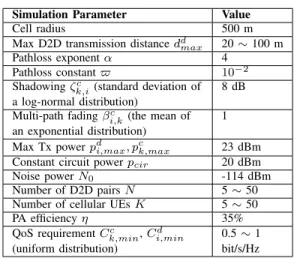
TABLE I
SIMULATIONPARAMETERS.
Simulation Parameter Value
Cell radius 500 m
Max D2D transmission distancedd
max 20∼100 m
Pathloss exponentα 4 Pathloss constant̟ 10−2
Shadowingζc
k,i(standard deviation of 8 dB
a log-normal distribution) Multi-path fadingβc
i,k(the mean of 1
an exponential distribution)
Max Tx powerpdi,max, pck,max 23 dBm
Constant circuit powerpcir 20 dBm
Noise powerN0 -114 dBm
Number of D2D pairsN 5∼50
Number of cellular UEsK 5∼50
PA efficiencyη 35%
QoS requirementCc k,min,C
d
i,min 0.5∼1
(uniform distribution) bit/s/Hz
mobile communication systems [51]. Preference establishment and D2D-CU matching can be realized by the powerful base band unit (BBU) pool which exploits cell cooperation and coordination among densely distributed remote radio heads (RRHs).
5) Complexity: For a pair of (di, ck), the computational
complexity for establishingP(di)andP(ck)mainly depends
on Algorithm 1.qd
i andqkc produced by Algorithm 1 increases
at each iteration and converges to qd∗
i and qkc∗ at a
super-linear rate [49]. WithN D2D pairs andKCUs, the computa-tional complexity of Algorithm 1 isO(N KLloopLdual), where
Lloop and Ldual are the numbers of iterations required for
converging to the optimum EE and optimal power allocation strategies, respectively. In Algorithm 2, sortingN D2D pairs and K CUs in a descending order leads to a complexity of
O N Klog(N K)
. In Algorithm 3, under the rule that every
di∈ Dhas only one chance to send requests to CUs inP(di),
the matchingµcan be obtained with a complexity ofO(KN)
[36].
IV. NUMERICALRESULTS
In this section, the proposed energy-efficient matching algorithm, labeled as “energy-efficient stable matching”, is compared with several heuristic algorithms. The first is the power greedy algorithm, which always allocates the maximum transmission power pd
i,max (or pck,max). The second is the
random power allocation algorithm, which allocates power uniformly distributed in the range[0, pd
i,max](or [0, pck,max]).
−400 −200 0 200 400 600 −500
−400 −300 −200 −100 0 100 200 300 400 500 600
Location in x (m)
Location in y (m)
D2D Tx D2D Rx CU BS
Fig. 3. A snapshot of locations of K CUs andN D2D pairs in a single cellular network (K=N= 50, the cell radius is500m).
20 30 40 50 60 70 80 90 100
0 50 100 150 200 250
Maximum D2D Transmission Distance
Average Energy Efficiency (bits/Hz/J)
energy−efficient stable matching random power, random matching spectrum−efficient, max−SINR matching power greedy, random matching
Fig. 4. Average EE of D2D pairs versus maximum D2D transmission distance (K=N= 5,dd
max= 20∼100m).
of SE are generated randomly from a uniform distribution in the range [0.5,1] bit/s/Hz. We average the simulation results over 103 times.
The average EE performance and UE satisfactions of the obtained energy-efficient stable matching is evaluated and verified. We adopt a statistical model to define a UE’s satis-faction as the cumulative distribution functions (CDFs) of the matching result that is higher than its satisfaction threshold. For example, defining di’s satisfaction threshold as cm, the
matching result µ(di) is compared with the threshold cm to
evaluate whether di is satisfied with µ(di). di is said to be
satisfied withµ(di)ifdi prefers µ(di)at least as well ascm,
i.e., µ(di) di cm. Otherwise, di is said to be unsatisfied
with µ(di) if it is matched to a partner that is less preferred
to the threshold, i.e., cm ≻di µ(di). The CDF is denoted as
P r{µ(di)di cm}, which is the probability thatdiis matched
with a partner that is more preferred to the threshold cm.
5 10 15
0 100 200 300 400 500 600 700
Number of D2D Pairs (CUs)
Average Energy Efficiency (bits/Hz/J)
energy−efficient stable matching random power, random matching spectrum−efficient, max−SINR matching power greedy, random matching
Fig. 5. Average EE of D2D pairs versus numbers of active D2D pairs and CUs (dd
max= 20m,K=N= 5∼15).
5 10 15 20 25 30 35 40 45 50 0
0.1 0.2 0.3 0.4 0.5 0.6 0.7 0.8 0.9 1
Satisfaction Threshold
CDF of Satisfaction
energy−efficient stable matching, K=M=20 energy−efficient stable matching, K=M=50 random matching, K=M=20
random matching, K=M=50
Fig. 6. CDF of D2D pairs’ satisfactions versus satisfaction threshold (N =
K= 20,50,dd
max= 20m).
Fig. 4 shows the average EE performance of D2D pairs versus the maximum D2D transmission distance dd
max with
K = 5 CUs and N = 5 D2D pairs. Simulation results demonstrate that the proposed algorithm achieves the best EE performance in the whole regime. The proposed algorithm outperforms the random power allocation algorithm, the power greedy algorithm, and the spectrum-efficient algorithm by
132%, 206%, and 248% for dd
max = 20 m, respectively.
1 2 3 4 5 6 7 8 9 10 200
300 400 500 600 700 800
Number of Game Iterations
Average Energy Efficiency (bits/Hz/J)
K=N=5 K=N=10 K=N=15
Fig. 7. Average EE versus the number of game iterations (dd
max= 20m,
K=N= 5,10,15).
increasing transmission power beyond the point for optimum SE not only brings no SE improvement in an interference-limited environment but also causes significant EE loss. Note that, as the D2D transmission distance increases, the EE performance of all algorithms decreases because higher transmission power is required to maintain the same QoS performance than in the scenario of short distance.
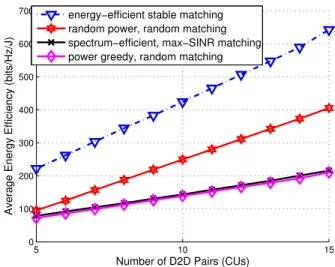
Fig. 5 shows the average EE performance of D2D pairs versus the number of active CUs K and D2D pairs N with
dd
max= 20m. The average EE performance of all algorithms
increases linearly as the active number of CUs and D2D pairs increases. The reason is that as the number of CUs increases, not only the total number of available orthogonal channels increases, but also each D2D pair has a wider variety of choice in the expanded matching market than in the original one. The probability for a D2D pair to be matched with a better partner becomes higher in the expanded matching market. The proposed algorithm has the steepest slope among the four, which indicates that it can exploit more benefits from the diversity of choices than the heuristic algorithms could. Both the spectrum-efficient and the power greedy algorithms have the flattest slope since the value of choice diversity is not fully exploited and power consumption is also ignored in the resource allocation process.
Fig. 6 shows the CDF of D2D pairs’ satisfactions versus various satisfaction thresholds with K = N = 20,50 and
dd
max= 20m. We adopt the Monte-Carlo method to calculate
the CDF that uses repeated matching results (104 times) to
obtain the numerical results. In the case of K = N = 20, the probability of being matched to the first three choices for D2D pairs is66.4%. In contrast, the corresponding probability under random matching is only 15.4%. When the number of D2D pairs and CUs is increased from 20 to50, there is still as high as56.9%of D2D pairs that have been matched to the first three choices, while the corresponding probability under random matching is decreased dramatically from 15.4% to only6.4%. Significant UE satisfaction gains can be achieved
by the proposed algorithm compared to the random matching. In addition, the simulation results also reveal the fact that the proposed algorithm is able to outperform the random matching for a wide range of satisfaction values.
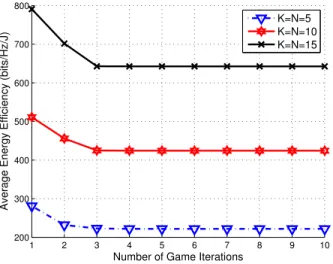
Fig. 7 shows the convergence of the iterative algorithm (Algorithm 1) versus the number of game iterations. It is shown that the proposed algorithm only requires 3 ∼ 4
iterations to converge to the equilibrium. In the first game iteration, higher EE performance can be achieved because CUs are not aware of the D2D pairs and transmit in lower power levels. With the entry of D2D pairs into the game, CUs have to increase their transmission power to satisfy QoS requirements, which in turn causes co-channel interference to D2D pairs and reduce their achievable EE performance until they reach a Nash equilibrium.
V. CONCLUSIONS AND FUTURE WORK
In this paper, an energy-efficient stable matching algorithm was proposed for the resource allocation problem in D2D communications. Taking into account UEs’ preferences and satisfactions, the joint partner selection and power allocation problem was formulated to maximize the achievable EE under maximum transmission power and QoS constraints. The re-sulting problem is nonconvex and computationally intractable. Inspired by the matching theory and game theory, the NP-hard problem was transformed into a one-to-one matching problem with UEs’ preferences modeled as the optimum EE under a specific matching. A noncooperative game based iterative algorithm was proposed to establish mutual preferences by exploiting nonlinear fractional programming. The proposed matching algorithm was proved to be stable and weak Pareto optimal. Extensive simulation results validate the effectiveness and superiority of the proposed algorithm. The present match-ing approach sheds new light on the research directions for resource allocation problems in green D2D communications. Potential future works include the extension of one-to-many matching, the modeling of UE preference from a big-data perspective, and the consideration of context-aware content caching, etc.
APPENDIXA
Proof of Theorem 2
Proof: First, if the strategy pd∗
i obtained by the iterative
algorithm is not the Nash equilibrium, the D2D transmitter can choose the Nash equilibrium pˆd
i to obtain the maximum
EEqd∗
im. However, by Theorem 1 and Theorem 4,q
d∗
i can also
be achieved by choosingpd∗
i , andqid∗ is unique. As a result,
pd∗
i is also part of a Nash equilibrium. A similar proof holds
for pd∗
k .
Second, according to [48], a Nash equilibrium exists if the utility function is continuous and quasiconcave, and the set of strategies is a nonempty compact convex subset of a Euclidean space. Taking the EE objection function defined in (6) as an example, under the matching µ(di) = ck, the
numerator Ud
i defined in (2) is a concave function of pdi,
∀i∈ N. The denominator defined in (4) is an affine function ofpd
The set of the strategies {[0, pd
i,max]} is a nonempty compact
convex subset of the Euclidean space. Similarly, it is easily proved that the above conditions also hold for the cellular UE. Therefore, a Nash equilibrium exists in the noncooperative game.
Third, there may be multiple equilibria that satisfy the optimality condition. This conclusion can be directly drawn from the properties of nonlinear fractional programming as shown in page 4 of [44], which shows that the solutions
pd∗
i of the equation Uid(pdi∗)−qid∗Eid(pid∗) = 0, and pck∗ of
the equation Uc
k(pck∗)−qkc∗Ekc(pck∗) = 0 may not be unique.
Therefore, if there exists multiple solutions, the combination of these solutions may generate multiple Nash equilibria. However, despite that there may be multiple equilibria, the maximum EE obtained by the iterative algorithm is unique. The proof is similar to the proof of Lemma 4 in [44], which proves that the optimum result obtained by nonlinear fractional programming is unique.
Finally, given a Nash equilibrium {pd∗
i , pck∗}, the
corre-sponding EE {qd∗
i , qkc∗} produced by Algorithm 1 is unique
according to Theorem 1 and Theorem 4. If di chooses p˜di
rather than pd∗
i (p˜di 6= pdi∗) as its transmission strategy, the
corresponding CU ck will also choose p˜ck rather than pck∗
(p˜c
k6=pck∗) to improve its individual EE. The iteration process
in Algorithm 1 will continue until the strategy set {p˜d i,p˜ck}
converges to a new Nash equilibrium, and the corresponding EE is denoted as{q˜d
i,q˜kc}. Then, we must haveq˜id=qid∗, and
˜ qc
k = qck∗, which otherwise contradicts with Theorem 1 and
Theorem 4. Therefore, this proves that eitherdi or ck is able
to unilaterally achieve better performance by deviating from the Nash equilibrium. This completes the proof.
APPENDIXB
Proof of Theorem 3
Proof:For anydi∈ Dand anyck∈ Cthat are not matched
with each other,µis stable if(di, ck)do not form a blocking
pair, i.e., di ≻ck µ(ck),ck ≻di µ(di). We prove the theorem
by showing that the two necessary conditions di ≻ck µ(ck)
andck≻di µ(di)cannot hold at the same time.
Let us begin from the assumption that ck ≻di µ(di), then a
request must have already been sent by di toµ(di)based on
the defined matching rules. With the matching result µ(di)6=
ck, it means thatdi is less preferred byck compared toµ(ck),
i.e., µ(ck)≻ck di. Thus, althoughck is more preferred bydi
than µ(di), ck has no incentive to be matched with di, i.e.,
the condition di ≻ck µ(ck)does not hold. The same proving
process can be repeated with minor revision to show that the condition ck ≻di µ(di) does not hold if di ≻ck µ(ck). As
a result, di and ck do not form a blocking pair for µ since
di≻ck µ(ck)andck ≻diµ(di)cannot hold at the same time,
which proves thatµ is stable.
APPENDIXC
Proof of Theorem 5
Proof: ∀di∈ D, we assume that there is a better matching
µ′ such that µ′(di)≻di µ(di). In other words, every di∈ D
is matched to a better partner under µ′ compared to µ, that
is, every di ∈ D is matched to some CU under µ
′ which has rejected its request underµ. Thus, every CU in the set of
µ′(D)must have issued a rejection underµ. However, any CU which receives a request in the final step of Algorithm 3 has not issued a rejection to any D2D pair due to the matching rule. Otherwise, at least one more iteration is required to match the rejected D2D pairs with some CU. This contradicts the assumption of existing µ′ and proves that µ is weak Pareto optimal for D2D pairs.
REFERENCES
[1] R. Wang, H. Hu, and X. Yang, “Potentials and challenges of C-RAN supporting multi-RATs toward 5G mobile networks,” IEEE Access, vol. 2, no. 8, pp. 1187–1194, Oct. 2014.
[2] O. Bello and S. Zeadally, “Intelligent device-to-device communications in the internet of things,”IEEE Sys. J., vol. PP, no. 99, pp. 1–11, Jan. 2014.
[3] S. Zhang, N. Zhang, S. Zhou, J. Gong, and Z. N. ans S Shen, “Energy-aware traffic offloading for green heterogeneous networks,”
IEEE J. Sel. Areas Commun., vol. PP, no. 99, pp. 1–12, Jan. 2016. [Online]. Available: http://arxiv.org/abs/1409.2475
[4] N. Zhang, H. Liang, N. Cheng, Y. Tang, , J. W. Mark, and X. Shen, “Dynamic spectrum access in multi-channel cognitive radio networks,”
IEEE J. Sel. Areas Commun., vol. 32, no. 11, pp. 2053–2064, Sep. 2014. [5] K. Doppler, M. Rinne, C. Wijting, C. B. Ribeiro et al., “Device-to-device communication as an underlay to LTE-Advanced networks,”
IEEE Comm. Mag., vol. 47, no. 12, pp. 42–49, Dec. 2009.
[6] M. N. Tehrani, M. Uysal, and H. Yanikomeroglu, “Device-to-device communications in 5G cellular networks: challenges, solutions, and future directions,”IEEE Comm. Mag., vol. 52, no. 5, pp. 86–92, May. 2014.
[7] G. Fodor, E. Dahlman, G. Mildh, S. Parkvallet al., “Design aspects of network assisted device-to-device communications,”IEEE Comm. Mag., vol. 50, no. 3, pp. 170–177, Mar. 2012.
[8] J. Liu, Y. Kawamoto, H. Nishiyama, N. Kato, and N. Kadowaki, “Device-to-device communications achieve efficient load balancing in LTE-Advanced networks,”IEEE Wirel. Comm. Mag., vol. 21, no. 2, pp. 57–65, Apr. 2014.
[9] D. Feng, L. Lu, Y. Yi, G. Y. Liet al., “Device-to-device communications underlaying cellular networks,”IEEE Trans. Comm., vol. 61, no. 8, pp. 3541–3551, Aug. 2013.
[10] Y. Chia, K. Doppler, C. B. Ribeiro, and O. Tirkkonen, “Resource sharing optimization for device-to-device communication underlaying cellular networks,”IEEE Trans. Wirel. Comm., vol. 10, no. 8, pp. 2752–2763, Aug. 2011.
[11] L. Lei, Y. Kuang, N. Cheng, and X. Shen, “Delay-optimal dynamic mode selection and resource allocation in devicetodevice communications -part I: optimal policy,”IEEE Trans. Veh. Tech., vol. PP, no. 99, pp. 1–13, Jun. 2015.
[12] C. Xu, L. Song, Z. Han, and Q. Zhao, “Efficiency resource allocation for device-to-device underlay communication systems: a reverse iterative combinatorial auction based approach,” IEEE J. Sel. Areas Commun., vol. 31, no. 9, pp. 348–358, Sep. 2013.
[13] J. Liu, N. Kato, J. Ma, and N. Kadowaki, “Device-to-device communica-tion in lte-advanced networks: a survey,”IEEE Commun. Surv. uTutor., vol. 17, no. 4, pp. 1923–1940, Nov. 2015.
[14] B. Zhou, H. Hu, S. Huang, and H. Chen, “Intracluster device-to-device relay algorithm with optimal resource utilization,” IEEE Trans. Veh. Tech., vol. 62, no. 5, pp. 2315–2326, Jun. 2013.
[15] Y. Cheng, Y. Gu, and X. Lin, “Combined power control and link selection in device-to-device enabled cellular systems,”IET Commun., vol. 7, no. 12, pp. 1221–1230, Aug. 2013.
[16] N. Golrezaei, P. Mansourifard, A. F. Molisch, and A. G. Dimakis, “Base-station assisted device-to-device communications for high-throughput wireless video networks,”IEEE Trans. Wirel. Comm., vol. 13, no. 7, pp. 3665–3676, Jul. 2014.
[18] J. Liu, S. Zhang, N. Kato, H. Ujikawa, and K. Suzuki, “Device-to-device communications for enhancing quality of experience in software defined multi-tier LTE-A networks,”IEEE Net. Mag., vol. 29, no. 4, pp. 46–52, Jul. 2015.
[19] X. Zhang, Z. Zheng, Q. Shen, J. Liu, X. S. Shen, and L. L. Xie, “Optimizing network sustainability and efficiency in green cellular networks,”IEEE Trans. Wirel. Comm., vol. 13, no. 2, pp. 1129–1139, Feb. 2014.
[20] C. Xu, L. Song, and Z. Han,Resource Management for Device-to-Device Underlay Communication. Springer Briefs in Computer Science, 2014, pp. 1–79.
[21] A. Mukherjee and A. Hottinen, “Energy-efficient device-to-device MIMO underlay network with interference constraints,” inProc. IEEE WSA’12, Dresden, Germany, Mar. 2012, pp. 105–109.
[22] S. Wen, X. Zhu, Z. Lin, X. Zhang, and D. Yang, “Energy efficient power allocation schemes for device-to-device (D2D) communication,” inProc. IEEE VTC Fall’13, Las Vegas, USA, Sep. 2013, pp. 1–5.
[23] F. Wang, C. Xu, L. Song, Q. Zhao et al., “Energy-aware resource allocation for device-to-device underlay communication,” inProc. IEEE ICC’13, Budapest, Hungary, Jun. 2013, pp. 6076–6080.
[24] T. Ta, J. S. Baras, and C. Zhu, “Improving smartphone battery life utilizing device-to-device cooperative relays underlaying LTE networks,” inProc. IEEE ICC’14, Sydney, Australia, Jun. 2014, pp. 1–6. [25] Z. Wang, C. Xu, L. Song, and Z. Han, “Energy-efficient resource
allocation for device-to-device underlay communication,”IEEE Trans. Wirel. Commun., vol. 14, no. 4, pp. 2082–2892, Aug. 2015.
[26] S. Mumtaz, K. M. S. Huq, A. Radwan, J. Rodriguez, and R. L. Aguiar, “Energy-efficient interference-aware resource allocation in LTE-D2D communication,” inProc. IEEE ICC’14, Sydney, Australia, Jun. 2014, pp. 1–6.
[27] D. Wu, J. Wang, R. Q. Hu, Y. Cai et al., “Energy-efficient resource sharing for mobile device-to-device multimedia communications,”IEEE Trans. Veh. Tech., vol. 63, no. 5, pp. 2093–2103, Mar. 2014.
[28] Z. Zhou, M. Dong, K. Ota, J. Wu, and T. Sato, “Energy efficiency and spectral efficiency tradeoff in device-to-device D2D communications,”
IEEE Wirel. Commun. Lett., vol. 3, no. 5, pp. 485–488, Jul. 2014. [29] D. Wu, L. Zhou, Y. Cai, R. Q. Hu, and Y. Qian, “The role of mobility for
D2D communications in LTE-Advanced networks: energy vs. bandwidth efficiency,”IEEE Wirel. Comm. Mag., vol. 21, no. 2, pp. 66–71, Apr. 2014.
[30] L. Wei, R. Q. Hu, Y. Cai, and G. Wu, “Energy-efficiency and spectrum-efficiency of multi-hop device-to-device communications underlaying cellular networks,”IEEE Trans. Veh. Tech., vol. PP, no. 99, pp. 1–13, Aug. 2015.
[31] M. R. Garey and D. S. Johnson,Computers and Intractability: A Guide to the Theory of NP-Completeness. USA: W H Freeman and Company, 1979.
[32] Z. Zhou, M. Dong, K. Otaet al., “A game-theoretic approach to energy-efficient resource allocation in device-to-device underlay communica-tions,”IET Commun., vol. 9, no. 3, pp. 375–385, Feb. 2015.
[33] Y. Gu, W. Saad, M. Bennis, M. Debbah, and Z. Han, “Matching theory for future wireless networks: fundamentals and applications,” IEEE Comm. Mag., vol. 53, no. 5, pp. 52–59, May. 2015.
[34] D. Gale and L. S. Shapley, “College admissions and the stability of marriage,”The American Mathematical Monthly, vol. 69, no. 1, pp. 9– 15, Jan. 1962.
[35] A. E. Roth and M. Sotomayor,Two Sided Matching: A Study in Game-Theoretic Modeling and Analysis, 1st ed. Cambridge, UK: Cambridge University Press, 1991.
[36] G. O’Malley, “Algorithmic aspects of stable matching problems,” Ph. D. dissertation, University of Glasgow, 2007.
[37] A. M. EI-Hajj, Z. Dawy, and W. Saad, “A stable matching game for joint uplink/downlink resource allocation in OFDMA wireless networks,” in
Proc. IEEE International Conference on Communications 2012 (ICC 2012), Ottawa, Canada, Jun. 2012, pp. 5354–5359.
[38] X. Feng, G. Sun, X. Gan et al., “Cooperative spectrum sharing in cognitive radio networks: a distributed matching approach,”IEEE Trans. Comm., vol. 62, no. 8, pp. 2651–2664, May. 2014.
[39] D. Niyato, P. Wang, T. H. Pink, W. Saad, and D. I. Kim, “Cooperation in delay tolerant networks with wireless energy transfer: performance analysis and optimization,”IEEE Trans. Veh. Tech., vol. 64, no. 8, pp. 3740–3754, Sep. 2014.
[40] M. Hasan and E. Hossain, “Distributed resource allocation in 5G cellular networks,” no. 4, pp. 1–26, Sep. 2014. [Online]. Available: http://arxiv.org/abs/1409.2475
[41] ——, “Distributed resource allocation for relay-aided device-to-device communication under channel uncertainties: a stable matching ap-proach,”IEEE Wirel. Comm., vol. 63, no. 10, pp. 3882–3897, Oct. 2015. [42] B. Ma, H. S. Mansouri, and V. W. S. Wong, “A matching approach for power efficient relay selection in full duplex D2D networks,” inProc. IEEE ICC’16, Kuala Lumpur, Malaysia,, May. 2016, pp. 1–6. [43] Y. Gu, Y. Zhang, M. Pan, and Z. Han, “Matching and cheating in device
to device communications underlaying cellular networks,”IEEE J. Sel. Areas Commun., vol. 33, no. 10, pp. 2156–2166, Oct. 2015.
[44] W. Dinkelbach, “On nonlinear fractional programming,”Management Science, vol. 13, no. 7, pp. 492–498, Mar. 1967.
[45] S. Boyd and L. Vandenberghe,Convex Optimization. Cambridge, UK: Cambridge University Press, 2004.
[46] A. Asadi, Q. Wang, and V. Mancuso, “A survey on device-to-device communication in cellular networks,” IEEE Commun. Surv. uTutor., vol. 16, no. 4, pp. 1801–1819, Apr. 2014.
[47] H. Kwon and T. Birdsall, “Channel capacity in bits per joule,”IEEE J. Ocean. Eng., vol. OE-11, no. 1, pp. 97–99, Jan. 1986.
[48] M. J. Osborne and A. Rubinstein,A Course in Game Theory. Cam-bridge, MA, USA: MIT Press, 1994.
[49] K. T. K. Cheung, S. Yang, and L. Hanzo, “Achieving maximum energy-efficiency in multi-relay OFDMA cellular networks: a fractional programming approach,”IEEE Trans. Comm., vol. 61, no. 8, pp. 2746– 2757, Jul. 2013.
[50] D. Gusfield and R. W. Irving,The Stable Marriage Problem: Structure and Algorithms, 1st ed. Cambridge, MA, USA: MIT Press, 1999. [51] S. Luo, R. Zhang, and T. J. Lim, “Downlink and uplink energy
minimization through user association and beamforming in C-RAN,”
IEEE Trans. Wirel. Comm., vol. 14, no. 1, pp. 494–508, Aug. 2014. [52] G. Miao, N. Himayat, and G. Y. Li, “Energy-efficient link adaptation in
frequency-selective channels,”IEEE Trans. Comm., vol. 58, no. 2, pp. 545–554, Feb. 2010.
[53] A. Goldsmith,Wireless Communications. Cambridge, UK: Cambridge University Press, 2005.
Zhenyu Zhou (S’06-M’11)received his M.E. and
Kaoru Ota (M’12)was born in Aizu Wakamatsu, Japan. She received M.S. degree in Computer Sci-ence from Oklahoma State University, USA in 2008, B.S. and Ph.D. degrees in Computer Science and Engineering from The University of Aizu, Japan in 2006, 2012, respectively. She is currently an Assistant Professor with Department of Information and Electronic Engineering, Muroran Institute of Technology, Japan. From March 2010 to March 2011, she was a visiting scholar at University of Waterloo, Canada. Also she was a Japan Society of the Promotion of Science (JSPS) research fellow with Kato-Nishiyama Lab at Graduate School of Information Sciences at Tohoku University, Japan from April 2012 to April 2013. Her research interests include Wireless Networks, Cloud Computing, and Cyber-physical Systems. She has received best paper awards from ICA3PP 2014, GPC 2015, IEEE DASC 2015 and IEEE VTC 2016. She serves as an editor for Peer-to-Peer Networking and Applications (Springer), Ad Hoc & Sensor Wireless Networks, International Journal of Embedded Systems (Inderscience), as well as a guest editor for IEEE Wireless Communications, IEICE Transactions on Information and Systems. She is currently a research scientist with A3 Foresight Program (2011-2016) funded by Japan Society for the Promotion of Sciences (JSPS), NSFC of China, and NRF of Korea.
Mianxiong Dong (M’13)received B.S., M.S. and
Ph.D. in Computer Science and Engineering from The University of Aizu, Japan. He is currently an As-sociate Professor in the Department of Information and Electronic Engineering at the Muroran Institute of Technology, Japan. Prior to joining Muroran-IT, he was a Researcher at the National Institute of Information and Communications Technology (NICT), Japan. He was a JSPS Research Fellow with School of Computer Science and Engineering, The University of Aizu, Japan and was a visiting scholar with BBCR group at University of Waterloo, Canada supported by JSPS Excellent Young Researcher Overseas Visit Program from April 2010 to August 2011. Dr. Dong was selected as a Foreigner Research Fellow (a total of 3 recipients all over Japan) by NEC C&C Foundation in 2011. His research interests include Wireless Networks, Cloud Computing, and Cyber-physical Systems. He has received best paper awards from IEEE HPCC 2008, IEEE ICESS 2008, ICA3PP 2014, GPC 2015, IEEE DASC 2015 and IEEE VTC 2016. Dr. Dong serves as an Editor for IEEE Communications Sur-veys and Tutorials, IEEE Network, IEEE Wireless Communications Letters, IEEE Cloud Computing, IEEE Access, and Cyber-Physical Systems (Taylor & Francis), as well as a leading guest editor for ACM Transactions on Multimedia Computing, Communications and Applications (TOMM), IEEE Transactions on Emerging Topics in Computing (TETC), IEEE Transactions on Computational Social Systems (TCSS). He has been serving as Symposium Chair of IEEE GLOBECOM 2016, 2017. Dr. Dong is currently a research scientist with A3 Foresight Program (2011-2016) funded by Japan Society for the Promotion of Sciences (JSPS), NSFC of China, and NRF of Korea.
Chen Xu (S’12-M’15) received the B.S. degree