Ogata, H. et al. (Eds.) (2015). Proceedings of the 23rd International Conference on Computers in Education. China: Asia-Pacific Society for Computers in Education
Analyzing the Features of Learning Behaviors
of Students using e-Books
Chengjiu YINa*, Fumiya OKUBOa, Atsushi SHIMADAa, Misato OIa, Sachio HIROKAWAb, Masanori YAMADAa, Kentaro KOJIMAa, Hiroaki OGATAa
aFaculty of Arts and Science, Kyushu University, Japan
bResearch Institute for Information Technology, Kyushu University, Japan
Abstract: The analysis of learning behavior and identification of learning style from learning logs are expected to benefit instructors and learners. This study describes methods for processing learning logs, such as data collection, integration, and cleansing, developed in Kyushu University. The research aims to analyze learning behavior and identify students’ learning style using student’s learning logs. Students were clustered into four groups using k-means clustering, and features of their learning behavior were analyzed in detail. We found that Digital Backtrack Learning style is better than Digital Sequential Learning style.
Keywords: Learning analytics, Learning behavior, Learning log, E-books, Data mining for learning
1. Introduction
E-learning may be subsumed under digital learning, which is a more recent term and arguably has a broader long-term utility (Mason and Pillay, 2014). Many imported digital learning systems have been developed, including Blackboard, Virtual-U, WebCT, and TopClass. These systems accumulate large log data on students’ activities. The log data record learning practices, such as reading, writing, taking tests, and performing various tasks in real or virtual environments with peers (Mostow, 2004). An analysis of these log data could help improve the education practice for both instructors and students. For example, by analyzing the features of students’ activities, instructors can improve their teaching methods. Meanwhile, students can master learning techniques and learn others’ learning style.
Recently, researchers have examined open educational resources (OERs), such as OCW and MOOCs. Compared with OERs, traditional educational resources, such as books, textbooks, or their learning contents, cannot be easily accessed online, and data on students’ learning activities are unavailable. Therefore, verifying the educational effectiveness of traditional educational resources remains challenging. Despite the variety in types of traditional learning resources, research on the measurement of their educational effects is limited.
A possible solution is the use of e-books in traditional classrooms, which will enable recording of learning logs that can be used to analyze students’ learning behaviors (Ogata et al., 2011; Li et al., 2012; Mouri et al., 2013). Analyzing educational data could yield fruitful results in determining how a pedagogical strategy impacts different types of students, how students study subtopics, and what pages/topics students skip, among others (Romero, 2007).
By 2020, the Ministry of Education, Culture, Sports, Science and Technology (MEXT) of Japan is scheduled to replace all of the textbooks for elementary, middle, and high schools with e-books1. Such a move will usher “Educational Big Data,” which will comprise learning logs. As a forerunner to this institutional effort, Kyushu University has supported this work in using BookLooper for e-books beginning in April 2014. BookLooper is a document viewer system provided by a partner to this research, Kyocera Communication Systems Co., Ltd., and can be used on personal computers and smart phones. Thus, students can use it as desired, and their learning log will be collected continuously.
1http://www.mext.go.jp/
Instructors’ lecture materials, such as slides or other notes, can be posted to BookLooper, which can record students’ learning behaviors when they use e-books to read their learning contents. Instead of traditional textbooks, traditional classrooms in Kyushu University use BookLooper. Kyushu University implemented the “Bring Your Own PC” program in 2012.
Students can use BookLooper to preview their lessons before class, such as writing questions. They can also take note and mark part of a page as important content during class. After classes, they can review the learning content. All of these learning behaviors will be recorded. Meanwhile, such records will create a large volume of data.
Using these records, educational effectiveness can be verified, and the features of students’ learning behaviors analyzed. The present study continues the research on analyzing learning behaviors. 1) Shimada et al. (2014) analyzed students’ learning behaviors in using the e-textbook system, including the time each student spends before the lecture and time spent browsing each page of slides. This work also investigated the effectiveness a learning environment in helping students understand the contents of lecture materials.
2) Yamada et al. (2014) investigated the relationship between self-efficacy and learning behaviors using the e-textbook system. The methods used for data collection were based on MSLQ and a log that recorded the number of pages students read over a short period of time. The students’ behaviors of using markers and annotations were found to be related with their self-efficacy and with the intrinsic value of the learning materials.
As such, the present work will analyze learning behaviors and identify students’ learning styles by analyzing their learning logs, continuing the work of Yin et al. (2014). Processing methods for these learning logs, such as data collection, data integration, and data cleansing, will also be discussed. By performing partial correlation analysis, the study found that a number of learning behaviors have a significant relation with students’ final exam scores. Students’ learning logs were also used to identify learning styles. Students were clustered into four groups using k-means clustering to analyze their learning features in detail.
2. Related Works
Educational Data Mining is an emerging discipline, concerned with developing methods for exploring the unique types of data that come from educational settings, and using those methods to better understand students (Yin et al., 2013). Many researchers have focused on educational data mining. Kay et al. (2006) mined the patterns of events in students’ teamwork data based on electronic traces of students’ collaboration. Pechenizkiy et al. (2008) discovered student preferences on educational materials, and the system could decide if a learning material is appropriate for a student or not.
Especially, analyzing learning behaviors is a critical topic in learning analysis. Chiang (2014) indicated that knowledge-sharing behaviors are important during the inquiry learning process. Tsai et al. (2011) explored the correlates among instructors’ epistemological beliefs concerning Internet environments, their web search strategies, and search outcomes.
Collecting data is the first step in learning analysis. Based on the data source, studies on learning behaviors can be classified into three categories:
A) Analysis using a questionnaire: In this category, data are collected using a pre-designed questionnaire. Li-Hsing Ho et al. (2013) used a questionnaire to investigate the teacher behavior of adopting mobile phone messages as a parent–teacher communication medium. Tan and Seah (2011) explored questioning behaviors among elementary students engaged in science inquiry via a computer-supported collaborative learning tool. Using a Web-based portfolio assessment questionnaire, Chang (2012) attempted to categorize Global behaviors in a Web-based portfolio assessment using the Chinese Word Segmenting System.
B) Crowdsourcing data: In this category, a crowdsourced data collection system is opened to users. Users use the system and consciously leave data on their learning behavior. For example, Chiang (2014) provided an augmented reality (AR) system to guide students in knowledge sharing in inquiry learning activities, where students capture images from an authentic environment and share these with others. Ogata et al. (2011) also provided a system
called SCROLL, in which students can share their every data learning log using learning memos, RFID tags, and cameras. Hwang et al. (2008) proposed the use of a meta-analyzer to assist instructors in analyzing students’ Web-searching behaviors while using search engines for problem solving. In this system, students share their search logs with others.
C) Automatically recorded behaviors: In this category, learning behaviors are recorded automatically; users leave records subjectively. Zeng et al. (2009) collected users’ reading behavior logs while reading e-documents to verify their course ontology. Huei-Tse Hou (2012) explored the behavioral patterns of learners in an online educational role-playing game. The actions (gaming behaviors) conducted by these participants were recorded automatically in the game database.
For categories A) and B), the data are collected consciously. Therefore, data are affected by users’ own subjective factors. For category C), the data is collected objectively, removing the subjective factors that affect data authenticity. The present work falls under category C).
Thus far, research on learning logs of learning contents in the classroom has received limited academic attention. The current research is on using e-books to collect students’ learning logs throughout the study period and then analyze their learning behaviors. This work has three features.
1) Data are collected automatically from e-books used in the classroom.
2) Data are collected objectively to avoid subjective factors that affect the authenticity of data. 3) Two learning styles are identified from the learning log, the features of which are analyzed.
3. Data Collection and Processing 3.1 Data Collection
The first stage of data processing is data collection (Yin et al., 2013). The server structure consists of four parts: data collection, data analysis, data backup, and data providing. Two systems are used to collect educational data in Kyushu University: Moodle and BookLooper. Students’ learning logs are collected using BookLooper. Instructors and students can access these two systems using their smart phone or laptop anywhere on or off campus.
3.1.1 Kyocera Server
Through BookLooper, students can read learning contents used in the classroom, and all actions of using BookLooper will be recorded to a database. The students’ learning data are collected and stored on the data server of Kyocera.
In the second semester of 2014, BookLooper was used in five courses, with 297 students, in Kyushu University. A total of 262,193 records were gathered from October 1 to November 25, 2014. These data occupied 138 MB in storage. The average size of records was 1.67 KB/student/day/course. In 2015, 2,700 students will use BookLooper, which will yield a large volume of learning logs to build educational big data.
Two types of data are stored in the database.
a) Teaching materials and teaching slides used in the classroom
b) Students’ learning actions, such as “next page,” “previous page,” “add marker,” “search,”
“zoom,” “memo,” and “reading time” 3.1.2 Kyudai Server
A Moodle server called Kyudai Server was created to provide an e-learning system for instructors and students in Kyushu University. Students can use this system to take tests and submit reports, whereas instructors can use it to take attendance, distribute questionnaires, carry out tests, manage students’ achievements, and carry out questionnaire surveys. All of these data are stored on two data servers: a backup of the Moodle server and another for data integration, data cleansing, and data migration.
Figure 1. Marker and Memo 3.1.3 Data Integration, Cleansing, Migration
Four systems were developed to process data daily.
a) A data migration system for transferring data between BookLooper and Moodle systems b) A system to calculate the time difference between actions every day. The BookLooper system
only records action time. When an action occurs, the current time will be recorded, but not the duration. A system was thus developed to calculate the time difference between two actions. c) A system for integrating the data from BookLooper and Moodle, such as statistical reading
time and number of markers. These data were used for a Moodle plugin, which can provide learning feedback to instructors and students.
d) A system for integrating the user information data of BookLooper and Moodle 3.2 Data Explanation and Processing
This research focused on analyzing the learning logs of 100 freshmen at a university in 2014. They attended the class Information Science opened in October 2014. All the learning contents of the lectures were prepared as e-books in the BookLooper system.
3.2.1 BookLooper Log
In BookLooper, e-books are organized in three layers: bookshelves, books (learning contents), and pages. Users can read, go to next, and return to previous. They can also make bookmarks and leave memos. These actions are logged in the system (Fig. 1).
Table 1: Sample Action Log.
Userid Action name Document ID Page Number Action time
S1 Next 00000000NBU1 16 2014/11/22 10:40:55
S1 Prev 00000000NBU1 15 2014/11/22 10:42:15
S1 Memo 00000000NBU1 15 2014/11/22 10:42:16
S2 Marker 00000000NBU1 15 2014/11/22 10:42:18
One data log contains the date, time, user ID, learning content ID, page number, user action, and other data. Students’ reading history will be recorded whenever they use BookLooper. Table 1
shows a sample learning log. While a user performs an action, the action and target page number will be saved as one record. Table 2 lists the actions and their explanation.
Table 2: Action Explanation.
3.2.2 Data Processes
To use valid learning logs, the following data processes were performed:
a) Invalid record: If the time difference between two actions is longer than 30 minutes, then the record is invalid. It means that the student did not read the contents, as he/she did not conduct any action in 30 minutes.
b) Invalidity preview: If a student did not preview for the lesson (read the learning content before class) up to three minutes before the class, then he/she is considered to have not done a preview for the lesson.
c) Invalidity score: Students’ final exam scores are not analyzed if they used BookLooper during a test.
d) Repetitive answers: Tests are carried out using Moodle, and students could answer the question more than one time. Record of the first time is used to calculate students’ final exam scores.
4. Data Analysis 4.1 Learning Style
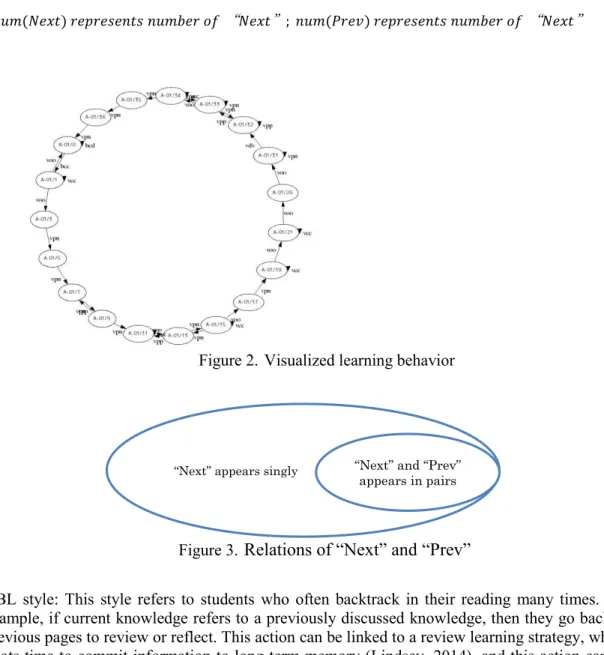
Learning style can be identified using the learning log. For example, the “Next” and “Prev” logs show when a user goes to a next or previous page. Figure 2 is a graph of the learning behaviors. The graph visualizes the students’ actions using the “Action time,” “Page No,” “Prev,” and “Next” logs.
The study found that a number of students recorded many “Prev” actions, indicating their review of previous pages many times. Meanwhile, other students had more “Next” actions, indicating that they just read the pages of the learning contents in sequence. According to these results, this research defines two types of e-book learning styles: Digital Sequential Learning (DSL) style and Digital Backtrack Learning (DBL) style.
a) DSL style: This style refers to students who, upon finishing reading one page, proceeds to the next page, and who rarely go back to previous pages. They read the pages of the learning contents in sequence. For students of this style, the “Next” action appears the most in their learning log. The following formula is used to determine whether a student belongs to the DSL style. Formula (1) is used to compare the number of “Next” and “Prev” actions.
As shown in Figure 2, the “Next” action could appear independently or paired with the “Prev” action. Formula (1) also calculates the number of “Next” actions that appear independently. The result “N” of formula (1) is used in Formula (2). Formula (2) is used to compare the “N” and the number of “Prev” actions. A bigger DSL value thus indicates a higher frequency of independent
“Next” actions. A large DSL value indicates that the learning style of the student is DSL style. Action name Explain
NEXT While a user goes to next page, he will click “NEXT” button, and the action name will be saved as “Next”.
PREV While a user goes to previous page, he will click “PREV” button, and the action name will be saved as “Prev”.
MARKER While a user want to highlight some row in the learning content, he will click “Marker” button, and the action name will be saved as “Marker”. MEMO While a user want to write some memo in the learning content, he will click
“Memo” button, and a textbox will be shown. After he finished writing memo, the action name will be saved as “Memo”.
Figure 2. Visualized learning behavior
� = � − � (1)
��� = �/ � (2)
� � ͆� ͇; � � ͆� ͇
b) DBL style: This style refers to students who often backtrack in their reading many times. For example, if current knowledge refers to a previously discussed knowledge, then they go back to previous pages to review or reflect. This action can be linked to a review learning strategy, which allots time to commit information to long-term memory (Lindsey, 2014), and this action can be linked to a reflection learning strategy, which involves linking current knowledge to previous knowledge (Costa &, Kallick, 2008).
The learning logs of this style show the “Prev” and “Next” actions in pairs many times, and the frequency of pairings is very high. The following formula is used to determine whether a student belongs to DBL style. Formula (3) is used to compare the number of “Prev” and “Next” actions.
��� = � / � (3)
As shown in Figure 4, “Next” often appears with “Prev” in pairs. Formula (3) is used to compare the “N” and the number of “Prev” actions. A large DSL value indicates a high frequency of “Next” actions, identifying the learning style of the student as DSL style.
4.2 Partial Correlation (SPSS)
Figure 3. Relations of “Next” and “Prev”
“Next” appears singly “Next” and “Prev” appears in pairs
SPSS was used to find the partial correlation of Score(final exam scores) with other variables, such as the number of “Next” and “Prev” actions, Preview Times, Read Pages, and Read Time. The variable Score has a significant correlation with Score RP, as well as with PT, RT, NN, and NP. Further, variable RP has a significant correlation with Score, PT, RT, NN, and NP (Yin et al., 2015).
Table 3: Partial Correlation Result.
RP PT RT NN NP
Score PCC 0.728 0.417 0.681 0.665 0.532
RP PCC 1.000 0.557 0.903 0.955 0.771
PCC (Pearson correlation coefficient) p <.0001
According to these results, a k-means clustering analysis was conducted to cluster students in groups according to their similarity in learning behavior, and then analyze the features of learning behaviors in groups.
4.3 K-means Clustering
The main problem of k-means is in determining the k value and selecting cluster centers. Firas-Matinez et al. (2007) analyzed users’ similar behavior by k-means clustering. The same method was used in this study. Formulas 4 and 5 were used to determine the k value.
� = i ( ��,�,�=1,…,�)−��
ax(��, i ( ��,�,�=1,…,�)), (4)
� =∑ ��
�
�=1� (5)
The initial cluster centers were selected randomly. Given the randomness of the original centers, k-means was run for each value of k 100 times. A minimized distance was selected: from all the data to their own cluster center. k = 2, …, 9 were assigned, and an algorithm was run using Euclidean distance.
Figure 4 presents the evolution of the quality of the partitions obtained for the values of k tested. The optimum partition was obtained with a value of k = 4, because the q-value (q-value is qk) was bigger than the others. Therefore, the students were grouped into four clusters.
Figure 4. Determine k-value by q-value Marker and Memo
0 0.1 0.2 0.3 0.4 0.5 0.6 0.7 0.8 0.9
2 3 4 5 6 7 8 9
q-value
k-value
q-value
Table 4: K-means Clustering Result.
Users Score DSL DBL RP PT RT (H) Cluster1 21 55.24 5.24 0.28 58.14 0.1 2.38 Cluster2 22 80.55 2.35 0.34 205.76 0.48 6.8 Cluster3 36 88.83 1.93 0.4 317.23 1.83 11.29 Cluster4 21 93.4 2.3 0.36 433.35 3.26 15.32
Six variables were used to cluster the students: Score, RP, DSL, DBL, PT, and RT. Table 4 and Figure 6 present the center of each cluster. Clusters 1 to 4 had 21, 22, 36, and 21 students, respectively. Cluster centers translated into the behavior of the users, as described below.
a) Cluster 1: Based on the large DSL value (5.24) is large and small DBL value (0.28), the students were classified to have DSL learning style. They almost do not preview lessons before their class (PT: 0.1). The other variables, such as RT and RP, were also small, which led them to obtain about 55.24 test points.
b) Cluster 2: Based on their small DSL value (2.35), these students fell under the DBL learning style. However, they also almost do not preview lessons before their class (PT: 0.48). In other variables, such as RT and RP, they obtained greater final exam scores than cluster 1. They obtained 80.55 test points.
c) Cluster 3: Their small DSL value (1.93) indicated that these students had a DBL learning style. However, their PT was low (1.83). They recorded greater final exam scores in other variables, such as RT and RP, compared with cluster 2, and they obtained 88.83 test points.
d) Cluster 4: Their low DSL value (2.3) pointed to their DBL learning style. Their PT (3.26) was sufficient, and in other variables, such as RT and RP, they recorded greater final exam scores compared with other clusters. They obtained 93.4 test points.
Based on the above, the DBL learning style is better than the DSL learning style. The students in cluster 2 showed a good learning behavior, as they spent more time to read learning content and preview lessons before class. They also obtained higher final exam scores. However, the DBL learning style is not sufficient; students need to preview their lessons and spend more time to read learning contents.
5. Conclusion and Future work
Analyses on students’ learning behaviors comprise an important thrust in education research. This study focused on e-books used in the classroom. Using the e-book system BookLooper, this work recorded students’ learning behaviors in their daily academic life.
The paper presented means for collecting and analyzing learning logs using e-books, as well as the analysis of students’ learning behaviors based on these learning logs.
The results showed that the number of pages read correlated with students’ final exam scores. By clustering students into four groups, this work analyzed their learning behaviors in detail. Digital Global Learning style was found to have merit. Another finding suggested that previewing lessons before class is a positive and beneficial learning behavior.
This research analyzed students’ learning behaviors in general. A future effort may delve into cases of learning behaviors among students. Such a study may also differentiate between learning behaviors used by students for different learning contents.
Acknowledgements
The research results have been achieved with support from the Research and Development on Fundamental and Utilization Technologies for Social Big Data (No. 178A03) and the Commissioned Research of National Institute of Information and Communications Technology, Japan.
References
A. L. Costa & B. Kallick (Eds.) (2008). Learning and Leading with Habits of Mind: 16 Essential Characteristics for Success. Alexandria, VA: ASCD
A. Shimada, K. Kojima, F. Okubo, C. Yin, M. Yamada, and H. Ogata (2015). Informal Learning Behavior Analysis Using Action Logs and Slide Features in E-textbooks. Proceedings of the 15th IEEE International Conference on Advanced Learning Technologies (ICALT 2015), pp.116-117.
C.-C. Chang, C.-C. Chen, Y.-H. Chen (2012). Reflective behaviors under a web-based portfolio assessment environment for high school students in a computer course, Computers & Education , vol. 58, pp.459–469 C-J. Yin, F. Okubo, A. Shimada, K. Kojima, M. Yamada, N. Fujimura, and H. Ogata (2014). “Smart phone based
data collecting system for analyzing learning behaviors,” Proc. International Conference of Computers on Education, pp. 575–577.
C-J. Yin, S. Hirokawa, J.Y. Yau, T. Nakatoh, K. Hashimoto, Y. Tabata, Analyzing Research Trends with Cross Tabulation Search Engine, International Journal of Distance Education Technologies, Vol 11. No.1, pp.31-44, 2013.
C-J.Yin, H-Y. Sung, G-J. Hwang, S. Hirokawa, H-C. Chu, B. Flanagan, Y.Tabata, Learning by Searching: a Learning Approach that Provides Searching and Analysis Facilities to Support Research Trend Surveys, Journal of Educational Technology & Society, vol.16, no.3, pp. 286–300, 2013.
C-J. Yin, F. Okubo, A. Shimada, M. OI, S. Hirokawa, H. Ogata, Identifying and Analyzing the Learning Behaviors of Students using e-Books, International Conference on Computers in Education, 2015, in print. C. Romero, S.Ventura (2007). Educational data mining: A survey from 1995 to 2005, Expert Systems with
Applications, vol. 33, pp.135–146
E. Frias-Martinez, S. Chen, R. Macredie, X. Liu (2007). The Role of Human Factors in Stereotyping Behavior and Perception of Digital Library Users: A Robust Clustering Approach. J. User Modeling and User-Adapted Interaction, vol. 17, no. 3, pp.305–337
G.J. Hwang, P.S. Tsai, C.C. Tsai, & J.C.R. Tseng (2008), A novel approach for assisting teachers in analyzing student web-searching behaviors, computer & education, Computers & Education vol. 51, pp. 926–938. H.-T. Hou (2012). Exploring the behavioral patterns of learners in an educational massively multiple online
role-playing game (MMORPG), Computers & Education, vol. 58, pp.1225–1233
H. Ogata, M. Li, H. Bin, N. Uosaki, M. El-Bishoutly, & Y. Yano (2011). SCROLL: Supporting to share and reuse ubiquitous learning logs in the context of language learning. Research and Practice on Technology Enhanced Learning, vol. 6, no. 3, pp.69-82.
J. Cheon, S. Lee, S. M. Crooks, J. Song, (2012). An investigation of mobile learning readiness in higher education based on the theory of planned behavior, Computers & Education, vol. 59, pp.1054–1064
J. Kay, N. Maisonneuve, K.Yacef, O. Zaiane (2006). Mining patterns of events in students’ teamwork data, Proceedings of the Workshop on Educational Data Mining at the 8th International Conference on Intelligent Tutoring Systems (ITS 2006), pp.45–52
J. Mason & H. Pillay (2014). Opening Digital Learning to Deeper Inquiry. In Mohamed Ally & Badrul Khan (Eds.), The International Handbook of E-learning. Athabasca University. pp.1-10.
J. Mostow (2004). Some useful design tactics for mining its data, In Proceedings of the ITS2004, Maceió, Alagoas, Brazil, pp. 20-28
K. Mouri, H. Ogata, M. Li, B. Hou, N. Uosaki, & S. Liu (2013). Learning Log Navigator: Supporting Task-based Learning Using Ubiquitous Learning Logs, Journal of Research and Practice on Technology Enhanced Learning (RPTEL), vol. 8, no. 1, pp.117-128.
L.-H. Ho, C.-L. Hung, H.-C. Chen (2013). Using theoretical models to examine the acceptance behavior of mobile phone messaging to enhance parent–teacher interactions, Computers & Education 61 , pp.105–114
M. Blagojevic, Z. Micic (2013). A Web-based intelligent report e-learning system using data mining techniques, Computers Electrical Engineering. Vol. 39, No. 2, pp.465–474
M. Li, H. Ogata, B. Hou, N. Uosaki, & Y. Yano (2012). Personalization in Context-aware Ubiquitous Learning-Log System, Mobile and Ubiquitous Technology in Education, pp.41-48.
M. Pechenizkiy, T. Calders, E. Vasilyeva, P. De Bra (2008), Mining the student assessment data: Lessons drawn from a small scale case study, Educational Data Mining 2008, p.187.
M. Yamada, C. Yin, A. Shimada, K. Kojima, F. Okubo, and H. Ogata (2015). Preliminary Research on Self-regulated Learning and Learning Logs in a Ubiquitous Learning Environment, Proceedings of the 15th IEEE International Conference on Advanced Learning Technologies(ICALT 2015), pp.93-95.
P.-S. Tsai, C.-C. Tsai, & G.-J. Hwang (2011). The correlates of Taiwan teachers’ epistemological beliefs concerning Internet environments, online search strategies, and search outcomes. Internet and Higher Education, vol. 14, pp.54-63.
Q. Zeng, Z. Zhao, Y. Liang, (2009). Course ontology-based user’s knowledge requirement acquisition from behaviors within e-learning systems, Computers & Education, vol. 53, pp.809–818
R.M. Felder, & L.K. Silverman (1988). Learning and teaching styles in engineering education. Engr. Education, vol. 78, no. 7, pp.674-681.
R. V. Lindsey, J. D. Shroyer, H. Pashlery, M. C. Mozer (2014). Improving students’ long-term knowledge retention through personalized review. Psychol Sci., vol. 25, no. 3, pp.639-47
S.-C. Tan, L.-H. Seah (2011). Exploring relationship between students’ questioning behaviors and inquiry tasks in an online forum through analysis of ideational function of questions, Computers & Education , vol. 57, pp.1675–1685.
Tosti H.C. Chiang, Stephen J.H. Yang, G.-J. Hwang (2014). Students' online interactive patterns in augmented reality-based inquiry activities, Computers & Education , vol. 78, pp.97-108
X.Yang, J. Li, X. Guo, X. Li (2015). Group interactive network and behavioral patterns in online English-to-Chinese cooperative translation activity, Internet and Higher Education , vol. 25, pp.28–36